



Abstract
In this paper, we engage with the emerging literature that studies the support for populism by means of attitudes among the public at large. More specifically, our paper has two objectives. First, we extend recent research by Akkerman et al. by showing that their measure performs rather well in a context that differs from the one it was originally formulated in. Data from Flanders (the Dutch speaking part of Belgium, N = 1,577) also demonstrate that the support for populism can be empirically distinguished from feelings of lack of external political efficacy. Second, this is one of the first studies that assess who supports populism and why they do so. We show that populism is embedded in deep feelings of discontent, not only with politics but also with societal life in general. Moreover, we demonstrate that populism is strongest supported by stigmatized groups who face difficulties in finding a positive social identity. In the conclusion, we discuss the implications of our findings.
Introduction
This paper engages with the emerging literature that studies populism from the so-called “demand side” of politics, that is, the attitudes of voters (Akkerman, Mudde, and Zaslove 2014; Axelrod 1967; Elchardus and Spruyt 2016; Hawkins, Riding, and Mudde 2012; Rooduijn 2014b; Spruyt 2014; Stanley 2011). 1 Despite their mutual differences, these endeavors all assume that although populism is to some degree the product of political entrepreneurs, public actors do not create such a political position ex nihilo. Populist parties or politicians have to address and positively resonate with sentiments and views already held in some form by a significant part of the population (Zaller 1992). It is this substratum of attitudes that we aim to measure and study.
In the past few years, different measures have been proposed to tap into populist attitudes. The most comprehensive approach has been followed by Akkerman, Mudde, and Zaslove (2014) who extended Hawkins, Riding, and Mudde (2012). In this paper, we take their work as a starting point. Our aim is twofold. First, we apply the Akkerman et al. measure to Flanders (the Dutch speaking part of Belgium; N = 1,577). We attempt to further improve the populism scale and assess how this scale performs in a context that differs from the one it was originally formulated in. From the beginning of the nineties onwards, Flanders has had different successful populist parties from various ideological backgrounds, therefore rendering it an interesting case to study. Second, we aim to assess who supports populism and why they do so. Although it is fairly well-known who votes for (right-)wing populist parties (e.g., Mudde 2007; Oesch 2008), much less research has been conducted into populist attitudes itself (but see Elchardus and Spruyt 2016).
This paper adds to the existing literature in three ways. First, we deliver further support for the usefulness of the populism inventory and provide a suggestion to further strengthen the scale. Second, we demonstrate that the support for populism can be empirically distinguished from feelings of lack of political efficacy in a measurement model . Third, whereas the success of populist parties in Western Europe is often attributed to the growing number of “losers of globalization” (e.g., Bornschier 2010; Kaltwasser 2015; Kriesi et al. 2006), this is one of the first studies that empirically tests the core claims of this theory regarding populism per se. More specially, we empirically demonstrate how the support for populism unites very divergent grievances and draw specific attention to the special role the empty signifier, “the people,” plays in providing stigmatized groups a positive social identity. The latter is applied to the situation of the less educated.
The remainder of this paper is organized as follows. First, we define populism and argue for studying the support for populist attitudes. Then, we develop a theoretical model that predicts social variation in the support for populism and argue that the support for populism can be seen as a part of identity politics. Next, we describe our data and measures and present the results of our empirical analysis. In the conclusion, we elaborate on the implications of our findings.
The Support for Populism among Voters
Measuring the Support for Populism as an Attitude
In this paper, we follow scholars who study populism from an ideational approach and consider populism as a set of ideas that can be either used strategically or result from a genuine conviction. 2 Scholars who searched for a minimal definition of populism’s content (e.g., Akkerman, Mudde, and Zaslove 2014; Kriesi and Pappas 2015; Rooduijn 2014a; Stanley 2008; Van Kessel 2014) propose to see populism as constituted by four ideas—(1) the existence of two homogeneous groups, that is, “the people” and “the established elite”; (2) between which an antagonistic relationship exists; (3) whereby “the people” are portrayed as virtuous, and the elite are denigrated; and (4) the will of the people is considered the ultimate source of legitimacy (popular sovereignty). It is the combination of these four ideas that gives populism its specific, discursive logic. In the next section, we elaborate on that logic and explain why it is psychologically appealing for vulnerable people.
The “people centrism” (cf. Rooduijn and Pauwels 2011) component in populism—that is, the representation of the people as a pure and homogeneous group whose will should be the crucial reference for politicians—is the element that theoretically distinguishes populism from mere political discontent: “Populism is not just a reaction against power structures but an appeal to a recognized authority” (Canovan 1999, 4). Indeed, what distinguishes the support for populism from simple political discontent and frustrations is that populism remains a politics of hope, that is, the hope that where established parties and elites have failed, ordinary folks, common sense, and the politicians who give them a voice can find solutions. For this reason, Canovan labels populism as a kind of “redemptive politics” based on the democratic promise of a better world through the actions of the sovereign people.
There is at least one good reason to measure the support for populism by means of opinions or attitudes. One of the key features of populism is that its exact form is highly context specific (e.g., de la Torre 2015). This renders it difficult to discern the support of populism on the electorate of specific parties because voters are always recruited on the basis of several issues and concerns or, in the words of Mény and Surel (2002, 17), “it is precisely by identifying populism with specific programmes or ideology that we miss out on its crucial specificity.” For that reason, it seems worth distinguishing between populist attitudes and populist votes.
Who Supports Populism?
In this section, we formulate expectations about who is likely to support populism. A comprehensive theory that explains the success of populism will be multi-layered, focus on macro-contextual elements, and theorize the complex interplay between the supply (e.g., the strategies of political parties, changes in the party landscape, etc.) and the demand side of populism (e.g., Kriesi and Pappas 2015; Van Kessel 2015). In this paper, our objective is more modest. We aim to understand how long-term socio-economic and political trends in Western Europe have created a substantial “latent” demand for populism among voters. To this end, we should first answer the question, what renders populism attractive and for whom? We argue that the sharp distinction between “the people” and “the established elites” renders populism in Western Europe a typical attitude of people who suffer from being overwhelmed and disoriented by societal changes, who have been placed in a weak and vulnerable economic position because of such changes, who feel their voice does not matter in politics, or who face difficulties in finding a positive social identity. These people find in populism (1) a sharp group distinction that allows them to attribute responsibility for their own feelings of uncertainty and uneasiness to factors that lie beyond their control and responsibility so that they can maintain their self-respect and (2) the hope to overcome these troubles through the action of the sovereign people.
To understand the proposed mechanism, we should take into account two key characteristics of populism, that is, its tendency to dichotomize discussions (Panizza 2005) and the use of empty signifiers (Laclau 2005). This combination provides populism the capacity to unite very different grievances. First, populism structures social and political space by dividing it between a homogeneous block of straight-thinking “ordinary people” and the established elite, creating us and them, friend and foe (Canovan 1999; Mudde 2004). Exactly that property, we hold, renders populism attractive to people who experience vulnerability. Common to all experiences of deprivation and frustration is that they need to be coped with. Coping strategies depersonalize experiences (e.g., Hogg 2005) by representing the perceived personal vulnerability in such a way that the responsibility is put outside of the individual. One of the easiest ways to achieve this is to represent the personal situation as part of, or even as, a consequence of the opposition between groups in which one group disfavors the other group. When “my” problems are represented as “our” problems, “my” responsibility in the experienced vulnerability decreases automatically. In this way, “uncertainty . . . ‘drives’ people to join groups” (Hogg 2000, 224). The further specification of that group does not need to be exact. “We, the people,” for instance, can serve as a rhetorical means to put oneself under the safe umbrella of a group (Laurijssen and Spruyt 2014). The bottom line of our argument is that people who use a coping mechanism to safeguard their self-esteem will be attracted to stories or attitudes that are based on a sharp us–them distinction. Populism’s central logic, constituted by the combination of the four elements described earlier, renders it extremely suitable to politicize problems in exactly that way.
Second, a considerable attribute of populism is that it is able to unite very different grievances. Laclau (2005) was among the first to stress that populism is based on an antagonistic division between empty signifiers whose meaning is fully determined by their antagonistic relationship (the people are the antithesis of the elite). This tendency to focus exclusively on the irreconcilable gap between the people and the elite enables populists to neglect internal differences between the members of the category “the people” and unite different grievances. The fact that populists always justify themselves in terms of a consensual value—that is, democracy (see GESIS 2013, 590–94), “We are the true democrats!”—renders populism, all the more, an easily accessible and flexible attitude for people who feel vulnerable.
The described general mechanism implies that people who feel (economically, culturally, etc.) vulnerable are expected to have a higher tendency for supporting populism. A crucial test then becomes to show that the support for populism originates in different types of experienced vulnerability. So, who is likely to feel vulnerable in contemporary societies and for what reasons? We believe that the thesis of the “losers of globalization” offers a comprehensive framework to answer that question in our investigated context (Kriesi 2014; Kriesi et al. 2006). This theory starts from three central consequences of globalization, that is, increased economic competition, heightened cultural diversity and cultural competition, and increased political competition between the state and all kinds of supra-national organizations. We will not elaborate here on these well-documented tendencies itself but point to their two (analytically distinct) outcomes that constitute two different sources of feelings of vulnerability. First, and especially as a consequence of the changing patterns of economic competition, a growing number of people in Western European countries no longer possess the right skills and/or knowledge to get a rewarding job in the labor market. Increasingly, low-skilled, hard but relatively rewarding work is disappearing in Europe. That element also applies more generally. In an “information” or “knowledge” society, some basic information processing skills are needed to keep up to speed; thus, leaving the less educated vulnerable. Kriesi (2014, 364–65), thereby relying on Peter Mair’s (2013) work, has linked these structural economic transformations to the erosion of parties’ representation function in Western Europe. Specifically, (1) the increasing importance of supra- and international governance structures (that lead to longer and less transparent chains of representation and “backstage politics”), (2) the tension between taking responsibility that implies the neglect of certain demands of the electorate and being responsive among mainstream parties, and (3) the mediatization that link politicians more directly to their voters, resulted in a decline of political parties’ representation function and fostered a feeling “that the parties that habitually govern are all alike, that they all betray the public behind the scenes . . .” (Kriesi 2014, 367).
In sum, there are good reasons to expect that due to increased economic competition, innovation, and changing types of work, certain groups are simply ill-suited to function well in a contemporary globalized world characterized by a widening gap between the rulers and the ruled. This may result in a structural crisis on the feeling of being represented. These experiences may be a first source of feelings of social, economic, and political vulnerability.
Second, yet no less significant, is that an increasing number of people face difficulties in finding a positive social identity, irrespective of their actual competences. Globalization is not only an economic or technical phenomenon, but also a cultural evolution in which a particular cosmopolitan identity is being actively promoted. Such an identity is characterized by a general open-mindedness, a fascination for new and different experiences, individualism, the exploration of the own uniqueness, and so on. People who adhere to such views on the self often reject the longing for community, a sense of belonging, and so on, typical with members of the lower and working classes. With traditional class identities deteriorating in today’s society, many working class and less educated people continue to be stigmatized as irrationally closed-minded (Dench 2006). This may yield a second source of feelings of vulnerability: social identity insecurity and stigma consciousness. Depending on the specific context, various groups may suffer from identity insecurity. What matters here is that although the identity element is clearly present in the thesis of the globalization losers, we are unaware of any direct empirical test that people who are aware that they belong to a stigmatized group are more likely to support populism.
To further explore this two-way path to populism, we apply it to one specific case, that is, the situation of the less educated in Western Europe. From voting studies, we know that less educated people are far more likely to vote for populist parties (e.g., Arzheimer 2009; Bornschier 2010). The less educated also report more political discontent, higher levels of feelings of a lack of political efficacy, and less interest in politics (Coffé and Michels 2014). Therefore, it seems very likely to find educational differences in the support for populism. The key question, however, is how exactly such a relationship comes about.
One possible explanation would attribute such a difference to the consequence of the socializing effect of education, its contribution to civic knowledge, feelings of political efficacy, or more general cultural (sometimes called “reflexive”) capital. The weakened position the less educated have in a “knowledge society” fosters stronger feelings of social, economic, and political vulnerability. If that is the case, one can expect that the effect of education is mediated by factors such as political interest, political competence, cultural capital, and a lack of political efficacy.
However, it seems likely that this mechanism should be complemented by an explanation that takes into account the status effects of education. In contemporary societies, education functions as a status marker (Spruyt 2014). This is epitomized in Tony Blair’s statement, “Ask me my three main priorities for government and I tell you education, education, and education.” In societies that put such heavy emphasis on education, the label “less educated” carries social stigma. We know that people are not inclined to spontaneously identify with a “deficiency” (e.g., Centers 1961). For the same reason, the idea that current societies (Bovens and Wille 2010 call them “diploma democracies”) are heading toward an open educational conflict and a revolt of the less educated is an exaggeration. However, this does not rule out the possibility that the less educated may be frustrated by (1) the political dominance of the higher educated or (2) the experience of being held in contempt due to their lack of education. Recent experimental research, for example, found that across different experiments, citizens in Britain preferred a candidate who had not been to university (Campbell and Cowley 2014). Other research demonstrated that the less educated are more inclined to see the gap between the less and higher educated in terms of warmth and conflict-related stereotypes whereas the highest educated tend to differentiate educational group in terms of perceived competence (Spruyt and Kuppens 2015). These findings offer indirect support for the idea that the stronger support for populism among the less educated does not exclusively result from a diffuse feeling of political vulnerability (e.g., low self-perceived political competence or a lack of external political efficacy) but may instead be inspired by the grievance and frustration with the dominance of the higher educated in contemporary politics.
In our reasoning, it is precisely the vagueness of the distinction applied in populist discourse between us (the people) and them (the political elite) that a stigmatized group like the less educated are able to vent their frustrations and rate oneself among a certain group and thus enjoy the depersonalization of experiences: “populism emerges when ‘he’ becomes ‘them.’” In a parallel fashion, “‘I’ becomes ‘we’ as the people are envisioned as a generalized entity subject to the same conditions and frustrations as the individual” (Taggart 2002, 74). If this reasoning applies, then we expect that (1) the less educated support populism, even after taking into account all the indicators that refer to the more technical competences education is likely to transfer. We also expect that (2) the remaining relationship will be moderated by the salience of people’s education for their social identity. Populism will be supported strongest by less educated people who perceive similarities between them and other less educated people.
Lest our argument be misunderstood, we are not claiming that the rise and success of populism and populist parties has been caused by a revolt of the less educated. However, the preceding arguments offer theoretical reasons to expect that aspects of an educational consciousness are significant factors in the way populism finds resonance among segments of the public. We apply this reasoning here to education, but we expect this mechanism to also apply to other stigmatized groups (e.g., the lower classes) in contemporary Western societies.
Context of the Study
For a number of reasons, Flanders is considered a suitable test case to study the support for populism. First, already in the 1990s, Flanders faced the steep electoral rise of a “text book case of right wing populism” (Jagers and Walgrave 2007, 334). Although in recent years the Vlaams Belang (before 2004, Vlaams Blok) has lost much electoral support (de Lange and Akkerman 2012), it remains the main populist party in Flanders. Besides Vlaams Belang, smaller populist parties have emerged from various ideological backgrounds. Lijst Dedecker, for example, is a neo-liberal populist party that was quite successful between 2007 and 2010 (Pauwels 2010), but disappeared out of parliament in 2014. In addition to right-wing populist parties, in recent years, a radical left wing (communist) party has become increasingly popular (Pvda; Party of the Labour). The president of this party wrote a best-seller titled How Dare They? The Euro, the Crisis and the Big Hold-Up that clearly contains some of the core elements of populism. Research into populist attitudes showed that the voters of this party scored as high as those of the Vlaams Belang (Elchardus and Spruyt 2016).
One of the reasons for the upsurge of populist parties in Flanders is that voting in Belgium is still compulsory. Voting for populist parties provides dissatisfied voters a means to vent their discontent (de Lange and Akkerman 2012). In addition, due to the low electoral threshold (5%), small parties can enter parliament relatively easily. The received funding for being in parliament increases their communication possibilities that may further enhance populist feelings among the public at large (Van der Brug 2003). All these elements render Flanders an interesting case to study the support for populism. Moreover, Belgium (the same applies even more strongly for the Flemish region) is among the group of European countries which have only been weakly affected by the recent economic and political crises that followed the financial crisis of 2007. This renders it likely that in the support for populism among voters, the implications of the long-term evolutions which are the focus of this study dominate.
Data and Measures
This study relies on data from a survey of a simple random sample of the population of Flanders aged between eighteen and seventy-five years gathered in the fall of 2013. The sample was drawn from the national person register, which contains records of all Belgian citizens. A mail questionnaire was used, and after four waves, 1,577 properly filled out questionnaires were returned (net response rate 42%). Subsequent comparisons with population data revealed that the less educated were somewhat underrepresented in our sample. Therefore, the data were weighted by the educational level (highest weighting value = 1.64).
A number of socio-demographics were taken into account. Age was recoded into three categories (18–35, 36–55, 56 or older). Education was measured as the highest level obtained. For respondents still at school, their current grades or level of education were considered as the highest credential obtained. For both groups, educational levels were coded in three categories: lower secondary education or less, higher secondary education, and higher (post-secondary) education. The economic position was measured by a composed indicator based on the average monthly disposable family income, house ownership, monthly savings, and a subjective indicator that measures how well one’s income allows to make ends meet. A categorical principal components analysis on these characteristics revealed one dimension that captured 53 percent of the variance (Cronbach’s α = .71).
In addition to these indicators of “objective” social position, we also included two measures that tap into the relative affinity with politics. People who score low on these indicators are also expected to develop feelings of vulnerability. First, political interest was measured with three items—that is, “I am not interested in politics,” “I sometimes read about politics” (reversed coded), and “If there is a political discussion on TV, I switch to another channel” (Cronbach’s α = .75). Second, cultural capital (sometimes called “reflexive capital”) refers to the ability to recognize cultural expressions and comprehend their meaning. It is often associated with the adoption of a broader perspective that acknowledges the contingency of one’s own views and respects those of others (Achterberg and Houtman 2009). Cultural capital was measured with five items on participation with the parents in highbrow cultural activities (i.e., reading, going to the library, visiting museums, going to the theater, attending plays). Respondents indicated on a 4-point scale how often they participated in these activities (never–very often; Cronbach’s α = .82).
Next, a number of variables were included that (1) tap into different types of feelings of vulnerability and (2) are expected to mediate the relationship between the “objective” indicators of vulnerability and the support for populism.
Lack of political efficacy can be considered an indicator of political vulnerability. The external variant was measured with five items (Table 1; Cronbach’s α = .69). Three other items measured self-assessed political competence that relates to internal feelings of political efficacy (Morrell 2003)—that is, “I know more about politics than most people around me,” “When people talk about political issues, I usually have an opinion about it,” and “I do barely understand most political issues” (reversed coded; Cronbach’s α = .71). Anomie is often seen as a measure of experiencing cultural insecurity and is commonly linked to processes of detraditionalization (Achterberg and Houtman 2009). The four items borrowed from Srole (1956) point to the fast societal changes and express the feeling of not being able to deal with such change (Cronbach’s α = .87). 3 Feelings of relative deprivation were measured with four items that express the sentiment of belonging to a disadvantaged group that “never gets what they deserve” (Cronbach’s α = .91; see Elchardus and Spruyt 2012). 4 Higher scores on the deprivation scale indicate stronger feelings of deprivation.
Frequency Distribution of Items Tapping into Populism and Lack of External Political Efficacy in Flanders.
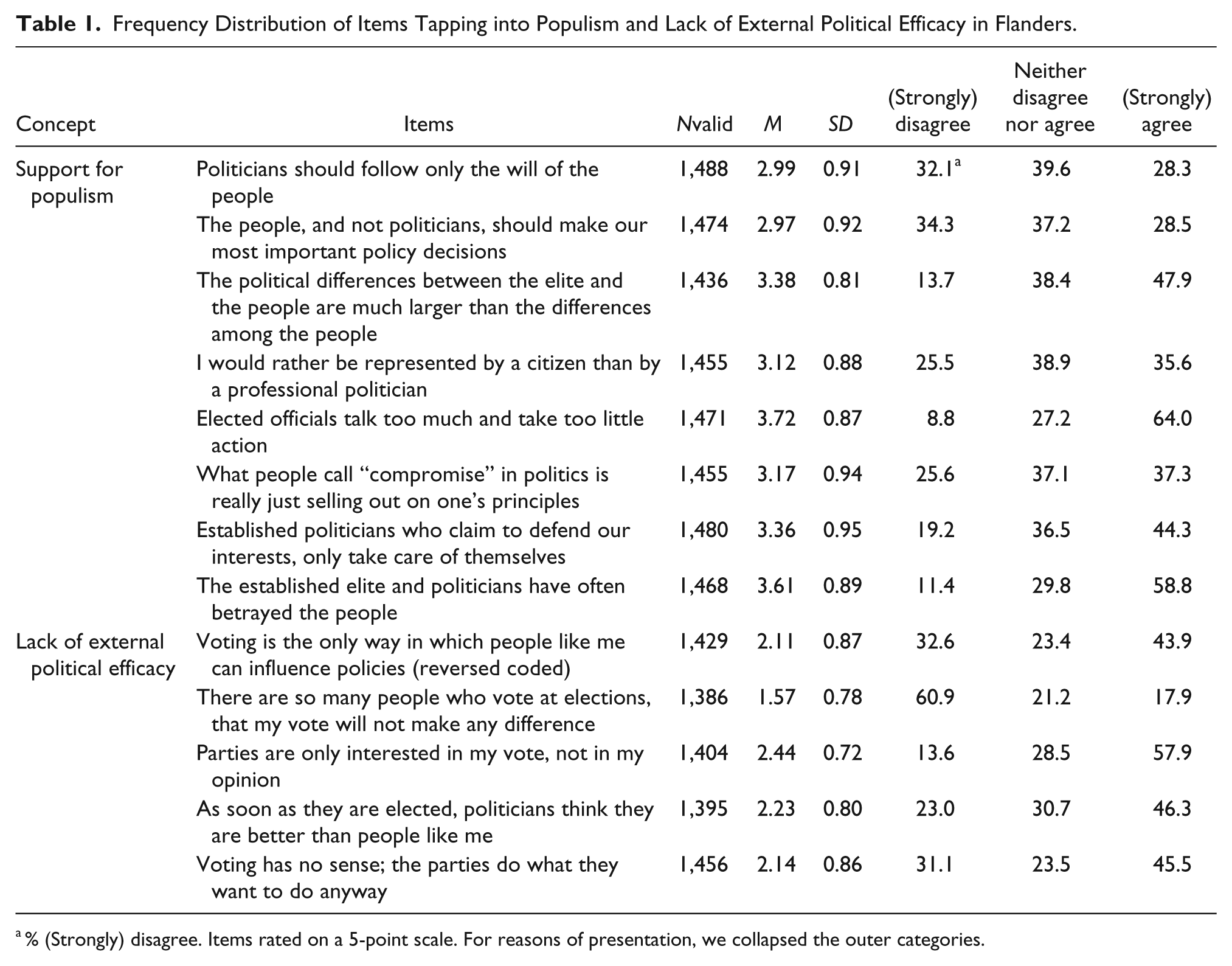
% (Strongly) disagree. Items rated on a 5-point scale. For reasons of presentation, we collapsed the outer categories.
To put the idea of populism as a type of identity politics to a strict empirical test, we also included a measure of education-based identity comprised of four items adapted from Leach et al.’s (2008) general and multicomponent measure for social identities—for example, “I feel connected to people who followed the same education” and “I am similar to people who followed the same education”—(Cronbach’s α = .81). One of the advantages of this measure is that it assesses different aspects of education-based identity regardless of the actual educational level or specific content of the education one followed. Previous research has shown that this is prerequisite to avoid many missing values (especially among the less educated; Spruyt 2014; Stubager 2009). In line with earlier research, less educated people were less likely to identify with their education (M = 4.89) when compared with the highest educated (M = 5.63; η = 0.185; p < .001).
All attitude items were rated on a scale ranging from 1 to 5. For all (attitude) scales, missing value imputation was used for respondents who had valid answers for at least half of the items of a scale. To construct scales, the score for all items of a scale were summed and rescaled to a 0 to 10 continuum.
Results
Measuring the Support for Populism among the Public at Large: Validation of an Existent Measure
Regarding the measurement of the support for populism among voters, we started from Akkerman, Mudde, and Zaslove (2014) who extended Hawkins, Riding, and Mudde (2012). Their measure focuses on the core features of populism, namely, the sovereignty of the people, the antagonism between the people and the establishment, and the Manichean moral dimension of populism.
Regarding the content of populism, the eight items cover all important elements (Table 1). The first four items embody the populism’s people-centrism component—as most clearly expressed in items such as “People should follow only the will of the people,” “The people, and not politicians, should make our most important decisions,” and “I would rather be represented by a citizen than by a professional politician”—by reflecting a clear idea about representative government. These items not only articulate a notion of popular sovereignty, but they also at least implicitly represent the people as a homogeneous group. The latter idea is crucial for establishing an equivalential chain for social demands and is explicitly articulated in the item “The political differences between the elite and the people are much larger than the differences among the people.” The people centrism in the first four items is linked with the idea that the politicians do not represent the true will of the people as present in the last four items. The first two questions of this subset—“Elected elites talk too much and take too little action” and “What people call ‘compromise’ in politics is really just selling out on one’s principles”—represent this idea in a blunt but rather descriptive way. The other two items—“Politicians who claim to defend our interests, only take care of themselves” and “The established elite and politicians have often betrayed the people”—clearly accuse politicians of taking advantage from “the people,” and in this way, more explicitly introduce the (Manichean) moral aspect of the antagonism between the people and the elite. The latter two items were not present in the original measure as formulated by Hawkins, Riding, and Mudde (2012) and Akkerman, Mudde, and Zaslove (2014) but replaced the item “Politics is ultimately a struggle between good and evil.” This item performed poorly in the Dutch sample (factor loading = 0.32) and, in our view, also lacks external content validity. No Flemish politician would make such an essentialist claim. The moral dimension in populism in Flanders (but most likely also in other European countries) is not considered an essential element of democracy per se but rather of the current state of democracy. Populism in Flanders remains the politics of hope; the hope that with a populist leader, things will become better. For this reason, we formulated two items—“Established politicians who claim to defend our interests only take care of themselves” and “The established elite and politicians have often betrayed the people”—which explicitly articulate the moral dimension but used non-essentialist language.
This measure for the support of populism improves upon older measures in three ways (for an overview, see Akkerman, Mudde, and Zaslove 2014; Hawkins, Riding, and Mudde, 2012). First, it does justice to the fact that populism is more than a broad anti-establishment attitude. The people-centrism component is better developed when compared with other scales (e.g., Elchardus and Spruyt 2016). Second, the survey questions for measuring the support for populism not only tap into populism’s core ideas but also adopt the blunt language in which these ideas are voiced in public discourse. Indeed, all items have been formulated in the language that is not only present in the rhetoric of populist parties in general but also in the emotionally engaging rhetoric of Flemish populist parties (cf. Pauwels 2011). Third, although the different ideational components are important, it is their combination that constitutes the specific populist logic. The latter characteristic applies not only in theoretical terms to the formulated questions, but it is also manifested empirically by the high reliability of the scale as a whole (Cronbach’s α = .86).
Although the attitude scale’s primary objective is to reflect the relative distances between respondents rather than the absolute levels of a certain attitude (which will always be contingent on the exact item wording), inspection of the frequency distribution of these relatively new items provides useful information. Table 1 reveals a very clear pattern. Items that tap into the anti-establishment component received the most support. For example, 64 percent of the people, agreed that most politicians talk a lot but do little and almost 59 percent confirmed that the established elites and politicians have often betrayed the people. With almost 48 percent of the people who agreed that the differences between the elite and the people are bigger than those among ordinary people, it becomes clear that discontent with the current state of affairs in politics is widespread. All items that claim that the people should be the only reference for politicians or the idea that all important decisions should be taken by the people rather than by politicians, received considerably less support. Content analysis of party manifestos and other publications showed that the anti-establishment element was the most discriminating component of populism among parties (Rooduijn and Pauwels 2011). Interestingly, the frequency distribution of the items seems to suggest that among the people themselves, the pattern is the complete opposite.
Although based on sound theoretical reasoning, the introduction of a new measure always raises questions about how this will relate to others relevant attitudes. In public opinion research, many different concepts have been used to tap into discontent with the current state of affairs in politics. Lack of (external) political efficacy is one of the most widely used of them (e.g., Morrell 2003) and refers to the belief that institutions and politicians are unresponsive to citizens’ demands. As explained before, the main theoretical differences between a lack of political efficacy and populism is that whereas feelings of a lack of external political efficacy presents its diagnosis in general terms and articulates it in a highly fatalistic way leaving little hope for improvement in the future, the anti-establishment component in populism focuses on the established elites, and the people-centrism element offers hope for a better future. In the online appendix, confirmatory factor analyses demonstrate that the items referring to feelings of a lack of political efficacy and the support for populism measure two different latent constructs.
Who Supports Populism?
To assess social differences in the support for populism, we estimated six nested-regression models. In the first model, we only included gender, age, an indicator of the economic position, and the educational level. In the second model, we added the indicators of political interest and cultural capital. We consider this model as our baseline model against which we compare the more complex models. In Model 3, we added feelings of internal and external political efficacy. Political interest, political competence, cultural capital, and, to a lesser extent, political efficacy are the characteristics which education has a direct socialization effect on. If an explanation in terms of social identities bears some potential to add to the literature, it should have an effect over and above these traditional explanations. Therefore, in Model 4, we added the indicator of educational identification and two interaction terms between the level of education and the identification variable. There is, indeed, no reason to expect that educational identity per se has a relationship to populism. Instead, we expect that education-based identity to have a different effect for the less educated when compared with the higher educated.
In Model 5, we added anomie to the regression model. We consider anomie here as an indicator for generalized cultural insecurity. In the last model, we enter feelings of relative deprivation. These feelings are known to be quite strongly related to the material position (Elchardus and Spruyt 2012); anomie correlates strongly with education. Entering both attitudes into the model (Models 5 and 6) should be seen in light of our attempt to put an identity-based explanation for the support for populism to a strict empirical test. It is, of course, nearly impossible to determine the causal ordering between anomie, feelings of relative deprivation, and populism. By controlling for anomie and feelings of relative deprivation, we primarily aim to test how robust the effect of education-based identity on populism actually is.
The results warrant four conclusions (Table 2). First, with respect to the control variables, both age and gender turned out largely irrelevant throughout the entire analysis.
Multiple Regression Analyses on the Support of Populism in Flanders.
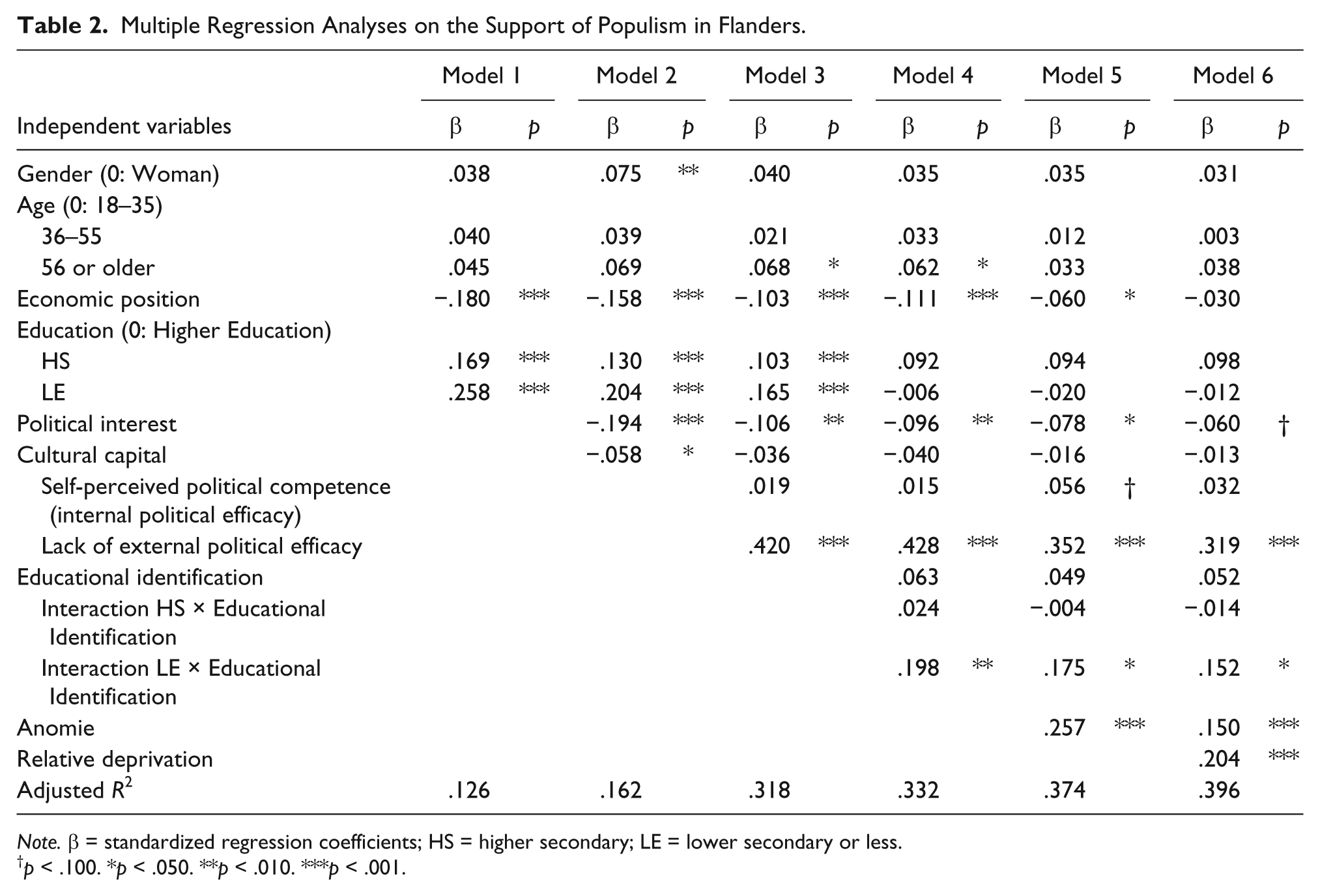
Note. β = standardized regression coefficients; HS = higher secondary; LE = lower secondary or less.
p < .100. *p < .050. **p < .010. ***p < .001.
Second, people’s material position proved to be a relatively good predictor for populism. With increasing wealth, the less likely people were to support populism (Model 1). The effect of the material position was largely unmediated by the political interest, political competence, or cultural capital (Models 2 and 3), but fully mediated by anomie and feelings of relative deprivation (Models 5 and 6). Those that are more economically vulnerable are more likely to develop feelings of anomie and relative deprivation which then lead them to populism. That finding dovetails with the proposed mechanism which holds that (economically) vulnerable people are susceptible to attitudes that attribute their experienced uneasiness to factors that fall beyond their individual control.
Third, there is quite a strong relationship between education and the support for populism; with the less educated supporting populism much more strongly when compared with the higher educated. This relationship is to a certain extent mediated by the indicators that refer to the more evolved cognitive aspects people acquire through education. People who indicated that they are not interested in politics, never read about politics, and switch to another channel when a political program is shown on TV (lack of political interest) support populism. Interestingly, whereas the support for populism is strongly related to a lack of (external) political efficacy, it turned out to be unrelated to self-perceived political competence (Model 6). This make sense given that the core message of populist rhetoric blames the political system and establishment for being unresponsive to the people’s concerns and interests. Also, in this way, feelings of (political) insecurity and vulnerability are fully attributed to factors that lie externally to an individual’s control.
Even after taking into account these indicators that cover the potential direct socialization effects of education, a substantial association between the educational level and populism remained (Model 3). That relationship, however, was strongly moderated by education-based identity (Model 4). As mentioned earlier, people are more likely to identify with their education when obtaining an increasing level of educational attainment. However, the stronger less educated people feel that they are similar to and connected with people who followed the same education, the stronger they support populism. This relationship proved to be quite robust (Models 5 and 6).
Fourth, in the final model, it becomes very clear that the support for populism is quite strongly embedded in different kinds of feelings of vulnerability (i.e., lack of external political efficacy, anomie, and feelings of deprivation). Indeed, our results indicate that populist attitudes are grounded in a deep discontent, not only with politics but also with societal life in general. Besides, people characterized by a strong feeling of lack of political efficacy, people who believe that they live in a world that is unfair and where they do not get what they deserve, or people for whom the world changes too fast so that they lose track, all support populism. We believe that in this way—that is, all variables that attribute the origins of feelings of vulnerability to factors outside the person are highly correlated with the support for populism—populism fits within a general coping strategy. We have shown that this not only applies in general but also for more specific groups; for example, within the less educated. The general guiding hypothesis with respect to the latter is clear: people who identify with a marginalized and stigmatized group find a safe haven in populism. Now that strong and positive class identities have ceased and individualism is rampant, this seems to be the only available option to achieve a positive social identity. Such an identity should not be seen as a kind of new “class consciousness” in the classical sense—as described by Centers, Bartolini, Mair, and so on—but rather refers to stigma consciousness.
Discussion and Conclusion
This paper attempted, first, to measure the support for populism in Flanders by means of a recently proposed attitude scale and, subsequently, study social differences in this support. In this conclusion, we use our findings as a starting point to propose different possibilities for further research.
Regarding the measurement of populist attitudes, our findings deliver further empirical support for the usefulness of the measure proposed by Akkerman, Mudde, and Zaslove (2014) and Hawkins, Riding, and Mudde (2012). Not only did we validate the scale in a different region, we also showed that populist attitudes can be empirically distinguished from feelings of lack of external political efficacy. Indeed, both attitudes could not only be separated in a measurement model, we also found that education-based group identity moderates the relation between educational attainment and the support for populism. No such interaction effect was found for feelings of lack of external political efficacy. At the theoretical level, our findings beg the question whether the support for populism and feelings of a lack of external efficacy also differ with respect to their causal effects. To the extent that populism is effectively a politics of hope, one expects that the support for populism is more strongly related to voting intention when compared with feelings of a lack of external political efficacy. Further exploring the effects of populist attitudes would be valuable in itself. Indeed, in regions where voting is not compulsory, a citizen who holds populist attitudes has the choice between a “voice” or an “exit” strategy (cf. Hirschman 1970). An interesting question, then, concerns whether we can distinguish populist voters from populist non-voters and under which conditions populism may enhance turnout. Such exploration would provide us a better insight on exactly how the element of discontent in populism (which may be expected to push people away from politics) interacts with the element of hope (which may be expected to foster a willingness to participate).
Regarding the question who supports populism, this study focused on the consequences of long-term social, economic, and political evolutions in Western Europe that resulted in a growing population of “losers of globalization.” These evolutions are often presented as responsible for the steady increase of populism in this region. One of the advantages of the populism measure is that the support for populism is not contaminated with other ideas, allowing for a more strict testing of the link between experienced vulnerability and the support for populism than has been done before. At the theoretical level, we explained why vulnerable people are likely to be attracted by populism. One of the main contributions of this study is that we also empirically showed that in the support for populism, very different feelings of economic, cultural, and political vulnerability come together. In that sense, populism succeeds where contemporary political parties fail (Mair 2013, chap. 3), namely, in uniting different grievances. That general finding, however, should be qualified in two ways. First, although in the final model different types of vulnerability predicted populism, the strength of the relationships varied substantially. Of all indicators in our model, a lack of external political efficacy was by far the single most important predictor for the support of populism, accounting for about half of the total explained variance. It is clear the politicians and parties who aim to decrease the demand for populism should primarily invest in reducing the (rather widespread) feeling that they are unresponsive to the concerns and grievances of voters. Being responsive seems particularly important given that some of these concerns and grievances are associated with long-term structural evolutions that render it very difficult to completely eliminate these grievances. Second, one intriguing finding is that in the final model, it is not vulnerability per se that matters (i.e., material wealth, educational attainment, cultural capital, and internal political efficacy) but subjectively experienced vulnerability (i.e., relative deprivation, anomie, perceived lack of political efficacy). “Objective” vulnerability matters for populism through “processed” vulnerability. It is probably at that point that psychological coping mechanisms among voters and the politicization of social conditions by parties meet. Populist parties and politicians offer vulnerable people the discursive stepping stones that translate their daily experiences and concerns into the support for populism. Although our data seem to support that interpretation, further research should unravel this interplay between the demand and supply side of populism.
In this study, we paid special attention to the vulnerability fostered by difficulties in finding a positive social identity. Although this “identity” element has always been present in the theoretical work of the thesis of the losers of globalization, in empirical research, it has received little attention. In this study, we focused on this in the situation of the less educated, a group that occupies a stigmatized position in the region we studied. This is, however, but one of the possible applications of a more general mechanism. Our main argument in this matter is that a stigmatized group will find in the empty signifier, “the people,” a means to adopt a group perspective to interpret their social position and maintain their self-respect. Thus, the more the specific group position constitutes a core part of their identity, the more people will define themselves as part of the “common man” and the more they will be attracted to populism. Further research should test this mechanism among other stigmatized groups (e.g., lower classes). A particularly interesting case concerns the situation of ethnic minorities. These are probably among the most stigmatized groups in current societies. Because in contemporary Europe populism is often combined with right-wing ideologies that take a fierce anti-immigrant standpoint, we expect them to not vote for populist parties. It is in this type of context that distinguishing between populist attitudes and populist votes might be the most interesting.
One limitation of this study is that the analyses presented here concern a synchronic analysis of a theoretically diachronic process. Theoretically, we expect (1) that when feelings of vulnerability increase, the likelihood of supporting populism also increases but (2) also that populist people are more susceptible to populist messages itself. In this way, vulnerability is thought to increase both the demand for populism and the acceptance populist messages receive. Analytically, however, these are two distinct processes. Empirically, experimental research can help us to assess the empirical support for each of them.
Footnotes
Declaration of Conflicting Interests
The author(s) declared no potential conflicts of interest with respect to the research, authorship, and/or publication of this article.
Funding
This research was support by a grant from the National Research Foundation (FWO; no. G026911N).
Notes

References
Supplementary Material
Please find the following supplemental material available below.
For Open Access articles published under a Creative Commons License, all supplemental material carries the same license as the article it is associated with.
For non-Open Access articles published, all supplemental material carries a non-exclusive license, and permission requests for re-use of supplemental material or any part of supplemental material shall be sent directly to the copyright owner as specified in the copyright notice associated with the article.
