



Abstract
Does the Tea Party affect how lawmakers vote? Given the possible spurious effect of a representative’s ideology, we leverage natural variation in the Tea Party’s existence and examine this question through the lens of party switching. Like when lawmakers change parties, representatives who (1) joined Tea Party Caucus and (2) had a large volume of Tea Party activists in their district underwent a significant shift to the right in the 112th Congress. We believe these findings support both legislative-centered and extended network theorists. An additional analysis reveals that, unlike Democrats and non-Tea Party aligned Republicans who also shifted to the extremes in the 112th Congress, Tea Party Republicans did not “bounce back” in the 113th Congress. Lastly, we find no equivalent rightward shift in comparable conservative caucuses or among Republicans with similar ideologies and districts. In the end, although the Tea Party is not a “party” in the classic sense of the word, we claim that it is having “party like” effects in Congress. In the conclusion section, we discuss the implications of these results for the stability of the current two-party system. Given our findings, a major realignment or split within the Republican Party would not be surprising.
Introduction
Scholarly work on the Tea Party is divided on a key question. In the behavioral literature, researchers debate whether the Tea Party represents a new social movement or is simply the extreme wing of the Republican electorate. And in the congressional literature, scholars are conflicted on whether lawmakers affiliated with the Tea Party exhibit unique roll-call patterns and are discernible from their conservative—yet non-Tea Party aligned—brethren.
We address the latter topic and ask the question, does the Tea Party have an independent effect on how legislators vote? Given the possible spurious effect of a lawmaker’s preferences (Krehbiel 1991), we examine this question through the lens of party switching (Nokken 2000; Nokken and Poole 2004). In other words, we leverage natural variation in the Tea Party’s existence and model shifts in the voting behavior of all representatives in the 111th to the 112th Congresses. Although lawmakers exhibit remarkable stability in their roll-call record (Poole 2007), we believe there are both electoral and institutional reasons why the Tea Party could have party like effects on the behavior of its adherents. We label the Tea Party’s effect “party like” because we theorize it stems from the coordinated institutional actions of a bloc of lawmakers, and this coordinated behavior is not simply a by-product of ideological agreement. In simple terms, we contend that Tea Party affiliated lawmakers are behaving as if they belong to a distinct party. In the analysis, we are careful to test for section bias, control for rival causes of ideological change, and examine roll-call shifts in comparable caucuses and coalitions.
We find support for our paper’s core hypotheses. 1 According to the results, the Tea Party’s emergence induced a conservative shift in the voting behavior of its lawmakers. We find that representatives who (1) joined the Tea Party Caucus and (2) had a large volume of Tea Party activists organized in their district underwent a significant shift to the right in their roll-call record in the 112th Congress. As we explain in greater detail below, these twin effects support the work of legislative-centered theorists and more recent work conceptualizing parties as an extended network of organized interests. In contrast, the findings contradict Gallagher and Rock (2012), who concluded that Tea Party affiliation is not meaningful in terms of how lawmakers vote. An additional analysis reveals that, unlike Democrats and non-Tea Party aligned Republicans who also shifted to the right or left in the 112th Congress, Tea Party Republicans did not “bounce back” in the 113th Congress. In the end, the results we uncover do indeed resemble what happens when lawmakers join a new party. Last, the Tea Party Caucus’s conservative shift is not evident in comparable caucuses (including the House Liberty Caucus and Republican Study Committee) or among Republicans with similar ideologies and from similar districts. We conclude with a discussion of the implications of these results for the stability of the current two-party system.
Scholarly Studies of the Tea Party
A key question in scholarly discourse of the Tea Party is their elite and mass-level roots. While some believe the Tea Party had “grassroots origins,” noting their development at the local level without a leadership structure (Bullock and Hood 2012), others contend that the movement was fostered by conservative news media and wealthy financers (Skocpol and Williamson 2012; Williamson, Skocpol, and Coggin 2011). A similar debate concerns scholarly conceptualizations of Tea Party’s policy positions. While journalists and pundits often cite the Tea Party’s “libertarian” roots, Abramowitz (2011) concluded they are best understood as simply an extreme, and thus preexisting, wing of the conservative movement (see also Jacobson 2011; Knowles et al. 2013; Williamson, Skocpol, and Coggin 2011). In contrast, some believe Tea Party adherents are ideologically distinct from Republican identifiers. For example, Gerson and Wehner (2014) claimed that Tea Partiers diverge from conservative Republicans given their rejection of political compromise.
While dozens of books and articles examine the Tea Party’s elite- and mass-level origins, little work has studied the Tea Party through an institutional lens. In fact, we identified just three such studies. Bond (2013) found that, even when controlling for party and ideology, Tea Party freshmen were significantly less likely to support President Obama’s policy proposals. In this respect, Bond concluded that belonging to the Tea Party had an effect on a lawmaker’s legislative behavior. In contrast, Gallagher and Rock (2012) found that members of the Tea Party are indistinguishable from other Republicans. If being a member of Tea Party is a meaningful distinction, “it doesn’t seem to reveal itself in how congressmen vote” (Gallagher and Rock 2012, 112). And, finally, Bailey, Mummolo, and Noel (2012) reached mixed conclusions on this question. In a compressive examination of the subject, Bailey, Mummolo, and Noel tested various possible effects: (1) membership in the Tea Party Caucus, (2) endorsement by FreedomWorks, (3) the number of Tea Party activists in a member’s district, and (4) district-level Tea Party favorability. While they find no relationship between Tea Party affiliation (endorsement by FreedomWorks and Caucus membership) and a lawmaker’s overall voting behavior, they do find a robust relationship between the volume of Tea Party activists in a member’s district and roll-call behavior on a few key votes.
We believe this disagreement in the congressional literature hinges—in part—on the challenge of disentangling Tea Party affiliation from a member’s underlying preferences. At issue is the following: do Tea Party adherents vote together despite ideological disagreement or with their fellow Tea Partiers because of ideological compatibility? In the end, this question resembles a classic debate in the congressional literature.
Empirics: Parties and Preferences
A spirited debate in the congressional literature concerns the overlapping effects of parties and preferences on voting behavior. At the crux of this debate is a theoretical question: what is meaningful partisan behavior? In “Where’s the Party,” Keith Krehbiel (1993, 255) famously concluded that party effects are rare. Nonpartisan effects, by comparison, are “demonstrably significant.” At the same time, an empirical issue is the fact that members’ voting patterns exhibit remarkable stability over time. Poole (2007, 435) notably claimed that members “die in their ideological boots.”
Given the stability of a lawmakers’ voting behavior, and the challenge of disentangling preferences and partisanship, congressional researchers in the 2000s turned to a unique data source: lawmakers who switch parties. Because “switchers” have stable preferences and represent the same constituents, it is possible to compare their voting behavior in a pre–post fashion and determine whether group affiliation has an independent effect on roll-call behavior. Exploring the pre- and postswitch voting behavior of twenty representatives and senators, Nokken (2000) found that party switchers make consequential changes in their voting behavior in the direction of their new party. A control group of “proximities” showed no signs of comparable shifts. Subsequent studies by Nokken and Poole (2004) and Nokken (2009) produced similar results.
Our paper’s empirical framework follows the above studies by leveraging natural variation in the Tea Party’s existence. In addition to the methodological value of holding constant a lawmaker’s ideology, we see considerable substantive value in studying the Tea Party through the lens of party switching. Quite simply, we think the issue lies at the heart of how we conceptualize what the Tea Party is. Like Heaney and Rojas (2007, 2015); Bawn et al. (2012); Koger, Masket, and Noel (2009); and others, we think the formal definition of a party (as a monolithic, hierarchical, institutionalized team) ignores critical variation in what constitutes partisan behavior.
Theory: The Tea Party’s “Party Like” Effects
Our theory claims that the Tea Party is quite capable of having partisan effects on the behavior of legislators. We choose to call the Tea Party’s ability to influence voting behavior “party like” because (1) it stems from the coordinated institutional actions of a bloc of lawmakers, and (2) this coordinated behavior is not simply a by-product of ideological agreement. Although the Tea Party is not a party in the classic sense of the word, our claims fit squarely within leading conceptualizations of what political parties are, how they originate, and how they function. One perspective posits that parties serve as a mechanism for individual members to achieve their electoral and policy goals through collective action. A second view posits that partisan behavior has both exogenous and decentralized causes. In this respect, our theoretical justification for calling the Tea Party’s effect “party like” draws on both legislative-centered theories as well as more recent work from extended network theorists.
Electoral Effects: Endorsements and Activists
According to classic “legislative-centered” theories of parties-in-Congress, lawmakers establish reliable voting blocs to facilitate the passage of collectively optimal outcomes that, in turn, produce a nonexcludable partisan brand that helps lawmakers win reelection (Aldrich 1995; Cox and McCubbins 1993). A more recent view—which we focus on here—posits that partisan behavior is a consequence of an “extended network” of actors that pool their resources in pursuit of electoral and policy goals (see Bawn et al. 2012; Cohen et al. 2008; Grossman and Dominguez 2009; Heaney and Rojas 2015; Koger, Masket, and Noel 2009). As Bawn et al. (2012, 517) put it, unlike legislative-centered theories, in this camp, “interest groups and activists are the key actors” (emphasis added).
We therefore focus on Tea Party interest groups and activists as having possible party like effects on the behavior of lawmakers. We know, after all, that activists and interest groups are motivated by legislative goals (Grossman and Dominguez 2009). Our basic claim is that within the broader electoral network—where social movements and parties collide—interest groups and activists can shape the behavior of Tea Party adherents in a manner that mirrors formal partisan effects. Although we think all organized groups have these kinds of effects, we believe the Tea Party is unique. Indeed, most activists and interest groups focus on a single issue (Heaney and Rojas 2007, 2015) or tend to be relatively moderate and support candidates of both parties (Koger, Masket, and Noel 2009). In contrast, Tea Party activists and interest groups span all policy domains and are decidedly targeted at Republican lawmakers.
On interest groups, we first note that they conduct many of the same actions as parties (Magelby 2011) and shape the behavior of partisan networks (Bawn et al. 2012). Among their various electoral actions, one of the most important is endorsing candidates. Like partisan endorsements, research has shown that interest group endorsements serve as an important “cue” for voters (Dominguez 2011) and play a key role in nomination contests (Cohen et al. 2008; Dominguez 2011). Unlike endorsements, the effect of activists is largely hidden from the public (Masket 2009, 14). Nonetheless, activists are powerful within party networks for a few reasons. Activists pay closer attention to campaigns, are more likely to vote and contribute money, and are more ideologically extreme (Bawn et al. 2012). As Burden (2001, 100) put it, even if the primary electorate is not responsible for electing extreme candidates, activists have a greater “pull.”
Institutional Effects: The Tea Party Caucus
In addition to their possible electoral effects, the Tea Party has an institutional role. Drawing on classic “legislative-centered” theories, we focus on a single construct: the Tea Party Caucus. In particular, we draw heavily from the body of research on the effect(s) of congressional member organizations.
At the heart of why the Tea Party Caucus could have party like effects is the fact that they have a formal organizational structure that functions in a quasi-partisan fashion. As a Congressional Member Organization (CMO), the Tea Party Caucus conducts many of the same actions as parties: holding regular meetings, exchanging information, developing legislative strategies, and so on (Dilger and Glassman 2014). Although the Tea Party Caucus had just one official leader in the 111th and 112th Congresses—Michelle Bachmann—various informal leaders exist as well (Louie Gohmert, Mike Pence, Steve King). Like formal party leaders, we propose that these leaders conduct the basic tasks of setting the Caucus’s agenda and coordinating the organization’s legislative strategy. And although the Tea Party Caucus cannot compel members to support the Caucus’s agenda by offering “inducements” (Aldrich 1995; Rohde 1991), the rank-and-file still have incentives to adopt the Caucus’s position. First, the Caucus’s position may serve as a useful cue in the absence of perfect information. Indeed, the literature on CMOs cites “cue giving” as one of their key powers (Kingdon 1989; Pinney and Serra 1999). Second, Caucus members have a policy-making incentive to engage in collection action. Once again, the literature on CMOs notes that one of their key powers is “policy coordination” (Loomis 1981; Miller 1990) and that CMOs compete with parties for agenda control (Hammond 2001).
A second possible explanation for the Tea Party Caucus’s effect on the voting behavior of its adherents is an informal process of member socialization. Although uncommon in the parties-in-Congress literature, numerous authors have cited socialization as an important explanation of legislative behavior (Lupia and McCubbins 1994; Matthews 1959; Price and Bell 1970). Within this literature, a handful of studies note that socialization even explains partisan behaviors. In fact, some studies conclude that political parties intentionally socialize members (Loomis 1984; Sinclair 1981). In a recent study, for example, Ragusa (2016) shows that much of the Senate’s polarization since the 1990s can be explained by the partisan behavioral norms senators learned during their tenure in the House. Given the Tea Party’s reputation as band of “uncompromising insurgents,” coupled with the fact that Tea Party membership had clear electoral benefits in 2010 (Bullock and Hood 2012; Karpowitz et al. 2011), we propose that Caucus members internalized or learned the Tea Party’s extreme behavioral style.
Data and Method: Measuring Tea Party Allegiance
Given the theoretical discussion, we classify each lawmaker’s “electoral” and “institutional” ties to the Tea Party. In addition to furthering our understanding of the Tea Party’s legislative effects, this theoretical distinction contributes to the party switching literature. After all, the party switching literature is silent on whether roll-call changes induced by a switch in party affiliation are caused by institutional or electoral factors (see McCarty, Poole, and Rosenthal 2001, 686).
An important question at this point is “Are the electoral and institutional wings distinct?” Yes. According to our data, just 10 percent of lawmakers affiliated with the Tea Party joined the Caucus and received an endorsement from either FreedomWorks or the Tea Party Express. In addition, while there is certainly a causal link between the volume of Tea Party activists in a lawmaker’s district and the decision to join the Tea Party Caucus, the overall correlation is on the low end (corr. = .21). Although it may sound surprising, the fact is that all three constructs—the volume of Tea Party activists, Tea Party endorsements, and belonging to the Tea Party Caucus—are quite distinguishable.
The Tea Party Caucus
A week after submitting a formal request with the House Committee on Administration, on July 19, 2010, Congresswoman Michele Bachmann announced the creation of the House Tea Party Caucus. A few days later, on July 21, the Caucus held its first official meeting. According to media reports, the Caucus began its first meeting with twenty-eight members. (Because membership in CMOs is not publicly available, there is no “official” list of Caucus members.) Prior to the November midterm, in late October of 2010, Bachmann claimed on her personal website that the Tea Party Caucus had increased to fifty-two members. Following the 2010 midterm, however, a few members retired, lost a renomination, or simply failed to sign up again in the 112th Congress. In the end, we identified forty-six permanent members of the Tea Party Caucus who served in both the 111th and 112th Congresses. We validated these data with a comparable list published by Gallagher and Rock (2012) and found perfect agreement.
Tea Party Endorsements and Activists
As noted earlier, we examine two electoral explanations for a rightward shift caused by Tea Party affiliation. First, we test for the effect of Tea Party endorsements. We considered a representative endorsed by the Tea Party if they received the formal endorsement of either FreedomWorks or the Tea Party Express. 2 Notably, the endorsement strategy of both provides a nice balance as FreedomWorks generally does not endorse incumbents while the Tea Party Express does. Second, we test the effect of the volume of Tea Party activists in a lawmaker’s district. We obtained these data from Bailey, Mummolo, and Noel (2012), who aggregated Burghart and Zeskind’s (2010) municipal data at the district level. 3 Specifically, this variable records the raw number of district residents registered with one of six national Tea Party organizations (per 1,000) in 2010.
Data and Method: Modeling
Because we are interested in the causes of ideological change, as opposed to the causes of ideology, the choice of ideal points is critical. Popular measures such as Common Space scores (which are static for the duration of a lawmaker’s career) and DW-NOMINATE (which constrain a lawmaker’s ideological movement to a linear function) are inappropriate. Fortunately, Nokken and Poole’s (2004) “one Congress at a time” scaling procedure is perfectly suited for the present application. 4 In their estimation strategy, Nokken and Poole fit a two-dimensional constant model and then, holding the roll-call coordinates fixed, estimate ideal points for each lawmaker in each Congress. With these scores, we compute each lawmaker’s ideal point first difference (Y112th − Y111th) as our dependent variable. Higher values indicate movement in the conservative direction in the 112th Congress.
In computing the change in each lawmaker’s ideal point, the 111th Congress serves as our “pre-Tea Party” period while the 112th Congress serves as our “post-Tea Party” period. We justify this cut point on two grounds. First, the Tea Party Caucus formed late in the 111th Congress. And second, the 2010 midterm, separating both Congresses, was the Tea Party’s first major venture into national elections. Nonetheless, if this cut point does not properly delimit the theoretical mechanism, it will bias the results against finding a Tea Party effect (because any effect, present in both time periods, will cancel out).
Although differencing a lawmaker’s ideal points holds constant the underlying causes of a lawmaker’s ideology, we need to also account for possible causes of changing ideology. On one hand, perhaps lawmakers who were moving in a conservative direction prior to the 111th Congress were simply more likely to join the Tea Party Caucus. We account for this in two ways. First, we include a variable that records the trend in a lawmaker’s ideal points before the Tea Party’s emergence. Ideological Trend subtracts a lawmaker’s ideal point in the 110th Congress from their ideal point in the 111th Congress. Second, we include a variable that records the partisan trend of a lawmaker’s district. Using the two-party vote in each of the prior presidential elections, District Trend is coded such that higher values indicate a representative’s district was moving in a Republican direction before the Tea Party’s emergence. On the other hand, perhaps extreme conservatives were more likely to move in a conservative direction in the 112th Congress and were also more likely to join the Tea Party Caucus in the 111th Congress. We account for this in two ways as well. First, we include the variable 111th Ideology, which represents a lawmaker’s raw Nokken and Poole ideal point in the 111th Congress. Second, we control for the raw partisanship of a lawmaker’s congressional district. For the variable District PVA, the “district’s presidential vote advantage,” we control for the Republican candidate’s share of the two-party vote for president in the lawmaker’s district averaged for the previous two presidential elections. Last, Republican is an indicator variable coded for membership in the GOP. We include this variable to ensure that any Tea Party effects we uncover are not spuriously caused by broader polarizing effects in the GOP.
Findings
Regression Analysis
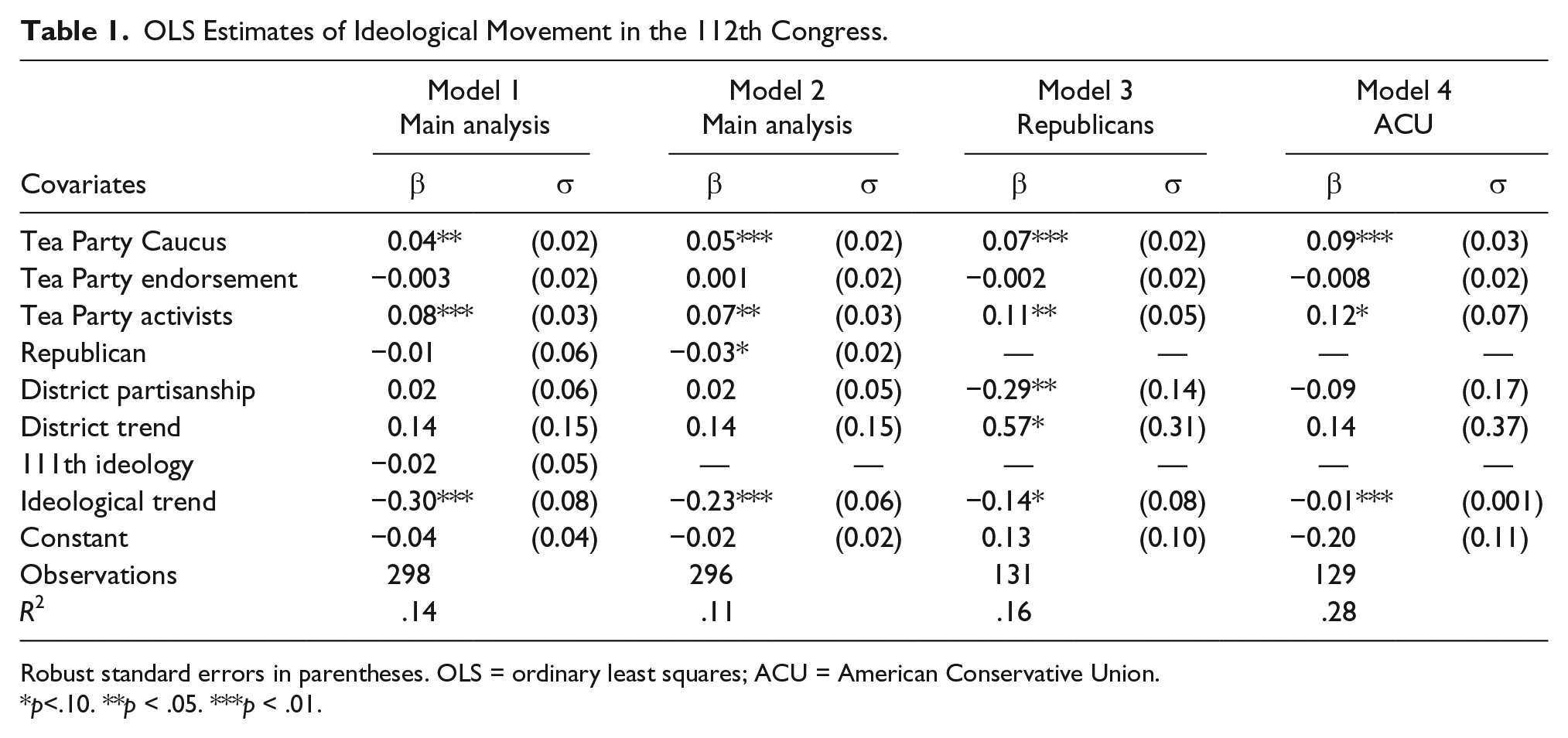
Because the dependent variable is continuous, each model was estimated using ordinary least squares (OLS). Model 1 includes each variable and all observations. Based on the results of diagnostic tests, Model 2 removes two outliers and one collinear variable. 5
According to Models 1 and 2, lawmakers who joined the Tea Party Caucus and those with a large volume of Tea Party Activists who organized in their congressional district underwent a significant conservative shift in their voting behavior in the 112th Congress. Both variables are positive (revealing that members adopted more conservative positions following the Tea Party’s emergence) and statistically significant in each model. Ultimately, we believe these results validate our claim that the Tea Party had a “party like” effect on the behavior of its members in the 112th Congress. Because the variables are on different scales, a direct comparison of the effects is difficult. Nonetheless, the estimates reveal that the conservative shift caused when a member joined the Tea Party Caucus is between 0.04 (Model 1) and 0.05 (Model 2). A comparable change in the volume of Tea Party activists in a member’s district (from the minimum to the maximum) is associated with a conservative shift of between 0.09 (Model 1) and 0.08 (Model 2). As a whole, our results show that the Tea Party had a polarizing effect on the voting record of lawmakers in the 112th Congress and that this effect has both electoral and institutional causes.
Looking at Models 1 and 2, Ideological Trend is the only other robust covariate. Contrary to expectations, the negative coefficient indicates that ideological movement from the 110th to 111th Congresses produced ideological movement in the opposite direction in the 112th Congress. Conceptually, it would seem that when a lawmaker moves to the extremes in one Congress, they are likely to moderate their voting record or “bounce back” in the subsequent Congress. An obvious question is “Will this moderating effect “undo” the Tea Party’s electoral and institutional effects in the 113th Congress?” On this question, the answer is no, as the moderating effect is not >1. In other words, the model predicts that only one-third to one-fourth of the Tea Party’s polarizing effect will be moderated in the 113th Congress (we examine this possibility in greater detail in the “Additional Ideological Shifting in the 113th Congress” section).
Robustness Checks
In Table 1, we also report two robustness checks. Our first robustness check is a model with the sample restricted to Republicans. Despite their claims of being “nonpartisan,” lawmakers affiliated with the Tea Party are exclusively from the GOP. We believe this refinement will help isolate ideological movement on the Republican side and effectively control for idiosyncratic ideological shifts among Democrats. Model 3 reports the results. Not only does Model 3 confirm our main findings, but the coefficients on the Tea Party Caucus and Tea Party Activists variables are larger in magnitude. If anything, this suggests that including Democrats in the sample causes the model to underestimate just how much the Tea Party influenced the behavior of Republican lawmakers.
OLS Estimates of Ideological Movement in the 112th Congress.
Robust standard errors in parentheses. OLS = ordinary least squares; ACU = American Conservative Union.
p<.10. **p < .05. ***p < .01.
Our second robustness check estimated a model with an alternative dependent variable. Using ratings from the American Conservative Union (ACU), where higher values indicate a more conservative record, we again compute the shift in each lawmaker’s roll-call record from the 111th to the 112th Congresses. 6 In addition to serving as a robustness check, this helps assess whether the results in Models 1 to 3 are indeed due to behavioral changes (e.g., a behavioral shift to the right and/or greater roll-call coordination) or changes in the bills voted in the 112th Congress (e.g., a more conservative legislative agenda). Although both are consistent with our theory, we emphasize behavioral changes as the most likely cause of the Tea Party’s conservative effect. In brief, because interest group ratings are scaled from a set range of agenda items, they help account for fluctuations in the agenda from one Congress to the next. Model 4 reports the results. Like Model 3, the coefficients on the Tea Party Caucus and Tea Party Activists variables are statistically significant and larger in magnitude in Model 4 compared with Models 1 and 2. 7
Selection Model
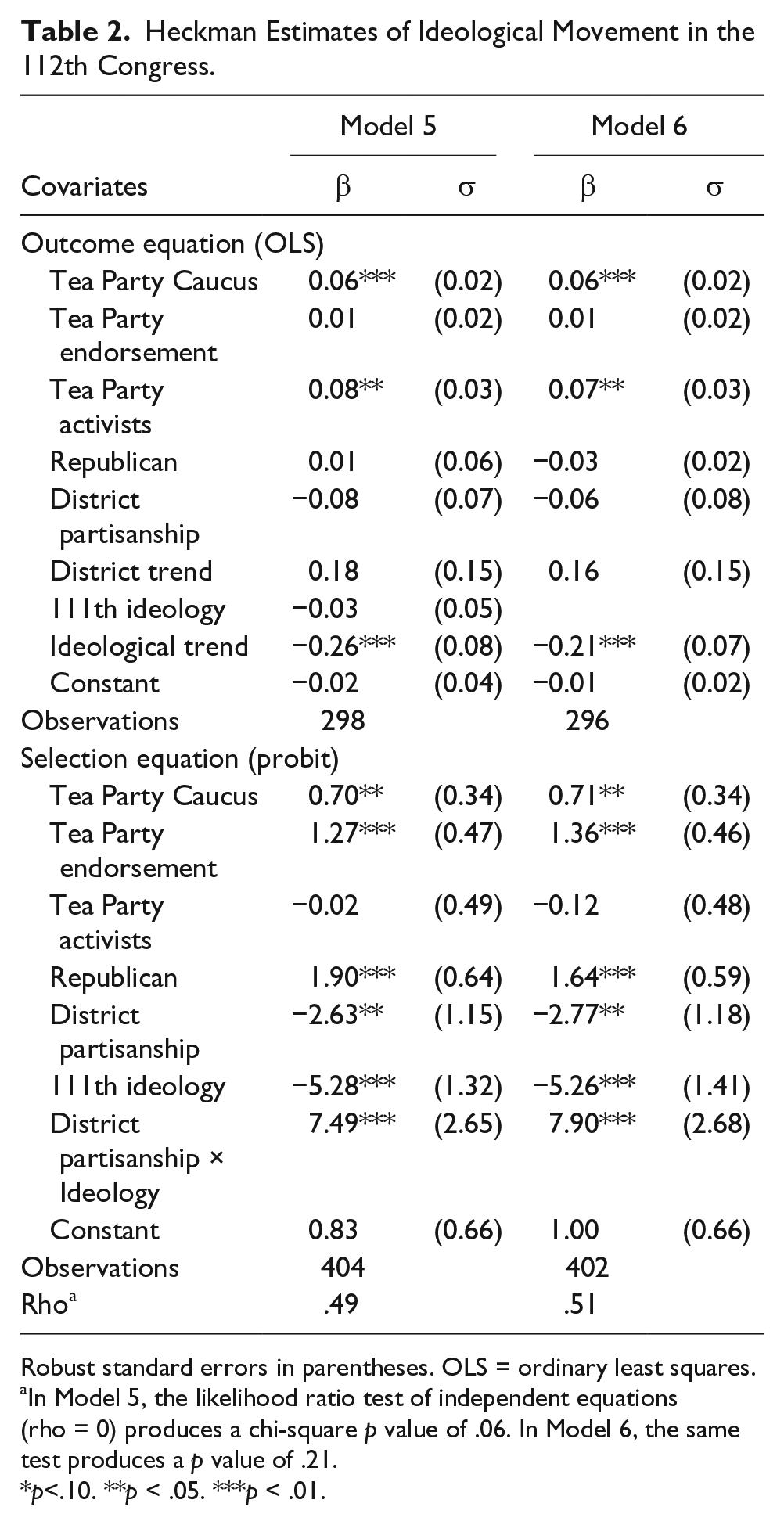
In this section, we examine a possible limitation with differencing ideal points. Because some representatives retired or lost reelection, the dependent variable is missing for a nonrandom sample of individuals. For this reason, we estimated a selection model using Heckman’s two-step routine (Heckman 1979). We estimate two equations: a probit “selection equation” (modeling whether a lawmaker won election in 2010) and a continuous “outcome equation” (the same models as above). For the selection equation, we include five factors that explain whether an incumbent won reelection in the 2010 midterm (Carson and Pettigrew 2013; Karpowitz et al. 2011). We included Republican, Tea Party Caucus, Tea Party Endorsement, and Tea Party Activists from earlier. And fifth, we control for a lawmaker’s ideological proximity to their constituents using an interaction between District Partisanship and Ideology. We expect a positive coefficient, indicating that conservative (liberal) lawmakers are more likely to win reelection in Republican leaning (Democratic leaning) districts.
Looking at the selection equation, we can see that the model supports four of five of the hypothesized determinants of reelection in the 2010 midterm. Accounting for these effects should help control for any selection bias in the outcome equation. When we look at the outcome equation, we can see that the results are virtually identical to the regression results (Models 1−4). We once again find that lawmakers who joined the Tea Party Caucus and those with a large volume of Tea Party activists in their district underwent a statistically significant conservative shift in their roll-call patterns in the 112th Congress. Looking at the bottom of Table 2, we can see that the Heckman routine does not reject the null hypothesis that rho = 0 at the p < .05 level (testing whether the selection and outcome equations are independent). While rho is approaching significance in Model 5, it is far from significance in Model 6. Simply put, we do not find evidence of selection bias in our data set.
Heckman Estimates of Ideological Movement in the 112th Congress.
Robust standard errors in parentheses. OLS = ordinary least squares.
In Model 5, the likelihood ratio test of independent equations (rho = 0) produces a chi-square p value of .06. In Model 6, the same test produces a p value of .21.
p<.10. **p < .05. ***p < .01.
Additional Ideological Shifting in the 113th Congress
A final question is whether the Tea Party caused a second conservative shift in the next Congress. In other words, is the effect we uncovered in the 112th Congress present in the 113th Congress? For both theoretical and substantive reasons, we believe the answer is no.
As a theoretical matter, a second conservative shift would be inconsistent with our claim that the Tea Party’s effect resembles what happens when lawmakers join a new party. After all, the literature documents that changes in party affiliation cause a sharp and durable behavioral shift. As Nokken (2000, 425) put it, “Partisan constraints should induce members to vote like members of their new party and to do so consistently after they change party affiliation.” Because Models 1 to 4 showed that significant ideological movement in one Congress causes ideological movement in the opposite direction in the next Congress, the null effect we are hypothesizing would be in contrast with what Models 1 to 4 predict. If Tea Party legislators did not “bounce back” in the 113th Congress, it would further validate that the Tea Party had a constraining effect on the behavior of its adherents.
As a substantive matter, a second conservative shift in the 113th Congress is unlikely given the Tea Party’s mixed electoral record in 2012 and the Caucus’s institutional decline. On the electoral side, in the aftermath of the 2012 election, a number of commentators concluded that the Tea Party cost the GOP control of the Senate (see, for example, Jacobson 2013). Furthermore, polls showed a significant reduction in popular support for the Tea Party in 2012. 8 On the institutional side, the simple fact is that the Caucus was much less active in the 113th Congress. It had to “relaunch” in April of 2013 after hibernating in the wake of the 2012 elections (Boyle 2013). And although no official list of their activities is available, numerous media reports noted that the Caucus held few formal meetings and was generally inactive for much of the session. Political commentators claimed that the Caucus was “almost silent in the 113th Congress” (Fuller 2015) and “lost its traction” (Collins 2013).
For these reasons, our expectations in the 113th Congress are as follows. Although Models 1 to 4 show that lawmakers who shift to the extremes in one Congress had a large “bounce back” in the next Congress, this moderating effect should not be evident for Tea Party adherents if our results are indeed characteristic of a party switch. Simply put, lawmakers who joined the Tea Party Caucus and had a large volume of Tea Party activists in their district should have continued the extreme record they established in the 112th Congress.
We examined this issue by reproducing Model 2 for the 113th Congress. As with earlier, our dependent variable is a lawmaker’s shift from the 112th to the 113th Congress (Y113th − Y112th). We updated the corresponding independent variables as well. All coding schemes, data sources, and modeling strategies are the same as Models 1 to 4. 9 Because we want to know whether Tea Partiers who shifted to the right in the 112th Congress bounced back in the 113th Congress, we created two interaction terms between the magnitude of a lawmaker’s shift in the 112th Congress and the Tea Party Caucus and Tea Party Activists variables from Model 1 to 4. For comparison purposes, we computed the same effects for non-Tea Party Republicans and Democrats.
We do not report the raw results because of space constraints but will make them available upon request. Instead, Figure 1 presents the main findings. Figure 1 reveals a lawmaker’s estimated ideological shift in the 113th Congress on the y-axis varying their shift to the extremes (left for Democrats, right for Republicans) in the 112th Congress on the x-axis. 10 For Democrats, we see that a sizable leftward shift in the 112th Congress (x-axis) is estimated to produce a significant rightward shift in the 113th Congress (y-axis). Although the size of the bounce back is smaller in magnitude, we see the same effect for Republican lawmakers not affiliated with the Tea Party. A non-Tea Party Republican who shifted 0.15 to the right in the 112th Congress (x-axis) is estimated to shift back to the left by 0.042 units in the 113th Congress (y-axis). For Tea Party Republicans, however, Figure 1 reveals a small and statistically insignificant bounce back in the 113th Congress. For Tea Partiers who shifted 0.15 to the right in the 112th Congress (x-axis), the model estimates that they shifted back to the left by just 0.017 units in the 113th Congress (y-axis). Consistent with expectations, the results confirm that members of the Tea Party who adopted an extreme roll-call record in the 112th Congress were more likely to continue their extreme behavior in the 113th Congress compared with Democrats and Republicans not affiliated with the Tea Party.
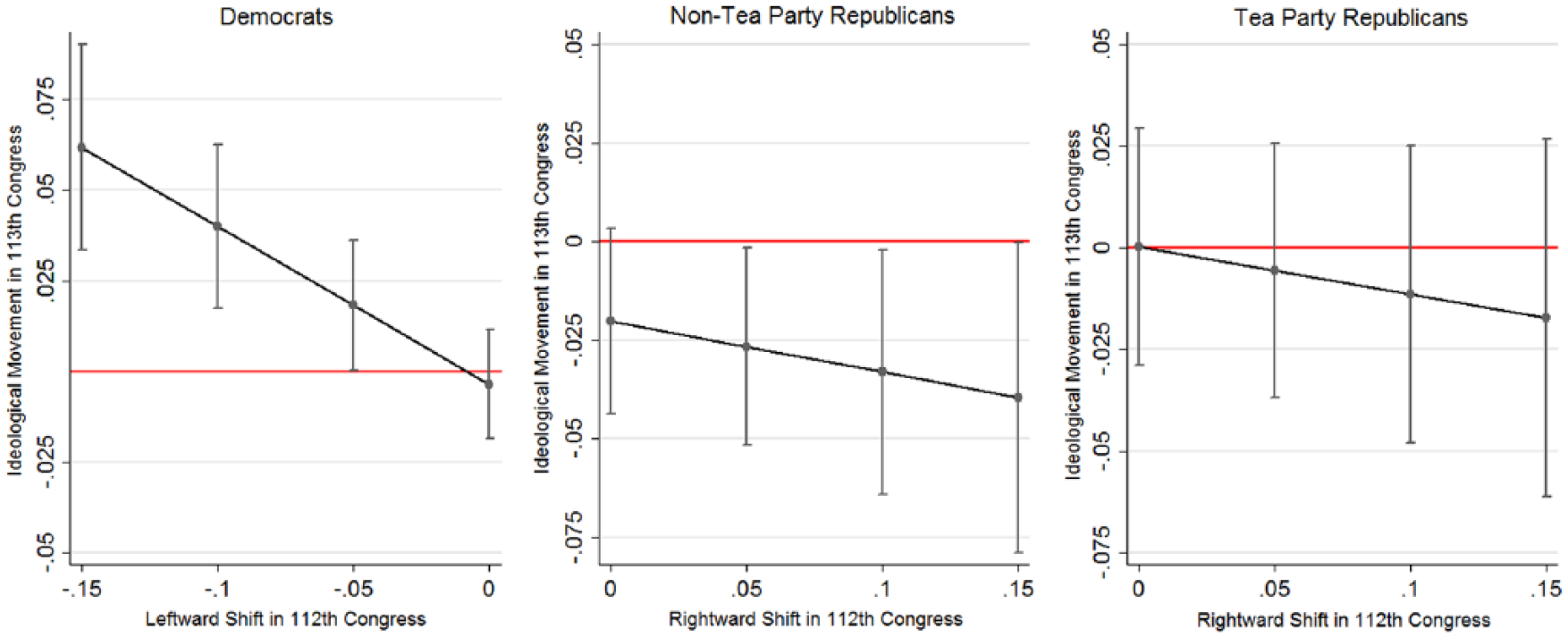
Ideological movement in the 113th Congress.
Proximates: Is the Tea Party Caucus Unique?
We theorized that the Tea Party Caucus had a polarizing effect in the 112th Congress because of its (1) policy coordination and agenda setting role, and (2) party like socializing effects. An important question remains: is the Tea Party Caucus’s effect unique among comparable conservative caucuses and coalitions?
We examined this question in two ways. On one hand, we recorded membership in two analogous conservative caucuses: the Liberty Caucus and the Republican Study Committee. 11 On the other hand, we followed Nokken (2000) and tested the effect of two “proximate” variables. Indeed, Nokken (2000) isolated the distinctive behavior of party switchers (in part) by creating a control group who were similar in key ways. First, based on a member’s ideal point, we tested three indicators: Conservative (Republicans > 50th percentile), Very Conservative (Republicans > 75th percentile), and Extremely Conservative (Republicans > 90th percentile). Because Extremely Conservative performs best, it is the one we report. Second, we created an index of each Republican’s district partisanship and personal ideology and matched each member of the Tea Party Caucus with their closest non-Tea Party colleague. Because this indicator most closely resembles Nokken’s (2000) approach, we label it Proximates.
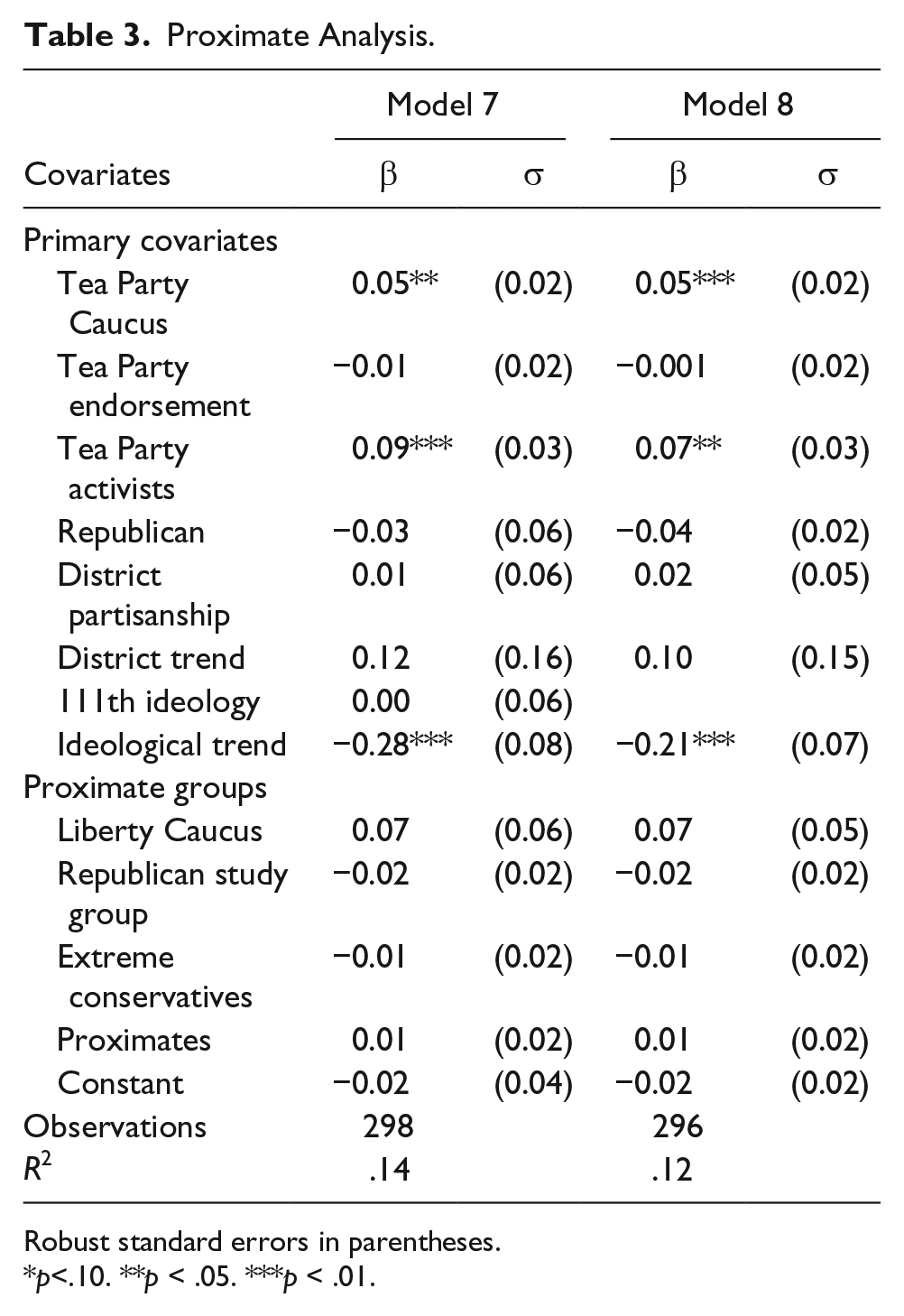
Table 3 presents the results. We used the main models from the “Regression Analysis ” section, where Model 7 is an analogue of Model 1 (with all observations and covariates) while Model 8 is an analogue of Model 2 (with two outliers and one collinear covariate removed). When we examine the results, none of the six proximate groups experienced a meaningful shift in their voting behavior in the 112th Congress. Among these additional variables, Liberty Caucus is in the proper direction and is large in magnitude but is nonetheless not statistically significant. In contrast, the coefficients on Tea Party Caucus and Tea Party Activists are once again significant and positive, indicating a consequential rightward shift for these members.
Proximate Analysis.
Robust standard errors in parentheses.
p<.10. **p < .05. ***p < .01.
Why is the Tea Party Caucus unique? We offer three explanations. First, while we agree with those who note that all caucuses shape the behavior of members (Loomis 1981; Miller 1990), we think those effects are mostly isolated to individual policy domains or specific votes. Ultimately, the Tea Party Caucus is unique because it is just one of six “intraparty caucuses” (ones with a broad policy agenda) in the universe of 737 CMOs in the 113th Congress (Dilger and Glassman 2014). Second, it is important to keep in mind that the Tea Party’s birth was sudden in historical terms. For this reason, we think the Caucus’s agenda setting and socializing effects were very concentrated. Furthermore, we suspect that the Caucus’s party like socializing effects (Ragusa 2016) are probably stronger than what is typical in most CMO’s given the Tea Party’s reputation as a band of “ideological purists.” A third reason for the Tea Party Caucus’s uniqueness is their high ideological cohesion. According to some scholars (Aldrich 1995; Finocchiaro and Rohde 2008; Rohde 1991), ideological cohesion creates incentives for the rank-and-file to empower leaders who, in turn, act decisively to craft an agenda that satisfies members’ electoral and policy goals.
Conclusion
Although the Tea Party is not a “party” in the formal sense of the word, we believe it is apt to say that the Tea Party is having “party like” effects in Congress. In the end, the conservative shift we uncovered for lawmakers with a large volume of Tea Party activists in their district and those who joined the Tea Party Caucus is robust to model specification (including possible selection effects) and the inclusion of multiple control variables. As a substantive matter, the results resemble what happens when lawmakers join a new party. And like when lawmakers switch parties, this conservative shift was not “undone” in the next Congress. Last, we do not observe a similar effect for members in comparable conservative caucuses or among lawmakers with similar ideologies and districts.
As noted earlier, we believe these results fit both legislative-centered theories as well as the work of extended network theorists. Can both perspectives be correct? We believe they can, if we consider that parties have separate institutional and exogenous functions. Just like parties in Congress could not function without the support of a network of activists and interest groups, exogenous actors are reliant on institutional parties to secure their policy goals. In this respect, we agree with Heaney and Rojas’s (2007, 2015) claim that there is a middle ground between the institutional and exogenous domains—what they call a “party in the street”—where activists, interest groups, and partisan actors interact in ways that can be marked by significant cooperation (but also significant conflict). Recent work even suggests a link between the actions of exogenous actors and cycles of partisan institutional change in Congress (Dodd 2015). As a whole, although the Tea Party is not a formal party, we think the classic view of parties (as monolithic, hierarchical, institutionalized teams) ignores critical variation in what constitutes partisan behavior.
Like any study on a nascent topic, greater work is needed. Indeed, research on the Tea Party’s institutional effects is quite limited in volume compared with the significant body of electoral and behavioral research. Regarding future studies, more sophisticated analyses are possible. For example, research could estimate separate ideal points for members of the Tea Party (Nokken and Poole 2004) or disaggregate the roll-call record into procedural and final passage votes (Nokken 2009). We see this as a particularly worthwhile endeavor given that the patterns we identified could be driven—in part—by the Tea Party pulling the congressional agenda rightward. As noted in the “Robustness Checks” section, we view this effect as fully consistent with our theoretical claims that the Tea Party is having a party like effect in Congress. Future work could also examine the Tea Party’s effect on policy outcomes. While we are able to show that the Tea Party matters for the voting behavior of individual members, it is not clear whether the Tea Party skews outcomes beyond the chamber or Republican Party medians.
And finally, it will take decades to know the true consequences of these results. At one extreme, the rightward shift caused by the Tea Party could lead to the dismantling of the existing two-party system. On one hand, recent work has shown that the current two-party arrangement was spawned by the efforts of interest groups and activists to bring about changes in national policy (Noel 2012; Schickler, Pearson, and Feinstein 2010). So, while the Tea Party is not a formal party, their activists and interest groups could bring about a reorganization of the existing party system. On the other hand, while the modern two-party system was defined by realignment within existing party structures (Polsby 2004), American politics has witnessed the opposite: party factions breaking away and forming a new party. Of course, in the current 114th Congress, the Tea Party Caucus seems to have been supplanted by a newer—and seemingly more conservative—group of insurgents: the Freedom Caucus. Based on our observations of the Freedom Caucus in 2015, it seems that they are causing the same “party like” effects that we document in this paper. Writing for TheHill.com in August of 2015, noted political reporter Juan Williams claimed that the “GOP right wing” (referring to the Freedom Caucus by name) is “acting like its own party.” In the end, while it is impossible to predict if and when the Tea Party (or their brethren in the Freedom Caucus) will formally split with the Republican Party, it would not be surprising given the results we uncovered in this paper.
Footnotes
Acknowledgements
We would like to thank Matthew Hitt, Josh Huder, Josh Ryan, and Adam Silver for commenting on an earlier version of the paper. John Thevos assisted with the data collection. We would also like to thank Michael Bailey, Jonathan Mummolo, and Hans Noel for providing data used in this project. Last, we would like to thank the editors of Political Research Quarterly and four anonymous referees for their helpful feedback.
Authors’ Note
As always, all errors are our own.
Declaration of Conflicting Interests
The author(s) declared no potential conflicts of interest with respect to the research, authorship, and/or publication of this article.
Funding
The author(s) received no financial support for the research, authorship, and/or publication of this article.