



Abstract
Scholars who examine judicial independence offer various theories regarding its development. Some argue that it serves as a type of insurance for regimes who believe their majority status is in jeopardy. Other scholars argue that insurance theory does not offer an adequate explanation until states democratize. We argue that part of the explanation for these mixed results involves the inadequacy of insurance theory as a complete explanation. Our paper develops a multidimensional theory that focuses on the interplay of constraints on ruling elites derived from levels of political competition within the government, the potential for social competition within the state, and regime type. We test our argument using a dataset of approximately 145 countries over forty years, and our results support the argument that development of judicial independence is related to the political landscape encountered by the executive. Ethnic fractionalization in the state, political competition, and regime type each has a conditional effect on the observation of judicial independence.
Most individuals would agree that the ability of courts to provide legal checks against other branches of government without undue political influence is important; this judicial independence offers protections for minority rights and checks against abuses of power by the political branches of government. Indeed, it may be one necessary component for the development of democracy (for example, see Becker 1987; Haynie 1997; Helmke 2002; Herron and Randazzo 2003; Hirschl 2001; Iaryczower, Spiller, and Tommasi 2002; Larkins 1996; Melone 1996; Smithey and Ishiyama 2000; Widner 2001) and for the protection of democracy against autocratic reversals (Gibler and Randazzo 2011). Nevertheless, despite this importance, we actually know little about how judicial independence emerges and develops within the state.
Judicial independence may serve as a type of insurance for ruling regimes that expect turnover. In this framework, the courts guarantee protection for at-risk leaders who fear political reprisals following leadership turnover (Finkel 2005, 2008; Ginsburg 2003). However, while intuitively appealing initially, recent arguments suggest that the theory may have only limited utility beyond democratic states (see Rebolledo and Rosenbluth 2009) and that political competition, its primary causal mechanism, may sometimes counteract the development of judicial independence. As Popova (2010) argues, intense political competition may not make the courts referees; instead the courts themselves become spoils for incumbents to merely rubber stamp their policies.
We argue that part of the explanation for these mixed results involves the inadequacy of insurance theory as a complete explanation either theoretically or empirically across different political environments. Previous studies have also limited themselves either to specific cases or limited time spans. Together, this combination has greatly hampered the generalizability of arguments about the development of judicial independence within the state.
In this paper, we argue that the development of judicial independence is a multidimensional phenomenon conditioned by regime type, the level of political competition within the regime, and the potential for inter-group trust across society as a whole. We evaluate our argument by providing the first large-N statistical test of the predictors of judicial independence using a sample of approximately 145 countries spanning over forty years. We find that judicial independence is more likely in democracies when the risk of political losses is greatest: when competition is high and when the potential for trust is low. These relationships reverse among non-democracies. We explain our logic in the next two sections—by first demonstrating how previous studies hint at these relationships and then by discussing why judicial independence is controlled by the state’s political and social environment. Our research design and empirical tests follow, and we close with a discussion of the implications of our study.
Judicial Independence as Insurance
Kapiszewski and Taylor (2008, 749) note that conceptual murkiness has hampered studies of judicial independence and led to conflicting results. For example, differentiating between the impartiality of judges during decision making and the ability of lower court decisions to vary substantially from higher court rulings is essential when considering how institutions affect judicial behavior. Here, we focus on the institutional autonomy of the courts from influence by other branches of government. The power and assertiveness of the court system will be correlated with this type of independence, but our theory and tests specify only the likelihood that any given ruling will be dispensed without undue influence from other institutional actors within the state.
The most prominent explanation for the development of judicial autonomy within the state involves conceptualizing the courts as potential insurance for politicians. Initially articulated by Landes and Posner (1975), “insurance theory” argues that judicial independence relies on the extent to which those politicians currently in power expect to lose office in the future. Leaders have strong incentives to empower the courts with greater levels of independence when they are threatened politically or when they believe that they will no longer remain in power (see Ginsburg 2003; Helmke and Rosenbluth 2009; Ramseyer 1994). Consequently, an independent court system, empowered with the authority to protect minority rights and promote the rule of law, forms a system of insurance for fearful leaders that makes ex post punishment more difficult.
By focusing on leaders’ expectations of removal from power, insurance theory is driven by the level of political competition within the regime. Finkel (2005, 2008) provides some of the best work on how political competition incentivizes leaders. For example, the PRI-controlled party system within Mexico found itself unable to easily influence local governments and faced increased doubts about its ability to maintain national offices during the early 1990s as opposition parties gained influence. As she points out, the immediate effect of this political competition was for the new president, Ernesto Zedillo, to introduce judicial reforms that would grant judicial independence to the courts. Previously, there was no need for such measures because of PRI’s political dominance, but, as opposition power grew, the PRI began to back judicial independence for two reasons. First, the acquiescence to judicial reforms allowed the PRI to push through advantageous electoral changes. As importantly, though, the PRI began to see the concession as useful for protection of its interests should the opposition win and the party be removed from office. Political competition thus made judicial independence attractive for governing elites in both the short and long terms by instituting electoral changes that would aide the PRI’s electoral advantage and insure the party’s interests should it lose office.
Although the case evidence is strong for this theory, we believe the argument is incomplete, especially when the theory is ported to different types of political systems. First, political competition may not always relate positively to judicial independence. Popova (2010), for example, finds that political competition has undermined the establishment of judicial independence in Russia and the Ukraine by turning the courts into political spoils for the party in power, serving as rubber stamps for incumbents. Furthermore, insurance theory fails to account for the changing environment and leader incentives that potentially support a strong executive. Following the dissolution of the Soviet state, the newly elected president of Russia, Boris Yeltsin, clashed with leaders of the Russian parliament over governmental reforms that often came before the new Constitutional Court. 1 Yeltsin suspended the Constitutional Court in the fledgling democracy in October of 1993, dissolved the legislature, and ordered tanks to fire on the parliament building. The incentives to the leader in this case supported a strong executive hand, even if it risked challenging the institutional structure of the state, and this occurred within a political environment that was uncertain and unstable for Yeltsin. Hence, this a difficult case for relying solely on insurance theory to explain the development of an autonomous court.
Similarly, Rebolledo and Rosenbluth (2009, 4) suggest a curvilinear relationship between political competition and judicial independence. They argue that there is little benefit for politicians to advocate judicial independence when competition is weak, and intense competition often leads to judicial manipulation to preserve the ruling regime. Therefore, median levels of competition support judicial autonomy. Collectively, these studies imply the relationship between political competition and judicial independence is more dynamic than originally believed and is likely conditioned by other existing political institutions within the state.
Finally, both Rebolledo and Rosenbluth (2009) and Popova (2010, 1204) argue that judicial independence studies have been focused on democracies, and this limits their ability to explain courts that emerge during transitioning regimes. As Popova demonstrates, leaders in partially democratic states possess substantially different incentives due to the instability of the regime and the potential for wholesale replacement of those in power (Popova 2010, 1205). 2 Thus, when leaders face the increased risk of complete regime change, they may be willing to grant small increases in judicial independence while remaining reluctant to allow substantial developments to occur. This will be especially true when the potential for retribution is highest.
Judicial independence can also evolve within non-democratic or even authoritarian regimes as court systems develop their own distinct identities that may not reflect the preferences of either the legislative or executive branches of government. 3 As Carrubba (2005) demonstrates, strategically oriented courts can provide leaders with tools for enforcing regulatory compliance within the regime. This usefulness to the regime allows the court to create an identity and grow in power; as long as the leaders continue to benefit from this compliance, the regime will tolerate occasional defections from their preferred policies. Too much autonomy breeds sanction from the leadership, but, over time, small policy drifts over time toward increased autonomy lead to the development of distinct judicial independence within the state.
This outline of the literature reinforces both the utility and limits of insurance theory. At-risk leaders are likely to seek additional protections should political shifts occur, and this often includes imbuing the courts with power and autonomy. However, most leaders tend to face more nuanced incentives. As our next section argues, judicial independence can emerge in multiple ways, depending on the political and social environment confronting the regime.
Political Competition, Social Trust, and Regime Type
A fundamental feature of politics is that politicians pursue choices that maximize their potential to remain in office. This is true whether one examines members of the U.S. Congress (e.g., Fenno 1977; Mayhew 1974; Rohde 1979), the U.S. presidency (e.g., Canes-Wrone, Herron, and Shotts 2001; Canes-Wrone and Shotts 2004; Krause 2002; Simon and Ostrom 1988), or members of parliament across different countries (Browne, Frendreis, and Gleiber 1986; Lupia and Strom 1995; Tsebelis 1995; Warwick 1992; Williams 2011). Leaders must similarly worry about what happens when their tenure is over—when they are voted out of office, are term-limited, or even overthrown. Both types of self-interest affect the likelihood and development of judicial institutions within the state, and self-interest will also condition whether those courts are independent from outside influences.
Courts can have multiple functions within the state, but we focus on two principally. First, insurance theory places primary importance on the role courts can have maintaining minority rights. The risk of political turnover provides incentives for leaders to think about the future and how they are treated when leaving office. Insurance theory assumes, then, that increased political competition prompts leaders to support independent courts that will protect these leaders and their interests from the opposition. Although this limits the ability of those in office to extract from the opposition, judicial independence becomes a necessary hedge if political fortunes change.
The limit of this argument is its focus on democracies and stable governments. Turnover in democracies and mixed regimes tend to be ballot driven. However, in non-democracies and authoritarian governments, the potential for turnover rests in both the relative strength of those outside the political system and also how likely those outsiders are to seek revenge if they were to gain political power. This imposes the curvilinear relationship between judicial independence and competition suggested by Rebolledo and Rosenbluth (2009). When outsiders are weak, there is no need for judicial independence because there is no fear of turnover, but when outsiders are strong, and potentially hostile, the courts become yet another means of maintaining the power of the regime. Court independence then becomes more likely when outsiders are moderately strong and not, especially hostile to the interests of the regime.
The second function provided by a strong court system is its role as legitimizer of the regime in power. In democracies, strong and independent judicial institutions allow political leaders to establish social control, bolster the regime’s claim to legitimacy, strengthen administrative compliance, and facilitate trade and investment (Ginsburg and Moustafa 2008). By investing the courts with adequate authority and independence, the executive establishes a viable institution capable of insuring the stability and performance of the regime. The loss in executive and legislative power to the independent courts is vastly outweighed by its state-legitimizing functions.
Meanwhile, autocratic leaders may sometimes change the nature of courts and use them as private goods to enforce compliance with the elite’s regime. Carrubba (2009) demonstrates this formally when he shows that autocratic leaders can use the courts to overcome collective action problems within the state, enforcing common regulatory schemes. The de jure stamp of approval adds legitimacy to the regime but, even more importantly, provides a common salient focus for organizing the state around leader-preferred policies.
These different uses of courts create an interesting paradox. As the size of the winning coalition increases relative to the size of the electorate so too should support for an independent judiciary, and this is true in both autocratic states and among democracies, albeit for different reasons. In autocracies, the use of the court as a tool for compliance provides a wider dispersal of the private good, while in democracies, the courts become a public good that provides stability as well as administrative and economic performance. Thus,
But does this hold true in mixed regimes?
Given the differences in how courts are structured across regime types—private versus public goods systems—it seems unlikely that the effect of the ratio of winning coalition to selectorate size will remain consistent in mixed regimes. As the judiciary moves toward greater independence, encouraging a move toward consolidation of the democracy, it becomes a threat to elite interests, and support for judicial independence among the elites will wane. Thus,
The pool of potential challengers also matters for leadership survival. In some systems, even a poorly performing leader will survive because no alternative exists, or a replacement leader may come from the same elite group and not really constitute a challenge to the regime or the elites. These are non-competitive political systems and pose little risk to leader survival. High-risk systems for the leader would include any system in which the pool of challengers is quite large or the makeup of the pool of challengers presents a threat to the policies of the leader’s group. These competitive systems incentivize leaders to support judicial independence as a safeguard for their well-being and policies.
We conceptualize political competition in two distinct ways. First, we consider the level of potential social competition within the state, and we do so with measures of ethnic fractionalization. High levels of ethnic fractionalization may lead to lower levels of trust within society, which impairs the ability of regimes to coordinate and cooperate in an effective manner. This has long been assumed in the literature on inter-ethnic cooperation (see, for example, Fearon and Laitin 1996), and, recently, the connection between exposure to diversity and political distrust has been confirmed at the individual level, using Danish survey data (Dinesen and Sønderskov 2015)
More important for our argument is that leadership turnover will be more consequential if the challenger represents groups not currently in power. Ethnic fractionalization increases both the number of potential challengers and the importance of maintaining office for the leader’s supporters as leadership turnover is likely to yield substantial policy changes. Hence, leaders face a higher risk of turnover in democracies, where the regime’s inclusion of social groups enables diverse (and regularized) competition. We suspect, therefore that
We provide the caveat of democratic governance for H2a (all groups can provide leaders) because, again, the courts act differently in non-democracies. In non-democracies, courts serve the ruling elites by increasing compliance with the elite’s regime. In addition, in autocracies, and even partial democracies, there will be at least one group that is excluded from the elites governing the state, and, therefore, the ruling elites will not support a judicial independence that might encourage rights for politically excluded groups. In other words, judicial independence poses more risk to the non-democratic ruling elite in that the court may facilitate increased political competition and/or the threat of potential regime and elite change. Therefore,
Our second source of political competition considers the level of contestation within the institutions of government. As before, we argue that higher levels of political competition within the government will add to leaders’ fears about turnover, and this incentivizes the leadership to develop judicial institutions as protection following a change in leadership. Investing the judiciary with adequate levels of independence provides added insurance during times of increasing uncertainty. Recall, though, that private goods judiciaries may help enforce elite power, and, in non-democratic systems, a more powerful judiciary will not help leaders or their policies following a successful challenge. In other words, independent courts will not protect the ousted leadership in non-democracies as courts serve the ruling elite interests; hence, leaders have little incentive to grant independence for insurance. Thus, increased political competition in non-democracies will be associated with a decrease in the importance and independence of the judiciary. Together, in hypothesis form, we expect that
Together, these hypotheses suggest a complex relationship between the sources of political competition within the state and government and the likelihood of support for judicial independence. Our theory takes seriously the different uses of a judiciary within the state and posits relationships that are conditional upon regime type. We begin tests of these arguments in the next section and outline the first large-N examination of the sources of judicial independence within the state.
Research Design and Methodology
We test our argument on a dataset of judicial independence that includes approximately 145 countries from 1960 to 2000. 4 To our knowledge, this represents the first large-N study focused on the development of judicial independence. 5
The dependent variable is a composite index of de facto judicial independence developed by Linzer and Staton (2012). Using a Bayesian latent-variable measurement model, Linzer and Station develop an indicator of judicial independence that ranges from 0 to 1 (independence). The indicator leverages data from several popular identifications of judicial independence, each of which has been limited in scope or temporal range. 6 Grouping these data as a latent-variable analysis assumes a common characteristic of de facto judicial independence unites the indicators, which could prove troublesome if there is substantial conceptual slippage across indicators. However, the trade-offs from this unifying assumption are mitigated by the wide spatial and temporal coverage available when using all indices. The latent-variable measure also minimizes the theoretical and empirical problems associated with coverage boundedness and missing data. As Linzer and Staton (2012, 27) demonstrate empirically, this new index provides ample variation over time, covers a large number of countries, and does so with a measure that has strong face and content validity.
To examine the potential constraints facing the leader, we use the Bueno de Mesquita et al. (2003) measure of the ratio of the Size of the winning coalition in relation to the size of the selectorate. 7 This variable ranges from 0 to 1 with higher values associated with larger winning coalitions, 8 and we expect larger winning coalition ratios to be associated with higher levels of judicial independence.
Our Ethnic fractionalization measure captures one aspect of the degree of heterogeneity and socio-political competition within a society. We use the Fearon and Laitin’s (2003) measure of the population share of the largest group in the country. Inverted for the sake of presentation, the variable ranges from 0 to 1 with higher values depicting greater heterogeneity within the population. We expect increased heterogeneity to decrease political trust and hamper calls for judicial independence within the state. 9
We identify the level of political competition within the government using Vanhanen’s (2011) Index of Political Competition. This index calculates the percentage of votes gained by smaller parties in parliamentary and/or presidential elections—a simple subtraction from 100 of the largest party’s vote share, multiplied by the percentage of the population who voted. Higher values are associated with greater levels of political competition within the state that should increase pressure for judicial independence.
We also control for several state- and international-level factors that may affect levels of judicial independence. For example, as external threats to the state often reduce the number of institutional veto players and dampen internal political competition (Gibler 2010), we control for the level of external threat that targets the regime, and we do so in multiple ways. First, we include the Index of Civil Unrest from the Major Episodes of Political Violence data (1946–2008; see Marshall 1999); it ranges from 0 to 10 and sums the magnitude of civil violence, civil war, ethnic violence, and ethnic war. The second variable, Militarized neighbor, identifies the highest level of state militarization—percentage of the population in the military—among all bordering states (see Singer, Bremer, and Stuckey 1972). Finally, we include a dichotomous measure for the presence of a Territorial rivalry based on Thompson’s (2001) list of strategic rivalries; these rivalries indicate an explicit desire by bordering states to negotiate the division of territory between the two states.
Our second set of control variables identify state attributes associated with judicial independence that could conceivably be related to our independent variables of interest. The level of democracy as measured using the 21-point, combined Polity IV score, and we use this level of democracy measure as a base component for our interactive terms. We include a variable measuring the Age of the court and its square, Age of the court squared; judicial independence may simply be a function of time, with higher levels developing as courts gained more legitimacy through the years. Finally, we include a measure of state wealth (GDP [gross domestic product]) and assume a correlation between wealth and the openness of the political environment; wealth is a notoriously good predictor of democracy and political decentralization and often accounts for a great deal of the variation in political processes within the state. Together, we believe our controls provide a strong null hypothesis that independent judiciaries are merely the products of time, wealth, and/or democracy.
Empirical Results
Because of the potential for non-linear relationships within our argument, simple regression models are insufficient. Royston and Altman (1994) and Sauerbrei et al. (2004) demonstrate the utility of fractional polynomial regression models instead. As they demonstrate, the traditional assumption of linearity may be incorrect, leading to a misspecified model in which a relevant variable may not be included because its true relationship with [the] outcome is non-monotonic, or in which the assumed functional form differs substantially from the unknown true form. (Sauerbrei et al. 2004, 3465)
In addition, they demonstrate the utility of fractional polynomial regression over simply including quadratic or cubic polynomials directly into the traditional regression framework. Consequently, we adhere to this advice and estimate a fixed effects fractional polynomial model that allows us to directly detect potential non-linearities in the data while simultaneously controlling for unique idiosyncracies related to specific states. 10 The results of this model appear in Table 1. An F test (not reported in Table 1) indicates that this model better captures any unexplained variance attributed to the unbalanced nature of the panel data structure than a typical regression model. 11
Fractional Polynomial Regression on Judicial Independence.
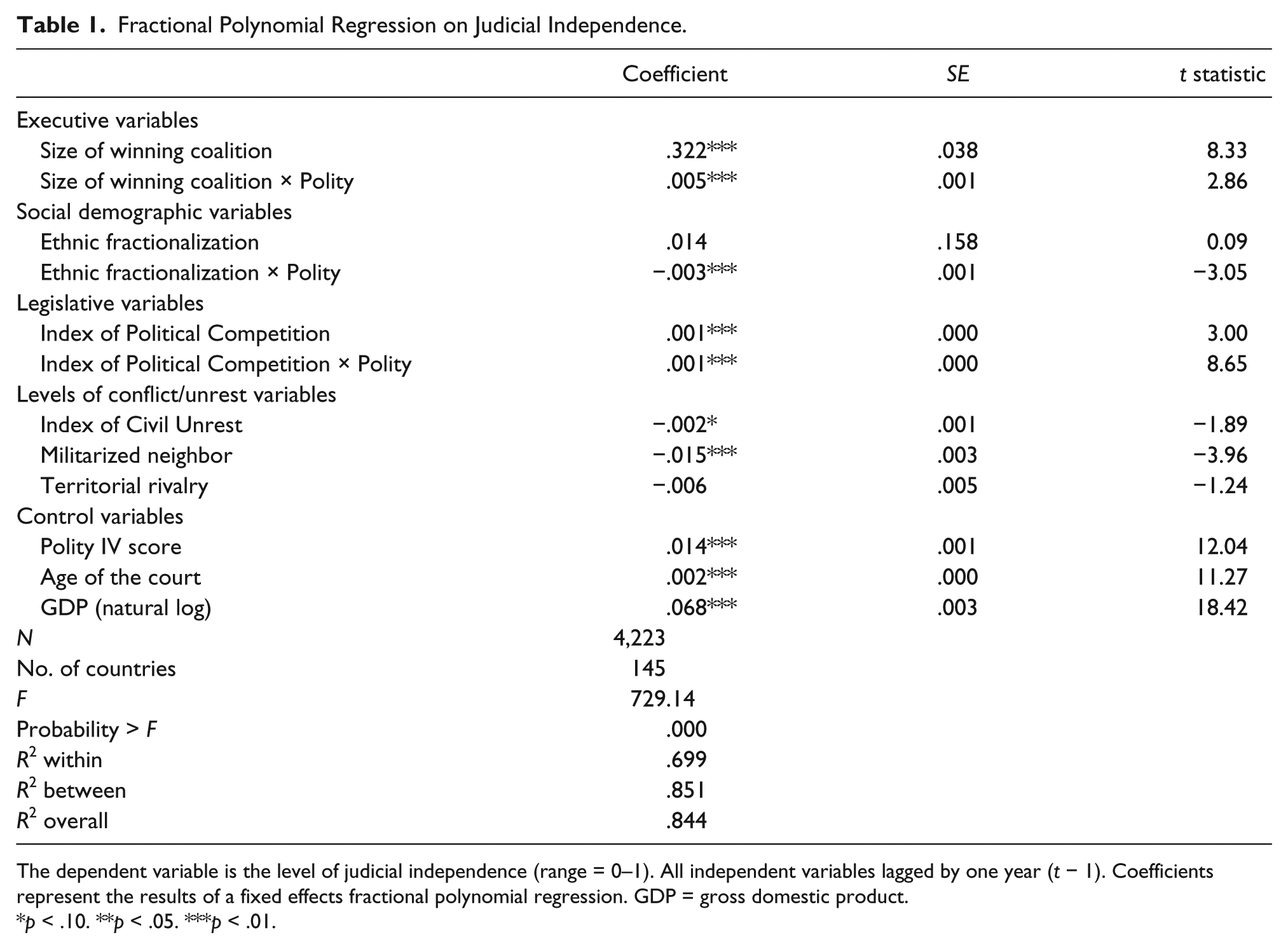
The dependent variable is the level of judicial independence (range = 0–1). All independent variables lagged by one year (t − 1). Coefficients represent the results of a fixed effects fractional polynomial regression. GDP = gross domestic product.
p < .10. **p < .05. ***p < .01.
Examining the results from the fixed effects fractional polynomial regression reveals several interesting patterns. First, we examine the set of primary independent variables that focus on constituent influences facing the executive and observe that both are statistically significant. The variable Size of the winning coalition is significant and positive indicating that states with larger coalitions in the selectorate will possess higher levels of judicial independence. In addition, the interaction term Size of winning coalition × Polity is also significant and positive indicating that the effect of coalition size becomes more prominent as countries become more fully established democracies.
The next set of variables measure the effects of social demographic characteristics, in particular the degree of ethnic fractionalization within a state. Here, we observe that Ethnic fractionalization alone does not exert a statistically significant influence on levels of judicial independence. Moreover, though the coefficient on the interaction term Ethnic fractionalization × Polity is significant in Table 1, further examination reveals that the conditional effect of this interaction combined with its base constituent terms is not statistically significant.
Finally, we examine the set of variables related to the amount of political competition within the legislature. Table 1 reveals that the variable Index of Political Competition is significant and positive indicating that states with larger numbers of viable political parties will possess higher levels of judicial independence. In addition, the interaction term Index of Political Competition × Polity is also significant and positive indicating that the effect of political competition becomes more pronounced as countries become more fully established democracies.
Turning to the various control variables in the model, we observe some additional patterns of interest among the levels of conflict variables. First, the variables Index of Civil Unrest and Militarized neighbor are both significant and negative. This indicates that states experiencing higher degrees of unrest or that have militarized neighbors are less likely to invest greater levels of independence in their courts. Finally, all of the remaining control variables are statistically significant and positive. Consequently, states with greater investments in democracy, older judiciaries, and larger amounts of wealth all experience higher levels of judicial independence.
Substantive Impact of Empirical Results
Although the results listed in Table 1 reveal interesting patterns, it is difficult to identify the substantive impact and conditional (and potentially non-linear) relationships between judicial independence and the size of the winning coalition or political competition. Therefore, we graph the predicted levels of judicial independence against each independent variable and show the separate effects across levels of democracy as well as the overall effect if one were to simply pool the data. Figure 1 reveals this graph for the size of the winning coalition in the state.
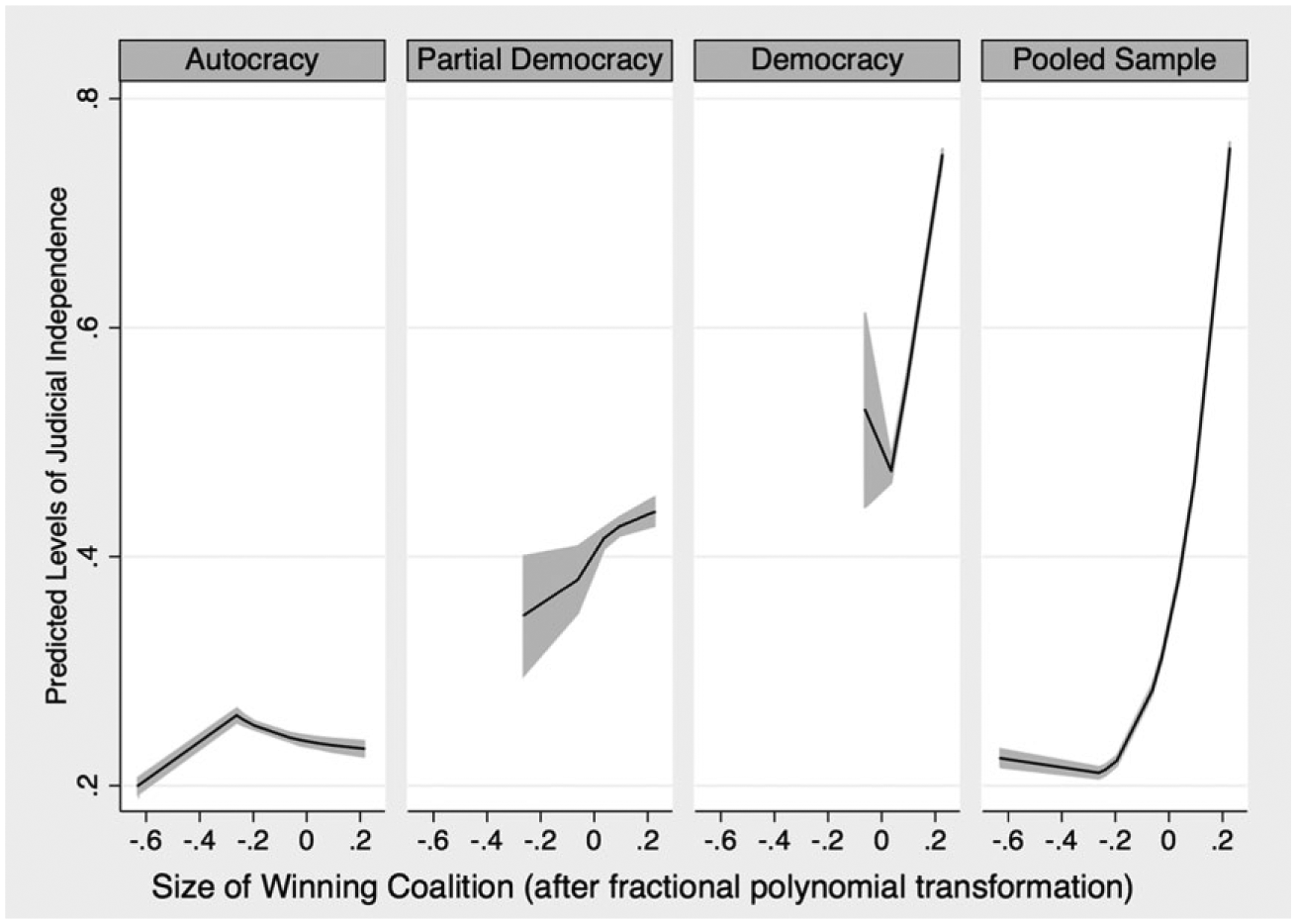
Predicted levels of judicial independence by winning coalition size.
As the far right side of the graph reveals, if one were to simply examine the pooled sample, and not condition the results on levels of democracy, one would observe a relatively pronounced linear relationship 12 between the size of the winning coalition and judicial independence. Thus, one might reach the incorrect conclusion that increases in the size of the winning coalition always lead to increases in judicial independence. However, once we condition this relationship based on levels of democracy, a starkly different pattern exists. Within fully established democracies we observe an initial decrease in judicial independence from approximately .520 to approximately .480 followed by a substantial increase to approximately .780. In states with partial democracies, there is a monotonic increase from approximately .370 to approximately .420. However, in autocracies, the effect is non-monotonic; their level of judicial independence states near .200 and peaks around .250 after which it decreases to approximately .210. Taken together, these graphs indicate that executives encounter changing situations related to the size of the winning coalition. Leaders of established democracies have greater incentive to grant higher levels of judicial independence because the likelihood of losing office is high. Similarly, leaders in partial democracies have incentives to increase judicial independence, though these incentives are not nearly as pronounced as those for leaders of established democracies. But leaders of autocracies face a different political environment. Initially they can afford to increase levels of judicial independence because the likelihood of losing office is small. However, eventually they must be cautious about granting additional judicial independence because those courts could begin to strike down executive initiatives, which potentially leads to a change in leadership.
These results do not fully support our hypotheses (H1a) that the ratio of the winning coalition to selectorate size will be positively related to support for higher levels of judicial independence in both democracies and autocracies. Instead, we find a non-linear, concave relationship in democracies for this ratio. Yet, the initial decrease remains relatively small compared with the substantial increase in judicial independence overall. Similarly, we find a curvilinear, convex effect on judicial independence in autocracies contrary to our expectations. In partial democracies, we predicted (H1b) that there should be a curvilinear relationship between the ratio of winning coalition to selectorate size and judicial independence. Yet, we discover a monotonic increase in judicial independence.
Examining Figure 2 reveals the effects of political competition within the government on judicial independence. Here, we observe a linear relationship regardless of the levels of democracy within a state. Whether one examines the pooled sample, or separately looks at established democracies, partial democracies, or autocracies, the relationship remains consistent. As legislatures become more politically competitive, this leads to higher levels of judicial independence. These results provide partial support for our hypotheses. Our expectation (H3a) that there is a positive relationship between political competition and judicial independence in democracies is supported empirically. However, our expectation (H3b) for a negative relationship between political competition and judicial independence in non-democracies does not receive empirical support.
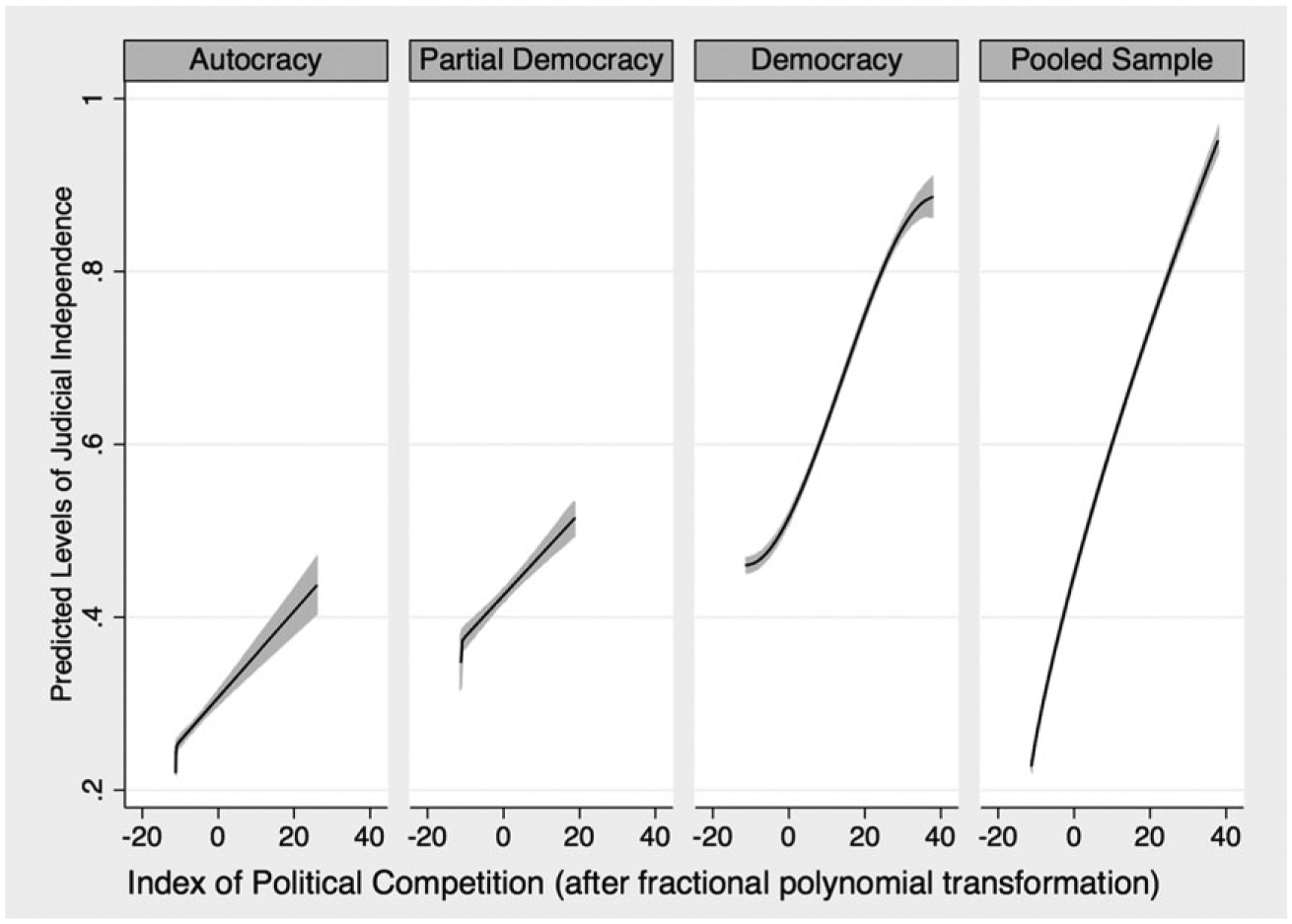
Predicted levels of judicial independence by political competition.
Conclusion
What are the conditions under which states invest their courts with meaningful levels of independence? The most frequent theoretical explanation is that judicial independence serves as insurance to political leaders to protect them from potential abuses of power when they lose their majority status. Although this theoretical argument possesses an intuitive appeal, the empirical evidence concerning its support is mixed. We argue that part of the explanation for these mixed results involves the inadequacy of insurance theory, in its current form, as a complete explanation either theoretically or empirically. In addition, the previous studies seek to evaluate insurance theory either through examining a small number of countries or across a limited time frame.
Our paper reexamines the foundations of insurance theory and argues for a more nuanced version that incorporates potential non-linear relationships that are conditional across specific levels of democracy. We test our argument using a dataset of judicial independence in 145 countries from 1960 to 2000. Our empirical results indicate that the development of judicial independence is related to levels of political competition in the legislature and the political landscape encountered by the executive. Moreover, levels of democracy also conditionally affect the latter.
Additional research is necessary to better understand the underlying theoretical implications of these non-linear relationships. One possibility echoes Fearon’s (2003) argument that increases in these components impairs the ability of governments to coordinate and cooperate in an effective manner. We speculate that an alternative explanation may involve the ability of independent courts to shift their focus from ensuring compliance for regime policies in autocracies to expanding collective rights for minority groups or individual rights similar to courts in democracies. Although leaders in autocracies and partial democracies may not feel threatened by the judicial protection of individual rights initially, the expansion of collective rights for minority groups may pose significant threats to political power. Consequently, leaders in these states may seek to reduce the independence of the judiciary.
Without additional research into these explanations, our knowledge of the substantive implications for judicial independence will remain incomplete. We believe our large-N analyses have provided important clues about the composition of judicial independence. However, future research—especially case examinations of the mechanisms at work—is needed. We believe the identification of these structural predictors of de facto independence are an important first step in understanding cross-national and cross-temporal variations in institutional design.
Footnotes
Declaration of Conflicting Interests
The author(s) declared no potential conflicts of interest with respect to the research, authorship, and/or publication of this article.
Funding
The author(s) received no financial support for the research, authorship, and/or publication of this article.
Notes
References
Supplementary Material
Please find the following supplemental material available below.
For Open Access articles published under a Creative Commons License, all supplemental material carries the same license as the article it is associated with.
For non-Open Access articles published, all supplemental material carries a non-exclusive license, and permission requests for re-use of supplemental material or any part of supplemental material shall be sent directly to the copyright owner as specified in the copyright notice associated with the article.
