



Abstract
This article examines when partisan media effects occur during presidential campaigns. I argue that partisan media are most likely to influence candidate impressions early in the election cycle, when voters have less crystallized impressions of the candidates and are less motivated to defend their party’s nominee. Using multiple methods and two large-scale surveys spanning 2008, I show that Fox News affected favorability toward Barack Obama during the first five months of the election year, but those effects largely disappeared over the last five months. The results varied by political knowledge, however, as Fox News affected low-knowledge viewers throughout the entire year, but only affected high-knowledge viewers early in the election cycle. These results provide important new evidence on how partisan media affect viewers and when those effects occur during a presidential election.
Every four years, Americans are bombarded with information about the presidential election from the early primaries through Election Day in November. More than ever, the media environment allows people to structure what information they receive, with many choosing to get news from partisan sources on cable television, political talk radio, and the Internet. Although partisan media attract only a small percentage of Americans (Prior 2014), their audiences tend to be more politically active than Americans in general, which translates to more attention from elected officials (Abramowitz 2012; Levendusky 2013). There is even evidence that partisan media make their audiences more active in politics, thus, increasing their influence on the political system (Dilliplane 2011). Furthermore, Clinton and Enamorado (2014) find that partisan media influence the decisions of elected officials.
Given the characteristics of their audience, it is important to understand how partisan media affect public opinion during elections. Previous research provides compelling evidence that partisan media affect how audiences evaluate presidential candidates leading up to Election Day (Dilliplane 2014; Levendusky 2013; Morris and Francia 2010; Stroud 2011), though some argue that self-selection into partisan media weakens these effects (Arceneaux and Johnson 2013; Bennett and Iyengar 2008; Prior 2014). A topic that is largely ignored in previous research is when partisan media effects occur during an election cycle. Studies typically treat media effects as consistent over time rather than dynamic. That is, scholars have implicitly assumed that partisan media would have the same effects on audiences in April of an election year as they do in October.
In this research, I argue that partisan media effects are more likely to occur prior to the general election period. Public perceptions of the candidates crystallize over the course of the campaign (Wlezien and Erikson 2002), making it more difficult for partisan media to persuade audiences late in the election. In addition, opposing partisans will be more motivated to defend their party’s nominee later in the election, when interparty competition is at its zenith. During the general election, partisan media effects are likely limited to the less politically sophisticated portion of the audience because they tend to base candidate impressions on more recently salient information and are less likely to engage in motivated information processing.
To test this theory, I examine the effects of Fox News on favorability toward Barack Obama during the 2008 presidential election. Using a variety of methodological approaches, I examine the effects of Fox News on viewers during the primaries and the general election period. Specifically, I use variation in both exposure to Fox News and its candidate coverage to predict over-time variation in attitudes toward the candidates. The 2008 presidential election provides a good case study because of the open contest and the wealth of survey and content analysis data available throughout the year. In the end, this research represents an important first step toward understanding the timing of partisan media effects.
Partisan Media Effects during Presidential Elections
Much of the existing research on partisan media effects pays little attention to when those effects occur during the election cycle. Some scholars have used experiments to examine partisan media effects because they offer the best test of causation. However, for a variety of reasons, experimental research has not shed much light on the timing of partisan media effects during an election. For one, experimental research typically exposes people to partisan media at one point in time (Arceneaux and Johnson 2013; Feldman 2011; Levendusky 2013). This approach does not account for potentially diminishing returns from repeated coverage of the same candidate over time. In addition, experimental research rarely replicates the actual timeline of a presidential campaign. Some exceptions are experiments that use dynamic process tracing (Lau and Redlawsk 2006) or repeated-measures experiments (Mitchell 2014), but scholars have yet to incorporate partisan media into these designs.
Alternatively, survey research provides a good test for media effects over the course of an election cycle and in a natural campaign environment. Examining the effects of mainstream media in particular, Bartels (1993) found that effects were strongest during the early portion of the 1980 presidential campaign and diminished as candidate impressions stabilized closer to Election Day. For various reasons, it is questionable whether partisan media effects would follow a similar pattern as mainstream media or campaign effects more broadly. First, partisan media present consistently one-sided message flows to audiences, in contrast to the two-sided communications flows that are typical of mainstream media and competing presidential campaigns. While two-sided communications flows tend to cancel out, “distinctive media messages favoring one side or the other in a political controversy are, by contrast, likely to produce sizable opinion changes over time” (Bartels 1993, 275–76). The one-sided information flows on partisan media may have larger and perhaps more stable effects on viewers than the two-sided message flows presented by mainstream media. Second, partisan media sources have more ideologically homogeneous audiences than mainstream media outlets (Stroud 2011), which may allow it to continue affecting like-minded viewers who uncritically accept its messages throughout the election year. Conversely, opposing partisans may ignore everything that partisan media have to say, simply because they do not find the source credible (Turner 2007). Past research suggests that partisan media have minimal effects when viewers believe the source lacks credibility (Baum and Groeling 2009; Levendusky 2013). In addition, partisan media outlets are more overtly opinionated than mainstream news sources, and past research suggests that opinion content tends to produce larger media effects than straight news (Entman 1989; Page, Shapiro, and Dempsey 1987; Smith and Searles 2013). In short, it is important to develop both theoretical expectations and methodological approaches that account for the unique characteristics of partisan media.
Previous observational research on partisan media effects during elections have produced mixed results. Morris and Francia (2010) found that partisan media affected candidate impressions during the 2004 party conventions, but they did not examine effects earlier in the year. Conversely, Dilliplane (2014) found that partisan media had inconsistent effects on candidate polarization—measured as the absolute difference in candidate favorability—late in the 2008 presidential election, but did not test for this effect during the primaries. Some studies examined media effects over the entire election year, but did not pay attention to when the effects were strongest (Smith and Searles 2014; Stroud 2011). In short, previous research does not provide much insight into whether partisan media effects occur early or late in the campaign.
To be clear, the purpose of this study is not to reexamine whether partisan media affected audiences during the 2008 election, as previous research provides compelling evidence in that regard (Dilliplane 2014; Levendusky 2013; Smith and Searles 2014; Stroud 2011). Instead, this study builds on previous work by examining when partisan media effects are most likely to occur. With that goal in mind, I chose to limit the scope of this analysis to how Fox News influenced the impressions of the Democratic candidate Barack Obama. In general, news media are most likely to affect public opinion when they present a one-sided information flow (Dalton, Beck, and Huckfeldt 1998; Klapper 1960; Zaller 1996). Content analyses suggest that partisan media are consistently negative toward the opposing candidate, but not overly positive toward the in-party nominee (Barker 1999; Project for Excellence in Journalism 2008). Furthermore, previous research suggests that partisan media increase negativity toward opposition candidates (Barker 1999; Feldman 2011; Levendusky 2013), but there is inconsistent evidence that partisan media affect like-minded candidates (Morris and Francia 2010; Smith and Searles 2014). Most importantly, the Democratic primary extended until June, while the Republican primary was over in February. The extended Democratic primary provides a large enough sample during the primaries to compare with the general election.
The choice to focus exclusively on Fox News, and not its liberal counterpart MSNBC, is based on methodological considerations. The surveys used in this analysis had enough Fox News viewers in 2008 to examine how its effects vary by partisanship, political knowledge, and time period. There simply were not enough survey respondents that watched MSNBC to allow for a similar analysis. Although this research is constrained by data limitations, previous work suggests that liberal and conservative media have similar effects (Levendusky 2013; Morris and Francia 2010).
Hitting Them Early
For a variety of reasons, partisan media effects are likely to weaken as the election goes on, but not to the same extent among all viewers. One reason is that public impressions of political candidates often suffer from a primacy bias, in which early information carries greater weight in summative evaluations (Holbrook et al. 2001). According to the online model of information processing, people form initial positive or negative impressions of political candidates based on the first information they receive (Lodge, McGraw, and Stroh 1989). When people encounter new information, impressions are updated online in a positive or negative direction. Most of the information that caused the opinion change is subsequently forgotten.
The primacy affect occurs because new information is processed based on prior opinions. In a process termed “hot cognition,” the feelings brought to mind by one’s prior affect toward the candidates influences their motivations when processing new information (Erisen, Lodge, and Taber 2014; Lodge and Taber 2005). Once people establish a positive or negative evaluation of a candidate, they tend to evaluate new information with a directional motivation to confirm their previous positive or negative evaluation, respectively. For example, Westin and colleagues (2006) found that people felt discomfort when they were confronted with negative information about their preferred presidential candidate in the 2004 election. The initial discomfort motivated partisans to engage in rationalization to alleviate cognitive dissonance (Festinger 1957). Partisan media may be able to affect people’s initial impressions of the candidates, but these effects will be less likely as opinions strengthen.
Partisan media may also suffer from a saturation effect, which occurs when consistent negative media coverage of a candidate diminishes in persuasiveness following repeated exposure. In the context of media coverage of political scandals, Mitchell (2014) found that repeated exposure to news about the same scandal has an initial effect on evaluations of the political actors, but subsequent exposure has diminishing effects over-time. For example, Fox News viewers likely updated their impressions of Obama following initial coverage of Jeramiah Wright and Bill Ayers in 2008, but viewers were unlikely to update their impressions again following subsequent discussions of his ties to those figures.
In addition, the party primaries allow partisan media the opportunity to turn opposing partisans against their eventual nominee. During the party primaries, partisans should be less motivated to defend the opponents of their preferred candidates from attacks leveled by opposition media. In other words, those supporting Hillary Clinton in the 2008 Democratic primary may have been insufficiently motivated to counter-argue Fox News’s attacks on Barack Obama. This would allow Fox News to increase negativity toward Obama among Democrats that supported his opponents in the primary. Conversely, those supporting Obama in the primary should be sufficiently motivated to counter-argue attacks from Fox News, resulting in null effects on his supporters. After the party’s nominee has been chosen, however, intraparty competition gives way to interparty competition, which should motivate partisans to defend their party’s nominee regardless of who they supported in the primary.
In sum, during the primaries and early summer months, partisan media will help viewers form their initial impressions of the candidates, and subsequently inform those weak impressions through a one-sided information flow. As candidate impressions become stronger, the one-sided communications flow will have weaker effects. Like-minded viewers will eventually form impressions that are consistent with the slant of their preferred news source. Watching Fox News will make Republican viewers dislike the Democratic presidential nominee, but future attacks will simply reinforce the opinion rather than change it. Meanwhile, partisan media are likely to affect some opposing partisans during the primaries because they are less motivated to defend in-party candidates. After the candidate has been selected, partisans have an incentive to defend their party’s leader from attacks leveled by opposition media. By the time the general election gets underway, most partisan media viewers will either already agree with their news source or will counter-argue most of what they have to say. In regard to the effects of Fox News on Obama’s favorability, I propose the following hypotheses.
The extent to which partisan media effects diminish over time is also likely to be contingent on the political knowledge of the viewer. Politically knowledgeable viewers are more likely to evaluate candidates using an online tally (McGraw, Lodge, and Stroh 1990), which is biased in favor of initial information (Holbrook et al. 2001). Meanwhile, less knowledgeable viewers tend to rely on whatever considerations come to mind at the moment of evaluation, which favors more recently processed information (McGraw, Lodge, and Stroh 1990). Furthermore, politically knowledgeable viewers are more likely to counter-argue information that conflicts with their prior impression (Taber and Lodge 2006). 1 Less knowledgeable viewers will have less information to counter-argue messages that are incongruent with their previous opinion. In other words, politically knowledgeable viewers are likely to develop stable impressions much earlier than less knowledgeable viewers and should be more resistant to subsequent information that conflicts with their opinions. Consequently, partisan media should be able to influence the impressions of low-knowledge viewers throughout the entire campaign, but will only affect high-knowledge viewers early in the election.
Data Sources
For this study, I rely on three publically available data sets, including two large-scale surveys and a content analysis of media coverage. The survey data come from the Internet and telephone portions of the 2008 National Annenberg Election Study (NAES), which were conducted simultaneously using different respondent pools. The Internet portion of the NAES was a panel survey, wherein the same respondents were re-interviewed over the course of the year. The survey was conducted in collaboration with Knowledge Networks, which maintains a nationally representative random sample of respondents. Respondents were initially selected by telephone through random digit dialing and offered Internet access to participate in the surveys. Although there were five waves in total—spanning from October 2, 2007, through January 31, 2009—this study only uses data from four: the winter, spring, summer, and fall waves. The winter wave of the survey interviewed 19,190 respondents from October 2, 2007, through January 1, 2008. The spring wave included 17,747 interviews conducted from January 1 to March 31, followed by the summer wave in which 20,052 respondents were interviewed from April 2 to August 29. The fall wave captures 19,241 respondents’ attitudes during the general election from August 29 to Election Day. For analysis, I only include respondents who participated in the spring, summer, and fall waves of the survey, for a total of 12,628 respondents. 2 A complete list of all questions and response options for the Internet survey can be found in Online Appendix Table A1 (http://prq.sagepub.com/supplemental/).
The telephone portion of the survey contacted 55,852 adult respondents in the United States on a daily basis from January 2, 2008, until November 3, 2008. Survey respondents were selected using random digit dialing, with cell phones excluded. 3 Interviews were conducted in either English or Spanish, depending on the preference of the respondent. Among respondents included in the analysis, there was a weekly average of 1,262 respondents, ranging from a low of 326 to a high of 1,886. More interviews were conducted during the primaries and general election than during the summer months. The complete questions and response options used in the telephone survey are listed in Online Appendix Table A2.
Content analysis data come from the campaign coverage index (CCI), gathered by the Project for Excellence in Journalism. The CCI is a subset of the larger News Coverage Index, but only includes stories that concerned the 2008 presidential campaign. 4 The primary content variable of interest is the duration of candidate coverage on television news. Stories were counted as discussing a candidate if more than 25 percent of the story (in time) was about the candidate. I created a measure representing the number of minutes per week (over forty-three weeks) Obama was discussed on Fox News.
The content data were merged with survey responses based on the week of the respondent’s interviews. The coverage variable was lagged by one week so that when the two data were matched, survey measures by week of interview corresponded to coverage measures from the previous week. On average, Fox News devoted 136 minutes per week to Obama with a low of thirty-four minutes to a high of 234 minutes. Previous research has used content to predict attitudes, but typically relied on tone of coverage (Dalton, Beck, and Huckfeldt 1998; Entman 1989; Page, Shapiro, and Dempsey 1987). In this research, I use the overall amount of candidate coverage, which has some advantages over measures of tone. For one, the amount of coverage devoted to a candidate is not dependent on coders’ interpretations of content. 5 Second, although tone only captures the effects of one dimension of media effects, the amount of coverage devoted to a candidate will capture any effects that might result from priming (Miller and Krosnick 2000), framing (Nelson, Clawson, and Oxley 1997), or elite cues (Dalton, Beck, and Huckfeldt 1998; Entman 1989). Finally, the amount of coverage variable does not make any assumptions about how viewers will interpret the content, while tone assumes that viewers will interpret content similar to trained coders.
Main Results
In this study, I use three different approaches to examine the effects of Fox News on viewer opinions. First, I use variation in exposure to Fox News to predict changes in favorability toward Obama. The purpose of this approach is to test whether partisan media exposure predicted change in candidate favorability both early and late in the election cycle. Second, I use variation in the content of Fox News programs to predict variation in viewers’ favorability toward Obama. Using panel data and fixed-effects regression, I control for individual exposure and isolate the effects of variation in the amount of candidate coverage to predict variation in candidate impressions. Third, I replicate the second approach using a rolling cross-sectional survey and a different measure of exposure to partisan media.
These methodological approaches are complementary in that they each address weaknesses in the other designs. The first approach does not speak to causation because it relies on an endogenous independent variable (media exposure), but the other two designs use variations in media content, which are out of the viewer’s control. Meanwhile, the latter two designs do not speak to the long-term effects of partisan media, but the first design is ideally suited to identify effects, if they occurred. In addition, the surveys operationalized exposure to partisan media in different ways, which helps address problems with the unreliability of media exposure variables (Dilliplane, Goldman, and Mutz 2013). In short, this wealth of data allows me to replicate the analysis using multiple approaches and two different survey data sets during the same time period.
Exposure to Partisan Media and Opinion Change
For the first part of the analysis, I examine whether increased exposure to partisan media predicted greater attitude change among viewers. Admittedly, this approach is a weak test of media effects because it leaves open the possibility of omitted variable bias and reverse causation. The strength of this test is that it is likely to capture partisan media effects if they occurred during the election. To the extent that partisan media had any affect at all, those effects are likely to be more pronounced among those that are exposed to partisan media. Conversely, if increased exposure to partisan media does not predict opinion change, the latter is probably caused by some other factor.
To measure partisan media exposure, the Internet portion of the NAES presented respondents with a list of news and entertainment programs and asked them to identify which programs they watched in the last month. Exposure to Fox News is measured as the number of Fox News programs (out of ten) that respondents indicating watching during the spring wave of the survey. Previous research has tested the reliability of this measure (Dilliplane, Goldman, and Mutz 2013) and used it to identify the effects of partisan media on voting behavior and political participation (Dilliplane 2011, 2014). 6 The primary dependent variable is respondents’ feeling thermometer ratings of Barack Obama. I use other respondent characteristics as controls such as party identification, ideology, interest in the election, exposure to MSNBC programs, and the number of hours respondents watched television the previous night. More detailed information concerning the variables used in this analysis can be found in Online Appendix Table A1.
As one would expect, Fox News viewers did not enter the election year as a representative segment of the American public. 7 During the spring wave of the panel survey, 41 percent of Fox News viewers identified as Republicans, while another 16 percent leaned Republican. Among those identifying as Republicans, Fox News viewers were only 2.69 points less favorable than non-viewers. Meanwhile, Democrats that watched Fox News were more ideologically moderate than non-viewers, but were just as likely to strongly identify as Democrats. Importantly, Democrats watching Fox News were only 2 points (out of 100) less favorable toward Obama than Democrats that did not watch Fox News. In short, Fox News viewers started the election year with similar feelings toward Obama as co-partisans that did not watch Fox News. More specific information about the characteristics of Fox News viewers compared with non-viewers is provided in Online Appendix Table A3.
Did exposure to Fox News predict change in Obama’s favorability? Table 1 reports the results of regression models using exposure to Fox News during the spring wave to predict change in favorability toward Obama from one wave to the next. 8 Consistent with Hypothesis 1, exposure to Fox News predicted a decrease in favorability toward Obama early in the election year. Exposure to each additional Fox News program (out of 10) predicted a 0.80 reduction in favorability toward Obama early in the campaign. In addition, exposure to Fox News predicted increased negativity toward Obama among independents and Democrats, as well as Republicans. Of course, most of the independents lean toward one of the two parties, but I left them as independents to provide the reader with more information. 9 The results in Table 1 also provide support for Hypothesis 2 as increased exposure to Fox News was not a significant predictor of change in Obama favorability from the summer to the fall waves of the survey.
Exposure to Fox News and Change in Favorability toward Obama.
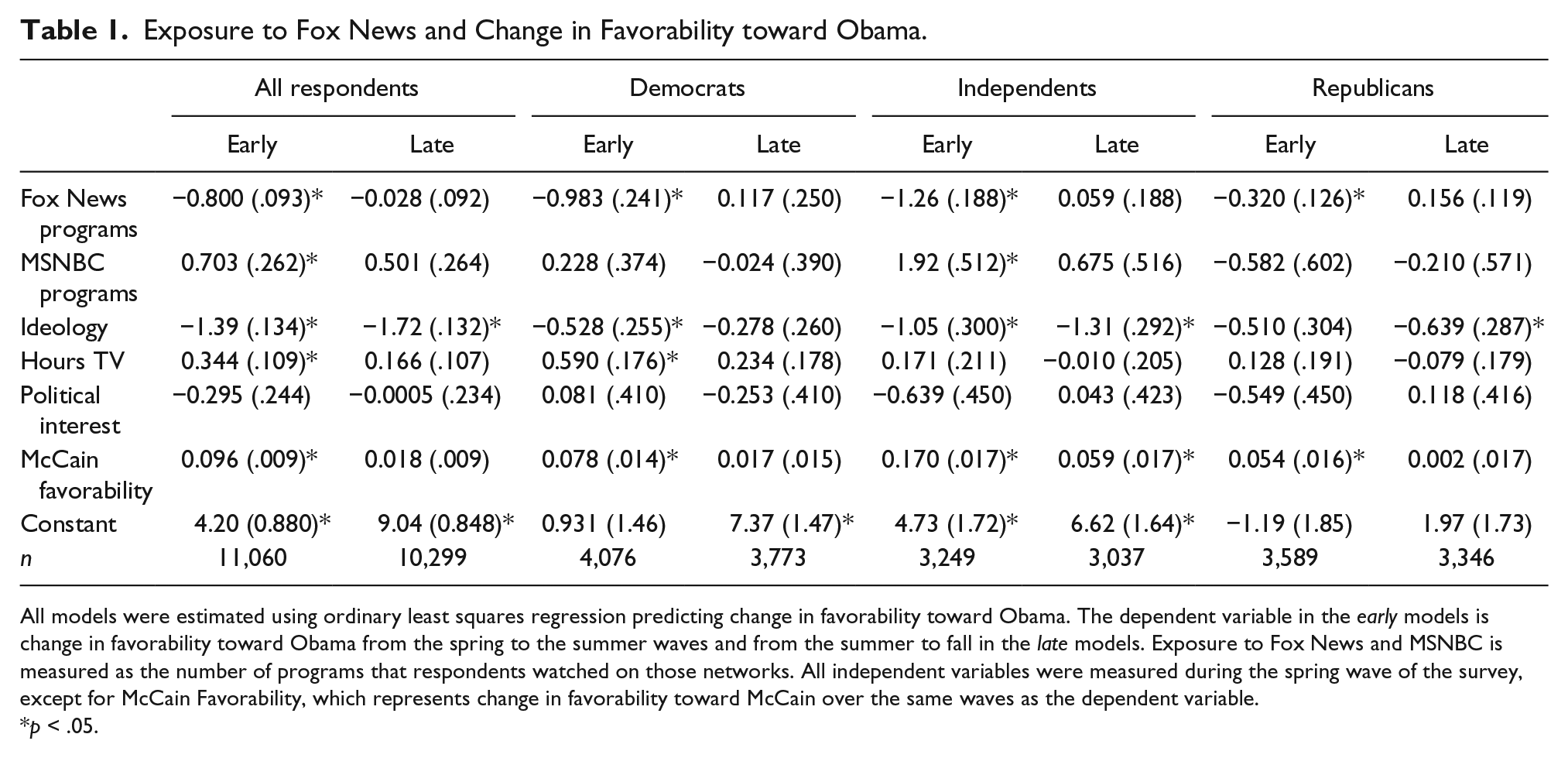
All models were estimated using ordinary least squares regression predicting change in favorability toward Obama. The dependent variable in the early models is change in favorability toward Obama from the spring to the summer waves and from the summer to fall in the late models. Exposure to Fox News and MSNBC is measured as the number of programs that respondents watched on those networks. All independent variables were measured during the spring wave of the survey, except for McCain Favorability, which represents change in favorability toward McCain over the same waves as the dependent variable.
p < .05.
Partisan Media Content and Opinion Change
In the second part of this analysis, I use variation in Fox News coverage to predict variation in viewers’ attitudes toward Obama. Using panel data and fixed-effects regression allows me to compare each respondent with their responses at different points in time. This is similar to a repeated-measures design in which each respondent is exposed to different amounts of coverage at different points in time, with the survey conducted the week following each exposure. The design capitalizes on the mostly exogenous nature of content variations and the random selection of the survey date.
The primary independent variable was created by summing the total minutes that each program devoted to Obama during the week prior to that respondent’s interview. Specifically, I multiplied the number of minutes each program devoted to Obama by the binary variable indicating that the respondent selected that program in the survey. 10 I then summed all Fox News programs, creating a measure of coverage on the Fox News programs that each respondent watched throughout the campaign. I also created a variable measuring exposure to MSNBC content to include as a control. The exact formulas used to create these variables are available in Online Appendix Table A1. Of course, there is no way to be absolutely sure that viewers were exposed to every minute of content on the programs they watched in the last month. It is reasonable to assume, however, that those saying they watched a program in the last month were more likely to see content than someone who does not watch the program. Furthermore, to be counted as viewers of a program, respondents had to select it from the list in both the spring and fall waves of the survey, which should provide more confidence that they are regular viewers.
Table 2 shows the effects of increased coverage of Obama on his favorability. In support of Hypothesis 1, increased coverage of Obama preceded lower favorability among viewers. From the spring to summer waves, exposure to an additional thirty minutes of Fox News coverage of Obama predicted 3.24 points lower favorability toward Obama, compared with a 0.15 decrease from the summer to fall waves of the survey. In addition, this pattern was similar among Republicans, Independents, and Democrats, suggesting that Hypotheses 1 and 2 hold regardless of party identification. In short, increased coverage on Fox News affected viewers early in the campaign, but not later in the year.
Fixed-Effects Regression Predicting Favorability toward Obama.
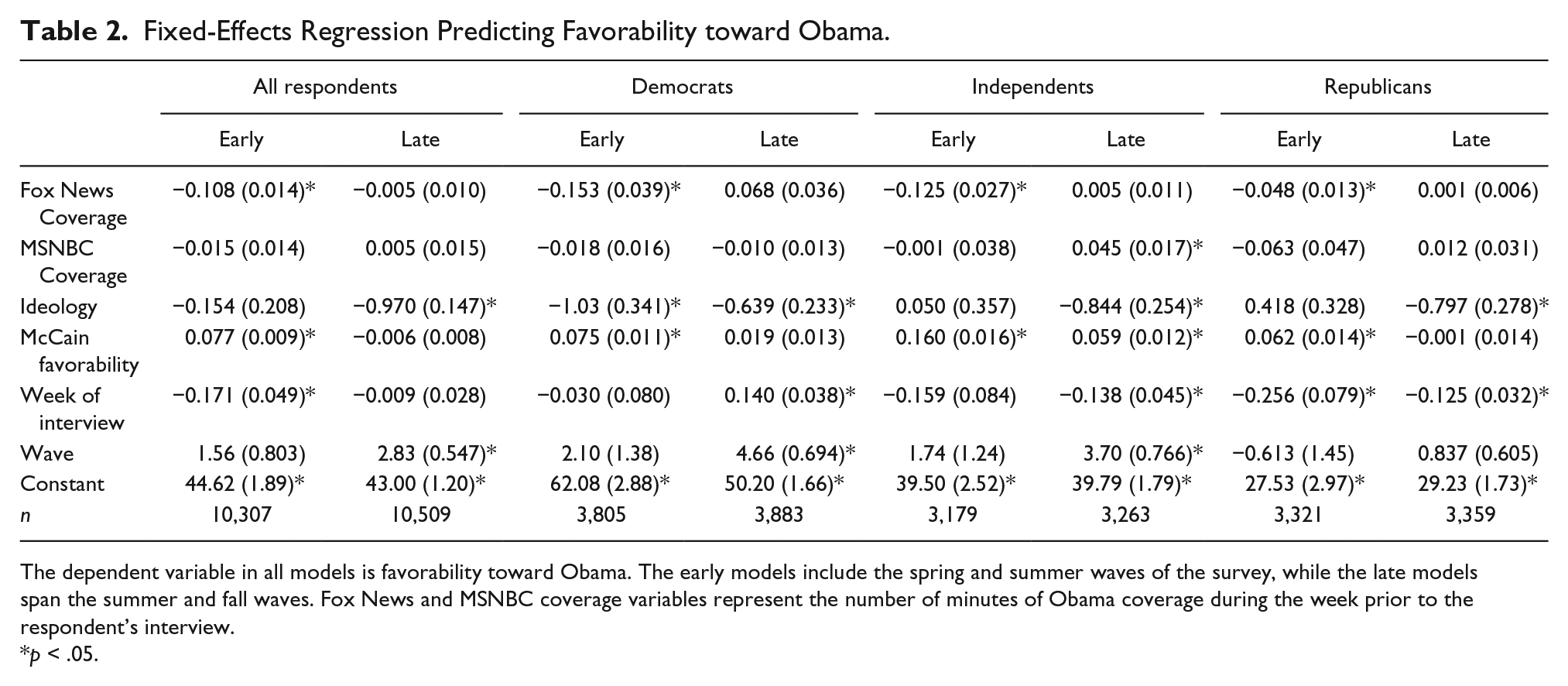
The dependent variable in all models is favorability toward Obama. The early models include the spring and summer waves of the survey, while the late models span the summer and fall waves. Fox News and MSNBC coverage variables represent the number of minutes of Obama coverage during the week prior to the respondent’s interview.
p < .05.
Dividing the Opposition
Thus far, the results suggest that Fox News was able to turn Democrats against Obama during the Democratic primary. Was this effect limited to Democrats that supported other candidates in the primary? To test Hypothesis 3, I conducted the same analysis as above, but separated Democrats based on their expected vote in the primary election. Table 3 shows the results from regression models using exposure to Fox News to predict change in favorability toward Obama among primary voters. Consistent with Hypothesis 3, exposure to Fox News predicted lower favorability toward Obama, but only among Democrats that supported other candidates in the primary. During the general election period, exposure to Fox News did not predict changes in Democrat’s favorability toward Obama, regardless of who they supported in the primary.
Change in Obama Favorability among Democratic Primary Voters by Candidate Support.

Cells contain coefficients from OLS regression models predicting change in favorability toward the candidates. Standard errors are in parentheses. Models only include those identifying with the candidate’s political party, and respondents are separated by their expected vote in the political primary in their state. Expected primary vote was measured during the winter wave of the survey because McCain clinched the nomination prior to the end of the spring wave.
p < .05.
To further examine this question, Table 4 shows the effects of increased coverage on Democrats’ support for Obama. Once again, the results are consistent with Hypothesis 3, as Fox News only affected Democrats who did not support Obama in the primary. Meanwhile, increased coverage of Obama had no apparent effect on Obama’s supporters during the primaries. As expected, Fox News did not lower favorability toward Democrats from the summer to fall waves. In fact, increased coverage of Obama predicted higher favorability among Democrats during the general election. Altogether, these results suggest that partisan media might contribute to divisive primaries, but may also help rally opposing partisans around their nominee during the general election.
Fixed-Effects Regression Predicting Obama Favorability among Democratic Primary Voters by Candidate Support.
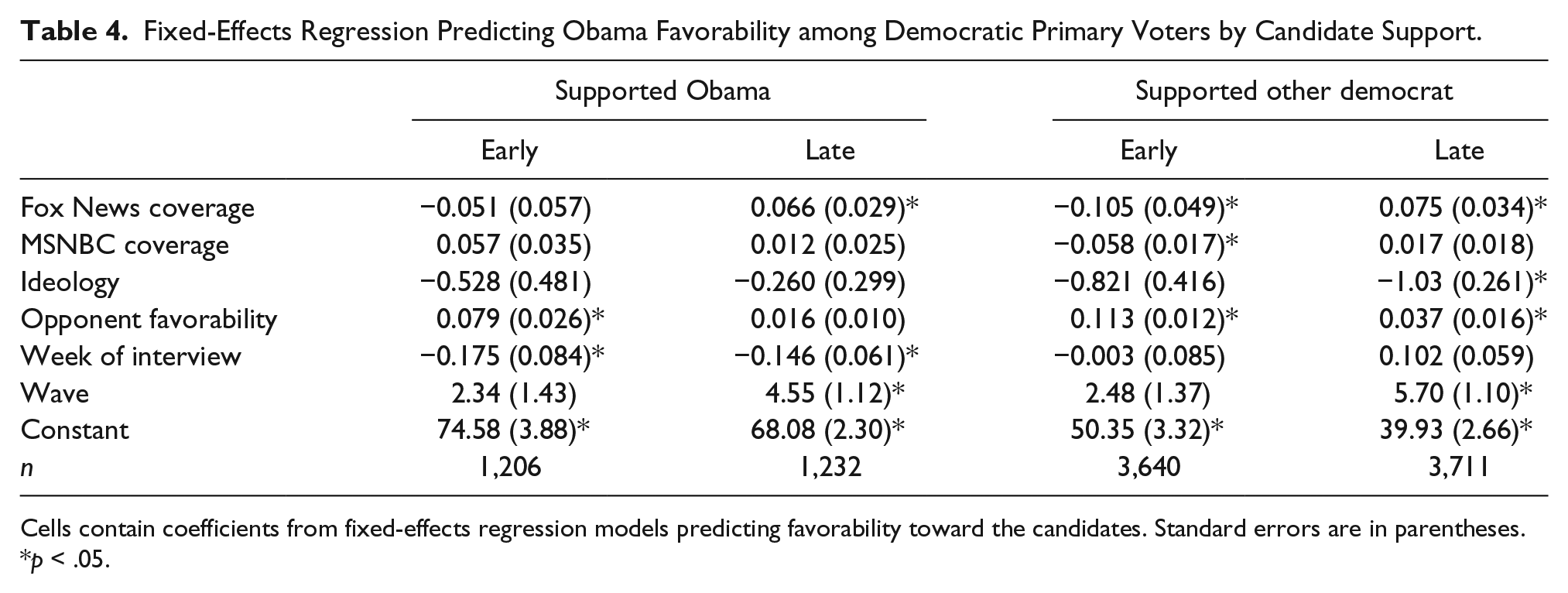
Cells contain coefficients from fixed-effects regression models predicting favorability toward the candidates. Standard errors are in parentheses.
p < .05.
It is important to approach these results with caution, however, because they are based on very small subsamples. Although 381 Democrats watched at least one program on Fox News, only ninenty-six supported Obama and 285 supported another candidate. Although the results suggest that partisan media may be able to divide opposing partisans in the primary, I hesitate to draw any conclusions given the limitations of this data. In other words, these results should be interpreted as exploratory rather than confirmatory. Nonetheless, scholars studying divisive primaries may benefit from considering partisan media’s role in stoking intraparty conflict prior to the general election.
Variation by Political Knowledge
To supplement the previous analysis and to examine Hypotheses 4 and 5, I turn to data from the NAES rolling cross-section telephone survey. Recall that the rolling cross-section (RCS) telephone survey sampled a new group of respondents every day, which I group into weeks from Monday through Friday. An important difference between the panel and telephone survey was the measurement of respondents’ exposure to television news. Whereas the panel survey asked whether respondents watched specific programs, the telephone survey only asked which channel was respondents’ primary source for news. 11 Exposure to Fox News is represented as a binary variable indicating whether the respondent listed Fox News (16%) as their primary news source. 12 I then created an interaction variable by multiplying the binary Fox News variable by the number of minutes of coverage devoted to Obama on all Fox News programs. Including interactions in a regression model isolates the effects of Fox News coverage on candidate favorability, but only on those respondents who rely on Fox News as their primary news source. I also include the binary exposure variables to control for differences in characteristics among those using Fox News as their primary source. 13
Figure 1 shows the effects of thirty minutes of weekly Fox News coverage on viewers’ favorability toward Barack Obama. The full models used to produce Figure 1 can be found in Online Appendix Tables B1 and B3 (political knowledge). It is important to note that the RCS survey measured favorability on a 0 to 10 scale instead of the 0 to 100 scale for the panel data. The models under the “Early” heading only included respondents interviewed from January 1 through June 4, which is the day Hillary Clinton officially withdrew from the Democratic primary. Following Clinton’s withdrawal from the race, intraparty competition gave way to interparty competition, thus changing the motivation of Democrats that did not support Obama during the primary. 14 The “Late” models only include respondents interviewed from June 5 to Election Day.

The effects of coverage on Obama favorability.
Similar to the previous analysis using panel data, the results suggest that Fox News only affected viewers early in the campaign. Among all viewers, an additional thirty minutes of Fox News coverage of Obama predicted a 0.20 decrease in Fox News viewers’ favorability toward Obama (from 0 to 10) prior to June 4, compared with a 0.04 decline in favorability during the general election. Although the coefficient for Democrats was not significant (p < .05), this was likely due to a small weekly sample of Democrats using Fox News as their primary source. 15 Consistent with Hypothesis 2, Fox News had no apparent effect on Obama’s favorability late in the campaign.
To further examine when Fox News affected viewers’ perceptions of Obama, I estimated models on a four-month rolling basis. Figure 2 shows the effects of thirty minutes of Obama coverage on his favorability during four-month periods from January through October. The complete models are available in Online Appendix Table B3. The results in Figure 2 suggest that Fox News had its largest effects during the first few months of the year, but little to no effect during the summer and fall months. From February through the end of May, an additional thirty minutes of Fox News coverage predicted a 0.21 decrease in favorability among Fox News viewers the following week. In contrast, increased coverage of Obama on Fox News had almost no effect on Obama’s favorability from June through October. To be clear, over the last five months of the election, increased coverage of Obama on Fox News did not predict subsequent negativity among Fox News viewers.
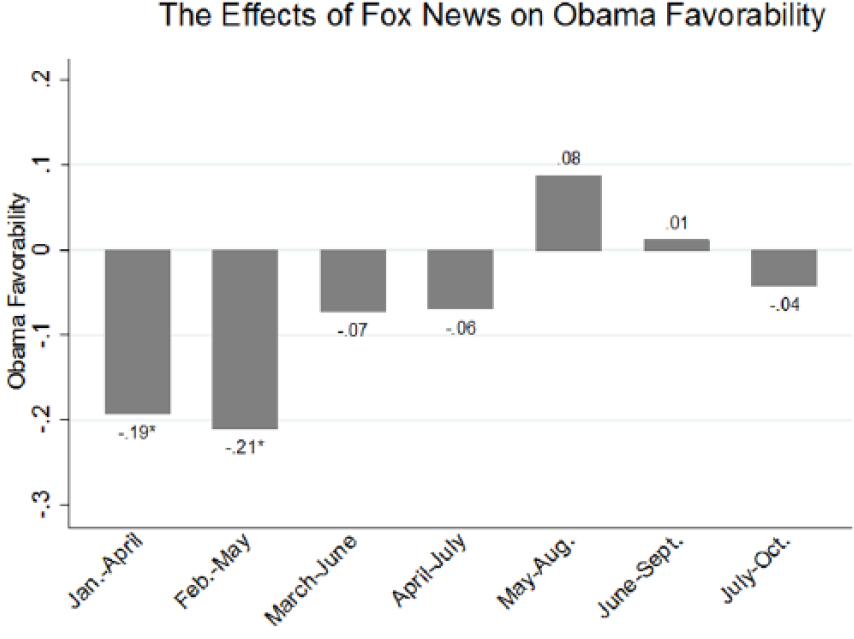
The effects of Fox News on Obama favorability.
Unlike the online panel survey, the telephone portion of the NAES includes questions measuring respondents’ general political knowledge, which allows me to test Hypotheses 4 and 5. 16 The results in Figure 1 provide support for Hypothesis 4, as Fox News affected low-knowledge viewers both early and late in the election. Among low-knowledge viewers, an additional thirty minutes of Obama coverage predicted a 0.25 drop in Obama’s favorability early in the election, compared to a 0.13 drop late in the campaign. Consistent with Hypothesis 5, Fox News coverage appeared to make high-knowledge viewers less favorable toward Obama early in the election, but those effects disappeared over the last five months of the election. In short, these results are consistent with Hypotheses 4 and 5, as partisan media effects appear to diminish among politically knowledgeable viewers, but not low-knowledge viewers.
Discussion
Scholars have devoted a lot of attention to understanding how partisan media affect public perceptions of the candidates during election periods (Prior 2014). However, rarely have scholars given much thought to when partisan media effects are most likely to occur during an election cycle. I argue that partisan media effects are more likely to occur early in the election when viewers are forming initial impressions of the candidates and are less motivated to defend their party’s nominee. Late in the campaign, partisan media are only likely to change candidate impressions among low-information viewers who tend to rely on recently salient information rather than long-standing impressions. The empirical results are consistent with this theory. Fox News appeared to affect attitudes toward the Democratic nominee during the Democratic primary, but those effects disappeared during the last five months of the campaign. Furthermore, Fox News’s effect persisted only among less politically knowledgeable viewers.
To be sure, the effects of partisan media early in the election are not entirely due to weak opinions. Although weak opinions are more susceptible to change, the information environment prior to the general election contributes to the effects of partisan media. During the primary, Democrats appeared to be less motivated to defend Democratic candidates from counter-attitudinal media sources. From January through May of 2008, Fox News only lowered Obama’s favorability among Democrats that supported other candidates in the primary. Thus, partisan media may contribute to divisive primaries by turning opposing partisans against in-party candidates.
Perhaps the most important finding is that Fox News had no apparent effect on most viewers over the last five months of the election. If researchers only tested for effects during the general election period, they would have concluded that partisan media had minimal effects on public opinion. Studies may be missing important media effects simply because surveys are conducted after the effects occurred. These results underscore the importance of testing for media effects early in the election, when candidate impressions are less informed and intraparty competition is more salient than interparty competition.
The main obstacle to measuring media effects early in the election is simply a lack of available survey data. Fortunately, the NAES conducted two large-scale surveys throughout the entire election year in 2008, and included sufficiently large samples to identify effects on small subsamples of partisan media viewers. Many political scientists rely on surveys conducted during the last few months of the election, such as the American National Election Study. Unfortunately, such surveys are administered long after partisan media have helped most viewers form their impressions of the out-party candidate. Although studies during this time period might still find effects, they are likely limited to low-knowledge viewers who tend to rely on recently salient considerations. More politically knowledgeable viewers made up their minds during the primaries with the help of their preferred partisan news source. Absent the sort of large-scale data used in this study, experiments could potentially test for diminishing effects using a repeated-measures design, or perhaps dynamic process tracing (Lau and Redlawsk 2006). To my knowledge, no experiment has yet incorporated partisan media into a repeated-measures design, but there is certainly potential for future research.
When interpreting this research, it is important to keep a few limitations in mind. For one, this study only examines one partisan news source during one election. I chose to limit the scope of this analysis to Fox News because there were an insufficient number of MSNBC viewers in the samples. This was particularly problematic when examining the effects of content variation on subgroups such as Republicans and low-knowledge viewers. For the benefit of readers, I replicated all the previous analyses, but predicting the effects of MSNBC on favorability toward John McCain. The results are available in Online Appendix C. As expected, exposure to MSNBC predicted opinion change in ways consistent with Hypotheses 1 to 3. However, when content was the independent variable, the results were wildly inconsistent across time periods and surveys. Although inconsistent empirical findings are not necessarily a limitation of a research design, it is likely that these particular results were hampered by a small sample size for MSNBC viewers.
It could be that this phenomenon is limited to Fox News, or it could be that Fox News simply had a sufficiently large audience to capture the effects. Alternatively, these results could stem from the different ending periods for the Republican and Democratic primaries in 2008. John McCain clinched the Republican primary early in the year, but the Democratic primary lasted until the summer. 17 Moreover, opinions of John McCain may have been more stable than Obama because he had been in the national spotlight for longer—including his unsuccessful bid to win the Republican nomination in 2000. Regardless, future research is needed to replicate these results using different news sources and elections.
On a related note, these results could be an artifact of the 2008 presidential election and may not generalize to other races that include incumbents or more nationally recognized politicians. Ideally, I would replicate this analysis in both 2004 and 2012, but I too am limited by the availability of survey data. Few large-scale surveys are conducted on a daily basis over the entire course of an election year. In fact, this limitation underscores one of the most important contributions of this research, which is to point out how data availability limits theoretical advancements in the study of media effects. Perhaps previous research ignored the timing of partisan media effects because they did not have the data to test it empirically. This study takes a first step in conceptualizing media effects as dynamic over the course of an election cycle. Hopefully, as Internet surveys become less expensive, scholars will have greater flexibility to incorporate time sensitive dynamics into the study of partisan media and political campaigns.
Footnotes
Acknowledgements
The author thanks the Annenberg Public Policy Center and the Project for Excellence in Journalism for collecting these data, making it available for public use.
Declaration of Conflicting Interests
The author(s) declared no potential conflicts of interest with respect to the research, authorship, and/or publication of this article.
Funding
The author(s) received no financial support for the research, authorship, and/or publication of this article.
Notes
Supplemental Material
The survey data used in this analysis are available at the Annenberg Public Policy Center website (http://www.annenbergpublicpolicycenter.org/political-communication/naes/), whereas the content analysis data came from the 2008 campaign coverage index that was downloaded from the Project for Excellence in Journalism website ( ).
).
References
Supplementary Material
Please find the following supplemental material available below.
For Open Access articles published under a Creative Commons License, all supplemental material carries the same license as the article it is associated with.
For non-Open Access articles published, all supplemental material carries a non-exclusive license, and permission requests for re-use of supplemental material or any part of supplemental material shall be sent directly to the copyright owner as specified in the copyright notice associated with the article.
