




Abstract
Local governments prioritize spending on various types and levels of public services. Although scholars have shown that citizen preferences and institutional factors, such as economic, political, and legal arrangements, play a role in resource allocation, scholars have not systematically examined the impact of local elected officials’ own ideological preferences on service prioritization. A better understanding of the impact of personal ideology on local government resource allocation is needed as this provision of funds has implications for democratic governance and responsiveness. We develop and use a novel measure of local elected official ideology using a 2011 survey of California local elected officials to test the hypothesis that local decision-maker ideology affects attitudes on funding-specific service categories. We find evidence that local elected officials’ attitudes toward service reductions are associated with both their own individual ideology, measured on the conservative–liberal spectrum, and the ideology of their constituents.
Keywords
One of the core functions of municipal government is the delivery of a wide array of public services, such as public safety, parks and recreation, transportation, housing, and public welfare. Through the allocation of limited resources to a variety of public services, municipalities have a direct and substantial impact on citizens’ quality of life. But why do local governments prioritize some services for funding and not others? Public administration and political science scholars devote substantial attention to understanding what determines governments’ prioritization of spending for various services at all levels of government. Urban scholars have examined the impact of economic constraints and citizen preferences on municipal resource allocation decisions (Kantor 1995; Peterson 1981; Tiebout 1956). Tiebout (1956) suggests that local governments offer a package of public services to attract citizens who vote with their feet by moving to the municipality that best aligns with their preferences for the type, level, and cost of services provided. Others suggest that the allocation of limited government resources to local public services is a function of a municipality’s economic resources (Peterson 1981), inter-governmental resources (Kantor 1995), or political arrangements (Lubell, Feiock, and Ramirez 2009; McCabe and Feiock 2005; Schaffner, Streb, and Wright 2001).
Despite evidence at the federal level that the political ideology of elected officials affects expenditure priorities at other levels of government (Bertelli and Grose 2009; Cox and McCubbins 1986), previous research on local expenditures has not included analysis of the political ideology of local elected officials. Instead, research has focused primarily on the influence of public opinion, economic, and institutional constraints. The difficulty of measuring local elected official ideology contributes to this gap in the literature and is an obstacle we seek to overcome in this article.
In this study, we use a novel measure of local elected official political ideology to examine its relationship with elected officials’ attitudes toward resource allocation, controlling for economic constraints, institutional constraints, and local constituent ideology. Our method, which on its own is useful for future research on local governance, makes use of item response theory (IRT) to estimate the ideology of local elected officials in California. Our examination allows for a better understanding of the motivations behind resource allocation priorities at the local level. Findings suggest that increasingly conservative officials are less likely to cut services in six policy categories (corrections, fire protection, housing and community development, parks and recreation, and arts and culture) compared with the base category of public welfare services. In addition, officials representing municipalities with more liberal voters are less likely to cut the base category of public welfare services than four of the other municipal service categories (libraries, police protections, corrections, and transportation). Taken together, our results offer evidence that though citizen preferences do affect local elected official attitudes toward service provision, the ideological leanings of the local elected officials themselves also play a significant role in spending priorities. This is a novel finding that contributes to our understanding of resource allocation, as the role of local decision-maker ideology is largely absent from the literature on local government resource allocation to this point.
Economic and Municipal-Level Determinants of Local Policy Priorities
Although national elected officials address a diverse set of policy issues including foreign affairs, the federal budget, and social issues, the attention of local elected representatives is focused more acutely on the delivery of a wide array of public services. These services include, but are not limited to, public safety, transportation, public works and utilities, economic development, and public welfare. The allocation of resources to these services is significant. As of 2013, there were 89,004 local governments in the United States, who collectively spent roughly $1.7 trillion in direct annual expenditures (Barnett et al. 2014)—more than twice the combined annual expenditures of the state governments of California, Texas, Florida, and New York (U.S. Census Bureau 2013).
Local government officials have strong incentives to adopt policies that retain and enhance the revenue stream (or the local tax base), especially when they have a high degree of fiscal autonomy and a mobile population (Buchanan 1971; Tiebout 1956). According to Tiebout’s (1956, 418) model of local expenditures, “various [local] governments have their revenue patterns more or less set. Given these revenue and expenditure patterns, the consumer-voter moves to that community whose local government best satisfies his set of preferences.” In other words, local politicians make resource allocation decisions to attract and retain like-minded consumer-voters within their locality. In Tiebout’s (1956) model, resource allocation is, at its core, driven by citizen preferences.
Officials may also consider institutional constraints, such as fiscal capacity and the economic well-being of their community, in determining resource allocation levels. Fiscal capacity is the ability of a government to generate taxes and other revenues in relation to the cost of its service or spending obligations (F. S. Berry 1994; Johnson and Roswick 1991). In the case of declining fiscal capacity, local governments are limited in their ability to increase the allocation of resources to various service areas due to a poor ability to generate revenues. In an effort to maintain the tax base and revenue stream, municipal politicians draft policy and allocate resources to promote economic development activities in the community (Hajnal and Trounstine 2010). Peterson (1981) theorizes that economic development is a primary concern among local elected officials. He argues that in the case of developmental services (those that enhance the local economy or local tax base by generating additional revenue), fiscal capacity has little impact on expenditure levels, but measures of demand strongly affect resource allocation. In the case of “housekeeping” services (those that have neither a positive nor negative effect on the local economy, such as garbage collection), fiscal capacity, supply, and demand all have a moderate impact on expenditure levels. For redistributive services (those that transfer wealth to help the needy and unfortunate, such as old age assistance and housing), fiscal capacity, rather than supply and/or demand, has the strongest impact on expenditure levels (Peterson 1981, 49). Others have shown that municipal-level demographic factors, such as population change, race, and a municipality’s age distribution, may also affect city expenditures (Morgan and Watson 1995) and play a role in resource allocation to certain services, specifically social welfare services (Craw 2010).
Political Ideology and Policy Outputs and Expenditures
Several scholars argue that municipal governments are responsive to the political ideology of residents in expenditure decisions (Choi, Bae, and Feiock 2010; Tausanovitch and Warshaw 2014). One common definition of political ideology is “a set of beliefs about the proper order of society and how it can be achieved” (Erikson and Tedin 2003, 64). The liberal–conservative spectrum can be thought of as containing two aspects: advocating versus resisting social change and rejecting versus accepting inequality (Jost et al. 2003). Ideology predicts citizens’ general value orientations with liberals exhibiting greater egalitarianism (Evans, Heath, and Lalljee 1996; Federico and Sidanius 2002), whereas conservatives emphasize principles of meritocracy (Kluegel and Smith 1986; Skitka 1999; Skitka et al. 2002). Generally, liberals exhibit a stronger preference for social change and equality compared with conservatives (Anderson and Singer 2008; Jost, Banaji, and Nosek 2004; Nosek, Banaji, and Jost 2009).
The idea that citizen preferences influence local decision making is a core tenet of representative democracy, and a significant literature has sought to demonstrate this linkage (Achen 1978; Blais, Blake, and Dion 1993; Downs 1957; Enns and Wlezien 2011; Ezrow et al. 2011; Kang and Powell 2010; McDonald and Budge 2005; Powell 2000). Downs (1957) suggests that when competing for votes, politicians and parties converge on the median voter to win a majority; this majority then monitors the government to ensure their preferences are implemented. Elected officials competing for votes are thus influenced by the preferences of their constituents (Choi, Bae, and Feiock 2010; Clingermayer and Feiock 2001; Dahl 1961; Hajnal and Trounstine 2010; Meier, Stewart, and England 1991). In addition, the literature on elected officials serving in state or national office has shown that electorally ambitious officials draft policy to appeal to the preferences of their constituents and earn future votes (Erikson, Wright, and McIver 1993; Kousser, Lewis, and Masket 2007; Mayhew 1974).
With regard to political ideology, the expectation is that among liberal populations and voters, policy should be more liberal than in those localities where the public holds more conservative views (Erikson, Wright, and McIver 1993; Tausanovitch and Warshaw 2014). For instance, Choi, Bae, and Feiock (2010) find that while economic, institutional, and demographic factors play a role in local government expenditure choices, so too does citizen ideology. Studies have also shown that citizen attitudes toward public welfare services and public safety are consistently associated with ideology (Feather 1985; Kluegel 1990; Kluegel and Smith 1986; Skitka et al. 2002; Skitka and Tetlock 1993). Some service categories are viewed more favorably and as more deserving of public funding by conservatives than by liberals and vice versa. For example, conservatives generally favor increased crime control efforts (Beckett 1997; Jacobs and Helms 1996). Research in various states has suggested that Republicans are more likely to support punitive crime control tactics (Cook and Lane 2009). With regard to expenditures, Republicans are more likely to support building new jails, whereas Democrats are more likely to support community service programs as an alternative to incarceration (Welsh 1993). Multiple studies have shown a linkage between citizen ideology and state incarceration rates (Greenberg and West 2001; Jacobs and Helms 2001), and others find that Republican strength in state legislatures is significantly and positively associated with state spending on corrections (Stucky, Heimer, and Lang 2007).
In general, at all levels of government, research has consistently suggested that liberals generally favor increased spending on wealth-transfer social programs, such as housing, health and hospitals, and public welfare, whereas conservatives prefer decreased spending on these services (Feather 1985; Kluegel 1990; Kluegel and Smith 1986). Following an unparalleled expansion of public welfare programs in the 1960s and 1970s, spending on social services has come under attack by more conservative politicians seeking to scale back the “welfare state” (Pierson 2006). Ultimately, in the most recent work on the topic, Tausanovitch and Warshaw (2014) provide strong evidence that municipal policy across a spectrum of policy issues corresponds with the liberal–conservative ideology of citizens.
Taken together, the research on public expenditures directed toward public welfare and corrections or criminal justice at the state and national level suggests that ideology does play a role in public expenditure priorities. Despite the absence of measures of local official ideology in most studies of municipal expenditures, prior work at other levels of government suggests that decision-maker ideology is associated with policy outcomes and expenditure decisions (Bertelli and Grose 2009, 2011; Clinton et al. 2012).
The Role of Decision-Maker Ideology in Policy Making
Most local elections for city and county councils are non-partisan elections in which candidates run without any party labels to signal ideology or party to voters. Although these non-partisan local elections do not include party labels on ballots, political parties may still be involved in these elections in some capacity, but we expect this is primarily in larger cities. Local elections are covered parsimoniously by the media (McDermott 1998) and are widely considered to be low-information elections in which voters rely on non-partisan cues such as incumbency (Krebs 1998) or demographic information such as gender or ethnicity (Lien 1998; Longoria 1999; Squire and Smith 1988; Vanderleeuw 1990). If voters in low-information, high voter fatigue elections rely on such simple cues as gender and ethnicity to select a candidate, there may be a low degree of congruence between citizen ideology and legislator ideology. In other words, voters in local elections may be particularly distant, ideologically, from their elected officials as ascertaining the ideology of candidates is difficult and costly for voters in non-partisan, low-information local elections. Furthermore, lacking partisan signals and clear ideological labels makes it even more difficult for voters to hold local politicians accountable for their adherence to the party line, or the general notions associated with each ideology.
In addition, though local government budgets are public record and available to citizens, they often run hundreds of pages long and can be difficult for the average citizen to comprehend or analyze. Many citizens, even those with strong ideological leanings, are inattentive to non-controversial decisions on local expenditures. Considering both the nature of local elections and the potential for inattentiveness to local resource allocation decisions, we argue citizen ideology and local elected official ideology should be considered separately in empirical analyses of local government decision making.
We present two key hypotheses with regard to local decision-maker ideology and resource allocation priorities. Given that elected officials were asked to choose one service category from a list of several for which they would most support a reduction in funding, we use public welfare as a base service category against which to compare the other service categories. Although any service category could have been selected as the base case, we selected public welfare services for two reasons. First, public welfare services have been shown to have a clear ideological linkage in the previous literature (with liberals favoring increases in public welfare spending and conservatives opposed) allowing for clear comparisons with other service categories. Second, though public welfare expenditures account for approximately 6 percent of direct local government expenditures in California, these expenditures are still significant, with local governments in California spending roughly $16.9 billion on public welfare in 2013 (U.S. Census Bureau 2013). Using public welfare services as the base category, we predict the following:
The first hypothesis tests the notion that more liberal constituencies will place pressure (via electoral incentives) on elected officials to oppose the reduction of spending on public welfare services over other municipal services. The first hypothesis, conversely, predicts that more conservative constituencies will affect the local elected official’s attitude such that he or she will be more likely to support the reduction of public welfare services over other municipal services. The alternative hypothesis is that the ideological disposition of a local constituency has no impact on an elected official’s likelihood of opposing the reduction of spending on public welfare services.
The second hypothesis tests the proposition that as a local politician becomes increasingly liberal, he or she is less likely to support a reduction in public welfare spending over spending in other service areas. However, the more conservative a local elected official is, the more likely he or she will be to support reducing spending on public welfare services over other municipal services. The alternative hypothesis is that personal ideology on a liberal to conservative spectrum has no impact on support or opposition to a reduction in public welfare spending.
Data and Methods
To test these hypotheses, we use data from the California Public Officials Survey, a web-based survey of city council members, county supervisors, and mayors in California municipalities conducted in the winter of 2011. California offers a unique setting for a study of local elected officials as it is often perceived as a leader on policy issues and has powerful institutions allowing for direct citizen democracy. However, California has a particularly large and diverse population. Indeed, Ramakrishnan and Baldassare (2004) find that some groups, including Latinos, Asian-Americans and African-Americans, are much less represented in political processes than other groups in statewide and local issues. In addition, at the local level, California elections for both city and county posts are non-partisan, meaning that ballots do not list the political party each candidate belongs too.
The statewide survey was distributed by email and mail to all local elected officials in California (N = 1,865) and garnered 478 responses from across the state, resulting in a 25.6 percent response rate, more than the typical response rate of surveys of the mass public. Of those, 392 observations included enough data to estimate the revealed ideology of the respondents. Those who received the survey were asked questions about the most important issues facing their municipality, the services provided by their city, and the types of services they would support reducing during fiscal stress. Among respondents, 78 percent indicated that their municipality had already made service reductions in the past 12 months to at least one service area. Respondents were also asked a series of questions about their ideological leanings, political party affiliations, and their support or opposition to key statewide policy proposals.
Dependent Variables
We operationalize two dependent variables. First, we measure the intention to cut public welfare, or whether the local elected official indicated he or she would support reducing public welfare services over not reducing public welfare services. Second, we examine all service reduction options comparing the intent to cut public welfare services with all twelve other services listed on the survey, including education, libraries, public welfare, hospitals and health, police protection, corrections, fire protection, housing and community development, transportation, parks and recreation, public works and utilities, or arts and culture. These variables are based on the response to the question, “If it became necessary to reduce the provision of public services in your city/county in the next 12 months, in which single area would you most support service reductions?” Respondents could select only one category in which they would most support a reduction in spending. First, this nominal variable is coded a “1” if the local official responded “Yes” for the intent to cut public welfare variable, meaning they selected public welfare services for spending reductions over all other categories, and a “0” if they selected any other category. Of the respondents, thirty-six elected officials (8.09%) stated their intention to cut public welfare (the base case) as their top priority if further cuts were necessary. The remaining respondents selected one of the twelve other service categories as the area in which they would most support a service reduction. The second dependent variable included all service categories listed above.
Independent Variables
In both models, our two key independent variables, citizen ideology and personal ideology, are measures of constituent and elected official political ideology, respectively. In several previous studies, scholars make use of public opinion polling results or election outcomes to estimate the political preferences of voters at the local level (see Choi, Bae, and Feiock 2010; Hajnal and Trounstine 2010). In this study, the citizen ideology variable is measured as 1 minus the proportion of the electorate that voted for Obama in the 2008 election. The advantage of this measure is that it allows us to meaningfully compare one municipality with another across the state and obtain a measure of the general liberal or conservative leanings of each city. This variable is coded on a left–right scale from 0 to 1, with “0” indicating the most liberal municipality (with 100% of voters selecting Obama in the 2008 election) and “1” indicating the most conservative municipality (with 0% of voters selecting Obama in the 2008 election). For example, the city of Berkeley, California, the home of UC Berkeley, in which 92 percent of the municipal population voted for Obama in 2008 would be coded as a 0.08 on this scale.
The second key independent variable is our measure of local elected official ideology, called personal ideology and defined as the revealed ideology of the elected official estimated using IRT. Developed initially for educational and psychological testing (Baker 2001; van der Linden and Hambleton 1997), the IRT approach, unlike other scalar or factor analysis techniques, does not assume that each item on the survey contributes equivalently to the resulting estimate of political ideology. Over the last twenty years, IRT has gained a growing following in political science and public management scholarship. A similar methodology has been used to measure the ideology of members of Congress (Bertelli and Grose 2006; McCarty, Poole, and Rosenthal 2001; Poole and Rosenthal 1997, 2007), agency heads and federal employees (Bertelli and Grose 2009; Clinton et al. 2012), voters (Bafumi and Herron 2010; Clinton 2006), organizations (Bonica 2013; McKay 2008, 2010; Poole and Rosenthal 1997, 2007), and nonprofit leaders (Mason 2015).
Personal ideology is thus estimated for each local elected official by comparing survey responses on eighteen policy issues that had recently been before the California state legislature using a method developed by Clinton, Jackman, and Rivers (2004) and an estimation technique designed by Martin and Quinn (2002). Policy issues on the survey included “Banning offshore drilling for natural gas” or “Requiring all health insurers to provide prenatal health care coverage for pregnant women.” These policy proposals were selected because they showed a strong distinction (discrimination) between liberal and conservative votes on the floor of both houses of the California legislature, and also were expected to have a high level of salience among other political elites including local elected officials. 1 Even though a local politician may not be considering a particular policy for enactment at the local level, respondents’ support or opposition to the policy being enacted at the state level is a signal of their conservative or liberal leanings. By asking respondents if they support or oppose each policy, their survey responses are thus treated as if they are roll call votes, with a “support” response being the same as a “yea” on the floor of the legislature. Mapped or appended onto the roll call votes in the legislature, this provides an opportunity to “bridge” between these two levels of government, comparing the ideology of legislators and local officials on the same issues. Because we are able to directly model the dichotomous responses to the survey items and roll call votes as a function of the latent variable, we avoid key assumptions such as the multivariate normal distribution for observed items required by factor analysis and alleviate concerns over identification of the political ideology measure we generate.
Each item (or survey question) has both difficulty and discrimination properties on an item characteristic curve (Baker 2001). Originating in educational testing, a “difficult” question will function well among those more able (in an educational context) and an easy question will function best among those with a lower ability. Discrimination, however, is how well each item differentiates between those with lower and higher ability. The steeper the curve, the better the item is able to discriminate (Baker 2001). In the context of the measure in this study, an item’s discrimination will help differentiate a “liberal” on the left side of the scale, from a “conservative” on the right.
The parameters estimated are the ideal points themselves, F, or the local official’s revealed political ideology, including a difficulty parameter (the intercept) α j and the discrimination parameter (slope) where the legislator i votes on the roll call j. Roll call votes were coded 1 for “Yea” and 0 for “Nay.” The discrimination parameter β j captures the weight of change in the probability of voting yea on a roll call as the member’s ideal point θ i moves from liberal to conservative.
The IRT model we use asserts that subject j’s observed response to item (question) i is driven by a latent utility ui,j = biqj − ai + ei,j, where qj is a latent variable we term personal ideology, ai is the difficulty parameter, and bi is the discrimination parameter. The model is identified through a priori constraints on the latent variable as suggested by Clinton, Jackman, and Rivers (2004). In a unidimensional space estimated through Bayesian methods, it is necessary to provide two linearly independent restrictions on the ideal point to assist in identifying the model. Specifically, we set prior restrictions on the ideal points of four extremists in the legislature, a liberal (set at “−1”) and a conservative (set at “1”) in each house based on the selected roll call votes (seven of which were on the survey). On the right is Assemblyman Paul Cook (Republican, Yucca Valley) and Senator Roy Ashburn (Republican, Bakersfield); on the left is Assemblyman Mike Eng (Democrat, Monterey Park) and Senator Loni Hancock (Democrat, Oakland).
Estimates revealed that the mean ideology value for the California Senate was −0.361, the Assembly was −0.102, and the survey respondents was 0.037. Figure 1 provides the distribution of respondents compared with the distribution of the state elected officials, demonstrating that while the California state legislature is polarized by party affiliation with a bi-modal distribution, California local elected officials who responded to the survey were relatively normally distributed and more conservative than the California Legislature. We suspect the unimodal distribution of local elected officials can be partially attributed to the institution of non-partisan elections, but full analysis of this phenomenon is beyond the scope of present discussion. 2
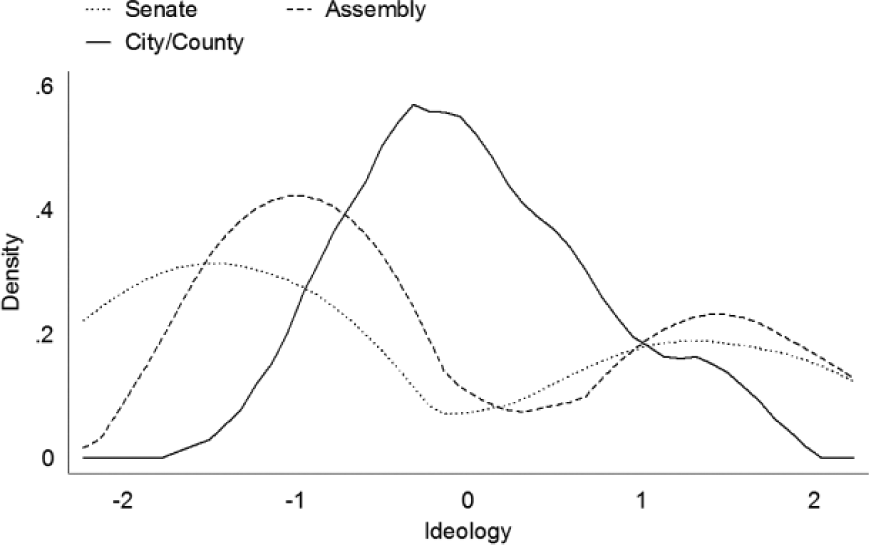
Revealed ideology of California legislators and city/county officials.
To provide face validity for our measure of personal ideology, the values created through IRT were compared with the respondents’ answer to one additional question on the survey: “Do your current views lean toward the Republican Party or Democratic Party?” In addition to the two partisan response options, “Decline to State” was also offered as a response option to survey participants. Figure 2 shows the distribution of the respondents by ideology and self-reported party. As Figure 2 shows, those respondents who lean more toward the Democratic Party are to the left on the personal ideology scale of those who lean more toward the Republican Party. Those who declined to state a preference are generally distributed between those who were willing to share their partisanship status.
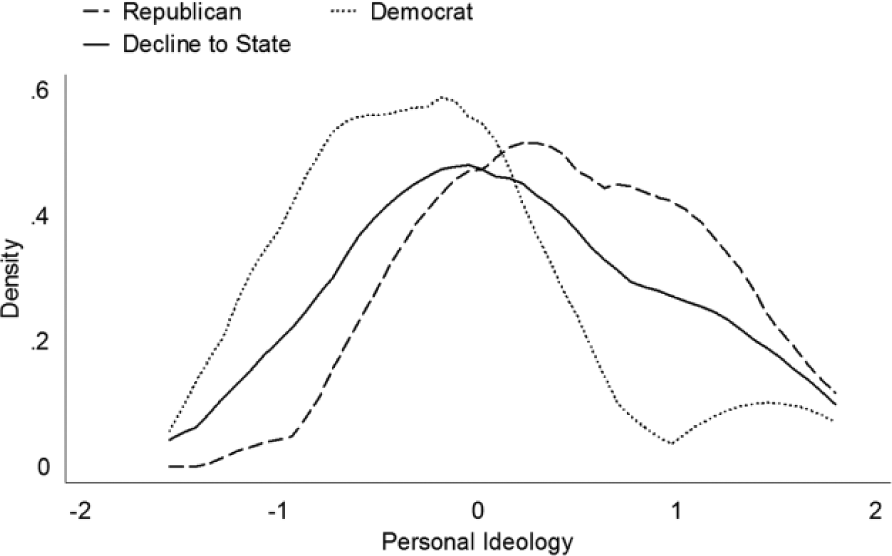
Personal ideology of elected officials by self-reported party.
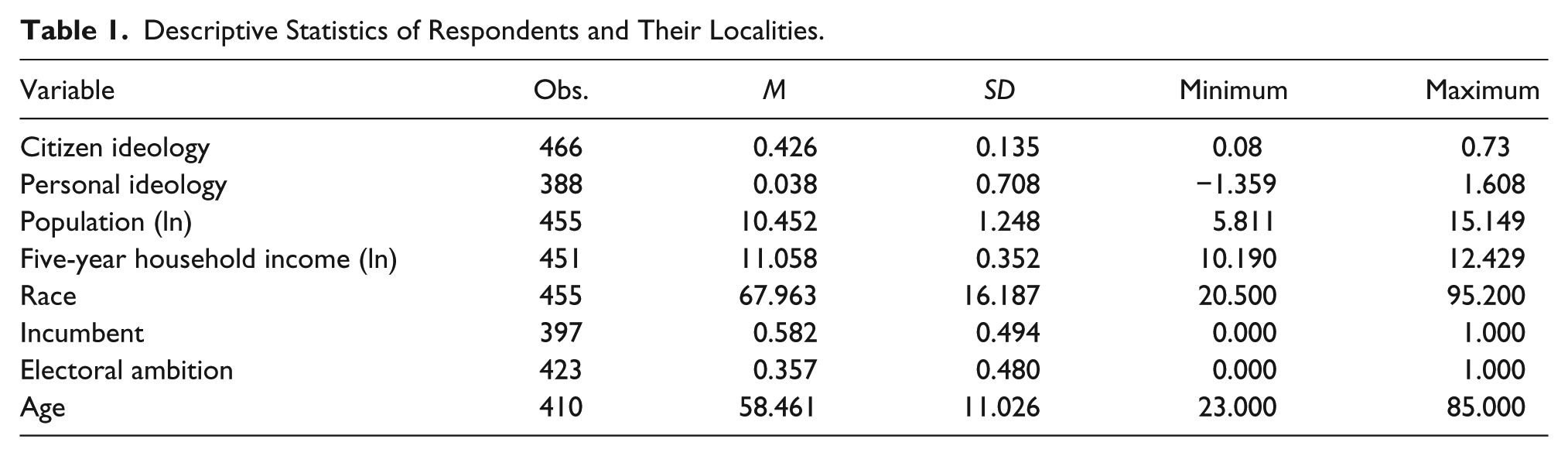
We incorporate several other variables in our analysis to control for both institutional/political characteristics of the officials’ home city or county, and their personal characteristics. Institutional characteristics include a log of the total population of the respondent’s municipality, race (a measure of the diversity of a municipality measured as the proportion of the municipality that identifies as white), the log of the five-year average for household income, and the municipalities’ revenue change from 2008 to 2010 in the city budget over the past three years (2008–2010) to control for the possible financial strain a city may (or may not) be experiencing. We also include controls for city (1) and county (0) forms of government and whether or not the state budget (1) was identified as the most important issue (budget top priority) facing the locality by the elected official, controlling for perceived financial constraints at the local level. The personal characteristics of the respondents include electoral ambition, a dichotomous measure of whether the respondent desires to run for higher elected office in the future, whether or not they were an incumbent (1) and their age. Summary statistics for the relevant variables are included in Table 1.
Descriptive Statistics of Respondents and Their Localities.
To test the representativeness of our sample with regard to some of the key indicators in our empirical model and check for sample selection bias, we estimated a probit regression model predicting the probability that an elected official who received an invitation to complete the survey did in fact complete and submit the survey. Our results 3 suggest that three factors are significantly related to the likelihood of responding to the survey: mean municipal annual income, where the more wealthy a municipality was, the more likely an official was likely to respond, and the percentage of the municipal citizens who identify as white (also a positive relationship). In addition, officials were less likely to respond as the population of their municipality increased. Although these results suggest that representatives representing smaller, wealthier, and increasingly white municipalities were more likely to respond to our survey, we feel that the substantive effects are not so large as to present a major limitation in our conclusions, especially as one of the key independent variables in our model, municipal ideology, is not associated with the likelihood of responding to the survey.
Analysis and Findings
First, we estimated the binary intent to cut public welfare as a function of both personal ideology and citizen ideology with a probit regression model. As the result demonstrates, both citizen ideology and personal ideology are significant in the expected directions. The more conservative an elected official, the more likely he or she is to favor reducing spending for public welfare programs over all other programs. This finding shows support for both Hypotheses 1 and 2, suggesting that politicians are influenced both by their own personal ideology and the ideology of their constituents when they make a decision on the allocation of scare municipal funds. In addition, a Wald test indicates that we can reject the null hypothesis that personal ideology and citizen ideology have no impact on the intent to cut public welfare services. The full estimation results are displayed in Table 2, while Figure 3 presents a graphical representation of the predicted probabilities of intent to cut public welfare based on personal ideology. There is also a significant and negative relationship between county and city officials, meaning that city officials were less likely to intend to cut public welfare than county officials.
Intent to Cut Public Welfare, Probit Model.
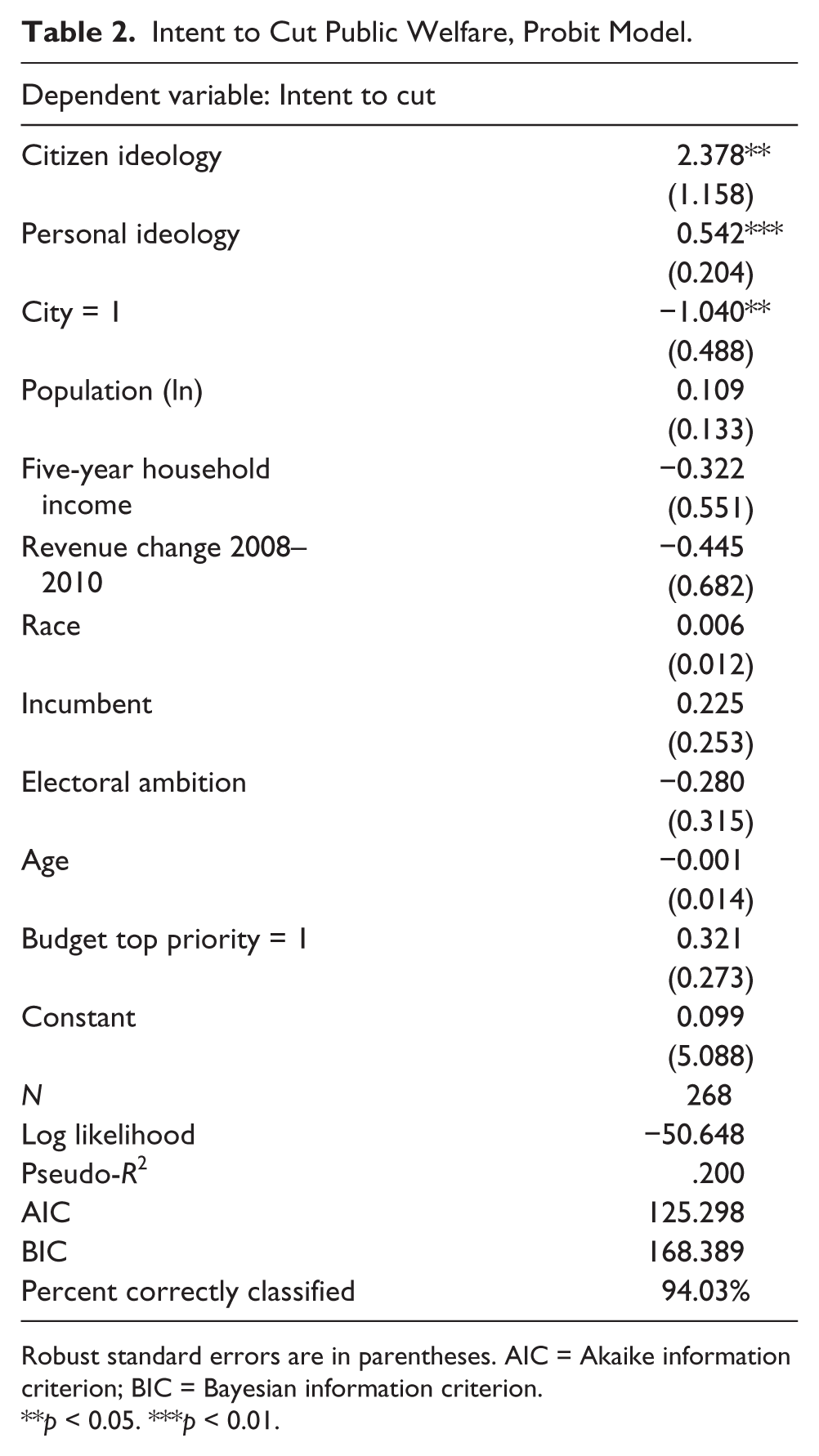
Robust standard errors are in parentheses. AIC = Akaike information criterion; BIC = Bayesian information criterion.
p < 0.05. ***p < 0.01.
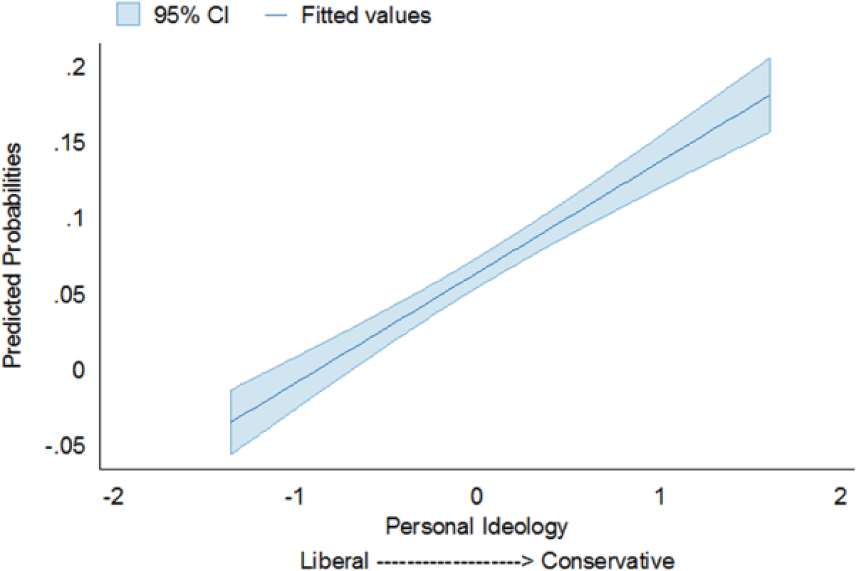
Predicted probabilities of elected officials’ intent to cut public welfare by personal ideology.
As a second analysis of the key research question and subsequent hypotheses, we estimated the impact of both personal ideology and citizen ideology on indicating a desire to cut all other service categories compared with public welfare. 4 In this analysis, we used a multinomial probit model, holding public welfare as the base category. This tests the impact of both citizen ideology and personal ideology on the likelihood of reducing the allocation of resources to a given service, compared with public welfare services. In other words, positive coefficients indicate that the official was more likely to select reductions to the service in question than public welfare services, whereas negative values indicate that the official was less likely to support reductions to the service in question than to public welfare services. The results of this analysis are displayed in Table 3, and show that both citizen ideology and personal ideology are significant for several service categories compared with public welfare spending. For example, citizen ideology and the intent to cut services are negative and significant. That means as citizen ideology is more liberal, there is an increased likelihood of cutting libraries, police protection, corrections, transportation, and parks and recreation services compared with public welfare. For all categories of services, the relationship between cuts to various services and personal ideology is also significant and negative. As an elected official’s personal ideology increases (in the direction of being more conservative), there is a decreased likelihood of cutting corrections, fire protection, housing and community development, transportation, parks and recreation, and arts and culture compared with public welfare. In other words, more conservative elected officials are more likely to cut public welfare services, than the other six service categories mentioned, including public safety and corrections, which fits the normative understanding of conservative versus liberal spending priorities.
Intent to Cut All Categories Compared with Public Welfare, Multinomial Probit Regression.
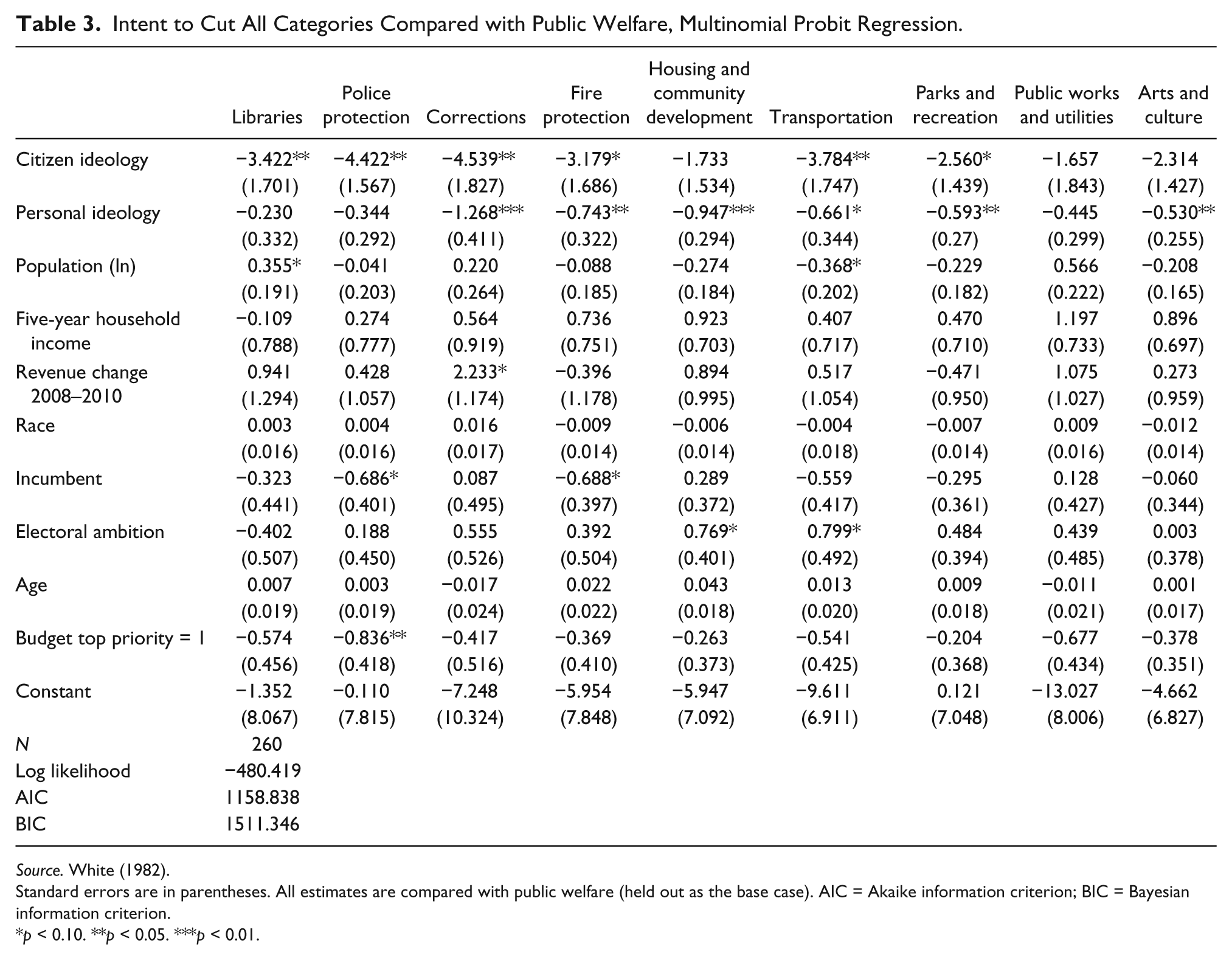
Source. White (1982).
Standard errors are in parentheses. All estimates are compared with public welfare (held out as the base case). AIC = Akaike information criterion; BIC = Bayesian information criterion.
p < 0.10. **p < 0.05. ***p < 0.01.
In addition, incumbency also has a negative and significant effect on intent to cut police and fire protection. Incumbents were less likely to cut police and fire protection services compared with public welfare. Those with electoral ambition were more likely to be interested in cutting housing and community development compared with public welfare. The statement that the budget was the top priority was negative and significant for police protection, meaning those individuals who claim budget is a top priority were less likely to cut that service over public welfare. A community’s median household income (five-year average) is also significant and positive, meaning that the wealthier the community is, on average, the more likely the elected official is to prefer cutting most other services offered rather than public welfare.
Ultimately, these findings provide support for both Hypotheses 1 and 2. Considering that the correlation between constituent ideology and local elected official ideology is lower than one might expect (−0.22), and by including each measure in our model to control for the effect of the other, these findings suggest that the personal ideology of elected officials is separate from the pressures exerted by the electoral makeup of their constituency. Based on these results, it appears that personal ideology is as important as citizen ideology in influencing the attitudes of local elected officials toward expenditures to various service categories. This is an important finding that contributes to our understanding of the factors that affect public service expenditure priorities at the local level, particularly because individual local elected official ideology has not been studied in the same model as constituent ideology.
Conclusions
In this study, we use IRT to estimate, for the first time, the revealed ideology for local elected officials across the state of California to better understand whether personal ideology, when controlling for citizen preferences, affects the expenditure priorities of local elected officials. Much of the scholarly work on local resource allocation decisions either ignores public opinion (Tiebout 1956) or suggests that public opinion is not a significant factor (Peterson 1981). By illustrating the effect of both municipal and personal ideology on elected officials’ attitudes toward local resource allocation, we make a unique contribution to the extant literature on local policy making. Other scholars could use our method of measuring of local elected official ideology in other areas of research, including research on patterns of contracting-out on the local level, or research comparing the local attitudes of decision makers with those of federal and state officials. Although this study does not attempt to address these questions, subsequent research on these topics may benefit from using this same approach to measuring local decision-maker ideology.
The results of our analysis suggest that a local elected official’s own ideology is associated with his or her attitude toward expenditure reductions, even when controlling for citizen ideology and the economic condition of the city. Although citizen ideology is also a significant factor in expected ways, the important finding of this study is that local elected officials’ own ideological leanings are independent and significant factors in their attitudes toward resource allocation to various public service categories. Local elected officials, selected in non-partisan elections to represent their communities in municipal policy making, appear to be influenced by both their own individual ideology and that of their constituents, even when accounting for economic and budgetary constraints.
The two most noteworthy limitations of this study are the average, but not impressive, response rate of local elected officials to the survey and the limited geographical scope of the study. There is also the possibility that the relationship is opposite of what we propose here—that cities do attract those citizens who are more aligned with their own personal preferences (as Tiebout [1956] suggests). However, our results suggest that local politicians’ support for cutting certain categories of public services is associated with both citizen preferences and their own personal ideology, which is not easily ascertainable by local voters. Although our results do not rule out the possibility that some citizens were drawn to the city because of a preference for the array of services currently offered, they do suggest that local politicians do not view resource allocation decisions solely as a way to please current constituents or attract future constituents. Rather, the results suggest that local politicians view these resource allocation decisions within the framework of both constituent preferences and their own ideological dispositions.
Despite these limitations, the empirical contribution of a survey of local elected officials in California is significant in and of itself for offering insights into political elites, specifically their ideology, rather than the public at large. Furthermore, a sample selection analysis does suggest that few demographic factors influenced the likelihood of those in the sample to respond to the survey, bolstering our confidence in the generalizability of the results. Although our analysis of the data on California local elected officials’ attitudes suggests a relationship between ideology and spending at the local level, these results are just one test of what should be a wider research agenda on ideology and distributive spending at the local level throughout the United States.
Finally, intuition suggests that there may be a relationship between electoral marginality and the impact of personal ideology on expenditure priorities, with candidates running in more competitive elections migrating toward the middle of the ideological spectrum to garner more voters. It is also likely that more liberal candidates run for office (and win) in more electorally liberal localities, as well as conservatives in conservative localities. However, in California, local elections for city council and county supervisor are non-partisan—reducing some important signals available to voters about selecting a candidate that is most aligned with their own preference for political party. Instead, voters have to rely on advertising and candidate communications, along with local media—which might not always provide clear-cut signals with regard to ideology or partisanship (who is not in favor of safe streets or better schools, for example). Although voters can always look to past votes to attempt to identify the ideological leanings of a candidate for local office, this can only be done for incumbents and at a relatively high opportunity cost to voters in terms of the time required to conduct such individual research into candidate preferences and past votes. In addition, even holding constituent ideology constant, we find that the personal ideology of the local elected officials is still a significant determinant of attitudes toward service reductions. This finding suggests that previous studies that focus on economic constraints, institutional constraints, or the median-voter model’s impact on local expenditure priorities may be missing a key component to elected official decision making—their own ideological leanings.
Although local officials may respond to citizen preferences as a means to maximize their electoral prospects, and even our results support this proposition, their attitudes toward expenditures are also associated with their own ideology. This result has important implications for democratic governance and responsiveness, suggesting that local elected officials may be ideologically motivated despite the commonly held assumption that local politics are much less ideological than state and national politics. This study offers evidence of ideology playing a role in local elected officials’ attitudes toward levels of service provision, the most integral function of local governments, and also lays a foundation for further research to examine the role of ideology in local politics in other geographical areas and in other types of local policy making.
Footnotes
Declaration of Conflicting Interests
The author(s) declared no potential conflicts of interest with respect to the research, authorship, and/or publication of this article.
Funding
The author(s) disclosed receipt of the following financial support for the research, authorship, and/or publication of this article: The John and Judith Bedrosian Center on Governance the Public Enterprise, an applied research center at the University of Southern California Sol Price School of Public Policy provided funding for the completion of the California Public Officials Survey.
Notes

References
Supplementary Material
Please find the following supplemental material available below.
For Open Access articles published under a Creative Commons License, all supplemental material carries the same license as the article it is associated with.
For non-Open Access articles published, all supplemental material carries a non-exclusive license, and permission requests for re-use of supplemental material or any part of supplemental material shall be sent directly to the copyright owner as specified in the copyright notice associated with the article.
