




Abstract
Although there is a large literature on the career decisions of House members, there is a dearth of critical scholarship examining retirement decisions in the Senate. This study aims to address this under-explored topic and identify the key factors in Senate retirement decisions. With a less demanding election schedule, greater power afforded to individual senators, more prestige attached to the office, and fewer attractive options for progressive ambition, we find that Senate retirement decisions differ substantially from patterns observed in the House. Among other things, the partisan retirement differential that is so obvious and persistent in the House (with Republican MCs retiring at higher rates than Democrats) is markedly absent in the Senate. We explore this and other inter-chamber differences, discussing both their empirical and normative ramifications, and noting their importance for our understanding not only of the two chambers but also of the two parties.
For several generations, students of the U.S. Congress have been interested in the career patterns of incumbent representatives, especially their retirement decisions. In an era that has been characterized by what some have called “super incumbency advantages,” this interest has been driven in large measure by the fact that voluntary departures have far outstripped electoral defeats as a source of congressional turnover. For those interested in legislative turnover and political renewal, retirements are a significantly larger source of congressional replacement than are electoral defeats. Ornstein et al. (2013) report that in the almost four-decade period between the federal election campaign reforms of the early 1970s and 2012, retirements from the House of Representatives surpassed electoral defeats 726 to 501 (1.4 to 1). The Senate ratio of 1.58 to 1 (141 to 89) is even starker.
One consistent finding in this literature has been that Republican legislators tend to retire—either from public life altogether or to seek other offices—at higher rates than do Democrats, a situation that has significant implications for the partisan balance of power in the Congress. However, as with many areas of congressional studies, virtually all of the attention to retirement patterns has been devoted to the House of Representatives. This is unfortunate for several reasons. First, it leaves our understanding of congressional career dynamics incomplete. The numerous institutional disparities between the House and the Senate might contribute to very different factors influencing career choices in the two chambers. Second, and relatedly, there are reasons to suspect that the partisan discrepancies so obvious in the House might not be present (or at least as marked) in the Senate. Comparisons of the two chambers might provide added insights into these partisan dynamics, permitting us a better appreciation of the factors that make government service attractive to legislators in different parties.
The paper unfolds as follows. First, we review the relatively copious literature on House retirement patterns, focusing where appropriate on the important partisan dimension, followed by a review of the very limited work that has been done on Senate retirements. Second, we overview the differences between the two chambers, focusing on those that might reasonably be expected to affect legislators’ career decisions. Third, we describe and analyze data on departures from the Senate from the 93rd through the 113th Congress (1973–2014), considering both retirements from elective life and progressive ambition to run for other offices, comparing these voluntary departures with rates of electoral defeat and with similar departure rates in the House. We also consider the effect of party on retirement decisions, both descriptively and in multivariate models that control for other relevant factors. Finally, we conclude by discussing the implications our findings hold for our understanding of the chambers of Congress and for the desire of members of the two parties to serve in them, as well as outlining some avenues for future research.
Previous Research
At least since Mayhew’s (1974, 5) famous dictum that members of Congress (MCs) may be considered “single-minded seekers of reelection,” students of the Congress have been fascinated by the unusual cases of those incumbents who opt not to run again. In part, this enquiry was driven by the fact that Mayhew’s treatise on the “electoral connection” coincided with an unanticipated surge in voluntary House retirements during the 1970s, even as incumbents’ rates of re-election remained high. Initial studies of this upsurge focused on the causes of retirements. Stressing the unintentional consequences of institutionalization, Cooper and West (1981) noted that increasingly lengthy sessions, increasingly complex policy debates, increasingly demanding constituents, and increasingly odious fund-raising responsibilities led some members to the conclusion that “the job [was] . . . not fun anymore.” In the same vein, Hibbing (1982) indicted institutional and partisan changes, particularly the decline in the seniority norm, which had guaranteed committee leadership roles to long-serving members of the majority party.
Focusing on micro rather than macro factors, other researchers looked to the individual circumstances—some political, some economic—of individual MCs. Jacobson and Kernell (1983), for instance, concluded that retirement choices were based on personal calculations of the estimated costs and benefits of seeking re-election, especially in terms of the national political forces at play in particular election cycles. Similarly, Moore and Hibbing (1998) found retirements over the 1960 to 1996 period to be more common among older members, those less electorally secure, those (relative to their ages) less senior, and those at greater distance ideologically from their party median. Drawing on labor economics, Kiewiet and Zeng (1993) developed an expected utility model, concluding—unexpectedly—that though age and partisanship did not sizably affect members’ retirement decisions, institutional reforms such as those discussed by Hibbing did have significant effects. Using a similar perspective, Hall and Van Houweling (1995) found that personal economic circumstances and members’ opportunities for advancement in the chamber were the principal influences on retirement decisions (see also Groseclose and Krehbiel 1994 for a focused analysis of House retirements in the 1992 election cycles, especially the influence of changes in campaign finance regulations).
Shifting attention from causes to consequences, Gilmour and Rothstein (1993, 1996) developed a dynamic model to demonstrate that under common conditions, retirement decisions have substantial implications for partisan control of the House of Representatives. Analyzing data from the period 1954 to 1990 and concentrating on the unpleasantness of long-term minority status in a majoritarian institution, they concluded that voluntary departures “cost the Republicans anywhere from 5 to 15 seats in the House,” accounting for “about 20% of the number [of seats] needed to win a majority” (Gilmour and Rothstein 1993, 358).
Ang and Overby (2008) extended this time series forward, capitalizing on the natural experiment afforded by the Republican takeover of the House following the 1994 elections to interrogate Gilmour and Rothstein’s conclusion that higher retirement rates among GOP MCs were driven by their experiences as members of the seemingly “permanent minority.” Ang and Overby’s finding that Republicans continued to retire at higher rates even when in the majority convinced them that fundamental partisan differences rather than minority/majority status account for differential retirement rates. 1 Although they also argued that improvements in Republicans’ ability to win and hold open seat races partially compensated for retirement losses, Ang and Overby (339) concluded that GOP career choices “significantly attenuated the size of their legislative majority and contributed to their ouster as the majority party in the elections of 2006.”
Murakami (2009) used data on House career decisions from the 97th through the 108th Congresses (1997–2004) to assess four hypotheses related to differences in partisan retirement rates: that those in the minority party, conservatives, those with better political opportunities outside of the chamber, and those with more lucrative private sector opportunities are more likely to retire. Distinguishing between those opting to leave the public arena entirely and those reaching for higher office, he found that little other than ideology mattered for the first category and little save ideology and political opportunities (i.e., gubernatorial and Senate seats that were either open or occupied by the other party) for the latter; notably, he concluded that after taking proper account of other factors, partisanship itself is insignificant to retirement decisions. Murakami’s analysis not only made a coherent case for why conservative politicians might prefer governorships (with their state focus and veto power) or Senate seats (with the filibuster) to secure spots in the House but also provided evidence that ideology matters within parties as well as across parties, with conservative MCs from both caucuses more likely than their relatively more liberal co-partisans to leave the House voluntarily. 2
In contrast to the relatively voluminous literature on House career decisions, extant analysis of senators is scant. To the best of our knowledge, only two studies (Bernstein and Wolak 2002; Livingston and Friedman 1993) have delved into Senate retirement patterns, and only Bernstein and Wolak (2002) have focused on the Senate over a substantial time period. Responding to evidence of increasing rates of congressional retirements in the 1970s, Livingston and Friedman (1993) examined data from both chambers in the 1980s and concluded that the spike in voluntary departures from Congress in the previous decade had been an “aberration.” Although their descriptive data did, indeed, show a slightly (1%) greater tendency toward retirement on the part of Republicans in both chambers, their limited time series did not permit adequate analytical leverage in their multivariate discriminant analysis to distinguish minority party status from Republican status, so they could not directly test for a partisan effect per se (see p. 247). Bernstein and Wolak (2002) used more extensive longitudinal data, exploring Senate retirements between 1962 and 2000. They found only two variables significantly related to retirement choices: age and minority party status. Unfortunately, they treated all retirements from the chamber as the same (i.e., they did not distinguish between retirement from public life and progressive ambition), and they did not test for an explicit partisan dimension.
We will draw on these previous studies as we develop models to explore Senate retirements. Specifically, we will use many of the variables that have been found to exert significant influence on retirement decisions, especially in the House, including age, minority status, tenure, electoral marginality, ideology, and partisanship. First, however, we will spend some time considering the unusual nature of the upper chamber and how that might influence our expectations.
The Exceptional Senate
As numerous observers have noted, the U.S. Senate is not only under-studied relative to the House, but it is also an exceptional legislative body (Oppenheimer 2002). The Senate is endowed by the Constitution with unusually long terms and with a number of executive powers shared with the president (e.g., confirmation of key bureaucratic, judicial, diplomatic, and military nominees; ratification of treaties) that distinguish it from the House, where the “constant campaign” undercuts deliberation and the chamber tends to focus exclusively on legislative tasks. The evolution of the chamber’s rules since the early 1800s—in particular the abolition of the previous question and the development of the filibuster—also renders the Senate a different sort of legislative institution, making it a far less majoritarian body and bestowing significantly greater powers in individual members, who (at least in the absence of super-majority support) have substantial capacity to block legislation.
These institutional differences have implications for senatorial careers that should be addressed when considering retirement decisions. First, longer terms make campaigning a less arduous activity, which may make age less of a factor in choosing whether or not to retire. 3 Second, as it places considerable power in the hands of minority senators, the filibuster likely makes the Senate a more rewarding place in which to serve in the minority party, at least relative to the House, where the legislative agenda is subject to tight majority party control. As a result, it is not at all clear that minority party senators face the same level of job frustration often attributed to the minority in the House (Fenno 1989; Gilmour and Rothstein 1993). Third, Republicans in particular might find the Senate a more attractive environment than the House because the executive powers shared with the White House and the negative power embedded in the filibuster match better their views of themselves as “executives” and their preference for limiting rather than expanding the reach of government (Ang and Overby 2008; Ehrenhalt 1992; Freeman 1986; Jacobson 1990). Fourth, in terms of attractive alternatives, senators have fewer choices than do House members, a good number of whom are enticed by the possibility of running for the Senate. 4 In contrast, relatively few offices—perhaps only one, the presidency—constitute an indisputable “promotion” from the Senate. 5 As much of the partisan disparity in House retirement rates has been attributed to higher levels of progressive ambition among Republicans (Ang and Overby 2008; Gilmour and Rothstein 1993), the discrepancy might not be as obvious in the Senate.
We expect, therefore, that retirement dynamics in the Senate may well differ from those chronicled in the House. We anticipate that retirements (especially to pursue other office) will be less common in the upper chamber, as well as less associated with age and minority party status than seen in the House. Most importantly, we hypothesize that the partisan differential seen so persistently in the House will be muted or absent in the Senate due to the chamber’s greater relative appeal to GOP lawmakers.
Data and Bivariate Analysis
To gain a better understanding of the contours and dynamics of Senate retirements, we analyze data from the 93rd through the 113th Congresses (1973–2014). This time series permits us to overview what may profitably be considered the “modern” Senate, since the adoption of the Federal Election Campaign Act of 1972, the introduction of televised proceedings in 1974, and the last major reform to cloture requirements in 1975.
Table 1 presents a summary of departures from the Senate over that period, broken down by party and by type of departure (i.e., retirement from elected office, progressive ambition, and electoral defeat), 6 with summary comparisons to House retirements. Several aspects of this table deserve comment.
Departures from Senate, 93rd to 113th Congresses.

First, as in the House, voluntary departures significantly outstrip involuntary departures as a source of membership turnover. Across the twenty-one Congresses, of the 261 departures (excluding deaths in office), retirements and progressive ambition account for 64 percent (n = 167) of the total, which closely reflects the ratio seen in the House.
But there are differences with the House as well. Retirements from public life constitute a far larger percentage of voluntary Senate departures than is seen in the House. Between the 93rd and the 113th Congresses, of the 167 voluntary departures, 144 senators (86%) retired from elective office compared with a mere 23 (14%) who immediately sought other office. Figures extrapolated from Ang and Overby (2008, 342–44) show significantly greater balance between the two exit streams in the House. As anticipated, with fewer opportunities for “promotion,” senators are less likely to leave their seats to chase other offices.
Similarly, at least at first blush, there appears to be little in the way of a partisan disparity in the Senate when it comes to retirements. As the figures in Table 1 indicate, seventy-six Senate Democrats retired from elective office over the course of the 93rd to 113th Congresses, which represents a 6.8 percent rate (76 of 1,119 Senate seats held by Democrats over the period). That is almost identical to the 6.7 percent rate (68/1,011) found among Republican senators. Similarly, in terms of progressive ambition, partisan rates were 1.1 percent among both GOP and Democratic senators. Consistent with our expectations, at least at the level of bivariate analysis, Republicans seem no more likely than Democrats to depart the Senate of their own volition.
Also consistent with what we anticipated, being in the minority party per se does not seem to be strongly associated with Senate retirements. Excluding the 107th Congress, during which party control of the chamber shifted three times, twenty Congresses are summarized in Table 1. Of these twenty, the minority party witnessed larger numbers of retirements only nine times, while the remaining eleven Congresses were almost evenly split between instances in which both parties had the same number of retirements (n = 5) or the majority party actually saw more defections (n = 6, including the past two Congresses).
Multivariate Analysis
To see if our bivariate results hold in the presence of the usual controls, we construct multivariate models, guided by the earlier work of Bernstein and Wolak (2002). We expand and extend their analysis by updating the time series through the 113th Congress, including party as an independent variable of interest (as well as several other important control variables), and examining progressive ambition separately.
Initially, we examine all voluntary departures together. We code as 1 any senator in any Congress who retired from public life, left the Senate to pursue another elective office, or left to accept a major public appointive position (i.e., Cabinet post). All other senators (i.e., those remaining in the chamber and those who left the Senate involuntarily through death or electoral defeat) we code as 0. 7
On the right-hand side of our equations, we include several variables of interest. First, of course, there is party, coded 0 for Democrats and 1 for Republicans, with “independent” senators coded according to the party they caucused with. Second, we include several other variables the previous research has found to be significant in the House, including ideology (as measured by first dimension DW-NOMINATE scores) 8 and whether or not in that Congress a senator was in the chamber’s majority (1) or minority (0) party. 9 Third, we include two variables unique to Senate analysis: whether or not the senator was in a re-election year (1 if yes, 0 if no) and whether or not the senator was appointed or elected to office (1 if appointed, 0 if elected). Our expectations are that senators are more likely to retire at the end of a six-year term than in the midst of one and that appointed senators are in some cases place-holders who have no intention of pursuing a lengthy tenure in the chamber. 10 Senators who are initially appointed but who are subsequently elected to the office are treated as elected. Fourth, we include a number of control variables used in previous studies that might reasonably be thought to affect career decisions, especially legislative career decisions. These include age, the square of age (to account for possible non-linear effects), gender, tenure in the Senate, and being a Southern Democrat. 11 To account for the Jacobson–Kernell strategic politicians thesis (Jacobson and Kernell 1983), that career decisions are—in part at least—driven by perceived threats to re-election, 12 we also include vote share in most recent election, 13 membership in the president’s party, and membership in the president’s party during a midterm election cycle. Finally, we include one final variable that has not been included in previous analysis, which we label “legislative experience.” Operationalized as the number of years that senators had previously served in state legislatures or the U.S. House of Representatives, this is an effort to capture whether senators are political “careerists” or “amateurs” (Canon 1990). Although not all amateurs are “hopeless,” it seems likely that ceteris paribus those with more legislative experience might find the Senate a more hospitable environment in which to serve. 14
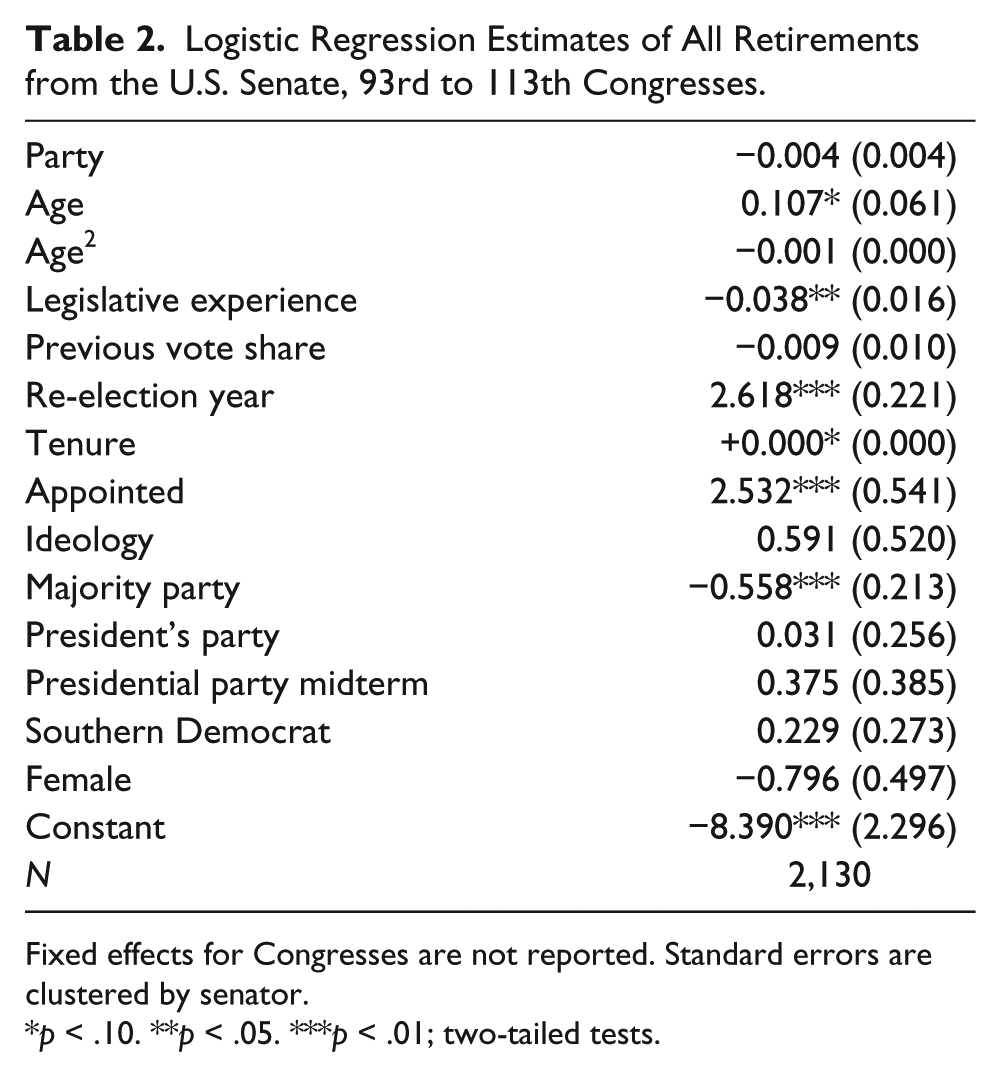
Our initial findings are reported in Table 2, which shows the results of logistic regression analysis of all decisions to depart the Senate voluntarily. 15
Logistic Regression Estimates of All Retirements from the U.S. Senate, 93rd to 113th Congresses.
Fixed effects for Congresses are not reported. Standard errors are clustered by senator.
p < .10. **p < .05. ***p < .01; two-tailed tests.
Many of our variables perform as expected, or at least in an explicable fashion. Consonant with Bernstein and Wolak (2002), we find age is significantly related to retirement, though the strength of the association is more modest than they reported, which is perhaps not all that unusual in an institution where 85 percent could claim membership in the AARP and almost a quarter are over the age of 70. As expected, senators are more likely to retire at the end of a six-year term and to do so if they were appointed rather than elected. Somewhat unexpectedly (but also in line with Bernstein and Wolak’s earlier findings), especially for a chamber that gives rather unprecedented power to the minority through traditions like holds and filibusters, minority senators were comparatively more likely to retire, suggesting that even in an institution that requires super majorities, it is less rewarding to be on the minority side of the aisle. Consistent with our bivariate findings, there is no evidence that Republicans are more likely than Democrats to retire, indicating that—along the partisan dimension—service in the “upper” chamber is different from the “lower,” a point we will return to in due course. Similarly, contra-Murakami (2009) ideology does not seem to have any discernible impact on retirements, with conservatives no more likely than liberals to leave the institution. However, legislative experience does exert a significant influence, with senators who have more experience in the House and state legislatures significantly less likely to retire in any given Congress than their otherwise similarly situated colleagues.
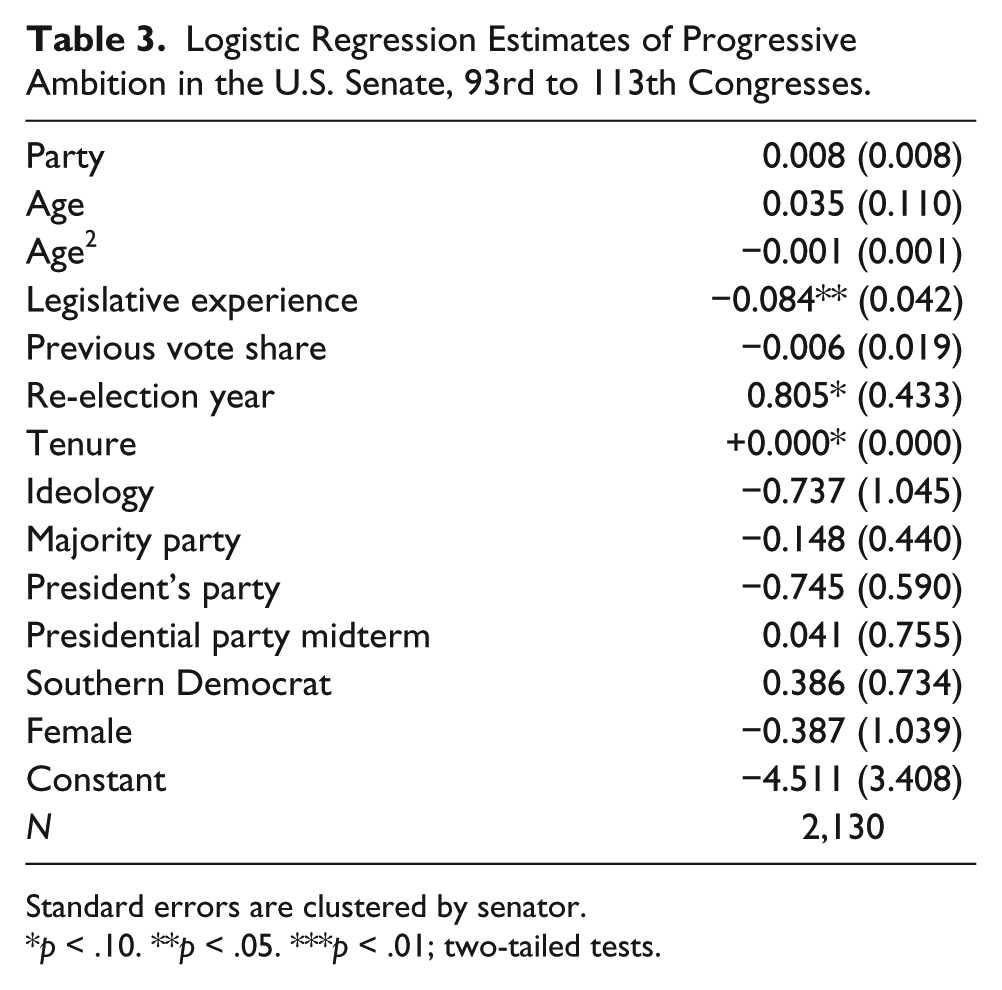
To delve deeper into Senate retirement decisions, we analyze progressive ambition separately, in results reported in Table 3. Although the Senate is a very prestigious body, some senators are willing to relinquish their seats to pursue other coveted positions. Recall from Table 1 that over the past four decades, twenty-three senators—roughly 1 percent of each partisan caucus—have done this. In our analysis, we code as progressive ambition (1) only those cases in which senators immediately ran for another elective office or were nominated for a cabinet post. All other senators (including those who took other high-profile, but non-governmental posts, such as Jim DeMint’s move to the Heritage Foundation) we code as 0. 16
Logistic Regression Estimates of Progressive Ambition in the U.S. Senate, 93rd to 113th Congresses.
Standard errors are clustered by senator.
p < .10. **p < .05. ***p < .01; two-tailed tests.
Results summarized in Table 3 suggest that the only factors that systematically influence progressive ambition are experience (legislators seem to want to stay legislators), and—more modestly—whether or not it is a re-election year and how long the senator has served in the chamber. Factors that influence retirement more generally such as age, membership in the majority party, and appointment status have no discernible influence on those seeking higher office. Our principal variable of interest, party, is again insignificant, indicating—unlike in the House—no greater propensity among Senate Republicans than Democrats to chase higher office. There are relatively few promotions available to senators, and Republicans seem no more likely than Democrats to forgo the Senate to pursue them. 17
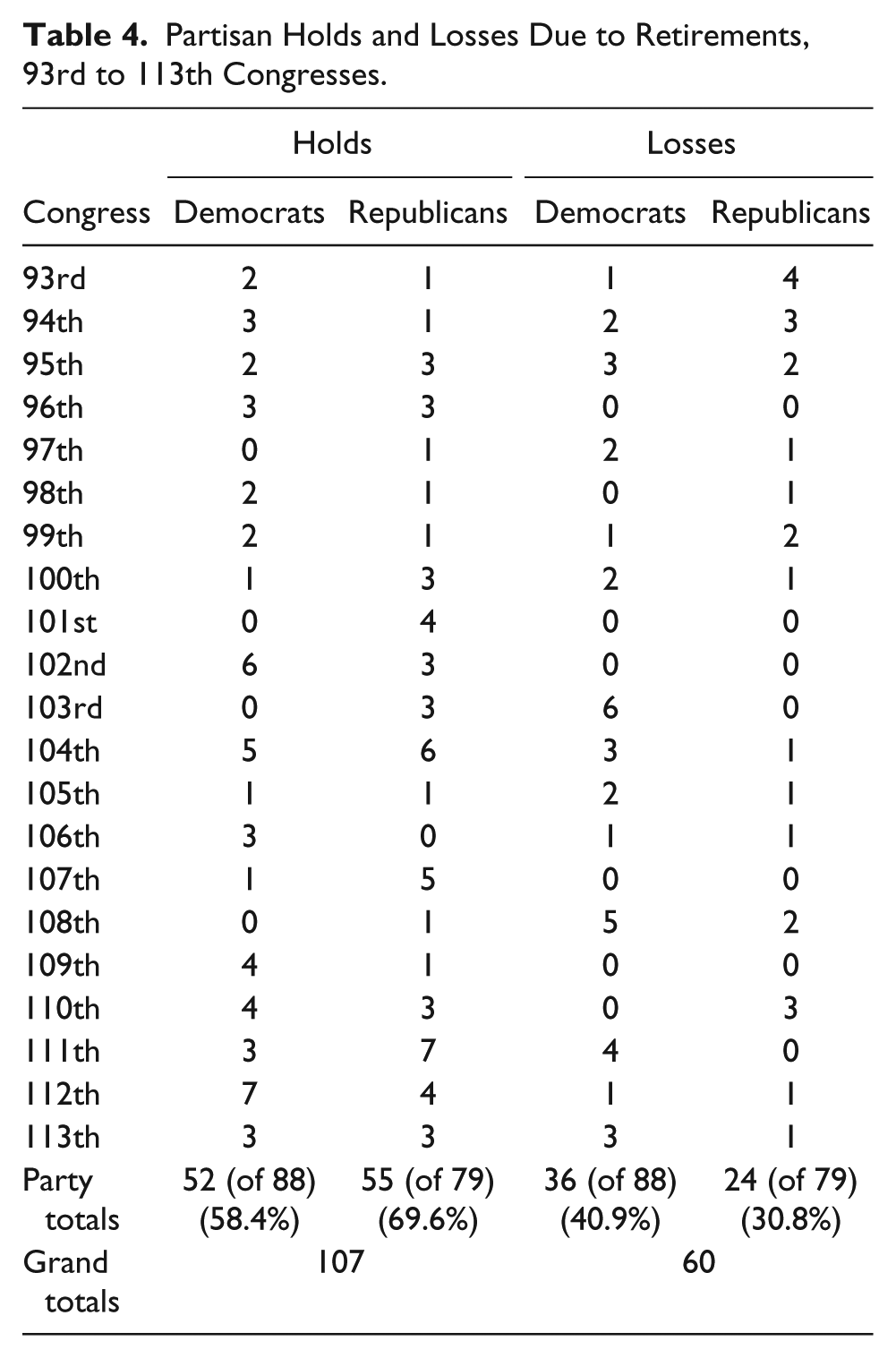
Finally, one point stressed by Ang and Overby (2008) was that in the House, Republicans were able to compensate in part for their higher retirement rates by greater success in the open seat races caused by retirements. Although we find no similar partisan disparity in retirement rates in the Senate, there is an analogous GOP advantage in holding Senate seats they have vacated and picking up seats vacated by Democratic retirements. As the figures reported in Table 4 show, overall, both parties do reasonably well holding on to vacated seats, with over 64 percent (107 of 167) remaining with the same party. But the Republican hold rate of 69.6 percent exceeds the Democratic rate by over 10 percentage points. If, as Gaddie and Bullock (2000) have argued, open seats are “where the action is,” in the modern Senate, Republicans have done a better job than Democrats of blunting their losses due to retirements.
Partisan Holds and Losses Due to Retirements, 93rd to 113th Congresses.
Discussion
Our study was motivated by the desire to extend work on career decisions in the U.S. Senate, to update and extend the limited previous research on the institution, to examine retirements due to progressive ambition separately, and, specifically, to determine if partisan differentials in retirements observed in the House of Representatives were also present in the upper chamber. In some ways, our findings reinforce those of previous studies, especially Bernstein and Wolak’s (2002). We, too, find age and minority party status associated with greater overall levels of retirement. But we also find that prior legislative experience tends to dampen the urge to retire, while being an appointed senator and being in a re-election year make retirement more attractive. Our results also suggest that progressive ambition is difficult to model. Of more than a dozen variables in our models—most of which have been found to affect other aspects of legislative behavior—only legislative experience (negatively) and being up for re-election (positively) are statistically associated with senators’ decisions to seek other offices.
Our finding that partisan retirement differentials are absent in the upper chamber is interesting for what it says about Republicans and Republican office holders, at least when painting in broad strokes. The fact that the Senate appears, compared with the House, to be a more amenable chamber for Republicans suggests that the upper chamber’s roles (in particular sharing certain executive functions with the president) and rules (in particular the filibuster) fit more comfortably into Republicans’ views of themselves and their party. As others going back at least to Freeman (1986) have suggested, the parties are different, drawing on different classes and types of people for both their membership and leaders. Our findings about senators—especially in comparison with MCs—are consonant with a Republican conception of themselves as independent executives (rather than constrained backbenchers) and their party mission as one of limiting (through holds and the filibuster) rather than expanding the role and size of government. More abstractly, the Senate has been called the “least democratic democratic institution on the face of the earth” (Hulse 2003). Republicans, who have long been less comfortable with unbridled democracy, seem more comfortable there than in the majoritarian House.
Finally, our finding that Republicans have been more successful than Democrats in retaining the seats of their retiring senators does match the pattern observed in the House (Ang and Overby 2008). Retirements can have ugly consequences for a legislative party. In addition to surrendering considerable expertise (Hibbing 1991), retirements can trigger expensive, internecine primary battles, and yield the electoral advantages of incumbency in what become open seat races. The Republican Party has been advantaged in the Senate not just by maintaining retirement rates roughly equal to Democrats but also by its ability to retain more of the seats of its retirees. An implication of this is that over the twenty-one Congresses included in our analysis—essentially the entirety of the modern, post-Watergate Congress—Republicans held a larger proportion of Senate (47.5%) than of House (44.7%) seats.
Although this analysis has deepened our understanding of the dynamics of Senate retirements, it has also suggested avenues for future research. First, as we have explored only the most recent decades of data, an obvious extension would be to analyze retirement patterns back to the beginning of the elected Senate in the second decade of the twentieth century. In addition to the insights that might be generated by examining data from previous political eras, the additional data would give us more methodological leverage to explore such things as possible interactive effects. Second, subsequent analysis might also explore the impact of polarization on retirement decisions. At the aggregate level, does polarization help account for the spikes in Senate retirements seen in years such as 1996, 2010, and 2012? At the individual level, does state-level polarization influence senators’ career decisions? Third, though ideology as we measure it does not emerge as significant in our analysis, it is possible that it might assume greater importance if operationalized in other ways or modeled differently. In future research, we plan to explore both the effects of conservatism and ideological congruence within parties on senators’ retirement calculations. Fourth, it would be interesting to explore further post-Senate career patterns, both for senators who retire from public life and those who pursue further political ambition. What activities do senators pursue in retirement? Do attractive opportunities in either the public or private sectors weigh significantly on retirement decisions? Finally, it might be instructive to tie together research that has been done on career beginnings with end of career decisions. We have scratched the surface of that in this analysis, showing that legislative experience prior to the Senate is associated with longer service in the Senate. Do other early career factors (such as occupational background or early political experiences) also make a difference regarding the attractiveness of Senate service?
Footnotes
Acknowledgements
We would like to thank Adrian Ang, Burdett Loomis, Amanda Murdie, Andrew Taylor, Laron Williams, participants in the Legislative Institutions seminar at the University of Missouri, three anonymous reviewers, and the journal’s editors for their comments and suggestions.
Authors’ Note
An earlier version of this paper was presented at the 2015 meeting of the Midwest Political Science Association in Chicago, Illinois.
Declaration of Conflicting Interests
The author(s) declared no potential conflicts of interest with respect to the research, authorship, and/or publication of this article.
Funding
The author(s) received no financial support for the research, authorship, and/or publication of this article.
