



Abstract
Resources for foreign aid come under attack when parties that care little for international affairs come to power. Internationally focused parties of the left and right, however, prefer to use aid as a tool to pursue their foreign policy goals. Yet varying goals based on left–right ideology differentiate the way donors use foreign aid. We leverage sector aid to test hypotheses from our Partisan Theory of Aid Allocation and find support for the idea that domestic political preferences affect foreign aid behavior. Left-internationalist governments increase disaster aid, while parochial counterparts cut spending on budget assistance and aid that bolsters recipients’ trade viability. Conservative governments favor trade-boosting aid. We find consistent, nuanced, evidence for our perspective from a series of Error Correction Models (ECMs) and extensive robustness checks. By connecting theories of foreign aid to domestic politics, our approach links prominent, but often disconnected, fields of political research and raises important questions for policymakers interested in furthering the efficacy of development aid.
Keywords
Foreign aid offers a potent instrument to incentivize recipient leaders’ behavior, but its effectiveness has long been questioned. 1 For many scholars, aid’s patchy record in promoting democratization, growth, and cooperation stems from moral hazard and geopolitics: donors’ strategic incentives diverted aid flows from the neediest or most deserving states and damaged their credibility. Analysis focused on which donor-states fell into this trap (Berthélemy and Tichit 2004), and on aid’s expanded utility after the Cold War (Bearce and Tirone 2010). New research, however, seeks to explain variation in aid efforts within countries over time. These studies open up the democratic donor-state, substituting the domestic political preferences of governments for the amorphous “national interest,” but find mixed support thus far (e.g., Dreher, Nunnenkamp, and Schmaljohann 2015; Fleck and Kilby 2010; Noël and Therién 1995). Yet foreign aid allocations likely reflect the goals of domestic decision-makers, and consequently, the preferences of key actors should influence foreign aid outputs (Dreher, Nunnenkamp, and Schmaljohann 2015; Fleck and Kilby 2010; Milner and Tingley 2010; Tingley 2010).
We consider how partisan ideological preferences affect donors’ allocation decisions across the array of foreign assistance sectors. We argue that parties’ preferences predict their approach to foreign affairs. Changes in the preferences of governing parties produce shifts in allocation across aid types. Focusing on the effect of ideology on the most frequently used aid sectors allows detailed predictions that would be obscured by aggregate trends. 2 Our perspective dovetails with studies of party politics and public policy, where scholars recognize that policies and budgets reflect political processes (Bevan and Greene 2016; Green-Pedersen and Mortensen 2010; Soroka and Wlezien 2010; Whitten and Williams 2011). Elections and coalition negotiations create governments with varying preferences over multiple dimensions of politics (Laver and Shepsle 1996).
Our theory relaxes strong assumptions about traditional left–right (RILE) ideology by introducing a second dimension: internationalism. This dimension captures governments’ preferences for engaging and influencing foreign countries relative to isolationism. This dimension has become increasingly salient in donors’ domestic politics. Internationalism varies across parties with otherwise similar ideology and within parties over time. Donald Trump’s views on aid and trade, for example, strongly contrast those of the 2012 Republican Party candidate, Mitt Romney (The New York Times 2012; Thoma 2016). 3 The absence of this dimension from prior work may partially explain inconsistent results across analyses using RILE dichotomies and aggregate aid flows (e.g., Dreher, Nunnenkamp, and Schmaljohann 2015; Fleck and Kilby 2010; Noël and Therién 1995).
Adding internationalism allows us to identify preferences of four ideal types of parties: left-pro-international, left-anti-international, right-pro-international, and right-anti-international. We predict that internationalist governments likely use foreign aid as a tool of influence. Subsequent changes in aid allocations will reflect variation in preferences, as governments choose types of recipients and aid channels. Thus, we derive predictions regarding aid provision across stated purposes. 4 For example, a country can target aid to civil society or economic sectors depending on their RILE preferences for policy.
We test hypotheses from the Partisan Theory of Foreign Aid Allocation with data on parties’ priorities for foreign aid from the Comparative Manifestos Project (CMP), government composition from ParlGov (Döring and Manow 2016), and aid allotments from AidData (Tierney et al. 2011). 5 Analysis of twenty-eight donor countries over nearly forty years supports an explanation that incorporates ideological preferences. Internationalist governments pursue economic agendas through aid allocations that reflect their partisan preferences. We submit our results to a wide range of robustness checks, including alternate modeling and measurement strategies in the online appendix.
This study holds implications for theories of political development, foreign influence, partisan politics, and democratic accountability. Our theory suggests an additional explanation for aid’s failure to induce behavior from recipient states. This lack of success partially reflects aid’s politicized nature and the conditions under which it is given. The donor credibility problem, here, stems from domestic political competition rather than the global balance of power. The timing, amount, and nature of aid allocated should not depend on the politics of the donor country, lest recipients perceive funds as tools of political manipulation.
Furthermore, theories of representative democracy require representatives to pursue campaign statements. Studies often find weak evidence of partisan priorities affecting policy change (e.g., Bevan, John, and Jennings 2011). Our findings, however, suggest parties pursue their stated goals. Previous research may miss nuanced effects of preferences on foreign policy, as we find that short- and long-term effects may differ. Moreover, foreign aid’s effect on goals such as democracy promotion and developing foreign markets for trade manifest over time. More broadly, evidence suggests partisan governments pursue priorities consistent with their electoral statements, even in the realm of foreign policy.
Preferences and Government Policy
Scholars link parties’ ideology to government behavior. Research predicts budgets and policy via either the goals of parties’ supporters or statements from their campaigns (Hibbs 1977). While much research emphasizes competition on the traditional RILE economic dimension of politics, parties stake out independent positions on a diversity of issues, including the environment, immigration, and foreign intervention (de Vries and Hobolt 2012; Lowe et al. 2011). Domestic electoral competition forces governments to outline preferences on diverse issues, while incentivizing a reputation of accountability for their statements.
Parties balance their sincere preferences against office-seeking goals (Strøm 1990). Electoral competition encourages parties to shift preferences in response to public opinion (Adams, Haupt, and Stoll 2009), issue-focused parties’ success (Meguid 2008), competitors’ policy changes, and economic conditions (Williams, Seki, and Whitten 2016). Voters’ responses to these shifts, however, are often delayed (Somer-Topcu 2009).
Electoral and intra-party motives drive party manifesto content. Parties select issues because of historically positive associations (Egan 2013; Petrocik 1996), or to match traditional supporters’ preferences (Hibbs 1977). Ideologically extreme and governing parties incorporate new topics (de Vries and Hobolt 2012; Schumacher, de Vries, and Vis 2013). Parties emphasize topics to appear responsive (Sigelman and Buell 2004; Spoon and Klüver 2014). Past government experience, economic conditions, and the diversity of their parliamentary delegation and leadership all influence the breadth of issues in parties’ campaigns (Greene 2016; Greene and O’Brien 2016).
Varied motives drive parties to address topics beyond the traditional RILE cleavage, such as foreign policy. The electoral context encourages parties to focus on economic foreign policy, or broader goals (e.g., Greene 2016; Hellwig 2012; Williams, Seki, and Whitten 2016). Distinguishing preferences on such issues from those on the economic dimension allows researchers to account for the complexity of party competition and policy change inside democracies.
On entering office, parties pursue policy consistent with electoral statements to maintain a positive reputation. Research connecting electoral statements to behavior in government describes a complex linkage between parties’ goals and policy-making behaviors. For example, parties campaign on and formulate budgets emphasizing the goals of their primary electoral constituencies (Hibbs 1977). Even in the context of coalition or divided government, parties fulfill many electoral pledges (Thomson 2001, 2011), and pursue policies and budgets consistent with their goals (Alesina and Rosenthal 1995; Schmidt 1996). Parties pursue control of cabinet positions and engage in oversight of ideologically distant ministers on their issue priorities (Bäck, Debus, and Dumont 2011; Greene and Jensen 2016). Parties’ may face substantial hurdles to implementing their policy priorities but dedicate resources consistent with their electoral appeals nonetheless (Green-Pedersen and Mortensen 2010; Soroka and Wlezien 2010; Tsebelis 2002). Further, their responses to changing events depend on their policy priorities (Bevan and Greene 2016, 2017).
Research on competition and accountability suggests that parties hold distinct preferences across diverse issues. They pursue policy in line with these statements in parliament and through budgetary decisions. Building on this approach, we propose the Partisan Theory of Foreign Aid Allocation, incorporating multidimensional policy preferences and varying foreign aid types.
A Partisan Theory of Foreign Aid Allocation
Foreign aid transfers capital from rich to poor states. Governments use aid to achieve outcomes. Donor goals vary from geostrategic coalition-building, to pursuit of new markets for imports. Generous-mindedness is possible, too; the desired outcome may be “. . . some indication that they [donors] have had a favorable impact on the residents of the recipient country” (Dudley and Montmarquette 1976, 133).
Donors’ goals drive patterns of aid allocation. If economic goals predominate, then trade partners likely to import goods from the donor should receive more aid. If geopolitical strategy drives donors, then alliance partners, those near to rivals, or possessed of valuable natural resources should garner a larger share of aid flows. If a desire to improve recipients’ lives propels policy, then governments most in need of and most likely to properly utilize additional resources should see more aid. The empirical literature supports these arguments, though many lament the relative power of trade and geopolitical incentives over humanitarianism (Berthélemy 2006; Berthélemy and Tichit 2004; Collier and Dollar 2002; Fuchs, Nunnenkamp, and Öhler 2015; Stone 2006). Milner and Tingley (2010) find particularly strong support for the role of economic incentives in American legislators’ preferences, tracing their votes on forms of aid to their districts’ resource endowments.
Much of this literature, however, examines cross-donor variation in aid allocation (e.g., Dietrich 2016). To explain changes in aid distribution within donors, scholars examine ruling parties’ ideologies. Many draw a parallel between domestic preference for redistribution and willingness to transfer wealth to less developed countries (Noël and Therién 1995; Therién and Noël 2000; Tingley 2010). Findings regarding the relative generosity of leftist (or social-democratic) parties vary across sample and method of estimation (Fuchs, Dreher, and Nunnenkamp 2014). Sometimes leftist parties appear more generous (Tingley 2010); other times conservative governments allocate more (Dreher, Nunnenkamp, and Schmaljohann 2015; Goldstein and Moss 2005). Some evidence suggests rather, that liberal and conservative actors send aid for different reasons (Brech and Potrafke 2014; Fleck and Kilby 2006, 2010; Milner and Tingley 2010).
We contribute to this emerging literature, linking ideology to foreign aid preferences. Parties’ policy goals play an important role in the formulation of foreign aid programs. Considering parties’ preferences for foreign involvement explains variance in donor behavior. The effect of parties’ preferences is more complex than previously suggested; the relative strength of actors’ ideologies and desire to become internationally engaged imply varying affinity for types of foreign aid that serve different political goals (e.g., humanitarian vs. budget aid). Incorporating preferences over foreign intervention and sectoral aid will explain previously inconclusive evidence for RILE allocation patterns.
Previous scholarship equates domestic preferences for redistribution of wealth (leftist ideology) with willingness to redistribute wealth internationally (Noël and Therién 1995; Therién and Noël 2000). While we agree that leftist economic ideology affects donor preferences over foreign aid, we also believe this assumption ignores variation in the rationale behind aid. One need not believe in economic and social justice to see foreign aid as a useful policy tool, particularly for aid allocated to sectors such as budget support or trade factors. Conservative governments have plenty of reasons to support foreign aid: economic growth promotes the development of new markets for a country’s products and services; contributing to international efforts earns the state more influence in IOs; charity creates a favorable reputation that appeals to conservative social values.
We propose that attitudes toward foreign affairs, or internationalism, constitute an important factor in models of donor behavior. Parties of both the left and right may see foreign aid as an expedient tool to pursue policy goals abroad, depending on their preferences for engaging with the wider world. Part of aid’s expedience, however, stems from the different goals it can be tailored to serve.
Incorporating economic ideology with internationalism produces four ideal party types: left-pro-international, right-pro-international, left-anti-international, and right-anti-international. RILE ideology encapsulates preferences relevant for predicting variance in sectoral aid allocations. Although often initially defined by its emergence from class conflicts (e.g., labor vs. capital groups; Lipset and Rokkan 1967), RILE ideology also contains and organizes disagreements on a range of topics such as social, morality, or education policies. The exact content of the RILE dimension differs across contexts but generally reflects broadly prescribed responses to social, economic, and political inequality (e.g., Mair 2007). Left-leaning positions emphasize the role of governments in decreasing economic inequality; more rightist positions tolerate inequality in the name of economic development and market liberalization (Bakker, Jolly, and Polk 2012; Huber and Inglehart 1995). While most associate the RILE dimension with economic conflict, “attitudes to gender, to the police, to the international order . . . form an intrinsic element of that dimension” (Mair 2007, 215; see also Budge, Robertson, and Hearl 1987). Overall, preferences for economic, gender, social, and political equality will lead leftist governments to use aid types that reduce inequalities abroad, while more conservative governments design aid packages for broad economic growth.
The internationalism dimension refers to preferences for engagement versus insularity. A pro-international party champions international organizations, looks to the international community for legitimacy, and seeks a greater role in international affairs. Consider the British Conservative party’s 2010 declaration:
Protecting Britain’s enlightened national interest requires global engagement. We will be safer if our values are strongly upheld and widely respected in the world. Our national identity is bound up in our historic global role as an outward-looking nation, giving generously to developing countries, and providing a safe haven to genuine refugees. (Conservative Party Manifesto 2010, 109)
6
An anti-international party emphasizes the costs of international entanglements, demanding greater focus on domestic matters and reduced obligations abroad. The Australian Liberal Party’s Federal Platform, for example, offers this more guarded statement about global engagement: “Liberals recognise the growing influence of globalisation but guard the sovereignty of our nation” (Liberal Party of Australia 2015, 15). Indeed, the party’s entire 2015 foreign policy statement contains less than two hundred words.
Table 1 summarizes our conceptualization of the intersection between economic ideology and internationalism. Integrating these dimensions produces meaningful distinctions. The British Conservative Party’s emphasis on international influence fits well with a rightist pro-international agenda, prioritizing diplomatic efforts to further Britain’s “. . . culture, education, commerce and security.” Labour’s 2010 manifesto exemplifies a leftist pro-international party, emphasizing “[t]he global poverty emergency” and reforming international organizations to favor inclusiveness (Labour Party Manifesto 2010, 10.6). 7
Summary of Partisan Ideology across Dimensions.
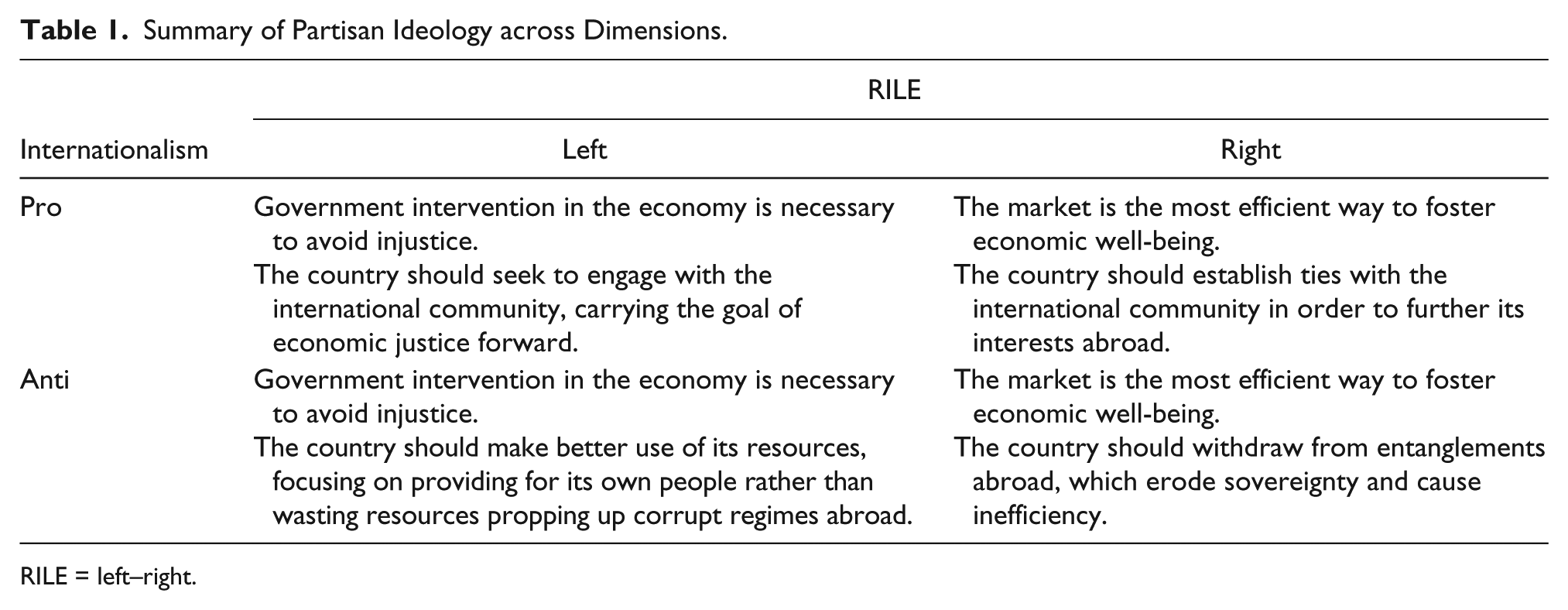
RILE = left–right.
Foreign policy statements can be prominent, such as Trump’s recent calls for reducing foreign aid versus Clinton’s appeals for greater international intervention (Thoma 2016). On entering office, parties seek to appear responsible and accountable. Even if foreign policy is a secondary division, election campaigns often include strong reform pledges. 8 For example, the British Conservative party in 2010 included a foreign policy section that declared, “We will engage positively the world to deepen alliances and build new partnerships. We will reform international institutions, help those in need . . .” (Conservative Party Manifesto 2010).
Manipulating aid allocations provides a relatively easy demonstration of commitment to foreign affairs.
9
The Conservative Party manifesto later explains that “. . . we should use this opportunity to reaffirm . . . our values—which is why we will continue to increase the level of British aid” (Conservative Party Manifesto 2010). Aid can be used to further many goals; it is customizable. Donors manipulate not just how much aid their government sends, but to which countries, what purposes, and which recipient actors the funds accrue. The U.S. Republican Party platform of 2012 contains a potent example, directly contrasting its vision for the use of foreign aid with the incumbent democratic government’s:
The effectiveness of our foreign aid has been limited by the cultural agenda of the current Administration, attempting to impose on foreign countries . . . legalized abortion and the homosexual rights agenda. At the same time, faith-based groups—the sector that has had the best track record in promoting lasting development—have been excluded from grants because they will not conform to the administration’s social agenda. We will reverse this tragic course, encourage more involvement by the most effective aid organizations, and trust developing peoples to build their future from the ground up. (Republican National Committee 2012, 46)
Hence, we expect internationalist governments to adjust more than just the amount of aid. To align international assistance programs with their preferences, parties will also alter the goals that aid dollars serve. In practice, this means changing the type of foreign aid allocated.
The Partisan Theory of Foreign Aid produces nuanced expectations regarding both the types of programs favored by donors and the recipients to which more funds will flow. Here, we develop the first set of expectations: how do pro-international governments of different ideology differ in the types of aid favored? 10 Table 2 summarizes our expectations.
Summary of Theoretical Expectations.
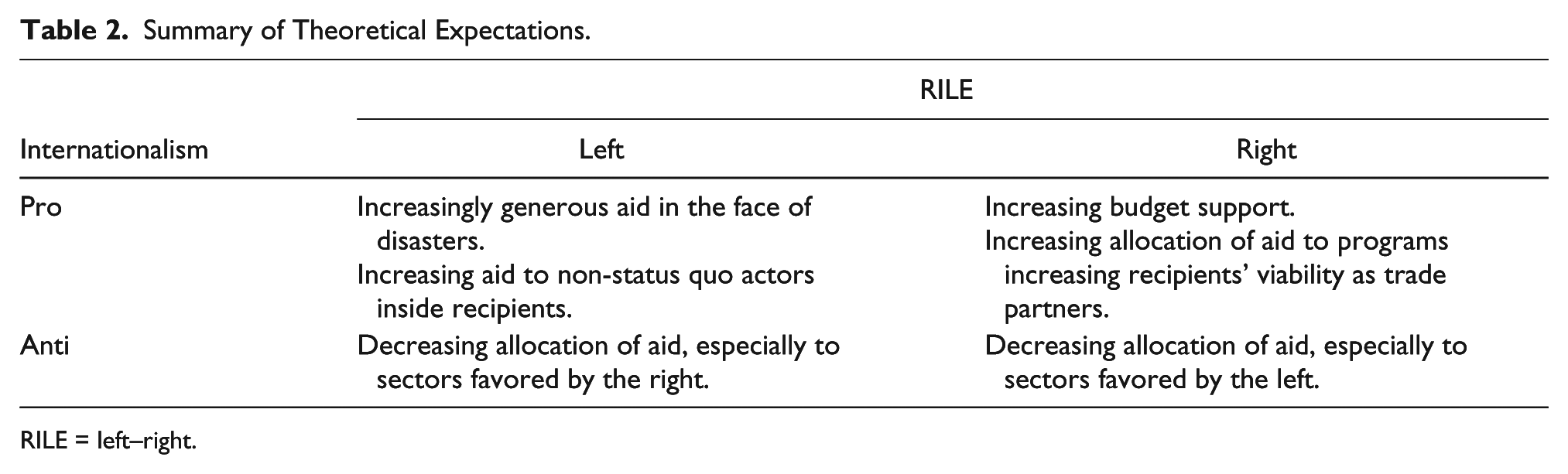
RILE = left–right.
If left pro-international parties favor economic justice and equality (e.g., Mair 2007), then they may choose to allocate more aid overall as argued by some in the literature. However, they may also attempt to allocate aid that reduces economic or social inequality (Fleck and Kilby 2006). We consider disaster assistance, here, as a metric of need. To tap the social-justice angle of leftist ideology, we consider aid to non-status quo (SQ) actors.
Disaster and humanitarian assistance comprise a significant component of aid budgets. At first glance, stochastic events—earthquakes, drought, and disease outbreaks—determine this flow. Such processes drive much of the volatility in aid receipt (Hudson and Mosley 2008). Natural disasters provide a clear indicator of economic deprivation and need. Typically, nongovernmental organizations (NGOs) on the ground administer humanitarian funds and supplies, limiting embezzlement by recipient states. This aid potently symbolizes a left-international government’s support for reducing economic and social deprivation. Conversely, a left-international government that ignored international disasters may draw constituents’ ire. This form of aid, therefore, fits particularly well with the goals ascribed to leftist governments.
Confronted with failure to promote democracy and growth, many donors seek to bypass recipient governments, by directly funding non-SQ groups. 11 Those concerned that dependence on foreign actors for revenue weakens “vertical accountability” in recipients, allowing the powerful to further enrich themselves at the expense of the poor (Boone 1996), may prefer directly funding civil society and nonexecutive actors. 12 Sometimes called “democracy aid” (Resnick 2012; Scott and Steele 2011), these transfers include programs to establish and strengthen independent electoral commissions, increase voter registration and political participation, train and oversee police and legal processes, and promote human rights and race and gender equality. Pursuing these goals coordinates with leftist’s preoccupation with political and social inequality by strengthening institutional frameworks that ensure representation in government (Therién and Noël 2000). Money sent through such channels may look more legitimate to leftist constituencies skeptical of democratizing governments and business interests.
This discussion produces the following testable expectations.
Rightist internationally minded parties should also use foreign aid liberally. However, their strategy differs substantively from pro-international left governments; preferences for economic growth, liberalized markets, traditional moral and social values, and overall greater tolerance for inequality motivate their choices (e.g., Mair 2007; Volkens et al. 2011). Consequently, we expect right-pro-international parties employ aid to cultivate new markets for capital-intensive exports (Fuchs, Nunnenkamp, and Öhler 2015; Milner and Tingley 2010), carry favor with geopolitically relevant states (Dreher, Sturm, and Vreeland 2009a, 2009b, Kuziemko and Werker 2006), and gain influence over targeted leaders (Bueno de Mesquita and Smith 2007, 2009). These motives may produce equivalent aggregate aid spending across sectors that encourage liberalization and opening of foreign economies (with fewer protections for specific industries) and support more traditional social policies and dominant groups. 13
Milner and Tingley (2010) find evidence of variation in preferences for aid allocation in the U.S. Congress based on the prevalence of heavy-capital industries across constituencies. At the national level, we expect rightist governments use aid to support export-oriented businesses. Contrasting governments that emphasize reducing inequalities, rightist governments might funnel aid toward projects to increase the viability of recipient markets for goods. This can be partially accomplished by boosting the economic capacity of potential trade partners. A vast swathe of the purpose codes identified by the Organisation for Economic Co-operation and Development (OECD) and AidData suggest this motivation.
Rightist parties might also pursue “aid-for policy” deals (Bueno de Mesquita and Smith 2009). Just as those concerned about the neediest within recipient countries eschew budget aid as potentially fungible and injurious to their purposes, donors looking to purchase influence may prize program support as the most effective tool (Dreher, Nunnenkamp, and Thiele 2008; Resnick 2012). Less preoccupied by economic inequality, rightist governments value budget aid’s potential to induce reforms beneficial to donor capitol groups. Aid that helps recipients spend on what they choose and bolsters their trade ability has symbolic value. It signals donor support of recipient governments, easing future requests for favors relevant to economic, geopolitical, or other goals.
We should, then, expect the following hypotheses to hold.
Given their ideological propensities, we expect left and right governments on the anti-international side not to increase aid allocations of any type. Inward-looking governments deprioritize influence over foreign countries in ways that are consistent with other aspects of their ideology. Our expectations, then, require that we allow internationalism to condition the effect of ideology on aid flows.
Altogether, we expect that relative differences in ideology produce prominent differences in governments’ foreign aid distribution. Left-international governments allocate resources to aid that reduces economic, social, and political inequalities, whereas more right-international governments use aid to develop market access and trading partners. Focusing only on the total amount of aid would muddle ideology’s effect and produce inconsistent empirical findings across samples. Therefore, we focus our analysis on differences in foreign aid sectors.
Data and Method
We construct a set of aid allocations for twenty-eight donors from 1974 to 2010. 14 Using AidData 2.1 (Tierney et al. 2011), we aggregate aid flows by purpose codes, creating a series of dependent variables appropriate for each hypothesis. We model the time-series cross-sectional nature of these dependent variables using ECM with panel-corrected standard errors. ECMs allow testing for both short- and long-term effects of the key independent variables while accounting for autoregressive processes. The results are comparable to the first difference model used by Tingley 2010 but include lagged values of the independent variables (Best 2012). 15 Specifically, our ECMs take this form 16 :

In Equation 1, Y is a series of dependent variables containing the donor, i’s, yearly total aid allocations in a sector, k. Each dependent variable measures aid allocations for the specified purpose in constant 2009 U.S. dollars. Sectors include Aid to Non-SQ Actors, Disaster Aid, Budget Aid, Trade-factor Aid, and Economic Infrastructure Aid. We identify aid flows appropriate to each sector via AidData’s purpose scheme. For Aid to Non-SQ Actors, we flag projects aimed at “Strengthening Civil Society”, “Legal and Judicial Development”, “Women in Development”, and “Support to National, International, or Local and Regional Non-Governmental Organizations.” 17 Disaster and humanitarian aid have their own category. Budget Aid is similarly easy to isolate as it is described directly as “General Budget Support” (code 51010). We count all “Production Sector” aid as Trade-factor Aid. 18 Finally, we identify aid intended to bolster economic capacity as “Economic Infrastructure and Services.” 19 A logarithmic transformation of each dependent variable improves model performance.
We capture donor governments’ policy preferences with the CMP (Volkens et al. 2011), using Lowe et al.’s (2011) logged scale of parties’ RILE placement to operationalize governments’ broad policy goals. This measure accounts for a number of economic and social policy goals that distinguish parties’ goals on the most important dimension of conflict in most advanced industrial democracies (e.g., Bakker, Jolly, and Polk 2012; Budge 1993; Lipset and Rokkan 1967). We interact RILE Ideology with a measure of the governments’ preferences for engagement with the world to assess our conditional hypotheses. Parties farther left on the main dimension of conflict have more negative scores. We operationalize the second dimension using a logged scale of the CMP’s codes for internationalism. 20 Since pro-internationalism can be considered a “left” position, internationalism takes more negative values for parties that prefer international engagement. To avoid confusion in the discussion below, then, we refer to this measure as Anti-Internationalism.
Aggregating the preferences of coalition governments and of parties in presidential systems requires some care. Strong arguments exist for and against using the political party of the executive to represent the “government’s” position. Executives usually enjoy great latitude in implementing foreign policy. Coalition partners and opposition parties, though, attenuate this freedom. To accommodate these concerns, we developed two versions of RILE and Anti-Internationalism. The first uses the mean coalition party or legislature position, depending on system of government. 21 The second uses the preference point of the prime minister or president. 22 In the interest of space, we relegate the second set of results to the online appendix.
Figure 1 plots mean coalition RILE and Anti-internationalism. The logged scale means neither dimension has a natural center position. This plot illustrates the four party types. Leftist parties that favor and abhor entanglements with the international community exist. Likewise, some economically conservative parties advocate strongly for engagement while others do not. Only a slight tendency for right parties to be less pro-international exists, with a correlation of 0.282.
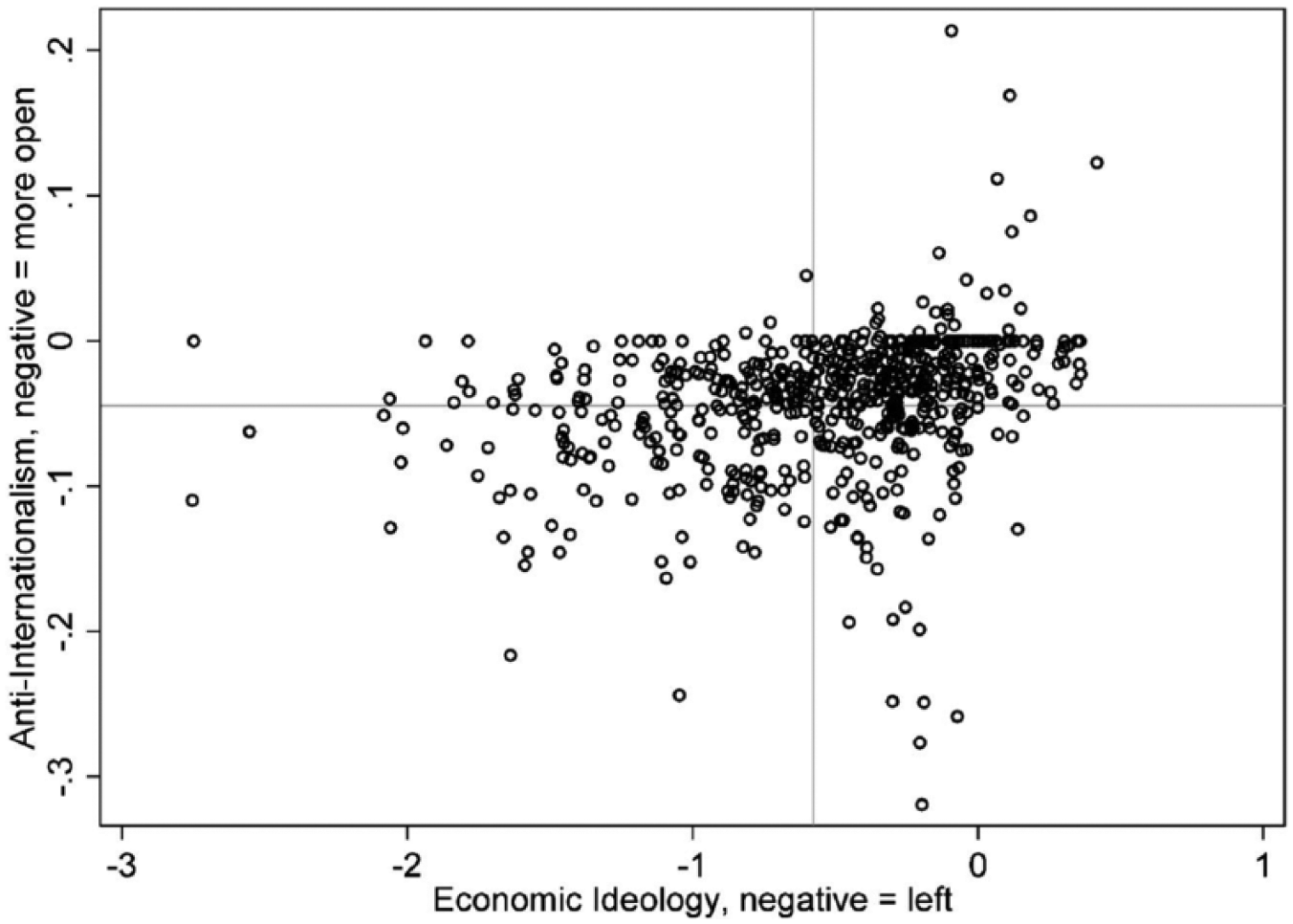
Distribution of government preferences across dimensions.
We include several controls to account for institutions, partisan arrangements, and international conditions. Like Tingley (2010), we include the parliamentary strength of Christian Democrat and Social Democrats. Following Therién and Noël’s (2000) logic, we account for the range of preferences in parliament with the percentage of seats controlled by socialist, communist, and Christian democratic parties.
Other controls address governments’ ability to implement policy. The effective number of cabinet parties accounts for negotiations between multiple coalition partners. A clear parliamentary majority increases the coalition’s policy influence, operationalized here as cabinet’s parliamentary seat share. 23
Countries’ economic characteristics and internal conditions also influence aid allocation. We incorporate measures of economic openness to control for a link between more liberal trade preferences and aid (see Alesina and Dollar 2000; Heron 2008; McKinlay and Little 1977; Tingley 2010). 24 Domestic economic conditions constrain aid allocations (Heinrich, Kobayashi, and Bryant 2016), so we include real GDP (Gleditsch 2008). Finally, we incorporate geopolitical differences caused by the Cold War with a dummy variable flagging pre-1991 observations (Bearce and Tirone 2010).
Analysis
We hypothesize that aid allocations depend on donor government preferences for both RILE and internationalism. The results are largely consistent with this perspective. In two cases, our expectations for RILE proved incorrect. But, in each category of aid, anti-internationalism and RILE condition each other. In three of the five models, the constitutive coefficient on Δ anti-internationalism is negative and statistically significant.
Table 3 presents the ECM results. Each column corresponds to the regression on the named sector. Due to the interactions between our continuous measures of ideology and internationalism, and the ECM technique, each coefficient in the tables below provides highly conditional information. 25 Coefficients for a variable’s level at time t − 1 indicate long-term effects, while the change coefficients speak to short-term effects. Due to the interaction, the constituent coefficients for both the lagged and change variables indicate the effect of RILE (or its change) when internationalism (or its change) equals zero. Zero’s substantive meaning varies across the lagged and change variables. For lagged values, it means the zero point on the dimension, which is rare for RILE. 26 For anti-internationalism, zero values are slightly more common and assigned when party manifestos provide no means of evaluating a pro- or anti-position. 27 A zero value on the change variables, however, means no shift in preferences occurred between the current and previous time-period. The appropriate interpretation of the coefficient for change in anti-internationalism, then, is the short-term effect of an increase in parochialism absent a change in RILE from the previous period. The strong pattern of significant negative effects in these coefficients, then, signals support for our argument.
ECM Regressions by Aid Sector.
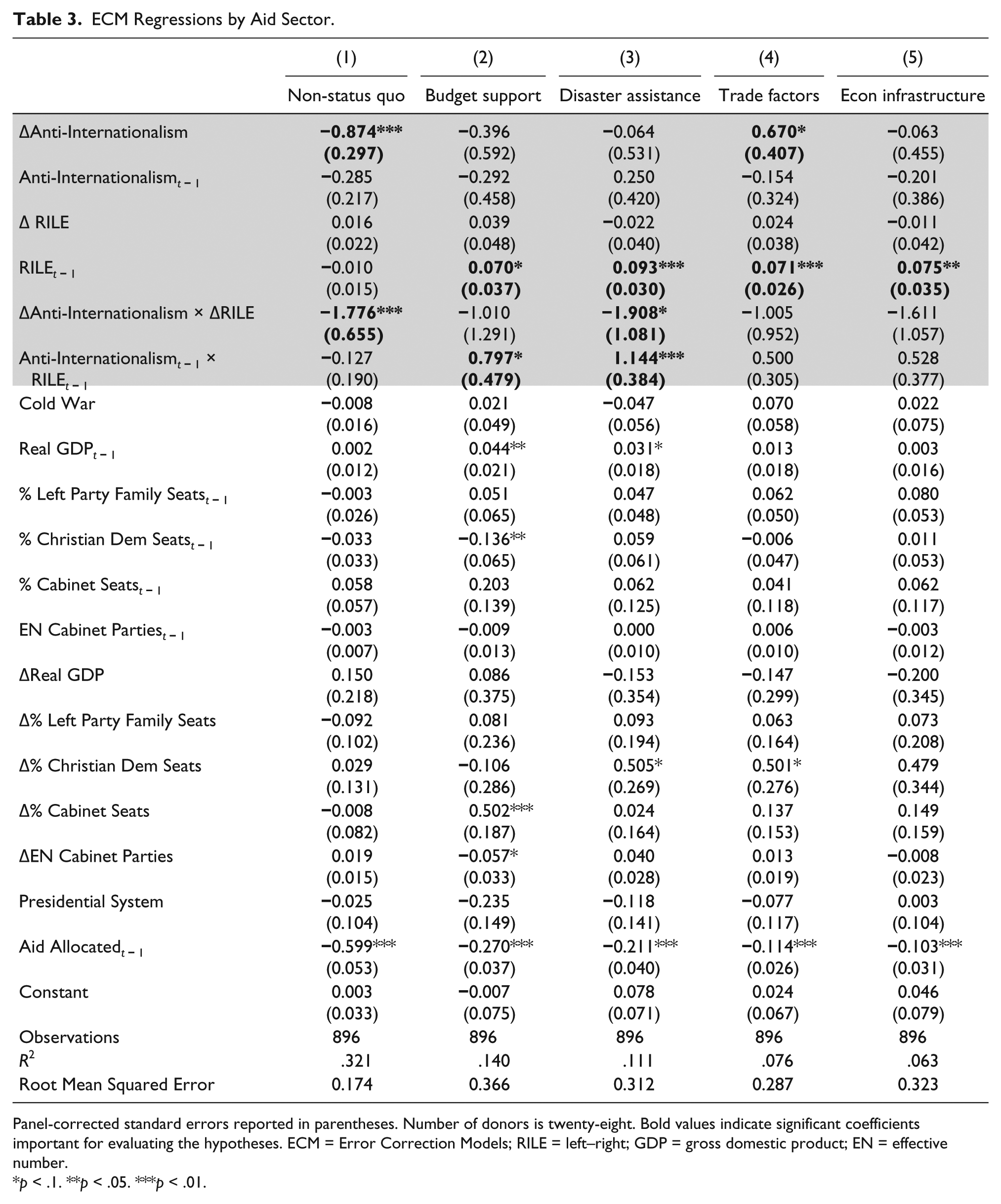
Panel-corrected standard errors reported in parentheses. Number of donors is twenty-eight. Bold values indicate significant coefficients important for evaluating the hypotheses. ECM = Error Correction Models; RILE = left–right; GDP = gross domestic product; EN = effective number.
p < .1. **p < .05. ***p < .01.
Due to the limited information conveyed by coefficients, we graph the marginal effect, in both the short- and long-term, for each preference dimension. For a more holistic view of the results, we also designed a simulation (similar to Williams and Whitten 2012), which compares aid allocations over time. The simulation begins with an “election” in two equivalent countries A and B. 28 In both countries, elections bring in internationalist governments, two standard deviations to the left of average. Country A’s new government has economic ideology scores two standard deviations to the left of the sample mean. In B, the new government’s economic ideology lies two standard deviations to the right of the mean. Plugging in these values, we calculate the predicted outcome, that is, the difference in aid allocated to each sector, for these two governments. The simulation proceeds as though these governments rule for five years. 29 We repeat the simulation moving parties to the right on internationalism for more complete interpretation. 30
Figures 2 and 3 report the marginal effects of RILE and anti-internationalism, respectively. The marginal effect gives the average increase in Y for an instantaneous increase in X, at each value of its conditioning variable. As both dimensions are conceptualized along a RILE continuum, an increase in economic ideology is a move to the right; an increase in anti-internationalism is a move away from international engagement. The thin lines in Figures 2 and 3 provide 95 percent confidence bands, calculated using the formula for the variance of a sum of random numbers (Friedrich 1982, 810). The shaded histograms provide the in-sample distribution of the conditioning variable. Figure 4 reports the results from the simulated pro-internationalist governments with 95 percent confidence bounds; Figure 5, of anti-internationalist governments.

Long- and short-term effect of economic ideology on aid allocation.
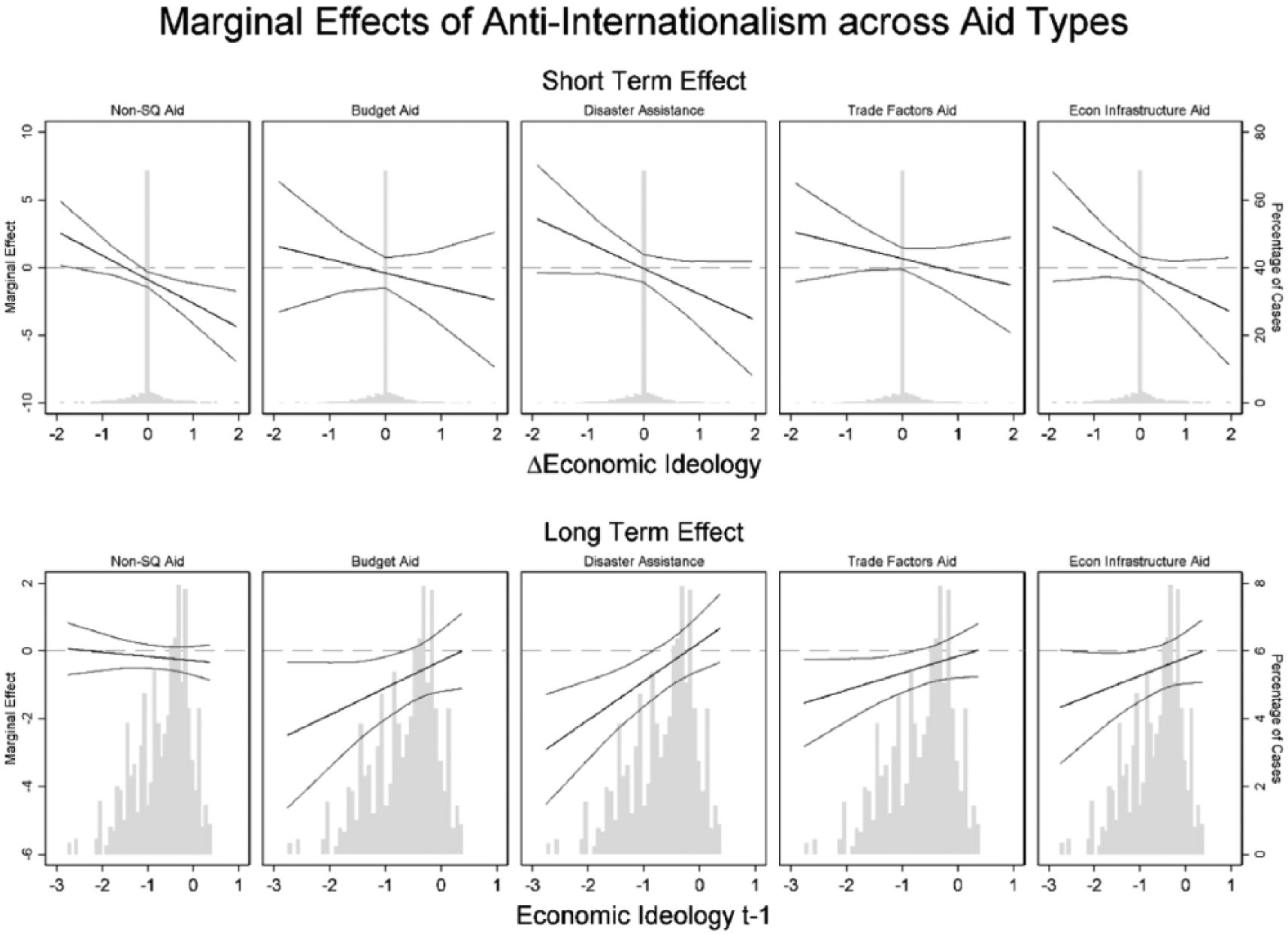
Long- and short-term effect of economic ideology on aid allocation.
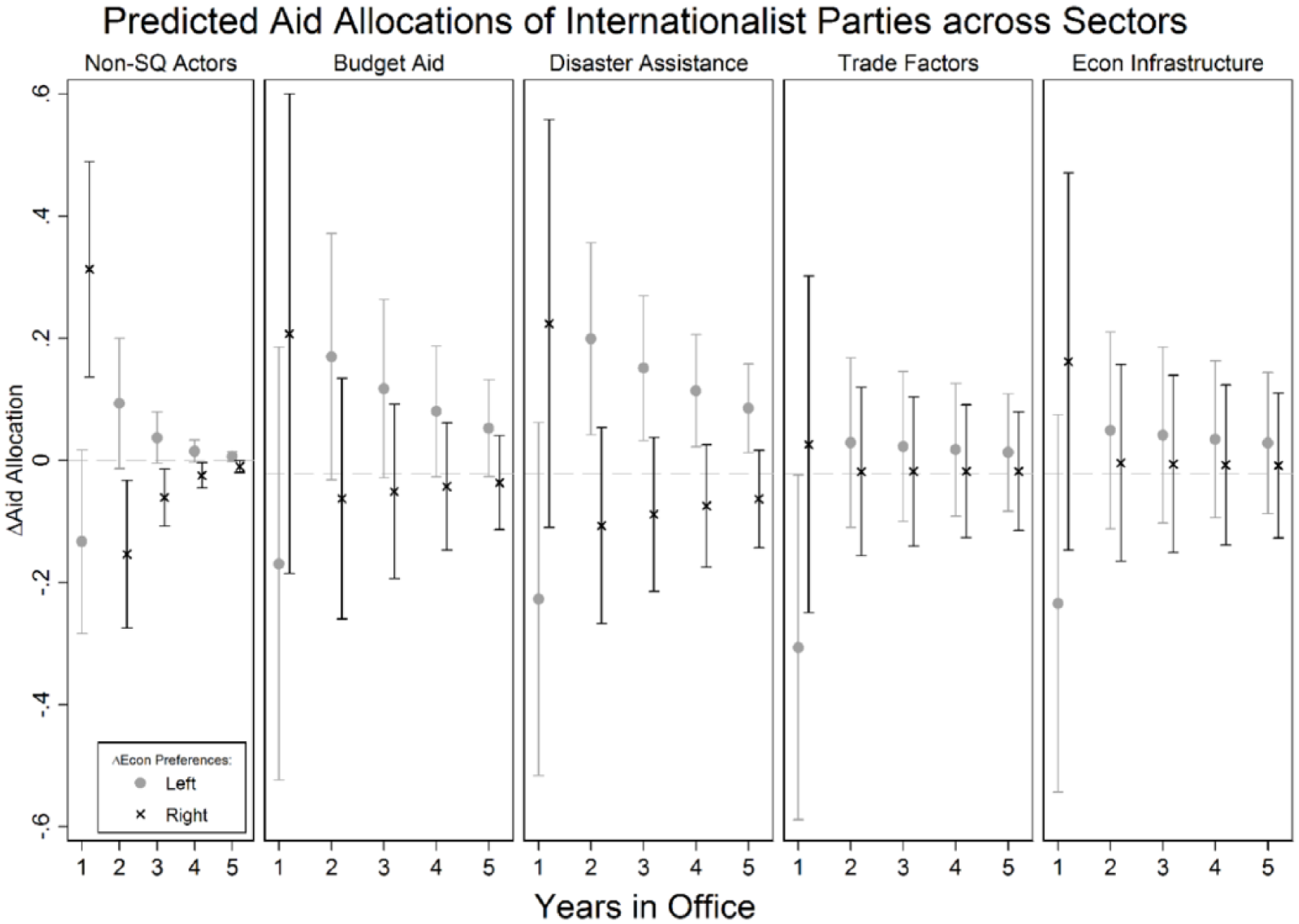
Results from simulation of pro-international election winners.
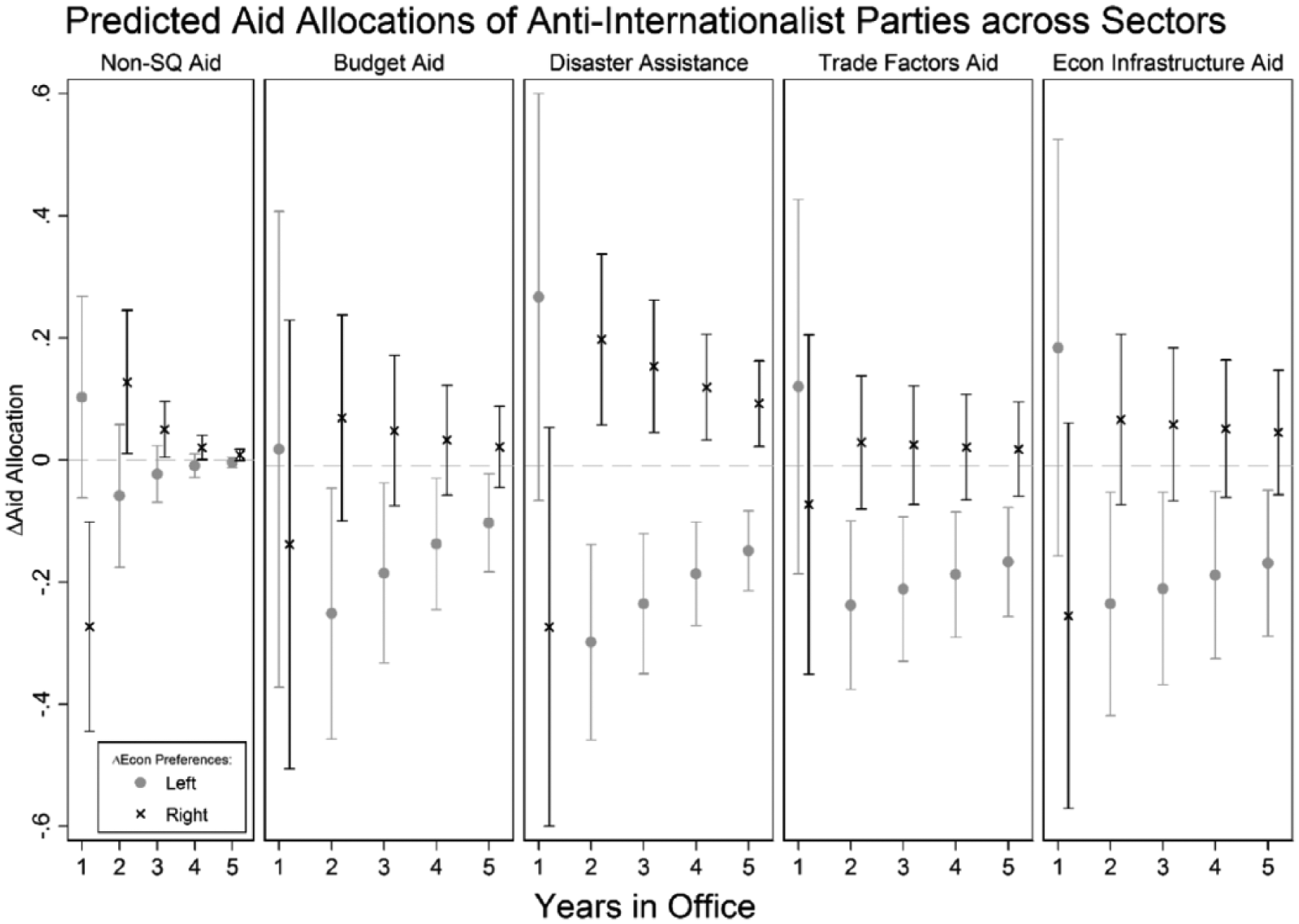
Results from simulation of anti-international election winners.
Hypothesis 1a: Non-SQ Aid
In our first hypotheses (H1a and H1b), we predict left-international governments will increase aid to disaster relief and non-SQ actors. The first panels in Figures 2 and 3 display the pertinent marginal effects. Our model shows that, in the short term, moving to the right associates with greater allocations of non-SQ aid if the party also becomes more internationalist. Further, a change toward anti-internationalism decreases such aid allocations, only if the government also becomes more economically conservative. These findings do not perfectly fit expectations. Our logic regarding need-based aid led us to hypothesize that pro-international leftist governments would be the ones to increase aid to non-SQ actors. We find instead that internationalist parties of the right boost this type of aid. Decreasing allocations to non-SQ actors when parties shift to the right on both dimensions, though, meshes with our perspective.
Figure 4 plots the predicted aid allocations from our simulated election of pro-internationalist parties. The predicted effects soften results regarding this hypothesis. In the first round of our simulation, the right-internationalist government significantly increased aid to non-SQ actors; the similarly internationalist, but economically liberal, government decreased the allocation. The short-term effect for the left parties, though, falls well short of statistical significance. In subsequent years, our model shows the right-internationalist government reversing its allocation pattern. Within three years, subsequent cuts canceled out the first round’s increase. The long-term effect for left-pro-international donors is positive, and marginally significant (at α = 10 percent). When the simulated election brings anti-internationalist parties to power (see Figure 5), the pattern for right governments reverses: a large decrease is offset by subsequent additions. For the left government that eschews engagement with the international community, though, predicted changes in allocation never differ significantly from zero.
Hypothesis 1b: Disaster Assistance
The third columns in our figures evaluate the effects on disaster aid. Short-term effects are barely significant in this regression. Natural disasters occur stochastically but are more likely to accumulate over the course of a government’s tenure than to cluster in the first year; the effect of preferences plays out over the long term. The steep slope of its marginal effects indicates that the internationalism dimension strongly conditions economic ideology’s long-term effect. A more conservative government that is also internationalist allocates less money to disaster aid. On the parochial side, however, conservative governments appear more generous in this form of aid. Examining the other side of the interaction effect, we see that the significant results pertain entirely to the leftist side of economic ideology. Consistent with H1b, the effects show that parochial leftist parties assign less of this form of aid. Figure 4’s third panel contains the predicted outcomes for this model. In the long run, a pro-internationalist left government spends more on disaster assistance while right-internationalists make no significant changes. Figure 5 shows the alternate election results, with anti-internationalist governments coming to power. Here, we see the strong significant marginal effect of economic ideology playing out: on the anti-internationalist side, left and right governments behave very differently. The long-run cuts of left-anti-internationalist governments are deeper than the increased allotments by conservatives.
Hypothesis 2a: Budget Support
Our second set of hypotheses predict that conservative internationalist governments increase aid that signals backing for a government through budget support (H2a) or grows external markets for the country’s goods (H2b). Contradictorily, we find that economic ideology never significantly affects allocations to budget support (see second panels in Figure 2). In the long-term, though, anti-internationalism negatively affects it if combined with leftist ideology (see Figure 3). The pattern is clearer in Figure 5. The parochial leftist government slashed budget aid after taking office, while its rightist counterpart made no significant adjustments.
We interpret this evidence as supportive of our theory, if not the specific wording of H1b. While rightist governments do not boost budget support, they also refrain from cutting it even if they become opposed to international entanglement. The long-term decrease in such aid by left-anti-internationalist governments is reasonable: budget aid is easily perceived as a potentially corrosive or unequitable means of redistributing wealth.
Hypothesis 2b: Trade Factors and Infrastructure
We employ two dependent variables to assess whether right-internationalist governments pursue economic advantage by bolstering new markets for their countries’ exports. Results across these two regressions mirror each other quite closely, as we expected they would. For both types of aid, a shift to the right of the economic spectrum decreases allocations by moderately anti-internationalist governments in the short term, but the limited range of significance for this marginal effect raises doubts about its validity. The most similar set of effects across the two models can be seen in the long-term marginal effects of anti-internationalism. These suggest that parochialism is associated with lower aid allocations by leftist governments. The predicted effects illustrate the estimated changes in allocations over time. Pro-internationalist parties rarely differ from each other in their decisions regarding aid for trade (see Figure 4). In the trade factors model, our simulation suggests a short-term decrease in aid by far-left internationalist governments, but with very broad confidence bands. Figure 5, showing hypothetical anti-internationalists, reveals the significant effects. Here, we see significant, long-term reductions in trade-boosting aid by leftist parties. We summarize the results of our primary analysis in Table 4.
Summary of Findings by Hypothesis.

Together, these results suggest that if a difference in preferences for these types of aid exists, it exists only for anti-internationalist governments. The inefficiency in predicted outcomes for pro-internationalist governments, though, may be due to noise in our measurement scheme. Perhaps the expected patterns of trade-boosting aid surface only in the subset of states with a history of purchasing donors’ exports. Testing this more refined hypothesis requires a dyadic data structure, and thus lies outside the bounds of this analysis.
Controls
Many of the control variables also perform as predicted. Cabinets controlling a larger percentage of the lower house of parliament increase budget aid in the short term, presumably due to easier policy making. This logic also explains presidentialism’s negative, though insignificant, coefficients for most sectors. Presidential systems require greater compromise due to additional institutional veto points (Tsebelis 2002). More fractionalized cabinets, those with a greater effective number of cabinet parties, only have a negative short-term effect on budget aid. Coalitions with more parties face difficulties agreeing on common foreign policy reforms, particularly in relation to aid sectors intended to influence the behavior of governments more directly. Greater left-leaning seat share (Social Democrat and Communists) has no consistent long- or short-term effect (contrasting Therién and Noëll’s logic). Yet the lack of additional effects from ideology beyond the government’s is unsurprising; our more nuanced measurement of the government’s position accounts for parties’ ideology.
Discussion
Domestic political preferences and constraints affect actors’ choices and capacities in international politics (Putnam 1988; Whitten and Williams 2011). Research on donor-state preferences often makes overly strong simplifying assumptions, masking interesting variation both in donor preferences and in foreign aid. Considering only the RILE dimension of economic ideology lumps together governments with dissimilar goals. Despite arguments in the literature to the contrary, we contend that parties with liberal domestic preferences will not necessarily believe that excess wealth generated by their economy should be transferred to the less fortunate abroad. Similarly, governments with conservative ideology may not scorn foreign aid as a soft-hearted waste of resources. Indeed, we find that a conservative economic ideology rarely leads to reduced aid, even when combined with anti-internationalism.
Foreign aid offers a flexible tool of foreign policy. Measuring donors’ “aid effort” simply by allocations as a proportion of available resources obscures the myriad purposes of economic assistance. Benevolent pursuit of economic justice is not the only motivation behind foreign aid. Because donors use aid in pursuit of many different “returns,” conservative governments interested in promoting their constituents’ interests abroad find reasons to increase aid as well. Broadly, governments’ ideological goals correspond to varied forms of foreign aid.
We find support for our expectations that RILE preferences condition the aid allocation patterns of regimes. Left governments give disaster aid generously but are markedly less enthusiastic about nearly everything else. Right governments may be less sensitive to swings in the internationalism dimension, a sign that conservative governments more consistently value influence over others.
Despite earlier work’s focus on RILE politics, internationalism matters. Left-anti-international governments, for example, reduce aid to the type of economic projects championed by left-pro-international parties. In the case of trade-focused aid, economic ideology manages only to blunt the stronger role of parochialism for conservative governments.
Turning to policy implications, potential recipients should tailor aid requests to the political profile of the donor governments for maximum leverage. As this logic suggests, though, politicization of aid may seriously threaten its overall development mission. Donor-state policy makers who prefer that aid focus on need and impact could benefit from built-in external commitment mechanisms, such as employing multinational or nongovernmental agencies to ensure consistent, long-term funding (McGillivray and Pham 2015). Decisions regarding oversight and implementation of aid programs may also reflect changes in donor governments’ preference.
More broadly, we further efforts to bridge the divide between the concepts and theories championed by comparative politics and those emphasized in international relations. The last decades brought an explosion of theory that privileges domestic politics in explaining international outcomes, yet too many models still employ extreme simplifying assumptions, boiling domestic politics down to regime-type binaries, leaders down to survival-motivations. The perspective forwarded here takes seriously policy preferences, and variations therein, across democratic polities. In doing so, we tie electoral motivations to policy preferences, and these preferences to variation in foreign policy.
Footnotes
Declaration of Conflicting Interests
The author(s) declared no potential conflicts of interest with respect to the research, authorship, and/or publication of this article.
Notes
Supplemental Material
Supplemental material for this article is available with the manuscript on the Political Research Quarterly (PRQ) website.
References
Supplementary Material
Please find the following supplemental material available below.
For Open Access articles published under a Creative Commons License, all supplemental material carries the same license as the article it is associated with.
For non-Open Access articles published, all supplemental material carries a non-exclusive license, and permission requests for re-use of supplemental material or any part of supplemental material shall be sent directly to the copyright owner as specified in the copyright notice associated with the article.
