




Abstract
Despite the long historical battle of members of the gay and lesbian community to gain equal rights as their heterosexual counterparts, the adoption of public policies at the national level that recognize same-sex partnerships and marriages is a relatively recent political development across the globe. Consequently, we know little about whether, and how, this type of legislation affects public attitudes toward homosexuality. This study examines the relationship between same-sex couple legislation and public opinion using data from the World Values Survey from the years 1989 to 2014. While previous studies examining this relationship in the European context have found a positive relationship, the results presented in this paper paint a less optimistic picture of the impacts that same-sex couple legislation has on attitudes toward homosexuality. Specifically, I find that instead of same-sex partnership legislation increasing favorable attitudes across the entire population, it only affects individuals who are already generally supportive of homosexuality. Implications for gay and lesbian rights are discussed.
Introduction
While the legal recognition of same-sex marriage at the federal level is relatively new in the United States, other countries across the world have a much longer history of granting gays and lesbians the right to marry. The Netherlands was the first country in the world to grant legal recognition of same-sex marriage in 2000. Since then, twenty-one other countries have done the same. 1 However, even before recognizing same-sex marriage, many countries granted legal recognition to same-sex partnerships, with Denmark being the first country to do this in 1989. Since then, just over two dozen other countries have done the same. 2
Given the relative dearth of same-sex partnership legislation across the world, there are few cross-national empirical studies that examine the effects of such legislation on public attitudes (but see Hooghe and Meeusen 2013; Takács and Szalma 2011; van den Akker, van der Ploeg, and Scheepers 2013). Moreover, as the majority of this legislation has been passed in European countries, previous cross-national studies focus almost exclusively on Europe while ignoring the rest of the world. However, given the increasing expansion of same-sex couple recognition in other parts of the world, we can begin to examine a greater number of countries to test whether trends and relationships involving same-sex couple legislation and public opinion that have been found in Europe hold when the context is expanded to include countries outside of Europe.
In this paper, I address the question of how same-sex partnership legislation affects public opinion toward homosexuality. From an empirical viewpoint, being able to include a greater number of countries in the estimations gives us greater power to determine whether trends that have been found to exist in one geographic region are also present in other types of societies. From a more practical perspective, answering this question is important to understanding the societal acceptance of an historically disadvantaged group with a long history of political and social discrimination. If the legal recognition of same-sex couples increases favorable attitudes toward these individuals, it suggests that the societal position of gays and lesbians may increase more rapidly than it otherwise would as more countries begin passing such legislation. Moreover, it shows that political elites do not necessarily need to wait for societal attitudes to catch up to potential legislation before it is introduced and adopted. Instead, it suggests that elites can have a significant influence on societal attitudes simply by passing certain types of legislation. However, if this type of legislation has no impact or a negative impact (i.e., a backlash effect) on public attitudes, then the future for increased acceptance of homosexuals across the world is much bleaker. As Hooghe and Meeusen (2013, 260) explain, If we do not find any relation, this would suggest that the introduction of same-sex marriage or registered partnership is mainly an elite process, involving political decision makers and political activists, but without any obvious relation to public opinion.
This paper proceeds first with a discussion of historical trends in attitudes toward gays and lesbians. Next, I present the theory and hypotheses, which I derive from the literature that examines the effects of legislation on public attitudes, including opinion backlash. I then discuss the data and methods by which I test the hypotheses, followed by a discussion of the results. I conclude with a discussion of the implications these findings have for gay and lesbian rights and potential avenues for future research in this area.
Attitudes toward Homosexuality
Gays and lesbians have a long history of being discriminated against across all cultures in the world. Despite being culturally accepted during the Greek and Roman Era, homosexuality was eventually condemned with the rise of Christianity (Geneseo at The State University of New York 1997), with many individuals and groups citing religious morality as a justification for discrimination against homosexuals, even in the modern era (Herek 1991). Eventually, medical groups transformed the sin of homosexuality into a mental illness. It was not until 1992 that the World Health Organization removed homosexuality from its International Classification of Diseases (Burton 2015).
Despite the long history of prejudice against these individuals, scholars have found that negative attitudes toward gays and lesbians have been declining at a relatively consistent rate in recent decades due to several other changes taking place, at least in Western societies (Gibson 2007; Scott 1998). Two factors that have been found to partially explain the decline in prejudice is the increase in education and the decline of strict religious adherence. Jaspers, Lubbers, and De Graaf (2007) argue that the increase in secularization and increasing levels of education can explain the decline in homosexual prejudice as individuals who are less well educated (e.g., Hello, Scheepers, and Gijsberts 2002) and more religious (e.g., Scheepers, Te Grotenhuis, and Van der Slik 2002; Treas 2002) are less likely to approve of homosexuality. In addition to rising education levels and increased secularization, Inglehart (2008) argues that a change in societal values from traditionalism to postmodernism has also contributed to greater acceptance of homosexuality. Finally, Kollman (2007) suggests that increased activities and visibility of lesbian, gay, bisexual, and transgender (LGBT) movements and organizations also help explain the decline in prejudice.
In addition, scholars have found several other predictors of tolerance toward homosexuality. At the individual level, gender (Andersen and Fetner 2008; Cullen, Wright, and Alessandri 2002; Kite and Whitley 1996), social network (Cullen, Wright, and Alessandri 2002), religiosity (Hooghe and Meeusen 2013; van den Akker, van der Ploeg, and Scheepers 2013), partisanship (Bishin et al. 2016), marital status (van den Akker, van der Ploeg, and Scheepers 2013), and age (Andersen and Fetner 2008; Hooghe and Meeusen 2013; van den Akker, van der Ploeg, and Scheepers 2013) influence one’s attitudes toward homosexuality. At the national level, economic development (Andersen and Fetner 2008), democratic stability (Hooghe and Meeusen 2013), and a country’s religious composition (van den Akker, van der Ploeg, and Scheepers 2013) also affect these attitudes.
Legislation Effects on Attitudes
As Hooghe and Meeusen (2013) point out, much of the extant literature that examines attitudes toward homosexuals focuses strictly on broad social changes in public opinion rather than on the causes or effects of same-sex partnership legislation. However, as more countries have begun passing this type of legislation over the past several decades, a few scholars have recently been able to examine the effects of such legislation on public opinion. It should be noted, though, that of the few cross-national empirical studies that examine the relationship between same-sex couple legislation and public attitudes, all focus exclusively on European countries and examine a relatively short period of time in the early 2000s. Hooghe and Meeusen (2013) investigate this relationship across twenty-nine European countries between 2002 and 2010. They find that there is indeed a correlation between public opinion toward gays and lesbians and the level of same-sex legislation that a country has adopted, although the authors are unable to make causal claims. Similarly, Takács and Szalma (2011) examine twenty-six European countries between 2002 and 2008 and find that social acceptance of gays and lesbians is significantly higher in countries that adopted same-sex partnership legislation in the post-adoption period while there is no significant change in acceptance of gays and lesbians in the same time period in countries that did not adopt such policies. Van den Akker, van der Ploeg, and Scheepers (2013) also find that individuals who live in countries with more tolerant laws toward gays and lesbians disapprove of homosexuality less than individuals who live in countries with less tolerant laws in their study of twenty European countries from 2002 to 2008. Here again, however, the authors note that the direction of causality is unclear.
In addition to the few cross-national studies examining same-sex partnership legislation, there is also a literature on opinion backlash, particularly in the American context. Bishin et al. (2016, 626) define backlash as “a large, negative, and enduring shift in opinion against a policy or group that occurs in response to some event that threatens the status quo.” As the authors point out, many scholars have argued that the fear of backlash has been used in American politics to prolong or halt the passage of numerous laws designed to promote minority interests, including policies that would benefit African Americans, women, Latinos, and homosexuals. The authors use both an online and natural experiment, as well as large-sample survey data, to examine whether or not the passage of same-sex partnership legislation (or same-sex partnership rulings in cases where the law came about through the judiciary) sparks opinion backlash toward gays and lesbians. They find no evidence that such backlash occurs, even among individuals who are most predisposed to dislike homosexuals.
Similarly, Flores and Barclay (2016) conduct a cross-state comparison in the United States using panel data and find no evidence of opinion backlash after same-sex marriage legislation is introduced in a state. Moreover, these authors find that antigay attitudes are actually reduced in states where same-sex marriage policies are introduced. They argue that rather than sparking a backlash, and rather than polarizing the public, changes in policy regarding same-sex partnerships can actually legitimate the issue. They find that when individuals change their positions on the issue of same-sex marriage after this type of legislation is introduced, the changes are overwhelmingly in a more positive direction.
Scholars have examined the impact of legislation on attitudes related to other policies as well. In a panel study, Colombotos (1969) examines attitudes of physicians toward the Medicare program before and after its implementation and finds that though there was bitter opposition to the Medicare bill prior to its adoption, ten months after its implementation, favorable attitudes rose significantly. Franklin and Kosaki (1989) examine attitudes toward abortion and find that attitudes toward abortions that protect health became more favorable after the Roe v. Wade decision.
The aforementioned studies aside, we simply do not know much about the relationship between same-sex partnership legislation and public opinion, particularly outside of the European and American states contexts. This project extends previous studies by including countries from all over the world and over a longer period of time to examine whether previous findings can be generalized at a broader level. This is important because as Flores and Barclay (2016, 47) state, “A single policy context confounds the changes due to the focusing event with time, while the examination of multiple contexts accounts for such confounding.” In other words, by looking at several countries that have passed same-sex partnership legislation at different times, we can account for the general time trends related to public opinion to determine the direct effect that legislation has on attitudes in the post-adoption period. Moreover, given that the majority of research on tolerance of homosexuality focuses on a single nation (Andersen and Fetner 2008), the insights derived from previous findings regarding the practical implications for the progress of the LGBT movement do not necessarily consider the broader, more global fight for gay and lesbian rights.
Causality and Hypotheses
In many of the previous studies examining the relationship between legislation and social attitudes, there is a causality-related dichotomy that is commonly discussed. One view is that legislation can never move public opinion and that legislation without public support is doomed for failure. The common phrase used regarding this view is that “stateways cannot change folkways” (Colombotos 1969, 319). Proponents of this view argue that change in public opinion must precede legislative action while opponents of this view argue that the law can be an effective initiator of social change. Allport (1954, 471) states, “It is a well known psychological fact that most people accept the results of an election or legislation gladly enough after the furor has subsided . . . They allow themselves to be re-educated by the new norm that prevails.” Hooghe and Meeusen (2013) echo these two opposing views, pointing out that agenda-setting studies would suggest that public opinion (and the media) affects what makes it on the political agenda to begin with (e.g., Hester and Gibson 2007) while other studies suggest that the causal arrow flows in the other direction, with legislation bringing attention to certain policy areas and affecting related attitudes (e.g., Badgett 2009).
It is worth noting explicitly that by focusing on the change in attitudes due to the passage of legislation, I by no means am arguing that public opinion is not important in determining what legislation makes it on the political agenda in the first place. It is very possible, and indeed likely, that a policy must have a minimum level of support among the public before legislation regarding that policy is even crafted. As Lax and Phillips (2009, 369) point out, “There are numerous paths by which opinion can shape policy, [with] the most obvious [being] the ‘electoral connection.’” However, once the policy is passed, the causal arrow necessarily flows from legislation to attitudes (assuming we can control for the initial level of support for the policy and the trend of support over time). It is this effect of legislation on attitudes (if such an effect exists at all) that I am interested in here, regardless of the level of support for the policy prior to its adoption.
While the method that I use to test this relationship allows me to make causal claims, I recognize that there may be several mechanisms driving the relationship. First, as Allport (1954) points out, the legislation might “re-educate” individuals so that they reevaluate their own attitudes to be more in line with the law. Second, it might be that individuals now view the acceptance of same-sex couples as the new societal norm and update their attitudes accordingly. Related to these points, Colombotos (1969, 323) cites the New York State Medical Society after Medicare was implemented: “Now that ‘Medicare’ is an accomplished face, [the Society] will cooperate in every way possible . . . As citizens and as physicians, the members of the State Society will obey, and assist in the implementation of the law of the land.” Third, legislation might increase favorable attitudes toward homosexuals based on contact theory. After a country recognizes same-sex couples, the number of (legal) same-sex partnerships or marriages in a given country necessarily increases from zero to a number greater than zero after the corresponding legislation is adopted. Consequently, the probability of an individual coming into contact with, hearing about, or reading about (e.g., in the news) individuals in same-sex relationships also increases. Numerous scholars have found that individuals who come into contact with gays and lesbians are more likely to be supportive of both homosexual lifestyles and also policies promoting LGBT rights, including same-sex marriage (Barth and Parry 2009; Herek and Capitanio 1996; Herek and Glunt 1993; Overby and Barth 2002).
A final potential method by which individuals change their attitudes after same-sex couple legislation is passed relates to perceived consequences of the legislation. After the legislation passes and same-sex couples begin entering into legal partnerships, heterosexual individuals who were worried about any negative consequences (either to themselves or to society) might see that nothing has changed in their own lives after the adoption of such legislation. As a result, these individuals will no longer be skeptical of the effects of same-sex partnerships and update their attitudes accordingly. For example, Badgett (2004) finds that legally recognizing same-sex partnerships has no effect on heterosexual marriage rates, heterosexual divorce rates, or nonmarital birth rates in the post-adoption period in five European countries that passed same-sex partnership legislation.
Regardless of the exact mechanism, the outcome of each leads to the following hypothesis:
Moreover, as the rights of same-sex couples increase from being able to enter same-sex partnerships (e.g., civil unions) to full marriages, I expect an additional increase in favorable attitudes toward homosexuality, similar to the findings of Hooghe and Meeusen (2013). In other words, if a country allows same-sex couples to legally enter into civil unions, but not marriages, it is possible that it sends a message that homosexual unions are acceptable but they are still not equal to a heterosexual marriage. Thus, attitudes toward homosexuality might get a boost from this type of legislation, but it might not be as big as if the country were to recognize same-sex marriages like any heterosexual marriage. Regarding the difference between civil unions and same-sex marriages, Herek (2006, 617) states, “Denying same-sex couples the label of marriage—even if they receive all other rights and privileges conferred by marriage—arguably devalues and delegitimizes these relationships.” Thus, I expect:
However, it is possible that these expectations are too optimistic despite the supporting evidence for each of them found in previous studies in the European (e.g., Hooghe and Meeusen 2013; Takács and Szalma 2011) and American contexts (e.g., Bishin et al. 2016; Flores and Barclay 2016). Rather than changing individuals’ beliefs about homosexuality in a positive direction, the adoption of such legislation might simply reinforce preexisting attitudes, both positive and negative. In their study on the Defense of Marriage Act (DOMA) in the United States, for example, Bishin and Smith (2013) find not only substantial variation in attitudes toward gay and lesbian rights, but they also find that support for DOMA among legislators themselves is affected by the presence and size of certain subconstituencies in a given district. Even among Democratic legislators, there are heterogeneous effects of public opinion on support for gay rights legislation.
Franklin and Kosaki (1989) examine this as it relates to abortion attitudes. They argue that when looking at aggregate attitudes, it is possible that the effect of legislation might appear to be zero even though the legislation might have had significant effects on different groups of people, but in opposite directions. For example, passing a piece of legislation might increase negative attitudes among individuals who already had negative attitudes, and it might simultaneously increase positive attitudes among individuals who had preexisting positive attitudes. By looking at aggregate levels of opinion change, the net effect would appear to be zero. In other words, rather than converting opinions in a uniform direction, the decision to adopt certain legislation might polarize individuals who disagree about the policy even more. Like abortion, gay and lesbian rights have become a relatively salient issue. While this means that individuals will most likely be aware of any changes in national legislation concerning same-sex couples, it also means that individuals likely have well-structured beliefs and attitudes about this issue. If this is the case, then instead of same-sex couple legislation increasing aggregate levels of favorable attitudes toward homosexuality, I expect the following competing (compared with H1 and H2) hypothesis:
Similar to the first set of hypotheses, I am agnostic about the exact mechanism driving the polarizing effects of the legislation. One possibility, similar to Franklin and Kosaki (1989), is that the environment in which individuals receive news about the legislation reinforces one message about the topic. If an individual who previously disagreed with homosexuality were to change her opinion about it after the legislation passes, she will eventually revert to her original opinion on the matter if her social environment reinforces negative views of gays and lesbians. Franklin and Kosaki (1989, 763) state, “In this way they test their own interpretations of what has happened and modify their conclusions in light of the communal interpretation.” Another possible mechanism might be that individuals who view homosexuality negatively might have stronger attachments to other identities that inform their opinions on the subject. For example, many individuals are against homosexuality for religious reasons. If same-sex legislation is passed, they may view that as a threat to their religious identity and thus, view the subject even more negatively. On the contrary, in the absence of a threat to another identity, the legislation might validate the opinions of individuals who approve of homosexuality and allow them to crystallize those attitudes even more.
Finally, as mentioned above, much of the previous research on this topic has focused on Europe given that it is the region in which most same-sex legislation has been adopted. Part of the reason for this might be due to influences of the government of the European Union (EU). A 2006 resolution by the European Parliament called on member nations of the EU to ensure that members of the LGBT community are protected from violence and also states that same-sex couples should enjoy the same respect and dignity as the rest of society (Takács and Szalma 2011). In addition, prior to joining the EU, each member country was also part of the Council of Europe, which was founded on the value of human rights. Thus, European countries have a long history of emphasizing the rights of minorities, especially sexual minorities, at least compared with other countries across the globe. To my knowledge, no other supranational government or organization has placed as much emphasis on its members protecting gay and lesbian rights as the EU. As such, I expect the influence from these supranational governing bodies to affect the relationship between same-sex couple legislation and attitudes toward homosexuality. Given that the European Parliament placed an emphasis on LGBT rights and that more European countries have passed legislation recognizing same-sex partnerships than any other region in the world, I expect that attitudes toward homosexuality are likely already relatively positive in EU member states compared with these attitudes in countries outside of the EU. This assumption is confirmed by a Pew Research Center survey conducted in thirty-nine nations, finding that “views of homosexuality are most positive in Europe.” 3 Thus, given the relatively positive preexisting attitudes in Europe, I expect:
Data and Method
To test the hypotheses, I use longitudinal cross-section data from the World Values Survey (WVS), integrated with similar data from the European Values Survey (EVS). These surveys were conducted over various waves between the years 1981 and 2014. As the data include the year in which the survey was conducted, I am able to pool the data by country-year. 4 The WVS is a high-quality survey that is administered to a nationally representative sample in almost one hundred countries across the world (which make up almost 90% of the world’s population). The survey asks the same questions in each country related to how values impact social and political life.
As mentioned above, many of the studies examining the effect of legislation on public attitudes across multiple countries have trouble making causal inferences due to various methodological limitations. One difficulty relates to trying to disentangle the effects that legislation has on public opinion from the factors that lead to the adoption of legislation in the first place. In other words, if the level of LGBT acceptance within a country affects that country’s decision to adopt certain LGBT policies, it is difficult to determine the precise influence of the legislation on attitudes toward homosexuals in the post-adoption period. However, the fact that longitudinal public opinion data related to attitudes toward homosexuality exists for both countries that have passed same-sex legislation and countries that have not passed such legislation allows me to use a difference-in-differences approach. More specifically, in every wave of the WVS, respondents are asked the same question related to how often homosexuality could be justified.
In its simplest form, the difference-in-differences method mimics an experiment by exposing one group to a treatment while another group receives no treatment (control group). An outcome variable is measured in both groups both before and after the former group receives the treatment. Any between-group difference between the two within-group differences is the causal effect of the treatment on the outcome variable. It is important to note that making a causal inference here relies on the assumption of common trends between groups. In other words, in the absence of the treatment, the group exposed to it would have behaved in the same way that the group not exposed to the treatment behaved.
However, with more cases from several time periods, we can relax this assumption by including a variable to control for unit-specific (in this case, country-specific) trends (Angrist and Pischke 2015). In other words, including country-specific time trend variables allows for the nonparallel evolution of the outcome variable across countries. In addition, we can include year and country fixed effects to account for both temporal changes in the dependent variable (attitudes toward homosexuality) that are common across all countries and time-invariant differences in the dependent variable between countries, respectively. In short, we can extend the simple difference-in-differences approach to include multiple countries that are exposed to the treatment(s) at different points in time while relaxing the common trends assumption to make causal inferences about the effect of same-sex partnership legislation on attitudes toward homosexuality (Angrist and Pischke 2015, 191–201).
In the analyses below, the main dependent variable in each model is constructed from a question asking how often the respondent believes homosexuality can be justified. Thus, my unit of analysis in all the estimations below is the individual, pooled by country in a given year. Responses to the question range from 1 (homosexuality is never justifiable) to 10 (homosexuality is always justifiable). Although relying solely on one question to measure attitudes toward homosexuality is not ideal, the advantage to using this question is that it is asked in the same way in every wave of the survey. Moreover, previous research has found that attitudes toward homosexuality are generally one-dimensional (e.g., Hooghe and Meeusen 2012). 5
The main independent or “treatment” variable of interest measures the level of same-sex legislation that exists in a given country and year. 6 I code this variable as 0 if the country has no same-sex legislation in a given year, 1 if the country recognizes same-sex unions (but not full marriage) in a given year, and 2 if the country recognizes same-sex marriage in a given year. If the status of same-sex legislation in a country varies between survey waves, the same country will have different values for this variable across years. Table A in the online appendix lists all the countries in the dataset that are included in the analysis. As it is necessary to control for country-specific trends, the analysis is limited to countries that have observations for at least two waves of the survey. This leaves me with a total of seventy countries between the years of 1989 and 2014. 7 Among these seventy countries, twenty-four have passed legislation recognizing either same-sex partnerships or marriages (or both). The remaining forty-six countries did not pass any type of legislation recognizing same-sex couples at the national level prior to the final survey wave for that country.
In addition to the main independent variable, some of the estimations below include other covariates that previous research has shown to affect attitudes toward homosexuality (Dunn 2010; Herek 1984; Hooghe 2012; Hooghe and Meeusen 2013; Jaspers, Lubbers, and De Graaf 2007; Smith 1994; Takács and Szalma 2011). These include gender, age, religiosity, marital status, and education. The coding of each of these variables can be found in Table B in the online appendix, and descriptive statistics can be found in Table C in the online appendix. Given the findings in previous literature related to these variables, I expect that individuals who are women, younger, less religious, and highly educated to be more approving of homosexuality than individuals who are male, older, religious, and have lower education levels. Previous findings regarding the relationship between marital status and attitudes toward homosexuality are somewhat mixed, with different studies using different measurements and reference categories.
Results and Discussion
To test the hypotheses, I estimate a series of difference-in-differences regression models. 8 For the first two hypotheses, I first estimate a baseline model that regresses only the level of marriage legislation on attitudes toward homosexuality (as well as the necessary country and time fixed effects and country-specific trends). I then estimate another model that includes the covariates mentioned above. The results are presented in Table 1.
Effects of Legislation on Attitudes toward Homosexuality.

Standard errors in parentheses.
p < .1. **p < .05. ***p < .01.
As we can see, the coefficient on the legislation variable in the baseline model and in the full model is signed in the expected direction, but is not statistically significant. Thus, the first two hypotheses cannot be confirmed. At least when all respondents in all countries are grouped together, it appears as though the level of same-sex partnership legislation present in a country does not significantly affect public opinion.
With the exception of marital status, each of the other covariates in the full model behaves as expected, with all covariates having a statistically significant relationship with attitudes toward homosexuality. Females, younger individuals, those with a higher level of education, and those who are less religious are more approving of homosexuality than males, older individuals, individuals with less education, and individuals who attend religious services more frequently. Previous studies use a variety of categories/groupings for marital status so it is difficult to form an expectation based on prior research. Here, given that “Married” is the omitted category, it appears that individuals who live together (not married) as well as those who are divorced, separated, or single all have more favorable attitudes toward homosexuality than married individuals. Individuals who are widowed view homosexuality less favorably than those who are married. One potential explanation for the difference between married individuals and individuals who are living together (not married) might be that those living together without being married might hold less traditional views on relationships. Regarding the differences between those who are married and those who are divorced or separated, it could be that those who have gone through a divorce or separation might hold a less idealistic view of marriage, and thus are open to deviations from the traditional view of marriage. Finally, a potential explanation for the differences between married individuals and those who are single might be the correlation between marital status and age. Individuals who are married might be older, on average, than individuals who are single. Given that age is negatively correlated with favorable attitudes, those who are married (and older) would view homosexuality less favorably than those who are single (and likely younger). Creating a dummy variable that takes the value of 1 for individuals who are married and 0 for individuals who are single and then running a Pearson’s correlation with age shows a strong and significant (.52, p = .000) positive correlation.
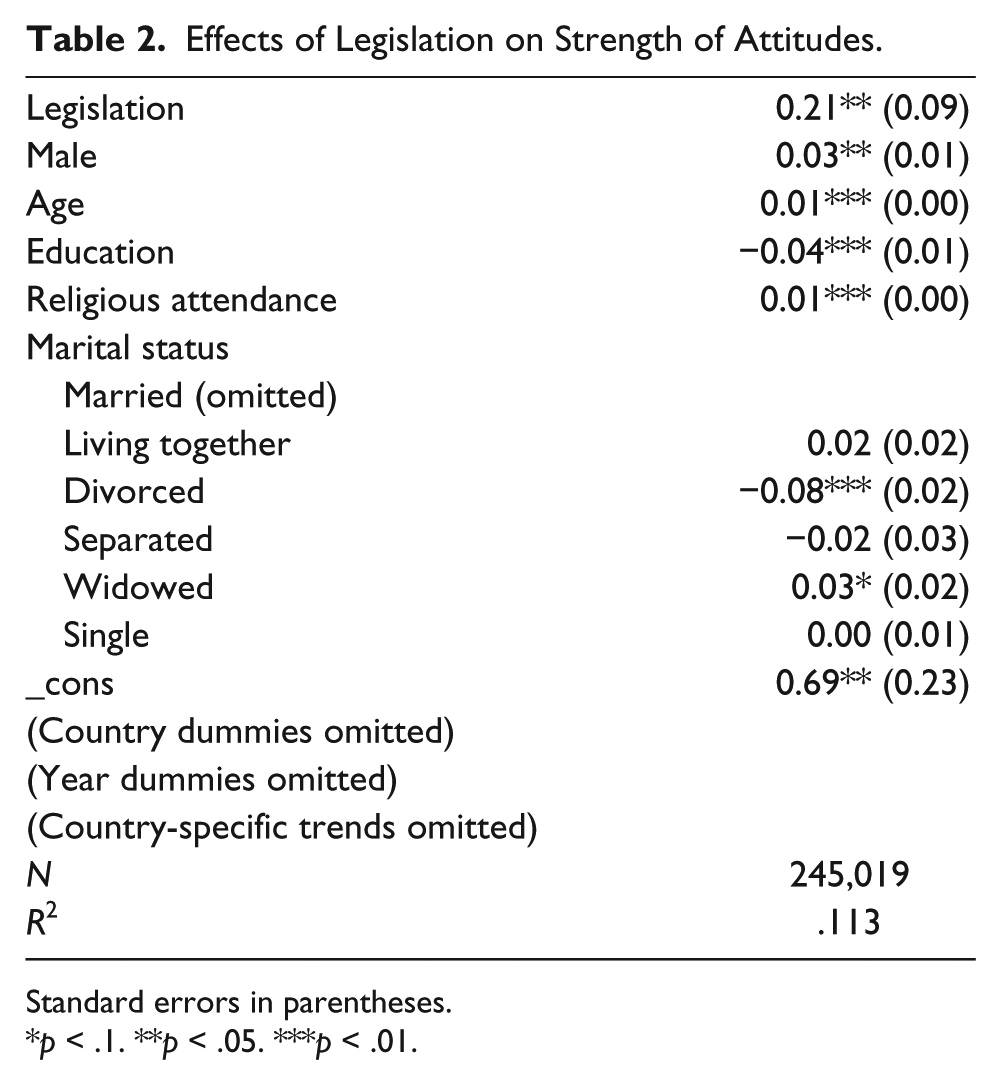
While the first two models cannot confirm the first two hypotheses, that does not mean that legislation has no effect on attitudes toward homosexuality. As H3 states, legislation might have a polarizing effect on attitudes, which would appear to be a net effect of zero when we look at the data in the aggregate as we just did. To test this, I first estimate a model where I transform the dependent variable to measure extremity of attitudes rather than approval or disapproval. As the original dependent variable ranges from 1 (homosexuality can never be justified) to 10 (homosexuality is always justified), individuals toward the middle of the scale feel more moderately than those at the extremes. Consequently, I split the variable between those who disapprove (less than 6) and those who approve (greater than 5) of homosexuality and then make a new scale ranging from 1 (least extreme on either the disapproval or approval side) to 5 (most extreme on either the disapproval or approval side). 9 These results are presented in Table 2.
Effects of Legislation on Strength of Attitudes.
Standard errors in parentheses.
p < .1. **p < .05. ***p < .01.
Table 2 shows some initial support for the idea that legislation polarizes individuals rather than persuades them all in a similar direction. Legislation has a positive, significant effect on attitudes. On average, the strength of individuals’ feelings toward homosexuality increases by about 0.21 (in both the favorable and unfavorable directions combined). In addition, males, older, and more religious individuals are more likely to have stronger feelings about homosexuality than women, younger individuals, and those who seldom attend religious services. It is interesting to note that these are the individuals who are also least likely to view homosexuality as justifiable. Similarly, individuals who have higher levels of education are more likely to have more moderate feelings. The results regarding marital status are mixed, with no clear pattern.
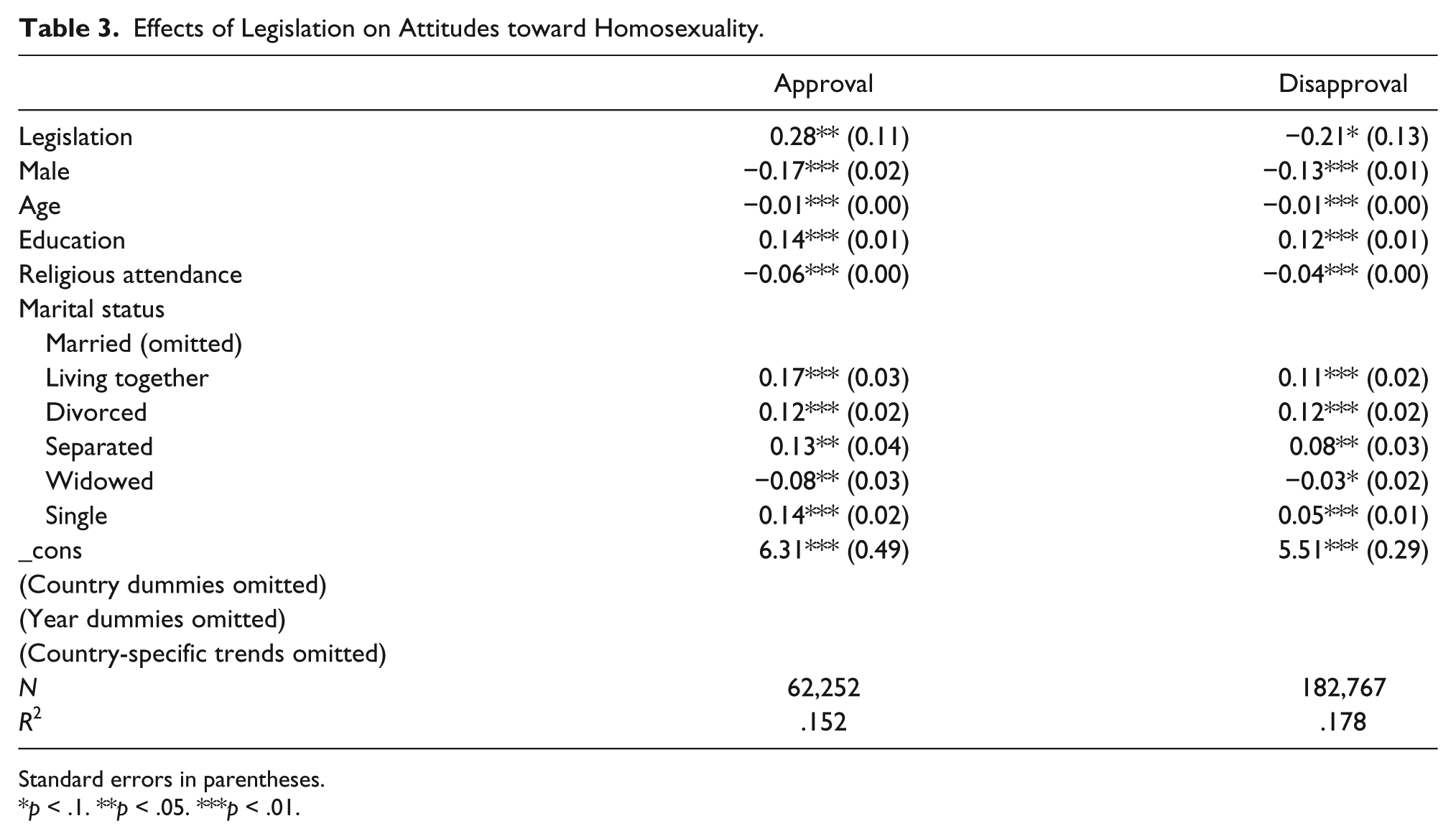
However, to actually test H3, I need to differentiate between individuals who view homosexuality favorably and those who view it unfavorably. In other words, the estimation presented in Table 2 masks any differential effects that legislation has on those who approve and disapprove of homosexuality as they are both combined in the dependent variable. To look at how legislation might affect individuals who already approve or disapprove of homosexuality differently, I estimate two additional models: one that limits the sample to individuals who disapprove of homosexuality and one that limits the sample to individuals who approve of homosexuality. 10 The results are presented in Table 3.
Effects of Legislation on Attitudes toward Homosexuality.
Standard errors in parentheses.
p < .1. **p < .05. ***p < .01.
Table 3 tells a story that is consistent with the third hypothesis. In the model that is restricted to respondents who disapprove of homosexuality, after a country passes legislation recognizing same-sex partnerships, the belief that homosexuality can be justified decreases by 0.21 on average compared with the pre-adoption period. Looking at the marginal effects, holding other covariates at their mean, the average level of justification given by individuals who do not believe homosexuality can be justified a majority of the time before any legislation is passed is 1.98, followed by 1.77 once a country passes civil union legislation, and 1.55 after a country recognizes same-sex marriage. In other words, among individuals who do not believe homosexuality can be justified, once a country passes same-sex partnership legislation, their attitudes become even less favorable.
When we look at the model that is restricted to individuals who are supportive of homosexuality, legislation has the opposite effect. As a country passes a new level of same-sex partnership recognition, the frequency that homosexuality can be justified increases by 0.28, on average. Looking at marginal effects with other covariates held at their mean, individuals who believe homosexuality can be justified a majority of the time in a country that has not passed any legislation believe the frequency of justification is 8.36. This increases to 8.64 after the country recognizes civil unions and again to 8.92 after the country recognizes same-sex marriage. In other words, among individuals who believe homosexuality can be justified a majority of the time, once a country passes same-sex partnership legislation, their attitudes become even more favorable.
It is also interesting to note the effects of the covariates in both of these models. For every covariate, the coefficients are nearly identical between the two models. This means that regardless of whether or not an individual initially approves or disapproves of homosexuality, males, older individuals, those who are less educated, and those who are more religious are less approving of homosexuality than women, younger individuals, those who are more educated, and those who are less religious.
What does all of this mean? It appears that rather than having a uniform effect on public attitudes, legislation that recognizes same-sex couples instead has a polarizing effect. Among individuals who believe that homosexuality cannot be justified most of the time, once same-sex legislation is passed, their attitudes toward homosexuality become even more negative. However, among the population that believes homosexuality can be justified a majority of the time, their favorable attitudes increase even more in the post-adoption period. Before discussing how these results compare with previous studies, let me first turn to the fourth and final hypothesis.
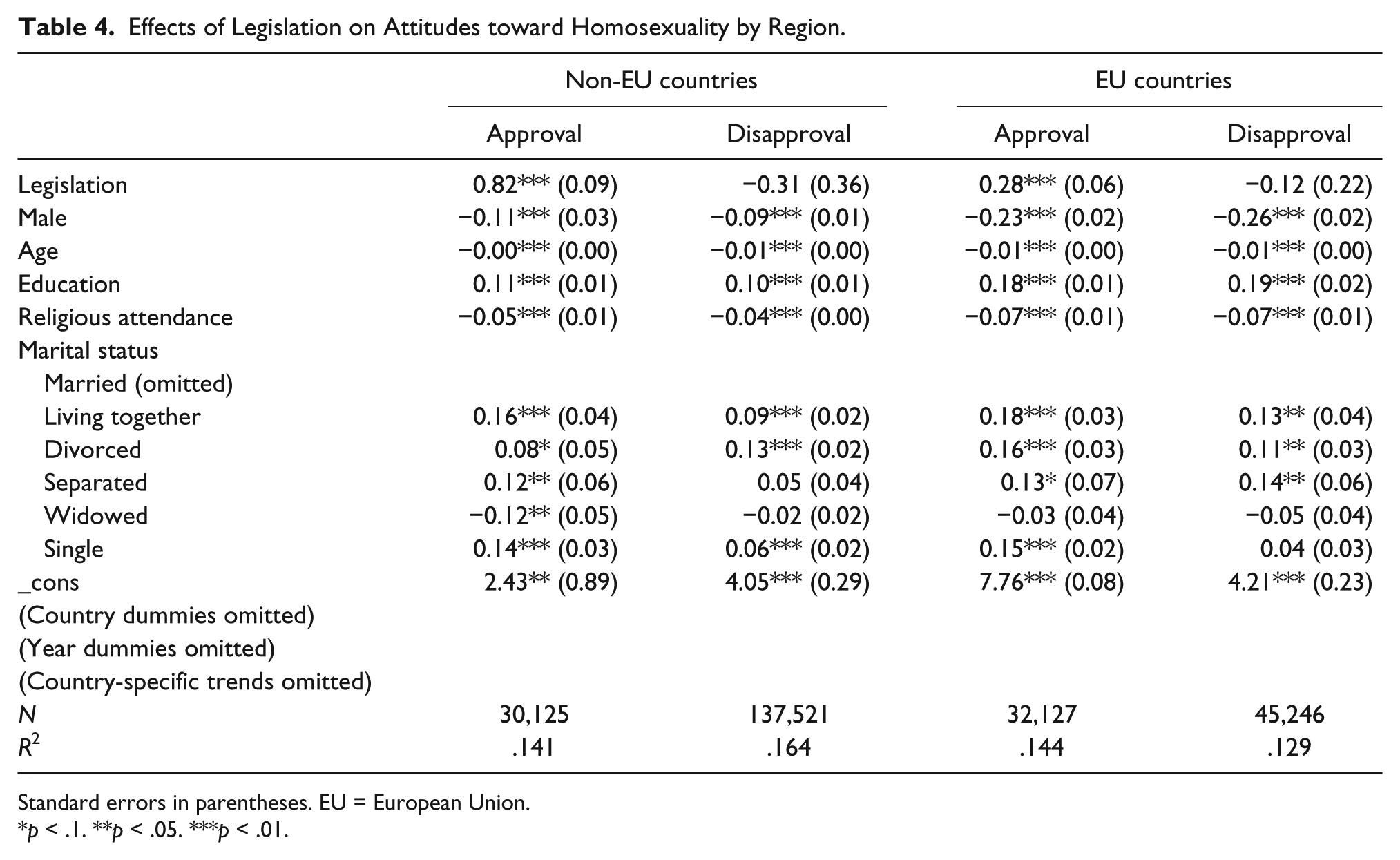
In addition to having differential effects across individuals, legislation might also affect attitudes differently depending on the region of the world. As mentioned above, most same-sex partnership legislation has been passed in European countries. However, given the recent adoption of this type of legislation in other countries across the world, we can begin to compare this relationship in European countries with countries outside of Europe. To do this, I run two additional models, with one restricting the sample to countries that belong to the EU and the other including all other countries. As we found that legislation has different effects on individuals who view homosexuality as justifiable than it does on individuals who do not view homosexuality as justifiable, I separate these individuals again here and present the results in Table 4.
Effects of Legislation on Attitudes toward Homosexuality by Region.
Standard errors in parentheses. EU = European Union.
p < .1. **p < .05. ***p < .01.
When looking at the disapproval models, legislation has no impact on attitudes among individuals who already believe that homosexuality cannot be justified a majority of the time. This is true in both EU countries as well as outside of the EU. While legislation appeared to have an impact on attitudes in Table 3 when EU and non-EU countries were combined, it is unsurprising that this relationship no longer holds when the sample size is reduced in the Table 4 models, especially because the relationship was only significant at the .10 level when all countries were combined. 11 However, among individuals who believe homosexuality can be justified a majority of the time (approval models), there is some support for the fourth hypothesis. Legislation has a much smaller effect on attitudes in EU countries than in non-EU countries. In non-EU countries among individuals who are already supportive of homosexuality, passing same-sex partnership legislation causes a 0.82 (on average) increase in how often these individuals believe homosexuality can be justified. The increase among similar individuals in EU countries is only 0.28 (p < .01). In other words, individuals who are supportive of homosexuality in EU countries are less affected by legislation than similar individuals in non-EU countries. This is likely due to the fact that individuals in the EU have more supportive attitudes toward homosexuality to begin with given the social and political norms as well as the supranational influences in EU countries. Consequently, there is less room for these attitudes to become more favorable once legislation has been passed since attitudes are already relatively high, at least compared with individuals outside of the EU.
Covariates in Table 4 show a similar pattern as the results presented in Table 3. Men, older individuals, those with less education, and those who are more religious are less likely to believe that homosexuality can be justified than women, younger individuals, those with more education, and those who are less religious. This is consistent regardless of whether individuals are generally supportive or unsupportive of homosexuality and regardless of whether or not these individuals live in EU countries. Here again, marital status does not appear to have a consistent effect on attitudes.
Figures 1 and 2 show the predicted margins with 95 percent confidence intervals at each level of marriage legislation for each estimation in Table 4. As the figures show, when no legislation has been passed, attitudes are more favorable in EU countries than non-EU countries. Even among individuals who are unsupportive of homosexuality, those inside the EU believe it can be justified more often than those outside of the EU. This is true regardless of the level of legislation that has been passed. Individuals generally unsupportive of homosexuality who live in an EU country before it recognizes any sort of same-sex partnership believe homosexuality can be justified only about 25 percent of the time. This drops to around 24 percent after the country recognizes civil unions and again to about 22 percent after the country recognizes same-sex marriage, although these differences are not statistically significant. For similar individuals outside of the EU, they believe homosexuality can be justified only about 18 percent of the time before their country recognizes any sort of same-sex partnership. This drops to about 15 percent after the country recognizes civil unions and again to about 12 percent after the country recognizes same-sex marriage. However, here again these differences are not statistically significant.
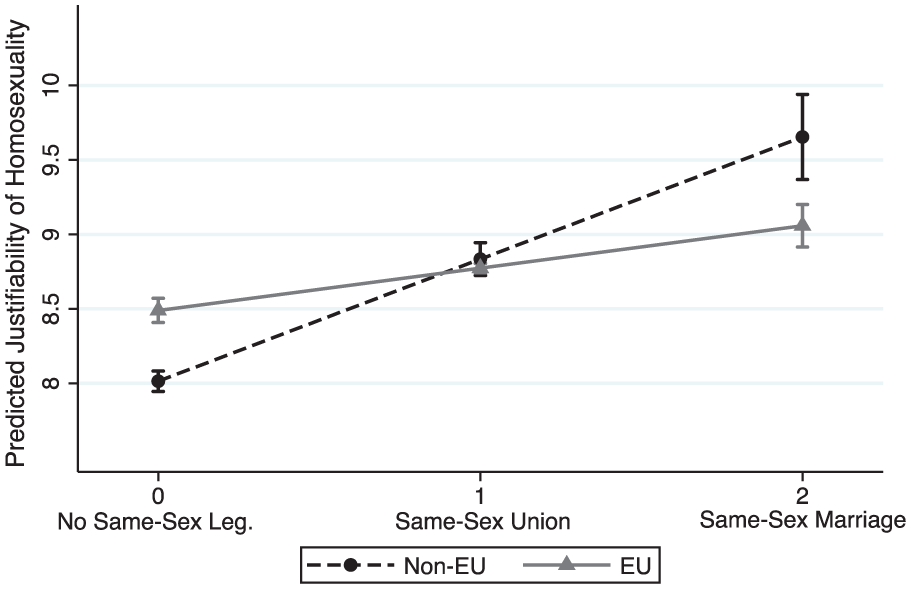
Predictive margins with 95% CIs approval models.
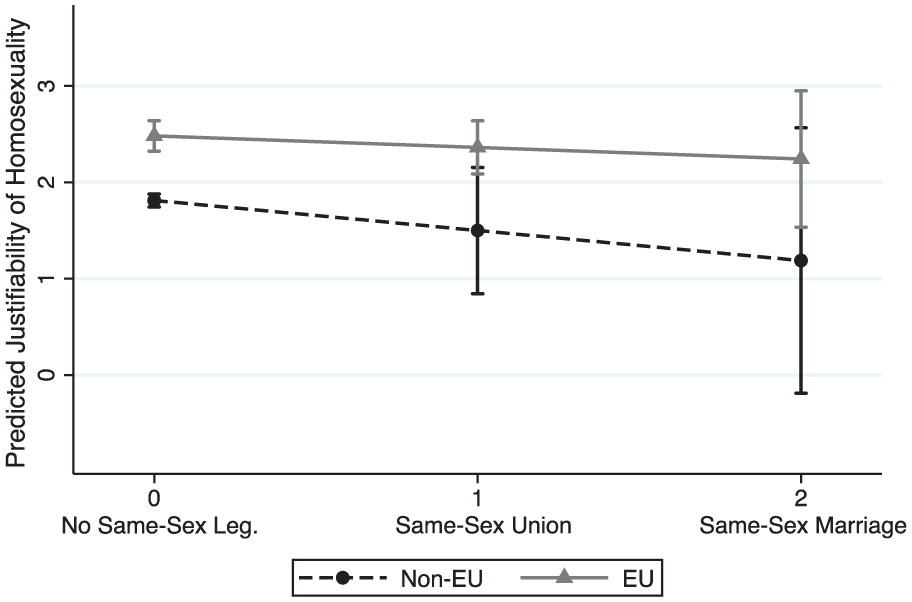
Predictive margins with 95% CIs disapproval models.
Figure 1 shows that among individuals generally supportive of homosexuality, legislation has a significantly more positive influence on individuals outside of the EU compared with those in EU countries. The effect is strong enough to the point that passing legislation recognizing civil unions basically equalizes attitudes toward homosexuality across EU individuals and non-EU individuals. Furthermore, when a country outside the EU recognizes same-sex marriage, this causes an increase in favorable attitudes to the point that they become more favorable than the attitudes of similar individuals in countries that have passed same-sex marriage within the EU.
Holding other covariates at their mean, individuals supportive of homosexuality in an EU country that has not passed any legislation believe that homosexuality can be justified about 85 percent of the time. This increases to about 88 percent after the country recognizes same-sex partnerships and again to just over 90 percent after the country recognizes same-sex marriage. For similar individuals who live outside the EU, before the country passes any legislation, they believe that homosexuality can be justified about 80 percent of the time. This increases to about 88 percent after the country recognizes same-sex partnerships and to about 96 percent after the country recognizes same-sex marriage. This means that for individuals generally supportive of homosexuality who live outside of the EU, having their country go from having no legal recognition of same-sex partnerships to recognizing same-sex marriage causes them to go from believing that homosexuality can be justified about four out of five times to believing that homosexuality can be justified almost always.
How do these findings fit in with the extant literature? Compared with the studies on European countries that find a positive relationship between same-sex legislation and attitudes toward homosexuality (e.g., Hooghe and Meeusen 2013; Takács and Szalma 2011), the results presented here portray a somewhat different picture. I can imagine two possible explanations for these differences. First, it is possible that the differences can simply be explained by differences in context. Previous studies that focus on Europe all use data from the European Social Survey for a much more limited number of years (2002–2010 is the most lengthy time period examined between any of the studies). Given previous studies’ limitations in terms of time period and number of countries (and regions) examined, it is possible that the results in other studies are capturing something that is time and location dependent.
Second, it is possible that previous results are being driven by the increase in favorable attitudes among individuals who are already supportive of homosexuality. In none of the previous European studies mentioned do the authors separate their analyses based on favorable versus unfavorable attitudes to determine whether the legislation affects these two groups differently. As seen above, same-sex partnership legislation has heterogeneous effects across individuals. Depending on the number of supportive and unsupportive respondents in the previous studies’ datasets, it is possible that the group that already has favorable attitudes is driving the results that show an overall positive relationship between legislation and favorable attitudes toward homosexuality.
The results presented here align much more with studies conducted on samples living in the United States. Similar to Bishin et al. (2016), I find no evidence of a backlash effect. Table 3 shows a negative effect of legislation on attitudes toward homosexuality, but this is only significant at the .10 level. Furthermore, when this is broken down by region (EU vs. non-EU), the significance of this effect disappears. In addition, Flores and Barclay (2016) find that a majority of their respondents do not change their attitudes toward homosexuality, but among those who did, they changed in a more favorable direction. Similarly, I find that individuals who are generally unsupportive of homosexuality do not change their opinion after legislation is passed while individuals generally supportive of homosexuality change their attitudes in a more favorable direction.
Similar to the mechanisms mentioned above, a possible explanation for the heterogeneous effects might be due to one-sided elite cues on the issue. In the aftermath of legislation being passed, it is likely that those who pushed most vehemently for the legislation are the ones who are loudest about its victory. Thus, individuals who were supportive of same-sex marriage all along might tune in to these elites and receive reinforcement or validation that boosts their favorable attitudes even more. However, those who opposed the legislation might be relatively silent after it passes. Thus, individuals who tune in to these elites do not receive additional cues one way or another so their attitudes remain the same. Another possible explanation for the heterogeneous effects is that individuals who disapprove of homosexuality might have strong ties to certain identities (e.g., religion) that make it difficult for their attitudes toward certain issues to be changed. Meanwhile, individuals who approve of homosexuality might not feel that any of their identities are threatened, and thus, their attitudes are easier to change. The evidence above showing that individuals unsupportive of homosexuality are more extreme in their disapproval than the more moderate attitudes among those who approve of homosexuality provides some support for this explanation.
Conclusion
Regardless of any similarities to or differences from previous findings, the results presented here suggest that legislation that recognizes same-sex couples does indeed have an effect on public attitudes toward homosexuality. However, rather than “re-educating” individuals about new societal norms and increasing compliance and acceptance, it appears as though this legislation strengthens preexisting attitudes among individuals who were already supportive of homosexuality. Among individuals who are the most likely to cause hurdles for or perpetuate discrimination against the gay and lesbian community (i.e., those unsupportive of homosexuality), passing legislation that recognizes same-sex couples has little to no effect on them. If legislation does affect this population, it appears that it would be in the opposite direction of what would advance LGBT acceptance (i.e., it would make negative attitudes even more negative).
These results might appear less than optimistic if we consider that the number of individuals who believe homosexuality cannot be justified most of the time far outweighs those who believe it can be justified most of the time. In my sample of over 245,000 individuals across the globe, almost 75 percent belong in the former group while only about 25 percent belong in the latter group. Furthermore, within these groups, the modal categories for how often homosexuality can be justified are at the extremes. Almost 50 percent of the entire sample believes homosexuality can never be justified while only 11 percent believes homosexuality can always be justified.
That being said, if favorable attitudes become stronger among even a relatively small portion of the population after such legislation is adopted, then it is possible that an increasing number of individuals will work harder to support the cause of gay and lesbian acceptance, which could then spread acceptance to other members in society who are unaffected by the legislation. Furthermore, the fact that the direction of movement in public opinion as a result of this legislation only occurs in a more favorable direction rather than sparking any sort of backlash effect should be encouraging for those seeking equality for gays and lesbians. There appears to be no downside to seeking greater protections for this community through legislation, at least as far as public opinion is concerned. Moreover, given the finding that across countries younger individuals are more accepting of homosexuality than older individuals, as younger cohorts replace older cohorts, it is likely that national legislation protecting the gay and lesbian community will have a positive impact on a larger population in the future.
While this study extends previous findings on an increasingly relevant topic as more countries begin recognizing same-sex couples at the national level, it is not without limitations. First, this project can only comment on the issue of same-sex legislation. While same-sex legislation is likely relatively salient as it is a major change in political systems and societies more generally, it is not likely that these results can be generalized to less salient political issues. That being said, it is typically the most salient issues about which individuals have the strongest opinions, which points out the importance of understanding the relationship between legislation on these topics and public opinion. Second, while this study focuses on legislation, there are many other relevant factors that affect attitudes toward LGBT individuals. As a consequence, the findings here do not necessarily indicate that the progress of gay and lesbian rights will be slow. While legislation recognizing same-sex couples is important for the gay and lesbian community in terms of being treated equally under the law, this legislation is just one piece of a much larger puzzle when it comes to societal acceptance of this community. Future scholars should consider how other attitudes or behaviors might also influence attitudes toward homosexuality for us to have a more complete understanding of how we can increase acceptance of an otherwise marginalized group.
Footnotes
Declaration of Conflicting Interests
The author(s) declared no potential conflicts of interest with respect to the research, authorship, and/or publication of this article.
Funding
The author(s) received no financial support for the research, authorship, and/or publication of this article.
Notes

References
Supplementary Material
Please find the following supplemental material available below.
For Open Access articles published under a Creative Commons License, all supplemental material carries the same license as the article it is associated with.
For non-Open Access articles published, all supplemental material carries a non-exclusive license, and permission requests for re-use of supplemental material or any part of supplemental material shall be sent directly to the copyright owner as specified in the copyright notice associated with the article.
