



Abstract
Executive-legislative interactions operate with cost-benefit trade-offs. Presidents possess several material options in granting Congressional requests to leverage Congressional support but must also marshal these scarce resources. We argue presidents should strategically grant requests from members of Congress for a range of executive actions based upon the cost of the request and the political context. Using an original data set of nearly 4,000 internal Congressional requests made during the Eisenhower, Ford, and H. W. Bush administrations, we find that presidents are strategic in granting requests, where the cost of the request is an important consideration when deciding whether or not to approve a legislator request, especially on executive appointments but not on legislative matters. Ideological proximity to the president matters more than partisanship in granting requests. Presidents are sensitive to cost when ideology is concerned but less so when granting requests to committee chairs. We conclude by highlighting the implications for interbranch bargaining.
Keywords
How do presidents allocate the political resources under their control? Broadly, the literature suggests that political incentives structure how and when presidents deploy executive resources, including outlays of money and time. Rather than functioning as strictly universalistic stewards for effective national policies, presidents target politically valuable constituencies to reward (Kriner and Reeves 2015a, 2), especially as presidents seek reelection (Cohen 2006; Light [1982] 1998; Wood 2009). Allocating resources to politically friendly territories allow presidents to use their executive resources to their full advantages, especially in states that are consequential for reelection efforts (Hudak 2014; Kriner and Reeves 2012). Presidential efforts to build political capacity are also highlighted by allocation of resources such as disaster declarations (Kriner and Reeves 2015b), perpetuating military base operations (Kriner and Reeves 2015a), and geographic locations of post offices (Rogowski 2015). Despite the many studies exploring the president’s strategic interbranch relationship with Congress, none have looked at the informal avenue of Congressional requests made to the White House and the White House’s granting of these requests as part of president’s targeting of resources to members of Congress. This article argues the president prioritizes the requests of certain members based upon their strategic value to the White House, contingent upon the cost of the request, and uses a unique new data set to examine this behavior.
Given the resource advantages, presidents may prioritize their choices to deliver specific items to members of Congress—deliverable policy and political items only the president can provide through his unique executive function. Presidents may allocate executive resources in the form of benefits to geographic locations that elect or may elect copartisans to Congress. For example, Covington (1988) finds presidents reward supporters and Congressional and party leaders in allocating presidential perks (White House social invitations). Christenson, Kriner, and Reeves (2017) also show that presidents allocate more federal grants to states with copartisan senators, especially recently elected copartisans. Executive agencies also play a role in the distribution of “pork,” where cabinet agencies award more federal grants or contracts to states with senators of more proximate ideologies to the president (Bertelli and Grose 2009). We assume presidents have specific objectives in this environment and benefit from granting requests to members of Congress as part of a long-term bargaining process. Yet, not all requests are equal in terms of the source of the request or the cost or benefit to grant the request—a higher cost may dampen the ability of the president to carry out the request or require the White House to spend the capital to grant the request.
Our analysis in this article addresses this strategic interbranch relationship by developing a theory of strategic presidential usage and allocation of limited resources. We test this theory with an original data set comprised of several thousand Congressional requests during the Eisenhower, Ford, and H. W. Bush administrations. These data present another way to capture the transactional environment in which presidents have specific, particularistic goods they can provide (a meeting, a campaign visit, a nomination), consistent with theoretical insight on particularistic presidential outlays. Our theory suggests that the president is a strategic actor (responding to incentives) whose decisions to grant or not grant requests is largely dependent upon the cost of the request to himself as well as the political context in which the member is making the request such as copartisanship, the support of the president in the members’ district or state, and the leadership status of the member.
Our analysis is divided into five sections. In the next section, we review the relevant literature as we lay out our theory, which informs the generation of our hypotheses in the subsequent section. Then we introduce our original data set, operationalize our variables of interest, and detail our empirical process. We present our findings and discussion in the fourth section. In testing this perspective, we estimate a series of logistic regressions modeling institutional, individual-level, and political factors that affect the likelihood of presidential decision making. The results mostly support the hypotheses, validating that the president respond to incentives in a competitive policy-making environment. We conclude with a discussion of the contributions of our research to the subfield of interbranch bargaining and presidential resources, addressing areas of future research in light of the limitations of our approach.
Interbranch Transactions with Limited Presidential Resources
Constitutional constraints bind the president and Congress together. Both policy-making institutions have a mutual interest in achieving policy goals and establishing their political legacies. Given these mutual interests and constitutional constraints, both branches operate in a strategic environment, each with limited resources. Whether competitive or cooperative, bargaining between the branches “depends on the strategic situation” (Jones 2005, 26) and the context of negotiations (Sullivan and de Marchi 2011). Beginning with Neustadt (1990), presidents have been considered successful insofar as they can bargain and maximize the opportunities afforded to them. Such a competitive environment requires strategic, considered actions by both branches in the policy-making apparatus. Whether in the form of the president’s submission of his legislative agenda (Cohen 2012; Rudalevige 2002), or distributive politics to smooth the bargaining process (Alexander, Berry, and Howell 2015; Evans 2004), the two branches communicate on a wide range of topics and seek to affect the other’s decision making calculus. Taken together, these foundational studies and numerous others underscore the fact that the branches bargain (Sullivan 1990a), and the president is strategic in his usage of a limited pool of resources unique to his office (Howell, Jackman, and Rogowski 2013). It follows that a president should be able to strategically and successfully wield his political resources to strengthen his position in Washington politics, secure his political legacy, and achieve his desired outcomes (policy or otherwise).
Regarding the Congressional side, recent evidence has demonstrated that members of Congress strategically engage in communication (specifically letter writing) to the executive branch to achieve specific ends, whether to influence policy creation or in pursuit of distributive benefits for their districts (Mills, Kalaf-Hughes, and MacDonald 2016; Neiheisel and Brady 2017). In addition, members of Congress write the president directly to signal policy priorities and legislative ability, while attempting to ingratiate themselves to the president as they develop professional networks to advance their careers as elected politicians, while more senior and powerful members are more likely to write given their already-established positions of power and influence both in and out of the chamber (Waggoner 2017).
Ultimately, in determining their course of action, presidents consider the context and potential cost constraints facing them. The president is a constrained, strategic actor who must negotiate to achieve his policy agenda—several scholars find presidents responsive to incentives, such as passing legislation or generating support for his agenda, while recognizing the importance of the institutional and political forces constraining him as he seeks to achieve his legislative goals (Beckmann 2010; Canes-Wrone, Howell, and Lewis 2008; Cohen 2012). To bargain, it is important to recognize that the resources of presidents are limited. If they are competing with Congress for policy outcomes, self-interested politicians must be miserly about when and how they spend their political capital. With limited resources, presidents must think carefully about their actions, weighing political context in light of constitutional constraints. Such a maximization of opportunities plays in the president’s favor, especially when he is actively engaged in the policy process through lobbying Congress (Beckmann 2010; Sullivan 1991). One understudied presidential resource is favor granting by the executive.
Indeed, by observing Congressional requests the president approves and those he rejects, we can explain strategic presidential decision making in the context of granting requests. As such, additional factors beyond the content of the request play a role in determining the types of requests the president is willing to approve as well as the types of costs of the president is willing to bear. We cannot directly recount a causal connection between future legislator support of the president and the granting of a request, but the pattern of application and fulfillment of these requests can inform our understanding of the strategic calculations presidents make when considering which requests to grant. Presidents seek to use the power of their office to incentivize members of Congress to side with them (Kerbel 1993). We cannot measure the precise effect of the favor granting but we can understand and explain the president’s strategic behavior in granting requests to representatives of their colawmaking institution.
Expectations
The main theoretical argument we advance is that variations in the political environment and the cost of granting a request can affect the decision of the president to either approve or reject a Congressional request. Presidents respond to incentives in the bargaining environment and should look to accommodate members’ requests in aid of the assisting the White House’s future actions (although we do not directly measure that here). Our first expectation argues that presidents should be more likely to approve requests from copartisan members of Congress. Presidents need copartisans to build legislative coalitions, so offering assistance to fellow party members allows presidents to encourage unity on legislation (Bond, Fleisher, and Wood 2003; Edwards 2000; Lebo and O’Geen 2011; Lee 2009). Ban and Ingraham (1990) find that presidents may pay off key members of their party for their active (and continuing) support (see also Bonafede 1987; Covington 1988). For instance, in the selection of federal appointees, presidents will “repay the members of their own party; in this passive sense, membership in the president’s party is an influential factor in the selection process” (Mackenzie 1981, 195). This is often done to hold diverse party factions together (Lewis 2008, 8). The distribution of positions as a reward for past support also creates incentives for compliance with the president in hopes of getting future favors from the president (Weko 1995).
Individual member ideology is a good signal of likeminded presidential action (Alexander, Berry, and Howell 2015). Presidents frequently employ a “reward strong supporters” strategy for allocating presidential “favors” (Covington 1988). Legislators who are similar to the president should more credibly be able to make requests that comports with the president’s policy or political interests and further their joint interests. Presidents have been shown to use ideology as shorthand for which information to deem credible when being lobbied by Members of Congress (Fleisher and Bond 1992, 1996). Specifically, the absolute difference between the legislator’s ideology and president’s ideology should be negatively related to the likelihood of a member of Congress receiving a filled request. That is, the greater the distance between the ideological measures of the president and the member (reflecting a larger positive gap), the less likely the president will be to appoint or nominate a person requested by that Member (signaled by a negative coefficient). This extends specifically to nominations, where scholars have found that those individuals closer in ideological proximity to the president may find more success in having their nomination position requests filled (Weko 1995, 128). Shared ideology reflects a signal of “purity,” especially in the personnel selection process (Binder and Maltzman 2002; Epstein and Segal 2005; Fisher 1987; Nemacheck 2007; Pfiffner 1996; Shipan and Shannon 2003, 80)
Presidents will approve requests for those members of Congress who possess greater political resources. Party leaders, committee chairs, and ranking members of committees are a critical part of the legislative process (Mackenzie 1981). Committee chairs or ranking members, especially those from committees with gatekeeping authority over legislation and power over the federal nominations, are therefore theoretically in a better position to have their requests granted (Nemacheck 2007). Committee chairs have more staff resources, access to policy-relevant information and access to communications networks unavailable to other members and should therefore be more likely to overcome the “costs” of lobbying the president (R. Hall 1996). Likewise, members who are new to Congress have less experience and fewer connections within and outside of Congress than other members, and are therefore less likely to have the ability to participate in a meaningful way (R. Hall 1996). Our expectation, therefore, is that those Members with greater authority and institutional power will be more likely to get their requests filled.
Finally, because resources are limited and opportunities to act are often finite, we posit that the president’s response to a request is dependent upon the cost of the request. We expect that high cost requests are less likely to be approved than low cost requests, as a function of the limited resources available to the president (e.g., by constantly acting on high cost requests such as issuing executive orders requested by members would have the potential to not only cheapen the president’s power and his ability to bargain successfully but would also potentially negatively affect his ability to make future reciprocal requests of his counterparts). Copartisans and powerful members are more influential in the legislative process and should be prime to have a request granted, but when interacted with the cost of the request we should expect the president to be sensitive to the difficulty of fulfilling the request. Requests that are costlier in terms of political capital or scarce resources will be marshaled more judiciously. Requests that are lower in cost, either because the resources are plentiful or the opportunities greater, will be easier to provide by comparison. Although presidents should want to accommodate fellow partisans or members with greater ability to help them, the cost of a request will weigh heavily on the president’s willingness to accommodate the request. In short, the cost of the request should be the most salient factor in presidents granting requests. Despite the strategic value posed by favor granting copartisans or committee chairs, presidents will reserve important decisions (characterized by high cost issues) to be decided on the basis their own ideological or political reasons.
Empirical Strategy: Data and Model Specification
The primary data analyzed in this article come from a recently uncovered and unstudied catalog of summaries of congressional mail sent to Presidents Eisenhower, Ford, and Bush, archived at each respective presidential library. Summaries of incoming Congressional mail are titled “The President’s Mail” and include the date and are divided into House and Senate members (see also Conley and Yon 2007; Rottinghaus and Bergan 2006). 1 These were prepared for the president’s daily viewing (at the president’s request). 2 For the Eisenhower White House, the newly created Office of Legislative Liaison summarized these letters. 3 Archival records were only available for the 83rd to 85th Congresses during Eisenhower’s terms in office (suggesting that records were not kept of the 86th Congress). For the Ford White House, the White House Office of Legislative Affairs organized these summaries. These mail summaries begin the week of August 22, 1974, and ran uninterrupted until the end of the President Ford’s term. 4 The Chief of Staff (Donald Rumsfeld, then Dick Cheney) was always included on the distribution list. 5 Each daily summary typically included the member of Congress’ name and a brief three to four sentence summary of the content of the letter. 6 For the Bush White House, summaries of incoming congressional mail were delivered to the president weekly and were titled “Presidential Log of Selected White House Mail.” These mail summaries began the week of February 9, 1989, and ran almost uninterrupted until the end of the week of August 7, 1992. 7
Of the full universe of more than 12,500 total letters written to the president (and summarized weekly in a memoranda), 3,908 requests over this time span had a specific outcome that could be captured. 8 For example, requests such as asking for a bill to be signed is considered a “traceable” request, in that the outcome of that piece of legislation can be tracked. These letters catalog dozens of types of requests of the White House, including appointments, vetoes, speaking requests, disaster declarations, pardons, and White House visits. These data present another way to capture the transactional environment in which presidents have specific, particularistic goods they can provide (a meeting, a campaign visit, a nomination), consistent with theoretical interest in particularistic presidential outlays. Given the nature of the requests, our analysis is restricted in this article to the universe of requests from members of Congress and the factors explaining the likelihood of those requests being met. 9 Our sample of available data also only include presidents who faced opposition Congresses, thus shaping the nature of the results.
As noted, the range of requests spans policy requests, legislative requests, and political requests. For instance, on October 15, 1975, Representative Robert McClory (R-IL) wrote the Ford White House offering his “support for appointment of George M. Chandler to ICC.” Similarly, Senator Lloyd Bentsen (D-TX) wrote to President Ford on March 17, 1975, with an endorsement of “Sara Bolieu to National Advisory Committee for Flammable Fabrics Act.” Representative George (D-KS) wrote to President Eisenhower to encourage him to issue a disaster declaration due to flooding in his state. Other letters also dealt with the intersection between international diplomacy and trade, including a letter from Senator Frank Murkowski (R-AK) who urges the end of the embargo of the country of Vietnam, and a letter from Representative Dean Gallo (R-NJ) encouraging President Bush to consider human rights abuses when crafting Chinese trade policy. On legislative matters, which made up a significant number of requests, Representative Fithian (D-IN) wrote President Ford to encourage him to sign energy and tax cut legislation and Representative Hageorn (R-MN) asked the president to sign the National Food Stamp Reform Act of 1975. For political requests, Senator Bender (R-OH) asked President Eisenhower to campaign for him in Ohio and Representative Herbert (R-FL) asked President Ford to attend a fundraiser for him in Florida as part of the president’s trip to the south.
Table 1 displays the raw descriptive data for both those members who write the president and the full chamber. 10 The differences between the full chamber and the universe of letter writers to the president are similar with respect to mean ideological score, ratio of Republicans to Democrats, and mean presidential support in the district or state (those who wrote the White House had only slightly higher voters support for the president in their state or district). When the distance between the president and the member is identified, those farther ideologically from the president tend to write slightly more than present in the full data set. Also, as expected, party leaders and committee chairs tend to write the president frequently—seventy-three of the eighty-nine party leaders wrote the president in these years and 699 of 913 committee chairs. Ranking members of committees are also influential members, although in the opposition party, and write the president frequently as well (almost all of the 324 ranking members wrote the president during this time frame).
Comparing Basic Descriptive for Letter Writers versus the Full Chamber.
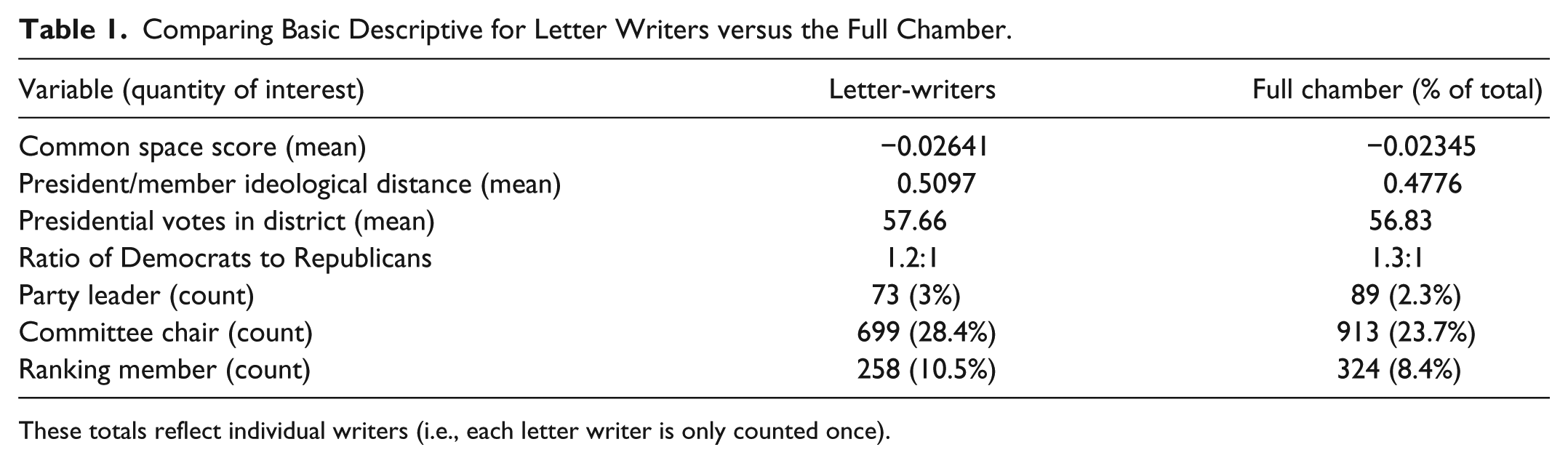
These totals reflect individual writers (i.e., each letter writer is only counted once).
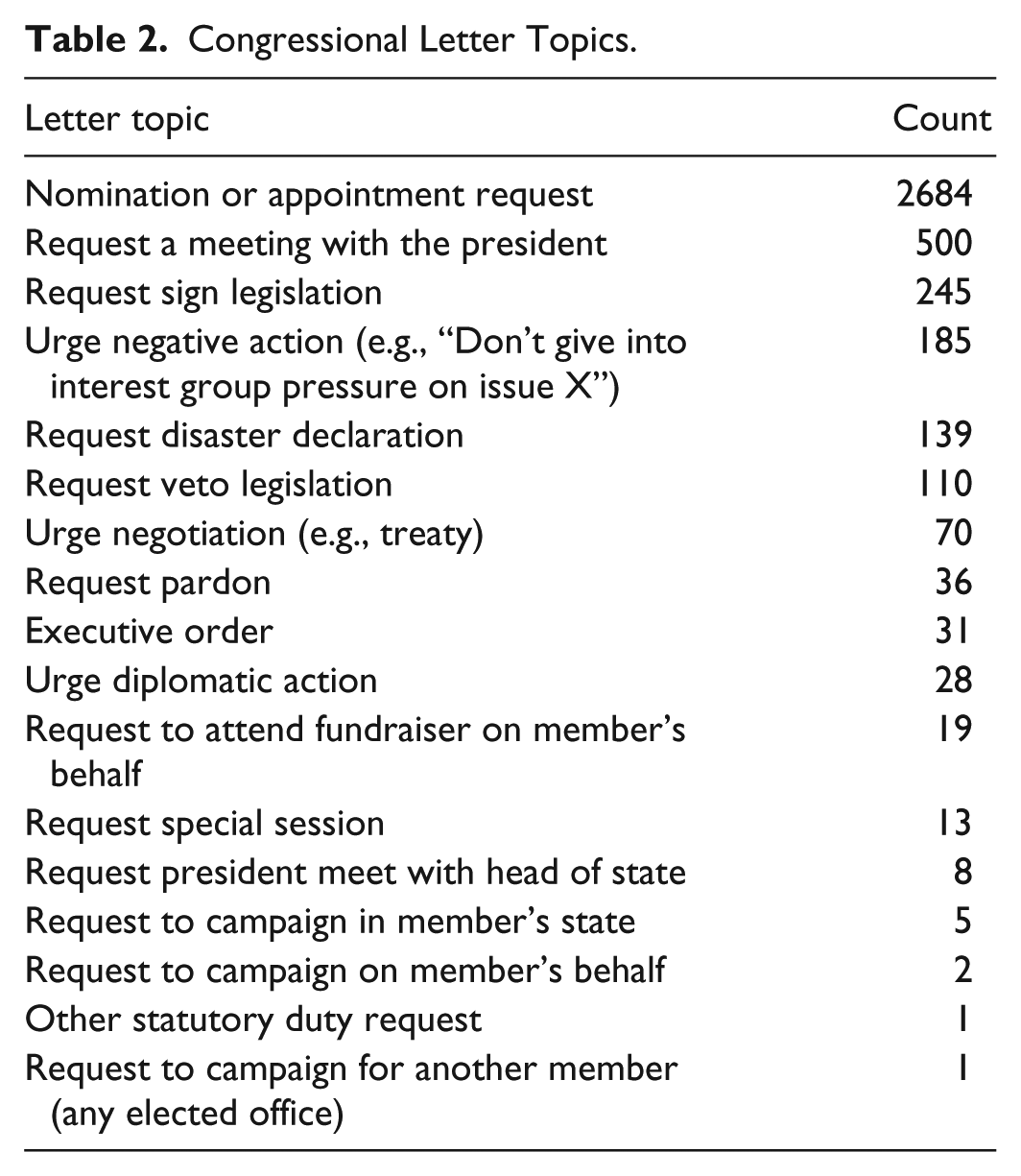
The types of requests are myriad and run the gamut of legislative and political interactions between the branches, as illustrated in Table 2. Most of the orders involve a request for a nomination or appointment, a power reserved to the president. These dominate the request landscape, making them a prime subject type to explore more fully which we do below in Table 4. Unsurprisingly, the next largest categories are requests to sign or reject legislation, another function only the president can perform. More specific executive functions such as executive orders, requests for special sessions, disaster declarations, or pardons, comprise a smaller number of total requests. A modest number of foreign policy requests are made of the White House: fewer than one hundred requests from Congress for diplomatic action, negotiations on treaties, or meeting with a head of state. Congress seems to have deferred these issues to the president. Interestingly, political requests (campaigning with the member, visiting the member’s state, or attending a fundraiser with the member) are small in number, most in the single digits or under twenty. These requests may come through the party or president’s campaign office instead of the White House. However, five hundred requests are to meet with the president, although these requests are not necessarily political in origin.
Congressional Letter Topics.
Advantages to Data
This article fills not only an empirical gap in modeling presidential decision making. First, these data are as complete a record of such written congressional requests as is known to exist. A comprehensive search and discussions with archivists at each presidential library revealed that these summaries represent the most complete records kept of such requests. In short, we are confident that these data represent a complete universe of Congressional mail requests formally sent to the White House. 11 Without question, such informal communication arrangements occurred; however, they were not systematically recorded and are therefore beyond the bounds of empirical study (see Mackenzie 1981). Therefore, we treat these data as representative of congressional opinion and time dependent, and the conclusions offered are nuanced toward these ends. Second, these requests and the president’s response offer a unique window into the transactional structure between the lawmaking branches. For instance, other articles that use distributive outcomes on base closings (Kriner and Reeves 2012) and on outlays of post offices (Rogowski 2015) consider the outcome but not the demand for that outcome. 12 We are able to see, for the first time, the options in front of the president from an internal perspective via Congressional letters written directly to the president, and second, the outcome of the president’s decision in light of the choices he faced. These data supplement an already rich literature with a fuller sense of the universe of requests that presidents face in the bargaining environment.
Request Approval
Request approval is the dependent variable, and is dichotomously coded as “0” for the president denying the request or “1” for the president’s fulfillment of the request, tracked by following up on the specific request made by the member. These are requests that only the president can facilitate, either personally or that the White House more generally can deliver. To catalog what legislation was signed, where visits were made, who received a meeting with the president, and which individuals received particular positions, we relied on several official sources: the Federal Register, the Weekly Compilation of Presidential Documents, the president’s Daily Diary, and the Plum Book on Policy and Supporting Positions. Our decision rule was that the request had to be filled within one year of the original request. For example, in the 84th Congress on July 31, 1956, Congressman Barrett (D-PA) wrote President Eisenhower requesting the president approve the Watershed Protection Act amendments. The president did approve these amendments, and this request was coded as approved. As indicated above, Republican Representative Robert McClory of Illinois wrote of his “support for appointment of George M. Chandler to ICC,” which the president did. Inversely, in the same Congressional session, Representative Hoeven (R-IA) requested that President Eisenhower approve the Omnibus Flood Control bill. However, Eisenhower did not approve this bill, and thus this request was coded as not approved.
Cost
The cost variable is also a dichotomous indicator reflecting the cost of the political request to the president. To capture variation in the sensitivity of the president to the cost of different types of requests, we broadly coded “cost” in three ways. In the first designation (General Cost), requests to the president are those that are of typically greater weight, such as a request for the president to sign a specific bill, an individual to be nominated or appointed to a federal position, a veto of a specific bill, or diplomatic recognition of a foreign government are coded “1” for high cost. Such requests, especially if the action taken is unpopular, could have notable effects on the president and are difficult to undo. Low cost requests (coded “0”) are those that are easier for the White House to provide. For instance, a request to establish a commission to study an issue, an agenda item is included for discussion on a legislative or international summit, a political request to campaign for a member, a meeting with the president, and so on. The second coding designation (Legislative Cost) codes all legislative issues as high cost, such as requests to sign a bill, veto a bill, or request a special session as “high” cost and all other requests as “low” cost. The third coding designation (Nomination/Appointment Cost) codes all appointment requests as “high” cost and all other requests as “low” cost. These unique cost variables are estimated in each model using the full data set (no censoring of the cases).
Party and Institutional Resources
Chamber-level attributes, such as shared party, committee chairs, ranking members, and party leaders, were coded dichotomously, indicating whether or not the characteristic applied to the member. All other members not in these categories are coded as “0” and those that were included coded “1.” The Almanac of American Politics for the appropriate years were consulted to document these variables.
Ideological Distance
Ideological similarity to the president is measured by absolute distance between the president’s common space score and the legislator’s common space score. Common Space scores are used as a measure of ideology as they are comparable across chambers (Carroll et al. 2008). This measure and approach is similar to other measures of interbranch evaluations (Binder and Maltzman 2002; Shipan and Shannon 2003).
Chamber
To control for the chamber in which the member serves, we coded “0” if the member served in the House of Representatives and “1” if the member served in the Senate.
Electoral Support
To control for the possible electoral connection driving presidential payoffs of members who had higher support in a district or state, we control for the percentage of the two party vote the president received in the state or district of each member.
Model Estimation
To test the substantive portion our theory, we have thoroughly addressed the possibility of sample selection bias. We first tested for sample selection issues to determine that members who choose to write the president do so on a strategic basis as a function of individual and institutional characteristics. We estimated a two-stage Heckman probit selection model displayed in Table 3. This system of two equations (selection and outcome) addresses the threat of bias in our estimates generated by systematic differences in letter writers versus nonletter writers. The results demonstrate that selection effects are not an issue—an insignificant rho statistics measuring the error correlations between the equations is not significant. 13 Although the overall selection effect is not problematic for estimating a standard logit model, the results instructively show that copartisans, party leaders, committee chairs, and those ideologically more distant from the president are more likely to write the president. We also include cost in the outcome equation (since it corresponds to the president’s incentives only) and the results indicate that it is significant and negative, as expected, signaling that higher cost requests were less likely to be filled by the White House. Ultimately, the results show no significant selection effects, allowing us to proceed without controlling for this issue.
Political and Institutional Variables.
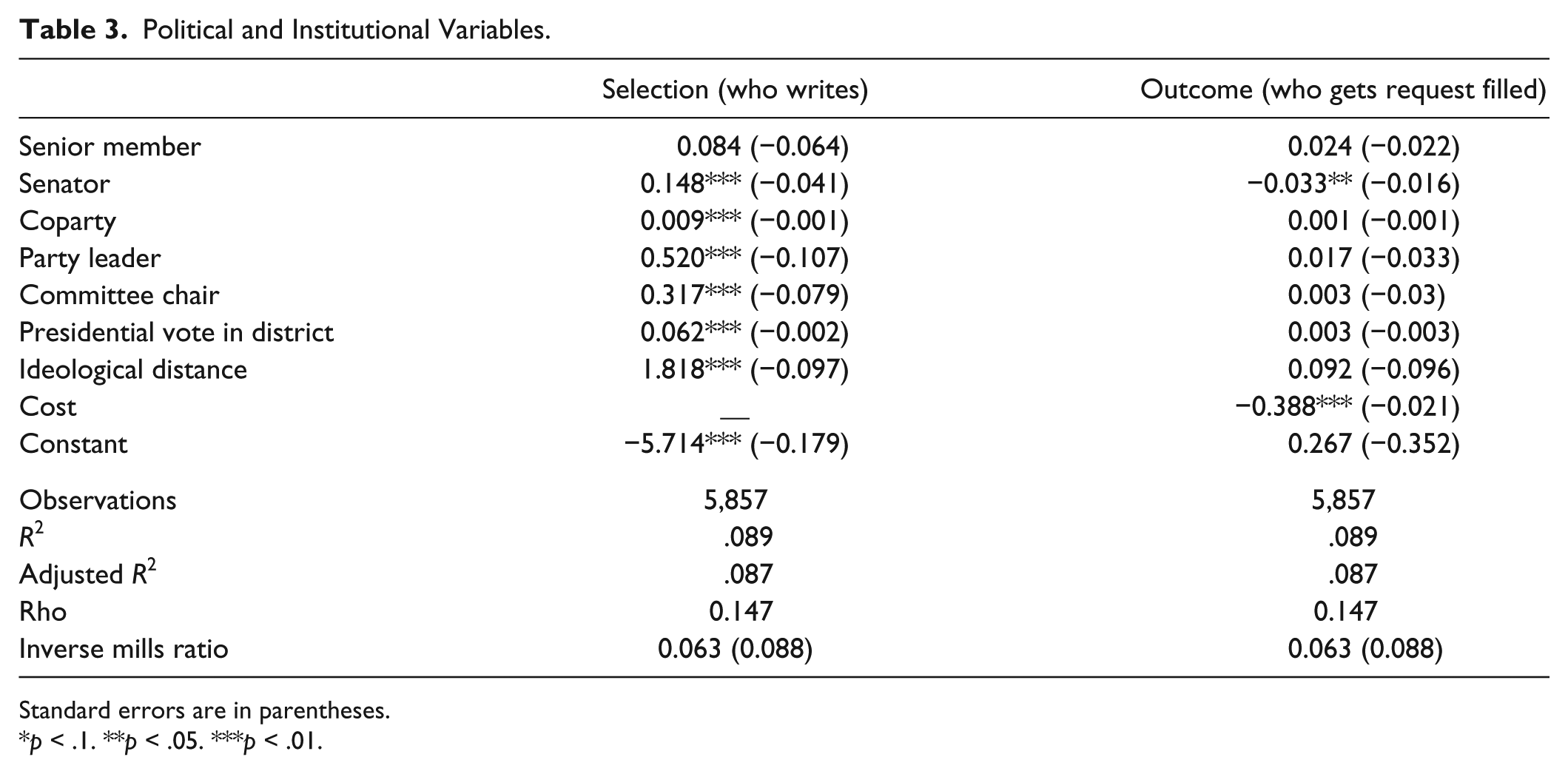
Standard errors are in parentheses.
p < .1. **p < .05. ***p < .01.
We initiate a full empirical strategy to test our hypotheses by estimating a series of logistic regressions, given that our dependent variable of interest—request approval—is binary. We estimate the likelihood of the president’s approval of the given request based on a series of theoretically relevant exogenous predictors, including the variables mentioned above, in addition to control variables, and interaction terms. We also cluster the standard errors by individual legislators. We then utilize postestimation simulations to generate predicted probabilities. The findings along with discussion and interpretation are presented in the following section.
Interbranch Transactions and the President’s Resources
If considerations and evaluations are to be made concerning the costs associated with certain choices available to the president, both requests that are approved (i.e., observed actions) and those that are not approved are required to account for the full picture the relationship between the lawmaking branches. Our data allow us to view the actions taken by the president, in light of the full menu of options he faced, thereby avoiding issues of endogeneity. In an effort to test our theory and also to better understand the relationship between the branches, we explore several factors associated with letter writing and the president’s response with resources (or not). Per the theory, institutional and political variables should condition the likelihood of granting a request in addition to the cost of the request to the president. 14 Using maximum likelihood techniques with standard errors clustered on the legislator, we estimated several models with and without interactions. We present the first set of results in Table 4.
Political and Institutional Variables Interacted with Cost.
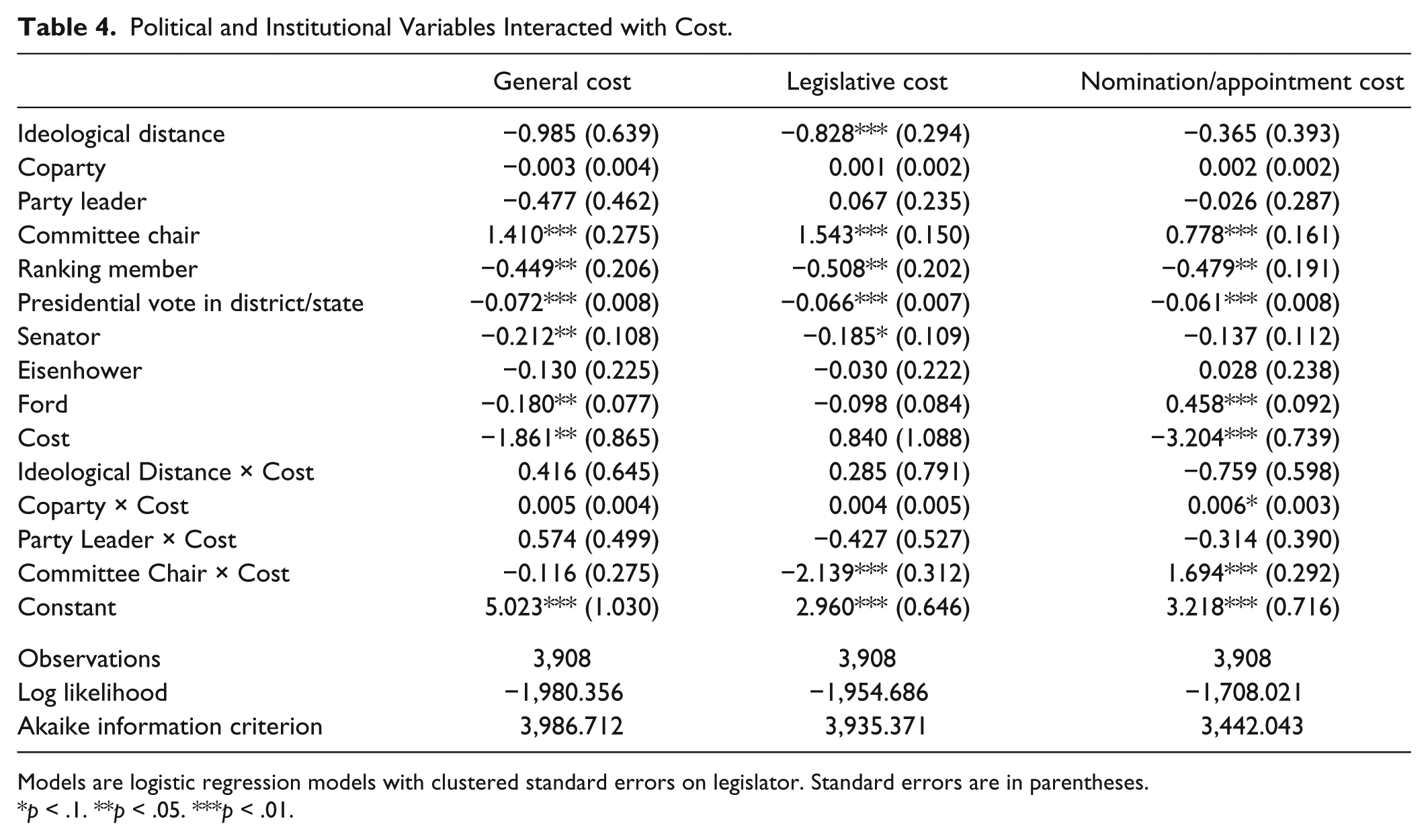
Models are logistic regression models with clustered standard errors on legislator. Standard errors are in parentheses.
p < .1. **p < .05. ***p < .01.
There appears to be a negative electoral connection since members whose districts had greater percentages of support for the president had slightly less success getting their requests filled across all three cost specifications. Consistent with other findings below, presidents may use their resources to court constituencies (and members) where the president performed less well in the past election. The coefficient of no greater than −0.072 across the models, however, suggesting these effects are substantively modest. The results from Table 4 also demonstrate that House members are more likely to get their requests filled than Senators. Committee chairs (the same party as the president) are significantly and substantively more likely to get their requests filled than rank and file members, as expected in Hypothesis 3a. Ranking members (the opposite party of the president) are significantly less likely to get their requests filled than rank and file members, not surprising considering the positive finding for committee chairs and the fact that ranking members are of the opposite party of the president. This is consistent across all “cost” specifications. There is no strong statistically significant effect for party leaders across any of the models in Table 4, contradicting expectations in Hypothesis 3b.
The output in Table 4 also largely supports our expectations with respect to the cost of the request. In two of the three models, the coefficients for the cost of the request are consistently negative and significant at p < .01, as expected by Hypothesis 4a. 15 In the General Cost specification, presidents are about 41 percent less likely to fulfill a request when the cost is higher. 16 Second, in the Nomination/Appointment Cost specification in Table 4, presidents are about 56 percent less likely to fulfill a nomination or appointment-based request than other requests, a substantively and statistically larger effect than the general cost specification, suggesting that presidents are more careful in doling out appointment requests because they are more valuable. In the Legislative Cost specification, the variable is not statistically significant. This finding implies that presidents are less concerned about granting legislative-based requests, likely in part because by the time the request is made, the outcome has already been decided and the lobbying of the president has less tangible effect on the outcome. It may also be that the request is incidental at that point to the cost of the request, reducing the coefficient. Figure 1 illustrates the differences in fulfillment of high and low cost requests for each of the three cost specifications—higher cost requests are substantially less likely to be granted than lower costs requests for the General (a) and Nomination/Appointment (b) cost specifications.
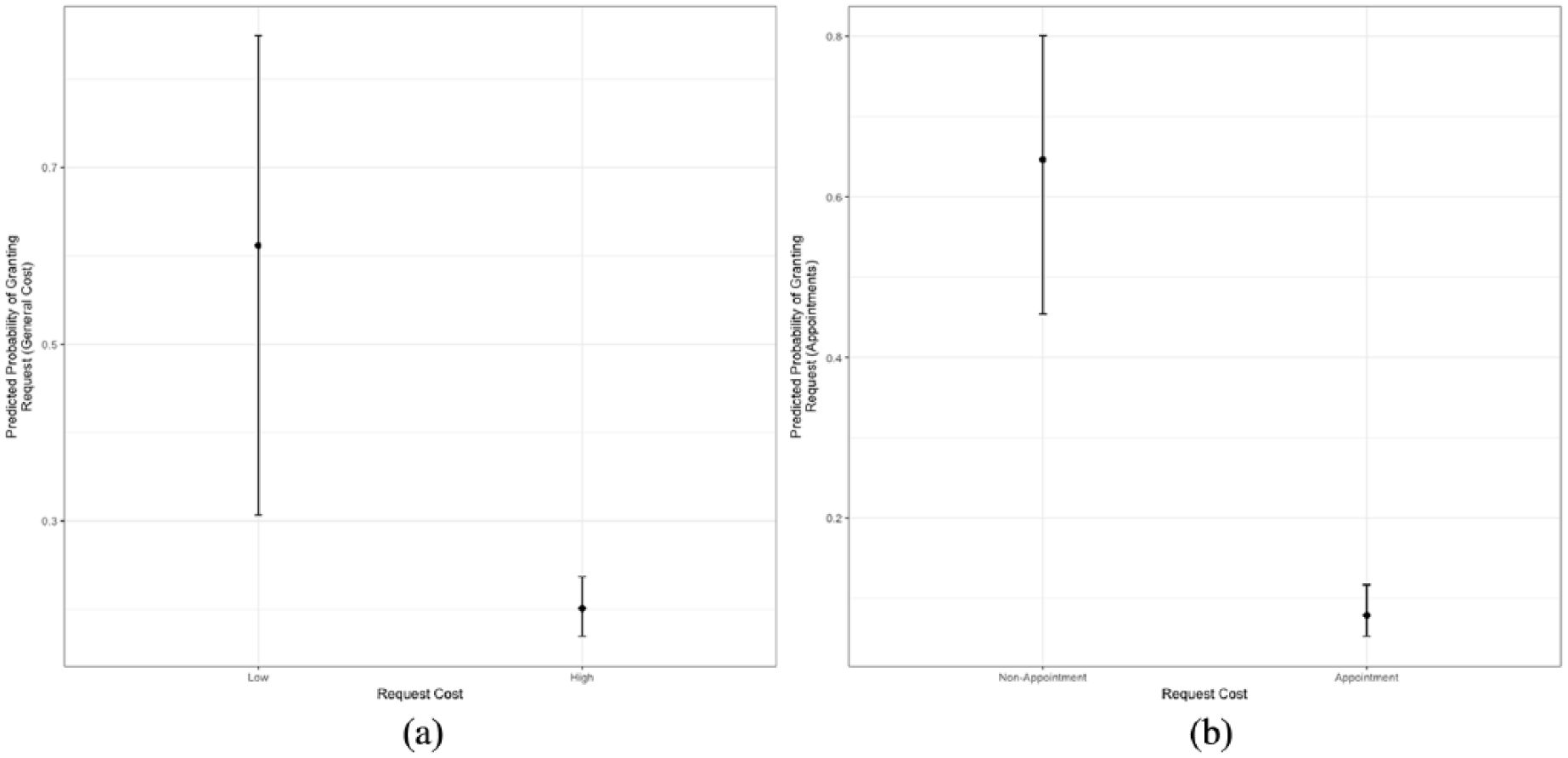
Predicted probabilities.
The interaction of cost and the political and institutional variables determines how sensitive the president is to the cost of the request. The results generally support our expectations. In legislative requests, presidents are significantly less likely to fill a request from a committee chair if the cost is higher. Presidents are more sensitive to the cost of the legislative request which can be significant (like a vetoing or signing a bill) even if the request come from a committee chair, as expected in Hypothesis 4. In line with the legislative gatekeeping literature (e.g., Cox and McCubbins 2005), committee chairs’ influences may be more prominent earlier in the legislative process rather than later. Other institutional variables reveal mixed effects in Table 4. As noted above, committee chairs are much more likely to get a nomination or appointment request filled from the president controlling for cost, as expected in Hypothesis 3a. However, contradicting Hypothesis 4b, committee chairs are even more likely to get their request for a nomination or appointment filled, even considering higher cost (the effect is only present in the Nomination/Appointment Cost model specification). Because of their critical status in the legislative process, committee chairs have a rarefied position in the political process of making appointments. Generally, presidents are marginally sensitive to the cost of such a request even from these important players for general and legislative costs but not for nomination or appointment costs.
Providing supportive evidence for our expectations in Hypothesis 2, Table 4 shows that the farther the ideological distance between the president and the member, the less likely the president is to grant the request (the effect is limited to the Legislative Cost specification). 17 Put differently, closer ideological members are more likely to get their legislative requests filled and those more distant from the president are less likely to get their legislative requests filled. However, when directly interacted with the cost of the request, the effect disappears in Table 4 suggesting that the White House is sensitive to cost even when factoring in a request from an ideologically closer members. That presidents generally are more likely to grant legislative requests to those members ideologically farther away from his ideal point suggests that presidents do modestly reserve prime resources for those the White House hopes to court rather than exclusively rewarding allies. Also contradicting expectations in Hypothesis 1, the estimates for copartisanship consistently fail to completely meet expectations—in none of the models does copartisanship of the requesting member give the requiting member an advantage in getting a request filled.
Conclusion
Our results demonstrate that the allocation of the president’s resources are responsive to incentives and limitations. A president’s power, though substantive and unique, is attenuated and affected by a constrained political context and the nature of his limited resources. As such, he has the power to grant political requests that only he can and does so with clear calculations and strategic considerations of his political environment. Ultimately, the institutional factors constraining the letter writer as well as the political context in which the president is deciding impact the motivation to write the letter and also the response of the president regarding specific requests made. As Jones (2005) suggested, the structure of interbranch interactions is highly strategic and dependent on numerous factors.
In this vein, our findings make two important contributions to the study of interbranch bargaining and presidential resource allocation. First, and foremost, we fill a theoretical gap by accounting for the choices facing the president when considering his options for decision making. He is presented with numerous political requests by members of Congress, battling for his attention and his unique resources (e.g., to fill a federal vacancy). Yet, these requests are coming from competitors in a constrained political context. The cost of requests to the president can and do affect his ability to act freely. Thus, he must be calculated in his decision to dole out political and policy favors. Indeed, we find that context shapes presidential responses to Congressional requests. But this can only be fully appreciated when considering all of the choices with which the president is faced, rather than focusing solely on the observable outcomes of presidential action (i.e., unilateral actions, political visits to districts, etc.). Presidents may not compromise on legislation (Sullivan 1990b), but granting a request may help induce future coordination and cooperation. Our unique data also allow us to address and avoid this common issue of endogeneity by examining the full menu of options facing the president, to understand and postulate about why the president chose to act in some instances but not others.
Our second contribution is an empirical one. Polsby (1986, 194) famously noted that presidents use their executive leverage to “help thy friends or woo thine enemies”—we find that presidents do a little of both. We find that presidents are strategic in granting requests, where the cost of the request is an important consideration when deciding whether or not to approve legislators’ requests. Cost matters to presidents less when granting appointments to committee chairs than other members. Presidents are most sensitive to cost when considering granting requests from members of Congress with greater ideological differences—the otherwise strong effects of granting legislative requests to closer ideologues recede from statistical significance with the inclusion of a high cost request. Ideology is a stronger tie in filling requests than party based on these results. Ideology, however, is more flexible and malleable than party so presidents grant requests to members whom they will get the most potential payoff in the future. Indeed, generally presidents appear to court future support rather than reward past support as evidenced by more requests granted to those members with lower electoral support in the past election, those ideologically closer to him, committee chairs, and fewer grants to copartisans.
This form of interbranch communication is only one-way of examining the transactional structure between the branches. To be sure there are many more. In addition, our research is limited in that we only examine three of the post-World War II (WWII) modern presidents and only Republican presidents, all of whom were relatively moderate within their party. Moderates may have a greater need to stimulate support through requests granted than presidents closer to their party’s ideological medians. The finding of high cost requests being less likely to be granted could also reflect the president’s lack of agenda power during the periods of divided government in our sample (all Republican presidents and Democratic-led Congresses). This limits the generalizability of the findings to all presidents but allows us to carefully begin to widen the literature on interbranch relations. Another empirical limitation is that we do not know whether a requesting legislator received a related but not directly requested outcome, such as an ideologically proximate appointee to a federal position. This makes for a conservative test, however, of the process because we capture only direct, identifiable requests in the cases where they occur instead of a wider and broader scope of general or similar requests. Even considering these limitations, our research is an important step in understanding the nature of bargaining between the branches, how the president’s limited resources affect this process, all the while avoiding common issues of endogeneity in our data by offering an untapped look into interbranch bargaining in a competitive and constrained political environment.
Supplemental Material
Appendix – Supplemental material for The Cost of Doing Business: Congressional Requests, Cost, and Allocation of Presidential Resources
Supplemental material, Appendix for The Cost of Doing Business: Congressional Requests, Cost, and Allocation of Presidential Resources by Brandon Rottinghaus and Philip D. Waggoner in Political Research Quarterly
Footnotes
Declaration of Conflicting Interests
The author(s) declared no potential conflicts of interest with respect to the research, authorship, and/or publication of this article.
Funding
The author(s) received no financial support for the research, authorship, and/or publication of this article.
Notes
Supplemental Material
Replication data for this article are available with the manuscript on the Political Research Quarterly (PRQ) website.

References
Supplementary Material
Please find the following supplemental material available below.
For Open Access articles published under a Creative Commons License, all supplemental material carries the same license as the article it is associated with.
For non-Open Access articles published, all supplemental material carries a non-exclusive license, and permission requests for re-use of supplemental material or any part of supplemental material shall be sent directly to the copyright owner as specified in the copyright notice associated with the article.
