



Abstract
In-group identity is particularly important in understanding political behavior among minority populations living in the United States. Despite its importance, we know relativity little about what explains variation in perceptions of group identity among U.S.-based minority groups. I develop a theoretical framework drawing extensively for social identity theory to explain development of in-group identities among Latinos in the United States. I suggest the availability of neighborhood-level ethnic stimuli increases the likelihood that Latinos will come to see themselves a part of pan-ethnic group rather than a unique individual. I use the 2008 Collaborative Multi-Racial Political Survey (CMPS), a nationally representative public opinion poll of registered voters with oversamples of Latino respondents. I find that the availability of ethnic stimuli positively associates with stronger perceptions of group identity among Latinos. Latinos who live in contexts rich with ethnic stimuli and cues are more likely to adopt in-group identities than those who live in environments lacking ethnically salient resources.
Introduction
In-group identity is one of the most heavily relied upon variables in understanding minority political behavior and attitudes today (Pérez 2015a, 2015b; Sanchez 2006b; Valenzuela and Michelson 2016; Vargas, Sanchez, and Valdez 2017). Whether due to interest in linked fate after the election of the first black president or the increase in ethnic identity since the 2006 immigration rallies, political scientists today are rightly fascinated with the relationships that group identity–related variables have in understanding minority political participation (Sanchez 2006b; Valenzuela and Michelson 2016), policy preferences (Sanchez 2006a), and political attitudes (Pérez 2015a, 2015b). Despite these interests in group identity as an independent variable, relatively little work has been devoted to understanding where perceptions of in-group identity come from and what explains variation in underlying levels of in-group identity, especially for groups such as Latinos living in the United States. Although the importance of group identity among minority groups in the United States has been well established in political science for some time, recent work in American politics more broadly has promoted the importance of social identities in explaining political attitudes and behaviors (Achen and Bartels 2016; Green, Palmquist, and Schickler 2004; Mason 2015).
In this paper, I draw on social identity theory (Tajfel and Turner 1979) and self-categorization theory (Turner et al. 1987) to develop a psychological-based framework that explains variation in perceptions of group identity among Latinos living in the United States. I argue that perceptions of in-group identity are explained by a psychological process where group members are more likely to identify with the group when that group is made salient and accessible and offers certain psychological benefits (Turner et al. 1987; Ethier and Deaux 1990, 1994). Group salience, accessibility, and fit vary based on the degree of exposure to ethnic stimuli in the local environmental and social context. In contexts with greater ethnic stimuli, I expect individuals to be more likely to identify with ethnic categories when compared with similarly situated individuals in areas with fewer ethnic stimuli (Ethier and Deaux 1994; Jiménez 2010).
I examine the association between three local environmental and social ethnic stimuli and perceptions of group identity: (1) ethnic density or the proportion of ethnic residents in one’s neighborhood; (2) ethnic saturation or the opportunity for exposure to ethnic cues as measured by the number of ethnic-named businesses in the neighborhood; and (3) ethnic social interaction, the process in which individuals engage with ethnic members in a variety and formal and informal ways, as measured by frequency of church attendance with co-ethnics. Although each of these are distinct dimensions, the former two measures are conceptually related along a structural dimension. On the contrary, ethnic interaction is a more social dimension of ethnic context. 1 In terms of group identity, I use the linked fate measure, which asks how much one’s individual well-being is connected to their larger pan-ethnic group also doing well (Dawson 1994; Sanchez and Masuoka 2010). Group identity measured this way is ideal for two reasons. First, linked fate is structured on the idea that individuals recognize themselves as part of a group and their well-being and overall status is connected to that group. Implicit in the notion of linked fate is a recognition that the individual is similar too and attaches one’s identity to the group. This is important because it captures a stronger attachment to the group than membership (McClain et al. 2009). Although linked fate does not directly map onto other group identity constructs identified in social psychology, it relates to measures of centrality, self-stereotyping, and to a lesser extent, group solidarity (Leach et al. 2008). Second, linked fate is one of the most commonly used group identity variables in political science that deals with U.S.-based minority groups (Dawson 1994; Gay, Hochschild, and White 2016; Junn and Masuoka 2008; Sanchez and Masuoka 2010; Tate 1993). To test this framework, I use a nationally representative survey merged with neighborhood-level information to determine whether the availability of ethnic stimuli associates with perceptions of group identity among Latinos.
I find that ethnic stimuli positively associate with perceptions of strong group identity for Latinos, suggesting that Latino identity is moored in the local environmental and social context (Ethier and Deaux 1994; Jiménez 2010). Given that questions of reverse causality loom over observational and especially contextual research, I provide both empirical evidence and historical insight to assuage these concerns. I find no support that those with strong perceptions of group identity are more likely to move into areas with greater ethnic stimuli. A recent move among Latinos with strong group identity negatively associates with the ethnic stimuli. These analyses provide empirical support and connect with a larger body of work that has shown how residential choices, even within metropolitan and suburban areas, are constrained for minorities in the United States (Clay 1979; Freund 2010; Krysan and Crowder 2017). Although redlining and restrictive covenants have been outlawed, current residential segregation and residential spatial patterning still reflect once widely implemented practices (Clay 1979; Krysan and Crowder 2017). Clay (1979, 407) notes, “Migration to the suburbs from the, central city has not been part of the traditional residential mobility pattern of urban blacks; they remain in the same communities where they have always been.” Major lawsuits regarding racial steering are currently under litigation. 2 Despite these issues associated with observational evidence, the findings presented here offer important insight to scholars in group identity and those studying contextual effects.
Moreover, these results speak to an important and missing element in our understanding of group identity for Latinos living in the United States, namely, identifying a set of group-based factors that are associated with its variation rather than a focus on individual-level variables. If the politicization of identity through the identity to politics link operates distinctly for people with varying levels of identity, it is important to understand the antecedent conditions of identity development to fully map connections between identity and politics (Lee 2008; Pérez 2015a, 2015b). It also adds to an important conversation regarding the role of micro-level contexts and their ability to clarify important political and social phenomena, which are too often overlooked (Huckfeldt 1980, 1983). In terms of political phenomena, early scholars privileged local-level attributes to explain and understand behaviors and attitudes (Dahl 1961; Wolfinger 1965). The role of local-level factors to explain political-based outcomes is especially important for minority and immigrant groups, because they rely on local-level networks and informal channels to understand the political and social makeup of the host society (Bloemraad 2006). In the remainder of the paper, I explain the psychological-based framework that connects local environmental and social ethnic stimuli to perceptions of group identity, outline the research design, examine the results, and conclude by discussing the implications and suggestions for future work.
Where Does Group Identity Come from?
Group identity is an important predictor of political participation and engagement for minority groups in the United States (Dawson 1994; McClain et al. 2009; Miller et al. 1981; Sanchez 2006b; Verba and Nie 1972). If fact, for members of the African American community, perceptions of group identity provide a strong rational heuristic when making political decisions (Dawson 1994; Tate 1993). As Dawson (1994) points out, when one’s overall economic chances and well-being are intimately linked to their racial group status and these links have been forged over generations, a group-based heuristic provides a rational framework with which to interpret the political world. Socialization practices in the black community highlight and instill this link (Dawson 1994; Harris-Lacewell 2010; McClerking 2001). For Latinos and other immigrant-based groups, socialization practices do not offer the same persuasive appeal given that many Latinos living in the United States trace their history to one or two generations.
Yet, a large body of work has established a clear link between ethnic attachments and political outcomes, especially among Latinos (Masuoka 2006; Pérez 2015a; Sanchez and Masuoka 2010; Valenzuela and Michelson 2016). What has garnered less attention in the political science literature is work explaining where in-group identities come from and what explains why some group members have stronger perceptions of in-group identity compared with others. Although many scholars have demonstrated a relationship between environmental context and group identity, much of this work examines members of the black community (Bledsoe et al. 1995; Gay 2004; Lau 1989). In addition to these studies, there have been two dominant approaches to explain what drives variation in perceptions of group identity.
One set of studies focuses on the role of individual-level covariates such as age, income, education, and so on and the relationship with strength of group identity (Dawson 1994; Masuoka 2006; Sanchez 2008; Sanchez and Masuoka 2010; Tate 1993). Most of the findings analyzing individual-level covariates reveal inconsistent results across studies, perhaps because individual-level predictors are not theoretically motivated. Individual-level variables pertain to the individual and are not necessarily connected to group-based outcomes unless an explicit theoretical link is made (Davenport 2016; Dawson 1994).
A second set of studies has turned to more group-oriented social and contextual factors as potential drivers of group identity (Ethier and Deaux 1994; Gay 2004; Junn and Masuoka 2008; Sanchez and Masuoka 2010). Junn and Masuoka (2008) found that Asian American racial group identity is a latent attitude and must be activated by an exogenous contextual force that reinforces the connection between the individual and the larger group. Ethier and Deaux (1994) found that group identity for Latinos is maintained though variations in the ethnic resources offered in certain environments. They argue that contexts rich in ethnic stimuli provide a more robust mooring for ethnic identity (Ethier and Deaux 1994). Alba (1992) argues that ethnic festivals and co-ethnic interactions are the key sites for ethnic identity expression. Jiménez (2010) similarly argues that everyday ethnic interactions replenish and revive the ethnic identity of individuals. Given certain contexts, such as those where more immigrants live, these opportunities are much more likely. Sanchez and Masuoka (2010) report a positive connection between a Latino social context and stronger perceptions of group identity.
Previous work examining relationships between one’s environmental and group identity has come up with revealing results, especially for African Americans (Bledsoe et al. 1995; Gay 2004; Lau 1989). Lau (1989) examines the relationship between social density and identity for eleven different groups. He finds an inverted curvilinear but significant relationship between density and identification for blacks and businessman, a positive linear relationship for middle class and conservatives, and a curvilinear relationship for poor. Bledsoe et al. (1995) expand on this and find a strong positive link between black density and racial solidarity. As a neighborhood becomes more black, blacks living in those areas express a greater degree of racial solidarity. Finally, Gay (2004) examines the relationship between neighborhood quality and linked fate, finding that as the quality of the neighborhoods increases, the probability of strong linked fate decreases. The socioeconomic status of the neighborhood has little impact on feelings of linked fate in her study. These studies make clear that important identity outcomes are informed by environmental features of one’s neighborhoods. They also demonstrate that respondents are responsive to features of their environment.
Research in developmental psychology has examined the ethnic identity acquisition of minority youth extensively (Phinney 2000; Phinney and Alipuria 1990; Phinney and Chavira 1995). Among minority youth living in the United States, Phinney (1989) suggests that ethnic identity is established in part by role models as well as groups within their social and environmental setting. Although ethnic identity is to some extent informed by parental socialization practices, Phinney et al. (2001) show that in-group peer interaction is a stronger predictor of ethnic attachment among minority youth. In-group interaction, which is key among adolescents, is also important for adults. Alba (1992) argues that within these ethnic-to-ethnic interactions, ethnicity is experienced. Environmental and social contexts matter a great deal in explaining variation in ethnic identity. Although the extant literature has established a link between environmental and social context and identity, at least for minority youth, what is needed is a broader theoretical framework that supplies the instances when we should expect to see perceptions of group identity and under what conditions.
To develop this framework, I turn to work in the social identity approach which offers the robust framework needed to understand when, where, and under what conditions we should expect to see variation in perceptions of group identity. Ultimately, I test this theory in a large-scale observational study among Latinos in the United States.
A Social Identity Link between Ethnic Stimuli and Group Identity
My goal is to clarify what explains the variation in perceptions of group identity among Latinos living in the United States. To do this, I draw on the social identity research tradition, which incorporates social identity theory (Tajfel and Turner 1979) and self-categorization theory (Turner et al. 1987), to provide the tools and language that I use to develop a psychological-based framework that connects one’s local environmental and social context to variation in perceptions of group identity (Ethier and Deaux 1990, 1994; Junn and Masuoka 2008; Sanchez and Masuoka 2010).
The social identity tradition holds that group members view their group membership as a salient component of their identity when they begin to view the membership as part of their identity (Turner et al. 1987). Group membership, while imposed in the United States by a system of racial hierarchy, is conceptually distinct from group identity (Kim 1999; Lee 2008; Masuoka and Junn 2013; Valenzuela and Michelson 2016). Because of this, members of racial and ethnic groups in the United States express wide variation in strength of group identity (Masuoka 2006; Sanchez and Masuoka 2010). In other words, not all census-defined Latinos, Blacks, or Asian Americans in the United States identify with those imposed racial and ethnic constructs. Furthermore, there is variation in the degree of identity among those who do identify with their membership categories.
In the SIT, psychological group formation is governed by categorization, or the “degree that two or more people come to perceive and define themselves in term of some shared ingroup-outgroup categorization” (Turner et al. 1987, 51). In-group attachments to social categories are formed through the realization of similarities with other individuals vis-à-vis the differences coming from out-group(s). As Turner et al. (1987) points out in the meta-contrast principle, people are more likely to construct a psychological group with others who are more similar to them than with those who are more different. This suggests that to some extent, people look for similarities between themselves and others as they are categorizing themselves into various social categories. During the categorization process, the attachment to a social category is overseen by self-stereotyping, a process “whereby people come to perceive themselves more as the interchangeable exemplars of a social category rather than as unique personalities as defined by their individual differences” (Turner et al. 1987, 50). The more people see themselves similar to the exemplars of the group, the more likely they are to have a strong in-group identity. For lower status groups such as racial and ethnic minority groups in the United States, perceived intra-group homogeneity furthers a group-based identity (Doosje, Ellemers, and Spears 1995; Ellemers, Spears, and Doosje 1997; Simon and Brown 1987). As one’s ethnic category becomes more salient, individuals are more likely to adopt the ethnic in-group identity, in part, because they are searching to maintain a positive self-image, one of the psychological benefits of identifying with a group (Ellemers, Spears, and Doosje 2002; Simon and Brown 1987; Tajfel and Turner 1979). Ethnic social categories are the salient social categories because they are easily accessible, fit with what individuals see and experience in day-to-day life, and help maintain a positive status over other less homogeneous possible categorizations (Brewer, Manzi, and Shaw 1993; Doosje, Ellemers, and Spears 1995; Ellemers, Spears, and Doosje 1997; Simon and Brown 1987).
Based on these insights, I claim that local-level ethnic stimuli raise the salience, accessibility, and fit of the Latino social category. In response to the increased salience and accessibility of the Latino social category, group members will be more likely to perceive a strong in-group identity conditional on the variation in the local-level ethnic stimuli (Ethier and Deaux 1994; Jiménez 2010; Turner et al. 1987). When ethnic stimuli are strong and easily accessible in the residential environments and social contexts, mooring to the larger pan-ethnic group is more meaningful, provides greater psychological benefit, and offers the best opportunity to maintain a positive status (Brewer, Manzi, and Shaw 1993; Ethier and Deaux 1994). Thus, I hypothesize that local environmental and social contextual ethnic stimuli will be positively related to perceptions of group identity (Hypothesis 1 [H1]). This means that I expect Latinos who are exposed to greater ethnic stimuli to feel stronger group-based attachments to other Latinos and see being Latino as an important part of who they are. In contrast, I predict that those who live in environments lacking ethnically rich stimuli will be less likely to perceive that they share a strong perception of in-group identity with other members of the pan-ethnic group (Ethier and Deaux 1994; Jiménez 2010). The available social support and benefits that are derived from pan-ethnic connections are too weak and inaccessible in climates that lack rich ethnic stimuli (Ethier and Deaux 1994; Sanchez and Masuoka 2010). Thus, it is less likely that individuals in these contexts will see the group as an important part of who they are. Individuals in these environments are less likely to be exposed to ethnic cues and stimuli that connect individuals to groups.
I also clarify the relationship between the types of ethnic stimuli that associate with group identity. Much of the work in developmental psychology suggests that ethnic-based social interactions relate to perceptions of group identity (Phinney 2000; Phinney and Alipuria 1990; Phinney and Chavira 1995). These interactions can be understood as the social dimensions of ethnic stimuli. Yet, as other work has pointed out (Ethier and Deaux 1994; Gay 2004), physical or environmental attributes also relate to perceptions of group identity, which refer to a more structural dimension of ethnic stimuli. Consistent with SIT, both of these dimensions are capable of transmitting and raising the salience, accessibility, and fit of the Latino social category. I expect that both dimensions of ethnic stimuli will relate to perceptions of group identity among Latinos in the United States.
Data and Method
Data
First, I use the 2008 Collaborative Multi-Racial Post-Election Study (CMPS). This was a telephone survey of 4,563 registered voters conducted between November 9, 2008, and January 5, 2009. This survey is ideal for the current project because it includes a large subsample of Latinos (N = 1,519). The survey instrument was available in English and Spanish. Missing data were imputed using multiple imputation.3,4 Second, all contextual demographic information was gathered from the 2000 U.S. Census. Third, I used Yelp’s business listing database accessed through its API. 5
A looming question in any model-based inference type research design is the issue of reverse causality. This is especially the case in contextual-based designs, where we could suspect that attitudes toward one’s group are driving residential housing decisions. Without a casually identified research design, it is impossible to identify a true causal effect of the context on attitudes. Given that this study relies on a model-based inferential approach, the conclusions are not causal. It is also impossible to rule out the reverse causality possibility. I do, however, aim to alleviate these concerns by including control variables such as age, income, and education, all factors in housing selection decisions. I also present the results of models where I examine the relationship between a recent move and the various key independent variables. In that section, I attempt to “test” for self-selection by examining a set of models that considers each of the neighborhood-level factors as outcomes rather than independent variables.
Operationalization of independent variable
I operationalize ethnic stimuli as a set of three unique measures that maps onto a much broader concept similar to co-ethnic raw materials (Alba 1992; Jiménez 2010). Ethnic density is measured as the percent Latinos living in one’s census tract using the census-measured percent non-white Hispanic population in a given respondents census tract. Census tracts are ideal for the current study as I am interested in availability of ethnic stimuli within the immediate vicinity of one’s home. 6 Zip codes, counties, cities, and metropolitan statistical areas are far too large to capture the level of variation and detail. Ethnic density is distributed, M = 0.40, SD = 0.32. 7
A second source of ethnic stimuli is the availability of social interaction with other ethnic group members. These interactions, as Jiménez (2010, 133) points out, “are not merely trappings of a symbolic ethnicity but powerful building blocks that are key to the construction of more salient ethnic identities.” I measure this stimulus using a self-reported measure of church attendance with co-ethnics. 8 Frequent church attendance with co-ethnics receives a 4 and frequent church attendance with whites is a −4. 9 Those who never attend church are not excluded from the analysis, rather they receive a zero. As Phinney et al. (2001) show, in-group interactions are powerful transmitters of ethnic content and strongly inform the ethnic identity of minority youth in the United States. As such, the coding of this variable is meant to capture this idea explicitly. Frequent attendance with whites could be coded as zero along with the non-attenders as neither of them is exposed to the ethnic content. This is problematic because it presumes that white contact is the same as no contact, which does not theoretically fit any of the literature discussed above. Instead, I expect frequent attendance with whites to have the opposite relationship. Latinos who attend church with whites should be less likely to connect with other Latinos compared with those who do not attend at all. 10 Religious attendance is not the perfect measure because there are other opportunities where individuals can interact with fellow co-ethnics. However, there is an extensive literature that highlights the importance of church for Latinos in the United States (Jiménez 2010; Jones-Correa and Leal 2001; Valenzuela 2014). Valenzuela (2014) points out that 93 percent of Latinos identify with a faith tradition and a full 75 percent attended services regularly. In the current data, this variable is distributed, M = 0.72, SD = 2.2.
Ethnic saturation is defined by Lau (1989, 222) as “any factor that increases the salience of group membership.” Alba (1992, 121) illustrates a wide variety of cultural expressions including food, language, and holiday ceremonies that “help to distinguish members of one social group from those of another.” Measuring ethnic saturation systematically outside of self-reports is particularly challenging across a multi-state sample. Qualitative approaches to gather this information as Jiménez (2010) did would be nearly impossible for thousands of unique addresses. Given my focus on micro-level and local-level factors, any workable measures at the county or city, such as the presence of ethnic festivals or celebrations, do not capture the intra-area variation that is present across so many communities. To overcome this limitation, I developed a novel measure that captures the level of ethnic saturation near a respondent that does not rely on self-reports. To do this, I use a ratio of ethnic-named businesses within the immediate vicinity of a respondent. 11 To construct this ratio, I use Yelp’s API to gather up to hundred business names within a specified distance from the respondent’s physical address. The Yelp API draws a concentric buffer around each respondent using a specified radius. 12 I then divide the number of ethnic businesses by the total number of returned businesses to get a proxy for the level of ethnic saturation. In a qualitative verification task, I traveled to a dozen neighborhoods in Los Angeles County, California, and King County, Washington, and found that the Yelp scores accurately reflect the ethnic saturation of an area. 13 The variation picked up by the process was present in the neighborhoods I visited. The radius I used was the distance a resident would easily walk or drive by regularly. Further information about this process is presented in the online appendix. The distribution of ethnic saturation is M = 0.08, SD = 0.15.
Control variables
To isolate how ethnic stimuli associate with perceptions of group identity, I control for a number of variables. In terms of socioeconomic variables, the respondents age, whether or not they obtained a college degree, whether the respondent is a home owner, and respondents household income. Political partisanship is controlled for with a single dummy variable: republican. I control for time in U.S. Mexican, Cuban, Puerto Rican, and born in U.S.. I also control for neighborhood diversity using an entropy measure that accounts for remaining racial and ethnic composition of a respondents census tract (explained in the online appendix).
Method
I model the perception of group identity given the availability of ethnic stimuli as well as other covariates using ordered probit. I measure group identity, using Dawson (1994) linked fate question, “How much does your ‘doing well’ depend on other [LATINOS] also doing well?” with the possible responses, “a lot,” “some,” “a little,” or “not at all?” The distribution of the outcome variable is shown in Figure 1 (Latino: M = 1.70, SD = 1.16).
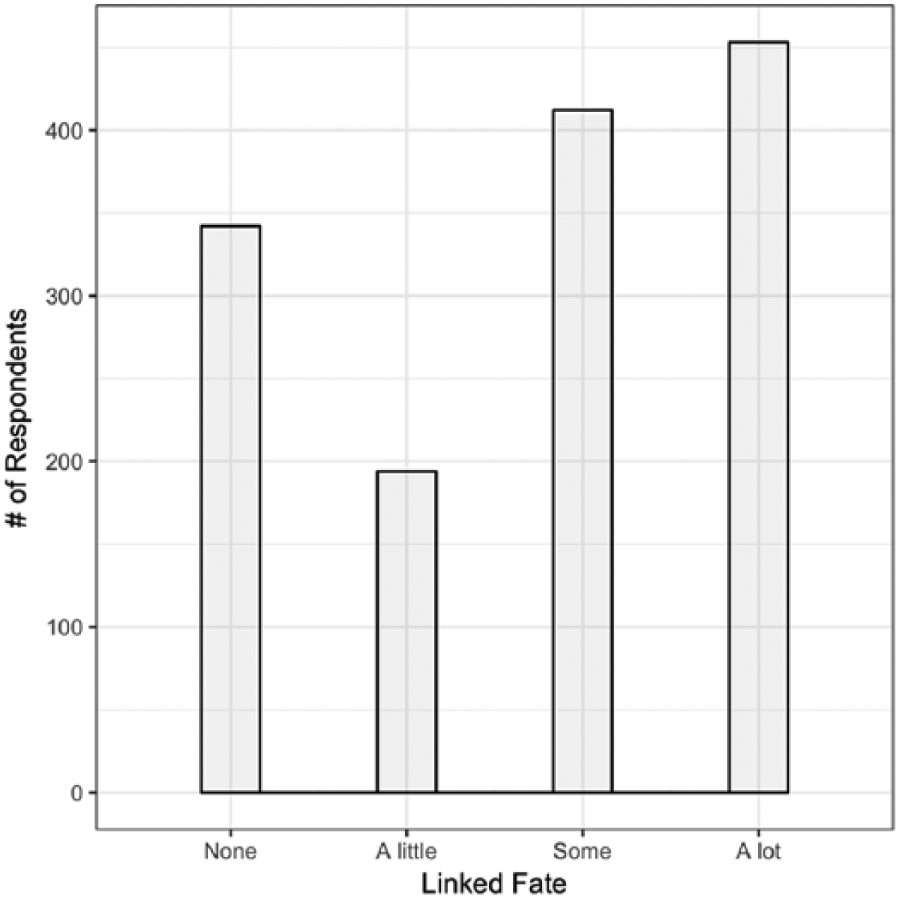
Latino group identity (linked fate).
Results
Among Latinos living in the United States, I expect those living in areas with a greater availability of ethnic stimuli to demonstrate stronger perceptions of group identity than those who live in areas with less. Table 1 reports the raw coefficients from an ordered probit regression model that first considers the bivariate relationship between each of the key independent variables and the outcome as well as a model with full controls.
The Association between Ethnic Stimuli and Group Identity among Latinos.
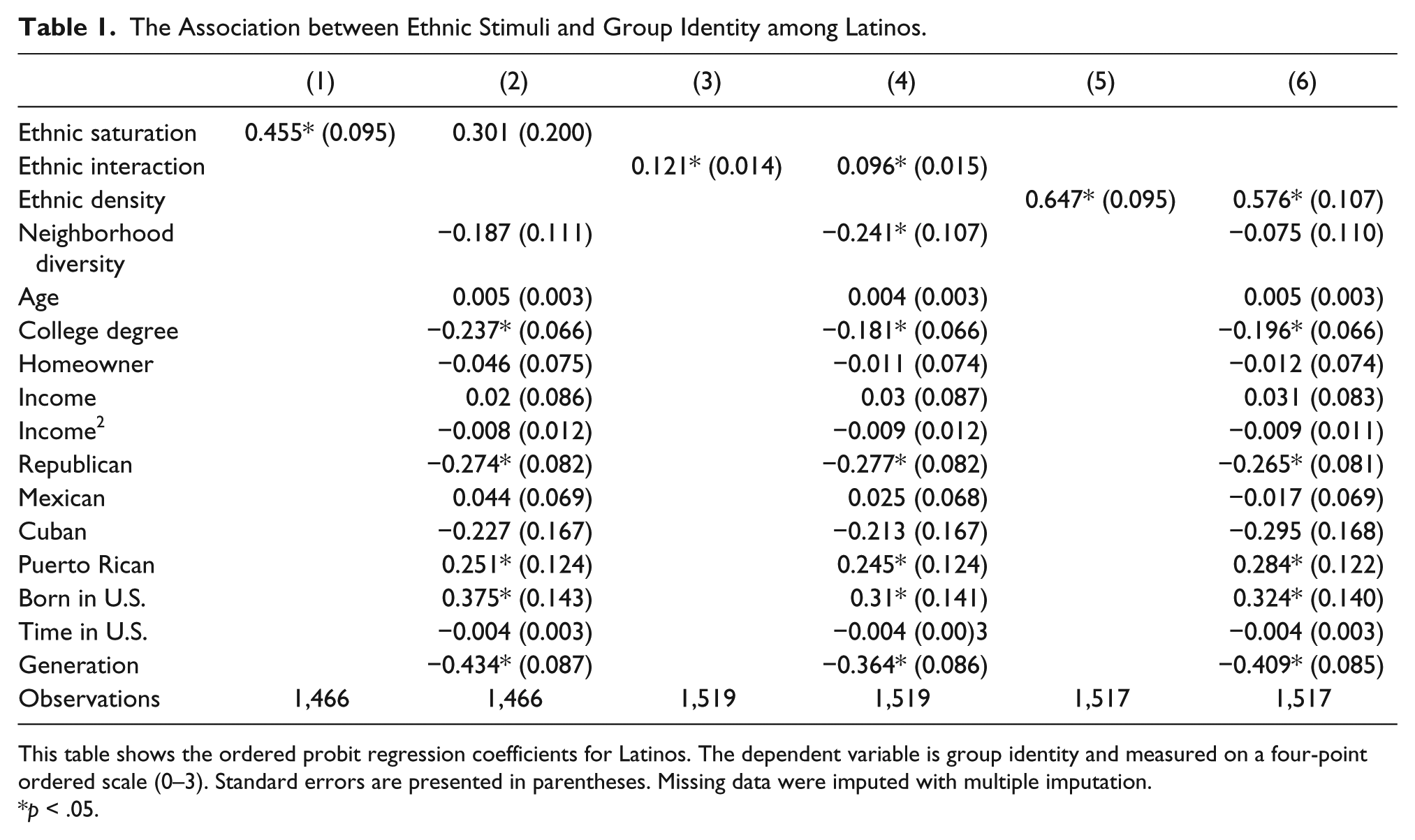
This table shows the ordered probit regression coefficients for Latinos. The dependent variable is group identity and measured on a four-point ordered scale (0–3). Standard errors are presented in parentheses. Missing data were imputed with multiple imputation.
p < .05.
Examining the bivariate relationships between group identity and each of the ethnic stimuli in columns 1, 3, 5 in Table 1 illustrates that each of the three stimuli has a positive and significant relationship with the outcome. For ethnic density, the estimate = 0.647 (0.095); ethnic saturation is 0.455 (0.189); and ethnic interaction = 0.121 (0.014). As the coefficients are not directly interpretable, I use predicted probabilities to better understand the size of the substantive relationship. These results are presented in Figure 2. As each of the three panels shows, an increase in the level of the ethnic stimuli in the neighborhood (x-axis) is associated with an increased probability of perceiving strong group identity (y-axis). The substantive effects in Figure 2 are quite large. The probability that a Latino respondent who attends church with whites very regularly has a strong perception of group identity is less than 0.20. In contrast, if the respondent attended church very frequently with Latinos, the probability of strong group identity is greater than 0.40. The 20 percentage point difference is a 100 percent change in the overall probability. While ethnic interaction has the largest effect, the relationships for ethnic saturation and ethnic density are substantively large as well.
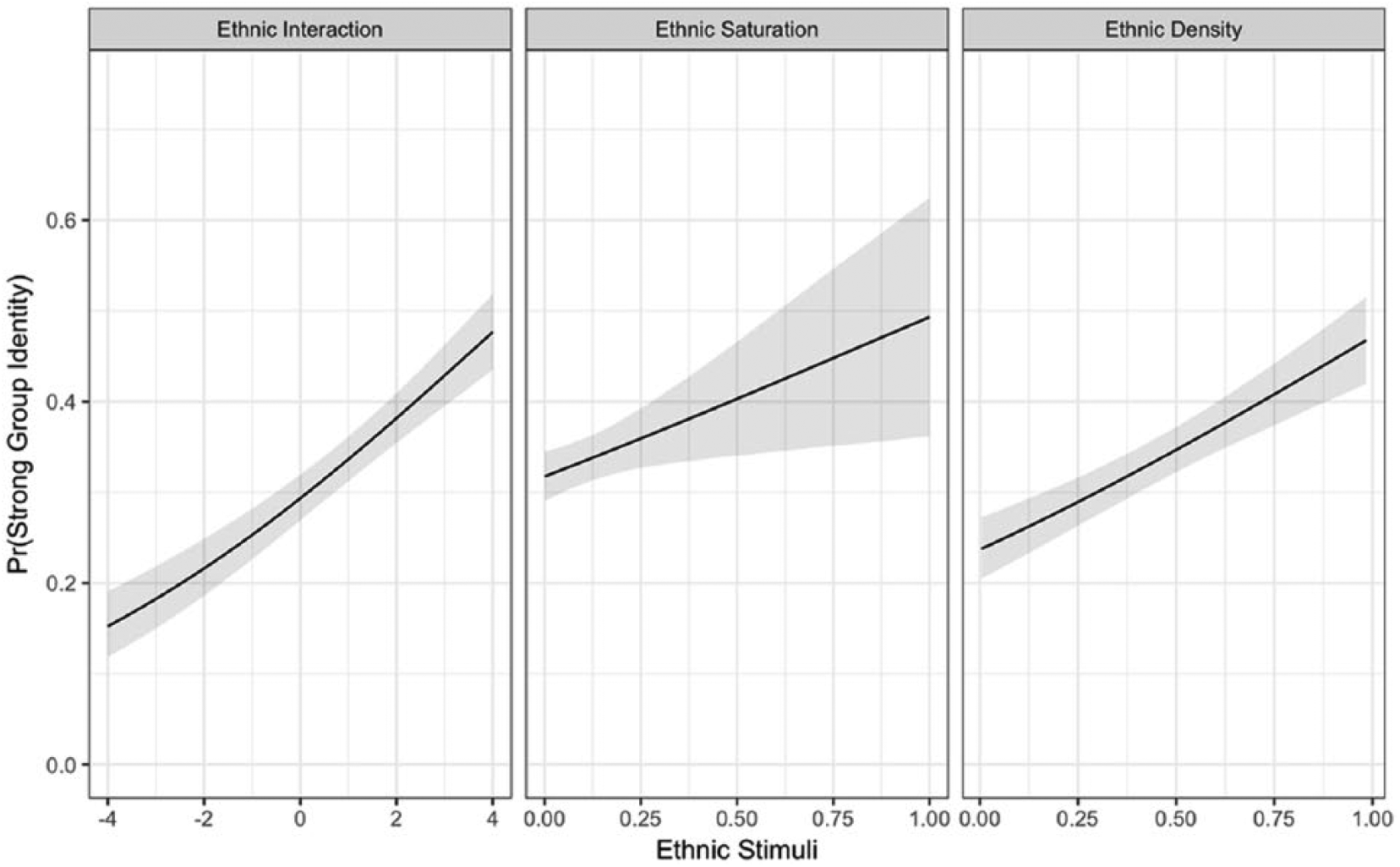
Predicted probability of strong group identity given variation in ethnic stimuli.
In a fully specified model (columns 2, 4, 6) in Table 1, we see that the results are largely consistent between both model specifications. Ethnic density 0.576 (0.107) and ethnic interaction 0.096 (0.015) remain positive and significant when a full host of controls are included. Ethnic saturation 0.301 (0.20) is no longer statistically significant, but the relationship is in the hypothesized direction.
Figure 3 displays the predicted probability of strong group identity given changes in the level of ethnic stimuli using the fully specified model. 14 Comparing these results with those in Figure 2 demonstrates a consistent finding. The availability of ethnic stimuli in one’s neighborhood is positively associated with perceptions of strong group identity. Even with a full set of control variables, the substantive effects are quite large. Take the first panel, which shows ethnic interaction. At the lowest level, the probability of strong group identity is 0.19, 95% CI: [0.14, 0.24]. At the highest level of ethnic interaction, the probability of strong group identity is 0.45, 95% CI: [0.40, 0.51]. This is a 26 percentage point change, even after controlling for a host of control variables. The relationship with ethnic saturation is the weakest, which likely comes from the lack of variation in the variable. 15 In terms of ethnic density, Latinos who live in almost entirely non-Latino areas have a predicted probability of 0.25, 95% CI: [0.21, 0.29], for strong group identity. The predicted probability of strong group identity among those whose neighbors are nearly 100 percent Latino is 0.48, 95% CI: [0.40, 0.56]. These individuals are almost twice as likely to perceive strong group identity compared with their co-ethnics in non-Latino neighborhoods.

Predicted probability of strong group identity given variation in ethnic stimuli with control variables.
The Social and Structural Dimensions of Ethnic Stimuli
The results above support the hypothesis that increases in ethnic stimuli increase the likelihood that Latinos will moor their identity to the larger pan-ethnic group. Next, I consider the association between these variables simultaneously and explore the additive effects of the ethnic stimuli along the social and structural dimensions. In the online appendix, I provide detailed correlation, Cronbach’s alpha, principal components, and factor analyses for each measure of ethnic stimuli. The conclusion I draw from these analyses, along with the existing work in the field, is that there are two distinct, yet related dimensions of ethnic stimuli. Ethnic density and ethnic salience both share an underlying dimension while ethnic interaction is captured well by another dimension. This is not surprising given ethnic density and ethnic salience are both independently measured features of the environmental context and are theoretically more about the physical and structural environment. I refer to this as the structural dimension. Ethnic interaction is a self-reported measure of a social behavior and relates to work that associates social interaction and group identity. I consider this the social dimension.
In the next set of analyses, I consider both dimensions simultaneously in a set of regressions that try to get a more complete understanding of how variation in ethnic stimuli puts into motion a psychological process whereby group members are more likely to see themselves as part of the larger pan-ethnic group.
The regression results, presented in Table 2, show that the structural and social dimensions are both positive and significant, providing strong support for the hypothesis that the availability of ethnic stimuli associates with strong perceptions of group identity. To interpret the substantive impact, I present predicted probabilities in Figure 4, which demonstrates a strong positive relationship between the structural and social dimensions and perceptions of strong group identity. 16 A change from living in a neighborhood with no co-ethnics, no Latino-named businesses, and attending church regularly with mostly whites (point estimate [pe] = 0.16, 95% CI: [0.12, 0.21]) to a neighborhood where nearly 100 percent of the neighbors are also Latino, the businesses are almost all Latino named, and going to church regularly with other Latinos (pe = 0.71, 95% CI: [0.57, 0.83]) is associated with a 55 percentage point change in the probability of perceiving strong group identity. Although this change is possible within the data, it is unlikely as the vast majority of respondents do not live in an area where 100 percent neighbors are Latino and a super majority of the business is Latino named. Examining a change from the one standard deviation below the mean (pe = 0.21, 95% CI: [0.17, 0.25]) to one standard deviation above the mean (pe = 0.50, 95% CI: [0.42, 0.58]) is associated with a 29 percentage point increase, which means that Latinos in the latter neighborhood are over twice as likely to perceive a strong group identity than those in the former neighborhood. 17
The Association between Social and Structural Dimensions of Ethnic Stimuli and Group Identity.
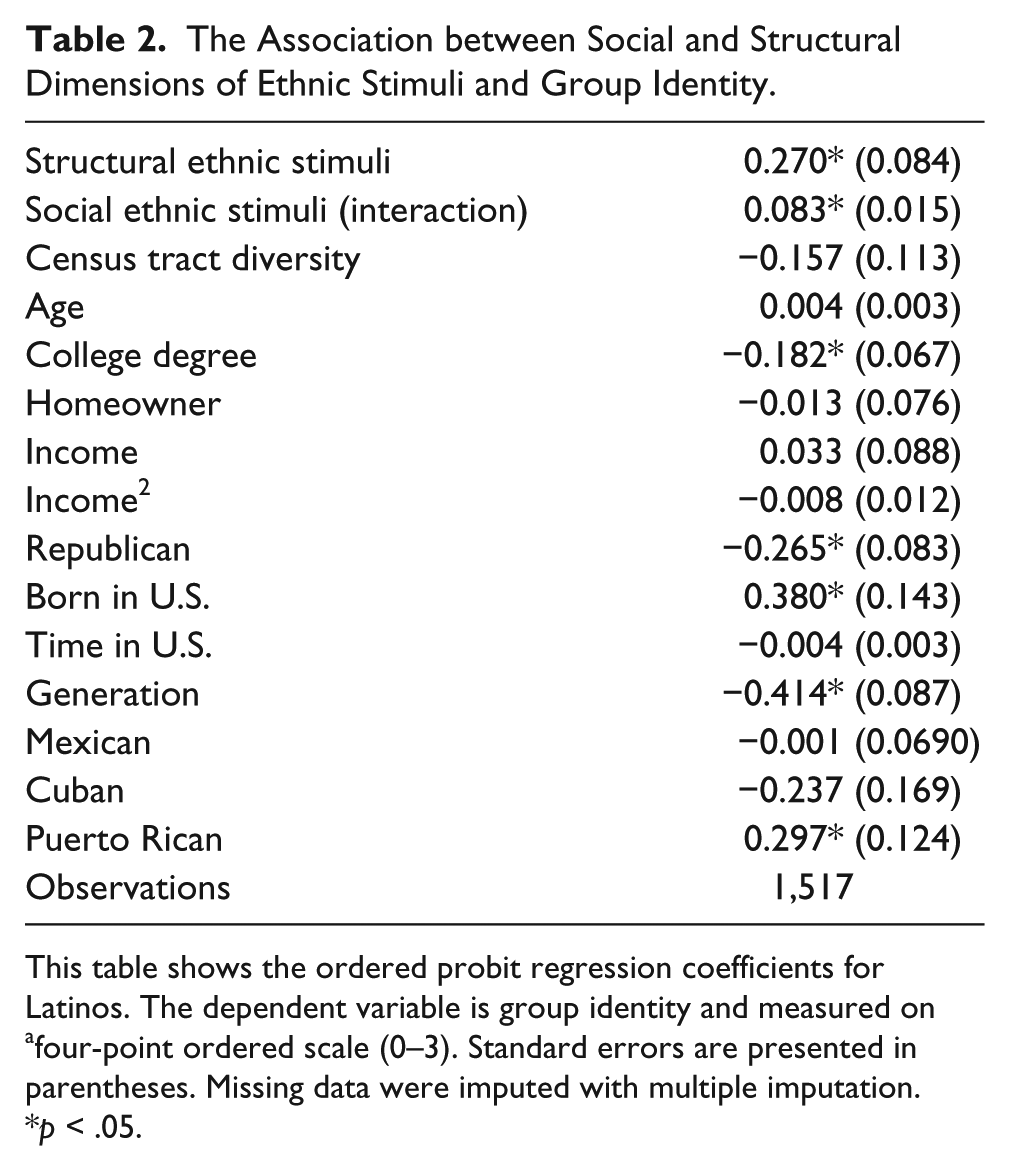
This table shows the ordered probit regression coefficients for Latinos. The dependent variable is group identity and measured on afour-point ordered scale (0–3). Standard errors are presented in parentheses. Missing data were imputed with multiple imputation.
p < .05.

Predicted probability of strong group identity for structural and social dimensions of ethnic stimuli.
Neighborhood Self-Selection
I have shown evidence that connects the availability of ethnic stimuli in one’s neighborhood with perceptions of strong group identity. As robust as the findings are, given the use of observational data, it is impossible to entirely rule out selection effects. Latino respondents with strong perceptions of group identity could select into areas with a greater availability of ethnic stimuli and the relationships I showed above would be endogenous. Below, I provide evidence using the observational data that suggests that self-selection does not appear to be the case.
Although the claim of self-selection does bring up valid concerns, there is not much historical evidence that minority group members living in the United States ever had full autonomy and/or choice in residential housing decisions (Freund 2010; Krysan and Crowder 2017). Institutionalized practices and non-institutionalized practices have also shaped the housing choices for member of racial and ethnic minority group members in more implicit ways (Krysan and Crowder 2017). 18
I conduct a set of analyses where I consider each of the ethnic stimuli as a measure of a respondents’ revealed residential preference (Enos and Gidron 2016). I assume that each of the ethnic stimuli is to some extent the behavioral realization of individual and family preferences given a set of constraints. If self-selection is evident and respondents’ strength of group identity does associate with greater ethnic stimuli, I expect to see a positive association between those who recently moved and the outcome of interest. This relationship should be strongest among those with strong perceptions of group identity.
I regress each ethnic stimuli measure on an interaction between a dummy indicator for those who have moved at least once within the past five years and the strength of group identity to ascertain the relationship between moving and group identity with ethnic stimuli. I include standard control variables to account for a person’s income, age, and education level, time in U.S., and whether they are foreign born. Given this modeling specification, there would be positive support for self-selection conditional on group identity if the interaction term between group identity and a recent move is positive and significant. If strength of group identity pushed people into neighborhoods with greater levels of ethnic stimuli, I expect to see this realized among those who have moved recently. People move for all sorts of reasons, but this analysis is specifically examining the claim that people with strong perceptions of group identity select into neighborhood with greater levels of ethnic stimuli.
In Figure 5, I plot the ordinary least squares (OLS) regression coefficients from the model specified above for each of the four independent variables. As a reminder, the structural dimension is an additive index of ethnic density and ethnic saturation. The key variable of interest is the interaction between group identity and the dummy indicator for a move within the past five years. In each of the plots, this relationship is always negative. High group identity and a recent move are negatively associated with each outcome.
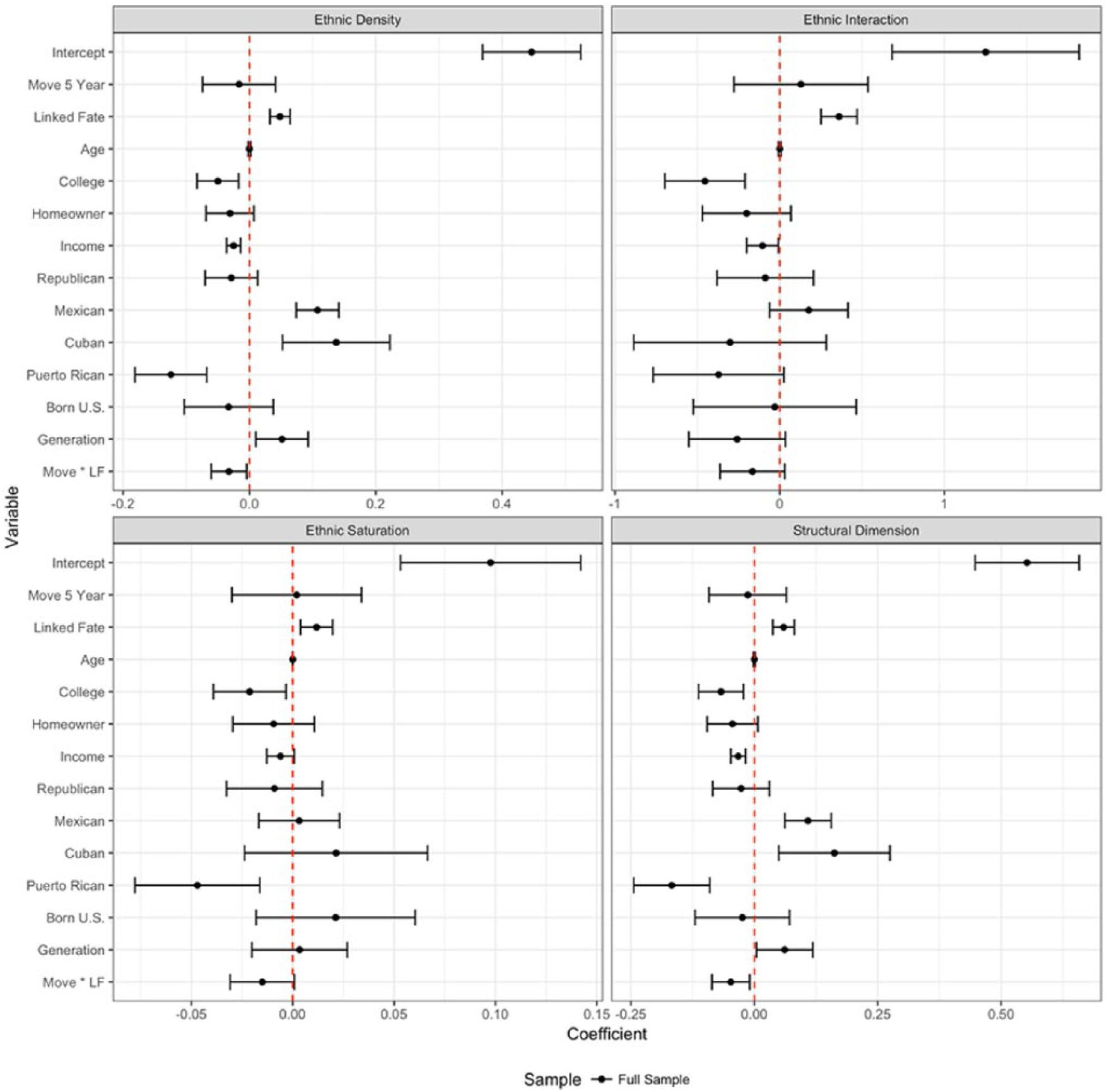
Plotted coefficients showing moving in past five years does not positively associate with the outcome of interest for Latinos.
The findings in Figure 5 do not demonstrate evidence of self-selection. There is not a positive relationship between group identity and ethnic stimuli among respondents in the sample who have recently moved. These individuals are likely weighing a host of other factors in their residential selection calculus. Because these findings push back on a common criticism of contextual research, future work should take seriously the issue of residential selection and how it works for members of minority group living in the United States, who are exposed to constraints not imposed on their non-white counterparts who likely have more agency in residential selection.
Discussion and Conclusion
In this paper, I sought to explain the conditions under which variation in perceptions of group identity among Latinos associate with the availability of ethnic stimuli in the local environmental and social context. As predicted, ethnic density, ethnic saturation, and ethnic interaction, all associate with stronger feelings of group identity for Latinos. Latinos exposed to higher levels of all three stimuli are more than twice as likely to moor their identity to the Latino group compared with those who live in neighborhoods with lower levels of ethnic stimuli.
Group identity is fascinating because it is at the root of many behaviors, including those that seem to be in contrast to one’s material or self-interest (Akerlof and Kranton 2000; Dawson 1994). In terms of politics, the strength and salience of group identity is known to increase the support for the Democratic Party among blacks (Dawson 1994), increase support for co-ethnic policies among Latinos (Sanchez 2006b), and support co-ethnic candidates (Barreto 2007). As one of the most heavily relied upon predictors of behavior and attitudes for racial and ethnic minorities in the United States, we are well informed as to the conditions under which perceptions of group identity impact political attitudes and behaviors (Junn and Masuoka 2008; Pérez 2015b; Valenzuela and Michelson 2016). We know that high identifiers are much more likely to engage on behalf of the group when exposed to hostile rhetoric (Pérez 2015b). We also know that more proactive appeals, such as those based on identity expression, matter most for those who see themselves as part of an ethnic group (Valenzuela and Michelson 2016). What is missing from the current literature is work that fully explores the variation in strength of group identity and considers the conditions under which some individuals have forged strong attachments to the group whereas others balk at such identification. As Pérez (2015b) points out, the strength of group identity is the most important moderator of how U.S.-based Latinos respond to xenophobic rhetoric. In this paper, I use a framework inspired by social identity theory to provide a set of conditions and factors that explain variation in perceptions of group identity among the one of the fastest growing minority groups in the United States.
This paper also makes another important contribution to the literature, especially the group identity work among minorities in the U.S. context. Much of the current research focuses on how group identity and threat are related (Pérez 2015b; Vargas, Sanchez, and Valdez 2017). For example, Vargas, Sanchez, and Valdez (2017) explore how statewide immigration policies affect perceptions of linked fate among Latinos and suggest that Latino respondents are responsive to the threat induced by punitive policies enacted at the state level. What this literature leaves out are the processes that may not be related to threat that could inform and explain variation in a host of social and political attitudes. Although there is no doubt that the role of threat is important to perceptions of identity (Ellemers, Spears, and Doosje 2002; Pérez 2015a; Sanchez and Masuoka 2010; Vargas, Sanchez, and Valdez 2017), more work needs to be done on those factors that are not related to threat (Jiménez 2010). For one, social identities are not always developed in response to threats from an out-group or external source. Second, local context is likely a mediator of threat. Threatening discourse and punitive policies are interpreted though the very context that people live and work. Do contexts that promote a positive group identity, that is, those where ethnic stimuli reinforce a way to maintain a positive self-image, diminish the effect of threatening discourse, the perception of punitive policies, and xenophobic rhetoric from elite sources?
The availability of ethnic stimuli within one’s immediate social and structural context associates with stronger perceptions of group identity among Latinos through the framework offered by self-categorization theory (Ellemers, Spears, and Doosje 2002; Huddy 2001; Turner et al. 1987). When parent’s take their children to school, they walk by other co-ethnic families and pass by co-ethnic businesses. Informal interactions in these instances promote positive feelings toward their ethnic group (Jiménez 2010) and reinforce that they are members of a group rather than unique individuals (Turner et al. 1987). Driving to and from work, residents who work outside the neighborhood still pass co-ethnic business and see their co-ethnic neighbors. The constant exposure to these ethnic stimuli reinforces one’s connection to a larger group, even without conscious recognition of these factors. Ultimately, residential and social environments provide important information to residents about their connection to others vis-à-vis the larger social landscape (Hopkins, Tran, and Williamson 2014).
Supplemental Material
prq_supporting_info_online_supp – Supplemental material for Local Origins: Context, Group Identity, and Politics of Place
Supplemental material, prq_supporting_info_online_supp for Local Origins: Context, Group Identity, and Politics of Place by Bryan Wilcox-Archuleta in Political Research Quarterly
Footnotes
Acknowledgements
I would like to thank Matt Barreto, Tyler Reny, Sergio I. Garcia Rios, Lorrie Frasure-Yokley, David Sears, Efrén Peréz, Hannah Walker, Angela Ocampo, Ryan Enos, Kassra Oskooi, and Hannah Walker for insight and guidance throughout this process. Their comments and ideas made this paper better. I would also like to thank the participants at Midwest Political Science Association (MPSA), American Political Science Association (APSA), Politics, Race, Immigration, and Ethnicity Consortium (PRIEC), and Western Political Science Association (WPSA) where this paper was presented multiple times.
Declaration of Conflicting Interests
The author(s) declared no potential conflicts of interest with respect to the research, authorship, and/or publication of this article.
Funding
The author(s) received no financial support for the research, authorship, and/or publication of this article.
Notes
Supplemental Materials

References
Supplementary Material
Please find the following supplemental material available below.
For Open Access articles published under a Creative Commons License, all supplemental material carries the same license as the article it is associated with.
For non-Open Access articles published, all supplemental material carries a non-exclusive license, and permission requests for re-use of supplemental material or any part of supplemental material shall be sent directly to the copyright owner as specified in the copyright notice associated with the article.
