



Abstract
In this article, we consider the gender gap in political participation by analyzing recent survey data about German adolescents. Differentiating between institutional, non-institutional, and expressive participation, we show that, even in Germany where there is strong gender equality, type-specific gender differences persist. Testing for resource, socialization, and attitudinal explanations, in multivariate regression analyses, we identify socialization in civic forms of participation together with the lower confidence of women in their personal and political skills as major drivers for the sexual differences in political engagement, especially so for institutionalized forms of participation.
Discourse on the gender gap in political representation and participation has received increasing attention over the past decades. Much effort has been devoted to increasing awareness of the existence and the consequences of gender differences in political life and to implementing policies countering this discrepancy. However, and not withstanding such efforts, gender balance is far from being achieved, and current imbalances are associated with serious legitimacy problems for democracy (Paxton and Hughes 2013).
The now extensive literature on gender differences in political participation stresses that women are less likely to consider political office or other political activities in the first place and identifies several explanations (Verba, Burns, and Schlozman 1997; Westle 2001). Time, socioeconomic resources, and socialization are among the most prominent reasons for the gender gap. While all these findings are well-established in the literature, two points stand out that might question their overall generalizability. First, research on gender differences in political participation is dominated by findings from the United States, the country ranking ninety-fifth out of 185 with regard to women’s representation in national parliaments (Inter-parliamentary Union [IPU] 2016). Second, most studies on the gender gap in participation rest on survey data from adults (but see Gaiser et al. 2016; Hooghe and Stolle 2004; Lawless and Fox 2013). While this is a straightforward approach in political participation research for obvious reasons, it hardly allows us to examine the potential of future adults. Studying youth engagement is highly informative because participation at early age paves the way for future engagement (Duke et al. 2009; Manganelli, Lucidi, and Alivernini 2014).
Addressing both shortcomings, in this paper, we analyze the gender gap in political participation among German adolescents. We first examine whether a gender gap for this specific group, indeed, exists, before we turn to the questions of which theories of political participation can explain it and in how far the same independent variables have different effects on the political participation of young women and men. For this, we make use of newly compiled data from 2015. Based on a survey particularly designed to capture political participation among younger respondents aged between fourteen and twenty-nine, we want to qualify the mostly adult-centered theories about the gap in political participation, which commonly reinforce gaps in socioeconomic resources and socialization as major reasons for unequal participation.
Germany—as all other democracies—has a long history of unequal political participation by sex. Especially before German reunification, both voting participation and membership in political parties was considerably lower among women than men (Cornelissen 1993), differences that were also reported for the first federal election after reunification in 1990 (Metje 1991). However, since the 1990s, these patterns gradually began to change. For several reasons, we expect today’s German adolescents to represent a “least likely case” for gender differences in major explanatory variables and, thus, in political participation. Not only is the role of women in German politics now well above the worldwide and European mean (Germany is twenty-sixth in the 2016 worldwide IPU ranking), but also gender differences in voting participation have nearly disappeared in federal elections (Schmidt and Röser 2011). Regarding potential explanatory variables, educational resources are expectedly equally distributed among today’s German adolescents. Personal income paving the way for participation is still more equally distributed between young women and men because they predominantly rely on the parental household for financial support. Finally, very rarely have German adolescents borne children and so do not suffer the major restriction on time available for political engagement. Regarding socialization factors, we see an approximation of gender-specific images with respect to the role of women in family, labor market, and politics. Over the past twenty years, the share of young women and men with egalitarian attitudes has increased steadily, and there is a broad consensus on the equal distribution of household tasks (Bundesministerium für Familie, Senioren, Frauen und Jugend [BMFSFJ] 2007, 29; Destatis 2016a, 427; Schmidt and Röser 2011). Taken together, these characteristics of German adolescents offer us the opportunity to look at a world of equally distributed socioeconomic resources and largely common socialization experiences between the sexes—which already fulfills the policy targets defined by many of today’s governments.
Our argument in this paper is twofold. First, we stress the importance of distinguishing diverse types of political participation when analyzing the gender gap therein. Our descriptive analyses and multivariate regressions indicate that type-specific gender differences persist even in a least likely case such as Germany. Second, we identify different effect sizes of relevant explanatory factors between women and men. Especially for institutional forms, the relationship between civic skills and internal efficacy appears to be the driver for gender differences in participation. Thus, even in favorable political and social environments, where young women and men expectedly have equal chances of participation, gender differences exist, mostly due to varying levels of confidence in becoming politically engaged.
Defining Political Participation
As has been emphasized by political theorists, political participation takes center stage in the functioning of democracy. Voting, attending political discussions, or running for office—all such activities not only guarantee that citizens’ voices are heard, they also structure public discourse, select candidates for office, and guarantee that the elected represent the public will.
To come up with a definition of political participation, which does not risk becoming a “theory of everything” (van Deth 2014), we here commit ourselves to a minimal one (see also S. Fox 2014). We do so by referring to political participation as citizens’ voluntary activities that influence politics but do not take place in schools, families, places of employment, or voluntary associations. Applying this definition, we rule out political attitudes, non-voluntary activities, activities of citizens in their roles as elected political actors, and what we refer to as school or club involvement. 1 In contrast, we include legal and illegal, instrumental and symbolic, and individual as well as group forms of activity.
Following from this definition, we differentiate three types of political participation: institutional, non-institutional, and expressive (see van Deth 2014 for similar categorizations; S. Fox 2014). While each refers to citizens’ voluntary activities affecting politics, we expect them to differ in their repertoire of actions, their main target groups, and the dominant way of influencing these targets. Institutional participation is most straightforward as it covers long-established activities, which mainly address the state via participation in elections or actively running for or holding office. The dominant principle here is parliamentary representation. In contrast, the repertoire of actions being non-institutional covers protest activities, which became prominent during the Civil Rights era, demonstrations and boycotts being the most widespread examples. These publicly organized protests have not only state but also social or economic consequences. Finally, expressive participation includes activities primarily giving voice to the political aims and intentions of citizens. Many of these are individual or organized via the Internet without people coming together in groups, and so, at first, they may appear less relevant. However, political online activities are very important for members of younger age cohorts, which are our central interest in this article.
With regard to gender differences across the three types of participation, international studies addressing the gender gap among adults report that institutional and some non-institutional activities still predominately involve males. Not only are men more likely to be party members (Scarrow and Gezgor 2010) and more inclined to seek direct contact with politicians, they also tend to engage more in public or collective participation, such as taking part in political discussions or attending political meetings (Marien, Hooghe, and Quintelier 2010; Westle 2001). Conversely, there are forms of participation to which women seem to be more attracted. These comprise the rather private forms of protest such as signing a petition or boycotting products (Marien, Hooghe, and Quintelier 2010; Schmidt and Röser 2011). International empirical results, hence, indicate that in general women are not less engaged in politics but participate differently (Coffé and Bolzendahl 2010).
Explaining Gender Differences in Political Participation
Now that we have defined our subject of interest and distinguished between types of political participation, we can turn our attention to potential explanatory variables. In doing so, we separate the theoretical arguments presented in the literature into three groups, addressing socioeconomic resources, socialization environment, or politically relevant attitudes and beliefs. For each of these sets of variables, we discuss their importance, summarize previous findings regarding differences between (mainly adult) women and men, and discuss our expectations pertaining to gender differences in our target group, that is, German adolescents.
Socioeconomic Resources
Individual resources have a long tradition in research on political participation (Verba and Nie 1972). Resource-informed explanations are decisive in that resources initially increase the political interest of an individual and consequently the amount of his or her participation.
Above all, income and education are considered the central resource types, as they affect both the time available to deal with political issues as well as the intellectual readiness for participation (Schlozman, Burns, and Verba 1994). Other prominently discussed resource variables are age and responsibility for children. Aging is expected to increase political participation as individuals collect politically relevant skills and knowledge. This leads to the internationally well-established finding that older people engage more in different political activities, most prominently voting, than younger groups (Marien, Hooghe, and Quintelier 2010; Melo and Stockemer 2014; Quintelier 2007). At the other end of the scale, children are discussed as decreasing parents’ political participation, as they limit both income and time available for political matters (Voorpostel and Coffé 2012).
Regarding the political participation of women compared with men, the effects of socioeconomics are very clear. Beside the remarkable fact that the gender gap in education has diminished largely within Organisation for Economic Co-operation and Development (OECD) countries, empirical evidence still unanimously shows that women not only have less income at their disposal than men, but also more often work part-time and below senior level with lower social and economic status (OECD 2012). Therefore, unequal access to and distribution of socioeconomic resources between the sexes is a common explanation for less female engagement in politics (Burns, Verba, and Schlozman 2001; Coffé and Bolzendahl 2010). Beyond these differences in access, the relevance of resources lies in the fact that they have different impacts on the political participation of women and men. The number of dependent children in a household exacerbates the persistent gender gap because of the restriction on the leisure time available for mothers much more than fathers (Voorpostel and Coffé 2012). Then, even if women reach occupational positions similar to men, they might still be unable to participate equally in political affairs due to larger shares of housework and family care that falls on them.
Acknowledging the persistent gender differences in socioeconomic resources, their relevance for our target group of adolescents can reasonably be expected to be less than for adults. The first reason for this is the more equal distribution of educational qualifications among women and men in younger age cohorts. For Germany, data show that we, indeed, should expect young women to outperform young men slightly in their level of formal education, as there are more women now enrolled in the highest tier of the German school system, the Gymnasium, as well as in university (Autorengruppe Bildungsberichterstattung 2016, 296ff.). Second, and while the gender pay gap is still observable and heatedly discussed in Germany, income should be less relevant for our target group. As many adolescents are still in education and live with their parents, they mainly rely on family financial resources, which tend to be equally distributed between daughters and sons (Langmeyer and Winklhofer 2014; for evidence from this sample, see Table 1). Finally, children as an important obstacle for leisure time are a rarity among German adolescents; the mean age of women becoming a mother for the first time is thirty years (Destatis 2016b). Also, we find that family obligations are more equally distributed between young women and men than in older age cohorts (Kluge 2014, 718). In short, we expect socioeconomic resources to play a very limited role in explaining potential gender differences between young women and men in Germany, but at the same time to be a source of variation within both groups:
Descriptive Statistics and Gender Differences.
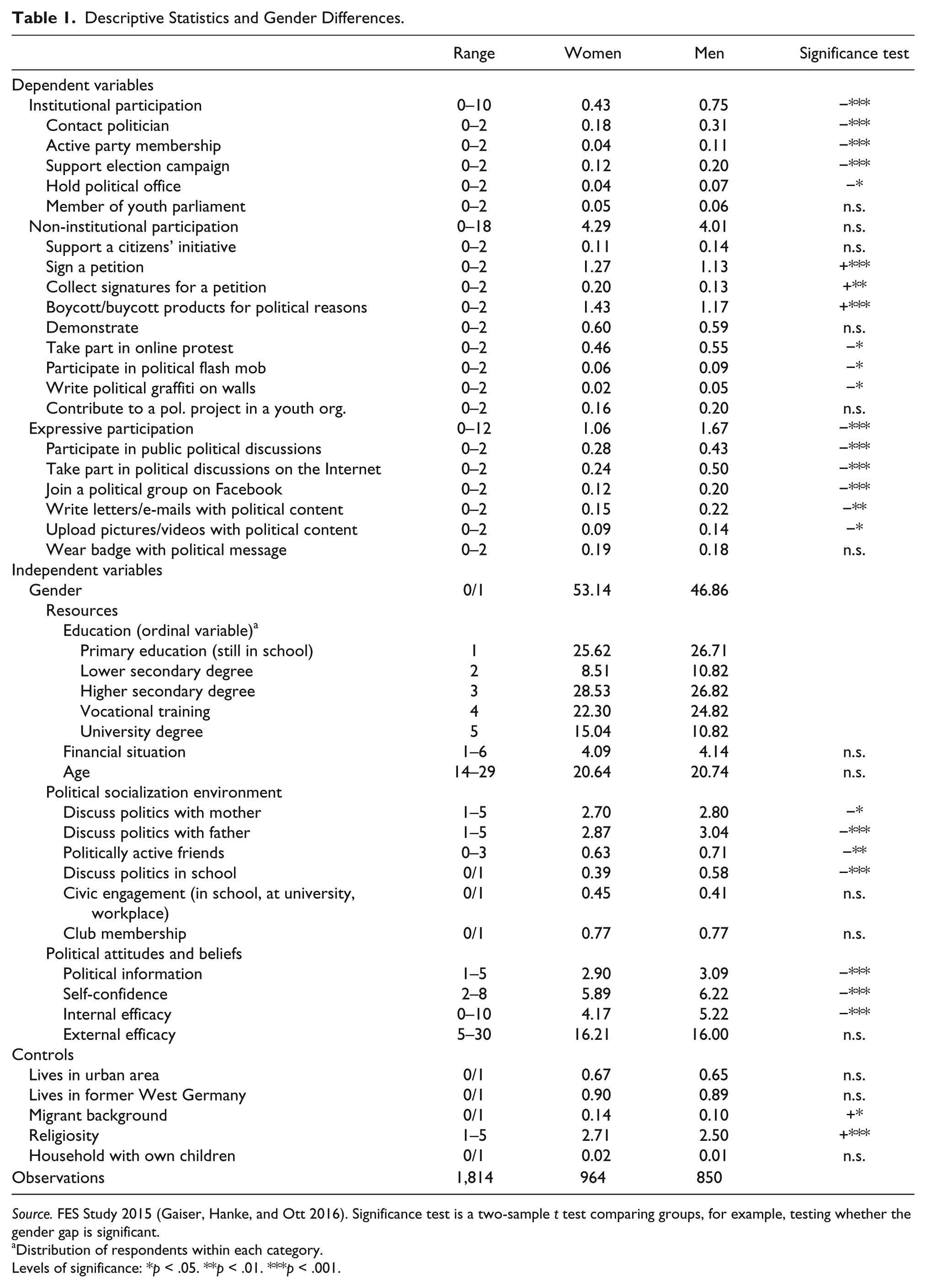
Source. FES Study 2015 (Gaiser, Hanke, and Ott 2016). Significance test is a two-sample t test comparing groups, for example, testing whether the gender gap is significant.
Distribution of respondents within each category.
Levels of significance: *p < .05. **p < .01. ***p < .001.
Political Socialization Environment
Next to the resource hypothesis, the theory of gendered socialization has garnered much attention in research on political participation. Political socialization environment influences adults’ perspectives on gender roles in public and private and their interest in political matters from early childhood. The family context is seen as most important because parents serve as role models for their children. Stable parental political attitudes and frequent contact with political issues through family discussions significantly increase pre-adult awareness and long-term predispositions for participation (Schwarzer and Connor 2013). Studies from the United States show that party identities are known to be passed from parents to children, and the same applies to political affiliations and attitudes to voting (Jennings, Stoker, and Bowers 2009). Moreover, children from politically aware homes not only participate more often in political and school activities but, even at a younger age, are more likely to join demonstrations and boycotts or donate money for political purposes (White and Mistry 2016).
Besides family socialization, regular contact and exchange with politically active friends significantly influence youth political engagement. Through discussions and confrontation with other opinions, peers can be inspiring role models. Previous research from Sweden has stressed how, after socialization experiences within the family, informal political discussions and activities in the peer group rank next in influencing political interests (Amnå et al. 2009; Ekström and Östman 2013). Moreover, in some cases (e.g., in Belgium), the influence of politically active friends even exceeds the impact of family influence on adolescents (Quintelier 2015).
Furthermore, for our target group of adolescents, experiences at school—and later in tertiary education—have been identified as crucial for political socialization (Quintelier and Hooghe 2013). Civic engagement might come in the form of politically relevant courses, extracurricular activities, or the opportunities to be active in student governments. The resulting encouragement is prominently discussed in educational research, emphasizing not only politically relevant knowledge and skills transmitted by school activities, but also what U.S. researchers refer to as “competitive experience” (R. L. Fox and Lawless 2014). As an example of this, even competing to become class spokesperson is a very significant event for young children (Lawless and Fox 2010).
Finally, political socialization might also come via experiences outside family or school, for example, through membership of sport clubs, churches, youth organizations, and so on (McFarland and Thomas 2006). As with civic engagement, club activities transmit relevant skills and stimulate competitive experiences. Team sports such as soccer, where direct physical and psychological competition with the opponent is in the foreground, have been found to increase political engagement and especially readiness to apply for political office (Lawless and Fox 2013). As has been discussed in our concept definition, we see joining clubs as relevant for, but distinguishable from, political participation.
Pertaining to gender differences in politically relevant socialization, research suggests that girls and boys not only have different experiences due to the distinct activities they engage in, also they are differently affected by the very same experiences. Regarding our target group of young Germans, recent findings indicate that socialization experiences are much more equal between sexes compared with U.S. adolescents. Not only do young women and men in Germany report rather similar life plans regarding family and work (BMFSFJ 2007, 29), recent survey data also indicate that civic engagement in workplace and clubs is more equally distributed among sexes (Walper, Bien, and Rauschenbach 2015). In school, girls between twelve and eighteen, in fact, show more interest in becoming class representative or engaging in the school newspaper than boys (Meinhold-Henschel 2008).
While we see that at least parts of the political socialization environment of German young women and men now looks much more similar compared with older cohorts, we lack findings on how they are affected by their aligning experiences. U.S. findings report that parents not only speak with their sons about political matters more often than with daughters, but due to gendered relationships, girls have been found to be differently affected by their parents’ worries, resistance, and supervision than boys, which, in turn, alters their participatory behavior (Fridkin and Kenney 2007; Gordon 2008). Similarly, the gendered nature of politics in public discourse may reduce the political effects of the role model on young women’s inclinations to participate (Campbell and Wolbrecht 2006). From their study about the gender gap in political ambition among college students in the United States, Lawless and Fox (2013) conclude that, compared with boys, girls are exposed to less information about politics via discussions in family and school, receive less encouragement about aiming for a professional career or becoming active in politics. All of this could explain why they favor more informal and socially oriented forms of political participation (Hooghe and Stolle 2004). Summing up the arguments on the role of political socialization, we hypothesize,
Politically Relevant Attitude and Beliefs
Last, political attitudes and beliefs are important predictors of political participation, even if the direction of causality between attitudes and behavior is open to debate (Quintelier and van Deth 2014). In general, a recurrent international finding in political participation research is that people with higher political interest, higher degrees of self-confidence, internal and external political efficacy are much more likely to partake politically (Coffé and Bolzendahl 2010). 2
Concerning the gender gap, women regularly turn out to be less politically interested and efficacious than their male counterparts (Coffé 2013). Both older and younger women shy away from competitive experiences and underestimate their personal, professional, and political skills (Booth and Nolen 2012; Niederle and Vesterlund 2007). R. L. Fox and Lawless (2011, 62) precisely summarize the situation within the United States: “men are more likely than women to express confidence in skills they do not possess and overconfidence in skills they do.”
Regarding our target group, politically relevant attitudes and beliefs are arguably the least equally distributed set of explanatory variables. Notwithstanding equal access to socioeconomic resources and substantially adapted socialization experiences between young women and men in Germany, the former report less interest in politics and do less often take up leadership roles in civic activities outside school (Gaiser et al. 2016). As indicated by several studies from the fields of education and psychology, self-confidence seems to play a crucial role here. Analyzing a recent survey of Germans aged between eleven and sixteen years, the psychologists Kröner-Herwig, Maas, and Reckling (2014, 9) point to “a stable tendency for girls to be more censorious and derogatory towards themselves.” Such assessments are also prominently discussed in education research, where the much lower confidence of girls in solving mathematical problems is now seen as the main driver for their lower test results—and international comparison makes clear that such gender differences are larger in Germany than in most OECD countries (OECD 2009). We assume that politically relevant attitudes and beliefs not only considerably affect the general propensity to engage politically but might also affect girls, boys, and the three participation forms differently. More precisely, we expect them to play a crucial role in increasing boys’ willingness to engage in public forms of participation, especially those performed in small groups and with a clear allocation of responsibility—qualities that describe institutional forms much better than private (e.g., boycotting) or mass forms (e.g., demonstrations) of political participation. As a general hypothesis, we state,
Data and Method
For our analysis, we use a novel data set originating from a research project by the Friedrich-Ebert-Stiftung (FES) and the German Youth Institute (DJI), the FES Youth Study 2015 (Gaiser, Hanke, and Ott 2016). The survey was designed to particularly capture political participation of young people and is unprecedented in its detailed and comprehensive focus on the involvement, opinions, and value-orientations of young Germans. The FES Youth Study is a follow-up inquiry to the AID:A II survey 3 (Walper, Bien, and Rauschenbach 2015) and includes respondents aged between fourteen and twenty-nine years who had agreed to participate in a panel study. Of the gross sample of 9,174 young people invited to participate in the online interviews (computer-assisted web interviewing) during June and July 2015, 2,075 respondents completed the questionnaire. Although the response rate of 23 percent is rather low but not unusual for online surveys (see Fan and Yan 2010), the sample is largely representative of the age group compared with census data. 4 After dropping missing values via listwise deletion, the data set comprises a sample size of 1,814 respondents (female: N = 964, 53.14%; male: N = 850, 46.86%). As our dependent variables are continuous, we run several ordinary least squares (OLS) regressions, reporting ß-coefficients and robust standard errors. To ease comparisons, we standardize all continuous variables by their means.
Dependent Variables
To evaluate gender differences in political participation comprehensively, we operationalize our three dependent variables from two survey questions asking about the attitude toward, and the experience of, twenty forms of political participation shown in Table 1. The first question asked respondents whether they would consider engaging in any of the activities listed. A follow-up question asked those open to active participation to indicate how often they have already participated (never, once, or more than once). We merged both questions into a categorical indicator with three outcomes for each political activity. A value of 2 indicates that a person is willing to participate in this activity and has already participated more than once. Respondents who have participated once are marked with a value of 1. Finally, a value of 0 comprises all those who have never been active, but can generally imagine participating in the future, or who cannot imagine participating in this form at all. As indicated in Table 1, we assign each activity to one of the three participation types we introduced earlier (institutional, non-institutional, and expressive). All activities within one type are added forming three continuous indices, respectively.
Independent Variables
While the gender-dummy (1 = women, 0 = men) captures potential differences between women and men, we include three different indicators of socioeconomic resources in our models. Education is operationalized as an ordinal variable with values ranging from 1 to 5, depending on the highest educational achievement (1 = primary education, still in school, 2 = lower secondary degree or no degree, 3 = upper secondary degree, 4 = vocational training, 5 = university degree). 5 Financial situation reflects the respondents’ subjective satisfaction with their financial situation. Because we do not know whether respondents work a side job or receive financial support from their parents, we refer to satisfaction with the personal financial situation as a proxy for income. Financial situation is measured on a scale from 1 to 6, with 1 indicating “not satisfied at all” and 6 “very satisfied.” As our sample of fourteen- to twenty-nine-year-olds is quite heterogeneous in terms of background variables such as education, workplace position, as well as in latent variables such as psychological and cognitive maturation, we separate it into three age groups (14–17, 18–23, and 24–29 years).
We depict the political socialization environment by five variables. Discuss politics with father or mother measures the frequency of discussions on a scale from 1 to 5, where 1 indicates “never” and 5 “very often.” The second indicator reflects the number of politically active friends on a scale from 0 (no one is politically active) to 3 (almost all friends are politically active). Discuss politics in school is measured as a dichotomous variable indicating whether the respondents have discussed politics with their teachers beyond the teaching content. Civic engagement captures respondents’ most recent activities in school or workplace. The variable is constructed out of items reflecting engagement in school (work in student council, being school or class representative, or being a school mediator), engagement in university (being active in the student assembly or in the general student committee), and at work (as class representative during vocational training or as a member of the works council). The dichotomous variable equals 1 if respondents have been active during their most recent occupation. 6 Club membership is a dichotomous variable indicating whether the respondents are currently active in a club (sports club, religious group, heritage club, music/theater association, culture club, or volunteer fire department, or something else not primarily political).
Coming to political attitudes and beliefs, we include political information as an item capturing how often respondents inform themselves about politics via channels such as TV, radio, or online media. We summarized the different forms into one continuous variable ranging from 1 (“never”) to 5 (“on a daily basis”). Self-confidence is operationalized as an additive index of two items, asking respondents to rate how far they agree with the statements, “I can find a solution to every problem” and “I can easily handle difficulties because I can trust my skills,” resulting in a continuous variable ranging from 2 to 8. Finally, we include measures of respondents’ internal and external efficacy. We measure the former with a single item asking respondents, “How able do you feel to take an active role in a group involved with political issues?” on a scale from 0 (“not able at all”) to 10 (“fully able”). With external efficacy, we measure how far people agree that political actors are responsive to citizens’ interests by a composite index including five items. 7 The index ranges from 5 to 30 with higher values indicating higher degrees of external efficacy.
A set of control variables was used to remedy the variance due to structural inequalities within Germany. 8 Here, we include indicators for living in an urban area, a West-East dummy, having a migrant background, and being religious. One last control captures whether the respondent is already a parent, for example, lives in a household with own children—which with a value of less than 2 percent is a very rare case in our sample.
Results
To analyze gender differences between German adolescents regarding the three forms of political participation, we first rely on descriptive evidence (Table 1) and then turn to multivariate regression analyses (Tables 2 and 3). Starting with the descriptives, Table 1 reports the mean values of our dependent and independent variables separately for young women and men. The results of significance tests for gender differences (two-sample t tests comparing groups) are reported in the last column; a minus sign indicates that women have lower mean values than men, a plus sign indicates the opposite.
Multivariate Regressions Predicting Involvement in Three Types of Participation.

Ordinary Least Squares (OLS) regression with standardized coefficients and robust standard errors in parentheses; reference group for age: 14–17.
Levels of significance: *p < .05. **p < .01. ***p < .001.
Multivariate Regressions Predicting Involvement in Three Types of Participation by Gender.
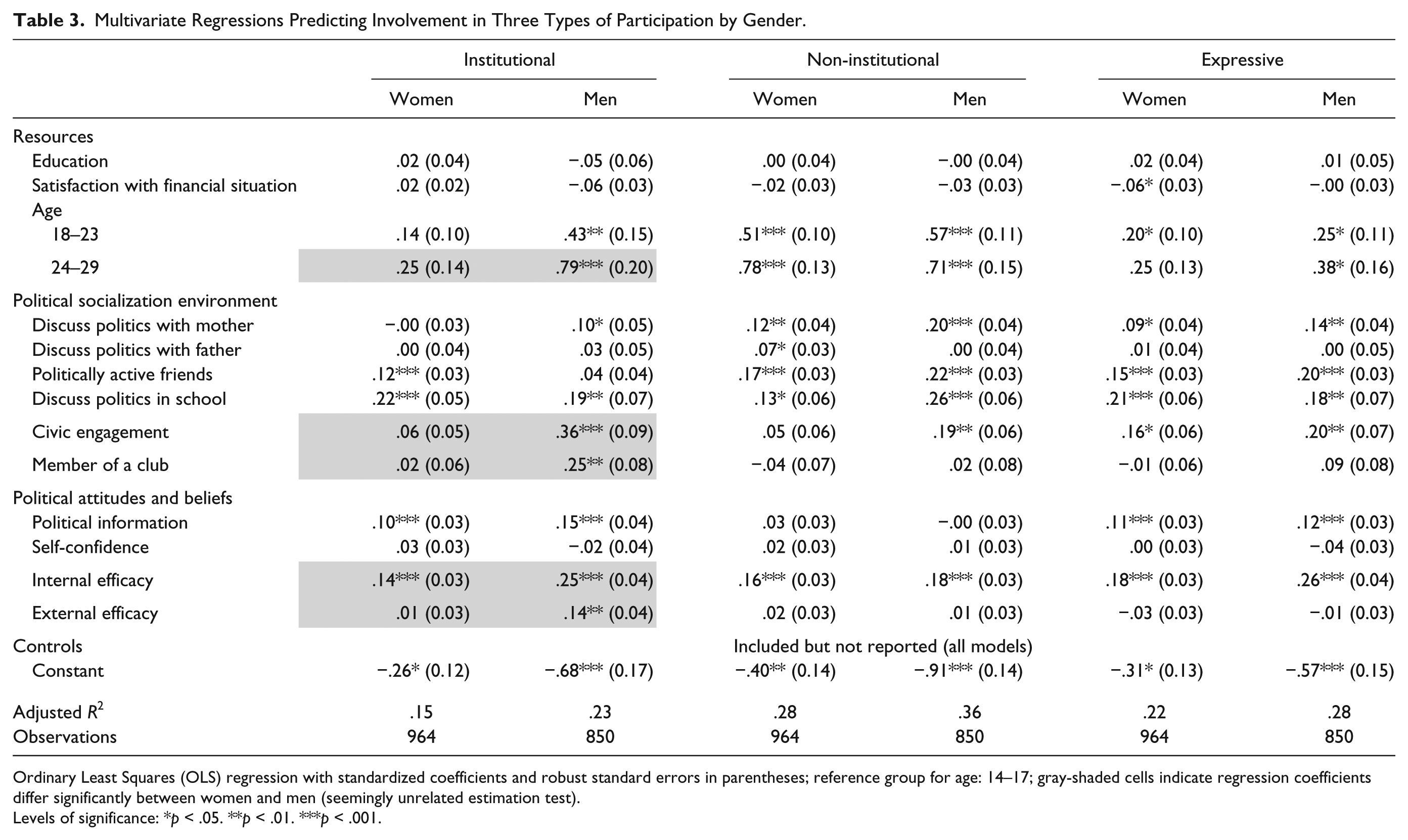
Ordinary Least Squares (OLS) regression with standardized coefficients and robust standard errors in parentheses; reference group for age: 14–17; gray-shaded cells indicate regression coefficients differ significantly between women and men (seemingly unrelated estimation test).
Levels of significance: *p < .05. **p < .01. ***p < .001.
With regard to our dependent variables, we find significant gender differences for two of the three types of political participation. In accordance with previous findings, our sample of young people confirms that men are more likely to become involved in institutional forms of participation than women. While activities in this category are rather unpopular in general, this pattern is much more pronounced for women, and we find significant differences for four out of five activities. We also observe a similar gender gap for expressive participation, men engaging more frequently in public political discussions—both offline and online. However, our mean comparison shows insignificant results for the type of non-institutional participation, where women seem more willing to engage in some forms of protest (boycotting and petitions) and men in others. This finding is in line with previous research. Women have been found to participate more in resource efficient and private, for example, less visible forms of action, and ones that are easy to integrate into their everyday lives, such as shopping (Coffé and Bolzendahl 2010; Stolle and Micheletti 2006).
Regarding the independent variables, we detect—as expected—no significant differences for socioeconomic resources. Female and male respondents in our sample are on average the same age, are equally satisfied with their financial situation and have equal levels of educational attainment. However, we find differences for both the socialization variables and politically relevant attitudes. Not only is it more common for young men to engage in political discussions with both their fathers and mothers, teachers, and peer groups, males are also more politically informed and have higher levels of self-confidence and internal efficacy than young women. In contrast, women engage equally often in school or work-related activities as do men and show no less belief in the responsiveness of politicians.
Analyzing these differences in a more sophisticated way, our first set of multivariate models regress the three types of participation on the explanatory variables for the entire sample of women and men (n = 1,814). For each type of participation, Table 2 reports a restricted model including only the gender-dummy with all controls and a full model where also the resource, socialization, and attitudinal variables are included (the third model introduces an interaction effect and is discussed later). Comparing the first two models for each type, we can, thus, detect whether gender differences persist and how far our explanatory variables can explain them.
We can draw four major conclusions from Table 2. First, once we control for our full set of theoretically relevant independent variables, the extent of the gender gap in political participation diminishes. However, even by including all resource, socialization, and attitudinal variables, we are unable to explain the entire effect of gender on institutional and expressive (in which men engage significantly more) or non-institutional participation, in which young German women are significantly more likely to engage than men. Second, to explain the political participation of German adolescents, the general picture is that socialization variables slightly outperform politically relevant attitudes and beliefs, which in turn are much better predictors than the resource variables, except age. In our sample of fourteen- to twenty-nine-year-olds, political participation in all forms is lowest in the youngest age group of fourteen- to seventeen-year-olds and increases steadily among older groups. While this can easily be explained for institutionalized forms (of which many have age requirements), these age differences for non-institutional and expressive forms lead us to expect that latent variables such as psychological and cognitive maturation play a crucial role here. Third, and in line with political socialization theories, conscious discussions about political issues with mothers (but not fathers), teachers, and peers significantly increase the likelihood of all forms of participation. Previous experience in civic engagement is most positively related to institutional engagement, which is plausible because the institutional structures of participation in school, universities, or firms closely resemble those within political parties. Such former experiences make the step up to becoming politically active more attainable. Fourth, and in contrast to socialization environment, the effects of politically relevant attitudes and beliefs are more mixed and dependent on the distinct type of participation. For example, better politically informed respondents tend to engage more in institutional and expressive activities than in protests. Also, belief in the external efficacy of the political system is much more important for institutional forms of participation than for the other types. This intuitively makes sense as the items tapping external efficacy largely relate to politicians, the group having the highest importance for the first type of participation. Finally, Table 2 points to the importance of internal efficacy for explaining all types of participation. The effect sizes (ranging from .17*** to .22***) easily outperform, for example, political information (.11*** to .12***) and are only matched by some of the socialization variables (politically active friends, discuss politics in school, and civic engagement).
The analyses presented so far inform us that especially age, socialization experiences, and differences in political attitudes and beliefs do play a key role in explaining gender differences in each of the three participation types, whereas economic resources are of very limited relevance. While this is what we expected theoretically and our very reason to focus on Germany, what remains to be addressed is the question of how far the same independent variables have different effects on the political participation of young women and men. For this, we followed two estimation strategies. First, we estimate fully specified models for separate samples including only young women (n = 964) or men (n = 850). To calculate the difference in effects between female and male models within each type of participation, we combine both models and estimate them simultaneously in a single model conducting a seemingly unrelated estimation. Subsequently, we test whether the regression coefficients differ between the gender groups. The results of this analysis are presented in Table 3.
The general message of this analysis is that there are many similarities in the extent to which our explanatory factors matter for the political participation of young women and men. Across the three participation types, there is not one independent variable, which significantly increases participation for women but decreases it for men. Any effect differences are, therefore, a matter of strength rather than direction. Of the economic resource variables, none differs significantly in effect for women and men. In contrast, five independent variables do show significant gender differences (indicated by the gray shading of the cells), and these are exclusively relevant for the institutional type of political participation. We do not find any significant differences in effect sizes for the two other participation types.
Starting with age, the most solid finding here is that older age cohorts engage significantly more in any form of participation than younger cohorts. However, effect sizes for women and men do differ for the institutional participation type: with increasing age, men tend to engage significantly more than women. This points to a general aversion to forms of institutional (and lesser to expressive) participation among young women, independent of age. Other significant gender differences concern the role of civic engagement and club membership. Both socialization variables are particularly important for formal male participation, while neither is significantly related to the formal participation of women. Regarding politically relevant beliefs, we find differences for the effects of internal and external efficacy. Although important for both sexes, the belief in ones’ ability to influence politics increases formal participation of men (.25***) much more than that of women (.14***). The same pattern appears for external efficacy. If we remember that women and men do show different means for only one of these five independent variables (namely, internal efficacy; compare Table 1), we can conclude that males’ confidence in their ability to contribute to politics is the variable accounting for most of the gender gap in political participation among German adolescents. Not only do men show higher mean values for this variable, its beta coefficient also is significantly stronger.
Our second estimation strategy to identify gender differences in political participation is based on interaction effects between gender and the most important independent variables just identified. This seems necessary as the comparison of the sub-sample coefficients presented in Table 3 assumes each variable to be moderated by the effect of gender. We now consider the possibility that the most important explanatory variables interact with each other and thereby lead to different effects for young women and men. To test for interaction effects, we estimate several three-way interactions between gender, internal efficacy, and civic engagement (or club membership) for the full sample and report the model statistics in Table 2 (Models 1.3., 2.3, and 3.3). 9
Two significant findings stand out from these analyses, and both concern the interplay between internal efficacy (the most important of the political beliefs variables) and civic engagement (the most important socialization variable). Figures 1 and 2 show these effects for both institutional (Figure 1) and expressive participation (Figure 2), that is, the two participation forms in which men are significantly more engaged than women. The figures show that the effect of engaging in civic activities increases political participation of young men much more than that of women. Moreover, the effect for men is highly dependent on their level of internal efficacy: men who have great trust in their ability to influence politics and have experiences with civic forms of participation have a much higher chance to engage also politically. In contrast, civic engagement is not a very strong driver for the political engagement of women, irrespective of their belief in their own political abilities. Interpreting these findings—and recalling the fact that women and men have similar chances of engaging in civic forms of participation—we argue that men benefit more from their civic engagement as they not only learn politically relevant skills, they are also more willing to make use of these skills for their political engagement because of their greater internal efficacy. This relationship between skills and efficacy is especially important for institutional forms of participation, as these are both highly visible and demand a clear allocation of responsibility between participants—characteristics that people (i.e., women) with low levels of internal efficacy are significantly less willing to confront themselves with.

Average marginal effect on civic engagement in institutional participation.
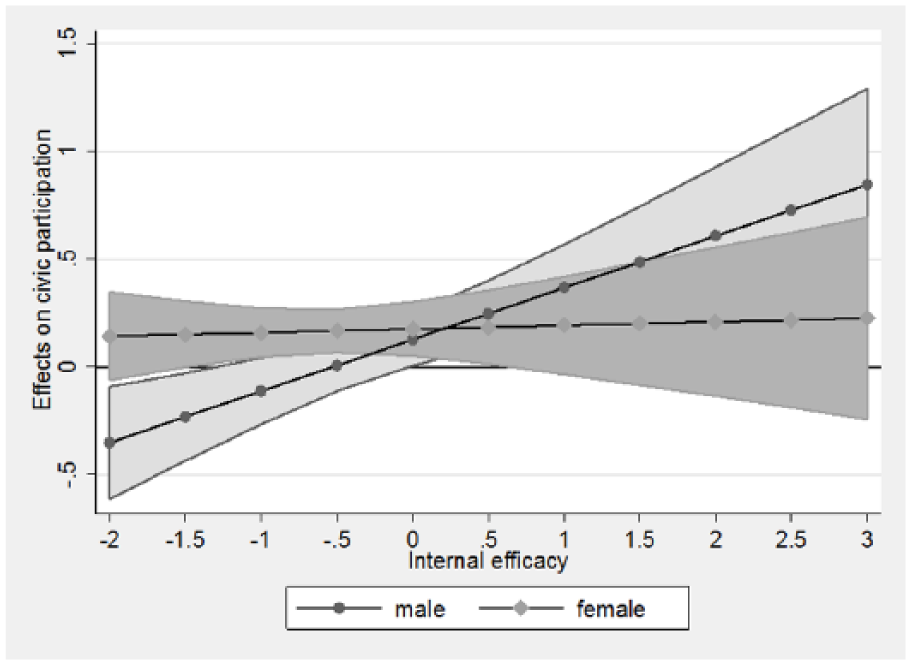
Average marginal effect on civic engagement in expressive participation.
Conclusion
Explaining gender differences in political participation is a lively and politically highly relevant research topic. However, many of the well-established findings discussed in current literature stem from the United States, and most studies have focused on adult women and men, whereas only a few have analyzed adolescents’ attitudes and behavior. In this paper, we have addressed both limitations by analyzing the gender gap in political participation among German adolescents. Focusing on the youngest group of citizens with a political voice in a country known for its comparably high degree of gender equality in society and politics, we provided a “least likely case” for detecting gender differences in political participation. This is especially so because socioeconomic resources—the most established variables explaining the underrepresentation of women in politics—are equally distributed among today’s German adolescents. Therefore, German adolescents offer us the chance to look at patterns of political participation in a setting of equally distributed educational and material resources between both sexes, thus, raising Germany above particular case relevance to full international significance.
Summarizing our results based on a recent and unique online survey, we detect a gender gap in political participation even in this least likely setting. However, there is no general pattern of young German women showing less willingness to engage politically; rather, we observe different preferences for certain forms of participation between the sexes. While young men are more likely to become involved in institutional and expressive forms of participation, young women tend toward non-institutional, protest-oriented activities.
Regarding the main theories explaining political participation, the findings presented in this article highlight the socialization environment and politically relevant attitudes and beliefs rather than socioeconomic resources. Young German women and men dispose of similar levels of resources for political participation, and the effect on their participation does not differ much between the sexes, which supports H1. In contrast, German women not only experience less political support from their schools, peers, and parents (in line with H2), they also show significantly less confidence in their own skills, specifically in politically relevant skills. As especially internal efficacy is not only unequally distributed between sexes but does have a much greater effect on males than females (giving support for H3), lower feelings of self-efficacy result in gender differences in institutional participation, even in the most favorable setting of equality.
These differences can be expected to play their part in the underrepresentation of women in future national politics, which are still dominated by institutionally organized candidates and most prominently by parties. As long as this pattern of unequal self-selection into institutional politics persists and as long as the monopoly of decision-making rests with parties and political institutions, it will be difficult to establish gender equality of representation in politics—irrespective of prominent role models such as Chancellor Angela Merkel. In contrast, we see much reason for the prognosis that gender differences in political participation will intensify when economic resources become relevant for our adolescents, as the German labor market still in part stratifies and discriminates regarding gender. Our results demonstrate that gender differences in participation can, indeed, be noticed as early as adolescence, underlining the need to analyze their causes and effects at this early age.
Supplemental Material
Pfanzelt_Replication_Data – Supplemental material for The Gender Gap in Youth Political Participation: Evidence from Germany
Supplemental material, Pfanzelt_Replication_Data for The Gender Gap in Youth Political Participation: Evidence from Germany by Hannah Pfanzelt and Dennis C. Spies in Political Research Quarterly
Supplemental Material
Supplemental_materials_online_supp – Supplemental material for The Gender Gap in Youth Political Participation: Evidence from Germany
Supplemental material, Supplemental_materials_online_supp for The Gender Gap in Youth Political Participation: Evidence from Germany by Hannah Pfanzelt and Dennis C. Spies in Political Research Quarterly
Footnotes
Declaration of Conflicting Interests
The author(s) declared no potential conflicts of interest with respect to the research, authorship, and/or publication of this article.
Funding
The author(s) received no financial support for the research, authorship, and/or publication of this article.
Notes
Supplemental Material
Supplemental materials for this article are available with the manuscript on the Political Research Quarterly (PRQ) website.

References
Supplementary Material
Please find the following supplemental material available below.
For Open Access articles published under a Creative Commons License, all supplemental material carries the same license as the article it is associated with.
For non-Open Access articles published, all supplemental material carries a non-exclusive license, and permission requests for re-use of supplemental material or any part of supplemental material shall be sent directly to the copyright owner as specified in the copyright notice associated with the article.
