



Abstract
Research has shown that citizens’ economic perceptions heavily influence their political support, both support for the incumbent government and support for the political system. Yet, inadequate attention has been paid to how the economic roles of the government shape the economic basis of political support. We argue that the extent to which the government is engaged in the economy determines how people attribute economic success or failure to the government and thus moderates the effect of economic perceptions. Focusing on one widely researched measurement of political support in a democratic setting, democratic satisfaction, we analyze the moderating effect of government economic engagement on the effect of economic perceptions among eighteen Latin American democracies. A consistent finding yielded in our study is that with a higher level of economic engagement of the government, there is a stronger association between citizens’ perceptions of economic conditions and their satisfaction with democracy.
Keywords
Citizens’ evaluation of government outputs, especially economic ones, strongly influences their attitudes toward both the incumbent government and the overall political system (Citrin and Green 1986; Hetherington 1998; Hibbs 1982; Lewis-Beck and Stegmaier 2000; Listhaug 1995; Lockerbie 1993; Mishler and Rose 2001a; Newton 2006; Przeworski 1996; Weatherford 1984, 1987). In particular, it has been widely reported that people’s satisfaction with democracy, one of the most frequently focused indicators of political support, hinges on their perception of economic performance (e.g., Campbell 2015; Duch 1993; Lagos 2003; Lewis-Beck and Stegmaier 2013; Lühiste 2014; Magalhães 2016; Wells and Krieckhaus 2006). The link between citizens’ economic perception and political support (both the specific support for the government and more general support for the political system), however, has also been proven by many studies as neither clear-cut nor direct. The effect of economic perception on political support is moderated by individual attributes such as political ideology, partisanship, and winner/loser positions (G. Evans and Andersen 2006; Tilley and Hobolt 2011) and institutional factors such as the concentration of political power and the coalition status of the ruling government (C. J. Anderson 2007; Powell and Whitten 1993). Some studies further suggest the role of politicians as strategic players in moderating the effect of economic performance on political support (Hellwig 2012). Politicians can adjust policy positions in response to economic conditions to shape how voters attribute responsibility and evaluate elites. Magalhães’ (2016) recent study shows that the effect of economic perception on individuals’ satisfaction with democracy is determined by perceived procedural justice.
Among the factors examined in the literature, there is inadequate attention to how the relationship between the government and the economy shapes the effect of economic perceptions on political support. We contend that the economic roles of government cannot be assumed invariant across countries and argue that government engagement in the economy amplifies the political effect of economic evaluations. It does so not only by increasing, in both reality and citizens’ perceptions, the government’s political responsibilities for economic outcomes but also by reinforcing the instrumental (economic) logic of individuals in formulating their attitudes toward the government.
To empirically test our argument, we use a combined data set of AmericasBarometer that covers four waves (2006, 2008, 2010, and 2012) of national surveys in eighteen countries. Our multilevel analyses consistently show that the positive effect of economic perceptions on democratic satisfaction and other commonly used indicators of political support (i.e., presidential approval and government performance evaluation) is increased by a higher level of government engagement in the economy.
This research contributes to the literature in two ways. First, the theoretical perspective that we offer extends the scholarship that suggests the contingent effect of economic perceptions. Our argument indicates that, in addition to widely suspected individual and institutional moderating factors, the extent of government economic engagement constitutes an important macro-level structural factor that shapes the political effect of economic perceptions. Second, this study broadens the implications of the economic roles of the state. The economic implications of the various economic roles of the state have been well discussed in the literature (Acemoglu 2005; P. Evans 1995; Kohli 2004; Wade 1990). Their political implications, particularly those for public opinion, however, have received less attention. This study highlights the political implications of the government’s economic role by showing that it alters how people perceive the relevance of the government to the economy and determines to what extent economic situations entail political consequences.
Contingency of Economic Basis of Political Support
“Before economic discontents take on political significance, people must either believe that the government produced them or that it is the government’s job to remedy them” (Peffley 1985, 192). Based on this, a number of theoretical and empirical studies have identified the factors that influence how citizens link economic conditions to the government and, thus, shape the effects of individuals’ economic perceptions on their support for the government in general and satisfaction with democracy in particular. In this regard, two types of factors have been well theorized and studied (for two reviews, see C. J. Anderson 2007 and Magalhães 2016).
The first type of factor occurs at the individual level. Citizens with different sociopsychological attributes, such as motivation, bias, and cognitive abilities, view government differently under the same economic conditions. For instance, majority/minority (or winner/loser) status is found to be a significant moderator of the effect of economic perceptions on satisfaction with democracy. “Winners discount negative information about the economy because of their status as supporters of the incumbent government” (C. J. Anderson and Guillory 1997, 72). Partisanship is another important precondition that shapes economic perceptions, which, in turn, determines both voting preference in particular and political support in general (Rudolph 2003; Tilley and Hobolt 2011). Rudolph (2003) developed a comprehensive list of individual factors that generate heterogeneous effects of economic perceptions, including partisanship, economic ideology, and individuals’ perceptions of institutional context.
The second type of factors concerns political institutions. A key argument in this field of study is that the “clarity of responsibility” of political institutions determines the extent to which citizens praise or blame the government for economic performance (C. J. Anderson 2000; Becher and Donnelly 2013; Powell and Whitten 1993; Rudolph 2003). Complex institutional setups blur the lines of responsibility and allow representatives to escape attention or to shift blame, and institutional designs influence how citizens assign responsibility for the government (C. J. Anderson 2007). For instance, compared to people in a country where the power of policy making is concentrated in the hands of one party or one institution, those in a system with a greater extent of power-sharing are less likely to associate economic misfortune with the government (Becher and Donnelly 2013; Duch and Stevenson 2008). Other factors that potentially can determine the clarity of responsibility and the political effect of economic perceptions include the proportion of legislative seats held by the largest party (C. J. Anderson 2000), the ideological cohesion of coalitional government, and the political decentralization in the vertical dimension (C. D. Anderson 2006).
More closely related to our study, Alcañiz and Hellwig (2011) argue that a close tie to world markets shifts responsibility toward international actors. In this study, we share the same interest in the relevance of economic structure to responsibility attribution. Our study, however, differs from theirs and others by providing an explicit account of the importance of the relationship between the government and the economy for the attribution of economic responsibility and a direct empirical test of the moderating effect of domestic political-economic structure. We believe that how the government is related to the economy strongly influences how people perceive the economic responsibility of the government and, thus, how they evaluate the government in different economic situations.
Government Engagement and Economic Basis of Political Support
Historically, governments around the world have played rather different roles in the economy. The literature on the varieties of capitalism, for instance, has noted that advanced industrialized democracies vary substantially with regard to the role of the states in their national economy (Hall and Soskice 2001; Streeck and Yamamura 2003). They differ, for example, in the extent to which the government deals with the capital-labor relationship and provides social welfare. The governments in developing countries are also engaged in the economy to a great, if not greater, extent. They are involved in the economy for different reasons, such as the necessity for the state to jump-start and protect national enterprises, the heavy dependency on natural resources, and the communist legacy of state-run economy (P. Evans 1995; Kohli 2004; Migdal 1988; North 1981; Wade 1990). In any case, the economic roles of modern states cannot be reduced to mere monetary or managerial policies. Instead, they play direct roles in such forms as government public investment, taxation, spending, transferring, and other activities that are directly related to economic output.
Although there are historical or natural reasons why the governments are engaged in the economy, as the history of Latin America, the region of interest in this research, has shown, they have a choice of liberating or intervening (or keeping intervening) the economy. They thus bear variant levels of political responsibility for economic conditions across countries depending on how much they are engaged in the economy. Government economic engagement amplifies the political consequence of economic output, both in reality and in perception, for two reasons. First and foremost, it increases the extent to which citizens assign responsibility to governments for economic outcomes. The strong appearance of government in economic activities makes salient the role of the government in the perceptions of the public. Most citizens, as suggested in previous studies, are not sophisticated enough to establish a direct connection between economic situations and government responsibility (Alesina, Roubini, and Cohen 1997; C. J. Anderson 2007; Lohmann 1999). In particular, institutions such as power sharing and office alteration dampen public’s dissatisfaction against the government “by institutionalizing opportunities for leadership and policy change” (Remmer 1996, 618). A relative separation between the economy and the government further adds to the vagueness of responsibility in citizens’ perceptions. Among the countries where the government’s role is mostly indirect, it is more difficult, if not impossible, for citizens to directly connect economic outcomes with the government.
In contrast, frequent and intensive engagement of the government in assets ownership, investment, economic production, and other economic activities clearly signals to the public the relevance of the government to economic outcomes. This engagement enables them to identify the responsibility of the government in economic affairs. Institutions, such as power distribution and office alteration, still can blur the responsibilities of specific individuals or organizations and make it difficult for the citizens to tell exactly who or which government agencies should be responsible for the economic performance. However, such a blurring of responsibility might cause the problem of responsibility attribution for citizens only when they attempt to blame specific individuals or organizations, not when they associate economic conditions with the government en bloc. Citizens in countries who see a more visible government in the economy hold, to a greater extent, the government as a whole liable and thus become dissatisfied with the political system in general if they suffer from economic duress for which they suspect that the government has played a critical role.
Second, government economic engagement can also reinforce the instrumental logic of political support. As suggested in the literature, citizens’ attitudes toward government are shaped by both calculations of material benefits and concerns about values and norms (Bratton and Mattes 2001; Citrin 1974; Easton 1975; G. Evans and Whitefield 1995; Finkel, Muller, and Seligson 1989; Lipset and Schneider 1987; Miller 1974; Muller and Jukam 1977). The appearance of a strong government role in the economy makes a difference by tipping the balance toward material versus nonmaterial goods in terms of political support. That is, people associate, to a greater extent, their evaluations of legitimacy with the government’s economic performance, as compared to other nonmaterial factors, and their political support is more susceptible to the fluctuations in the economic situation than noneconomic considerations.
This increased importance of economic considerations in forming individuals’ political support results not only from their perceptions of government’s economic responsibility but also from the actual connection between their economic interests and the government. The incomes of citizens who live in an economy where the government has a strong hand are likely to be influenced by the government’s activities during both the ebb and flow of the economy. As noted in studies of developing economies, when the economy is heavily dependent on the government, the most important sources of profit are often derived from the collaboration with state agencies (Bellin 2000; Bueno de Mesquita and Downs 2005; Remmer 1999). The business elites, for instance, rely on political elites to get preferential manufacturing and trade policies, to secure the flow of capital in the form of loans and investments, and to obtain other benefits. The masses also rely, to a great extent, on the government-owned or government-invested enterprises for employment, salaries, and social welfare benefits derived from the returns of state businesses. When the economic well-being improves in such a system of patronage, citizens give credit to the government, more so than do their counterparts in countries where the role of government is minimal.
Recognizing the importance of this “pocketbook” mentality, governments, particularly in developing democracies, have a tendency to boast about the role of government in the economy for political reasons. The government’s contribution to economic growth helps the government to gain political support from the citizens. A common challenge for new democracies in the developing world is the lack of robust support for the regime. Citizens in such countries have limited experience or knowledge of democratic structure, operation, and political principles; they have not developed a normative commitment to democracy; and political institutions such as the rule of law and accountability have not been fully established (Mishler and Rose 2001a, 2001b; Rose and Shin 2001; Svolik 2013). To earn political support or people’s satisfaction with the newly installed democratic institutions, the regimes in those countries often must rely on the tangible benefits, especially economic ones, that they can bring to the masses (Kitschelt 1992; Mishler and Rose 2001a; Przeworski 1991).
Governments’ deliberate interventions in the economy, however, can rapidly deplete popular support during difficult times, and the connection between the government and the economy thus backfires. When the economy turns bad, the same taking of responsibility that has earned the government credit makes it liable for economic losses in the public’s perceptions (Joseph 1997; Tang and Woods 2014; Whitehead 1993). This occurs because, during the economic downturns, the government has to discontinue preferential treatment, lay off employees, or stop delivering social benefits due to the shrinking revenues of the government’s investment. Therefore, a large portion of individuals’ incomes will be lost due to the policies and actions of the government. Moreover, as the holders of public assets, politicians and government agencies have the motivation and capacity to protect their privileged income at the expense of the masses. Government economic involvement in new democracies also provides opportunities for politicians to engage in rent-seeking and other corruptive behaviors. This is again particularly true in developing countries because political institutions in such countries have yet to become effective in constraining politicians’ behaviors (Keefer 2007; Mohtadi and Roe 2003; Weyland 1998). As a result, the higher the stake of the government in the economy, the greater is the relevance of the government to the economic interest of citizens in both perceptions and reality.
In essence, the government faces a strategic dilemma of its economic intervention. On one hand, without a salient role of economic engagement, the government cannot creditably claim credits associated with economic growth. It could instead focus on its role in noneconomic issues such as social policies and political performance (e.g., anticorruption). However, for developing democracies that are usually plagued with social and political problems, an active role in a fast growing economy can be an attractive option for the government to obtain political support, more so than it can obtain from state-free economic growth . On the other hand, however, economic growth cannot be guaranteed, with or without government engagement. A greater role is accompanied with a greater responsibility. High levels of state engagement alleviate the problem of responsibility attribution for the public and make the ruling regime more likely to be punished during economic downturn.
In sum, we have the key hypothesis of this study:
Data and Measurement
To test the conditional effects of economic perceptions on political support, we use the data set of AmericasBarometer (2006–2012). We chose this data set for several reasons. First, AmericasBarometer is one of the few data sets that contain the information necessary for our analysis. It has questions about the evaluation of national and individual economic conditions and political support (including democratic satisfaction). Most importantly, it contains information of whether respondents voted for the incumbent government, an important factor that may contaminate political support, especially satisfaction with democracy (Curini, Jou, and Memoli 2012). Second, AmericasBarometer enables us to identify winner/loser status in a more consistent way than do other cross-national surveys that contain such information. One complication in coding winner/loser status is the varying constitutional designs and electoral systems. The advantage of using AmericasBarometer is that it contains eighteen Latin American countries with the same presidential system. We limit our sample to those eighteen countries and identify the winner of elections in the same sense across countries, that is, whether the respondent voted for the incumbent president. Third, the AmericasBarometer has conducted multiple waves of surveys with the same survey instruments and identical questions, and four of them (2006, 2008, 2010, and 2012) contain all the necessary information for our analysis. Multiple waves of surveys provide a large number of units of analysis at the aggregate level (sixty-four country-wave units in total), which leads to an adequate number of degrees of freedom in our multilevel analysis. The summary statistics of all the variables used in this study are reported in Online Appendix 1.
More substantively, Latin America offers an appropriate context to test the conditional effect of state economic engagement on the relationship between economic perceptions and government support. For one thing, economic consideration has been salient in forming people’s political attitudes, including both specific support for the government and general support for political system and democracy as a whole, in Latin America (Alcañiz and Hellwig 2011, 396; Lewis-Beck and Stegmaier 2013). Among other problems, new democracies Latin American countries have particularly been faced with dual challenge of a relatively slow economic growth and a dire public perception of it among their citizens after the turn of the century (Alcañiz and Hellwig 2011, 396). For instance, in the sample we choose, only 15 percent respondents evaluate their country’s economy as “good” or “very good” and 18 percent respondents think the national economy has become “better.” A reinvestigation about the political effect of economic perceptions can shed light on the stability of the government and the consolidation of democracy in the region.
For another, the economic roles of the governments in Latin America vary greatly. Since the end of World War II, Latin American countries have adopted different economic policies. Most of them first adopted imported-substitution industrialization with a strong state intervention for the first several decades, and many of them have then moved to economic liberalization and trade liberalization since 1980s. Due to the history of both types of macro-economic policies and the divergence in the timing and depth of economic reforms undertaken in different countries, there exists a wide variation in the extent of state engagement in the economy across the region. For example, in our sample, public investment accounts for about 10 percent of total investment in the economy on average in Chile and Argentina and about 45 percent in Venezuela and 55 percent in Bolivia. Such a wide variation provides us an ideal sample to test how people would attribute the national and personal economic well-being to the government under different economic structures.
Political Support
Political support is a multidimensional concept (Easton 1965; Norris 1999). We in this study thus use different measurements to avoid bias. Among different ones, our main analyses focus on one of the most commonly used indicator, individuals’ satisfaction with democracy. In AmericasBarometer, respondents indicate their satisfaction with the way democracy works in their country on a scale of 1 (very satisfied) to 4 (very dissatisfied). We recode the scale such that a higher value indicates a higher level of political support.
Democratic satisfaction is certainly not specific support (support for particular institutions or figures, especially the incumbents) in Easton’s (1965) conventional typology. It is a dimension of political support at the level of political system or regime. Among the three objects of support at the regime level in Norris’s (1999) refined typological framework (regime principles, regime performance, and regime institutions), democratic satisfaction is a short-term evaluation of the performance output of the political system (Curini, Jou, and Memoli 2012, 244). It taps “how democracy functions in practice as opposed to the ideal” (Norris 1999, 11). Therefore, it is an expression of general support for the current democratic political system in place. It should be noted that democratic satisfaction should not be confused with another major concept of political support, “support for democracy.” A person who is dissatisfied with the way democracy works in practice in his or her country does not necessarily mean that he or she does not support democracy as a fundamental principle of the political regime (Lühiste 2014).
We focus on democratic satisfaction as our main measurement of political support mostly because the object of support in this measurement corresponds more closely to our theory. On one hand, we do not want to focus on one particular government office, either administrative offices or the legislative bodies. As pointed out in the literature and explained in our theoretical section, ordinary citizens cannot really tell which government institution exactly should be responsible for economic performance. For instance, it might be the presidential office, a legislative branch, or other nonelected institution that has made a particular decision to increase government’s engagement in the economy in a certain area. However, citizens can hold the whole regime as accountable for output and thus become dissatisfied with the performance of political regime if they suspect its responsibility for economic failures. On the other hand, we do not intend to go as far as to claim that economic misfortune and its connection with the government will further make people to abandon democratic principles on which Latin American democratic states are built. Instead of replacing the democratic system with an authoritarian one, a dissatisfied person could opt for another government or another type of economic policies that is embraced by a particular party.
We choose democratic satisfaction also because of the salient status of this concept and measurement in the literature (Curini, Jou, and Memoli 2012; Lühiste 2014; Magalhães 2016; Newton 2006; Waldron-Moore 1999). Democratic satisfaction has become one of the most used and well-researched indicator of political support. Therefore, using democratic satisfaction as the main measurement helps our study to speak to a consistent body of literature. Especially, there have been many studies of democratic satisfaction and its economic basis in different regions (e.g., Asia, Chu et al. 2008; Europe, Wagner, Schneider, and Halla 2009; Africa, Bratton, Mattes, and Gyimah-Boadi 2005). Focusing on a particular government institution runs into the problem of variant constitutional frameworks among different regions and different countries. An abstract and system-level measurement of support can bridge the understanding of the economic basis of political support across different contexts.
Although we focus on satisfaction with democracy, we check the robustness of our findings using alternative measurements of political support. We first create an index of specific support (on the scale from 0 to 10) by summing and recoding the responses to four questions that asks respondents to evaluate the performance of the current administration. 1 We further rely on the information of a question that directly asked one’s evaluation of the performance of the incumbent president in his or her country. 2 Together, these three measurements can effectively capture one’s level of political support at different dimensions.
Economic Perceptions
In the literature, scholars have used various measurements of economic perceptions (C. J. Anderson and Guillory 1997; Becher and Donnelly 2013; G. Evans and Anderson 2006). For instance, they distinguish between sociotropic evaluation (evaluation of the national economy) and egocentric evaluation (evaluation of the personal economy). They also differentiate between the evaluation of the past (retrospective) economic situation and that of present situation. In our main analyses, we measure economic perceptions by using the responses to the question that asks the respondents’ retrospective evaluation of the country’s economic situation. In additional analyses, we also use the present evaluation and egocentric evaluation of economic situation to check the robustness of our findings.
Economic Engagement of the Government
To measure the extent to which the government is engaged in the economy, we rely on the data provided by Fraser Institute, Economic Freedom of the World (EFW). EFW contains a composite index that indicates the extent of government economic engagement (“size of government”). This index is created based on four indicators of the economic roles of the government: “government enterprises and investment,” “government consumption,” “government transfers and subsidies,” and “top marginal tax rate.” On the original scale of 0 to 10, a higher score denotes a higher level of economic freedom and hence a lower level of state engagement in the economy. For a better interpretation and comparison, we recode and reverse it to a scale of 0 to 10 such that a higher score indicates a higher level of state engagement. Figure 1 presents government engagement across Latin American countries over the four waves of survey (with some waves missing a few countries).

Levels of government economic engagement over time across countries.
It shows that, first, there is a large variation across countries. For example, Colombia and Venezuela have the highest level of state engagement in the economy on average among all countries. In countries such as Costa Rica, Dominica, El Salvador, and Honduras, the government has relatively been passive in meddling with the economy. Second, while the level of state engagement stays relatively stable in many countries (e.g., Dominica, Guatemala, and Peru), there is a marked and meaningful variation over years in some countries and a drastic fluctuation in a few of them. Colombia, for instance, has experienced a significant and steady decrease in government involvement in the economy, while the governments in Ecuador and Panama have greatly increased its presence in the economy. However, generally speaking, the variation of government engagement exists mostly across countries.
We use this summary index as the measurement of government economic engagement in main analyses. In a set of robustness-check analyses, we also use each of the four component indicators separately. We do so because presumably these different aspects of economic engagement of the state could have different effects on the relationship of concern. As shown in Online Appendix 2 (A-D), Latin American countries vary greatly in all these four aspects of government engagement.
The governments around the world have been engaged in the economy in numerous ways, and we thus do not intend to capture all aspects of government intervention in this study. We believe that this composite index and its component indicators constitute a good measurement of government economic engagement in our conception. Public ownership and investment are the most important ways through which the government directly participates in economic production. Government consumption spending measures the involvement of governments in providing goods and services for the direct material needs of the population. Income tax rate and transfer are the standard approaches the government uses to finance public spending and redistribute wealth. In fact, the “size of government” index and its indicators have already been used in the literature to measure the economic engagement of the government in the economy (Tang, Huhe, and Zhou 2017; Tang and Woods 2014).
Moreover, the measurement we use focuses on the most direct and visible aspects of government roles in the economy and thus well correspond to our theory. We would like a measurement of government economic engagement that can most directly signal to the public the responsibility of the government. The economic activities included in this study are the ones that clearly demonstrate to the general public how much the government meddles in the economy and the extent to which economic well-being is connected with the government. For instance, the number of state-owned enterprises and the amount of government’s public investment directly generates employment opportunities, and thus an increase of unemployment from the public sectors during economic downturns can augments the responsibility of the government. An increase of income tax rate can also make the citizens more likely feel the financial stress during economic duress and thus attribute the responsibility to the government. Moreover, the index we use and its four components of government economic roles are objective aspects that are less problematic for measurement than are other dimensions.
Other Variables
Following the extant literature, we include a set of variables at the individual level: female (0 for male, 1 for female), age (in years), education levels (in years), and urban residence (0 for rural, 1 for urban). Most importantly, we control for the effect of the winner/loser status of respondents. We obtain this variable by coding their responses to the question about for whom they voted in the most recent presidential elections (1 for voters of the incumbent presidents, 0 for others).
At the country level, we include economic growth, measured as the growth rate of gross domestic product (GDP) per capita, and the level of perceived government corruption, measured as the Corruption Perceptions Index (CPI). Moreover, given the widely suspected moderating effect of political institutions on the relationship between economic perceptions and political support, we include a variable at the country level that captures the concentration of political power, an indicator of the clarity of responsibility. This variable concerns whether the governing party of the chief executive office in a country also controls legislative bodies. The data are obtained from the Database of Political Institutions. In addition, we include a variable of federalism to control for the effect of clarity of responsibility at the vertical dimension. Finally, since Alcañiz and Hellwig (2011) have pointed out the potential influence of dependence on the world economy for responsibility attribution, we include a composite indicator from EFW, “freedom to trade internationally.” This indicator ranks countries on a scale from 0 to 10 based on various aspects of trade including “taxes on international trade,” “regulatory trade barriers,” “international capital market controls,” and others.
Analyses and Results
Model Choice
In our data, individuals are nested in countries, and each country has four waves of surveys. Therefore, a multilevel model is appropriate for our analysis. Given the data structure, a three-level model might be appropriate (individual-country-wave). However, we choose not to include a separate level for time (wave). Instead, we combine the country level and wave level and use a two-level model in our main analyses. The first level is individual, and the second level is “country-wave.” We do this for two reasons. First, the number of the units of the two aggregate levels, especially at the level “wave,” is limited (eighteen for countries, four for waves). It is not adequate to conduct statistical analysis either for a single wave of countries (eighteen cases) or for a separate level of “wave” in addition to “country.” This is especially a problem in this study since we include a number of necessary variables (as many as six variables) at the aggregate level and an interaction term between an aggregate variable and an individual variable. Second, as shown in Figure 1, the greatest variation of the key variable of theoretical interest, government economic engagement, exists across countries although we do see a meaningful variation over time in a few countries. We, therefore, do not model time-varying effect of government engagement although we have four waves of data, but treat each country-wave as a cross-section unit (sixty-one aggregate units in total). Because the primary dependent variable, democratic satisfaction, is on a four-point ordinal scale, we employ a two-level ordered logistic model for analysis.
The analysis of a null model with only intercepts shows that intraclass correlation (ICC) is 0.07, meaning that 7 percent of the total variance comes from the second level (i.e., country-wave). This percentage is relatively small, but it is understandable and acceptable. The survey was conducted at the individual level, and the number of individuals surveyed is as many as ten thousands, but that of the country-waves is as few as sixty-four. As claimed by Steenbergen and Jones (2002), positive ICCs have the potential of biasing statistical inferences if we ignore the multilevel nature of data structure. For instance, even an ICC of 0.01 can produce a Type I error rate of 0.17 (Steenbergen and Jones 2002, 220). Moreover, the variance component at the aggregate level (country-wave) in all of our models is statistically significant. The use of a multilevel model is thus necessary.
To deal with potential problems associated with the empirical strategy of using country-wave as the second-level unit, we employ several means. First, since for each wave of surveys there might be time-specific unobserved effects, we include wave dummies in all of our analyses. Second, in one analysis, we only include one wave of countries (eighteen countries). Both approaches check the robustness of our findings against the potential suspicion that a large number of aggregate units might inflate the significance of coefficients. Lastly, another robust analysis fits a three-level model (individual, country, and wave).
Main Analysis
In Table 1, we present the results of our main analyses of democratic satisfaction. 3 Model 1 is the baseline model in which we included an interaction term between economic perceptions (retrospective evaluation of the national economy) and the composite index of government economic engagement (size of government). The analysis shows that, first, a positive economic perception is associated with a higher level of democratic satisfaction. Second, economic engagement of the government is negatively associated with democratic satisfaction. Third, more important to our theory, the statistical significance of the interaction term indicates that government economic engagement also affects government support through moderating the effect of economic perception. With a higher level of government engagement in the economy, the effect of economic perception on government support is greater in magnitude.
Estimation of Satisfaction with Democracy.
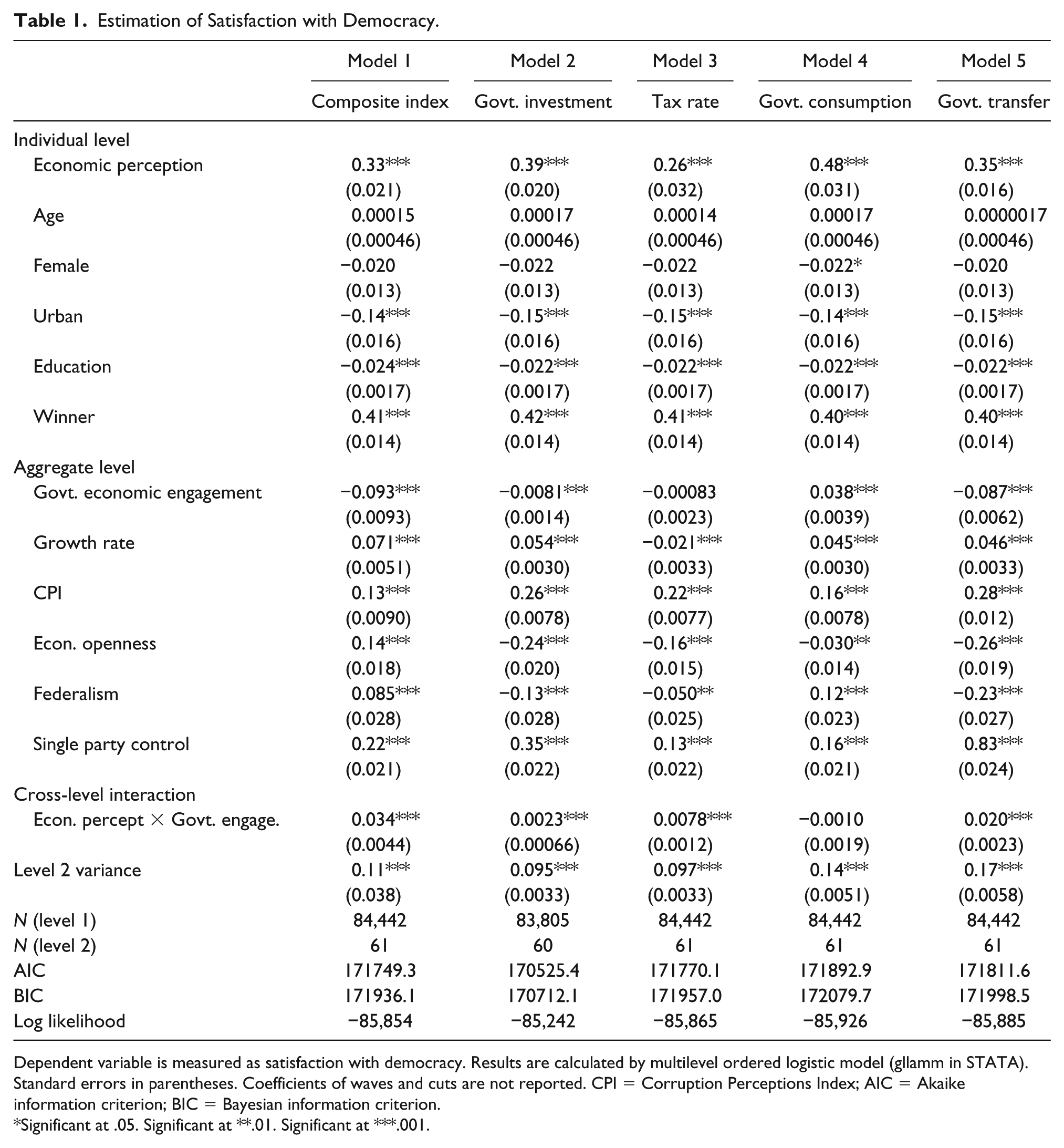
Dependent variable is measured as satisfaction with democracy. Results are calculated by multilevel ordered logistic model (gllamm in STATA). Standard errors in parentheses. Coefficients of waves and cuts are not reported. CPI = Corruption Perceptions Index; AIC = Akaike information criterion; BIC = Bayesian information criterion.
Significant at .05. Significant at **.01. Significant at ***.001.
Figure 2 presents a marginal effect plot based on estimation of Model 1 for a substantively meaningful interpretation of the moderating effect of government economic engagement. The plot shows that, first, an individual who perceived a better economic situation is more likely to have a higher level of democratic satisfaction, no matter how much the government is engaged in the economy. Second, the upward trend of the solid line in the graph indicates that the positive effect of economic prosperity on democratic satisfaction increases in magnitude with a higher level of government engagement in the economy. For instance, when an individual’s economic perception changes from being “worse” to “better” in a country where the government economic engagement is measured as 2, the probability he or she would hold a higher level of satisfaction with democracy increases by about 8 percent. In places where the government engagement is measured as 4, that probability for the same person would be about 12 percent. That is, a standard deviation increase of government engagement will bring about 50 percent increase, 12–8, in the magnitude of the change in probability holding a higher level of satisfaction. In a country with the highest level of state engagement (a standardized value of 10), the increased probability is 18 percent.
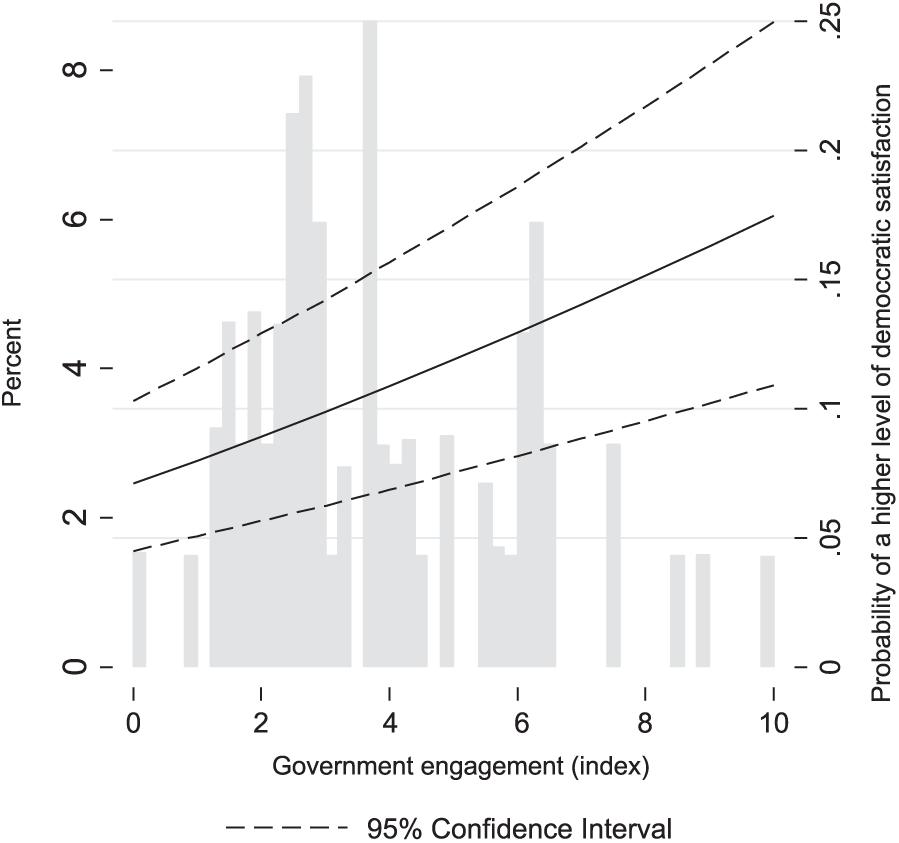
Marginal effect of economic perceptions on democratic satisfaction at all levels of government economic engagement.
From Model 2 to Model 5 in Table 1, we conduct a set of analysis replacing the composite index of government economic engagement with each of the four components (government investment in Model 2, tax rate in Model 3, government consumption spending in Model 4, and ratio of government transfer to GDP in Model 5). The analyses of the four models show a pattern generally consistent with that of Model 1. The interaction term between economic perception and three of the four component measures of government engagement is statistically significant (i.e., investment, tax, and transfer). Government consumption has no significant moderating effect on the relationship between economic perception and satisfaction with democracy, a finding consistent with Alcañiz and Hellwig (2011).
Robustness Check
In Table 2, we further check the robustness of our findings in various ways, using Model 1 in Table 1 as the baseline. First, we change the measurement of the independent variable, economic perception in Model 1 (perception of the present national economy) and Model 2 (perception of personal economy). Second, we change the measurement of dependent variable, political support, by using a composite index that measures one’s evaluation of government performance in four aspects (Model 3) and evaluation of the president’s performance (Model 4), respectively.
Estimation of Political Support.

Results are calculated by multilevel ordered logistic model (gllamm in STATA) except Model 3 (multilevel OLS, xtmixed in STATA). The analyses in this table are based on Model 1 in Table 1. The alternations are specified by the title of each column. Standard errors in parentheses. Coefficients of waves and cuts are not reported. Level 3 variance is omitted in Model 6. CPI = Corruption Perceptions Index; AIC = Akaike information criterion; BIC = Bayesian information criterion; OLS = ordinary least squares.
Significant at .05. Significant at **.01. Significant at ***.001.
In Model 5, we control for the potential moderating effect of institutional and individual factors, both of which are widely suspected in the literature. The first term is between economic perception of the national economy and the legislative control of the governing party. The inclusion of this term controls for the moderating effect of political concentration and, hence, one aspect of clarity of responsibility. The second interactive term is between economic perceptions and individuals’ voting choice in the most recent election. The inclusion of this variable controls for the moderating effect of winner/loser status on the relationship between economic perceptions and political support. The analysis shows one’s winner/loser status has no moderating effect of the effect of economic perceptions. The macro political institution does have such an effect. In both analyses, the interactive effect between economic perceptions and government economic engagement is still statistically significant and positive.
Finally, we vary model specification by changing the strategy of dealing with time. We included dummies of waves in all models presented so far to account for unobserved heterogeneity over time. Alternatively, we fit a three-level model (individual, country, and wave) in Model 6. We also limit the sample to one wave with the largest number of countries (wave 2008, Model 7). Both analyses confirm the positive moderating effect of government economic engagement on the relationship between economic perceptions and political support.
Discussion and Conclusion
The extant literature on the economic basis of political support has paid inadequate attention to the moderating effect of varying economic structures on the influence of economic perceptions. We contend that the homogeneity of the state-economy relationship cannot be assumed due to the fact that the governments around the world have engaged in economic productions and other key economic activities to various extent. The government’s economic engagement constitutes a structural factor that predetermines people’s perceptions of the connections between the government and the economy. The government becomes responsible for economic outcomes not only due to its competence but also because of its actual presence in the economy and the resultant connection with the interests of the citizens in their perception and in reality. Therefore, when analyzing the instrumental logic of political support in a comparative framework, we should take into consideration the relevance of the economic structure as defined by the extent to which the government is involved in the economy.
The findings of the multilevel analysis indicate that one’s perceptions of economic conditions have varying effects on political support, contingent on the level of a government’s economic engagement. The more the government is engaged in the economy, the more likely one is to attribute economic success or failure to the government and, hence, to increase the weight of economic conditions in forming political support. This finding is robust against alteration of measurements and model specifications.
Among the limitations of this study, we particularly would like to point out that perception of the economy and perception of government will be highly correlated if both measures are subject to the same biases and measurement error. This has been a long-standing problem of the extant literature on the issue of economic basis of political support. For example, optimistic people are more positive on both perceptions, and people with a negative mind are more likely to be dissatisfied with both the economy and the government at the same time. While we cannot find a perfect instrument to deal with this issue in this study, we conduct an additional analysis controlling for the effect of respondents’ mood, “satisfaction with life.” As Model 11 in Online Appendix 3 shows, the result stays the same for the main variables of our interest.
The significant moderating effect of government economic engagement adds to the understanding of the democratic responsibility of political institutions. Many studies have suspected that, due to individual and institutional constraints, citizens may fail to impose necessary negative sanctions on the government offices or officials for bad performance of the economy, which is more straightforward for average citizens to judge than are other areas of government performance (C. J. Anderson 2007). The incompetence in the economy might not lead to office alteration or, consequently, to the improvement of governance. This causes the problem of democratic accountability. Our finding implies that citizens do have a rational basis when it comes to the economic basis of political support. For one thing, they always hold the government accountable, to some extent, for perceived economic performance. For another, more importantly, they are more likely to do so when the government is, in fact, more involved in the economy. A more active government role, therefore, is associated with greater political responsibilities.
The amplifying effect of government economic engagement causes a challenge, in particular, for developing democracies that are of focus in this study. On one hand, citizens in developing countries generally expect an active role of the state in the economy in order to promote economic development. On the other hand, the government in those countries also has political motivations to involve itself in the economy. Through delivering a better economy, the government can gain stronger support from the citizens for the newly installed democratic regimes. Nevertheless, although it is easy to get involved, it is difficult to maintain consistent growth. Even great competence of government economic management cannot guarantee economic success. The failure to fulfill the economic promise can lead to landslide decline of democratic support. Citizens withdraw support for the government and even for the political system not only because they are not satisfied with the economic situation but also because they blame the government for its part. This constitutes a fundamental dilemma for the consolidation of the political support in the new democracies in the developing world.
Supplemental Material
Online_Appendix – Supplemental material for Contextualizing the Economic Basis of Political Support: Government Economic Engagement, Economic Perceptions, and Democratic Satisfaction
Supplemental material, Online_Appendix for Contextualizing the Economic Basis of Political Support: Government Economic Engagement, Economic Perceptions, and Democratic Satisfaction by Min Tang and Narisong Huhe in Political Research Quarterly
Footnotes
Declaration of Conflicting Interests
The author(s) declared no potential conflicts of interest with respect to the research, authorship, and/or publication of this article.
Funding
The author(s) disclosed receipt of the following financial support for the research, authorship, and/or publication of this article: This research has been supported by the National Natural Science Foundation of China (Grant No. 71774106) and Program for Innovative Research Team of Shanghai University of Finance and Economics (No. 2014110344).
Supplemental Material
Supplemental materials and data for this article are available with the manuscript on the Political Research Quarterly (PRQ) website.
Notes
References
Supplementary Material
Please find the following supplemental material available below.
For Open Access articles published under a Creative Commons License, all supplemental material carries the same license as the article it is associated with.
For non-Open Access articles published, all supplemental material carries a non-exclusive license, and permission requests for re-use of supplemental material or any part of supplemental material shall be sent directly to the copyright owner as specified in the copyright notice associated with the article.
