



Abstract
The rise of female chief executives appears to signal gender progress, but this may not be unequivocally so. This article advances a contextual theory for the role of gender on leaders’ approval ratings, a key measure of “success” and source of executive power. I argue that because of gendered expectations and discourse, female presidents will receive lower approval ratings in contexts of corruption. The study focuses on Latin America, known for its powerful, masculinist presidential regimes and its democratically elected female leaders. I first trace the gendered construction of President Michelle Bachelet’s image as an honest mother. Upon a presidential scandal, higher standards and gendered discourse resulted in deeply disappointed citizens, significantly undermining her popularity. Models of eighteen Latin American countries next reveal a negative impact of being a female—rather than a male—president on approval ratings. Marginal effects plots show that female presidents score worse than their male counterparts in contexts of at least one presidential scandal and higher executive corruption. This article contributes to the growing literature on gender and corruption. It also challenges some conventional wisdom on the pro-women consequences of female leadership in providing a more nuanced account of the role of gender in the executive branch.
Despite traditional doubts concerning female leadership, women have governed for at least a year in about one in four countries since 1960. 1 This appears as an unequivocal sign of gender progress, but the stakes are high for female leaders to receive comparable approval ratings—a key measure of “success” and source of power—as their male counterparts (Campello and Zucco 2015; Carlin, Love, and Martinez-Gallardo 2015b; Light 1999; Neustadt 1990). Executive institutions’ masculinist characteristics are thought to undermine women leaders’ ability to appear equally competent (Duerst-Lahti and Kelly 1995; Jamieson 1995; O’Brien and Reyes-Housholder forthcoming), but recent work concludes that gendered standards and double binds no longer matter (Brooks 2013; Teele, Kalla, and Rosenbluth 2018).
I advance the literature on female leadership with a theory spelling out how gendered standards and discourse in contexts of corruption can undermine their ratings. The abuse of political power for personal gain is a top citizen concern in much of the world (Anderson and Tverdova 2003; Davis, Camp, and Coleman 2004; Seligson 2002). “Pro-women” stereotypes—such as the idea that women are more ethical—may favor female leaders, particularly in countries tainted by these kinds of scandals (Barnes and Beaulieu 2014; Murray 2010; G. Thomas and Adams 2010).
I instead argue that because of this belief in women’s integrity, female presidents often face higher standards for their moral leadership. When corruption accusations emerge implicating female-led administrations, “pro-women” discourse may backfire, and the opposition can resurrect latent doubts about women’s ability to govern. Therefore, gendered expectations and discourse in these contexts will likely result in lower approval ratings for female than male presidents.
I conduct this study in Latin America, known for its powerful, masculinist presidential regimes as well as its recent trend of democratically elected female leaders (Cox and Morgenstern 2001; Jalalzai 2016; Reyes-Housholder and Thomas 2018). I first illustrate the theory by showing how beliefs in women’s integrity helped raise the bar for moral leadership under Chile’s presidenta. When a scandal broke implicating her family, President Michelle Bachelet played to her traditional strengths by portraying herself as an honest, emotionally candid mother. The opposition, however, discursively leveraged her motherhood to discredit her, and others faulted her for not leading in stereotypically masculine ways. Citizens’ disappointment deepened, and Bachelet’s ratings plummeted.
Cross-sex and cross-country comparisons further enhance the theory’s plausibility. Bachelet’s co-partisan male predecessor had confronted a similar scandal, but emerged virtually unscathed. Likewise, in Brazil, a male president won reelection in 2006 despite scandals while his female successor was impeached in 2016 for less egregious offenses. Presidential approval models spanning eighteen Latin American countries from 2000 to 2016 test the overarching predictions (Carlin et al. 2016). Models first show a negative impact of being a female—rather than a male—president on citizen evaluations, controlling for several political and economic confounders. Marginal effects plots from interaction models reveal that female presidents score worse than male presidents in contexts of at least one scandal and medium to high levels of executive corruption.
Implications are far-reaching and troubling. The mere presence of women in politics is thought to erode traditional beliefs about women’s inability to govern, and chief executives, positioned in the highest offices and attracting the most media attention, may exert the strongest symbolic effects (Franceschet, Annesley, and Beckwith 2017; Reyes-Housholder and Schwindt-Bayer 2016). However, if citizens perceive female presidents as less “successful” than male presidents—particularly on corruption issues where citizens thought these women would be more effective—public support for women in politics may erode. This could affect future female candidacies not only for presidential but also for gubernatorial, legislative and local offices. In short, rather than fomenting a “virtuous cycle” (A. C. Alexander 2012), the recent rise of female presidents could entail a backlash against women in politics, slowing or even reversing gains in gender equality. In contrast to much of the largely sanguine literature on female leaders (Genovese and Steckenrider 2013; Jalalzai 2008; Skard 2015), this study presents a more cautionary tale of the consequences of female-led administrations.
Existing Research on Gender, Ratings, and Corruption
Research on the performance of female chief executives has examined whether they name more women ministers, promote more pro-women policies, and issue fewer unilateral decrees (O’Brien et al. 2015; Reyes-Housholder 2016, 2019; Shair-Rosenfield and Stoyan 2018). Some work suggests that female presidents score lower in public opinion surveys (Carlin, Carreras, and Love forthcoming; Reyes-Housholder and Thomas 2018), but scholars have yet to systematically theorize and probe relationships connecting presidents’ gender, corruption scandals, and approval ratings. Three perspectives make competing predictions as to whether citizens will rate female presidents differently from their male counterparts.
Foundational works suggest that the (over)valuing of masculine leadership styles means that citizens will judge women more harshly than men (Duerst-Lahti and Kelly 1995; Jamieson 1995; O’Brien and Reyes-Housholder forthcoming). Prescriptive role stereotypes dictate how presidents, men, and women should behave (Prentice and Carranza 2002), and traits desirable for presidents tend to overlap with traits desirable for males, for example, forceful and aggressive (Rosenwasser and Dean 1989). Women presidents can hardly fulfill expectations to act both “presidential” and “feminine” without facing public reprobation for deviating from behaviors assigned to one of their social roles. The dilemma evokes “double binds.” Citizens moreover form opinions of their presidents via sexist media, which will likely assess female presidents more negatively (Falk 2010; Shorenstein 1997).
This pessimistic viewpoint, which anticipates female presidents to unduly receive worse ratings, contrasts with much of the latest research. Influential survey experiments demonstrate that gendered standards and double binds do not hurt female politicians (Brooks 2013; Teele, Kalla, and Rosenbluth 2018), and observational studies show that voters do not penalize women candidates (Dolan 2014). Some have pointed to these results, derived mostly from legislative candidates, to draw conclusions about the diminishing power of gender stereotypes for presidential candidates (Teele, Kalla, and Rosenbluth 2018). This view posits a relatively neutral role of gender in predicting that citizens will evaluate female and male presidents not according to whether they meet gendered expectations, but instead whether they perform well according to more objective indicators of good governance, such as macroeconomic performance.
A third perspective is even more sanguine: some gendered beliefs—such as women’s competence on “compassion” issues, their ability to emotionally connect with voters, and their potential to instigate change—benefit female politicians (Barnes and Beaulieu 2014; Huddy and Terkildsen 1993; Murray 2010). Ideas concerning women’s comparative advantages not only may help women win elections (Reyes-Housholder 2018), but they also could buoy their popularity. This perspective further suggests that women who “shatter the highest glass ceiling” necessarily display extraordinary political skills (Genovese and Steckenrider 2013; Jalalzai 2008; Skard 2015). Efficacious management of gendered expectations and strategic leveraging of “pro-women” stereotypes could result in a gendered boost in the polls. Women presidents could prove even more popular than men.
One “pro-women” stereotype in this vein posits that women are more honest and less corrupt(ible) than men. Some feminists endorse the idea of women’s superior ethics (Chodorow 1979; Gilligan 1993), and citizens often infer morality from politicians’ sex (D. Alexander and Andersen 1993; Barnes and Beaulieu 2014; Barnes, Beaulieu, and Saxton 2018; Eggers, Vivyan, and Wagner 2017). Associations between women and integrity appear in Latin America where 32.6 percent of citizens in 2012 said that men are more corrupt as politicians while just 4 percent said women are more corrupt (Latin American Public Opinion Project [LAPOP] 2012).
Explanations for this “pro-women” stereotype relate to women’s historical status as outsiders as well as their traditional identities as mothers (Franceschet, Piscopo, and Thomas 2016; Gilligan 1993; Goetz 2007). Concerning the former, women’s political marginalization reduces their access to networks that coordinate corrupt behavior. Women presidents may have inserted themselves into these male-dominated networks to ascend politically, but their gender still may move citizens to infer less likelihood for corruption. Regarding the latter identity, mothers often teach their children to follow rules and instill moral values. Maternalism implies that these self-sacrificing women take less interest in personal gain.
This third perspective focuses on how stereotypes describe women’s positive traits such as honesty and associated behaviors. It therefore overlooks how stereotypes can also proscribe moral failures women (Prentice and Carranza 2002), which opens the possibility of greater punishment against female presidents for ethical transgressions. Studies concluding gender’s innocuity or even beneficial effects pose other shortcomings. First, extant experiments by design do not factor in the opposition’s and media’s gendered, sometimes misogynistic, discourse (Falk 2010; Shorenstein 1997). Second, studies employing real-world data tend to focus on women running for legislative offices rather than women holding executive offices. The Bachelet analysis below demonstrates how “pro-women” discourse during female-led campaigns can play out differently during female-led administrations.
Extrapolating from legislative research to the presidency also may present problems given the latter’s enhanced masculinism (Duerst-Lahti and Kelly 1995; O’Brien and Reyes-Housholder forthcoming). Expected behavior for executive and legislative office-holders diverges along gendered lines: presidents are tasked with top–down policy execution and bureaucratic management while legislators must horizontally deliberate and compromise with each other. Accountability mechanisms also differ in that an individual holds responsibility for executive bureaucracy while legislators may be assessed collectively. The theory presented below draws on all these perspectives in arguing that gendered expectations and discourse, which can entail contradictory effects, ultimately will result in worse evaluations for female presidents in contexts of corruption.
A Theory of Gender’s Role on Presidential Approval Ratings in Corrupt Times
Presidents are supposed to demonstrate moral leadership (Kinder et al. 1980; Neustadt 1990), but some “get away” with breaches more easily than others (Balán 2014; Rennó 2011; Shah et al. 2002). Prevalent beliefs in women’s integrity could raise moral standards for female presidents via three mutually reinforcing pathways, ultimately resulting in lower likelihood for female presidents to emerge from scandals unscathed.
First, voters who prioritize corruption issues may gravitate toward female presidential candidates because of this belief in women’s integrity. Saliency theories imply that constituents supporting female presidents are more likely to use performance on corruption to inform overall assessments of their presidency (Bélanger and Meguid 2008). Conversely, citizens who think other issues are more important may tend to support male presidents, and such constituents in turn may be less likely to punish their presidents for ethical failures, particularly if the economy performs well (Carlin, Love, and Martinez-Gallardo 2015a). Differences in constituency priorities could mean that female presidents’ ratings are more sensitive than male presidents’ ratings to performance on corruption.
A second way hinges on how presidential contenders campaign on their strengths (Druckman, Jacobs, and Ostermeier 2004). The belief in women’s integrity may motivate female candidates to strategically promise to fight corruption and sell themselves as untainted outsiders and honest mothers, thereby raising hopes for moral leadership (Christie 2015; Murray 2010; Reyes-Housholder 2018; Richter 1990; G. Thomas and Adams 2010). Finally, even when women running for president do not proactively create this kind of gendered image, mediatic focus on these candidates’ outsider and maternal identities can also heighten expectations for cleaner government (Franceschet, Piscopo, and Thomas 2016; G. Thomas and Adams 2010; M. Thomas and Bittner 2017). Therefore, female presidents placed on a taller pedestal may have “further to fall” when the public discerns breaches of faith (Barnes, Beaulieu, and Saxton 2018; Eggers, Vivyan, and Wagner 2017; Esarey and Schwindt-Bayer 2018).
Contexts of alleged malfeasance moreover carve out opportunities for the opposition to exploit the female president’s vulnerability. Those outside of the administration will likely attempt to manipulate gendered, even “pro-women,” stereotypes to cast doubt on her leadership. This can further exacerbate disappointment in and disapproval of female presidents.
The next section illustrates the theory’s mechanics on the presidencies of Chile’s Michelle Bachelet, which constitute a prominent, if not crucial, case study in the literature on female chief executives (Jalalzai 2016; Reyes-Housholder 2016, 2019; Waylen 2016). Her 2006 election marked the beginning of a string of presidenta victories in Latin America. She set records for presidential popularity in Chile during her first term, and won reelection in one of the most lopsided contests in the country’s history. Most other female leaders cannot boast such achievements. If we should expect any woman chief executive to successfully handle gendered expectations, we would expect this during Bachelet’s second term.
Bachelet’s Moral Leadership and the Fallout of Caso Caval
Ongoing scandals in Chile implicated the entire political spectrum during the early 2000s. In total, 76 percent of Chileans believed either some, most, or all politicians were corrupt (Segovia 2003). Voters desired moral leadership: 67 percent of Chileans said honesty was the most important characteristic “to exercise (presidential) power in an exceptional way,” and 62 percent chose “values and principles” (Fundación 21 2003). Female politicians seemed to enjoy a comparative advantage on this issue as 46 percent said women were more honest while just 2 percent said men were, and 36 percent believed women had more values and principles while only 2 percent believed this about men.
Aware of the demand for more ethical, indeed, female leadership, then-Minister Bachelet strategically leveraged “pro-women” beliefs to bolster her candidacy (Reyes-Housholder 2018; G. Thomas 2011). Her first presidential campaign crystallized her image as an honest outsider and mother. Although fighting corruption was not central to her platform, the gendered trait of integrity imbued much of her messaging. Some advertisements, for example, ended with the phrase “word of a woman” (palabra de mujer), evoking both her gender and truthfulness (Franceschet and Thomas 2010, 192).
The media further raised expectations for cleaner government during the 2005–2006 campaigns. A content analysis of Chilean newspapers revealed positive framing of Bachelet’s honesty as well as emphasis on her gendered ability to change politics (Valenzuela and Correa 2009). The press also employed a maternalist narrative in its Bachelet coverage (Franceschet, Piscopo, and Thomas 2016; G. Thomas and Adams 2010).
Citizens viewed corruption issues as one of her strengths. A 2005 poll asked Chileans to indicate whether she, Joaquín Lavín, Sebastián Piñera (her conservative competitors), or Tomás Hirsch (a minor, left-leaning candidate) was more capable of resolving corruption: 35 percent named Bachelet while 24 percent said Lavín, 21 percent Piñera, and 3 percent Hirsch (Segovia 2003). Plus, 26 percent more Chileans deemed her more honest and trustworthy than Lavín. Thus, “in a context of political disaffection, Bachelet was capable of re-charming the electorate, who perceived her as a candidate who was trustworthy . . .” (Quiroga Morales 2008, 12).
“Pro-women” beliefs at the time seemed to bolster Bachelet’s popularity. No major scandal implicated her 2006–2010 administration, and Chileans awarded her performance on corruption better scores than other Latin American presidents (LAPOP 2012). She exited office with approval ratings that topped 80 percent.
Competing again in 2013, the ex-presidenta saw little need to reemphasize her personal qualities and instead focused on ambitious policy proposals. She easily won reelection and set out to fulfill her pledge to tackle inequality. She also appointed her son, Sebastián Dávalos, as Social-Cultural Director, a position traditionally reserved for first ladies.
The scandal erupted on February 6, 2015. Chilean newsmagazine Qué Pasa reported that Caval Limited, partly owned by Dávalos’s wife, had received a US$10 million loan from Banco de Chile one day after Bachelet’s 2013 reelection (Salaberry 2015b). A meeting between Dávalos and Andrónico Lukšić—Banco de Chile vice president and a member of the country’s wealthiest family—allegedly sealed the deal, which allowed Caval to purchase a plot of land (Salaberry 2015a). A subsequent change in the property’s legal status enabled the business to sell it for a multimillion dollar profit (“Las Pruebas Del Uso de Información Privilegiada En El Caso Caval” 2015). Dávalos, accused of influence peddling and use of privileged information, resigned on February 13.
Bachelet was vacationing at her Lake Caburgua residence when the scandal broke. She returned to Santiago ten days after her son’s resignation, which by then was headlining national news. She was never formally accused of wrongdoing, and tax fraud charges against Dávalos were eventually dropped. His wife was convicted of tax evasion and sentenced to prison.
How Raised Expectations Exacerbated Bachelet’s Disapproval
Bachelet’s approval ratings fell from 42 percent in the last quarter of 2014 to 36 percent in the first quarter of 2015 (the period immediately after Caso Caval erupted), 31 percent in the second quarter, and 27 percent in the third (Carlin et al. 2016). These numbers never fully bounced back, hitting 38 percent by February 2018 (Plaza Pública Cadem 2018). “What sealed the irreversible collapse of the Mandataria was Caso Caval. A direct hit to her principle strength, her credibility” (Molina 2018, 113). How exactly did the scandal, which involved a relatively small amount of money and never directly implicated the presidenta, create so much damage?
Caso Caval incited a discursive conflict over whether Bachelet had known about the suspected abuses of power prior to the Qué Pasa article and whether she had failed to prevent and adequately admonish them. The media’s coverage of the scandal, initially dubbed “Daughter-in-Law-Gate” (Nueragate), was almost entirely negative and deeply gendered. Bachelet responded by playing to her perceived strengths as she portrayed herself as an honest, emotionally candid mother. Visibly moved, she confessed on February 23 that the last few days had been painful as a “mother and presidenta,” and she claimed to have learned about Dávalos’s meeting with Lukšić via the media (Vargas 2015).
Bachelet continued this strategy in an interview in April. Describing herself as an “honest” person, she revealed details of her personal life to undermine the widely held assumption that she knew about her son’s and daughter-in-law’s business deals (“Presidenta Bachelet” 2015). She explained that as a candidate or presidenta: . . . one is busy all day and travels a lot. I see my mother and my family very little in general, and when there is a possibility to see them, what I do is invite them to have lunch . . . . I have asked that we not speak about work because it is a moment to be with family, what we talk about is family . . . it is obvious that I have been hit by what has happened. It has been hard, as a woman, as a mother and as. But I have all the integrity and the clarity of what has to be done, all the strength and the energy to continue working. (“Presidenta Bachelet” 2015)
Bachelet sat down the following month with television personality Don Francisco. Claiming to represent all Chileans, he asked why her ratings had fallen to the 30s after reaching the 80s during her first term. She responded that the news involving her son and daughter-in-law “obviously” one explanation (“Michelle Bachelet anuncia en exclusiva cambio de gabinete en T13” 2015). Don Francisco then implied that Bachelet—as a mother grappling with her son’s poor decision-making—struggled in her presidential duties: You, in addition to being Presidenta . . . you are a daughter-in-law, you are a mom, you are a daughter, you have a family. How does being a president, which is a very important thing, come together with being a mother-in-law . . . (and) with the obligation of this first authority? Because the presidential regime in Chile is very strong. (“Michelle Bachelet anuncia en exclusiva cambio de gabinete en T13” 2015)
Bachelet replied: I have been a mom all my life—since I had my children—and I have been presidenta in a previous period and today. And for not one second do I lose sight of what it means to be president . . . I am going to exercise leadership in this and in other areas. As a mom, I am going to continue being a mom. . . . I am not going to stop being human. It is the pain of the people that made me return to Chile. (“Michelle Bachelet anuncia en exclusiva cambio de gabinete en T13” 2015)
Bachelet not only acknowledged her motherhood and humanity but also defended her leadership. She later insisted that she was the same “Michelle” as always: “I don’t lie” (“Michelle Bachelet anuncia en exclusiva cambio de gabinete en T13” 2015). In short, she tried to leverage her previously advantageous, gendered qualities, but her own gendered discourse seemed less effective in the context of Caso Caval.
This communication strategy may have even backfired: many outside her administration not only exploited her maternal status to discredit her but also tapped into sexist stereotypes about women’s leadership. Members of the conservative coalition Chile Vamos crafted a discourse to chip away at Bachelet’s personal popularity, which once had seemed indestructible. Their argumentation was premised on the idea that mothers are emotionally connected to their children and their children’s spouses, regularly ask how they are doing, and indeed, what they are doing. The opposition insisted in press conferences and interviews that because Bachelet was a mother, she knew about her son’s and daughter-in-law’s alleged behavior.
To refute the presidenta’s February 23 statements, Felipe Ward of Chile Vamos asserted that Bachelet had been aware of the business deal: since common sense indicates that if a son earns an important number (of pesos) so quickly, at least one would tend to think that he would inform his progenitor how well he is doing in the society to which he belongs. (“Alianza considera insuficiente la declaración de Bachelet sobre caso Caval” 2015)
One lawyer from the opposition similarly concluded that “any mother that sees her son begin to have a millionaire lifestyle with luxury cars and foreign trips, obviously would wonder what is the origin of these extraordinary resources . . .” (Águila V. 2016).
Another deputy tried to discursively trap Bachelet:
I do not believe the Presidenta when she says that she found out from the press about the Lukšić meeting . . . and if it were like that, it is really serious that the son of the Presidenta is doing that kind of business dealing behind the Presidenta’s back. (“Nicolás Monckeberg” 2015)
On one hand, Bachelet as a mother “had” to have known about her son’s and daughter-in-law’s illegal dealings, and she therefore lied to the Chilean public. On the other hand, if she had no previous knowledge, then she not only had failed in her maternal duties but also appeared an incompetent leader.
A senator from the opposition argued that Bachelet prioritized her maternal feelings over her presidential responsibilities, and she: lost the opportunity of her life when Caso Caval happened for (not) having taken a plane, come back to Santiago, kicked out her son and having made a moral judgment . . . She has to be Presidenta of the Republic before being a mother. (“Manuel José Ossandón señaló que Bachelet debió haber ‘sacado a patadas a su hijo’ de su cargo en el gobierno” 2015)
Conservatives as late as March 2018 repeated the refrain: Bachelet, like any mother, necessarily had known about Dávalos’s business affairs before the Qué Pasa article. One former presidential candidate said the following just days before Bachelet left office: If he rode in the Lexus when he got married, she could have asked him “Hey, son, are you doing so well to have three Lexus? You are doing so well to get married in this place, to have this tremendous party?” (“Kast afirmó que Bachelet le podría haber preguntado a su hijo” 2018)
Gendered criticism of Bachelet went beyond using her motherhood to discredit her. Many resurrected latent doubts of women’s ability to govern, pointing to Bachelet’s emotional candor to infer weak leadership. Responding to Bachelet’s January 2016 remarks, one Chile Vamos spokeswoman chided her for excess weeping. “Presidenta, do not cry so much and tell your son to give back the money” (“Oposición a Bachelet por Caval” 2016).
Some on the left also faulted Bachelet for allowing seven days to pass—an eternity in modern presidential politics—before her disgraced son resigned. Several implied that she had blundered in not acting “decisively,” “aggressively,” and “rationally,” that is, in stereotypically masculine ways. One party leader in her coalition opined that “there should have existed a more clear exercise of presidential authority” (“Walker y Caso Caval” 2015). Dávalos’s former chief of staff said the presidenta’s “reaction should have been more aggressive, stronger . . .”
One center-left leader expressed “disappointment” with Bachelet’s emotional reactions. Marco Enríquez-Ominami argued that she was using communication tactics that no longer worked (“ME-O critica ‘parálisis’ de Bachelet y se muestra decepcionado por su ‘reacción emocional’ y no racional frente al caso Caval” 2015).
With limiting herself to her pain and giving an emotional and not rational answer, she chose a path that has not paid off as it had before. Today in Chile, rationality is gaining back its place. We are asking for explanations. Bachelet gave an emotional response: “I am hurt.” . . . you hope for . . . a voice about ethics, conduct, decency. I would have hoped that, beyond all the psychological considerations, that she would have asked her son to resign, and that she have a value judgment about this type of business deal. (“ME-O critica ‘parálisis’ de Bachelet y se muestra decepcionado por su ‘reacción emocional’ y no racional frente al caso Caval” 2015)
Most citizens directly attributed Bachelet’s diminishing popularity to the scandal’s fallout. One poll showed that 64 percent believed the scandal affected her image “a lot” or “a good deal” while 15 percent said it affected “some” and just 17 percent said it had little or no effect (Plaza Pública Cadem 2015). Internal polling from the General Secretary of the Government Ministry suggests that failed expectations drove many Chileans to turn their backs on their once beloved presidenta. In total, 62.1 percent of respondents said that they had seen or heard about her February 23, 2015, statements (Ministerio Secretaría General de Gobierno 2015), and most seemed to think she was lying: 60 percent assumed she knew about Dávalos’s business beforehand. About 62.5 percent evaluated her declarations as “bad” or “very bad.”
Bachelet’s, the opposition’s, and the media’s gendered discourse all seemed to exacerbate Caso Caval’s negative consequences over time. In total, 27 percent of Chileans thought that Bachelet knew about her son’s dealings “in general” and 25 percent thought she knew “with details” in February 2015 (Ministerio Secretaría General de Gobierno 2015), and eleven months later, both those numbers rose to 35 percent (Ministerio Secretaría General de Gobierno 2016a). The public seemed to presume that Bachelet lied not just once, but every time she insisted learning about this from the media.
When asked to rate their emotions regarding Caso Caval, 71 percent of Chileans said in January 2016 that they felt some or a lot of “anger”; 67 percent said they felt some or a lot of “shame,” and 63 percent said they felt some or a lot of “disappointment” (Ministerio Secretaría General de Gobierno 2016a). Responses to this question were similar in February 2016 (Ministerio Secretaría General de Gobierno 2016b). Many withdrew support because they felt Bachelet had let them down.
Cross-Sex and Cross-Country Parallels
A comparison with Bachelet’s co-partisan predecessor highlights Chileans’ differential responses to ethical shortcomings under the watch of female and male presidents. Ricardo Lagos’s son-in-law, CORFO vice president Gonzalo Rivas, resigned in 2003 after news of insider trading involving US$100 million in certificates of deposit. These events hardly raised eyebrows. Another presidential scandal that attracted more attention involved the Ministry of Public Works (dubbed “MOP-Gate”). Neither scandal involving his son-in-law or the ministry that he had led prior to assuming the presidency damaged his public standing. Lagos himself acknowledged in 2015 interviews that Bachelet had handled Caso Caval appropriately, and indeed similarly to him when he faced comparable circumstances (Balán 2011, 201–02; “Para Ricardo Lagos lo más grave del Caso Caval es ‘el tema ético’ y la ‘imprudencia’ de Dávalos” 2015; “¿Qué le pasa a Chile?” 2015). 2
Although not a perfect comparison, this evidence is broadly consistent with the argument that presidential scandals coupled with gendered standards seemed to affect Bachelet’s popularity more than that of the similarly positioned Lagos. Allegations against her son and daughter-in-law would have elicited much less uproar in the absence of such gendered discourse surrounding Bachelet’s moral leadership.
It could be that Chileans—who are used to relatively low corruption levels—are exceptionally intolerant of abuses of power under women leaders, particularly when scandals involve the president’s family. How well can the theory, derived from the Chilean experience with family-related scandals, generalize beyond this country? Corruption levels in Brazil hover around the regional average, and recent presidential scandals there have not centered on blood ties (Transparency International 2017). Identifying similar patterns in Brazil could shine light on the theory’s external validity.
Mensalão, a scandal involving millions of dollars in kickbacks to legislators, implicated President Lula’s administration beginning in 2005. His constituents nevertheless seemed to prioritize issues other than corruption, and consistent with the theory, improvements in constituents’ material well-being seemed to secure his overwhelming reelection in 2006 (Balán 2014). Lula handed off power in 2011 to his co-partisan, handpicked successor, former chief of staff Dilma Rousseff. He left office, was convicted of corruption, and yet while in jail he led in the polls during much of the 2018 presidential campaigns. The public seemed to forgive or deny his well-documented moral failings.
Brazilian citizens punished Rousseff far more for her alleged missteps. Upon mensalão, several men hoping to succeed Lula in 2010 vanished from national politics, enabling her to emerge as a presidential contender with a squeaky clean image (Power 2014). She leveraged “pro-women” stereotypes during her first campaign, characterized by a maternalist media coverage (Pires 2011; Reyes-Housholder 2018). This seemed to raise expectations and standards for her moral leadership. Most observers consider her relatively uncorrupt compared with her male counterparts, and as the theory expects, her popularity nosedived upon Lava Jato, which implicated her reelection campaign, and accusations that she broke laws to hide federal deficits (Macaulay 2017). Her approval ratings, which had reached the 70s during her first term, plunged to single digits in 2015, and Brazilian Congress impeached her the following year.
Data and Modeling
Cross-national, time-series models will test the overarching prediction that female presidents receive lower ratings than male presidents in contexts of corruption. Models include data on eighteen Latin American countries, six of which elected women: Nicaragua (Violeta Chamorro 1990–1997), Panama (Mireya Moscoso 1999–2004), Chile (Bachelet 2006–2010, 2014–2018), Argentina (Cristina Fernández de Kirchner 2007–2015), Costa Rica (Laura Chinchilla 2010–2014), and Brazil (Rousseff 2011–2016). Adding other countries that have only been governed by men improves precision in the estimates concerning male presidents, and all results are robust to models that exclude these countries.
All female presidents except Chamorro were inaugurated after the third quarter of 1999. Including data prior to this could risk unwarranted extrapolation to historical periods when women in the executive branch were far less common and democracies were less consolidated (Escobar-Lemmon and Taylor-Robinson 2005; King and Zeng 2006). Data begin in 2000 and extend to either 2015 (in the case of the presidential scandals models) or to 2016 (for the executive corruption models). The data feature five female and seventy male presidents, and all results are robust to including Chamorro’s presidency.
The dependent variable is net approval ratings, the percentage of positive ratings minus the percentage of negative ratings (Carlin et al. 2016). The mean is 14.64, that is, 14.64 percent more citizens approved of their president than disapproved from 2000 to 2016 in eighteen countries. Presidents’ gender is coded according to biological sex with 1 for female and 0 for male. About 10 percent of the observations correspond to female presidents while 90 percent correspond to male presidents.
Variables capturing the contexts of presidential scandals and executive corruption provide different tests of the theory. Presidential scandals data were compiled from reviews of Latin American Weekly Report, which summarizes the region’s news (Carlin, Love, and Martinez-Gallardo 2015a; Pérez-Liñán 2007). Scandal takes a value of 1 if at least one story reported a scandal implicating the president, the administration, the cabinet, legislators from the president’s party or the president’s family or friends, and zero otherwise. This operationalization reflects the frequency of media reports, which may not capture scandals’ severity (if determined, for example, by amounts of missing dollars) or how directly the president is thought to be involved. About 30 percent of the observations feature at least one scandal, and all female presidents experienced at least one scandal at some point in their administrations.
Varieties of Democracy Project data measure executive corruption annually from 2000 to 2016. This variable captures expert opinions on how often “members of the executive, or their agents grant favors in exchange for bribes, kickbacks, or other material inducements” and how frequently “they steal, embezzle, or misappropriate public funds or other state resources for personal or family use” (Coppedge et al. 2016).
The correlation between female presidencies and scandals is .11, but it is −.22 between female presidencies and executive corruption. This discrepancy aligns with the theory: the positive correlation suggests the media may report more often on scandals implicating female leaders and their entourage. Intense coverage of scandals could compound damage to women’s popularity even though, as the negative correlation indicates, country experts do not perceive their administrations as more but rather less corrupt than those of their male counterparts.
Models control for two political and three economic factors. Presidents’ ideology could confound the relationships between gender, corruption, and approval ratings as conservative presidents may tend to emphasize morality, law, and order. 3 Ideology is coded as −10 for far left, −5 for center-left, 0 for centrist, 5 for center-right, and 10 for far-right (Murillo, Oliveros, and Vaishnav 2010). Bachelet, Fernández, and Rousseff professed center-left ideologies, while Chinchilla maintained centrist positioning, and Moscoso leaned to the right.
Following standard approval models, honeymoon is coded as 1 for first three months of a presidential term. Data on annual gross domestic product (GDP) growth, unemployment rates, and percentage change in inflation capture macroeconomic conditions (International Monetary Fund Data 2017). If the models perform well, honeymoons and greater GDP growth should increase approval while unemployment and inflation should decrease it. Table 1 shows these variables’ descriptive statistics.
Descriptive Statistics.

GDP = gross domestic product.
All models use panel-corrected standard errors and country fixed effects. Models 1, 3, 5, and 7 address temporal correlation with lagged dependent variables, positing that past evaluations inform current evaluations (Beck 2001; Beck and Katz 1995). 4 Other methodologists express reservations concerning this approach (Achen 2000; Keele and Kelly 2006), and so models 2, 4, 6, and 8 instead account for time trends with dummy variables for each quarter (Angrist and Pischke 2009, 182–85). Quarterly fixed effects account for the possibility of Latin Americans’ tolerance for corruption decreases over time or temporally varies in nonlinear ways (Sung 2003).
Results
Models 1 and 2 estimate the impacts of presidents’ gender and scandals. Models 3 and 4 estimate the impacts of presidents’ gender and executive corruption. Table 2 reveals that for all the models female presidents have lower approval ratings than male presidents after controlling for the political and economic confounders. These results are in line with existing studies (Carlin, Carreras, and Love forthcoming).
Presidents’ Gender and Approval Ratings.

GDP = gross domestic product.
p < .10. **p < .05. ***p < .01.
Models 1 and 2 show that media reports of scandals do not exert a significant impact on ratings. Executive corruption does not exert a significant impact on approval in model 3, but it does in model 4. The results, indicating that scandals and corruption do not consistently bruise presidential popularity, align with this paper’s theory as well as extant findings that effects are conditional on macroeconomic performance (Carlin, Love, and Martinez-Gallardo 2015a; Rosas and Manzetti 2015).
Ideology and honeymoon are significant, revealing that conservatism correlates with worse evaluations, and presidents receive a boost during their first three months in office. All other controls are significant—except for unemployment in model 3—and their signs point in the expected directions. These estimates thereby bolster the models’ credibility.
Results from Table 3’s interactive models support the overarching predictions that female presidents are punished more in contexts of corruption: specifically when the media reports on scandals and as experts perceive greater executive corruption. Presidents’ gender is significant and negative in models 5 and 6, but scandals are not significant. Most importantly, the interaction is significant and negative in both models, providing evidence for the theory. Finally, all of the controls again are significant, and their signs are in the expected directions.
Presidents’ Gender, Corruption, and Approval Ratings.

GDP = gross domestic product.
p < .10. **p < .05. ***p < .01.
Models 7 and 8 interact presidents’ gender with executive corruption. Whether the president is female is significant in model 7, but not model 8. Executive corruption is not significant in either model. Most relevantly, the interaction between these variables is significant and negative in both models, thereby supporting the argument. The results of the control variables again strengthen the interaction model’s plausibility: all are significant, except for unemployment in model 7, and their signs are in the expected directions.
Interaction terms’ magnitude and significance by themselves cannot fully speak to whether female presidents receive statistically lower ratings in contexts of scandals and executive corruption (Brambor, Clark, and Golder 2006; Esarey and Sumner 2018). Following conventional methodological recommendations, Figure 1 shows the predicted values for scandals while holding all other variables at their means. The y axis shows net approval ratings. Male presidents have higher ratings than female presidents in the absence of scandals. However, when the media covers at least one scandal, women’s ratings fall while men’s ratings remain steady. Figure 1 therefore is consistent with the theory.
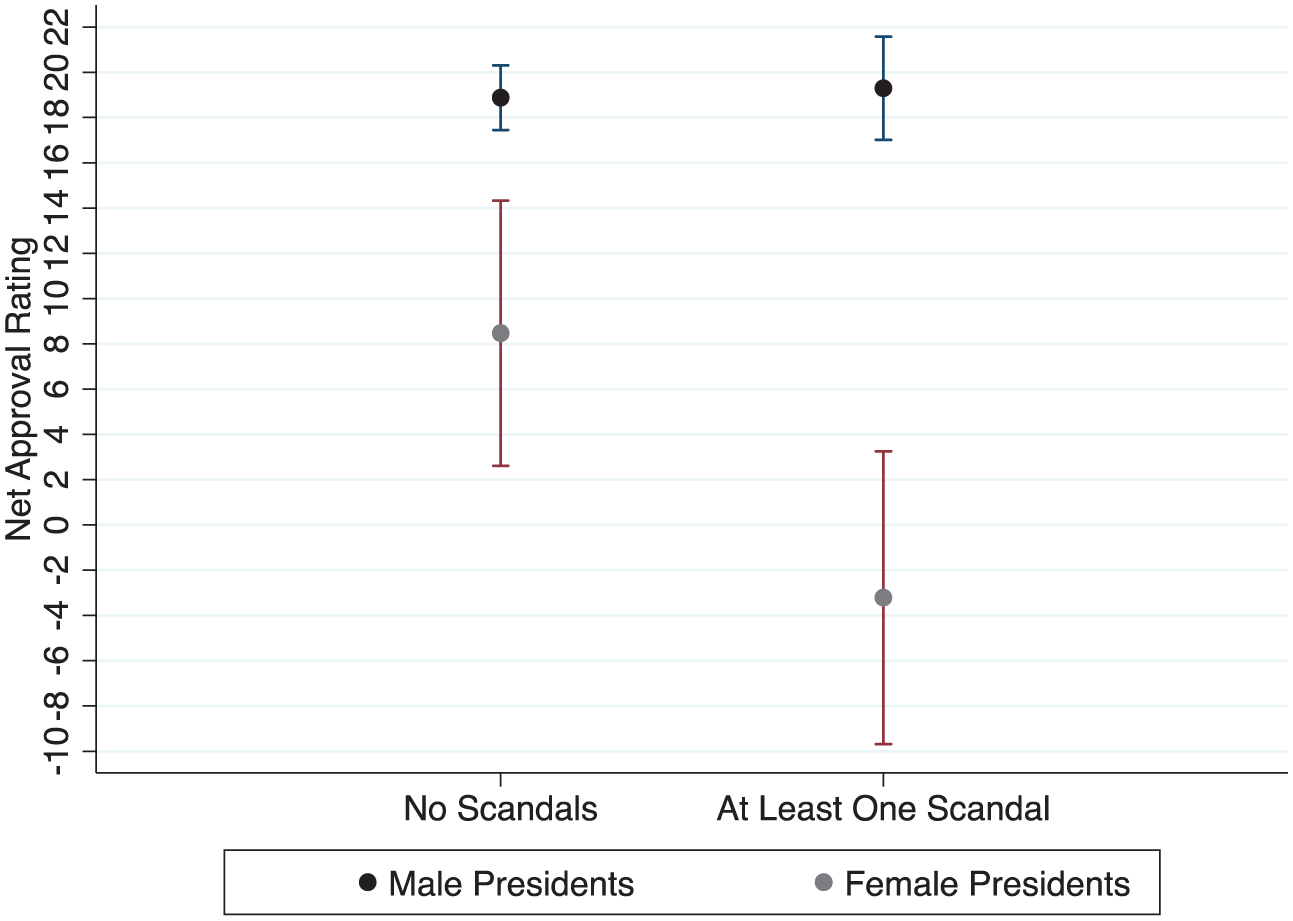
Presidents’ gender, scandals, and approval ratings.
Figure 2 depicts the predicted values from model 7. The x axis shows the perceived corruption levels in the executive branch, ranging from 3 to 55. Overlap in the 95 percent confidence intervals suggests that net ratings are statistically similar for female and male presidents when executive corruption levels are less than or equal to 10. Consistent with the theory, the confidence intervals begin to separate once corruption levels hit 10, and female presidents continue to receive statistically lower evaluations at corruption values exceeding 10. In short, as perceptions of corruption in the executive branch rise, male presidents’ ratings remain steady while female presidents’ ratings noticeably fall. These figures therefore support the theory’s predictions that citizens punish female presidents more severely for suspected moral failings.

Presidents’ gender, corruption, and approval ratings.
Conclusion
Scholars know little about the governing “success” of female chief executives. Contributing to the burgeoning literature on gender and corruption, this article illuminates how seemingly “pro-women” beliefs concerning their morality can raise ethical standards for sitting female leaders. This paradoxically creates obstacles to their governing success. Distinctions between descriptive, prescriptive, and proscriptive stereotypes help explain their contradictory consequences (Brooks 2013; Prentice and Carranza 2002). The descriptive stereotype, in attributing ethical morality to women, could boost female politicians, particularly when they are seeking office. On the contrary, prescriptive and proscriptive stereotypes, in dictating how women should and should not behave, open up possibilities for greater obstacles to female leadership.
I implemented a three-stage approach to probing the argument that in contexts of corruption female presidents receive worse ratings than male presidents. First, a discursive analysis traced the construction and role of gendered expectations in Chile, which contributed to the disproportionately negative impact of Caso Caval on Bachelet’s popularity. Second, similar patterns of greater punishment for moral failings under female leadership appeared in Brazil, home of some of the most egregious scandals in the world. Third, statistical analysis of eighteen Latin American countries provided evidence of the theory’s ability to generalize beyond Chile and Brazil. Controlling for several confounders, female presidents receive worse ratings than male presidents in contexts of at least one presidential scandal and medium to high levels of executive corruption. Exaggerated responses to failures of first-time presidentas may partly explain why men regained their monopoly on presidential power by March 2018.
My argument challenges influential “virtuous cycle” ideas (A. C. Alexander 2012). Dominant theories of symbolic representation contend that the mere presence of women in office positively influences beliefs concerning their ability to lead and inspires other women to run for office (Beaman et al. 2009; Campbell and Wolbrecht 2006; Morgan and Buice 2013). Such accounts leave little room for unintended negative consequences of past female leadership on future female leaders. First-time female chief executives, such as most in this study, are especially relevant in this regard because they attract unusual amounts of media attention, both domestic and international.
Following these insights, future research can investigate whether female leaders are punished more for failures in other areas where women are “supposed to” outperform men. For example, education and health are considered stereotypically feminine, compassion issues (Huddy and Terkildsen 1993). Female candidates may perform well electorally when more voters prioritize these policy areas (Murray 2010), but beliefs about women’ comparative advantages may similarly create unrealistic, hard-to-meet expectations for their performance in these other areas. Evidence of failure, for example, during mass student protests or health care crises, could incommensurately depress women’s approval ratings.
Concluding that gender stereotypes only hurt female leadership misses the nuance of this article’s theory. The discursive analysis from Chile reveals how elite actors—presidents, the opposition, and the media—with divergent goals activate and manipulate latent beliefs concerning gender. Outcomes can depend on context. This article identified an overall negative impact of gendered discourse when corruption appears to worsen. The possibility remains for female presidents to receive a popularity bump should they fulfill expectations for moral leadership.
This perhaps occurred during Rousseff’s first two years in office when the faxineira fired tainted ministers. Her “extraordinary” popularity, which at the time exceeded Lula’s, puzzled prominent Brazilianists (Power 2014, 31), further highlighting the limits of gender-blind analyses of executive politics. This study illuminates how a context of gendered expectations surrounding her moral leadership can help account for variation in her popularity. Thus, future case studies should examine presidents’ gender and approval ratings when corruption seems to improve. Any gendered boost favoring women presidents nevertheless is unlikely to fully counter gender’s deleterious consequences identified in this article. The role of gender—at least in the area of corruption but possibly in other areas—will likely have a net negative effect on women, as suggested by the significant and negative coefficients for presidents’ gender in all but one of the statistical models.
These conclusions challenge other pieces of (often implicit) conventional wisdom. First is the assumption of many survey experiments that gender stereotypes either hurt, help, or exert no effect on women in politics. Such arguments are commonly inferred from positive, negative, or null average causal effects. The Bachelet presidencies suggests new ways in which the consequences of “pro-women” stereotypes in the real world crucially depend not only on differences in descriptive, prescriptive, and proscriptive stereotypes but also on the opposition’s discourse and media coverage. These insights again raise questions over the ability of some experimental designs to capture the real-world impact of gender for presidential politics. Future research should consider potentially determinant contextual factors such as these.
The theory’s generalizability to parliamentary regimes remains unclear, but possible. Gendered patterns of expectation-generation during campaigns and disproportionate punishment for ethical shortcomings while in office may have occurred in countries such as Thailand. Prime Minister Yingluck Shinawatra succeeded her corruption-ridden brother in a context where the female sex is associated with greater integrity (Branigan 2011). Although not accused of personal graft, Shinawatra’s government was overthrown in a coup motivated by corruption accusations surrounding her rice program.
To close, this article reminds scholars just how deeply gender permeates the executive branch. Public expectations, moral leadership, and approval ratings are central themes of presidential studies (Edwards and Howell 2009; Kinder et al. 1980; Light 1999; Neustadt 1990), and this study illuminates how we cannot fully understand these dynamics without considering gendered discourse. The findings expand not only our knowledge of women in politics but also our understanding of executive politics.
Footnotes
Declaration of Conflicting Interests
The author(s) declared no potential conflicts of interest with respect to the research, authorship, and/or publication of this article.
Funding
The author(s) disclosed receipt of the following financial support for the research, authorship, and/or publication of this article: Support was provided by the Centre for Social Conflict and Cohesion Studies (COES) and the Universidad Diego Portales through the CONICYT/FONDAP/15130009 grant.