



Abstract
In this paper, we analyze how legislator–voter relationships influence legislative organization. We argue that legislators who engage in clientelistic practices to gain votes will create much larger committee systems, with more committees, than legislators who engage in more programmatic practices. We test these arguments using an original dataset on the number of committees in the lower chambers of seventy-seven democracies throughout the world. Our analysis demonstrates that the number of committees is higher in legislatures with clientelistic practices than in legislatures with programmatic practices. The results provide a new understanding of how legislator–voter relationships influence legislative organization and lay the groundwork for a series of studies that examine how the clientelism-programmatic spectrum influences legislative organization.
Introduction
Dozens of countries transitioned away from authoritarian government in democracy’s third wave. In many cases, regime changes inaugurated reforms designed to increase representation, political rights, civil liberties, and accountability. Yet, good governance has failed to materialize in many new democracies (Bardhan and Mookherjee 2006; Foweraker and Krznaric 2002; Hagopian and Mainwaring 2005; Heller, Kyriacou, and Roca-Sagalés 2016; Helmke and Levitsky 2006; Jensen and Wantchekon 2004; Keefer 2007; Keefer and Vlaicu 2008; Mainwaring, Bejarano, and Leongómez 2006). Many argue that clientelism is to blame for these new democracies’ failure to deliver on democratic promises. Clientelism occurs when politicians exchange private goods for citizens’ votes (Desposato 2007; Hicken 2011; Keefer 2007; Keefer and Vlaicu 2008; Stokes 2005; Stokes et al. 2013; Weitz-Shapiro 2012, 2014). Recent research has shown how politicians who engage in clientelistic practices adapt their clientelistic strategies to democratic institutional contexts (Desposato 2007; Fox 1994; Helmke and Levitsky 2006; Hicken 2011; Kitschelt and Wilkinson 2007; Mustapic 2002; Stokes 2005; Stokes et al. 2013; Taylor 1996; Weitz-Shapiro 2012, 2014). In this article, we examine how they have adapted their strategies within the legislative arena with respect to the number of legislative committees.
Legislative committee system structures vary cross-nationally, but most committee systems are designed to give legislators some influence over the allocation of government resources. In some cases, committees are designed to give certain individuals or parties control over a very specific resource stream that they can redistribute to voters (Kasfir and Twebaze 2009; Lewis 2009; Lyne 2008, 193). In other cases, committees give members some control over the development of public goods in a particular policy area (André, Depauw, and Martin 2016; Cox and McCubbins 1993; Kim and Loewenberg 2005; S. Martin 2014; Young and Heitshusen 2003). Even committees in the British House of Commons, which have been traditionally viewed as weak, have some influence over the content of bills during the policy-making process (Thompson 2016).
The number of legislative committees varies dramatically cross-nationally, even though most committee systems give legislators some influence over the allocation of government resources. As we argue in this paper, the size of the committee system can influence which kinds of resources legislators can redistribute, which affects their relationships with their constituents (Cox and McCubbins 1993; Diermeier and Myerson 1999; Katz and Sala 1996; L. W. Martin and Vanberg 2004, 2005; Mayhew 1973; Young and Heitshusen 2003). We contend that legislators and party leaders will design committee systems to increase leverage over legislators as they redistribute the appropriate types of goods to their constituents, thereby re-enforcing and strengthening the relationships between legislators and their constituents (Barkan 2009; Carroll, Cox, and Pachón 2006; S. Martin 2011). In a clientelistic setting, this entails party leaders using committee structure to undermine the prospects for legislators’ collective action against leadership. This could allow for the development of particularistic policies as long as committees’ jurisdictions are defined within a limited policy space. Having a large number of committees could allow party leaders to pursue a divide and conquer strategy to consolidate power over the distribution of government resources, prevent overspending that is associated with clientelistic bargaining (Keefer 2007), and help control how particularistic resources are spent. Through this strategy, party leaders could divide legislators into different committees with partially overlapping jurisdictions, which would lead to inter-committee conflict over resources. In turn, party leaders could consolidate control over the policy-making process and over clientelistic resources as legislators look to party leaders to resolve these conflicts (Siavelis 2002).
In contrast to legislatures with clientelistic parties, we argue that party leaders and legislators in more programmatic settings, where legislators exchange public goods for citizens’ votes, will design committees to help them develop public policy (André, Depauw, and Martin 2016; Cox and McCubbins 1993, 2005; Diermeier and Myerson 1999; S. Martin 2014; Mayhew 1973; Young and Heitshusen 2003). We expect committees in these systems to be designed with broader policy focuses than their counterparts in legislatures with clientelistic parties. Comparatively, this should reduce the number of committees. As such, we expect that the number of committees will be greater in legislatures with clientelistic practices than in legislatures with programmatic practices.
We draw from a unique dataset on the number of legislative committees in seventy-seven democracies to explain variation in committee systems. We find a great deal of variation in the number of legislative committees cross-nationally, which we explain through variation in party linkages. Legislatures where politicians regularly use clientelistic practices to gain office are associated with a larger number of committees than legislatures where politicians use programmatic practices to gain office.
Our analysis makes two contributions to comparative scholarship on democracy. First, we demonstrate how party linkages with voters can influence the design of legislative committee systems. We are not the first to recognize that party linkages could influence legislative committee structure (Cox and McCubbins 1993; S. Martin 2011, 2014; Shepsle and Weingast 1981a, 1981b). However, we focus on how informal institutions can influence party linkages, and we analyze the effects of party linkages on legislative institutions in a broader global context. The second contribution is to make public a novel dataset that allows scholars to test hypotheses surrounding cross-national variation in legislative committee systems. We develop these contributions in the remainder of the paper.
Legislative Committees as Fertile Ground for Clientelism
A legislative committee system’s structure depends on the type of parties that control the legislature (S. Martin 2011). Clientelistic parties develop committee systems that help party leaders gain leverage over individual legislators. One way in which clientelistic parties can use committees to maintain party discipline and undermine collective action against the leadership is by creating a large number of committees with particularistic jurisdictions. We have no systematic, cross-national information on true jurisdictional domain in these committees and limited information about specific clientelist contexts. Nevertheless, the evidence we do have suggests parties in clientelist systems create a large number of redundant committees, with overlapping jurisdictions or a large number of committees with narrower jurisdictions within a larger domain (e.g., committees for aquaculture, ranching, and vegetable farming within the broader agricultural domain). The specific types of particularistic committees created can then help legislators tailor programs to target specific, narrow groups of voters or other political supporters (Kasfir and Twebaze 2009; Lewis 2009; Lyne 2008).
Our broader logic is that clientelistic parties design committees with particularistic jurisdictions to govern more easily. Clientelistic parties face challenges during the legislative process as they are forced to pass legislation to benefit specific politicians’ narrow constituencies and also meet broader party and coalition needs. One way to pass this type of legislation is through logrolling or trading support for particularistic benefits. Yet, these deals are difficult to achieve and not often credible once in place because clientelistic parties are usually weak (Brown et al. 2011; Henisz 2004; Kellam 2015; Williams 2017). A large number of particularistic committees can help legislators overcome this collective action problem if each maintains control over its own resource streams (Fiorina 1987). Committees either require strong gatekeeping power or strong executive or legislative leadership to enforce bargains between committees. In the former case, strong gatekeeping power prevents other committees from changing their bargains ex post by voting for bills in policy jurisdictions outside of their own. Alternatively, legislators could shift enforcement to legislative or executive leaders to ensure that legislators maintain power over policy making in their committees’ jurisdictions (Batto 2005; Evans 1999; Fiorina 1987; Mustapic 2002; Pereira and Mueller 2004; Taylor-Robinson and Diaz 1999; Weingast and Marshall 1988). Legislative party leaders and the executive often have strong supervisory roles over committees and strong budgetary powers in many countries with clientelistic parties (Desposato 2007; Kitschelt and Wilkinson 2007; Morgenstern and Nacif 2002). These supervisory roles could then maintain legislators’ authority to distribute resources within their own policy jurisdictions in exchange for supporting leaders’ policy initiatives.
Ultimately, the party leadership uses the committee system to divide-and-conquer legislators in clientelist settings. The particularistic committee system increases legislators’ dependence on party leadership for committee assignments and subsequent access to policy resources to benefit their clients. Simultaneously, legislators know that creating a large number of committees with specific jurisdictions helps legislators claim credit for distributing specific private goods because it makes it easier for supporters to discern which committee is responsible for the creation of specific targeted benefits. 1 This credit-claiming process is an essential aspect of clientelistic politics because it allows voters to monitor legislators’ behavior. By doing so, it helps re-enforce the distribution of private goods for votes because it demonstrates that legislators fulfilled their promises (Desposato 2007; Eaton 2001; Evans 1999; Kasfir and Twebaze 2009; Keefer 2007; Lewis 2009; Lyne 2008; Mustapic 2002; Stokes 2005).
Nigeria’s legislature illustrates how clientelistic party systems promote a large number of committees with particularistic policy jurisdictions. Nigeria’s political system features clientelistic parties and its House of Representatives has ninety-six legislative committees. All of these committees encompass a variety of specific interests. For example, Nigeria’s House has at least four education committees: one for agricultural colleges, one for basic education, one for maritime education, and one for tertiary education. The House also has at least three different energy committees: one related to gas resources, one related to drilling, and one related to refining and selling gas resources. In addition, there are several different environmental committees, financial services committees, social services committees, and committees that target specific demographic groups. We witness a similar pattern in other legislatures with clientelistic parties, such as those in Argentina (forty-five committees), Mexico (fifty-six committees), and the Philippines (fifty-nine committees). The specific types of committees in these legislatures can all help legislators create tailored programs that target specific groups of voters or other political supporters (Kasfir and Twebaze 2009; Lyne 2008). The particularistic committee system increases legislators’ dependence on party leadership for committee assignments and subsequent access to policy resources to benefit their clients.
Legislative Committees in Programmatic Settings
Many older democracies also went through a period where clientelistic practices were common, even though programmatic practices tend to be the norm today (Cox 1987; Katz and Sala 1996). Several scholars argue that economic development, political competition, and the emergence of new “programmatic” parties induce other parties to revise their particularistic positions in favor of universalist programs to improve party competitiveness in elections (Geddes 1991; Keefer 2007; Keefer and Vlaicu 2008; Lyne 2008; Weitz-Shapiro 2012, 2014). In such a context, parties begin to offer local public goods (such as public schools), regional public goods (such as roads), or even national public goods (such as welfare spending) in exchange for votes (Hicken 2011; Kitschelt 2009). Unlike in clientelistic settings, parties do not monitor specific individuals to determine whether they vote. Moreover, the criteria for benefiting from government resources are not based on whether a citizen voted for the party in power.
Parties in today’s programmatic settings exchange public goods for votes. As a result, we expect that committee systems in programmatic settings will revolve around helping legislators distribute public goods to voters (Mayhew 1973). The literature on committee design in older democracies (i.e.; democracies that tend to have programmatic parties) already recognizes this phenomenon. First, according to the informational theory of committee system design, legislators design committee systems in part to make the legislative process more efficient, to ensure that members of committees become experts in their committee’s policy jurisdiction, and to ensure that committees create policies that are ideologically appropriate (Cox 1987; Fenno 1973; Gilligan and Krehbiel 1987; S. Martin 2014). In other words, legislators do not design committees to represent several particular interests. Instead, they design committees to develop well-informed public policy proposals in broad policy areas that most members of the chamber find acceptable. This process should reduce the number of committees relative to a legislature with clientelistic parties because committees will represent broad policy interests that benefit many different types of voters and legislators in general, not a wide variety of particular interests.
In a similar sense, the distributive theory of committee system design holds that committees exist to allow members to credibly commit to collectively distributing public policy benefits to several different types of constituencies. This allows legislators to become policy experts within each committee’s policy jurisdiction and allows them to claim credit for distributing benefits to different specific constituencies (Hall and Grofman 1990; S. Martin 2011, 2014; Shepsle 1979; Shepsle and Weingast 1981a, 1981b). Note that this theory, as it has been applied to older democracies with programmatic parties, has only focused on how committees represent specific constituencies, not individuals’ particular interests. Benefits are targeted toward specific groups under this arrangement and all members of those groups benefit from the programs regardless of who they voted for. For example, the U.S. House of Representatives’ agricultural committee represents broad agricultural policy goals in general (e.g., farming, rural development and electrification, water conservation, forestry, financial matters related to farming, biotechnology, food distribution to poor families, foreign agriculture, and agricultural colleges). Benefits that the committee creates are based on the collective interests of several different groups that have agricultural interests, not just one particular group or set of individuals. In contrast, the Philippines’ House of Representatives hosts more clientelistic parties and has at least three different permanent committees that pertain to agriculture. One committee has jurisdiction over agrarian reform, another over agricultural production, and another for rural development. Hence, according to the distributional theory of committee design, legislators in programmatic settings design committees to help legislators distribute benefits to different groups within specific constituencies. In comparison with committee systems in a clientelistic setting, creating committees to represent different groups within specific constituencies should reduce the number of committees in the legislature, as committees represent the interests of groups instead of the interests of individual voters or donors.
Party-based theories of committee design also focus on how committees are designed to help legislators distribute public goods to voters. Party-based theories assume that party leaders design committees to help develop policy that aligns with the majority party or coalition’s ideological preferences. Note that ideological goals are based on the distribution of public, not private, goods to voters (Aldrich and Rohde 2000; Cox and McCubbins 1993, 2005; S. Martin 2011; Young and Heitshusen 2003). This should reduce the number of committees as compared to a legislature with clientelistic parties, as party leaders will create committees that represent broad policy interests, not the interests of particular individual voters. Hence, for example, while legislators in the U.S. House of Representatives focus on developing social welfare programs, there is no one single committee devoted to developing programs such as food allowances or housing. Instead, other committees that focus on broad policy goals (such as agriculture or financial services) have jurisdiction over these specific policy areas.
Coalition theories on committee design in countries with programmatic parties also emphasize how programmatic parties use committees to develop public goods. In this case, they focus on how committees can help members of the governing coalition uphold their coalition bargain with respect to distributing public goods. In coalition systems, members of one party in the coalition tend to lead specific ministries and members of another coalition party tend to chair the corresponding committees (André, Depauw, and Martin 2016; Carroll and Cox 2012; Diermeier 2014; Diermeier and Myerson 1999; Katz and Sala 1996; Kim and Loewenberg 2005; S. Martin 2014; L. W. Martin and Vanberg 2004, 2005, 2014). Committees in these situations slow down the legislative process and carefully review legislation that their corresponding ministers create to align the legislation with the coalition preferences and reflect the coalition bargain. Committees in coalition systems with programmatic parties therefore theoretically focus more on developing policy to benefit many different groups of voters collectively, not individually. This process should lead to a smaller number of committees than we would otherwise observe in a legislature with clientelistic parties, as coalition leaders will create committees that represent the diverse public broad policy interests of their members, not the interests of particular voters that individual parties in the coalition represent.
Central Hypothesis
We argue that party leadership and legislative leaders in clientelistic settings expand the number of committees for a variety of reasons: to control legislators, to benefit narrow constituencies, and to claim credit for the distribution of clientelistic resources. In contrast, legislative party leaders in programmatic settings limit the number of committees to ensure legislators develop well-informed, ideologically appropriate public goods for which they can claim credit for distributing. This discussion leads to Hypothesis 1.
We test the above hypothesis against a unique dataset on the number of standing legislative committees in seventy-seven democracies in 2016. We couple this information with cross-national data on clientelistic practices from the Varieties of Democracy project (Coppedge, Gerring, Lindberg, Skaaning, Teorell, Altman, Andersson, et al. 2017). We then match this information with key institutional and economic characteristics likely to influence the structure of the legislative committee system. We describe the individual indicators we use in models of legislative committee systems and the techniques we use to build those models below.
Research Design
We test our hypothesis by building four ordinary least squares regression models using the Number of Committees in the lower chambers or unicameral chambers of seventy-seven democracies throughout the world. 2 We use data from each country’s legislative websites on the number of standing committees in the lower or unicameral chambers. We exclude subcommittees from the analysis because information regarding subcommittees is not consistently available for most of the countries in our sample. 3
The mean Number of Committees in the dataset is twenty-one. Three countries tied for the smallest number of committees at six, while Nigeria stood alone with ninety-six—the largest number of committees. The data are skewed to the right, indicating that there are a handful of countries with many committees in the data. Extreme outliers also include Argentina (forty-five committees), Mexico (fifty-six committees), and the Philippines (fifty-nine committees) (see Figure 1).

Number of committees.
Main Independent Variables
Our main argument focuses on the effect of clientelism on the number of committees in a legislature. Unfortunately, clientelism is difficult to measure because it is an illegal practice. In addition, clientelism is an informal institution, where the exact rules that structure clientelistic relationships are not written down, only “understood” (Weitz-Shapiro 2012). We therefore estimate the relationship between clientelism and the legislative committee system through a series of proxy variables.
The first proxy variable for clientelism, Clientelistic Parties, indicates the extent to which parties exchange public or private goods for votes in a country. We use the “Party Linkages” variable from the Varieties of Democracy (Coppedge, Gerring, Lindberg, Skaaning, Teorell, Altman, Andersson, et al. 2017) dataset for this measure. 4 This variable relies on country-expert ratings to describe the linkage between parties and their constituents in their respective country. Experts responding to V-Dem questionnaires were asked to choose one of the following options that best reflected characteristics of the party system represented in a country’s national legislature:
Clientelist. Constituents are rewarded with goods, cash, and/or jobs.
Mixed clientelist and local collective.
Local collective. Constituents are rewarded with local collective goods, for example, wells, toilets, markets, roads, bridges, and local development.
Mixed local collective and policy/programmatic.
Policy/programmatic. Constituents respond to a party’s positions on national policies, general party programs, and visions for society.
The resulting original scale variable in our sample ranged from 0.269 to 3.959, with lower values indicating that parties in a country offered private goods for votes while higher values indicated that parties in a country offered public goods for votes (Coppedge, Gerring, Lindberg, Skaaning, Teorell, Altman, Bernhard, et al. 2017; Coppedge, Gerring, Lindberg, Skaaning, Teorell, Andersson, et al. 2017). 5
Our second proxy variable for clientelism, Vote Buying, also comes from the Varieties of Democracy (Coppedge, Gerring, Lindberg, Skaaning, Teorell, Altman, Andersson, et al. 2017) dataset. We use the most recent value of the “Election Vote Buying” variable for each country in the dataset for this measure. 6 This variable relies on country-expert ratings to describe the extent to which parties and candidates exchange money or gifts for votes. Country experts responding to V-Dem questionnaires were asked to choose one of the following options that most accurately described the extent of vote buying in their country of expertise:
Yes. There was systematic, widespread, and almost nationwide vote/turnout buying by almost all parties and candidates.
Yes, some. There were non-systematic but rather common vote buying efforts, even if only in some parts of the country or by one or a few parties.
Restricted. Money and/or personal gifts were distributed by parties or candidates, but these offerings were more about meeting an “entry-ticket” expectation and less about actual vote choice or turnout, even if a smaller number of individuals may also be persuaded.
Almost none. There was limited use of money and personal gifts, or these attempts were limited to a few small areas of the country. In all, they probably affected less than a few percent of voters.
None. There was no evidence of vote/turnout buying.
The resulting original scale variable in our sample ranged from 0.509 to 3.981. Lower values indicate widespread vote buying in a country and higher values indicate little vote buying in a country (Coppedge, Gerring, Lindberg, Skaaning, Teorell, Altman, Bernhard, et al. 2017; Coppedge, Gerring, Lindberg, Skaaning, Teorell, Andersson, et al. 2017). (It is important to note that the correlation coefficient between the Clientelistic Parties and Vote Buying variables was .7786.)
Based on Hypothesis 1, we expect the clientelism proxy variables to have a negative effect on the number of committees in a country. As parties become less likely to engage in clientelistic practices, the number of committees in the legislature should decrease.
Finally, we use the Party Institutionalization variable from the V-Dem dataset as a proxy to assess the effects of party strength on the number of committees (Coppedge Gerring, Lindberg, Skaaning, Teorell, Altman, Andersson, et al. 2017). Our logic here is similar to that of Party Linkages and Vote Buying. Party institutionalization changes the incentives of legislative leaders: it strengthens incentives to provide public goods and decreases incentives to divide and conquer legislators through promises of particularistic legislation. We expect more settings with more institutionalized parties to have fewer committees than those with less institutionalized parties.
Control Variables
There are several other factors that may influence the number of committees in a legislature, which we include as control variables in our models. First, we add an indicator for the Total Number of Legislators to our models. We expect this variable to have a positive effect on the number of committees. That is, as the number of members of the legislature increases, the number of committees should increase.
The second control variable we include in the analysis is Electoral Rules. We code the variable as follows: 0 for legislatures where members are elected through single member district (SMD), plurality rule elections or multimember district (MMD), plurality rule elections; 1 for legislatures where members are elected through mixed methods (SMD or MMD and proportional representation [PR]); and 2 for legislatures where members are elected through PR elections. We expect this variable to have a negative effect on the number of committees.
In plurality rule, SMD and MMD elections, although party labels matter, voters still vote for specific candidates. Legislators in these systems should want to claim personal credit for delivering goods to their constituents because voters will reward them with their votes for providing local private and public goods (André, Depauw, and Shugart 2014). Hence, legislators in these systems should be more interested in serving on committees with a more particular focus, where they can help redistribute goods to specific types of constituencies and claim credit for it. This effect should increase the number of committees. In contrast, in PR elections, legislators are elected under the same party label. Even when there is a personal vote option, a party’s votes still get pooled together and the number of seats a party receives is based on its collective vote share. Legislators from the same party should then want to claim collective credit for redistributing resources to voters in these systems, as this could help them collectively gain more votes in subsequent election (André, Depauw, and Shugart 2014). Hence, legislators in these systems will be less likely to desire to be on particular committees and instead be more interested in developing a committee system that appeals to large groups of voters instead of particular groups of voters. This effect should decrease the number of committees in the legislature.
The third control variable we include in the analysis is Executive Type. The variable is coded 0 for countries that are pure presidential systems and 1 for countries with a parliament and prime minister. We expect presidential systems to have a larger number of committees than parliamentary systems. This is because having more committees makes it easier for the legislature to block legislation from passing, creating a stronger bargaining position for the legislature relative to the President. We base this expectation on Diermeier and Myerson (1999) who examine the effect of bicameralism and inter-cameral bargaining on committee structure. Here we treat bicameralism and presidentialism in a similar fashion as they both represent a separation in power between key veto players in the legislative process.
The fourth control variable we include is the Effective Number of Parties, which measures the effective number of parliamentary parties in a legislature (Gallagher 2017). 7 We expect the number of committees to increase as the number of parties increases. This is because the number of parties that need to cooperate to form a coalition increases as the number of parties increases. This, in turn, should expand the number of issues the governing coalition addresses, therefore increasing the number of committees. 8
The fifth control variable we include in the analysis is Bicameralism. We code countries that have unicameral legislatures as 0 and countries that have bicameral legislatures as 1. We expect countries with bicameral legislatures to have a larger number of committees. This is because a larger number of committees may make it easier for one chamber to block legislation from passing, by creating a stronger bargaining position for that chamber relative to the other (Diermeier and Myerson 1999).
The sixth control variable we use is Constitutional Constraints to address the possibility that some committees could be institutionalized, which would then place upper and lower bounds on the committee systems. The indicator is coded 0 for countries that do not have any constitutional barriers for committee formation and 1 for countries that have constitutional constraints on committees. Typically, this means that the legislature either is required to create three or more specific committees based on constitutional rules, or ensure that the partisan composition of committees reflects the partisan compositions of the legislature.
The last control variable we include is Log of GDP per Capita. We expected wealthier countries to have the resources to expand government services and to create more committees devoted to different aspects of public policy. Hence, we expected the Log of GDP per Capita variable to have a positive effect on the number of committees. 9
Results
We display the results of Models 1 and 2 in Table 1, which include the Clientelistic Parties variable. 10 The results of the models provide support for Hypothesis 1, as the coefficients for Clientelistic Parties are negative and significant in all models. The Number of Committees in the legislature decreases as parties in a country become less likely to engage in clientelistic practices. Substantively, our first two models estimate that, on average and all else equal, a legislature with fully clientelistic parties will have about ten to fifteen more committees than a legislature with no clientelistic parties.
The Effect of Clientelistic Parties on Number of Committees.

Robust standard errors in parentheses.
p < .05. **p < .01. ***p < .001.
Next, we display the results of Models 3 and 4 in Table 2, which includes the Vote Buying variable. The results of the models provide support for Hypothesis 1, as the coefficient for the Vote Buying variable is negative and significant in all models. As parties in a country become less likely to engage in vote buying, the Number of Committees in the legislature decreases. Substantively, according to these results, on average and all else equal, a legislature in a country with widespread vote buying should have about thirteen to eighteen more committees than a legislature in a country with no vote buying. 11
The Effect of Vote Buying on Number of Committees.
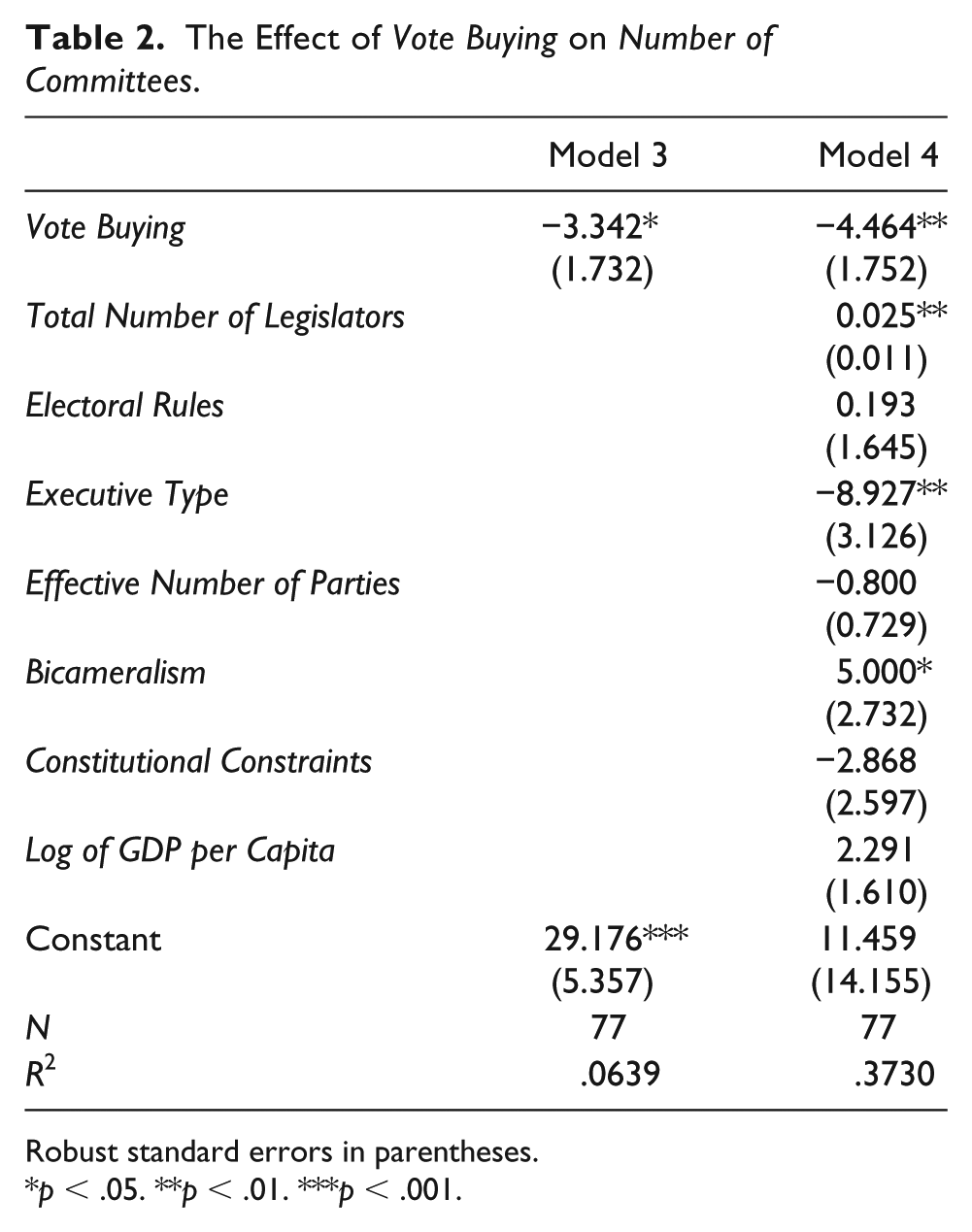
Robust standard errors in parentheses.
p < .05. **p < .01. ***p < .001.
Finally, we display the results of Models 5 and 6 in Table 3, which includes the Party Institutionalization variable. The results in the models provide additional support for Hypothesis 1, as the coefficient for the Party Institutionalization variable is negative and significant in Model 6, though not in the bivariate model (Model 5). The Number of Committees in the legislature decreases as parties in a country become more institutionalized. Substantively, we estimate that a legislature in a country with highly institutionalized parties would have roughly twenty-three fewer committees than a legislature in a country with very low party institutionalization.
The Effect of Party Institutionalization on Number of Committees.
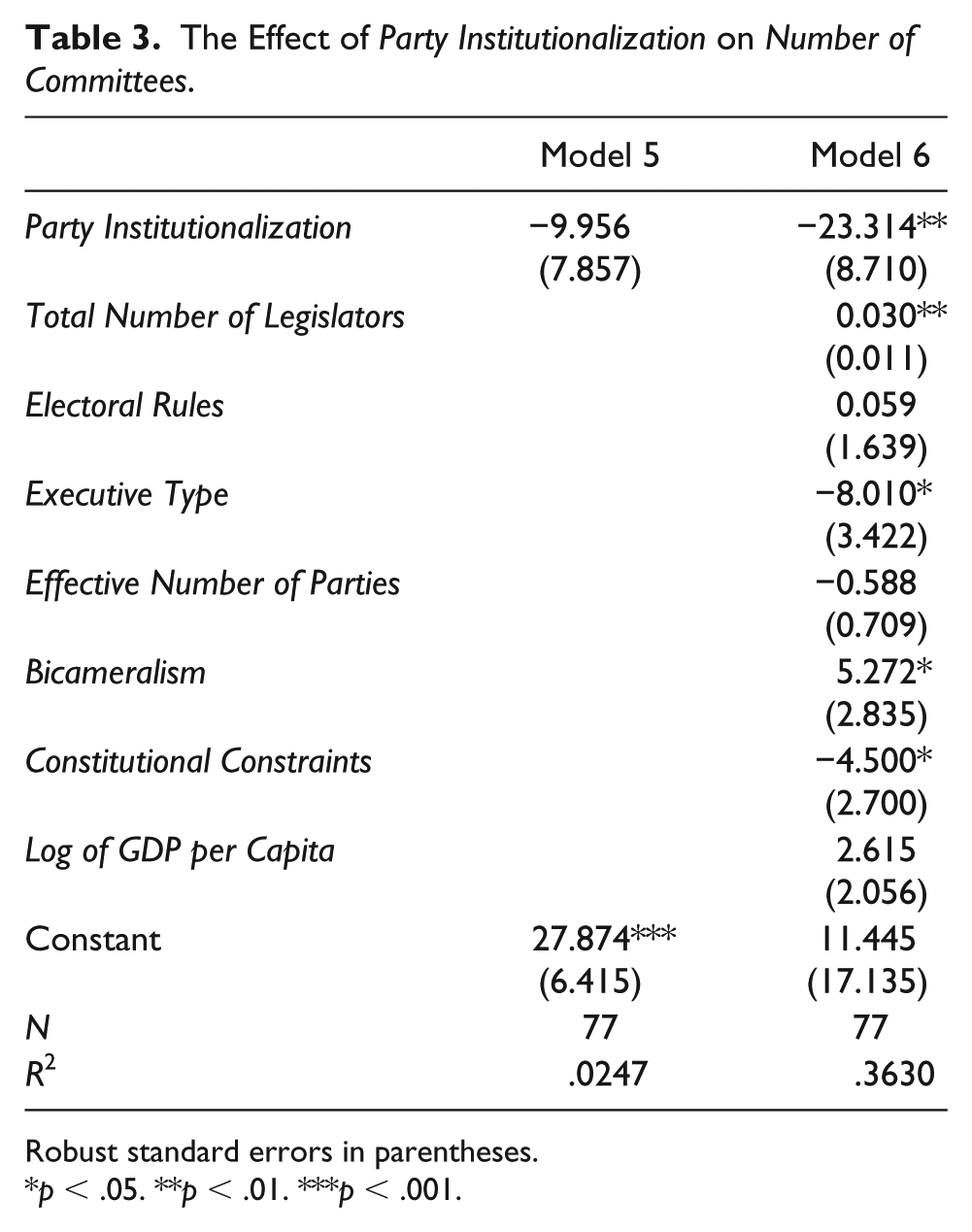
Robust standard errors in parentheses.
p < .05. **p < .01. ***p < .001.
With respect to the control variables, as expected, the coefficient for the Total Number of Legislators variable is positive and significant in Models 2, 4, and 6. These results suggest that as the total number of legislators in a legislature increases, the number of committees increases. In addition, as expected, the results for the coefficient of the Bicameralism variable are also positive and significant in Models 2 and 4. These results suggest that there are about five more committees in lower chambers in bicameral legislatures than in unicameral legislatures. The coefficient for Executive Type is also negative and significant in Models 2, 4, and 6. We estimate eight to nine more committees in legislatures in presidential systems compared with legislatures in parliamentary systems, on average.
The results for the coefficients of the Electoral Rules variable, Number of Parties variable, Constitutional Constraints variable, and Log of GDP per Capita variable are insignificant in Models 2, 4, and 6. It is surprising that electoral rules and constitutional constraints do not effect the number of committees. It is still a possibility that these variables influence the number of committees in a legislature, but their effects can only be observed in a larger sample. In addition, the Log of GDP per Capita could be insignificant because it is so highly correlated with our clientelism variables.
Last, we also reran Models 1 to 4 for countries with legislatures with less than forty committees and legislatures with less than fifty committees as a robustness check. The coefficient for Party Linkages remains significant in Models 1 and 2, but the coefficient for Vote Buying becomes insignificant in all models. The countries that we remove in these models tend to have clientelistic parties and, as expected, a large number of committees. Not surprisingly, removing these countries reduces the negative relationship between the variables and the Number of Committees. 12
Conclusion
Democracy’s third wave raised hopes for responsive, accountable governance. Decades later, new democracies’ gains have been modest: good governance is elusive and clientelism continues to undermine democratic performance (Desposato 2007; Helmke and Levitsky 2006; Hicken 2011; Jensen and Wantchekon 2004; Keefer 2007; Keefer and Vlaicu 2008; Stokes et al. 2013; Weitz-Shapiro 2014). Contrary to many expectations, democratic institutional contexts have proven to be fertile ground for maintaining and expanding clientelistic networks (Fox 1994; Kitschelt and Wilkinson 2007; Taylor 1996; Weitz-Shapiro 2012). Our research extends the investigation of clientelism in democratic contexts to the ways that legislator–constituent relationships propagate through legislative institutions. Specifically, we identify how informal institutions embedded in party systems can promote or impede the clientelistic use of legislative committees.
Our findings suggest that legislators and party leaders design committees to exert leverage over individual legislators and distribute resources to their constituents to re-enforce legislator–constituent relationships (Barkan 2009; Carroll, Cox, and Pachón 2006; Cox and McCubbins 1993; Diermeier and Myerson 1999; Katz and Sala 1996; S. Martin 2011; L. W. Martin and Vanberg 2004, 2005; Mayhew 1973; Young and Heitshusen 2003). Parties in more clientelistic party systems design committees to enforce party discipline and prevent collective action against party leadership as they distribute resources to targeted constituents to distribute resources to targeted constituents (Kasfir and Twebaze 2009; Lewis 2009; Lyne 2008). Party leaders then expand the number of committees in clientelistic systems to control legislators by distributing narrow committee assignments that are tied to specific groups of voters. In contrast, legislators in more programmatic settings exchange public goods for citizens’ votes and therefore design committees to help develop public policy that is favorable to large groups of legislators and voters (André, Depauw, and Martin 2016; Cox and McCubbins 2005; Diermeier and Myerson 1999; Kim and Loewenberg 2005; S. Martin 2011, 2014; Mayhew 1973; Young and Heitshusen 2003). As a result, the number of committees is smaller in these systems.
The results of our analysis support our central hypothesis, but our research only represents the first broad, cross-national step in explaining variation in the structure of the legislative committee system. Future research on committees over time in countries where the data are available represents the next step in research on this topic. Unfortunately, we are limited by the availability of data on committee systems. Including the roughly 120 remaining countries around the world in our analysis is not possible at this time. A truly global dataset would provide a better test of the central hypothesis because we would be able to analyze more countries with clientelistic party systems.
In addition, investigating the impact of party linkages on committee systems’ specific rule-sets is a natural extension of this analysis. For example, it is possible that party linkages influence whether committee seats are proportionally distributed based on a party’s seat-share in a chamber. We would expect parties in clientelistic systems to make rules that support their distribution of private goods by having members control committees relevant to their supporters’ interests as well as having members sit on a diverse set of other types of committees. This idea requires additional development and testing, but it represents one of many options for additional exploration of how the party system may influence legislative rules and subsequent policy outcomes. For example, future research might also evaluate the extent to which distinctions between clientelistic and programmatic party systems influence committees’ investigative powers. Committees in clientelistic systems are likely to have fewer professional staffers and fewer investigative powers—especially to subpoena interest groups’ documents—or compel their testimony.
Our results also speak to the other roles committees play beyond policy making. In particular, legislators also use committees as a means to engage in executive oversight. Cruz and Keefer (2015) suggest that legislators and parties that engage in clientelistic practices care little about monitoring the executive because voters will not reward them for their oversight role, and such oversight could affect politicians’ ability to engage in clientelistic practices. Hence, the implication is that politicians in clientelistic party settings are unlikely to design committee systems to promote extensive oversight over executives. In contrast, programmatic parties do tend to engage in executive oversight. Committees in legislatures with programmatic parties might therefore be designed to allow legislators to review executive action.
A natural extension of this analysis is to examine the role of programmatic versus clientelistic party systems on subcommittee design. Subcommittees are extensions of committees and, as such, may result from the same pressures that expand committee systems. For example, legislative leaders and committee chairs may create subcommittees to better control committee members and further divide and conquer to prevent collective action against party leadership. In this sense, a large number of subcommittees in some systems may play a similar role to a large number of committees in others, for example, by supplying specific benefits to targeted constituencies and for controlling appropriations (Adler 2000; Kirst 2018). Yet, subcommittees may have different functions and powers than committees, and may emerge from a different set of factors relative to those that influence committee formation. The lack of cross-national data on subcommittees makes it difficult to evaluate our claims surrounding committees in that context. Still, we do hope that it will become possible to test these and other hypotheses once data become available.
Finally, our results speak to the effect of party linkages on other characteristics of executive and legislative organization. In particular, cabinet ministries play a significant role in the policy-making process in many parliamentary democracies, much like committees. Party linkages may thus also affect the number of ministries in parliamentary systems. One of the implications of our results is that the number of ministries in parliaments with clientelistic parties may also be greater than the number of ministries in parliaments with programmatic parties. Ultimately, an important lesson from our research is that clientelism can adapt to many political and economic circumstances. Vigilance to prevent clientelistic use of legislative systems is therefore necessary—even in countries thought to be insulated from clientelistic tendencies.
Supplemental Material
Online_Appendix_3 – Supplemental material for Clientelism by Committee: The Effect of Legislator–Constituent Relationships on Legislative Organization
Supplemental material, Online_Appendix_3 for Clientelism by Committee: The Effect of Legislator–Constituent Relationships on Legislative Organization by Julie VanDusky-Allen and Michael Touchton in Political Research Quarterly
Footnotes
Declaration of Conflicting Interests
The author(s) declared no potential conflicts of interest with respect to the research, authorship, and/or publication of this article.
Funding
The author(s) received no financial support for the research, authorship, and/or publication of this article.
Notes

References
Supplementary Material
Please find the following supplemental material available below.
For Open Access articles published under a Creative Commons License, all supplemental material carries the same license as the article it is associated with.
For non-Open Access articles published, all supplemental material carries a non-exclusive license, and permission requests for re-use of supplemental material or any part of supplemental material shall be sent directly to the copyright owner as specified in the copyright notice associated with the article.
