



Abstract
Approval affects congressional support for the president, with a reelection motivation the main linkage mechanism. Yet, the literature has not fully explored this linkage due to theoretical barriers and serious data limitations. Using a new theory and novel data, we argue that the impact of the reelection motivation should vary with contextual factors. This paper identifies two such factors rarely explored together: member party and chamber. We hypothesize that opposition party legislators will be more responsive to constituent approval than co-partisans, but this partisan differential will hold only for the Senate, not the House. We test our hypothesis on House and Senate data, from 2006 through 2012, using multiple regression poststratification (MRP) to measure district and state approval of the president. The analysis finds support for the chamber differences hypothesis that has implications for partisanship and representation.
There is general agreement that presidential approval affects congressional support for the president. A frequently cited linkage mechanism between approval and support is reelection—legislators’ support will covary with constituent approval to maximize their reelection prospects. The electoral connection theory assumes legislators will be responsive to the opinions of constituents in their districts. Yet, considerable disagreement in the literature exists over the impact of approval on support. Some studies find a positive relationship between approval and support (Barrett and Eshbaugh-Soha 2007; Beckmann 2010; Bond, Fleisher, and Wood 2003; Brace and Hinckley 1992; Canes-Wrone and De Marchi 2002; Edwards 1976, 1977, 1980, 1989, 1997; Lebo and O’Geen 2011; Ostrom and Simon 1985; Rivers and Rose 1985), but others do not, or at best, find a modest relationship (Bond and Fleisher 1980, 1984, 1990; Bond, Fleisher, and Northrup 1988; Borrelli and Simmons 1993, Cohen et al. 2000; Collier and Sullivan 1995; Fett 1994; Peterson 1990). One study even finds a negative relationship (Lockerbie, Borrelli, and Hedger 1998).
Two challenges exist in trying to resolve the disagreement about the effect of approval on support. First, although most agree that the approval–support relationship may vary with contextual factors, few studies investigate whether contextual factors moderate the approval–support relationship. One relevant study, Dwyer and Treul (2012), demonstrates on Senate data that opposition members are more responsive to state-level presidential approval than co-partisans. There are good reasons for such party asymmetry. Co-partisans will support the president even when the president is not popular because doing so may help their reelection chances (Cohen 2011; Lebo and O’Geen 2011). Opposition legislators face a different incentive mix, with their party pulling them to oppose the president, but reelection concerns pushing them to support the president when he is popular among their constituents. Thus, opposition members should be more responsive to constituent-level approval than co-partisans. Second, testing the approval–support hypothesis requires approval data for member constituencies. Constituency-level approval data for the Senate (at the state level) are rare and such data are nearly nonexistent for the House. One contribution of our paper is the use of a relatively new method for estimating subnational opinion, multiple regression poststratification (MRP).
This paper addresses the effect of constituent approval of the president on Congressional support, contingent on chamber and electoral cycle. Specifically, we ask whether opposition members are more responsive to presidential approval among their constituents than co-partisans in both the House and Senate. Although party differences in responsiveness has received some attention for the Senate (Dwyer and Treul 2012), to our knowledge, it has not received any attention for the House. We argue that party differences in responsiveness will hold only for the Senate, not the House. Plus, during election periods, opposition party senators become increasingly responsive to constituent approval of the president for electoral reasons, but no such electoral cycle appears to exist for the House. Existing research has documented electoral cycle responsiveness to constituents for the Senate (Buttice and Highton 2016; Elling 1982; Kuklinski 1978; Lindstädt and Vander Wielen 2011; Thomas 1985; Wood and Andersson 1998), although rarely for presidential approval (Dwyer and Treul 2012).
The question of joint party–chamber effects on the approval–support relationship is important for several reasons. First, influencing public policy is an important job expectation for modern presidents but they have limited resources to influence congressional outcomes. Presidential approval is one possible resource to influence Congress, yet we know relatively little about the mechanisms through which approval affects roll call voting. Moreover, presidents may modify their coalition building strategies depending upon which members most strongly respond to constituent approval. If opposition members increase their support as approval rises, presidents may target legislators representing districts where they are popular, perhaps moving to the center to secure opposition legislator support. The centrist strategy, however, may not be optimal if opposition members from only one chamber are responsive to constituent approval. Investigating the joint effects of party and chamber on responsiveness to approval has implications for presidential coalition building strategies and their effectiveness.
Second, this topic has representational implications. Assuming approval is an important aspect of public opinion, as it conveys information about public preferences on policies and support for the president, then it matters how responsive legislators are to constituent approval and the conditions under which responsiveness rises or falls. The quality of representation may suffer if factors such as chamber and partisan differences limit member responsiveness to constituent approval. Third, our paper addresses critical House–Senate chamber differences. Research contends that there are important differences between the two chambers, yet there is little research testing whether chamber differences affect policy outcomes and member behavior (Gailmard and Jenkins 2007; Lazarus and Steigerwalt 2009).
Few studies test whether the approval–support relationship varies with the proper context. This paper identifies two contextual factors—member party and chamber—and uses unique data to examine their mediating impact on the approval–support relationship. Our paper proceeds as follows. The next section presents the theory, hypothesizing that approval will have stronger effects on opposition members in the Senate than the House. During reelection periods, opposition senators should become increasingly responsive to constituent approval for reelection reasons but with no strong effects for the House. Then, we discuss our novel data, outline our empirical strategy, and present the analyses that find support for our hypotheses. The conclusion puts the findings into perspective and offers suggestions for future research.
The Electoral Connection, Approval, and Support
The reelection motivation is an important linkage mechanism between constituent approval and congressional support for the president (Bond and Fleisher 1990; Edwards 1976, 1989, 2009). This theory maintains that, covetous of reelection, legislators consider their constituents’ preferences when casting roll calls. Legislators also assume their roll call records will affect how constituents vote in upcoming elections. Hence, members try to predict voters’ reaction to their roll call positions to lessen as much as possible any negative consequences of their roll call votes. Predicting the future, however, is difficult, full of uncertainty, and prone to error. Unanticipated events may alter the political landscape, the policy agenda, and the opinions of voters. Yet, predicting the electoral implications of current behavior is important for members as they try to mitigate the potential negative consequences of their roll call votes.
Members may be especially sensitive to constituent approval because of the president’s visibility and importance to most voters. Roll calls on which the president takes a position often become critical campaign issues and voters tend to equate the president’s position with the party’s position. When the president takes a position, voters in general assume the president’s position is their party’s position. Evidence exists on the importance of voter attitudes about the president for their congressional voting decisions. Gronke, Koch, and Wilson (2003) find voters tend to cast ballots for candidates of the president’s party when they approve of the president, but will vote against those candidates when they disapprove of the president. Canes-Wrone, Brady, and Cogan (2002) show members of Congress who support an unpopular president have higher rates of electoral defeat.
Evidence on the Approval–Support Linkage
The electoral connection theory predicts a relationship between approval and support for the president. However, considerable disagreement in the literature exists over the impact of approval on support. Some studies find a positive relationship but others find no or at best a modest effect (see the studies cited above). There are several possible sources of this divergence in the literature. First, few studies have data on approval within legislative constituencies; thus, there are few direct tests of the hypothesis at the member level. To compensate for data limitations, some studies use proxies, like election results, as an indicator of constituent approval. 1 Others eschew testing the relationship at the member level, instead focusing on the relationship between chamber-level support (or success) and national-level approval. 2 These designs, although informative, are limited for testing the approval–support hypothesis. Election results are not the same as approval—a president’s approval in a state or district four years into a term may differ markedly from his showing in the presidential election. Plus, aggregate studies cannot say anything about individual member behavior, the focus of the electoral connection theory.
A small number of studies test the approval–support hypothesis with constituency-level data. Three use state-level data, limiting their analyses to the Senate, and thus cannot test for chamber differences or say anything about the relationship for the House (Cohen 2011; Cohen et al. 2000; Dwyer and Treul 2012). Only Ponder and Moon (2005) try to investigate the relationship for the House, using American National Election Study (ANES) data from 1980 to 1998. Although they find approval effects for both chambers, there are potential problems with aggregating ANES data to produce state/district opinion estimates (Erikson 1978). And this sparse literature produces divergent findings. Cohen et al. (2000) do not find support for the approval–support relationship, but Cohen (2011), Dwyer and Treul (2012), and Ponder and Moon (2005) do.
Given the theoretical importance of the approval–support hypothesis, disagreement over its existence and strength, and limitations of constituency-level approval data, there is need for better data on approval at the district and state level. We introduce a method, MRP, which produces precise estimates of district/state approval. These data allow a direct test of the approval–support hypothesis at the member level, as well as the party–chamber differences and the electoral cycle hypotheses. Three hypotheses emerge from the puzzle of these relationships, explained in subsequent sections: the party differences, chamber differences, and electoral cycle hypotheses.
The Mediating Impact of Party
First, the party differences hypothesis suggests that co-partisans and opposition members have different incentives for supporting or opposing the president on roll calls. Due to differences in their incentive structure, co-partisans will support the president no matter the president’s approval level among constituents, but opposition members will be responsive to changing approval levels, with increases in support as constituent-level approval rises. Co-partisans have incentives to support the president, no matter his approval level among their constituents. A co-partisan’s chance for reelection improves when voters view the president as strong and successful, but worsens when the president is viewed as weak and unsuccessful. Presidential roll call success may affect voters’ views of the president, with higher success rates leading to a more positive image among voters, and better election prospects for congressional co-partisans. Consequently, co-partisans will support the president to ensure the presidential roll call victories.
There is empirical support for these linkages. Approval rises and falls with presidential success on roll calls (Brace and Hinckley 1992; Cohen 2013; Rivers and Rose 1985), and there is a positive association between success and voters’ viewing the president as strong (Cohen 2015), establishing the linkage between presidential success and voters’ image of the president. Plus, voters’ image of the president affects their congressional voting decisions. Voters are more likely to vote for candidates of the president’s party when they approve of the president (Gronke, Koch, and Wilson 2003), and Canes-Wrone, Brady, and Cogan (2002) show that member support for an unpopular president increases the likelihood of electoral defeat. Furthermore, Lebo and O’Geen (2011) demonstrate that higher presidential success in Congress leads to the president’s party winning more seats in the upcoming election, and Cohen (2015) shows that congressional co-partisans are advantaged electorally when voters think the president is strong versus weak. Thus, we should expect co-partisans to support the president no matter his approval ratings among their constituents.
Opposition members, however, face two incentives, party and constituency, that at times pull them in differing directions. Their party pulls them to oppose the president consistently. Yet, when the president is popular among their constituents, reelection needs will lead them to increase their support of the president. When the president is unpopular, the pull of party and constituency leads to the same decision—vote against the president. But, when the president is popular, the opposition member feels pressures from the party to vote against the president and constituency pressures to vote with the president. Thus, opposition members will be responsive to changing approval levels among their constituents.
The Mediating Impact of Chamber
Second, the chamber difference hypothesis contends that opposition senators, but not representatives, will be responsive to approval ratings among their constituents. Differences between the House and Senate affect legislators’ responsiveness to their constituents. For instance, the House party leadership possesses stronger tools to enforce party loyalty than in the Senate through agenda setting and committee assignments. Since the 1980s, the House leadership has enhanced its ability to organize its party and the chamber, for example, by determining the membership of the Rules committee (Lee 2009; Rohde 1991, 2010). The House leadership also strongly influences the congressional agenda, such as which bills will receive floor votes and under what debate and voting rules (Lazarus and Steigerwalt 2009; Meinke 2016; Rohde 2010; Sinclair 1992). Moreover, the House leadership has the ability to discipline members who fail to toe the party line, such as refusing to advance a member’s legislation, chocking off campaign resources, and compromising committee assignments (Pearson 2015).
In contrast, the Senate has a more egalitarian structure, allowing individual senators greater freedom to debate, offer amendments, and vote even in opposition to their party. For example, unlike the House, which generally uses simple majority rule, a minority of senators can filibuster, and, if successful, keep the Senate from considering a bill. Recent years have witnessed increasing use of the filibuster against presidents in the Senate (Bond, Fleisher, and Cohen 2014). As Davidson et al. (2018, 155) remark about the Senate versus the House, “Unlike the House, today’s Senate is an institution that tolerates and even promotes individualism. Senators cherish and assert their independence.” Senators, unlike representatives, due to the organizational structure of the two chambers, are better able to act on their individual needs, especially those emanating from their constituencies.
Furthermore, representatives and senators face different electoral contexts. Senators generally win with smaller margins than representatives, which should increase their sensitivity to constituent opinion (Abramowitz 1980; Jacobson and Carson 2015; Nice 1984). Senators’ greater electoral vulnerability should sensitize them to constituency opinion, including presidential approval, more strongly than for representatives. Thus, we hypothesize that opposition senators, but not representatives, will be responsive to changing approval levels in their constituencies.
Electoral Cycle Effects
Legislators should become more responsive to constituent opinion as the election nears—the electoral cycle hypothesis. This hypothesis assumes voters are myopic that they weigh recent roll call votes more heavily when deciding which candidate to vote for than distant roll calls. Voters may be myopic for several reasons. They may forget what legislators did in the more distant past and only pay attention to legislators’ voting records as the election nears and have to decide for whom they will. Scholars have found voters do tend to give more weight to more recent events, especially economic issues (Healy and Lenz 2014). Legislators should be more sensitive to recent changes in public opinion as a means to enhance their reelection prospects.
There is empirical support for the electoral cycle hypothesis, but only for senators with their long six-year terms. Ideology is important as a representative linkage, where states that are more ideologically liberal are more likely to elect senators who take more liberal roll call positions (Ansolabehere, Snyder, and Stewart 2001; Clinton 2006). This responsiveness effect is durable even in the face of replacement of a senator and the strength of party unity over time (Buttice and Highton 2016). Voters are more attentive later in a term as well and are more easily able to accurately place legislators on an ideology in the last two years of their terms (Franklin 1993). Other than Dwyer and Treul (2012), few studies pertain to presidential approval, but rather to other aspects of constituency opinion (Elling 1982; Kuklinski 1978; Lindstädt and Vander Wielen 2011; Thomas 1985; Wood and Andersson 1998).
The comparatively short term for representatives, and the notion that due to the short two-year term, they are always running for reelection (Mayhew 1974) probably accounts for the lack of attention to an electoral cycle of responsiveness in the House. Arguably, House opposition party leaders may loosen their pressures on members to adhere to the party line during the reelection period to ensure reelection for their members. If in the minority, opposition House leaders may calculate it is more important to become the majority party than to force members to cast a difficult roll call that might get them in trouble with their constituents. When in the majority in the House, the same logic may hold, but as a way to retain majority status. Thus, there possibility exists of an electoral cycle in the House.
Past Approaches to Measuring Subnational Approval
Testing these hypotheses requires constituency-level approval data. Because such data are hard to come by, past research has used alternative approaches to estimate constituency-level approval. First, some used proxies for approval like election results (Borrelli and Simmons 1993; Buck 1972; Edwards 1978; Harmon and Brauen 1979; Hickey 2016; Leogrande and Jeydel 1997; Martin 1976; Pritchard 1986; Schwarz and Fenmore 1977; Weinbaum and Judd 1970). Another approach employs national approval, sometimes disaggregated by party (Bond and Fleisher 1980; Bond, Fleisher, and Northrup 1988; Edwards 1976, 1977, 1989, 1997). A third approach aggregates support to the chamber level, looking at the impact of national approval on chamber-level support (Beckmann 2010, Bond and Fleisher 1990, 1984; Bond, Fleisher, and Wood 2003; Brace and Hinckley 1992; Canes-Wrone and De Marchi 2002; Cohen 2011; Cohen, Bond, and Fleisher 2012; Lebo and O’Geen 2011; Lockerbie, Borrelli, and Hedger 1998; Ostrom and Simon 1985; Peterson 1990; Rivers and Rose 1985).
There are limitations of each of these approaches for testing the approval–support hypotheses. None directly tests the hypothesis at the member level, the most theoretically appropriate level of analysis (Edwards 1997, 2009). Election results are not identical to approval and thus can only indirectly test the hypothesis. Using national approval on member support raises the question of a level of analysis mismatch and assumes that approval is the same across congressional districts, a dubious assumption. Finally, aggregate-level studies cannot say anything about individual member behavior. Thus, there is the need for constituency-level approval data.
Still several studies have tested the approval-support hypothesis with constituency-level data. Three studies use state-level data, which limits their analyses to the Senate (Cohen 2011; Cohen et al. 2000; Dwyer and Treul 2012), and thus cannot test the chamber differences hypothesis. Ponder and Moon (2005) use ANES data from 1980 to 1998, aggregated to both the district and state levels, reminiscent of the Miller and Stokes’s (1963) design. They find effects of approval on support but aggregating ANES data is problematic because resulting samples are small and not representative of district opinion (Erikson 1978).
Another approach for measuring subnational opinion from national surveys is simple aggregation, as in Erikson, Wright, and McIver (1993), where individual-level responses are aggregated to the state or district level. This approach has not been used for estimating subnational approval and there are issues with simple aggregation. When the number of respondents in national surveys is small, surveys must be pooled to generate large enough samples (Lax and Phillips 2009b). Pooling over time may be inappropriate for measuring approval because it can change considerably in short time periods. The advent of large samples, like the Cooperative Congressional Election Study (CCES), helps with the pooling issue. Still, there may be measurement error for subnational opinion even in using large samples when the sampling frame is not designed to produce representative samples for subunits.
Measuring Subnational Approval Using MRP
Due to the above concerns, research has turned to multilevel regression and poststratification (MRP) for estimating subnational opinion. 3 We use MRP on CCES data from 2006 to 2012 to estimate approval in the states and districts. The CCES samples are large and include respondents in all districts and states for every year. But as the CCES sampling frame is not meant to produce representative samples for districts or states, there may be measurement error if we simply aggregate to districts and states, especially in locales with a small number of respondents. MRP has been shown to improve upon aggregation because it uses information on respondent demographics, residence, and the demographic distribution within the respondents’ geographic location to generate more precise subnational opinion estimates. MRP has been used to estimate state opinion (Gelman et al. 2008; Enns and Koch 2013; Kastellec et al. 2015; Kastellec, Lax, and Phillips 2010b; Lax and Phillips 2009a, 2012; Pacheco 2011, 2012; Park, Gelman, and Bafumi 2004) as well as for districts, counties, and cities (Tausanovitch and Warshaw 2013, 2014; Warshaw and Rodden 2012) to useful effect. As detailed in Tables A1 and A2 of Supplemental Information Document (SID), MRP produces more precise estimates of approval in the state and districts than aggregation.
MRP proceeds in two steps. First, individual-level opinion is modeled as a function of respondent demographics, geographic location, and the distribution of relevant demographics in the geographic location. Step 2 aggregates these individual-level estimates to the geographic unit, weighted by the distribution of demographic groups in the unit. See Warshaw and Rodden (2012) for estimation procedures for districts and Kastellec, Lax, and Phillips (2010a) for states.
Party, Approval, and Support in the Senate
Figure 1 presents a scatter plot, with regression lines overlaid, on the simple relationship between approval and party status for the Senate on nonunanimous roll calls grouped together. The regression lines are plotted for the actual approval range of the two sets of senators. Generally, opposition senators represent states with lower approval than co-partisan senators. Nonunanimous roll calls are defined as all votes where the president’s side received less than 80 percent of the vote. Roll calls where the president’s side received 20 percent or less are also included. Traditionally, votes when the president’s side wins by huge margins (when there is consensual agreement in Congress and the executive on an issue) are not considered good tests of support for the president (Edwards 1985). 4 Figure 1 indicates a slight relationship between member party and support as approval increases, with opposition senators slightly more responsive than co-partisans. For example, for each 10 percent shift in presidential approval, co-partisan support increases about 3 percent, but opposition support moves 4.5 percent, suggesting somewhat greater opposition than co-partisan responsiveness to presidential approval, as hypothesized.
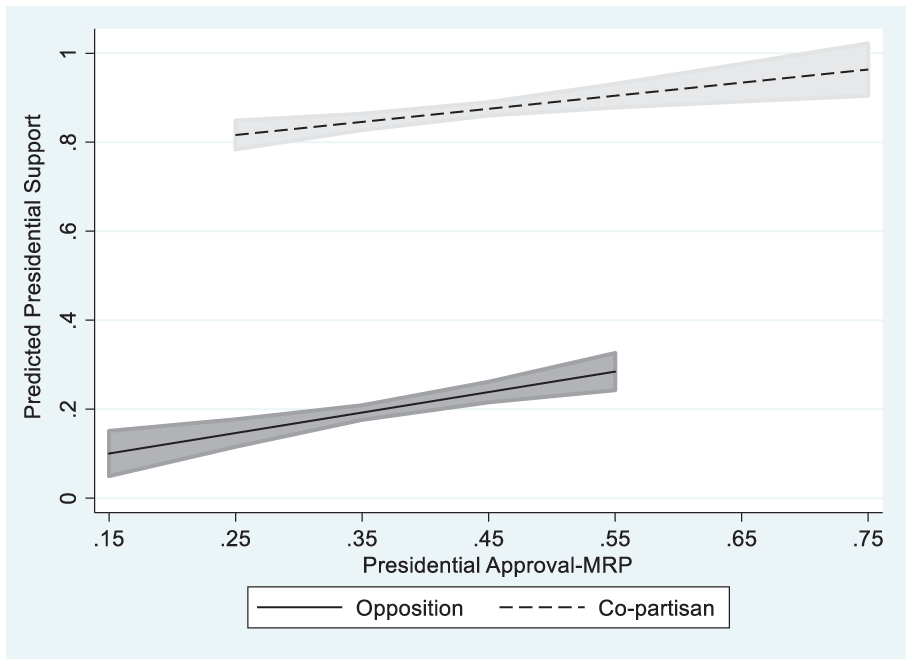
Impact of party status and presidential approval on support for the president, senate, nonunanimous roll calls, 2006–2012.
Do these bivariate results hold up with other variables that may also affect support? In addition to opposition-same party status, we employ several control variables. Ideological distance between the president and the member using Bonica’s period–specific campaign finance (CF) scores 5 and whether the president’s party holds a majority are our main controls. Additional estimations also include electoral vulnerability, presidential party, and national approval. Ideological distance is commonly used in studies of presidential support and is meant as a measure of member policy preferences (Cohen et al. 2000; Dwyer and Treul 2012; Bond and Fleisher 1980, 1984). As roll calls are used to measure ideological distance, the possibility exists that constituent opinion may affect ideology. In fact, for both chambers, ideological distance and approval are correlated at about .30 (p < .001). To guard against spuriousness between approval and support, it is important to control for ideological distance.
Aggregate studies consistently find majority presidents are more successful than minority presidents. Two reasons may account for greater success of majority than minority presidents—the larger number of co-partisans and/or the ability of the majority to advantage the president’s agenda. For instance, Covington, Wrighton, and Kinney (1995) find that presidents win more roll calls that are on their agenda than not on it, and that there is a greater proportion of on agenda items for majority than minority presidents. Similarly, in his game presidential agenda setting model, Beckmann (2010) finds majority presidents are more successful than minority executives. We also control in the models for national approval to test whether members respond to constituency approval, as our hypothesis predicts, and/or to national approval. Confidence in our critique of using national approval at the individual member level will be bolstered if members respond to constituency approval controlling for national approval. Also, we can expect, due to electoral considerations, that electorally vulnerable members will be more responsive to constituent opinion than safer legislators (Griffin 2006). Cohen and Rottinghaus (2018) report that electoral vulnerable legislators are more responsive to constituent approval than safer members. Thus, we control for electoral vulnerability.
Table 1 presents results of several multilevel models, with senators nested in states and states nested in years. Model 1 presents the results of a baseline estimation without the interaction between party status and approval. Most of the baseline variables are statistically significant and in expected directions: support declines as ideological differences widen, co-partisans are more supportive than opposition members, and support is higher when the president is popular in member constituencies. We also test the party differences hypothesis with an interaction term that multiplies party and approval (model 3). The coefficient for the interaction term is positive and statistically significant, providing support for the party differences hypothesis. The results are also substantively meaningful. With a coefficient of above .30, an opposition member’s support will increase by 0.30 or more percent for each 1 percent increase in approval. Plus, the gap in support of co-partisans and opposition members narrows as approval rises.
Impact of State Approval, Party Status, and Reelection Cycle, on Support for the President, Nonunanimous Roll Calls, Senate, 2006–2012, Multilevel Model.
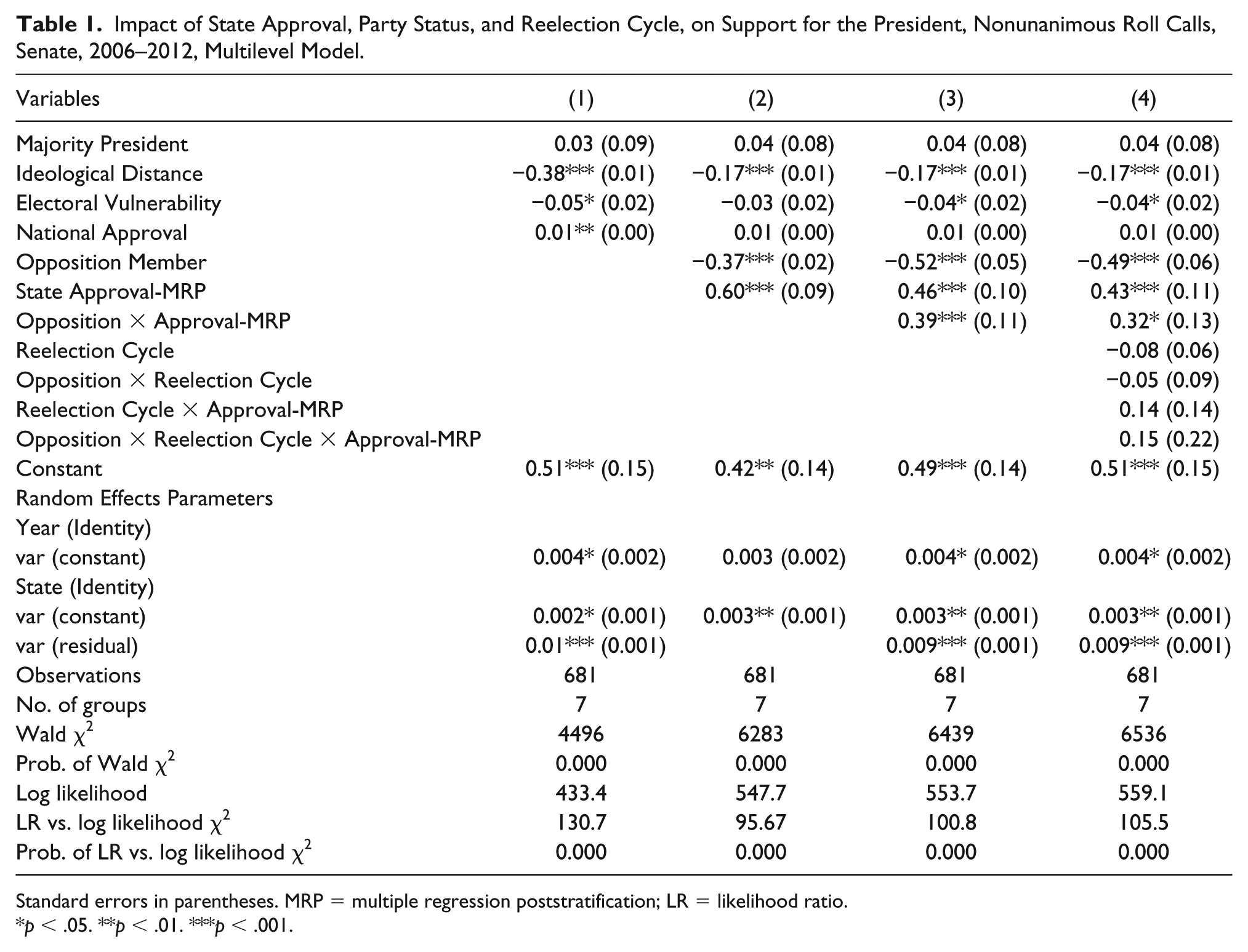
Standard errors in parentheses. MRP = multiple regression poststratification; LR = likelihood ratio.
p < .05. **p < .01. ***p < .001.
Figure 2 presents a marginal plot of support across different approval levels for opposition and co-partisan senators based on model 3. With the above control variables included and the multilevel estimation, both opposition and co-partisan senators appear even more responsive to state-level approval than in the simpler estimation. Furthermore, the difference in responsiveness between opposition and co-partisans widens, as evident by the much steeper slope for opposition than co-partisan senators. Specifically, for each 10 percent shift in presidential approval, co-partisan support rises about 4.6 percent while opposition support increases by about 8.5 percent, a 3.9 percent difference, compared with the 1.5 percent difference using the simpler estimation.
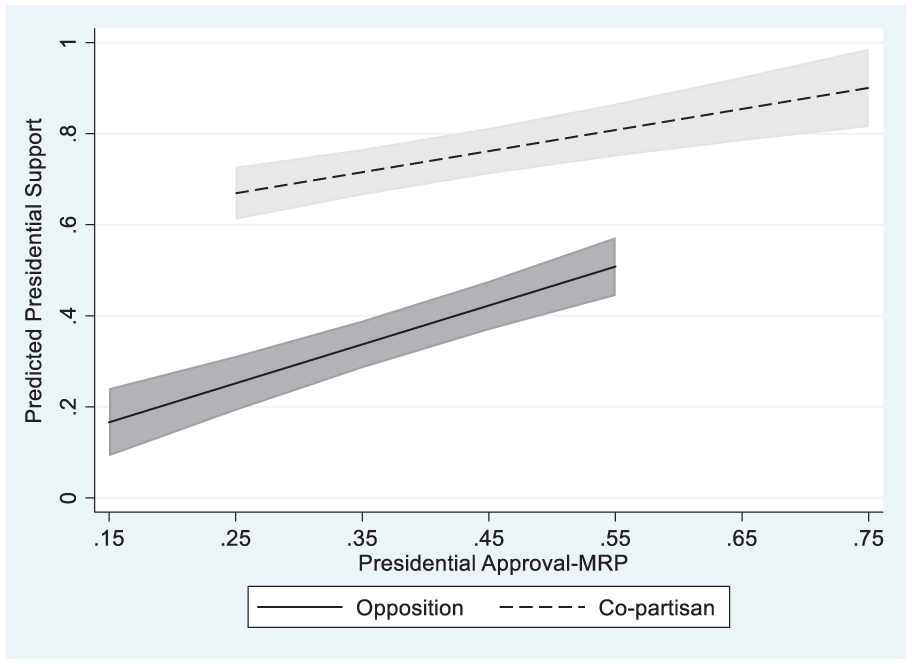
Presidential support of senators by party and state-level approval, 2006–2012.
The electoral cycle hypothesis suggests that senators will demonstrate increasing responsiveness as the election nears. We use the standard electoral cycle definition for the Senate, distinguishing between the first four and the last two years of the six-year term, hypothesizing greater senator responsiveness to constituent approval in Years 5 and 6, reelection years, than the first four years. We interact this dummy variable (non-reelection = 0, reelection years =1) with the approval/party status interaction, a three-way interaction term, (Reelection Cycle) × (Opposition Member) × (State Approval), to test the hypothesis.
Table 1 presents the results. As multicollinearity may be very high with the three-way interactions, coefficients and tests of statistical significance may be unreliable and difficult to interpret. We employ a marginal effects plot to facilitate interpretation—Figure 3 plots the predicted support for the president at different approval levels for the four sets of senators—opposition and co-partisan senators during the reelection and non-reelection phases of their terms in office. The figure shows a steeper slope for opposition senators during reelection years than the non-reelection years, but little apparent difference in slopes for co-partisans across the two sets of year. For instance, in non-reelection years, a 10 percent shift in approval will affect co-partisan support by 4.3 percent compared with 5.7 percent during reelection years, a small 1.4 percent difference. In contrast, in non-reelection years, a 10 percent shift in approval will affect opposition support by 7.6 percent compared with 10.5 percent during reelection years, a 2.9 percent difference, twice as much as for co-partisans.
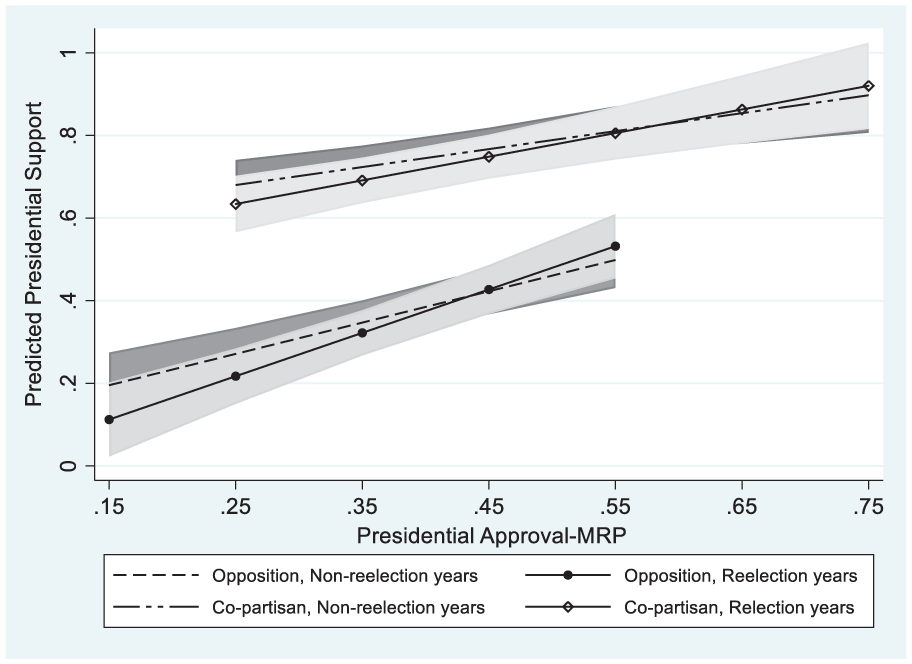
Presidential support of senators by party, election cycle, and state-level approval, 2006–2012.
Party, Approval, and Support in the House
The previous section found strong support for the party hypothesis for senators, but we do not expect opposition representatives to be similarly responsive to district-level approval. Figure 4 presents a scatter plot, with regression lines overlaid, on the simple relationship between approval and party status for the House on nonunanimous roll calls. The figure indicates no relationship between party status and support as approval increases. The slope for opposition members runs parallel to that of co-partisans. For example, each 10 percent shift in presidential approval corresponds to a 3.5 percent change in co-partisan support and a 3.9 percent change in opposition support, hardly any difference, as hypothesized.
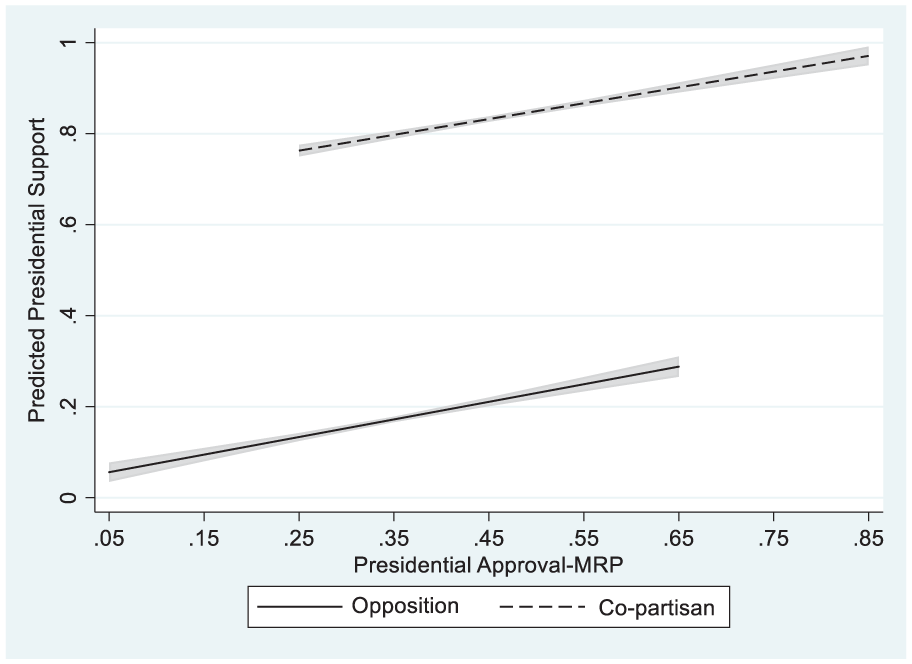
Impact of party status and presidential approval on support for the president, house, nonunanimous roll calls, 2006–2012.
Table 2 model 4, presents a multilevel model, with districts nested in years, and similar controls as used for the Senate estimation. These results repeat what we found for the Senate—majority presidents receive higher support than minority presidents, support declines as ideological differences widen, co-partisans support the president more than opposition representatives, and support is higher when the president is popular. 6 Like for the Senate, we test the party differences hypothesis with an interaction term between opposition party and district approval (see Table 2, model 4). The regression coefficient falls short of statistical significance, but multicollinearity among the variables comprising the interaction term may render those significance tests unreliable. Thus, we turn to a marginal effect plot of support at various levels of approval, presented on Figure 5.
Impact of District Approval, Party Status, and Reelection Cycle on Support for the President, Nonunanimous Roll Calls, House, 2006–2012, Multilevel Model.
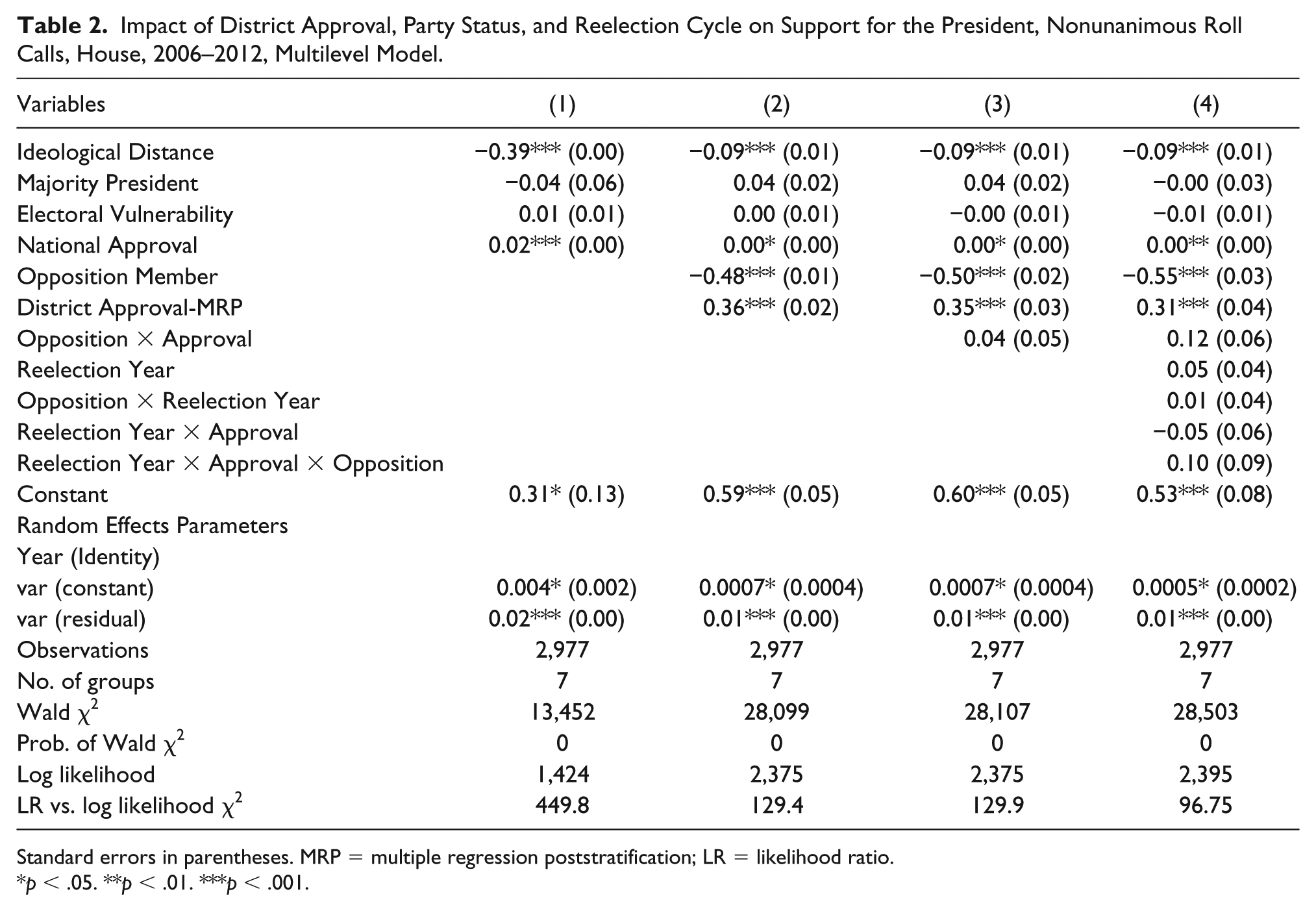
Standard errors in parentheses. MRP = multiple regression poststratification; LR = likelihood ratio.
p < .05. **p < .01. ***p < .001.
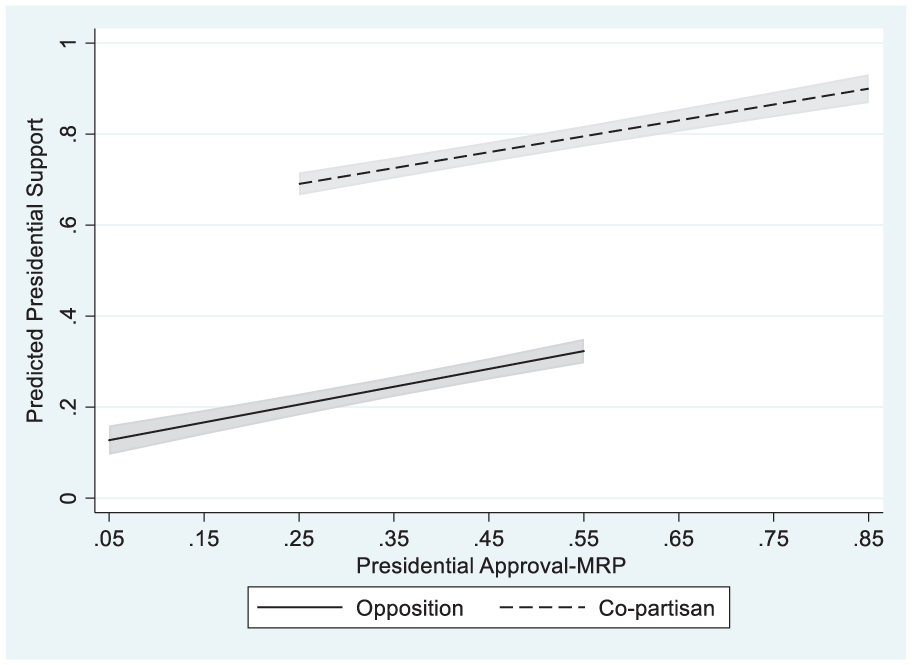
Presidential support of representatives by party and district-level approval, house, 2006–2012.
On Figure 5 (based on Table 2, model 3), the slopes for co-partisans and opposition representatives are similar. A 10 percent shift in presidential approval results in a 3.5 percent change in co-partisan support and a trivially higher 3.9 percent swing for opposition representatives. As the party–chamber hypothesis specifies, differential party responsiveness to approval is found to exist only in the Senate, where the findings show senators have somewhat greater freedom to act on their own reelection needs compared with representatives. Yet, is there an election cycle in opposition responsiveness, as we found for the Senate? Here, for the House, we define the reelection period as the year of the election (even years) and the non-reelection period as the first year of the term (odd years). Then, this dummy variable is interacted with party status and approval, creating a three-way interaction, as above. Table 2 presents the results. Again, the three-way interaction falls well short of statistical significance, but multicollinearity may obscure the effects of the interaction; thus, we turn to a marginal effects plot to facilitate interpretation, shown in Figure 6.
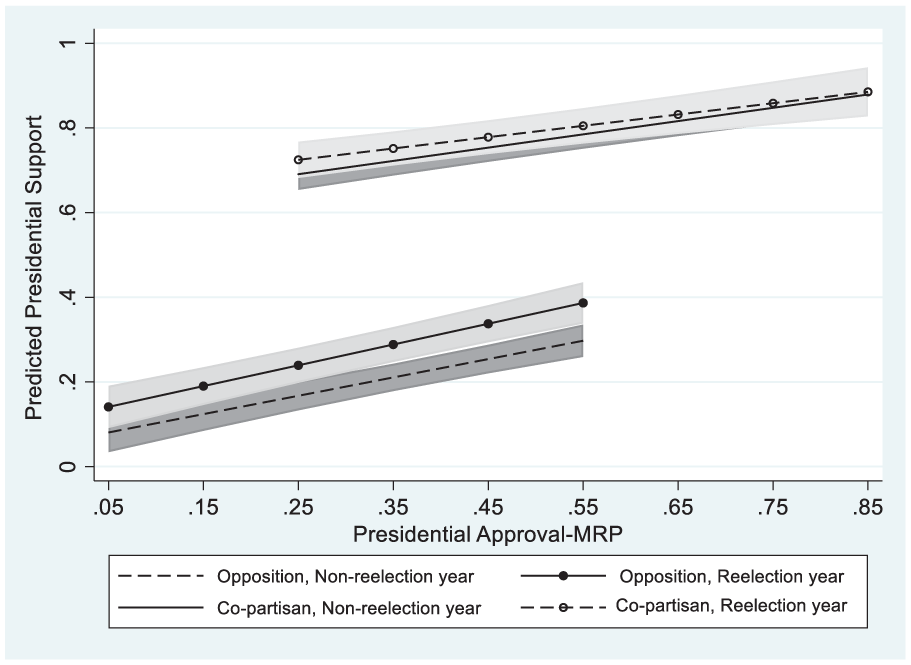
Presidential support of representative by party, election cycle, and district approval, 2006–2012.
The slopes for opposition and co-partisan representatives during non-reelection and reelection years appear nearly identical, suggesting that there is no electoral cycle effect for the House. Specifically, a 10 percent fluctuation in approval leads to a 4.4 percent support shift among opposition represents in the non-election year, and a trivially greater response of 4.9 percent in the election year. Plus, the same 10 percent alteration in approval corresponds to a support shift of 3.1 percent among co-partisans during the non-election year and a trivially lower response rate of 2.6 percent during the reelection year. None of these differences are statistically significant.
Conclusion
Considerable debate exists over whether approval affects member support for the president. One source of the controversy stems from the lack of data on approval within members’ districts. This paper makes several contributions to this literature. First, we present a technique for more precisely estimating presidential approval in districts and states than employed in previous approaches, using MRP on Cooperative Congressional Election surveys from 2006 to 2012. Second, these data allow us to compare the impact of approval on support for both representatives and senators. Extant research has mostly focused on the Senate due to data availability. Third, our data allow us to address whether the member’s party and chamber mediate the effect of approval on support. Past research has compared approval’s effect on opposition and same party legislators, but not representatives versus senators. Comparing behavior across the two chambers adds to the limited but growing literature on House–Senate differences.
First, and most importantly, we find responsiveness to constituent approval for legislators in both chambers, helping to establish the connection between approval and support at the individual member level, as theory predicts but has not been adequately empirically demonstrated. Second, we also find opposition senators are more responsive to changes in approval among their constituents than co-partisan senators. Furthermore, this effect is even greater during the last two years of a senator’s term, when they are preparing and running for reelection. But opposition representatives appear no more responsive to changes in presidential approval levels in their districts than representatives of the president’s party, as our theory predicts.
Our findings are important for several reasons. The first concerns the controversy in the literature on the linkage between approval and support. Theoretically, members are thought to care about approval among their constituents for electoral reasons, fearing they would be electorally punished if their support for the president diverged too much from their constituents’ views of the president. To test the theory requires data on presidential approval within member constituencies, but rarely do such data exist, and when available, it exists primarily for the Senate. Thus, rarely has research directly tested the approval–support relationship. The controversy in the literature over the approval–support relationship is in part a function of indirect tests. Our data, which allow a direct test, provide strong evidence that approval affects member support.
The question of approval’s impact on support is also important from a representation theory standpoint. Representation theory suggests that legislators will consider their constituents’ opinions when making policy. Approval is an important indicator of public reactions to and support of the president, the most visible policy maker for most voters. That we find approval affects member support suggests legislators are representing their constituents’ opinions when casting votes on presidential roll calls. But the differences in responsiveness between the House and Senate also suggest that at least in this regard, opposition senators do a better job of representing their constituents than opposition representatives. This finding is also somewhat ironic, as we would expect representatives, who face reelection contests every two years, to be more responsive to their constituents than senators who have a long six-year term. But as argued here, the majority party leadership in the House has greater influence over its members than available to leadership in the Senate. These chamber differences limit the ability of representatives to be responsive to at least this one aspect of constituent opinion. Future research on chamber differences should look at other aspects of constituent opinion, such as support on specific policies.
One limitation of our research is despite the pooling of data across several years, our design is essentially cross-sectional. In contrast, the aggregate time series research is concerned with the dynamic effects of approval on support—that is, when presidential approval rises or falls, does member support (aggregated to the chamber) respond accordingly (Bond, Fleisher, and Wood 2003). For nearly twenty years, there have been literally hundreds of incarnations of the presidential approval questions on national polls, often with several dozen or more per month. It may be possible to combine such surveys, perhaps monthly using MRP estimation, to develop a dynamic measure of district/state approval, assuming the survey is large enough and provides district and state information on respondents.
Beyond the question of whether approval affects support is the subsidiary question of whether some types of legislators are more sensitive to constituent approval than others. As Edwards (1985) rightly argues, member-level data are best suited for testing such hypotheses. This paper looks at two types of member differences, based on party and chamber, and found the joint effects of these two factors mediated the impact of approval on support for the president. Future research should look at other differences across members. Indeed, whether some types of members are more sensitive to constituent approval than others may have implications for presidential coalition building strategies, linking these opinion dynamics to presidential behavior. Our results suggest presidents might best target opposition senators, especially those running for reelection soon, those whose constituents highly approve of the president, and those from constituencies that the president could finds ways to boost their approval ratings. Some research suggests that local travel and news coverage of the president may marginally increase the president’s approval in those targeted localities (Cohen 2010). An important direction for future research is linking these opinion dynamics to presidential behavior.
The MRP estimation methodology used here also allows us to address another question regarding the impact of constituent approval on presidential support. Canes-Wrone (2006) argues that legislators will be more responsive to constituent opinion on specific policies than presidential approval. Consequently, she argues that presidents will be more likely to take public positions on issues when the public’s policy preferences are closer to the president’s than the existing policy status quo. With MRP, it is possible to estimate both district/state opinion on specific policies and approval and compare their relative influence on member voting when the president has taken a public position. In addition to the question investigated here—the impact of approval on support—the MRP technique employed here suggests numerous new directions for future research.
Supplemental Material
Constitutent_Approval_and_Pres_Support_Supplimental_File – Supplemental material for Constituent Approval and Presidential Support: The Mediating Effect of Party and Chamber
Supplemental material, Constitutent_Approval_and_Pres_Support_Supplimental_File for Constituent Approval and Presidential Support: The Mediating Effect of Party and Chamber by Jeffrey E. Cohen and Brandon Rottinghaus in Political Research Quarterly
Footnotes
Declaration of Conflicting Interests
The author(s) declared no potential conflicts of interest with respect to the research, authorship, and/or publication of this article.
Funding
The author(s) received no financial support for the research, authorship, and/or publication of this article.
Notes
Supplemental Material
Supplemental materials and replication materials for this article are available with the manuscript on the Political Research Quarterly (PRQ) website.
References
Supplementary Material
Please find the following supplemental material available below.
For Open Access articles published under a Creative Commons License, all supplemental material carries the same license as the article it is associated with.
For non-Open Access articles published, all supplemental material carries a non-exclusive license, and permission requests for re-use of supplemental material or any part of supplemental material shall be sent directly to the copyright owner as specified in the copyright notice associated with the article.
