




Abstract
Using traits conventionally believed to lead to elevation from the Circuit Courts to the Supreme Court, this paper uses an item response theory model to estimate latent elevation estimates for each Circuit Court judge nominated and confirmed between 1901 and 2017. I validate this measure by showing that it predicts which Circuit Court judges are promoted to the Supreme Court and which end up on the president’s Supreme Court shortlist. Furthermore, I investigate how the Senate strategically responds to the nomination of Circuit Court nominees with high elevation estimates. The Senate takes longer to confirm nominees with high elevation scores and is less likely to confirm them by voice vote, and these nominees receive a greater share of nay votes. This paper concludes by suggesting additional uses for the elevation estimates.
One of the central questions in the judicial politics literature involves the political dynamics that underlie the selection of the individuals who serve on the federal courts. Existing scholarship addresses questions such as how the president decides who to appoint to the courts (Nemacheck 2008; Rottinghaus and Nicholson 2010), how the Senate exercises its advise and consent authority (Binder and Maltzman 2002; Epstein et al. 2006; Martinek, Kemper, and Van Winkle 2002), and how interest groups participate in the confirmation process (Caldeira and Wright 1998; Maltese 1995). While these questions and their answers provide valuable insight into the political dynamics of judicial selection, they fail to consider one important aspect of judicial selection. The federal courts are designed in a hierarchical structure. Within this hierarchical structure, judges often serve on a lower court and are later promoted to a higher court. In fact, the modal form of experience prior to a particular appointment is experience on a lower court. In the context of the Supreme Court, this means experience on the Circuit Court of Appeals. Of all Supreme Court Justices since 1901, 44 percent have served on the Circuit Court. This trend has only strengthened over time; since the 1970s, at least eight of the nine sitting Justices have served on the Circuit Courts.
Despite the centrality of experience on the lower courts, judicial politics scholars have yet to develop a reliable measure of potential for elevation from a lower court to a higher court. Few scholars have attempted to develop measures that capture Circuit Court judges’ potential for elevation to the Supreme Court. Meanwhile, existing measures suffer from two flaws. First, measures are too narrow and do not encompass a range of nuanced considerations that presidents view as valuable for potential Supreme Court nominees. Second, each measure makes incorrect assumptions about the nature of elevation potential. Specifically, they assume that potential is gained only after a nominee is first confirmed to the Circuit Court. Yet, many Circuit Court nominees are discussed as having the potential for promotion to the Supreme Court before they are even confirmed to the Circuit Court. Thus, the theoretical expectations based on existing measures of potential for elevation are not clearly defined.
To resolve this problem, this paper develops elevation estimates for Circuit Court nominees using an item response theory model. The elevation estimates capture a Circuit Court nominee’s potential to be elevated to the Supreme Court. The estimates are based on a nominee’s experience, personal pedigree, and contextual cues provided at the time of their nomination. I validate the scores in two ways. First, I show that they predict which Circuit Court judges are elevated to the Supreme Court and which Circuit Court judges are considered for elevation to the Supreme Court. Second, I show that in accordance with theory, the elevation estimates predict the degree of scrutiny the Senate gives Circuit Court nominees. Specifically, I show that Circuit Court nominees with high elevation estimates experience greater time to their confirmation vote, are less likely to be confirmed via voice vote, and receive a greater share of nay votes than Circuit Court nominees with lower elevation estimates.
Elevation of Circuit Court Judges
Serving on the Circuit Court of Appeals prior to a Supreme Court nomination is becoming a norm. Since 1901, 44 percent of all Supreme Court Justices have had experience on the Circuit Court of Appeals. This makes experience on the Circuit Court of Appeals the modal form of experience Supreme Court nominees have before they are appointed to the Court. Over time, the trend of Circuit Court experience is strengthening and it is becoming increasingly a norm that Supreme Court Justices will serve on the Circuit Courts prior to their appointment (Epstein, Knight, and Martin 2003). Figure 1 displays the percentage of Justices who had previously served on the Circuit Courts prior to their appointment to the Supreme Court. As Figure 1 highlights, since the 1970s, at least eight of the nine Justices have served on the Circuit Courts prior to their appointment to the Supreme Court. Due to this norm of prior Circuit Court experience, it is important to understand which Circuit Court judges have high potential for elevation to the Supreme Court. Existing research presents several possibilities.

Percent of Supreme Court Justices with Circuit Court Experience.
Court Experience
Budziak (2013) presents the most detailed attempt to estimate an indicator of potential for elevation from the Circuit Courts to the Supreme Court. His measure uses factor analysis, using a judge’s relative age and judicial experience to produce a measure of potential for elevation. Judges who are relatively young with relatively high levels of judicial experience are said to have high potential for elevation. In his analysis, he demonstrates that judges with higher potential for elevation tend to display greater ideological consistency than judges with low potential for elevation. He reasons that judges who are ideologically consistent have greater likelihood of capturing the attention of a co-partisan president.
By contrast, Black and Owens (2016) are less concerned with establishing a measure of potential for elevation and more interested in how being considered for elevation influences the decision making of Circuit Court judges. Black and Owens (2016) conceptualize a Circuit Court judge as being under consideration for promotion as an indicator variable capturing whether the judge appeared on the sitting president’s shortlist for a potential Supreme Court vacancy (Nemacheck 2008). They find that judges who appear on the president’s shortlist update their voting behavior during periods with a Supreme Court vacancy, becoming more ideologically consistent, more compatible with the president, and more deferential to the federal government.
Savchak et al. (2006) model the factors that lead Federal District Court judges to be promoted to the Federal Circuit Court of Appeals. Their model finds that the best predictor of elevation is presidential compatibility with a judge’s record and a shared partisanship between the president and the trial court judge. Thus, while Savchak et al. (2006) do not formally establish a measure of potential for elevation, their model implies that a shared partisanship and ideological compatibility with the sitting president would be two traits that potentially would lead Circuit Court judges to be elevated to the Supreme Court.
While each measure provides useful insights into elevation and how potential elevation may influence judicial behavior, each measure has limitations that diminish their validity as measures of elevation potential. Chief among these limitations is a narrow conceptualization of potential. Specifically, each measure is based on only one or two considerations. For example, Budziak (2013) uses only relative age and experience. While these factors are important, other factors beyond a nominee’s youth and judicial experience are also important. Typically, potential for elevation is discussed in ways that encompass multiple traits each highlighting the importance of experience, personal qualification, and contextual cues. Furthermore, Budziak (2013) does not validate his measure and does not demonstrate that his measure predicts which nominees are elevated from the Circuit Courts to the Supreme Court. Thus, there is limited evidence that demonstrates that the scores produced by Budziak (2013) reliably capture potential for elevation.
The research of Savchak et al. (2006) indicates that the best predictor of elevation is a shared ideology and partisanship with the sitting president. While presidents undoubtedly are concerned about this kind of ideological and partisan congruence, these two factors alone provide a limited explanation for the elevation of Circuit Court judges to the Supreme Court. There are two primary reasons for this. First, at any given time, roughly 30 to 60 percent of the federal judiciary is staffed with co-partisans of the president (Zuk, Gryski, and Barrow 1993). To choose among these co-partisans, presidents must rely on alternative considerations. In other words, shared co-partisanship and similar ideologies may be important, but they are far from determinative. Second, and similarly, presidents must rely on partisan and ideologically neutral arguments when selecting nominees due to the legal nature of the judiciary and confirmation hearings (Cameron and Park 2011; Holmes 2007). Thus, considerations that highlight a nominee’s qualifications and personal pedigree are likely to be important when selecting among co-partisans. Furthermore, it is unclear whether the factors that lead to elevation at the trial court level would mirror those that predict elevation from the Circuit Courts to the Supreme Court.
A secondary weakness is that existing measures define potential for elevation based on information that is only available after a judge’s initial confirmation. This is problematic because many Circuit Court nominees are widely considered to have Supreme Court potential at the time of their Circuit Court appointment. For example, when Sri Srinivasan was initially appointed to the D.C. Circuit Court by President Obama in 2013, he was widely considered to have future Supreme Court potential (Wolf 2013). Another example is Don Willett who, when appointed by President Trump to the Fifth Circuit Court in 2017, was widely viewed as someone with the potential to secure a future Supreme Court appointment (Lind and Matthews 2016).
By not accounting for factors in place prior to their confirmed to the Circuit Courts, current measures of potential for elevation have somewhat flawed theoretical expectations about the influence of potential elevation on judicial behavior. Specifically, the research of Budziak (2013) and Black and Owens (2016) assumes nominees only gain elevation potential once initially confirmed to the lower court, and that once nominees accumulate potential for elevation, they strategically change their behavior to secure elevation to the Supreme Court. However, if some Circuit Court nominees—such as Sri Srinivasan and Don Willett—have potential for elevation prior to taking their seat, the theoretical expectation changes. Specifically, it would be anticipated that many judges behave strategically once they are initially seated. In the context of Budziak (2013), this means the relationship he observes is potentially spurious; nominees who anticipate they will be considered for a future Supreme Court position are likely to engage in strategic behavior their entire career and not only once they gain experience. An alternative account of this finding is that judges display greater ideological consistency in their voting behavior as they gain experience because they have acclimated to their position (Hagle 1993).
In the context of the research of Black and Owens (2016), this means the effects they estimate likely underestimate the true effects of being considered for elevation because some judges in their sample may have been acting strategically their entire careers as they anticipated being considered for a Supreme Court vacancy. Thus, because all existing measures of potential for elevation are based on post-confirmation considerations, the theoretical expectation of how potential for elevation influences the behavior of judges is unclear. Furthermore, because each measure is based on post-confirmation information, current measures of potential for elevation cannot be used to address pre-confirmation research questions. This is especially problematic because there is a strong theoretical basis to believe that the Senate will treat high potential Circuit Court nominees differently than low potential Circuit Court nominees.
Elevation Estimates
While the elevation of judges has received considerable attention in the scholarly literature, there is still little evidence about what makes a Circuit Court of Appeals judge have high potential for a future elevation to the Supreme Court. As discussed above, current conceptualizations of potential for elevation are limited because each measure relies on a narrow set of nominee traits and uses information available only post confirmation. To remedy these problems, I use item response theory to estimate latent elevation estimates using information from multiple indicators that are widely considered to lead to elevation. Moreover, these indicators are known prior to a nominee’s initial Circuit Court confirmation. My sample includes all judges nominated and confirmed to the Circuit Court of Appeals between 1901 and 2017. Data on nominees are collected from the Federal Judiciary Center.
When choosing Supreme Court nominees, the president values experience (Nemacheck 2008). Presidents value experience because a lengthy work experience provides insight into the decision making of potential nominees. Indeed, Hitt (2013) shows that when the president selects Supreme Court nominees with high levels of previous work experience, the president is more likely to succeed in selecting someone who closely matches their own ideology.
Yet not all experience is equally informative. Some experiences are better suited for developing the legal skills and acumen required to be a Supreme Court Justice. Furthermore, some experiences provide more information about a potential nominee’s attitudes and beliefs about the political and legal issues they could potentially hear as a Supreme Court Justice. Specifically, nominees who have previously worked in the office of the Solicitor General accumulate vast knowledge about the inner workings of Supreme Court and the types of legal issues that come before it. The Solicitor General is so well respected by the Supreme Court that she is often referred to as the “tenth Justice” (Caplan 1987). Due to the nature of the position, work experience in the office of the Solicitor General provides two important signals for a president making a Supreme Court appointment. First, it provides a record of how the individual thinks about important legal issues before the Court, and second, it provides the individual with experience in dealing with the types of legal issues likely to be before the Court. These two factors make an individual with work experience in the office of the Solicitor General an attractive candidate for a future Supreme Court appointment.
Similar to experience in the office of the Solicitor General, having experience in the Justice Department makes individuals attractive for a future Supreme Court nomination. Work in the Justice Department provides a vast record of an individual’s thoughts and beliefs on a wide range of legal issues and similarly provides them with knowledge of the federal court system. For these reasons, whether an individual has had previous work experience in the office of the Solicitor General or Justice Department is included in the item response model that predicts latent elevation estimates.
Another source of work experience that signals potential for elevation is work experience as a Supreme Court law clerk. Supreme Court law clerks represent the best students from the most elite law schools (Ward and Weiden 2006). Supreme Court law clerks work closely with the Justices to decide which cases should be granted certiorari; moreover, in most cases, they produce first drafts of the Court’s opinion (Ward and Weiden 2006). Experience as a Supreme Court law clerk signals an individual’s intellectual ability to carry out the work required of a Supreme Court Justice. Experience as a clerk also potentially makes it easier for a potential nominee to adjust to their work on the Court requiring less time to acclimate to their new role on the Supreme Court (Hagle 1993). Presidents likely prefer a nominee that takes less time to acclimate because Justices show greater ideological variation as they acclimate to their new positions (Hagle 1993). For these two reasons, experience as a Supreme Court law clerk increases the elevation potential among Circuit Court nominees.
When selecting potential Supreme Court Justices, presidents also place high value on personal qualification. Cameron and Park (2011) demonstrate that in public remarks about their Supreme Court nominees, presidents focus their remarks on the nominee’s qualification and personal background. For example, when President Trump nominated Neil Gorsuch to the Supreme Court in 2017, he did not mention that Gorsuch was widely viewed as a political conservative. Instead, President Trump remarked that “Judge Gorsuch has outstanding legal skills, a brilliant mind, tremendous discipline, and has earned bipartisan support [in his previous confirmation to the 10th Circuit Court]” (Trump 2017). Thus, to be considered a high potential Circuit Court nominee, the nominee must have strong personal qualifications. Work experience in substantively meaningful position—such as the Office of the Solicitor General, the Justice Department, Supreme Court law clerk—help presidents articulate a nominee’s qualification, but there are other important indicators of qualification that give Circuit Court nominees potential for future elevation to the Supreme Court.
The first is whether the nominee attended an elite law school. Attending an elite law school sends signals about a nominee’s personal qualifications. By attending an elite law school, it is assumed that nominees have the intellectual capabilities required to be a successful judge. Furthermore, elite law schools serve as gatekeepers for other opportunities that make a nominee have potential as future Supreme Court appointee (Borthwick and Schau 1991; Redding 2003). Thus, by attending an elite law school, individuals are likely to find themselves in networks or careers that allow them to gain the types of experience presidents desire in Supreme Court nominees (Barton 2012). For these reasons, if a Circuit Court nominee attended an elite law school, it gives them a greater potential for future elevation to the Supreme Court. For the purposes of this paper, elite law schools are defined as the top five law schools according to the USA Reports which include Harvard, Stanford, Yale, Chicago, and Columbia. While there is some variation among the top five law schools, over time that variation typically occurs only within the subset of the top five. For example, Yale may move from being the third ranked law school to the second ranked law school, but it is much more rare for a different law school to enter the top five (Bonica and Sen 2017).
Another indicator of qualification is a candidate’s American Bar Association (ABA) rating. The ABA’s Standing Committee on the Federal Judiciary vets nominees’ record using three criteria: (1) integrity which captures the nominee’s reputation within the legal community; (2) professional competence which includes intellectual capacity, writing and analytical skills, and knowledge of the law; and (3) judicial temperament which encompasses the nominee’s commitment to the rule of law, their decisiveness, open-mindedness, and freedom from bias (ABA 2009). Based on these criteria, the ABA assigns nominees a rating of “well qualified,” “qualified,” or “not qualified.” 1 Nominees who achieve the highest ABA score demonstrate that they are well respected by the legal community and widely viewed as excelling in the responsibilities they will be undertaking as a judge. Nominees’ ABA ratings are used by the president in their public remarks about nominees and are discussed during nominees’ confirmation hearings to signal their qualifications (Cameron and Park 2011; Farganis and Wedeking 2014). Due to the importance of a nominee’s ABA rating in framing their qualification and their initial confirmation, nominees who earn a “well-qualified” rating by the ABA are viewed as having higher potential for future elevation from the Circuit Courts to the Supreme Court.
Beyond experience and qualifications, contextual factors provide some information about the potential for elevation Circuit Court nominees have. One such contextual indicator is which Circuit Court a judge is initially appointed to. Specifically, nominees who are initially appointed to the D.C. Circuit may be seen as having greater potential for elevation than nominees initially appointed to other Circuit Courts. The D.C. Circuit Court is often referred to as the “second highest court in the land” and initially hears many salient cases dealing with Congressional and constitutional interpretation. Because of this, the D.C. Circuit Court is often referred to as a “proving ground” for future Supreme Court nominees (Bravin 2013). Based on this, a variable that captures whether the nominee was initially nominated to the D.C. Circuit is included in the latent model of potential for elevation.
A second contextual factor that is important to presidents is the nominee’s age. Once confirmed, Supreme Court Justices serve lifetime terms, pending good behavior. Presidents want to maximize their influence over policy by selecting young nominees who are likely to serve long terms, and this is especially true at the level of the Supreme Court (Budziak 2013; Nemacheck 2008). Executive officials, tasked with helping President Reagan select Supreme Court nominees, regarded fifty as the perfect age for a potential Supreme Court nominee, reasoning that fifty-year-old appointees were young enough to serve long term and old enough to have accumulated enough experience to be qualified for the position (Bravin 2013). Other presidents have seemingly followed similar advice, as the average age of the Supreme Court nominee is fifty-three at the time of their appointment (Bialik and Gramlich 2017). Due to the importance of age, for a Circuit Court judge to have high potential for elevation, they must be young. Here, I define a young nominee as being forty-five years of age or younger at the time of their appointment to the Circuit Courts. This is somewhat younger than the average Circuit Court nominee, who has an average age of forty-seven years old. The justification for using forty-five is that this allows nominees to gain a few years of experience before attaining the “perfect age” for elevation, which President Reagan’s advisers indicated is fifty. 2
To summarize, research indicates multiple traits that highlight a nominee’s experience and personal pedigree. Many of these traits provide contextual cues indicating that a Circuit Court nominee has the potential to be elevated to the Supreme Court. These traits are as follows: (1) experience working in the Office of the Solicitor General, (2) experience in the Justice Department, (3) experience as a Supreme Court law clerk, (4) having attended an elite law school, (5) receiving the highest qualification rating from the ABA, (6) being appointed to the D.C. Circuit, and (7) being under the age of forty-five. Table 1 details the percentage of nominees who have each item.
Percentage of Circuit Court Nominees with Each Item.

ABA = American Bar Association.
Using information from these seven items, I estimate an item response theory model to predict nominees’ latent potential for elevation from the Circuit Courts to the Supreme Court (Birnbaum 1968). Only nominees confirmed to the Circuit Courts are included in the analysis and nominees who failed to obtain confirmation are excluded from the analysis. 3 Data on nominees come from the Federal Judiciary Center. The specific item response model estimated uses binary indicators to estimate a continuous latent concept and includes both discrimination and difficulty parameters. One of the assumptions of item response theory models is that the underlying concept is unidimensional. Using the advice of Funk and Rogge (2007), I use factor analysis to confirm the unidimensionality of the latent concept. The model includes robust standard errors on Congressional session. While the expectation is that across the entire series each of the seven traits has a positive association with potential for elevation, the relative importance of each trait may vary depending on session-specific contextual considerations, such as the specific individuals or current norms in the Senate. 4 Therefore, I expect that the errors are correlated within Congressional sessions (Lynch and Madonna 2013).
The discrimination parameter provides information on how well individual items differentiate between those with low elevation potential and high elevation potential, and is represented by each item’s slope. In the model of latent potential for elevation, previous experience as a Supreme Court law clerk, attending a top five law school, and being appointed to the D.C. Circuit Court have the highest discrimination parameters.
The difficulty parameter provides detail on how much information each item contributes to the latent elevation estimate and is represented by the item’s intercept. In the model of latent potential for elevation, work experience in the Justice Department, being nominated to the D.C. Circuit Court, and work experience in the office of the Solicitor General have the highest difficulty parameters. Therefore, these items provide the greatest weight to the latent elevation estimates.
The upper pane of Figure 2 visually presents the model’s parameters. After estimating the item response model, I derive elevation estimates for each judge in the data set. These scores range between 0 and 1, where higher values represent greater potential for elevation. The lower left pane and lower right pane of Figure 2 display the distribution of elevation estimates. The lower left pane includes the estimates with ±1 standard error, and the right pane displays a histogram of the resulting scores. The average elevation estimate is .16, with a standard deviation of .20. The individual judge with the highest elevation estimate is Sri Srinivasan. Other judges in the top ten of elevation estimates are Richard Posner, Merrick Garland, John Roberts, Douglas Ginsburg, Harold Leventhal, Robert Bork, Brett Kavanaugh, David Barron, and Neil Gorsuch. Of these individuals, six have been nominated for elevation to the Supreme Court and eight have appeared on presidential shortlists.

Summary of IRT model.
If the elevation estimates are a valid measure of which Circuit Court nominees will go on to be appointed to the Supreme Court, one way to validate the estimates is to determine whether they predict who is elevated to the Supreme Court and who is considered for elevation. To accomplish this, I estimate three logistic regression models. The first model predicts nomination to the Supreme Court using the elevation estimates. The second model predicts consideration for elevation to the Supreme Court as a function of the judge’s elevation estimate. I conceptualize consideration for elevation as appearing on the president’s Supreme Court shortlist (Nemacheck 2008). 5 Of the 641 judges included in the data, 3.77 percent (25) were elevated to the Supreme Court 6 and 16.42 percent (109) appeared on the president’s shortlist for consideration. Finally, I validate the elevation estimates by using them to predict selection for nomination from the shortlist. If the elevation estimates predicted which candidate is selected from the shortlist, it would further them as a valid measure of elevation potential.
The results of these three logistic regressions are presented in Figure 3, which demonstrates that the nominee’s elevation estimate strongly predicts whether they will be considered for elevation. The left pane displays the relationship between the elevation estimates and the probability of being nominated to the Supreme Court. For a nominee with an elevation estimate of 0, the predicted probability of them being nominated to the Supreme Court is .01, while a nominee with an elevation estimate of 1, the predicted probability is .48. The middle pane displays the relationship between the elevation estimate and appearing on the president’s Supreme Court shortlist. The predicted probability of a nominee with an elevation estimate of 0 appearing on the shortlist is .10, while a nominee with an elevation estimate of 1, the predicted probability is .68. The right pane displays the elevation of being selected for nomination to the Supreme Court conditioned on whether the candidate appeared on the president’s shortlist. The predicted probability of a nominee selected off the shortlist is .128, while a nominee who has an elevation estimate of 1 has a probability of .64. These results demonstrate that the elevation estimates are valid and predict what they are intended to predict—that is, elevation to the Supreme Court and consideration for elevation.

Validation of elevation estimates.
Senate Confirmation Behavior
While I have validated the elevation estimates by demonstrating that they predict which Circuit Court judges are considered for elevation to the Supreme Court, as well as which judges are ultimately selected for elevation, another form of validation would demonstrate that the estimates help explain political phenomena in ways that would be anticipated by theory. Specifically, I analyze how a Circuit Court judge’s elevation estimate influences the Senate’s behavior during their initial confirmation hearing. Analyzing how elevation estimates influence the Senate’s behavior during Circuit Court judge’s initial confirmation hearings has the additional benefit of justifying using pre-confirmation measures of elevation potential, which is an important advantage of the elevation estimates developed here compared with alternative measures.
The scrutiny the Senate gives nominees to the Circuit Court of Appeals varies significantly across nominee. Some nominees receive little scrutiny, such as James Graves who was appointed by President Barack Obama in 2013. The Senate took just forty days from his nomination to confirm him. Graves was confirmed via voice vote, with no formal opposition to his nomination. Meanwhile, some nominees such as Stephen Higginson who was also appointed by President Barack Obama in 2013 receive intense scrutiny. Higginson waited 175 days to be confirmed, and when he was confirmed, the Senate used a roll-call vote in which 20 percent of the voting Senators voted against his nomination.
A long line of research attempts to explain the level of scrutiny that Circuit Court nominees face before they are confirmed by the Senate. One popular conceptualization of scrutiny is the length of time it takes the Senate to confirm a Circuit Court nominee after the president formally appoints them. On this question, the literature concludes that the variation in scrutiny is best explained by institutional opportunities, ideological consideration, and nominee demographics. For example, Binder and Maltzman (2002) demonstrate that ideological considerations influenced the length of time it took the Senate to confirm Circuit Court nominees. Specifically, when the Senate median is ideologically distant from the President and when the Senate is controlled by the opposition party, nominees are given greater scrutiny. Binder and Maltzman (2002) also find that institutional considerations such as the length of time left in the Congressional session influenced the degree of scrutiny given to a nominee. If a nominee was appointed early in the Congressional term, the Senate will provide them with greater scrutiny than if they were appointed later in the Congressional term.
Martinek, Kemper, and Van Winkle (2002) come to similar conclusions, finding that both ideological considerations and institutional concerns predict the length of time a Circuit Court judge will await before being confirmed. Like Binder and Maltzman (2002), Martinek, Kemper, and Van Winkle (2002) demonstrate that ideological distance matters. Martinek, Kemper, and Van Winkle (2002) also provide evidence that institutional considerations matter too. Specifically, they show that nominees will receive more scrutiny in the president’s second term and late in the president’s term. They also find that nominations after Robert Bork’s failed nomination to the Supreme Court, nominees receive more scrutiny and face longer times to confirmation. They argue that this is because Bork’s failed nomination changed the Senate’s norms regarding judicial appointments. In addition to ideological considerations and institutional opportunity, Martinek, Kemper, and Van Winkle (2002) find that nominee traits can influence a nominee’s time to confirmation. They find that nominees with higher ABA ratings experience less time to confirmation, while racial and ethnic minority, and female nominees receive more time to confirmation.
Returning to the example of the nominations of James Graves and Stephen Higginson, existing explanations of nominee scrutiny fail to explain the vast difference in the two nominees’ times to confirmation. Both nominees were nominated by the same president during the same session of Congress and have similar demographic traits. If existing explanations fail to explain the vast differences in the Senate’s behavior toward the nominations of two similar nominees, what does? One explanation could be their potential for elevation to the Supreme Court. Graves has an elevation estimate of 0, indicating he has below average potential for elevation; by contrast, Higginson has an elevation estimate of .66, indicating significantly above average potential to be elevated to the Supreme Court. Beyond the differences in the Senate’s treatment of the Graves and Higginson nominations, there is reason to believe that the Senate will give greater scrutiny to Circuit Court nominees with higher elevation estimates. One reason that Circuit Court nominees with higher elevation estimates may receive more scrutiny is because there is potentially more at stake during their confirmation than nominees with low elevation estimates. For high elevation estimate nominees, not only is a position on the Circuit Court at stake but perhaps a future position on the Supreme Court as well. Because of this, the Senate has greater incentive to scrutinize the nominee’s background and make sure there are no issues that could cause problems for a future elevation to the Supreme Court.
This incentive is present for co-partisans and opposition partisans. Co-partisans want to ensure there are no surprises that may come up during a future Supreme Court nomination and cause the nominee embarrassment; the opposition partisans may believe it is easier to damage the credibility of a Circuit Court nominee than a Supreme Court nominee in which there is a high presumption of confirmation (Krutz, Fleisher, and Bond 1998). Furthermore, high potential nominees may invoke more strategic disagreement and obstruction from the minority party simply because they want to annoy the majority party and score points for their “team” (Gilmour 1995; Lee 2009; Theriault 2013). This incentive diminishes for low potential nominees because considering their low potential, the costs in terms of time and energy are not worth the effort put into disagreement and obstruction. On the whole, because there is more at stake for Circuit Court nominees with high elevation estimates, this should incentivize the Senate to give these nominees more scrutiny. Hypothesis 1 formalizes this expectation:
While time to confirmation has been the most widely used indicator of the Senate’s scrutiny toward judicial nominees, it is not the only form of scrutiny. Another form of scrutiny is to confirm nominees by roll-call vote rather than a vote voice. At the Circuit Court level, vote voice is the most common form of confirmation with 78 percent of Circuit Court nominees between 1901 and 2017 being confirmed by voice vote. Voice votes allow nominees to be confirmed via unanimous consent without the need to hold an official roll-call vote. Voice votes allow the Senate to take care of routine business quickly and save limited floor time for more important issues (Oleszek 2001). While there is little research on the conditions under which judicial nominees will be confirmed via voice vote or roll-call vote, it seems reasonable that low-salient nominees will be confirmed via voice vote while higher salient nominees will be confirmed or approved by roll call (Oleszek 2001). Due to their high potential for elevation to the Supreme Court, Circuit Court nominees with higher elevation estimates are more salient than nominees with low potential for elevation.
Furthermore, holding a roll-call vote guarantees more information that can be used by the Senate in case of a future potential nomination to the Court. Based on this, I advance Hypothesis 2:
While there is greater incentive to give more scrutiny to Circuit Court nominees with higher elevation estimates, there is also an incentive for Senators who would oppose a Circuit Court nominee in a potential promotion to the Supreme Court to vote nay on their Circuit Court confirmation—even if they believe the nominee to be qualified for the Circuit Court. When judges are elevated from the Circuit Court to the Supreme Court, their confirmation vote at the Circuit Court is used to frame their Supreme Court hearings. For example, after President Trump appointed Neil Gorsuch to the Supreme Court in 2017, many Republican Senators invoked his unanimous confirmation to the 10th Circuit Court of Appeals to frame him as an acceptable Supreme Court nominee who in the past had obtained bipartisan support (Hulse 2017). Senators who anticipate opposing the Circuit Court nominee for a potential Supreme Court nomination, then, have an incentive to vote against their nomination to the Circuit Court—even if they believe the nominee is qualified as a Circuit Court nominee. This is because they want to prevent a future potential frame of unanimity or bipartisan support at a potential future Supreme Court confirmation hearing. Due to this incentive, I posit Hypothesis 3:
Data and Analysis
Time to Confirmation
My argument is that the Senate will give greater scrutiny to nominees with high elevation estimates. One conceptualization of scrutiny has been the time it takes the Senate to confirm potential nominees. Hypothesis 1 argues that the Senate will take longer to confirm nominees who have high elevation estimates. To test this hypothesis, I fit an accelerated failure duration model that predicts nominees’ time to confirmation in days. 7 Data on time to confirmation were obtained from the Federal Judiciary Center. 8 The model controls the ideological considerations, 9 institutional considerations, and nominee demographics already known to influence time to confirmation (Binder and Maltzman 2002; Martinek, Kemper, and Van Winkle 2002). 10 Because errors are likely to be correlated within each Congressional session, robust standard errors are used and clustered on each Congressional session (Lynch and Madonna 2013). The results for the accelerated failure model are presented in Table 2.
Accelerated Failure Model.

Standard errors in parentheses.
p < .05. **p < .01. ***p < .001.
Being that coefficient for the elevation estimate variable is statistically significant and less than 1 provides support for Hypothesis 1, which posited that nominees with higher elevation estimates will endure longer periods until they are confirmed. Figure 4 displays the survival curves for individuals with the minimum and maximum elevation scores. The model implies that a nominee who has the minimum elevation score has a probability of .25 not being confirmed after eighty-four days—the average time to confirmation—while a nominee with the highest elevation score has a probability of .43 of not being confirmed at this point.
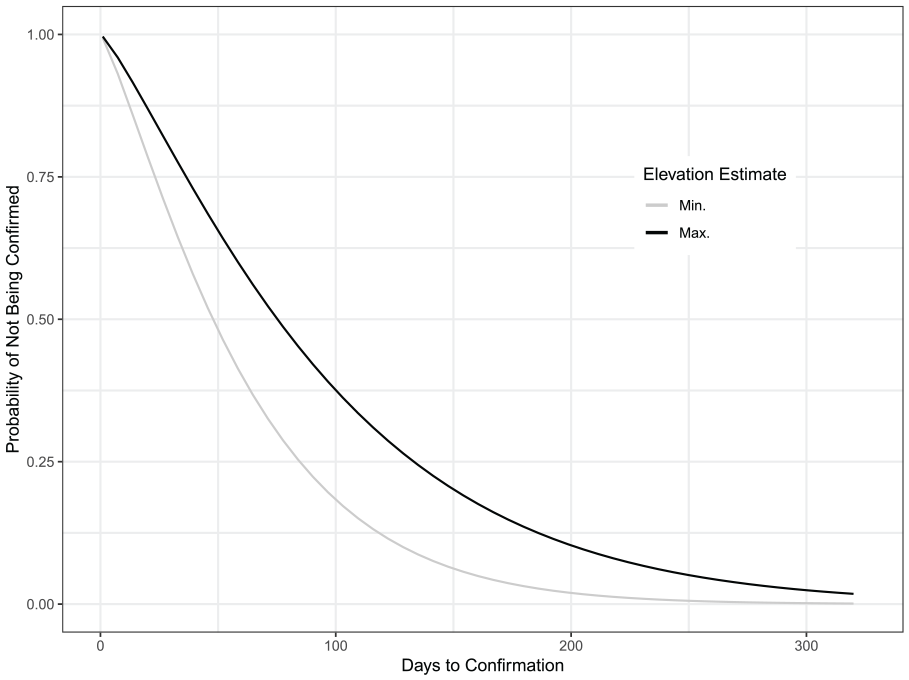
Accelerated Failure Model model results: Demonstrating longer times to confirmation for nominees with high elevation estimates.
Voice Vote
Another way the Senate can express heightened scrutiny of federal court nominees is to subject them to roll-call vote rather than voice votes. For federal court nominees, voice vote is the primary method of Senate confirmation. Of all nominees confirmed between 1901 and 2017, 79 percent were confirmed via voice vote. Roll-call votes require Senators to officially voice their preference on a nominee, serving as a record in the event that a nominee is eventually elevated to the Supreme Court. Hypothesis 2 predicts that nominees with higher confirmation scores will be less likely to be confirmed via voice vote. To test this hypothesis, I fit a logistic regression model that predicts whether a nominee was confirmed via voice vote. Data on whether a nominee received a voice vote were obtained from the Federal Judicial Center. The model includes clustered robust standard errors on individual Congressional session to account for the possibility that errors are correlated within each session (Lynch and Madonna 2013). The model controls for each of the variables included in Table 2. The results from the logistic regression analysis are presented in Table 3.
Logistic Regression: Voice Vote.

Standard errors in parentheses.
p < .01.
In Table 3, the coefficient for the elevation estimate score is statistically significant and negatively signed, indicating support for Hypothesis 2. Nominees with high elevation estimates are less likely to be confirmed via voice vote and instead are confirmed via roll calls where votes are officially recorded. The substantive effect across the range of a nominee’s elevation estimate is presented in Figure 5. A nominee with the minimum elevation estimate has a predicted probability of being confirmed via voice vote of .81, while a nominee with the highest elevation estimate has a predicted probability of just .50 of being confirmed via voice vote.

Logistic model results: Demonstrating nominees with higher elevation estimates are less likely to be confirmed via voice vote.
Nay Votes
My general expectation is that when presented with a federal appeals court nominee who has a high potential to be elevated to the Supreme Court, the Senate gives these nominees greater scrutiny than nominees with low potential for elevation. Thus far, I have demonstrated this to be true in two contexts: (1) time to confirmation and (2) whether a nominee is subjected to a roll-call vote. Another way the Senate can give scrutiny is to vote against their confirmation. Hypothesis 3 states that nominees with higher elevation estimates will receive more nay votes than nominees with lower elevation estimates. Senators have a greater incentive to vote nay on high elevation nominees because it prevents potential narratives of unanimity at potential future Supreme Court confirmation hearings. During Supreme Court confirmation, nominees’ past confirmation votes to the federal court of appeals are heavily discussed, and the opposition party threatens being accused of opposing a nominee they once endorsed. For example, when considering Neil Gorsuch’s nomination to the Supreme Court, Senator Mitch McConnell drew heavily from the fact that Gorsuch was unanimously confirmed to the Circuit Court. To test Hypothesis 3, I estimate a two-step Heckman selection model. The first step models whether or not the nominee is confirmed via roll-call vote or voice vote. The second stage models the percentage of nay votes a nominee receives conditional upon the effect of the selection variables. The model includes clustered robust standard errors on each Congressional session, to account for the fact that errors are correlated within sessions (Lynch and Madonna 2013). This model excludes nominees confirmed via voice vote and controls for the other variables included in the models in Tables 2 and 3. The results to the second stage of the Heckman selection model are presented in Table 4. The statistically significant and positively signed coefficient for the elevation estimate variable indicates that Hypothesis 3 is supported by the data. Nominees with high elevation estimates receive a greater percentage of nay votes than nominees with lower elevation estimates. Substantively, moving from the minimum to the maximum elevation estimate score increases the share of nay votes by 27.8 percent.
Heckman Selection Model: Percent Nay.
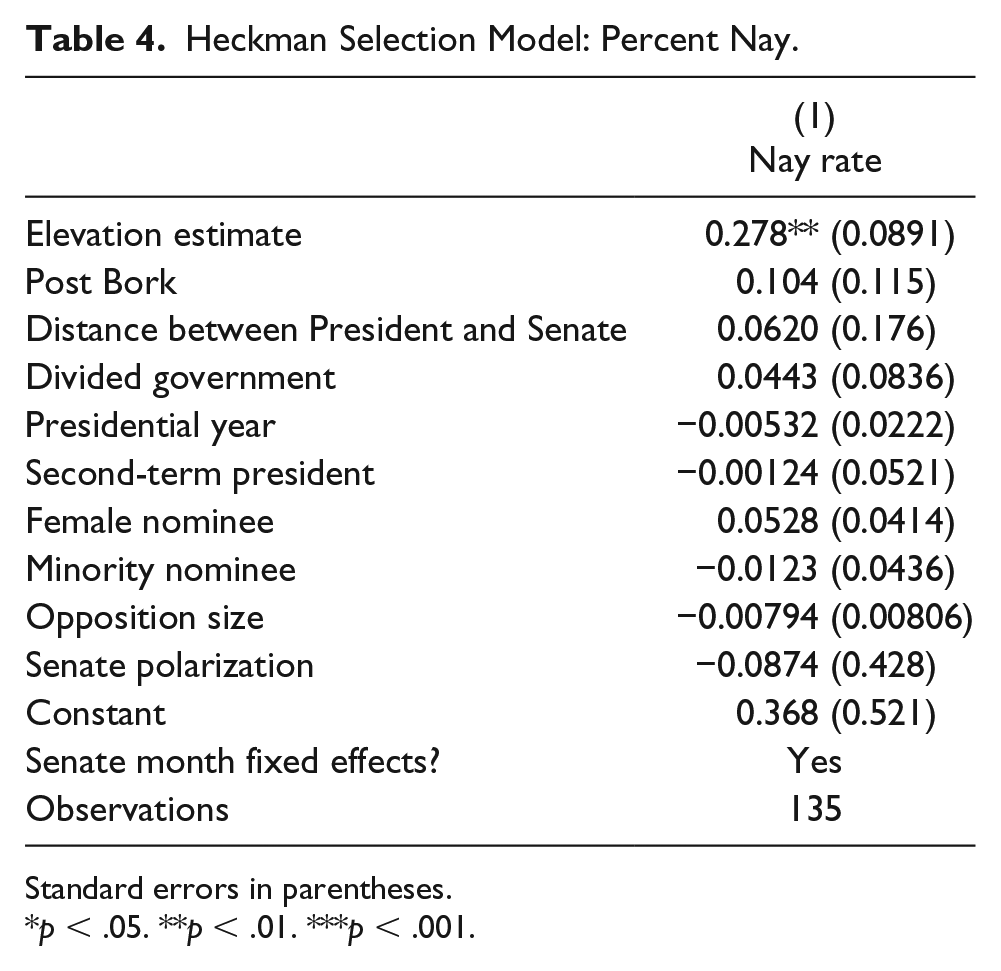
Standard errors in parentheses.
p < .05. **p < .01. ***p < .001.
Future Usage of the Elevation Estimates
The elevation estimates produced in this paper have a broad set of potential future applications. Research on elevation considers how the potential for elevation influences the decision making of Circuit Court judges. However, as I argue in this paper, this research conceptualizes potential for elevation in a problematic manner. Specifically, this research assumes that potential only begins to manifest once a Circuit Court judge is confirmed. However, this is not the case. Many nominees have Supreme Court potential prior to their confirmation as a Circuit Court judge. Thus, the theoretical expectations of previous research are somewhat flawed. The elevation estimates derived in this paper provide a better test of the potential for elevation on judicial behavior. Specifically, my expectation would be that early in their careers, Circuit Court judges engage in behaviors that signal their ideologies and elevation potential to appointing presidents. This type of behavior would include greater ideological consistency, a higher propensity to write separate opinions, and greater deference toward executive authority. However, as a Circuit Court judge with a high elevation estimate ages, and the probability for promotion passes them by, it would be expected that their elevation estimate is less predictive of this type of behavior.
Another application of the elevation estimates is to determine whether they help predict a judge’s decision to retire from the Circuit Court of Appeals. Specifically, it may be expected that judges with high elevation estimates see themselves as having potential to be elevated to the Supreme Court and this is a career goal they set for themselves. However, once passed over for a vacancy, these judges may feel disappointed and realize that they will be unlikely to achieve their career goals. This may lead them to retire from the Circuit Courts and pursue other employment opportunities, such as in private practice or legal education. However, judges with low elevation estimates probably understand that it would be a long shot for them to be elevated to the Supreme Court; thus, when passed over during a vacancy, they do not feel disappointed and are not any more likely to retire to pursue alternative career paths because they do not experience the same disappointment.
Finally, this paper estimates elevation estimates that capture the potential of Circuit Court judges to be elevated to the Supreme Court, but it is often the case that judges on the Federal District Courts are elevated to the Circuit Courts (Savchak et al. 2006). Similar elevation estimates can be developed to capture the potential elevation of District Court judges. Once elevation estimates are produced for District Court nominees, similar research to that proposed for Circuit Court nominees can be conducted. Specifically, does the Senate give greater scrutiny to District Court nominees with high Circuit elevation estimates? Do District Court judges with high Circuit elevation estimates behavior differently than those with low estimates? and Are high potential District Court judges likely to retire after being passed over for a Circuit Court vacancy?
Summary of Findings and Implications
The modal form of experience Supreme Court nominees have is experience on the Circuit Court of Appeals. Since 1901, 44 percent of Supreme Court Justices have had experience on the Circuit Courts, and in recent years, this trend has strengthened. Since the 1970s, at least eight of the nine sitting Justices have served on the Circuit Courts. Despite the centrality of Circuit Court experience, scholars have yet to establish a reliable measure of what leads Circuit Court judges to be elevated to the Supreme Court. In this paper, I use an item response theory model to create a more reliable measure of potential for elevation. My measure improves upon existing measures in two ways. First, the measure is more nuanced and includes a broader range of indicators typically assumed to lead to elevation from the Circuit Court to the Supreme Court. These indicators include experience, personal pedigree, and contextual cues. Second, my measure is estimated prior to a Circuit Court nominee’s confirmation. This means that unlike existing literature, I do not make the assumption that potential for elevation only exists after a nominee has been confirmed to the Circuit Court. Furthermore, I validate my measure of potential for elevation by showing that it predicts which judges are elevated from the Circuit Court to the Supreme Court, and also predicts which Circuit Court judges are considered for elevation to the Supreme Court. Furthermore, conditional upon being on the shortlist, the elevation estimate predicts which nominee is selected for elevation off of the shortlist.
The scores are further validated by showing that they predict strategic Congressional behavior that would be anticipated to be associated with a good measure of potential for elevation. Specifically, a Circuit Court nominee’s elevation estimate influences the amount of scrutiny given to them by the Senate during their confirmation. Greater scrutiny manifests in three different ways: (1) greater time to confirmation, (2) roll-call votes on confirmation rather than voice votes, and (3) greater percentage of nay votes. Furthermore, by showing potential influences on strategic Congressional behavior prior to a nominee’s confirmation to the Circuit Court, I demonstrate the need for a measure of elevation potential based on traits measured prior to a nominee’s Circuit Court confirmation.
There are weaknesses to the elevation estimates, as there are with any measure. Specifically, the elevation estimates as estimated are static measures. For the purposes of determining how the elevation estimates influence the Senate’s confirmation behavior, this is not problematic. The static nature of the estimates does become problematic when analyzing decision-making behavior because as judges serve on the Court of Appeals and age, their potential for elevation decreases because president desires young nominees. For example, Sri Srinivasan has an elevation estimate of 1, but in twenty years he will unlikely have high potential for elevation due to age. Because of this, scholars using the elevation estimates to predict decision-making behavior should weight the scores such that they decay over time. Establishing a specific guide to weighting this decay is beyond the scope of this project and should be developed based on the theoretical need of the research question rather than guided by an overarching rule.
Supplemental Material
Badas-PRQ-Elevation-Replication-Data – Supplemental material for Elevation Potential among Circuit Court Nominees and Its Effect on the Senate’s Confirmation Behavior
Supplemental material, Badas-PRQ-Elevation-Replication-Data for Elevation Potential among Circuit Court Nominees and Its Effect on the Senate’s Confirmation Behavior by Alex Badas in Political Research Quarterly
Supplemental Material
Online_Appendix – Supplemental material for Elevation Potential among Circuit Court Nominees and Its Effect on the Senate’s Confirmation Behavior
Supplemental material, Online_Appendix for Elevation Potential among Circuit Court Nominees and Its Effect on the Senate’s Confirmation Behavior by Alex Badas in Political Research Quarterly
Footnotes
Acknowledgements
The author would like to thank Eileen Braman, Bob Carp, Erin Pullen, Katelyn Stauffer, and Eric R. Schmidt for their helpful comments and suggestions.
Declaration of Conflicting Interests
The author(s) declared no potential conflicts of interest with respect to the research, authorship, and/or publication of this article.
Funding
The author(s) received no financial support for the research, authorship, and/or publication of this article.
Notes
Supplemental Material
Supplemental materials for this article are available with the manuscript on the Political Research Quarterly (PRQ) website.

References
Supplementary Material
Please find the following supplemental material available below.
For Open Access articles published under a Creative Commons License, all supplemental material carries the same license as the article it is associated with.
For non-Open Access articles published, all supplemental material carries a non-exclusive license, and permission requests for re-use of supplemental material or any part of supplemental material shall be sent directly to the copyright owner as specified in the copyright notice associated with the article.
