



Abstract
Research shows that female legislators tend to support liberal, pacifistic approaches to foreign policy. But it remains unclear whether they are dovish because they seek to represent the dovish values of women generally or because they tend to represent mostly liberal voters. To answer this question, we examine all foreign policy votes cast in Congress over the last five decades to estimate the ideological locations of House and Senate members on a hawk-dove dimension. Once we control for partisan and constituency effects, we find only limited evidence that female legislators are more dovish than their male counterparts are.
A large literature shows that women—elites and the mass public—are more pacifistic than men are. They oppose the use of military force, have concerns over war casualties, and support humanitarian interventions at much higher rates than men do (Eichenberg 2003; Gelpi, Feaver, and Reifler 2006; Nincic and Nincic 2002; Norrander 1999; Shapiro and Mahajan 1986). In addition, research finds that democratic governments spend less on military budgets and conduct fewer military operations when their parliaments see an increase in the number of elected women (e.g., Clayton and Zetterberg 2018; Koch and Fulton 2011; Shea and Christian 2017). The evidence that female legislators are more dovish than their male counterparts are appears to be overwhelming. However, much of this evidence is drawn from the aggregate decisions of legislatures, not the individual decisions of lawmakers. Most studies simply do not consider the degree to which gender—as opposed to party loyalty and constituency pressure—independently shapes the foreign policy preferences of legislators. To date, only one study has controlled for party affiliation and electoral influences while examining the individual security decisions of female lawmakers (see Swers 2007). But this analysis has focused narrowly on the pattern of bill sponsorship among male and female senators after the 9/11 terrorist attacks. No study has looked at the full range of foreign policy issues over many decades to compare men’s preferences to those of women.
The purpose of our article is to conduct this comparison, and to do so with all the necessary controls, in order to see whether female and male legislators make different decisions on the same national security questions. We focus our study on the U.S. Congress because its members can vote freely without being punished by caucus leaders. To start, we collect all foreign and defense policy votes cast by members of Congress between 1973 and 2016. These votes concern everything from the Vietnam and Iraq wars to nuclear nonproliferation and weapons sales. We then apply a dynamic ideal point estimation technique to these votes to plot each member on a hawk-dove dimension. Once we have estimated each member’s position, we see whether women in Congress are more dovish than their male colleagues are.
Our initial results indicate that, in the House and to a lesser extent in the Senate, female legislators vote differently than male legislators do on foreign policy items. However, once we account for the relative conservatism of each member’s district or state, the gender differences decrease sharply. Elected women are still more dovish than elected men are, at least in some periods, but this difference largely stems from constituency preferences. When female and male Democrats represent similar voters, they tend to have overlapping foreign policy positions; the same goes for female and male Republicans. These results hold whether we conduct regression analyses or use matching techniques, leading us to conclude that women appear pacifistic because they tend to represent liberal constituents. The implication of our findings is that, in overlooking constituency effects, a number of studies have overstated the role that gender plays in shaping national security preferences.
Competing Theories and Conflicting Expectations
What drives legislative behavior, broadly speaking? Research suggests that three factors—reelection incentives (Mayhew 1974), party loyalty (Lee 2009; Theriault 2008), and gender identity (Swers 2002, 2013)—compete to influence the policy choices of lawmakers. However, scholars have found it difficult, especially when examining foreign policy decisions, to disentangle the effects of gender from other factors. As a consequence, there appears to be as much evidence supporting the view that gender shapes foreign policy preferences as there is evidence challenging this view.
On one side, extensive research shows that women, either for social or biological reasons, are more cooperative and pacifistic than men are (see Goldstein 2001). Pointing to this finding, scholars have investigated whether women as elected representatives take dovish positions on military actions that distinguish them from their male colleagues. Much evidence suggests they do. Several studies have found that democratic governments spend less on military budgets and conduct fewer military operations when their parliaments see an increase in the number of elected women (Caprioli 2000; Clayton and Zetterberg 2018; Koch and Fulton 2011; Shea and Christian 2017). Granted, these studies do not establish a direct link between budget outcomes and the decisions of female lawmakers. But because they find increases in women and decreases in militarism are strongly correlated across many democracies, these studies reasonably conclude that most female legislators vote as doves.
Elected women may pursue dovish policies not only because they are dovish themselves but also because they seek to represent the dovish preferences of women in general. Scholars have found important evidence that female lawmakers act as substantive representatives, raising policy issues on behalf of women nationally rather than just reflecting the demands of their own constituents (for a review, see Paxton, Kunovich, and Hughes 2007). For example, women in Congress push and support policies that men traditionally neglect—such as childcare and reproductive health—and they do so, to some degree, even when it goes against their party’s ideological agenda. While female Republicans operate in a party that seeks to limit women’s rights (Karol 2009, chap. 3), they nonetheless develop voting and cosponsorship records that sometimes buck their party on women’s issues (Dodson 2006; Swers 2002). Moreover, and more directly related to this study, evidence suggests that female members from both parties work on a subset of defense issues—such as sexual assault and discrimination in the military—that are of particular interest to women (Dittmar, Sanbonmatsu, and Carroll 2018, 156–57).
On the other side, many congressional studies find that partisan and electoral pressures play a much greater role in shaping the policy decisions of legislators than social identity does. Scholars acknowledge that female members of Congress tend to be more liberal than male members are. But, they argue, we observe this difference because most female legislators are Democrats from affluent liberal districts (Palmer and Simon 2008, chap. 7). Once scholars account for party identification, gender no longer plays a clear role in shaping the domestic policy views of female lawmakers (S. Jenkins 2012; Schwindt-Bayer and Corbetta 2004). These findings on gender and partisan effects are in line with broader studies that show a connection between the increased partisan loyalties of voters and the increased polarization in the House and the Senate (for a review, see Barber and McCarty 2016).
The same partisan and constituency effects that shape domestic policy decisions in Congress may also shape foreign policy decisions. Research shows that policymakers are not immune from constituency interests on national security matters, such as defense spending (Bartels 1991; Carter 1989) and humanitarian interventions (Hildebrandt et al. 2013; Sobel 2001). 1 If there is a consistent electoral connection in foreign policy matters, two possibilities may arise. First, female legislators may simply establish dovish records to satisfy their liberal Democratic base, which likely prefers diplomacy over militarism. Second, studies that credit the increasing presence of female legislators for declines in military budgets may be overlooking the main factor that explains these declines: the rise of liberal voters. If so, these studies may suffer from omitted variable bias. 2
At the same time, research on public opinion and foreign policy complicates the partisan-electoral story that explains most legislative behavior. On one hand, because voters have little incentive to follow international developments, except in times of crisis, foreign policy is usually a low salience issue (Baum and Potter 2015; Knecht and Weatherford 2006). When voters are too inattentive and uninformed to hold legislators accountable, legislators can follow their own personal agenda without risking electoral penalty. This dynamic may be especially powerful in foreign policy matters, where the public largely views the president, not Congress, as responsible for the management of national security (Knecht 2010). Therefore, female legislators may show an unusual level of independence on foreign policy issues, staking out dovish positions that otherwise deviate from the broad preferences of their party, their constituents, or both.
On the other hand, because the electorate pays inconsistent attention to foreign policy, rank-and-file legislators have little reason to develop independent positions on security issues. In general, it takes significant effort to learn about and keep abreast of policy matters, and doing so consumes the limited time that legislators have for raising campaign funds and meeting important lobbyists, among other things (Kingdon 1989, chap. 9). Unless members sit on a national security committee, they have no incentive to curtail, even minimally, reelection activities in order to pursue policy concerns that fall outside of their main duties (Fowler 2015; Zegart 2011). 3 Moreover, foreign policy discussions often cover classified materials that require legislative leaders to meet executive officials behind closed doors; it is during these informal talks where policy agreements are frequently developed (Hersman 2000). Such closed-door negotiations leave rank-and-file members out of the loop, encouraging them—regardless of gender—to cast foreign policy votes in line with their party’s president, their party’s congressional leaders, or their party’s delegation on the committees of jurisdiction (Kingdon 1989; Sullivan et al. 1993). In short, most legislators—whether male or female—may not know enough about foreign policy to stray from their party’s or their constituents’ basic positions.
We are left, then, with two conflicting views on gender and foreign policy that both have strong theoretical and empirical foundations. There are good reasons to expect that female members are more dovish than male members are, even after accounting for partisan and constituency effects. But there are equally good reasons to expect that partisan and constituency effects play a stronger role than gender does in shaping members’ foreign policy decisions.
Data and Measurement
To test these competing hypotheses, we analyze how the gender of legislators has affected their voting on foreign and defense policy issues in Congress. While we recognize that floor votes may vary in salience and substantive importance, we opt nonetheless to use all foreign and defense policy votes for this study. We have two reasons for doing so. First, anything less than a comprehensive examination of foreign policy voting will leave our research question unresolved. Analysis of a subset of foreign policy votes will only tell us about potential gender differences on a narrow selection of foreign policy items.
Second, previous research suggests that foreign and defense policy issues overlap considerably in Congress and that they map rather easily onto a hawk-dove dimension. Legislators’ positions on, say, military budgets and multilateral organizations may appear to be independent, but often they are not. The views they hold on one set of security issues frequently predict the views they hold on other security issues. Studies show that a hawkish foreign policy includes, on one hand, support for increased defense spending and unilateral militarism and, on the other hand, opposition to international agreements, foreign aid, and humanitarian interventions (Cronin and Fordham 1999; Holsti and Rosenau 1996; Jeong and Quirk 2019; Karol 2009; Nincic and Ramos 2010). A dovish position on foreign policy is the mirror opposite. Of note, dovish positions match the purported foreign policy preferences of female legislators: support for foreign aid and humanitarian interventions and opposition to unilateral militarism and increased defense spending.
But even though we have strong grounds for examining all foreign policy votes, the problem remains that some votes are more controversial or important than others. Moreover, votes are not directly comparable over time because, even though they all concern national security, the substance of issues and the issues themselves often change. To deal with these problems of heterogeneity, we use a roll call scaling method to produce ideological scores for Congress members on the foreign policy dimension. The DW-NOMINATE model produces the most widely used ideological scores for members of Congress (Poole and Rosenthal 2007). But these scores are not suitable for our purposes. Since the DW-NOMINATE model uses all votes cast to measure the overall conservatism of each legislator, it captures the broad conflict between parties rather well—but not the differences within parties on specific issues. Studies that examine particular policies or subsets of bills thus require issue-specific measures to explore ideological trends (Aldrich, Montgomery, and Sparks 2014; Roberts, Smith, and Haptonstahl 2016). 4 For these reasons, we adopt a different scaling approach—the Martin and Quinn (2002) method for locating Supreme Court justices in an issue space—and use it to estimate the foreign policy positions of Congress members. 5
This technique is a dynamic version of the Bayesian ideal point estimation method, which allows for the comparison of estimated ideal points over time (see Clinton, Jackman, and Rivers 2004; Jackman 2001). The Martin-Quinn scale runs roughly from −3 to 3, arraying members on a unidimensional continuum. To estimate House members’ positions, we use all roll calls between 1973 and 2016 that the Policy Agendas Project has identified as foreign and defense policy votes. 6 For the Senate, we examine all relevant votes during a narrower timeframe—from 1993 to 2016—because few women held seats in the upper chamber before the 1990s. On our scale, members with negative scores are doves and members with positive scores are hawks. A full methodological account of the model and the measure is available in Jeong (2018). But one point is worth emphasizing here: we can directly compare scores over time because the Bayesian estimation utilizes information from the previous Congress to update ideal points in the subsequent Congress. Next, we provide some additional validation of the measure.
The Hawk-Dove Estimates
There are two related concerns when generating ideological scores: does the estimation model sufficiently account for the roll call data, and do the ideal point estimates accurately reflect the positions of legislators on the policy dimension of interest? To answer the first question, we compute the classification rate of a logit model that includes our ideal point estimates as the sole predictor for all foreign and defense policy votes. This model, in other words, shows us the degree to which our ideal point estimates correctly predict how every legislator voted on every national security item under consideration in Congress. We find that our measure achieves a classification rate between 80 percent and 90 percent across all years and in both chambers, indicating that our hawk-dove measure successfully captures the dynamics of foreign and defense policy voting. 7 For comparison, we examine the classification rates of logit models that include two other sole predicators: a party indictor and DW-NOMINATE scores. Our measure outperforms these alternative predicators, again across all years and in both chambers (see the online appendix for full results). Importantly, the high classification rate for our hawk-dove measure suggests that we do not need to treat foreign policy and defense policy as separate dimensions to generate valid ideal point estimates on national security.
As for the second question—do the estimates match legislators’ actual preferences?—we can check to see whether our results for prominent members correspond with their reputations. While we do not expect most members to be equally liberal (or conservative) on foreign and domestic policy matters, we do expect well-known moderates in the Senate to stake out moderate positions on both dimensions. This is because they represent swing states where voters readily punish ideological purists. We also expect that members who have sought leadership positions in their party to sit close to their party’s mean on the hawk-dove dimension. This is because leaders typically sit in the “middle” of their parties (Jessee and Malhotra 2010).
In Figure 1, we present the foreign and domestic policy positions of key senators, using our hawk-dove estimates and the first-dimension DW-NOMINATE scores. We have standardized these two sets of ideal point estimates to allow for direct comparison. As expected, both Democratic and Republican moderates—such as Richard Lugar (R-IN), Susan Collins (R-ME), and Claire McCaskill (D-MO)—sit closer to the center of the foreign policy space than to their parties’ respective means. Also as expected, we see leading party figures—such as John Kerry (D-MA) and Hillary Clinton (D-NY)—overlap with their party’s position on foreign policy. Having sought the Democratic leadership, both Kerry and Clinton would have needed to hold mainstream party views on foreign policy to run competitive primary campaigns. Equally important, Figure 1 shows that some members hold foreign policy positions that differ from their domestic policy positions—but these members tend to have “mixed” reputations. For instance, Dianne Feinstein (D-CA) is generally viewed as a mainstream liberal on domestic issues. But because she has supported aggressive intelligence programs (Hudson and Harris 2013), she is also considered a relative hawk. That our scale shows her deviating from the Democratic Party in a hawkish direction increases the confidence we have in our measure. 8
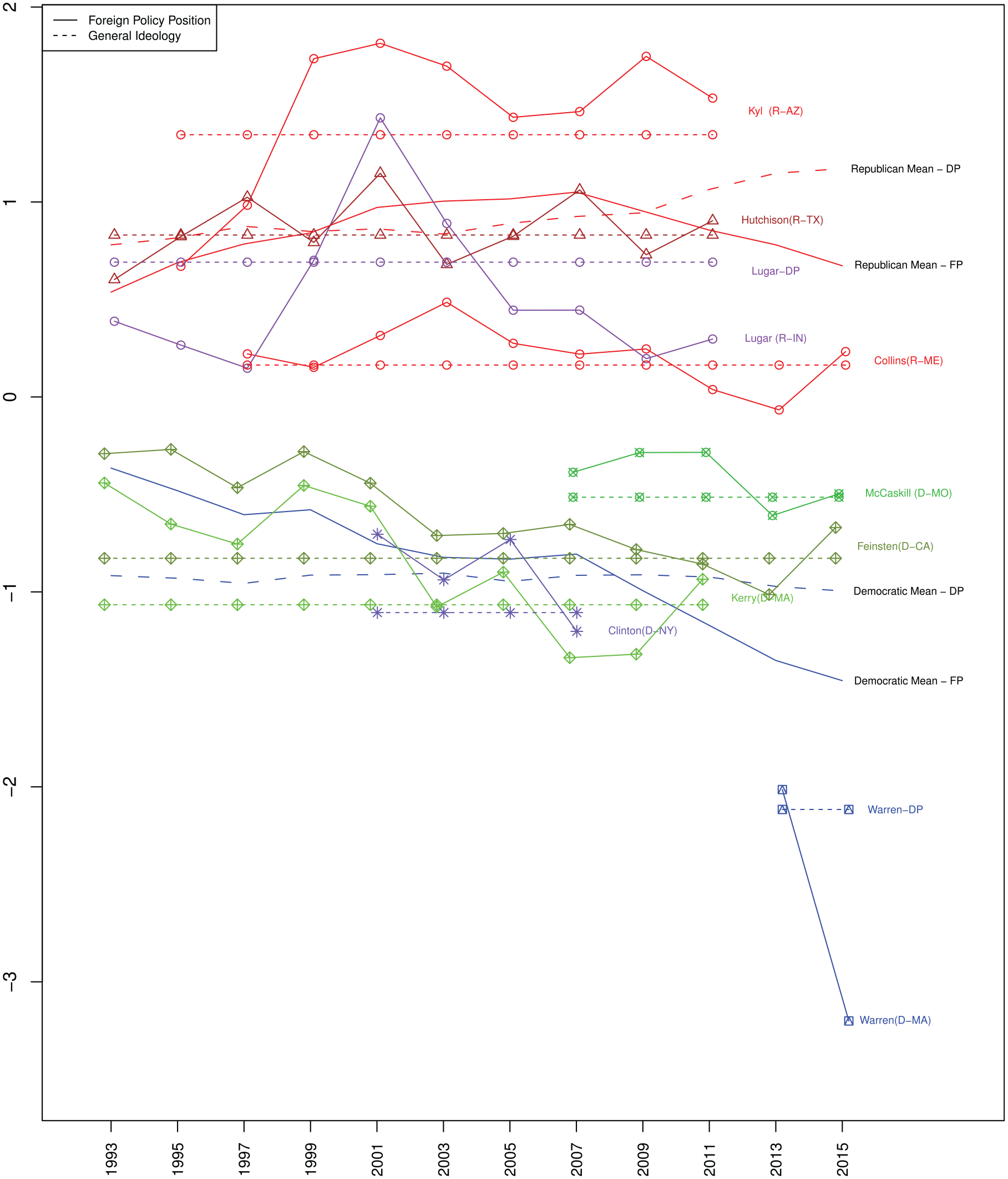
Select senators and their mean foreign policy positions.
In sum, the examples from Figure 1 provide important validation of our estimates and lend support to the high classification rate that shows our hawk-dove measure correctly predicting members’ votes on national security items. We now provide a more systematic analysis of whether and to what extent gender influences foreign policy preferences.
The Gender Effect on Foreign Policy Voting: Regression Analyses
To begin our analysis, we plot the mean foreign policy positions of senators and House members by gender and party. Figure 2 presents these data across multiple decades, thus providing us with a baseline view of the ideological distributions. In both parties and chambers, the mean position of female members is generally more dovish than the mean position of their male colleagues—but we do observe two important deviations. First, female Democrats are no more dovish than male Democrats are in the Senate. Second, while initially moderate, House Republican women become indistinguishable from House Republican men by 2005. Since these trends are merely suggestive, we need to conduct additional tests to determine whether gender affects foreign policy voting.

Mean foreign policy positions by gender and party.
Because the data for our outcome of interest—the hawk-dove estimates—are continuous, a linear regression model would appear to be appropriate. But such a model comes with serious limitations given the structure of our data. One problem is that most legislators serve across multiple Congresses, raising concerns about the independence of observations in our dataset. To fit a linear regression model without member and Congress fixed effects would inflate the number of nonindependent observations and ignore any cross-member variations not explained by the predictors. Biased estimates and incorrect standard errors would result. But equally problematic, the inclusion of member fixed effects would mask our time-invariant predictors—including gender—and encourage us to make incorrect inferences (Baltagi 2001). Alternatively, we could fit a separate linear model for every two-year Congress and ignore the panel structure of our data. But this strategy would count the effect of gender as completely independent across Congresses, which would then make it difficult to draw any general trends from the results.
What we need is a regression model that assumes our observations are not independent across time. A varying-intercept, varying-slope model incorporates this assumption into the estimation process (Gelman and Hill 2007, chap. 13). Similar to a random effects model, it allows the coefficients to vary over time so that investigators can see whether the coefficients achieve statistical significance for each separate period in a dataset. For example, it would let us report twenty-two coefficients for each independent variable in our House models because the House data include twenty-two separate Congresses (the 93rd to 114th). In other words, a varying-intercept, varying-slope model would help us determine whether—and when—gender matters. But unlike a series of nonpooled linear models, it would assume that the effect of gender does not differ completely from one Congress to another—even as it allowed this effect to vary over time. We therefore opt to use a varying-intercept, varying-slope model for the analyses here. 9
Our main explanatory variable is a dichotomous indicator for female legislators. In our first model, we include a control variable for party membership because of likely differences between Democrats and Republicans. However, to explore gender and party differences comprehensively, we create four dummy categories (Female Democrats, Female Republicans, Male Democrats, and Male Republicans), and then use Male Democrats and Male Republicans as the baseline category in the second and third models, respectively. Thus, the coefficients for female Democrats in the second model represent the difference between female and male Democrats, while the coefficients for female Republicans in the third model represent the difference between female and male Republicans.
In each model, we control for several factors that potentially affect members’ foreign policy views, including their veteran status and their membership on national security committees. 10 The online appendix includes full discussion of our variables, and it provides the full specification and results for each model.
Results
Figure 3 presents the varying slopes for variables that measure the difference between female and male members on foreign policy voting from three different models for each chamber. The main takeaway is that gender matters much less in the Senate than in the House. In the top panel, the coefficients represent the difference between female and male senators after controlling for party, veteran status, and committee membership. The 95 percent credible intervals for all coefficient estimates include 0, indicating that female senators are no more dovish than male senators are. The second panel reports the coefficients that represent the difference between female and male Senate Democrats (i.e., the coefficients for Female Democrats when Male Democrats is the baseline category), while the third panel reports coefficients that represent the difference between female and male Senate Republicans (i.e., the coefficients for Female Republicans when Male Republicans is the baseline category). At no point do results for female Democrats achieve statistical significance (see the second panel); however, female Republicans are significantly more dovish than their male colleagues are from 2007 to 2014 (see the third panel). The remaining three panels display the varying slopes for the same variables in the House. They show that female members in general (the fourth panel) and female Democrats in particular (the fifth panel) are significantly dovish across nearly all years covered in the data.
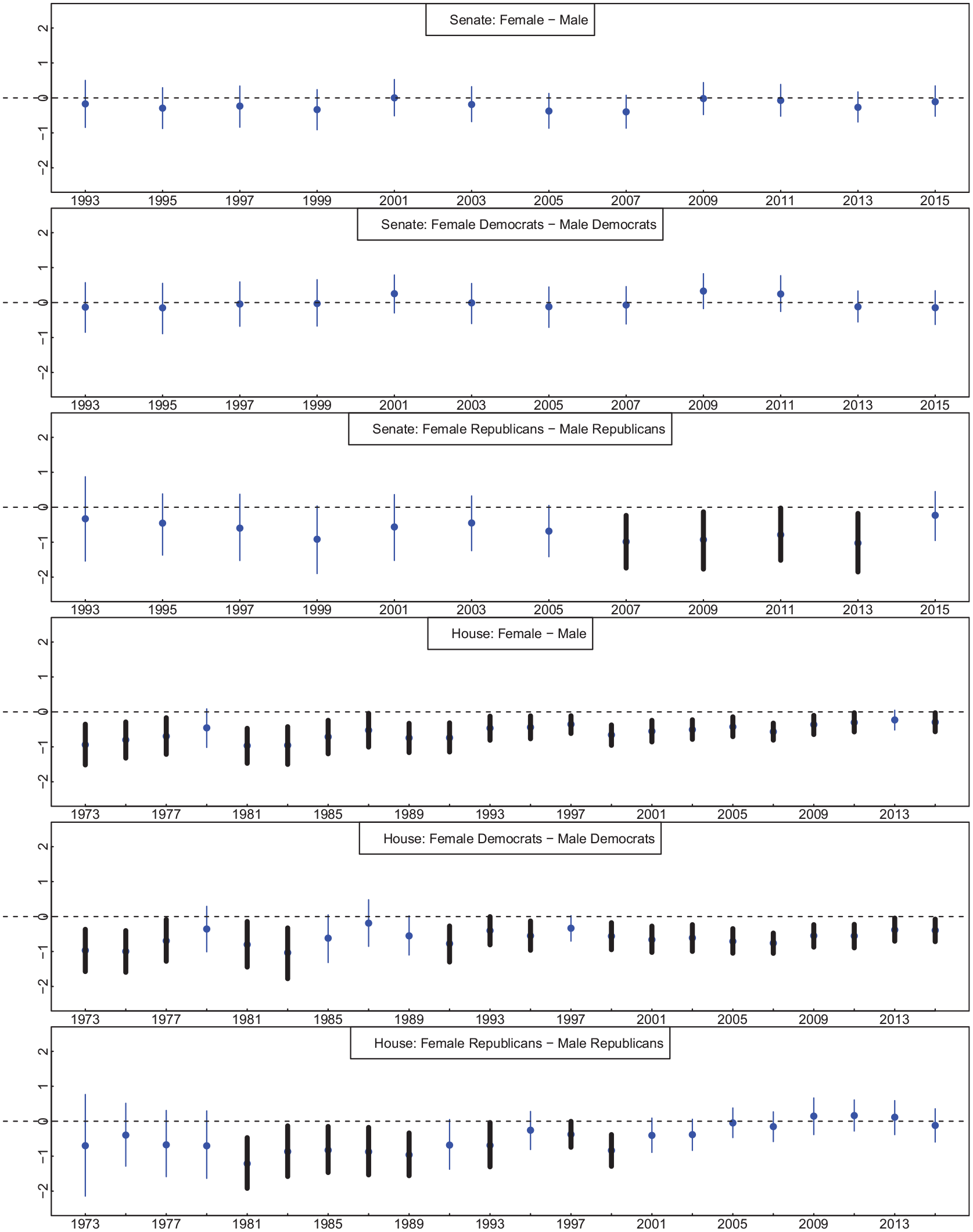
Gender and members’ position on foreign policy.
Why do we see such different results from the two chambers? One possibility is that female senators may feel special pressure to overcome gender stereotypes of dovishness on military issues (see Koch and Fulton 2011; Swers 2007). Because they are much higher in profile than House seats are, Senate positions set members up for presidential bids and other executive branch positions. If female senators want to compete in this arena, they may calculate that they need hawkish records to do so. But we are skeptical of this explanation for two reasons. First, our data show that the only woman in our study to have run for president, Hillary Clinton, was not particularly hawkish. In fact, as we mentioned before, her estimated position aligns almost perfectly with the Democratic mean in the Senate. Second, female Democrats who represent conservative-leaning states and female Republicans who represent liberal-leaning states are the ones who deviate most from their parties on foreign policy. These Democrats are relative hawks while these Republicans are relative doves (see, e.g., the positions of McCaskill and Collins in Figure 1). This point suggests that reelection concerns—not political ambitions—drive women’s decisions on foreign policy.
To test this possibility, we add a variable to our models that controls for the level of conservatism in each state and district. Specifically, we use the vote share for the Republican presidential candidate in the previous election—a common measure used to account for voter ideology (e.g., Canes-Wrone, Howell, and Lewis 2002). 11 Figure 4 reports the results with the added control and shows that its inclusion leads to major changes in our findings. Indeed, the gender effect now disappears in the Senate and it decreases dramatically in the House. 12
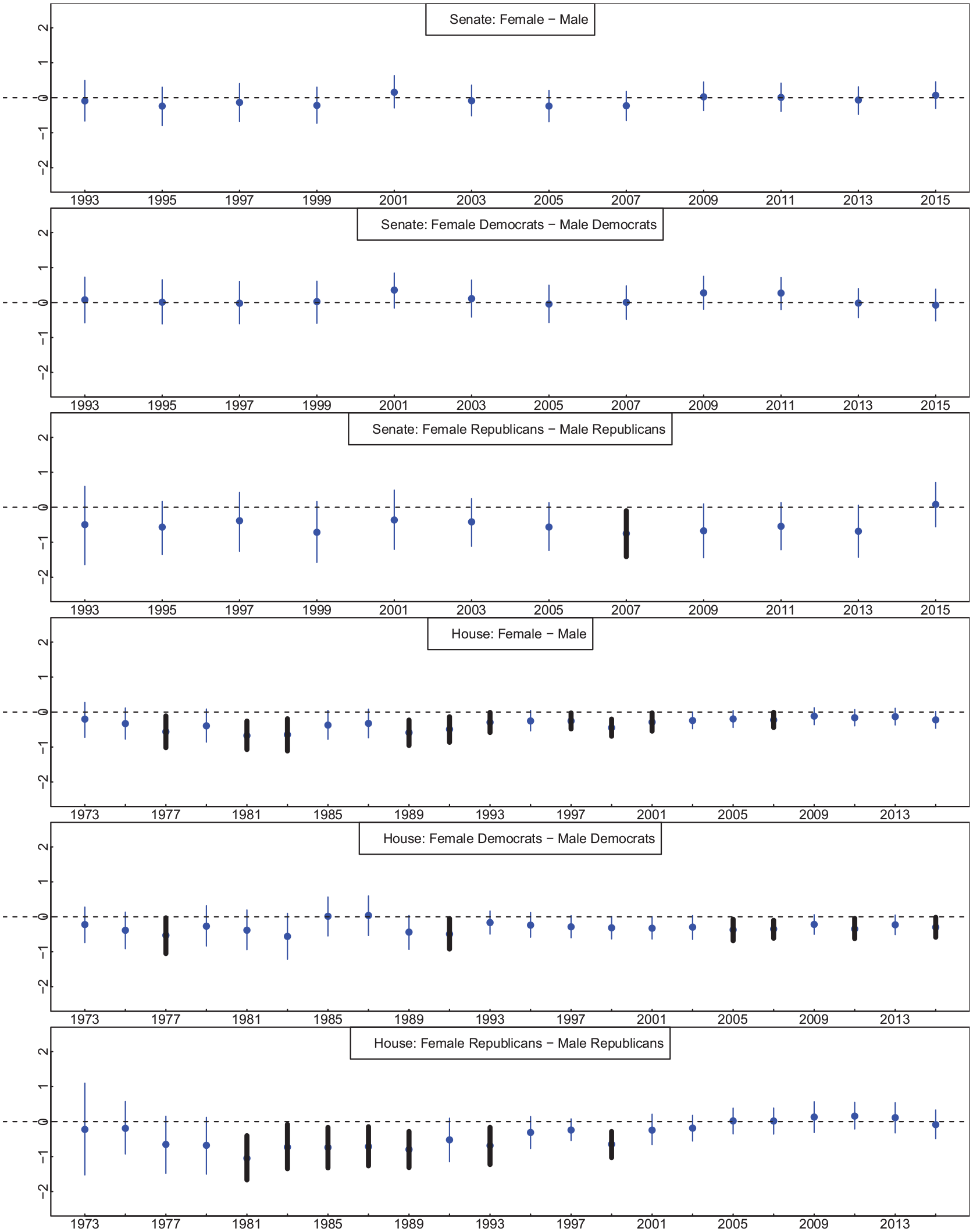
Gender and members’ position on foreign policy, controlling for republican presidential vote share.
The best way to appreciate the decrease in the House is to compare the results for female Democrats before and after we control for district conservatism, since these results undergo the greatest shift. By looking at the fifth panel of Figure 3 (the before) and the fifth panel of Figure 4 (the after), we can see the magnitude of this shift. For clarity, we reproduce these two panels and present them together in Figure 5. Before, female House Democrats are significantly dovish across most Congresses in our analysis; after, they are significantly dovish in only one-quarter of the periods. This change in results suggests that female members have largely represented liberal districts and have established foreign policy records that reflect their constituents’ preferences. That the coefficients for district conservatism are positive and statistically significant in both chambers reinforces this conclusion (see the online appendix for full results). The bottom line is that, once we account for voter ideology, we see gender having a reduced effect on foreign policy voting.
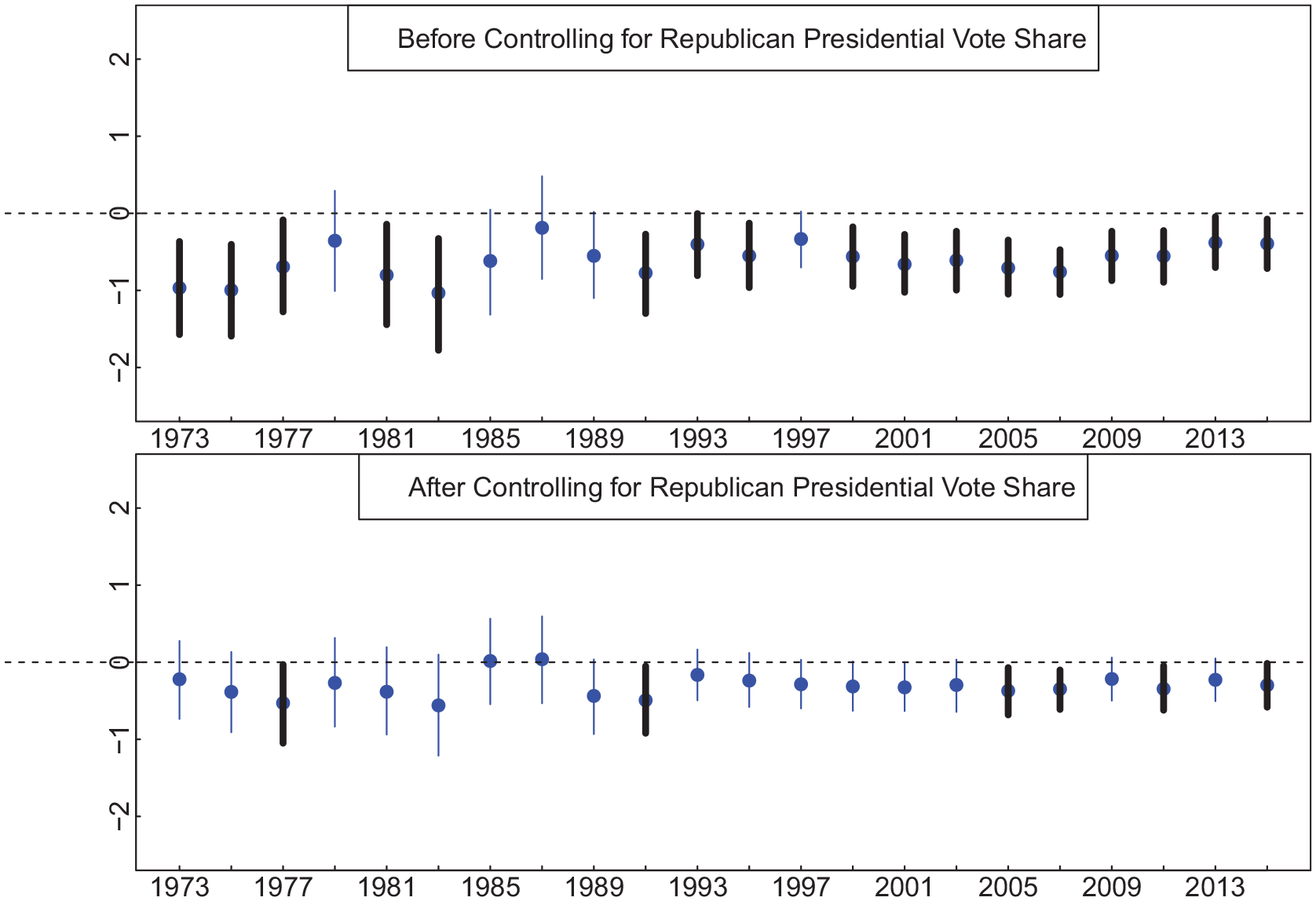
Difference between House female and male Democrats on foreign policy, before and after controlling for Republican presidential vote share.
Robustness Checks: Matching Analyses
To ensure the robustness of our findings, we decide to use an alternative method for examining the possible gender effects on foreign policy positions in Congress. Regression analyses allow us to test hypotheses using the full set of our observations, but such analyses can produce misleading results if there are unobserved characteristics in the data. That is, our coefficient estimates could be biased if unobserved factors are correlated with constituency preferences, district or state partisanship, and gender. We therefore use a matching analysis to reduce the differences across legislators in order to see whether gender effects are present after accounting for unit heterogeneity. As an additional benefit, this method allows us to check whether the Republican presidential vote share used in the regression models is an appropriate measure of a district’s position on foreign policy.
Beyond methodological considerations, a matching analysis that compares the foreign policy positions of female and male co-partisans from the same states helps us explore another concern: whether differences in legislative behavior arise because of gender stereotypes. Considerable research shows that voters evaluate female and male members differently (Dolan 2004, 2010; Kahn 1996; Sanbonmatsu 2002) and that gender expectations have a powerful influence on the actions that female members take (Lazarus and Steigerwalt 2018). We cannot explore the prevalence and intensity of gender stereotypes across states, districts, and time to assess their role in shaping the foreign policy decisions of legislators; the data for such a project do not exist. However, if gender stereotypes and gender expectations are at work here, we should see that—despite representing the same or similar constituents—female legislators are more dovish than their male colleagues are.
For the Senate, we compare the average difference between female and male co-partisan senators from the same state. Admittedly, not many senators come from same-party, split-gender delegations, but there are a sufficient number for us to draw inferences from the 103rd Congress onward. 13 To construct a measure of uncertainty surrounding the average difference, we use 1,000 sets of estimated ideal points and compute 1,000 sets of average differences. Since the Martin-Quinn approach is based on the Markov chain Monte Carlo method, it provides draws from the posterior densities. By using these draws, we can calculate the 2.5 percent and 97.5 percent quantiles of the average distances between split-gender delegations of co-partisan senators and in turn generate the 95 percent credible intervals of the average difference. If there is an independent effect of gender on foreign policy positions, the ideological difference between female and male senators will be significant and negative among matched members.
The top panel of Figure 6 shows the average difference between the split-gender delegations of co-partisan senators. We see that female senators are more liberal on foreign policy than their male co-partisans are in only three of the twelve Congresses under review. There does not appear to be a consistent gender effect. However, unlike the regression analysis where we saw no significant results for gender in the Senate, the matching analysis suggests that gender matters to some limited degree. This difference in results raises the possibility that, at times, gender stereotypes or related factors may influence foreign policy voting in the Senate.
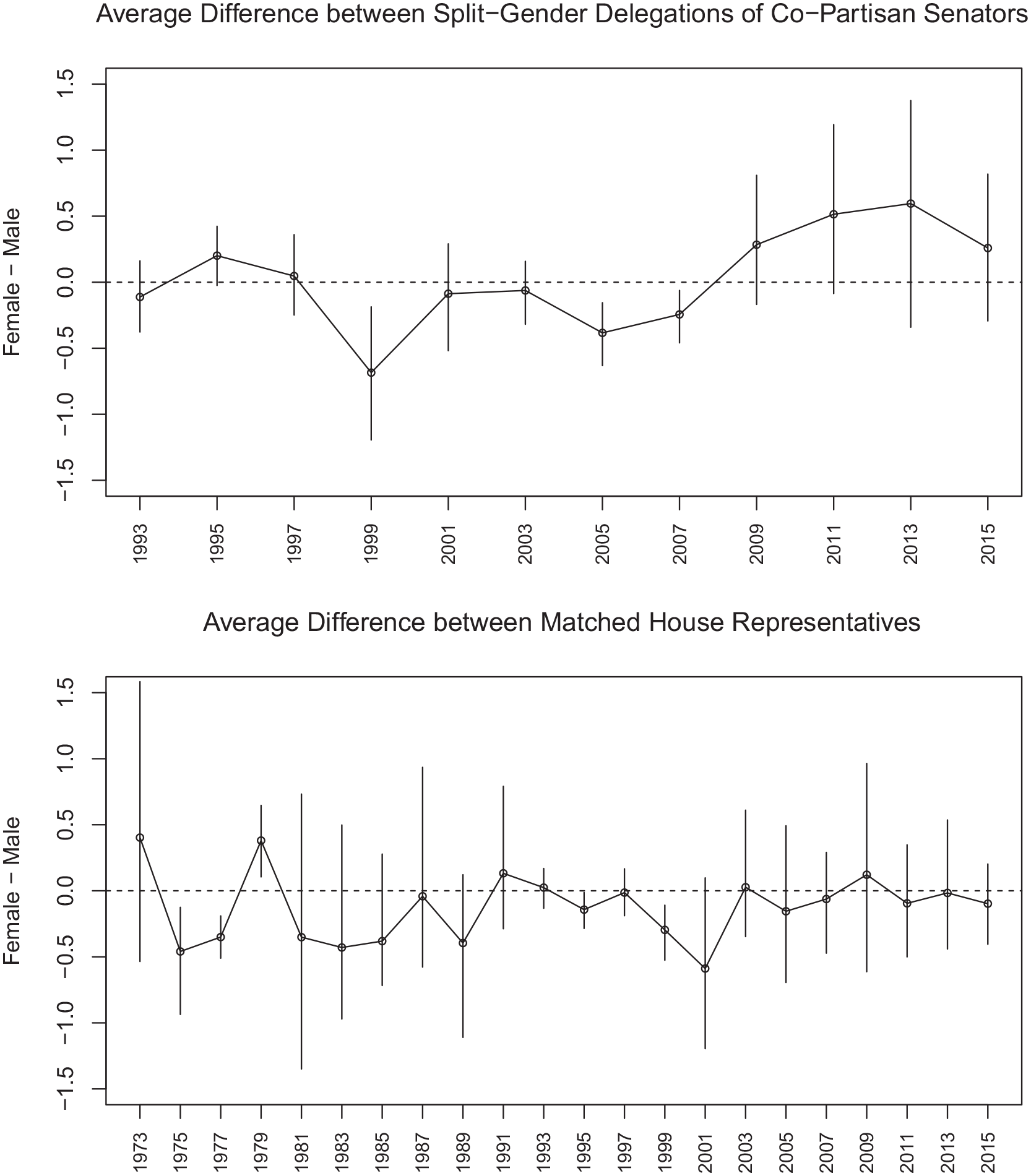
Analysis of matched members’ gender difference on foreign policy.
For the House, we match female and male members from the same state and party, and from districts that are ideologically similar and regarded as electorally “safe” for incumbents. For Democrats, we choose districts in the same state where the vote share for the Republican presidential nominee in the previous election was less than 40 percent (0.4). For Republicans, we choose districts where the Republican presidential vote share exceeded 60 percent (0.6). 14 In this way, we can compare the average distance of co-partisan female and male members who represent districts with similar ideological preferences and partisan commitments. Although we cannot hold constant the effects of constituency as completely as we have done for the Senate data, this approach still allows us to hold constant the effects of party and constituency to a significant degree. The bottom panel of Figure 6 shows the results. Consistent with our previous findings on House members, we see only a limited gender effect on foreign policy voting once we hold constant the effects of party and constituency. Again, these results raise the possibility that gender stereotypes may have a modest influence on foreign policy decision-making.
Concluding Discussion
To summarize, we have investigated the role of gender in foreign policy to answer the following question: are female legislators dovish because they seek to represent the dovish values of women generally or because they tend to represent mostly dovish voters? To find the answer, we examined all foreign and defense policy votes in Congress and generated hawk-dove estimates for members across five decades. Initially, we found important gender differences in both chambers, even after controlling for party identification. But the differences between men and women decreased once we considered constituency preferences. The answer appears to be that female legislators are dovish because they represent dovish voters. Or put another way, gender and constituency both shape legislative behavior, but the effect of constituency preferences largely explains the effect of gender.
Our findings here have broad implications. Clearly, they demonstrate the need to take into account electoral and partisan incentives of legislators when examining gender effects on policy decisions and voting. In addition, and in contrast to earlier studies, our findings suggest that the increased presence of elected women may not push a country to adopt dovish strategies; rather, a country with a liberal electorate may simply favor dovish policies and elect a larger share of liberal members, including liberal female members (see Caprioli 2000; Caprioli and Boyer 2001). If so, then the gender composition of national legislatures may not be a key causal mechanism for a country’s declining military focus. Instead, it may simply be an indicator of a country’s increasing liberalism.
That being said, our results do show that even after taking constituency into account, there is a limited gender effect on foreign policy voting. With the inclusion of all control variables, gender remains significant in the House for roughly one-quarter of the Congresses in this study. What underlying factors explain this intermittent effect? We posited that female lawmakers likely face different expectations from voters than their male colleagues do and thus feel greater pressure to establish dovish records. The results from our matching analysis suggest that gender stereotypes may play some role here, since the results show, at times, female and male members voting differently even though they represent the same voters.
One other possibility is that certain institutional arrangements may give female legislators the latitude to pursue dovish policies. When we initially reported our findings, we did not highlight every period where female members deviated from their party’s position. But in the House, two time periods stand out. Female Democrats were significantly dovish for parts of the George W. Bush and Barack Obama presidencies, while female Republicans were significantly dovish throughout the 1980s. One rough pattern emerges from these results: women are apparently more willing to establish dovish records as members of the House minority than as members of the House majority. Being in the out-party may provide women with some important flexibility on foreign policy questions. Indeed, because minority party leaders have almost no capacity to restrain dissident members (J. A. Jenkins, Crespin, and Carson 2005), women may pursue dovish policies precisely when they can avoid or minimize their leadership’s wrath. While this explanation is plausible, our analyses do not reveal a consistent relationship between female dovishness and minority status. For example, we see no gender difference among minority party Republicans in either the 1970s or the 2000s. With only twenty-two Congresses in our dataset to examine, we cannot conduct a systematic examination of institutional variation and gender effects.
To determine the extent to which gender stereotypes versus institutional arrangements explain female dovishness goes well beyond the scope of this project. There may even be a complex relationship between the two, where the influence of gender expectations on women’s legislative behavior varies under different institutional conditions. Future studies that combine the effects of gender and institutional factors are needed to identify the political circumstances under which gender and gender expectations affect public policies.
Supplemental Material
House_Replication_Data – Supplemental material for Gender and Foreign Policy: Are Female Members of Congress More Dovish than Their Male Colleagues?
Supplemental material, House_Replication_Data for Gender and Foreign Policy: Are Female Members of Congress More Dovish than Their Male Colleagues? by William Bendix and Gyung-Ho Jeong in Political Research Quarterly
Supplemental Material
House_Replication_Model1 – Supplemental material for Gender and Foreign Policy: Are Female Members of Congress More Dovish than Their Male Colleagues?
Supplemental material, House_Replication_Model1 for Gender and Foreign Policy: Are Female Members of Congress More Dovish than Their Male Colleagues? by William Bendix and Gyung-Ho Jeong in Political Research Quarterly
Supplemental Material
Online_Appendix – Supplemental material for Gender and Foreign Policy: Are Female Members of Congress More Dovish than Their Male Colleagues?
Supplemental material, Online_Appendix for Gender and Foreign Policy: Are Female Members of Congress More Dovish than Their Male Colleagues? by William Bendix and Gyung-Ho Jeong in Political Research Quarterly
Supplemental Material
Senate_Replication_Data – Supplemental material for Gender and Foreign Policy: Are Female Members of Congress More Dovish than Their Male Colleagues?
Supplemental material, Senate_Replication_Data for Gender and Foreign Policy: Are Female Members of Congress More Dovish than Their Male Colleagues? by William Bendix and Gyung-Ho Jeong in Political Research Quarterly
Supplemental Material
Senate_Replication_Model1 – Supplemental material for Gender and Foreign Policy: Are Female Members of Congress More Dovish than Their Male Colleagues?
Supplemental material, Senate_Replication_Model1 for Gender and Foreign Policy: Are Female Members of Congress More Dovish than Their Male Colleagues? by William Bendix and Gyung-Ho Jeong in Political Research Quarterly
Footnotes
Acknowledgements
We thank Carolyn Keller, Tyson King-Meadows, and the anonymous reviewers for their helpful comments.
Authors’ Note
An earlier version of this article was presented at the 2019 meeting of the Midwest Political Science Association.
Declaration of Conflicting Interests
The author(s) declared no potential conflicts of interest with respect to the research, authorship, and/or publication of this article.
Funding
The author(s) received no financial support for the research, authorship, and/or publication of this article.
Notes
Supplemental Material
Supplemental materials and replication materials for this article are available with the manuscript on the Political Research Quarterly (PRQ) website.

References
Supplementary Material
Please find the following supplemental material available below.
For Open Access articles published under a Creative Commons License, all supplemental material carries the same license as the article it is associated with.
For non-Open Access articles published, all supplemental material carries a non-exclusive license, and permission requests for re-use of supplemental material or any part of supplemental material shall be sent directly to the copyright owner as specified in the copyright notice associated with the article.
