



Abstract
This study examines the relationship between disaster risks and interstate conflict. We argue that in disaster-prone areas actors’ rational expectations about the likelihood and magnitude of potential future disasters can make conflict more likely. The relationship emerges when future disasters are viewed as shocks that are expected to shift the relative power balance among states. If large enough, such expected shifts can generate commitment problems and cause conflict even before any disasters take place. Our approach represents a shift of focus from previous research, which investigates the effect of actual disasters and ignores rational expectations regarding future events. We use a simple game-theoretic model to highlight the commitment problem caused by disaster risks. We then discuss and apply an empirical strategy enabling us to disentangle effects of disaster proneness from effects of actual disaster events. Our results indicate that greater disaster risks are indeed associated with a higher likelihood of interstate conflict.
Do natural disasters have a pacifying effect on international relations, or fuel discord and violence? Despite decades of theoretical and empirical work, scholars have failed to reach a consensus on the nature of the relationship between disasters and conflict. A number of studies suggest that natural disasters may have a pacifying effect: when disasters strike, they may reduce the likelihood of conflict by serving as a focal point for cooperation in the aftermath of an environmental shock and reducing the relevance of other potential sources of conflict (Kelman and Koukis 2000; Quarantelli and Dynes 1976). In addition, natural disasters and climate-related scarcities can damage the capacity to engage in conflict (Salehyan and Hendrix 2014). This effect could be due to direct disaster damage to military capabilities, as well as subsequent reductions in military spending. Governments’ military expenditures could decline because disasters reduce economic resources and productivity in affected regions where industrial and transportation infrastructure experienced disaster-related damage and, consequently, government revenues (Noy 2009; Raddatz 2007).
At the same time, there is an equally large amount of research indicating that environmental shocks may have the opposite effect. Disasters, especially sudden and severe, appear to increase the likelihood and intensity of conflict. They reduce economic resources available to affected states and slow down economic growth. Shortages of scarce resources and hence deprivations in affected countries can then trigger violence as affected populations seek to get access to territories with resources that could make up for the disaster-related losses (Brancati 2007; Gleditsch 1998; Homer-Dixon 1994, 2001; Kahl 1998; Miguel, Satyanath, and Sergenti 2004; Nel and Righarts 2008; Reuveny 2002). In this case, environmental shocks alter the relative size of fighting costs and expected benefits of fighting: costly conflict becomes a more attractive option if a population struck by a natural disaster faces the trade-off between peaceful starvation and fighting to gain new territory, which may induce risk-acceptant behavior by the affected state. Similarly, exogenous shocks to resources could lower the opportunity cost of conflict and make conflict a more preferred course of action (Chassang and i Miquel 2009).
In addition, some scholars disagree with the assessment that natural disasters are linked to conflict and report nonfindings in their investigations of the relationship between environmental shocks and conflict likelihood (Bergholt and Lujala 2012; Nardulli, Peyton, and Bajjalieh 2015; Theisen, Holtermann, and Buhaug 2011). One of the criticisms of existing research is that it overlooks the possibility that scarcities of resources generated by natural disasters may force affected countries to use the remaining resources more efficiently. Furthermore, disaster-prone societies may seek to adapt by improving their policies and technology in response to environmental shocks, thereby reducing or eliminating deprivations in the aftermath of disasters (Simon 1996). These adaptation and mitigation mechanisms may undermine the hypothesized relationship between natural disasters and conflict. Therefore, the causal link between environmental shocks and conflict is likely to be more complex than many studies acknowledge, and may depend on a range of intervening political and socioeconomic factors (Bernauer, Bohmelt, and Koubi 2012).
Our contribution to this debate is to develop a theoretical framework to analyze the relationship between disaster susceptibility and conflict. We conceptualize natural disasters as a form of shocks that affect states’ capabilities, and emphasize the role of rational expectations about potential future disasters in explaining conflict in disaster-prone areas. 1 We argue that when states anticipate differential effects from potential future shocks on their capabilities, the anticipation can generate commitment problems between states before shocks’ arrival, and conflict may result. 2 More broadly, our approach suggests that, in addition to actual disaster events, expected future disasters can be a source of conflict, and empirical analyses of the link between disasters and conflict should take disaster expectations into account.
Previous studies that have reached different conclusions mainly consider short- or long-term impacts of actual disasters, which are implicitly treated as isolated individual events that do not appear to trigger any learning in affected populations. In other words, these studies assume that populations only react to environmental shocks, but do not form or act upon expectations regarding the likelihood of potential future disasters, regardless of the frequency of such shocks in the past. We argue that individuals, including decision-makers, form disaster expectations based on past events, and, under certain conditions, they can behave proactively based on these expectations. More specifically, we argue that, in the presence of a disputed issue, rational expectations about potential future disasters can give rise to a commitment problem and result in conflict. 3
In the next section, we develop a theory that incorporates rational expectations about future disasters that may lead to conflict. Next, we conduct Monte Carlo analyses to identify an appropriate empirical strategy for disentangling the effect of disaster expectations from that of actual disasters, which leads us to focus on the effect of disaster risks in years without disaster events. We then conduct tests of our theoretical expectations using Militarized Interstate Disputes (MID) data on interstate conflict. Our empirical analyses show that, in line with our theoretical argument, disaster expectations are associated with an increased likelihood of conflict when actual disasters are absent.
Disaster Risks as a Determinant of Conflict
As our brief overview has suggested, despite disagreements over the impact of individual disaster events, this literature shares one assumption. The impact of a disaster on conflict likelihood is to be expected and measured in the aftermath of the disaster, either in the near term or in the long run. Hence, conflict behavior is mostly reactive in that actors respond to actual disaster losses. How would the conclusions change if we revised this assumption to incorporate the effect of disaster events on rational actors’ expectations about future events? If populations of areas that frequently experience environmental shocks learn over time that such shocks occur with regularity and, hence, are likely to take place in the future, these expectations might enter decision-making processes when it comes to interactions among states. More specifically, if decision-makers fear that they will lose bargaining power as a result of a future disaster and will have to settle for a smaller share of resources, the decision-makers may prefer conflict in the present period, as the existing literature on power shifts suggests. 4
The game-theoretic model, presented below, illustrates this dynamic formally, whereas here we discuss the assumptions and intuition behind it. We start with the observation that natural disasters often reduce the availability of resources in the region where such disasters occur. More importantly for our argument, such disaster-generated resource scarcities can affect states’ military capabilities. One example of resources that can be converted into military capabilities is commodities that governments can export to generate revenues (Morgan and Reinhardt 2016): disasters can disrupt mines, oil and gas pipes, roads, railways, and other infrastructure for commodity extraction and transportation. This revenue-reducing effect of disasters is more general, as previous research suggests: disasters tend to disrupt industrial activity and lower economic productivity, which in return shrinks government revenues (Noy 2009; Raddatz 2007). The consequence is a reduction in government spending, including spending on the military. 5 In addition to damaging effects on countries’ infrastructure, disasters generate human costs. Deaths from major disasters may reduce the pool of citizens available for military service (a direct impact on military capabilities) and labor force, thereby hurting economic productivity, which in turn has a negative indirect effect on military capabilities. 6
We focus on commitment problems generated by actors’ rational calculations about potential future shocks to their capabilities that have differential effects as the main mechanism of conflict onset: if decision-makers anticipate that future environmental shocks will significantly diminish state capabilities and weaken the state’s position relative to others, either directly or by contributing to existing sources of power shifts, the threatened state may prefer conflict against its future potential opponents while it is still in a relatively strong position. This is because the state that expects to get relatively stronger after a disaster in the future cannot credibly commit to not using its future strength against weakening rivals to acquire more resources (Powell 2004).
A key implication of this argument is that decision-makers may not wait until an actual disaster strikes to engage in conflict. In other words, disaster costs do not need to materialize before states preemptively mobilize for militarized conflict. Although existing research provides evidence of a link between environmental shocks or natural disasters and interstate conflict (Devlin and Hendrix 2014; Nelson 2010; Tir and Stinnett 2012), 7 our proposed mechanism for conflict is distinct from theoretical approaches focusing on actors’ reactions to individual shock events (Chassang and i Miquel 2009; Nel and Righarts 2008). Anticipated major disasters can contribute to existing sources of power shifts, and the country that is relatively less vulnerable to disasters compared with its adversary and that is expected to become relatively stronger due to environmental shocks may be unable to credibly commit to upholding existing resource allocations when the power balance shifts in its favor. Thus, in areas that experience more frequent and severe disasters with differential effects on states, the likelihood of conflict may be higher, all else being equal. Our empirical analyses in the next section aim to disentangle these two distinct—reactive versus proactive—mechanisms.
If states form expectations about future disasters and their potential effects on the relative balance among them, do decision-makers in vulnerable states pursue disaster preparedness strategies to shield their states from disaster-related damage, minimize adverse effects on state capabilities, and by doing so alleviate potential commitment problems? Disaster preparedness and mitigation programs certainly exist in many vulnerable regions of the world. However, a recent Global Assessment Report on Disaster Risk Reductions indicates that countries severely underinvest in these programs. 8 First, it is likely that populations in less affluent regions already suffering from instability will be unable to achieve preparedness and adaptation (Buhaug 2016). Academic research similarly suggests that governments of disaster-prone countries tend to underinvest in preparedness and mitigation (Neumayer, Plumper, and Barthel 2014), which leaves these countries ill-prepared when disasters strike. Even when disaster-prone countries do prepare, such measures could lead to greater investment and development in high-risk areas, and an unusually massive disaster event would then be significantly more deadly and costly than in the counterfactual scenario of minimal disaster preparedness (Neumayer, Plumper, and Barthel 2014). In addition, even democracies may not spend enough on preparedness measures to avoid substantial damage because democratic leaders have strong incentives to reduce fatalities due to domestic political pressures, but much less motivation to increase overall disaster resilience (McLean and Whang 2019; Neumayer, Plumper, and Barthel 2014; Quiroz Flores and Smith 2013).
A Model of Disaster Expectations and Conflict
We formalize our argument by developing a simple game-theoretic model. Our goal is not to provide an entirely new causal mechanism for conflict among states. Instead, the stylized model allows us to ground our theoretical argument in the well-established commitment problem framework and elucidate the causal mechanism linking expectations about potential future disasters to the emergence of conflict.
9
Consider the interaction between two state actors, A1 and A2, which bargain over the division of an infinite flow of benefits, represented by the unit interval [0, 1]. Although the discussion of specific benefits that A1 and A2 bargain over is beyond the scope of this article, some examples may include rents from agricultural production on a given territory, or revenues from extracting and exporting commodities, or political control over a territory and capacity to collect taxes. Assume that, in each discrete time period, A1 makes a take-it-or-leave-it offer to A2 to divide that period’s benefits. If A2 accepts the offer, the division is implemented immediately. If A2 rejects, war ensues, which is modeled as a costly, game-ending lottery. The military capabilities of each state are represented by m1 and m2, respectively, with
To incorporate the possibility of future disasters, suppose that, in period 2, a disaster hits the region with exogenous probability
Thus, when a disaster takes place, the balance of power between the two actors shifts in favor of A1 from

Asymmetric effects of disasters on capabilities.
Suppose that no future disasters take place from period 3 onward. We focus on this setup for simplicity of exposition. In Supplementary Material, we show that allowing disasters to take place in any period with some probability does not change the model’s conclusions.
12
We assume that the actors’ utilities are linear in present benefits, that is, for any share of
As this is a game of complete information, we focus on subgame perfect Nash equilibrium (SPNE). Below, we first show that the subgame in period 2, when a disaster may hit, has a unique equilibrium in which no war occurs. We then describe equilibrium behavior in the first period when no disasters have yet taken place, and specify conditions for war occurrence. Supplementary Material provides proofs of all propositions.
Intuitively, because a disaster can only strike in period 2, no future shifts in the balance of power are possible in period 3 or later. Thus, whether or not a disaster occurs in round 2, the players find a settlement that they both prefer to a costly war. When a disaster hits, the settlement favors A1 more, as this actor becomes relatively stronger in the disaster aftermath. Moreover, the more severe the disaster’s impact is for A2, the better A1 expects to do in peaceful bargaining for the rest of the game.
Next, we analyze states’ behavior in the first period, before a disaster may occur. The following proposition summarizes the condition for conflict in period 1.
In this scenario, war results due to a commitment problem. Both A1 and A2 are aware that disasters may or may not strike in the future, but if they do, A1 will become relatively stronger. As shown in Proposition 1, bargaining in all future rounds will reflect this shift in the balance of power and A1 will receive a larger share of benefits in every subsequent round. A1 cannot credibly commit to not using this future advantage in bargaining if the disaster occurs, and A2 needs to be compensated in period 1 for the potential future adverse shift in capabilities. If there is a feasible settlement in period 1 that compensates A2, war is avoided and peace prevails. The largest compensation A1 can offer in period 1 is to concede the whole stake in period 1 to A2. If this is not sufficient to satisfy A2, war results, which is represented by the inequality condition in Proposition 2.
War becomes more likely if a disaster is more likely (
What are the empirical implications of this model? Even though directly testing the model would require accurate proxies for each of the model’s parameters, including the actors’ costs from conflict, their discount factor, and their expectations about the likelihood and severity of potential future disasters, which are not available, the model still provides observable empirical implications about the link between disaster susceptibility and interstate conflict. Building on the fact that most natural disasters are exogenous and on our theoretical argument that actors form rational expectations about the likelihood of future disasters based on past disaster severity and frequency, we expect more disaster-prone areas to experience more interstate conflict. Such rational expectations contribute to underlying sources of power shifts among states, and hence conflict due to commitment problems becomes more likely in areas that are prone to major disasters, even after controlling for any conflictual or pacifying effects of actual disaster events. Therefore, the following hypothesis links disaster hazards as a proxy for actors’ expectations about future disasters and the likelihood of conflict onset:
Note that our approach can explain mixed findings in the conflict literature regarding the effects of natural disasters. If environmental shocks are anticipated and states fight due to this expectation, conflict does not need to follow actual shocks. Rational expectations of future disasters, combined with the fact that many large-scale disasters are sufficiently rare, suggest that existing studies may suffer from a critical oversight. If expectations of environmental shocks affect conflict behavior, empirical analyses of conflict that focus only on actual disasters will overlook the effects that our theory attributes to disaster proneness. Therefore, in the “Empirical Analysis” section, we use global data on disaster propensity to investigate the effects of disaster proneness on interstate conflict.
Empirical Analysis
In this section, we conduct statistical tests to investigate the link between disaster risks and interstate conflict onset and report empirical results that show evidence of such an association. We first conduct a Monte Carlo analysis to determine which empirical strategy offers a more appropriate test of our hypothesis, given that actual disasters and disaster risks are not entirely independent from one another. We then propose a measure that approximates actors’ rational expectations about future disaster events. Next, we test our hypothesis and gauge the association between disaster hazards and the onset of interstate conflict. Our empirical models yield support for our main theoretical expectation linking disaster susceptibility to conflict. Specifically, statistical tests show that countries located in regions with higher levels of environmental risks are more likely to experience interstate conflict.
Empirical Strategy Selection: Monte Carlo Analyses
In testing our hypothesis linking disaster susceptibility to conflict, we need to differentiate between the effect of future disaster risks and potential effects of actual disaster events that may have happened in a given observation year. The main difficulty is that disaster events and a variable measuring susceptibility to such events are likely correlated, as the latter is directly related to the data generating process for the former. Thus, simply replacing disaster variables with our susceptibility measures in a model of conflict onset might be misleading as any estimated effect could be due to the existing correlation between the two variables. Relatedly, including both susceptibility measures and actual disaster events as independent variables in a model of conflict could lead to large standard errors due to potential multicollinearity.
To explore various empirical strategies in testing the hypothesized relationship, we conduct Monte Carlo analyses that evaluate the bias and efficiency of each approach. In our analyses of sample sizes ranging from 200 to 10,000, we focus on three hypothetical scenarios for the data generating process: (1) only actual disasters matter and disaster susceptibility is irrelevant for conflict in the data generating process; (2) both susceptibility and actual events matter for conflict; and (3) only disaster susceptibility is a determinant of conflict and actual disaster events are irrelevant. In each scenario, we compare the performance of three empirical strategies in recovering the underlying relationship in the data generating process: (a) including both a variable measuring disaster events and a variable on disaster susceptibility in the regression model; (b) including only a susceptibility measure; and (c) focusing only on years that did not experience disaster events, and including a disaster susceptibility measure.
Consider a sample of C countries observed over T periods. For each country i in year t, disasters may occur or not, and this process follows a Bernoulli distribution with mean

where Y is the binary dependent variable recording conflict events, D is a binary variable recording disaster occurrence, P represents
Monte Carlo analysis 1: When only disaster events matter (false positives)
For this analysis, we set
The Probability of a Significant Coefficient for the Disaster Susceptibility Variable across Three Monte Carlo Analyses.
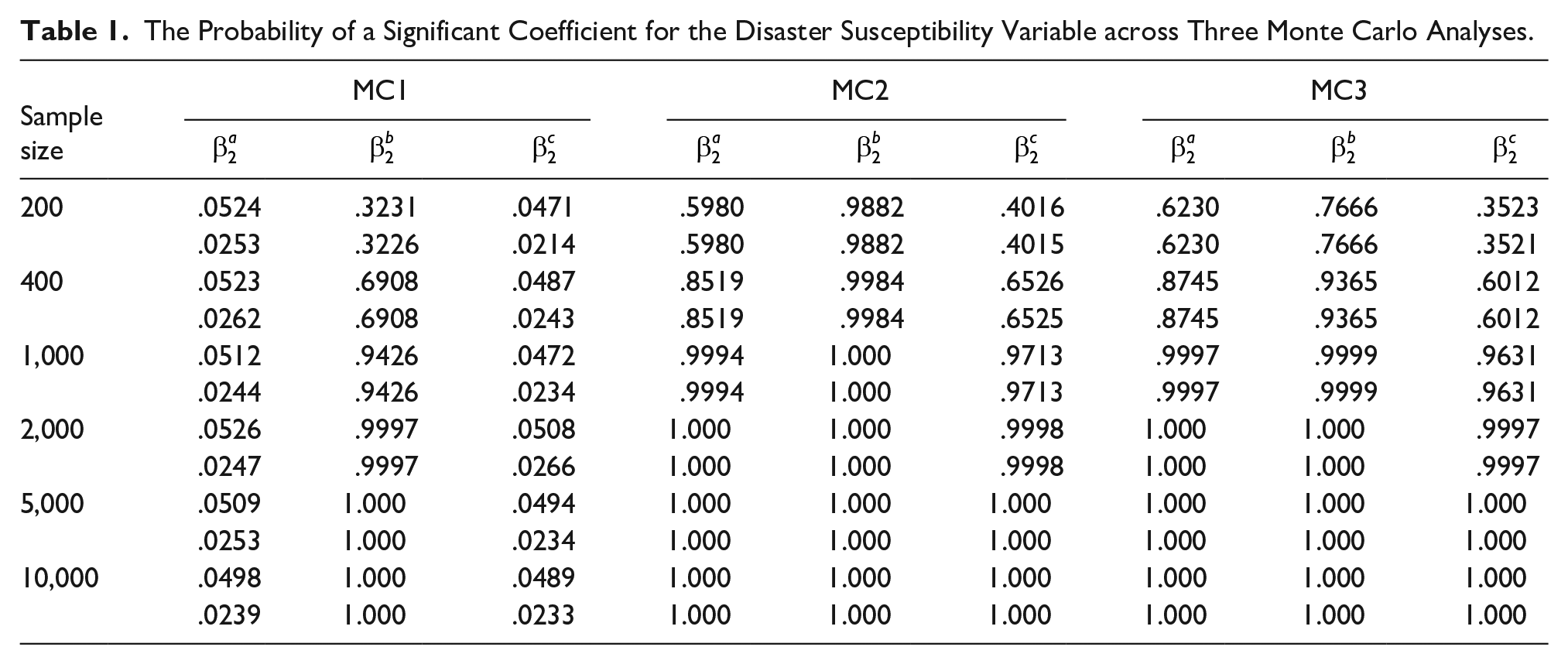
The top entry in each cell represents the proportion of significant
Monte Carlo analysis 2: When disaster events and susceptibility matter (false negatives)
For this analysis, we set
Monte Carlo analysis 3: When only susceptibility matters
Finally, we focus on the case when only susceptibility matters for conflict, and actual disaster events are irrelevant. For this analysis, we set
To summarize, we find that strategy (c) that selects on the independent variable to focus on no-disaster years and includes only the susceptibility measure in the analysis provides a better approach in terms of a lower false-positive rate compared with the other approaches. In other words, if no relationship exists in the data generating process between disaster risks and conflict, approach (c) is the least likely to find one. Moreover, it provides a more conservative test, as its false-negative rate is slightly higher than those of the other two approaches. This means that it is harder to report a significant coefficient with this approach as it is slightly biased in favor of the null hypothesis of no relationship. Thus, informed by these results, we test our hypothesis by analyzing the link between interstate conflict onset and disaster risks using only information on dyad years that did not experience any disaster events.
Operationalization of Disaster Risks
To test our hypothesis, we need a measure of disaster expectations. Ideally, we would use a measure to capture actors’ dynamically shifting expectations about future disaster events in their region in a given time period for each observation in our data set. Although we do not have access to a dynamic data set of this form, we approximate actors’ expectations using data on the likelihood of natural disasters available from the Socioeconomic Data and Applications Center (SEDAC). 15
SEDAC provides detailed information on six categories of natural hazards: floods, cyclones, droughts, volcanoes, earthquakes, and landslides (Dilley et al. 2005). In using this information, our main assumption is that decision-makers form expectations about the likelihood and severity of future disasters by observing the frequency and magnitude of past disaster events. That being said, it is possible that boundedly rational actors have shorter memories, put more weight on more recent disasters, or have other cognitive limitations that our measurement approach cannot capture. Some actors could completely ignore past events as well. Also, data coverage and accuracy could possibly vary across different regions due to variations in record keeping or government transparency levels. Nevertheless, we believe that disaster data from SEDAC serve a useful first step in approximating actor expectations because the data sets offer comprehensive information on disasters’ relative likelihood and distribution over time.
For each type of disaster, the data sets provide a frequency metric ranging from 0 to 10 for each 2.5-minute grid cell over the globe, with higher scores representing locations that are at a higher risk for that specific disaster. Although we use these measures on individual disasters in some of our empirical analyses, our hypothesis necessitates that we capture the overall propensity of experiencing different disasters as well. Thus, we construct a measure of the average disaster risk as our main independent variable by taking the mean of the six hazard scores for a given country.
For many dyad years in the data set, some of the information included in our disaster risk measure occurs after that dyad’s year because SEDAC disaster frequency maps use decades of data to approximate the frequency and distribution of a given hazard. The exogeneity of many disaster events alleviates this concern. Even though in reality actors’ rational expectations can only be based on disaster events that occurred in the past, the measure we employ offers a valid proxy for actors’ expectations, assuming that disaster events are random samples from the same stationary data generating process that our measure approximates with more data points. 16
To get a better sense of the disaster risk scores, consider the cyclone hazard. Figure 2 presents a snapshot of SEDAC’s Cyclone Hazard Frequency Distribution map over part of East Asia (Columbia University Center for Hazards and Risk Research, Columbia University Center for International Earth Science Information Network, The World Bank, and United Nations Environment Programme Global Resource Information Database Geneva 2005). Darker colors in this map represent areas that are estimated to experience more cyclone force wind speeds based on decades of storm observations. Based on this map, SEDAC has generated an ordinal ten-point scale cyclone risk score that is detailed down to each 2.5-minute grid cell. Japan, for instance, has more than 20,000 such cells, and each grid cell receives a cyclone risk score. The cyclone hazard measure averages over all such cells to come up with an overall score of around 9.48 for Japan. Similarly, Taiwan has a score of 10, whereas South Korea’s score is 7.61, and North Korea has a score of 4.98.
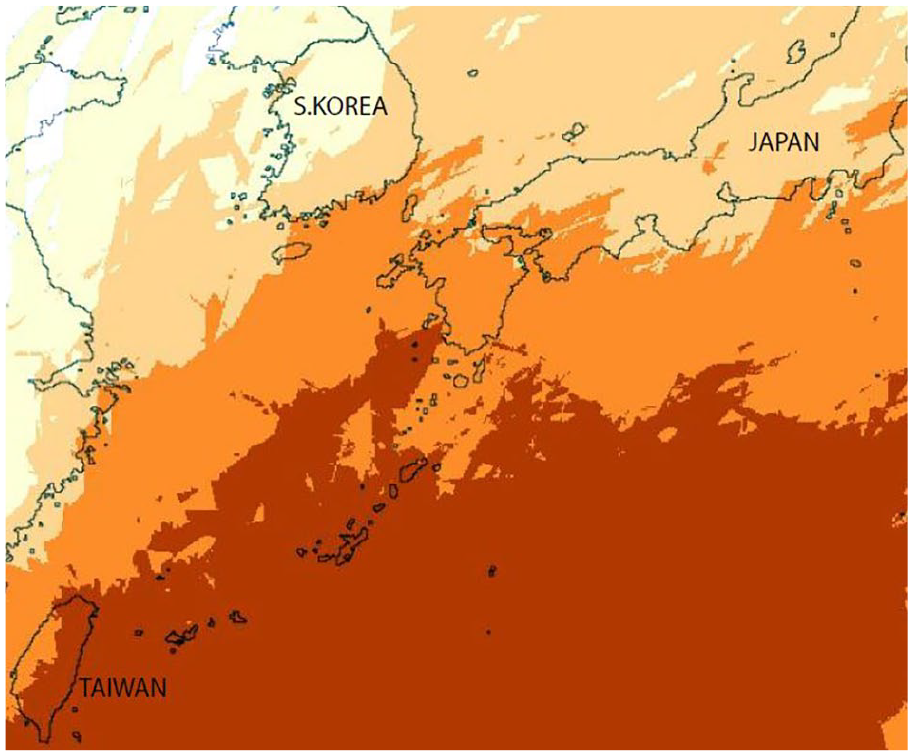
Cyclone hazard frequency distribution map of East Asia (Columbia University Center for Hazards and Risk Research, Columbia University Center for International Earth Science Information Network, The World Bank, and United Nations Environment Programme Global Resource Information Database Geneva 2005).
Disaster Risks and Interstate Conflict Onset
In this section, we investigate whether there exists a relationship between disaster risks and conflict among states. The unit of analysis is nondirected dyad years. 17 Below, we report specifications with politically relevant dyads as well as all possible dyads in the international system after 1945. 18 Informed by our Monte Carlo analyses, we focus on observations in which neither of the states in the dyad experienced any disaster event in that year to better isolate the effect of disaster risks. 19 For specifications with politically relevant dyads, our sample size is 6,380, whereas all dyads’ specifications have a sample size of 116,714.
The dependent variable in this analysis is Conflict onset, which is a binary measure that takes the value of 1 when a dyad experiences a dispute involving the use of force (maximum hostility level of 4 or above), as specified in the MID data set (Ghosn and Bennett 2003; Palmer et al. 2015). As we described earlier, the main independent variables represent the susceptibility of each state to six disasters: cyclones, droughts, earthquakes, floods, landslides, and volcanoes. Due to the nondirected dyadic unit of observation, we convert each risk variable to indicate the total risk for a given dyad. We also generate and use an Average hazard variable, which averages over the six risk variables for the dyad. Based on our theoretical argument, we expect that disaster risks should be more salient for actors’ capability projections in dyads located in high-risk areas. When overall disaster risks are substantial, commitment problems and hence conflict become more likely, in contrast to low-risk areas.
Our models incorporate several control variables that previous studies identify as determinants of conflict onset. First, we include Relative capabilities in the dyad, defined as
Due to the binary dependent variable of interstate conflict onset, we estimate logistic regression models with standard errors clustered at the dyad level. The results presented in Table 2 offer support for our hypothesis linking disaster risks to interstate conflict. Consistent with our theoretical expectation, in models M2 and M4 that use the average hazard measure for all six disasters, the risk variable has a significant positive coefficient in both politically relevant and all dyads specifications. These findings indicate that areas susceptible to disasters are more likely to experience conflict onset in years without disasters. When we focus on individual disaster variables in models M1 and M3, the drought and flood hazard variables have positive and significant coefficients in both politically relevant and all dyads specifications. In the latter specification, the coefficient on Earthquake hazard is also positive and statistically significant. The only significant exception to the overall pattern is Landslide hazard: the coefficient on this variable is negative and significant in the specification with all dyads. Finally, the coefficients on the cyclone and volcano hazard variables are not significant at conventional levels. Among the control variables, Contiguity, Rivalry, and Alliance achieve significance and are in line with the theoretical expectations.
Interstate Conflict and Disaster Risks, Dyads without Disasters, Post-1945.
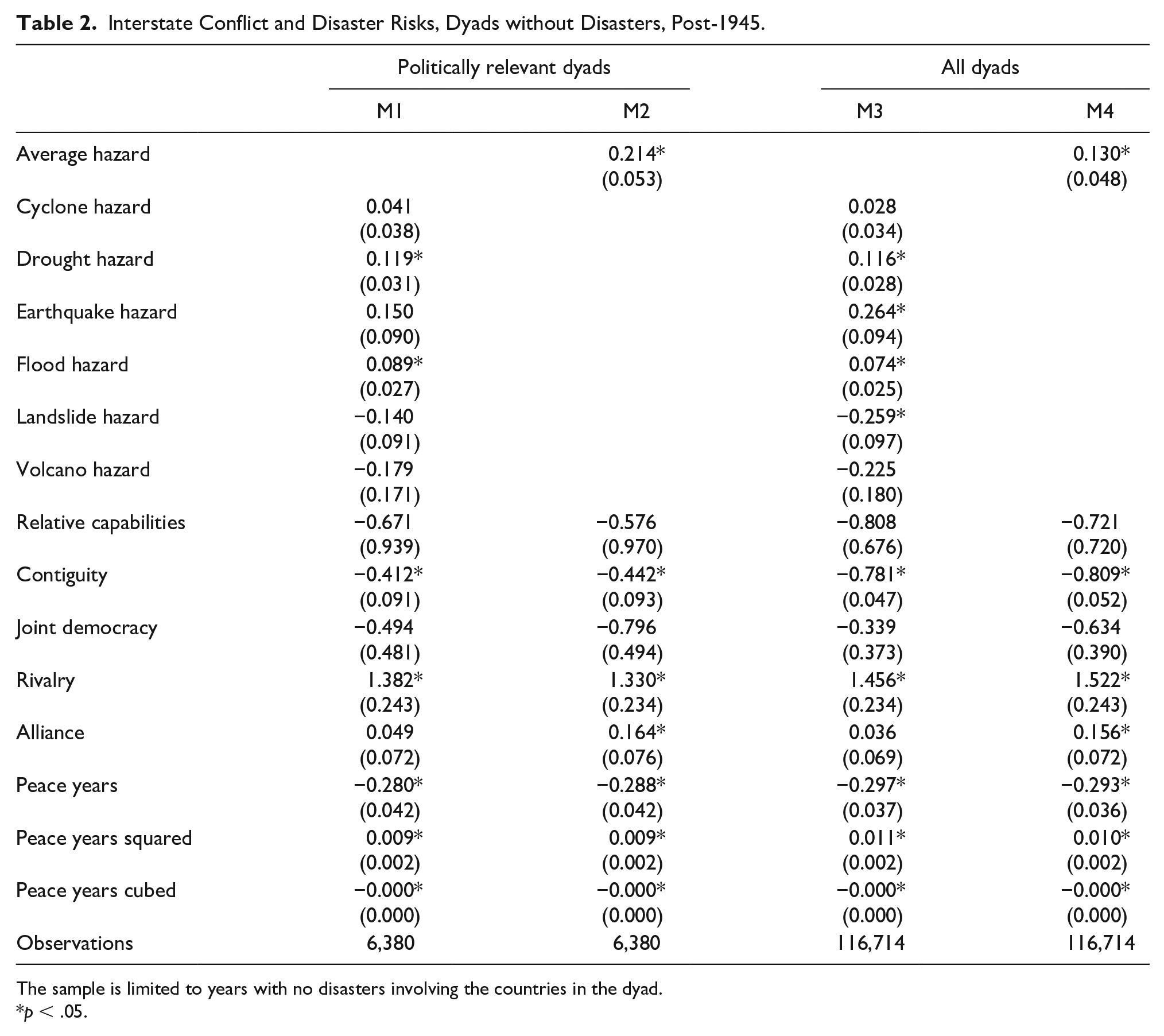
The sample is limited to years with no disasters involving the countries in the dyad.
p < .05.
What are the substantive effects of disaster risks on conflict onset? Based on model M2, Figure 3 plots the predicted probability of conflict onset when the Average hazard variable takes values from the 0th to 95th percentiles (calculated by 5 percentile increments), when the Rivalry dummy is fixed at one and all other regressors are set at their mean values for rival dyads. In each percentile value, there is a predicted positive effect that is significantly different from zero. Moreover, with each percentile increment, predicted probabilities show an increasing pattern. For instance, the effect of increasing disaster risks from the minimum sample value to its maximum results in an increase in conflict probability by .15 (from .04 to .19), with a confidence interval of (.07, .28) around this first difference. If, instead, we use the theoretical maximum of the variable for this calculation, the resulting first difference from the baseline probability value of .04 to .72 is around .68, with a 95 percent confidence interval of (.30, .92).
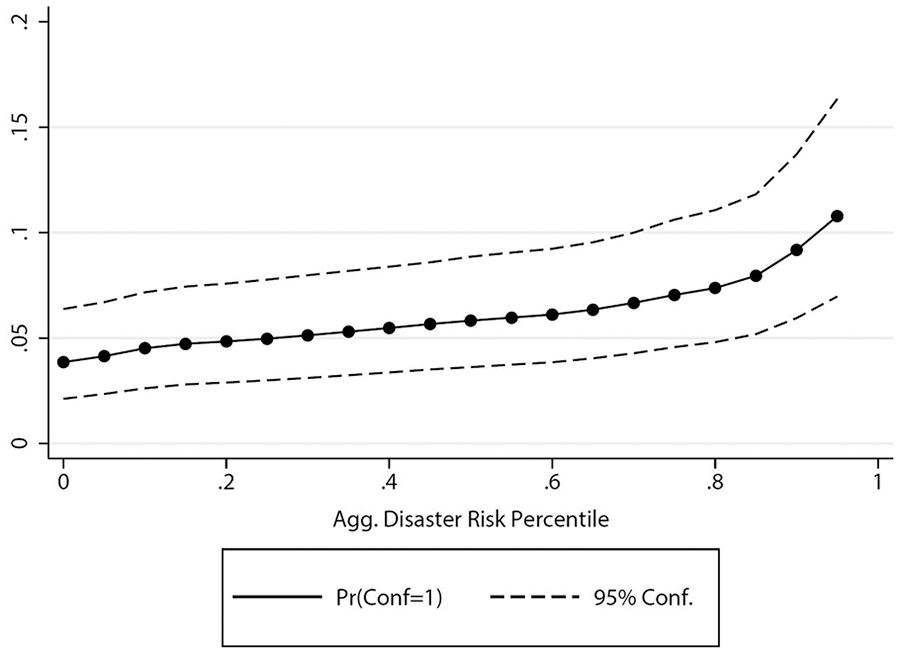
Disaster risk and interstate conflict.
Next, we focus on model M1 and calculate substantive effects for individual disaster risk variables that have statistically significant coefficients. As in the above analysis, we set Rivalry at one and keep other regressors fixed at their mean values for rival dyads. For such an observation, the effect of increasing the Drought hazard measure from its sample minimum to maximum results in a .15 increase in the probability of conflict onset from the baseline probability of .04 to .19. The confidence interval for this first difference is (.06, .28). If we use the theoretical minimum and maximum values instead, the estimated increase in probability jumps to .26 with a confidence interval of (.09, .48). Similarly, for Flood hazard, increasing susceptibility from the sample minimum to maximum results in a .12 (.03, .24) increase in the probability of conflict onset (.15 for the theoretical range, with a confidence interval from .04 to .30).
In sum, with few exceptions, disaster susceptibility is a significant determinant of interstate conflict onset. The estimated effects of disaster proneness are distinct from any potential effects of actual disaster events. Equally important is the sizeable substantive effect of disaster risks on conflict. 20
Conclusion
This article presents a theoretical argument that links anticipated natural disasters and conflict. When we view conflict onset as a bargaining failure among states, expectations about future disasters that may potentially shift the relative power balance could generate commitment problems and lead to conflict in disaster-prone regions of the world. Our empirical analyses provide evidence of a positive relationship between disaster susceptibility and interstate conflict likelihood, after controlling for any effects of actual disaster events on conflict. This finding suggests that the literature on disasters and conflict should take into account disaster susceptibility as an additional determinant of interstate conflict.
Although our results indicate that more research is necessary to revisit explanations of conflict in disaster-prone areas and account for disaster expectations, our study also has important implications for policy adoption and implementation in the area of disaster preparedness, especially during the period of climate change. There is an upward trend in the number and intensity of adverse weather events as a result of global warming (Coronese et al. 2019; Otto et al. 2018; Van Aalst 2006), and our results suggest that more severe and frequent disasters will increase the likelihood of interstate conflict in areas adversely impacted by these shocks. For instance, rising sea levels—one consequence of global warming—could have a multiplier effect for some of the disasters we consider in our article. In coastal areas, rising sea levels are likely to exacerbate the effect of cyclones and could increase the severity and frequency of floods. When state actors incorporate this multiplier effect into their expectations, commitment problems could become more severe and conflict likelihood would increase. When we interact the disaster risk variables with a time trend in our models, the magnitude of the effect of disaster risks on conflict increases over time. If decision-makers learn and accept that climate change leads to an increase in the likelihood of extreme and sudden disasters, such as severe heat waves, floods, and droughts, we would expect decision-makers to update their expectations about the future to reflect the changing climate patterns. Our research suggests that such updating would lead to more conflict, even in periods without actual disasters.
To address this challenge highlighted in our study, donor countries and international organizations, such as the United Nations, should consider allocating more resources to areas that suffer from frequent disasters. Such assistance would be more effective if it comes in the form of disaster preparedness and mitigation programs, rather than post-disaster relief alone. This assistance is important not only for helping these areas to rebuild immediately after disasters, but also for changing expectations about resource allocation in the future, which would affect decision-making in years without actual disaster events. If aid agencies and donor countries succeed in developing expectations of effective and equitable humanitarian assistance in the wake of a natural disaster, conflict due to commitment problems would be less of a concern, as long as actors residing in these disaster-prone areas believe that such relief efforts will deliver sufficient aid to compensate costs generated by any future disasters and maintain the balance of power with any potential adversaries.
Supplemental Material
Online_Appendix – Supplemental material for Expecting the Unexpected: Disaster Risks and Conflict
Supplemental material, Online_Appendix for Expecting the Unexpected: Disaster Risks and Conflict by Muhammet A. Bas and Elena V. McLean in Political Research Quarterly
Footnotes
Acknowledgements
The authors thank Connor Dezzani-Huff, Matthew Kim, Aseem Mahajan, and Anton Strezhnev for valuable comments and suggestions.
Declaration of Conflicting Interests
The author(s) declared no potential conflicts of interest with respect to the research, authorship, and/or publication of this article.
Funding
The author(s) received no financial support for the research, authorship, and/or publication of this article.

Notes
References
Supplementary Material
Please find the following supplemental material available below.
For Open Access articles published under a Creative Commons License, all supplemental material carries the same license as the article it is associated with.
For non-Open Access articles published, all supplemental material carries a non-exclusive license, and permission requests for re-use of supplemental material or any part of supplemental material shall be sent directly to the copyright owner as specified in the copyright notice associated with the article.
