



Abstract
This article examines the creation of political parties in Congress with a focus on ties between emerging party leaders and members, 1789–1802. Using an egocentric selection model, we examine who John Adams, Alexander Hamilton, Thomas Jefferson, and James Madison tied with as a function of the characteristics of the emerging leader, a member of Congress, and dyadic relationships between the two. We also examine whether ties affected the party chosen by members of Congress. Everything else equal, we find leaders were more likely to form ties with ideologically similar members, but find no evidence of them tieing with more pivotal voters. In response, members were more likely to join the Federalist party if they received a Federalist tie, but they were not more likely to join the Republican party if they received a Republican tie. Understanding such relationships is an important step for understanding the creation of parties in the United States.
Keywords
Introduction
Almost every major episode in American political history has been associated with a key personality coming to power committed to change. No account of the New Deal would leave out Franklin Delano Roosevelt, and no account of the first American political parties would leave out Alexander Hamilton or Thomas Jefferson. But if energetic leaders are so important, how do they rise to power and what types of people do they associate with as they ascend?
This article examines the coalitions formed by John Adams, Alexander Hamilton, Thomas Jefferson, and James Madison as they attempted to create the first parties in Congress. The United States provides fertile ground for studying the origin of parties because formal parties did not exist when the federal government began in 1789 and many early Americans openly opposed parties. Hamilton thought a “spirit of faction, which is apt to mingle its poison in the deliberations of all bodies of men, will often hurry the persons of whom they are composed into improprieties and excesses” (Rossiter 1961, 111). Jefferson wrote, “If I could not go to heaven but by a party, I would not go there at all.” 1 Other early Americans took similar stances. If parties were so unwelcome, how did they form so quickly?
While a number of scholars have studied the incentive to create parties (Aldrich 1995, 2011; Carpenter and Schneer 2015; Eguia 2013), few have studied with whom party leaders made connections as they created the first coalitions in Congress nor whether those connections affected which party a legislator chose to join. This article fills that gap. It focuses on the formation of parties in the U.S. Congress 1789–1802, using a new data set of 1,640 leader–legislator dyads. Our data end in 1802 because the Republicans overwhelmingly controlled Congress from 1802 forward. 2 It tests three conjectures: (1) party leaders interpersonally tied with ideologically similar individuals, (2) they were more likely to tie with pivotal members of Congress, and (3) ties affected the party which legislators chose to join.
We test these conjectures using two sets of regressions, both of which use letters as a measure of a directed tie. The first tests whether future party leaders (John Adams, Alexander Hamilton, Thomas Jefferson, or James Madison) were more likely to have a tie with an ideologically similar legislator (a past, present, or future member of Congress). It also tests whether leaders were more likely to tie with legislators that were more likely to pivot a chamber.
The second set of regressions tests whether members of Congress who entered after 1794 were more likely to become a Federalist if they received a tie from a Federalist leader 1791–1794, and whether they were more likely to become Republican if they received a tie from a Republican leader during the same period.
We find evidence for two of our three hypotheses. Everything else equal, emerging leaders were more likely to tie with ideologically similar legislators. We find no evidence that they were more likely to tie with members more likely to be pivotal. More interestingly, the effects varied by leader. Jefferson was the most likely to tie with ideologically similar legislators. Yet, members of Congress were more likely to join the Federalist party if they received a tie from Hamilton. They were not more likely to join the Republican party if they received a Republican tie.
Political scientists regularly study parties and interest groups as networks (Box-Steffensmeier et al. 2013; Koger, Masket, and Noel 2009; Massengill, Caldeira, and Minozzi 2017; Noel 2013; Siegel 2009, 2011). They have only begun, however, to study the formation of those networks. 3 This article adds to the party network literature by expanding the theoretical and empirical work on the formation of parties in the United States.
Literature
Although many scholars disagree about the exact date that parties formed in the United States, many argue that congressional parties had formed by the end of the Fourth Congress. They also agree that Adams, Hamilton, Jefferson, and Madison were the leaders at the forefront of the emerging parties (Cunningham 1957; Elkins and McKitrick 1994; Hofstadter 1972). The rifts between Hamilton (an emerging Federalist) and Madison (an emerging Republican) became apparent when Hamilton introduced his financial plan in 1791. The plan attempted to address the nation’s liabilities by assuming state debts, paying off bond holders at face value, and issuing new securities. Hamilton also proposed the First National Bank of the United States, which Madison and others found unconstitutional. Coalitions slowly formed around these differences, as well as competing views about the proper trading partner in Europe. The Federalists favored trade with Great Britain; the Republicans preferred trade with France. Conflict continued until the presidential election of 1800, when the Republicans took control of both branches of Congress and the Presidency.
Historical studies of the origin of parties in the United States have described the creation of two coalitions in great detail (Cunningham 1957; Elkins and McKitrick 1994; Hofstadter 1972). For example, Hofstadter (1972) describes the conditions for party development in the new republic, with emphasis on why Americans were slow to accept parties. More data-driven approaches have chronicled the clustering of congressional ideal points over time (Hoadley 1980; Jillson and Wilson 1994), argued that the Constitution facilitated vote trading (Aldrich, Jillson, and Wilson 2002), claimed that the antifederalists filled most of the Republican ranks (Aldrich and Grant 1993), or examined the effect of Jefferson’s dinner parties on Congressional roll call votes (Massengill, Caldeira, and Minozzi 2017). None of these studies have examined with whom party leaders created interpersonal ties as they built their emergent party, nor why.
Studies of contemporary politics examine whether ties between political organizations are partisan (Koger, Masket, and Noel 2009), the effect of ideology on ties between lobbyists (Carpenter, Esterling, and Lazer 2004), and the network centrality of members of Congress (Victor and Ringe 2009).
The rational choice literature largely focuses on the incentive to join coalitions (Aldrich 1995; Eguia 2013; Riker 1962). In a seminal work, Aldrich (1995, 2011) argues that parties developed in two stages. In the first stage, coalitions formed to overcome social choice problems in Congress. In the second stage, political leaders such as Andrew Jackson and Martin Van Buren attempted to overcome collective action problems in the electorate to win more congressional seats. Aldrich claims that Jackson purposefully targeted swing states to help win elections, but he does not apply the same logic to swing voters in Congress. Nor does he describe with whom leaders connected as they created congressional coalitions and why.
Theory
To understand Aldrich’s (1995, 2011) theory, and how our theory can be viewed as an extension, consider a stylized example of the incentives to form parties presented in Table 1. 4 Aldrich uses examples like this to explain the formation of parties in the first three congresses. The example contains three legislators, {A, B,C}, and three bills, {X, Y,Z}. The table lists the cardinal utility that each legislator receives from each of the three bills. For example, legislator A receives three units of utility from bill X, because it provides benefits to his or her district, but A loses one unit of utility from bills Y and Z, because those bills spend money on other districts using tax revenues from all three districts.
The Incentives for Party Formation.
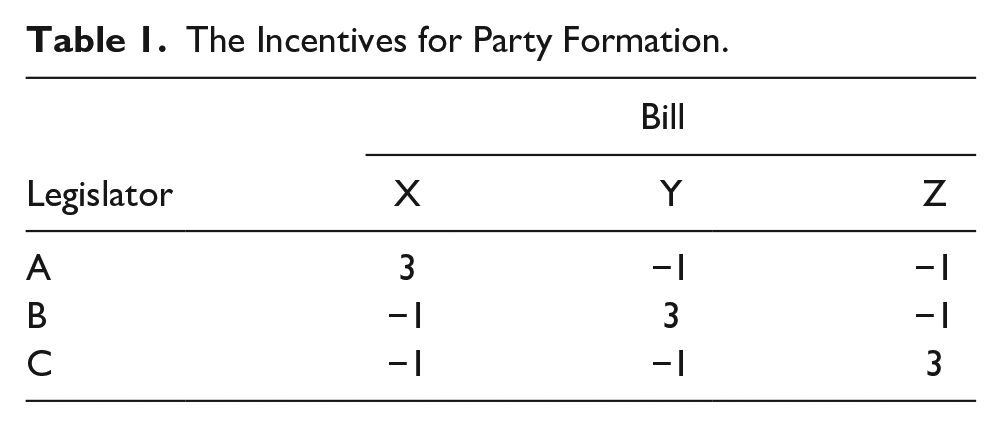
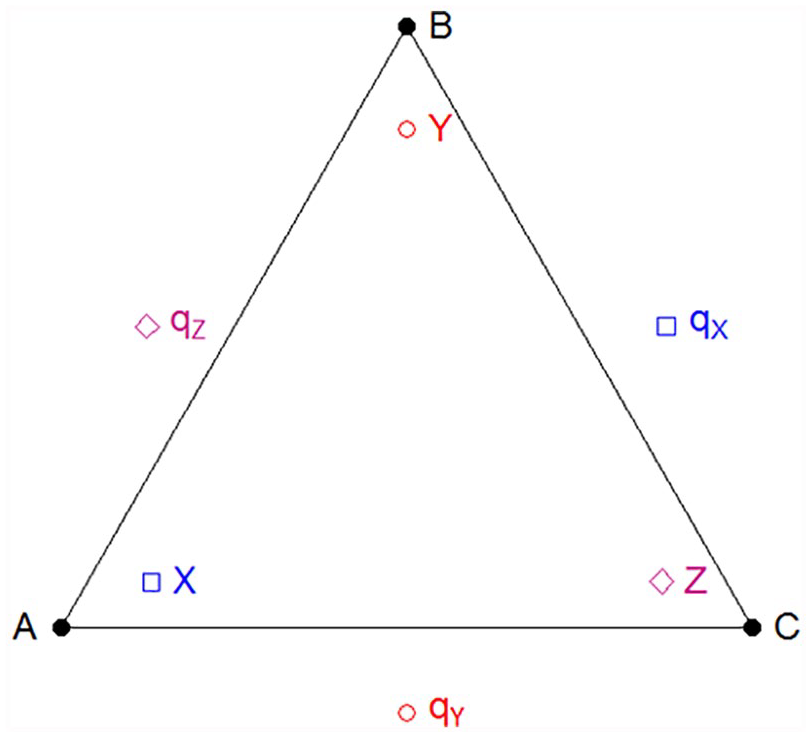
The idea can be seen in the two-dimensional spatial voting model beneath the table. Here, A, B, and C are ideal points and X, Y, and Z are the locations of three spending bills. Each bill has a different status quo, represented by qX, qY, and qZ, respectively.
If the three legislators voted on each of the three bills sincerely and separately, none of the bills would pass. However, two legislators could do better by forming a stable, minimum winning coalition across all bills rather than voting alone or forming a three-person coalition (Aldrich 2011). In this sense, forming a stable, minimal winning party is rational.
A natural extension of Aldrich’s theory is to ask “with whom” would legislators chose to form stable coalitions? If legislator A is the first to take the initiative, would he or she form a majority coalition with B or with C? Assuming that all types of bills might be proposed in the future, and legislators do not know the locations of those bills when coalitions are formed, at least two factors could influence his or her decision.
First, a leader might consciously or unconsciously create coalitions with legislators that are ideologically similar to themself. Ideologically similar legislators are more likely to have common demands and less likely to oppose bills that other members of the coalition want. In this example, B and C are equidistant from A, so there is no reason for A to favor one coalition over the other. But if B were closer to A, A would have reason to form a coalition with B rather than C.
Second, an individual forming a coalition would gain by including a pivotal voter from one of the chambers. Such voters can help a coalition succeed (Richman 2011). To see this, consider the ideal points of five legislators in Figure 1. In this case, legislator A is equidistant from B, C, and E, so A could easily create a minimum winning coalition of {A, B,C}, {A, B,E} or {A,C,E}. Leaving relative distances aside, legislator A might benefit from including C because C is more likely to pivot a majority vote than the other two legislators—particularly if the party is undisciplined and legislators could vote individually. Everything else equal, including C in A’s coalition would increase A’s chances of legislative success.

Pivotal voters.
Although he does not use the term pivotal, historian Nobel Cunningham (1957) claims that pivotal members were actively targeted. He writes, Part of the activity of the party, especially in the opening days of a session, consisted in making efforts to win the support of members who had no clear party ties, and appealing, at all times, to that body of men who considered themselves independent of parties and whose vote might decide an issue. (p. 77)
Our third hypothesis tests whether ties worked. If individuals tried to tie with ideologically similar legislators or legislators that were more pivotal, would those legislators reciprocate by increasing the probability of joining a leader’s emerging party? Would personal contacts affect party choice independent of ideology and pivotalness?
A New Data Set
To test these conjectures, we need a measure of interpersonal relationship. We use correspondences because they are the most comprehensive measure of personal or professional relationship surviving from the early American period. To attain these connections, we created a new data set of all letters to and from Adams, Hamilton, Jefferson, and Madison from 1789 to 1802. These four individuals corresponded with roughly 2,880 unique individuals during the this period with more than 23,000 correspondences to or from the four. This includes foreigners and corporations, as well as former, current, and future members of Congress. We hand-coded all of these correspondences using the most complete collection of published manuscripts available for each author (Adams 1850; Boyd 1950–2016; Butterfield 1963; Cooke and Syrett 1961–1987; Hutchinson et al. 1962–2016). These publications include manuscripts gathered by the Library of Congress, the National Archives, various historical societies, academic institutions, and individual owners of letters, among other sources. We coded the date of the letter, the author, the recipient, whether parties were discussed, and whether a majority of the letter was devoted to politics. 5 Only 8 percent of the letters from the four leaders discussed parties, while 70 percent were mostly about politics.
Jefferson sent or received more than two letters a day during this period which was substantially more than the other three. Adams sent and received 665 letters during the period, which was one-twentieth of Jefferson’s volume and the fewest among the four men. Adams’s opposition to the formation of parties might explain why he wrote considerably fewer letters than Jefferson (Hofstadter 1972). Nevertheless, the scant number of correspondences to or from Adams raises questions about whether his manuscripts are complete. 6 The political manuscripts of the other three leaders appear to be unabridged. 7
Ties with Members of Congress
The current study focuses on a subset of the data—the correspondences between the leaders and the 410 people who were members of Congress for at least one year between 1789 and 1802, inclusive. Each legislator was either a member of Congress, a former member, or a future member that entered Congress sometime during the period. Jefferson wrote to 114 of these individuals, averaging more than eighteen different people per year. Hamilton wrote to seventy-one of them, averaging thirteen different people per year; Madison wrote to twenty-eight, averaging less than four different people per year; and Adams wrote to twelve, averaging less than two different people per year (see Figure 2, Frame A). Hamilton and Jefferson focused their attention on active members of Congress more than on past or future members (see Figure 2, Frame B).
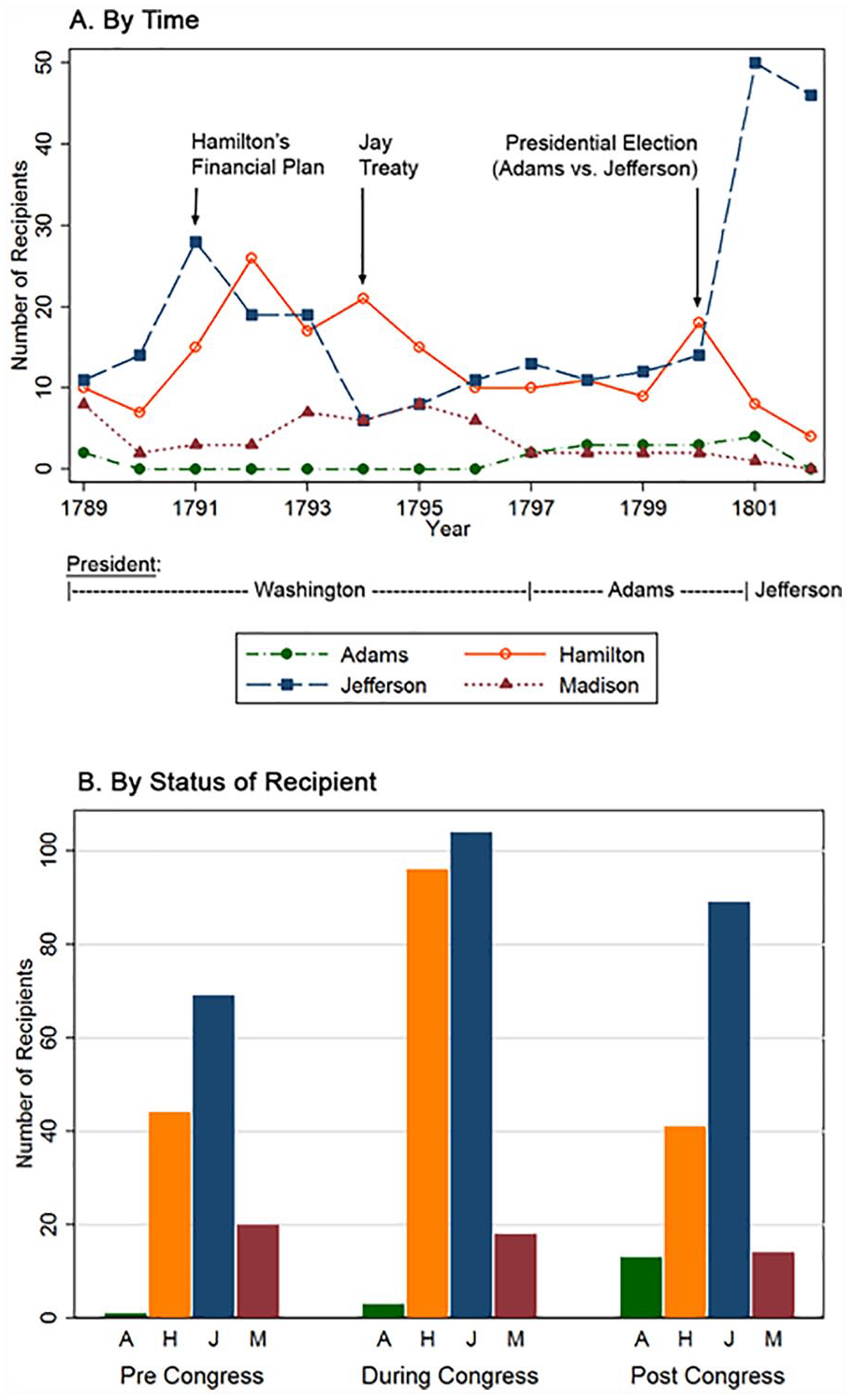
Letters from the leaders.
With the exception of letters written by Jefferson during his presidency in 1801 and 1802, there is little trend in the total number of individuals contacted over time. Nevertheless, there are some patterns. For example, the four men sent a greater proportion of their letters to active members of Congress as time progressed (not shown). 8
We use these letters to measure the existence of an asymmetric, professional or personal relationship between two people. Asymmetric relationships among friends include A inviting B to his or her home or A going to B for advice. In our case, an asymmetric tie between a sender and a receiver exists if the sender sent at least one letter to the receiver in a particular year. We do not make use of the content of letters in the main part of the manuscript because the content of letters was diffuse, and the purpose is to measure professional (or personal) relationships. 9 We consider ties weighted by content as a robustness check in the appendix.
The distinction is important because party leaders rarely used letters to convince someone to join their party. A typical letter contained personal information, a discussion of politics, and little more. For example, Hamilton wrote Henry Lee fifteen times between 1789 and 1795. In one of his letters, Hamilton explained that the British minister did not take offense to his circular letter and offered Lee his opinions on the “real” situation in France. He never broached the ungentlemanly topic of asking Lee to join his coalition or support a bill, perhaps because such propositions were considered brash in the eighteenth century
10
and politically dangerous if the letter was shared with others, as they often were.
11
As Aaron Burr wrote, It would not be easy neither would it be discreet, to answer your enquiries or to communicate to you my ideas with satisfaction to either of us, in the compass of a Letter. I will endeavor to do it in person. (To Thomas Jefferson, June 21, 1797, Boyd 1950–2016, 29: 447–48)
Treating correspondence as an indication of an interpersonal tie is similar to the sociological treatment of friendship. Friendship can be measured by determining whether individuals write letters to each other. But unless one is studying a social media like Facebook, researchers would not expect authors to explicitly ask someone “to be their friend.”
Graphing Ties
To evaluate our hypothesis about the relationship between ties and ideology, we need an ideological space that includes members of Congress, as well as Adams, Hamilton, and Jefferson. Ideological positions for Madison and Jefferson can be estimated in the usual fashion using Madison’s votes in the first four Houses and Jefferson’s presidential position statements. Adams issued too few position statements as President to attain an ideological score (Poole and Rosenthal 1997) and Hamilton was never a member of Congress nor a President.
To get Adams and Hamilton back in the space, we used a technique described by Poole (2005). We combined votes from the Congress of the Confederation (where Adams and Hamilton did vote) with votes from the first seven U.S. Congresses (where they did not vote) into one matrix, and then estimated two sets of scores using W-NOMINATE: (1) those from a combined matrix of all votes from the Congress of the Confederation and the first seven U.S. Congresses, and (2) those from the first seven U.S. Congresses only. 12 The latter provided fixed ideological positions for members of the post-Constitution Congresses. 13 We then predicted the positions of Adams and Hamilton using a multivariate regression with the two-dimensional scores from the first seven congresses as the dependent variables and the two-dimensional scores from our combined matrix as the independent variables. 14 This technique was used to infer positions for Adams and Hamilton only. The ideal points of the other 411 individuals in our study came solely from votes in the post-Constitution Congresses.
To graph our network of ego–alter ties, we placed members of Congress in the location of their NOMINATE scores, and then graphed ties between leaders (ego) and legislators (alters) 15 (see Figure 3). We do not include alter–alter ties because alter–alter ties are not directly related to our study and most alter–alter correspondences are missing. Each frame of the figure depicts the ideal points of the members of the House or Senate in a particular year (black dots); the ideal points of the Federalist leaders (blue dots); and the ideal points of Republican leaders (red dots). It also includes blue lines, indicating the number of letters written from a Federalist leader to a member of Congress, and red lines, indicating the number of letters written from a Republican leader to a member of Congress. Thicker lines indicate more letters sent than thinner lines.
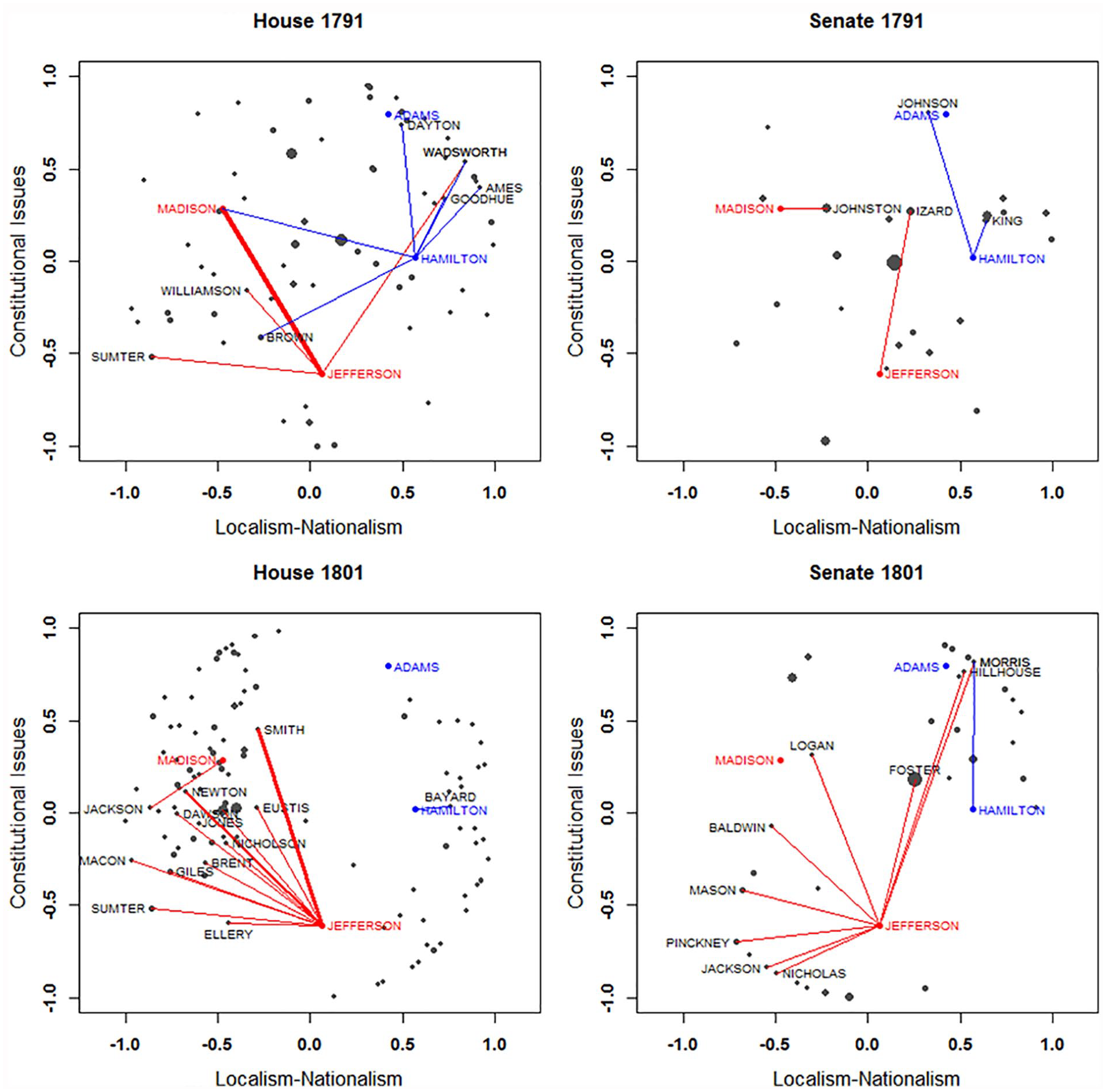
Letters from emerging leaders to members of Congress, 1791 & 1801.
For example, the first frame depicts the letters written by the four leaders to members of the U.S. House of Representatives in 1791. Jefferson wrote Thomas Sumter, Jeremiah Wadsworth, and Hugh Williamson once each that year. He wrote Madison seventeen times. Because Jefferson was not a member of the U.S. House, but Madison was, Madison’s letters to Jefferson are not included in the figure. Hence, the thickness of the line between the two is solely an artifact of the seventeen letters from Jefferson to Madison.
The Shapley–Owen value (SOV) associated with each member of Congress is indicated by the size of the ideal point, with larger points for members of Congress that have greater SOVs. An SOV measures how often a member is pivotal in his or her chamber for all possible status quo and proposal locations, assuming each status quo and proposal location is equally likely (Owen and Shapley 1989). We calculate SOVs for each chamber-year separately using an algorithm similar to the one described by Godfrey, Grofman, and Feld (2011).
In 1791, the most important legislation was Hamilton’s financial plan, which signaled Madison’s break from Hamilton. As can be seen in the top two frames of Figure 3, the ideal points of members of Congress were fairly spread out. More importantly, the emerging Federalist and Republican leaders maintained ties with a variety of individuals, often without a clear preference for ideology. This might be expected as parties were largely frowned upon in the first two congresses and the ideological dispositions of its members were not well known.
In 1801, Jefferson became President and increased his ties, largely with members of his party. The 1801 frames on the bottom of Figure 3 show greater partisan divides than the frames for 1791.
These frames, and similar frames for the years not reported, indicate few ties with members who had larger SOVs. Keeping in mind that a pivotal legislator might be difficult to identify, it may not be surprising to find a weak relationship between ties and SOVs. Evidence in favor of the pivotal voter hypothesis is a tall order.
Regressions: Legislator Selection Model
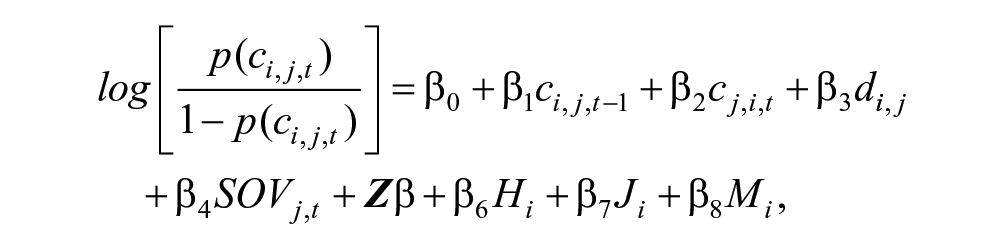
In the vernacular, the early development of parties can be seen as the emergence of several egocentric, selection models. An egocentric selection model examines the creation of a social network from the perspective of a single actor, or in this case four key actors. The underlying question in these models is with whom do key actors interact as a function of the characteristics of the leader, the legislator, and the dyadic relationships between the two.
Assuming
where
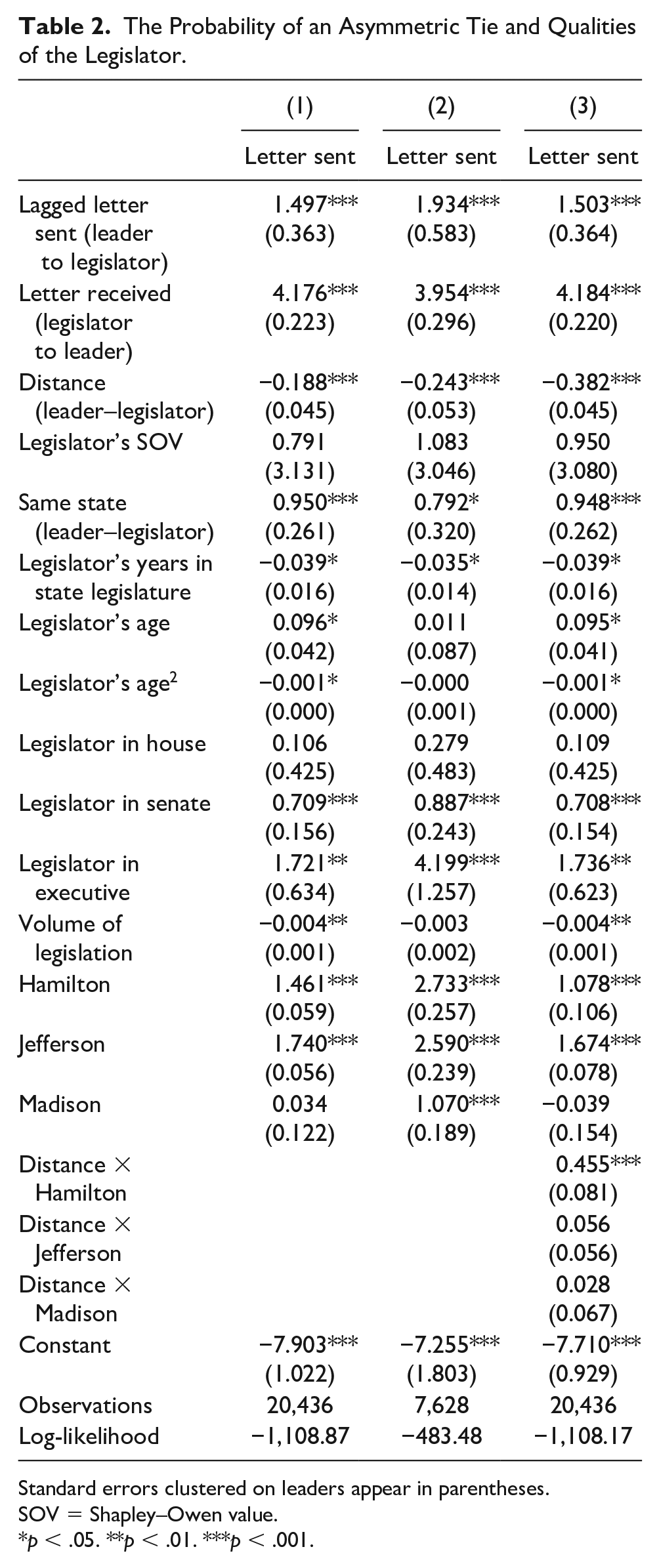
Table 2, column (1) presents our primary results. Column (2) is the same except the data are limited to individuals who are either in Congress or entering Congress for the first time the next year. Column (3) uses the same data as column (1) except the leader variables are interacted with ideological distance. We describe the results from column (1) first.
The Probability of an Asymmetric Tie and Qualities of the Legislator.
Standard errors clustered on leaders appear in parentheses. SOV = Shapley–Owen value.
p < .05. **p < .01. ***p < .001.
Lagged letter sent indicates whether a letter was sent from a leader to a legislator in the previous year. In addition to helping address first-order autocorrelation, this variable controls for a predisposition to make ties with a particular legislator. The coefficient is positive and significant as one might expect, indicating that previous ties affected current ones.
Letter received (i.e., letter sent from legislator
Distance, the variable testing our first hypothesis, measures the ideological distance between a leader and a legislator in a two-dimensional space. This variable is negative and significant as expected, indicating that leaders were more likely to create an interpersonal tie with an ideologically similar legislator. We say more about this relationship at the end of this section.
SOV, each legislator’s Shapley–Owen Value, measures the degree to which a legislator could pivot his chamber. Because Congressional membership varied by year, SOV varies by year as well (and by legislator) and is zero for anyone outside of Congress. The coefficient for SOV is positive, as one might expect, but insignificant—perhaps because it was difficult to pinpoint “those who might decide an issue” (Cunningham 1957, 77). 17
With regard to the remaining control variables, same state indicates whether the leader and legislator were from the same state in year t. It controls for the possibility that people from the same state were more likely to tie than people from different states. Not surprisingly, hailing from the same state has a positive and significant effect on the probability of a tie. With other variables held at their means (or modes), a discrete change of hailing from different states to hailing from the same state increases the probability Adams made a tie by 0.3 percentage points, Hamilton by 1.4 percentage points, Jefferson by 1.8 percentage points, and Madison by 0.3 percentage points. 18
Years in State Legislature measures the number of years a legislator served in his state legislature before entering Congress. Its negative and significant coefficient suggests that leaders were more likely to form ties with legislators that had less legislative experience, everything else equal. Perhaps such individuals were more likely to be independent of parties and more open to persuasion.
The positive and significant effect of age and negative and significant effect of age2 suggest that even though leaders may have been more likely to tie with inexperienced politicians, they were more likely to tie with older, more mature legislators at a decreasing rate of their age. Additional years increased the probability of attracting a tie but each additional year increased the probability by a smaller amount than the previous year, with the probability peaking at age 48.
The next three variables control for the legislator’s current role in the federal government. Presumably, the four leaders would have business with government officials and would be more likely to contact a member of Congress or the executive than someone outside those bodies.
House controls for whether the legislator was a member of the U.S. House of Representatives the year they received a tie. Its positive coefficient suggests that the leaders were more likely to send letters to members of the House than to legislators outside Congress, but the insignificance of the relationship suggests that we cannot differentiate House members from future and past members of Congress. Roughly three hundred people per year were not members of Congress in our study—well more than congressional membership in a given year.
Senate measures the same for the U.S. Senate. Its coefficient is positive and significant as one might expect. Because the Senate is considerably smaller than the House, a typical member of the Senate should have a greater impact on policy than a typical member of the House. This might explain why this relationship is significant, while the relationship for the House is not.
Executive indicates whether a legislator was a member of the U.S. executive. 19 The positive and significant coefficient for executive suggests that members of the executive branch were more likely to receive a tie than other individuals outside Congress, perhaps because it helped them conduct their business. 20
Volume is the total number of roll calls considered by the House and Senate in year t. Although one might think the average number of ties would increase with the total number of roll calls (i.e., more workload implies more letters), the negative and significant relationship suggests that increased work load actually decreased the propensity to make a tie, with other factors controlled.
The remaining variables are dummies indicating whether Hamilton, Jefferson, or Madison was the leader in the dyad (with Adams as the omitted category). The positive and significant coefficients for Hamilton and Jefferson, and insignificant coefficient for Madison, reflect the fact that Hamilton and Jefferson wrote more letters to past, present, or future members of Congress than Adams or Madison. 21
The second model, in column (2), is the same as the one in column (1) except the data are limited to current members of congress and the year before members entered Congress for the first time. As one can see, the sign and significance of these variables remain the same, with a few exceptions: same state is significant at the weaker .05 level, age, age2, and volume are no longer significant at traditional levels, and executive is significant at the stronger .001 level. Finally, Madison is positive and significant at the at the .001 level, indicating that a legislator is more likely to receive a letter from Madison than from Adams.
The third model, in column (3), is the same as column (1), except leader dummies are interacted with distance. With interaction terms included in the model, the z statistics for distance, the leader dummies, and the interaction terms cannot be interpreted in the usual fashion. Instead, these relationships can be analyzed using a post-hoc z test (Brambor, Clark, and Golder 2006). The coefficients for distance conditioned on leader show that distance is negative and significant for Jefferson, Adams, and Madison, but positive and insignificant for Hamilton. Because distance is insignificant for Hamilton, and Adams and Madison created few ties, it appears that Jefferson is largely responsible for the relationship between ties and ideological similarity.
The relationship can be seen in Figure 4. Figure 4 plots the predicted probability of a tie on various distances while other variables are held at their means or modes. The green dash-dot line with solid circles in the figure indicates the predicted effect of distance for Adams; the orange solid line with hollow circles indicates the predicted effect for Hamilton; the blue long-dash line with solid squares shows the effect for Jefferson; and the brown dotted line with solid triangles shows the effect for Madison. The latter overlays the line for Adams in the figure because the predicted probabilities for Adams and Madison are very similar. 95 percent confidence intervals are also shown. As the figure indicates, Jefferson’s predicted probability decreases as distance increases, consistent with our first hypothesis. Holding other variables constant, a one unit increase in ideological distance between Jefferson and a legislator decreases the odds of Jefferson sending a letter by 25 percent. The relationship for Hamilton does not decrease, and ideological distance has very little effect on the few individuals to which Adams and Madison tied.

Predicted letter sent and the ideological distance of the legislator.
In hindsight, this result makes perfect sense. Hamilton and Jefferson actively organized coalitions in and out of Congress. But while Jefferson directed his lieutenants to respond to Hamilton in the newspapers or keep track of potential supporters, Hamilton was largely writing state politicians about military affairs or details of his financial plan. This made Hamilton’s ties much more diffuse. 22 Meanwhile, Madison created few ties with few members of Congress despite his prominence in American political history.
To provide a robustness check, and to determine whether the content of letters might affect the results, we recreated the network using weighted ties, with larger weights for stronger political connections in the appendix. That model produces similar results. 23
Regression: Party Selection Model
Finding that party leaders, particularly Jefferson, wrote ideologically similar individuals raises questions about whether ties from a leader affected a legislator’s party choice. Did the directional tie of a personal or professional relationship with a leader encourage a legislator to join the leader’s ranks?
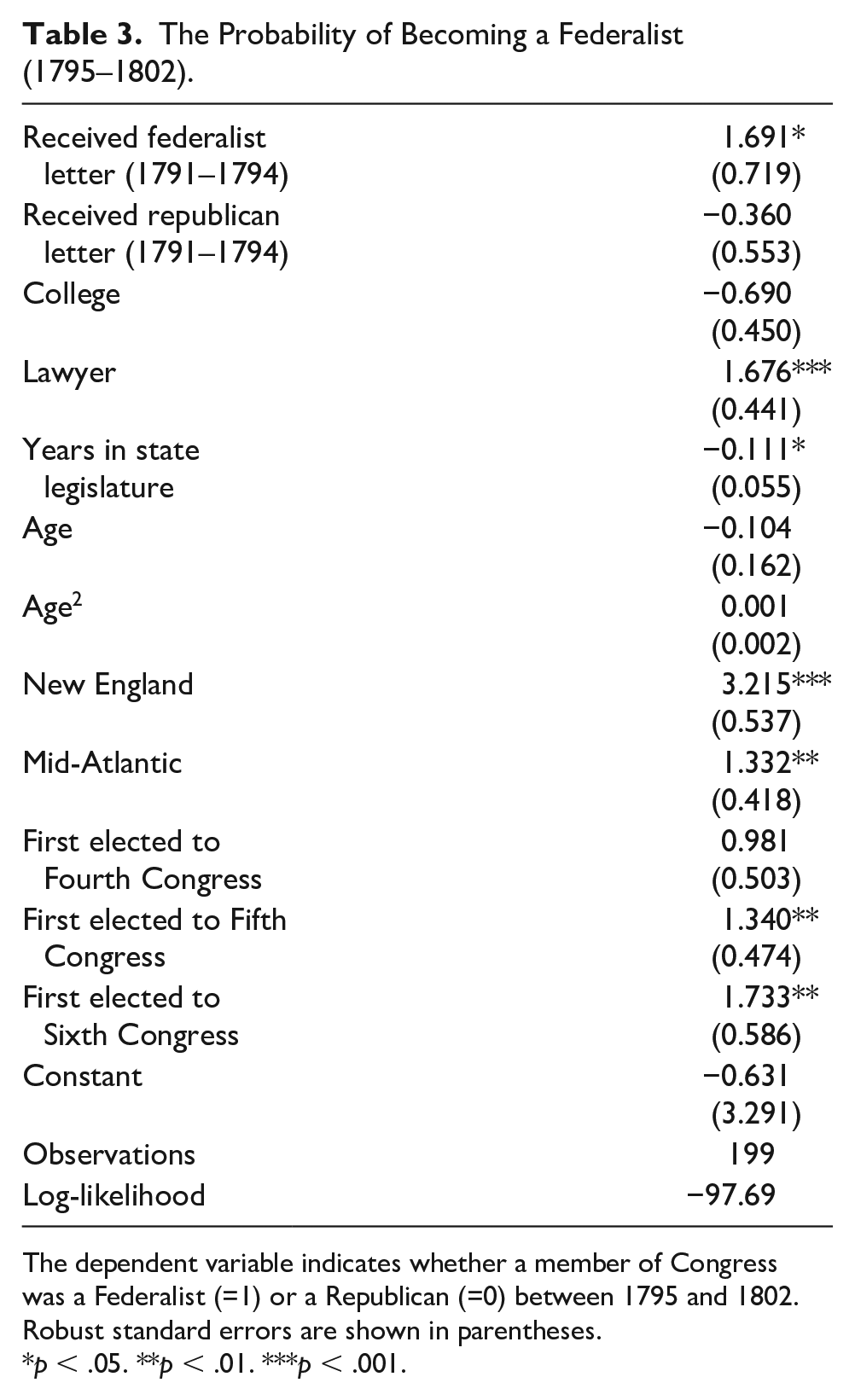
We answer that question by introducing a purely cross-sectional regression which relates a legislator’s party identification to the receipt of a letter from a leader. To avoid endogeneity, the regression is limited to members of Congress who were initially elected to the Fourth, Fifth, Sixth, or Seventh Congresses. The dependent variable measures whether the Congressperson became a Federalist (=1) or a Republican (=0) when they first entered Congress. 24 The key independent variables are two dummy variables indicating whether the member of Congress received a letter from a Federalist leader or from a Republican leader, respectively, during the second or third congresses when party identifications were not yet official. 25 We omit letters from the First Congress because parties were widely vilified at the time and ties were much more haphazard. The results of this analysis appear in Table 3.
The Probability of Becoming a Federalist (1795–1802).
The dependent variable indicates whether a member of Congress was a Federalist (=1) or a Republican (=0) between 1795 and 1802. Robust standard errors are shown in parentheses.
p < .05. **p < .01. ***p < .001.
Received Federalist Letter is a dummy variable indicating whether the member of Congress received a letter from one of the Federalist leaders, namely, Hamilton, during the second or third Congress. 26 Its coefficient is positive and significant at the .05 level, indicating that a legislator was more likely to join the Federalist party if they received a tie from Hamilton before entering Congress. Although the Federalist leaders sent fewer letters than their Republican counterparts, this result suggests that Hamilton’s ties had an effect. With other variables held at their means (or modes for dichotomous variables), a Southerner first elected to the Fourth Congress was 36 percentage points more likely to support the Federalist party if he received a tie from Hamilton during one of the previous two congresses than if he did not—a large effect. A New Englander, who was first elected to the Fourth Congress, was only 0.06 percentage points more likely to join the Federalists if he received a similar tie, perhaps because New Englanders were inclined to become Federalists.
Received Republican Letter, in contrast, is negative as one would expect but insignificant, suggesting that receiving a tie from Jefferson or Madison during the second or third Congress had no effect on the party chosen by a legislator who joined Congress between the beginning of the Fourth and end of the Seventh Congresses. Jefferson may have actively created ties with individuals who had similar ideological views, but our results provide no evidence that his ties affected party choice—at least during the early years of Congress. This is quite surprising because Jefferson and Madison toured New England to gain support for their legislative agenda in 1791, and they were known to have won the respect of Governor George Clinton, Aaron Burr, and others, during their travels. Perhaps the reason for the result is that Jefferson maintained ties with ideologically similar legislators who were predisposed to join his ranks with or without a tie. 27 Hamilton contacted some individuals who were not entirely predisposed to join his party.
College is a dummy variable indicating whether the Congressperson was college educated. It is negative and insignificant suggesting that those who were more educated were not more likely to join one party or the other, contrary to common perceptions that the Federalists represented the elites.
Lawyer indicates whether the Congressperson passed the bar or practiced law. It is positive and significant, suggesting that all else equal, lawyers were more likely to become Federalists than Republicans.
As before Years in State Legislature indicates the years a Congressperson spent in a state legislature. The sign and significance of this variable suggests that members of Congress with less legislative experience were more likely to join the ranks of the Republicans, not the Federalists.
The insignificance of age and age2 suggests that we cannot reject the null hypothesis that age had no effect on party choice.
New England and Mid-Atlantic are regional dummies indicating the region from which a Congressperson hails, with the South as the omitted category. 28 The positive and significant coefficient for these two variables suggests that Congresspeople from New England or the Mid-Atlantic were more likely to join the Federalist party than equivalent people from the South, consistent with the historical narrative about Republican domination of the South and Federalist domination of New England. For many years in our study, the Federalists carried Pennsylvania, New York, and other parts of the Mid-Atlantic.
The final three variables are dummy variables indicating whether the Congressperson was first elected to the fourth, fifth, or sixth Congress, with the seventh Congress omitted. The Federalist party controlled both the House and Senate during the Fourth through Sixth Congresses. Republicans took control of both chambers during the seventh, explaining why the three variables are positive with respect to the omitted category.
Conclusion
E. E. Schattschneider (1942: 1) claimed that “political parties created democracy and modern democracy was unthinkable save in terms of the parties.” Although American political parties were partly built from the bottom up, few would argue that Adams, Hamilton, Jefferson, and Madison played anything less than major roles in the creation of parties in the United States. Aldrich (1995, 2011) and others have helped us understand why it was rational to form parties in Congress and why members of Congress would embrace those attempts. This study extends those ideas by helping us understand with whom party leaders connected and whether those connections affected the party chosen by a legislator. In doing so, it helps us move us beyond the incentive to form a party toward the actual process of party formation.
We find evidence that emerging party leaders were more likely to tie with ideologically similar politicians. We do not find evidence that they were more likely to tie with individuals who were more likely to pivot a congressional chamber.
But our results are more nuanced. Jefferson was largely responsible for forming relationships with ideologically similar legislators, while Hamilton connected to politicians with a greater variety of ideologies. Adams and Madison took a less active role than the other two. This is particularly interesting for Madison, who has been described as the “father of the party system” (Jaenicke 1989, 116). Our results suggest that Madison’s interpersonal ties were not driven by ideology, like Jefferson’s, and they were not effective in shaping party choice, like Hamilton’s.
Ironically, newly elected Congresspeople were more likely to become Federalists if Hamilton extended them an earlier tie than if he did not, and the predicted effect was quite large for recipients from the South—a contested region where Federalists could swing a few supporters and a relationship with Hamilton could make a difference. Republican ties did not have the same effect, perhaps because Jefferson tied with politicians who were predisposed to become Republicans, making each tie less impactful in and of itself.
The moral is far-reaching. There is value in making connections with people that are ideologically dissimilar to oneself, intentionally or unintentionally. Connecting with people who have different views may have greater impact in swaying a person’s opinion than connecting with people who already agree with one’s position.
Part of the reason the Republicans may have ultimately succeeded in creating a longer-lasting party than the Federalists might have been that Jefferson connected with almost twice as many people per year as Hamilton—particularly during his presidency. Those connections may have swayed few minds, but they helped organize individuals with similar views into a formidable party.
Supplemental Material
Online_Appendix – Supplemental material for Creating Parties in Congress: The Emergence of a Social Network
Supplemental material, Online_Appendix for Creating Parties in Congress: The Emergence of a Social Network by Keith L. Dougherty in Political Research Quarterly
Footnotes
Appendix
To determine the robustness of the results presented in Table 2, column (1), we created three sets of ties weighted by the strength of political connection between the sender and the receiver. The first weighs a tie 1 in year
Acknowledgements
Special thanks to Jamie Monogan for statistical advice, and to Brittany Leach, David Hughes, and Grace Pittman for research assistance.
Declaration of Conflicting Interests
The author(s) declared no potential conflicts of interest with respect to the research, authorship, and/or publication of this article.
Funding
The author(s) received no financial support for the research, authorship, and/or publication of this article.

Supplemental Material
Notes
References
Supplementary Material
Please find the following supplemental material available below.
For Open Access articles published under a Creative Commons License, all supplemental material carries the same license as the article it is associated with.
For non-Open Access articles published, all supplemental material carries a non-exclusive license, and permission requests for re-use of supplemental material or any part of supplemental material shall be sent directly to the copyright owner as specified in the copyright notice associated with the article.
