



Abstract
One of the hallmarks of the Trump Administration has been the president’s frequent use of Twitter to express his approval of or disdain for firms such as L.L. Bean or Macy’s. The suddenness with which corporations have come into the political spotlight presents a research opportunity to scholars interested in opinion leadership and partisan polarization. To what extent do presidential tweets lead to polarization of Democrats’ and Republicans’ opinions about the firms that are praised or excoriated? Are these effects especially strong among co-partisans? How long-lasting are they? Using weekly evaluations of firms that came under fire from President Trump’s tweets, we model the net brand ratings of Democratic and Republican respondents. Our time-series results suggest that presidential criticism via Twitter typically has strong immediate effects on net ratings that subside after a few months. One noteworthy exception is presidential criticism of Apple, which coincided with criticism from prominent Democrats as well. Overall, the magnitude of the immediate effect demonstrates the role of elite opinion leadership in precipitating polarized assessments of firms that were previously evaluated similarly across the political spectrum.
President Donald J. Trump is a prolific user of Twitter, boasting more than 62 million followers on one of the most visible accounts on the platform. 1 Through his frequent use of Twitter, President Trump regularly engages a variety of subjects and actors. He has used Twitter at times to spotlight his friends and at other times to direct criticism at his foes. Many of the recipients of President Trump’s public admiration or disdain are not inherently political, but rather become politicized when the head of the Republican Party features them on his Twitter feed. In fact, some of the most successful American brands, such as Apple, Macy’s, Nike, Nordstrom, and others, have been jolted into the political limelight either during Donald Trump’s presidential campaign or during his tenure as president. For example, he has explicitly or implicitly called for boycotts of Apple, Macy’s, and Nike using Twitter. His daily barrage of tweets often generates attention beyond his millions of followers, as they are shared by other users and are further amplified by media coverage (Wells et al. 2016). The sudden politicization of these brands presents an opportunity to evaluate the president’s ability to guide consumer attitudes and behavior toward these brands.
President Trump’s transformation from reality TV personality to the foremost Republican official occurred during a period of heightened polarization in the United States, in which Democrats and Republicans increasingly view their own party favorably and the opposing party negatively (Iyengar, Sood, and Lelkes 2012). Many recent studies have shown that partisans’ views and behaviors can be influenced when they begin to associate seemingly nonpolitical entities with one of the major political parties (e.g., Banda, Carsey, and Severenchuk 2020; Panagopoulos et al. 2020). In recent years, politics has infiltrated the marketplace, with large percentages of Americans reporting boycotting or “buycotting” products or companies for political reasons (Endres and Panagopoulos 2017) or for their association with President Trump and his family’s products (Copeland and Becker 2019). The dynamics of an affectively polarized citizenry that, at a minimum, claims to engage in “partisan consumerism,” and a president who does not shy away from voicing his own negative views of (and disagreements with) American companies, creates an opportunity to evaluate the influence of elite partisan opinion leaders via social media on affective polarization in the marketplace, as showcased by President Trump’s tweets calling on the public to embrace or shun specific brands.
We examine the president’s ability to lead public opinion by monitoring shifts in overall brand evaluations of partisans following the president’s public expressions of scorn toward multiple U.S. companies. Modern presidents routinely avail themselves of the “bully pulpit” to appeal directly to the public, and presidential pronouncements have the capacity to influence public opinion (Canes-Wrone 2006; Edwards 2003). Cavari (2013) argues presidents are uniquely positioned to shape public attitudes by virtue of being, “the most dominant actor in American politics” (p. 336), but presidential leadership of public opinion varies depending on specific contexts or conditions, message attributes, or individual characteristics (Cavari 2013; Cohen 2015; Tedin, Rottinghaus, and Rodgers 2011). Partisan identity has been shown to condition responsiveness to presidential cues, for instance (Cohen 2015; Zaller 1992); while co-partisans may be receptive to such cues, opposition party identifiers may be resistant or may react negatively (Cohen 2015; Zaller 1992). These arguments imply elite cues will polarize partisans’ views, but these effects could also be asymmetrical if co-partisans are more responsive to presidential cues, as several studies have demonstrated (Cavari 2013; Cohen 2015). We expect that public responsiveness to presidential signals extends to consumer settings.
Aggregating daily surveys of Americans’ brand perceptions into a weekly time-series that stretches from January 2014 through January 2019, we assess the extent to which President Trump’s tweets affect how Democrats and Republicans view consumer brands. We test his influence separately among self-reported Democrats and Republicans and find that the president’s calls to boycott and/or endorsements of emerging boycotts have immediate, negative effects on Republicans’ brand perceptions while having the opposite effects for Democrats. These shifts in opinion are often large, highly significant, and persist for up to five months. Our results also suggest the effects are most potent among the president’s co-partisans.
Background and Expectations
Most Americans self-identify as either Democrats or Republicans, 2 and their attachments to one of the major political parties influence both their political participation and their views of many policy and political issues (Campbell et al. 1960). The reach of partisanship in the United States, however, extends beyond the political realm and has become a central component of some partisans’ social identities (see, for example, Mason 2018). Over the last forty years, partisans have become more divided, with many Democrats and Republicans viewing their fellow partisans more positively while viewing opposing partisans more negatively—a phenomenon known as affective polarization (Iyengar, Sood, and Lelkes 2012; Lelkes 2016). This in-group bias favoring one’s own party combined with animosity toward the other party is consistent with social identity theory (Tajfel and Turner 1979) and has both electoral and non-electoral consequences. Partisan divisions, for example, can elicit emotional responses (e.g., anger or incivility), which in turn can drive political attitudes, vote choice, and voter turnout (Huddy, Mason, and Aarøe 2015; Miller and Conover 2015). Affective partisan polarization has grown so strong in the United States that it rivals other societal divisions, such as racial polarization, and can contribute to discriminatory evaluations of, and actions toward, the individuals affiliated with (or perceived as affiliated with) the other party (Iyengar and Westwood 2015). Outside the political realm, how partisans view and treat each other can be affected by their perceptions of other people’s party affiliation. Both contract workers (McConnell et al. 2018) and employers (Gift and Gift 2015), for example, have demonstrated preferences for co-partisans.
Positive (negative) views and actions toward individuals affiliated with the same (other) political party could extend to corporations that become associated with either the Democrats or Republicans. Sizable percentages of Americans claim their behavior in the marketplace has been influenced by political or social factors (Endres and Panagopoulos 2017; Newman and Bartels 2011). Consumers can express their opposition to a brand’s politics by avoiding the brand through boycotts when they disagree with its politics. Alternatively, consumers can seek out brands through “buycotts” when they agree with their politics (Bennett and Entman 2000; Neilson 2010; Shah et al. 2007; Stolle and Micheletti 2015). Corporate political activity often occurs under the radar but can influence consumer preferences if partisans become aware of a brand’s allegiance to one political party instead of the other, such as through exposure to political contributions in past election cycles (Panagopoulos et al. 2020). Given the potentially negative consequences of communicating a partisan position to their customer base, corporations generally avoid advertising their positions on divisive political issues. However, brands have been known to engage issues that are widely supported by their customers. For example, corporations have been rewarded by consumers when the business signals their support for policies such as environmental protections or human rights (Hainmueller and Hiscox 2015a, 2015b; Hainmueller et al. 2015), both of which are backed by large majorities of the American public.
Many corporations work to cultivate an appealing image of their firm through their advertising and marketing strategies, though no brand has complete control over its image and can be drawn into a partisan fight by others. This risk has, arguably, increased over time, due in part to the widespread use of social media (Endres and Panagopoulos 2017), and the tendency of users to disproportionately tweet about negative rather than positive interactions with a brand (Liu et al. 2017). Social media can expose users to relevant information that may produce changes in their shopping and eating habits. In fact, active social media users report higher rates of past boycotting and buycotting (Becker and Copeland 2016; De Zúñiga et al. 2014; Endres and Panagopoulos 2017). Social media, such as Twitter, has magnified the influence of some elites who can now directly communicate with their followers. Political figures, candidates, and elected officials are no exception to the adoption and use of social media (Evans et al. 2014). In recent years, all U.S. senators, for example, have maintained active Twitter accounts, and, at times, senators have used the platform to communicate divisive partisan messages to the public (Russell 2018). President Trump is an especially avid Twitter user (Stolee and Caton 2018). Dating back to when he announced his candidacy for president through his first two years in office—between June 16, 2015, and January 30, 2019—President Trump tweeted 11,097 times (14,547 times if retweets are included). 3 His tweets often receive considerable attention, with both liberals and conservatives retweeting and amplifying his messages (Zhang et al. 2018). In addition, the media regularly cover President Trump’s Twitter activity, which magnifies his messaging to a broader audience (Wells et al. 2016). Multiple corporations have found themselves in the crosshairs of these tweets. In the period since President Trump announced his candidacy for president, he has encouraged his supporters to boycott brands on multiple occasions, and urged his followers to buycott at least one brand (L.L. Bean) over a policy, political, and/or personal clash with the corporation. 4
Case Selection and Study Context
In the current study, our examination focuses on the dynamics of brand perceptions for three cases—Macy’s, Nike, and Apple, described in detail below. These cases were selected following a comprehensive review of President Trump’s tweets between June 16, 2015, and January 30, 2019, to identify all brands mentioned in a tweet including the terms “buy” (L.L. Bean) or “boycott” (Macy’s, Nike, Apple, Harley-Davidson, CNN, Univision) over this period. We focus our analyses on consumer goods/retail brands for which public opinion data are available from YouGov’s BrandIndex tracking surveys. Our analyses leverage these public sentiment data over time, collected previously for several but not all of these brands. Therefore, we were unable to include brands such as Harley-Davidson or L.L. Bean for which public attitudes were not tracked. 5 Applied to the universe of brands about which President Trump tweeted during the period of our study, these selection criteria yielded the three cases described in detail and analyzed below. Given the arguments summarized above, we expect Republicans’ brand ratings will strengthen (weaken) following a favorable (unfavorable) signal delivered via a President Trump tweet, while views among Democratic identifiers will move in the opposite direction.
Macy’s is one of the corporations for which then candidate Trump issued a boycott plea via his Twitter account during the 2016 campaign for the Republican nomination. President Trump and Macy’s had a partnership dating back to 2004 to sell Trump-branded ties and other menswear products. On July 1, 2016, both President Trump and Macy’s released statements that they were terminating their partnership with the other. While both claimed responsibility for the decision, Macy’s blamed the demise of their partnership on President Trump’s campaign rhetoric, mainly regarding immigrants and immigration, which conflict with Macy’s values and commitment to diversity (Lee 2015). President Trump released a statement announcing the split with Macy’s on Instagram and subsequently tweeted a link to the posting, “My recent statement re: @macys — We must have strong borders & stop illegal immigration now! . . .” His statement was followed by four additional tweets that day, which referenced Macy’s and included a direct call to boycott the brand:
[July 1, 2015 11:59 AM] Those who believe in tight border security, stopping illegal immigration & SMART trade deals w/other countries should boycott @Macys.
[July 1, 2015 12:00 PM] For all of those who want to #MakeAmericaGreatAgain, boycott @Macys. They are weak on border security & stopping illegal immigration.
[July 1, 2015 04:10 PM] Interesting that @Macys criticized me but just paid $650,000 in fines for racial profiling. Are they racists?
[July 1, 2015 04:11 PM] Who is @Macys to pretend innocence when they “racial profile” all over the place? Paid big fine! 6
President Trump used Twitter to lash out at Nike following the release of Nike’s “Believe in Something” advertising campaign featuring former San Francisco 49ers’ quarterback, Colin Kaepernick. The context of this dispute dates back to President Trump’s frequent criticisms of the National Football League (NFL) during the 2017 football season and during the summer of 2018 when some players chose to kneel during the national anthem to protest police brutality and racial injustice. The kneeling protest originated with Kaepernick, who became the face of the movement, during the 2017 preseason. President Trump regularly lashed out at the NFL for not quelling the protests by forcing all players to stand during the anthem, with more than twenty tweets during the 2017 season. President Trump resumed his tweets as the 2018 season approached. President Trump’s ire toward the NFL spread to Nike when it released its advertisement featuring Kaepernick. President Trump reacted quickly to Nike’s advertisement campaign and endorsed calls to boycott Nike. On the morning of September 5, 2018, President Trump tweeted, Just like the NFL, whose ratings have gone WAY DOWN, Nike is getting absolutely killed with anger and boycotts. I wonder if they had any idea that it would be this way? As far as the NFL is concerned, I just find it hard to watch, and always will, until they stand for the FLAG!
Two days later, President Trump followed up with a second tweet, “What was Nike thinking?” One potentially important contrast with the other cases is the fact that Nike’s ads continued to reach large audiences, which may have magnified the effect of the boycott calls highlighted by President Trump’s tweets.
President Trump called upon his followers to boycott Apple in 2016. What is distinctive about this case, however, is that both he and prominent Democrats spoke out against Apple’s refusal to follow a court order requiring Apple to assist the FBI with unlocking an iPhone used by one of the shooters 7 in the terrorist attack in California that killed fourteen people in December 2015. On February 19, 2016, then candidate Trump tweeted, “I use both iPhone & Samsung. If Apple doesn’t give info to authorities on the terrorists I’ll only be using Samsung until they give info.” Minutes later, he called for a boycott: “Boycott all Apple products until such time as Apple gives cellphone info to authorities regarding radical Islamic terrorist couple from Cal.” Many Republican presidential candidates sided with Donald Trump, as did Democrats. The ranking member of the Senate Judiciary Committee, California Senator Dianne Feinstein (D), is one Democratic official who publicly spoke out against Apple on multiple occasions including during network interviews. Senator Feinstein called on Apple to cooperate, by saying, “Apple is not above the laws of the United States, nor should anyone or any company be above the laws. To have a court warrant granted, and Apple say they are still not going to cooperate is really wrong” (as quoted in Gutierrez 2016).
The candidates competing for the Democratic Party’s presidential nomination, Hillary Clinton and Bernie Sanders, however, took more neutral positions when asked to weigh in during a town hall. Sanders was first asked, “Whose side are you on, Apple or the FBI’s?” and responded, “I’m on both. This is—it’s a very complicated issue” (MSNBC and Telemundo 2016). Clinton fielded a similar question and responded, This is a very hard dilemma. And what I keep calling for is to try to get the government and our great tech companies to figure out what is the path forward? Because I don’t know what this judge is going to do in this case. I assume that it’ll be appealed. It’s going to have lots of ramifications. But I see both sides. And I think most citizens see both sides. We don’t want privacy and encryption you know destroyed. And we want to catch and make sure there’s nobody else out there whose information is on that cellphone of the killer.
While the Democratic presidential candidates attempted to stay in neutral territory although expressing a desire for the FBI to gain access to the iPhone, Apple was backed by most tech executives at peer companies and a lone Democratic senator, Ron Wyden of Oregon (McGregor and Tan 2016). Democrats in Congress largely aligned with the FBI or attempted to stay neutral. President Trump and Republican elites, in contrast, sent a clear message that they sided with the FBI over Apple.
These three episodes provide opportunities to assess how public sentiment toward the brands involved may have shifted in the aftermath of each brand’s politicization. By assessing the impact of the president’s public pronouncements, we can evaluate the extent to which public views shifted as well as the duration of any such shifts. Next, we proceed to discuss the data we analyze to address these questions. We then describe the analyses and our interpretation of the findings.
Data
The data used in the analyses that follow were obtained from YouGov’s BrandIndex surveys. YouGov tracks and monitors consumers’ brand perceptions daily using a proprietary online panel of two million Americans. For more than ten years, 4,500 respondents have been queried daily about more than 1,700 brands in forty-five sectors about a wide range of characteristics, including demographics, location, attitudes, behaviors, and intentions. YouGov uses responses to compile separate, aggregate series about respondents’ purchase considerations, “buzz,” brand quality and value, brand recommendations, impressions, reputation, satisfaction, awareness, ad awareness, purchase intentions, brand attention, and word-of-mouth exposure. YouGov also tracks whether respondents are current or former customers.
In the key analyses below, we analyze aggregate patterns of brand ratings using an index measure derived from several of YouGov’s “brand health metrics.” The index is a composite measure calculated as an average of scores on the following six individual indicators: impression, value, quality, reputation, satisfaction, and recommend scores. As such, we argue this measure captures the most comprehensive, overall perception of a brand’s reputation. 8 In theory, each item ranges from ‒100 to +100, as does the index, which averages across each of the six constitutive indicators. These brand-health metric scores subtract negative responses from positive, so a score of zero would indicate exactly equal mentions of positive and negative. A negative score would indicate that more respondents have a negative perception of that health measure than positive. For example, the recommend items ask, Which of the following brands would you recommend to a friend or colleague? And which of the following brands would you tell a friend or colleague to avoid? If all respondents indicate they would recommend the brand, then the score would equal +100 on this metric. If all respondents indicated they would avoid the brand, the score would equal ‒100. If, in a particular week, 60 percent of respondents reported they would recommend a particular brand to a friend or colleague, 25 percent reported they would tell a friend or colleague to avoid the brand, and the remaining 15 percent would neither recommend the brand nor encourage others to avoid it; then the recommend item score would be +35 (60% recommend minus the 25% who would avoid). As such, scores capture the direction and magnitude of overall sentiment toward the brand.
We acquired brand sentiment data aggregated weekly for the time period January 5, 2014, to January 26, 2019, separately for respondents who identified as Democrats or Republicans. Our central hypothesis is that brand perceptions will polarize following a presidential pronouncement via tweet. Based on arguments developed above, we also expect responsiveness to presidential signals will be asymmetrical, or stronger among co-partisans (Republicans, in the case of President Trump) compared with out-partisans (Democrats). We test these hypotheses using the index measure of brand ratings for the firms that came under presidential fire during the period of our study. We focus on brand perceptions because weekly behavioral outcome measures—confirmed purchases—were unavailable. Nevertheless, we examine weekly measures of purchase intentions and present the results in Appendix 1.
Time-Series Model
Before describing our interrupted time-series model, let us first inspect the time-series properties of the index measure of brand ratings. For each of the three firms, we have a time-series that represents the difference in evaluations between self-identified Democrats and self-identified Republicans. Prior to the intervention of a presidential tweet, we would like to know about the dynamics of each series. In particular, does the autocorrelation structure suggest an autoregressive disturbance term? The stronger the autocorrelation, the more long-lasting the effects of a shock to the series (e.g., a presidential tweet) are expected to be. Are these autocorrelations strong enough to suggest a unit root? If so, an intervention permanently affects brand image. Does the pattern of partial autocorrelations suggest a moving-average component? If so, that is a sign of an autoregressive series that is measured with survey error. Do the series seem to drift deterministically in either a positive or negative direction? If so, it may be more difficult to disentangle short-term shocks from long-term drift.
Fortunately, from the standpoint of ease of analysis, the time-series properties of all firms’ brand index measures are very simple. As shown in Table 1, the autocorrelations are very faint. Even with a one-week lag, they never go beyond 0.1254, which suggests that the series return to their long-term means quite quickly. The partial autocorrelations are also weak and follow no particular pattern, suggesting a negligible moving-average component. In only one of the series (Nike) is there evidence of a significant time trend prior to the intervention, and this upward trend is fairly modest. In sum, the time-series appear to be close to equilibrium prior to the interventions.
Autocorrelations and Partial Autocorrelations by Brand.
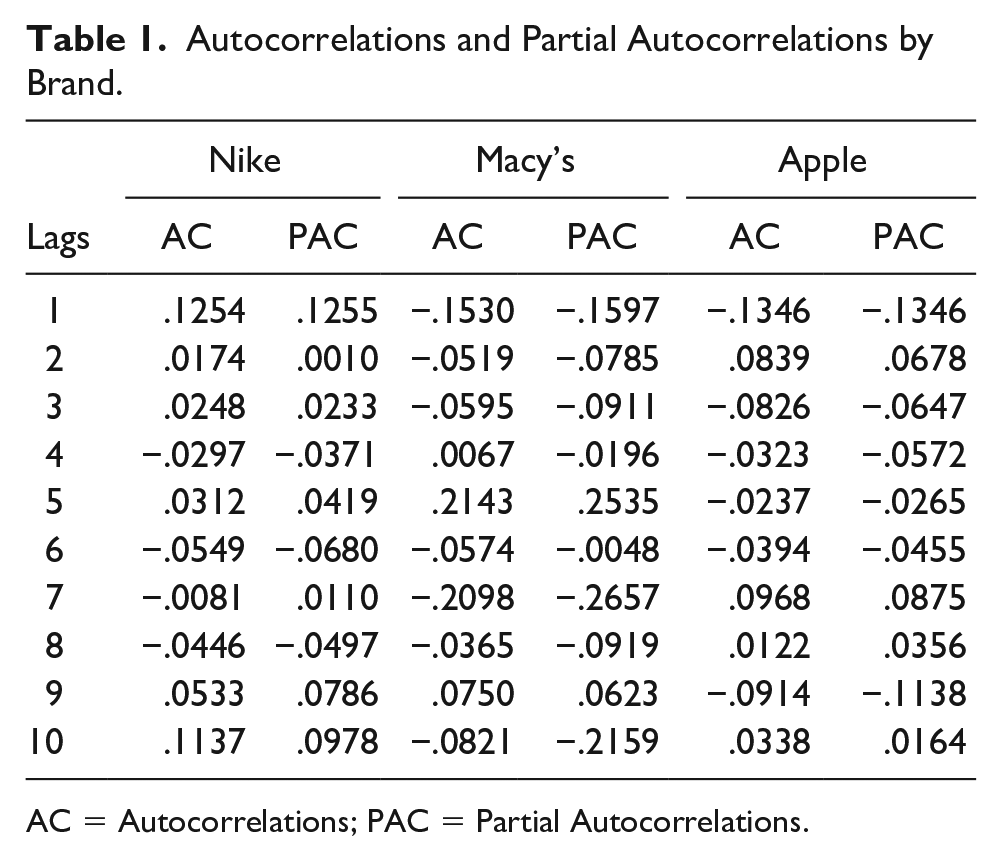
AC = Autocorrelations; PAC = Partial Autocorrelations.
Given these mild dynamics, modeling choices are relatively innocuous, and all of the statistical results reported below are robust to alternative models. Our workhorse model (1) will simply regress the current week’s rating on the preceding week’s rating, a linear time trend, and a set of indicator variables that mark the first and second month after President Trump’s initial tweet about the firm.

The key parameters of interest are β3 and β4, which indicate the shift in relative evaluations of Democrats and Republicans one month and two months after the initial tweet.
To assess the decay of these effects over time, we expand the basic model to include indicators for months three, four, and five after the initial tweet:

Model (2) is a more flexible version of model (1) that allows for treatment effects to persist longer. An F test comparing the two nested models may be used to gauge whether there is significant evidence of persistent effects beyond two months.
Results
The series with the most profound response to President Trump’s Twitter comments is Nike’s index ratings, as shown at the top of Figure 1. Prior to President Trump’s intervention, the Nike series’ mean—which represents the magnitude of the difference between Democrats and Republicans—was 2.9, with a standard deviation of 6.4. During the month following the initial presidential tweet, the average net rating is 65.6, which represents a movement of almost ten standard deviations. The two regression models confirm this large and statistically significant increase as shown in Table 2. Model (1) suggests an intervention-induced jump in the first month of 32.9 points, diminishing to a jump of 15.9 in the second month. Model (2), which fits the data significantly better, shows an initial jump of 51.6 points, falling gradually until it becomes 20.5 by the fifth month. All five month-effects, whether considered separately or jointly, are significantly greater than zero.
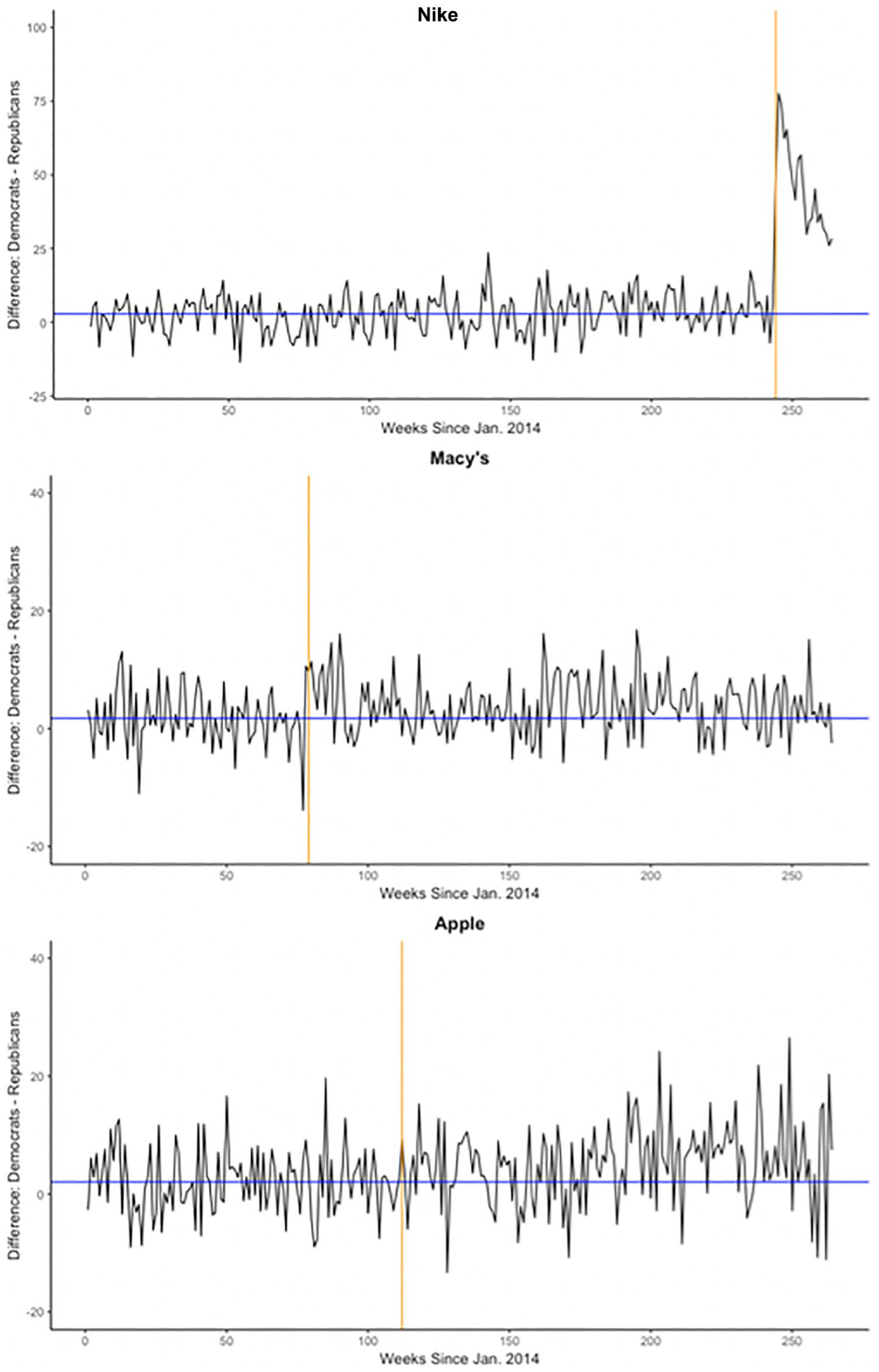
Difference in brand ratings between Democrats and Republications, January 2014−January 2019.
Differences in Brand Ratings between Democrats and Republicans following Donald Trump Boycott Tweets.

Standard errors in parentheses.
p < .1. **p < .05. ***p < .01.
The next most noteworthy effect is associated with Macy’s. Prior to the intervention, Macy’s enjoyed a slight ratings advantage among Democrats, with a mean of 1.7 and a standard deviation of 5.0. In the month following President Trump’s barrage of negative tweets, the net partisan rating surged to 7.8. Model (1) shows significant effects of 5.5 points in both the first and second months after the intervention; model (2) shows significant positive effects also in month three, but negligible estimates for months four and five. 9
These two cases suggest the immediate polarizing effects of comments from President Trump, followed by gradual decay as the daily churn of political controversies shifts to other topics. Theory suggests quite a different response in the event that leaders of both parties make critical remarks about a given firm, as occurred with Apple during 2016. Consistent with this theoretical expectation, we find that the difference in brand ratings moved in no particular direction after Donald Trump expressed his irritation with Apple, presumably because prominent Democrats were critical as well. Neither regression model detects any effect on brand ratings even in the immediate aftermath of the tweets; indeed, not only are the estimates weak and statistically insignificant, they are unexpectedly negative during the first month after the intervention.
Taken together, the results attest to the importance of polarization in the messages conveyed by party leaders. We see partisan divergence in brand perceptions in the wake of comments made by President Trump without support from like-minded Democrats. No divergence in ratings occurs when leaders from both parties offer similar criticisms.
What happens when we look for heterogeneous effects by respondents’ party identification? Do Republican respondents react more strongly to President Trump’s tweets than Democratic respondents? A series of parallel analyses broken down by partisan subgroups for each of the cases we examine, presented in Table 3, suggests the answer is yes, at least in some cases. 10 The most noteworthy case is Nike: although Democrats offer significantly higher ratings in the first month following the tweet (4.43, SE = 2.46), the negative reaction among Republicans (–48.39, SE = 3.38) is an order of magnitude stronger. It does not seem to be the case that Republicans are simply more responsive in general to elite messages, because, in the case of Apple, both Democrats and Republicans show significant declines of approximately the same magnitude. Rather, it appears that the polarizing effects of presidential tweets are driven, in large part, by their ability to rally co-partisans to take a hostile view of the brand under fire.
Brand Ratings following Donald Trump Boycott Tweets by Party.
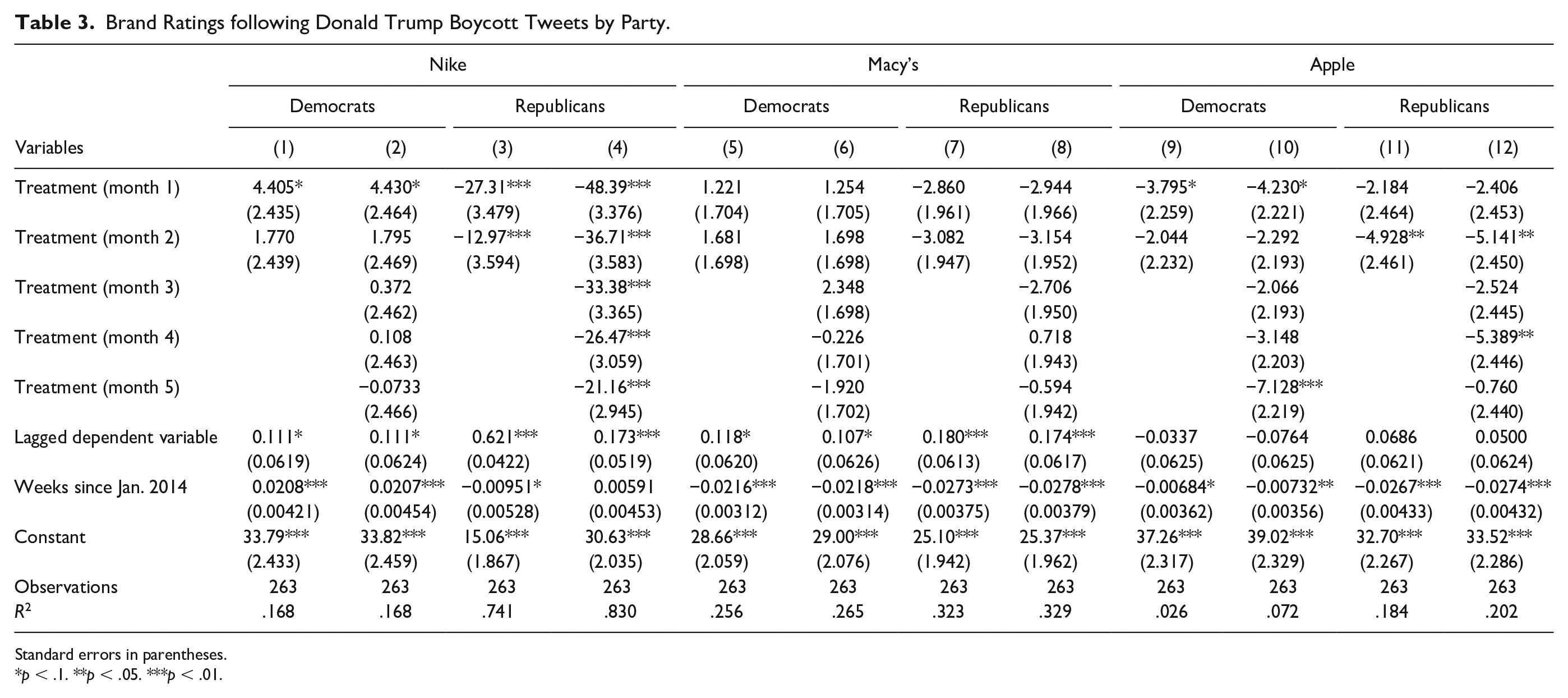
Standard errors in parentheses.
p < .1. **p < .05. ***p < .01.
Conclusion
This study contributes to the growing literature on the nexus between political preferences and consumer attitudes. In our study, political preferences emanate from party identification, long known to be a strong predictor of presidential approval. Like other recent presidents, President Trump elicits sharply different reactions from self-identified Democrats and Republicans. Accordingly, his tweets repel Democrats and resonate with Republicans. It would be unsurprising if President Trump’s messages framed partisans’ views about legislation or foreign affairs; what is interesting here is his messages’ ability to polarize the public’s evaluations of firms, such as retail stores or consumer product manufacturers, that would otherwise be evaluated similarly by Democrats and Republicans.
Our aggregate time-series results suggest that President Trump’s tweets criticizing firms typically have large polarizing effects on the brand ratings of Democrats and Republicans. For Macy’s, where the critical comments have to do with a Trump family business, the effects are large and statistically significant initially but decay over several weeks. 11 In the case of Nike, where the critique centers around a politicized sports issue, the initial effects are especially large, and the process of decay is more gradual.
Our results contribute to the literature on elite opinion leadership (Lenz 2013; Zaller 1992), which has long suggested that partisans look to figures such as the president for cues about how to evaluate issues and people, by testing the effects of elite influence outside of traditional policy issues. Based on our findings, we would add firms to the list of stimulus objects that may be politicized by elite discourse. And in keeping with the literature on opinion leadership, which emphasizes the importance of one-sided versus two-sided communication, we find little polarization in the case of Apple, which came under fire both from President Trump and leading Democrats. This pattern offers an important qualification to the hypothesis that presidential criticism of firms is polarizing; while that might ordinarily be the case insofar as the president’s views are out of step with those of opposing party leaders, polarization will not occur when elites on both sides express similar views.
One interesting puzzle that is not well-explained by the literature on elite opinion leadership is why the polarizing effects we observe initially later subside. Few Republican notables rose to the defense of the firms that President Trump criticized. A “Bayesian” interpretation of decaying effects (Gerber and Green 1998) would focus on the information flows that cause people to update their evaluations of firms such as Nike and Macy’s; the information that they gleaned from President Trump’s tweets gradually became passé as newer information came to light. The problem with this interpretation is that it seems unlikely that respondents received an appreciable amount of updated firm-specific information in the wake of the Twitter dustup. Another interpretation is that the public gradually forgets presidential accusations. Forgetting is certainly a possibility given what we know about myopic economic voting in presidential elections (Wlezien 2015); unfortunately, we lack direct survey evidence about what comes to mind when partisans now think about Nike and Macy’s. Certainly, the rapid pace with which media attention has shifted from topic to topic during the Trump presidency, in part, in response to the extraordinary pace of presidential statements, has caused headline news to become passé in a matter of weeks and sometimes days. A related possibility growing out of theories of hot cognition (Lodge and Taber 2005) is not so much that people forget but that the emotions that are initially stirred by presidential accusations gradually subside and cease to guide evaluations of firms that are primarily thought of in utilitarian terms. Politicians are famous for their long memories for slights, but ordinary partisans seem to be more magnanimous—forgetting or forgiving or both.
Footnotes
Appendix 1
Appendix 2
Appendix 3
Acknowledgements
An earlier version of this paper was presented at the 2019 Annual Meeting of the American Political Science Association in Washington, D.C. We appreciate feedback from Yanna Krupnikov, Christopher Muste, and audience participants. We also thank the editor and three anonymous reviewers for their constructive suggestions as well as Jonathan Krasno and Michael Schwam-Baird, who collaborated with us on an earlier project on the same topic. Finally, we are grateful to Samantha Luks and Justin Pincus at YouGov for their helpful assistance and support for this project.
Declaration of Conflicting Interests
The author(s) declared no potential conflicts of interest with respect to the research, authorship, and/or publication of this article.
Funding
The author(s) disclosed receipt of the following financial support for the research, authorship, and/or publication of this article: This research was supported by grants from Democracy Fund and Open Society Foundation, neither of which is responsible for the content of this article.
