




Abstract
Legislators will sometimes vote against their party’s position on roll-call votes to differentiate themselves from the party mainstream and to accrue a “personal vote.” Research suggests that the use of rebellion to generate a personal vote is more common (1) among majority party members and (2) among ideological extremists. But these majority party extremists only have a strong incentive to rebel in situations where the accrual of a personal vote is electorally useful. In this manuscript, we evaluate variation in rebellion rates of state legislators in the United States conditional on ideological extremism and majority control. Using donation-based measures of ideology and roll call–based measures of party loyalty over a twenty-year period across more than 30,000 legislators, we find that when legislators have little incentive to differentiate themselves from their parties, this “strategic” party disloyalty among majority party ideological extremists is limited. However, when legislators have strong incentives to craft a personal vote, ideological extremists defect from their party more often than their moderate counterparts. In particular, we find greater evidence for this type of strategic party disloyalty in states with high intra-party competition and low inter-party competition and less evidence in states with high inter-party competition.
In April of 2019, the New York state legislature passed a state budget of $175 million. Democratic majorities, in charge of both the state’s Assembly and Senate for the first time in nearly a decade, passed the landmark bill that included reforms to the state’s criminal justice spending priorities, increases in education spending for schools in the state’s poorer communities, alterations to transit pricing in major cities, as well as other modifications to health care spending and environmental protections. Governor Cuomo and the majority leaders of both chambers praised the budget as one of the most progressive in New York’s history. Despite what appears to have been a significant political victory for the state’s Democrats, Assemblyman Charles Barron [D-Brooklyn] voted against his party’s budget, railing that it did too little to address inequality in the state and failed to fund a state commission for publicly financed elections. Barron was one of the only two Democrats to oppose his party’s budget in the State Assembly. 1
For traditional models of spatial voting, such “protest” votes can be puzzling. However, recent research focusing on “strategic party disloyalty” offers an explanation for protest voting that centers on legislators’ efforts to signal ideological purity to constituents via this type of grandstanding vote (Kirkland and Slapin 2017, 2018; Slapin et al. 2018). And recent research on Congress finds that such “ends against the middle” voting is reasonably prevalent in the U.S. Congress (Duck-Mayr and Montgomery 2019). This argument suggests that legislators seeking to develop a personal vote will occasionally oppose their own party as part of a symbolic effort to demonstrate ideological commitment when they can portray their own party’s legislation as not moving far enough in an ideological direction. Indeed, Charles Barron, in the wake of his vote against his own parties’ budget, posted several videos on his webpage in which he highlighted how the budget represented a failure to address a racist and unequal capitalist society, an argument likely to fit well with his Brooklyn district, but reflecting views to the left of the Democratic Party mainstream. By voting against the budget and his own party, he gave himself a prime opportunity to reiterate his views and to distinguish his position from that of the party center. 2 Barron could use the budget vote to burnish his leftwing credentials, at least in part, because he is highly unlikely to face an electoral challenge from the Republican Party in his very left-leaning district. Instead, if he were to face an electoral threat, it would likely come from same side of the ideological spectrum in the form of a primary election challenge. Such threats are very real, as demonstrated by the recent defeat of long-serving Member of Congress Joe Crowley by Alexandria Ocasio-Cortez in New York’s 14th Congressional district. In such instances, emphasizing left-wing positions is relatively more important than loyalty to the Democrat Party for ensuring electoral security.
In this manuscript, we examine these dynamics in U.S. state legislatures where the level of electoral competition between the parties, and thus, the value of a personal “brand” versus a partisan “brand,” varies across states. A personal brand is likely more valuable in settings where representatives need to distinguish themselves from fellow partisans, but do not need to worry about competition from other parties. By looking at state legislatures, we add to a growing literature that examines how legislators’ defection on roll-call votes helps them to develop a personal brand in the U.S. Congress (Carson et al. 2010; Kirkland and Slapin 2017) as well as in other legislatures, particularly in two-party Westminster systems (Campbell et al. 2016; Kam 2009; Slapin et al. 2018; Vivyan and Wagner 2012).
Using estimates of state legislator ideology from campaign donation data for more than 30,000 state legislators (Bonica 2014), along with party loyalty scores (Shor and McCarty 2011), and measures of inter-party electoral competition (Holbrook and Van Dunk 1993), we find that the strategic party disloyalty argument fits legislative behavior best when inter-party competition is low, and thus, the need for a personal vote is high. In states where one party dominates, resulting in the absence of inter-party competition, legislators have no need to distinguish themselves from opposing party members. Instead, they must somehow distinguish themselves from colleagues with the same partisan label. It is in these settings that symbolic rebellion from one’s own party is most prevalent.
Electoral Competition and Party Loyalty
Research has repeatedly demonstrated that electoral incentives can affect how legislators behave on the floor and thus can have an impact on party loyalty on roll-call votes (Carson et al. 2010). Electoral incentives also often lead representatives to develop a “personal vote” to separate themselves from their party (Cain, Ferejohn, and Fiorina 1987). For example, differences across legislative electoral systems such as district magnitude and candidate selection rules can impact how state legislators reach out to constituents through the provision of targeted legislation and pork (Bagashka and Clark 2016; Rogowski 2017). However, providing “pork” in the form of targeted legislation, post offices, or military bases is only one tool in a representative’s toolkit for building a personal brand and connecting with voters.
Building on Fenno’s (1978) original work on home style, recent research has highlighted the different representational styles of representatives depending on their ideological congruence with their district (Grimmer 2013a, 2013b). This work finds that the most ideologically extreme legislators are also the most likely to align with their districts and to curry favor with constituents through ideological position-taking. Voting against their party, especially when the party proposes legislation that is deemed insufficiently true to an ideology, can serve as a mechanism for these representatives to highlight their positions and to separate themselves from fellow partisans (Kirkland and Slapin 2017, 2018). According to Cox and McCubbins (1993), legislators reap electoral benefits by presenting themselves as part of a distinct brand (see also Aldrich 1995). However, this may not apply equally to all legislators. Mayhew (1974) reasons that strong, programmatic parties can actually be a liability for members of Congress in their myopic quest for reelection. Empirically, scholars have demonstrated that the electorate may punish very strong party loyalty (Carson et al. 2010; Deckard 1976; Harbridge and Malhotra 2011). Occasional disloyalty may allow representatives to signal ideological purity, or to foster an independent, ideological personal brand rather than tying their own electoral fates to a partisan brand over which those legislators have less control.
Party Labels, Personal Brands, and Electoral Threat
The theory that we put forward here hinges upon voters’ perceptions of incumbent legislators. Extant research suggests that voters make determinations about officeholders on the basis of party labels (Campbell et al. 1960; Popkin 1994), personal brands (Cain, Ferejohn, and Fiorina 1987; Fenno 1978; Mayhew 1974), and descriptive characteristics such as race and gender (Fulton 2012; Philpot and Walton 2007). Of these three considerations, party labels are the most important in voters’ decision-making. Research in political behavior consistently finds that the average voter does not pay close attention to politics and relies on party labels to make decisions (Achen and Bartels 2017). This is especially true in low-information contests such as state legislative elections (Schaffner and Streb 2002) and helps to explain why citizens often fail to hold their state legislators accountable (Rogers 2017).
Due to the importance of party labels in voters’ decision-making, legislators have strong incentives to build a “party brand.” The party brand refers to the collective reputation of the party in a legislature. This brand is managed by the party’s leadership in the legislature (Cox and McCubbins 2007). While individual legislators cannot control the party’s brand, they can contribute to the consistency of the brand by faithfully voting with their party. Empirical evidence suggests that legislators are motivated to build a strong party brand by limiting division within the chamber and ensuring party programmatic success (Butler and Powell 2014; Cox and McCubbins 2005). Indeed, Rogers (2017) finds that citizens generally do not hold legislators accountable for being ideologically out of step in their individual roll-call voting patterns. Given the low levels of ideological thinking among the public (Kinder and Kalmoe 2017), this is not terribly surprising and suggests citizens are much more likely to think about legislative behavior from a partisan perspective.
Although the party brand is important, if a legislator is too loyal to their party it may prove to be an electoral liability (Carson et al. 2010). Research attributes the strong partisanship observed in the electorate to out-group disdain rather than in-group affinity (Abramowitz and Webster 2018). This suggests that voters are skeptical of both parties. For this reason, legislators should want to maintain some perceptual distance between themselves and their party in the minds of voters. In order to achieve this distance, legislators craft a personal brand that is distinct from their party’s brand. Legislators use a number of different tools to build this brand such as communication with constituents (Fenno 1978; Grimmer 2013b), casework (Cain, Ferejohn, and Fiorina 1987), distributive benefits (Bagashka and Clark 2016), and legislative accomplishments (Volden and Wiseman 2014).
We argue that the nature of the electoral threat determines the importance of a legislator’s personal brand in influencing electoral outcomes. A legislator’s personal brand ought to be less consequential when the electoral threat comes from the opposing party. Voters most often choose the candidate who shares their partisan identity in these situations. In contrast, a legislator’s personal brand becomes crucial when an electoral threat emerges from within the legislator’s own party; partisanship is not informative to voters in primary contests. In this situation, legislators must run on the basis of their own distinct brand.
Unlike other tools for constructing a personal brand (press releases and other communications, the delivery of pork, etc), casting a roll-call vote necessitates a trade-off between a legislator’s personal brand and the party’s brand. In order to build a personal brand on the basis of voting behavior, a legislator must dissent from their party majority, since legislators rarely garner recognition for voting with their party. While this may be beneficial for an individual legislator, it diminishes the reliability of the party’s brand. If legislators rebel too frequently, they could render their party’s brand unrecognizable to the electorate and also signal disunity.
In their “strategic party disloyalty” argument, Kirkland and Slapin (2018) contend that the likelihood of legislative rebellion is determined by ideology and majority status. Ideological moderates craft personal brands on the basis of legislative victories that benefit their constituents. For this reason, they always have some incentive to support a piece of legislation if it affords them opportunity to credit-claim to their constituents (Grimmer 2013b). Ideological extremists develop personal brands that emphasize ideological purity and an unwillingness to compromise. Thus, extremists have incentive to vote against any piece of legislation they feel is incongruent with their ideological convictions or does not move the status quo far enough in an ideologically extreme direction.
Since majority party status determines who controls the agenda (Anzia and Jackman 2013; Cox and McCubbins 2005), it also determines when legislators rebel. Moderates in the minority are more likely to cast dissenting votes to join with the opposing majority party as they seek to gain access to legislative goods. When their party enters the majority, moderates become more loyal since their party now controls the flow of legislative goods. When ideological extremists are in the minority, they consistently vote with their own party to oppose the agenda of the majority party, with whom they are ideologically opposed. When their party is in the majority, they become more likely to defect from their party in order to criticize their party for betraying its principles. Thus, this effort to balance personal and partisan brands results in ideological moderates becoming more loyal when their party wins majority control of a chamber. Ideological extremists, in contrast, become less loyal when their party wins majority control (Kirkland and Slapin 2017; Slapin et al. 2018).
Strategic Party Disloyalty and Electoral Competition
If strategic party disloyalty is a type of personal vote-seeking behavior, as Kirkland and Slapin (2018) suggest, we believe that it should be moderated by electoral competition. As electoral competition increases, party labels become more strongly determinative of electoral outcomes and the electoral need for a personal brand diminishes. Party leaders who have a vested interest in controlling the chamber should seek to strengthen their party’s brand. They will pressure legislators through direct and indirect means to vote the party line in order to accomplish this. Legislators comply because it is in their electoral interest and the interest of their party. Therefore, as electoral competition increases, we should see increased party loyalty from legislators regardless of ideology.
As electoral competition decreases, we hypothesize that the need for a personal vote increases as legislators anticipate an electoral threat coming from within their own party. Recent work from Anderson, Butler, and Harbridge-Yong (2020) strongly support this position. These authors find compelling evidence that legislators are unlikely to engage in bipartisan compromise as the threat of facing a primary electoral challenge increases. Using a variety of survey experimental designs, this work suggests that legislators will often fail to adopt seemingly ideologically beneficial compromises (moving the status quo in a preferred direction) to avoid creating the opportunity for internal party challenges to emerge. That is, according to Anderson et al., legislators fear being labeled as compromisers if there is some reasonable potential that such a label may lead to an internal party challenge. This supports our contention that in places where between-party competition is low and internal party competition is high, legislators must rely on some sort of personal brand as opposed to a partisan brand and are thus willing in these states to vote against their party in certain circumstances. Therefore, the pattern of legislative behavior identified by the strategic party disloyalty argument should become more prevalent. As electoral competition decreases, and intra-party competition increases, we should anticipate moderates becoming more faithful when changing from the minority to the majority party and extremists becoming less faithful when changing from the minority to the majority party.
Data and Methods
To test our conditional expectations derived from the strategic party disloyalty argument, we require data on (1) legislators’ level of party loyalty, across (2) transitions in majority party control, (3) legislators’ ideologies, and (4) some measure of inter-party competition for legislative seats. To capture legislators’ level of party loyalty over time, we examine the roll-call voting behavior of lower chamber U.S. state legislators from 1994 to 2010, using data provided by Shor and McCarty (2011). We calculate legislators’ party loyalty as the percentage of votes on which a legislator voted with the majority of his or her party, using only party votes—those where a majority of one party opposed the majority of the other party. This is calculated for each legislator for each legislative session, providing us with a time-varying measure of party loyalty for more than 30,000 lower chamber state legislators. 3 The average level of party loyalty in our sample is 86.86 percent, with a standard deviation of 11.82. In this window, we have more than 26,000 legislators in the majority party of their chamber 18,000 in the minority party. Additionally, 3,275 legislators serve in both the majority and minority party at some point, as their tenure extends long enough for the party to either obtain majority status or lose it.
In addition to our measure of party loyalty, we require a measure of legislative ideology. This has traditionally been a challenge for studies of legislative politics, as most measures of legislative ideology are themselves based on roll-call votes (Poole and Rosenthal 1985), and we wish to avoid a situation in which we are regressing one summary of roll-call votes (party loyalty scores) on another (ideal point measures). Fortunately, Bonica (2014) provides ideal point estimates for a truly enormous swath of elected officials based on campaign donation patterns as a part of the DIME database. The underlying logic behind these ideal points is much the same as that of roll-call votes, whereby candidates’ and elected officials’ ideology scores are derived from a measurement model in which two actors with similar types of donation patterns are assumed to show that similarity because donors suspect that they have similar ideological positions. These donation-based ideology estimates (referred to as CFScores) have been used in a host of applications focused on representation (Barber 2016; Hall 2015; Thomsen 2014) and have been validated as reasonable measures of ideology in a variety of ways (Bonica 2018, 2019). We then calculate the ideological extremity of each legislator in our sample as the distance between that legislator and the least ideologically extreme member of his or her party in the sample. Thus, if among Republicans in our sample, the least extreme member we find has an CFscore of −0.1, each legislator’s ideological extremity is the absolute distance between −0.1 and the legislator’s observed CFscore in that session. 4
As a measure of the varying levels of legislative competition, we use the Holbrook–Van Dunk (HVD) index of legislative competition (Holbrook and Van Dunk 1993). The HVD index measures district level electoral competition within a particular state as a function of several components: the percentage of the popular vote won by the winning candidate, the winning candidate’s margin of victory, whether a race was contested or not, and whether or not a seat was “safe,” where safety is indicated by a winner receiving more than 55 percent of the vote share. 5 The mean value of the HVD index in our sample is 38.15 with a standard deviation of 10.95. 6
Armed with the key variables for our analysis, we now turn toward our modeling strategy. 7 We wish to assess how the transition from minority party status to majority party status influences the party loyalty of state legislators. Prior research implies that this relationship varies depending on the individual legislator’s ideology, and we suspect that this conditional relationship itself depends on within-district levels of electoral competition. 8 To assess the empirical support for these hypotheses, we leverage a variety of multilevel regressions that include legislator-level, state-level, and year-level varying intercepts. These nested intercept structures should allow us to model the host of legislator, state, and temporal attributes that might influence legislators’ levels of party loyalty (Harden and Kirkland 2018; Kirkland and Slapin 2017; Slapin et al. 2018).
Results
We begin our analysis taking a somewhat exploratory approach. The strategic party disloyalty argument suggests that ideological extremists become less loyal when their party gains majority control of a chamber, while ideological moderates become more loyal under these circumstances. We suggest that this pattern is likely to vary by state as a function of a moderating variable: electoral competition. Thus, our argument only has merit if there is actual variation in how ideological extremists and moderates respond to majority party status across the states. As such, before testing our particular argument that electoral competition is a moderator, we report the results of a pooled multilevel regression predicting legislators’ level of party loyalty as a function of their ideological extremity measured through CFscores, their majority party status, and an interaction of these two covariates (majority party status × ideological extremity), with varying intercepts for legislator, year, and state, and varying coefficients for extremity, majority party status, and their interaction by state.
This provides us with forty-nine distinct sets of marginal effects: effects of majority status for moderates and extremists for each chamber in our sample. We extract the marginal effect of majority party status for the maximally and minimally ideologically extreme legislator in each state from these varying coefficients and report each of these marginal effects in Figure 1. The square, red dots in the plot represent the marginal effect of majority party status for the maximally extreme legislator for that state, while the black, circular dots represent the marginal effect of majority status for the minimally extreme legislator for that state. For twenty-eight lower state legislative chambers, the marginal effect of majority party status for ideological extremists is negative, as the strategic party disloyalty argument would suggest. For twenty-one chambers, though, the marginal effect of majority status for ideological extremists is positive, suggesting that in these states, the strategic party disloyalty argument fits party loyalty patterns less well. Critically for our hypotheses, this demonstrates that in some places, the strategic party disloyalty argument holds up well and in others, it holds up less well. Ultimately, our task is to determine whether inter-party electoral competition explains the variance in Figure 1 well. 9

The effect of majority party status on party disloyalty across states for moderates and extremists.
Our initial exploratory research suggests that there is observable (and thus potentially explainable) variance in the fit of the strategic party disloyalty argument across U.S. state lower legislative chambers. The next step in our process is to evaluate whether that variance is related to electoral competition itself. To do so, we again turn to a multilevel modeling approach. We estimate a multilevel linear model predicting the party loyalty of individual legislators using the same covariates from Figure 1 while removing the varying coefficients. Furthermore, we now measure levels of electoral competition across states over time and interact that covariate with our measures of ideological extremity and majority party status. We report the results of three-way interaction approach in Table 1. This model also includes varying intercepts for individual legislators, years, and states.
Multilevel Regression Predicting Party Loyalty Scores for Lower Chamber State Legislators by Majority Party Status, Ideological Extremity, and Legislative Electoral Competition.

Table reports results from a multilevel linear model predicting individual legislators’ party loyalty scores on partisan votes from 1994 to 2012. Varying intercepts for individual legislators, states, and years are included in the model. Standard errors are reported in parenthesis.
p < .05.
Because directly interpreting the coefficients of such a complex model is challenging (Brambor, Clark, and Golder 2006), we report the marginal effects of majority party status as ideological extremity increases in Figure 2. The three-way interactive model allows us to estimate these marginal effects at any value of electoral competition, given its status as a conditioning variable in the model. Figure 2 plots these effects for states at the minimum and maximum level of electoral competition. We can see that the marginal effects that emerge from this modeling approach that in states with maximal levels of electoral competition, the effect of majority party status is virtually uniform across the range of ideological extremity. However, in states with low levels of electoral competition, the effect of majority party status on party loyalty is positive for ideological moderates and negative for ideological extremists. 10

The marginal effect of majority party status as ideological extremity increases for states with and without high levels of legislative two-party competition from a fully interactive model.
To give these marginal effects more of a practical interpretation, Table 2 reports the predicted party loyalty of maximally and minimally ideologically extreme state legislators in both high electoral competition and low electoral competition environments, as they move from minority party status to majority party status based on the coefficients reported in Table 1. In a state with low electoral competition, ideologically extreme state legislators are loyal to their party on roll-call votes about 84.5 percent of the time; a figure which falls to about 82.5 percent of the time when those same legislators are in the majority. Ideologically moderate legislators in low competition states, however, increase their loyalty from voting with their party 77.3 percent of the time to 86.2 percent of the time. These opposite reactions to the transition to majority party status are what the strategic party disloyalty argument would suggest would occur in low competition states where personal votes are prized relative to partisan cues. In high competition states where party support is central to electoral success, however, both ideological extremists and moderates increase their levels of party loyalty on roll-call votes when they transition to the majority party. This transition does not have a statistically measurable effect on perfectly moderate legislators, but does have an effect on ideological extremists, increasing their levels of party loyalty by roughly 4.7 percent. Thus, once again, we see strong evidence that the strategic party disloyalty argument fits state legislators’ levels of party loyalty better in states with low levels of inter-party electoral competition.
Difference in Predicted Party Loyalty Rates on Roll-Call Votes for Most Moderate and Most Extreme State Legislators in High and Low Competition States.
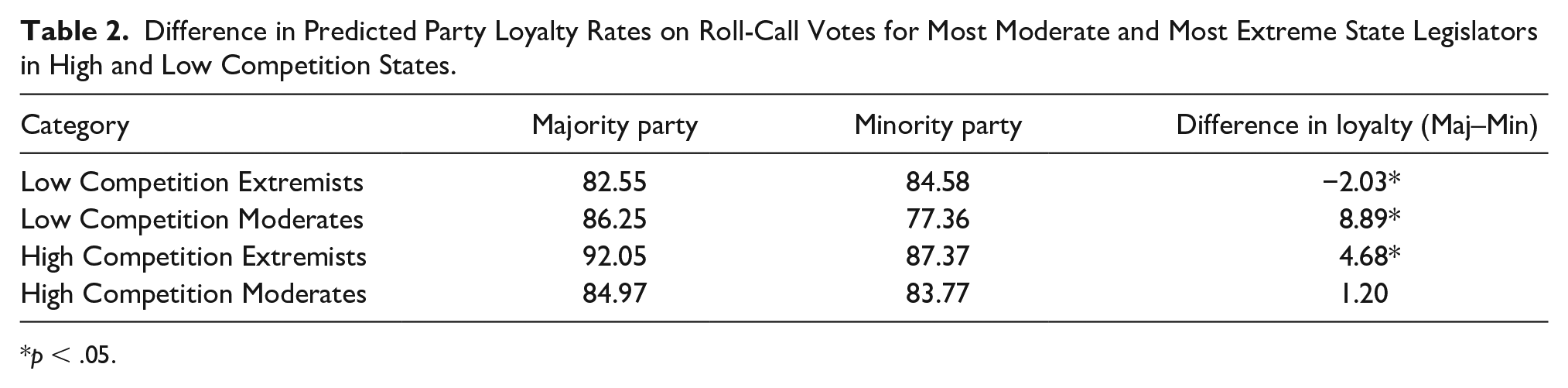
p < .05.
District Vote Share
Our prior analysis offers strong support for our conditional extensions of the strategic party disloyalty argument. Electoral competition for state legislative seats conditions the way that different legislators respond to their party gaining majority party status. In states with little inter-party competition, extremists become less loyal when their party gains majority control of the chamber, while moderates become more loyal. In states with high levels of inter-party competition, all legislators become more loyal when their party gains majority status. We suggest that this pattern arises because legislators use decisions about party loyalty as tools to connect with voters in different ways. Perhaps it is not legislators’ own ideologies that are driving this pattern, though; instead it may be the ideology of their constituents. Legislators from ideologically extreme districts may be tempted to craft an image of ideological purity by occasionally grandstanding and engaging in strategic party disloyalty in the majority party.
According to this perspective, our models in Table 1 should not include legislators’ own ideologies, but instead some measure of their district’s ideology. While measures of district ideology for state legislatures have recently become available (Tausanovitch and Warshaw 2013), these measures are estimated based on an aggregation of survey responses from several waves of surveys from 2006 to 2012. As such, their utility for predicting behavior in the window of time we study (1994–2010) is limited. Instead, we use the district-level two-party vote share of the presidential candidate from the state legislator’s party in the most recent presidential election to assess the ideological leaning/copartisanship of a district (Rogers 2017). Using data generously provided by Rogers (2017), we construct a measure that ranges from −0.5 to +0.5. The measure is calculated as (Copartisan presidential candidate’s vote share −0.5), such that an evenly split district in which both presidential candidates received 50 percent of the vote share would receive a score of 0.0, a district in which the candidate copartisan with the district’s state legislator received 100 percent of the vote share would have a value of 0.5, and a district in which the state legislator’s opposing party’s candidate received 100 percent of the vote share would receive a value of −0.5. Because the time frame of these are more limited than for our legislator ideology data, our analysis using district presidential vote shares only covers 2000–2010, and just over 25,000 legislator-year observations.
We contend that districts that (1) elect a Democrat (Republican) state legislator and (2) vote heavily for the Democrat (Republican) presidential candidate are reliably liberal (conservative) districts that might encourage legislators to develop liberal (conservative) personal brands, whereas districts that either (1) elect a state legislator of the opposite party of their most recent presidential choice or (2) are split between the two presidential candidates quite closely would instead encourage more moderate legislators to focus on legislative successes that require majority party support. To evaluate these contentions, we replicate the model found in Table 1, but instead of using a legislator’s own ideological extremity as measured by the extremity of their CFscore, we instead use a measure of their district’s ideological extremity using our measure of their copartisan presidential candidate’s vote share in the most recent presidential election. The results of this replication appear in Table 3.
Multilevel Regression Predicting Party Loyalty Scores for Lower Chamber State Legislators by Majority Party Status, District Partisan Extremity, and Legislative Electoral Competition.
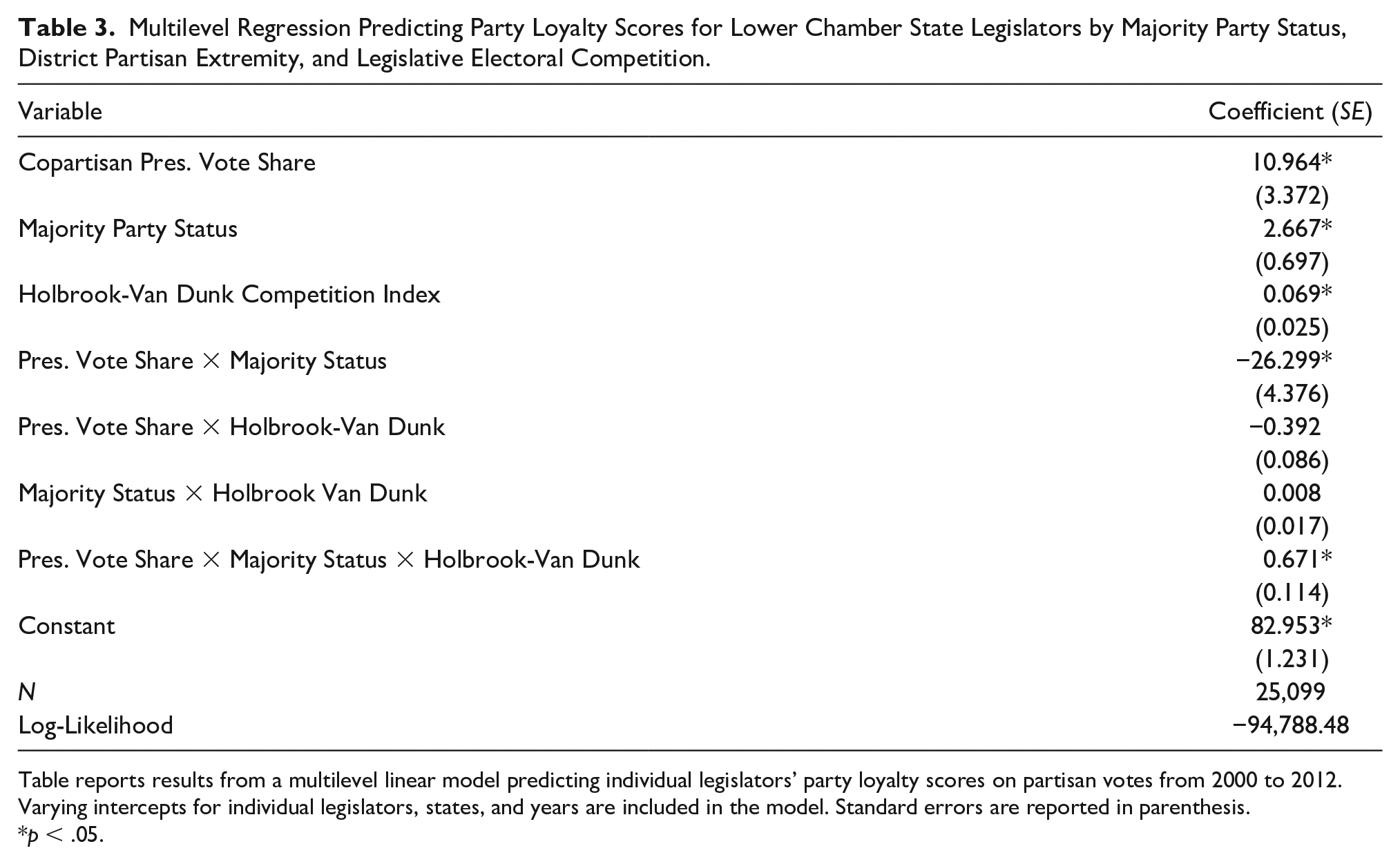
Table reports results from a multilevel linear model predicting individual legislators’ party loyalty scores on partisan votes from 2000 to 2012. Varying intercepts for individual legislators, states, and years are included in the model. Standard errors are reported in parenthesis.
p < .05.
As was the case in our earlier models leveraging three-way interaction terms, attempting to directly interpret the coefficients in Table 3 would prove challenging. Instead, Figure 3 again plots the marginal effect of the majority party status covariate across the range of copartisan presidential vote share for legislators in states with high and low levels of legislative electoral competition. 11 The figure indicates that in states with high levels of legislative inter-party electoral competition, legislators from districts that split their presidential vote share, or voted for a presidential candidate from the opposing party of their state legislator (that is, legislators we would expect to be driven toward moderation by their district), become more loyal when their party moves from the minority to the majority. Legislators in these same states from districts who strongly voted for their own party’s presidential candidate (that is, legislators from districts that would encourage ideological extremity) become less loyal when their party moves from the minority to majority status.
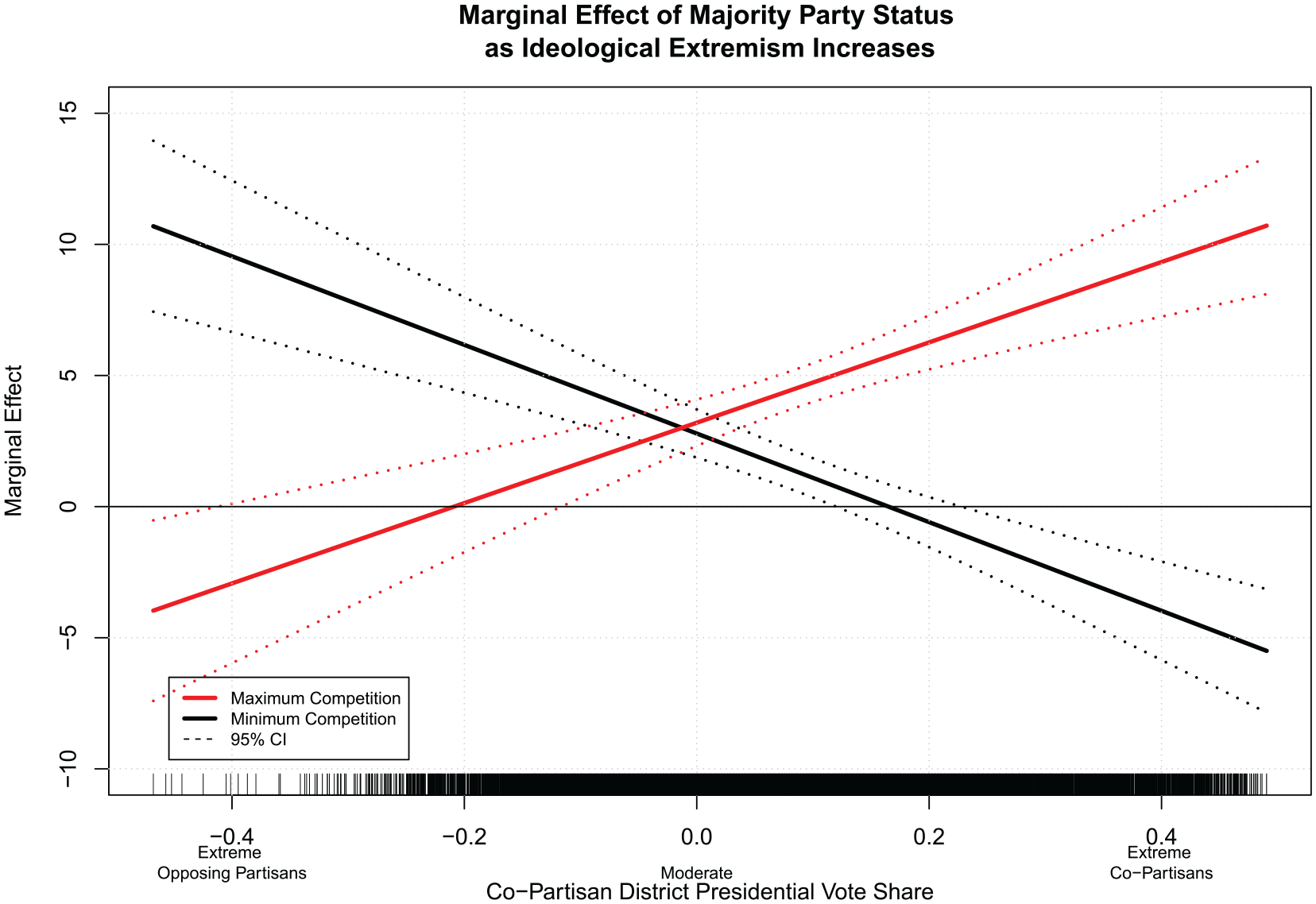
The marginal effect of majority party status as presidential copartisan vote share increases for states with and without high levels of legislative two-party competition from a fully interactive model.
Alternatively, in states with high levels of inter-party legislative electoral competition, legislators either do not react to changes in the majority status of their party (a null effect) or become more loyal to their party. It is worth noting the striking similarities between Figures 2 and 3. In both figures, in low inter-party legislative competition states moving from “`moderation” (either ideologically moderate legislators, or districts that should encourage ideological moderation by legislators) to “extremism” (again, either actual extremism or districts that should encourage extremism) changes how legislators respond to majority party status. In states with high levels of legislative electoral competition, no legislators ever become less loyal as a result of the move from minority party to majority party status.
Finally, once again to aid in interpreting the results in Table 3, Table 4 reports the predicted levels of party loyalty for legislators in low and high inter-party legislative competition states from districts with even splits and high copartisan presidential vote shares, analogous to the predictions we report in Table 2. Again, we see that legislators from low inter-party competitions states and districts that should encourage extremism (high copartisan vote shares) see decreases in their party loyalty when their party wins majority status. All other legislators respond to majority status by becoming more loyal.
Difference in Predicted Party Loyalty Rates on Roll-Call Votes For Most Moderate and Most Extreme State Legislators In High and Low Competition States.

p < .05.
Thus, across more than 30,000 state legislators over twenty years of legislative behavior, we see robust support for our extension of the strategic party disloyalty argument. When legislators have little to fear from the opposing party, the strategic party disloyalty argument holds up quite well in explaining legislative party loyalty. Legislators who we would expect to be extreme (either because we observe that extremism, or because it is encouraged by their constituents) become less loyal in the majority party, while legislators who we would expect to be moderate become more loyal. When legislators are actively worried about challenges from the opposing party, differences in the reaction of extremists and moderates to majority party status disappear, and all legislators respond to majority status by increasing their levels of party loyalty.
Conclusion
The standard spatial model suggests that there is rarely a reason for ideologically extreme legislators to oppose their party, but across in many contexts—for example, U.S. Congress and Westminster—we know that they do with some degree of regularity. We build on a theory of strategic party disloyalty that suggests that when moving from minority to majority status ideologically extreme legislators should be more inclined to rebel as a signal to their constituents of the legislators’ ideological purity. We go beyond the existing theoretical accounts to suggest that this relationship should be moderated by the levels of electoral competition. Specifically, when inter-party competition is low and intra-party threats are more palpable, the benefits to more extreme legislators from sending an ideological signal through their disloyalty are highest. To ward off challengers and rise to the expectations of ideologues in their home districts, extremists will occasionally grandstand and oppose their own party, and will do so more commonly in places where inter-party competition is low.
We find that a simple test of strategic party disloyalty explains behavior in some U.S. state legislatures but not in others. That is, moving from minority to majority status increases disloyalty among ideological extremists only in some states. However, when we factor electoral competition into our empirical analysis, we find that the three-way interaction effect between electoral competition, party loyalty, and ideology is well-supported by the data. In states with higher intra-party competition, where the payoff to disloyalty is higher, we see more evidence that extremists deviate from their party when in the majority. Our results are of substantive interest and importance for several reasons. Given recent trends toward decreasing inter-party competition in state legislatures, our findings suggest that majority parties may see increasing defections coming from the ideological wings of their own party. Likewise, as affective polarization among the public grows, voters may come to value demonstrations of loyalty to one’s in-group even more, making such defections even more valuable. Such trends may lead parties to consider how they manage defections or to create opportunities for legislators to burnish their ideological credentials in other ways. In comparative context, our results lead us to expect similar or related behavior in many political systems where legislators are encouraged to pursue personal votes and develop personal brands due to intra-party competition, often a result of electoral institutions (see Carey and Shugart 1995). More generally, we explain more than 15,000 legislators’ behavior across forty-nine legislative chambers and twenty years. These U.S. state legislatures govern spending in excess of $2 trillion. The California legislature governs the seventh largest economy in the world and the Texas legislature governs the 10th. Understanding legislative behavior in these settings is extremely important. Additionally, the ability to compare across forty-nine legislatures within the same political system allows us to examine the scope conditions of the strategic party disloyalty argument and to think about the argument’s comparative utility.
There is still work to be done on party disloyalty. We hope to see future scholars consider other moderators of the strategic party disloyalty argument. Many other state legislative institutions might encourage legislators to pursue personal brands to a greater or lesser extent. Indeed, institutions such as state legislative term limits or levels of legislative professionalism play prominent roles in legislative careers that may exaggerate or dampen the effects we see here. While an examination of every potential moderator is beyond the scope of our current research, we encourage future scholars to consider these alternatives. We can also imagine reasons for legislative disloyalty other than signaling purity to constituents. Long-term bargaining strategies, pressure from prominent organized interests, or genuine ideological opposition or multidimensional ideologies could conceivably all drive party disloyalty in some circumstances (Izzo 2018; King and Smith 2008; Nokken 2003; Seo 2010). We hope future work considers all of these possibilities as empirical work on state legislative behavior grows.
Supplemental Material
online_appendix – Supplemental material for Party Competition, Personal Votes, and Strategic Disloyalty in the U.S. States
Supplemental material, online_appendix for Party Competition, Personal Votes, and Strategic Disloyalty in the U.S. States by Richard Burke, Justin H. Kirkland and Jonathan B. Slapin in Political Research Quarterly
Footnotes
Declaration of Conflicting Interests
The author(s) declared no potential conflicts of interest with respect to the research, authorship, and/or publication of this article.
Funding
The author(s) received no financial support for the research, authorship, and/or publication of this article.

Supplemental Material
Notes
References
Supplementary Material
Please find the following supplemental material available below.
For Open Access articles published under a Creative Commons License, all supplemental material carries the same license as the article it is associated with.
For non-Open Access articles published, all supplemental material carries a non-exclusive license, and permission requests for re-use of supplemental material or any part of supplemental material shall be sent directly to the copyright owner as specified in the copyright notice associated with the article.
