




Abstract
Past research has shown that issues vary significantly in their salience across citizens, explaining key outcomes in political behavior. Yet it remains unclear how individual-level differences in issue salience affect the measurement of latent constructs in public opinion, namely political ideology. In this paper, we test whether scaling approaches that fail to incorporate individual-level differences in issue salience could understate the predictive power of ideology in public opinion research. To systematically examine this assertion, we employ a series of latent variable models which incorporate both issue importance and issue position. We compare the results of these different and diverse scaling approaches to two survey data sets, investigating the implications of accounting for issue salience in constructing latent measures of ideology. Ultimately, we find that accounting for issue importance adds little information to a more basic approach that uses only issue positions, suggesting ideological signals for measurement models reside most prominently in the issue positions of individuals rather than the importance of those issues to the individual.
Introduction
Researchers have long understood that the salience of issue attitudes varies considerably both across and within individuals (Howe and Krosnick 2017). While these differences have been leveraged to explain a number of discrete outcomes, ranging from attitude accessibility (Krosnick 1988) to candidate evaluation (Peterson 2004), we know far less about how variations in attitude salience affect composite measurements of public opinion such as latent measures of political ideology. In particular, because differences in issue salience constitute a form of differential survey item functioning, it may be important to account for issue salience in order to produce accurate estimates of political ideology.
The resurgent debate regarding the impact of ideology on Americans’ political behavior further motivates our consideration of issue salience in latent measurement (Fowler 2020). Many in the field view ideology as having little, if any, effect on citizens’ political behavior; indeed, recent studies find that ideology is only a weak predictor of vote choice and other preferences (e.g. Kinder and Kalmoe 2017). But such conclusions rest on measurement approaches that do not incorporate individual-level variations of issue salience into resulting estimates of ideology. As such, past research might understate the impact of political ideology on vote choice, representation, and other political outcomes of interest.
In this paper, we employ several different models for estimating latent ideology, each of which uses respondents’ rating of issue importance. Each approach incorporates information about the preferences and salience of each issue for a respondent, but incorporates salience information in vastly different ways. One approach uses salience as a weight in the estimation of latent ideology, another uses salience weighting to recode responses in a manner akin to rating scales, and a third employs salience weights to select meaningful responses for latent trait estimation. We assess the value-added from salience weighting across these diverse approaches using two survey data sets: (1) a subset of respondents to the 2016 Cooperative Congressional Election Study (CCES) and (2) a sample of respondents recruited by the online panelist recruitment firm Lucid. Throughout, we find that the salience-weighted ideological scales do not produce significantly better predictions of political outcomes of interest, providing evidence that accounting for issue salience does not improve commonly used scaling approaches for measuring ideology.
Accounting for Issue Importance in Political Ideology
Public opinion scholars have long recognized that while citizens hold multiple attitudes at the same time, not all attitudes hold equal weight across citizens. Some might care most deeply about their Second Amendment rights and care little about tax policy, while another might care deeply about tax policy while remaining relatively agnostic on the Second Amendment. Scholars often distinguish between objective or contextual salience—where an issue is receiving a great deal of attention from important actors in the political system—and subjective or individual salience—where an issue is particularly important to some people but less important to others (Lecheler, de Vreese, and Slothuus 2009). While these two dimensions are surely interrelated, we explore whether it is individual-level issue importance that may be an important missing piece from how individuals’ ideologies are currently estimated.
It is clear that individuals express far more concern for certain issues than others, relying on their most salient attitudes for decision-making (Howe and Krosnick 2017; Krosnick, Berent, and Boninger 1994). This concept—which we refer to as both attitude salience and issue importance (Ansolabehere and Puy 2018; Bernstein 1995; Boninger, Krosnick, and Berent 1995)—explains key features of political behavior, including political participation (Holbrook et al. 2016), information processing (Ciuk and Yost 2016), political learning (Nadeau, Niemi, and Amato 1995), attitude accessibility (Krosnick 1988), and attitude stability (Krosnick 1990). 1 Of more debate is whether attitude salience is a significant predictor of vote choice. Peterson (2004) finds evidence that voters do rely on such attitudes in candidate evaluation; however, Leeper and Robison (2020) uncover little support for the idea that people are more likely to engage in “issue voting” on issues that they rate as being more important to them. Likewise, Lau, Andersen, and Redlawsk (2008) find that accounting for issue importance makes little difference for whether an individual is found to have voted correctly.
While the differential influence of issue attitudes has informed our understanding of many discrete outcomes, it remains less clear how variation in issue salience might affect the estimation of composite measures of public opinion, most notably the latent scaling of political ideology. Researchers often summarize a citizen’s political ideology by scaling a number of issue attitudes together with a latent variable technique (see, e.g., Laver 2014), producing an estimate that represents a citizen’s “ideal point” of issue preferences along a single dimension (Ansolabehere, Rodden, and Snyder 2008; Berinsky 2017; Erikson, MacKuen, and Stimson 2002; Jacoby 1995). 2 In this paper, we explore variation in issue salience as a particular form of differential item functioning (DIF), which is characterized by items that exhibit different functioning along the dimension of latent ideology for different subgroups of respondents. In our area of interest, take for example an item that operates differently for men and women of similar ideological perspectives. Variation in issue salience across respondents constitutes another potential form of DIF, and one that if addressed could hypothetically improve latent estimates of political ideology. Critically, it is also one here that we do not detect or estimate, but rather is one that we know by virtue of survey items explicitly asking respondents to report how important the underlying topic of the question is to them.
Therefore, methodologically speaking, the incorporation of issue salience potentially provides a simple but important intervention for latent variable approaches. In standard latent variable models, particular items may be more strongly associated with (or discriminating of) the underlying dimension, thus contributing more to estimates of the latent trait among all respondents (Bollen 2002). Allowing some issues to contribute more information to the estimation of the population’s ideology is one way to account for objective or contextual salience. Issues that are attracting more attention from politicians and the news media may naturally provide more information about the public’s ideology. However, because standard models specify the operation of items at the global level, such approaches fail to address individual-level differences in issue importance. If some members of the public care quite deeply about the issue of gun control, then their views on that issue are likely to be more strongly driven by their underlying ideology. By contrast, when an issue is not particularly important to a group of people, their views on that issue may be less reflective of their ideology.
Existing work on individual-level issue importance provides some evidence for why we might expect this dynamic. For example, Lecheler, de Vreese, and Slothuus (2009) find that issue framing has no effect on attitudes on issues that are very important to individuals, but that the effects are much stronger on less important issues (see also Arceneaux 2008). Given that an important aspect of ideological thinking is issue constraint (Converse 1964), it is significant that people are more resistant to changing their views on issues that they identify as important to them. Additionally, Hill and Huber (2019) find that people express more confidence in the issue positions they take on issues that are more important to them. In short, these research studies suggest that when an issue is important to an individual, it is likely to provide consistent, clear, and confident information about the person’s ideology; by contrast, positions on less important issues are ephemeral, taken with less confidence, and therefore provide less clear signals about ideology. Thus, by masking this important variation between individuals, it is possible that existing approaches might produce less precise estimates of political ideology.
Why This Matters
Converse (1964, 54) argued that “issue publics”—subsets of citizens who care intently about particular issue areas—cancel out in the aggregate and “can be ignored at one level of description.” However, he also notes that A realistic picture of political belief systems in the mass public, then, is not one that omits issues and policy demands completely nor one that assumes widespread ideological coherence; it is rather one that captures with some fidelity the fragmentation, narrowness, and diversity of these demands. (p. 54)
Yet, by treating all issues as equally important to all individuals, current approaches to scaling ignore the potential role of issue publics, allowing those publics to cancel out in the aggregate. Our study aims to paint a more “realistic picture” of belief systems by taking more seriously the role of “issue publics” when measuring ideology.
Why might this more realistic picture be important? First, if our measures of ideology ignore the role of issue importance, then it could have consequences for the inferences we draw when it comes to questions of vote choice (Jessee 2009; Sides, Tesler, and Vavreck 2018) or representation (Tausanovitch and Warshaw 2013). Specifically, when independent variables are measured with more error, the coefficients for those variables in a regression model will tend to be biased toward zero. Accordingly, failing to account for issue salience when producing item scaling may lead scholars to understate the importance of ideology when it comes to vote choice, representation, or other political phenomena. This point is particularly important since there is presently a debate in the American politics literature about whether ideology is an important factor in mass decision-making (e.g., Barber and Pope 2019; Kinder and Kalmoe 2017). Fowler (2020, 142) describes the argument as follows: Another possibility is that voters don’t think much about policy or government performance, and instead, they are intoxicated partisans. They arbitrarily form psychological attachments to their party and blindly support that party in elections, regardless of the candidates’ policy positions, priorities, or abilities. This latter view appears to be the predominant one among current, empirical scholars of American political behavior.
However, as Fowler notes, the presence of measurement error in issue scaling could be consequential to the conclusions being drawn about whether individuals are motivated by ideology rather than other factors such as emotions or social identities. 3
Another prominent debate in the American politics field focuses on whether citizens have become ideologically polarized over time. While evidence about polarization among members of Congress and state legislators is quite clear, there is significantly more disagreement when it comes to whether the mass public is polarized. Fiorina, Abrams, and Pope (2006) argue that Americans are “closely divided” but not “deeply divided,” while Abramowitz and Saunders (2008) provide evidence indicating that “ideological polarization has increased dramatically among the mass public.” In a more recent study, Hill and Tausanovitch (2015) use an item response theory (IRT) scaling approach to show that “the policy views of the public have a relatively stable distribution over time.” However, if people take more ideologically extreme positions on issues that they care more about, then accounting for personal issue salience may reveal more polarization than traditional scaling models produce. Thus, accounting for personal issue salience can help to clarify whether or not the public is polarized on ideology.
Four Approaches to Estimating Ideology
Based on the discussion above, we outline four potential approaches to estimating an individual’s ideology. The first is a standard latent variable model of ideology that follows from the well-established literature on estimating ideology from survey responses. The other three institute some form of weighting for salience across survey respondents. 4
To help illustrate the differences in our approaches, we start with an example of two survey respondents. Consider a respondent answering a set of questions across three issue areas—immigration, abortion, and crime. The respondent cares a great deal about the issue of immigration and, accordingly, she has thought carefully about the issue. However, this respondent cares much less about issues related to abortion or crime. While the respondent answers questions in all three issue areas, she considers her responses to the immigration questions very carefully, drawing on her intense interest in the subject (Krosnick 1988). Her responses to the other issue areas, however, are not nearly as carefully considered. By contrast, a second respondent might be far more interested in the issue of crime (and not interested at all in immigration). His responses might follow a similar pattern, whereby he gives carefully considered answers to the questions about crime, but gives less thought to his answers on other issues.
All issue positions are equally informative across individuals. A standard scaling approach would give the first respondent’s answers to the items on immigration just as much weight as the second respondent’s answers and likewise for the answers on crime. This approach does allow some issues to be more informative than others, but this DIF happens at a global scale. This means that issues that have high contextual salience may provide more information about ideology, but this happens across all individuals. The assumption behind this model is that individual-level issue importance does not provide any additional information about a person’s ideology after we take into account the issue positions taken by the respondents. This is the standard approach used in the literature.
Positions on issues important to the individual are more informative. This model assumes that opinions on all issues provide information about an individual’s ideology, but that the signal is stronger for issues that are more salient to a respondent. So, for example, this model would give more weight to the first respondent’s answers on the questions about immigration, whereas the second respondent’s answers on questions about crime would be given additional weight. Overall, this model assumes that all issue positions are manifestations of an individual’s ideology, but that the relationship between ideology and issue positions is stronger for issues that are more salient to the individual. This may be especially significant when it comes to the problem of capturing polarization, since people tend to take more extreme positions on issues that they care more deeply about (Leeper 2014). Thus, treating all of an individual’s responses to issue questions as equally informative may lead scholars to understate the degree to which the public is polarized. We estimate two models along this line. The first incorporates salience by holding that positions on more important issues are more extreme responses on the response scale, while the second incorporates salience as a weight on the discrimination parameter.
Only positions on salient issues are informative. This model is an extreme version of the model above. Here we assume that only positions on issues that are salient to respondents provide meaningful information about the individual’s ideology. The logic behind this approach is the notion that when people respond to questions on issues they care less about, their answers will be malleable—perhaps even strongly influenced by the context of the questionnaire—and will therefore be of little value for understanding their ideology (Krosnick 1999; Zaller 1992). In terms of our running example, this model would hold that only the questions that the hypothetical respondents deeply consider—immigration questions in the case of the former respondent, crime questions in the case of the latter—are relevant to our estimates of latent ideology.
Data
We rely on two separate surveys for our analysis. First, we use the 2016 CCES common content file. 5 We use the 2016 CCES specifically because the survey questionnaire originally included a lengthy set of items which asked 13,244 individuals to rate how important different issues were to them. Respondents were asked to rate the importance of each issue area on a five-point scale ranging from “No Importance at All” to “Very High Importance.” While respondents were asked about the importance of fifteen different issue areas, we ultimately had accompanying issue questions for just eleven of these areas. Those issue areas are gun control, abortion, taxes, immigration, defense spending, the environment, jobs, crime, national security, health care, and gay marriage. The full details for the questions used from the CCES are available in the Supplemental Information.
Second, we fielded our own survey in 2018 on a sample of 1,508 respondents recruited using Lucid. Here, we used a different, novel approach to measuring issue importance. We did so in order to address potential concerns that simply rating the importance of issues was not particularly informative because respondents did not need to make trade-offs when providing these ratings (i.e., a CCES respondent could rank every issue as having “Very High Importance”). Thus, our 2018 survey first asked respondents to provide their positions on a set of nine issue questions across three areas (immigration, gun control, and abortion). Following that task, respondents were able to allocate one hundred points among each of their nine positions to indicate how important each position was to them. Details on this instrument are available in the Supplemental Information.
Models
As noted above, we estimate four models of latent ideology. In three of these four models, we incorporate salience, though each does so in a dramatically different way. Our aim is to better capture the multitude of ways in which salience might influence our estimates of ideology, and thus to offer the best and most comprehensive opportunity for us to uncover evidence of the influence of respondent issue importance. We detail our four models in turn.
Standard
Consider first the standard IRT model for estimating ideology. Each respondent

where
Weighted
In the standard model formulation, the difficulty parameter captures the point at which an item is equally likely to fall into either response category, while the discrimination parameter captures how well an item differentiates between the classifications. That is, both are relatively central from the perspective of educational testing, and indeed, the very names are evidence of the point. In the context of estimating ideology, however, neither captures variation in the differential weightings that citizens might have across different categories of questions.
Therefore, in our remaining three models, we explicitly incorporate the respondent rating of policy importance. For our weighted approach, we reformulate the basic model to incorporate the importance scales as follows. For each response

Here, the importance scales
Scale
Our third approach builds from the well-established area of rating scale models (see, e.g., Andrich 1978). Rating scale models offer a generalization of binary response IRT models that feature just two response categories (here, support or oppose). When we know more than the binary response (e.g., strongly support, weakly support, neutral, weakly oppose, or strongly oppose), the additional information can aid estimation of the underlying latent variable. Here, by treating the importance scales as indicative of how strongly one feels about their support or opposition of a policy, we rescale the responses to a space that is more indicative of the respondent’s relative preferences on the issue.
Therefore, for this model, we weight the responses rather than the estimates themselves. To do so, we incorporate the importance scales by recoding the responses y to {−1, 1}, then multiplying the responses by the importance scales. The rating scale model follows Andrich (1978) and Furr (2019) and is estimated as,
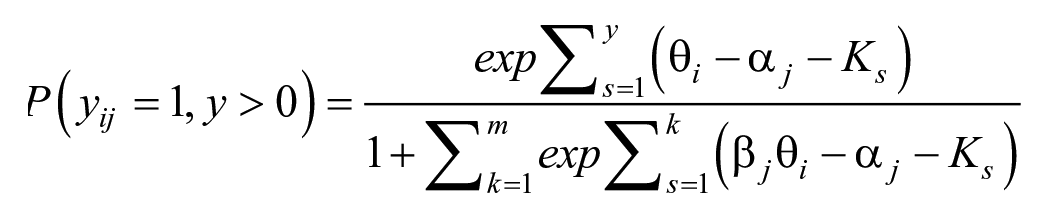

In the rating scale model,
It bears reiterating that, for this approach, we explicitly define the extremity of positions by rescaling the responses themselves. This is a relatively heavy-handed approach to incorporating importance scales as it fundamentally reshapes and redefines the observations that are explained by the latent concept.
Moderated
Finally, our fourth approach instead uses importance scales to choose the set of responses to employ in estimating latent ideology. The underlying intuition here is that only those items which a respondent actively cares about are indicative of latent ideology. This model, then, comes closest to the attitude salience perspective outlined above; citizens are concerned with one or a few sets of relevant policies, and those preferences are the guiding lights for their decision-making. The model incorporates this thinking by relying only on those attitudes which are—by virtue of the importance scales—identified as important by the respondent.
To wit, we take as our launching point effort-moderated item response models (e.g., Wise and DeMars 2006), and estimate a model that effectively removes the influence of responses for which the respondent rated the importance of the policy less than the median importance rating for that policy among all survey respondents.
The form of the moderated model is,

Here,
We use the median to address differences across issue areas in the average rating of issue importance. The median is particularly appropriate here, as it best allows us to identify relative ratings of importance within a category while addressing trade-offs in data selection. Specifically, a shift in either direction would carry costs; requiring even higher ratings of importance would decrease the amount of data we have with which to estimate the latent dimension—particularly pernicious where researchers do not have a robust surplus of respondents and questions, the usual setting for estimates of citizen ideology—while setting a lower threshold for inclusion would decrease the signal one can gain from incorporating the rating of importance.
In all, our three models incorporating respondent importance scales take methodologically diverse approaches that reflect the theoretical diversity of ways in which importance could come to influence the estimation of citizen ideology. In the weighted model, we weight the estimates themselves as part of the estimation procedure. In the scale model, we weight the responses, rescaling that responses on policies identified as important by the respondent are treated as more extreme than policies that are not identified as important by the respondent. Finally, the moderated model weights the responses, holding that only responses identified as important are useful to estimation of the latent dimension.
Estimation
We estimate the models using a Hamiltonian Monte Carlo algorithm (Gelman et al. 2013) through rstan (Stan Development Team 2018). The rating scale model is implemented through the edstan package (Furr 2019), and employs default weakly informative priors. All other models are estimated directly using rstan, and priors for the parameters are likewise weakly informative. We resolve reflection invariance using a regression approach from Gelman and Hill (2007, 318), setting a new variable
We run four chains of 5,000 iterations each with a 2,500 iteration burn-in for the CCES data, and four chains of 7,000 iterations each with a 3,500 iteration burn-in for the Lucid data. In both cases, convergence diagnostics provide strong evidence the chains have converged. Details are available in the Supplemental Material.
Results with CCES
We begin with a comparison of standard and salience-weighted ideal point estimates derived from the CCES data. In Figure 1, we provide a variety of metrics by which to compare the approaches. On the diagonal, we plot the distributions of estimates of ideology for each measure, divided by the self-identified party identification of the respondent. 8 Each approach partitions Republican and Democrat respondents as would be expected, and likewise for “Other” respondents.
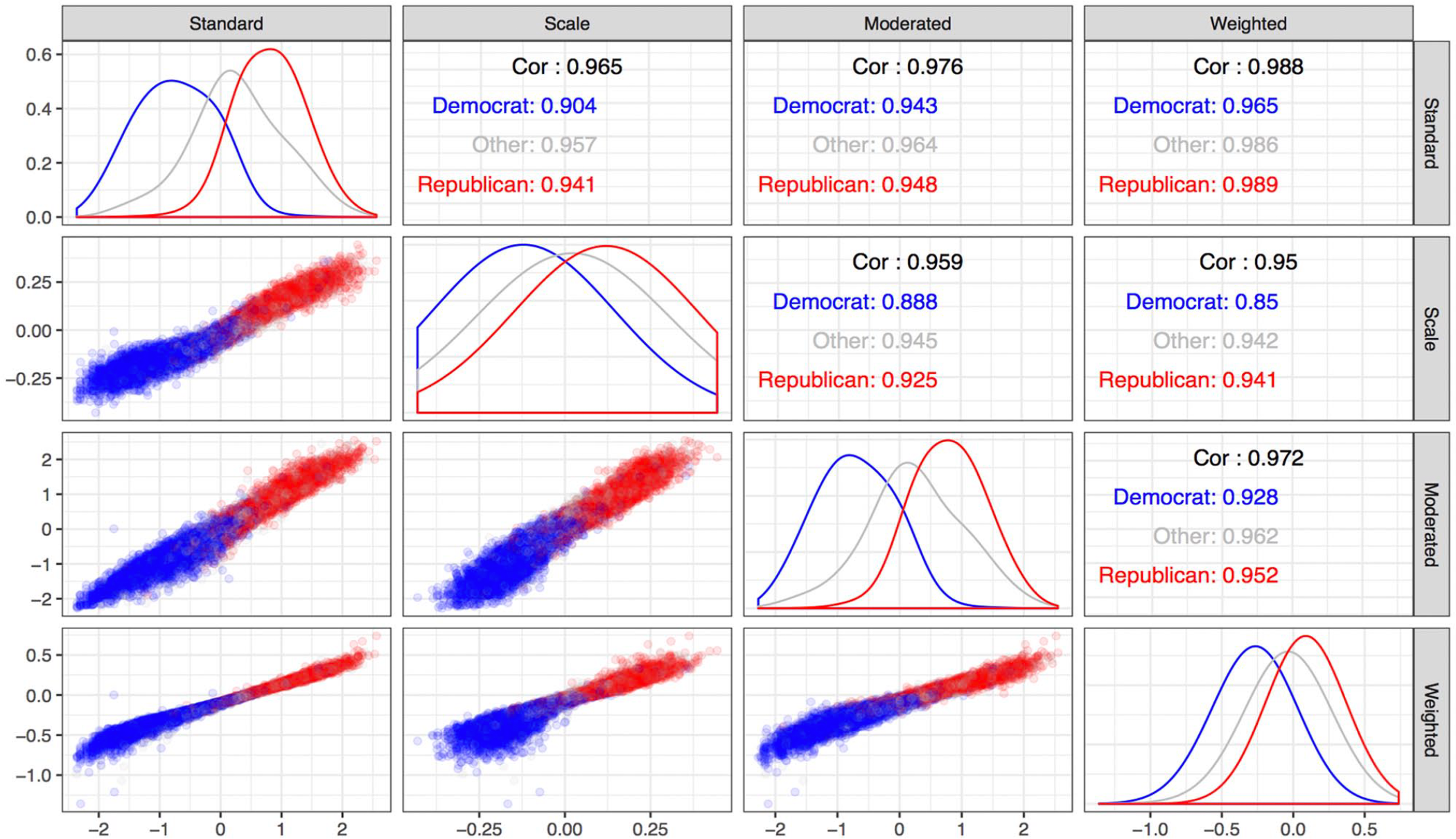
Comparison of latent ideology measures (CCES data).
We turn then to understanding the differences in individual estimates. Under the diagonal, we include comparative scatterplots of estimates for each model combinatorial. Throughout the six plots, it is strikingly evident that the measures are highly correlated. In fact, Pearson’s correlation coefficients for each of the combinatorials are never less than .95 overall. Above the diagonal, we include the correlation coefficients for each of the model comparisons. Digging deeper, we do find some minimal evidence of differences if one examines correlations among subgroups of respondents based on party identification. While each of the weighting approaches is highly correlated with other weighting approaches, the lowest correlations appear between estimates among Democratic respondents according to the rating scale approach. This is most evident in the second column of Figure 1, where the Democratic respondents (blue dots) are more dispersed than those in any other plot. On initial inspection, then, we see little evidence to suggest incorporating importance scales has critical ramifications for the estimation of ideology, though there is some suggestion one particular approach—rating scale weighting—may offer very slight changes to estimates among Democratic respondents.
One of our primary areas of interest is in whether the incorporation of salience might suggest differences in estimates of ideological polarization. To explore whether approaches incorporating issue salience better capture polarization in the ideological space of American voters, for each distribution of ideal points, we calculate the bimodality coefficient (see, e.g., Lelkes 2016). This measure captures the extent to which a distribution is unimodal or bimodal, and is estimated as a function of the distribution’s size, skewness, and excess kurtosis. Larger values of the bimodality coefficient indicate more bimodal data. Here, we observe values of 0.44 for the standard model, 0.38 for the weighted model, 0.44 for the moderated model, and 0.46 for the scale model. Though we observe some minimal variance in the estimates across approaches, the magnitude of the differences is substantively minor, and approaches incorporating issue salience do not systematically overestimate or underestimate polarization relative to the standard approach. In all, we find little evidence to suggest issue salience shifts our understanding of ideological polarization in the electorate.
While these descriptive results suggest our salience-weighted approach offers little improvement in the estimation of latent ideology, we can better evaluate the merits of the approaches by assessing their performance on prediction tasks. Thus, we turn now to analyzing whether the slight difference yields meaningful improvements on two predictive tasks. The first task we considered was predicting responses to a question from the postelection wave of the survey which asks respondents to state their preference for raising taxes versus cutting spending on a zero to one hundred scale.
9
In Figure 2, we plot the relevant estimate of ideology (x-axis) against deficit preferences (y-axis) for each of the four models. Under each plot, we include Pearson’s correlation coefficient, and the
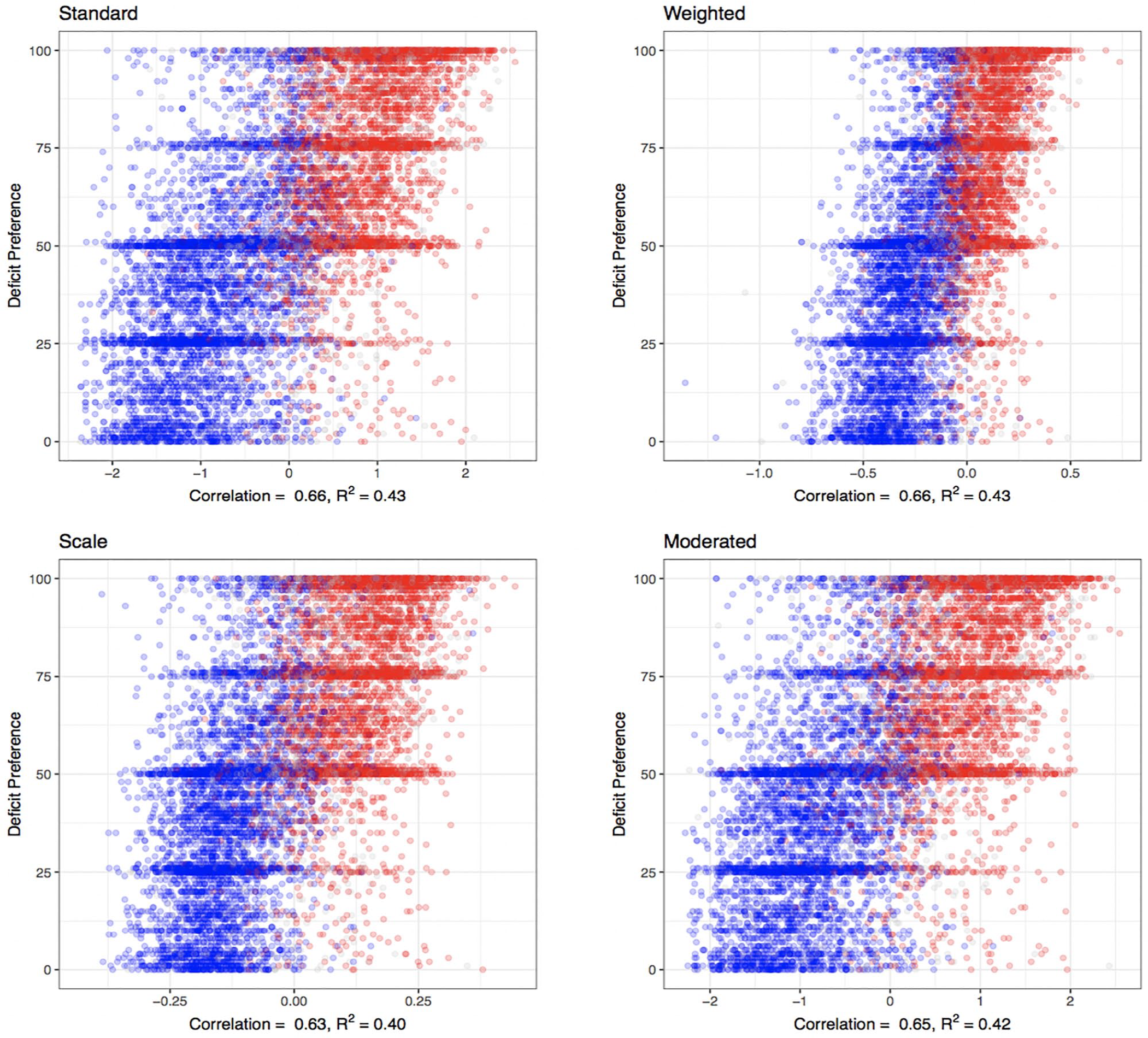
Relationship between ideal point estimates and deficit preferences.
Across both metrics, we find that the standard approach slightly outperforms each of the weighting approaches. Of the group of weighting approaches, the weighted approach matches but does not exceed the performance of the standard approach, with
As a second evaluative method, we use our measures to predict electoral choices. 10 Since general election vote choice is largely determined by partisanship, we turn to the presidential primaries, where voters might rely more on ideology to choose between candidates. For example, the 2016 Democratic nomination featured socialist Bernie Sanders competing against the more moderate Hillary Clinton. On the Republican side, the top three vote-getters included one of the most conservative senators (Ted Cruz), the more moderate John Kasich, and the ideologically enigmatic Donald Trump. Despite some clear ideological distinctions between the candidates, traditional measures of ideology were less powerful in predicting primary vote choices in 2016 than they had been in previous election cycles (Sides, Tesler, and Vavreck 2018). While much of the limited influence of ideology has been attributed to the unusually intense focus on identity issues, we also consider the possibility that the traditional ideology scales may be less useful in capturing intraparty ideological divisions.
In the 2016 CCES, respondents were asked if they voted in the 2016 primary and then, if they had voted, which candidate they supported. To assess the relative performance of the latent ideology measures, we employ each to predict primary vote choice. We create two subsets of the data: those individuals who report voting for a Democratic candidate and those individuals who report voting for a Republican candidate. For each separate model, we limit response options to the major candidates and an “other party candidate” category. Given the multiple categorical outcomes for both Democratic and Republican respondents, we estimate multinomial logit models of vote choice. The approach is a more conservative approach than ordered logit in case of violations of the proportional odds (or parallel regressions) assumption of ordinal logit.
We begin with Democratic vote choice. Our sample is limited to 4,721 respondents who identified a Democratic candidate as their primary vote choice. Here, the standard and salience-weighted models perform almost universally identically. Importantly, most models disproportionately assign votes to Hilary Clinton; in fact, the standard model assigns all respondents to Clinton because of the association of higher probability of Clinton votes across the entire spectrum of estimates of ideology, while the rating and moderated models predict nearly all respondents as Clinton votes. This is evident in Figure 3, where we plot the predicted probability of voting for each of the three potential outcomes (Clinton, Sanders, or Other) across the majority of the range of measures of ideology, with the x-axis limited to the mean of the ideological measure plus and minus two standard deviations.
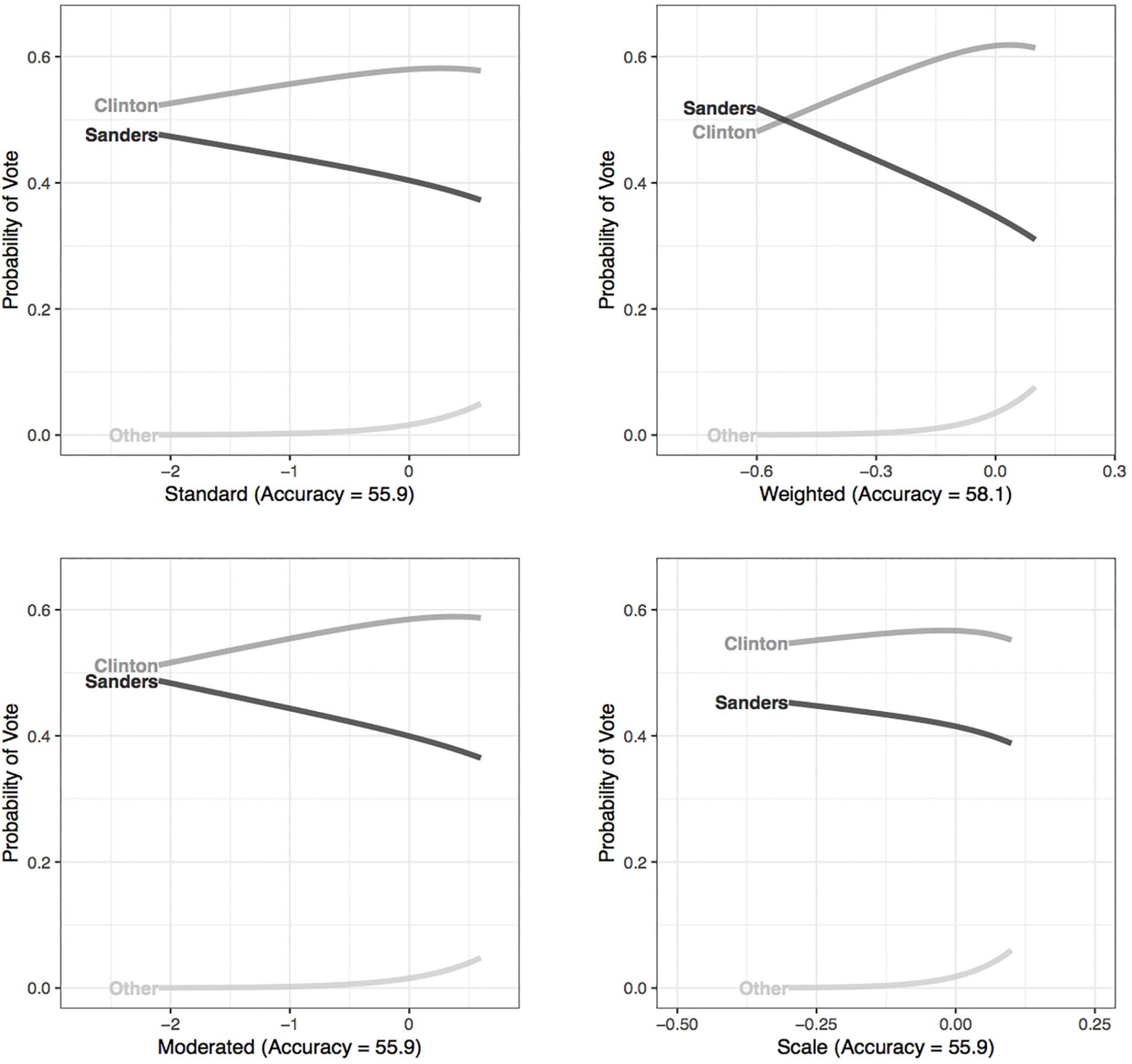
Predicted probabilities from multinomial logit of primary vote choice among self-identified Democrats.
Relative to the other models, the weighted model attaches slightly higher probabilities for very liberal Democrats to vote for Bernie Sanders. The result is that—unlike in other specifications—365 respondents are classified as Sanders voters. Of these, 234 are accurately classified as Sanders voters, but 131 are actually Clinton voters. Thus, the incorporation of importance provides only a marginal benefit, with very minimal improvement in predictive accuracy (2.2%) in one of the three alternative specifications.
Turning next to Republican respondents (Figure 4), our sample is limited to 4,289 respondents who report a primary vote choice of a Republican candidate. Here, the standard model actually performs slightly better than each of the alternative approaches, correctly predicting an additional four respondents as compared to the weighted model, an additional nineteen as compared to the rating scale model, and an additional sixteen as compared to the moderated model. Though the overall accuracy is again similar, there are differences in the priority given to different candidates. Relative to the other models, the weighted model predicts the most Trump voters (thus its success relative to other approaches), and fewer Kasich voters. On the other hand, the moderated model predicts the most Cruz voters, and the fewest Kasich voters. None of the models predicts a Rubio voter. Throughout, individual increases in predicting votes for candidates who ultimately lost (i.e., Cruz and Kasich) lead to improvements in the prediction of voters within those categories, but at the cost of inaccurately predicting an increased number of Trump voters.
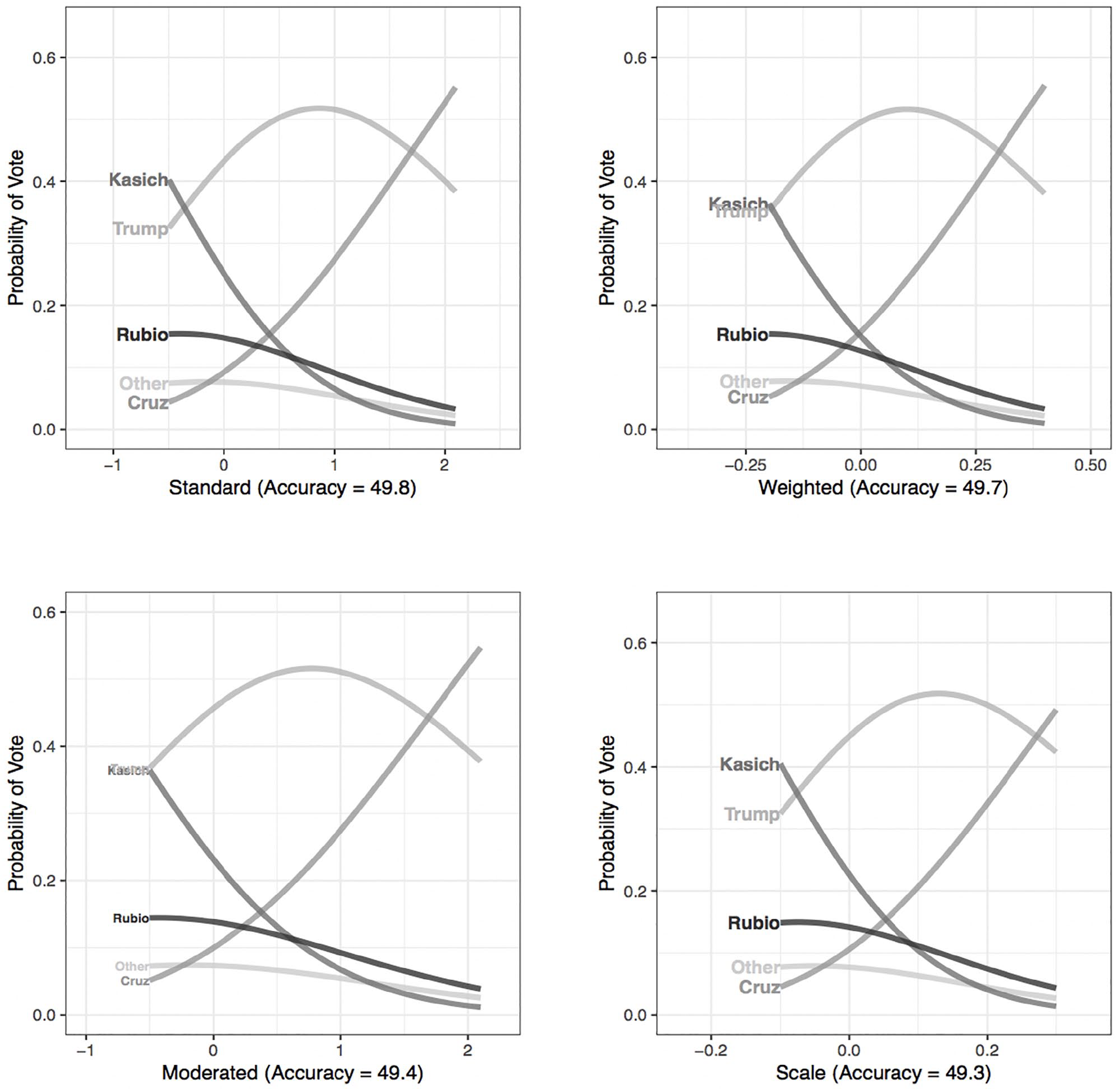
Predicted probabilities from multinomial logit of primary vote choice among self-identified Republicans.
Stepping back, we see that as was the case with the prediction of deficit reduction preferences, incorporating issue salience into measures of ideology offers little consistent improvement in the prediction of primary vote choice. Though estimates diverge in potentially interesting ways, they hold nearly identical predictive power in this series of predictive tasks. Incorporating salience in approaches to estimating ideology is a laborious and costly one for such marginal changes in the prediction of attitudinal and behavioral outcomes.
Results with Lucid
To check the robustness of the above, in our Lucid survey, we employ a novel approach for capturing respondent importance weighting. This approach instead treats importance as compositional, forcing respondents to allocate among nine responses a finite amount of “points” which roughly corresponds to the probability of their preferred position becoming policy. Thus, we explicitly force respondents to consider trade-offs in signaling an issue’s importance. We again estimate standard and salience-weighted ideal point models following the approach outlined above. Models are identical to the above, except we rescale the compositional measure to a one-to-five Likert scale in order to make the rating scale model approach tractable. We plot the results in Figure 5.
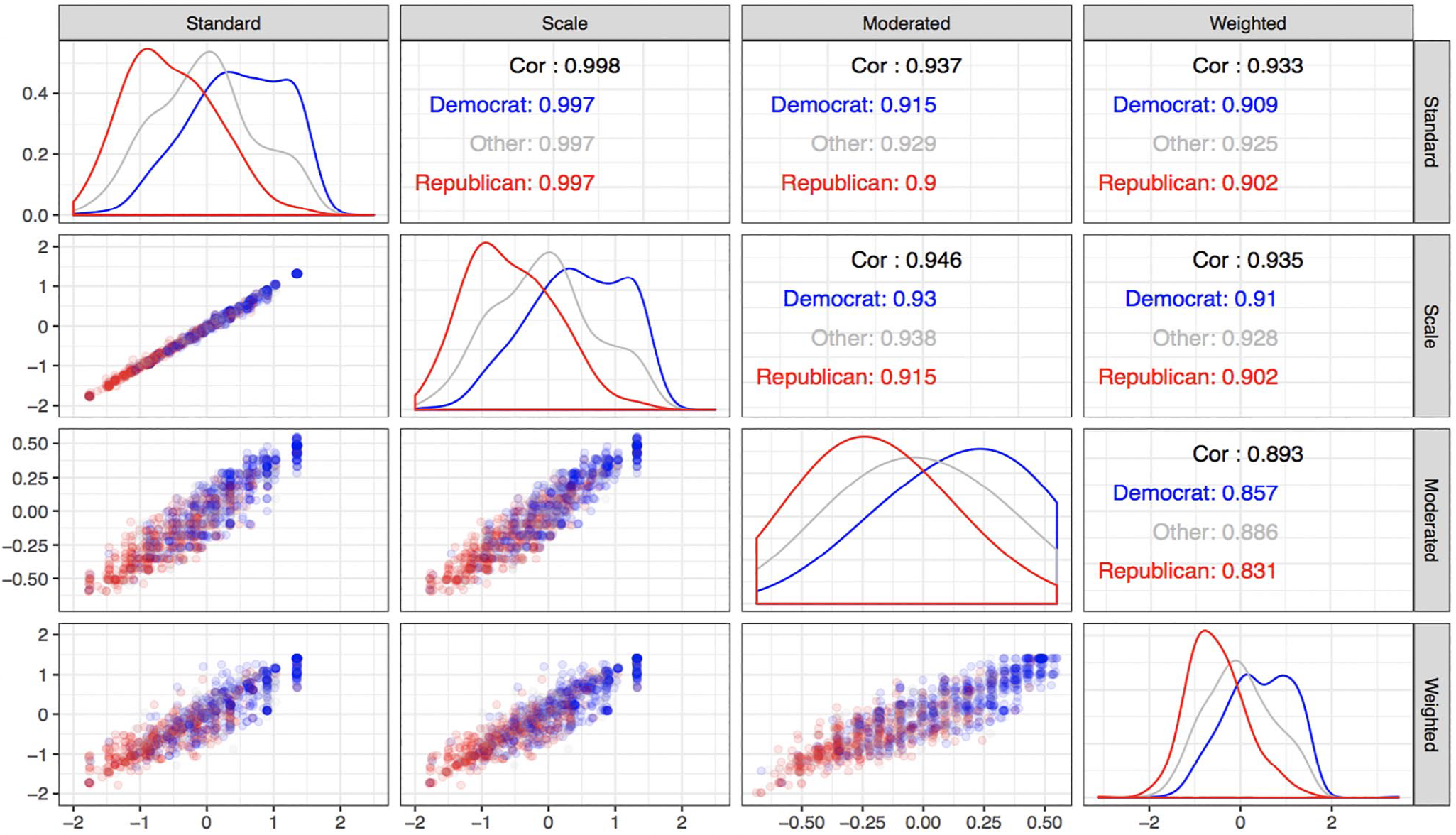
Comparison of latent ideology measures (Lucid data).
Despite the different approach to measuring importance, the ideal point estimates remain highly correlated, with Pearson’s correlation coefficients of .93, .99, and .94 between the standard and weighted, rating scale, and moderated approaches, respectively. Likewise, the distribution of ideal point densities, plotted in Figure 2, closely resembles Figure 1, as in each case, the distributions are quite similar between estimation approaches. Unlike before, we do not however see the within-subgroup differences, as Democrats and Republicans are approximately equally correlated across each of the comparisons.
We again estimate the bimodality coefficient to explore whether the measures suggest different rates of partisan ideological polarization. Recall that larger values of the bimodality coefficient indicate more bimodal data. Here, we find values of 0.40 for the standard model, 0.41 for the weighted model, 0.41 for the moderated model, and 0.51 for the rating scale model. Overall, we find little variance, with the notable exception of the rating scale model; yet while the bimodality coefficient for the rating scale model is relatively more distant from other model coefficients, the extent is much different than observed in the CCES case, and again does little provide consistent evidence of improvement.
Still, to see if the marginal differences in estimates from our approaches yield improvements in our ability to estimate ideology or to better capture ideological polarization, we again evaluate the value-added for the salience-weighted approaches by turning to predictive tasks. Here, survey respondents were asked three items which asked them to rate their preferences on a five-point scale for (1) tariffs on imported steel, (2) increased federal funding for charter schools, and (3) mandatory minimum prison sentences of five years for drug offenses. For each of the questions, we estimate separate multinomial logit models using our standard and weighted ideal point estimates.
We plot predicted probabilities for each of the analyses in Figure 6. As the figure makes clear, there are no large differences across any of the approaches, and there is no systematic improvement from using importance weighting across any of the approaches as compared to the standard approach. Starting with the top row, which features support for tariffs on imported steel, the standard approach offers a small (0.1%) improvement above the rating scale approach, but both the weighted and moderated approaches perform slightly worse (another 0.1%). In the second row, support for increased federal funding, each of the approaches incorporating importance performs better than the standard approach (0.1%–0.3%). Finally, in the third row, we see that the weighted model does better (1.0%) at predicting support for mandatory minimum sentences of five years for drug offenses, while the moderated approach performs much worse (5.3%) compared to the standard approach.
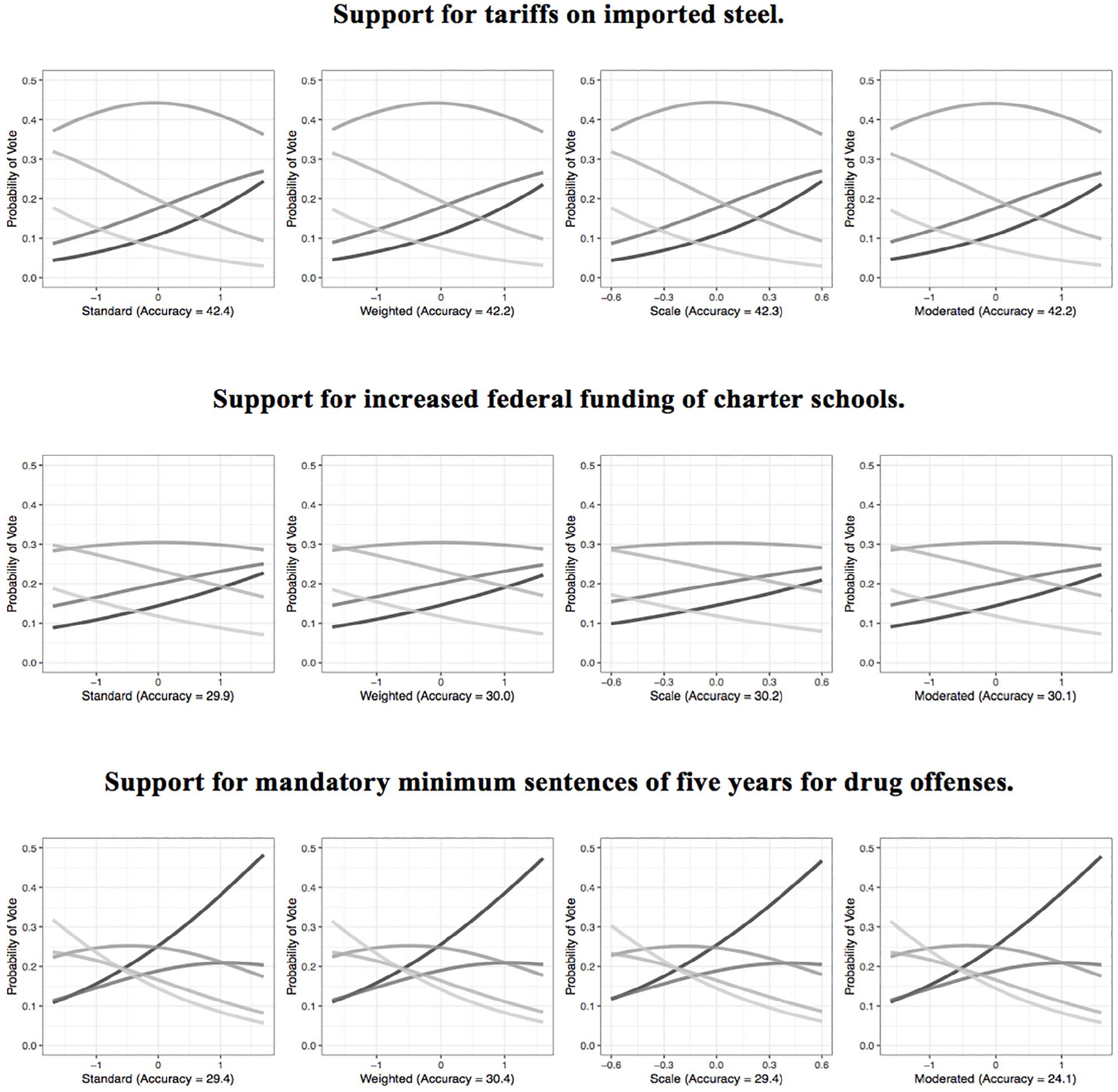
Predicted probabilities from ordered logit of policy preferences.
As before, we find little evidence to suggest the incorporation of issue importance substantially and consistently improves our ability to capture ideological preferences. Throughout the series of predictive tasks and across two different surveys and approaches to measuring importance, we find no systematic evidence that incorporating issue importance improves our ability to measure the ideological preferences of survey respondents in one dimension.
Discussion and Conclusion
In this paper, we compared a standard latent trait modeling approach to estimating ideology to a series of approaches for estimating latent ideology in a way that incorporates issue salience as a weighting strategy. Specifically, we sought to account for individual-level differences in issue salience as a means of weighting how certain items contribute to the estimation of an underlying ideology. We compared the utility of these strategies to one another and to standard IRT models in explaining ideological polarization in the electorate, both in descriptive terms and as indicated by relevant behavioral outcomes. Our approach builds upon previous work that accounts for the differential functioning of survey items in the estimation of ideology (e.g. Hare et al. 2015), but does so by weighting how items contribute to the estimate rather than standardizing them.
While our salience-weighted approaches produce some minimal differences, the latent measures produced from these disparate approaches are highly correlated with a latent measure built purely on scaling issue positions. Additionally, in a series of prediction tasks—prediction of deficit reduction preferences, primary vote choice, and policy preferences—we find no systematic evidence of improvements over the standard IRT model. We find this to be true with both standard importance weighting survey questions and a new compositional measure of importance derived from a survey instrument requiring respondents to weight their importance preferences. Across surveys and predictive tasks, we find little evidence to suggest that accounting for issue importance offers substantive improvements in our ability to estimate ideology. In this way, our findings are consistent with recent work by Leeper and Robison (2020), who find that individuals are not more likely to engage in issue voting when it comes to issues that they rate as more important to them. That personal issue salience does not send a stronger signal about one’s underlying ideology fits with a pattern whereby people are not significantly more likely to use important issues (versus unimportant ones) to make decisions between competing candidates.
Overall, our results have important theoretical and empirical implications. In the former case, researchers should consider exploring the theoretical basis of issue importance items. Does the fact that accounting for issue salience adds little, if any, information to the scaling of issues reflect something about the current polarized nature of politics in the United States, or does it say something more broadly applicable about how citizens formulate and hold their issue positions? One possibility seems particularly plausible to us. Americans may choose which party to support based on a small number of issues that they care deeply about; however, they then adapt their positions on other (less important) issues in order to coincide with that party’s platform (Barber and Pope 2019). In this way, issue importance may fail to provide us with much additional information about ideology simply because the positions that most people take on less salient issues are highly consistent with their views on issues they care most about. Issue importance clearly matters in this process—but not in a way that would be obvious from scaling a large number of salient and nonsalient issue items.
In terms of empirical implications, our work makes clear that scaling issue preference items offers a robust indicator of ideology, regardless of how salient those issues are to respondents. Looking ahead, one important future avenue for scholars to explore is how this issue salience manifests in models that treat ideology as multidimensional rather than unidimensional. In all, though, the conclusions that have been drawn by scholars related to the role of ideology in predicting vote choices and representation would not appear to be impacted by models that account for personal issue salience, nor do we find systematic evidence of more polarization among Americans when we make such accommodations.
Supplemental Material
online_appendix – Supplemental material for Political Ideology and Issue Importance
Supplemental material, online_appendix for Political Ideology and Issue Importance by Douglas Rice, Brian F. Schaffner and David J. Barney in Political Research Quarterly
Footnotes
Acknowledgements
We thank Justin Gross, Nathan Kalmoe, Chuck Smith, Paul Sniderman, and the American Politics Working Group at UMass for helpful feedback on this project.
Declaration of Conflicting Interests
The author(s) declared no potential conflicts of interest with respect to the research, authorship, and/or publication of this article.
Funding
The author(s) disclosed receipt of the following financial support for the research, authorship, and/or publication of this article: This research was supported by a grant from the National Science Foundation (Award # 1559125).

Supplemental Material
Notes
References
Supplementary Material
Please find the following supplemental material available below.
For Open Access articles published under a Creative Commons License, all supplemental material carries the same license as the article it is associated with.
For non-Open Access articles published, all supplemental material carries a non-exclusive license, and permission requests for re-use of supplemental material or any part of supplemental material shall be sent directly to the copyright owner as specified in the copyright notice associated with the article.
