



Abstract
Much attention is paid to how mechanisms for selecting political officials shape which types of officials hold positions of power, but selection procedures do not always produce the desired outcomes. In the context of the judiciary, many expected “merit” selection procedures to facilitate the selection of women justices to the bench, an expectation that has not been realized. Applying theories of procedural fairness to judicial selection procedures, I argue that observers’ beliefs that merit selection procedures are more “fair” (relative to unilateral selection procedures) makes observers more accepting of all-male benches. Survey experimental evidence demonstrates that respondents do perceive merit selection procedures as more fair than gubernatorial selection procedures, a priori. In turn, respondents are less critical of all-male courts when judges are selected through a merit selection procedure. These findings contribute to our understanding of the ways in which (1) selection institutions shape prospects for gender diversity, (2) institutional design can have unintended consequences, and (3) procedural fairness can obscure accountabilituy for suboptimal outcomes.
Introduction
Both scholars and practitioners express expectations that judicial selection institutions can shape the quality and characteristics of judges selected to the bench, and a growing literature addresses how different selection institutions shape prospects for gender or racial diversity in the judiciary (Alozie 1990; Bratton and Spill 2002; Hurwitz and Lanier 2003; Reddick, Nelson, and Caufield 2010). Merit selection—in particular—has garnered substantial attention for the ways in which it may (or may not) promote diversity in the judiciary. 1 Typically under merit selection procedures, a merit commission of several individuals accepts applications and seeks candidates for a vacancy. The commission then generates a short list of candidates from which the executive chooses a judge to fill the vacancy. 2
Merit selection was famously employed by President Carter for the selection of lower level federal courts. 3 As Berkson, Carbon, and Neff (1979, 105) explain, President Carter had two goals when he established the U.S. Circuit Court Judge Nominating Commission: selecting judges based on professional merit and rectifying the historic exclusion of women and minority judges by actively seeking out those candidates for the bench. Carter’s goal of diversifying the federal judiciary was successful. 4 Of the 262 judges Carter appointed to district and circuit courts, 15 percent were women and 15 percent were Black, Hispanic, or Latino (Solberg and Bratton 2005; Walker and Barrow 1985), a record-breaking level of diversity at the time (Babcock 1980).
Proponents of merit selection argue that members of the nominating commission focus on the qualifications of judges rather than on political or personal criteria or one’s networks of connection. This focus on qualifications serves to decrease opportunities for discrimination and other impediments to the selection of women and minorities (Martin 1981). As Justice Ginsburg explains, women and minority candidates were more successful under the Carter administration due to his emphasis on merit rather than the “‘old boys’ network” (Ginsburg and Brill 1995, 288).
Consistent with President Carter’s use of the merit system and subsequent diversification of the federal judiciary, many observers expressed optimism that merit selection procedures would necessarily promote diversity on the bench more generally (Clark 2002; Crompton 2001). Indeed, Norman Krivosha, the chief justice of the Nebraska Supreme Court from 1978 to 1987, writes “there is no question but that the merit selection system affords greater opportunities for women and minorities to find their way to the bench” (Krivosha 1987, 19). 5
However, the belief that merit selection procedures would be net beneficial for the selection of women judges has not been borne out in the several decades since Carter’s use of merit selection to diversify the federal judiciary (Goldstein 2006). Merit selection did not accelerate the selection of the first woman justice to state supreme courts (Goelzhauser 2011) 6 nor is merit selection associated with a greater proportion of women judges on the bench (Reddick, Nelson, and Caufield 2010). Indeed, some research suggests that merit selection disadvantages women at the nomination stage (Goelzhauser 2018b, 2019).
Why has enthusiasm for gender diversification under merit selection not been realized? Applying theories of procedural fairness and legitimacy to judicial selection, I argue that observers’ beliefs in the procedural fairness of merit selection procedures leads them to be less critical of suboptimal outcomes, including gender homogeneity on the bench. This acquiescence, in turn, may allow the exclusion of women to persist unpunished under merit selection procedures. I test this expectation using survey experimental evidence. Comparing a merit selection procedure with a unilateral, gubernatorial selection procedure, I find that respondents perceive merit selection procedures as, a priori, more fair (this pattern persists even when merit selection is referred to as the less-leading “committee-assisted selection”). Consistent with expectations, I then find that respondents are less critical of gender homogeneity under merit selection procedures relative to gubernatorial selection procedures. In other words, there is a counterintuitive drawback to implementing institutional changes that are championed as more fair or more trustworthy: observers’ beliefs in procedural fairness encourages acquiescence to otherwise problematic outcomes. These findings offer (or confirm) several lessons, including the idea that (1) institutional design can have unintended consequences, (2) selection institutions matter for gender diversification in the judiciary, and (3) procedural fairness can obscure accountability for suboptimal outcomes.
The rest of the article proceeds as follows: first, I outline existing literature about the role of selection institutions in the judiciary and on the selection of women. Then, I turn to procedural fairness and describe how citizens’ beliefs in the fairness of institutions can undermine prospects for judicial diversity. Finally, I detail two survey experiments used to test whether and how merit selection may undermine gender diversity in the judiciary. I conclude with a discussion of the ways in which this study informs broader understandings of gender diversification and institutional design.
The Effects of Judicial Selection Procedures
Debates about the best way to select judges to promote various outcomes have a long tradition, both globally and in the United States. In the U.S. context, for example, Alexander Hamilton advocated for judicial independence while Thomas Jefferson prioritized judicial accountability (Nejelski 1981; Webster 1995). More recently, scholars have addressed whether and how different selection institutions affect the quality of judicial qualifications (Cann 2006; Goelzhauser 2016) and judicial performance (Brace and Boyea 2008; Bright and Keenan 1995; Choi, Gulati, and Posner 2010; Hall 1992; Huber and Gordon 2004).
Importantly for the purposes of this project, a robust literature addresses how selection systems may shape prospects for gender diversity on the bench. Evidence, though, is mixed. Some argue that the concentration of accountability on the executive (Bratton and Spill 2002; Carbon, Houlden, and Berkson 1982; Goelzhauser 2016; Williams and Thames 2008) or the electoral exposure of judicial selectors (Valdini and Shortell 2016) leads to the increased selection of women. Judicial elections, likewise, do not systematically exclude women from office (Frederick and Streb 2008; Reid 2004a), and may actually provide women an advantage when they are challengers (Gill and Eugenis 2019). Other factors such as the timing of judicial turnover may have consequences for the diversification of the judiciary too (Arrington 2020). However, many find no effect of formal selection procedures on gender diversity in the judiciary (Alozie 1988, 1990; Hurwitz and Lanier 2003, 2008; Slotnick 1984). 7
When it comes to the effect of merit selection procedures—in particular—on gender diversity, the empirical evidence is bleak. Williams (2007) finds no relationship between merit selection procedures and women’s representation at the state trial court level but finds a negative relationship between the two for state appellate courts, a finding mostly confirmed by Reddick, Nelson, and Caufield (2010) who find that merit selection has no effect on the selection of women to state high courts or trial courts but is negatively associated with the selection of women judges to intermediate state appellate courts. At the state supreme court level, merit selection not only failed to accelerate the selection of the first women justices (Goelzhauser 2011), but may disadvantage women candidates at the commission nomination stage (Goelzhauser 2018b, 2019). 8
As a whole, the literature suggests that selection institutions play a limited role in judicial diversity (Goelzhauser 2016). In the context of the U.S. state courts, it appears that if selection institutions do shape diversity, the selection institution “best” for the selection of women is executive appointment (Goelzhauser 2016). These empirical findings contradict the popular expectation that merit selection is beneficial for gender diversity in the judiciary.
Merit Selection, Beliefs in Fairness, and Unintended Consequences
Why, despite enthusiasm, has diversification under merit selection procedures not been realized? I argue that beliefs in the overall fairness of merit selection procedures make observers less critical of suboptimal outcomes of merit selection, in this case: gender homogeneity on the bench. The idea that attitudes toward legal institutions affect perceptions of the outcomes of those institutions is not new. Theories of procedural justice hold that when observers believe the process is fair and impartial, they will continue to support legal institutions, even when outcomes are unfavorable (Lind and Tyler 1988; Murphy and Tanenhaus 1967; Tyler 2001, 2003). Similarly, legitimacy theory sets forth that citizens will defer to institutions and institutional outcomes when they consider those institutions legitimate and/or have diffuse support for those institutions. (Easton 1965; Engstrom and Giles 1972; Nelson and Gibson 2017; Tyler 2006).
As Gibson and others’ work shows, diffuse support of the judiciary can be augmented by exposure to legitimizing symbols of the judiciary (i.e., positivity bias theory). More precisely, legitimizing symbols of the judiciary lead to and reinforce the belief that the judiciary is a different type of institution than other political institutions, one based on objective legal principles and qualifications rather than politics. Given these perceived differences between courts and other political institutions, courts are perceived as “worthy of more respect, deference, and obedience—in short, legitimacy” (Gibson and Caldeira 2009, 142). In turn, this institutional legitimacy shapes how people perceive outcomes and makes people more willing to acquiesce to policies they oppose (Gibson, Caldeira, and Spence 2005).
The boundaries between procedural fairness, legitimacy, and diffuse support are blurred, and there is disagreement over the direction of causality—whether, for example, procedural fairness leads to legitimacy (Tyler and Rasinski 1991) or legitimacy shapes attitudes of procedural fairness (Gibson 1991). What these theories generally share, though, is the expectation that beliefs in the “fairness” 9 of judicial institutions make observers more accepting of the outcomes of those institutions, even when those outcomes are suboptimal. I apply this logic of procedural fairness and acquiescence to the case of judicial selection and gender diversity.
I argue that observers perceive merit selection procedures as more fair, all else equal, than gubernatorial selection procedures. While it is possible that observers’ beliefs in the fairness of merit selection stem from the term “merit” in the name (a possibility I test in later sections), there are at least three procedural reasons observers may perceive merit selection as more fair. First, because merit selection requires two stages, it prohibits unilateral appointment and limits the power of both the commission and the executive. As such, observers might expect fewer opportunities for patronage under merit selection procedures. Second, because two institutional actors must—to some extent—agree on the qualifications of a candidate to be selected to the bench, observers may expect merit selection to produce more generally appealing judges. Third, because the nominating commission includes non-politicians tasked with evaluating legal qualifications of candidates, observers may consider merit selection procedures as more meritocratic and less partisan than gubernatorial selection (e.g., Glick 1978). 10
Given the expectation that observers view merit selection as more fair than gubernatorial selection, I argue—consistent with theories of procedural fairness—that observers will be less critical of suboptimal outcomes under merit selection. Applied to the context of gender diversity on the bench, I expect observers to be less critical of gender homogeneity when gender homogeneity is the outcome of a merit selection process. In the next sections, I describe the survey experiments used to test the following hypotheses:
Empirical Evidence
To test the study’s hypotheses, I fielded two survey experiments through Amazon’s Mechanical Turk (MTurk) 11 in December 2017 and January 2018. 12 The first survey experiment tests observers’ perceptions of the fairness of merit selection relative to gubernatorial selection. The second experiment tests whether selection institutions shape respondents’ perceptions of the unfairness of an all-male bench. The analyses presented here are restricted to residents of the United States, and summary statistics for the samples are listed in Figures 3 and 4.
Beliefs about the Fairness of Merit Selection
Do people perceive of merit selection as more fair than gubernatorial selection? To test perceptions of fairness across selection institutions, respondents were shown information about two selection procedures to a hypothetical court. In one selection procedure, the governor is tasked with selecting judges to vacancies (gubernatorial selection). In the other procedure, a commission generates a short list of candidates from which the governor selects a judge to fill the vacancy (merit selection). Of course, merit and gubernatorial selection are not the only ways in which judges are selected in the United States; state court judges are also selected through partisan elections, non-partisan election, legislative election, and supreme court/chief justice selection (Reddick, Nelson, and Caufield 2010), although classifying selection systems is not always straightforward (Goelzhauser 2018a).
The comparison in this study is limited to merit and gubernatorial selection for a few reasons. First, research indicates a pattern between gubernatorial selection and greater gender diversity in the judiciary (Carbon, Houlden, and Berkson 1982; Goelzhauser 2016); for those interested in identifying which selection institution is more likely to lead to increased gender diversity, gubernatorial selection is a relevant alternative. Second, both merit and gubernatorial selection are elite selection procedures (Bratton and Spill 2002), so comparing gubernatorial selection with merit selection holds constant some of the key actors and types of actors involved in selection. Finally, merit selection and gubernatorial selection are sometimes grouped together as appointment systems in contrast to election-based selection systems (Arrington 2018a; Bratton and Spill 2002); comparing unilateral, gubernatorial selection with merit selection helps to disaggregate our understanding of judicial appointment systems.
After reading brief summaries of both gubernatorial and merit selection procedures, respondents were asked “Which selection procedure do you think will be more fair?” If respondents are indifferent or agnostic over selection methods, respondents should report that the two methods are equally fair and/or choose merit or gubernatorial selection as the more fair option in equal proportion. However, based on the reasons listed previously, I expect respondents to perceive merit selection as more fair than gubernatorial selection.
Figure 1 reports the proportion of respondents who gave each answer. Just under 80 percent of respondents indicated that merit selection is more fair; 10.8 percent of respondents indicated that the two processes were equally fair, and only 9.3 percent of respondents indicated that gubernatorial selection was more fair. Moreover, a difference in proportions test shows that it is highly unlikely that this difference in preference between merit and gubernatorial selection is due to chance (p < .001). Overwhelmingly, respondents perceive merit selection procedures as more fair than gubernatorial selection procedures, absent any information about outcomes.
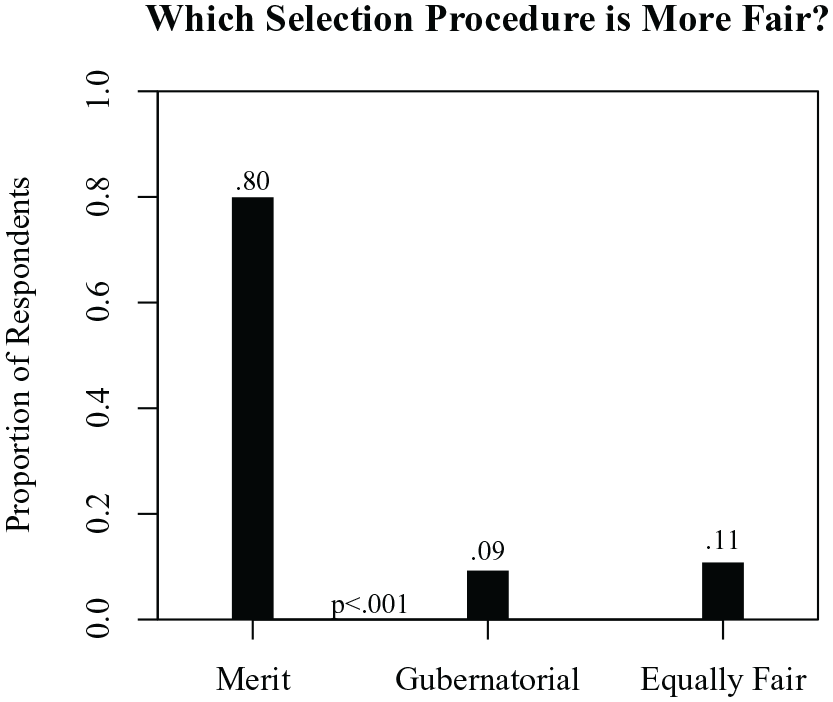
Merit versus gubernatorial selection.
Unpacking the preference for merit selection
After respondents indicated which institution they perceived as more fair, they had an opportunity to describe the reason they made their choice. Assessing these qualitative responses can shed light on why respondents perceived merit selection as more fair than gubernatorial selection. Using thematic analysis (Braun and Clarke 2006), I identified eight themes in the qualitative responses. In order of the frequency with which they appear in the data, those eight themes are
Limits power (of the governor), corruption, or bias, 13
Allows for more input in selection (having more people involved), 14
Focuses on qualifications, 15
Promotes accountability and the role of the public, 16
Lessens the role of politics, 17
Expands the candidate pool, 18
Leaves uncertainty about the composition/nature of the committee, 19 and
Gives the governor final say (in both procedures). 20
Table 1 lists exemplar responses for each category, and Table 2 shows the prevalence of each theme among respondents who indicated that merit selection was more fair, gubernatorial selection was more fair, or both processes were equally fair. Among respondents who indicated that merit selection was more fair than gubernatorial selection, the most common justifications included themes of limiting the power of the governor and/or potential for corruption or bias, involving input from more people in the selection process, and focusing on qualifications of candidates. For those who indicated that gubernatorial selection was more fair, the most common justifications centered on accountability and the role of public input. For those who indicated that the two procedures were equally fair, the most pronounced theme in responses was that in both procedures, the governor ultimately has the final say.
Qualitative Response Exemplars.
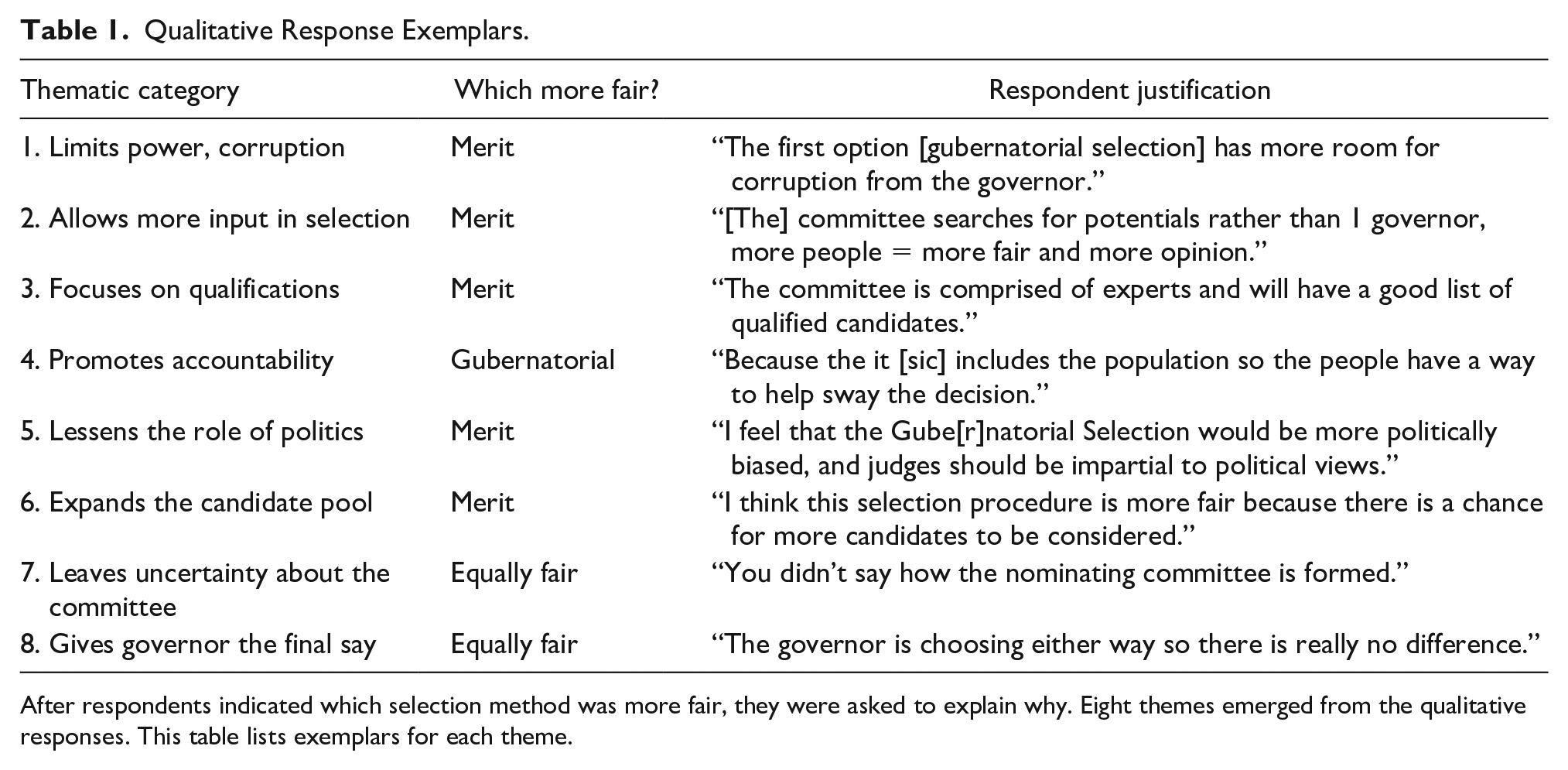
After respondents indicated which selection method was more fair, they were asked to explain why. Eight themes emerged from the qualitative responses. This table lists exemplars for each theme.
Qualitative Responses: Prevalence of Thematic Categories.
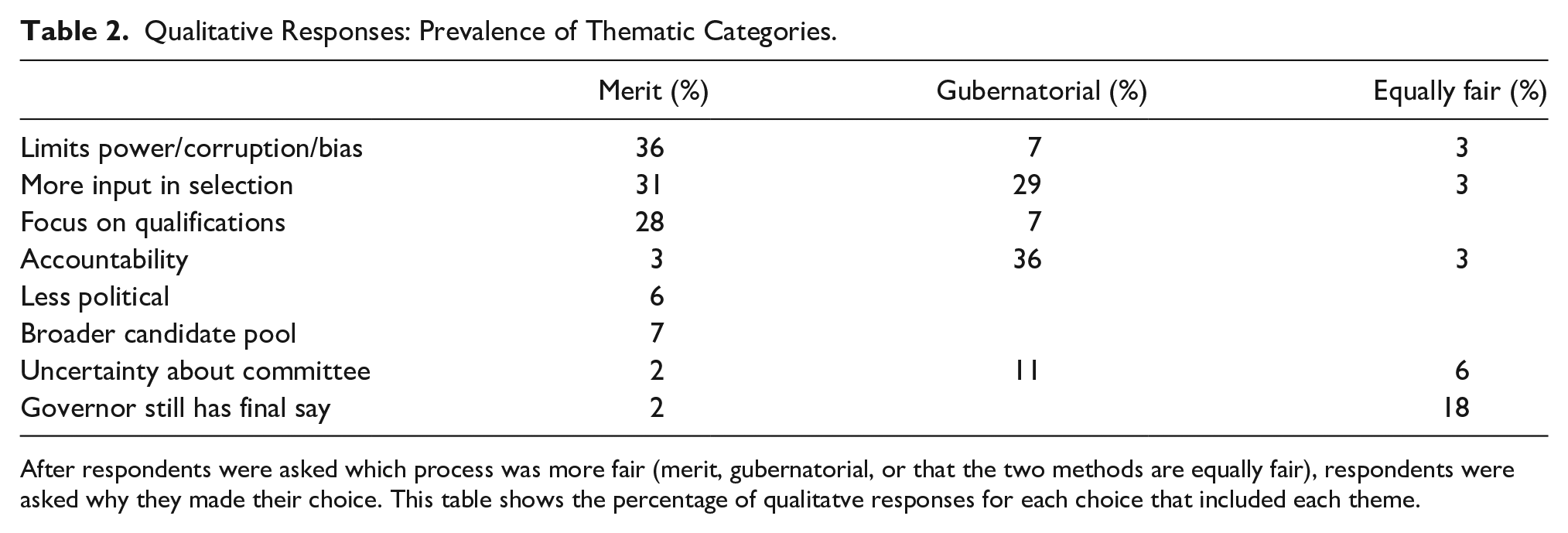
After respondents were asked which process was more fair (merit, gubernatorial, or that the two methods are equally fair), respondents were asked why they made their choice. This table shows the percentage of qualitatve responses for each choice that included each theme.
In summary, respondents overwhelmingly indicated that they perceived merit selection procedures as more fair than gubernatorial selection procedures. Those who indicated that merit selection was more fair generally identified the presence of additional actors, constraints on the governor, and a focus on qualifications as their justification.
The importance of “merit” in merit selection
Although most respondents provided substantive explanations for their perception of merit selection as more fair than gubernatorial selection, it is possible that respondents were swayed by the normatively laden term “merit” in the name. If this is the case, the respondents who indicated a preference for merit selection procedures may have been persuaded by the name of the procedure rather than beliefs about the fairness of the process.
Jones (2012, 455) describes the modern trend of naming short titles for federal statutes with “evocative language” to attract support for the bills. He notes how some titles imply success or contain appealing but subjective characteristics (e.g., “responsibility” or “accountability”) to help garner popular support for bills and make voting against the bills potentially more costly for legislators. 21 The term “merit” in “merit selection” could serve a similar function by implying that the process is necessarily meritorious, regardless of the actual procedures or outcomes of the process. Some scholars contend that the “merit” in merit selection is a “propagandistic misnomer” (Dimino 2003, 803) that “perpetuate[s] a myth of meritocracy” and serves to obscure biases that exist in our legal systems (Maute 2000, 1237). Having “merit” in the name, in other words, only conceals the political and non-meritocratic processes at play in the selection of justices through this selection process.
To test whether respondents’ beliefs in the fairness of merit selection depend on the leading name, I add a treatment group in which respondents are shown the exact same information except the “merit” selection process is referred to as “commission-assisted” selection. 22 Respondents were randomly assigned into the two groups, and Table 3 reports summary statistics of the treatment group and control group (the control group is the same group of respondents reported above). If the term “merit” is responsible for differences in perceptions of fairness across merit and gubernatorial selection, then the difference between gubernatorial selection and “merit” selection should disappear when merit selection is referred to as “commission-assisted” selection. In contrast, if the process of the selection procedure is more important than the label, the pattern of responses between commission-assisted and gubernatorial selection should be the same or similar to the pattern of responses between merit and gubernatorial selection.
Sample Characteristics.
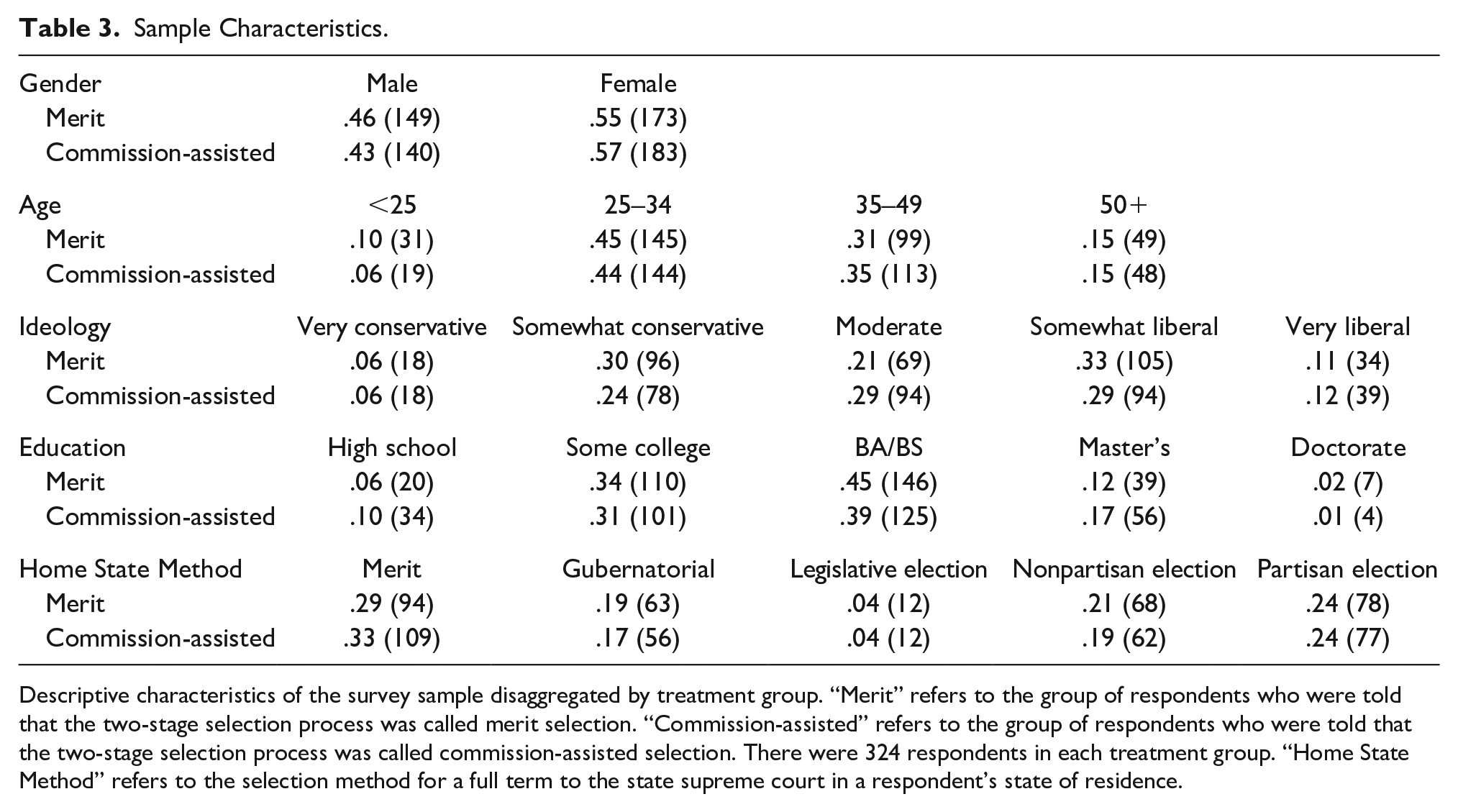
Descriptive characteristics of the survey sample disaggregated by treatment group. “Merit” refers to the group of respondents who were told that the two-stage selection process was called merit selection. “Commission-assisted” refers to the group of respondents who were told that the two-stage selection process was called commission-assisted selection. There were 324 respondents in each treatment group. “Home State Method” refers to the selection method for a full term to the state supreme court in a respondent’s state of residence.
Figure 2 plots the proportion of respondents who selected each option as more fair across treatment groups. The black bars show responses for those who saw “merit” and gubernatorial selection, and the gray bars show responses for those who saw “commission-assisted” and gubernatorial selection. The p-values along the x-axis are for the difference in proportion across treatment groups. Respondents were more likely to choose the two-stage selection method as more fair when the process was labeled as “merit” selection than when it was labeled “commission-assisted” (p = .013), but even with this difference, respondents still overwhelmingly chose “commission-assisted” selection as more fair than gubernatorial selection. In the “commission-assisted” treatment group, 71.6 percent of respondents chose commission-assisted (compared with 79.9% under “merit”); 14.8 percent chose gubernatorial selection, and 13.6 percent indicated that the two systems were equally fair.

Perceptions of fairness: “Merit” versus “commission-assisted” selection.
These findings indicate that the term “merit” may affect some respondents’ beliefs about the fairness of that selection system. However, most respondents (71.6%) in the “commission-assisted” group still indicated that the selection procedure was more fair than gubernatorial selection, absent the normative/subjective language. This suggests that the procedure—that is, the presence of additional actors who serve as a check on the governor and focus on qualifications—is what leads (most) people to perceive merit selection as more fair than gubernatorial selection. In the next section, I test whether the use of gubernatorial or merit selection procedures affect how respondents interpret information about the outcome of judicial selection.
The Effect of Selection Institutions on Perceptions of Gender Disparity
To test whether and how prior beliefs in the fairness of merit selection procedures may lead respondents to be less critical of observed gender disparity, I employ another survey experiment fielded in January 2018. Table 4 presents summary characteristics of the sample. Respondents were shown information about a hypothetical court with seven members. They were told that judges were drawn from a large and deep candidate pool that included many women. 23 The names of seven judges were listed along with an arbitrary bar association score. There were two treatment variables. First, the number of women’s names listed varied from zero to two. The names were drawn from a list of past and current state supreme court judges. 24 Second, half the respondents were told that judges were selected by the governor while the other half of respondents were told that judges were selected through a merit procedure in which a commission generated a short list of three names from which the governor chose one judge to fill a vacancy. Respondents were not given any information about the composition of the short-lists generated by the commission. Respondents were then asked if the selection of judges appeared fair or unfair using a 5-point scale: definitely unfair, probably unfair, neither fair nor unfair, probably fair, and definitely fair. Figure A4 in the Supplemental Appendix shows the survey instrument for the treatment group with merit selection procedures and two women justices.
Survey Respondent Characteristics.
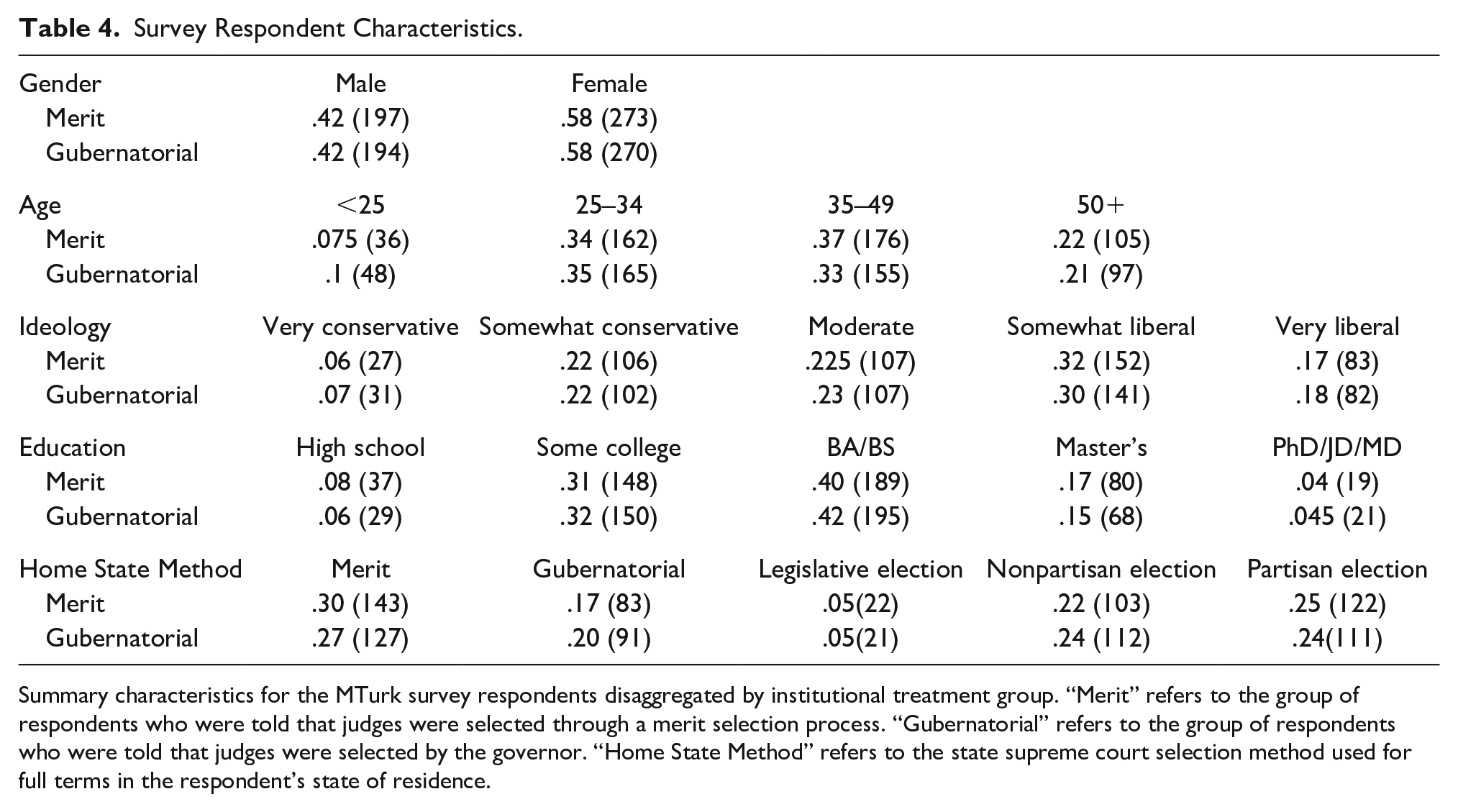
Summary characteristics for the MTurk survey respondents disaggregated by institutional treatment group. “Merit” refers to the group of respondents who were told that judges were selected through a merit selection process. “Gubernatorial” refers to the group of respondents who were told that judges were selected by the governor. “Home State Method” refers to the state supreme court selection method used for full terms in the respondent’s state of residence.
If selection institutions have no effect on how respondents interpret information, perceptions of fairness across different levels of gender diversity will be the same across both institutional treatment conditions. Figure 3 shows the proportion of respondents who indicated that the process seemed either definitely or probably unfair across the number of women judges and the selection institution type. When there were no women on the bench, almost half of respondents in the gubernatorial selection group concluded that the process was unfair. In contrast, about a third of respondents in the merit selection group indicated the all-male court was unfair. This difference in perceptions of unfairness of an all-male court across institution type is statistically significant (p = .008), suggesting that observers are indeed less critical of gender homogeneity when it is the outcome of merit selection, a process believed to be more fair.

Survey results, perceptions of unfairness across institutions type and diversity.
It is worth noting that respondents were more critical of an all-male bench (38.6% of respondents overall indicated that the process was probably or definitely unfair) than a court with one woman (26.6%) or two women (14.4%), which suggests that some respondents do care about gender diversity on the bench. In addition, the only statistically significant difference in perceptions of unfairness across institution type is for an all-male court. For respondents who care about gender diversity, an all-male bench should be the most problematic outcome—while one woman on a seven judge bench is not descriptively representative, women are at least included. It is reasonable that the effect of beliefs in procedural fairness on acquiescence to a suboptimal outcome is most pronounced for the most distressing outcome: the absence of women on the bench.
Discussion and Conclusion
Despite enthusiasm for the ways in which merit selection procedures could/would facilitate the selection of women, empirical evidence has been inconclusive—at best—about the role of merit selection in promoting gender diversity on the bench. One explanation for this discrepancy hinges on observers’ beliefs in the procedural fairness of merit selection: observers’ beliefs that merit selection is procedurally fair makes them less critical of suboptimal outcomes.
Survey experimental evidence confirms that respondents overwhelmingly consider merit selection procedures to be more fair than gubernatorial selection, absent information about outcomes. This preference for the two-stage process persists even when “merit selection” is referred to as “commission-assisted” selection. Qualitative responses suggest that respondents’ preferences for merit selection stem from the perception that merit selection limits opportunities for corruption, requires more input, and focuses on qualifications.
Given that respondents perceive merit selection procedures to be more fair than gubernatorial selection procedures, I hypothesized that observers would, in turn, be more accepting of suboptimal outcomes—in this case, all-male courts—under merit selection. Indeed, respondents were less critical of an all-male bench when they were told that judges were selected through merit selection. These findings offer several lessons.
First, this study corroborates the idea that procedural fairness can lead to acquiescence over outcomes. If beliefs in the fairness of procedures are well-placed or “deserved” (by whatever standard of deservingness), then this pattern may be benign. If, however, people believe in the fairness of a process for reasons that are unjustified or empirically inaccurate, then procedural fairness may serve to obscure nefarious consequences, such as the continued exclusion of women. Of course, whether or not an observer’s acquiescence is “good” or “bad” depends on the combination of an observer’s preferences over outcomes and a given goal of judicial selection. Throughout, I have treated the all-male bench as the undesired outcome, but that may not be true for all observers; for respondents who consider judging to be a masculine pursuit and are skeptical of women judges, beliefs in the fairness of the selection process might lead those respondents to be less critical of a bench that contains women.
Second, to the extent that acknowledging an outcome as suboptimal is the first step in rectifying that outcome, observer acquiesce to all-male selections may facilitate the continued exclusion of women from the judiciary. Furthermore, in the case of merit selection, the exclusion of women may persist for another reason: as Valdini and Shortell (2016) show, women justices are more likely to be selected by elites who are electorally exposed (rather than electorally sheltered) and can claim credit for diversification. In the case of merit selection, members of the nominating commission are removed from the electoral accountability of the public, which dampens the incentive to diversify to claim credit. Likewise, the electorally exposed governor who continues to select only male candidates can share any blame with the commission by emphasizing how his or her hands were tied, thus limiting potential electoral consequences for excluding women from the bench.
Third, these findings suggest that many observers accept no or minimal diversification in the judiciary. Sixty-one percent of respondents concluded that a process resulting in an all-male bench in a context in which there are plenty of qualified women was either “neither fair nor unfair,” “probably fair,” or “definitely fair.” For a court with one woman, 73.4 percent of respondents concluded the same. It is possible some respondents simply do not value gender diversity or the presence of women in the judiciary. 25 Or, perhaps respondents do care about gender diversity on the bench, but their beliefs in the fairness of the process are sufficiently strong that they conclude the exclusion of women is a temporary fluke. That is, respondents reason that the process is fair, it just so happens that right now the seven-most qualified candidates are men; next term maybe the seven most qualified judges will be female. Future research ought to address which observers care about diversity in the judiciary, and under what conditions preferences for diversity overpower beliefs in the fairness of the current selection procedures.
Fourth, these findings emphasize the endogenous relationship between a belief in the fairness of a process and approval of the outcomes of a process. The difference in responses between the merit selection and gubernatorial selection procedures to an all-male bench shows that beliefs about the fairness of a process shape how observers interpret outcomes. However, the fact that more people concluded that the selection process was unfair when no women were selected to the bench than when one or two women were selected shows that outcomes, in turn, inform beliefs about the fairness of the process. That is, beliefs about the process shaped interpretations of outcomes, but the outcomes also shaped interpretations about the fairness of the process. Future research should address the conditions under which perceptions of fair procedures shape the interpretation of outcomes compared with the conditions under which perceptions about the fairness of outcomes shape perceptions of procedural fairness.
Fifth, disaggregating the experimental results by ideology, we see that the effect of selection institutions on perceptions of unfairness for an all-male court is driven by respondents who self-identify as liberal (see Figure A2 in the appendix). Among conservative respondents, there is scant difference in perceptions of unfairness for an all-male court across merit selection or gubernatorial appointment. In addition, conservative respondents are no more critical of an all-male bench than a bench with one woman. Liberal respondents, on the contrary, are much more critical of all-male benches than a bench with one woman, and the treatment effect of selection institutions on perceptions of unfairness is substantial among liberal respondents. These heterogeneous treatment effects on the basis of ideology suggest that liberal respondents are far more attuned to or critical of the exclusion of women from judicial office. Moreover, liberal respondents’ perceptions of fairness are more sensitive to institutional procedures than conservative respondents. Exploring how ideology conditions the effect of judicial institutions on the perceptions of fairness of various outcomes presents a fruitful avenue for future research.
Finally, and perhaps cynically, these findings suggest ways in which strategic actors vested in the maintenance of the status quo may design institutions that signal “improvement” or increased meritocracy but instead serve to obscure accountability. Critics argue that merit selection is subject to the same political performances and pressures of electoral or appointment methods but simply pushes those pressures out of public view (Bopp 2013; Maute 2000; Schneider 2010). This is not to say that merit selection is “bad” or should be avoided generally or with respect to the selection of women candidates. A key lesson of this project is not that merit selection is worse for women than executive selection; the take-away is more subtle: the belief that a system is more fair may allow for otherwise unfair outcomes to persist. Even if merit selection dampens the selection of women, though, merit selection need not be “bad.” The prospect for diversification is just one of myriad implications of judicial selection institutions. The choice of selection institutions requires an assessment of the trade-offs across several criteria. This project emphasizes the importance of the ways in which institutional design shapes both outcomes and beliefs about the procedural fairness of a given process.
Supplemental Material
sj-docx-2-prq-10.1177_1065912920971712 – Supplemental material for Judicial Merit Selection: Beliefs about Fairness and the Undermining of Gender Diversity on the Bench
Supplemental material, sj-docx-2-prq-10.1177_1065912920971712 for Judicial Merit Selection: Beliefs about Fairness and the Undermining of Gender Diversity on the Bench by Nancy B. Arrington in Political Research Quarterly
Research Data
sj-zip-1-prq-10.1177_1065912920971712 – for Judicial Merit Selection: Beliefs about Fairness and the Undermining of Gender Diversity on the Bench
sj-zip-1-prq-10.1177_1065912920971712 for Judicial Merit Selection: Beliefs about Fairness and the Undermining of Gender Diversity on the Bench by Nancy B. Arrington in Political Research Quarterly
Footnotes
Appendix
Acknowledgements
A previous version of this paper was presented at the 2019 APSA Annual Meeting in Washington D.C. Many thanks to the conference participants, the PRQ reviewers, Jeffrey Staton, Beth Reingold, and Greg Goelzhauser for their constructive comments.
Declaration of Conflicting Interests
The author(s) declared no potential conflicts of interest with respect to the research, authorship, and/or publication of this article.
Funding
The author(s) received no financial support for the research, authorship, and/or publication of this article.

Notes
Supplemental Material
Supplemental materials and replication materials for this article are available with the manuscript on the Political Research Quarterly (PRQ) website.
References
Supplementary Material
Please find the following supplemental material available below.
For Open Access articles published under a Creative Commons License, all supplemental material carries the same license as the article it is associated with.
For non-Open Access articles published, all supplemental material carries a non-exclusive license, and permission requests for re-use of supplemental material or any part of supplemental material shall be sent directly to the copyright owner as specified in the copyright notice associated with the article.
