



Abstract
Stereotypes are powerful heuristics structuring decision-making, with research suggesting that gender-based stereotypes place women at a professional disadvantage. This paper tests whether attorneys’ gender influences Supreme Court outcomes. We construct an attorney-focused data set combining personal and professional attributes with case-level characteristics from 1946 to 2016. Our approach brings clarity to previous findings, enabling a longitudinal analysis of women participation before the Court. We find that attorney gender does not influence party success. In doing so, we show that a more nuanced approach is needed when studying the intersection between judicial outcomes and attorney traits.
“Intrinsic professional competence alone matters. The name or fame of counsel plays no part whatever in the attention paid to argument, and is wholly irrelevant to the outcome of a case.”
Reflecting on her career practicing before the Court, Lisa Blatt noted, “women have a harder time than men successfully arguing before the Court.” 1 This is not simply the view of Ms. Blatt. There is a widely held belief that these hurdles and discriminatory practices exist in the courtroom, resulting in women attorneys fairing worse than men before the Court (Gleason, Jones, and McBean 2019; Karpowitz and Mendelberg 2014; Patton and Smith 2017; Szmer, Sarver, and Kaheny 2010). 2 Associated claims suggest that men attorneys force out women attorneys from getting Supreme Court cases (Mencimer 2016), that women are less interested in arguing before the Supreme Court (Brinkmann 2003), and that they are less successful advocates. A growing literature on gender and courts has investigated how these challenges manifest in America’s judicial system.
In this paper, we focus on an under-investigated area: How attorney gender might influence Supreme Court outcomes. Extant work has found mixed evidence to support notions of a gender bias. We revisit this topic, asking: Do women advocates disproportionately lose before the Court? By constructing an original data set of all orally argued cases with a signed opinion from 1946 to 2016, we find no systematic differences in the likelihood of petitioner success when represented by a woman or a man. 3
Our approach offers an expanded time frame, 4 which is positioned to explore how women have fared over time as well as whether women’s increased presence in the Court has led to changes in gender-based success rates. Moreover, by exploring attorneys’ personal-level professional attributes, we show that professional stature is more important for understanding decisional outcomes and sheds light on research explaining how attorneys are treated during oral arguments.
Beyond this, our findings have implications for research exploring gender and judicial decision-making. As we illustrate, the women who argue before the Court are in many ways a class unto themselves. Near-universally, their careers as litigators before the Court start as government lawyers arguing cases on behalf of the Office of the Solicitor General. Given the unique role of the Solicitor General, and the Office more broadly, this overlap between gender and professional stature proves an important confounder often overlooked in previous research.
Gender and Stereotyping
When making decisions, individuals often rely upon stereotypes and heuristics. Stereotyping—the assignment of “identical characteristics to any person in a group regardless of the actual variation among members of that group” (Aronson 1988, 233)—allows individuals to organize, process, and evaluate information. It provides an additional layer of structure to the world using easily accessed representations of objects, events, or people (Haslett, Geis, and Carter 1992). Stereotypes are frequently used as “shortcuts” when sorting through information is cognitively burdensome, or when there is too little information and a decision cannot easily be made (Conover 1984).
Gender is one of the most prominent and readily available stereotypes drawn upon when decisions are made. Further, different traits are frequently assigned to men and women based upon these stereotypes. Men are traditionally stereotyped as strong, rational, assertive, and competent, whereas women are often stereotyped as more emotional, empathetic, warmer, and less assertive (McKee and Sherriffs 1957; Valian 2005). This stereotyping has traditionally extended to political evaluations and decision-making, with women political elites often being stereotyped as more liberal (King and Matland 2003), more capable of dealing with social welfare issues, but less capable at dealing with foreign policy, defense, and crime (Alexander and Andersen 1993; Huddy and Terkildsen 1993; Lawless 2004), and often viewed as outsider candidates, compared with men (Fridkin and Kenney 2009). Often, as soon as one perceives an individual to be either a man or woman, they assign attributes to that individual via the stereotyping process, sometimes intentionally but often not (Greenwald, Klinger, and Schuh 1995).
These stereotypes generally assign women traits that make them less likely to be considered credible or competent in political or professional settings, and likely place women at a disadvantage in a variety of avenues. These stereotypes have generally been thought to disadvantage women in the business and political realms (Fox and Oxley 2003; Kahn and Fridkin 1996; Sanbonmatsu and Dolan 2009; but see, Brooks 2013; Hayes and Lawless 2015 on political matters; e.g., Cuddy, Fiske, and Glick 2004 on the business world). A growing literature has investigated the ways in which gender, gender stereotyping, and disadvantages often facing women appear in the judicial system.
Studying Gender and Judicial Politics
Research exploring gender and judicial decision-making has tended to focus on how a judge’s gender influences decisions from the bench (see, e.g., Kritzer and Uhlman 1977). For example, Gruhl, Spohn, and Welch (1981) show that women judges were considerably less likely to sentence women defendants to prison, than men judges. Songer, Davis, and Haire (1994) find that in employment discrimination cases, women judges were significantly more liberal than men. Turner (2015) explores the extent to which the majority opinion writer’s gender influences whether fellow justices file a concurrence. Still others have found mixed support for the influence of gender on decision-making, even for cases involving “women’s issues.” 5
Other avenues of inquiry into the intersection of gender and the Court have studied the underrepresentation of women in the Supreme Court Bar (Sarver, Kaheny, and Szmer 2007). Those exploring advocacy and the courts have often focused on how the justices engage with attorneys. For example, Phillips and Carter (2009) demonstrated that liberal justices engage in more information seeking behavior when the attorney is a woman, relative to when the attorney is a man. Conservative justices demonstrate the opposite effect. Still others (Gleason, Jones, and McBean 2019) have studied how adherence to gender norms surrounding argument presentation in party-briefs submitted to the Court can affect how men justices evaluate the arguments in those briefs. Looking at women’s treatment, generally, some have found high levels of incivility toward women at all levels and positions within the legal system (see, e.g., Cortina et al. 2002; Lonsway et al. 2002).
Recent scholarship has shown that legal advocacy shapes judicial outcomes (Johnson 2001; Ringsmuth, Bryan, and Johnson 2013). Attorney arguments—whether written or oral—are important sources of information for justices (Caldeira and Wright 1988; Johnson 2003; Johnson, Wahlbeck, and Spriggs 2006). Oral arguments provide the justices with an opportunity to interact with counsel, asking questions and assessing a lawyer’s real-time advocacy capabilities. In addition to providing a forum for the justices to ask questions and clarify issues, oral arguments may induce the use of cognitive heuristics on the part of the justices when assessing the “messenger.” During oral arguments, the justices are starkly presented with a lawyer’s individual traits, “including gender, race, and age, and often general ‘likableness,’ which immediately brings many social stereotypes into play” (Lau and Redlawsk 2001, 954). Cognitive heuristics, in this case attorneys’ individual traits, may trigger a range of emotional and other responses (Marcus and MacKuen 1993) on the part of the justices, coloring how they evaluate the arguments being presented and whether the Justices readily accept the information. 6
Oral arguments place an attorney physically before the justices making it the forum most likely to cue gendered stereotypes. Since attorney gender is arguably one of the most readily perceived individual characteristics, the justices—whether intentionally or not—may assess a lawyer’s gender, activating a variety of stereotypes, many of which were discussed above, influencing perceptions of credibility. Oral arguments, therefore, become the forum where automatic stereotyping based on gender is most likely to occur.
A burgeoning literature has demonstrated that men and women attorneys may be received differently during this stage of the judicial process. Women lawyers are interrupted earlier and more frequently during oral arguments (Patton and Smith 2017). Justices speak more frequently and for longer when a woman is arguing before the Court (Patton and Smith 2017, 2020; Phillips and Carter 2009). This effect is particularly pronounced among conservative justices (Patton and Smith 2020). Finally, Gleason (2020) has argued that attorneys who deviate from gender norms in their communication style may be less successful. These findings—although concerning, for a society claiming to seek gender parity—do not directly address the most important question for litigators: Does an attorney’s gender influence their likelihood of winning?
Scholarship investigating the influence of attorney gender on judicial outcomes is mixed, sometimes finding that attorney gender is related to outcomes and other times not. For example, some work finds that no differences emerge, generally, between the willingness of the justices to vote in favor of a party represented by men or women attorneys, except in the case of the most conservative justices (Szmer, Sarver, and Kaheny 2010). Gleason (2020) finds that litigants represented by women may be more likely to win when the attorney adheres to gender norms when addressing the Court, and less likely to win otherwise. This ultimately leads Gleason (2020, 1) to ponder about, “ . . . how effective women are at the Supreme Court.” Other analyses have investigated the influence of attorney gender on decision-making by the Supreme Court of Canada (Kaheny, Szmer, and Sarver 2011) and decision-making by U.S. Courts of Appeals judges (Szmer et al. 2013), demonstrating that women attorneys acting as oral advocates may actually be more likely to win in these forums in most types of cases. 7
Revisiting Gender, Oral Advocates, and Success before the Court
Although the literature covered above has begun to explore the role gender stereotypes play in influencing how attorneys are treated and fare before the Court, as well as the role of gender in the justice system more generally, more work is needed to fully assess accounts by contemporary Court observers about the challenges facing women attorneys. Notably, much of the work cited above suggests women attorneys may be less successful as advocates, however, few have answered the question of most importance to attorneys and their clients—do women advocates disproportionately lose before the Court? Furthermore, work that does consider this question focuses on narrow bands of time, making it difficult to understand the broader arc of women attorneys’ success before the Court. Considering this, we add to extant findings regarding attorney gender and decisions by the nation’s highest court. In addition to showing that an attorney’s gender does not influence their party’s success before the Court, we offer an expanded time period over which to study advocate success. Importantly, we conceptualize and operationalize attorney success as the overall decisions of the Court—that is, whether the party represented by an attorney wins or loses. 8
Reviewing prior work above on gender stereotyping, the importance of oral advocacy, and Supreme Court decision-making it is reasonable to expect that attorney gender may influence decision-making at the Supreme Court. Specifically, given the importance of oral advocacy to judicial decision-making, the opportunity oral arguments present for traits subject to stereotyping to become salient, as well as the prevalence of often-automatic stereotyping, it is uncontroversial to suspect that stereotypes may play a role in the decision-making process of justices. Considering that such stereotyping often assigns to women traits that make them less likely to be considered credible or competent, and the existence of evidence that these stereotypes are harmful to women in both the political and professional worlds, we suggest the following hypothesis:
Surprisingly, the limited research focused on this debate lacks consistent findings. These realities prove puzzling considering the numerous reasons discussed above to expect women attorneys may face challenges before the Supreme Court. We seek to provide clarity and context to this line of inquiry by considering reasons to expect that the gender of an attorney presenting oral arguments may not influence the Court’s decision-making.
Over the 20th century, society’s view of women has changed drastically, becoming more accepting, and even encouraging in some instances, of women as professionals, serving as top-tier political candidates, the primary income earner in households, and in many other roles once thought only the domain of men (Roper Center 2014). 9 Women’s place in politics and the legal profession has changed over the past 50 years. As views about the appropriate social and professional roles for women change, we may expect negative stereotypes about women in those roles to be less influential.
As women become more prominent in professional, legal, and political life, the use of negative stereotypes in evaluating them decreases (see, e.g., Craig and Jacobs 1985; Stevens and Gardner 1987). For example, women running for office are no longer being evaluated differently by the public (Brooks 2013; Hayes, Lawless, and Baitinger 2014) or other political elites such as the news media (Hayes and Lawless 2015). Researchers suggest that the increased prominence of women candidates has reduced the use of negative stereotypes to portray and evaluate them (Hayes and Lawless 2015).
Szmer et al. (2013, citing Craig and Jacobs 1985) expect a decrease in negative stereotyping of women attorneys as more diverse individuals come to occupy appellate court judgeships. The example they cite as evidence comes from a study of men firefighters. As men gained more experience working with women firefighters, they grew to hold their women peers in higher regard and seemed to shed some of their stereotypes of women. We expect this to be true for women attorneys arguing before the Supreme Court as well.
Moreover, women are becoming more prevalent in the legal profession, which may suggest a decrease in the use of harmful stereotypes. 10 As women matriculate into law school in greater numbers, argue more frequently before the Court, and come to occupy a greater number of seats on the Supreme Court, their presence in the Courtroom should be considered less novel. 11 The justices, therefore, may be less likely to rely on potentially harmful stereotypes when evaluating arguments made by women attorneys in more recent times.
If it is the case that negative stereotypes are less frequently used in recent decades to evaluate women Supreme Court advocates, this might explain the puzzling findings of prior work, which have predominantly used data from recent decades. Evidence of this explanation would be an increase in women attorneys’ success before the Court the more recently one looks. Although litigants represented by women attorneys may have fared worse before the Court early-on, the relationship between attorney gender and party success may change over time, with women attorneys’ success before the Court reaching a point of no statistical or substantive difference from men. Although it is difficult to select a precise time at which we may expect this trend to take hold, considering most of the societal changes discussed above were underway throughout the 1970s through 1990s, we may expect that by 2000 there should be substantially different views of women attorneys than in the three or four decades prior. Thus, we suggest the following hypothesis:
In the next section, we discuss the data set and methods used to test our hypotheses. We then provide the results of our analysis, investigating the relationship between attorney gender and party success before the Court. Finally, we conclude with reflections upon this line of inquiry.
Data and Methods
We seek to answer three empirical questions: (1) Do women attorneys lose at a higher rate before the Supreme Court than men? (2) Has this changed over time? And, (3) what contextualizes these findings? To answer these questions, we employ an analytical strategy that accounts for attorney- and case-level characteristics. Our methodological decisions allow us to move beyond merely establishing whether a systematic bias against women advocates exists. Overall, this strategy helps to clarify the findings of previous work exploring gender biases affecting litigators before the Supreme Court.
We construct a data set consisting of every orally argued signed case before the Supreme Court from 1946 to 2016. 12 We scripted a program that searched each case’s citation—as provided by the Supreme Court Database—in the Case Access Project and extracted information about the attorneys arguing before the Court. Following previous research (see, e.g., Black et al. 2016; Feldman 2016; Gleason 2020; Szmer, Sarver, and Kaheny 2010), we limit our universe of cases to those where one attorney argues for the petitioner and one for the respondent 13 —this returns 5,112 cases. 14 This is done to account for both interdependence and deterministic reasons. First, multiple attorneys arguing on the same side of a case violates the observational independence assumption inherent in most model specifications. Limiting the scope to cases where one attorney argues each side alleviates this concern. Second, when multiple attorneys argue for the petitioner(s), it becomes impossible to determine which attorney’s personal or professional attributes were influential. Finally, such an approach allows us to compare differences in success when opposing attorneys are of the same, as well as different, genders.
Since personal characteristics can cue a range of responses, our analysis is limited to attorneys who have stood and orally argued a case before the Court. Source cue research suggests that attorney attributes are likely to influence judicial decision-making in narrow ways. Oral arguments allow the justices to interact with attorneys, and it is in this forum where the justices are most likely to recognize an attorney’s attributes. Concretely, we expect the attributes of those attorneys who stood and orally argued a case to be most salient and have the most measurable influence on Court outcomes. 15
Dependent Variable and Methods
To test our expectations, we model whether the petitioner secures a win before the Supreme Court. Using the Supreme Court Database, we construct a dichotomous dependent variable that equals 1 when the petitioner wins, and 0 otherwise. 16 We model vote for the petitioner to account for petitioner bias resulting from the reverse-mindedness of the Court.
Independent Variables
We construct several key independent variables designed to test our theoretical expectations. First, we create a variable indicating the arguing attorneys’ genders. 17 When identifying counsel, Supreme Court decisions generally are worded as, “John Smith argued the case for the petitioner, on the briefs with him were . . .” We scripted a program that coded nearly all the arguing attorneys and the gendered “him” or “her” in the case syllabus. We validated the names of arguing attorneys by consulting oral argument transcripts. 18 In addition, we validated attorney gender using a list of women oral advocates obtained from the Supreme Court history project. 19
Given the disparity in the number of cases involving two opposing men attorneys versus the number of cases involving opposing men and women attorneys, simply controlling for an attorney’s gender will result in biased estimations. Concretely, as the number of cases involving only men approaches infinity, the gender effect for men tends toward 0.5. To correct for this, we create a variable that captures the gender of the advocate for the two parties to a case. It combines the gender of the attorney for the petitioner, coded as 0 for a man and 1 for a woman, and the gender of the advocate representing the respondent, 0 for a man and a 1 for a woman, into a categorical variable representing the interaction of those two variables in all possible arrangements. In effect, this variable captures the interaction of two separate variables: one indicating if the gender of the attorney representing the petitioner is a woman and one indicating if the gender of the attorney representing the respondent is a woman. We can then use this to investigate the role attorney gender plays in influencing the likelihood of petitioner success before the Court, permitting us to consider the likely success of the petitioner when represented by a woman or a man, and when faced by a same- or different-gender attorney opposite them.
Constructing our key independent variable in this manner allows us to investigate what happens when attorneys on both sides of a case are women, when one or the other attorney is, and when none are. This provides numerous benefits. Most notably, it allows us to investigate the nuanced ways in which genders of counsel on both sides of a case may interact to shape outcomes. Only controlling for the gender of the petitioner’s counsel would not permit such an investigation. In addition, it allows us the unique feature of being able to keep cases involving two men arguing, and thus incorporate those data rather than exclude them.
Next, we include and interact the Court’s term variable—that is, year—with the variable identifying the gender of the attorneys representing both parties to the case. Doing so allows us to explore whether women attorneys’ success before the Court has changed over time.
Finally, we expect that an attorney’s professional experience and qualifications influence their success before the Court. To test this, we create three measures capturing different aspects of an attorney’s professional stature and qualifications. Drawing on previous research highlighting the Office of the Solicitor General’s success before the Court (see, e.g., Bailey, Kamoie, and Maltzman 2005; Black and Owens 2013; McGuire 1998) and the emerging appellate expertise among state government attorneys (Owens and Wohlfarth 2014), we control for whether the petitioner is a government attorney. Using a three-level categorical variable, we control for whether an attorney represents a state’s Attorney General office or Solicitor General office, the U.S. Attorney General’s or Solitictor General’s office, or is a private practicioner.
Related to the previous measure, we create a dichotomous variable that controls for whether an advocate previously served in the U.S. Solicitor General’s Office. Attorneys who gained experience working in the Solicitor General’s office will have a unique advantage over attorneys who have not.
Lastly, we construct a variable that accounts for the difference in the number of previous appearances before the Court between the petitioner and respondent. We tally the number of times an attorney appeared before the Court in oral arguments in the terms prior to, and including, the term in which the case was being argued. We tally prior appearances in oral arguments before the Court beginning in 1930 to account for the fact that attorneys arguing in 1946 and forward may have appeared before the Court in terms prior to 1946. Although our measure may miss some prior arguments by attorneys who argued before the Court prior to 1930, we believe this time frame captures most arguments of attorneys in the data set, and further, we have no reason to expect that those few arguments that are missed should be systematically related to other variables of interest. This measure is based on all cases with a signed opinion, not just those involving one attorney arguing each side. For example, if an attorney argued before the Court three times in 1940, twice in 1941, and once in 1947, the value for their appearances before the Court variable would be five for 1946 and six for 1947. We then take the difference between the opposing attorneys’ number of previous appearances. The variable takes a negative value when the respondent’s attorney has more appearances before the Court than the petitioner’s, will equal 0 when the petitioner’s and respondent’s attorneys have an equal number of previous appearances, and takes a positive value when the petitioner’s attorney has more previous appearances than the respondent’s attorney.
We control for this variable for two reasons. First, lawyers who are “repeat players” before the Court have an advantage over those who are not (see, e.g., McGuire 1995). These attorneys are generally viewed as more reliable and credible and thus more persuasive sources of information for the justices, in turn increasing their likelihood of securing a victory relative to less experienced attorneys. Moreover, these repeat players may not be distributed randomly across genders.
Second, controlling for repeat status may uncover certain characteristics about the men and women arguing before the Court. Those who appear before the Court repeatedly are, generally, exemplary attorneys. Given the challenges women still face in the legal profession, it is possible that the women arguing before the Court have had to be disproportionately better to get to this position. Accounting for an attorney’s appearances before the Court allows us to compare men and women attorneys on an “even footing.” 20
In creating this variable, we focus only on prior appearances before the Court as an oral advocate, not participation in briefs. We do so for similar logic as to why we only focus on oral advocacy when investigating the effect of gender; experience arguing before the Court is fundamentally different from participation in briefs. In addition, this is in line with much of the prior literature that studies, or accounts for, the effects of “repeat players” before the Court (see, e.g., Johnson, Wahlbeck, and Spriggs 2006; McGuire 1995, 1998).
Control Variables
We control for several factors that may influence petitioner success before the Court. Often, the Court will appoint an attorney to argue on behalf of a party to a case. There are several reasons for this. 21 However, when the Court appoints counsel for a litigant, like many other aspects, the decision is entirely discretionary. Since the justices personally select this individual to represent a specific position, it is possible that the Court may be more willing to accept—or at the very least will pay greater attention to—the arguments advanced by this advocate. As such, we control for whether the lawyer for the petitioner was Court-appointed.
Existing literature suggests that oral arguments from attorneys who served as the law clerk of a Supreme Court justice are more successful (Peppers 2006; Peppers and Zorn 2008). It is possible that the process by which individuals come to clerk for justices is systematically related to gender, and thus if this were the case it is possible that our findings are influenced by prior clerk status rather than gender. To account for this, we include a variable that identifies whether an attorney was a law clerk for a Supreme Court justice.
Recognizing the potentially persuasive role that amicus curiae briefs can play in judicial decision-making (Caldeira and Wright 1988; McGuire 1990, 1995; Perry 1991) and the information they provide the justices (P. M. Collins 2004, 810), we create two variables to control for amicus participation. First, we control for the difference in the number of amici filed on behalf of the petitioner and respondent. The variable takes a negative value when the respondent has more amici filed on their behalf than the petitioner, will equal 0 when the petitioner and respondent have an equal number of amici filed, and takes a positive value when the petitioner has more amici filed than the respondent. Second, we control for the institutional filing status of the amici briefs. We use a categorical variable to control for whether amici were filed by a state government, the U.S. government, or nongovernmental actors.
It is possible that some cases may prove more politically salient than others. In such cases, the attorneys’ gender—and subsequent performance during oral arguments—may be less consequential. The justices may be predisposed to support a party’s position irrespective of the advocate’s arguments. This line of reasoning follows from Maltzman, Spriggs, and Wahlbeck (2000) who suggest that in politically salient cases, justices’ personal preferences are more pronounced, and thus they are less likely to be influenced by their colleagues. To identify cases that are politically salient, we use a case salience index developed by T. A. Collins and Cooper (2016). Unlike work that relies on whether a case was discussed on the front page of the New York Times, the Collins and Cooper index represents coverage in four papers—Los Angeles Times, the Chicago Tribune, the Washington Post, and the New York Times—and controls for whether the case was covered on the front-page or elsewhere in the given paper. The case salience index (CSI) ranges from 0 (indicating that the case was not reported anywhere in the four papers) to 8 (indicating that the case was covered on the front page of all four papers).
Previously, it has been argued that political salience and legal salience are not necessarily the same (Brenner 1998). Politically salient cases, though they may interest pundits and the public, might have a limited impact on legal development and procedure. Conversely, legally salient cases may receive little media attention but have broad jurisprudential impact. In line with previous research (Bailey, Kamoie, and Maltzman 2005; Maltzman, Spriggs, and Wahlbeck 2000), we create a dummy variable to identify cases in which the Court either struck a law down as unconstitutional or overturned or altered precedent. 22
Considering the importance of ideology to judicial decision-making, we control for the ideological congruence between the Court and the lower court’s decision to account for the ideological propensity of the Court to vote for the petitioner. Following a procedure similar to Gleason (2020), we generate this measure by multiplying the ideology of the median justice with the ideological position for which the petitioner advocates. To do so, we multiply the median justice’s Martin-Quinn score (Martin and Quinn 2002) by −1 if the lower court’s disposition was conservative, suggesting the petitioner’s disposition is liberal, and by 1 if the lower court’s disposition was liberal. This yields a variable with positive scores if the median justice is ideologically inclined to overturn the lower court’s ruling, and thus rule in favor of the petitioner, and negative otherwise. We then include an interaction between this variable and our attorney gender indicator.
Some previous research has suggested that women attorneys may be more successful in cases involving “women’s issues,” because they are considered more credible sources in those case (Szmer et al. 2013; Szmer, Sarver, and Kaheny 2010). Following Szmer, Sarver, and Kaheny’s (2010) coding of cases that deal with topics seen as “women’s issues,” we create a variable indicating if the case attorneys are arguing deals with an issue area often considered favorable to women. Cases that meet this definition are coded 1, 0 otherwise.
Results
As mentioned above, our dependent variable is dichotomous—capturing whether the petitioner secures a win before the Supreme Court. Given this choice, we focus our analysis on cases where one attorney argues for the petitioner and one for the respondent. This results in 10,224 attorneys nested in 5,112 cases from 1946 to 2016, spanning thirty-four natural courts. Before directly testing our hypotheses, we provide summary statistics and tabulations of these data.
Of the over 10,000 lawyer-appearances in our data set, 710 (6.9%) are women and 9,514 (93.1%) are men. Focusing on how attorney gender is distributed by party to the case, these data show that men are relatively evenly divided in terms of representing the petitioner or the respondent. However, of the 710 instances where a woman argued a case, more than half of the time (54.1%) it was on behalf of the respondent.
As expected, Figure 1 shows that women appear more frequently as time goes on, comprising a larger proportion of the attorneys who litigate before the Court. Starting in the late 1960s through the early-1990s, women gradually started solo-arguing more cases before the Court. By 1993, 15 percent of attorney-appearances were by women. Although 1994 proves curious, the overall upward trend continues into 2016. Importantly, the number of unique appearances for women attorneys—in any given year—never reaches beyond twenty-nine, indicating that the women who argue before the Court are limited to a small cadre of repeat attorneys.

Percentage of women attorney solo-arguments before the Court.
Ultimately, our focus is to explore the influence of attorney gender on petitioner success. When cross-tabulating gender and petitioner success the chi-squared statistic fails to uncover any meaningful statistical association between these variables (χ2 = 4.9; p = .2). 23 Although exploratory statistics are useful for understanding underlying trends, we next present statistical models designed to test our expectations.
Given our binary dependent variable, whether the petitioner wins or not, we model these data using logistic regression with standard errors clustered by term. Since logit coefficients cannot be directly interpreted, we follow the work of Hanmer and Kalkan (2013) and present average marginal effects. 24
Our interest is in understanding both the unconditional effects of gender on petitioner success as well as conditional effects of gender over time and when interacted with the Court’s ideological congruence with the petitioner. As such, we run two models. The first explores the unconditional effects of gender; the second controls for the interaction between gender and Supreme Court term, as well as the interaction between gender and the Court’s ideological congruence with the petitioner’s position. Figure 2 presents the average marginal effects calculated at observed values for both the unconditional and conditional models.
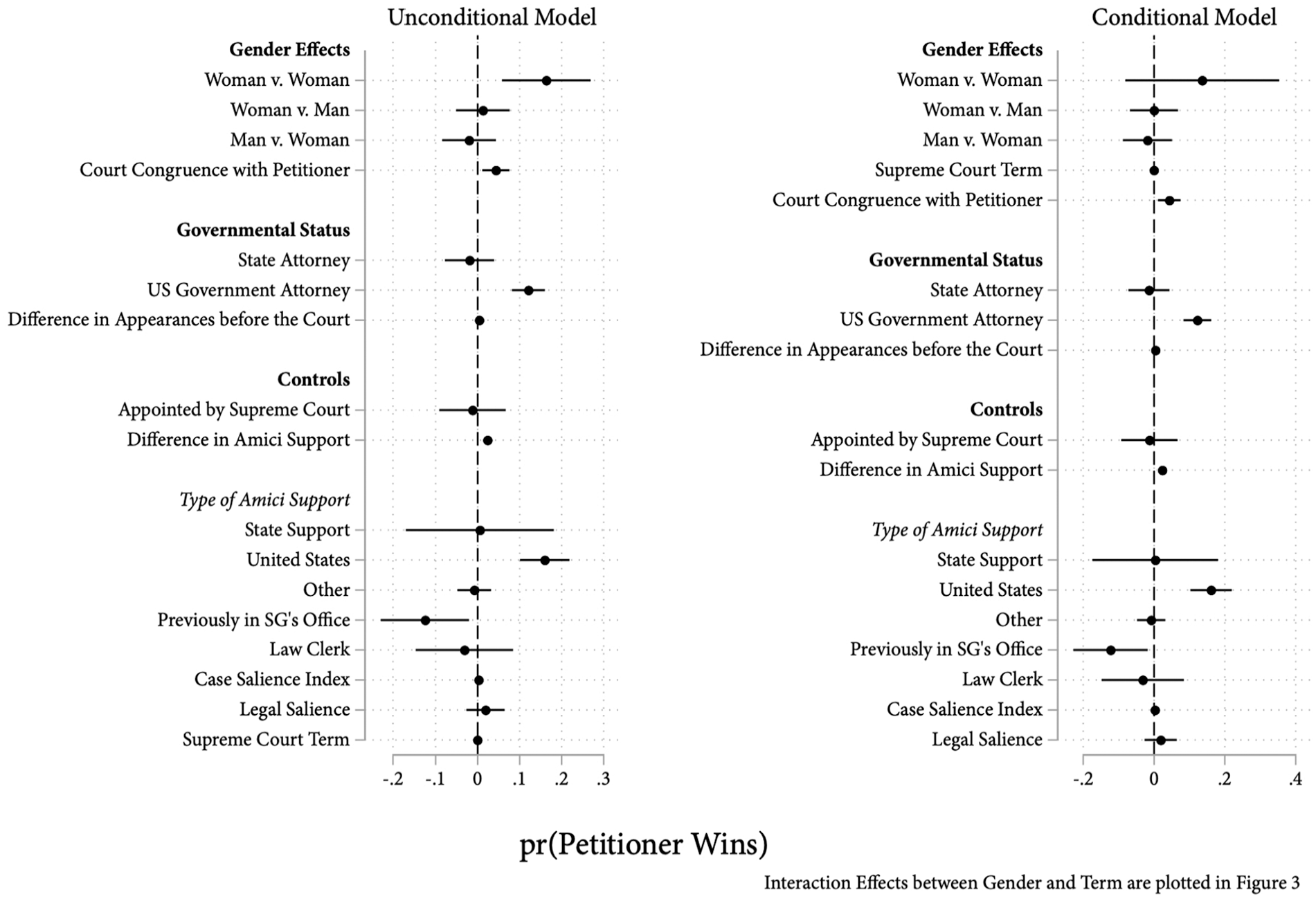
Average marginal effects for models 1 and 2.
Focusing first on the unconditional effects of gender (unconditional model), we find that the petitioner is more likely to win when opposing counsel are both women, although this effect goes away in the conditional model. Interestingly, there is no statistical difference in the likelihood of petitioner success when opposing counsel are of different genders or when opposing counsel are both men.
Turning to the interaction between attorney gender and Supreme Court term, we find no moderating effects. Over time, women arguing for the petitioner are statistically no more likely to win than are men arguing for the petitioner against another man. Likewise, a man arguing for the petitioner facing a woman is no more likely to win or lose over time than if that man were facing another man. In cases in which a woman attorney faces a woman attorney, the petitioner appears to have become increasingly likely to win; however, that interaction is not statistically significant. 25 Thus, regardless of the position of the gender of the attorneys, the likelihood of winning—relative to that of a man attorney representing the petitioner and facing another man—doesn’t statistically change over time. Figure 3 plots the marginal effects for the interaction between gender of the attorneys and Supreme Court term. Confidence intervals have been removed for visual purposes. However, in the Online Appendix (Figure A1) we present a faceted contrast plot for readers demonstrating our null findings.

Marginal effects plot for interaction between attorneys’ gender and term.
Our findings indicate that professional stature (e.g., whether an attorney is from the Office of the Solicitor General) is far more important for understanding successful outcomes before the Supreme Court. For example, the petitioner is 0.12 points more likely to win when represented by an attorney from the U.S. government (p < .05). 26 Conversely, the likelihood of petitioner success when represented by a state government attorney is not statistically distinct from a petitioner represented by a non-government attorney.
Next, we investigate whether previous experience in the Office of the Solicitor General influences petitioner success. We find that having worked in the SG’s Office decreases the likelihood of petitioner success. Attorneys who previously served in the SG’s office representing the petitioner are 0.12 points less likely to win, relative to attorneys who did not serve in the SG’s Office. Although surprising, upon further reflection and investigation, it is probable that this is a result of frequent appearance before the Court. As an attorney argues more frequently before the Court, the opportunity to lose increases as well.
As expected, repeat status increases petitioner success—corroborating previous research. We measure the difference in the number of appearances between the attorney arguing for the petitioner and the attorney arguing for the respondent. A positive value indicates that the petitioner’s attorney has more appearances before the Court than the respondent’s attorney. A negative value indicates that the respondent’s attorney has more appearances before the Court than the petitioner’s attorney. Zero indicates that opposing counsel have the same number of appearances before the Court.
In Figure 4, we show the overall trend. At a value of zero (opposing attorneys have the same number of appearances), the petitioner’s predicted probability of success is 0.65. As the discrepancy in prior appearances between the petitioner’s attorney and the respondent’s attorney increases, so too does the likelihood of petitioner success. Each appearance before the Court that a petitioner’s counsel has over the respondent’s increases the likelihood that the petitioner will win by 0.36 points. When the petitioner has five prior appearances more than the respondent, the likelihood of the petitioner winning increases by nearly 2 points, 1.8 percentage points. The inverse of this is that for every prior appearance before the Court the petitioner’s attorney has less than the respondent’s, the likelihood of the petitioner winning decreases by 0.36 points, or by just under two percentage points for every five less prior appearances the petitioner’s counsel has relative to the respondent’s counsel. This effect is statistically significant at traditional levels. This is a substantively significant relationship considering that this variable runs from −76 to 74, suggesting there are instances in which a substantial advantage or disadvantage in prior experience exists between attorneys.
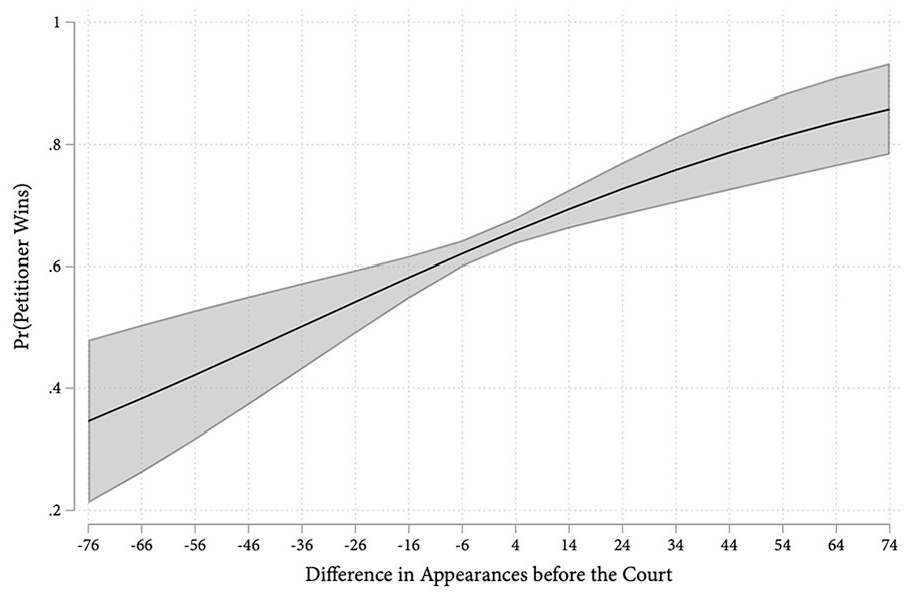
Difference in petitioner and respondent appearances before the court.
Considering the results from the unconditional model, we next turn to our control variables. 27 First, we find no statistically significant effects on the likelihood of petitioner success when the attorney is Court appointed. The justices do not seem to lend preferential treatment—in terms of the likelihood of success—to those requested to argue a given position. Likewise, we find that neither case salience nor legal salience reach statistical significance in predicting petitioner success. 28
We find that amici-support influences petitioner success. Each additional amicus brief filed in support of the petitioner over the respondent increases the petitioner’s probability of success by 0.2 points. This is a substantively significant relationship considering that the variable runs from −41 to 16. Moreover, this finding proves statistically significant. We find that petitioner success increases by 0.16 points when amici are filed by the United States in support of the petitioner, relative to no amici support. Amici filed on behalf of the petitioner by non-governmental groups or state governments fail to achieve statistically significant effects in the model.
Using our measure of ideological congruence discussed earlier, we find that the ideological congruence between the Court, measured as the ideology of the median justice, and the petitioner makes the petitioner more likely to succeed. Turning to the conditional model, the interaction between our measure of attorney gender for each party and ideological congruence is not statistically significant and an investigation of the contrasts of those variables demonstrates a similar finding. In addition, the coefficients on the attorney gender variable and ideological congruence variable are not statistically different between the conditional and unconditional models. This all suggests that ideological congruence and attorney gender do not have conditioning effects on one another.
Status as a former law clerk does not seem to have a significant effect on winning. This is likely for a few reasons. First, former clerks have a higher average number of previous arguments than non-clerks. It may well be that repeat appearances before the Court prove more influential than having been a clerk. Second, former law clerks are almost twice as likely to go on to appear before the Court representing the U.S. government in some capacity, which also leads to a higher level of success. Thus, although being a former law clerk may benefit attorneys in some instances, in most cases it is likely overwhelmed by other characteristics of those attorneys. We also interact petitioner former law clerk status with our attorney gender indicator. A model with these results can be found in the Online Appendix. Our substantive results for attorney gender do not change with the inclusion of this interaction. 29
Finally, turning to women’s issues, controlling for women’s issues and an interaction between women’s issues and our attorney gender variable does not substantively change our results. Furthermore, the interaction is not statistically significant. We present the estimates from this model in the Online Appendix. Thus, whether women attorneys are arguing about a “women’s issue” or not does not appear to alter their success before the Court regardless of which side they’re arguing on or the gender of the attorney they are arguing against.
Discussion
When accounting for other factors influential to the decision-making process, parties represented by women during oral arguments are not substantively different from those represented by men when it comes to securing a win. We present these findings against the backdrop of a literature that has offered numerous results over limited time periods. Moreover, research centering on attorney gender and Supreme Court outcomes has generally focused on individual justice voting behavior rather than the behavior of the Court as a whole. Importantly, we build upon earlier work by presenting a more comprehensive understanding of the backgrounds and experience of the individuals arguing before the Court, and over a substantially longer period of time than prior work, which aids in contextualizing our results.
Ultimately, we find that attorney gender is a poor predictor of success before the Court. Other characteristics such as attorney experience and party support are more strongly associated with party success. One interpretation of these findings may be that women no longer face discrimination in the legal profession or in their appearances before the nation’s highest Court. This interpretation would be that these findings suggest that there is some “good news” when it comes to the question of whether the gender of an attorney affects their party’s success before the highest Court. Notably, the gender of an attorney does not seem to be systematically related to their success. This is good news in so much as it means that for those attorneys who make it before the Court to argue, justice is “gender blind”—a finding that should offer observers of the Court and citizens alike comfort.
However, we suggest that another, more nuanced interpretation of these findings is implicated. Although the inability to find evidence of gender bias before the Court is undeniably good, we believe these results also suggest that discrimination against women attorneys continues to be rampant. We demonstrate that once before the Court women fare just as well as men, controlling for other relevant factors. However, a brief investigation into the litigation background of the women arguing before the Court finds that more women argued their first case before the Court as government attorneys and/or holding significant prior experience. Although, on average, the men arguing before the Court possess similar attributes, there also exists far more variation in their backgrounds and prior experience. This highlights that while men attorneys with varying backgrounds and experience have been afforded the opportunity to appear before the Supreme Court, women have had to be, on average, more qualified and experienced to receive the same opportunity. To the extent gender discrimination occurs in oral advocacy before the Supreme Court, it appears to begin far before women even make it to the Court. This poses many questions left unanswered, many of which have significant normative implications for our understanding of the judicial branch and American politics. If the sorts of women who make it to argue before the Court are fundamentally different from women attorneys who do not, and perhaps are even different in important ways from the men who argue before the Court, then that may have implications for representation of interests, equality within the legal profession, and even the sorts of decisions the court makes.
We believe these results suggest at least three future avenues of research. First, future work should build off of these findings to begin to pinpoint more carefully where along the Supreme Court advocacy “pipeline” women face barriers to entry. This can be useful to identifying the causes and how to overcome the disparity. Second, although we find that attorney gender does not seem to affect the decisions of the Court as an institution, or often not the individual behavior of judges, we encourage future work to continue to identify the ways in which attorney gender may matter, as an already bourgeoning new literature has begun doing. Finally, further work should attempt to understand the ways in which those women attorneys who do make it before the Court differ, if at all, from those who do not. As noted above, this line of research may have particularly significant normative implications for the legal profession, as well as representation within our judicial system.
Supplemental Material
sj-pdf-1-prq-10.1177_10659129211017231 – Supplemental material for The Attorneys’ Gender: Exploring Counsel Success before the U.S. Supreme Court
Supplemental material, sj-pdf-1-prq-10.1177_10659129211017231 for The Attorneys’ Gender: Exploring Counsel Success before the U.S. Supreme Court by Jonathan S. Hack and Clinton M. Jenkins in Political Research Quarterly
Footnotes
Acknowledgements
We thank the editors and three anonymous reviewers for their helpful comments, as well as participants at the American Politics Workshop at The George Washington University for their feedback.
Authors’ Note
Previous versions of this paper were presented at the 2017 Midwest Political Science Association Annual Conference and the 2017 Annual Meeting of the Southern Political Science Association.
Declaration of Conflicting Interests
The author(s) declared no potential conflicts of interest with respect to the research, authorship, and/or publication of this article.
Funding
The author(s) received no financial support for the research, authorship, and/or publication of this article.

Supplemental Material
Notes
References
Supplementary Material
Please find the following supplemental material available below.
For Open Access articles published under a Creative Commons License, all supplemental material carries the same license as the article it is associated with.
For non-Open Access articles published, all supplemental material carries a non-exclusive license, and permission requests for re-use of supplemental material or any part of supplemental material shall be sent directly to the copyright owner as specified in the copyright notice associated with the article.
