



Abstract
An emerging body of literature seeks to understand the determinants of roll-call participation in the early U.S. House of Representatives. A multitude of factors—electoral, institutional, and partisan—exerted significant influence over members’ participation decisions during the time we analyze. We analyze roll-call abstention rates from the 16th to 66th Congress (1819 to 1921) to determine whether electorally at-risk members differed in their attentiveness to their congressional responsibilities than members who faced less or no risk. By examining a century of congresses, we compare both the post-Civil War era immediately prior to adoption of the Australian ballot as well as the pre-Civil War congresses to identify those factors that affected members’ decision to participate on roll-call votes. The time series encompasses important electoral and institutional reforms, including the emergence of strong party caucuses and the enhanced agenda setting prerogatives of the majority party. Our results show that members responded to changes in the political environment, including to electoral concerns, and this effect is present prior to the Civil War. We also find that during the era of the strong Speaker, majority party members significantly increased their roll-call participation rates.
We argue in this article that the calculus of roll-call participation is shaped and influenced by changes in legislative and electoral institutions and practices and that this is observable in the variation in abstention rates across representatives and over time. 1 Specifically, we seek to assess the causal significance of electoral, legislative, and partisan institutions across multiple periods of significant institutional development in the U.S. House of Representatives. Although some nonvoting in the 19th century House arose due to idiosyncratic and nonpolitical factors like illness, drunkenness, and apathy, differences across members and over time suggest systematic patterns of nonparticipation associated with those periods of development.
The article proceeds as follows. First, we consider institutional changes in the 19th century House of Representatives that likely affected the calculus of voting for members. The list, though not exhaustive, does suggest three broad eras for considering their participation choices. Second, we provide an overview of the contours of House roll-call participation from 1819 to 1921. Third, we model individual-level roll-call participation rates across the century to understand the magnitude of the systematic components of nonvoting. 2 Together, the results suggest that members were responsive to institutional change, but that the standard markers of modernizing House institutions—notably the adoption of the Reed Rules and the emergence of the Australian ballot—resulted only in modest shifts in the roll-call participation of Representatives.
Institutional Development and Legislative Behavior
Between the late 1810s and 1910, the U.S. House of Representatives adopted most of the institutional features that define it today. By around 1820, the House moved decisively to rely on standing committees as engines of policymaking (Jenkins 1998). In 1837, members were able to introduce bills under their own names (Cooper and Young 1989), opening the door to the kind of position taking and credit claiming that became a staple of the modern Congress (Mayhew 1974). Parties transformed from weak during the Era of Good Feelings to formidable by the eve of the Civil War, resolving differences within the caucus and coalescing around leaders (Jenkins and Stewart 2013). The power of the House majority was further consolidated under significant procedural changes during the late 1800s and early 1900s. Foremost among these was the adoption of the Reed Rules, which essentially ended the minority’s ability to engage in dilatory tactics such as the disappearing quorum (Binder 1997; Dion 1997; Riker 1986). These procedures persisted even after members reasserted some of their autonomy from leadership with the overthrow of Speaker Joseph Cannon in 1910 (Schickler 2001).
Along with changes in the institutional and partisan environment within the House, important electoral contexts also changed. The early Congress was characterized by brief tenures in office and a relatively flat organizational structure (Polsby 1968), high rates of turnover (Fiorina, Rohde, and Wissel 1975), and little evidence of careerism until after the Civil War (Brady, Buckley, and Rivers 1999). During this early era, the existence of a clear electoral connection was “an assumption much less applicable” than it was in later Congresses (Rudder 1990, 186). Voters generally evaluated incumbents by their party affiliation rather than the representative’s behavior in office (Skeen 1986), and efficient gerrymanders made congressional elections highly responsive to presidential tides (Engstrom and Kernell 2014).
Electoral administration underwent significant change over this time period as well. The start of our series is marked by a system in which parties printed and distributed ballots listing only their candidates for office, with public voting where one’s choice observable by others (Bensel 2004; Converse 1972; Rusk 1970). Parties further controlled the nomination process and coordinated campaigns for office (Engstrom and Kernell 2014), leaving candidates limited ability to distinguish themselves.
The shift to the Australian, or official ballot starting in the late 1880s to the early 1910s had profound effects on voter behavior (Converse 1972; Engstrom and Kernell 2014; Rusk 1970) and on candidates winning and holding office in the House (Kernell 2003; MacKenzie 2015). The effects resulting from ballot reform extended into Congress and influenced the development of the committee system (Katz and Sala 1996), party cohesion and votes on pork barrel spending (Wittrock et al. 2008), and bill sponsorship activities aimed at steering pension benefits to particular constituencies (Finocchiaro and MacKenzie 2018).
While a crucial development, the adoption of the Australian ballot alone is not the only factor contributing to the emergence of an electoral connection. Carson and Jenkins (2011) articulate four components of an electoral connection: political ambition, autonomy over their own careers, accountability by voters, and responsiveness to constituents. Carson and Sievert (2018) show that although an electoral connection was weaker in the pre-Australian ballot House, all four components were present. While parties printed and distributed ballots, disappointed nomination seekers and competing factions would distribute their own ballots, and voters could write or paste in the names of alternate candidates on the party ballot (Altschuler and Blumin 2000; Ware 2000). Quality candidates had greater success than newcomers, indicating that some combination of candidate effort and voter choice is discernable even in a party-centric electoral system (Carson and Hood 2014; Carson and Roberts 2013). Bianco, Spence, and Wilkerson (1996) and Carson and Engstrom (2005) demonstrate that, at least for high profile issues like the 1816 Compensation Act and the 1824 Adams-Jackson contingent election, voters could and did hold representatives accountable for acting contrary to their wishes.
Reconsideration of the electoral effects of ballot reform on House members has also led to a reconsideration of its institutional effects. Carson and Sievert (2015) show that the increase in the quality of members’ committee appointments during the reform period had more to do with seniority and was independent of ballot type. Gordon and Simpson (2018) provide evidence that while a universalistic and locally oriented pork barrel was not present in the Jacksonian Era, it did emerge by the mid-1870s, more than decade before ballot reform. Finally, assessing a wide variety of data on members’ policymaking behavior using a difference-in-differences approach. Moskowitz and Rogowski (2019) find no discernable shift in behavior before and after reform.
Key reforms in both the operation of elections and in the partisan and institutional arrangements that governed House operations affected members’ opportunities and incentives to extract value from participating in (or abstaining from) the legislative process, roll-call voting in this case. However, research on the subject to this point either focuses almost entirely on member behavior in the late 19th century and early 20th century (e.g., Finocchiaro and MacKenzie 2018; Moskowitz and Rogowski 2019). This temporally limited focus overlooks important historical eras in the House. For instance, scholars like Carson and Sievert (2018) have identified evidence of nascent electoral incentives in the pre-Civil War era, as well as in the years immediately after the Civil War. By expanding our time frame, we span both eras and can directly compare the effects of electoral and institutional reform on members’ behavior. In the next section, we outline our approach to answering that question.
Roll-Call Participation as a Measure of Behavior
To investigate how members responded to a changing electoral, institutional, and partisan environment over time, we need a consistent measure of legislative behavior that spans the period from the early 19th century to the early 20th century. Therein lies a problem. Most standard indicators of legislative behavior in the modern Congress, including nearly all of those in productivity indexes (Fouirnaies and Hall 2018), were either unavailable to members in the Antebellum Era or not publicly recorded. Members could not introduce bills under their own name until 1837 (Cooper and Young 1989), nor could they cosponsor bills until 1967 (Campbell 1982; Koger 2003). The House did not adopt a system of standing committees for most House business until about 1820 (Jenkins 1998), and not until about 1833 did MCs receive at least one assignment to a standing committee (Canon and Stewart 2002). It was well after that period that committees began to keep thorough records of internal proceedings, and records of floor debates in the early decades are spotty (McPherson 1942; Robinson 1942). This means, for instance, that while Katz and Sala (1996) and Wittrock et al. (2008) can compare legislative activities in the years immediately before and after adoption of the Australian ballot in the late 19th century and early 20th century, their measure of committee membership cannot be extended to the early House. As a result, we have little direct evidence across time of how other institutional changes affected the emergence of an electoral connection despite evidence that elections began to influence congressional service well before the advent of the Australian ballot.
The one measure available throughout the period of interest here is roll-call participation. Following Fouirnaies and Hall (2018), we use roll-call participation to measure legislative behavior across the century we investigate. Participation proves an attractive metric because it allows us to assess how particular instances of change over a long time series manifest in a specific and consistent component of members’ legislative behavior. Members’ decisions to participate would be influenced by multiple factors that affected the relative cost–benefit calculus for voting. While members may prefer to shirk, doing so might have exacted an electoral price. Likewise, changes in institutional factors both within the chamber and in the political environment more broadly influenced participation. The emergence of strong partisan organizations along with the adoption of the official ballot influenced the relative utility associated with participating on roll-call votes.
Floor voting was also one of the few aspects of the early legislative process over which individual members possessed notable autonomy, and the archival record provides anecdotal evidence that roll-call participation was politically consequential. An 1806 broadside for the race to represent Charleston, South Carolina in the U.S. House contrasted the incumbent Democrat with the “Washington Republican” candidate. The Democrat was “frequently absent, on very important occasions” such that “Charleston . . . is the only metropolis in the Union which does not send a Member to Congress” (emphasis in original).
3
A broadside from 1827 for the election in Ohio’s 6th district noted that the incumbent was absent for a key vote to fund development of the Cumberland Road and “that Bill lost for want (in part) of [his] attendance.”
4
Likewise, incumbents used their own record of attendance to bolster their standing with constituents. Zadock Pratt (D-NY) wrote in a circular to his district in 1845, I have considered myself as the servant of the people, and bound, in honor and in conscience, to labor as diligently as every “good and faithful servant” should. Hence, during the four years, and as many sessions, in which I have had the honor to be your representative, I have never, even for a single day, been absent from, my post and my duty. (Capen 1852; emphases in original)
5
Concerns over the political vulnerability of nonattendance also influenced efforts at institutional reform. The Compensation Act of 1856 replaced a per diem that had been in place since the first congress with a per-session salary paid to members. Some feared that the move to a congressional salary would exacerbate attendance problems. The New York Daily Tribune (“From Washington” 1856), for example, said that absenteeism already prevented Congress from completing its business and even nearing the close of the session with appropriations bills yet to be passed that “the House obliged to adjourn before 3 P.M. for want of a quorum!” The Tribune writer concluded, “Pass this bill, and every lawyer in the House would go home to attend his circuit, every merchant to supervise his business, until the few who remained would be discouraged into adjourning, leaving the public business but half done” (4).
Physical distances to and from members’ district affected participation decisions. As incentives for members to travel home to their districts increased, the relative costs of travel to and from Washington became increasingly important. Considered in conjunction with the widely varying election dates across states (James 2007), some members facing reelection during a session confronted a choice between staying at the Capitol to participate in roll calls versus returning to their district to campaign. Such concerns were certainly heighted with important changes in electoral institutions, notably the adoption of the official or Australian ballot. We would expect, then, that members were more likely to miss roll-call votes in the lead-up to an election following the adoption of the Australian ballot, as members possessed both greater autonomy over elections and greater incentive to appeal directly to voters (Carson and Sievert 2018). Specifically:
To estimate how electoral factors influenced roll-call participation, we consider two indicators of electoral vulnerability: whether an incumbent ran for reelection to the House and their margin of victory in the previous election. As discussed above, there is evidence of a weak and nascent electoral connection in the early congresses, but not until later in the 19th century did ballot reforms induce members to build a strong personal vote to insulate themselves from partisan tides. As the institutional and partisan environments undergo notable changes, we expect the magnitude of the estimated effect of these indicators of vulnerability to vary across the congresses we analyze.
First, consistent with the findings of Carson and Sievert (2018) that a weak electoral connection is present prior to the Civil War, we hypothesize:
Finally, members’ vulnerability should be affected by states’ adoption of ballot reform. For much of the 19th century, elections used a consolidated party ballot which gave candidates only limited opportunity to appeal independently to voters. With the adoption of the Australian ballot at the end of that century, one could hypothesize that members would be less sensitive to electoral margin in shaping their legislative behavior. Specifically:
In sum, we hypothesize that roll-call participation is affected in part by electoral vulnerability but that the particular factors that constitute vulnerability vary over time due to important changes in electoral design and practice.
Changes in party organizations within the chamber should also influence roll-call behavior. As noted above, strong party caucuses began to emerge in the late Antebellum era (Jenkins and Stewart 2013) and minority parties and factions used a disappearing quorum whereby members would not answer a quorum call to halt floor consideration. The strategy saw occasional use in the Antebellum era, with a burst of activity beginning in the 1830s, including some led by members of the majority party, but came into full flower as a dilatory tactic of the minority after the Civil War (Koger 2010). Changes in majority party prerogatives initiated by Speaker Thomas Reed all but eliminated nonparticipation as an effective dilatory tactic (Schickler 2001). In addition, the highly centralized agenda power of the Speakers of this era should also manifest in greater levels of partisan pressure exerted on the majority party’s rank-in-file members. During this era, party leaders sought support primarily from their fellow partisans in the majority, while ignoring or hindering participation on the part of minority members. As such, the incentive to participate on votes should vary by party status whereby majority members were expected to support their party’s position, while minority members had fewer incentives to participate outside of registering their discontent with the majority party on votes. We hypothesize:
Taken together, we expect that this combination of factors—electoral, legislative, and partisan—influence members’ participation decisions in substantive and systematic ways, which we test in the next section.
Analyzing Roll-Call Participation in the U.S. House
To investigate participation decisions, we used the roll-call voting data found at voteview.com to calculate member-level abstention rates in each congress from 1819 to 1921 (the 16th to the 66th Congresses). 6 We adopt a purposely broad definition of abstention when calculating our nonvoting rates. In addition to individuals coded as “not voting” (ICPSR vote code 9), we categorize as not voting the ICPSR vote codes of paired yes/no, and announced yes/no, as these vote codes represent instances in which members are not on the floor to vote on a specific roll call. 7 Next, we sum the total number of abstentions for each member, and divide by the total number of votes in which he was a member of the House. 8
Figure 1 displays the average abstention rates for the 16th to 66th Congresses with LOWESS smoothing, and a vertical bar marking the 50th Congress, when Massachusetts became the first state to adopt the Australian ballot. The figure shows that the rate of nonvoting rises from the Era of Good Feelings through the last two decades of the 19th century—from a low of 14.6% in the 18th Congress (1823–1825) to a high of 41.5% in the 53rd Congress (1883–1885)—before tailing off in the early 20th century, with a series average of 30.1%. To put this in perspective, the House held an average of just over 395 votes per congress during this time period. A mean nonvoting rate of 30.1% translates into nearly 119 missed roll calls for the average MC in the typical congress.
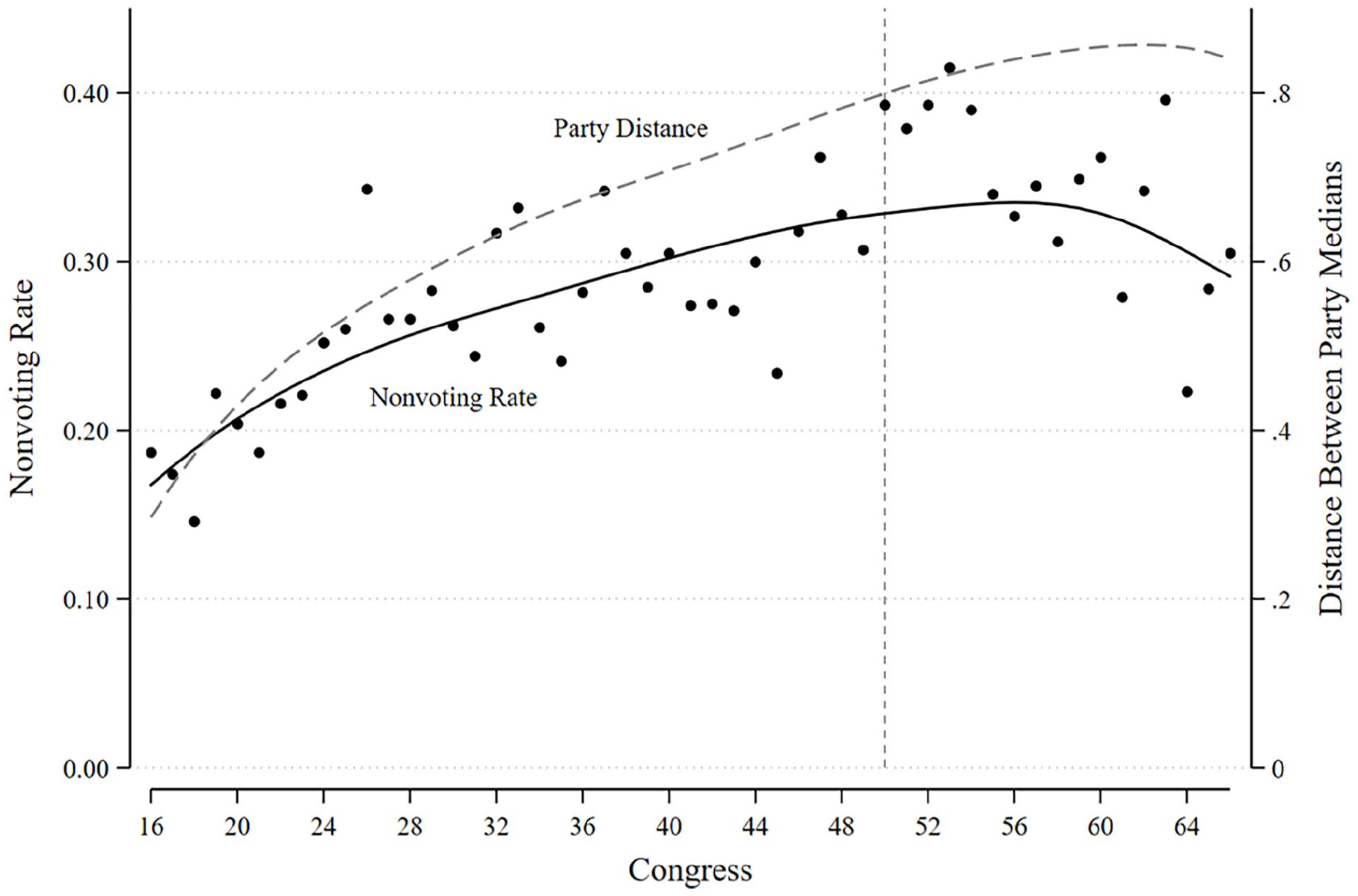
Average nonvoting rate and distance of party medians, 16th to 66th Congress.
Figure 1 also allows us to make a qualitative assessment of the influence of partisan factors on participation. 9 The figure shows that participation tends to track partisan polarization—as measured by distance between party medians—for much of the time we analyze. However, toward the end of the series as polarization remains high, abstention rates decline, a pattern consistent with Polsby’s portrayal of enhanced institutional development in the House. Furthermore, it underscores members’ increasing recognition of participation as a potential electoral matter, which gives rise to the emergence of such practices as the “Tuesday-Thursday Club,” a key example of an endogenous response on part of actors to facilitate members’ participation on roll calls (Nokken and Sala 2002).
We are concerned with how electoral considerations affect members’ roll-call participation in an era when the electoral connection was less developed. Those members who chose to seek reelection faced a potential electoral trade-off. On one hand, absenteeism could leave sitting members open to criticism from their opponents, while staying in Washington to cast votes could prevent them from returning to their district to campaign. Despite these competing pressures upon members, we hypothesize higher levels of abstentions in the month prior to an election in contrast to other months (H1). To assess this, we calculated the abstention rates on individual roll calls for each of the recorded votes in our data set.
We conducted a series of equality of proportions tests to compare the share of members absent on roll-call votes held in the month preceding an election to the share of abstentions on votes in all other months. To do so, we identified the month preceding the election month for each state to account for the widely varying election dates across states through most of the 19th century. For instance, elections to the 33rd Congress took place across 11 different months, starting with Iowa and Missouri in August of 1852—16 months prior to the start of the next congress—and concluding with Louisiana, Mississippi, and Maryland in November of 1853, just 1 month before the new congress convened. Second, those states that held elections in a given month may have held their elections on different days. Third, Congress did not always meet in the month immediately preceding a given state’s election. Using the 32nd Congress as a reference once again, 12 states held elections to the 33rd Congress in November or December of 1852, but the House recessed from August until December that year. While the Apportionment Act of 1872 mandated that congressional elections take place on the first Tuesday after the first Monday in November of even-numbered years, some states continued to hold elections on different dates. Maine, for instance, continued to hold House elections in September until 1960.
To code the pre-election month, we identified the month and year each state held elections to the subsequent Congress then coded the closest preceding month in which the House held roll calls. For instance, if the House was in session in even-numbered years and held roll-call votes in July and then recessed until December (a common practice for the time period we analyze), July would be designated the month preceding election for those states that held elections from August to November of that year. We recognize that this coding strategy provides a rather blunt mechanism with which to assess the effects of the timing of elections, but it likely biases against finding statistically significant results for a couple of reasons. First, those members who stood for reelection late in the year faced less pressure to return home early to campaign. Second, the month preceding election designation does not include votes held in postelection, or lame duck sessions which were typically defined by higher levels of abstention, especially among departing members who would serve in the subsequent congress (Jenkins and Nokken 2008, 2011).
To test our hypothesis of greater abstention in the month preceding the election (H1), we compare the proportion of members abstaining on a roll-call vote in those months with the percentage that do not participate on roll-call votes in all other months. Figure 2 presents the results, graphing the differences in the two scores. Statistically significant observations are depicted with a solid square and statistically insignificant differences by an open circle. The results show greater numbers of absences in the month preceding an election in 45 of 51 congresses in our data set and that difference is statistically significant at the 95% threshold in 41 of them. 10 These findings provide only partial support for our hypothesis; however, as the adoption of the Australian ballot around the 50th Congress appears to have little effect.
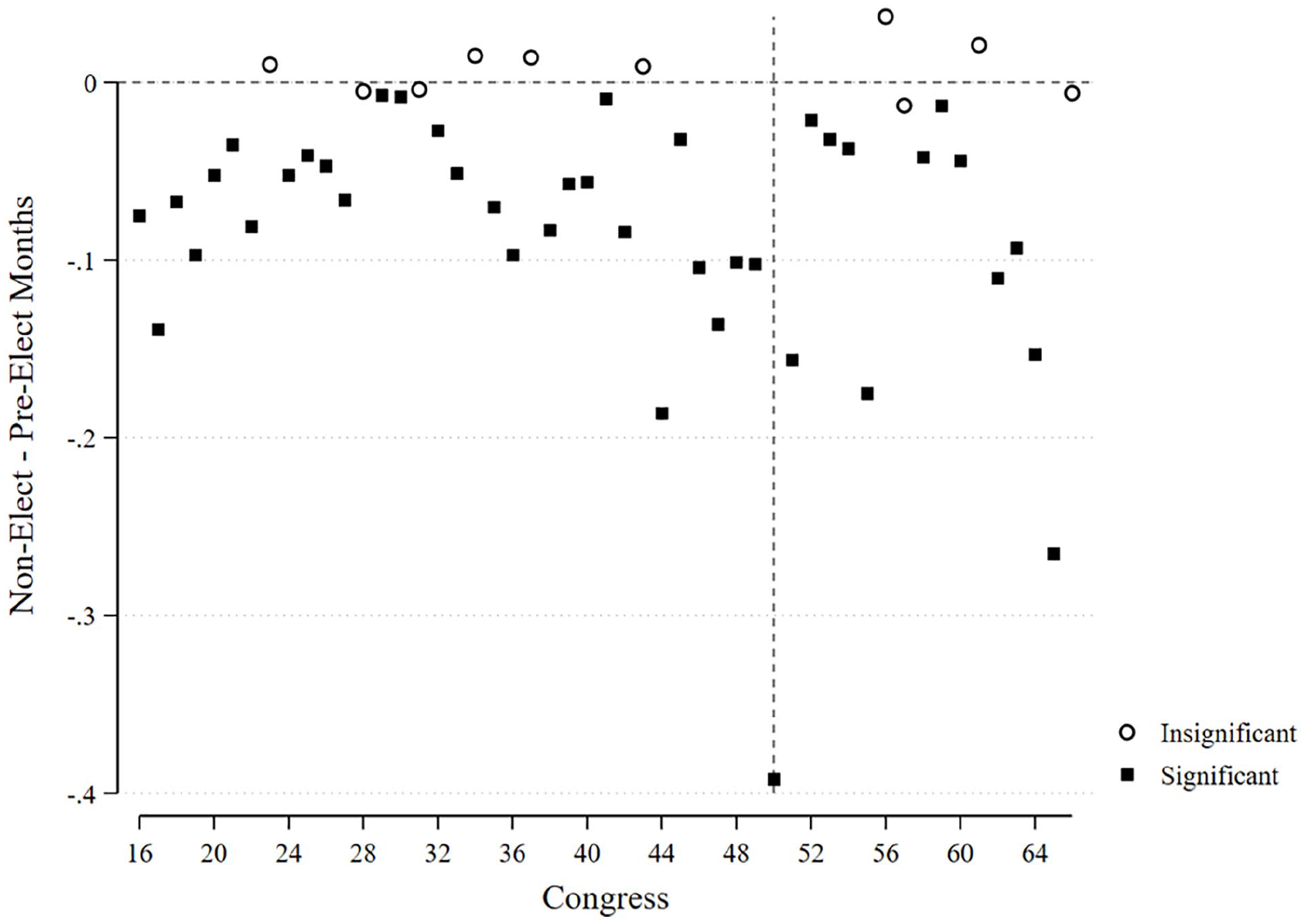
Difference in proportions, pre-election month nonvoting versus all other months.
Is there a similar contrast between abstention rates throughout the period before the election and after? A member might use his time for election-related activities in the months prior, and thus miss votes more systematically than in the months after the election. Institutional features ought to affect that calculus. In those congresses in which members were paid a per diem, there was a direct material cost for members to miss days during a session. Once a salary was adopted in 1856, however, compensation was unaffected by absences. Alternatively, members likely felt freer to shirk and skip votes following the elections, especially in the years prior to the rise of legislative professionalization during the latter decades of the 19th century (MacKenzie 2015; Polsby 1968).
To investigate, we compare the proportion abstentions on roll-call votes held in those months preceding each state’s election with the proportion of abstentions on votes held in the month of election and all subsequent months. For example, Illinois held elections to the 33rd Congress in November of 1852, which means each month, the House was in session in the 32nd prior to November of 1852 is coded as a pre-election month, while November and each succeeding month for that congress is considered a postelection month. Our expectation is that members after the election exhibit lower levels of abstention as the need to campaign for reelection disappears. If that is correct, we should find that participation rates in the month of election and the months that follow should be greater than in the months preceding the election.
Figure 3 plots the results of the difference in proportions tests comparing the percentage of abstentions across these two categories. Once again, statistically significant differences are indicated by a solid square and insignificant differences are indicated by a circle. In the early Congresses, we do not observe significant reductions in abstentions on votes held during the election month and the succeeding months. Starting in the 33rd Congress, just prior to the adoption of the congressional salary, turnout is higher on roll calls held in the postelection session in a majority of congresses. We find statistically significant reductions in abstentions in 22 of the 34 congresses from the 33rd to 61st Congresses. 11 These results should allay concerns of those in the 1850s who feared the adoption of a congressional salary would enhance members’ participatory shirking. In addition, for the early congresses, the combination of low professionalization and transportation challenges made the incentive to miss votes for pre-election campaigning and postelection shirking roughly equivalent. As with our previous test, however, few differences between the congresses emerge as a result from adoption of the Australian ballot, but we do note a steady change in behavior beginning in the late Antebellum period that continues through the turn of the century.

Difference in proportions, pre- election and postelection nonvoting rates.
These two sets of tests provide initial support to our argument that members’ roll-call participation was conditioned to some extent on electoral concerns and specific support for H1. To test for institutional and electoral influences on members’ participation, we specify a series of regression equations to estimate individual-level nonvoting rates. Although we recognize that factors such as illness, drunkenness, and apathy influenced members’ participation on roll calls, we are primarily interested in how systematic factors related to institutional and electoral conditions contribute to nonvoting. We contend participation rates will be influenced by important period-specific institutional changes. We address these issues straightforwardly by estimating separate models for specific time periods as this produces results that are easy to interpret and allow us to make qualitative comparisons of the effects across the series of models.
The dependent variable is the nonvoting (or abstention) rates for members who served a full term in a given Congress. To evaluate the effects of certain time-specific factors, we divide our data into three eras. 12 The first era encompasses the 16th to the 33rd congresses and includes the Era of Good Feelings and the emergence of the Jacksonian party system. The second period covers the 34th to the 53rd congresses and includes the emergence of sectional tensions and the Republican Party, the Civil War and Reconstruction eras, and ends with the emergence of a stable Democratic-Republican Party system, including the development of party caucuses as consequential decision-making bodies (Jenkins and Stewart 2013). Our third grouping includes the 54th to 66th Congresses, an era of continued Democratic–Republican party competition and the consolidation of majority party prerogatives (Schickler 2001).
The estimates for each of the three eras includes a common set of variables that capture important member-specific characteristics thought to influence participation on roll-call votes. We use two indicators to test for the influence of electoral considerations. The first is a dummy variable for whether the member sought reelection to the next congress, and the second an electoral margin variable takes a value a 0 to 100 scale as the difference in the percentage of the vote won by the incumbent and the percentage received by the highest loser, derived data collected by Dubin (1998).
In addition to electoral considerations, we are also interested in the ways partisan institutions might affect members’ participation. Specifically, we are interested in the effect of both the development of cohesive caucuses along with adoption of formal rules protecting the majority party agenda and the subsequent decisions on the party of majority and minority party members to participate on votes. To assess the effect of majority party status on absenteeism, we use a simple dummy variable. To account for changes in the formal rules on majority party power, we include variables to account for key moments of institutional change, described in the subsequent discussion of results. For each set of estimates, we used ordinary least squares (OLS) regression with congress-specific fixed effects (not reported), and robust standard errors clustered by individual member.
Several controls are used for additional factors which likely affected roll-call participation. First, to assess how relative ideological extremity might influence participation, we include a measure of the absolute distance between each member and the chamber median along both the first and second DW-NOMINATE dimensions. 13 It is reasonable to expect that the distance between a congressional district and the Capitol may have affected the propensity of members to participate the full session, given the challenges of travel at the time, especially during the early congresses. We utilized the United States Congressional District Shapefiles data (Lewis et al. 2013) to calculate two distance variables. The first is the distance in kilometers from Washington, DC, to the centroid of each congressional district. The second is the natural log of that distance to account for the effect associated with serving districts located especially far away from Washington. Finally, we include a seniority variable and an age variable to proxy for the possible effects time in office and infirmity, respectively, might play in participation (Swift et al. 2009).
Results from the 16th to the 33rd Congresses (1819–1855) appear in Table 1. Consistent with H2, members who sought reelection missed fewer votes, with an average attendance rate 3.7 percentage points higher than their lame duck colleagues. At the same time, neither of the other two election-related indicators—tenure in office and vote margin in the last election—were associated with absenteeism. We see the importance of an emergent party system in Congress in two ways. First, majority status resulted in a 2.5 percentage point higher participation rate vis-à-vis members of the minority party. Second, a dummy for the Jacksonian era congresses shows that, in contrast to the one-party period of Era of Good Feelings, representatives exhibited abstention rates 3.3 percentage points higher. These results run counter to the expectations of H4. Party membership significantly played a significant role serving to reduce roll-call participation. Finally, 14 we find that ideological extremism increases the rate of voting.
OLS Estimates Member Abstention Rates, 16th to 33rd Congresses.
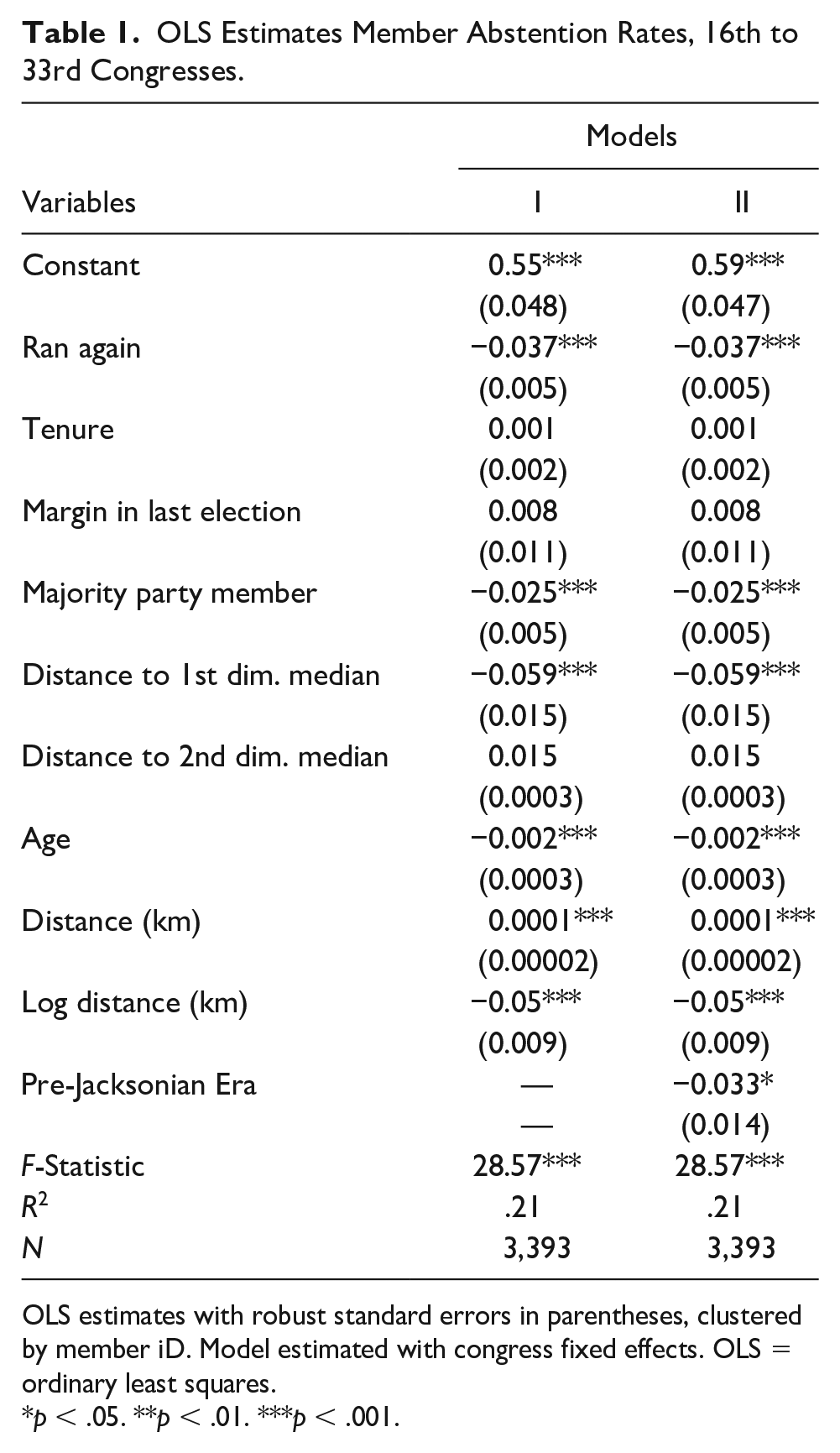
OLS estimates with robust standard errors in parentheses, clustered by member iD. Model estimated with congress fixed effects. OLS = ordinary least squares.
p < .05. **p < .01. ***p < .001.
Together, these results tell us that even in this era of rapid change in electoral and legislative institutions, members who sought reelection voted significantly more often than legislators who chose not to run again. Likewise, we find that the emergent two-party system of Whigs and Democrats played a role in whipping—or at least coaxing—members to participate on roll-call votes clearly indicating electoral and party institutions affected legislative behavior prior to the Civil War.
We turn next to the period from the 34th to the 53rd Congresses (1855–1897). This is an especially important era as it begins with the emergence of sectional differences that gives rise to the antislavery Republican Party, the waging of a Civil War, and the challenge of post-war Reconstruction. The period culminated in an era of stable Democratic–Republican partisan competition. We estimate three specifications of the model, with Model I as a baseline. Model II accounts for the dramatic upheaval resulting from both secession and the ensuing re-admitting of Southern states into the union. We include a dummy variable coded 1 for those Congresses that coincided with the Civil War and Reconstruction, 0 otherwise. The adoption of the Reed rules during the 51st Congress, and Reed’s Speakership ushered in a period of strong party discipline which, as discussed previously, likely affected members’ participation decisions. We account for that effect in Model III by including two additional variables. The first is a dummy variable for the 51st Congress to account for the adoption of the Reed Rules that allowed him to squelch the minority’s use of dilatory tactics. For the second, we interact the Reed and majority members variables to capture differential participation effects between majority and minority members in that Congress.
The results appear in Table 2. Once again, members who chose to run for reelection were less likely to miss roll-call votes, exhibiting a 5-percentage point reduction in abstentions, a larger reduction in nonvoting than in the previous era. Once again, as was the case with the prior era, district marginality did not affect participation. These results are consistent with the H2 and H3. Majority party status resulted in large statistically significant reductions in nonvoting across all three specifications exceeding the effect of majority party membership in the prior period by nearly three times. This lends support to H4. The results for member ideology run directly counter to those of the pre-Civil War congresses, with outliers on the second dimension exhibiting statistically significant increases in nonvoting. During this period, the second dimension is generally associated with issues related to currency and banking that included the rise of populism and agitation for the coinage of silver which could help to explain the significant result along this policy dimension (Poole and Rosenthal 1997).
OLS Estimates Member Abstention Rates, 34th to 53rd Congresses.

OLS estimates with robust standard errors in parentheses, clustered by member iD. Model estimated with congress fixed effects. OLS = ordinary least squares.
p < .05. **p < .01. ***p < .001.
Models II and III indicate increased nonvoting during the Civil War and Reconstruction years, as indicated by the statistically significant and positive coefficient on that variable across both specifications. Reed’s speakership has an interesting effect on members’ nonvoting rates. The coefficient on the Reed speaker variable is statistically significant and has a large positive coefficient (β = 0.19). The interactive term captures the effect across parties, indicating how majority Republicans might respond differently than the Democratic minority. The coefficient on the interaction is negative and statistically significant, suggesting that Republican members responded to the rules changes pushed by Reed and participated on roll-call votes more frequently than Democrats. Indeed, the linear combination of the majority party variable and the interactive term is statistically significant and negative (−0.17, t = −9.82) underscoring the reduced abstention in relative terms among the majority Republican members during the Reed speakership.
Our final set of models estimates abstention rates from the 54th to 66th Congresses (1897–1921) and appears in Table 3. Once again, we estimate the baseline model. Like the previous two eras, members who ran for reelection exhibit significantly higher levels of participation, but with greater effect than before, with nonvoting rates nearly14 percentage points lower than those who chose not to seek reelection. Contrary to the earlier congresses, electoral marginality significantly affected roll-call voting, but only after controlling for the Reed-Cannon era and for electoral reforms. These results lend support for H2 and H3.
OLS Estimates Member Abstention Rates, 54th to 66th Congresses.

OLS estimates with robust standard errors in parentheses, clustered by member iD. Model estimated with congress fixed effects. OLS = ordinary least squares.
p < .05. **p < .01. ***p < .001.
Members’ relative ideological extremity once again exerts a statistically significant influence on participation rates, but the effects differ across the NOMINATE dimensions. Extremity on the first dimension leads to lower levels of nonvoting, similar to our finding from first era, and contrary to the findings of others who study legislative behavior during this time (Meinke 2008). More extreme members on the second dimension exhibit significantly higher levels of nonvoting. 15
The third period in our study exhibits dramatic shifts in the role and power of party caucuses in the House and in electoral rules and processes. These moments of institutional change have interesting and seemingly contradictory effects on absenteeism. Generally, majority party status leads to a significantly lower nonvoting rate, consistent with the results from the previous eras and with H4. In Models II and III, we add a dummy variable to account for the strong speakerships of Reed and Cannon, along with an interaction with the majority party member variable. The Reed and Cannon speakerships are associated with statistically significant higher rates of nonvoting than in subsequent congresses and, unlike the previous era, that effect is even greater among majority Republican members. The linear combination of the majority party and the interaction term, however, still takes a negative and statistically significant value (−0.037, t = −2.12), so majority status still helps to increase members’ participation rates on balance. This finding is consistent with the partisan discord associated with emergence of the insurgent progressive wing within the Republican Party during the period of Cannon’s speakership where he used his powers as Speaker extensively to push a strongly conservative Republican agenda (Cooper and Brady 1981; Riker 1986; Schickler 2001).
Model III considers the effects of electoral reforms. First, the advent of the primary election shifted the power of nomination from party organizations directly to citizens, thereby affecting the process by which members sought reelection to the House, indicated by a dummy variable for those states and congresses using the new method. 16 The period also marks the adoption of the Australian ballot. We include two dichotomous variables to account for states’ use of either the office bloc ballot or the party list ballot. 17 Each is coded 1 for those Congresses for MCs from a state using that ballot design for that congress and zero otherwise. We find that the adoption primary elections and the Australian ballot exerted no statistically significant effects on members’ nonvoting rates, consistent with findings ballot reform had no effect on members’ particularistic legislative behavior (Moskowitz and Rogowski 2019). These results suggest that members were already becoming more sensitive to electoral considerations prior to the adoption of important reforms.
To facilitate comparison of the effects of electoral incentives and party institutions across the three eras, we graphed the results from the full model for each set of estimates. Figure 4 compares the standardized coefficients for our three measures of electoral influence. It underlines the importance of the association between reelection seeking and roll-call participation. The decision to run for reelection had a pronounced effect across all three congressional ears. Seeking reelection has larger effect than either of the other two measures across each time period we analyze. The reelection effect on roll-call voting exhibited similar magnitudes for the first two periods (16th–53rd congresses), eventually roughly doubling in magnitude in the third (54th–66th). Marginality was statistically significant in only the third era, and even then the effect was small. Altogether, these findings suggest that electoral factors affected roll-call voting, but that this was mainly due to a member’s decision to run for another term.
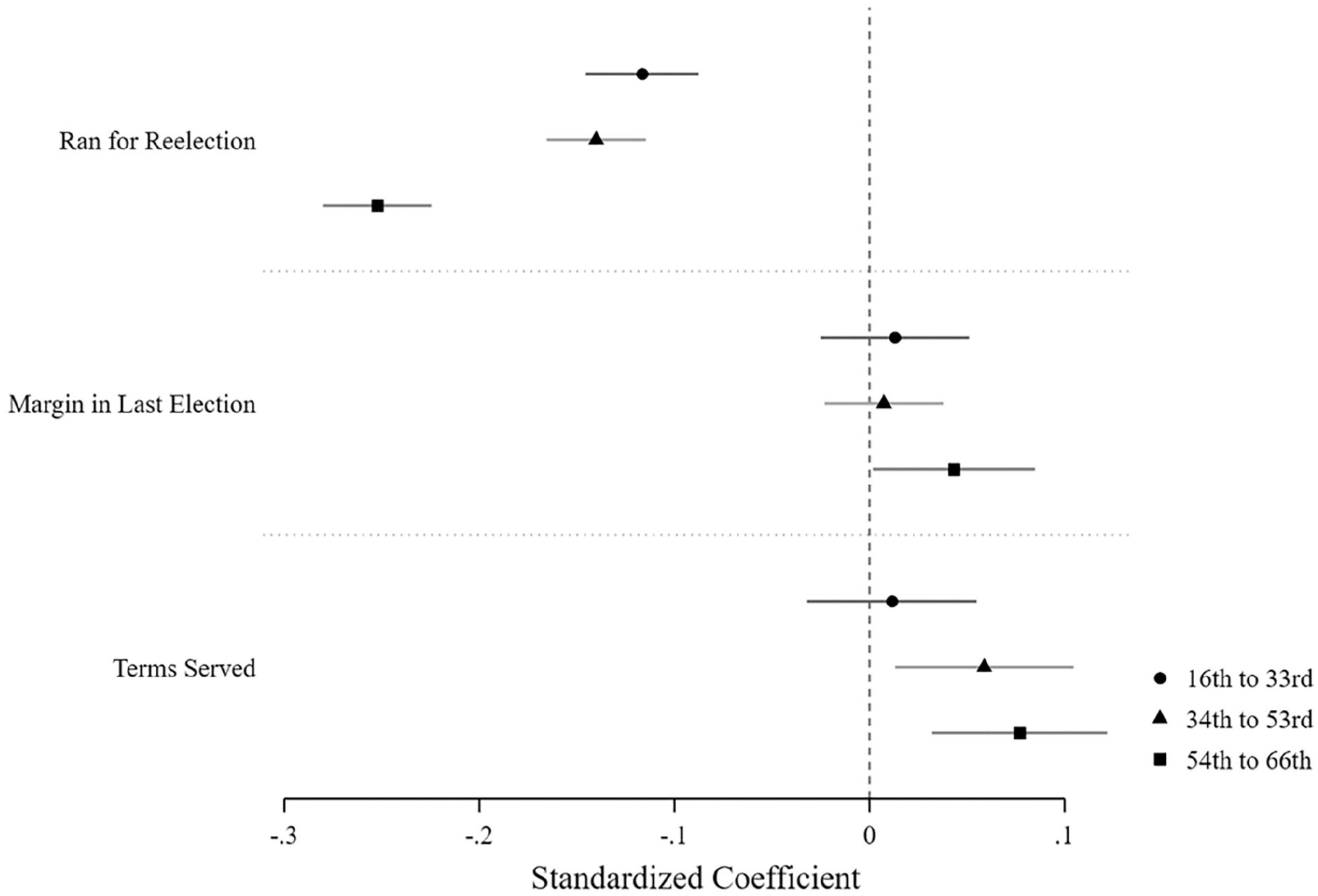
Comparison of estimated coefficients for electoral influences on nonvoting.
To assess the effects party organizations and prerogatives played, we estimated the marginal effect of majority versus minority party status along with the majority party interaction with the Reed and Cannon speakerships. The results are displayed in Figure 5. The most notable shifts occur just before, during, and after the strong speakerships of Reed and Cannon. The 51st Congress, in which the Reed Rules took effect, exhibited a high rate of nonvoting by minority party members, as expected. Interestingly, the nonvoting rate for the majority party in that congress, though lower than that of the minority, was higher than for either minority or majority caucuses in any other time period we examine. During Reed’s second spell as speaker and subsequently under Cannon’s speakership, differences between minority and majority party roll-call participation all but disappeared but remained relatively high overall. In the congresses in which neither of them was speaker from the 34th to the 66th, which includes congresses prior to and after they led the House, nonvoting occurred at about the same rate and with a small but persistent difference between minority and majority members. These findings illustrate both the conditions surrounding the adoption of the Reed Rules, characterized by unusually high rates of nonvoting by the minority, as well as the control Reed and Cannon enjoyed over the floor, essentially erasing the utility of nonparticipation for the minority.
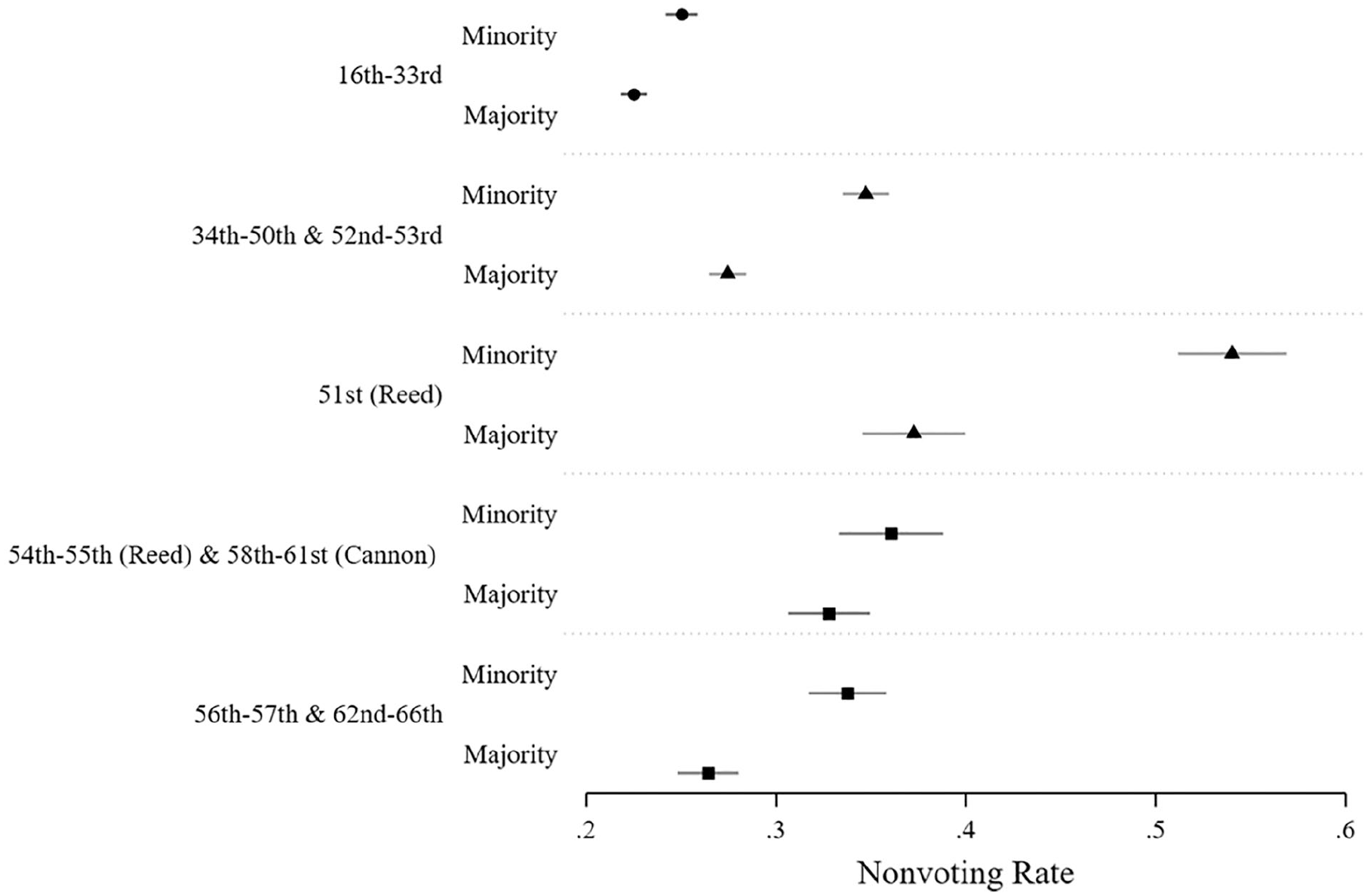
Estimated nonvoting rates and majority/minority party membership.
Discussion and Conclusion
In Home Style, Richard Fenno (1978) describes the challenges MCs face when deciding how to allocate resources, especially time. While Fenno’s study focused on the Congress of the 1970s, the idea that members of Congress face trade-offs when deciding how to divide time between Washington and home is applicable to all of congressional history. In this article, we investigated how multiple concerns influenced the members’ decisions to participate on roll-call votes. We find that important electoral factors influenced members’ participation on roll-call votes in predictable ways, including in periods before adoption of the Australian ballot. Indeed, campaigns from the pre-Civil War era made issue of members’ failure to participate in roll-call votes. While nonvoting in the time period we study is not solely the result of travel home to the district, some certainly is due to travel. Members furthest away were most likely to miss votes. However, members who lived very close to Washington, DC, also missed votes opting to visit the district during the session and risk missing votes.
By expanding the time series, we established that electoral considerations affected roll-call voting. Across each of the congressional eras we analyzed, members who sought reelection participated in a greater proportion of roll-call votes than those who did not run again. Our findings suggest the electoral connection emerged in stages and deepened over time. In the first period, covering the Era of Good Feelings and the Jacksonian period, a member’s decision to run for reelection made them less likely to miss votes, though seniority and electoral marginality did not. In the second time period, corresponding roughly to the Third Party System, an incumbent’s decision to run for reelection exhibited an even stronger effect on roll-call participation. In the third time period encompassing the strong Speaker era through 1921, reelection seeking and district marginality both exhibited significant effects on members’ abstention rates.
Party factors also contributed to nonvoting during the time period we studied. Majority party members exhibited significantly lower levels of nonvoting across each of the three Congressional eras we analyzed. During much of the time period we study, minority members frequently used nonvoting as a dilatory tactic to impede majority party’s agenda. That practice essentially ended by the 53rd Congress with the adoption of the Reed rules which allowed strong partisan speakerships of Reed and Cannon, at which time the difference in nonvoting between majority and minority members essentially disappeared. After Cannon’s ouster, however, the rate of nonvoting and the effect of majority status returned to roughly the levels observed prior to Reed’s tenure.
The findings reported here indicate a promising line of research on roll-call participation in the earlier congressional eras and on the evolution of an electoral connection across the 19th century. We identify several aspects of this research which warrant further attention and refinement. First, our analyses here utilize highly aggregated measures of individual nonvoting rates. One could expect to observe significant within-congress variation in nonvoting rates as a result of the complex timing of elections over much of this time period. In addition, this work could be extended to investigate those factors that influence nonvoting on particular types of roll-call votes. As minority members often abstained on specific votes to try to stop the majority party’s consideration of specific agenda items, the inclusion of roll-call-specific factors into our analyses would help to explain when and why members decided to participate or abstain on particular proposals. Such decisions were very likely not random occurrences, but the product of a particular voting strategy predicated on the spatial characteristics of the vote at hand. Despite these limitations, our work shows how electoral concerns influence members’ roll-call participation rates, even well before the period typically associated with a personal vote.
Supplemental Material
sj-pdf-1-prq-10.1177_10659129211017991 – Supplemental material for Institutional Development and Participation on House Roll-Call Votes, 1819–1921
Supplemental material, sj-pdf-1-prq-10.1177_10659129211017991 for Institutional Development and Participation on House Roll-Call Votes, 1819–1921 by John Baughman and Timothy P. Nokken in Political Research Quarterly
Footnotes
Acknowledgements
The authors would like to acknowledge Keith Poole for providing the roll-call data, Jeff Lewis for the district distance data, and Craig Goodman for election data used in this article. The authors take full responsibility in case of any errors.
Author’s Note
Previous versions of this article were presented at the Annual Meetings of the American Political Science Association in Washington, DC (2010) and Seattle, Washington (2011).
Declaration of Conflicting Interests
The author(s) declared no potential conflicts of interest with respect to the research, authorship, and/or publication of this article.
Funding
The author(s) received no financial support for the research, authorship, and/or publication of this article.

Notes
Supplemental Material
Supplemental materials for this article are available with the manuscript on the Political Research Quarterly (PRQ) website.
References
Supplementary Material
Please find the following supplemental material available below.
For Open Access articles published under a Creative Commons License, all supplemental material carries the same license as the article it is associated with.
For non-Open Access articles published, all supplemental material carries a non-exclusive license, and permission requests for re-use of supplemental material or any part of supplemental material shall be sent directly to the copyright owner as specified in the copyright notice associated with the article.
