



Abstract
Conspiracy theories are playing an increasingly prominent role worldwide in both political rhetoric and popular belief. Previous research has emphasized the individual-level factors behind conspiracy belief but paid less attention to the role of elite framing, while focusing mostly on domestic political contexts. This study assesses the relative weight of official conspiracy claims and motivated biases in producing conspiracy beliefs, in two countries where identities other than partisanship are salient: Georgia and Kazakhstan. I report the results of a survey experiment that depicts a possible conspiracy and varies the content of official claims and relevant contextual details. The results show that motivated reasoning stemming from state-level geopolitical identities is strongly associated with higher conspiracy belief, whereas official claims have little effect on people’s perceptions of conspiracy. Respondents who exhibit higher conspiracy ideation are more likely to perceive a conspiracy but do not weight motivated biases or official claims differently from people with lower conspiratorial predispositions. The findings indicate the importance of (geopolitical) identities in shaping conspiracy beliefs and highlight some of the constraints facing elites who seek to benefit from the use of conspiracy claims.
Conspiracy theories have become more prominent in world politics in recent years, as widespread distrust among the public has been met with rhetoric from opportunistic politicians (Mounk 2018; Wodak 2015). As a mode of political discourse, conspiracy theories appear to provide certain rhetorical advantages, as they cast doubt on unflattering news, defame political adversaries, and deflect blame—all while appealing to receptive audiences. When political calculation meets public cynicism, conspiratorial rhetoric may aid in agenda setting and the construction of political coalitions (Yablokov 2018).
Yet leaders seeking to shape opinion or win support through conspiracy theories face at least two major hurdles. First is the challenge that confronts any instance of elite communication: the intended recipients of conspiratorial messages possess preexisting knowledge and biases that make them susceptible to some appeals and resistant to others. The second is more specific to the cynical logic of conspiracy: people prone to believe conspiracy theories also tend to be skeptical of official sources, inclining them to discount information from authority figures. Understanding the opportunities and limits of conspiracism in politics is critical, as conspiracy theories, when wielded in the service of power, can weaken democratic accountability and potentially incite people to violence (Jolley and Paterson 2020; Rosenblum and Muirhead 2019).
This study analyzes how people regard conspiracy claims from official sources in relation to their preexisting biases. To isolate the effects of conspiratorial political messaging, both as an exogenous contributor to beliefs and as a rhetorical form distinct from other types of claims, I conduct a survey experiment that employs an original vignette describing a suspicious scenario that may or may not be a conspiracy. I randomly assign information about the official interpretation of the event and the actors involved to determine what factors cause respondents to perceive a conspiracy. The design provides insights into how respondents weigh (dis)trust of official sources against the perceived plausibility of the scenario.
The surveys were administered in two post-Soviet states, Georgia and Kazakhstan, which lie within a region where conspiracy theories proliferate, but which differ along important dimensions. I take advantage of their distinct geopolitical orientations to construct conspiracy vignettes of varying surface plausibility to survey respondents. Although partisan conspiracy theories have gained attention recently, many prominent conspiracy theories involve distrusted external actors. For example, in the United States, notions of Soviet infiltration of the government during the Cold War or United Nations’ efforts to impose a world government resonated for many people who perceived those distant geopolitical forces as hostile and nefarious. Geopolitical discourses may be just as instrumental as domestic factors in shaping how people make sense of the world, including believing in conspiracy theories.
The analysis shows that official conspiracy claims cannot easily overcome existing biases. Respondents are unsurprisingly more likely to accept an official account in which the identities of the perpetrator and victim conform to their intuitions based on their geopolitical priors. They are also prone to reject claims from an otherwise trusted official that conflict with their intuitive judgments about culpability. Conspiracy ideation, which raises the likelihood that a respondent perceives a conspiracy in general and is associated with distrust of authorities, does not affect the degree to which people weight official rhetoric in their determinations. Motivated reasoning, based on historical and cultural forces shaping people’s conception of territory and identity, dominates over other considerations.
This article makes two main contributions to the literature on conspiracy theories. 1 First, it proposes an original typology that specifies different paths by which exposure to information about a potential conspiracy might result in conspiracy belief. It discusses how the believability of official accounts of conspiracy might be limited because the content of claim may conflict with people’s perceptions of what is plausible, or because the speaker lacks credibility. People in positions of power may incur skepticism stemming from their perceived penchant to shade the truth or cover up unpleasant facts, a perception especially characteristic of those already suspicious of authority. Second, this analysis demonstrates how geopolitical orientations operate to construct sentiments about friends and enemies, especially where domestic political cleavages are not well established. Discourse in the geopolitical domain is often affective and reflects simplified views of virtue or malevolence, and therefore lends itself to making crude assessments about culpability. By using a realistic but fictitious conspiracy vignette involving relevant geopolitical actors, this study approximates the real-world judgments people are forced to make in the face of limited information. The findings highlight the importance of (geopolitical) identities in shaping beliefs and the facility with which they translate into conspiracy perceptions. These identities precede perceptions of both elite messengers and the content of their messages.
Conspiracy Theories as Political Communication
To explain why people believe some conspiracy theories, a growing body of work in political behavior has highlighted the impact of partisan motivated reasoning. People tend to selectively process information to conform to their prior attitudes and beliefs (Taber and Lodge 2006, 2016). Such biases are developed over time as a product of social identities, elite cues, information obtained through the mass media, and personal experience (Green, Palmquist, and Schickler 2004; Leeper and Slothuus 2014; Sapountzis and Condor 2013). Insofar as people can recognize the partisan cues implicit in a conspiracy theory, they are more likely to endorse or reject it, depending on its partisan valence (Edelson et al. 2017; Enders and Smallpage 2019; Miller, Saunders, and Farhart 2016; Nyhan and Reifler 2010; Pasek et al. 2014; Uscinski and Parent 2014). If a possible culprit is subject to negative affect based on previous associations, the mere mention of that actor may be sufficient for observers make intuitive judgments about a potential conspiracy—a common shortcut in the face of uncertainty (Van Prooijen and Jostmann 2013).
Another view of conspiracy theories focuses on psychological traits that do not necessarily apply to other kinds of beliefs (e.g., Abalakina-Paap et al. 1999; Brotherton, French, and Pickering 2013; Oliver and Wood 2014; Swami 2012; Swami and Coles 2010). Psychologists argue that humans are naturally inclined to see patterns amid random data and to infer agency and intentionality where none actually exists (Brotherton 2015; Whitson and Galinsky 2008). Some people may be unusually prone to conspiratorial thinking, a notion supported by findings that belief in one conspiracy theory predicts belief in others (Douglas, Sutton, and Cichocka 2017; Oliver and Wood 2014; Wood, Douglas, and Sutton 2012). Tendencies toward conspiracism are not easily predicted by other variables but may instead constitute a generalized conspiracy mentality (Brotherton, French, and Pickering 2013; Bruder et al. 2013; Imhoff and Bruder 2014; Lantian et al. 2016). According to this line of reasoning, people who score highly in conspiracy ideation should be more likely than others to interpret an unexplained event as a conspiracy, regardless of specific details. Yet general conspiratorial tendencies can work at cross-purposes with motivated reasoning, as when, for example, a possible conspiracy theory implicates a “friendly” actor. This begs the question of when salient informational cues or blanket presumptions of nefarious activity prevails.
When it comes to the sources of conspiracy beliefs, “top-down” communication can coexist or conflict with these “bottom-up” mechanisms. Despite rising concerns about “post-truth” public discourse and some recent work on conspiracy theories as political rhetoric in the US and elsewhere (Lewandowsky, Ecker, and Cook 2017; Mercieca 2020; Rosenblum and Muirhead 2019; Yablokov 2018), there has been only modest attention focused on the role of official actors in promoting (or rebutting) conspiracy theories (Atkinson and DeWitt 2018; Enders and Smallpage 2019; Radnitz 2018). Some studies have found that simply exposing people to conspiracy theories is sufficient to elicit agreement, although it is more likely to occur among people predisposed to see conspiracies (Butler, Koopman, and Zimbardo 1995; Kim and Cao 2016; Swami et al. 2013). 2 Because people have limited time and resources to devote to following current events, political, economic, or cultural elites are well positioned to interpret and communicate the operation of systemic forces (Zaller 1992). Elites can influence beliefs through framing, by establishing the criteria according to which people view an issue (Chong and Druckman 2007b; Druckman 2001; Nelson, Clawson, and Oxley 1997). Elite influence is especially potent when unopposed by competing frames. As Chong and Druckman (2007a, 102) put it, “if one side can establish the relevant terms of debate over an issue, it can successfully persuade individuals to support its position.” There is reason to believe that conspiracy theories, when endorsed by official actors, may be especially compelling. Government officials enjoy the prerogative of representing the state, endowing them with surface credibility when speaking on matters about which the public lacks insight, such as intelligence or national security (Radnitz 2021; Olmsted 2019). Especially in the presence of a new event, the ability to shape an interpretation before a listener consciously formulates an opinion can produce a politically desirable response.
Although substantial work on conspiracy beliefs has focused on partisan motivated reasoning, other sources of identity can be just as powerful. In particular, geopolitical culture—a state’s “prevailing sense of identity, place, and mission in the world” (Toal 2017, 39)—is expressed in simplified and often mythical terms, with narratives of heroism and virtue alongside binary constructions of friends and adversaries. Insofar as people seek to make sense of the world, the images produced by these stories provide frames of reference and can influence people’s beliefs about the fundamental nature of foreign entities and the appropriate means to deal with them (Hurwitz and Peffley 1990). Conspiratorial thinking is consistent with the ways that people imagine the machinations of global actors in relation to identity, security, and borders (Jones 2012). Geopolitical culture is not often linked to the motivated reasoning as a force that might shape people’s receptiveness to certain conspiracy theories, yet it can have similar effects to partisanship by providing an affective basis for opinion formation (Hale, Shevel, and Onuch 2018; Toal and O’Loughlin 2018).
Pandering or Persuasion
The preceding discussion explains how the perception of a conspiracy in a given instance may be stimulated by direct and immediate exposure to a claim that an event was a conspiracy, as well as by contextual attributes of the event itself. Yet these two dimensions are not independent of one another, as motivated reasoning may weaken the impact of official claims, or vice versa. To highlight the different ways these influences can interact, I created a typology that specifies four scenarios in which people might endorse a conspiracy theory, as a function of whether a conspiracy is claimed and whether contextual details make a conspiracy appear plausible in light of existing biases. As Table 1 shows, these two dimensions may be mutually reinforcing—where an officially articulated conspiracy claim accords with people’s intuitive judgments 3 —or conflicting, which occurs when a speaker implicates a sympathetic actor in a conspiracy; or refrains from claiming a conspiracy despite information that suggests, based on the audience’s biases, that a conspiracy likely occurred.
Conspiracy Claims, Perceived Plausibility, and Belief.

In Scenario 1, hegemonic conspiracy belief, claims and details align; the claimant states that there is a conspiracy, and the content contains plausibly conspiratorial elements based on the prevailing beliefs of the intended audience. Where the groundwork has been laid over time, through repetition and without substantial countervailing information, audiences may be primed to accept new claims that accord with hegemonic narratives that have been internalized as “commonsense” beliefs. In a partisan context, President Trump’s claims that his 2019 impeachment was a “hoax” or a “witch hunt” was plausible to his supporters, whose beliefs had been shaped by repeated and prolonged exposure to partisan narratives about the “deep state” (Cook 2019). In Russia, the Kremlin’s charge that poisoned opposition activist Alexei Navalny was working with the CIA built on years of propaganda on state television attacking the West and the liberal opposition, and made such collaborations appear commonplace (Reuters 2020).
In Scenario 2, intuitive conspiracy belief, the claimant does not endorse a conspiracy theory (or explicitly denies that a conspiracy occurred) but observers defy the official line and persevere in electing to see a conspiracy owing to their existing biases. Audiences may intuit the plausibility of a conspiracy theory because information about the actors involved suggests malevolence or sufficient motivation to execute a conspiracy. For intuitive belief to occur, such motivated processing would prevail over countervailing elite cues. This has occurred, for example, among Republicans who reject Covid-19 vaccines based on the belief that they represent a conspiracy to subjugate or harm them, despite messaging from most Republican elites, including governors, that they are safe (Ruiz and Bell 2021).
In Scenario 3, elite-driven conspiracy belief, the claimant promotes a conspiracy theory that is not intuitive, for example, by producing a novel claim out of whole cloth or by implicating a sympathetic or neutral actor as the perpetrator. Unlike cases in which there is an affinity between a claim and existing beliefs, audiences in this scenario must be persuaded by the claim of an authority figure irrespective of, or despite, the content of those beliefs. Thus, President Trump’s claim in 2019 that Ukraine rather than Russia had meddled in the 2016 election did not come out of an existing reservoir of animus toward Ukraine and yet found believers for whom the endorsement by Trump and his allies was sufficiently compelling (Frankovic 2019). Snyder (2018, 163) alludes to the same concept when he notes that Putin’s false claims during the Ukraine crisis were intended to “create a bond of willing ignorance with Russians, who were meant to understand Putin was lying but to believe him anyway.” In other words, Putin’s assertions were not intuitively plausible, yet he sought to gain public assent based on his word alone. 4
In Scenario 4, aberrant conspiracy belief, the claimant does not endorse a conspiracy theory and the attributes of the event are not inherently suspicious based on partisan or ideological considerations, yet observers nevertheless perceive a conspiracy. This cell corresponds to most research on conspiracy belief in advanced democracies, which views conspiracy belief as normatively problematic (e.g., Sunstein and Vermeule 2009) or as an aberration from an accepted standard of rationality (Douglas, Sutton, and Cichocka 2017; Swami and Coles 2010; Wood, Douglas, and Sutton 2012). Audiences who perceive a conspiracy in this condition are likely guided by their attraction to conspiracy as a mode of explanation, irrespective of the details. Such beliefs are evident among those who believe in the power of the Illuminati, chemtrails, or other “classic” theories that carry no special political valence. Aberrant belief would be reflected in an affirmative assessment of a potential conspiracy where the relevant contextual details suggest that it was not a conspiracy and officials do not endorse that interpretation.
To develop these four scenarios into hypotheses, I distinguish between cases in which elite claims and audience biases converge and instances in which they conflict. In other words, I ask how frequently people believe in conspiracy theories when a conspiracy claim and intuition are both present or both absent, as opposed to instances in which only one of those factors is present. If the latter, which dominates, authoritative claims or motivated reasoning?
The most straightforward scenarios occur when official claims and contextual information correspond in ways that are pro-conspiracy or anti-conspiracy. People should be most likely to endorse a conspiracy theory in the presence of a claim of conspiracy that accuses disliked actors. They should be least likely to do so when a claimant does not allege a conspiracy and the putative villains are sympathetic actors.
The most interesting cases occur when claims and intuitions work at cross-purposes. The differing logics of the two scenarios suggest that their effects are likely to be asymmetrical. In the case where a conspiracy is perceived to be plausible but is denied (intuitive conspiracy belief), people have strong motivations to endorse a conspiracy theory despite official cues. This is because the information that leads observers to perceive a conspiracy may also cause them to look skeptically upon the denial of conspiracy. Within the logic of conspiracy, powerful people have incentives to cover up the actions of perpetrators to conceal malfeasance (Fenster 1999). As a result, if a conspiracy is intuitively plausible, people are likely to discount an official denial. Of the two conflicting scenarios, people should be more inclined to perceive a conspiracy where the attributes suggest a conspiracy but an official denies it, than when an official claims one but the details make it appear implausible. In the language of Table 1, intuition dominates over elite-driven claims.
Examining the four scenarios together, the hypothesized ranking by levels of conspiracy belief is as follows: hegemonic > intuitive > elite-driven > aberrant.
I consider one additional factor as a potential moderator. Conspiracy mentality, or the “general propensity to subscribe to theories blaming a conspiracy of ill-intending individuals or groups for important societal phenomena” (Bruder et al. 2013), is usually regarded as a cognitive predisposition. This variable, also sometimes called conspiracy ideation or disposition, is important to consider because it can interact in various ways with the two dimensions in Table 1. As opposed to people who are selective in the conspiracy theories they embrace, inveterate conspiracists may be indiscriminate in their suspicion of power—whatever side it represents—in ways that amplify the effects of elite assertions and judgments based on existing biases. One possibility is therefore that there is no moderation effect: people who score highly in conspiracy ideation might simply believe more strongly that a conspiracy was present in all scenarios. Accordingly,
A second possibility requires conceptually distinguishing motivated reasoning from conspiracy ideation. People who score high in conspiracy ideation may be less subject to motivated biases because they are inclined to perceive a conspiracy due to the trappings of the event, and regardless of the actors implicated (Uscinski, Klofstad, and Atkinson 2016). They would then discount anodyne contextual cues that would otherwise lead (selectively biased) people to downgrade the possibility of conspiracy where sympathetic actors are accused—the elite-led and aberrant scenarios. 5 This is captured by the following hypothesis:
A third possibility is that conspiratorial people are especially resistant to official claims. To accept a conspiracy claim proffered from above involves overcoming suspiciousness about the claimant’s motives. Highly conspiratorial people might therefore discount official claims to a greater degree than less conspiratorial ones, leading to relatively lower scores in response to official conspiracy claims, namely in the hegemonic and elite-driven scenarios. 6 Rephrased to compare against the baseline hegemonic condition, I posit the following hypothesis:
Data and Method
Demonstrating the impact of conspiracy claims on public opinion faces several methodological challenges. In observational studies, even if it can be shown that conspiratorial claims made by officials are believed, the causal direction is uncertain. It may be the case that people are following elite cues, but it could also be the reverse—that elites are echoing public sentiment. Furthermore, people are likely to self-select into consumption of certain media or information networks, complicating the task of attributing attitudes to exposure to particular messages (Szostek 2017; Toal and O’Loughlin 2018). Several studies have recently used survey experiments to overcome these challenges. Hahl, Kim, and Zuckerman Sivan (2018) experimentally manipulate people’s experience of alienation to gauge their receptivity to rhetoric from “lying demagogues.” Enders and Smallpage (2019) use experiments to assess the interaction of partisanship and neutral or countervailing expert statements, but do not systematically counterpose conspiracy claims against motivated reasoning; Uscinski, Klofstad, and Atkinson (2016) conduct survey experiments involving partisan motivated reasoning and conspiracy predispositions but do not test the effects of elite claims or scenarios in which informational cues conflict with either of the individual variables.
To test the hypotheses, I embedded a randomized experiment within nationally representative surveys of two post-Soviet countries: Georgia and Kazakhstan. The surveys were administered face-to-face on 1,000 respondents in each country using a multistage, stratified random sampling design. 7
The former Soviet Union is no stranger to conspiracy theories. In Russia, the Putin regime wields conspiracy theories to mobilize citizens and cultivate support for its domestic and foreign policies (Pomerantsev and Weiss 2014; Snyder 2018; Yablokov 2018). The Kremlin’s conspiratorial rhetoric and images were on display during the 2014 war in Ukraine, as exemplified by its claims that a civilian airliner shot down by Russian-backed separatists was actually targeted by Ukrainian forces, and that a child in the Donbass region was crucified by Ukrainian “fascists” (Ostrovsky 2015; Snyder 2018). Geopolitical cultures in the post-Soviet region stem from a country’s historical relationship with Russia, preexisting national identity, the timing of national schooling, and mobilization against Soviet power (Darden and Grzymala-Busse 2006; Frye 2010). These factors shape a country’s contemporary foreign policy alignments—toward Russia or the West, in particular—and inform how citizens and elites alike view their state’s position in the world.
Georgia and Kazakhstan inherited many of the same legacies as Russia and experienced similar traumas during the transition out of Communism. Yet it is their divergent geopolitical alignments that make them suitable for this study. Kazakhstan’s geopolitical orientation has been generally pro-Russian due to geography and interdependence with Russia. Kazakhstan developed a national identity while under Soviet control and was only reluctantly thrust into independence in 1991. Kazakhstan lies within Russia’s media orbit and 75 percent of respondents in the survey report watching Russian television in the past week. In the course of doing so, they are exposed to narratives that vilify the United States and the “West” more broadly. According to Kremlin propagandists, the West deliberately keeps Russia weak, clandestinely sponsors nongovernmental organizations in the region to subvert pro-Russian governments through revolution, and pulls the strings to influence world events behind the scenes (Yablokov 2018). It is no surprise that anti-American sentiment in Central Asia has grown apace over the last decade (Schatz 2021).
Georgia, by contrast, has defined itself in opposition to Soviet rule and been at odds with Russia for most of the independence period. It experienced some of the largest protests against Moscow in the Soviet period and was one of the earliest republics to declare independence. Since 1991, but especially after a new government took power after the 2003 Rose Revolution, Georgia has worked to reorient its foreign policy toward the West. The 2008 war with Russia represented the culmination of Georgia’s efforts to escape Russia’s geopolitical orbit. Georgians typically do not get their news from Russia—under 6 percent reported doing so—and hold pro-West foreign policy views. Support for joining the North Atlantic Treaty Organization (NATO) is consistently in the high 60s or low 70s and support for joining the European Union is even higher. 8 Since the war, Russian has periodically moved forward the border it controls between Georgia proper and the breakaway regions of Abkhazia and South Ossetia. These moves have been loudly denounced by Georgian politicians, maintaining the salience of the narrative that Russia is an aggressive and hostile actor in the region (Toal and Merabishvili 2019).
These contrasting geopolitical orientations do not necessarily imply that citizens habitually implicate the United States or Russia in conspiracies, but they do provide the foundation for motivated biases when people are prompted to form an opinion involving those actors, similar to the role of partisanship in established democracies. The survey confirms that public opinion aligns with each country’s foreign policy. Table 2 shows that, in response to a question asking whom respondents consider a friend or enemy, people in Kazakhstan are significantly more likely to name Russia as a friend and the United States and NATO as enemies, while Georgians are the opposite.
Geopolitical Actors: Friends or Enemies?.

In most studies of belief in conspiracy theories, respondents are presented with a list of existing theories and asked their level of agreement. There are two problems with this approach. First, people are likely to already have opinions about well-known conspiracy theories, which makes it difficult to discern the origins of their beliefs. Second, in reality people are not always confronted with fully articulated claims but must make judgments in real time amid partial or conflicting information. This predicament has not been captured in most previous studies. To address these concerns, I wrote an original experimental vignette that varies whether a conspiracy is claimed and who is implicated. The vignette involves a 2 × 2 fully crossed design, with one-quarter of the sample randomly assigned each version. It involves Russia deliberately shooting down a U.S. airliner, the United States deliberately shooting down a Russian airliner, an American airliner crashing by accident, or a Russian airliner crashing by accident. The text reads,
An [a. American/b. Russian] civilian airliner flying over the Pacific Ocean mysteriously crashed, killing all 129 people on board. The weather was good and the airplane was in excellent condition. There were reports of [a. Russian/b. American] military exercises in the area. An anonymous [a. American/b. Russian] official said [c. there was no suspicion anyone deliberately caused the crash and blamed pilot error/d. it’s likely the plane was deliberately shot down. The a. Russian/b. US government denied it].
As an example of how it appears to respondents, version 1, which would be intuitive in Georgia and aberrant in Kazakhstan, reads as follows:
An American civilian airliner flying over the Pacific Ocean mysteriously crashed, killing all 129 people on board. The weather was good and the airplane was in excellent condition. There were reports of Russian military exercises in the area. An anonymous American official said there was no suspicion anyone deliberately caused the crash and blamed pilot error.
Respondents were then asked how likely it was that the plane was deliberately shot down. 9
Because both countries’ airliners fly over the Pacific, and both militaries are capable of operating in the region, the scenario is realistic. It is potentially conspiratorial, as air crashes often invite speculation as to causes and are accompanied by conflicting claims. Examples include a Korean airliner shot down by the Soviet Union in 1983 and the aforementioned crash of Malaysian flight 17 over Ukraine.
The four versions of the vignette correspond to the four scenarios of conspiracy belief, according to the typology in Table 1. The most straightforward cases are hegemonic, in which conspiracies are both plausible and claimed to have occurred (for Georgians, Russians shooting down an American plane; for Kazakhstanis, the reverse) and therefore likely to yield high levels of belief; and aberrant, where a conspiracy is neither claimed nor plausible (for Georgians, a Russian plane said to have crashed due to pilot error; for Kazakhstanis, an American one). Then there are two intermediate cases: elite-driven, in which the official alleges to Kazakhstanis, implausibly, that Russia shot down a U.S. plane (and the opposite for Georgians); and intuitive, in which the official denies the presumptively plausible claim (for Kazakhstanis) that the United States targeted the Russian plane, and again with the reverse for Georgians.
The claim that the plane was deliberately shot down is fairly subtle yet typical of conspiratorial accusations in the region. It does not involve fiery or emotional rhetoric, provide motives or evidence, or even name the aggressor. It simply makes an assertion. As such, it resembles the type of matter-of-fact claims that self-serving elites often make when they seek to create a favorable narrative or tarnish an adversary. 10 By avoiding additional confounders, the treatment allows respondents to make their own assessment based on the official’s perceived credibility and contextual cues.
The main independent variables are the treatments. To test the variants of H4, I include an index of six questions from Brotherton, French, and Pickering’s (2013) scale for Generic Conspiracist Beliefs. They measure attitudes toward conspiracy statements that do not name a specific actor and can be compared across contexts, such as, “The government is involved in the murder of innocent citizens and/or well-known public figures, and keeps this a secret.” 11 This continuous variable ranges from 1 to 4, with higher scores indicating higher conspiracy ideation. 12
Results
Because the treatments were randomized, I begin by using simple t tests to compare means. I then run regressions that pool the data from both surveys and include the treatments along with country dummy variables, standard controls, and interactions of treatments with conspiracy ideation.
Descriptive statistics reveal that the sample from Georgia tends to be somewhat older and more female than respondents in Kazakhstan. Education and income levels are similar. In both samples, respondents are older than the national median age, but by comparable amounts, (10 years in Georgia and 7 years in Kazakhstan). Women are slightly over-represented in both countries. Balance tests on five demographic variables reveal that differences in assignment to treatments are no more than would be expected by chance. 13
To display the results, treatments are ordered by the hypothesized ranking above, with hegemonic first and aberrant last. 14 Scores on the dependent variable (perceived likelihood that the plane was deliberately shot down), shown in Figure 1, starkly reveal that motivated reasoning, based on which country’s plane crashed, dominates over deference to official pronouncements. As expected, Georgians are more likely to perceive Russia as the aggressor and Kazakhstanis perceive the United States as the aggressor. This is evident when comparing the first two bars and last two bars for each country. Pooling across scenarios, the mean score in Georgia when the scenario is perceived to be plausible (hegemonic and intuitive) is 3.29 versus 3.00 (p < .000) when it is perceived to be implausible (elite-driven and aberrant); and 2.95 versus 2.66 (p < .000) in Kazakhstan. By contrast, pooling across perceived plausibility (the first and third vs. second and fourth bar), the score when a conspiracy is claimed (hegemonic and elite-driven) in Georgia is 3.15 versus 3.14 when denied (intuitive and aberrant)—essentially identical. In Kazakhstan, the mean score is 2.86 when claimed and 2.74 when denied, a marginally significant difference of p = .10.
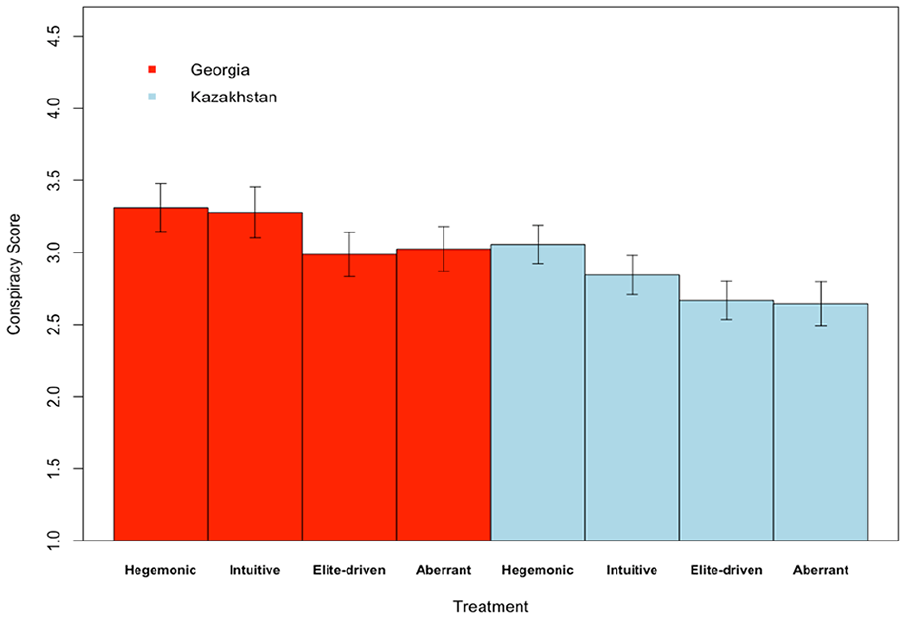
Plane crash vignette: Likelihood plane wаs deliberately shot down.
Tables 3 and 4 show results corresponding to the hypotheses separately by country. In Georgia, Table 3 indicates that respondents score highest when a U.S. airliner is shot down and the official claims a conspiracy (hegemonic), yet that score is statistically indistinguishable from the intuitive condition. Likewise, the mean score is lower when the airliner is Russian and no conspiracy is alleged (aberrant) but that is statistically indistinguishable from the elite-driven condition. Both results provide only partial support for H1 and H2. H3 pits two conflicting logics against one another: conspiracy is plausible but denied vs. implausible but claimed. As hypothesized, Georgians are significantly more likely to lean on their intuition that Russia shot down the U.S. plane, despite the official’s denial, than to believe the elite-driven claim that the United States was the aggressor against Russia (p < .05). When official denials meet with intuitively conspiratorial perceptions, intuition prevails, in support of H3.
Hypothesis Tests: Georgia.

Hypothesis Tests: Kazakhstan.

p < .10. *p < .05. **p < .01. ***p < .001.
As shown in Table 4, Kazakhstan is the mirror image of Georgia when it comes to people’s perceptions of the actors. The treatments in which Russians are the victims are viewed more suspiciously, with the hegemonic scenario producing the highest score, supporting H1. The low score for the aberrant scenario is indistinguishable from elite-driven, providing partial support of H2. To assess H3 for Kazakhstan, I compare scenarios in which Russia is the victim and a conspiracy is denied (intuitive) and where the United States is the victim and a conspiracy is alleged (elite-driven). The difference of .17 at a marginal level of significance (p = .07) partly supports H3, illustrating how prejudice against the disliked actor overrides even a “friendly” spokesperson’s denial.
These results indicate that conspiratorial intuitions are powerful, dominating official accounts. In both countries, the difference between the lowest two scores (elite-driven and aberrant) was not significant; and in Georgia there was no discernable difference between the highest scores (hegemonic and intuitive). Where cues emanating from above and below were at odds, motivated bias toward the actors involved prevailed in the determination of conspiracy or lack thereof.
Multivariate Regressions
The analysis thus far has shown that it is difficult to persuade people to believe in a conspiracy they are not already inclined to accept based on the contextual cues. But are some types of people more susceptible to certain appeals? To check the robustness of these findings and test H4, Table 5 shows the results for ordinary least squares (OLS) regressions on the full sample from both countries, with positive coefficients indicating a higher score on believing the plane was shot down. 15
OLS Regressions.

Hegemonic is the reference category. OLS = ordinary least squares.
p < .05. **p < .01. ***p < .001.
With the hegemonic conspiracy belief scenario as the reference category, the coefficients on the other treatments in Model 1 are substantively large and negatively signed, and statistically significant. The robustness of the treatments after inclusion of demographic variables and ideation indicates the importance of the specific details in the vignette. Conspiracy ideation is unsurprisingly a strong predictor of belief in this specific conspiracy theory. People in Kazakhstan are less likely to perceive a conspiracy than are Georgians, even after other variables are taken into account. Men are significantly less likely to believe in a conspiracy than women and, in contrast with research in Western democracies but consistent with accumulating findings in nondemocratic states, higher education is not predictive of less conspiratorial attitudes (Siddiqui 2020). 16
Model 2 supports H4a, that conspiracy ideation has equivalent effects across the board, rather than changing the relative rankings of the treatments. Conspiracy ideation remains highly significant as a main effect, while the lack of significance for any interaction term indicates that there is no additional effect for higher levels of general conspiracism. Thus, high conspiracists do not score relatively higher than low conspiracists in the scenarios where motivated reasoning would otherwise militate against perceiving a conspiracy (H4b), nor do they score relatively lower where a conspiracy claim is made by a (presumably distrusted) official (H4c).
To visualize these effects, I calculated the change in expected value of the dependent variable by treatment for people scoring high, medium, and low on conspiracy ideation (mean plus or minus one standard deviation). It is evident from this graphic that while conspiracy ideation increases people’s propensity to perceive a conspiracy in the vignette for all treatments, it does not alter the ranking of the treatment effects or substantially change the differences between them. It remains the case that hegemonic and intuitive scenarios are perceived more suspiciously than the elite-driven or aberrant conditions for all levels of ideation.
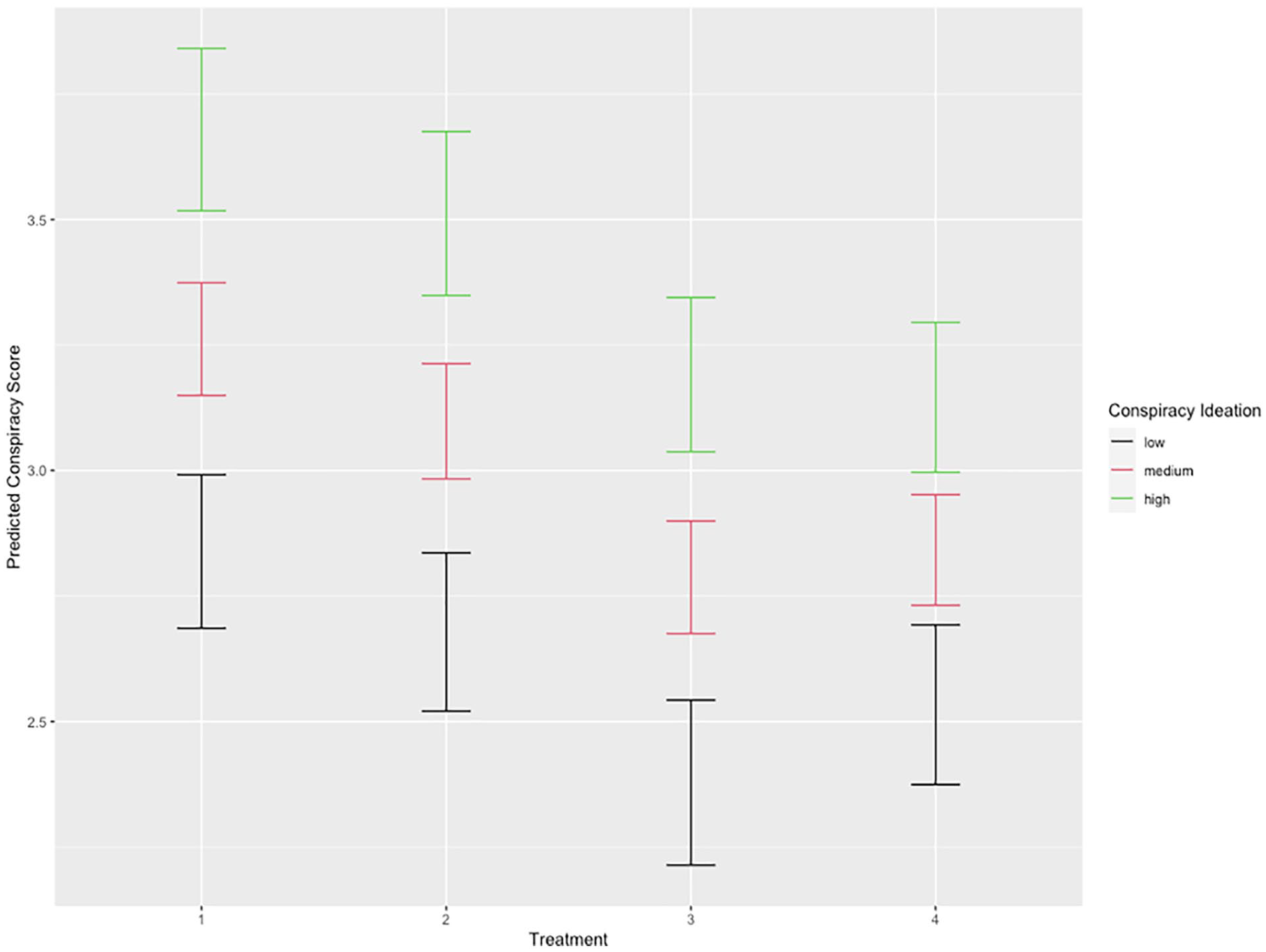
Predicted conspiracy scores for vignette by levels of conspiracy ideation.
Discussion and Conclusion
What draws people to conspiracy theories? A substantial literature has identified a number of psychological factors associated with conspiracy beliefs, yet although politicians employ conspiracy theories as part of their rhetorical arsenal, authoritative claims are often missing from the story. By decoupling claims of conspiracy from individual biases, I sought to parse out the importance of explicit suggestion and implicit cues. The results showed that respondents were more likely to accept conspiratorial explanations outright when the accused actors were already disliked and presumed capable of nefarious behavior. By the same token, conspiracy claims failed when the prospect of a conspiracy appeared implausible on its face. This suggests that elites cannot easily persuade audiences to endorse conspiracy theories that they do not otherwise find plausible. In other words, intuition about what is plausible prevails over efforts to frame the interpretation of events. I further showed that the ability of officials to persuade their audiences is to some extent out of their control, as it is shaped by people’s preexisting dispositions toward, and distrust of, power. As expected, people already predisposed to believe in conspiracy theories scored higher on the vignette in all treatments. Yet it is striking that even generally less conspiratorial people scored higher in the intuitive scenario than in the elite-driven scenario, suggesting that even trustful citizens regard official rhetoric skeptically.
By conducting this analysis in the domain of geopolitics, this paper expanded the scope for the study of conspiracy theories. Most research on belief in conspiracy theories has been conducted in Western democracies, yet conspiracy theories are a salient and even pervasive phenomenon in politics in much of the world (Butter and Knight 2016). This analysis demonstrated that motivated reasoning in the global realm operates similarly to that in the domain of partisan politics. The internalization over time of locational identity, the construction of allies and adversaries, and assumptions about their propensity to act in benevolent or nefarious ways primed people to make snap judgments about a suspicious event based solely on allusions to those actors. Motivated biases, along with generic conspiracy disposition, operated in ways consistent with previous research despite the unique setting for this study and the location of the action depicted in the vignette. This finding suggests that further research can apply concepts and scales developed in well-trodden domains to advance the study of conspiracy theories in new, and less studied, settings.
These findings have several implications for the study of conspiracy theories. Owing to motivated reasoning, the scope for the political deployment of conspiracy claims is limited by what people have internalized over time. If real-world politicians are successful in their use of conspiratorial rhetoric, it may be because they are naming the “right” culprits—attributing malevolent plots to unpopular actors. The centrality of plausibility explains why conspiratorial appeals fall flat when they implicate actors who do not strike observers as suspicious, as with claim that the Parkland, Florida students who organized rallies for gun control were really “crisis actors” (Wilson 2018). On the other hand, the bottom-up development of QAnon and its associated conspiracy theories yielded material for certain political elites to use as they sought to signal their identity—by pandering to voters devoted to the movement rather than innovating (Knutson 2020).
The findings also suggest that low confidence in authorities, especially among the most conspiratorial audiences, creates a conundrum for both conspiracy-touting elites and their audiences. Narratives about powerful actors seeking to benefit at the expense of the common good can backfire against officials by deepening cynicism aimed at all elites, thereby constraining their own political fortunes. Cynical audiences must grapple with how to interpret a claim of conspiracy from a figure whose motives are inherently suspect. One way to resolve the distrust dilemma is to discount most of what politicians say but to make exceptions when their claims are consonant with existing prejudices—yet without necessarily endorsing the speaker. As an example of this seeming contradiction, consider how accusations play out in Russia. Russians are generally cynical about their political institutions, yet many people watch state television and give credence to narratives that support the state, for example, about the conspiratorial activities of NATO or pro-democratic fifth columns (Peisakhin and Rozenas 2018). Such a disassociation may have taken place in the study. In the vignette, where a disliked actor was named, respondents could agree with an official conspiracy claim despite its coming from an unfamiliar and possibly untrusted source. Future studies may build on this finding to explore the conditions under which people choose to decouple the message from the messenger (Bleck and Michelitch 2017; Huang 2018).
There are several possible concerns about external validity. The official in this study is unnamed and lacking identifying information, leaving respondents without cues to determine how trustworthy he was. Certainly, the results would have differed if the claimant had been an authoritative figure like a president or well-known cultural elite, though in which direction is uncertain. The salient example of Trump’s ability to stoke conspiracy theories among his base may be exceptional, as not all politicians enjoy such a close and intense connection with their supporters (Mercieca 2020). This study addresses a more general—and more common—phenomenon, in which people are forced to weigh political appeals by figures who are not well known, charismatic, loved, or feared, but who use the authority of their office to promote conspiracy theories, whether to win public support or distract the public from malfeasance (Atkinson and DeWitt 2018).
Aside from giving claimants recognizable identities, further research might test how respondents regard a vignette in which the perpetrators and victims do not elicit strong sentiments like the United States and Russia did in this study. The lack of an anchor for motivated reasoning would place a greater burden on respondents to seek out other cues, such as the suspiciousness of the event—an unexplained plane crash—in general terms. Conspiracy ideation might play a more important role in the face of such a prompt. Another shortcoming of the design is duration. As master propagandists recognize, for narratives to take hold, they must be deployed repeatedly over long periods of time. After all, states begin to shape minds from birth and inculcate certain values and beliefs in their citizens in everyday life (Cantoni et al. 2017). Repeated exposure to initially improbable claims can over time cause people to perceive them as commonsensical, thereby transforming elite-driven narratives into hegemonic ones.
Conspiracy theories are an insidious yet common form of political rhetoric and are entering the mainstream in some societies where they were previously stigmatized. By disaggregating the factors that lead to their endorsement, this paper has shown what makes them popular but also highlighted the barriers to their uptake and political utility. Being aware of those limitations may be a necessary step toward countering their effects and ensuring that politicians who seek to win support through evidence-based appeals can compete on a level playing field.
Supplemental Material
sj-pdf-1-prq-10.1177_10659129211034558 – Supplemental material for Dilemmas of Distrust: Conspiracy Beliefs, Elite Rhetoric, and Motivated Reasoning
Supplemental material, sj-pdf-1-prq-10.1177_10659129211034558 for Dilemmas of Distrust: Conspiracy Beliefs, Elite Rhetoric, and Motivated Reasoning by Scott Radnitz in Political Research Quarterly
Supplemental Material
sj-pdf-2-prq-10.1177_10659129211034558 – Supplemental material for Dilemmas of Distrust: Conspiracy Beliefs, Elite Rhetoric, and Motivated Reasoning
Supplemental material, sj-pdf-2-prq-10.1177_10659129211034558 for Dilemmas of Distrust: Conspiracy Beliefs, Elite Rhetoric, and Motivated Reasoning by Scott Radnitz in Political Research Quarterly
Supplemental Material
sj-pdf-3-prq-10.1177_10659129211034558 – Supplemental material for Dilemmas of Distrust: Conspiracy Beliefs, Elite Rhetoric, and Motivated Reasoning
Supplemental material, sj-pdf-3-prq-10.1177_10659129211034558 for Dilemmas of Distrust: Conspiracy Beliefs, Elite Rhetoric, and Motivated Reasoning by Scott Radnitz in Political Research Quarterly
Footnotes
Acknowledgements
I am grateful to Gulnaz Sharafutdinova, John Heathershaw, Paul Goode, John O’Loughlin, Egor Lazarev, Grigore Pop-Eleches, Joshua Tucker, Scott Gehlbach, and Yuan Hsiao for their feedback, as well as from three anonymous referees.
Authors’ Note
Previous versions of this paper were presented at the 2018 convention of the Association for the Study of Nationalities and the 2019 PONARS Eurasia workshop in St. Petersburg.
Declaration of Conflicting Interests
The author(s) declared no potential conflicts of interest with respect to the research, authorship, and/or publication of this article.
Funding
The author(s) disclosed receipt of the following financial support for the research, authorship, and/or publication of this article: This research was partly funded by the University of Washington Royalty Research Fund.

Supplemental Material
Supplemental materials and replication materials for this article are available with the manuscript on the Political Research Quarterly (PRQ) website.
Notes
References
Supplementary Material
Please find the following supplemental material available below.
For Open Access articles published under a Creative Commons License, all supplemental material carries the same license as the article it is associated with.
For non-Open Access articles published, all supplemental material carries a non-exclusive license, and permission requests for re-use of supplemental material or any part of supplemental material shall be sent directly to the copyright owner as specified in the copyright notice associated with the article.
