




Abstract
Does the political nature of modern judicial confirmation hearings lead the public to think of the Supreme Court as a political body? Some political actors inevitably attack the institution during a confirmation hearing—which should lead to a decrease in support for it—but they attack the Court for acting extra-judicially. More generally, confirmation hearings send the American public an important and universal message: that the Supreme Court at least ought to be a legal institution. Based on original panel data closely surrounding the confirmation hearings of Supreme Court nominee Amy Coney Barrett, I find that confirmation hearings lead the public to place greater value on the non-political characteristics of a judge. While Supreme Court legitimacy reduced among Democrats over the course of the hearings, all respondents (including Democrats) became more likely to emphasize the importance of the legal qualities in a judge. For Democrats, the data suggests these two processes (reduced legitimacy and increased emphasis on a judge’s legal characteristics) worked independently. For Republicans—and consistent with positivity bias theory—enhanced legitimacy was predicted by a decrease in focus on the political aspects of a judge over the course of the confirmation hearing.
How do modern judicial confirmation hearings influence public views of the Supreme Court? 1 The political nature of the appointment process has led some to believe that judicial confirmation hearings fundamentally alter people’s perceptions of the Court, leading them to treat it simply as another political body of government. With a few limited exceptions, however, empirical research on the consequences of modern judicial confirmation hearings is lacking. We know little about whether confirmation hearings damage the Supreme Court’s essential reservoir of goodwill and the extent to which they lead the public to treat the judicial branch like any other political branch of government. Meanwhile, the politics surrounding the confirmation process grow in intensity and regularity. With much at stake, it is essential to test claims regarding the costs and benefits of judicial confirmation hearings empirically.
Consistent with work on positivity bias theory (e.g., Gibson and Caldeira 2009a), I argue that the politics saturating modern judicial confirmation hearings harm the Court’s legitimacy. That is because language and events that associate the Court with regular politics (i.e., political symbolism) can undermine or even overwhelm the legal symbols which typically protect the Court’s perceived legitimacy (Gibson and Caldeira 2011). Furthermore, I argue that the negative effect of political symbolism on perceived legitimacy is filtered through partisanship. While Democratic elites attacked the Court as political during Amy Coney Barrett’s confirmation hearings (and co-partisan respondents were easily persuaded), Republican elites claimed that these attacks were baseless, and that the Court continues to function as a legal institution. Invoking legal symbolism to describe the Court, Republican elites persuaded Republican respondents to maintain their view of the Court and reject out-partisan accusations that the Court had been acting extra-judicially.
Despite some negative effects on legitimacy, confirmation hearings also reinforce legal norms as elites convey the message that the Court at least ought to act as a legal institution. Though the context surrounding the appointment process generally and confirmation hearings specifically is often political, its actual content emphasizes legal frameworks by which to evaluate the Court. Whether prominent elites praise or attack the Court during hearings, they send a unified message to the public that the Court is not meant to be a political institution. This legal framework, in turn, influences public expectations of the Court.
Like Gibson and Caldeira (2009a), who analyzed the effect of Justice Samuel Alito’s appointment process on public views, I find that loyalty to the Court’s current institutional structure diminishes over the duration of the confirmation process. As expected, the reduction in perceived legitimacy today is partisan based. Yet, judicial confirmation hearings do not pose the existential threat to the judicial branch that many fear. Instead, I find also that reduced legitimacy is coupled with an increased emphasis on the judicial role of nominees. That is, over the course of a confirmation hearing, I find reduced legitimacy and an overall increase in public support for evaluating judges based on legal rather than political traits.
My analysis is based on an original, two-wave, nationally representative survey surrounding Supreme Court nominee Amy Coney Barrett’s confirmation hearing and confirmation vote. I administered the first wave of the survey on October 6–11. The Senate Judiciary Committee hearings were held on October 12–15, and the full Senate vote was held on October 26. I fielded my second survey shortly after this vote, on October 27–30. The speed of the confirmation hearing process and the proximity of the subsequent roll call vote to that process allowed for me to obtain a high response rate after only 3 weeks. Furthermore, the quick timeline increased the likelihood that changes in views between the two surveys were driven by the confirmation hearings, and not by other events related to the Court. 2 Finally, fielding the survey after the final roll call vote ensured that I accounted for views of the Court after Amy Coney Barrett became one of its official members.
This study has important implications for our understanding of modern judicial confirmation hearings. Many scholars are concerned that politicized confirmation hearings harm support for the Court. Zilis and Blandau (2021), summing up current views on the subject, suggest that “the contentious [confirmation] process has spilled into long-term orientations toward the Court.” Others suggest that confirmation hearings provide important public goods (Collins and Ringhand 2013; Farganis and Wedeking 2014; Schoenherr, Lane, and Armaly 2020). Both sides are correct. Modern hearings harm Court legitimacy; but they do so as they reinforce simultaneously the notion that the Court should be a legal institution.
The Political Context of Judicial Confirmation Hearings
Supreme Court vacancies arise for various reasons. Congress can create vacancies by legislation or impeachment. Justices can create vacancies through death, resignation, or retirement. The most common reason for a vacancy is retirement. Since the 2000s, however, three justices have created vacancies through their deaths (Baum 2021). Presidents nominate individuals to fill vacancies and forward those nominations to the Senate. Once the nomination is forwarded, the Senate typically refers the nomination to the Senate Judiciary Committee. The Senate Judiciary Committee performs various functions, but one of its most important and visible functions is to hold hearings on the nominees (Collins and Ringhand 2013).
Beginning in 1981, these confirmation hearings have been televised and widely viewed. The hearings last approximately 1 week. The full Senate then considers the nomination and decides whether to confirm the nomination (usually through a roll call vote). Supreme Court confirmation hearings receive widespread media coverage and public attention (Davis 2017). While some Court decisions also achieve public salience, rarely is such media coverage as sustained and intense as is media coverage related to the Court during the confirmation hearings. Thus, confirmation hearings for Supreme Court nominees have a greater potential to influence the public than do most other Court-related activities.
Politics has always played an important role in the appointment process: “about 90% of all nominees to the Court—and all of those chosen since 1975—have been members of the president’s party” (Baum 2021, 39). Presidents care about the policy positions of those they nominate; if confirmed, their nominee will be able to weigh in on national policy questions long after the president leaves office. But political and ideological compatibility is not the only consideration. Indeed, a necessary if not sufficient requirement is legal competence: “Discounting rare individual exceptions, the caliber of the Supreme Court has been universally high” (Abraham 2007, 49). That presidents continue to narrow their pool of potential nominees to those with substantial legal experience and high legal qualifications reinforces the notion that the Court is not widely perceived as simply a political institution.
The president’s decision on whom to nominate and the Senate’s confirmation decision on whether to confirm have become more political over time. 3 This has been especially true since the 1987 Senate rejection of Robert Bork to fill a Supreme Court vacancy. Despite his legal qualifications, Judge Bork was rejected by the Senate explicitly based on his personal and legal views related to judicial decision-making. The Senate had rejected nominees previously, but those had been at least justified on concerns regarding legal qualifications or ethics. Scholarship supports this argument. Epstein et al. (2006) find that nominee ideology has become more predictive of Senate voting since the Bork confirmation vote. Even so, as with presidential nominations, legal qualifications continue to predict Senator votes and are “a significant determinant of success in the Senate” (296).
Scholars and others have long expressed concern that the politicization of the appointment process will harm public support for the Supreme Court (see, e.g., Carter 1994). If senators focus on the personal viewpoints of nominees, the argument goes, then the public will doubt that justices are simply interpreters of the law and not policymakers. This viewpoint was expressed well by then-Senator Joseph Biden. After suggesting that both the president and senators have a right to consider the political viewpoints of nominees, he stated “that if we let it get down to that, that although constitutionally that may be able to be done, it would be a real serious, serious blow for justice in this country, the perception of it.” 4
Zilis and Blandau (2021) wonder if “contentious recent confirmation battles may have fundamentally altered public views about the Supreme Court.” One explanation is of the “bad apple spoils the bunch” variety, in which criticisms of the nominee color people’s views of the Supreme Court itself (see Carrington and French 2021; Krewson and Schroedel Forthcoming). Of course, elites also attack the Supreme Court directly during confirmation hearings. Rogowski and Stone (2019) provide some evidence, based on a conjoint experiment, that giving information to the public about the political contestation over a nominee influenced their support for the nominee and their perceived legitimacy of the Court.
However, empirical evidence of a negative effect of confirmation hearings on views toward the Court and nominees is severely limited. An exception is work by Gibson and Caldeira (2009a, 2009b). They fielded a multi-wave study surrounding the appointment process for then-Judge Samuel Alito. Using two waves of their nationally representative survey, they examined change in institutional support from May 2005 to June 2006. 5 Of their original sample of 1001 adult Americans, two-hundred and fifty-nine (28%) respondents completed both waves. They found an overall decrease in institutional loyalty over this time. Importantly, their data suggests that the decrease in support is unrelated to respondents’ ideology and partisanship. Rather, change in support is correlated in part with the self-reported number of advertisements that respondents observed during the January confirmation hearing.
A weakness of their study is the length of time between the two waves (≈13 months). Though Samuel Alito’s confirmation hearings (and appointment process more generally) occurred between the two survey waves, so did other important Court-related events. Chief Justice Roberts joined the Court between the first and second surveys. As usual, the Court released no shortage of controversial decisions during this period. The period was unique in other ways too—the first year of the Roberts Court was marked with an unusually high degree of unanimity. 6 Consequently, it is unclear that the appointment process itself drove changes in views toward the Court. For these reasons, a narrower gap between the first and second waves—including a period with no Supreme Court decisions nor additional confirmation hearings—is necessary to show that confirmation hearings influence views.
Much has changed since the Alito confirmation. Most obviously, confirmation hearings have become increasingly politicized. Gibson and Caldeira (2009b, 139–140) explain that “liberal interest groups spent $1,365,857 on advertising in trying to convince the American people that Alito should not be confirmed (and conservatives spent $1,041,535 in favor of his confirmation), making this one of the more expensive confirmation fights ever.” Recently, a single group (Judicial Crisis Network) spent 7 million in advertisements opposing Merrick Garland and 10 million in advertisements supporting Neil Gorsuch. Demand Justice pledged to match Judicial Crisis Network’s 10 million in spending against Amy Coney Barrett after they (Demand Justice) had spent only 5 million in advertisements against Brett Kavanaugh. 7
The confirmation hearing itself—and not just the politics surrounding it—has become more political. While the Senate’s 58–42 vote in favor of Alito’s confirmation may have been one of “the more controversial and divisive” at the time (Gibson and Caldeira 2009b, 139), that is clearly no longer the case. The last three Senate roll call votes for Supreme Court nominees have been 54–45, 50–48, and 52–48. Since Chief Justice Roberts’s 78–22 confirmation vote in 2005, a strong majority of senators from the opposition party (to the president) has voted against the nominee. For Amy Coney Barrett, not a single member of the Democratic party voted in her favor. Only one Republican voted against her. Confirmation hearings have become increasingly bitter, tit for tat, contests.
Positivity Bias Theory
The most prominent theory related to Court support and confirmation hearings is positivity bias theory (see Gibson and Caldeira 2009a). Positivity bias theory suggests that when people are exposed to information about the Court (and perhaps its members)—even negative information—legal symbols create a positivity bias that may wash out or even outweigh any effect of the negative information. Often this process is subconscious, leaving little opportunity for individuals to counter-act the biasing effect of legal symbolism (Gibson, Lodge, and Woodson 2014). For example, a conservative may learn about a liberal Court decision. In doing so, legal symbols may come to mind (the robe, the Court building, the title of “Justice,” etc.) which remind the individual that the Court is a legal (i.e., a non-political) entity. Symbols may also be more concrete, such as the legal reasoning that implicitly or explicitly justifies each decision. So, even though one may disagree with the ideological direction of the decision, they may respect the decision (and the Court) due to the legal nature of the institution or its decision.
The same thing can happen in the confirmation context. While Senators, interest groups, or others may attack the justice or even the Court during a hearing, legal symbols are simultaneously and perhaps subconsciously invoked. These symbols have a positivity bias which influences institutional support for the Court. In general, positivity bias theory predicts that the presence of legal symbols leads to greater support for the Court as an institution. Logically, the inverse could be true. Explicit emphasis on describing the Court as political (i.e., political symbolism) may lead to lesser support. In their seminal book on positivity bias theory and confirmations, Gibson and Caldeira (2009a) provide evidence of this as exposure to political advertisements related to the Alito confirmation led to a decrease in support for the nominee and Supreme Court. In other words, they confirm that explicitly political descriptions of the Court can lead to a decrease in support for the institution.
Like Gibson and Caldeira (2009a), I expect that political attacks during confirmation hearings will harm the Court’s legitimacy. But much of this effect should depend on partisan identification. That is, political attacks on the Court during confirmation hearings should have a negative effect on co-partisans, but little effect on out-partisans who view these attacks as less credible. Elite descriptions of the nominee and the Court as legally oriented actors should reinforce institutional support for the Court among co-partisans but have little influence on out-partisans. Out-partisans should see such descriptions as less credible.
It would be surprising if politicized and partisan confirmation hearings do not impact people’s perceptions of judiciaries and judging. Party identification and party cues are strong predictors of behavior and attitudes (Dalton 2016). Recent research suggests that partisanship and ideology predict support for the Court and justices (Bartels and Johnston 2013; Christenson and Glick 2015; Armaly 2020). As elites and the public polarize, individuals rely more consistently on partisan cues to form “correct” expectations regarding views on policy and current events. Nicholson and Hansford (2014) provide convincing evidence that partisan cues work in the Supreme Court context just as they do in other political contexts.
Thus, I expect confirmation hearings reduce the Court’s legitimacy, at least conditionally. This leads me to the following hypotheses: H1a: Supreme Court legitimacy will decrease among Democrats during the course of Amy Coney Barrett’s confirmation hearings. H1b: Supreme Court legitimacy will not decrease among Republicans during the course of Amy Coney Barrett’s confirmation hearings.
Importantly (and as explained in the next section), however, I do not expect confirmation hearings to lead the public to prefer a political Court; just the opposite, in fact.
The Legal Content of Judicial Confirmation Hearings
A close look at the content (and not just the context) of modern judicial confirmation hearings suggests that descriptions of the Court during confirmation hearings (even negative ones) employ legal frameworks which may reinforce legal expectations and standards.
While the appointment process is saturated with politics, we have seen there are clearly legal aspects to the hearings as well. For example, presidents feel compelled to limit themselves to a pool of individuals with strong legal credentials and substantial legal experience (Abraham 2007; Baum 2021). Senate voting is also influenced by the legal qualifications of nominees and constituent preferences over nominees (Epstein et al. 2006; Kastellec, Lax and Phillips 2010). 8 In addition, research on motivated reasoning in the judicial context suggests that any reduction in legitimacy due to confirmation hearings that we find does not necessarily indicate that members of the public want a more partisan or extra-legal Court, but rather they prefer a legal Court and are simply motivated to think the Court is not meeting legal norms and expectations (Badas 2016; Bartels and Johnston 2020).
Empirical research on the content of confirmation hearings repeatedly shows that political actors evaluate nominees using a legal framework. For example, Farganis and Wedeking (2014) show that when Senators ask about a nominee’s views (which occurs for about 70% of questions), the most common types of questions focus on judicial decision-making, the Constitution, and judging. The most common questions of fact (which account for approximately 30% of questions) focus on legal education, experience, and training. Non-legal employment history is the category accounting for the smallest proportion of factual questions.
Collins and Ringhand (2013) do a deep dive into the content of the discussions which take place during confirmation hearings. Their results suggest the potential for confirmation hearings to reinforce the legal nature of the judiciary rather than simply politicize the courts. “Each time one of these hearings occurs,” they argue, “Americans reengage in a debate about the meaning of the Constitution” (1). Using the transcripts from all hearings since 1939, they provide convincing evidence that hearings focus on concrete issues of constitutional law and judicial interpretation. Since the first televised hearing in 1981, senators and nominees have consistently spent one-sixth of their conversations on “concrete examinations of Supreme Court precedents” (146). Statements regarding nominees’ “judicial philosophies” constitute approximately 13% of all hearing discourse (132). When Senators seek to understand a nominee’s political and ideological orientations, they often do so in the language of law, precedent, and in the context of hypothetical decisions. By using this framework, political actors signal to the public that they should also evaluate nominees using legal frameworks.
Research shows that partisan cues exert substantial influence on people’s attitudes, even in judicial contexts (Nicholson and Hansford 2014). The public likely takes their cues on the Court from partisan elites (Dalton 2016). During the confirmation process, some elites attack the Court for acting extra-judicially. Others, who are more in alignment with the ideological tenor of the Court, are motivated to believe that Court decisions are legally justified. But whether the Court is being attacked or not, all respondents receive a reinforcement treatment from their co-partisan elites: that the Court ought to be a legal institution at the very least.
Evidence of a legal reinforcement effect can be found in how people evaluate judges. For instance, judicial confirmation hearings may lead people to evaluate the quality of a judge based on legal characteristics instead of a judge’s political values or background. Public evaluations of judges matter. Recent departures from what have been mostly party line votes for Supreme Court nominees are by cross-pressured senators in moderate districts. 9 Kastellec, Lax and Phillips (2010) provide compelling evidence of a connection between state-level public opinion and senator votes for Supreme Court nominees.
There is some disagreement, however, as to what types of characteristics the public prefers in a nominee. Sen (2017) argues that partisanship is the most important characteristic to the public. While legal qualifications seem to predict support for a nominee, her data suggests that nominee partisanship is most influential. Krewson and Owens (2021), however, include explicit measures of a nominee’s legal qualifications as well as indications of nominees’ judicial philosophy in an otherwise similar design. Their data provide evidence that legal characteristics are at least as important as partisanship. Work by Rivero and Stone (N.d.) likewise shows that members of the public care about the legal characteristics of nominees.
If modern judicial confirmation hearings reinforce legal norms, then we should observe a change in the relevance of legal and non-legal judge attributes to the public’s evaluation of judges during the confirmation process, such that legal characteristics become more relevant to judge evaluations and political characteristics become less so. 10 During the hearings elites express bi-partisan agreement that judges should be fair and impartial. They simply disagree as to whether the nominee and the Court act consistently with this agreed-upon standard. From the viewpoint of the public, then, partisan cues indicate (1) whether to support a nominee or the Court and (2) the existence of broad support for a norm of judicial impartiality. This leads to the following hypothesis.
H2: Confirmation hearings should increase the importance people place on the legal qualities of a judge and decrease the importance they place on political judge characteristics.
Legal Norms and Legitimacy
It is possible that our sets of predictions (H1 and H2) operate independently. That is, one, reduced legitimacy is based on the ways in which co-partisan elites use legal or political symbols to describe the Court. And, separately, two, during the course of the hearing all individuals increase their focus on evaluating the Court using a legal framework as a result of unified support for using such evaluative criteria by elites across the partisan spectrum.
On the other hand, an increase in focus on the legal characteristics of judges could predict a decrease in support for the Court. That is, the reduced legitimacy for the Court may be driven by increasingly high legal standards and an inevitable conclusion that the Court falls short of that standard. This would suggest that elite partisans indirectly influence the legitimacy of the Court through shaping the criteria upon which the Court is evaluated, rather than directly shaping views through their legal and political descriptions of the Court itself. I test the relationship between legitimacy and changes in evaluative criteria for all respondents. Given expectations of asymmetric effects related to legitimacy, I also test whether the relationship between legitimacy and evaluative criteria depends on party identification.
I have introduced a new way of thinking about the public value of confirmation hearings. Some political elites invariably attack the Supreme Court during confirmation hearings, and their attacks can harm public perceptions of the Court. This effect should be strongest among those in the public who are aligned with the partisanship of the attacking senators. Still, we must account for the fact that both attacks and defenses of the Court during confirmation hearings take for granted a legal norm of impartiality. During a confirmation hearing, arguments that justices should be legally oriented are prominent and bi-partisan. Accordingly, I expect that members of the public—regardless of their party identification—will be more likely to emphasize the importance and relevance of legal factors to their evaluations of judges following the confirmation process.
Data and Methods
I use original panel data to analyze public views before and after the Senate confirmation hearing and vote for Supreme Court nominee Amy Coney Barrett. President Trump announced his nomination of Amy Barrett on September 26, approximately 1 week following the death of Justice Ruth Ginsburg. The Senate Judiciary Committee hearings were held on October 12–15, and the full Senate voted to confirm on October 26, by a vote of 52–48. I fielded the first wave of my survey on October 6–11 and the second wave on October 27–30.
Lucid Fulcrum Exchange—a proven 11 and highly reputable online survey company—provided me with a nationally representative sample of American adults. The first wave was composed of 2015 respondents. In the second wave, I resurveyed all respondents from wave 1, with 712 respondents completing both waves. 12 This response rate of 35% exceeds the 28% recontact rate achieved by Gibson and Caldeira (2009a, 2009b) in their multi-wave study regarding the potential effects of Justice Alito’s appointment and confirmation process. My sample size of 712 respondents completing both waves is 275% larger in size. Below, I include multivariate analyses with control variables to reduce any potential bias related to panel attrition.
I measure two types of outcome variables. First is the traditional measure of perceived Supreme Court legitimacy (Gibson, Caldeira and Spence 2003), using a 5-item set of questions. 13 These questions measure the extent to which an individual supports the Court as an institution, even in the face of widespread disagreement with the Court’s outputs. In other words, they measure diffuse support for the Court, or the Court’s reservoir of goodwill, independent of public support for its actual outputs. The item-set represents the most accepted approach for validly measuring institutional loyalty to the US Supreme Court. Like previous work, I calculated for each individual their average score across the items, with larger values representing greater support for the Court. 14
The second set of dependent variables focuses on types of judge characteristics. At the end of the survey, participants were informed that they had completed the portion of the survey focused on Amy Coney Barrett and the Supreme Court, and that they would now be asked about their views of judges more generally. They were then provided a list of seven different judge traits by which they might evaluate a judge, and they were asked to indicate for each trait how important it was to their evaluation of a judge using a 4-point scale ranging from “Not at all important” to “Very important.” There were included three explicitly political characteristics (“political experience,” “ideology,” and “partisanship”) and two explicitly legal characteristics (“judicial experience,” and “judicial philosophy”).
Two other judge characteristics were included. One was “religious background.” Some of the discussions surrounding Amy Coney Barrett’s hearing were focused on her religion, in part because of religious-based accusations made against her during her earlier confirmation hearing for a lower federal court vacancy. 15 The second trait was “moral character.” Questions of moral character were pervasive during Brett Kavanaugh’s confirmation hearings and the public took notice (Krewson and Schroedel 2020). The trait is related also to ethical considerations considered by the American Bar Association. 16
I analyze raw change in Supreme Court legitimacy and judge evaluations, as well as change controlling for demographic variables. Partisanship is a key demographic variable in this study. For reasons explained, I expect that partisanship will be related to changes in perceived legitimacy. I do not expect partisanship to be related to change in the traits people use to evaluate judges. Partisanship is a self-reported, categorical measure, with respondents categorized as either Democrat, Republican, or Independent. To isolate the effects of partisanship and allay concerns related to panel attrition, I also control for Age, Education (continuous variables), Race, and Gender (categorical variables). 17
The American public were aware of the confirmation hearings and understood their implications. For example, I asked respondents at both waves whether the 2020 election will impact the makeup of the Supreme Court. At wave 1, it was perhaps unclear whether the vacancy would be filled before the election. At wave 2, the likelihood that the election would shape the composition of the Court should have reduced. Respondents were less likely to think the election would shape the composition of the Supreme Court after the hearings. Respondents also correctly observed a conservative shift in the Supreme Court while not observing ideological shifts for the Senate or Amy Barrett herself between the two waves.
Results: Change in Supreme Court Legitimacy
This article focuses on whether the Barrett confirmation hearings led to a decrease in perceived legitimacy of the Court and an increase in attention to the legal attributes of a judge. In analyzing these potential changes over time, I pay close attention to respondents’ party identification. I expect that partisanship identification will play a meaningful role in Court legitimacy but less of a role in preferences regarding a generic judge’s attributes.
Now, let us consider first whether Supreme Court legitimacy decreased during the confirmation process. To test this question, I rely on the measure of institutional loyalty (or legitimacy) discussed earlier. The legitimacy score was calculated at both waves using the same five-item set of questions. Here, to test for individual-level change in legitimacy, I subtract each respondent’s legitimacy score at the first wave from their legitimacy score at the second wave. A simple difference in means test of this legitimacy-change measure shows that, on average, legitimacy decreased, and that this effect is statistically significant. The average within-person change is −0.09. In more understandable terms, the data reveals that 23% of individuals remained steadfast in their views, while 45% of individuals felt the Court was less legitimate and 32% felt the Court was more legitimate.
What do we observe when separating out these results by respondent party identification? For Democratic respondents alone, the average change in legitimacy nearly doubles to −0.16. For Republican respondents alone, the difference is 0.04 (and not statistically significant). Thus, the negative effect found among Democrats is much stronger than the effect of the hearings on Republicans’ views of Supreme Court legitimacy. In more understandable terms, 54% of Democratic respondents felt the Court was less legitimate, 25% felt it was more legitimate, and 20% did not change their views. For Republicans, 36% felt it was less legitimate and 41% felt it was actually more legitimate. 18
Next, I test my hypotheses using multivariate regression analysis. Below I regress legitimacy score at wave 2 on respondents’ age, education, race, sex, and party identification, as well as their legitimacy score at wave 1. Including the lagged dependent variable allows me to estimate how the other independent variables relate to change in legitimacy over time. Table 1 includes the results of this regression analysis.
Linear regression of perceived Supreme Court legitimacy at wave 2 on legitimacy at wave 1 and other demographic characteristics of respondents.
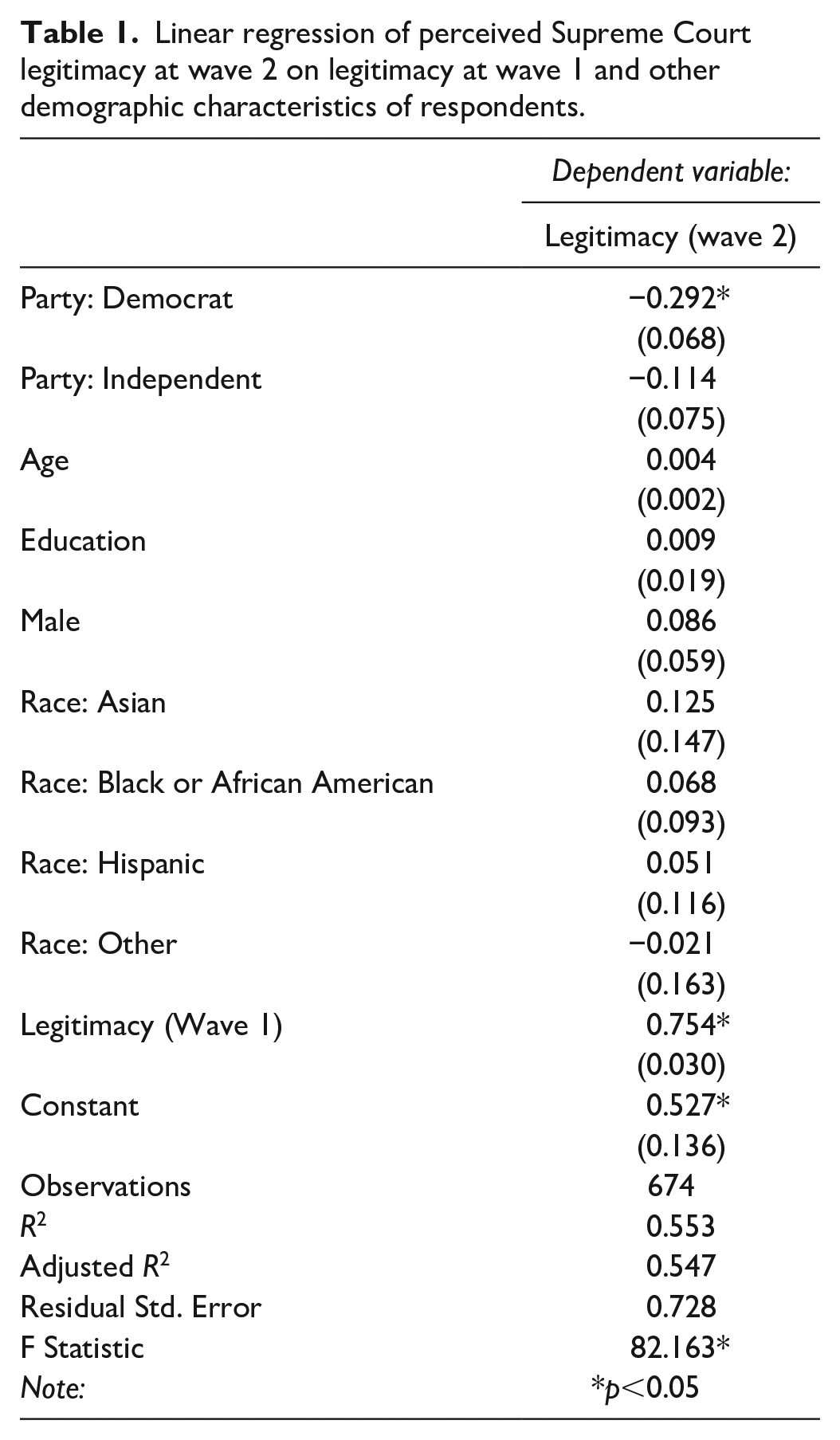
Unsurprisingly, the regression results reveal that perceived levels of Supreme Court legitimacy at wave 1 are statistically related to perceived levels of legitimacy at wave 2. Controlling for that relationship, though, which of the other independent variables explain changes in legitimacy? The only other statistically significant effect is party identification. Controlling for perceived legitimacy at wave 1, Democratic perceptions of legitimacy were 0.29 points lower at wave 2 when compared to Republican perceptions of legitimacy at wave 2. Age, education, race, and sex were unrelated to changes in Supreme Court legitimacy. 19
To understand the regression results more easily, I predicted legitimacy scores at wave 2 using the regression coefficient values and assuming a legitimacy score at wave 1 of 2.9 (which is the overall average score at wave 1). I did this for both Democratic and Republican respondents. All other variables were held at their mean or modal values. Figure 1 plots these results along with their 95% confidence intervals. As we can see, Republicans hardly change in their views of the Court, while Democrats exhibit a negative and statistically significant lower level of legitimacy.
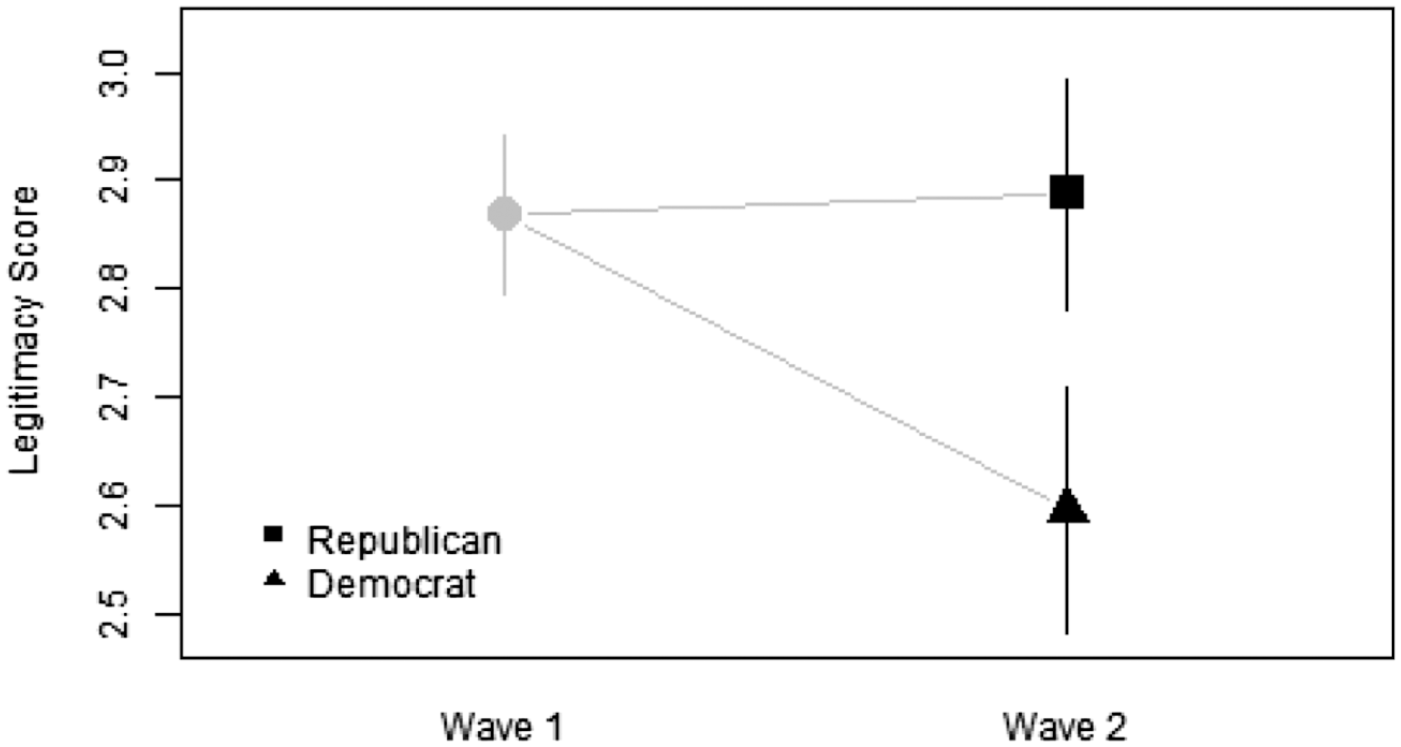
Predicted legitimacy scores at wave 2, given legitimacy score at wave 1 (gray circle) of 2.9, for both Democratic (black triangle) and Republican (black square) respondents. All other values are held at their median or modal values. Estimates based on regression model from Table 1. Vertical lines represent 95% confidence intervals.
Results: Change in Preferences over Judge Attributes
Having observed a decrease in legitimacy, should we expect a general increase in the importance attributed to extra-legal judge characteristics? Or do confirmation hearings also highlight and reinforce legal norms which would tend to decrease the importance of extra-legal judge attributes? As discussed, I asked individuals to self-report the importance of various legal and non-legal characteristics as they relate to their evaluations of judges. Figure 2 plots the average level of importance for each of the characteristics (on a four-point scale), both before the confirmation hearings and after the confirmation vote. Larger values indicate that a trait is of more importance to public evaluations of a judge.
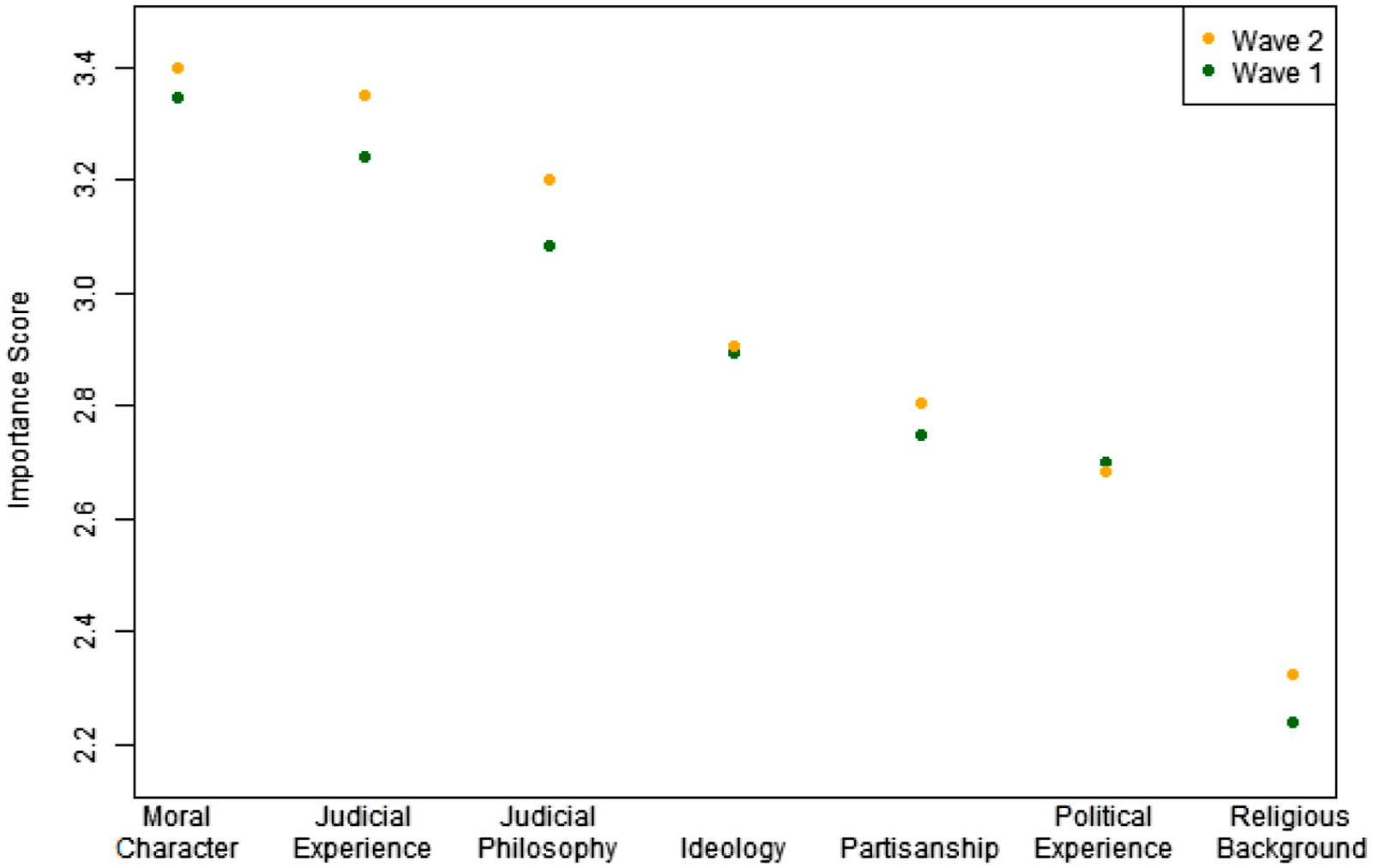
Plot of average level of importance attributed to each judicial characteristics, both before Amy Coney Barrett’s confirmation hearings (green circles) and after the Senate’s confirmation vote (orange circles). Higher values indicate greater importance.
Moral character was rated as the most important characteristics at both waves. Moral character taps into ethical considerations, which is a characteristic focused on directly by the American Bar Association when they evaluate nominees. That the public see this as even more important than the explicitly legal characteristics is interesting and consistent with previous research (Krewson and Schroedel 2020). A nominee’s religious background is seen as the least important trait of a judge. This is true both before and after the confirmation process. As mentioned, religious bias was a concern raised before the hearings and a topic which senators returned to frequently during the confirmation hearings. 20 Most importantly, each of the explicitly legal characteristics were listed as more important to respondents than each of the explicitly political characteristics, whether before or after confirmation hearings.
But what of the effect of the hearings themselves? As we can see, it does not appear that they changed people’s views of the importance of ideology and political experience. It appears from Figure 2 that, perhaps, there may have been an increase in the perceived importance of a judge’s partisanship. As we expected, the largest effects appear to be related to explicitly legal characteristics. To test the hypotheses regarding change in perceived importance of legal and non-legal characteristics, I next compare individual-level measures of change in ratings of each judge trait before and after the confirmation process. That is, I subtract each respondent’s rating for a given characteristic at wave 1 from their rating of that characteristic at wave 2. Figure 3 plots the average individual-level change in ratings for each judge trait (black, squares), with their associated 95% confidence intervals. I also separate out results by Republican (red, circles) and Democratic partisans (blue, triangles).

Estimates of individual-level change in the importance of various judge characteristics over the period of Amy Coney Barrett’s confirmation process. Vertical lines represent 95% confidence intervals. Vertical lines that cross the dashed horizontal line indicate that there was no statistically significant individual-level change in the importance of the associated trait to evaluations of judges. Black squares indicate all respondents; red circles indicate Republican respondents; blue triangles indicate Democratic respondents.
No explicitly political characteristic increased in average individual-level importance over the course of the confirmation hearings. This is despite decreases in perceived Supreme Court legitimacy that we observed earlier in the article. The hearings led to a general increase in the perceived importance of explicitly legal characteristics and had no general influence on the (already) lower levels of support for explicitly political attributes of a judge. 21
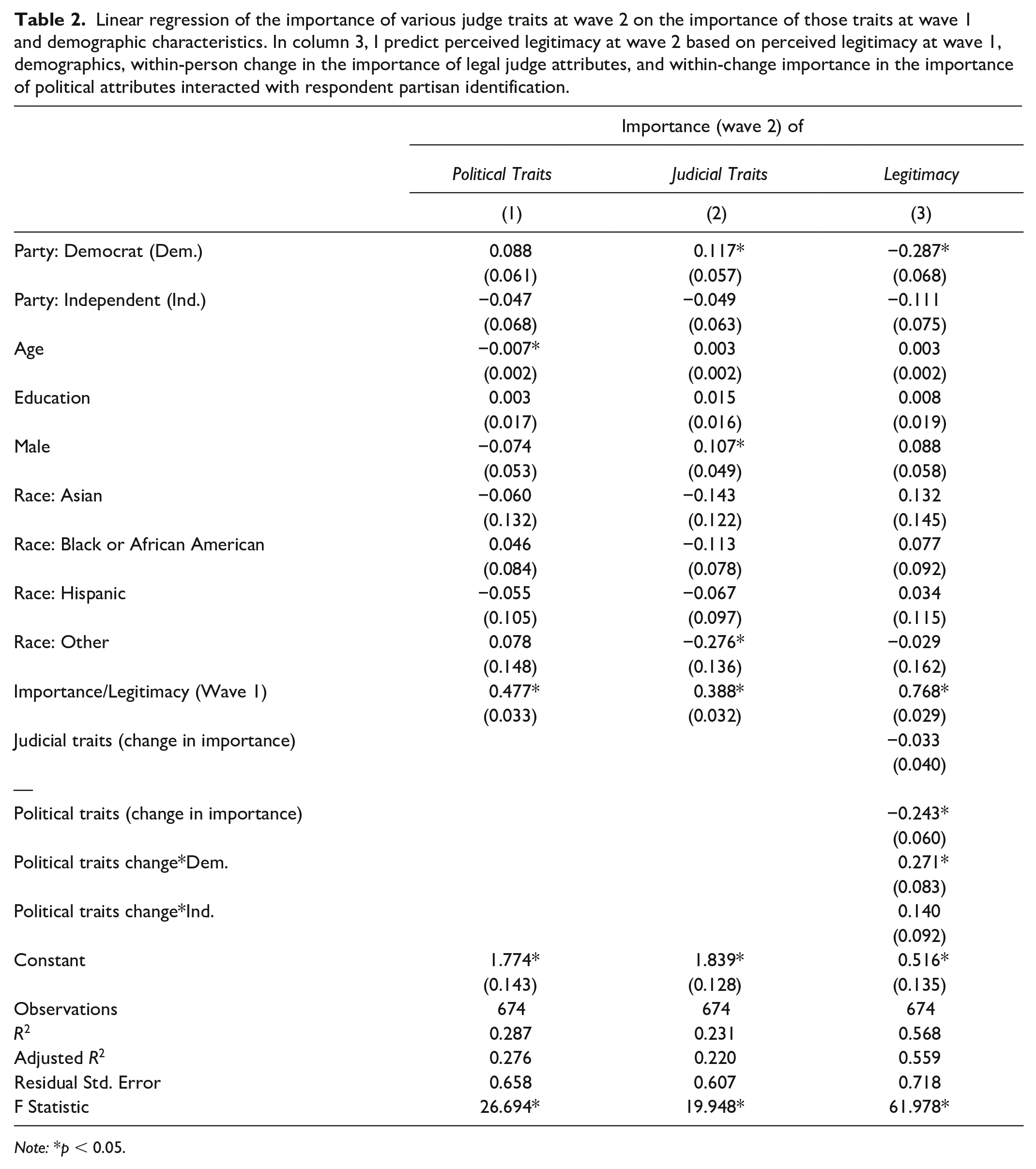
Now consider partisan differences as they relate to individual-level changes in the perceptions of various judge characteristics using multivariate regression analysis. I estimate two multivariate regression models and report their results in columns one and two of Table 2. The Political Traits model regresses the importance respondents place on the explicitly political characteristics (political experience, ideology, and partisanship) at wave 2 on respondents’ party identification, age, education, race, sex, and the average importance they placed on explicitly political traits at wave 1. 22 The Judicial Traits model uses the same model specification, but this time looks at the average importance of explicitly legal characteristics (judicial experience and judicial philosophy). We discuss the column three analysis in a moment.
Linear regression of the importance of various judge traits at wave 2 on the importance of those traits at wave 1 and demographic characteristics. In column 3, I predict perceived legitimacy at wave 2 based on perceived legitimacy at wave 1, demographics, within-person change in the importance of legal judge attributes, and within-change importance in the importance of political attributes interacted with respondent partisan identification.
Note: *p < 0.05.
For the first two dependent variables, I find that the importance attributed to a set of judge traits at wave 1 predicts support for those traits at wave 2. There is no evidence, however, that partisanship is related to change in perceptions of political traits. To the extent that partisanship matters, it predicts that confirmation hearings created a significantly greater increase in the perceived importance of legal traits for Democratic respondents, relative to both Republican and Independent respondents. As for the other independent variables, younger people were more likely to rate political characteristics as important following the confirmation process, women were less likely to perceive legal traits as important, and mixed race, native American, and Polynesian individuals were less likely to think judicial traits were important following the confirmation hearings.
Thus far, we see that the combination of partisan cues and partisan descriptions of the Court influence legitimacy. Separately, we see a general increase in support for evaluating judges based on legal characteristics. This suggests that descriptions of the Court using legal frameworks—regardless of their sentiment—lead the public to emphasize legal criteria in their evaluations of judges. Are changes in perceptions of Court legitimacy and changes in the criteria by which the public evaluates judges connected, or are they separate processes?
To answer this question, I first considered the correlation between within-person change in support for evaluating judges based on legal qualities (importance of Judicial Traits at wave 2 minus importance at of those traits at wave 1) and within-person change in Supreme Court legitimacy (again, subtracting perceived Legitimacy at wave 1 from the wave 2 legitimacy score). The correlation is negative and statistically significant. This suggests that the reason for reduced legitimacy is that people hold the Court up to a higher legal standard. The result is not robust, however. In column three of Table 2, I predict legitimacy at wave 2 based on legitimacy at wave 1, the interaction between within-person change in the importance of political judge traits and respondent party identification, the within-person change in the importance of legal judge traits, and the usual set of control variables. 23 The within-person change in Judicial Traits variable is no longer statistically significant in the full model.
What seems to matter most is how people change in their views of Political Traits. The more people emphasize the political aspects of a judge over the course of the confirmation hearings, the less legitimacy they attach to the Supreme Court over the course of the hearings. This is consistent with Gibson and Caldeira’s (2009a) finding that political advertisements during Justice Alito’s appointment process harmed views toward Justice Alito. In other words, positivity bias theory may explain some of the connection between legitimacy evaluations and judge evaluations. But not completely.
When we interact the change in Political Traits variable with respondent Party identification, the effect disappears among Democrats. So, for Democrats, (1) legitimacy reduced and (2) they became more focused on the legal characteristics of judges, but (3) these two things occurred independently. For Republicans, change in perceived Court legitimacy was predicted by change in evaluative criteria consistent with positivity bias theory. To understand the differences between Republicans and Democrats, I predicted levels of legitimacy holding most variables at their mean or mode, and varying change in support for political traits from its minimum to maximum, for both Republican and Democratic respondents. The results suggest that an increase in focus on political traits 24 during the hearings led some Republicans to equal Democrats in their low level of perceived legitimacy at wave 2. Democrats were predicted to have low levels of legitimacy at wave 2 regardless. 25
The findings presented in this article are consistent with my theoretical expectations. Democrats were more likely than Republicans to see the Court as illegitimate but there was no associated increase in preferences for “political” justice (cf. Bartels and Johnston 2012). We observed a general increase in emphasis on evaluating the Court based on legal characteristics among all respondents. Finally, we find that these two processes were connected for Republicans: lesser support for political traits increased perceptions of Supreme Court legitimacy. The processes were unconnected for Democrats: changes in evaluations of judge attributes did not explain the change in their perceptions of Court legitimacy.
Conclusion
Researchers appear to assume that political confirmation hearings lead to a preference for political justice, instead of decreasing such preferences (Bartels and Johnston 2012; Zilis and Blandau 2021). The data presented in this article, relying on a representative survey closely surrounding a political and modern judicial confirmation hearing, strongly suggests otherwise. Amy Coney Barrett’s confirmation hearings harmed the Supreme Court’s legitimacy but also led the public to express greater support for “legal” justice.
These findings have tremendous implications for our understanding of the effects of politicized confirmation hearings and the public’s perception of the judiciary. The nature of even (and perhaps especially) politicized confirmation hearings is that they reinforce legal norms. Elites attack the Court as being too ideological—not because it is insufficiently ideological. In an era of mass partisan polarization, the public takes cues from partisan elites, some of whom attack the Court (leading to a partisan reduction in legitimacy) but all of whom emphasize legal norms (reinforcing the idea that justices should be impartial).
The study adds to our understanding of positivity bias theory and raises important questions about the concept of diffuse support. While this study does not contradict the positivity bias thesis, it does add nuance to it. In particular, it suggests that the influence of legal (or political) symbols depends heavily on the credibility of their messenger or source. In the context of confirmation hearings, co-partisanship seems to drive the extent to which the invocation of political and legal symbolism impacts legitimacy.
In terms of conceptualizing diffuse support, this study suggests that the most used measure of diffuse support does not always operationalize respect for the Court as a legal institution. 26 That is because reduced legitimacy and widespread support for the Court as a legal institution were shown to exist simultaneously. While the confirmation hearing may have led to support for Court-curbing measures (a classic indicator of reduced legitimacy), such support may not reflect accurately a lack of respect for the Court as a legal institution, which is what the measure is meant to operationalize.
I acknowledge that there are some importation limitations to my research design. Most importantly, I analyze data surrounding a single confirmation hearing. It is possible that there is something unique about this confirmation process that influenced the results, although in many ways the hearing and its political context are similar to recent hearings. As it has been for nearly every nominee since 2005, support for the nominee was nearly universal among those of the same party as the president and opposition was substantial among those of the opposite party. The nominee, like nearly every other nominee, received a “well qualified” rating by the American Bar Association. And, unlike other recent nominations, the nominee herself was not marred with ethical and moral accusations.
The nomination of a conservative nominee to replace a liberal nominee is not necessarily unique, and it should bias against finding that the hearing reinforces the legal nature of the Court. The political context surrounding the confirmation also included the fact of proximity to an upcoming election, related political maneuvering in the Senate, and a vague promise by one presidential candidate to at least consider Court reform proposals. Again, if anything this would raise the likelihood of seeing the Court as a political institution if not for the legal content of confirmation hearings. In general, the confirmation process surrounding Amy Coney Barrett seems like a good case study to test a theory that confirmation hearings reinforce notions that the Court should be treated as a legal institution.
Still, scholars should use panel data to consider how confirmation hearings influence views across multiple appointments. Work by Krewson and Schroedel (2020) analyzed whether the public valued the legal characteristics of judges more than political ones shortly after the confirmation of Brett Kavanaugh. They too find that the public largely values the legal characteristics of nominees over explicitly political attributes, but they did not collect information on respondents’ views of judges immediately before the hearings. The lack of research on this important topic suggests the significant challenge of obtaining appropriate, quality data and it highlights the significant contribution this article provides.
Finally, scholars should consider the durability of confirmation effects on both legitimacy and the ways in which people evaluate judges. Even if some shocks to legitimacy are short-lived (Krewson and Schroedel Forthcoming), others point out that frequent drops in legitimacy will eventually erode the Court’s reservoir of goodwill (Gibson, Caldeira and Spence 2005). As for legal norms, what should we make of the effects observed in this study on the importance of legal attributes? Do they represent a permanent change in public attitudes, a temporary change in public attitudes, or even a fleeting priming effect? This is a debated issue in studies of legitimacy, where some authors argue that many effects we find are short-lived (see, e.g., Gibson and Nelson 2014). Unfortunately, this question goes beyond the scope of this study. Yet, it is a vitally important question—and one I strongly urge researchers to consider.
Supplemental Material
sj-pdf-1-prq-10.1177_10659129221094877 – Supplemental material for Political Hearings Reinforce Legal Norms: Confirmation Hearings and Views of the United States Supreme Court
Supplemental material, sj-pdf-1-prq-10.1177_10659129221094877 for Political Hearings Reinforce Legal Norms: Confirmation Hearings and Views of the United States Supreme Court by Christopher N. Krewson in Political Research Quarterly
Footnotes
Declaration of Conflicting Interests
The author(s) declared no potential conflicts of interest with respect to the research, authorship, and/or publication of this article.
Funding
The author(s) received no financial support for the research, authorship, and/or publication of this article.

Notes
Supplemental Material
Supplemental Material available online
References
Supplementary Material
Please find the following supplemental material available below.
For Open Access articles published under a Creative Commons License, all supplemental material carries the same license as the article it is associated with.
For non-Open Access articles published, all supplemental material carries a non-exclusive license, and permission requests for re-use of supplemental material or any part of supplemental material shall be sent directly to the copyright owner as specified in the copyright notice associated with the article.
