




Abstract
Surveys show that Latinos more strongly identify with their ethnic identities (i.e. national origin) than their pan-ethnic identity as “Latino/Hispanic.” Given the primacy of ethnic identity among Latinos, what impact does shared ethnic versus pan-ethnic identity between candidates and voters have on Latino vote choice? Studies suggest that an “identity-to-politics link” exists among Latinos; however, we believe the measurement of “co-ethnicity” should be reexamined. Using a survey experiment embedded in a module of the 2016 Cooperative Congressional Election Study, we randomize the ethnic, pan-ethnic, and partisan identification of a fictional male congressional candidate in a contest against a white non-Hispanic candidate to examine the role of shared ethnic identity on Latino vote choice. We find that Latinos, regardless of candidate partisanship, more strongly support co-ethnic candidates relative to candidates with whom they share a pan-ethnic identity. We also find that Latinos are significantly more supportive of a cross-ethnic Latino candidate compared to a pan-ethnic Latino candidate; and that Latinos are more likely to cross partisan lines to support a co-ethnic candidate. These results not only suggest that there exists a Latino “identity to politics” link, but that the extant scholarship has underestimated the size and scope of this electoral connection.
With few exceptions, scholarship on Latino political behavior has uncovered that the presence of a Latino candidate on the ballot has a positive influence on Latino electoral participation (for a review see Griffin 2014; De la Garza 2004; Fraga et al. 2006; Jones-Correa, Faham and Cortez 2018). More specifically, scholars have found that when given the opportunity to vote for a Latino candidate, regardless of the candidate’s partisanship, Latinos will overwhelmingly do so (Stokes-Brown 2006; Manzano and Sanchez 2010; Barreto 2007a; McConnaughy, White, Leal, and Casellas 2010). Across these studies, it is assumed that 1) “co-ethnicity” is defined by Latinos’ identification with their “pan-ethnic” identity as Latino or Hispanic, and 2) Latinos subsequently rely on this pan-ethnic identity when making political decisions. In short, these studies conclude that an “identity-to-politics link” exists among Latinos, as “co-ethnicity” has emerged as a key factor in accounting for Latino electoral behavior.
However, some scholars contend that while the “identity to politics link” is strong among African Americans, this link may not be replicated in the same fashion when examining Latino electoral behavior (Segura and Rodrigues 2007; Lee 2008). Chief among these scholars is Taeku Lee (2008), who proposes that assessing the link between group identity and political behavior necessitates the recognition of the potentially unique characteristics of the Latino community. In line with Lee’s directive, we note that Latinos, unlike African Americans, 1) hold weak attachments to the “pan-ethnic” identities of Latino and Hispanic and 2) prefer to identify with their ethnic identities (i.e. national origin) when compared to a pan-ethnic identity, leading to questions regarding the applicability of the “identity to politics” framework in studying Latino political behavior (Beltrán 2010; Itzigsohn and Dore-Cabral 2000; McClain, Johnson Carew, Walton, Watts 2009).
The disjuncture between the conventional scholarly definition of “co-ethnicity” and the ways in which Latinos actually identify, opens the door to questions concerning the existence and reach of the “identity to politics link” among Latinos in the United States. What, if any, impact does congruence between a candidate’s ethnic identity and that of a voter, what we define as “co-ethnicity,” have on Latino vote choice? To date, there has been relatively little scholarly exploration of this question (for exception see Michelson 2005). Given the primacy of ethnic identification among Latinos in the United States, we expect that Latinos exposed to a co-ethnic candidate will express greater support for the candidate in question relative to Latinos who are exposed to a pan-ethnic candidate. Additionally, we hypothesize that given the incidence of inter-ethnic tensions among Latinos living in the United States (Bohn 2000; Ochoa 2008; Fraga et al. 2006; Carey et al. 2013; Mallet and Pinto-Coehlo 2018), we expect that when respondents are exposed to Latino candidates whose ethnicity does not match their own, what we call “cross-ethnicity,” that Latinos will exhibit less support for the Latino candidate when compared to Latinos exposed to a pan-ethnic or a co-ethnic Latino candidate.
In testing these hypotheses, we employ an original survey experiment embedded in a module of the 2016 Cooperative Congressional Election Study (CCES), consisting of over 2,000 Latino respondents interviewed during the 2016 general election campaign. In this survey experiment, in order to better assess the role that our measure of “co-ethnicity” plays in vote choice among Latino voters, we randomly manipulate the partisanship, ethnic identification, and pan-ethnic identification of a fictional Latino male congressional candidate who is running against a white non-Hispanic male candidate. We find that Latinos, regardless of the partisanship of the Latino candidate in question, more strongly support Latino candidates with whom they share a co-ethnic identity relative to Latino candidates with whom they share a pan-ethnic identity. Additionally, we find that Latinos are more likely to cross partisan lines to support a co-ethnic Latino candidate in a contest against a white non-Hispanic candidate relative to Latinos exposed to a pan-ethnic Latino candidate who does not share their partisan identity. Surprisingly, we discover that Latinos are significantly more supportive of a cross-ethnic candidate when compared to Latinos exposed to a pan-ethnic candidate. We take these results as evidence of a strong “identity to politics link” among Latinos in the United States. However, contrary to extant studies, we believe that this link is strongest when the connection between the candidate and voter is based on ethnic rather than pan-ethnic identities. Our results further suggest that the continued reliance on pan-ethnic identity to best explain and predict Latino political behavior not only masks a key determinant of Latino vote choice in the United States, but underestimates the size and strength of the “identity to politics link” among the nation’s largest minority group.
Minority Empowerment and Latino Political Behavior
For decades, political scientists have explored how ethnic candidates influence the political behavior of co-ethnic voters (Griffin 2014). Much of the initial work in this literature examined how the presence of Irish or Italian candidates increased perceptions of the material and symbolic benefits associated with voting thereby increasing the vote share these candidates enjoyed from these ethnic communities (Wolfinger 1965; Dahl 1961; Erie 1990; Parenti 1967). In more recent years, the utility of the hypothesis concerning the link between identity and politics has been used to help to account for the political behavior of African Americans in the United States (Griffin 2014). Beginning with Bobo and Gilliam’s (1990) seminal work on minority empowerment, a number of studies have similarly found that the presence of an African American on an electoral ballot yields greater engagement and participation by members of the African American community (Lublin and Tate 1995; Bobo and Gilliam 1990; Tate 1991; Tate 1994; Dawson 1995; Banducci, Donovan, and Karp 2004, Washington 2006; Whitby 2007).
In view of the success of the empowerment hypothesis in predicting African American turnout and vote choice, a number of scholars of Latino political behavior have exploited its utility in accounting for Latino vote choice with the overwhelming majority of these studies concluding that, when given the opportunity, Latino voters prefer to vote for Latino candidates (Barreto 2007a; Stokes-Brown 2006; Manzano and Sanchez 2010; McConnaghy et al. 2010; Michelson 2005). For instance, using a scale of pan-ethnic attachment, Barreto (2007a) finds that Latinos with stronger pan-ethnic attachments are more likely to vote for Latino candidates regardless of partisanship. Stokes-Brown (2006) discovers that respondents who identify as “Hispanic” 1 are more likely to vote for a hypothetical Latino candidate that is equally qualified as their non-Hispanic opponent. Manzano and Sanchez (2010) find that shared pan-ethnic Latino identity between a candidate and voter, measured by shared identification as “Hispanic”, positively affects the likelihood of an electoral preference for a Latino candidate. Additionally, McConnaughy et al. (2010) use an experimental design to test whether shared Latino pan-ethnicity indicated by a fictional candidate’s name leads Latinos to vote for Latino candidates in a fictional city council election.
In each of the above mentioned studies, scholars find clear and consistent evidence of an “identity to politics link” among Latino voters as respondents who identify as Latino or Hispanic are more likely to support a Latino candidate when given the opportunity to do so. Others, such as Lee (2007; 2008), have challenged the assumption of an “identity to politics link” for Latinos citing the relatively weaker levels of group identification and consciousness among Latinos. Indeed, a number of recent studies of the racial identification of members of the Latino community have concluded that Latinos more strongly identify with their ethnic identities when compared with their pan-ethnic identity as Latino (Rodriguez 2000; Landale and Oropesa 2002; Golash-Boza 2006) and that Latinos hold weaker perceptions of “linked fate” to other Latinos when compared to other racial and ethnic groups (Sanchez 2006; Burnside and Rodriguez 2009; Sanchez and Masuoka 2010; Gay, Hochschild, White 2016; Segura 2012).
While studies of Latino vote choice have illuminated the key determinants of Latino political behavior, it is important to note that these studies measure Latino identity as the congruence between a voter and a candidate’s pan-ethnic identities. For example, Manzano and Sanchez (2010) in defining “co-ethnicity”, ask Latino survey respondents if they are “more likely to vote for a Hispanic/Latino candidate instead of a non-Hispanic/Latino running for the same office” (p. 572). As we detail below, we take issue with the use of pan-ethnic identities as the most precise measure of Latino identification and as the most appropriate means by which to test the impact of shared identity on Latino political behavior. We believe that the use of pan-ethnic labels may mask the impact that the presence of a co-ethnic candidate on the ballot has on Latino vote choice in the United States, thus underestimating the extent and influence of the “identity to politics link” among Latinos.
Re-Defining Latino Co-Ethnicity
We argue that a key theoretical problem with the extant scholarship on Latino political participation concerns its definition of “co-ethnicity.” In line with scholarship on African Americans, in much of the work on Latino vote choice the presence of a Latino candidate on the ballot, irrespective of the candidate’s ethnic background, is viewed as an opportunity for Latino voters to support a co-ethnic candidate. We view this assumption as problematic. First, at the heart of this assumption is the belief that Latinos, like African Americans, identify in a pan-ethnic fashion. This assumption of a strong pan-ethnic identification belies the fact that most Latinos identify most strongly with their ethnic identity (Rodriguez 2000; Landale and Oropesa 2002; Golash-Boza 2006). For instance, in a 2017 Pew Research Center survey, 50% of Latinos self-identified with their country of origin, while only 23% of Latinos saw themselves as “Latino/Hispanic” and 23% identified themselves primarily as “American” (Lopez, Gonzalez-Barrera, and Lopez 2017).
Weaker attachments to a pan-ethnic identity may be a reflection of the history of how these labels emerged. Rather than originating from the migrant and immigrant communities who trace their origins to Spanish speaking nation-states, the label “Hispanic” was first used during the 1970 decennial census, and then adopted by U.S. governmental agencies in an effort to homogenize varied ethnic groups and identities living in the United States (Mora 2014; Oboler 1995; Padilla 1985). In so doing, the U.S. government created a widely employed identity, but as noted by a number of scholars of Latino identification, this relatively new pan-ethnic identity is thought to have less substantive, symbolic, and emotional meaning when compared to an individual’s ethnic identity (Beltrán 2010; Itzigsohn and Dore-Cabral 2000; Landale and Oropesa 2002; Le Espiritu 2016; Oboler 1995; Padilla 1985; Rodgriguez 2000).
Given the preference for the use of ethnic identities among Latinos living in the United States, in this paper we define “co-ethnicity” as the shared attachment and identification with a national origin or ethnic identification between a Latino candidate and voter (Weber 1918). On the other hand, given the fact that a non-trivial portion of the Latino community do identify as either “Hispanic” or “Latino,” we define “pan-ethnicity” as the shared attachment or identification with the Latino or Hispanic community as expressed by a common identification as “Latino” or “Hispanic” between a Latino voter and a Latino candidate. Finally, we define “cross-ethnicity” as the incongruence between the ethnic identity of a Latino voter and the ethnic identity of a Latino candidate such that the voter and candidate in question trace their familial origins to distinct nation-states.
We distinguish between co-ethnicity, pan-ethnicity, and cross-ethnicity because we believe that each of these relationships between a voter and a candidate provides distinct contextual information to Latino voters that assist voters in making an electoral decision. While we believe that pan-ethnicity provides voters with a contextual cue that the candidate will seek to effectively represent the interests of Latinos as a community, we argue that co-ethnicity, in line with the patterns seen among of past generations of European immigrants and among African Americans today, operates as a cognitive shortcut for Latino voters (Wolfinger 1965; Dahl 1961; Erie 1990; Parenti 1967; Bobo and Gilliam 1990; Fairdosi and Rogowski 2015). More precisely, we believe that the presence of a co-ethnic candidates, more so than the presence of pan-ethnic candidates, leads Latino voters to more strongly believe that the candidate in question will provide particularized material and symbolic benefits to the voter and their ethnic community once in office. The expectation that a co-ethnic candidate will prioritize the interests of their ethnic community is a core component of scholarship on the political consequences of ethnicity, and thus we expect that co-ethnic candidate will be more attractive to a prospective voter relative to a pan-ethnic candidate (Weber 1918; Horowitz 1985).
On the other hand, we believe that cross-ethnicity between Latino candidates and voters provide additional information to voters above and beyond the information communicated by pan-ethnicity between a voter and a candidate. Whereas pan-ethnicity may provide a cue to a voter that the candidate in question will represent the broader Latino community, we contend that the presence of a cross-ethnic candidate for some voters primes the history of ethnic tensions and competition for scarce resources that has characterized relations between Hispanic ethnic groups in the United States. This contextual cue and associated prime then leads the voter in question to surmise the candidate will indeed provide more particularized substantive benefits to members of the candidate’s own ethnic community at the expense of the voter’s ethnic community (Ochoa 2008; Horowitz 1985; Padilla 1985; Bohn 2000; Fraga et al. 2010; Carey et al. 2013; Mallet and Pinto-Coehlo 2018). As a result, the cues provided by a cross-ethnic candidate may be more deleterious and could potentially decrease the level of electoral support relative to the presence of a pan-ethnic or co-ethnic candidate.
Expectations
In this paper, we explore whether the ethnic diversity seen in the Latino community, coupled with the stronger ethnic identification exhibited by large numbers of Latino voters, leads these voters to more strongly respond to co-ethnic rather than pan-ethnic cues in a fictional congressional election where a Latino candidate is running against a white non-Hispanic candidate. Thus, we hypothesize that an “identity to politics link” does indeed exist among Latinos, but given that a majority of Latinos identify primarily through their ethnic identities, that the link will be strongest for Latinos who share an ethnic as opposed to a pan-ethnic identity with a Latino candidate (H1). We also examine the impact of cross-ethnic Latino candidates, meaning those with an ethnic identity is not the same as the voter’s, on Latino vote choice when compared to co-ethnic and pan-ethnic candidates. Here, we expect that respondents exposed to a co-ethnic or pan-ethnic candidate will more strongly support the candidate in question relative to respondents who are exposed to a cross-ethnic candidate (H2) who is running against a white non-Hispanic candidate.
Studies of Latino partisanship show that most Latinos identify with the Democratic party with the exception of Cuban Americans who mostly identify as Republicans (Alvarez and Garcia Bedolla 2003; De la Garza 2004; Garcia 2016; Hero, Garcia, Garcia and Pachon 2000; Uhlaner and Garcia 2005; Hajnal and Lee 2011). There is evidence that Latino voters support Latino candidates no matter their partisanship (Barreto 2007a and 2007b,2010). However, studies aimed at examining the willingness of Latinos to cross party lines to support a fellow Latino political candidate uncover mixed results (Michelson 2005; Sadhwadi and Mendez 2018). While Sadhwani and Mendez (2018) find that Democratic Latinos are willing to cross party lines in order to vote for a Latino Republican candidate who is running against a white non-Hispanic Republican, Michelson (2005) shows that Latino voters facing a similar slate of candidates in a congressional election were not. Thus, we test two additional hypotheses that assess the interplay of partisanship and ethnicity. First, extending the logic of our initial hypotheses, we also expect that the draw of co-ethnicity will lead Latino voters to more strongly support a co-partisan and co-ethnic candidate at greater levels than Latinos exposed to a pan-ethnic and co-partisan candidate (H3). Second, we similarly expect that Latinos who are exposed to a co-ethnic and cross-partisan candidate will express greater support for this candidate when compared to Latinos exposed to a pan-ethnic and cross-partisan candidate (H4).
Data and Methods
In investigating the impact of co-ethnicity on the electoral preferences of Latino voters in the United States we employ data from a survey experiment embedded in a module of the 2016 Cooperative Congressional Election Study (CCES). The CCES is an online survey of over 64,000 American adults conducted via YouGov on behalf of over 50 colleges and universities. The CCES gathers a representative sample of respondents of “opt-in” volunteers from the YouGov database using data culled from the United States Census Bureau, voter registration databases, the Pew U.S. Religious Landscape Survey, and the Current Population Survey. This collaborative study has been shown to produce estimates similar to telephone and mail surveys (Ansolabehere and Schaffner 2014). The 2016 CCES was in the field in September and October of 2016 (pre-election), and re-interviewed respondents in November of 2016 (post-election). 2
2016 CCES Latino module respondents by Ethnic identity.
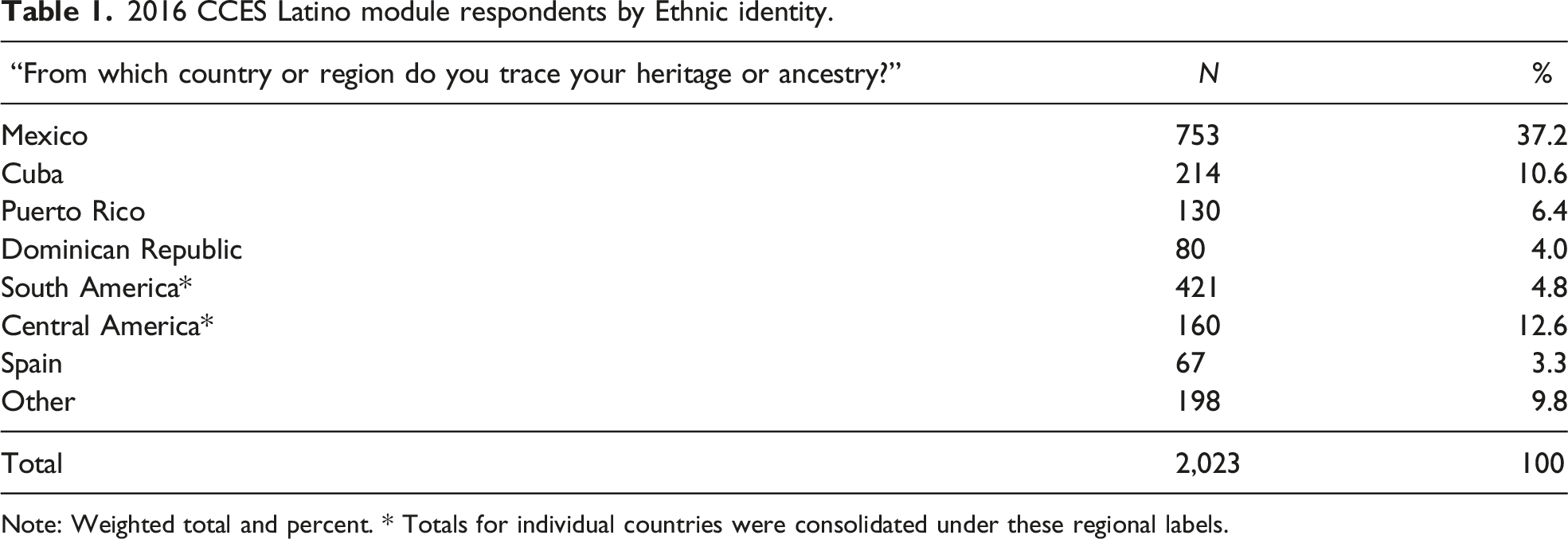
Note: Weighted total and percent. * Totals for individual countries were consolidated under these regional labels.
Respondents were randomly assigned to one of eight experimental conditions in the pre-election portion of the 2016 CCES Latino Module. In each condition, respondents were asked to indicate their candidate preference in an upcoming congressional election that was scheduled to take place in the fall of 2016 in Colorado’s fictional 8th Congressional District. We selected the state of Colorado to serve as the location of this fictional election for a number of reasons. First, to maximize the external validity of the experiment we selected a state with a large Latino population. In 2016, the state of Colorado had the eighth largest Latino population in the U.S. with one-fifth of the state’s population identifying as Latino (Stepler and Lopez 2016). Second, to guard against a respondent making inferences concerning the ethnicity of our pan-ethnic candidate we sought to select a state with a relatively diverse Latino population. While Colorado has a large Mexican population (66%), this trails states such as California (82%), Nevada (73%), Texas (88%), and Arizona (88%) with similarly large Latino populations making Colorado a strong choice for our experiment.
Our fictional election pits Jake Logan against Jose Martinez for the district’s open seat in the United States House of Representatives. These names were randomly derived from a list of popular Latino and white male first and last names, and are intended to prime the race of each candidate in question (Butler and Homola 2017). The use of stereotypical names to implicitly communicate the race of an individual has been used in countless studies of racial discrimination in housing and employment markets, as well as in recent work that explores the level of responsiveness of state legislators to minority constituents (for a review see Costa 2017). Given the extent of empirical support for this type of experimental design, we are confident that our experiment implicitly primes our respondents to think about the ethnic and pan-ethnic identities of each candidate.
The first experimental manipulation was to vary the partisanship of each candidate in the general election so that in each condition when Logan was portrayed as a Democrat, Martinez was portrayed as a Republican and vice versa (i.e. when Logan was a Republican, Martinez was a Democrat). 3 The central experimental manipulation in each of our eight conditions concerned the ethnicity of Jose Martinez. In the control conditions, respondents were only presented with candidate Jose Martinez who was labeled either as a Democrat or a Republican. In these conditions, we purposely did not speak to the ethnic background of Jose Martinez given the assumption that the use of the name “Jose Martinez” would prime our respondents to view this candidate in pan-ethnic terms. In our subsequent six experimental conditions, we prime our respondents to consider the ethnic identity of Jose Martinez by explicitly referencing the ethnic background of Jose Martinez. To maximize the external validity of our experiment, we selected the three ethnic groups (Mexican Americans, Puerto Ricans, and Cuban Americans) who have historically had a high number of representatives in the United States Congress (Casellas 2010). In the experimental conditions in which the candidate is presented as a Democrat, Jose Martinez is described as either: “Mexican-American Democrat Jose Martinez,” “Cuban-American Democrat Jose Martinez,” or “Puerto Rican-American Democrat Jose Martinez.” In the corresponding set of experimental conditions where the candidate is presented as a Republican, Jose Martinez is described as either: “Mexican-American Republican Jose Martinez”, “Cuban-American Republican Jose Martinez”, or “Puerto Rican-American Republican Jose Martinez.”
To ensure that we have a minimum number of co-ethnic respondents in each condition, we randomly assigned 1/4th of our sample of Mexican American respondents to the experimental conditions where the candidate’s Mexican American ethnicity is made explicit and randomly placed the remaining 3/4th of our sample of Mexican American respondents in the remaining six experimental conditions. 4 We repeated this for our Cuban American respondents in Cuban American Treatments and Puerto Rican respondents in our Puerto Rican Treatments to ensure a minimum number of ethnically congruent respondents in experimental conditions that feature either a Cuban American or Puerto Rican congressional candidate.
Results
Do Latino respondents exposed to a co-ethnic Latino candidate exhibit stronger support for the candidate in question relative to those exposed to a pan-ethnic Latino candidate and those exposed to a cross-ethnic Latino candidate? In line with existing studies of Latino participation, we initially look at support for Martinez in the fictional race against Logan irrespective of the fictional candidate’s partisan identity (Barreto 2010; Fraga 2018), and we restrict our analysis to Mexican American, Cuban American, and Puerto Rican respondents in order to more accurately reflect the ethnic identities used in our experiment. 5
Figure 1 includes three panels showing the average level of support for our fictional candidate Jose Martinez. Each gray dot in the figure represents the mean level of support for candidate Martinez among Latino respondents and we score our dependent variable, vote for Martinez, such that higher scores represent greater support for our fictional Latino candidate who is running against a white non-Hispanic candidate, Jake Logan. We find that respondents who were exposed to an experimental condition in which the Latino candidate in the fictional election was co-ethnic, meaning they shared the same ethnic group identity with the voter, express stronger support for candidate Martinez (b = 0.69, p = 0.0012) compared to Latinos who were in an experimental condition in which candidate Martinez was pan-ethnic (b = 0.57), as shown in the first panel on the left.
6
The middle panel shows that Latinos exposed to a co-ethnic candidate (b = 0.69, p = 0.05) express stronger average support for candidate Martinez relative to Latinos who were exposed to a cross-ethnic candidate (b = 0.64), a candidate with a different ethnic identity than that of the voter. Interestingly, Latinos who were exposed to a pan-ethnic Latino candidate (b = 0.57), show weaker average support for candidate Martinez relative to those who were exposed to a cross-ethnic Latino candidate and this difference attains standard levels of statistical significance (b = 0.64, p = 0.035). Average Level of Support for Martinez by Experimental Treatment, 2016 CCES Latino Module. Vertical Bars represent 95% confidence intervals, and sample sizes appear in parentheses. *** p < 0.001 ** p < 0.01 * p < 0.05, + p<0.10.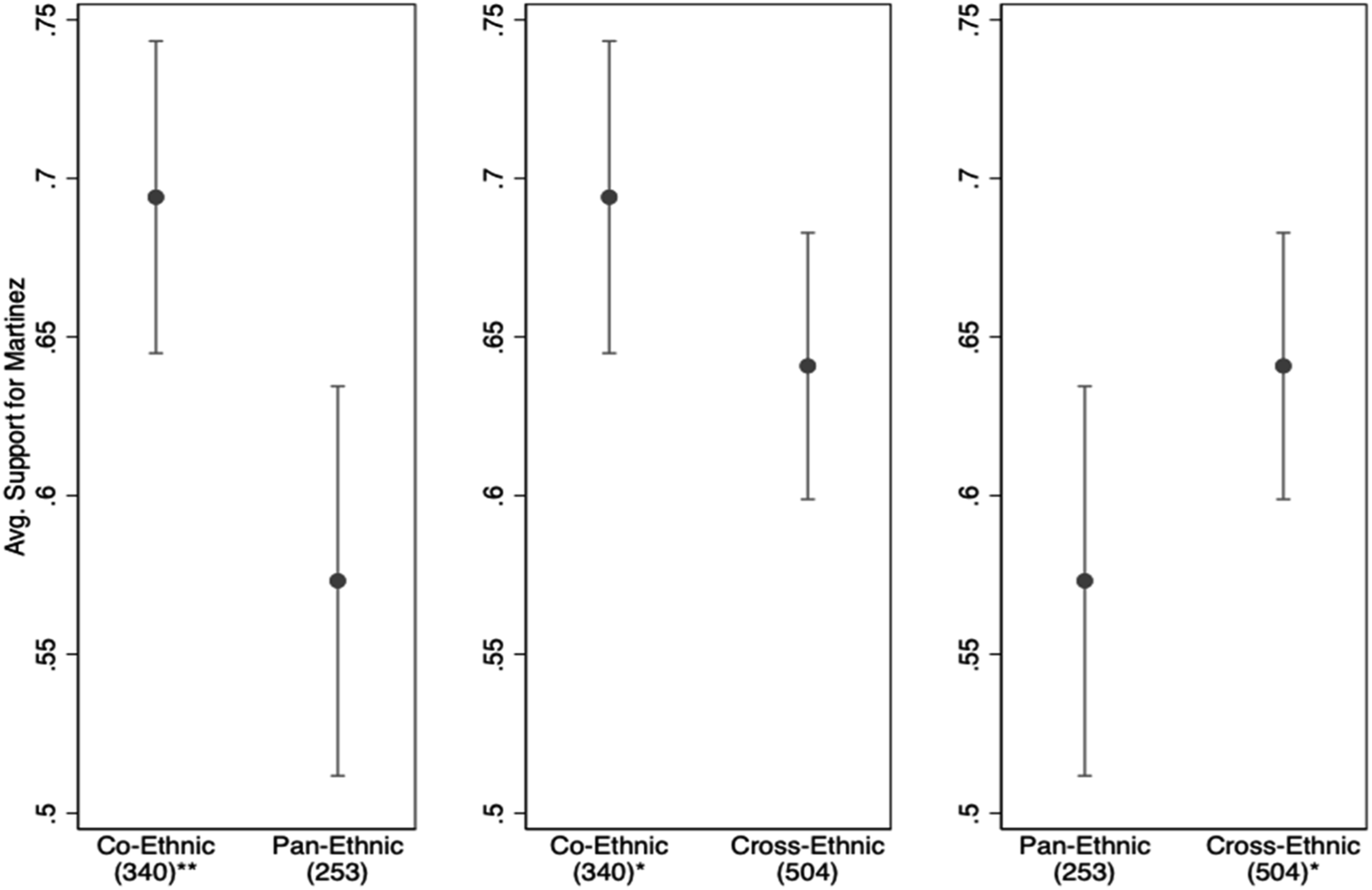
As noted above, in each of our treatments we randomly assigned an ethnic, pan-ethnic and a partisan identity to our fictional Latino candidate which allows us to explore if the partisanship of the candidate influences the vote choice of Latino respondents exposed to either a co-ethnic, pan-ethnic or cross-ethnic Latino candidate who is running against a white non-Hispanic male candidate. We first hypothesize that “co-ethnicity” will mobilize Latinos to more strongly support a co-ethnic candidate, relative to a pan-ethnic candidate, when the candidate in question shares the partisan identity of the respondent than when the candidate represents the opposing party (H3).
The top panel of Figure 2 explores how shared partisanship shapes the impact of co-ethnicity, pan-ethnicity, and cross-ethnicity on Latino vote choice. The top three panels in Figure 2 illustrate average support for our fictional candidate when Latino respondents are assigned to an experimental condition where Martinez is a co-partisan. In support of our hypothesis, we find stronger levels of support for a co-ethnic and co-partisan candidate (b = 0.91, p = 0.074) relative to a pan-ethnic and co-partisan candidate (b = 0.85) among our sample of Latino respondents. We find little evidence that Latinos differentiate between co-ethnic and co-partisan candidates (b = 0.91, p = 0.236), and cross-ethnic and co-partisan candidates (b = 0.89), nor do they differentiate between pan-ethnic and co-partisan candidates (b = 0.85, p = 0.183), and cross-ethnic and co-partisan candidates (b = 0.89). Average Level of Support for Martinez by Co./Cross-Partisanship between Latinos and Candidates and Experimental Treatment, 2016 CCES Latino Module. Vertical Bars represent 95% confidence intervals, and sample sizes appear in parentheses. *** p < 0.001 ** p < 0.01 * p < 0.05, + p<0.10.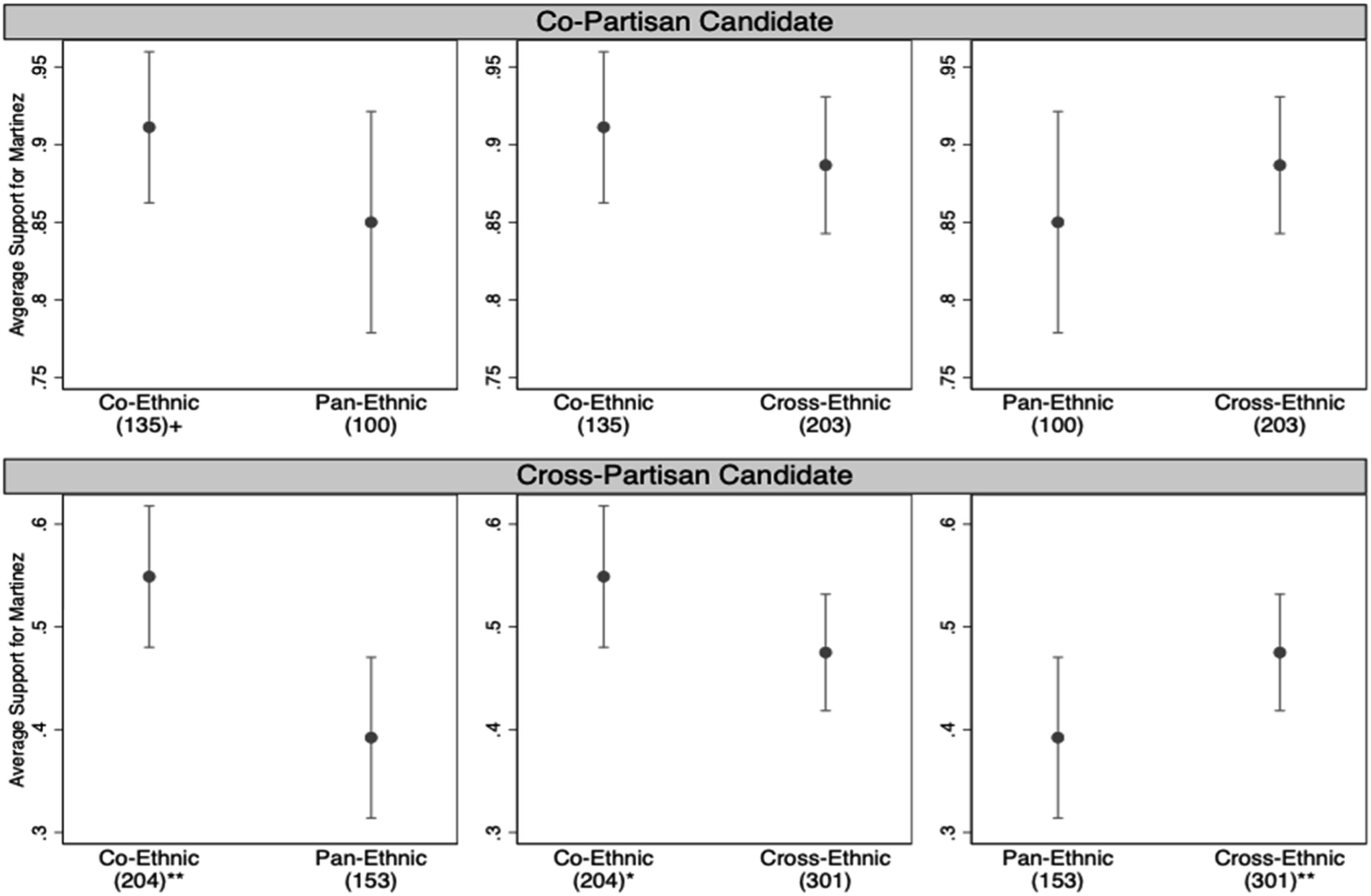
Finally, we hypothesized that voters exposed to a co-ethnic and cross-partisan candidate will more strongly support this candidate relative to Latino voters who are exposed to a pan-ethnic and cross-partisan candidate (H4). The bottom three panels in Figure 2 tests this hypothesis and displays plots of the average support for Jose Martinez when presented as a candidate who does not share the partisanship of the respondents in our experiment. The bottom left panel in this figure shows that average support for candidate Martinez is higher among Latinos presented with a co-ethnic and cross-partisan candidate (b = 0.55, p = 0.002) than among Latinos presented with a pan-ethnic and cross-partisan candidate (b = 0.39) who is running against the fictional co-partisan white candidate Jake Logan. Latinos in an experimental condition with a co-ethnic and cross-partisan candidate (b = 0.55, p = 0.052) also showed higher support for candidate Martinez relative to those in a condition with a cross-ethnic and cross-partisan candidate (b = 0.48), as seen in the bottom middle panel. Additionally, in the bottom right panel of Figure 2 we see that average support for candidate Martinez among Latino respondents exposed to a pan-ethnic and cross-partisan (b = 0.39) is weaker than among those exposed to a cross-ethnic and cross-partisan candidate (b = 0.48, p = 0.048).
Conclusion
The increasing size and influence of the Latino electorate in congressional and presidential elections coupled with a rise in the number of Latino candidates running for Congress has led to a wealth of studies that address the question; what, if any, role does a shared identity play in accounting for Latino political behavior? The conventional wisdom is that Latinos, similar to other minority groups in the United States, are more likely to support Latino candidates when given the opportunity to do so. In this paper, we argue for a distinct shift in how the scholarship on Latino political behavior should define support for Latino candidates expressed by Latino voters. We hypothesize that given that Latinos more strongly identify with their ethnic identity, meaning national origin/ancestry, relative to their pan-ethnic identity as Latino or Hispanic, that when presented with a co-ethnic candidate they will express more support for the candidate in question relative to Latinos who are presented with the opportunity to vote for a pan-ethnic Latino candidate. Using an original survey experiment embedded in a module of the 2016 CCES, we uncover clear and consistent evidence that Latinos when given an opportunity to support a co-ethnic candidate do so, and at higher levels when compared to Latinos exposed to pan-ethnic or cross-ethnic candidates.
Additionally, we find that evidence that co-ethnicity on the one hand bolsters the power of partisanship as co-ethnic and co-partisan candidates elicit greater electoral support when compared to pan-ethnic and co-partisan candidates among Latino voters. While the effect of co-ethnicity on co-partisan candidates appears to be weak, we would note that the conventional wisdom is that voters in general choose to support candidates primarily based on their partisanship (Campbell, Converse, Miller, and Stokes 1960; Green, Palmquist, and Schickler 2002; Hajnal and Lee 2011), and that in spite of the power of partisanship, that co-ethnic candidates still receive a small, but significant, electoral boost relative to pan-ethnic candidates who are co-partisan. On the other hand, we also find that co-ethnicity undercuts the influence of partisanship on candidate preferences among Latinos, as Latinos exposed to a co-ethnic and cross-partisan candidate are more likely to support this candidate relative to Latinos who are exposed to a pan-ethnic and cross-partisan candidate. This finding suggests that co-ethnicity, relative to pan-ethnicity, provides cross-partisan Latino candidates with additional electoral support from the Latino community that they would otherwise not enjoy, an important factor in close electoral contests featuring at least one Latino candidate.
Finally and surprisingly, we find that cross-ethnic candidates mobilize greater support for a Latino candidate when compared to pan-ethnic candidates. Our distinct approach to the study of shared identity between Latino voters and candidates is grounded in the expectation that if Latinos primarily identify on the basis of their ethnic identities they should be more likely to feel in-group affinity (Huddy 2001) toward members of their national origin groups, have a stronger sense of linked fate with their compatriots (Sanchez 2006; Sanchez and Masuoka 2010), be more aware of issues that specifically affect their ethnic group (Fraga 2018), and expect better representation (Wallace 2014) from politicians who share their particular history, language and culture. However, despite our expectation that cross-ethnic candidates would be less appealing to Latino voters we find that they express higher rates of support for cross-ethnic candidates when compared to pan-ethnic ones. What accounts for this contradictory result? We believe that cross-ethnic cues seem to convey additional information, in a similar fashion to co-ethnic cues, and these cues may prime the belief that personal details about the candidate in question that may elicit increased electoral support. For example, knowing the ethnic identity of a Latino candidate who does or does not share the ethnicity of the voter can serve as a heuristic about the candidate’s experience of migration/immigration, Spanish proficiency, regional accent, culture, music, cuisine, the candidate’s connection to their nation of origin, and/or the candidate’s level of assimilation among many other characteristics. This additional information could prime voters to feel greater affinity with cross-ethnic candidates, but also could signal that the candidate is proud of their heritage and is willing to provide the aforementioned information to voters unlike pan-ethnic candidates who may shy away from doing so.
Our results suggest the need to incorporate additional measures of identity in the study of Latino voting behavior. While some have concluded that the “politics to identity” link is missing among members of the Latino mass public, we believe that it was in fact hidden in plain sight. These findings suggest that alongside explorations of the role of pan-ethnicity that scholars of Latino political behavior should also assess the influence of “co-ethnicity” between voters and candidates in their analyses of the key determinants of Latino electoral behavior, particularly in elections that feature at least one candidate who self identifies as a Latino candidate. The decades long focus on pan-ethnic identity to tap the influence of shared identity on Latino political mobilization may mask the political power of co-ethnicity in the Latino community, and we hope that future studies take into account a more diverse set of items to measure the relationship between Latino candidates and voters. We also believe that this approach can assist in the study of other pan-ethnic groups, most notably the electoral behavior of Asian Americans and Americans of Middle Eastern and North African origin. Recent work by Leung (2021) finds evidence of higher levels support for Asian American candidates among voters who shared their national origin than among Asian American voters who did not, and we hope that future studies of minority voting behavior similarly explore the utility of co-ethnicity in these communities.
While our results are important in scholarly examinations of Latino vote choice, we also believe that our results have substantive effects for the strategies and tactics employed by Latino candidates. Given the increasing diversity and geographical dispersion of the Latino community, the in-group tensions among Latino ethnic groups, and the purported ubiquity of the Latino pan-ethnic identity, many candidates may shy away from declarations of their ethnic identity on the campaign trail. Our results indicate that emphasizing one’s ethnic heritage only has positive benefits for Latino congressional candidates. In elections featuring at least one Latino candidate, public declarations of a candidate’s ethnic identity positively mobilize not only co-ethnic voters, but also cross-ethnic voters, when compared to candidates who rely solely on their pan-ethnic Latino identity.
Although our results indicate that co-ethnicity plays an important role for understanding Latino voting, we believe that there is much work to do to better understand the role that shared ethnicity plays in shaping overall Latino electoral behavior. First, while we find that co-ethnicity matters in accounting for Latino political behavior in elections featuring a co-ethnic Latino candidate, we hope that future work explores why voters prefer co-ethnic candidates. In line with the extant work on the politics of ethnic attachments, we believe that the presence of a co-ethnic candidate primes the belief that the candidate on the ballot if elected will provide particularized benefits to the voter’s ethnic community, but additional empirical exploration of this hypothesis is warranted. Our study focused attention solely on three ethnic groups, but left unanswered is whether the power of co-ethnicity travels to other large and growing Latino ethnic groups in the U.S. like Dominicans, Salvadorans and Venezuelans. We hope that future work also explores if Cubans, Mexicans, and Puerto Ricans are unique in the role that co-ethnicity plays in structuring vote choice and if so what factors account for these differences. Relatedly, does the impact of co-ethnicity on vote choice wane in line with the well-documented diminished attachment to ethnic identity among later Latino immigrant generations? Do linked fate and group consciousness help to moderate the effect of co-ethnicity among Latinos in the U.S.? Does the influence of co-ethnicity only extend to vote choice, or are Latinos more likely to turnout for co-ethnic candidates and to exhibit greater political engagement and interest when exposed to a co-ethnic candidate? Finally, do our results “travel” across electoral contests at the local, state, and federal levels or is this effect pertain only to congressional elections? The answer to these questions will help to better understand the Latino identity to politics link and will better illuminate the impact and role of co-ethnicity on Latino political behavior in the United States.
Supplemental Material
Supplemental Material - Finding the missing link? The impact of co-ethnicity, pan-ethnicity, and cross-ethnicity on latino vote choice
Supplemental Material for Finding the missing link? The impact of co-ethnicity, pan-ethnicity, and cross-ethnicity on Latino vote choice by Ivelisse Cuevas-Molina and Tatishe M Nteta in Political Research Quarterly
Footnotes
Acknowledgments
The authors are indebted to Stephen Ansolabehere and Brian Schaffner for their generous support in fielding a module of Latino respondents in the 2016 Cooperative Congressional Election Study and inviting the authors to participate. We would also like to thank Tony Affigne, Melissa Michelson, Francisco Pedraza, Adriano Udani, Betina Cutaia Wilkinson, Sophia Jordán Wallace, and the anonymous reviewers for their insightful comments and suggestions at various stages of this paper.
Declaration of conflicting interests
The author(s) declared no potential conflicts of interest with respect to the research, authorship, and/or publication of this article.
Funding
The author(s) received no financial support for the research, authorship, and/or publication of this article.

Supplemental Material
Supplemental material for this article is available online.
Notes
Author Biographies
References
Supplementary Material
Please find the following supplemental material available below.
For Open Access articles published under a Creative Commons License, all supplemental material carries the same license as the article it is associated with.
For non-Open Access articles published, all supplemental material carries a non-exclusive license, and permission requests for re-use of supplemental material or any part of supplemental material shall be sent directly to the copyright owner as specified in the copyright notice associated with the article.
