



Abstract
This article examines the effects of committee specialization and district characteristics on speech participation by topic and congressional forum. It argues that committee specialization should increase speech participation during legislative debates, while district characteristics should affect the likelihood of speech participation in non-lawmaking forums. To examine these expectations, we analyze over 100,000 speeches delivered in the Chilean Chamber of Deputies between 1990 and 2018. To carry out our topic classification task, we utilize the recently developed state-of-the-art multilingual Transformer model XLM-RoBERTa. Consistent with informational theories, we find that committee specialization is a significant predictor of speech participation in legislative debates. In addition, consistent with theories purporting that legislative speech serves as a vehicle for the electoral connection, we find that district characteristics have a significant effect on speech participation in non-lawmaking forums.
Introduction
Congressional speeches offer legislators an important channel to convey information, signal their preferences, and draw attention to issues that matter to them. Typically, the targeted audience is a combination of constituents, peer legislators, and party leaders. Some speeches are delivered as part of legislative debates addressing a bill or a resolution and, as a result, focus primarily on the topic at hand, while others are delivered in forums where legislators have greater leeway to choose a topic. In addition, speech participation is often regulated in some manner. For instance, restrictions may stipulate that the speech be germane to the topic of the bill being debated, allocate a maximum time to each intervention, determine how many speakers can participate, or identify who has the power to decide who will speak. Norms may also affect the organization of legislative speech, giving some legislators priority over others.
Previous evidence from the U.S. Congress has shown that expertise, specialization, institutional power, and electoral incentives affect who speaks on the chamber floor. These effects are manifested in different manners, such as in norms that prioritize speeches from senior members, in the allocation of speaking opportunities by committee leaders during the so-called controlled time, and in the one- and five-minute speeches often utilized by marginalized legislators to raise issues of concern to them (Rocca 2007; Rybicki 2008). However, we know less about speech participation in other presidential countries and whether insights from the existing literature about specialization and the electoral connection extend to other settings.
This study examines the effect of committee specialization and district traits on speech participation. Informational theories, which originated in the study of the U.S. Congress, build upon the observation that legislatures address a variety of complex policy matters and that members of congress differ in their competencies and inclinations to tackle the various issues they face (Krehbiel 2004). Thus, the standing committee system was developed to meet the challenge of organizing legislative business in a way that taps the expertise of legislators and fosters specialization (Gilligan and Krehbiel 1987; Krehbiel 1991). One expectation from this theoretical perspective is that effective legislatures will induce committees to specialize and share policy-relevant information with the chamber. If that is the case, we should be able to find evidence for it in legislative speech. More specifically, if legislatures and parties utilize the committee system as a source of information, drawing on the policy expertise of their members, this should be reflected in differing rates of participation during legislative debates, depending on the issue at hand and the jurisdictional specialization of individual members.
In addition, theories of legislative speech have underscored the importance of electoral incentives (Proksch and Slapin 2015). If the individual reputations of legislators are electorally important, the argument goes, there should be few constraints on speech participation to facilitate opportunities to use legislative speech for electoral purposes. However, the informational needs of the chamber and parties’ concerns about conveying a cohesive message can clash with the desire to use speech to target electoral constituencies. Organizational arrangements that create alternative forums for speech participation within the chamber can resolve this dilemma (Alemán et al. 2017). Therefore, the effect of electorally relevant district characteristics on speechmaking will likely vary according to the forum. For example, settings dedicated to non-lawmaking speeches, which give members of congress greater latitude in choosing the topic of their talk, should be more conducive to constituency-focused behavior than legislative debates, where parties have a greater concern with conveying a consistent message and the chamber is more likely to benefit from policy-relevant information (Alemán et al. 2017).
Constituency-focused speechmaking is vital to legislators elected in candidate-centered electoral systems. They can use speeches to address policy matters important to constituents, show concern for the well-being of the district’s businesses and labor organizations, and praise relevant individuals or groups in their districts (Dockendorf 2018; Ishima 2020). Modeling speech topics can help assess the consequences of the electoral connection and the congruence between constituency traits and representation (Quinn et al. 2010). If district-level factors do indeed shape speechmaking, we should be able to find supporting evidence by investigating its content.
Our analysis of speech participation across different settings and topics focuses on Chile. Like the U.S. House of Representatives, the Chilean Chamber of Deputies has forums for both legislative debates and non-lawmaking speeches and an electoral system that promotes personal vote-seeking strategies. Interestingly, rules establish an open forum for bill debates, which means that systematic differences regarding speech participation in this setting are likely to reflect partisan and chamber norms rather than codified provisions. The empirical section analyzes 113,696 speeches delivered over 28 years and topic-coded along the lines of the coding scheme provided by the Comparative Agendas Project (Bevan 2019).
The contributions of this article are three-fold. First, we evaluate the implications of committee specialization for speechmaking and how informational signals vary according to the congressional forum where the speech is delivered. By doing so, we expand our understanding of the functioning of the committee system in presidential countries beyond the U.S. Congress and evaluate a central implication of institutional effectiveness. Second, we apply a recently developed state-of-the-art multilingual Transformer model, XLM-RoBERTa (Conneau et al. 2019; Liu et al. 2019), to carry out our topic classification task. Unlike other machine-learning techniques, XLM-RoBERTa is pre-trained in a large corpus to produce contextual meaning from each word and overall better predictive performance. To our knowledge, this is the first use of XLM-RoBERTa to topic-code political text (and the first to do so in Spanish). Third, we utilize the information on speech topics to evaluate the congruence between district-level factors and political representation. Previous studies analyzing this association have typically focused on other types of legislative behavior, and the few addressing speechmaking have mostly looked at aggregate data (i.e., not disaggregated by topics) or concentrated on a single topic.
The rest of this article is divided into six parts. The first briefly reviews previous works on legislative speech and the implications of informational theories for speech participation and presents our first set of hypotheses. The second section describes the specifics of the Chilean case and presents our second set of hypotheses focused on the electoral connection. The third part discusses our data collection strategy. The fourth describes the variables and models used to test our hypotheses. Results are presented in the fifth part of the paper, where we discuss the effect of our key variables across different topics in the two speech forums. Lastly, we summarize the implications of our findings in a short conclusion.
Speech Participation
Legislative speech is one of the tools legislators have at their disposal to communicate their positions on various issues. It is helpful for legislators seeking to connect with particular constituencies and parties expecting to create a brand that voters recognize. When electoral rules promote personalized vote-seeking strategies, legislators have incentives to use speeches to enhance their reputations with voters. Accomodating both leadership's interest in protecting the party brand and legislators’ need to develop a personal identity with voters is not easy. It is, in fact, a perpetual challenge for parties to find the right mix of loyalty and acceptable dissent that produces electoral benefits (Alemán et al. 2017; Lindstädt et al. 2011). Proksch and Slapin (2010) argued that electoral incentives influence the organization of legislative speech. They expected parties to impose fewer constraints on legislators’ speech participation when individual reputations are more electorally salient and greater control when presenting a cohesive party message is more valuable. Cross-national evidence from a sample of advanced economies supports these expectations (Proksch and Slapin 2015).
Other works have analyzed within-chamber differences. For example, Giannetti and Pedrazzani (2016) examined the Italian Chamber of Deputies and stressed the presence of different rules for debates on ordinary bills and law decrees. They noted that in the former, parliamentary rules establish a closed forum with restricted access to floor debates, while in the latter, rules establish an open forum with unrestricted participation. In the U.S. House of Representatives, bill debates often occur under restrictive rules that limit participation, although open rules are also an option. In addition, there are less-regulated forums where non-lawmaking speeches can be delivered, such as special-order addresses and one-minute speeches. Rocca (2007) found that in contrast to bill debates, one-minute speeches are dominated by institutionally disadvantaged legislators (e.g., freshmen and backbenchers), while more mainstream party members participate more actively during special orders. In the case of Chile, there is also a forum for non-lawmaking speeches (hora de incidentes). Previous studies have shown that backbenchers, members from more peripheral districts, and women are more likely than others to deliver non-lawmaking speeches, while legislators with higher tenure and members of key committees speak more often during legislative debates (Alemán and Micozzi 2021; Alemán et al. 2017; Gamboa and Toro 2018).
Studies have also analyzed the content of legislative speeches to derive information about the political positions of legislators (Proksch and Slapin 2010; Schwarz et al. 2017), gender differences (Bäck et al. 2019; Vallejo Vera and Gómez Vidal 2021), and variations across parties regarding word usage (Tucker et al. 2020), among other matters. Although this literature has become more prominent in recent years, it remains relatively thin regarding theoretical expectations of speech participation across different policy topics.
The importance of using information about speech participation across topics to answer questions about legislative institutions, the electoral connection, and policy representation is underscored by Quinn et al. (2010), who estimated the substance of topics in the U.S. Senate from 1997 to 2004. While those authors focused primarily on the estimation procedure and its validity, they also reported participation rates across topics and found that committee membership significantly impacts debate participation, that first-time members are less likely to participate in more technical issues, and that members of the minority speak more often (Quinn et al. 2010). These findings relate to previous works on party norms (i.e., committee deference and apprenticeship), expertise, and institutional constraints in the U.S. Congress (Fenno 1978; Hall 1996; Matthews 1960).
Cross-national evidence has been consistent with the notion that committee membership matters for speech participation. For instance, Proksch and Slapin (2015) surveyed political groups in the European Parliament to identify factors influencing the allocation of speaking time and found that membership in the responsible committee was the most critical. Evidence from European parliamentary countries also supports the notion that belonging to the committee with jurisdiction over the bill increases speech participation on related topics (Giannetti and Pedrazzani 2016, Schwarz et al. 2017).
Beyond the previously mentioned work of Quinn et al. (2010), empirical evidence relating committee membership to speechmaking in presidential countries is relatively scant, mainly deriving from work examining the prominence of committee chairs. For example, in Argentina, Ecuador, Mexico, and the U.S., committee chairs deliver more speeches than others, while in Brazil and Chile, the difference is not significant (Bäck et al. 2021).
Legislatures in presidential countries tend to operate in a relatively decentralized fashion, giving committees an important role in lawmaking. In most, committees are endowed with significant advantages over legislation, and committee members possess some formal powers over speech participation on the chamber’s floor. The practice manual of the U.S. House of Representatives, for instance, includes provisions giving members of the reporting committee priority in recognition during bill debates (Rybicki 2008). Such rules are not standard in other countries, but committee membership remains a relevant factor influencing speechmaking elsewhere. Nevertheless, the underlying reasons for committee influence are often left undiscussed in the speechmaking literature, and, for the most part, neither the role of specialization nor the need for policy information has been addressed.
Theories of legislative organization illuminate the reasons committee membership affects speech participation. Gilligan and Krehbiel (1987) started from the premise that specialization by committees helps the chamber obtain information about the consequences of alternative policies. Consequently, it makes sense for legislatures to coordinate committee appointments considering their members’ talents—who can specialize at a low cost due to their prior experience or interest (Krehbiel 1991, 136). Kim and Patterson (1988) argued that this norm of specialization is universal in legislatures because individual members lack enough information and expertise to address all relevant policy issues knowledgeably. The view that committees are vehicles of specialization has extended to both presidential and parliamentary countries (Mattsom and Strom 1995, Shepsle 1988).
Committee service enhances the expertise of legislators by providing them with access to informational resources, opportunities for learning, and contacts with related interest groups (Olson and Rogowski 2020). In this sense, it nurtures specialization. For example, Fernandes et al. (2019) showed how parties in the Portuguese Parliament use committees as training arenas for their MPs, assigning members based on their previous expertise (especially in high-salience committees) and then relying on those members for information during debates. Other scholars have discussed possible inducements to encourage committees to specialize and provide policy-relevant information to the chamber, such as restrictive amendment rules, staff and budget, and a norm of deference (Diermeier 1995; Gilligan and Krehbiel 1987; Krehbiel 1991).
Committee Membership and Legislative Debates
Two ways in which committee members convey informational signals to the chamber are through the committee report associated with the bill at hand and the related speeches delivered on the floor of the chamber. As Mattson and Strom (1995, 253) noted, these recommendations reflect “both the preferences of members and their estimates of the effectiveness of various policy options.” The latter is valuable information to the rest of the membership.
The informational signals conveyed by committee membership are unlikely to be manifested in all speeches. Instead, they should be particularly prevalent during legislative debates (when addressing bills, resolutions, or during interpellations), when a critical audience is the membership at large and the party leadership. In other words, if specialized committees are a tool that allows the legislature to attain a collective good—the benefits of expertise—then the signals committee members send to this critical audience should be manifested when the chamber makes collective decisions on policy matters. 1 This leads us to our first hypothesis:
Committee Membership and Non-Lawmaking Speeches
In forums dedicated to non-lawmaking speeches, in which members have the discretion to choose what to talk about, there are no collective policy decisions to make, and the audience is primarily constituents. As a result, these speeches are less likely to convey policy-related information to the chamber at large or programmatic party positions. Instead, they allow legislators to call attention to particular topics. However, this does not mean that committee membership is inconsequential for speech participation in this forum.
Because committee assignments most often reflect a legislator’s interests, we should observe non-lawmaking speeches centered on topics associated with one’s assignment. A member’s interests might be unrelated to district characteristics. For example, a legislator interested in health issues would likely seek an assignment on the Health Committee, regardless of her district’s attributes on this topic. Therefore, when considering non-lawmaking speeches, committee assignment serves as a proxy for a member’s interest. In other words, committee membership is likely to be associated with the prospect of delivering non-lawmaking speeches, but the underlying rationale is different from the one promoting speech participation in lawmaking debates. This is our second hypothesis:
District Level Factors and Speech Forum
Committee membership is not the only variable likely to generate different participation rates in the two analyzed forums. As previously noted, settings for non-lawmaking speeches tend to allow members of congress greater latitude to engage in constituency-focused behavior than those dedicated to lawmaking debates, wherein parties are more concerned about conveying a consistent message and tapping membership specialization. In addition, earlier works have shown that institutionally disadvantaged legislators are more likely than others to participate in non-lawmaking forums, where they can choose their speech topic with an eye towards enhancing their reputation with voters (Alemán and Micozzi 2021; Rocca 2007).
Furthermore, during lawmaking debates, and especially in the presence of strict germaneness rules, speeches must focus on the topic of the bill being discussed, limiting constituency targeting. As a result, district-level factors should have a greater explanatory force in predicting speech participation in non-lawmaking settings than bill debates. This implication is particularly relevant for our understanding of how legislative speech is used for constituency representation.
Scholars have largely utilized aggregated data when examining constituency effects (Gamboa and Toro 2018; Lin and Osnabrügge 2018). However, speech data disaggregated by topic offer advantages. First, it allows us to analyze more closely the congruence between constituency characteristics and representation (Ishima 2020; Quinn et al. 2010). Second, it allows us to examine whether these representational linkages vary according to the forum in which speeches take place and the topic at hand.
To this end, we examine the effect of two district traits: the relative proportion of rural versus urban population and the center versus periphery geographical location. Our hypotheses linking speech participation in specific topics to these two district-level characteristics are derived from the politics of the country we study: Chile. The following section discusses this case and specifies several testable implications about speech participation on specific topics based on these district characteristics.
Legislative Speeches in Chile
Our analysis focuses on Chile, a democratic presidential country with an institutionalized Congress composed of professional legislators. During the period analyzed for this article, 1990–2018, legislators were elected under rules that emphasized candidates’ personal characteristics, and reelection rates were among the highest in the region, comparable to those of Western European countries. Most legislators belonged to one of two cohesive coalitions: the center-right Alianza and the center-left Concertación (later renamed Nueva Mayoría). 2 During most of these years, the presidency was in the hands of the center-left coalition, except between March 2010 and March 2014, when the president was from the center-right coalition.
The agenda-setting power of the Chilean president is vast, which has led many to conclude that the balance of institutional power is tilted too strongly in the executive’s favor. However, despite the many prerogatives in the hands of the executive, three factors enhance the legislative role of congress. First, presidents typically lack control of both chambers of congress, and qualified requirements to pass bills on important policy areas exacerbate their need to bargain (Aninat 2006). Second, the Chilean Congress stands out compared to other legislative bodies in Latin America for its institutional capabilities, which is why it is typically classified as among the most effective and influential in the region (Palanza et al. 2016; Saiegh 2010). Third, the Chilean Congress has a largely professionalized membership, manifested in its members’ tenure and reelection rates (Huneeus et al. 2006; Palanza et al. 2016). Chilean legislators are also among the best paid in Latin America. 3 Generous salaries enhance the incentive to build a legislative career.
The primary setting in which the policy influences of Chilean legislators manifest themselves is in committees. Consistent with informational theories, the assignment of legislators to committees tends to be guided by members’ traits, such as prior experience and interests. For instance, Navia and Mimica (2021) showed that Chilean legislators were more likely to serve in committees that matched their academic degree. Furthermore, legislators’ surveys conducted by the Latin American Elites project of the University of Salamanca (Alcántara 2019) showed that close to 69% of respondents seek assignment to a committee according to their knowledge about the topics under the committee's purview. Another 23% of respondents expressed that deputies tend to seek a position in a committee that deals with issues relevant to their districts, while the marginal remainder affirmed that assignment is solely at the party’s discretion.
Comparative analyses of the role of committees in Latin America have consistently stressed the capabilities and technical expertise of committees in the Chilean Congress (Palanza et al. 2016; Saiegh 2010) and the relative stability of assignments (Huneeus et al. 2006). Surveys of legislators have shown that around 85% of respondents report that committee work is decisive, while 80% report that committee assignments provide some or a lot of influence over the work performed (Alcántara 2019). Furthermore, committee work is considered by 76% of members to be “the most attractive” aspect of their work (Huneeus et al. 2006).
Specialization is also promoted by institutional privileges, resources, staff, and norms of deference. Unfortunately, comparative data on the resources and staff of Latin American congressional committees are not yet available. However, we know that Chilean deputies enjoy sizeable personal staffs 4 and have at their disposal technical resources in the chamber and from the Library of the National Congress of Chile, which provides consultancy services to all members.
Particularly relevant are the special prerogatives committees have over legislation. Two stand out. First, all bills must be assigned to a committee and cannot be addressed by the floor without a committee report unless there is unanimous consent to avoid this process (articles 119 and 121 of the chamber’s rules). Second, amendments must be offered during the first “general” discussion of a bill and are sent to the respective committee for deliberation before the second “particular” discussion on the details of the bill (article 129 of the chamber’s rules). 5 If the committee rejects an amendment, the legislator who offered it may demand a vote on it during the “particular” discussion of the bill, as long as her request is endorsed by two party-group leaders (article 131 of the chamber’s rules). According to Gilligan and Krehbiel (1987), procedures that restrict the parent body’s ability to amend committee proposals enhance the informational role of committees. By endowing committees with the tools to influence policy, the chamber incentivizes investments in specialization. Furthermore, prior studies of the Congress of Chile have noted norms of deference during bill debates to senators (Agor 1971, 151) and deputies (Alemán et al. 2017) with more expertise. Diermeier (1995) formally showed how committees’ expectation of floor deference promotes specialization.
Given the institutional context and incentives just described, we expect congressional committees in Chile to fulfill the informational role highlighted by the theoretical literature. More specifically, we expect the advantages of specialization to the chamber to be manifested by a privileged position given to committee members during legislative debates, consistent with the first hypothesis outlined in the previous section of this article. In addition, committee assignment procedures in the Chamber of Deputies are likely to reflect legislators’ interests and, as a result, affect speech participation during non-lawmaking debates in a manner consistent with our second hypothesis.
Sessions in the Chilean Chamber of Deputies are divided into several parts. In our analysis, we separate legislative debates from non-lawmaking speeches. Close to 77% of all speeches delivered in the chamber fall within the category of legislative debates. Over three-quarters of these are speeches associated with bill debates, and around 10% are associated with agreements and resolutions. 6 According to the chamber’s rules, every legislator has the right to speak twice during the general discussion of a bill (up to ten and five minutes, respectively) and twice during the detailed discussion that follows (each time for up to five minutes). When discussing agreements and resolutions, speech participation is usually limited to four deputies per proposal and speaking time is comparatively shorter.
Non-lawmaking speeches are delivered during the Hour of Incidents, when legislators can address the topics of their choosing. They represent around 23% of the speeches delivered in the chamber. Previous studies have noted that legislators use this stage of the session to advocate for their constituents and represent the interests of their districts (Gamboa and Toro 2018). The speeches delivered in this forum are often reported by the media and televised by the chamber’s channel (Chile’s version of CSPAN). In addition, many legislators publicize these speeches on their websites, Twitter feeds, and Facebook accounts and sometimes request transcripts to be delivered to relevant members or interest groups in their districts. While time during the Hour of Incidents is allotted to parties rather than individuals, the available evidence indicates that party leaders do not restrict access to the floor or control deputies’ speech content (Dockendorff 2018, Gamboa and Toro 2018).
Legislative debates are not as well suited for position-taking on issues important to constituents as are non-lawmaking speeches. While strict germaneness rules during bill debates prohibit legislators from addressing issues unrelated to the matter being discussed, the Hour of Incidents allows them to cover any topic. Furthermore, institutional rules severely restrict the power of legislators to offer tax and spend proposals, limiting opportunities to use bill debates to push for particularistic amendments aimed at their constituents. As a result, position-taking speeches targeting district voters are much more likely to occur during the Hour of Incidents.
Our analysis goes beyond examining participation rates in these two forums and delves into representational expectations associated with specific speech topics. As Quinn et al. (2010) recognized, topic-coding of speeches provides a valuable tool to investigate legislators’ participation and answer questions about congressional institutions and the electoral connection. More specifically, it allows for an examination of the representational consequences of electoral district characteristics. To this end, we focus on two particularly relevant district traits: the proportion of rural versus urban population and the distance of the electoral districts to the metropolitan center.
Agriculture, including livestock and forestry, is the main source of income in rural areas of Chile. It affects the region’s development, environment, and water demand, as well as the population’s opportunities. In addition, rural areas tend to be less densely populated, and their inhabitants tend to have less access to essential services (water, electricity, sewage, and sanitation) than those living in urban areas. As a result, we expect the level of rurality in an electoral district to affect political representation. More specifically, we expect that the probability that a legislator would give a speech on agriculture would increase as the proportion of the rural population in her district goes up.
Conversely, the population of urban districts is more likely to prioritize other topics, such as labor and law and crime. In Chile, as in many other countries, rural areas have a lower labor force participation rate, a lower proportion of wage earners, more self-employed workers, and fewer workers engaged in training programs than urban areas (Donaire 2016). Moreover, rural areas have a lower proportion of unionized workers than urban areas. Therefore, we expect the probability of a speech on labor issues to increase as the urban population in a legislator’s district goes up.
In addition, evidence from Latin America has shown that fear of crime is higher in more populated cities (Gaviria Uribe and Pagés 1999). Despite its comparatively low crime rates, the relationship between urbanization and greater fear of crime is also present in Chile (Dammert and Malone 2003). Studies have shown that robberies are more likely to occur in urban than in rural areas (Bayer and Vergara 2006), and homicides are more common in the metropolitan region (Núñez et al. 2003), particularly in areas of greater density (González Esteban 2016). It is also common for the media to report crimes committed in cities more frequently than those committed in rural areas, which increases the perception that crime is a more significant problem in urban settings. Consequently, we expect the probability that a legislator would deliver a speech on law and crime to be greater as the proportion of the urban population in her district increases.
Matters prioritized by voters in regions farther away from the main metropolitan region are also likely to differ from those prioritized by voters closer to the city of Santiago, located in the center of the country. The Santiago metropolitan region is the most densely populated region and where around 40% of Chileans live. While it has a comparatively high level of development, it also faces particular challenges. For example, estimates of the housing deficit across Chile indicate that this problem is especially severe in the metropolitan region of the country (CASEN 2017). In addition, the greatest concentrations of homeless encampments are in the metropolitan region and Valparaiso (a city relatively close to Santiago). Both areas also have a comparatively high percentage of renters and people receiving rental subsidies. 7 So, we expect legislators from districts closer to the metropolitan center to be more likely to speak on housing issues than those from districts farther away.
Differences between the metropolitan center and more peripheral regions of Chile should also be manifested in how legislators address mining and energy topics. While mining (a crucial economic activity in Chile) occurs across the country, it is more common in its northern region. Mining is also responsible for about a third of the country’s electricity consumption. Most hydroelectric power plants are outside the metropolitan region, as are the dams that have generated politically charged disputes over several years. Many of them are located or planned to be built in the southern Patagonian region. So, we expect legislators from districts farther away from the metropolitan center to deliver speeches on mining and energy more often than those from Santiago or nearby districts.
The discussion of district-level characteristics leads us to four expectations:
Since we argued that the forum dedicated to non-lawmaking speeches is more conducive to position-taking and constituency targeting than others, we should observe these hypothesized effects more clearly in this forum. The following section discusses our data and the approach utilized for classifying speeches.
Data and Speech Categorization: The Topic Model
To evaluate our hypotheses, we first downloaded the journals for every session held by the Chilean Chamber of Deputies between March 1990 and March 2018 from the official website of Chile’s Congressional Library. This period comprises seven different (four-year) congressional terms. Then, we identified a total of 113,696 speeches delivered during those sessions. Next, we linked every speech to its respective author. Lastly, we proceeded to topic-code every speech using a state-of-the-art machine-learning model supported by a BERT architecture to train a classification model and predict the topics tackled by every speech.
To carry out the classification task, we use XLM-RoBERTa, an advanced multilingual Transformer model (Conneau et al. 2019; Liu et al. 2019). To train our model, we sample 2300 speeches and label them following a modified version of the Comparative Agendas Project coding rules. In the following sections, we provide details on the labeling of our data, a brief explanation of the inner workings of our model, performance statistics, and the validation test carried out.
Labeled Dataset
To train our classification model, we need a labeled dataset—also known as a training set. Rather than labeling the speeches, we label the titles that describe the topics of the speeches. 8 There are several advantages to using the titles instead of the complete speeches. First, speeches include content that is uninformative to our topic classification task. Legislators often precede their main points with formalities and procedural jargon. Content that does not provide information about the topic will add error to our models and reduce its predictive power. Second, titles succinctly describe the topics of the debates. They are highly informative and do not vary with differences in loquaciousness or deliberative styles. 9 Finally, the XLM-RoBERTa architecture can only support texts with a length of 512 tokens (words) or less. Speeches in our corpus are often longer than 512 words, which would have required trimming the text, potentially losing important information. Furthermore, it is computationally expensive to analyze longer documents.
For our training set, we sample 2300 speech titles
10
and label them by topics following a modified version of the Comparative Agendas Project (CAP) coding rules (Bevan 2019). We adapted the CAP coding scheme of 21 major topics to our corpus.
11
First, we eliminate concatenate categories that are similar in nature and do not have enough occurrences in our dataset. Thus, we combine domestic commerce with macroeconomics and tourism, and foreign trade with international affairs. Second, we add categories relevant to our corpus: local politics, a category that includes speeches referring to politicians (e.g., tributes) or political parties; territorial organization, a category that includes speeches referring to the creation of new territorial subdivisions; and sports, a category that includes speeches referring to sporting events or sport-related comments. The distribution of the topics in our training set is presented in Figure 1. Training topic distribution.
The XLM-RoBERTa Model
To train our topic classification model, we use XLM-RoBERTa, a multilingual machine-learning model supported by a BERT (Bidirectional Encoder Representation from Transformer) architecture. Transformers are a deep learning neural network used in Natural Language Processing (NLP) tasks. Transformers take sequential inputs, like words in a sentence, relating all inputs (words) to each other, which allows for high levels of contextual understanding. Given its ability to better “understand” lexical context, XLM-RoBERTa consistently outperforms other machine-learning models in text classification tasks, particularly in Spanish (Liu et al. 2019). We take advantage of XLM-RoBERTa’s predictive power to classify our corpus into topics. In the supplemental materials for this article, we expand on the use of transformer models and technical aspects of XLM-RoBERTa.
Performance
We fine-tune an XLM-R model using our training set to classify titles according to the categories mentioned above. As is common practice, we divide our labeled data into 80% training set, 10% test set, and 10% validation set. The overall out-of-sample accuracy of our model is 77%, a statistically significant difference from the no-information rate (11%). The worst performing categories were territorial organization (33%) and culture (50%). The confusion matrix, which summarizes the performance of our classification model, is presented in Figure 2. Confusion matrix.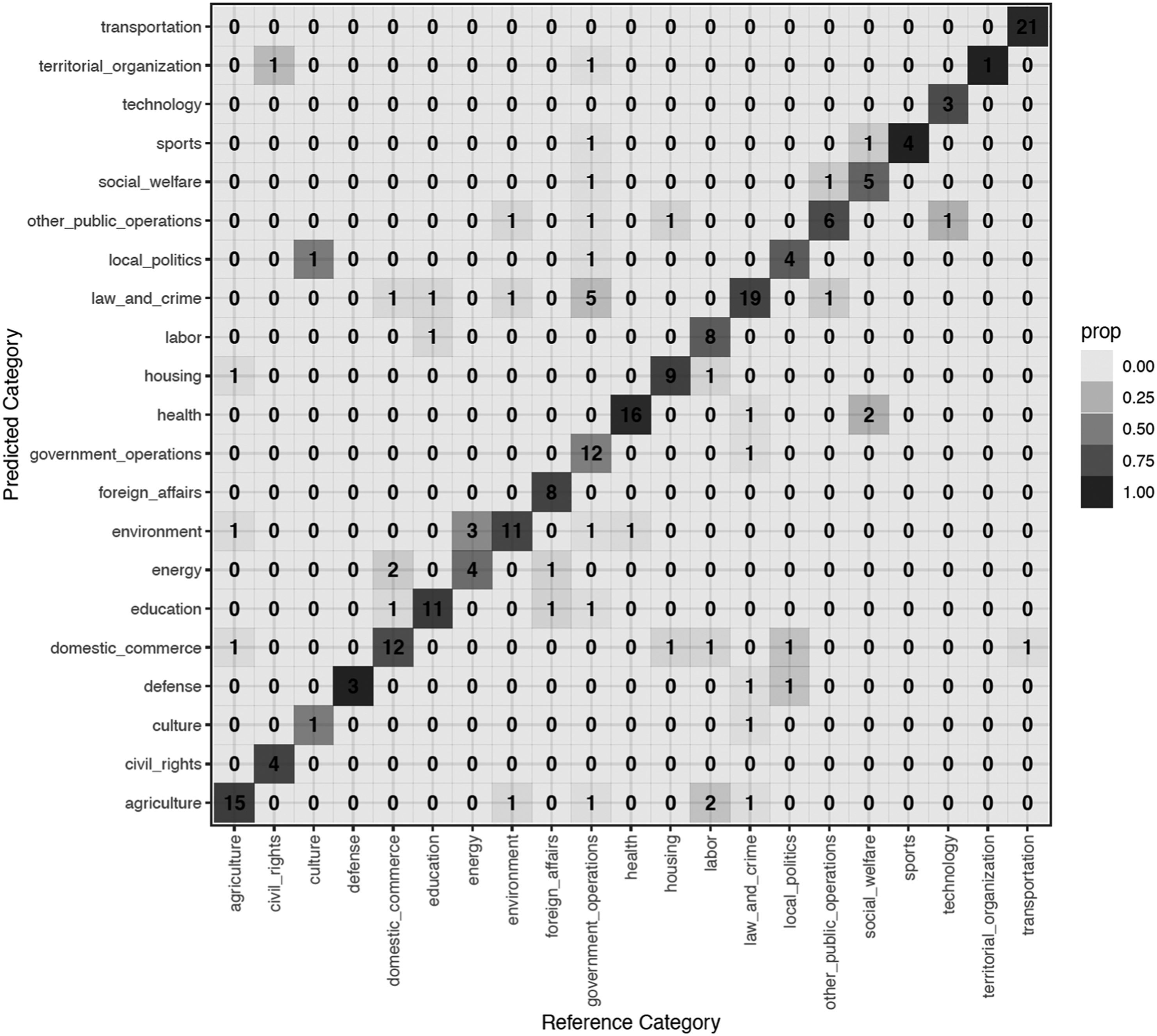
We use our model to predict the topics for the rest of the speeches. To validate our model, we sample 420 speeches and label them, and compare the hand-coded label with the topics produced by our model. The results show that the model is highly accurate. However, one category, government operations, appears as a catch-all topic. The topics included in government operations were unrelated to other topics but not necessarily internally related. In our main analysis, removing this category does not affect our results. The overall distribution of the topics of the speeches delivered by legislators in Chile’s Chamber of Deputies is presented in Figure 3. Topics distribution.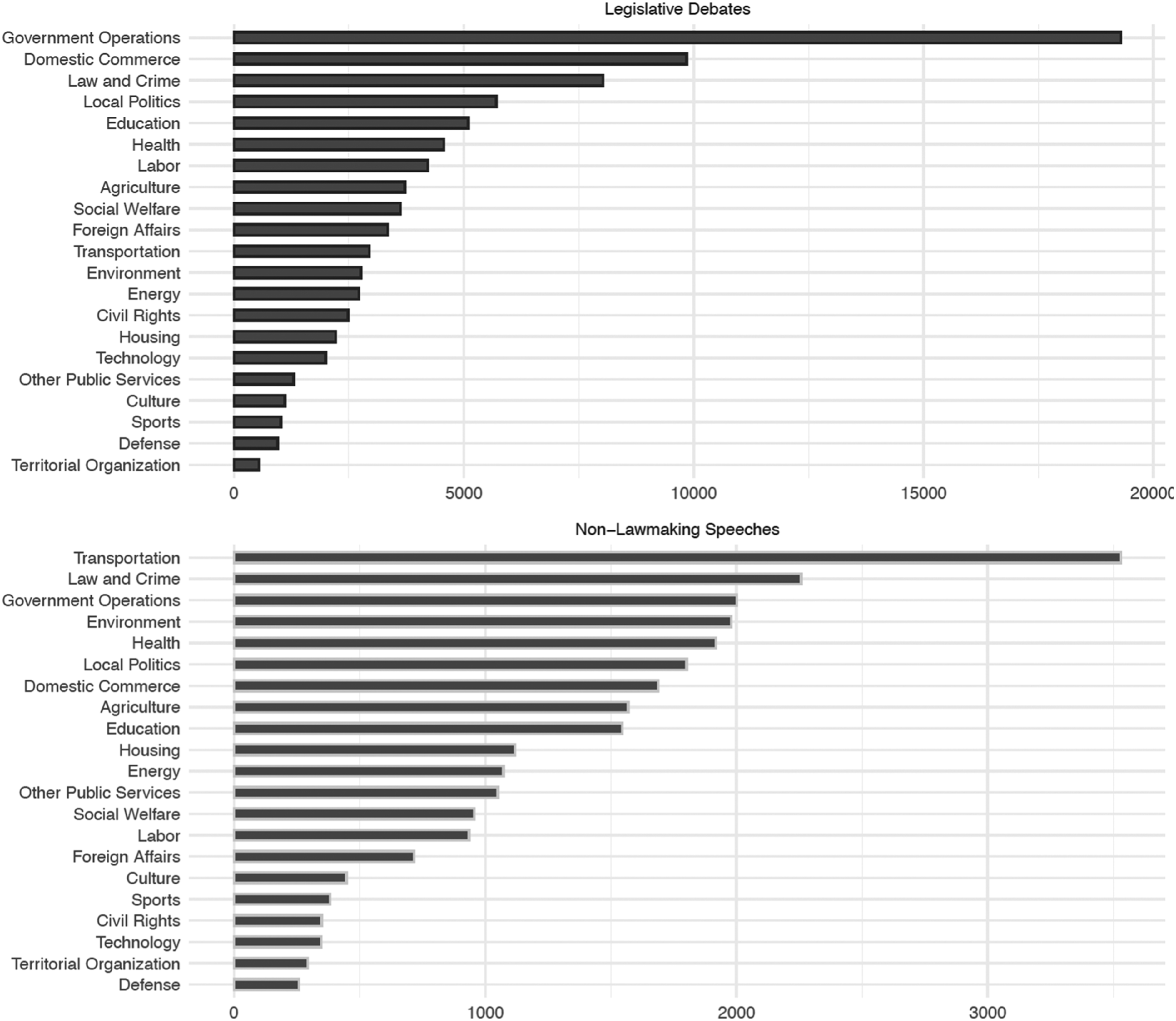
Covariates and Model
We constructed two sets of 21 dependent variables based on the topic model results. The first captures the number of non-lawmaking speeches a legislator delivered on a respective topic, and the second captures the number of speeches delivered during legislative debates on a respective topic. We regress speech participation by topic on a series of independent variables in two different models. The first model captures speeches delivered during legislative debates and the second non-lawmaking speeches. We present our results as coefficient plots for the most relevant independent variables. The full models can be found in the supplemental materials.
Our key explanatory variables provide information related to the legislator’s committee and district characteristics. 12 The first indicates whether the legislator was assigned to the committee associated with the topic of a given speech. The second specifies whether the legislator was the chair of the committee associated with that topic. Two other variables indicate whether the legislator was assigned to the most important permanent committees: Finance and Constitution. Any bill with financial implications is also assigned to the Finance Committee, and the Constitutional Committee deals with constitutional reforms, judicial matters, and internal rules. Scholars consistently name these two committees as the most prestigious in the chamber, with the Finance Committee being the most common second committee when bills receive multiple referrals. Two other variables focus on district traits associated with our expectations. The first indicates the proportion of the rural population in the legislator’s district based on census data. 13 The second measures the log kilometers between the deputy’s district and the official seat of government in the city of Santiago.
In addition, we include several controls. The variable chamber authorities equals one if the legislator was a member of the chamber’s directorate and 0 otherwise. Tenure indicates the number of congressional periods the legislator served in the chamber. Another variable equals one if the legislator is female and 0 otherwise. A series of dummies capture coalitional affiliation. Belonging to the Concertación (later renamed Nueva Mayoría) is the reference category, and the others are Alianza, which equals one if the legislator competed in the list of the center-right coalition and 0 otherwise, and Other, which equals one if the legislator competed in a list other than the two main ones and 0 otherwise.
Electoral performance is captured by a variable indicating the vote margin within the legislator’s list. Under Chile’s binomial electoral rule in place throughout the period analyzed—open list proportional representation with district magnitude equal to two—each of the main lists presented two candidates. Because, in most districts, each coalition would win one seat (to win both, the top list needed to double the second one), competition shifted to inside the list. Therefore, the margin of votes between the first and second members of the list reflects the candidates’ vulnerability. Finally, we include period-level fixed effects to account for temporal variation.
We utilize a generalized linear model with a binomial distribution and a logit link to examine our expectations. This model allows us to account for count data (our dependent variables) and impose an upper limit on the possible number of speeches on each topic—captured as the number of trials in the model. This upper limit refers to the total number of speeches (on any topic) delivered by the legislator in the respective congressional period and related forum. While most analyses of speech participation utilize negative binomial models, the GLM model provides a more accurate prediction of the number of speeches by imposing an upper limit to the binomial distribution—which we can incorporate because we know the number of trials.
Results
We begin evaluating the effect of belonging to the committee associated with the topic of the speech. This examination applies to 19 of our 21 topics because two (Local Politics and Other Public Services) do not have a specific committee associated with the topics. The results appear in Figure 4 and show the incidence rate ratios for the model. The top panel shows the results for legislative debates, and the bottom panel shows the results for non-lawmaking speeches. The dashed horizontal line indicates an incidence rate ratio of 1 (i.e., no effect). Membership in the related committee. Note: Gray dashed lines mark an incidence rate of 1 (no effect). Estimates in black are statistically significant (p < .05).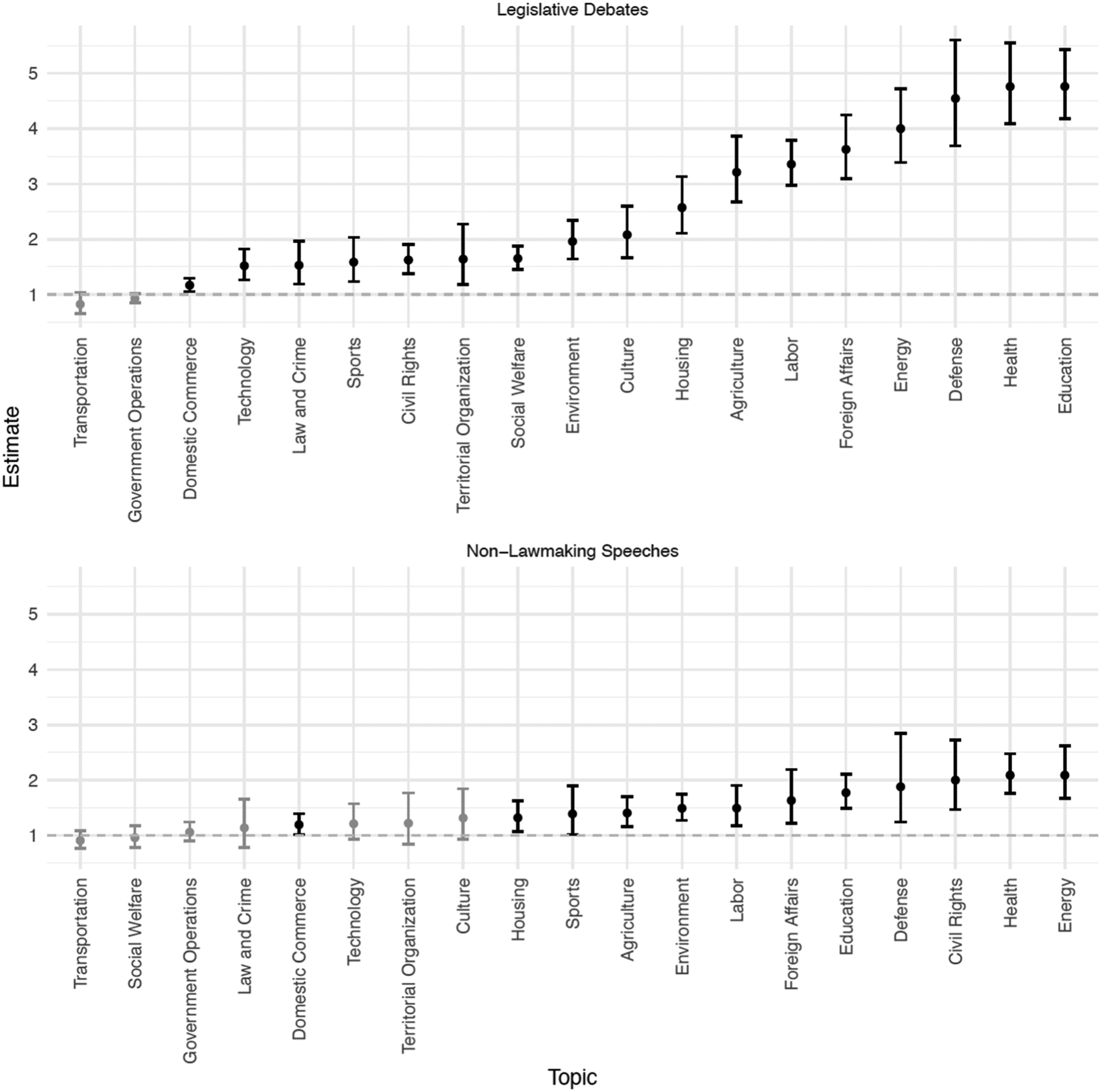
As the figure shows, membership in the related committee is a key predictor of speech participation. The top panel shows that the effect is statistically significant and in the expected direction in 17 of the 19 topics. That is, belonging to the committee with jurisdiction over such topics increases debate participation. The effect is particularly strong in the topics of education, health, defense, energy, foreign affairs, labor, and agriculture. In all of these, the incidence rate ratios are higher than 3. For example, belonging to the Education Committee increases the expected number of speeches in education by a factor of 4.8, holding other variables constant. These results are consistent with our first hypothesis and reveal that committee specialization is a significant predictor of speech participation during legislative debates.
The bottom panel of Figure 4 shows that, in terms of non-lawmaking speeches, the effect of membership in the related committee is statistically significant in 12 of the 19 topics. In five others, the effect is positive, but the coefficient is just shy of statistical significance. The effect is comparatively strong in the topics of energy, health, civil rights, defense, education, and foreign affairs. In these topics, the incidence rate ratios are greater than 1.5. These findings are consistent with our second hypothesis. They tell us that during the part of the session when legislators select the topic of their speeches, many choose to address the topics covered by their assigned committees. In other words, it suggests that committee assignments often reflect a legislator’s personal or electorally motivated interests, as reflected by her choice of speech topic.
The effect of being the chair of the committee with jurisdiction over the topic at hand appears in Figure 5. For legislative debates, being the chair of the related committee increases participation in 12 of the 19 topics. For non-lawmaking speeches, being the chair of the related committee increases the probability of speech participation in five of the 19 topics. The effect is strong when speeches cover the topics of defense, energy, labor, and health. So, being a committee chair increases the probability of giving a speech in close to two-thirds of topics during bill debates and just over one-fourth of topics during non-lawmaking speeches. Thus, being a chair of the related committee has a consistent but modest effect on increasing participation in most topics during legislative debates and no effect on most topics during non-lawmaking speeches. Chair of the related committee. Note: Gray dashed lines mark an incidence rate of 1 (no effect). Estimates in black are statistically significant (p < .05).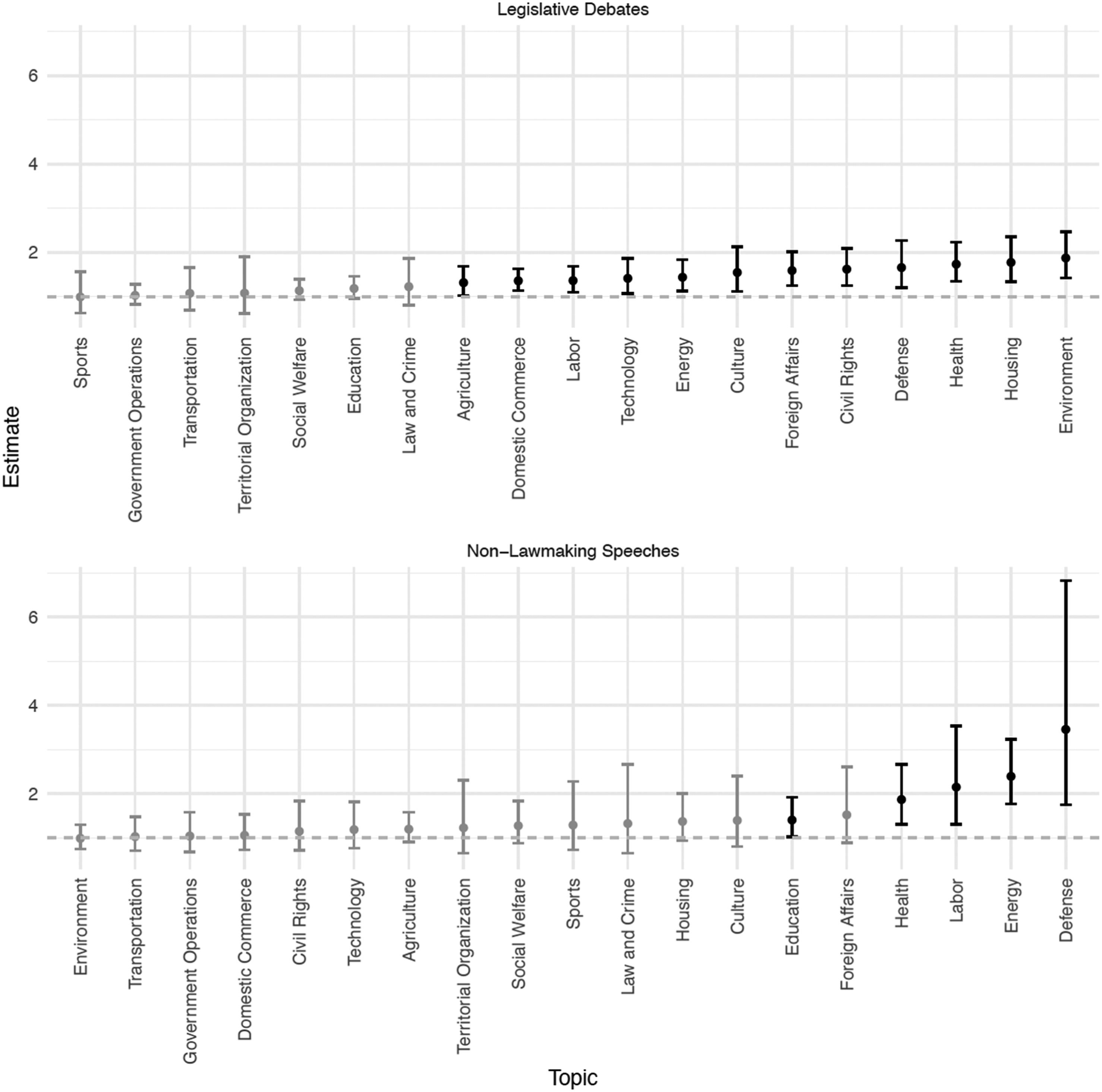
The other two variables capturing committee effects indicate membership in the Finance or Constitution Committees. The results appear in Figure 6. Recall that these two committees are usually considered the most prestigious in the chamber. The Finance Committee is also the most common second committee when bills are referred to more than one committee. Membership in the Constitution and Finance Committees. Note: Gray dashed lines mark an incidence rate of 1 (no effect). Estimates in black are statistically significant (p < .05).
The results show that members of the Constitution Committee, which deals with justice matters, deliver significantly more speeches than others on law and crime, civil rights, and government operations topics, both during legislative debates and in the forum dedicated to non-lawmaking speeches. For example, during legislative debates, belonging to the Constitution Committee increases the expected number of speeches on law and crime by a factor of 2.9, holding other variables constant. Interestingly, on ten other topics, such as energy, education, and agriculture, members of the Constitution Committee are significantly less likely than others to participate in legislative debates.
The results also show that membership in the Finance Committee increases participation in legislative debates on domestic commerce—the main topic associated with the purview of this committee. Belonging to the Finance Committee increases the expected number of speeches on domestic commerce by a factor of 1.9, holding other variables constant. This effect, however, does not extend to non-lawmaking speeches on the same topic. Membership in the Finance Committee also increases participation in legislative debates on foreign affairs, education, social welfare, energy, and government operations. Interestingly, membership in the Finance Committee reduces the likelihood of participating in legislative debates on law and crime and civil rights, two topics under the purview of the Constitutional Committee.
Overall, as we hypothesized, these results show a strong association between speech participation and membership in the committee associated with the topic at hand. While this effect is manifested in the two forums we examine, committee membership seems to be a stronger predictor of speech participation during legislative debates than during the Hour of Incidents, where non-lawmaking speeches are delivered.
Next, we examine the effects of district characteristics. Figure 7 shows the results associated with the proportion of the rural population (left panel) and distance to the center of Santiago (right panel). Our general expectation was that these districts’ characteristics would have a greater impact on predicting speech participation during non-lawmaking speeches than during legislative debates. The results show that this was indeed evident in most topics. For example, the proportion of rural population in the district has a statistically significant effect on speech participation in 11 of the 20 topics during the forum dedicated to non-lawmaking speeches, but only in six of the 20 topics during legislative debates. Likewise, distance to the center of Santiago significantly affects speech participation in nine of the 20 topics during the forum dedicated to non-lawmaking speeches, but only in six of the 20 topics during legislative debates. Rurality and distance to Santiago. Note: Gray dashed lines mark an incidence rate of 1 (no effect). Estimates in black are statistically significant (p < .05).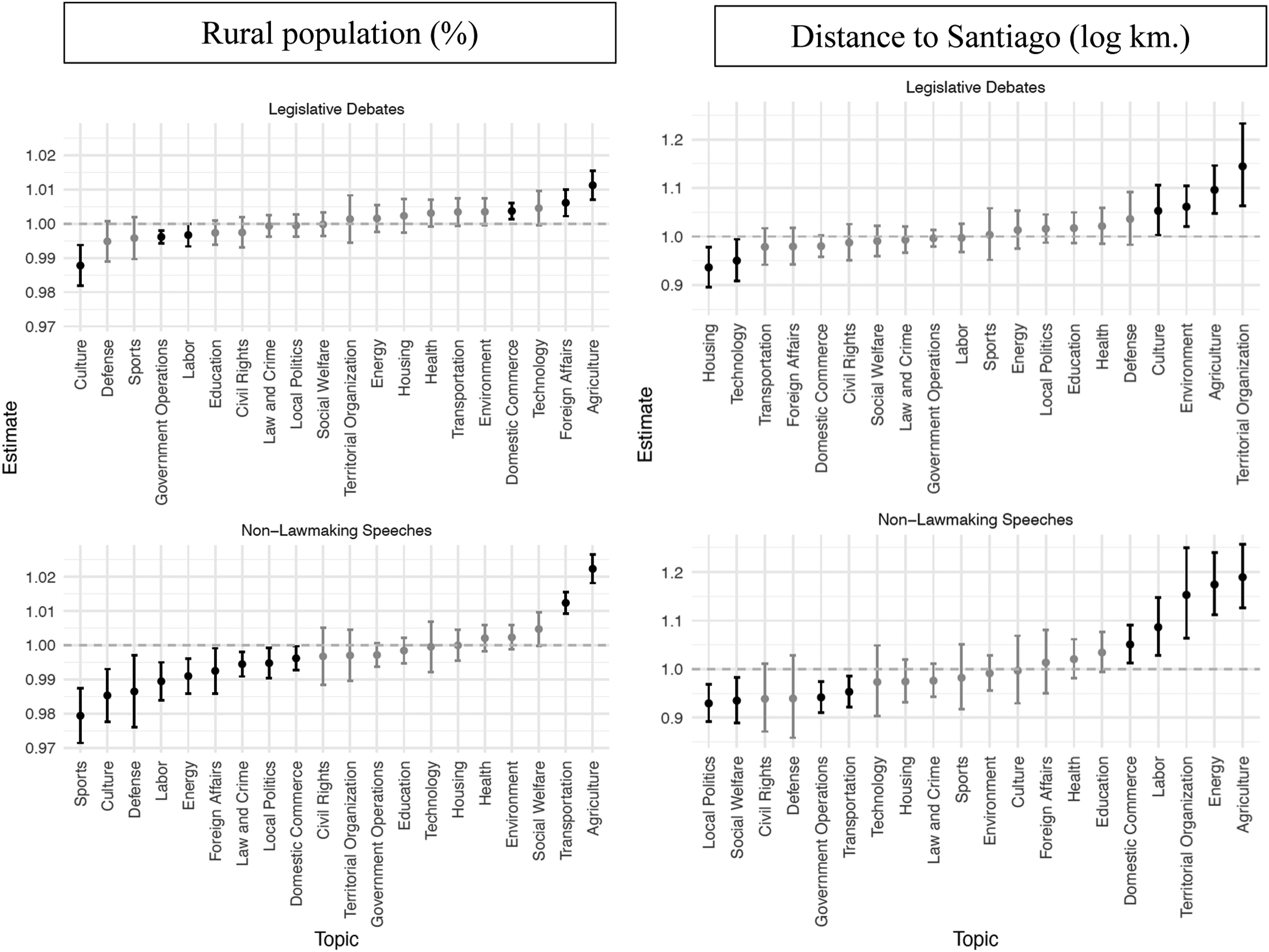
In addition, we expected legislators from districts with a greater share of rural population to speak more often about agriculture. This is the case during legislative debates and non-lawmaking speeches. For instance, a legislator from a district where the rural population is 40% is expected to give 8.4% of non-lawmaking speeches on agricultural issues. In comparison, a legislator from a district where the rural population is 10% is expected to give 4.5% of non-lawmaking speeches on this topic.
We also expected legislators from urban districts to speak more frequently about labor and law and crime than those from rural districts. Again, we found consistent results in both forums. For example, a legislator from a district where the urban population is 90% is expected to give 4.0% of non-lawmaking speeches on labor issues, while a legislator from a district where the urban population is 60% is expected to give 2.9% of non-lawmaking speeches on this topic. Legislators from urban districts are also more likely to give non-lawmaking speeches on law and crime topics. For example, a legislator from a district where the urban population is 90% is expected to give 9.7% of non-lawmaking speeches on law and crime issues, while a legislator from a district with an urban population of 60% is expected to give 8.4% of non-lawmaking speeches on this topic. The rural-urban characteristic of districts does not appear to affect the number of law and crime speeches given during legislative debates.
Lastly, we hypothesized that legislators from districts closer to the metropolitan center would speak more often about housing than those from districts farther away, and legislators from districts farther away from the metropolitan center would speak more often about energy than those from districts closer to it. As expected, the results show that legislators farther away from Santiago speak more often about energy matters (including mining) during the forum dedicated to non-lawmaking speeches. However, during legislative debates, distance to the center makes no difference in speeches about energy. In terms of housing, legislators from districts closer to Santiago speak about it more often than others but only during legislative debates.
Conclusions
As informational theories have argued, an effective legislature takes advantage of the specialization that members acquire in their respective committee assignments. While previous studies have examined the implications of informational theories by looking at the composition of committees, the choice of legislative procedures, or the path of legislation, we have focused on committee members’ speech participation. If committee specialization helps the legislature attain the benefits of expertise (a collective good), this should be reflected in the participation of committee members during legislative debates. Our analysis shows that belonging to the committee associated with a debate topic is a significant predictor of speech participation. In almost all topics, membership in the related committee increases the number of speeches given during legislative debates. The analysis also shows that being a chair of the related committee has a consistent and significant effect on increasing participation in most legislative debate topics.
We also argue that forums dedicated to non-lawmaking speeches, where members have the discretion to choose what to talk about, are less likely to convey policy-related information to the chamber and more likely to provide legislators with a favorable setting in which to target constituents. Since committee assignments are likely to reflect not only legislators’ expertise but also their interests (electorally motivated or not), we expect membership in the related committee also to affect the number of non-lawmaking speeches legislators give. The results of our analysis confirm this expectation. While the effect of membership in the related committee is less prevalent across topics during non-lawmaking speeches in comparison to legislative debates, it is still a significant predictor of speech participation.
Our expectation about committee membership influencing participation in legislative debates, which we have examined empirically with data from Chile, extends to other chambers in presidential and parliamentary countries. As long as the organization of such chambers fosters jurisdictional specialization and self-selection plays some influence in committee assignments, belonging to the committee associated with the topic being debated should be a likely predictor of speech participation.
Our research has also shown that constituency traits affect speechmaking activities. We show that increases in the proportion of rural constituents lead to more non-lawmaking speeches about agriculture, while increases in the proportion of urban constituents lead to more non-lawmaking speeches on labor and law and crime. In addition, we show that Chilean legislators from districts farther away from Santiago give more non-lawmaking speeches about energy matters (including mining) than legislators closer to the metropolitan center. District traits are a more significant predictor of speech participation in non-lawmaking speeches than legislative debates, as we expected.
Analyses of legislative speech have grown exponentially over the last decade. This article contributes to this body of research by analyzing a Latin American presidential democracy with electoral rules that emphasize the personal vote and institutional rules that create different forums for congressional speechmaking. In addition, most works so far have not examined speech participation across different topics. In this article, we use a newly developed and highly effective machine-learning technique to carry out our topic classification task and use this information to evaluate the implications of informational and electoral theories for speech participation. The findings of this article also expand our understanding of the committee system in presidential systems other than the U.S. and the electoral connection in Latin America.
Supplemental Material
Supplemental Material - Congressional Committees, Electoral Connections, and Legislative Speech
Supplemental Material for Congressional Committees, Electoral Connections, and Legislative Speech by Eduardo Alemán, Juan Pablo Micozzi, and Sebastián Vallejo in Political Research Quarterly
Footnotes
Acknowledgments
The authors would like to thank the Hewlett Packard Enterprise Data Science Institute at the University of Houston for providing access to computational resources that contributed to the research results reported in this paper. The authors also thank the anonymous reviewers for their comments and suggestions. Replication and data files can be downloaded from the PRQ website or  .
.
Declaration of Conflicting Interests
The author(s) declared no potential conflicts of interest with respect to the research, authorship, and/or publication of this article.
Funding
The author(s) received no financial support for the research, authorship, and/or publication of this article.
Supplemental Material
Supplemental material for this article is available online.
Notes
Author Biographies
References
Supplementary Material
Please find the following supplemental material available below.
For Open Access articles published under a Creative Commons License, all supplemental material carries the same license as the article it is associated with.
For non-Open Access articles published, all supplemental material carries a non-exclusive license, and permission requests for re-use of supplemental material or any part of supplemental material shall be sent directly to the copyright owner as specified in the copyright notice associated with the article.
