



Abstract
How do Americans’ preferences over judicial philosophy influence their support for judges and judicial decisions? Using an experiment attached to an adaptive choice-based conjoint analysis, we find that people hold preferences over judicial philosophies, that they rely on those preferences to evaluate judges and decisions, and that those preferences are not simply stand-ins for ideology and partisanship. These findings suggest that to understand people’s support for judges and judicial decisions one must pay attention to judicial philosophy.
How do Americans’ preferences over judicial philosophies influence their support for judges and judicial decisions? Regrettably, scholarship has not yet answered these questions. It remains unknown whether the public actually holds preferences over judicial philosophies, let alone how those preferences influence their support for judges and judicial decisions. We employ an adaptive choice-based conjoint (ACBC) analysis plus an experiment to examine whether and how the public’s preferences over judicial philosophy influence their support for judges and decisions.
The data reveal that people do indeed hold preferences over judicial philosophies and that they support judges and judicial decisions accordingly. When people disagree on policy grounds with a decision, they are more hostile to the judge (and the decision) who employs a disfavored judicial philosophy. When people agree on policy grounds with a decision, they are more supportive of the judge (and decision) who employs their favored judicial philosophy. And while preferences over judicial philosophy are related to ideology and to partisanship (which, themselves, strongly predict support for judges and judicial decisions), preferences over judicial philosophy nevertheless are at least partially independent from them.
These results are important for a number of reasons. They are among the first to show that Americans hold actual preferences over judicial philosophies and that they evaluate judges and decisions pursuant to them. They also show that people can and do hold different constellations of attitudes toward individual judges and toward individual decisions. Given these findings, scholars need to re-examine how they measure and evaluate support for courts by considering the relevance of judicial philosophy to their analyses. The findings may also open up new avenues for further research into the public’s preferences over institutions’ decision-making processes. At a time when institutions are shedding support, it is normatively important to determine what can rehabilitate them.
Judicial Philosophy and Support for Courts
The public evaluates judges and their decisions using myriad considerations (Armaly 2018; Badas and Stauffer 2018; Chen and Bryan 2018; Hoekstra and LaRowe 2013). People tend to support judges and decisions when they agree ideologically or politically with them, although there is some debate on just how strong these effects are (Nelson and Gibson 2020; Nelson and Tucker 2021). Bartels and Kramon (2022) focus on how the public evaluates the Supreme Court using partisan cues. They find that the sitting president’s supporters approve of the job the Court is doing more than his opponents. Christenson and Glick (2015) and Bartels and Johnston (2013) suggest that ideologues who oppose specific Supreme Court decisions are more likely to challenge the Court than those who approve of its decisions. Likewise, Nicholson and Hansford (2014) find that party cues and partisanship affect whether the public accepts a judicial decision. While judicial legitimacy overall resists sharp declines from single decisions (Gibson and Nelson 2015; Gibson et al. 2005; Nelson and Gibson 2020), support for courts is at least somewhat tied to the public’s ideological or policy agreement with judicial decisions (Zilis 2015, 2018).
Whether judges satisfy people’s general legal expectations also influences court support (Baird and Gangl 2006; Ramirez 2008; Scheb and Lyons 2001, 2000). The public favors legally qualified judges (Hoekstra and LaRowe 2013; Kaslovsky et al. 2021). People understand that judges hold ideological views, but they support courts “under the belief that judges exercise their discretion in a principled and sincere fashion” (Gibson and Caldeira 2011, 195). And so Zink, Spriggs and Scott (2009) find that people are more likely to agree with and accept Supreme Court decisions that follow rather than overrule precedent. Gibson et al. (2005, 197) report that: “The strength of the [Supreme] Court is its connection to legality; to the extent that the Supreme Court can present its decision as grounded in legality, acquiescence is more likely.”
Things like procedural fairness also influence whether people support courts. According to Tyler (2021), people seek fair procedures and do not focus solely on “the favorability of the outcomes” (12). “Procedural theories predict that people will focus on how decisions are made, not [just] on the decisions themselves, when making evaluations of fairness” (Tyler 2021, 736) (emphasis added). If a “judge treats [people] fairly . . . and by stating good reasons for his or her decision, people will react positively to their experience, whether or not they receive a favorable outcome” (Tyler 2021, 6). People look at whether decision makers are honest, unbiased, and motivated to be fair and consistent. In fact, they value procedural fairness so much that they will support institutions that employ fair procedures even when they “lose.”
Just as people evaluate judges based on ideological considerations, legal expectations, and procedural fairness, so too might they evaluate judges and rulings based on the judicial philosophies they employ. Taken at face value, a judicial philosophy commits a judge to apply a set of principles consistently. Judicial philosophies are process-focused. An adherent to a judicial philosophy decides cases based on general principles that are independent of a case’s substantive outcome. Because people have preferences over things like procedural fairness (Tyler 2021), they might also have preferences over a similar topic—judicial philosophies.
Today, two main judicial philosophies dominate scholarly and political discussions about “proper” judging: originalism and living constitutionalism. 2 Broadly speaking, an originalist is a person who interprets a legal provision based on what the provision’s words meant when its crafters wrote it. Originalists believe that the Framers of the Constitution chose their words carefully and that judges, when they interpret those words, should honor the Framers’ and ratifiers’ choices. To go beyond what the people understood the Constitution to mean when they ratified it, and thereby change its meaning, would be extra-constitutional amendment. So, for example, in District of Columbia v. Heller (2008), Justice Scalia determined the meaning of “arms” in the Second Amendment by analyzing its 18th-century meaning.
Conversely, a living constitutionalist is one who looks to the evolving views of the American public when interpreting the Constitution. 3 If a legal provision is unclear, the living constitutionalist believes judges should interpret its words as most appropriate to the current public. The judge will look at recent societal changes and sometimes even political events to determine the public’s preferences. For example, when the Trop v. Dulles (1958) Court declared that the United States could not constitutionally revoke a person’s citizenship as punishment for deserting the armed forces, it interpreted the Eight Amendment’s “cruel and unusual” language not in terms understood at the founding, but in a modern context. Living constitutionalists believe their approach keeps the Constitution updated which, in turn, protects its perceived legitimacy (Epstein and Walker 2014, 23–44).
Recent scholarship suggests that the general public may care about which judicial philosophies judges employ. Krewson and Owens (2021a, 2021b) find that the American public holds views on judicial philosophy, with Democrats more likely to prefer living constitutionalists and Republicans and Independents more likely to prefer originalists. Similarly, Greene et al. (2011) find “nontrivial levels of legal and political knowledge” (including knowledge about judicial philosophy) among the American public (361). Their data suggest that the “great majority of Americans feel comfortable expressing one or another view” on judicial philosophy (370). They also argue that the public’s views on judicial philosophy are “salient . . . not simply as a political commodity or partisan slogan, but also as a legal argument and as a culturally embedded meme” (360). These studies, however, were unable to address the effects of judicial philosophy independent of respondents’ ideological agreement with court decisions.
That people might hold preferences over judicial philosophy should not be surprising. Nationwide conversations about judicial philosophy occur periodically. When vacancies arise on the United States Supreme Court, the media often report on the nominees’ judicial philosophy and also on the philosophy of the departing justices (Comiskey 1999; Guliuzza III et al. 1991). Senate Judiciary Committee hearings, which many people watch and more learn about from the news, focus in part on judicial philosophy (Collins and Ringhand 2015). Ringhand and Collins (2010) discovered that judicial philosophy “has consistently been in a range of approximately 10%–20% of hearing comments” and possibly more (618). The recent confirmation hearings of Ketanji Brown Jackson saw numerous questions and news stories about her judicial philosophy, such as whether Judge Jackson was a living constitutionalist masquerading as an originalist. 4 Polling firms periodically ask the public questions about judicial philosophies, which suggests that these firms think the public has preferences over judicial philosophy. 5 And, as we noted above, the fact that people have underlying preferences over procedural fairness suggests they may have latent preferences over how judges decide cases.
To be sure, it remains unclear how people might obtain their views on judicial philosophies. We address that later. For now, we seek simply to determine whether people express preferences over judicial philosophies and whether they employ those preferences to evaluate judges and judicial decisions.
Estimating Individual-Level Preferences Over Judicial Philosophy
In May of 2021, we obtained a sample of 2170 high quality respondents from Qualtrics, a widely respected survey firm (Bonilla and Tiller 2020; Friedman 2019; Kane et al. 2021). 6 The sample matched the American adult population on a variety of demographic characteristics and achieved balance in terms of partisanship. (See section A1 in the online supplemental material for respondent information.) Sample in hand, we employed an adaptive choice-based conjoint (ACBC) design to collect information on respondents’ preferences. 7
In stage one, we asked respondents to indicate their preferences, separately, for each of nine judge attributes. (We randomized the order in which respondents observed the attributes.) We told them: “Below, we list descriptive characteristics of a judge. For each category, choose your most preferred characteristic from those provided.” Respondents identified their preferences over Judicial Philosophy (originalism or living constitutionalism); Legal Qualifications (not qualified, qualified, or well qualified); Ideology (liberal or conservative); Party of the Appointing President (Republican or Democrat); Judge Personality (conscientious, agreeable, open-minded, or empathetic); Judge Religion; (Catholic, Protestant, Jewish, or not religious); Judge Age (45, 50, 55, 60, or 65); Judge Race (white, black, or Hispanic); and Judge Sex (male or female).
To define the judicial philosophy attribute for respondents, we told them a hypothetical judge either “consider[ed] what the words in the Constitution meant at the time those words were crafted” or that the judge “look[ed] to the evolving views and values of the American public when interpreting the Constitution.” These two descriptions balanced our need to describe originalism and living constitutionalism meaningfully against the ever present need to keep respondents’ attention. These definitions are the same (Krewson and Owens 2021a, 2021b) or similar to (Greene et al. 2011) definitions used elsewhere. 8
In stage two (the “screener” stage), we created a pool of tailored judge profiles for each respondent. We presented six sets of profiles—with four profiles in each set—to respondents. The judge attribute levels (e.g., whether a judge was male or female) comprising each profile were based on weighted randomization, with the attribute levels most preferred during stage one given more weight. For each profile in a set, respondents indicated whether they could support the profiled judge. If a respondent could not support a profile, the software did not carry that profile into the next (“tournament”) stage. If a respondent consistently supported or refused to support profiles with particular attribute levels, the ACBC asked the respondent whether the attribute level was necessary or unacceptable. If the respondent found an attribute level to be unacceptable, the program would no longer show the respondent a profile with that attribute level. If the respondent stated an attribute level was necessary, then profiles only with that attribute carried forward to the next stage.
In the final stage (the “tournament” stage), we presented up to eight sets of profiles—with three profiles in each set—to respondents. Respondents indicated their most preferred judge in each set. We paired respondents’ most preferred judge in any one previous set against their most preferred judges in any other previous set. Only judges whom the respondent chose reappeared in subsequent sets. We iterated this process of pitting past profile winners against each other until one profile—the tournament winner—prevailed. Through this process, we derived each respondent’s most preferred attributes and levels for each attribute. (We outline each step of the ACBC and include screenshots in A2 of the online supplemental material.) 9
Results
Respondents rated a judge’s judicial philosophy among the most important judge attributes. Figure 1 plots the mean importance scores for each of our nine judge attributes, along with associated 95 percent confidence intervals.
10
Respondents cared most about a judge’s legal qualifications. On average, legal qualifications captured about 20% of the variation in respondents’ preferences. Respondents’ second most important characteristic (15% of the variation) was their agreement with the judge’s ideology. Third was the party of the appointing president tied with the judge’s judicial philosophy. Respondents’ preferences over judge philosophy accounted for approximately 13% of the variation in their preferences and was even more important to them than judge personality, religion, age, race, and sex. Estimates of Importance Scores for each attribute included in the adaptive choice-based conjoint. Horizontal lines are 95 percent confidence intervals.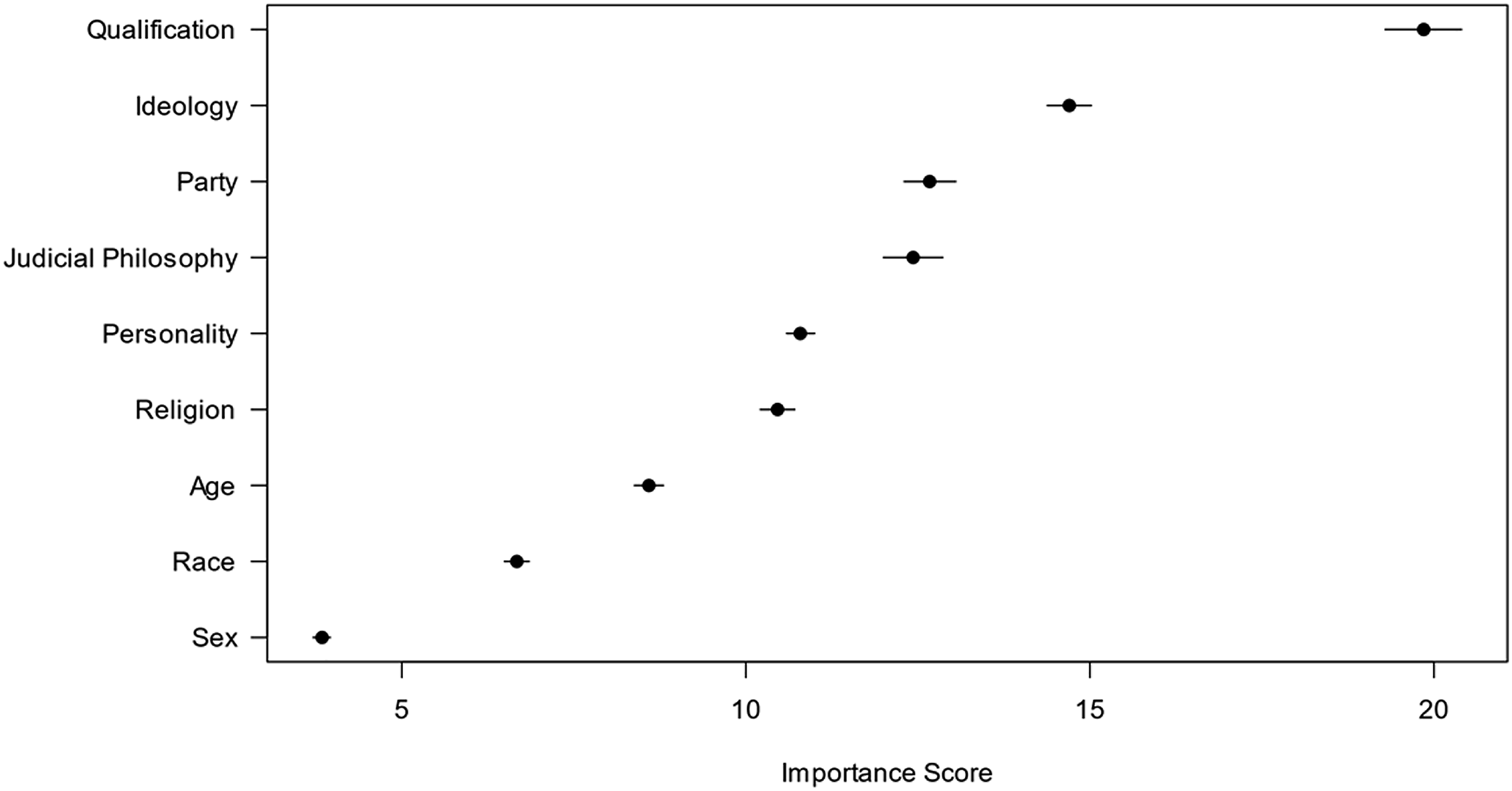
That judicial philosophy mattered to respondents is important. Also important, however, is knowing which philosophy respondents preferred. Recall that the ACBC asked respondents in stage one about their preferences over judicial philosophy (and other attributes) generally, without requiring them to make trade-offs within the context of comparing profiles. During that stage, 54% of respondents overall preferred a judge who espoused living constitutionalism while 46% preferred an originalist.
Preferences varied by respondent partisanship and ideology. Among Democrats, 72% preferred a living constitutionalist, while 28% supported an originalist. Similarly, 78% of self-identified liberals preferred a living constitutionalist judge while 22% supported an originalist. Conversely, 37% of Republicans supported a living constitutionalist, while 63% supported an originalist. 42% of self-identified conservatives preferred a living constitutionalist while 58% preferred an originalist. Among Democrats, 72% of tournament winners were living constitutionalists. Among liberal respondents, 70% of tournament winners were living constitutionalists. Among Republicans, 65% of tournament winners were originalists. And among conservative respondents, 60% of tournament winners were originalists. (We double-checked: self-identified liberals and conservatives did in fact hold liberal or conservative beliefs on abortion and affirmative action.) We will return to these results—and the fact that co-partisans’ views diverged—later.
While such information is useful, the ultimate purpose of the ACBC here is to estimate individual preferences over each attribute level. We analyze the raw ACBC data using hierarchical Bayesian (HB) methods to obtain estimates of respondents’ preferences over judicial philosophy and other attributes. That is, we estimate the multivariate normal distribution of the parameters (i.e., utilities) by aggregating individual-level means and variances over thousands of iterations. These parameters act as priors in the Bayesian sense when we estimate individual-level utility associated with attribute levels, again over many iterations. An individual’s ACBC responses will influence his or her utility estimates more as the sample variance for an attribute level becomes larger. The HB approach allows us to combine both individual- and sample-level information to maximize the data and obtain individual-level estimates that are both stable and reliable. 11
In contrast to the HB approach, a common approach in conjoint analyses is to estimate utilities using ordinary least squares (OLS) regression. Normally, OLS works because most conjoint research seeks to understand the average effect of any given profile attribute across all respondents. OLS is inappropriate to use, however, when one estimates individual-level preferences, particularly where, as here, we would be estimating 20 parameters for each respondent based on a maximum of 24 observations per respondent. The OLS approach would produce wildly imprecise estimates. 12 The HB approach, on the other hand, allows us to estimate individual-level utilities by “borrowing” information from other respondents to stabilize estimates.
Before we employ the individual-level estimates in our experiment, we reveal the various groups’ preferences over judicial philosophy. Based on the HB model, we simulated the proportion of respondents expected to prefer a living constitutionalist judge over an originalist judge when those judges are otherwise identical. Figure 2 plots the probabilities among our respondents. The vertical horizontal lines indicate 95% confidence intervals. A 50% probability on the y-axis indicates that the respondent is no more likely to prefer a living constitutionalist judge than an originalist judge. The data show that all respondents (combined) and independents did not distinguish between living constitutionalists and originalists. Democrats had a 66% likelihood of selecting a living constitutionalist judge over an originalist. Republicans had a 36% probability of doing so. (That is, Republicans had a 64% probability of selecting an originalist over a living constitutionalist.) Liberals, moderates, and conservatives had 74%, 55%, and 39% probabilities, respectively, of selecting the living constitutionalist judge over an originalist. Simulated probabilities of selecting a living constitutionalist judge over an originalist judge, holding all else constant. Vertical lines represent 95 percent confidence intervals. Estimates based on hierarchical Bayes regression analysis estimated using Sawtooth Software.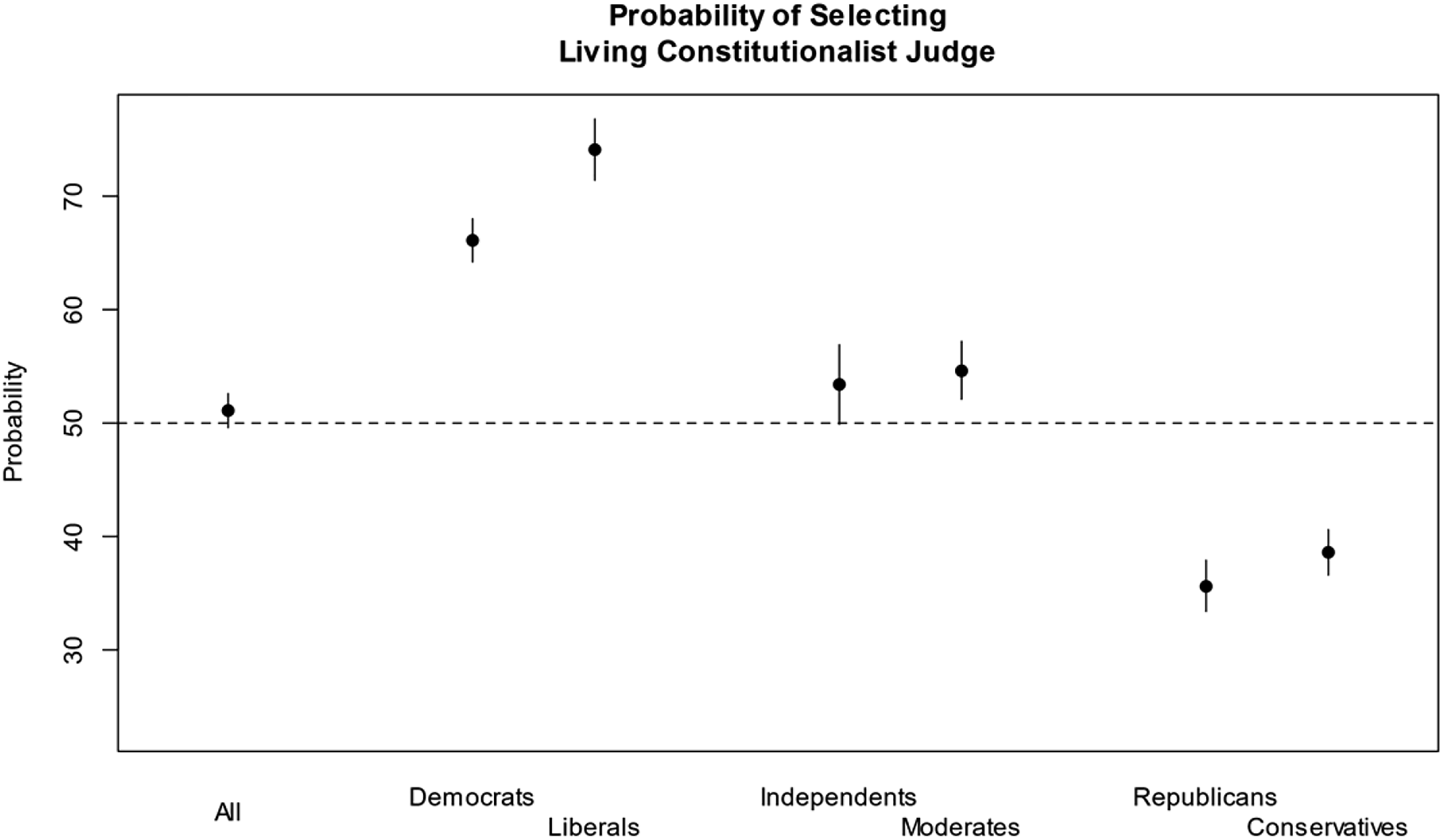
Taken together, these findings reveal that people hold preferences over judicial philosophy. Their preferences diverge—in part—depending on their partisanship and ideology. What remains to be seen is whether respondents trust judges and accept judicial opinions as a function of the judicial philosophy they employ—and whether their preferences over things like outcomes and ideology swamp their preferences over judicial philosophy.
Judicial Philosophy and Court Support: An Experiment
After estimating respondents’ individual preferences over judicial philosophy, we exposed them to two hypothetical federal cases: an abortion case and an affirmative action case. We focused on these highly salient issues because we wanted to ensure that respondents would have preferences over case outcomes. That way we could later examine their support for the judge or decision in cases where the respondent (dis)agreed with the decision. Focusing on these issues gives us greater leverage to compare ideological preferences versus preferences over judicial philosophy.
13
We randomized the order in which we presented these cases to our respondents. (In all analyses shown in the main text, we collapse the case topics. The effects of judicial philosophy are consistent across topics. See online supplemental material A6.) We randomly assigned judges to render a decision that supported or opposed abortion or affirmative action based on either a living constitutionalist or originalist rationale. We told respondents: “Recently, litigants brought a case before a federal court regarding the constitutionality of a [state law banning abortions after 20 weeks (i.e., 5 months)/university’s affirmative action program intended to increase admissions for racial minorities]. In a decision that [united the court across/divided the court along] ideological lines, the judge above [upheld/struck down] the [law restricting abortions/affirmative action program].” The case description also included randomized information about the judge’s sex and race. We offered these numerous options to avoid a priming effect in which respondents felt pressured to evaluate the judge based on judicial philosophy or case outcome. After respondents read about what happened in each case, they answered questions about: 1. Their trust in the judge to decide future cases fairly (completely, very much, somewhat, a little, none); and 2. Whether they believed the decision ought to be accepted as the final word on the matter or there ought to be an effort to challenge the decision and get it changed (strongly accept the decision, somewhat accept it, somewhat challenge it, strongly challenge it).
14
Respondents’ answers to these questions constitute our dependent variables for the two sets of analyses we perform. Small (large) values represent minimal (maximal) support for the judge or decision. It is worth pointing out, again, that our dependent variables examine reactions both to the judge and to the decision and that the two are not necessarily synonymous.
Judicial Philosophy and (Dis)Agreement With the Policy Outcome
In our first set of analyses, we employ three covariates of interest. Support for Originalism is the respondent’s estimated level of support for originalism based on his or her associated utilities derived from the conjoint analysis. The variable scales from 0 to 1, with larger values indicating greater support for originalism and smaller values indicating greater support for living constitutionalism. Individuals near 0.5 on the scale do not strongly differentiate between the two judicial philosophies. 15 Living Constitutionalist Decision takes on a value of 1 if we told respondents that the “ruling is widely perceived by legal scholars to be consistent with” a living constitution approach and 0 if the decision was supported by an originalist philosophy. 16 Agreement with the Outcome equals 1 if the decision is liberal and the respondent supported affirmative action (5–7 on a 7-point scale) or abortion (3–4 on a 4-point scale). It is 1 if the decision is conservative and the respondent did not support affirmative action (1–3 on 7-point scale) 17 or abortion (1–2 on 4-point scale). It is 0 if the decision was conservative (liberal) and respondents (did not) support affirmative action or abortion. We estimated ordinal logistic regressions for our two dependent variables (Trust and Accept) and included a triple interaction term with our three covariates. 18
Figure 3 shows that a judge’s philosophy significantly influences respondents’ trust in that judge. The top row shows respondents who claimed to have no trust in the judge. The bottom row reflects respondents who reported to trust the judge completely. (The online supplemental material shows all variations.) The left column reflects decisions with which the respondent disagreed on policy grounds; the right column, those with which the respondent agreed. When we account for whether the respondent agreed or disagreed with the policy outcome in the case, we see that respondents trust judges more (less) when they employ respondents’ favored (disfavored) judicial philosophies. Predicted levels of (dis)trust in judge for decisions that respondents (dis)agreed with on policy grounds that employed living constitutionalism or originalism. Small values of support for originalism represent a strong living constitutionalist; large values represent strong originalists. Solid portions of lines represent differences that are statistically significant; dashed portions represent non-significant differences. The table of results from this analysis appear in online supplemental material A5. Figures that include all the values of the dependent variable for trust in judge can be found at A9.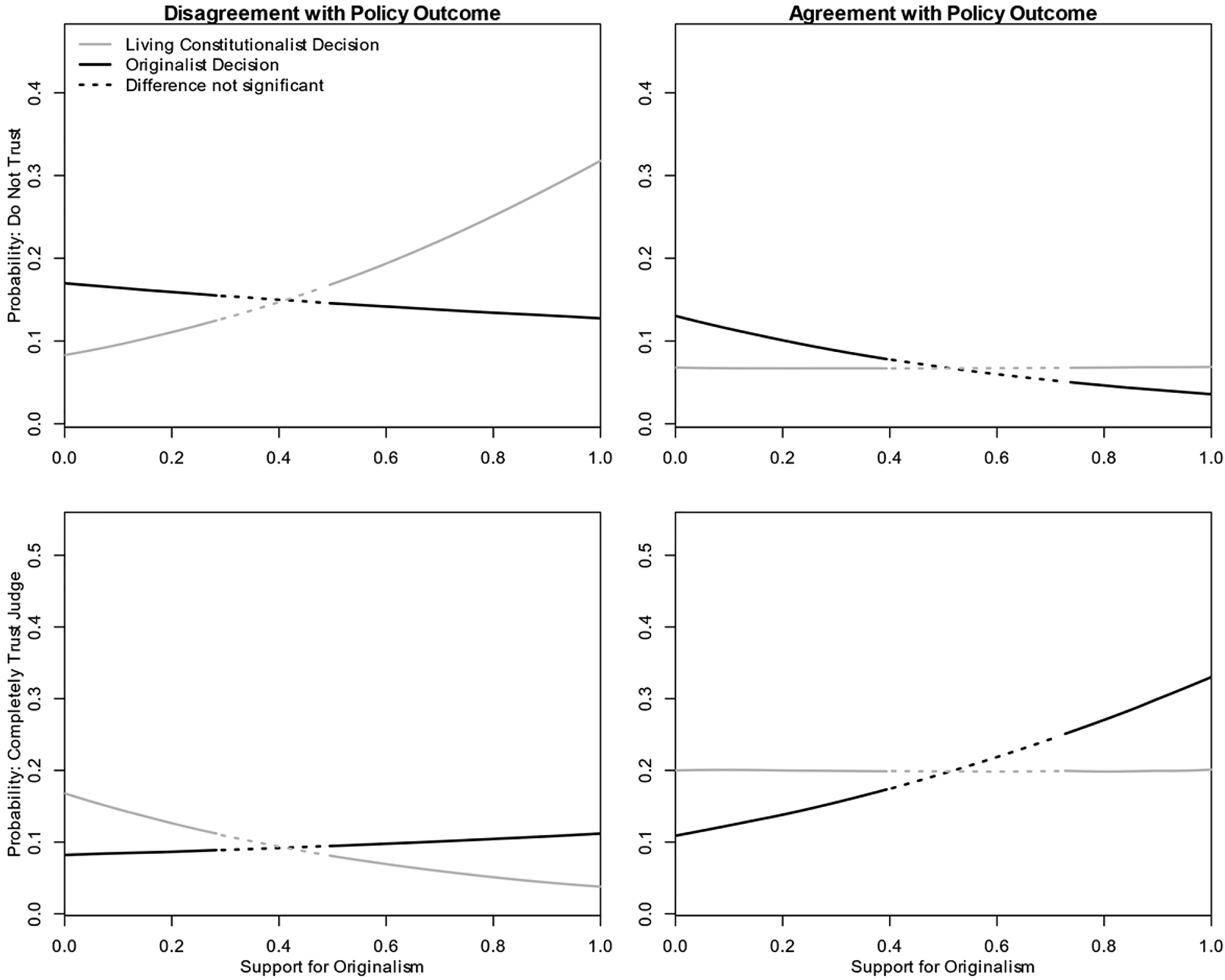
Disagreeable Opinion-Distrust Judge
Consider, first, respondents who disagreed with the policy outcome in the case. Respondents “punished” the judge more when he or she used a judicial philosophy with which the respondent disagreed. Respondents whose Support for Originalism scores are
Disagreeable Opinion-Trust Judge
Finding a judge to be completely trustworthy follows a similar pattern. Respondents whose Support for Originalism scores are
Agreeable Opinion-Distrust Judge
What is more, even when the judge rendered a decision with which the respondent agreed on policy grounds, the respondent still reacted to the judicial philosophy the judge used. Looking at the right column of Figure 3, we see that respondents who agreed with the policy outcome in the case and whose Support for Originalism scores are
Agreeable Opinion-Trust Judge
Respondents’ trust in the judge reveals the same pattern. Once again, even when respondents agree on policy grounds with the decision, they still react to the judicial philosophy the judge used. Originalists are more likely to trust judges who use originalism than living constitutionalism. Living constitutionalists are more likely to trust judges who use living constitutionalism than originalism. For example, a strong supporter of living constitutionalism is 7 [2, 12] percentage points more likely to trust the judge who makes an agreeable living constitution decision than to trust the judge who makes an agreeable decision using originalism. A strong supporter of originalism is 6 [0, 12] percentage points more likely to trust the judge who renders an agreeable decision based on originalism versus living constitutionalism.
Disagreeable Decision-Challenge It
Respondents’ decisions to accept or challenge judicial decisions also change with the decision’s judicial philosophy. Figure 4 shows that respondents are more likely to challenge decisions that employ a disfavored judicial philosophy and are more likely to accept decisions that employ a preferred philosophy. Consider respondents who disagreed with the policy outcome in the case (the left column). Respondents whose Support for Originalism scores are Predicted levels of acceptance for decisions that respondents (dis)agreed with on policy grounds that employed living constitutionalism or originalism. Small values of support for originalism represent a strong living constitutionalist; large values represent strong originalists. Solid portions of lines represent differences that are statistically significant; dashed portions represent non-significant differences. The table of results from this analysis appear in online supplemental material A5. Figures that include all the values of the dependent variable for accepting the decision can be found at A9.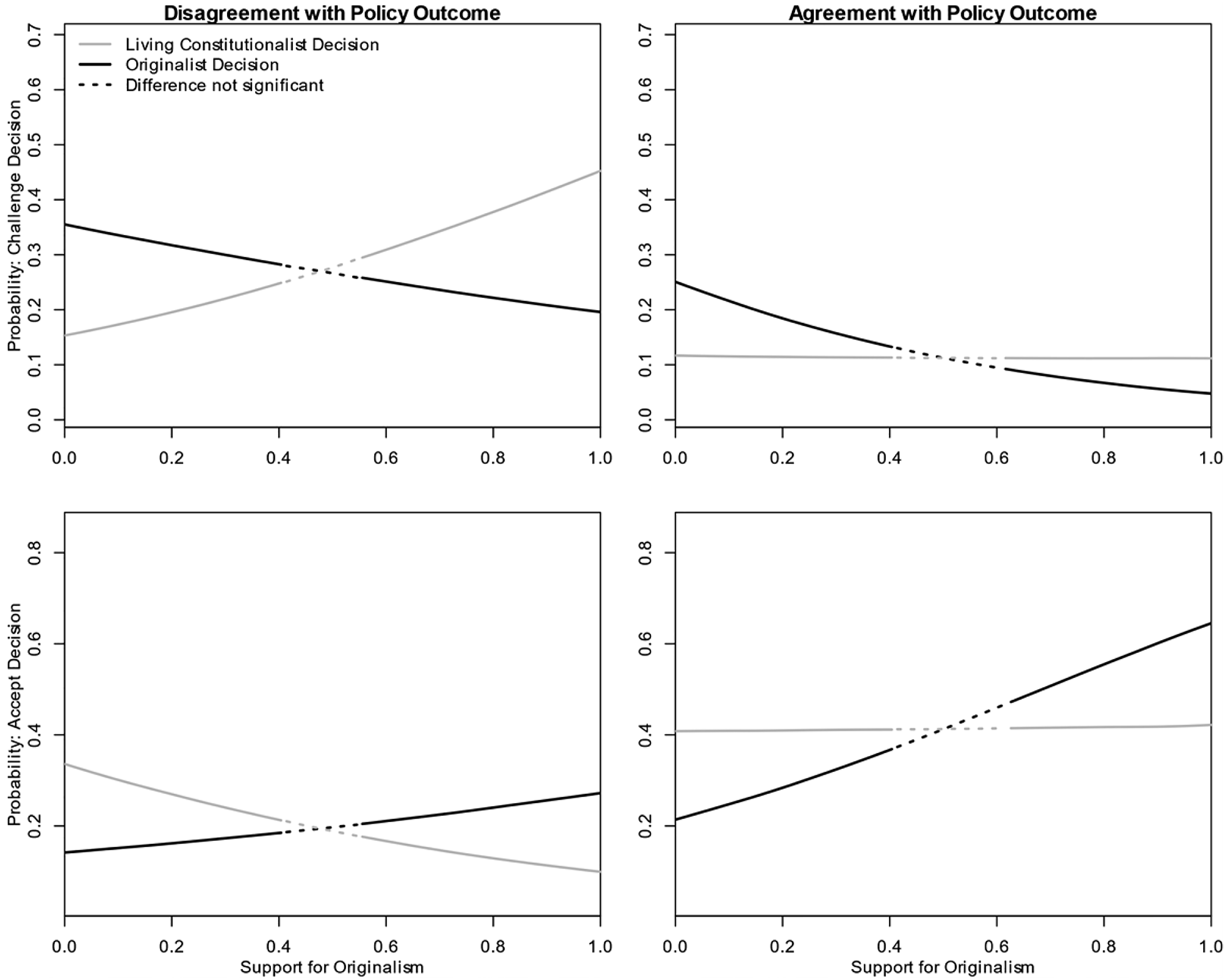
Disagreeable Decision-Accept It
Respondents’ decisions to accept disagreeable decisions (bottom left) follows the same pattern. Living constitutionalists are more likely to accept living constitutionalist decisions than originalist decisions while originalists are more likely to accept originalist decisions than living constitutionalist decisions. A strong supporter of living constitutionalism is 12 [6, 18] percentage points more likely to accept the disagreeable decision that is based on living constitutionalism versus originalism. A strong supporter of originalism is 10 [5, 15] percentage points more likely to accept the disagreeable decision that is based on originalism versus living constitutionalism.
Agreeable Decision-Challenge It
The public’s decision to challenge decisions with which they agree (right column) follows the same pattern. Respondents whose Support for Originalism score is
Agreeable Decision-Accept It
The decision to accept agreeable decisions follows suit. Even when respondents agree on policy grounds with the decision, they still react to the judicial philosophy the judge used. Living constitutionalists are more likely to accept opinions that employ living constitutionalism than originalism. Originalists are more likely to accept opinions that employ originalism than living constitutionalism. A strong living constitutionalist is 13 [5, 21] percentage points more likely to accept a living constitution decision with which she agrees than an originalist decision with which she agrees. Conversely, a strong originalist is 12 [3, 21] percent points more likely to accept an originalist decision with which she agrees than a living constitutionalist decision with which she agrees. These results are what we would expect to observe if judicial philosophy matters to respondents. Policy preferences matter, but so do preferences over how judges arrive at their decisions.
Judicial Philosophy and Ideology More Broadly
In the previous section, we evaluated how respondents’ specific support for court decisions interacted with their views of judicial philosophy. Here, we want to examine ideology more broadly. We want to examine how respondents react to liberal and conservative decisions. After all, Greene, Persily and Ansolabehere (2011) find that originalists are more likely than others to believe it is “very important” that courts “strictly follow the law no matter what people in the country may want.” They also find a correlation between support for originalism and support for both moral traditionalism and libertarianism. At the same time, they find that liberals more strongly favor an approach that “emphasizes changing times and current realities in applying the principles of the Constitution” (362) (see also Czarnezki and Benesh 2009). Accordingly, we refit our models using a triple interaction term that included the following: Support for Originalism, Living Constitutionalist Decision, and Ideological Outcome. Instead of measuring whether the respondent agreed with the outcome specifically, we measured whether the outcome itself was liberal or conservative.
Figure 5 reveals the same general trends. When we hold a decision’s ideology constant, respondents trust judges more when they employ respondents’ preferred judicial philosophies. Consider the respondents who reported no trust in the judge who ruled liberally (top left). Respondents whose Support for Originalism scores are Predicted levels of (dis)trust in judge for liberal and conservative decisions that employed living constitutionalism and originalism. Small values of support for originalism represent a strong living constitutionalist; large values represent strong originalists. Solid portions of lines represent differences that are statistically significant; dashed portions represent non-significant differences. The table of results from this analysis appear in the online supplemental material A7. Figures that include all the values of the dependent variable for trust in judge can be found at A9.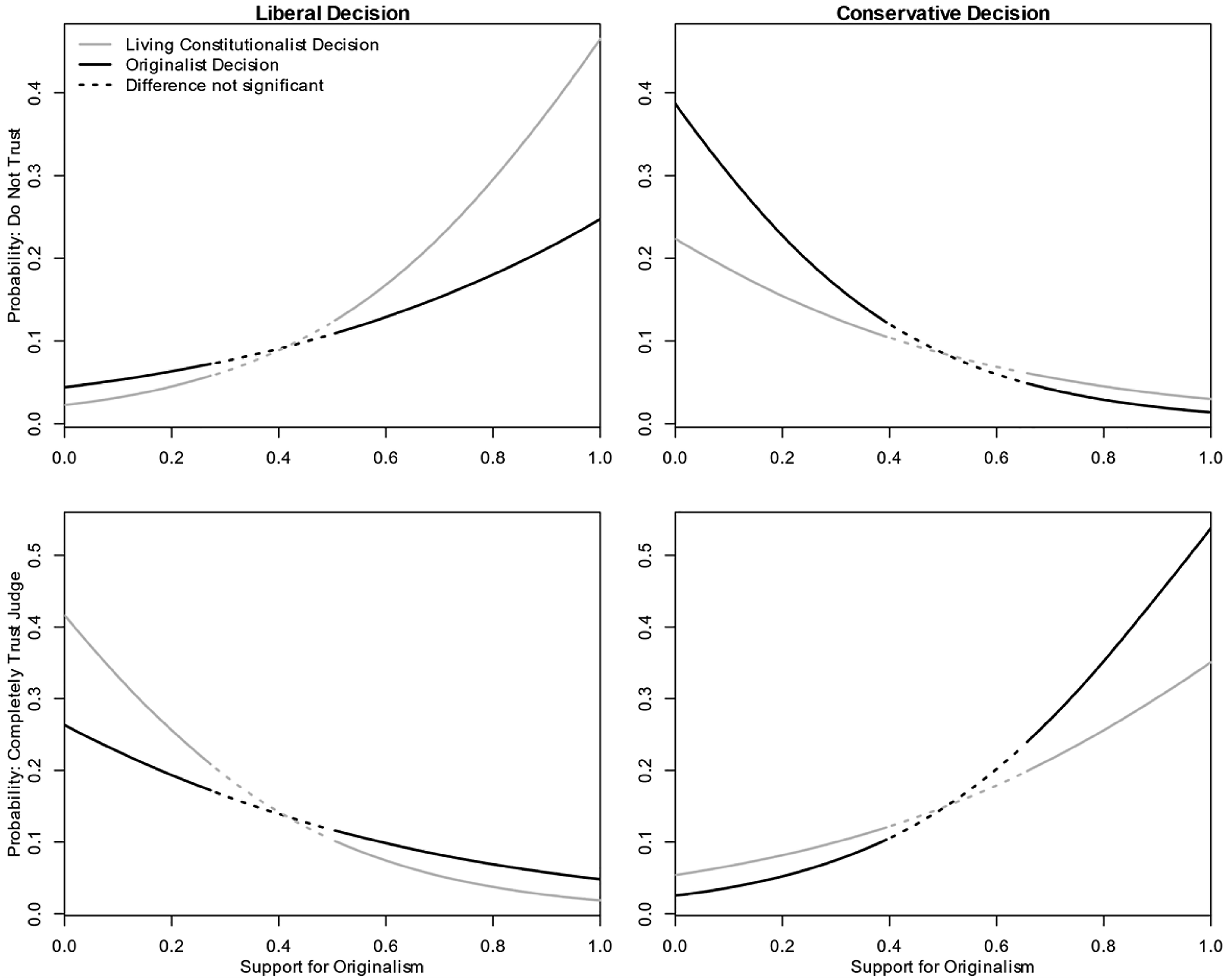
Respondents challenge and accept judicial decisions along similar grounds. Figure 6 shows that when we hold a decision’s ideology constant, respondents are more likely to challenge decisions that employ a disfavored judicial philosophy and are more likely to accept decisions that employ a preferred philosophy. Consider the probability respondents challenge a liberal decision (top left). Respondents whose Support for Originalism scores are Predicted levels of acceptance for liberal and conservative decisions that employed living constitutionalism and originalism. Small values of support for originalism represent a strong living constitutionalist; large values represent strong originalists. Solid portions of lines represent differences that are statistically significant; dashed portions represent non-significant differences. The table of results from this analysis appear in the online supplemental material A7. Figures that include all the values of the dependent variable for accepting the decision can be found at A9.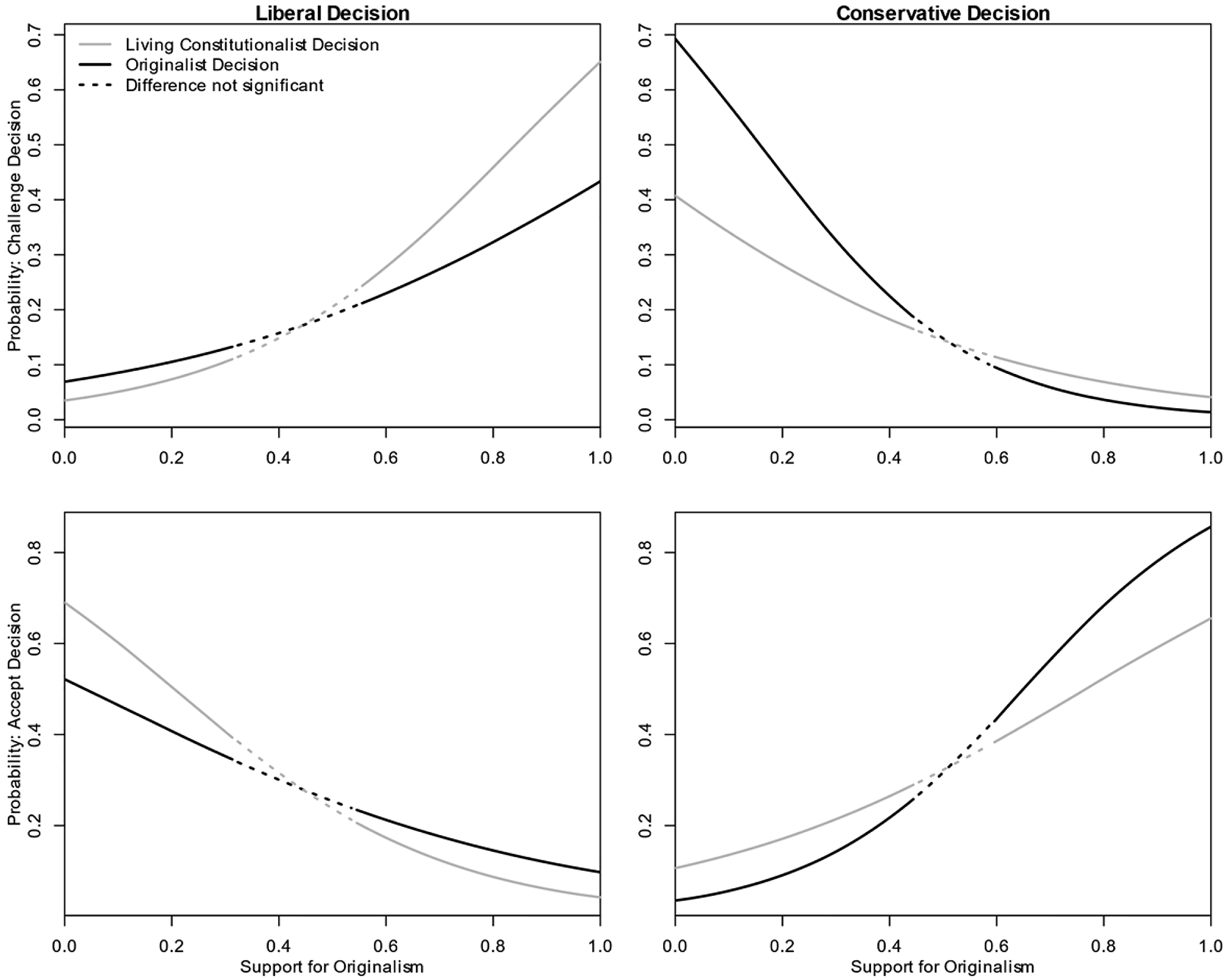
The public’s decision to challenge conservative decisions (top right) follows the same pattern. Respondents whose Support for Originalism are
From Where Do These Preferences Come?
People hold preferences over judicial philosophies. And while there is a general link between ideology or partisanship and judicial philosophy, that connection is not perfect. So where do people derive their preferences? This is an important question but ultimately is one that we cannot answer fully. Having said that, we can theorize a number of possibilities.
Partisan Elites
One possible explanation for our results is that partisan elites forge people’s views on judicial philosophy. According to this theory, the general public has little to no idea about judicial philosophies until partisan elites “educate” them and persuade people to follow a particular philosophy. So, for example, Senator Mitch McConnell repeatedly has stated that “the cornerstone of a nominee’s judicial philosophy should be a commitment to originalism and textualism” (Carney 2022). For his part, President Obama declared that judges need “empathy,” which galvanized liberals and Democrats behind an atextual (or less textual) philosophy. Senator Dianne Feinstein similarly declared: “I firmly believe the American Constitution is a living document intended to evolve as our country evolves” (Feinstein 2017). In this sense, partisan elites might move partisans from not caring about judicial philosophy to caring about it—and caring about it in a particular way.
Ideological Elites
Another possible explanation for our results is that ideological elites frame people’s views on judicial philosophies. For example, conservative media often discuss judicial philosophy. Rush Limbaugh once stated: “We get activist judges who take their personal policy preferences . . . and they call that law . . . That’s why ‘originalist’ is a key word. You go back; you look at the original intent. You can find it. It’s there. Federalist Papers, numerous discussions, the document itself . . .” (Limbaugh 2005, see also Hannity 2016). The right-leaning Federalist Society pushes hard for originalist judges while elite left-leaning groups such as the American Constitution Society (ACS) push hard for living constitution judges. In this way, ideological elites get people to care about judicial philosophies—and to care about them in a particular way.
While each of these theories is plausible, we are somewhat skeptical. Recall that neither Democrats nor Republicans hold monolithic views over judicial philosophy. Democrats split 74–28 and liberals split 78–22 for living constitutionalism while Republicans split 37–63 and conservatives split 42–58. Roughly one-quarter of Democrats and liberals supported originalism. Conversely, roughly 40% of Republicans and conservatives supported living constitutionalism. These data suggest to us that even if partisan or ideological elites try to shape the narrative, they have not been particularly successful. To be sure, their “members” lean in one direction, perhaps due to elite framing, but the variances seem to question the theory.
Nevertheless, we sought to dig deeper. To that end, we estimated a new OLS model. Our dependent variable—Strong Views—is the folded version of Support for Originalism. Recall that Support for Originalism scaled from 0 to 1, with 0 being maximal support for living constitutionalism and 1 being maximal support for originalism. Strong Views is the folded measure. It is the respondent’s absolute distance from the mean judicial philosophy score and ranges from 0 to 0.5, with larger values indicating that respondents held stronger views over judicial philosophy (either toward living constitutionalism or originalism).
Our main covariates of interest measure the respondents’ Partisanship and Strength of Ideology. We examine whether partisans (Democrats or Republicans) hold stronger views about judicial philosophy than Independents (the omitted baseline). We also examine Strength of Ideology by calculating the absolute distance from a neutral level of 4 on a 7-point ideological scale. Thus, a respondent with a larger value of Strength of Ideology has more extreme ideological views, whether liberal or conservative. We further control for respondents’ knowledge of the Court. Low Knowledge respondents answered less than two of our Court knowledge questions correctly. High Knowledge (omitted baseline) individuals answered both questions correctly—they were able to name the Chief Justice from a list of names and they knew that justices enjoy life tenure. 20 To determine whether high knowledge partisans and ideologues hold stronger views over judicial philosophy, we interacted respondents’ knowledge with partisanship and ideology. Finally, we control for the effects of respondents’ Race, Sex, Education, Age, and Income.
Multivariate linear regression of intensity of views over judicial philosophy based on partisanship, ideology, knowledge, and a host of demographic characteristics. We bold the most relevant statistically significant results.
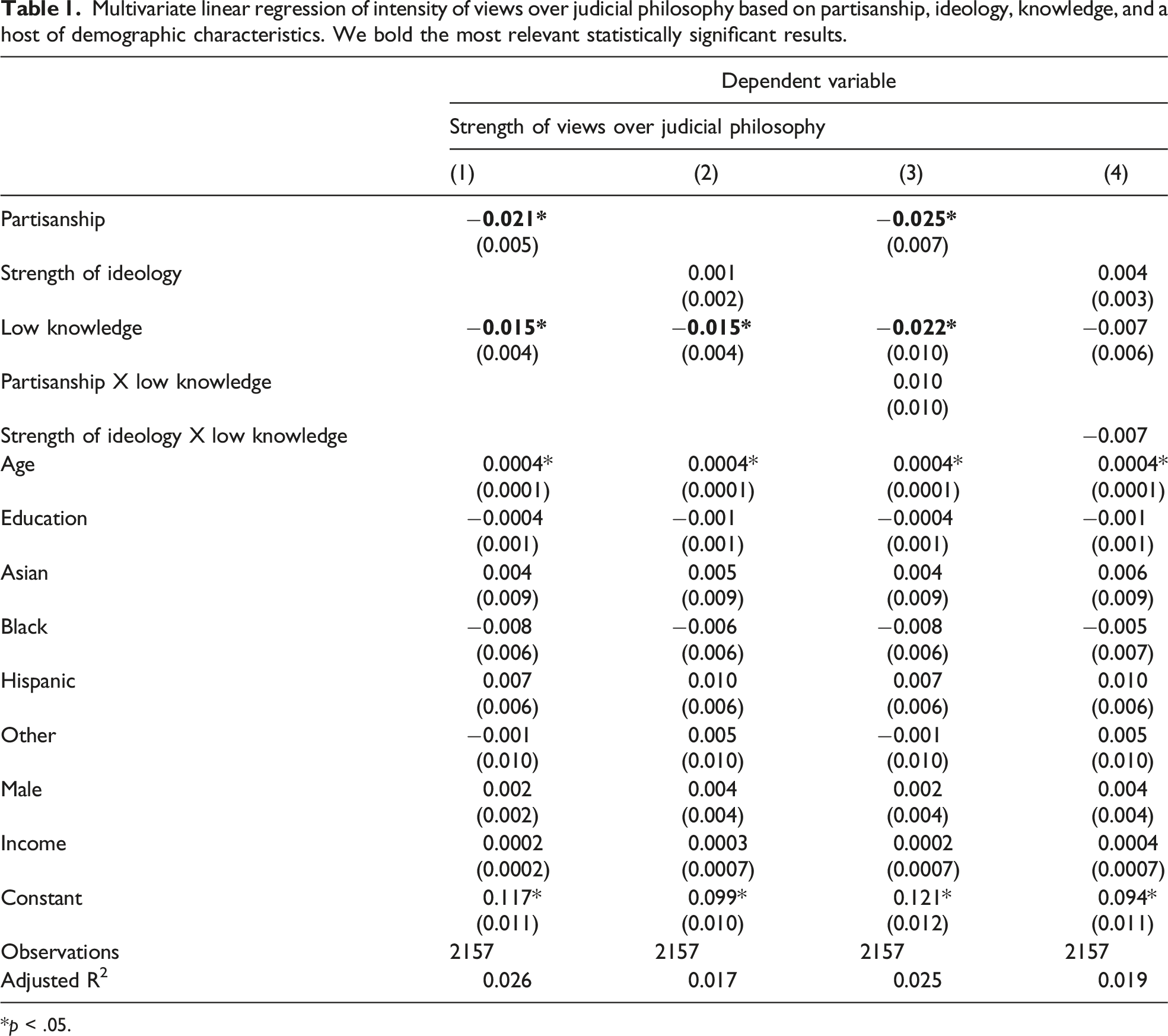
*p < .05.
The results also question, though to a lesser degree, the ideological elites theory. As Model 2 shows, ideologues are no more likely to hold strong views over judicial philosophy than moderates. Model 4 shows that, while higher knowledge ideologues seem slightly more likely to hold views on judicial philosophy than high knowledge moderates (
While mixed findings might support an inference that ideological elites frame these philosophies, one cannot be sure which way the causal arrow points. Perhaps ideologues would take to their philosophies even without any cueing by elites. From our perspective, there is just not enough here to support the ideological elite theory. Scholarship should examine things like respondents’ media consumption to analyze this topic further. If ideological elites use the media to influence people’s beliefs about judicial philosophy, respondents with greater exposure to those elite messages would hold more stable or intense views on judicial philosophy than respondents with less exposure (and they also might reveal greater factual knowledge of the Court). Of course, even there, one would need to be cautious when inferring causation.
We also regressed trust and acceptance on Support for Originalism separately for respondents of moderate and strong ideologies (still while controlling for the ideological direction of the decision and the philosophy employed in a case). If judicial philosophy is simply a shibboleth for ideologues—and not moderates—moderates would not have responded to judicial philosophy in our experiment. But they did. We divided our data into groups based on their ideological preferences for judges, derived from our conjoint results. We labeled respondents in the first and fourth quartiles as “extremes” and the middle 50% (the second and third quartiles) as “moderates.” Both the extremes and moderates continue to respond to the judicial philosophy treatment. Because ideological moderates also responded to the judicial philosophy treatment, we believe that preferences over judicial philosophy do not simply tap into ideology. 20
Genes and Experience
A further potential explanation for our findings is that people’s preferences over judicial philosophies come from their personal experiences or their genes. There is a growing line of scholarship that examines how people’s legal judgments develop (Cohn, et al. 2012; Kohlberg 2008; Tyler and Trinkner 2018). People’s past experiences with authority and their views of other institutions undoubtedly effect their preferences over judicial philosophies. Relatedly, there is a growing (though unsettled) literature on how genes might lead people to be conservative or liberal (Benjamin, et al. 2012). Perhaps the unobserved factors, such as genes, that may lead people to be liberals or conservatives also lead them to be originalists or living constitutionalists. Future scholarship might examine respondents’ psychological and genetic features more extensively, or their past experiences with institutions, to address these questions.
Conclusion
We coupled an adaptive choice-based conjoint design with a computationally intensive hierarchical Bayesian approach to estimate individual-level preferences over judicial philosophy. We then randomly assigned individuals to observe decisions with which they agreed or disagreed and that employed two judicial philosophies. The results showed that judicial philosophy matters to the American public when they evaluate judges and decisions. Public support for the judicial philosophy a judge employed predicts greater trust in the judge and a greater willingness to accept the judge’s decision. Individuals who are strongly inclined to accept (or reject) a decision on policy grounds become more (or less) likely to do so when the judge employs their preferred philosophy. What is more, the results show that people can and do hold different constellations of attitudes toward individual judges and individual decisions. In short, how judges justify their decisions influences public support for courts.
People appear to hold preferences over legal process, much like they impute notions of fairness into law. Research has focused on the degree to which people accept decisions because of how they are made and not just whether they agree with the outcome (Thibaut and Walker 1975, cited in Huo and Tyler 2002). Casper et al. (1988) find that procedural and distributive fairness influenced how defendants evaluated their treatment by the criminal justice system, independent of their sentences. In their analysis of people’s interactions with police and judges in California, Huo and Tyler (2002) find that procedural matters were the primary factor that shaped people’s acceptance of decisions and had more influence than preferences over outcomes. We suspect that judicial philosophy performs a similar role.
We hope that these findings spur greater research into strategic behavior in separation of powers structures or hierarchies. We know, for example, that courts with little legitimacy often must act strategically to avoid political rebuke (Staton and Vanberg 2008; Vanberg 2015). It could be that using a particular judicial philosophy might also influence how politicians and elites evaluate them. Reviewing tribunals (principals) might be more or less likely to review subordinates (agents) who apply certain decisional methodologies (Lax 2012). Actors within hierarchies often engage in strategic instrumentalism to evade review (Owens et al. 2013; Tiller and Spiller 1999). It seems possible that an actor who employs a particular judicial or decisional philosophy could evade or trigger hierarchical review (Turner 2017).
The policy implications of our findings are profound. The results can inform courts how they can protect their institutional support. Judges who regularly follow their judicial philosophies to unexpected ends might depolarize reactions to their decisions and build public support. Conversely, if judicial philosophies invariably (or even often) lead to consistent ideological outcomes, preferences over judicial philosophy may further polarize the public’s attitudes towards judges and courts. Judicial philosophies, in practice, could simply become shibboleths for adherents to particular policy ends. We may be nearing that point but the data suggest we are not there yet.
The academic implications of our results are equally important and suggest that scholarly understanding of public support for courts is incomplete. A long train of excellent scholarship examines how people view and react to judges and judicial decisions (Armaly 2018; Badas 2019a, 2019b; Badas and Stauffer 2018; Bartels and Johnston 2020; Christenson and Glick 2015; Nelson and Gibson 2020; Nelson and Tucker 2021; Nicholson and Hansford 2014, Bartels and Johnston 2013). If our results have anything to say on the matter, it is that when scholars evaluate support for courts, they should consider addressing how people react to the methodologies judges use. The public’s ideological agreement with court decisions goes a long way toward explaining public support for judges and decisions. But as scholars examine that support, we must not forget the role of judicial philosophy.
Footnotes
Declaration of Conflicting Interests
The author(s) declared no potential conflicts of interest with respect to the research, authorship, and/or publication of this article.
Funding
The author(s) received no financial support for the research, authorship, and/or publication of this article.

Supplemental Material
Supplemental material for this article is available online.
Notes
References
Supplementary Material
Please find the following supplemental material available below.
For Open Access articles published under a Creative Commons License, all supplemental material carries the same license as the article it is associated with.
For non-Open Access articles published, all supplemental material carries a non-exclusive license, and permission requests for re-use of supplemental material or any part of supplemental material shall be sent directly to the copyright owner as specified in the copyright notice associated with the article.
