



Abstract
Do U.S. voters care about the policy positions of a candidate when choosing prosecutors? Conventional wisdom suggests the public favors punitiveness and that prosecutorial elections are apolitical. I argue that voters do care about the policy positions of prosecutors, but different information environments induce different voting behaviors. Using a conjoint experiment across four information settings, I show how policy congruence plays an important role in shaping voter’s decisions when candidates’ policy information is available. When policy information is sparse, voters take cues to infer candidates’ political leanings even in nonpartisan or low-information electoral environments. Contrary to the dominant view that the public favors punitiveness, my results suggest that the public is not unequivocally harsh. These findings speak to the possible benefits that society can reap from increasing the level of information available in prosecutorial elections. The findings also call into question the prevalent view that elections ought to compel prosecutors to adopt tough-on-crime stances that result in a highly incarcerated populace.
Introduction
Prosecutors 1 in the United States possess broad discretion in judicial processes, including deciding the nature of charges brought against defendants and whether to engage in plea bargaining (Davis 2008). Even though prosecutors lack the formal power to make a sentencing decision, they control the information that flows to judges. Because of prosecutors’ pivotal influence, their policy positions are an important component determining rule of law at the local level. Take the issue of U.S. mass incarceration as an example: prosecutors who pursue punitive approaches strive for higher conviction rates and harsher sentencing (Arora 2019), whereas reform-minded prosecutors pursue a reduction in low-level nonviolent prosecutions and in jail and prison populations (Green and Roiphe 2020). The decisions prosecutors in the U.S. make have significant consequences for the American criminal justice system. Hence, understanding the selection of prosecutors is critical.
However, despite prosecutors playing a critical role in shaping the criminal justice system, research on U.S. prosecutorial elections suggests that prosecutorial campaigns are apolitical and candidates’ policy positions are inconsequential in elections. Local prosecutors usually run unopposed and candidates rarely announce their policy priorities to voters during campaigns (Wright 2008). Even when prosecutors do signal their political leanings, policy stances often remain unknown. Both Democratic and Republican prosecutors tend to cultivate tough-on-crime reputations, as the conventional view suggests the public favors punitiveness (Gordon and Huber 2002). These arguments have long been the dominant view regarding prosecutorial elections in the United States.
Since about 2010, the pattern seems to have changed. A group of reform-oriented prosecutors have steered their campaigns away from traditional law-and-order posturing by proposing restorative programs and by criticizing racial inequities in the criminal justice system (Davis 2019; Sklansky 2016; Wright, Yates and Hessick 2021). The emergence of issue-based campaigns and the victories of new-style prosecutors suggest that wide swaths of the voting public actually care about prosecutors’ policy stances. Despite such anecdotal evidence, we do not know the extent to which the public evaluates candidates on the basis of their policy positions.
To better understand voters’ preferences for prosecutors, I develop a framework which allows for the possibility that policy positions play an important role in guiding voters’ choice of prosecutors. I begin with the assumption that voters are rational actors in politics who vote for the candidates they believe will provide them with the highest expected utility. In my context, this means voting for the prosecutors predicted to pursue the policies closest to one’s own liking. However, the extent to which voters can infer candidates’ policy positions depends on the information environment that voters encounter. I divide information environments into high and low types. A high-information environment refers to elections where the environment transmits issue-based information, while a low-information environment refers to elections where these policy cues are absent.
I argue that voters will rationally use candidate-specific policy cues to update their beliefs about candidates and support candidates whose policy outlook aligns most with their own when in a high-information environment. Without policy information, I argue that voters make inferences about candidates’ policy leanings by considering their background attributes. Specifically, in low-information partisan elections, I expect voters will resort to party affiliations as the most informative cue because a candidate’s status as Democrat or Republican offers considerable insight into their likely policy positions if elected. Voters may associate Democratic candidates with a liberal position on criminal justice issues and Republicans with a conservative stance. Finally, in low-information nonpartisan elections, I expect voters to turn to gender and race as heuristics to infer candidates’ policy positions, as research suggests that voters associate women and Black candidates with liberal policy preferences (McDermott 1997; McDermott 1998).
To test my arguments, I conducted a conjoint survey experiment in April 2021 in which I presented 1849 American adults with 10 pairs of hypothetical profiles and asked them which candidate would be preferable as a district attorney. To manipulate the information environments the respondents might face, I randomly assigned the respondents to one of four settings: no policy information in a nonpartisan election; no policy information in a partisan election; policy information in a nonpartisan election; and policy information in a partisan election. With this empirical strategy, I can examine whether or not the effect of candidates’ characteristics on voter choices varies as information environments change.
I report three central findings. First, when given information about prosecutors’ policy platforms, candidates obtain more support from policy congruent respondents relative to incongruent respondents. Notably, partisanship does not mute this policy congruence effect: respondents who identify as Republican yet agree with a Democratic candidate’s policy platform are also associated with increased voting probability for Democratic candidates. Second, when candidate policy information is unavailable, I find respondents use party affiliation to infer candidates’ policy stances and choose likely policy congruent candidates. Third, I find no evidence that respondents apply traditional gender and racial cues when evaluating prosecutorial candidates in the two policy issues I examine.
This study contributes to the research on voting behavior and prosecutorial elections in 3 ways. First, it provides a framework for examining how information guides voters’ cue-taking. This advances our understanding of how voters elect prosecutors in partisan and nonpartisan elections as well as in high and low-information environments. Second, this study is one of the first to examine voter preferences in prosecutorial elections. In so doing, it reinforces the importance of policy congruence in this highly consequential yet often overlooked election context. Third, this study provides new insights into voting behavior in prosecutorial elections. As the analysis shows, respondents differ in their criminal justice views, and they care about the proximity of prosecutors’ policy positions when such information is available. These findings demonstrate there is potential benefit in increased information provided to voters in prosecutorial elections, necessitating the reconsideration of past views of electoral forces driving tough-on-crime stances for prosecutors.
Changes in the Landscape of Prosecutorial Elections
Traditionally, prosecutorial elections were low profile affairs in which voters did not have significant information about candidates and their issue positions. During campaigns, prosecutorial candidates seldom talked about their prioritization or implementation of certain policies; rather, campaign rhetoric tended to focus on personal qualifications or the sheer number of cases processed (Wright 2008). For this reason, voters generally had limited information with which they could evaluate prosecutorial candidates.
However, the contestation of prosecutorial elections has gradually changed over time (Hessick and Morse 2020; Wright, Yates and Hessick 2021). While in the past, incumbent prosecutors often ran unopposed, Hessick and Morse (2020) show a changing dynamic in prosecutorial elections—current prosecutors faced challengers upward of 30% of the time in the 2014 and 2016 election cycles, a departure from trends measured by Wright (2008). Even though incumbents still win the overwhelming majority of their elections, a group of reform-oriented prosecutors has unseated long-serving incumbents, challenging the conventional view that incumbents always win 2 (Sklansky 2016). It should be noted, these changes are more likely to appear in high-population districts (Hessick and Morse 2020; Wright, Yates and Hessick 2021).
Since about 2010, advocacy groups have began to endorse and criticize prosecutorial candidates for their positions on criminal justice policies as momentum builds for criminal justice reform. For example, in 2018, the American Civil Liberties Union (ACLU) launched the “Vote Smart Justice” and “Meet your DA” initiatives, which are nonpartisan voter-education programs providing voters with state-tailored information regarding candidates’ stances on key issues. Prosecutorial candidates’ campaigns also began to emphasize candidate differences rather than focusing on the strength of each candidate’s tough-on-crime stance. One visible change was the emergence of reform-oriented prosecutors bearing the “progressive” label and campaigning on using diversion and treatment programs as alternatives to incarceration (Davis 2019). As such, the visibility of prosecutorial election contests has increased in US counties over the past decade.
The emergence of issue-based campaigns has changed the information environment in some prosecutorial contests over time. One question that follows is how the increase in policy-related information influences electoral behavior: Does the new availability of policy information matter for vote choice relative to other available cues, such as party identity? Existing studies provide little insight into whether candidates who adopt a reform-minded platform influence voters’ choices at the ballot box, nor do we know whether an increase in policy information about candidates helps voters identify a like-minded candidate in prosecutorial elections.
A Theory of Voter Choice in Prosecutorial Elections
To examine how vote choices for prosecutors vary as the information environment changes, I turn to research on cue-taking and low-information elections. Studies consistently demonstrate a strong connection between voting behavior and the information environments in which voters evaluate political candidates. A high-information environment can increase citizens’ political knowledge (Carpini, Keeter and Kennamer 1994; Jerit, Barabas and Bolsen 2006) and political participation (Schulhofer-Wohl and Garrido 2013); whereas low-information environments consistently result in low participation and ballot roll-off (Hall 2007). Information environments also influence voters’ use of cues. Voters pay attention to candidates’ issue positions and reduce their reliance on partisan cues when candidate-specific information is available (Peterson 2017). When unable to determine a candidate’s policy preference, voters use shortcuts as a substitute for policy-related information (Popkin 1991; Sniderman, Brody and Tetlock 1993).
I assume that citizens are rational actors when deciding which candidate to support in elections. That is, citizens’ vote for the candidates they believe will provide them with the highest expected utility. In my context, this means voting for a prosecutor who a voter predicts will pursue policies that are closest to their own policy preferences. However, the extent to which citizens learn about candidates’ policy positions depends on the information environment. When election campaigns transmit candidate-specific policy information, voters can simply compare candidates’ policy stances, under the assumption that rhetoric and eventual policies will correspond reasonably well. 3 When information is scarce, voters rely on cues that help them predict what candidates might do when they are in office. In this study, I consider the information environments as either high- or low-information environments.
Voter Choice in High-Information Environment
A high-information environment refers to elections where campaigns transmit ample candidate-specific information that voters can use to evaluate candidates. In these elections, political donations tend to pour into the races, resulting in extensive TV campaign ads and news coverage, making candidate-specific information more accessible and readily observable to voters. Among the available information, I expect candidates’ policy positions to play the most important role in voters’ evaluation because they are best guides for voters to guess how the candidates would behave if they were in office. Using this information, voters calculate how each candidates’ issue position would affect their expected utilities, voting for the candidate that they expect to deliver policies closest to their own preferences. The empirical implication of this is that we would observe that policy congruence plays a key role in shaping voters’ candidate choices in a high-information environment.
The assumption about the role of policy in voting decision is well-supported in the literature. Historically, we have seen the significant influence of abortion attitudes on presidential elections (Abramowitz 1995) and LGBTQ attitudes on presidential approval (Tesler 2015). In the US judicial system, there is a similar connection between the public’s policy preferences and a political candidate’s stance on crime (Brace and Hall 1997; Hall 1995; Hall 2001), which translates to the observed connection between public punitiveness and prosecutor’s decisions. Scholars find that local punitiveness strongly influences federal prosecutors’ decisions regarding whether to pursue violent crime charges, in turn suggesting that prosecutors are also concerned about public issue-based evaluation (Boldt and Boyd 2018). Given that federal prosecutors are selected through an appointment system, Boldt and Boyd’s findings further imply that local punitiveness might have an even stronger effect in contexts where prosecutors are elected (Gordon and Huber 2002).
Voter Choice in Low-Information Environment
Partisan cue in low-information partisan elections
High-information environments are scarce, however, as most elections in the United States take place in low-information environments characterized by little media attention and less campaign spending. In such contexts, voters usually go to the polls without much knowledge about candidates’ policies. In these elections, I expect that voters engage in cue-taking to infer candidates’ issue positions. Among the available cues, I argue that candidates’ party affiliation on the ballot is a powerful shortcut to policy position (Popkin 1991; Rahn 1993). A politician’s status as a Democrat or a Republican offers considerable insight into their likely policy positions if elected (Grynaviski 2010). Therefore, voters can rely on partisan cues to guess candidates’ policy leanings in low-information settings. The positive relationship between candidate–voter party congruence has been demonstrated in a variety of low-information elections. For example, studies on state judicial elections consistently show that, party affiliation is the most important cue in partisan elections (Hall 2007; Klein and Baum 2001; Schaffner and Streb 2002). Access to judicial candidates’ party labels increases participation in judicial elections (Hall 2007) and helps voters select the candidate who is most aligned with their own party attachment and policy interests (Burnett and Tiede 2015).
Gender and race cues in low-information nonpartisan elections
Given that some states use nonpartisan ballots for their local elections, low-information environments in which partisan cues and policy information are both missing also exist. Here, I expect voters make inferences about candidates’ policy positions mainly via gender and race cues—both of which can be derived from candidates’ names on the ballot itself.
Voters apply their gender views to respective candidates through stereotyping (Sanbonmatsu 2002). Women are often perceived to possess feminine-coded traits, such as being warm and caring and therefore better at handling “compassion” issues, such as education, welfare, and women rights. In contrast, men are often perceived to possess masculine-coded traits, such as being tough and therefore better at handling crime, foreign policy, and defense issues (Alexander and Andersen 1993; Leeper 1991). Furthermore, women are also perceived to be more liberal than men (Koch 2002; McDermott 1997). These gender stereotypes influence voting behaviors (Badas and Stauffer 2019; Sanbonmatsu 2002) and even operate within parties. Voters see Democratic women as more liberal than Democratic men and Republican women as less conservative than Republican men (King and Matland 2003; Sanbonmatsu and Dolan 2009).
Similarly, ballot information may reveal their race, and this can also operate as a heuristic to signal candidates’ ideological leanings. Voters tend to perceive Black candidates as more compassionate toward disadvantaged groups and minorities (Sigelman et al. 1995), and Black candidates tend to fare better among more liberal voters and worse among conservative voters (McDermott 1998). While studies on women and minority prosecutors are sparse, recent scholarship finds that women prosecutors and minority prosecutors tend to be more lenient. Gunderson (2022) suggests that women prosecutors are associated with lower women and Black jail populations and lower incarceration rates; similarly, Black prosecutors are associated with fewer felony closures and convictions. To simplify, we should expect that voters tend to associate women and Black candidates with liberal policies.
Overall, using these candidate demographic attributes to infer policy positions enables voters to make guesses about which candidate is in line with their policy preferences despite having minimal knowledge about the candidates.
Testable Empirical Implications
I test respondents’ cue-taking in different information environments using two policy issues that were relevant at the time of the study: tough-on-crime and sanctuary city policies. I first introduce the 2 issues before stating my testable hypotheses.
Tough-on-crime policies
The first issue area, tough-on-crime, refers to a punitive approach to punishment that emphasizes the use of incarceration for more offenders for longer periods to prevent crime. After President Nixon announced the “war on drugs” in the 1970s, the U.S. implemented new policies that increased the incarceration rate for nonviolent offenses and intensified the severity of criminal penalties (Western 2006, Western, Travis and Redburn 2014). Over the past four decades, the tough-on-crime platforms have repeatedly been considered a winning election strategy (Beckett 1999; Marion 1994). However, as I discussed earlier, tough-on-crime policies have become more controversial since 2010.
In response to these concerns, a call for change has appeared in prosecutorial elections. Since about 2016, a new cohort of progressive prosecutors has emerged who oppose mass incarceration and support drug-treatment programs in lieu of long sentences for possession charges. Even though most progressive prosecutors are Democrats, there are a few Republican prosecutors who also adopt reform-orientated platforms (Greene 2020). The emergence of prosecutors with reform-oriented rhetoric from both parties makes the tough-on-crime issue a perfect policy issue to test how prosecutors with varying policy stances might influence vote choice.
Sanctuary city policies
The second issue is sanctuary cities. The term refers to the states and localities that have laws and regulations that place limits on their assistance to Immigration and Customs Enforcement (ICE) seeking to apprehend and deport unauthorized immigrants (Garcia 2009). Though sanctuary cities are not typically a criminal justice issue, this policy area is worth studying for three main reasons I outline below.
First, the issue of prosecuting immigrants is a salient issue in the criminal justice system. Scholars and social activists have noticed that local prosecutors’ ability to trigger deportation allows prosecutors to wield enormous prosecutorial power over immigration outcomes (Eagly 2017). Prosecutors’ positions on the sanctuary city issue are therefore closely related to the broader policy question of how non-citizens are treated in the criminal justice system.
Second, the unique role that local prosecutors play in American immigration enforcement pushes some prosecutors to take a policy stance on the sanctuary city issue. For example, during the Trump administration, thirty-three current and former prosecutors released a statement arguing that anti-sanctuary city policy threatens community trust and endangers public safety (Institute for Constitutional Advocacy and Protection, 2018). Many then-incumbent prosecutors instructed their assistant prosecutors to use discretion when dealing with cases involving immigrants to avoid harsh consequences like deportation (Fenton 2017). Furthermore, in districts with sizable immigrant populations, it is also common for prosecutors to address their policy stance on the sanctuary city issue. 4
Third, public preferences regarding sanctuary cities are greatly divided (Hajnal and Rivera 2014; Miller and Schofield 2008). This division, which falls along party lines, is also a division within the two parties. For example, when respondents to the 2016 CCES were asked whether the U.S government should identify and deport illegal immigrants, 22% of Democrats said “yes” with 78% saying “no.” Conversely, 66% of Republicans said “yes,” while 34% said “no,” indicating more than strictly partisan division. This raises the possibility of testing the relative effect of policy congruency over partisanship in determining vote choice.
Hypotheses
My theory predicts that voters’ use of cues varies with information environments. In high-information environments, I expect that policy congruence plays an important role in candidate choice. More specifically, I test the following hypotheses:
High-Information Environments
• Tough-on-crime candidates are associated with increased support from tough-on-crime respondents compared to pro-reform respondents. • Pro-reform candidates are associated with increased support from pro-reform respondents compared to tough-on-crime respondents. • Pro-sanctuary city candidates are associated with increased support from pro-sanctuary city respondents compared to oppose-sanctuary city respondents. • Oppose-sanctuary city candidates are associated with increased support from oppose-sanctuary city respondents compared to pro-sanctuary city respondents.
When information regarding candidates’ policy positions is unavailable, I expect respondents to rely on candidate party affiliations to infer policy stances. I consider that voters should generally consider Republican candidates to be conservative on the tough-on-crime issue and Democratic candidates to be liberal, mirroring results found in existing studies (Arora 2019; Sunstein et al. 2007). As for the sanctuary city issue, voters should regard Republican candidates to be conservative on immigration policies and Democratic candidates to be liberal (Sides, Tesler and Vavreck 2017; Sides, Tesler and Vavreck 2018). Therefore, when respondents use party labels to predict candidates’ policy stances, tough-on-crime and anti-sanctuary respondents would prefer Republican candidates more than a pro-reform and pro-sanctuary city respondent, respectively.
Low-Information Partisan Election
• Republican candidates are associated with increased support from tough-on-crime respondents compared to pro-reform respondents. • Democratic candidates are associated with increased support from pro-reform respondents compared to tough-on-crime respondents. • Republican candidates are associated with increased support from oppose-sanctuary city respondents compared to pro-sanctuary city respondents. • Democratic candidates are associated with increased support from pro-sanctuary city respondents compared to oppose-sanctuary city respondents.
Finally, when policy and partisan information are both unavailable, I expect respondents to resort to gender and race cues. Candidates’ gender and race cues can operate as heuristics to signal a liberal leaning (McDermott 1998). As such, I expect that women and Black candidates will obtain more support from pro-reform and pro-sanctuary city respondents, all else being equal.
Low-Information Nonpartisan Election
• Women and Black candidates are associated with increased support from pro-reform respondents compared to tough-on-crime respondents. • Women and Black candidates are associated with increased support from pro-sanctuary city respondents compared to oppose-sanctuary respondents.
Survey Design
Testing my hypotheses requires comparing candidates that differ in policy stances on the tough-on-crime and sanctuary city issues, as well as comparing elections that differ in the availability of information (high and low) and electoral methods (partisan and nonpartisan). I take an experimental approach, with hypothetical candidates combined with random assignments of informational settings; this enables me first to manipulate voters’ exposure to informational cues, and second to control for respondents’ background characteristics that may influence their candidate choice.
I test my hypotheses with a conjoint experiment consisting of four information environments. Conjoint designs are increasingly used in political science (Hainmueller, Hopkins and Yamamoto 2014). The conjoint design operates by presenting respondents with multiple pieces of information that randomly vary at the same time. In my design, I present respondents with 10 pairs of profiles regarding hypothetical prosecutorial candidates. The attributes of each candidate come from a set of candidate attributes (demographic characteristics, party, and policy positions). For each pair, respondents are asked to evaluate the profile of each hypothetical candidate and to identify which candidate they would prefer to see as their district attorney.
Random Assignment of Respondents to Groups
Random Assignment of Groups.

Randomized Attributes and Levels
Overview of Treatment Attributes and Levels.
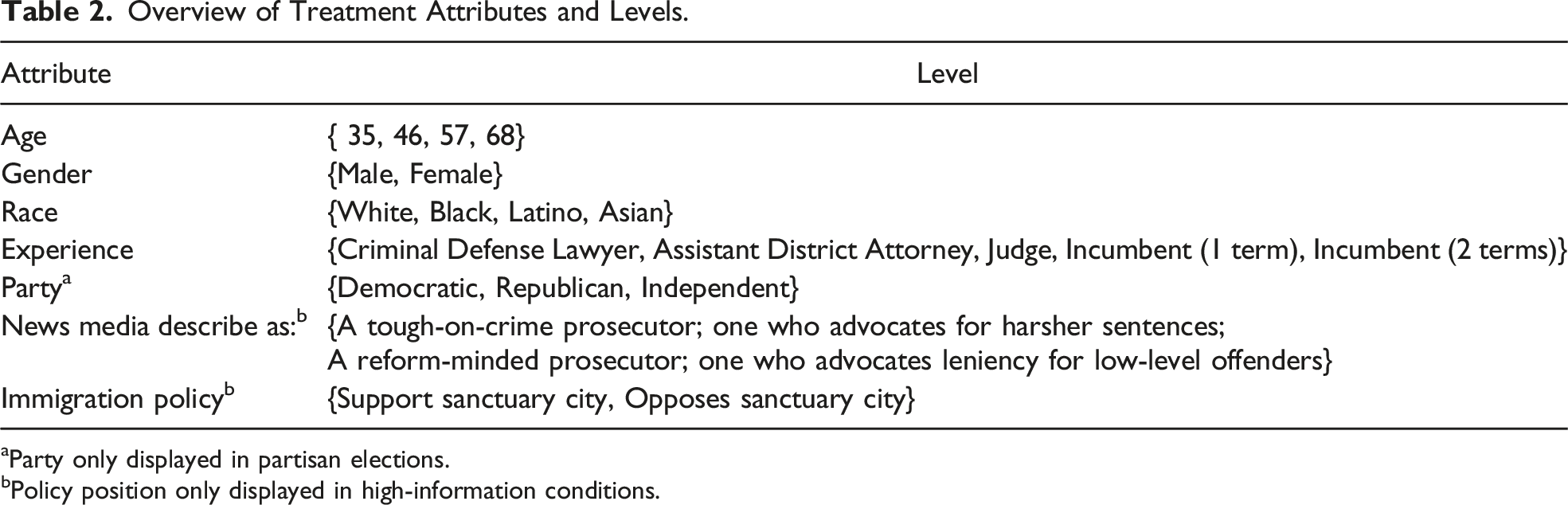
aParty only displayed in partisan elections.
bPolicy position only displayed in high-information conditions.
In the high-information settings, the candidate profiles contain 2 additional policy matters: candidates’ support for or opposition to the tough-on-crime issue, with the latter being termed reform-minded; 5 and candidates’ support for or opposition to sanctuary city policies. 6
Although this randomization approach may create uncommon combinations (Krewson and Owens 2021), such as a tough-on-crime prosecutor who supports sanctuary city policies, such combinations do occasionally appear in primary elections. Given that prosecutorial candidates compete with opponents within the same party in primaries, candidates may propose policy platforms aiming to distinguish themselves from other same-party candidates, resulting in seemingly counterintuitive policy platform combinations. For example, in 2021, New York County had a crowded district attorney race. Tali Farhadian Weinstein, one of eight Democratic contenders, exemplifies the case of a tough-on-crime prosecutor supporting sanctuary cities. During the campaign, Weinstein demonstrated her support for immigrants by showing her immigrant roots. At the same time, Weinstein ran as tough-on-crime. During the DA debate, she attacked her opponent Bragg’s pro-reform platform as being soft-on-crime. Given the possibility of different policy platforms that may appear in primary elections, I allow for the existence of unusual combinations of policy platforms in my survey.
Measuring Policy Preferences
To examine the extent to which voters’ policy preferences affect their support for candidates whose policy stances align with theirs, I need indicators for respondents’ policy preferences. I measure respondents’ preference for tough-on-crime policy from a pretreatment question where I present respondents two major views regarding the government’s approach about punishment and ask them to select which one is closer to their own policy preference. The two statements are presented below, respondents who select the first statement are coded as “pro-tough,” and the second is coded as “pro-reform.” Similarly, I ask respondents to read two statements regarding sanctuary city issues and select one that is closer to their opinions. Respondents who select the first are coded as “pro-sanctuary city” and who select the second are coded as “oppose-sanctuary city.”
Tough-on-Crime Issue
• Harsh sentencing has helped the society become safer. There are reasons to pursue a tough-on-crime approach. • Tough-on-crime policies did not make the society safer. We need alternatives to tough-on-crime policies, such as providing treatment programs for drug addiction.
Sanctuary City Issue
• Undocumented immigrants should be deported. There is no reason to have sanctuary cities. • Sanctuary cities are needed to provide services to undocumented immigrants while they are in this country.
Data
I recruited participants via Amazon’s Mechanical Turk (MTurk), a crowdsourcing marketplace allowing individuals to complete human intelligence tasks (HITs). I posted an HIT on MTurk in Spring 2021 with a link to my survey form in Qualtrics. Respondents read a consent form and were informed of the topic of the survey before they took it.
In my conjoint survey, each respondent read 10 randomly generated pairs of profiles (10 choice tasks), making the total number of evaluated profiles 36,980. Respondents were randomly assigned to four different groups with each group having over 9000 rated profiles. The number of rated profiles in each group is detailed in the Appendix (A2).
Generally, experiments based on MTurk samples obtain the same qualitative results as experiments carried out on random samples of the population (Mullinix et al. 2015), especially when using workers with a good reputation (Peer, Vosgerau and Acquisti 2014). However, there are potential limitations when using MTurk for subject recruitment. Studies find that samples recruited via MTurk are demographically different from the US population (Berinsky, Huber and Lenz 2012; Huff and Tingley 2015). There are also concerns regarding MTurk worker attentiveness, or that they may violate assignments by participating in experiments multiple times.
To ameliorate the abovementioned concerns, I took several steps to enhance survey quality and reduce sample imbalances. First, I only recruited workers with approval rates above 95% on previous MTurk tasks. Second, I embedded a screening protocol for checking IP addresses and blocking fraudulent workers (Kennedy et al. 2020). Third, I deployed screeners to identify inattentive respondents.
Specifically, I included two screener questions. In the first, I provided respondents a list of policy issues the country is facing and asked them to consider which they consider the most important. Yet in the question, I asked the respondents to ignore the question and only select “none of the above.” The second screener came up right before the treatment questions, I provided respondents a list of information sources (TV, radio, printed newspaper, etc.,) and asked respondents from which source they get their news. I asked respondents to only select “Other.” Respondents who failed the first screener received a warning message; those who also failed the second were directed to the end of survey. Overall, among the 2396 respondents who completed the survey, less than one quarter (23%) were removed for one of these three forms of failure. 1849 unique respondents remained in the sample.
Finally, I reweighted my sample. Although my sample resembles the US population in terms of gender and race characteristics, my sample is skewed toward Democrats and it contains a higher proportion of college/university graduates. 7 To correct for such imbalances, I weighted my sample to approximate US population demographics in terms of the proportions of age group, gender, education (no college degree, college degree, and above), ideology (liberal, moderate, and conservative), and race (White and non-White) using weights obtained via entropy balancing (Hainmueller 2012).
Statistical Analysis
As stated earlier, I am interested in the effect of respondents’ policy preferences on choosing candidates with the same issue position. For example, consider if being a tough-on-crime respondent affects choosing a candidate who supports tough-on-crime policies. A simple equation form is
Before looking at the estimates, we might be worried that other factors affecting the vote for a tough-on-crime candidate—such as respondents’ levels of education, occupation, and family background—might be correlated with a respondent’s stance on the tough-on-crime issue and with vote choice for a candidate with particular attributes. It is not as the same as respondents’ preferences on the tough-on-crime issue are randomly assigned so that all additional control variables are uncorrelated with candidate vote. It might be that respondents who favor tough-on-crime are correlated with other respondent background characteristics that affect choosing a tough-on-crime candidate.
To estimate the causal effect of a respondent’s policy position on candidate choice, I adopt a subset-data-by-treatment-level approach, as suggested by Bansak (2021), partitioning my sample by candidates’ randomized policy treatment levels prior to running the regression analysis. This allows me to control for demographic backgrounds that might affect policy preferences and candidate votes.
I first consider evaluating the policy congruence effect of the tough-on-crime policy. The randomized treatment is whether the candidates’ position is either tough-on-crime or reform-minded. I partition the sample into two sets accordingly. After subsetting, I rely on ordinary least squares (OLS) regression to predict the vote for tough-on-crime candidates using a set of variables for respondents’ policy preferences and characteristics. This lets me test whether shared policy positions increase the probability of voting for candidates. In this case, I test whether a respondent is more likely to vote for a tough-on-crime candidate if a respondent favors tough-on-crime over reform, controlling for the respondent’s background.
In the first subset, I evaluate a respondent’s choice for candidates who are tough-on-crime. The outcome variable is Candidate Choice given the candidate is tough-on-crime. The explanatory variable, Tough-on-Crime Respondent, is a dummy variable for respondents’ preference on the tough-on-crime issue (1 if pro-tough-on-crime, 0 if pro-reform). I include two dummy variables for respondents’ party affiliation, Democratic Respondent (1 if Democrat, 0 if Republican or Independent) and Republican Respondent (1 if Republican, 0 if Democrat or Independent). I interact the two respondent party identification variables with Tough-on-Crime Respondent to see if Candidate Choice changes for Tough-on-Crime Respondent at varying respondents’ partisanship. Finally, I include Gender, Education, Ideology, and Age as control variables 8 that may influence respondents’ candidate choice.
In the low-information setting, I adopt the same subsetting approach. I partition the sample by three randomized treatments: candidates’ party, gender, and race. I then predict the vote for Democratic, Republican, women, and Black candidates separately, using a set of variables for respondents’ policy preferences and demographic characteristics. 9
Results
I first examine how policy congruence influences voting decisions in high-information environments and then look at low-information environments, when candidates’ policy information is unavailable, to examine how voters might use cues to help them find potential policy congruence candidates.
Policy Congruence Effect in High-Information Environments
When exposed to candidate policy information, I expect respondents will evaluate candidates through an issue-oriented lens, allowing for policy congruence to play an important role in shaping voters’ preferences. Figure 1 demonstrates the policy congruence effect on two policy issues. The y-axis shows the changes in voting probability for a candidate associated with a respondent going from policy incongruent to congruent—subset by policies (columns of panels) and positions (rows of panels). The x-axis represents the varying combinations of candidate information treatments, ranging from showing issues-support-candidates (all candidates, Democrat, Republican, Independent) to showing issues-opposition-candidates (all candidates, Democrat, Republican, Independent). The dots indicate the median estimates, and lines show 95% confidence intervals. Grey dots and lines denote estimates for all respondents, dark grey for self-identified Democratic respondents, and black for self-identified Republican respondents. The y-axis shows the predicted probability changes associated with a respondent going from policy incongruence to policy congruence on two issues subset by policies and positions. The x-axis represents the varying candidate party treatments. Gray dots and lines denote estimates for all respondents, dark for Democrats, and black for Republicans. 95% confidence intervals are obtained from robust standard errors, clustered by respondent.
First and foremost, there is a significant increase in the probability that a respondent will support a candidate when the candidate shares the same issue position. The left column of Figure 1 shows the policy congruence effect on the tough-on-crime issue. On average (the all candidates subset), the probability of tough-on-crime respondents voting for tough-on-crime candidates increases by 14 percentage points relative to pro-reform respondents. This particular policy congruence for Republican candidates increases by 17 percentage points, and for Independent candidates it increases vote probability by 19 percentage points, while policy congruence for Democratic candidates is much lower (4 percentage points) and statistically insignificant. 10
The policy congruence effect is stronger for the sanctuary city issue. The right column of Figure 1 shows the probability of pro-sanctuary city respondents voting for pro-sanctuary city candidates (all candidates) increases by 26 percentage points relative to oppose-sanctuary city respondents. The increase is higher for Democratic candidates (32 percentage points) and Independent candidates (32 percentage points) but lower for Republican candidates (14 percentage points).
Importantly, this policy congruence effect is not muted by partisanship. As mentioned, I present changes in the probability of voting for candidate subset by candidates’ party labels and issue positions. This allows me to assess whether partisan labels reduce the policy congruence effect. I find that being a pro-sanctuary city Republican respondent also substantially increases the voting probability for pro-sanctuary city Democratic candidates by 32 percentage points relative to oppose-sanctuary Republican respondents. 11
Given that party identification is a powerful factor influencing voting behavior in the US, this result is striking. The fact that shared policy position increases voting probability even for an opposite party candidate suggests that voters value policy congruence and that partisanship is not so powerful as an influence that it can reduce the effect of policy congruence.
Overall, these findings provide evidence that policy congruence plays a crucial role in candidate choice when voters are in a high-information environment even after controlling for party and ideology. Further, it demonstrates that the provision of candidate policy information induces respondents to vote for candidates who are in line with their policy positions, even if those candidates are not co-partisans.
Voting in Low-Information Environments: Partisan Elections
In the previous section, I examine how policy information affects voting behavior when voters are in high-information environments. However, prosecutorial elections are commonly low-information elections in which I expect party and candidates’ demographic backgrounds to offer cues to policy-oriented respondents.
The first scenario I consider is low information, partisan elections. In this scenario, I expect voters to infer candidates’ policy platforms from their party affiliations. Voters generally assume that Republican candidates support tough-on-crime policies and oppose sanctuary city issues, while Democratic candidates hold the opposite positions.
Following the subsetting approach, I partition the data by candidate party labels and then run four linear regressions examining two sets of relationships. In the first set of models, I predict the vote for Democratic and Republican candidates separately while using a set of variables for respondent characteristics and their policy preference about the tough-on-crime issue. I run the analysis analogously for the sanctuary city issue in the second set of models.
Figure 2 presents the relationship between respondents’ policy preferences and candidate choices by parties. The left panel shows that, on average, tough-on-crime respondents are associated with slightly increased voting probability for Republican candidates relative to pro-reform respondents and decreased voting probability for Democratic candidates. While the differences are not statistically significant, the median estimated differences are sizable and sign in the anticipated direction. The right panel presents that, relative to oppose-sanctuary city respondents, pro-sanctuary city respondents are associated with increased support for Democratic candidates and decreased support for Republican candidates. The results are consistent with my hypotheses, and the estimated differences are significant. The y-axis shows the predicted probability changes associated with a respondent’s policy preference going from an opposing to a supportive attitude on the tough-on-crime issue and the sanctuary city issue, respectively. The x-axis shows candidate party treatments. 95% confidence intervals are obtained from robust standard errors, clustered by respondent.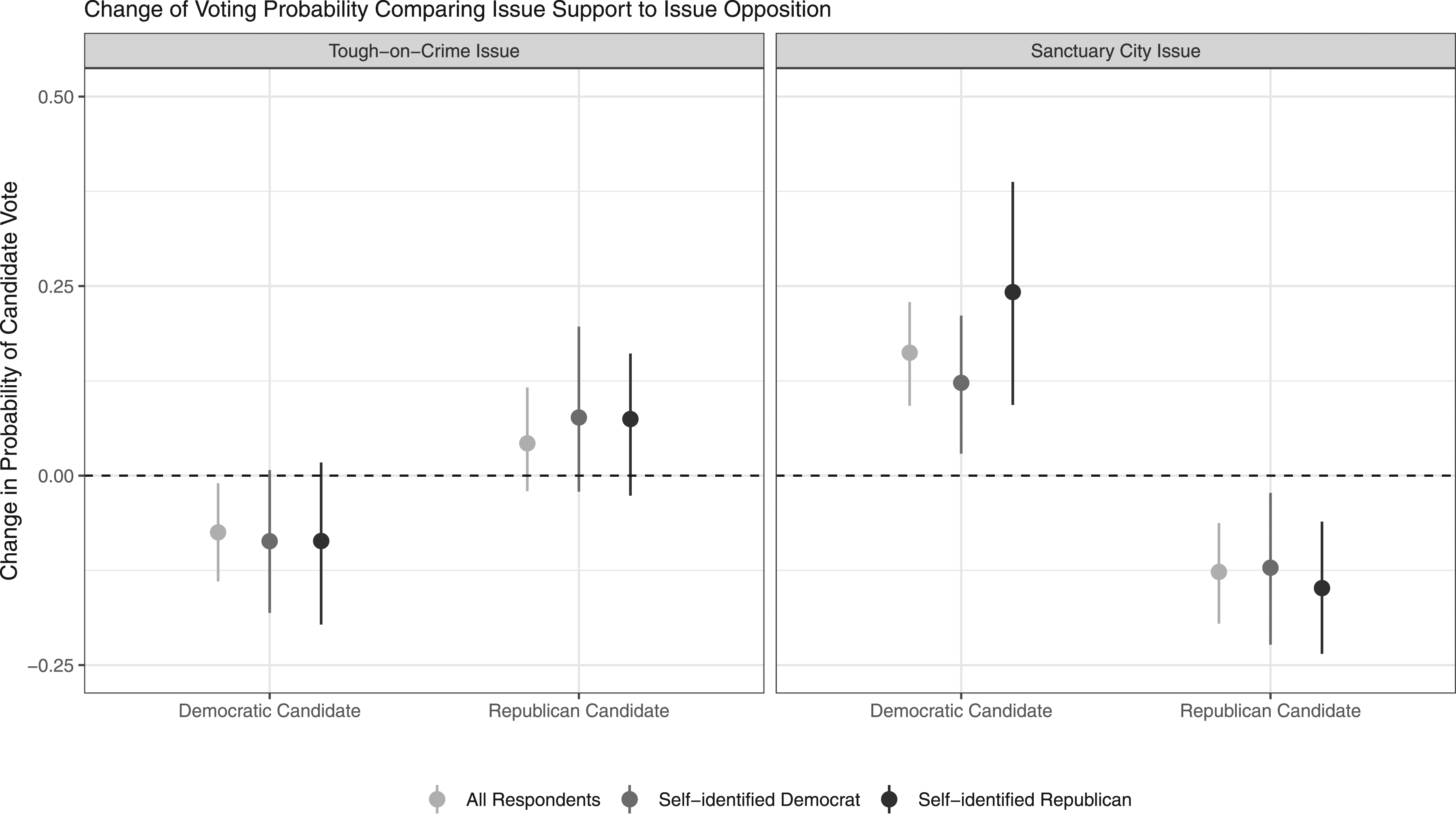
There is a clear pattern in which pro-sanctuary city respondents are associated with higher probabilities of choosing Democratic candidates and lower probabilities of choosing Republican candidates, despite respondents’ lack of a candidate’s policy information. The findings suggest respondents distinguish candidates’ policy positions by their party labels when it comes to the sanctuary city issue. This result demonstrates that respondents may vote based on candidates’ imputed policy stances without seeing candidates’ policy information, after accounting for respondent ideologies and partisan leanings. For example, for Republican respondents who support sanctuary city policies, the probability of voting for a Democratic candidate increases by 24 percentage points, relative to oppose-sanctuary city Republican respondents. However, the connection between tough-on-crime respondents and Republican candidates is weaker and insignificant, suggesting voters do not distinguish candidates’ positions on the tough-on-crime by party labels. I address possible explanations in the discussion section.
Voting in Low-Information Environments: Nonpartisan Elections
Five states—Arkansas, California, Minnesota, North Dakota, and Oregon—elect their local prosecutors in a nonpartisan manner. Therefore, I consider a second scenario of low-information voting: when candidates’ policy information and party labels are both unavailable. In this scenario, I posit that voters will infer candidates’ policy positions from gender and race, expecting that voters generally associate women and Black candidates with liberal political leanings. Specifically, I test whether tough-on-crime respondents are less likely to support women and Black candidates relative to pro-reform respondents, and if pro-sanctuary city respondents are more likely to support women and Black candidates relative to oppose-sanctuary city respondents.
Again, I subset the data by two randomized treatments (candidate gender and race) and then predict the vote for women candidates and Black candidates separately while using a set of variables for respondents’ characteristics and their policy preferences about the tough-on-crime issue and sanctuary city issue.
Figure 3 presents the relationship between respondents’ policy preferences and women and Black candidates. The left panel demonstrates that being a tough-on-crime respondent does not significantly decrease the voting probability for a woman or Black candidate relative to a pro-reform respondent. The right panel presents that, compared to oppose-sanctuary respondents, being a pro-sanctuary city respondent does not significantly change the voting probability for a woman candidate. Although pro-sanctuary city respondents are associated with increased support for Black candidates, the increase is not statistically significant. Overall, these findings suggest that voters might not use gender- or race-based cues to infer policy positions in the context of tough-on-crime and sanctuary city issues.
12
The y-axis shows the predicted probability changes associated with a respondent’s policy preference going from an opposing to a supportive attitude on the tough-on-crime issue and the sanctuary city issue, respectively. The x-axis represents two candidate characteristics treatments. Estimates obtained from interaction models interacting respondents’ policy preferences with separate dummy variables for respondents’ self-identified party affiliation. 95% confidence intervals are obtained from robust standard errors, clustered by respondent.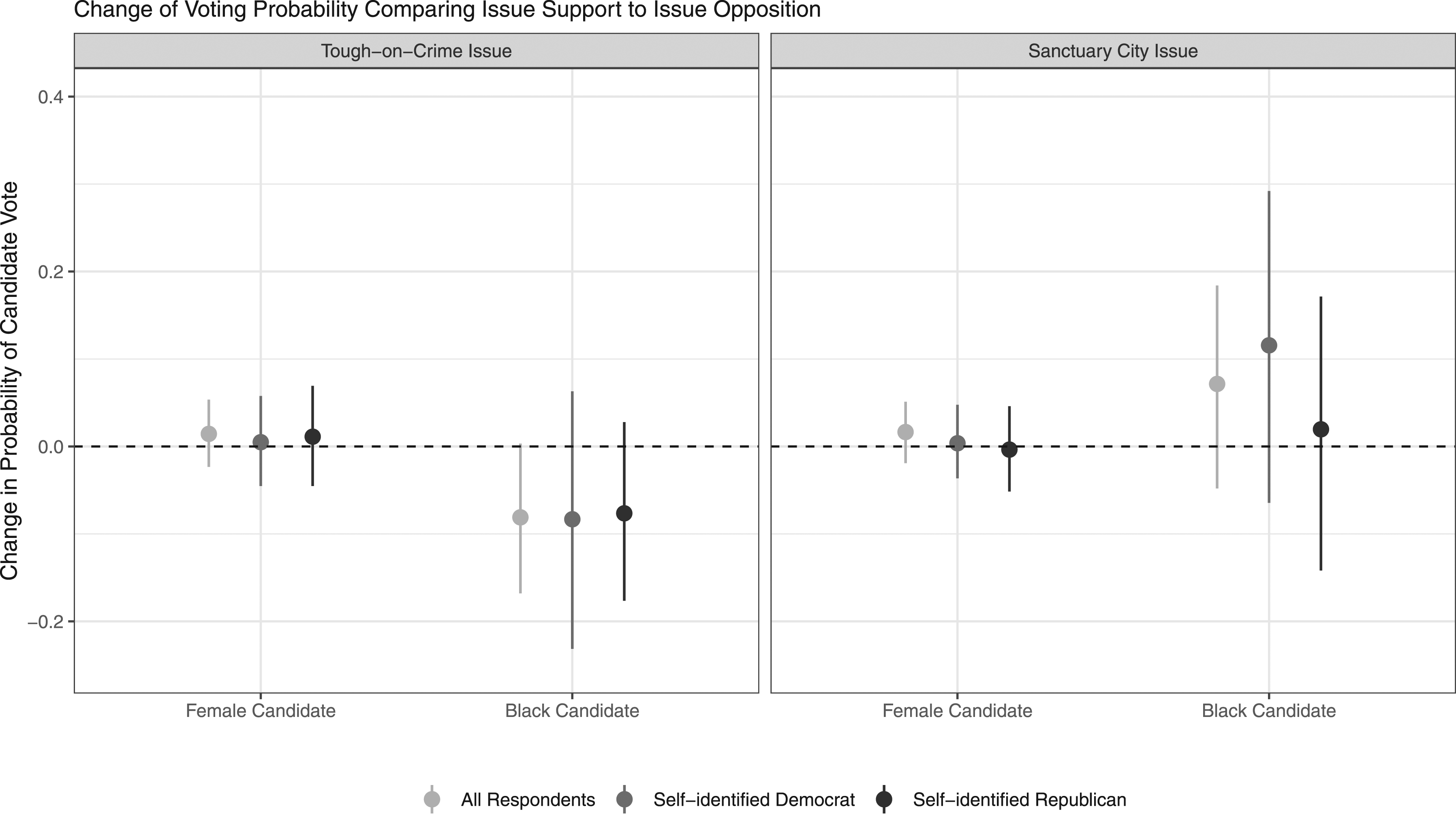
Discussion
An increasing number of politicians have moved away from tough-on-crime stances and platforms, favoring reform-oriented platforms more frequently in the 2010s and onward. Prosecutors have been advocating reductions in incarceration, the substitution of drug treatment programs for drug-related prison sentences, and reversals of wrongful convictions (Green and Roiphe 2020; Sklansky 2016; Wright, Yates and Hessick 2021). Similarly, social groups have been mobilizing bipartisan support for reforms and launching initiatives to help voters choose judicial candidates who support criminal justice reform issues. 13 However, we do not know whether candidates who adopt reform-minded platforms actually influence voters’ choices at the ballot box, nor do we know whether increased information about candidates’ policies helps voters identify like-minded candidates.
In this paper, I tackle this question by examining how the availability of candidate information influences voting decision in the context of prosecutorial elections. I develop a theory to analyze how voters evaluate prosecutorial candidates in four information environments. This study provides new insights for research on voting behavior and prosecutorial elections in three ways.
First, my results suggest that policy congruence significantly affects voters’ evaluations of prosecutorial candidates in high-information environments. On average, candidates obtain more support from respondents aligned with their policy stances. Given that this is even the case when candidates and respondents are from the opposite party, we have strong evidence that policy congruence plays a key role in voting for candidates. This finding echoes those that the literature has reported in other types of elections, such as presidential and congressional elections. 14
Second and contrary to my expectations, my results demonstrate that voters do not distinguish between candidates’ positions on the tough-on-crime issue by party labels. One possible explanation is party labels cause heterogeneous perceptions of tough-on-crime stances. For example, a recent study indicates that Democratic politicians are incentivized to pursue punitive policies when facing electoral pressures (Gunderson 2021). Thus, Democratic politicians might behave in the same way or tougher than Republican politicians. In turn, voters may find it difficult to connect party labels to policy stances on tough-on-crime.
Third, my results suggest that respondents do not use gender- and race-based cues to infer candidates’ policy positions in my two policy issues. This finding is inconsistent with prior studies suggesting that voters perceived women and Black candidates as more liberal and Black candidates as more committed to issues related to race (McDermott 1998; Williams 1990). One possible explanation for this result might be that respondents evaluate women prosecutors differently from women in general. Growing scholarships suggest that women politicians receive their own distinct stereotypes. For example, Schneider and Bos (2014) find that gender stereotypical traits ascribed to women politicians are distinct from those ascribed to women as such; voters also hold different expectations for women legislative and executive officeholders, suggesting more subtypes for women politicians (Sweet-Cushman 2021). Another possible explanation might be that voters do not link women candidates with a “soft” image as women prosecutors may strive to overcome gender stereotypes by behaving tougher than men. For example, Marilyn Mosby, the current State’s Attorney for the Baltimore district, won the Democratic primary by promising to be tough on violent crime; Angela Corey, former Florida State’s Attorney for the Fourth Judicial Circuit Court, had a punitive record in prosecuting juveniles and was known for seeking death sentences (Pishko 2016).
The presence of tough women prosecutors suggests that gender stereotypes of women candidates may not be useful as a heuristic for prosecutorial candidates. Similar phenomena to these complicated dynamics for women in politics are likely to occur for non-White prosecutors, explaining the absence of a racial cue affecting vote choices for prosecutors. These findings are encouraging for the continued and future study of the complexities of identities such as race and gender in political campaigns and criminal justice spheres, particularly causal mediators such as perceptions of femininity or aspects of stereotypes such as compassion by race and gender.
Conclusion
Prosecutorial decision-making is inextricably linked to matters of inequality, be it of race, class, or gender. The discretion prosecutors wield can be used to further entrench existing inequalities in America or weaken them. For example, despite being arrested for the same crime, Black drug offenders receive diversion as an alternative to incarceration at substantially lower rates than White offenders (Rehavi and Starr 2014). Ample studies show that tough sentencing regimes have a disparately negative impact on marginalized groups and that progressive policies can lessen these unequal outcomes. Understanding how the public’s demands for reform influence prosecutorial discretion is critical.
My results suggest that public preferences are not unequivocally harsh, and that voters care about whether candidates reflect their policy preferences when evaluating prosecutorial candidates. This finding suggests that the public’s demand for a less punitive approach may translate into candidate choices when the electorate is informed. In addition to the demand of justice, because mass incarceration also imposes an enormous burden on state and local governments, adopting corrective policies has a direct effect on reducing jail and prison populations and related budgets. 15 The potential effects that the public can have on criminal justice reform should encourage scholars and policymakers to examine how to increase voters’ attention in prosecutorial elections and improve the dissemination of information about candidates. Granted, an informed electorate alone will not suffice to change the political landscape of prosecutorial elections as candidate emergence and supply is also critical 16 (Hessick and Morse 2020; Wright, Yates and Hessick 2021). However, increasing information about prosecutorial elections is an essential first step for voters to identify policy congruent candidates.
Finally, like all studies, my design has limitations. Despite research suggesting that conjoint design can mirror real-world decision tasks where people face candidates with a bundle of attributes (Hainmueller, Hangartner and Yamamoto 2015), I acknowledge that my design does not fully mirror the dynamics of information flow that may circulate in actual low-information elections. In the real world, voters may learn about candidates’ party information even in nonpartisan elections. Voters may be exposed to candidates’ party information when campaigns get intense. Future research should more fully consider the dynamics at work when voters evaluate prosecutorial candidates; for example, by considering how the competition of the local media market may account for possible variations in information flow between elections in urban and rural districts.
With these caveats in mind, this study aims to determine whether providing respondents with a carefully controlled experiment setting with varying availability of information influences respondents’ cue-taking. The findings I present here demonstrate that respondents care about prosecutors’ policy stances more than previously assumed. Given that 95% of local chief prosecutors in the U.S. are elected, my results provide new information for political actors interested in increasing prosecutorial accountability.
Supplemental Material
Supplemental Material—How U.S. Voters Elect Prosecutors: Evidence from a Conjoint Experiment
Supplemental Material for How U.S. Voters Elect Prosecutors: Evidence from a Conjoint Experiment by Yu-Hsien Sung in Political Research Quarterly.
Footnotes
Acknowledgments
I thank the American Political Science Association and the University of South Carolina for funding this research. I also thank Brad Epperly, Tobias Heinrich, Jessica Schoenherr, Katelyn Stauffer, and the participants at the 2022 meetings of the Justice and Injustice Workshop, the PolMeth, and the Midwest Political Science Association, as well as faculty members at the University of South Carolina for feedback on this paper.
Declaration of Conflicting Interests
The author(s) declared no potential conflicts of interest with respect to the research, authorship, and/or publication of this article.
Funding
The author(s) disclosed receipt of the following financial support for the research, authorship, and/or publication of this article: This work was supported by the University of South Carolina (SPARC Graduate Research Grant) and American Political Science Association (Doctoral Dissertation Research Improvement Grant).

Supplemental Material
Supplemental material for this article is available online.
Notes
References
Supplementary Material
Please find the following supplemental material available below.
For Open Access articles published under a Creative Commons License, all supplemental material carries the same license as the article it is associated with.
For non-Open Access articles published, all supplemental material carries a non-exclusive license, and permission requests for re-use of supplemental material or any part of supplemental material shall be sent directly to the copyright owner as specified in the copyright notice associated with the article.
