




Abstract
Do negative economic shocks change fiscal policy preferences? We examine this question via the large COVID-19 shock, as the virus and ensuing lockdowns caused one of the largest acute economic contractions in recent history. While previous evidence that recessions meaningfully change fiscal preferences is limited, we hypothesize that the health pandemic should have had distinct effects. We argue that this is due to the large breadth, uncertainty, and socio-tropic basis of the economic contraction, and that worse economic evaluations and reduced economic optimism should correspond with greater support for fiscal interventions to address the crisis. To test these hypotheses, we use new panel evidence from Spain, a hard-hit country, surveying individuals prior to the pandemic and the same individuals during the pandemic. We find that individuals became more economically pessimistic across many measures. However, there is little evidence that this translates into support for more expansive fiscal policies. Second, we find through a framing experiment that this could be because individuals believe that the government’s fiscal policies would disproportionately benefit lower-income individuals. The findings indicate the theoretical importance of recessions for changing individual and socio-tropic economic expectations, but do not support the claim that large economic shocks can significantly change fiscal preferences.
Introduction
What is the impact of major economic crises on fiscal preferences, support for redistribution, and the size of the state? This paper investigates this question with new data regarding the public reaction to the COVID-19 pandemic, an unprecedented public-health challenge faced by most governments, and the cause of the most acute economic contractions in recent history in many countries. The pandemic provides an important case of understanding whether and how a sudden large economic contraction affects support for fiscal policies, which are a central function of governments. Understanding if and why fiscal preferences changed in response to this crisis generated by the pandemic offers an important instructive test of main theories of redistribution support. While there is now a plethora of studies of the pandemic’s effect on many political outcomes and behaviors, there remain few studies that focus on the effect of this major historical event on key views of fiscal redistribution, a core function of the state. The political implications and policy preferences of major recessions, and in particular the one caused by COVID-19, are of general interest to understand the conditions under which individuals change their demands from the state in response to economic shocks. Although the COVID-19 pandemic is a seismic event that is important in its own right to understand, the micro-foundations of preference change matter for the study of comparative political behavior and comparative political economy more generally.
Previous research provides limited evidence that recessions meaningfully change fiscal preferences and is inconclusive about whether, in aggregate, individuals have “countercyclical” fiscal preferences. Despite this, we hypothesize that the health pandemic should have had distinct effects on individual-level beliefs commonly theorized to affect fiscal preferences. We argue that this is due to the pandemic-based economic contraction’s large breadth, uncertainty, and socio-tropic basis, and that sharp aggregate reductions in personal income economic evaluations should correspond with greater support for fiscal interventions to address the crisis. We highlight these factors of an economic contraction that have been less tested in previous recessions as affecting preferences; these factors are of course not unique to the pandemic, and could be features of other types of economic crises.
To test our expectations, we first use an original two-wave representative panel of Spanish residents in August 2019 (surveying people prior to the economic crisis in a period of relatively high economic optimism and economic recovery since the first Eurozone crisis began in 2008), and the same individuals again in May 2020 (during an unprecedented economic contraction in the midst of the coronavirus crisis, when the end of the crisis remained elusive). This is both a valuable design and corresponding evidence, as, unlike most studies of fiscal preferences, it allows us to track within-individual variation in fiscal preferences as a result of exposure to the outbreak of the COVID-19 pandemic.
Building on existing panel findings for other recessions and theorizing about the real-world consequences of the pandemic, we theorize multiple reasons why the pandemic should on aggregate increase support for fiscal redistribution as a response; some reasons are pandemic-specific while others draw on existing claims about the effects of recessions on individuals. Our theory and design additionally facilitate three categories of empirical contributions relative to the growing literature on recessions and fiscal preferences. First, the panel design allows for more precise assessment of how much the pandemic and corresponding recession changed such views. While there has been a large body of work documenting whether various policy preferences or political views changed as the COVID-19 pandemic accelerated, relatively few studies have measured fiscal preferences using panel evidence from individuals prior to the pandemic. Second, our design assessed in both waves (pre- and during pandemic) not just individual economic circumstances, income, and fiscal preferences, but also expectations of both individual and national economic prospects, measured a variety of ways. For all of these concepts, we test for a wide battery of indicators and fiscal policy preferences typically not jointly considered in either cross-sectional nor panel surveys. Third, to more precisely test one plausible theory of support for fiscal redistribution and to hone in on pandemic-specific spending, within the second wave, we embed a framing experiment about pandemic-specific fiscal measures to test if a pandemic response benefiting primarily the economically worse off affects support. This allows us to assess one specific set of theories of support for redistribution as a tool to respond to recessions.
Spain is a particularly relevant case for data collection; over 2 years into the pandemic, more than 100,000 people in the country were killed by the virus 1 (with almost 12 million recorded cases since the start of the pandemic), and the ensuing economic recession was among the worst in Europe. After a period of steadily declining unemployment, in 2020, almost a million Spanish workers lost their jobs as a result of the pandemic. More than three and a half million workers were furloughed in the weeks after the onset of the pandemic and it has taken 2 years to reach pre-pandemic unemployment and GDP figures.
Overall, we find that the initial phase of the pandemic reduced perceived income and economic optimism. This is consistent with the underlying foundations of existing theoretical models, although the literature has not focused on these perceptual changes. However, and despite the change in perceptions, it had little corresponding effect on support for many fiscal policies, such as government spending and other related “Keynesian” policy responses. In cases where effects are precisely estimated, we interpret the magnitudes as fairly small given the size of the shock. Regarding potential motivations for supporting fiscal responses to the coronavirus crisis, our experimental evidence shows that framing COVID-specific fiscal policies as helping the less well-off reduces their support, compared to a more generalist framing of such policies. The findings indicate the theoretical importance of recessions for changing many individual and socio-tropic economic expectations, but challenge the expectation that large economic shocks can change fiscal preferences significantly.
In the next section, we present a summary of the relevant literature, motivations for our design, and our hypotheses. The Research Design section presents the research design and provides justification and context for evidence from Spain. The Panel Evidence section presents and discusses the results from the two-wave panel evidence, and the Experimental Results: Framing COVID-19 Fiscal Policies section discusses the results of the framing experiment. The Discussion section concludes with implications for future research.
Background, Motivation, and Hypotheses
Our study is motivated by the unprecedented COVID-19 pandemic, and its relationship to the growing literature that uses panel designs to probe the effect of economic shocks on fiscal preferences. The pandemic caused well-documented economic suffering across the world. The IMF had predicted a global recession of −4.4% in 2020 (IMF 2020a: p. xv). In Europe, real GDP fell by about 40% in the second quarter of 2020, annualized quarter-over-quarter (IMF 2020b). The unemployment rate in the OECD reached nearly 10% by the end of 2020, up from 5.3% at year-end 2019, and millions of jobs were furloughed; the initial economic impact of the crisis in terms of reduction in working hours was worse than the first few first months of the 2008 financial crisis. 2 Despite the positive effects of mass vaccination in partially restoring labor-force participation to pre-crisis levels, many economists still forecast some long-run negative consequences, as the crisis likely compounded economic losses and employment prospects for those already in precarious labor situations or in low-income jobs (Fana, et al. 2020). Spain, our site of evidence, was among the hardest hit states, as the estimated output reduction during 2020 was 12.8% of GDP, and the unemployment rate during 2020 increased to 16.5%. The economic contraction also reduced the number of effective hours worked in the second quarter by 23%, and more than one million people became labor-force inactive during the first wave of the pandemic alone. It is important to highlight that all these economic consequences happened quickly after the pandemic’s outbreak.
This public-health crisis has understandably provoked much research on many political attitudes or behaviors. 3 We first note the findings most relevant to our design, which are those that leverage the periods just prior to and after the virus outbreak to document key changes in opinion on other policy issues that are clearly related to the virus. To our knowledge, however, only a few studies examine the corona crisis’s impact on fiscal preferences using panel data. Blumenau, et al. (2021) find with British Election Studies (BES) data that the COVID-19 crisis did not change attitudes on many public policies, including the role of the government in the economy and the value of contributing with taxes to public goods. Ares, et al. (2021) also find using panel evidence from 2018 from Germany, Spain, and Sweden, little change in support for redistribution. Strikingly, Blumenau, et al. (forthcoming) find in the UK that specific health risks do not increase support for government spending on healthcare nor redistribution. These studies aside, there remains little research exploring the pandemic’s impact on fiscal policy preferences, as well as addressing the impact of the crisis on perceptions about the economic future.
Although the economic crisis and job losses have been driven by a unique public-health problem (associated with both the perceived “necessary” constraints to prevent the spread of the virus and fear of economic activity itself), it provides a valuable window to assess how such large, acute recessions affect economic perceptions and policy preferences. Even though the pandemic caused great economic damage and uncertainty, and made very salient the potential role of the state in mitigating such economic costs, we still know little about the pandemic effects on a range of attitudes and preferences related to fiscal intervention. Prior to the pandemic, there had been attention from the last “Great Recession” of 2007–2008 in the United States and Europe as to how economic shocks, and that recession in particular, affected redistribution preferences. 4
Our study builds on this literature on how negative economic shocks affect fiscal preferences, focusing on the role of the coronavirus pandemic, which for many countries was the most damaging post-war recession, and is able to assess individual changes due to a panel design. Most of the pre-COVID-19 recession literature tested the hypotheses derived from workhorse income-based or self-interest models of redistribution demand, and predicted that individuals, particularly those who suffer unemployment losses, income reductions, or increases in risk, would support more expansive and progressive fiscal policies that can compensate for such losses. However, to date, most evidence about the effect of general recessions indicates that they do not seem to strongly affect overall redistribution preferences. Margalit (2019) provides the most recent thorough review of this literature, with attention to designs that track individual preferences over time via repeated sampling (which best address issues of the causal effect of recessions), concluding that while negative shocks can increase support for redistribution for subsets of the population, their effect is generally temporary and minimal. Margalit (2013), Naumann et al. (2016), Martén (2019) analyze different panel studies in the United States, Netherlands, and Sweden, (respectively) and find that income losses did not substantially change fiscal policy preferences; O’Grady (2019) finds a small positive effect demand for taxation on the rich in Switzerland.
Although panel evidence on the impact of recessions on spending preferences still remains limited, it indicates so far that most preference changes are not long-lasting and voting behavior changes are limited. O’Grady (2019) theorizes fiscal policy preferences as a fixed set of policy views, and argues that preferences are stable over time, unaffected by economic recessions. His study highlights the importance of socialization in the formation of fiscal policy preferences, and concludes that only large changes in economic circumstances may provide the information and motivation affecting preference change. Overall, the existing panel studies following people prior to and during recessions provide little persuasive evidence that people’s social-policy views are very responsive to economic shocks, at least with respect to their own negative economic situation.
A related literature largely using cross-sectional evidence examines whether individuals’ overall fiscal preferences are actually counter-cyclical, as Keynesian economists may expect, but these studies also find little conclusive evidence that a majority of citizens have such views. Using UK-based survey experiments and Eurobarometer evidence, Barnes and Hicks (2021a) dispute the conjecture that individuals consistently support greater spending in response to recessions; they conclude that UK voters were probably pro-cyclical prior to 2015 and counter-cyclical since then, and that such attitudes are inconsistent with economic models about support for “optimal” macroeconomic policy. These findings are also evidenced by the turn to austerity in many countries after the Great Recession. Using conjoint evidence from many hard-hit European countries, Bansak, et al. (2021) find that some European electorates actually preferred on average austerity as a response during the Great Recession, due to a combination of ideological affinity with incumbent governments, and that these governments tailored austerity-oriented fiscal responses to attain majority support. 5 These findings comport with earlier studies using 2008 European data by Giger (2012), who finds that retrenchment is not generally unpopular, except among a subset of those who are political engaged.
Our goal is not to arbitrate among many studies about why voters support specific fiscal policies in response to recessions, but rather to emphasize that the panel and cross-sectional empirical findings do not tend to find public support for large, sustained shifts to support government spending as a response. We build on the aforementioned studies and compare data from a panel design pre- and during the pandemic, which allows for more precise isolation of the COVID-19 on preferences.
Building on these findings, the key question is whether the negative economic shock of the COVID-19 pandemic should have a distinct effect on preferences from previous recessions. Although there are many reasons as to why changes in fiscal support might be limited, drawing on discussion from previous crises, we hypothesize reasons why the COVID-19 recession could differ. We articulate four broad reasons why this shock would have changed fiscal preferences and increased support for redistribution. We link these reasons to specific implications in terms of relevant economic expectations and corresponding fiscal views.
First, the initial economic calamity was much more of a general widespread negative income and employment shock due to both fear of the virus (thus fear of social and economic interaction) as well as the nation-wide measures, such as lockdowns. In the specific case we analyze in this paper, Spain, a hard lockdown was implemented as a result of the state of emergency declared on March 14th 2020, which caused an unprecedented reduction in economic activity. Thus, in addition to individuals becoming unemployed, there was far more average income loss in the general population due to forced hours reduction, production contraction, and restriction in movement. Building on claims in the previous panel-design literature that focus on self-interest economic rationales for redistribution preferences, we hypothesize that simple negative income shocks should also on average increase support for fiscal intervention. We note that it remains less tested whether individuals in fact generally perceive themselves to have immediately lost income during recessions, or otherwise view themselves to be more at risk due to an economic shock (Rehm 2016). Given that this economic shock not only affected employment, but also general income loss, we expect on average greater negative income perceptions, which should increase support for fiscal intervention and redistribution.
Second, the coronavirus pandemic and associated lockdown were extremely novel in terms of uncertainty as to both the duration and long-term severity of the economic contraction; the situations of the pandemic and state of emergency as well were unprecedented. 6 We argue this novelty and uncertainty affected a series of beliefs which could have fiscal-preference consequences, for several reasons. Most directly, this means that individuals’ general expected future income would be lower, consistent with life-time horizon models discussed in Rueda and Stegmueller (2019). A corollary to this expectation is that, building on recent work that identifies the relevance of social network effects on individual policy preferences (Liu, et al. 2020); individuals would also have negative economic expectations of those in their immediate networks. We expect that the uncertainty caused by the economic contraction during this period to greatly dampen this optimism 7 ; correspondingly, overall demand for redistribution would increase due to the negative effect on long-term economic optimism. Finally, another mechanism linking uncertainty to fiscal support would be the rich literature that links risk of unemployment with support for social insurance (e.g., Rehm (2016) and Iversen and Soskice (2001)); as much evidence documents consumer uncertainty increasing during the pandemic, we expect this uncertainty to increase social spending support (Dietrich, et al. 2022).
Third, the pandemic was an extremely salient public-health oriented shock that at least temporarily increased political and social solidarity and other-regarding concerns, broadly defined (though we acknowledge such political solidarity faded as opposition conservative parties began criticizing the government in the Spanish context). 8 Previous literature indicates that recessions increase the weight of socio-tropic preferences (Claggett 1986). 9 We argue that due to the salience of the public-health system being overwhelmed and the obvious increase in mortality, in addition to the knowledge of the relative suffering of Spain compared to other countries, such socio-tropic sentiment might have increased. The novelty of such a pandemic-based economic shock might have enhanced such sentiment. Regarding a distinct channel of other-regarding concerns, the pandemic may have triggered greater “altruism” among wealthier individuals towards poorer individuals (Rueda and Stegmueller, 2019), that increases when negative shocks are very salient as in the coronavirus case. Our expectation is the pandemic increased both negative evaluations of the economy and lowered expectations about the future of the economy. And, due to the greater socio-tropic nature of this economic contraction and this reduced immediate and long-term economic optimism, we hypothesize on average greater support for redistribution.
Fourth, the pandemic was completely unexpected and global in origin. Many governments adopted fairly similar responses in terms of a clear priority to halt the spread of the virus such as lockdowns. Unlike previous economic crises, the reason for the economic calamity was fairly uncontroversial. For example, individuals or opposition parties could not clearly attribute the crisis to fiscal largesse, domestic or international banks, previous government policies, or—for European countries—the actions of the EU. This in turn meant that previous “narratives” normally used to justify various fiscal policies in response to other recessions would be more muted or less credible (Barnes and Hicks, 2021b; Bansak, et al. 2021). Therefore, we would expect that the clear external exogenous origin of the crisis should increase fiscal intervention support. Overall, despite the mixed or limited evidence to date that recessions strongly increase support redistribution (even among those most negatively hurt), there are reasons why the COVID-19 economic contraction might differ in terms of fiscal preferences.
The reasons for greater fiscal support that we outline here are of course naturally inducted from the COVID-19 experience, but they are not of course particular to the pandemic, and nor are all reasons distinct from previous forms of economic crises. We argue that economic crises that share the above features should generally reduce economic expectations with the corresponding impact of increase support for fiscal redistribution as a response to the crisis. 10
While our proposed research design cannot “rule in” all possible reasons, we focus on where the evidence weights more favorably for some explanations over others, and formulate the following baseline hypotheses, concluded from the points above: H1a: The COVID-19 pandemic reduced average expectations of income. H1b: The COVID-19 pandemic reduced average economic optimism. H1c: The COVID-19 pandemic increased average support for expansionary fiscal policies.
We also caution, however, two non-exhaustive reasons why the changes in economic evaluations as discussed above—even for a larger share of the population—may not translate into overall changes in fiscal preferences. The first caveat is the degree to which the crisis changes the income distribution. For example, if only a minority of individuals have suffered a severe shock, but the average level of income perception remains stable (perhaps skewed by some individuals who feel wealthier), then there would be little average change in demand for change to the fiscal policies. Although one channel by which recessions would change fiscal preferences should be via overall perception in income loss and expectations of future income, this can depend on a change to the overall income distribution. Much of the literature develops and tests core self-interested models of redistribution preferences in “normal” times, and extends them to “hard” times. However, this prediction is not a necessary consequence based on the standard models of redistribution, given that a key parameter is inequality. In terms of a naïve application of the workhorse Meltzer and Richard (1981) model, as long as a recession does not substantially change the income difference between the median and mean voter, a change in the distribution of preferences may not follow. 11
Another related caveat is that individuals may not perceive themselves to be net beneficiaries of any fiscal response to a recession. Some individuals may simply be averse to spending to assist those economically hurt by the recession. This sentiment, contra Rueda and Stegmueller (2019), can be due to either simple aversion to assisting the worse off, or tax aversion. If redistribution to respond to a recession is associated with (or paid for by) tax increases, individuals may believe that they will not be net beneficiaries. 12 If the recession affects more (or is perceived to affect) those who are worse-off, then middle-class or richer individuals may not wish to pay more taxes to benefit lower-income individuals. This is why it is relevant to explore the perceptions about the perceived beneficiaries of fiscal policies. 13
In summary, we expect that, despite conflicting theoretical predictions, there are multiple reasons why the recession triggered by the COVID-19 pandemic could have a distinct effect on support for fiscal policies, 14 unlike previously studied recessions. In this paper, we address this by employing a panel dataset that allows us to identify the impact of the pandemic shock on within-individual variation in preferences and a survey experiment.
Research Design
To assess the impact of the COVID recession on public spending and redistribution preferences, we survey a panel of Spanish adults that allows us to assess individuals’ preferences prior to the crisis and again during the crisis. Using Spanish data allows us to study an important case, as some estimates put the recession in Spain as three times as worse as the record contraction of 2009, with a reduction of 10–12% (it contracted by 3.7% in 2009). The 2019 first quarter’s 5.2% contraction was already the sharpest reduction since the historical series began in 1970 and twice as much as the worst quarter of 2009 (Reuters, 8 June 2020).
Our empirical strategy to test our expectations is twofold. First, we use a panel design of surveying individuals prior to the COVID-19 crisis in a time of relative economic optimism (August 2019) and in a period of much reduced economic and employment prospects, once the COVID-19 pandemic had started and its duration was highly uncertain (May 2020). Our surveys were fielded by the Spanish online survey company Netquest; the initial sample size in the first wave was 1200. 15 In the second wave, we interviewed 1523 individuals, among which 945 individuals were reinterviewees from the first sample. In the Supporting Information (SI), we provide an analysis of the sample attrition in Table A1. 16 In both surveys, we measure expected income, economic optimism, and preferences over support for fiscal policies measured in a variety of ways. We also measure changes in employment situation and income to assess whether such specific negative changes affect support as hypothesized from the above studies.
In the second wave, we also measured support for policies specifically designed to respond to the pandemic. We randomized the salience of such policies’ focus on assisting those who are the least well-off versus the general public. We do to this to test the specific proposition that the support for such social policies will be undermined if they target the less well-off; this provides one simple test of the degree to which beneficiary aversion matters for fiscal redistribution support.
Panel Evidence
Measurement
We first examine the individual changes regarding multiple economic expectations and fiscal policy preferences by comparing two waves of a panel survey before and during the pandemic. We present the main dependent variables of interest. 17 All variables have been recoded so that higher values indicate more economic optimism and more support. 18
First, we measure the individual’s self-assessed present as well as future income. We asked individuals to place themselves in a present income decile and to predict their future income decile; the motivation with this latter question is not about assessing accurate expectations, but rather as an alternative measure of long-term individual-level economic optimism and expectations.
Second, to test other forms of economic expectations and optimism, and to gauge whether the crisis actually reduced growth expectations, we measure these concepts in three dimensions. The first one, sociotropic economic optimism, is a four categorical variable that captures how the individual perceives the economic future of Spain in the next 5 years. The other two - personal economic optimism and economic optimism about acquaintances- are five-category variables that capture the expectations about the economic situation of the individual and their closest circle (family and friends) in the next 5 years. For all variables, we code higher values denoting greater optimism or expectations. These variables allow us to confirm whether economic perceptions changed as expected from our design.
The second set of dependent variables captures the core fiscal policy preferences. We pose a battery of questions that tries to make explicit the trade-offs involved in fiscal policy to avoid desirability bias in the responses. We assess fiscal preferences for several policy instruments. We measure support for social spending on social services on a 0-10 scale, which ranges between 0 “Substantially reduce spending on social services, which could reduce the deficit”; 5 “Leave public spending as it is today”; 10 “Increase substantially spending on social services, which could increase the deficit.” We assess tax preferences by asking regarding support for higher taxes, with a similar 10-point scale. We also assess preferences for general spending and debt tolerance with a variable that ranges from 1—“Reduce spending and debt substantially”—to 4 “Increase spending and debt substantially.”
Estimation Results
We present the individual-level changes due the COVID-19 pandemic for all dependent variables that capture economic optimism and fiscal policy preferences. We measure individual-level variation by comparing the responses to our May 2020 survey with responses by the same individuals in August 2019. Table A2 of the SI presents descriptive statistics of both samples. Overall, we note that the basic patterns indicate relatively little change in policy preferences over time, regarding fiscal policy.
Figure 1 shows that measuring average support for each of the fiscal policies in each wave, the average scores of supporting the various fiscal measures between August 2019 and May 2020 for social spending were 5.12 vs 5.22 (on the 1–10 scale); tax support was 3.78 vs 4.19; and general spending and debt tolerance was 2.26 vs 2.57. Thus, our baseline finding, from a mere descriptive view, is no to little support for greater fiscal expansion. Descriptive results. Average fiscal preferences by wave.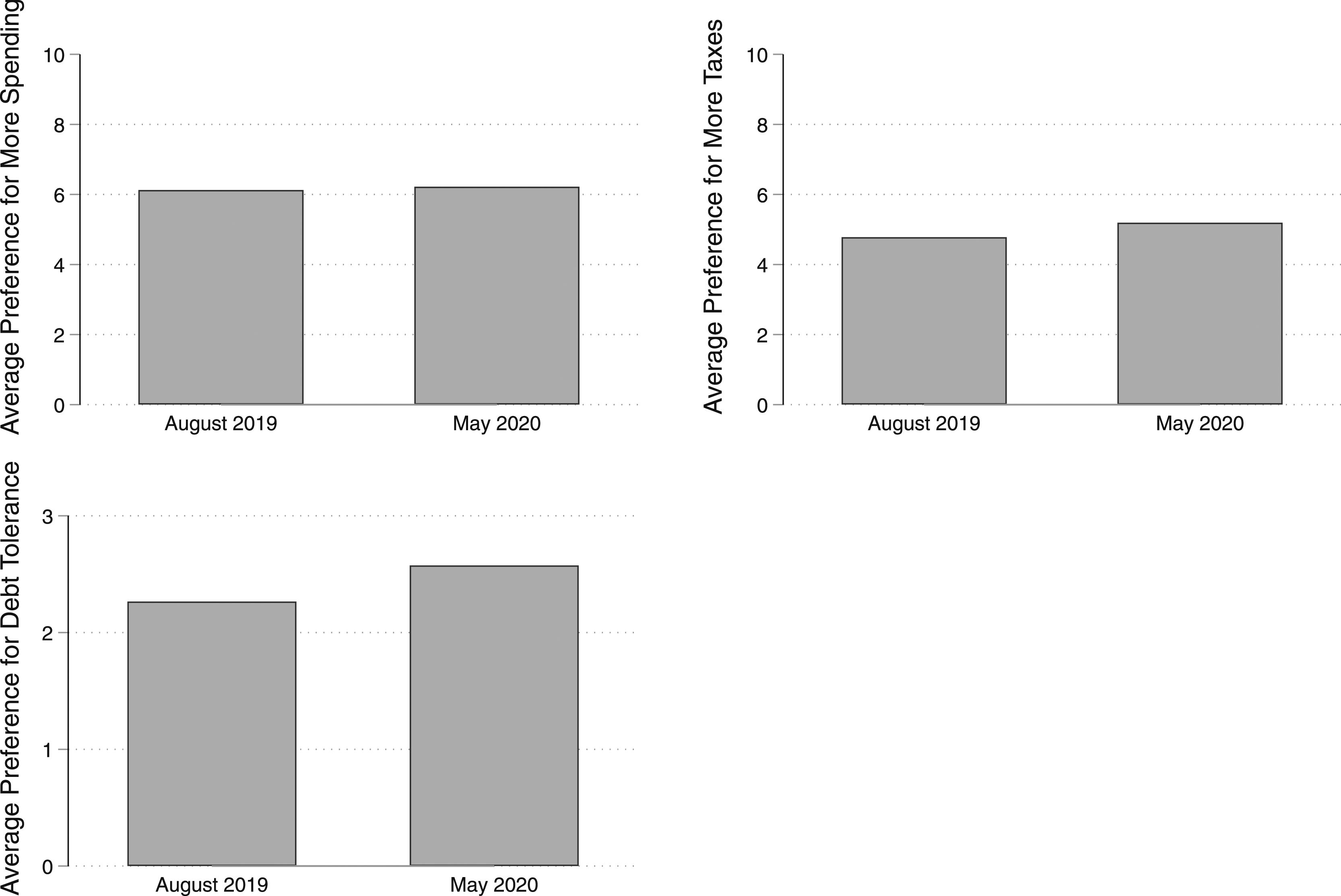
To more robustly test if the pandemic onset changed economic perceptions and policy preferences, we estimate individual fixed-effects models to account for within-individual variation controlling for all individual-level correlates. For ease of comparison and interpretation, we standardize all dependent variables to have mean 0 and a standard deviation of 1 (with higher values corresponding to greater support for social spending, taxation, general spending/debt toleration, etc.). All models include a binary variable for the May 2020 wave, to capture change from August 2019. The individual-level fixed-effect specification eliminates sources of bias related to time-invariant person-related and other individual-level characteristics, and allows us to assess in our wave variable the effect of the main exogeneous shock that affected all individuals, the onset of the pandemic. Hence, the effect is the covid-period variation in expectations and preferences compared to the pre-covid situation. We present results of models estimated with a standard set of socio-demographic covariates. 19 All results in the paper display 95% confidence intervals.
We start with the analysis of the impact of the pandemic on economic perceptions, beginning with perceived individual income decile and anticipated future income position. Figure 2 shows precisely estimated and significant negative effects on both perceptions, compared to pre-covid perceptions. Given that the models include individual fixed effects and short duration between the waves, there is little change in many of the individual covariates and the results are very similar when they are dropped. The figure shows that individuals perceive themselves to be poorer during the pandemic, and believe they will be relatively poorer in the future (relative to their pre-pandemic perceptions in August 2019). The effects are around 0.15 of a standard deviation. In absolute terms, they account for a magnitude of around 0.25 of a decile. The difference in perceptions between low-income individuals and the rest of the population in the pre-pandemic sample are between −0.55 (for future subjective income decile), and −0.7 (for present subjective income decile). Pandemic effect on current and future individual income.
Next, we test the argument (1b) that the pandemic affected overall economic optimism, using our multiple measures. Recall that we assess whether economic optimism was reduced individually, for one’s network, and for the economy as a whole. Figure 3 plots the average “pandemic” effects with each of these three dependent variables, following the same estimation procedure as above. The figure shows that the pandemic reduced economic optimism, and that this estimated effect is robust to inclusion of covariates. In the case of optimism about the Spanish economy and personal future economic situation, the pandemic reduced optimism by almost a half standard deviation. The effects are somewhat larger for expectations about the acquaintance’s economic situation (approximately two-thirds of a standard deviation), and, again, for all variables, the effect is larger compared to baseline levels of income and ideology. These results overall indicate that individuals in Spain became somewhat more pessimistic about their own economic prospects as a result of the pandemic, as well as about the economic prospects of their immediate social networks and the country. This is consistent with hypotheses 1a and 1b. We note though that the pandemic effect size is larger regarding pessimism about overall economic prospects as opposed to perception of individual income decile or future decile.
20
Pandemic effect on economic expectations and optimism.
In Figure 4, we test whether the change in expectations about the future are conditional on the economic situation of the respondent. We first replicate the above models including an interaction term between job loss or having been furloughed since March 2020 and the wave variable
21
and plot the predicted marginal effects in Figure 4. The figure shows that there are no significant conditional effects of pandemic-specific job loss on expectations. In addition, we estimate a second interaction term between the wave variable and a binary indicator of if the respondent is a low-income person (measured as someone that lives in a household that earns less than 1500 per month).
22
Again, we do not find precisely estimated nor high magnitude conditional effects. This indicates that the economic pessimism caused by the COVID-19 pandemic was not restricted to specific segments of the population that were more vulnerable; the general population had decreased economic optimism about the economy. Conditional pandemic effect on economic expectations and optimism.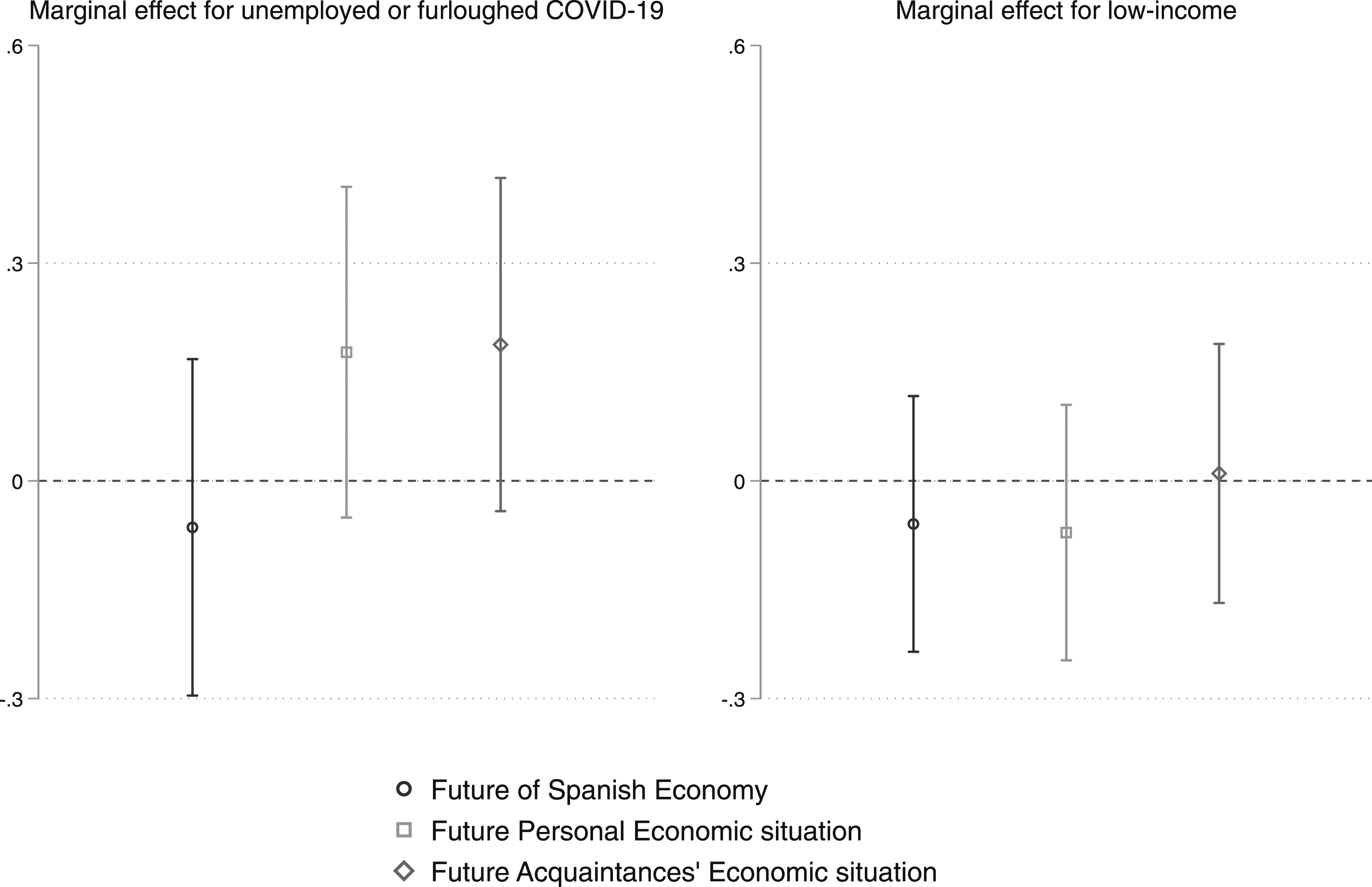
We now turn to the results of overall fiscal preferences, testing hypothesis 1c. We have presented evidence that Spanish individuals perceived a downgrade in their income position and reduced their economic optimism as a result of the pandemic. As a consequence, we would then expect that, on average, if individuals perceive that the economy is getting worse, they should be more likely to support expansive fiscal policies to cushion the effect of the crisis as elaborated above and in previous literature. Our baseline expectation is that the reduction in economic optimism indicates that individuals should on average be more favorable towards greater government fiscal intervention and redistribution as a result of COVID-19. We measure support for change in the three main fiscal policy dependent variables described above: preferences for more social spending, for higher taxes, and higher general spending and, therefore, more toleration of public debt. We conduct the same individual fixed-effect estimation procedure as above, regressing these three outcome variables on a wave indicator and the socio-demographic covariates.
Figure 5 displays the results. The coefficients show the change in preferences for fiscal policies in the post-covid wave compared to the pre-covid wave. The main findings are that while the pandemic appears to have increased support for social spending, taxes, and debt, the overall effects are either imprecisely estimated or substantively small. The findings do not confirm hypothesis 1c that the pandemic shifted public support for redistribution. Regarding support for more social spending, there is a small positive effect of the pandemic that is not precisely estimated. The effect borders conventional statistical significance at the p < 0.05 level, but it is of a negligible magnitude. Regarding the pandemic impact on support for more taxes, the effect is more precisely estimated and is around four times larger than that of spending. Critically, however, the magnitudes of the effects are still small, with an effect size around a fifth of a standard deviation. Altogether, the effects account for a small fraction of the standard deviation in the August 2019 distribution. We do find a somewhat more substantial pandemic effect in the increase in the tolerance for debt/general spending variable. Individuals seem willing to accept higher deficits and debt as a result of policies to counter the pandemic; we estimate an effect of around a third of standard deviation. Overall, we interpret these data as indicating small changes in preferences. While individuals do not move much (if at all) on support for more social spending and taxes, they are more accepting of higher levels of debt after the outburst of the COVID-19 pandemic, compared to their prior preferences.
23
But we note the limited change in support for the components of overall fiscal debts; importantly regarding the specific outcome of social or spending as opposed to debt tolerance, there is no pandemic effect. Pandemic effects on fiscal policy preferences.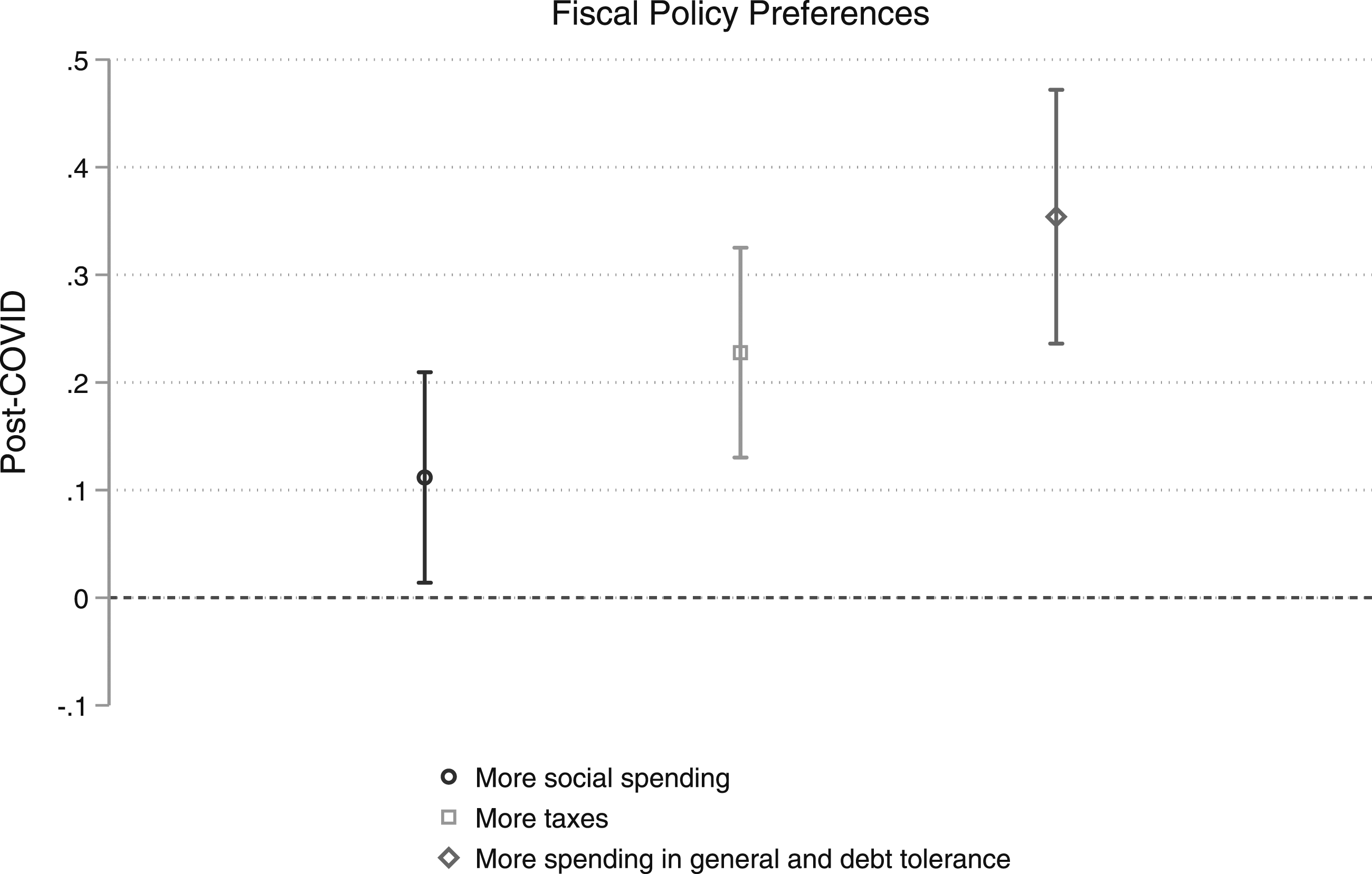
In Figure 6 we consider again heterogeneous effects on the effect of the COVID-19 pandemic on fiscal policy preferences. We explore first the conditional effects of having lost a job as a result of the crisis, which is a variable that we used in Figure 4. The marginal conditional effect of having lost a job as a result of the crisis on policy preferences allows us to test the most precise self-interest version of theories of fiscal preferences. Consistent with such approaches described above, one would expect those individuals that became unemployed due to the pandemic to become more supportive of more redistributive fiscal policies. We do not find that those who lost a job between the waves are more likely to have greater support for the expansion of fiscal policies. In the SI (Figure D1), we explore other measures of crisis experience, obtaining similar results.
24
Second, we explore the effect of the pandemic on fiscal policy preferences conditional on political ideology (measured in a 0 to 10 left -right scale).
25
This allows us to test if more left-wing individuals reacted more to the pandemic given longstanding claims that left-right orientations are a political compass that guides voters’ attitudes and decisions (Bobbio 1996). Within these orientations, according to Caprara and Vecchione (2018), political opinions and preferences of those on the left tend to be more affected by their concern for other people.
26
As ideological values constrain different preferences towards the role of government, this leads us to expect that values associated with social justice, equality and higher support for civil liberties, which are connected with the left (Goren et al. 2016) should be activated in hard times. However, we again find little heterogeneous effect of the pandemic on spending preferences by political ideology. Marginal effect of job loss and ideology on fiscal preferences.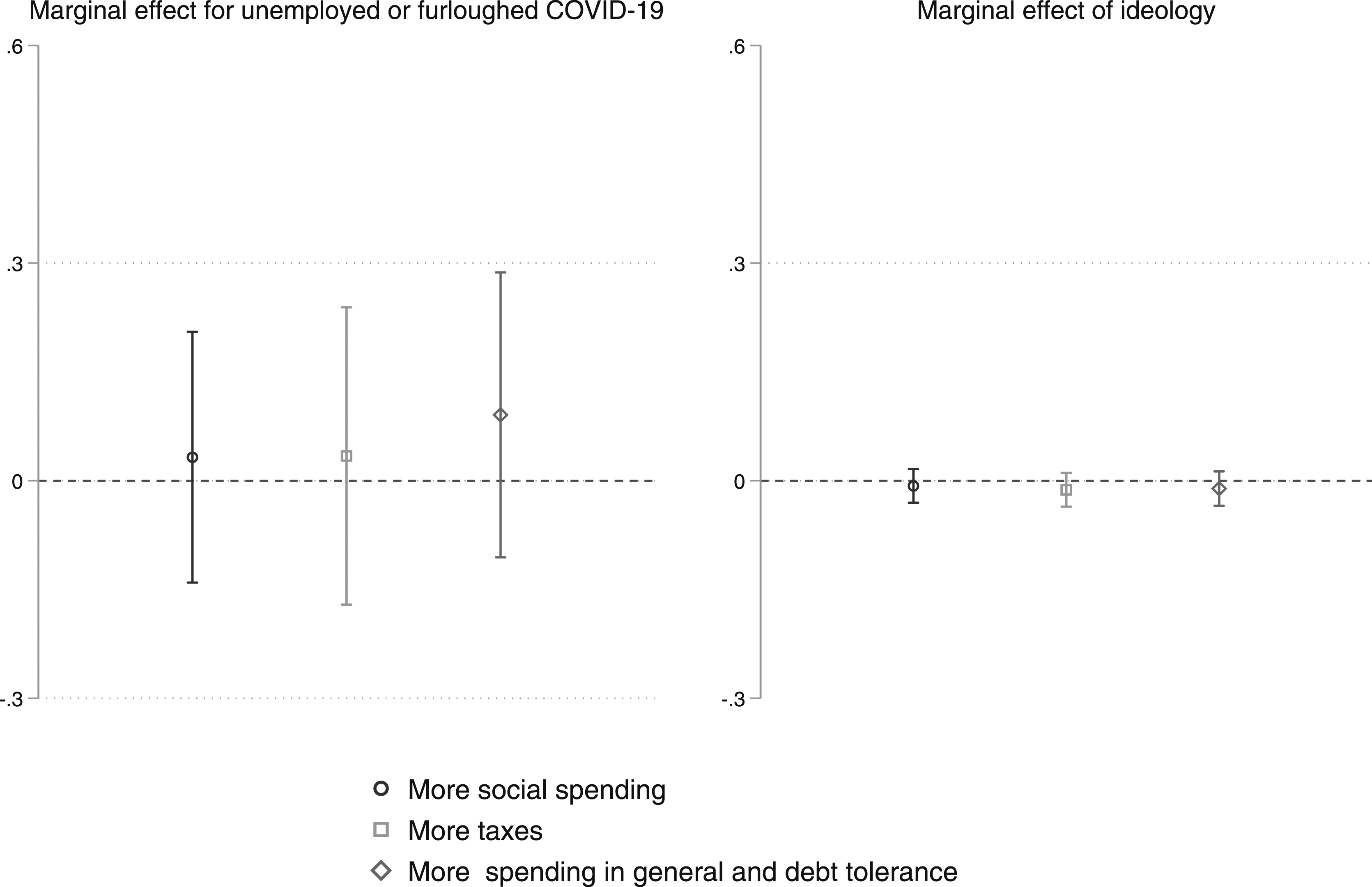
Overall, our panel results indicate that, although the pandemic made individuals more pessimistic and had a negative effect on individual economic perceptions, there was little impact on fiscal policy preferences. The only more sizable effect is in terms of debt tolerance; individuals seem to slightly support more policy responses to the pandemic crisis that require a stronger intervention of the state and, therefore, accept that these might create higher level of debt, but are not moved to demand specific policies that would facilitate that outcome (such as higher taxes or much greater social spending).
Experimental Results: Framing COVID-19 Fiscal Policies
In this second part of our study we consider one specific reason why support for greater spending despite a pandemic could be muted, by focusing on the perception of fiscal policies benefiting certain individuals. This allows us to test whether a fiscal response to the pandemic that is conceived as social insurance for the whole population receives different support from policies that are purely redistributive (Moene and Wallerstein, 2001). Our broad expectation was that for the reasons outlined above in terms of the pandemic having a large, dispersed, uncertain effect, that individuals might on average be less supportive of a policy that would be targeted towards lower-income workers. A larger related literature on deservingness and social-policy and partisan support (e.g., Attewell, 2021 Heuer and Zimmerman 2020, Van Oorschot, 2000, 2006) establishes that beliefs about deservingness of potential beneficiaries strongly conditions support for various policies. Recent findings on altruistic motivations for redistribution (Rueda and Stegmueller 2019) further motivate this expectation. 27
To test our broad expectation, in the May 2020 wave we re-interview the respondents of our panel and expanding the size to 1523 respondents and filling quotas of age and gender. All respondents answered the same general questions about fiscal policy preferences that we analyzed in the previous section, and then we posed a second module with a battery of questions measuring preferences over a set of real-world corona-specific spending relief policies, including policies prominently discussed at the time in Spain. In these questions, we randomized the framing of such policy measures as designed to help the population generally (control group) versus low-income individuals (treatment group). Half the sample was randomly assigned to a module where all of the covid-policy questions were framed in the generalist manner and the other half received all questions with the targeted-beneficiary framing. Our focus is whether the “poor beneficiary” framing reduces or increases support for the given policies; we present results for multiple measures of spending policies that are covid-specific. Drawing on the above theoretical expectations, we hypothesize that framing policies as helping the country generally will engender more support of them, than spending policies framed as helping specific poor beneficiaries.
We measure the support for spending policies as a response to the economic effects of the COVID-19 pandemic with three different variables. First, we measure whether individuals support fiscal spending increases in the context of public spending on social policies as a response to the coronavirus pandemic. The variables range from 0 (“I completely reject an increase in spending,”) to 10 (“I fully support an increase in spending”). Half the sample received a framing that the increases in spending would benefit low-income workers hurt by the pandemic, while the other half received the framing that the policy would help public services as a whole. Second, we posed a follow-up question assessing support for the amount of such spending relief. The response option was presented with a slider bar with the left-most endpoint labeled “0 euros or less” the mid-point labeled, “€ 200 billion” and endpoint labeled, “€ 400 billion or more” with labeled spine points for each increment of 50 billion. We used “€ 200 billion” as the median value, because this was the figure that the government announced it was going to propose as a response to the pandemic. The figure was salient in the news 28 and it was presented by the government as the highest mobilization of resources in Spanish history. 29 Finally, a third spending variable captures the support for the actual specific 200 billion spending package that the Spanish government approved. The variable ranges from 0 “I completely oppose the public spending package” to 10 “I fully support this public spending package.”
In Table A3 of the SI we display the descriptive statistics of all these variables for the two experimental groups. Recall that all these policies are framed as targeted to low-income individuals (a redistributive framing treatment) or as policies targeted to the overall population; this allows us to test the hypothesis of whether redistribution orientations in terms of beneficiaries reduce support for such responses.
For all pandemic-specific policy preferences, we estimate a series of OLS models and regress these dependent variables on treatment assignment (low-income beneficiary framing) with the inclusion of the covariates noted above. 30 For comparability purposes, we again standardize all variables to have mean of 0 and a standard deviation of 1 (see Table A3 of the SI).
Figure 7 displays the results for all policies. The upper graphs show the results for the three spending variables. Overall, the more “redistributive” framing (framing the policy as benefiting low-income individuals) reduces support for spending responses to the crisis. We note significant average treatment effects for all spending outcomes, though they are not large. Treated individuals are less likely to support an increase in spending (upper left panel). When asked about how large a spending package should be, they prefer a smaller spending package (upper right panel). Finally, when asked about support for the specific spending package that the government passed, the redistributive framing also reduces support (bottom left panel). In terms of the magnitude of the effects, these account for a bit less than a quarter of a standard deviation.
31
Overall, then, framing pandemic-specific spending as benefiting low-income individuals dampens support (and certainly does not increase it), challenging purely altruistic considerations of spending during the crisis;
32
in fact, those who were directly hurt by the crisis are not in fact more supportive of pandemic-specific policies. We posit that this may help explain why we observe little change in fiscal preferences during the COVID-19 crisis. In the SI, we also present tests of heterogeneous effects by political ideology, but, as in the panel analysis, we do not find strong evidence that ideology moderates fiscal policy support for these covid-specific spending items.
33
Framing effects on COVID-19 policy preferences.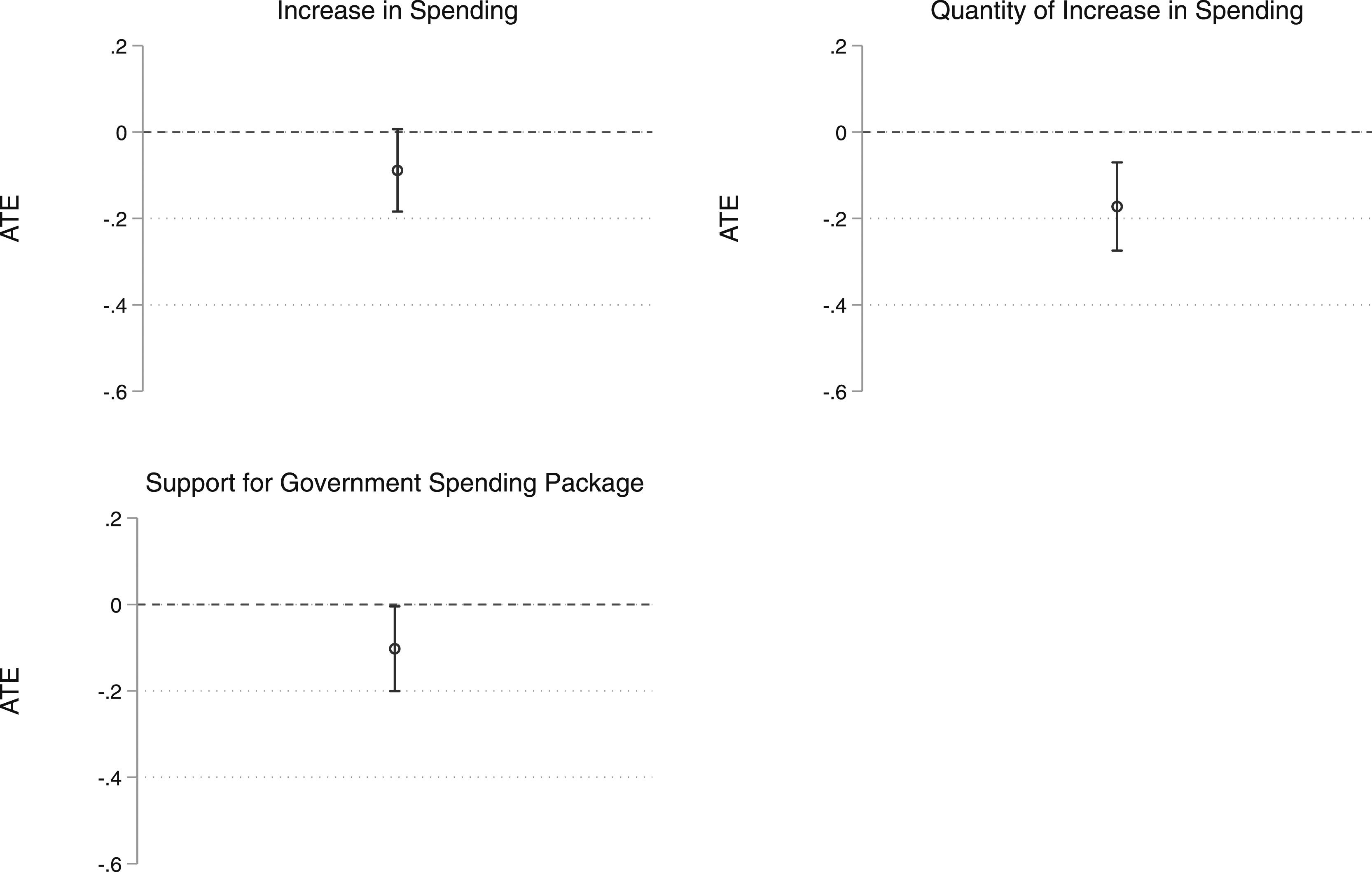
Discussion
The unprecedented economic contraction caused by COVID-19 calls for research to examine its impact on a cornerstone preference, that of the state’s fiscal role in society. Certainly, future social scientists and historians would benefit greatly from theoretically derived and “real-time” measures of how major crises actually affected key preferences. While there has been a wealth of findings related to the virus’ impact on other behaviors and attitudes, panel evidence on preferences that leverages pre-virus circumstances remains limited, and such evidence can help assess causality regarding shocks and fiscal preferences (Margalit 2019). We are able to test the impact of the pandemic on expectations and preferences using original data and tracking individuals prior to the pandemic and during it. This design contribution allows us to better identify the effect of the pandemic on within-individual variation.
We theorize that the recession caused by the virus would have distinct effects due to its breadth (number of individuals affected), uncertainty in duration, socio-tropic character (the fact that the country as a whole was suffering and in lockdown), as well as its global exogeneous origin. These factors are not unique to the covid economic crisis, but we think were important features of the crisis that could apply to other economic crises. However, our overall rejection of these expectations with respect to support for fiscal intervention provides further grounds for skepticism in terms of expecting major recessions to drastically change fiscal preferences. Our results do show that individuals did become more pessimistic about economic prospects, measured multiple ways regarding both individual and socio-tropic expectations. Despite this substantive change in economic perception, fiscal preferences changed little (even among those who became unemployed). Second, consistent with our expectation for the experiment, and with previous work on who is perceived to be “deserving” of assistance, fiscal responses to the COVID-19 pandemic receive somewhat less support if they are framed as policies that are targeted towards the low-income workers as opposed to general support, which we argue could help explain the muted pandemic effect.
We posit specific directions for future research to build on these findings. Our study was motivated by previous literature on general redistribution support and components of fiscal preferences (Barnes and Hicks 2018). Our measurement was based on large aggregate concepts of social spending, taxation, state size, and debt (to critically maintain consistent measurement across the waves), and future studies may benefit from measurement of more specific spending and tax policies (e.g., Bansak, et al. 2021, Ballard-Rosa et al. 2017). For example, one might expect that support for health-care–specific spending during the pandemic would increase (though we note that if there were such a preference, it did not appear to affect support for “aggregate spending” on social services as we have measured it). 34
Second, as we noted in our caveats to our expectations, although the COVID-19 recession affected a large number of individuals, following self-interested based models, the impact on redistribution support depends on the magnitude and distributional effect of negative income shocks. As noted, while the average perceived and future relative income are lower, this may not translate into demand for fiscal intervention if individuals perceive themselves to be poorer but not desiring of government assistance, as they may not support taxes for it, or believe that such assistance would disproportionately benefit those poorer. As discussed, the pandemic had a larger impact on overall economic perceptions of the country than on perceptions of individual income and future income, although both were negatively affected. Thus, despite the size of the pandemic shock, greater redistribution demands may not follow negative economic shocks if the distribution of individual-level preferences does not follow perceived income-distribution changes, or if inequality in income or risk does not change substantially. More research accounting for how perceptions are connected with specific spending preferences may challenge the findings here. Finally, more precise comparison of which factors in economic crises might drive preferences would be fruitful; a key factor may be whether the crisis affects groups perceived to be more “deserving” differently.
Supplemental Material
Supplemental Material - Economic Shocks and Fiscal Policy Preferences: Evidence From COVID-19 in Spain
Supplemental Material for Economic Shocks and Fiscal Policy Preferences: Evidence From COVID-19 in Spain by Ignacio Jurado and Alexander Kuo in Political Research Quarterly
Footnotes
Acknowledgements
We thank Jose Fernandez-Albertos for generous support. We thank Madeleine Hosli, Irene Menéndez-González, Jonas Pontusson, Christina Schneider, and Albert Solé-Ollé for helpful comments. We also thank for feedback the audiences at the Annual Meetings of the American Political Science Association, European Political Science Association, and the workshop participants on the “The Politics of Macroeconomic Policies” at the Max Planck Institute for the Study of Societies in Cologne.
Declaration of Conflicting Interests
The author(s) declared no potential conflicts of interest with respect to the research, authorship, and/or publication of this article.
Funding
The author(s) disclosed receipt of the following financial support for the research, authorship, and/or publication of this article: This research was supported by Spanish Agencia Estatal de Investigación and the Spanish Economic Ministry, State Program of Research, Development and Innovation Oriented to the Society Challenges through grants CSO2017-82881-R, CSO2013-48541-R and CSO2017-87597-R, as well as the ESRC through grant no. ES/N01734X/1, and the John F. Fell Small Grant CTD00180 at the University of Oxford.

Supplemental Material
Supplemental material for this article is available online.
Notes
References
Supplementary Material
Please find the following supplemental material available below.
For Open Access articles published under a Creative Commons License, all supplemental material carries the same license as the article it is associated with.
For non-Open Access articles published, all supplemental material carries a non-exclusive license, and permission requests for re-use of supplemental material or any part of supplemental material shall be sent directly to the copyright owner as specified in the copyright notice associated with the article.
