




Abstract
The Dreamers have become a driving force of policy and politics in the last two decades. Public opinion polls suggest that most Americans hold favorable attitudes towards Dreamers—more favorable than their attitudes about immigrants more broadly. This study suggests that age-at-arrival is a significant driving characteristic of this support. In 2019, I ran a 2-wave survey experiment in which respondents read a news story about an undocumented immigrant that either migrated at eleven or 21 years old. Respondents in the lower age-at-arrival condition reported more support for the immigrant; and this effect was most pronounced among those who were more opposed to immigration in general. A second 2-wave survey conducted in 2021 explored two possible mechanisms behind the impact of age-at-arrival: attitudes towards (a) assimilation and (b) attribution of responsibility. Results are considered as they relate to ongoing debates about Dreamers, media coverage, and attitudes about immigration.
“Today, there are hundreds of thousands of students excelling in our schools who are not American citizens. Some are the children of undocumented workers, who had nothing to do with the actions of their parents…” - President Barack Obama 2011 State of the Union Address
In 2001, the Development, Relief, and Education for Alien Minors (DREAM) Act (Senate Bill 1291) was introduced as a bipartisan bill that would provide undocumented youth in the United States a path toward citizenship. This legislation was the origin of the “Dreamers,” the targeted recipients of the policy, and the subject of Obama’s State of the Union comment above. No version of the DREAM Act has passed on a national level. However, the Dreamers, as a political group, have become a driving force of immigration policy and politics over the past two decades.
The ongoing debates about DREAM Act policies began with Plyler v. Doe (1982), a federal ruling granting undocumented children the right to attend public school regardless of their immigration status. What happens to undocumented youth who, after public school education, want to attend college, join the military, or work legally? This has been a highly debated question in immigration policy for many years. Political leaders have, however, been divided in their support, both for the original DREAM Act and the Obama administration’s Deferred Action for Childhood Arrivals (DACA) program (which provides temporary work permits, opportunities in college or the military, and protections from deportation, ostensibly until a national DREAM Act is passed).
Republican 2012 presidential candidate Mitt Romney equated the Obama legislation with amnesty for all undocumented immigrants, arguing that legalizing Dreamers would be a “magnet” luring even more “illegal” immigrants to the United States. “I think we have to follow the law and insist those who come illegally, ultimately return home, apply and get in line with everyone else” (Romney 2012). The Trump administration then attempted to end DACA; although the Supreme Court ruled in favor of Dreamers in 2020.
This ongoing policy debate has real-world consequences. Over 11 million people are living with undocumented immigrant status in the United States, and roughly 800,000 of them are “Dreamers.” These young people live in perpetual limbo, waiting for the United States to either accept them as fully fledged citizens or deport them. These immigrants have some rights, some schooling, some protections from deportation, but no nationalized path towards citizenship.
State-level differences further muddy the waters. Despite the absence of a national-level DREAM Act, 14 states have passed acts with similar objectives (including giving undocumented high school graduates the ability to access in-state college tuition; Chavez 2013; Schwab 2013). It is likely that the slow, partial progress of this legislation, as well as DACA, is at least partly a product of widespread public support for these immigrants.
Recent polls suggest that a majority of Americans want Dreamers to stay and receive legal status, support Congress passing a law granting permanent legal status to Dreamers, and support citizenship for Dreamers (Global Strategy Group 2019; Krogstad 2020; Kumar 2020). Support and protection from deportation for Dreamers exceeds support and protection for immigrants generally (Montanaro 2018; Narea 2021; Nicholls 2013; Olivas and Richardson 2020). When asked if immigrants who were brought to the U.S. illegally as children and who have graduated high school should be allowed to live and work in the U.S., a majority of Americans (86%) agree (American National Election Study 2020). Indeed, on many issues there is a majority support for Dreamers among both Democrats and Republicans (FWD 2021; Krogstad 2020). Research suggests, in sum, that Dreamers have captured the attention and sympathy of a large swath of the U.S. public.
Why do Americans hold more positive attitudes about immigrants who arrive at a young age than other comparable undocumented immigrants? Are Dreamers seen more favorably because they are characterized as children who were “brought against their will”—which places the criminalization of illegal immigration on their adult caretakers? Is it because they have lived in the U.S. long enough that citizens believe they are assimilated into American society? What effects might media coverage of young immigrants have on Americans’ attitudes towards immigration?
These are the questions that motivate the current project. I offer two possible explanations for the more positive assessments of Dreamers (relative to other immigrant groups): (1) age-at-arrival as a cue for assimilation and (2) age-at-arrival as a cue for agency and responsibility. In Study 1, I use a survey experiment to examine the impact of news about age-at-arrival on support for a hypothetical immigrant. Results confirm that this news has a small but significant positive impact on support for the immigrant; and that the effect is greatest among those who are more opposed to immigration in general. This stark finding is due, at least in part, to a ceiling effect for those who already view immigrants positively. However, this study is interested in how Dreamer attributes are especially compelling for those who are not keen on accepting immigrants, and we do see movement in the positive direction for this group. In Study 2, a follow-up experiment is used to (a) replicate Study 1’s findings, and (b) explore two possible mechanisms behind the impact of age-at-arrival: attitudes about assimilation, and attitudes about responsibility. Results suggest that attitudes about assimilation and responsibility are strongly associated with support for immigration; and that both attitudes are affected by news containing information about age-at-arrival.
Although the focus of this study is on childhood/Dreamer cues in immigration news stories, the findings are relevant to immigration coverage more generally. The results of this study conclude that age-at-arrival as a cue for (a) assimilation and (b) attribution of responsibility are especially important in shifting attitudes towards migrants (and especially for respondents that are opposed to immigration in general). In a concluding section, I consider these results in light of ongoing legislative and public debates about Dreamers, and immigrants more generally.
Background
There is a considerable body of work highlighting the tendency for different types of immigrants to be characterized as either “good” or “bad.” This categorization has been illustrated in studies on perceptions of police treatment and criminality (Andrews 2018), for instance. It is also evident in research on logistics and penalties in legal immigration proceedings, and decisions to deport or allow certain immigrants to stay (Keyes 2012). This categorization is an element of news coverage as well, where Dreamers are portrayed as “good,” in contrast with other immigrants (McDonnell et al. 2021; Sati 2017). Evidence in political science also suggests that American citizens’ emotions, beliefs, and attitudes towards immigration and certain types of immigrants are impacted by this type of categorization (i.e., Schwiertz 2016; Sirriyeh 2019; Sirriyeh 2020).
Quite possibly, the most obvious requirement of the DREAM Act and DACA is the focus on the age-at-arrival of these immigrants (they must enter the U.S. while under 16 years old). This study considers age-at-arrival as one variable through which immigrants may be categorized as “good” or “bad.” Age-at-arrival, that is, the age at which an immigrant arrives in the U.S., may impact assessments of “good” and “bad” in several ways. One possibility is that young immigrants are viewed as innocent; but scholars find that the notions of innocence that are commonly associated with White children in U.S. society have often been denied to immigrant Latinos and other children of color (Negrón-Gonzales et al. 2015). Immigrants in the U.S. are stereotyped as belonging to the Latino ethnic/racial group (e.g., Stewart et al. 2011; Valentino et al. 2013). Latinos are considered an ethnic group in the national census, though this group highly racialized in the U.S. context. The Dreamers are no exception to that racialization. Therefore, in this analysis, I focus on Latino migrants.
There are nevertheless other characteristics that may be associated with age-at-arrival. Here, I focus on notions of assimilation, responsibility, and agency in migrating. I explore the possibility that age-at-arrival is a driving force behind the widespread support for Dreamers among the American public. As in, this support may be driven by attitudes about assimilation and attribution of responsibility. In the sections that follow, I review the literatures on assimilation to American society and responsibility attributed to the act of illegally immigrating to the United States.
Age-at-arrival as a Cue for Assimilation
Assimilation is the process by which individuals or groups of differing racial and ethnic heritage are absorbed into the dominant culture of a society. Categorization as a “good” immigrant may depend in part on views about assimilation. Assimilation has been associated with worth and deservingness. Studies suggest that “good” immigrants are often those who assimilate into White, middle-class, capitalist American society; whereas “bad” immigrants are those who do not assimilate at all (Portes and Zhou 1993; Yoo 2008; Yukich 2013). Assimilation has been associated with notions of being hard-working, law-abiding, worthy, and highly-skilled (Andrews 2018; Newman and Malholtra 2019). Indeed, the consequences of not assimilating into the host country have been dubbed “assimilationist threat” (Paxton and Mughan 2006), whereby non-immigrant citizens develop a resentful perception of immigrants that fail to adopt American cultural norms. These processes of good versus bad immigrants are especially important regarding evaluating immigrants who migrated illegally, where moralistic evaluations seem to matter most (Wright et al. 2016).
How is age-at-arrival related to perceptions of assimilation? Immigrant children, simply by growing up in America, may assimilate into the host society, especially as they matriculate through K-12 education (as granted in the Plyler v. Doe ruling). Santa Ana (2002) finds immigrant children in public education tend to adopt an American value system. They become, he argues, “normal,” monolingual, English-speaking, middle-class children. The language aspect, in particular, is seen to increase positive attitudes towards immigrants as it signals assimilation (Hopkins 2015). In this way, assimilating Dreamers may not be perceived as a threat to American society. In sum: age-of-arrival may serve as a cue about the likely assimilation of (young) immigrants. As such, first hypothesis is as follows:
Lower age-at-arrival will be associated with
Previous work in the fields of politics and immigration has found that ceiling effects may impact the attitudes toward immigrants and immigration policy (i.e., Hopkins et al. 2014). If, prior to the experiment, a respondent is already more pro-immigrant in their attitudes, the cues from the experiment might have no impact. The current study posits that the experiment will be more powerful for those pre-disposed to have their attitudes in a more anti-immigrant direction. As such:
Hypothesis 1 will be especially true for respondents who (prior to the experiment) express lower pro-immigration attitudes.
Age-at-arrival as a Cue for Responsibility
Where does responsibility lie when a child illegally emigrates to the United States? In political debates and public discourse, Dreamers are often represented as children who were “brought here against their will” at a young age—placing the criminalization of illegal immigration on their parents, guardians, or caretakers. The condition of being brought to the U.S. implies that these immigrants had no choice to come. This signals a distance from their “illegality” (Nicholls 2013). In fact, activists and supporters have emphasized this point, and have sought to absolve Dreamers from the guilt of having broken the law (Keyes 2012; Nicholls 2013). There is a perception that undocumented children are blameless for the violation of immigration law by their parents (Abrego and Negrón-Gonzales 2020; Keyes 2012; Negrón-Gonzales et al. 2015; Nicholls 2013; Schwab 2013). They did not “choose” to cross the border and therefore cannot be held accountable for breaking the law. The parent acted criminally by bringing the child. In this way, Dreamers did not commit the “crime” of illegally crossing the border.
Decisions of determining responsibility of individuals often involve the psychological processes of locus of control. Rotter (1966) initially developed the concept of locus of control as a predisposition to view one’s personal situation as either (1) under one’s own control (internal) or (2) beyond one’s control (external). The concept has been extended to include the extent to which citizens view themselves, their society, and others as responsible for their own circumstances. Perceptions of control can be placed in a dichotomy of internal versus external sources. Harell et al. (2017) explore locus of control in the context of immigration and find that respondents who feel in control (personally or as a society) are less hostile towards immigrants. They also find that respondents who attribute negative outcomes to immigrants' predispositions are also more hostile towards the immigrants.
The concept of attribution of responsibility works in a similar way to locus of control, except that it shifts the focus from individual (respondent) control to perceived control of an immigrant’s actions. Iyengar (1989) conceptualizes attribution of responsibility as how much blame an individual places on an immigrant for illegally migrating, as opposed to blaming larger societal structures or political actors. Additionally, characteristics that make young immigrants more appealing as a group (here, assimilation and responsibility) should matter most for those who tend to hold more anti-immigrant policy attitudes. Respondents who are already hold pro-immigrant attitudes will not likely be as affected by representations of young child immigrants than older adult immigrants.
In sum, support for Dreamers may be driven by attitudes about assimilation and attribution of responsibility. As such, the second set of hypotheses are as follows:
Lower age-at-arrival is associated with
Lower age-at-arrival is associated with
Similar to H2, the ceiling effects come into play in these beliefs about immigrants. To test the impact of age-at-arrival and political attitudes among respondents who would most likely be impacted, and to keep the analyses balanced in Study 1 and Study 2, the following hypotheses are as follows:
The impact of age of arrival on immigrant support is moderated by prior beliefs about assimilation, in which respondents higher in assimilation attitudes will be most affected by the treatment.
The impact of age of arrival on immigrant support is moderated by prior beliefs about the locus of responsibility, in which respondents higher in responsibility attitudes will be most affected by the treatment.
Scholars have pointed out that there is limited research in relation to undocumented childhood arrivals (e.g., Schmid 2013). This study is one of the first to experimentally test the characteristics of age-at-arrival in news stories. In this analysis, Study 1 tests H1 and H2, while Study 2 tests H3–H6. 1
Study 1
This research project is split into two studies. In Study 1, an online experiment manipulates age in a fabricated news story and captures levels of immigrant policy support across two conditions: low (11 years) versus high (21 years) age of arrival. Survey questions capture attitudes including general support for immigration, which I consider as a control and moderator of the experimental conditions.
This 2-wave panel survey experiment was fielded in November 2019 in the United States. The survey was programmed in Qualtrics, pre-tested with 100 respondents on Amazon Mechanical Turk (MTurk), and then fielded in 2 waves with a sample of 738 panel respondents supplied by Dynata. The pre-test sample is not included in the analyses below. In wave 1, I collected respondents’ overall immigration attitudes, prior to the experiment. These variables are meant to be viewed as general moderators. In wave 2, two weeks later, respondents were exposed to the experimental manipulation. The retention rate from Wave 1 to Wave 2 is 63% (or 738 out of 1154 respondents). The entire survey instrument is in the Appendix. Participants in the second wave were 47% male, 66% White, 85% born in the U.S., 38% Democrat, 36% Republican, 29% ideologically liberal, and 32% ideologically conservative. The full survey descriptives are included in the Appendix, Table A1.
Measures and Results
In the survey experiment, respondents read a news story vignette about an undocumented immigrant that was either: (1) brought to the U.S. by his family at eleven years old (lower age-at-arrival condition) or (2) migrated to the U.S. by himself when he was 21 years old (higher age-at-arrival condition). The ages of 11 and 21 in these treatments are to ensure that respondents believe that the immigrant in the lower-age-at-arrival treatment is undeniably a child, while the immigrant in the higher-age-at-arrival treatment is undeniably an adult. In both conditions, the immigrant is now an adult, at age 25. The experiment primes age using both text and photos. This approach is externally valid—in news media, stories about Dreamers regularly include pictures of the immigrant in childhood (as seen in the lower age-at-arrival condition). In this case, I superimposed one picture over another in both conditions.
As aforementioned, there is no reason to believe that Dreamers are exempt from racialization that occurs in perceptions of immigrant groups in the U.S. Though this paper is focused on age-at-arrival, I focus on a Latino man in this study because this is the migrant that is prototypical for this group in media (as in, immigrants; for more information, see Branton and Dunaway 2009; Brown et al. 2018; Dixon and Williams 2015; Mohamed and Farris 2020). Indeed, attitudes toward Latinos is found to shape attitudes towards immigration for non-Latino White citizens in American politics (Pérez 2016). I will mostly be using the term “Latinos” in this paper to refer to members of this racial/ethnic group. Using the name “Luis Mora” and using a stereotypically Latino man in the stimuli is meant to inform respondents that this is a Latino migrant.
Figure 1 shows the conditions in their entirety. It should be noted that nowhere in the experimental stimuli are the words “Dream,” “Dreamers,” or “DACA” cued. In this way, the results of the experiment cannot be attributed to the possible positive connotations of the label “Dreamers.” Experimental treatments.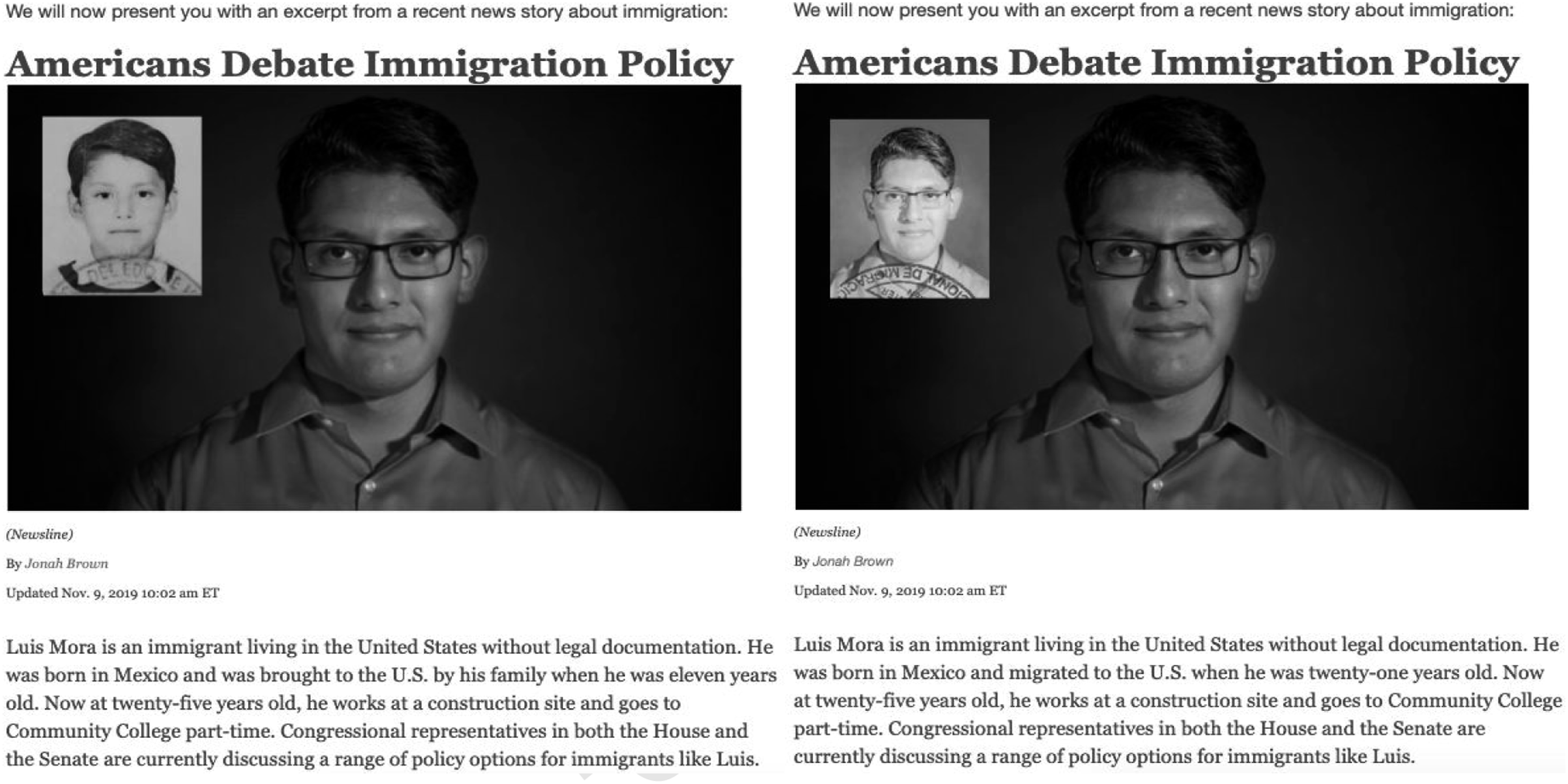
After exposure to the news vignette, respondents were asked the following questions: (1) Immigration and Customs Enforcement (ICE) is the government agency responsible for deporting immigrants. Should people like Luis be a priority for deportation? (reverse coded) (2) Congress is considering a policy that would protect some immigrants from deportation for 5 years. Should people like Luis be protected from deportation? and (3) Congress is considering a policy that would give some immigrants a legal path towards American citizenship. Should people like Luis be considered for a legal path toward American citizenship? Responses are given on a 4-point scale. Figure A1 in the Appendix shows the distribution of the re-coded (0–1) immigrant support scale, which has an alpha of 0.81, a mean of 0.64, and a standard deviation of 0.27. Zero represents low support and 1 represents high support.
A treatment check at the end of the survey asked respondents if they remembered whether Luis moved to the US as a child or an adult. A regression model that excludes those who failed this check produces similar results. This model is included in the Appendix, Table A2.
The Impact of Treatment on Immigrant support.
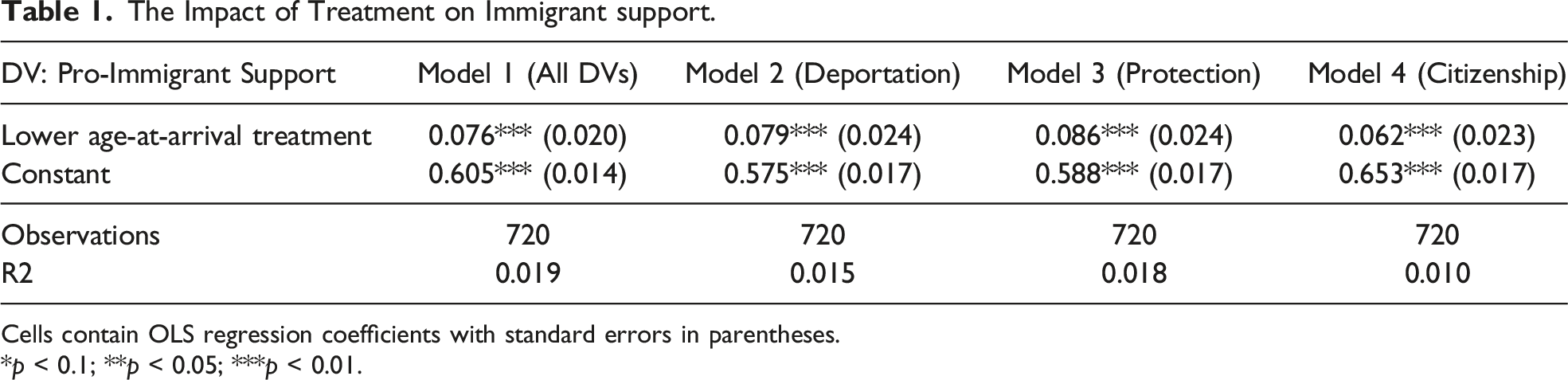
Cells contain OLS regression coefficients with standard errors in parentheses.
*p < 0.1; **p < 0.05; ***p < 0.01.
Do results in Table 1 change when we account for prior (or general) immigration attitudes? H2 is focused on this possibility; namely, the possibility that treatment effects are strongest for those who are generally unsupportive of immigration. Recall that immigration attitudes are captured in wave 1, two weeks before the experiment. The scale is based on 5 items used in prior surveys. One is drawn from the American National Election Study (2016, 2020): In general, do you think the number of immigrants from foreign countries who are permitted to come to the United States should be… [Decreased a lot, Decreased a little, Left the same as it is now, Increased a little, Increased a lot]
Heterogeneity in the Impact of Treatments on Immigrant Support.
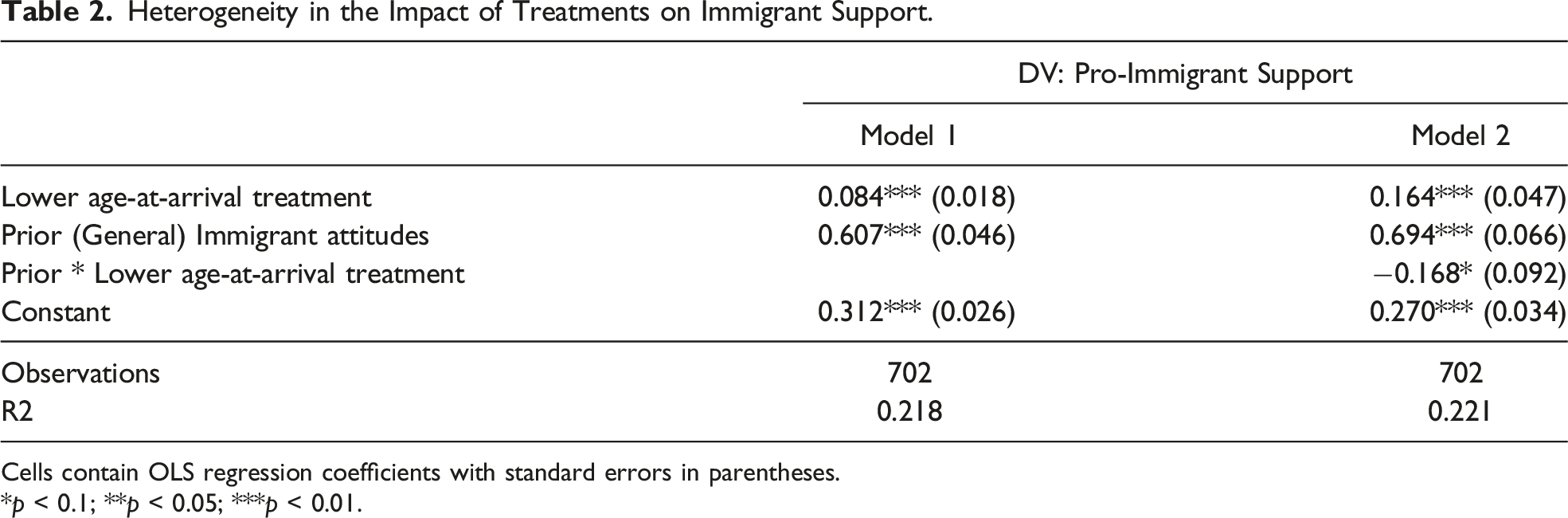
Cells contain OLS regression coefficients with standard errors in parentheses.
*p < 0.1; **p < 0.05; ***p < 0.01.
These results are illustrated more clearly in Figure 2, which presents estimated levels of immigrant support across the two treatments, and across the range of the immigration support variable. The light gray line (and associated 95% confidence intervals) shows estimated values for those in the high age at arrival treatment; the black line shows the same for those in the low age at arrival treatment. It is at the lowest end of immigration support that these predicted values differ significantly. Among those who strongly support immigration, age of arrival has no discernable impact; among those who do not strongly support immigration, age of arrival matters. Visualizing heterogeneity in the impact of treatments on immigrant support.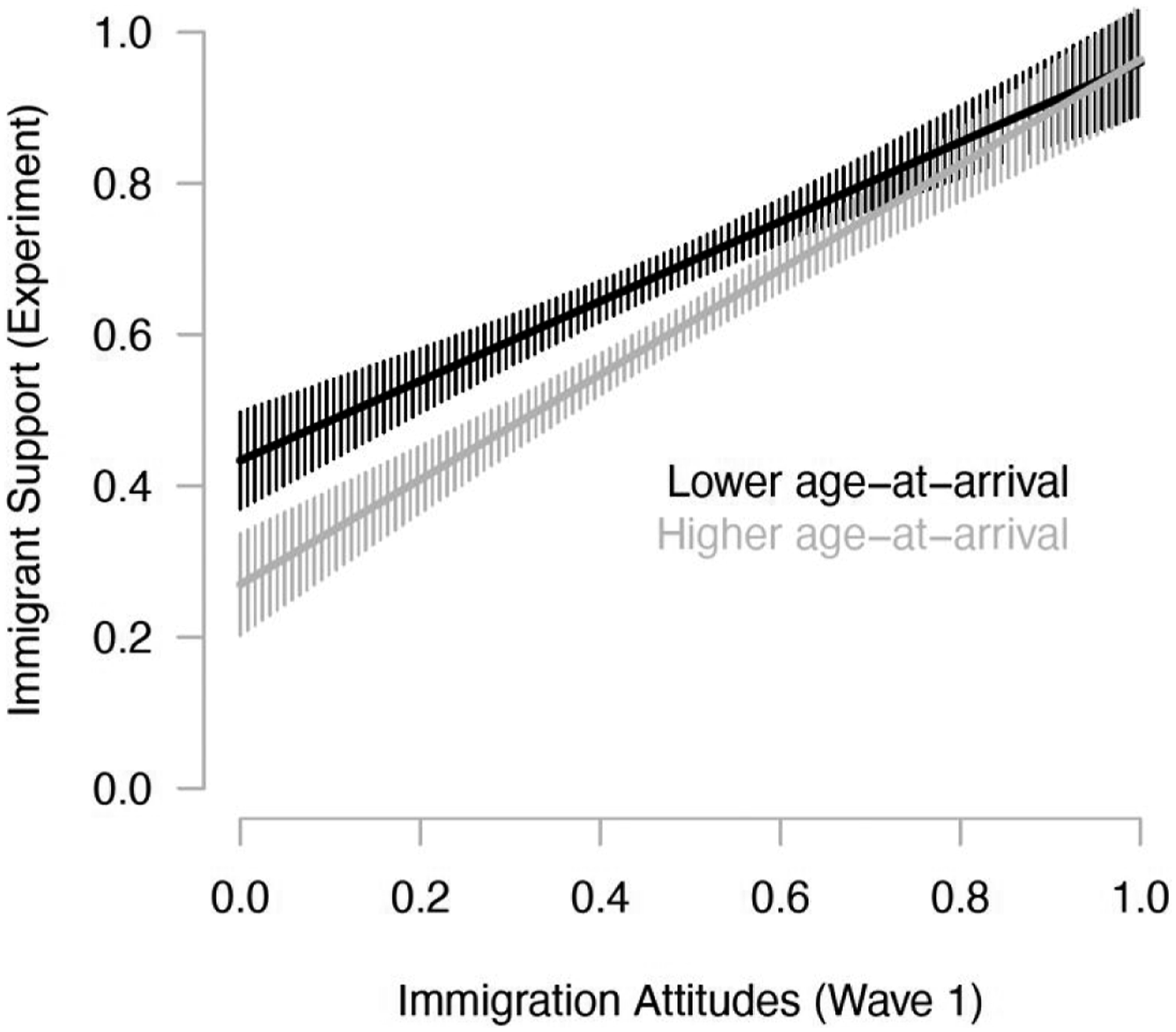
Study 2
Study 1 suggests that age of arrival does matter for immigrant support. However, it tells us very little about the mechanisms behind that impact. Exploring two possible mechanisms is the focus of Study 2. In this study, an online experiment both (a) replicates Study 1’s findings and (b) explores attitudes about assimilation and attitudes about locus of responsibility as two possible mechanisms behind the positive impact of age at arrival. I explore these attitudes in two ways: first, as dependent variables that are affected by the experimental treatment, and second, as variables that moderate the effects of the treatment.
This 2-wave panel survey experiment was fielded in September and October 2021 in the United States. The survey was programmed in Qualtrics and then fielded in 2-waves with a broad sample of 927 panel respondents supplied by Dynata. In wave 1, I collected respondents’ prior attitudes about (1) immigration overall, (2) attribution of responsibility, and (3) assimilation. As in Study 1, I capture these items prior to the survey experiment to record respondents’ attitudes before they were exposed to the experimental manipulation. As aforementioned, these beliefs are meant to capture moderators for general attitudes. In wave 2, one week later, respondents were exposed to the experimental manipulation. The retention rate from Wave 1 to Wave 2 is 67% (or, 927 out of 1384 respondents). The entire survey instrument is in the Appendix. Participants were 58% male, 87% White, 93% born in the U.S., 44% Democrat, 41% Republican, and 15% Independent/Other. The full survey descriptives are also included in the Appendix, Table A4.
Measures and Results
In the Study 2 survey experiment, Study 1 conditions were expanded into a 2 by 2 factorial design. Respondents were assigned to read one of four vignette news stories about an undocumented immigrant that was either: (1) brought to the U.S. by his family at eleven years old, (2) migrated to the U.S. by himself when he was 21 years old, (3) brought to the U.S. by his family at 21 years old, or (4) migrated to the U.S. by himself when he was eleven years old. This design was intended to isolate the impact of age and agency, instead of assuming that they work in tandem. Results nevertheless indicated no independent impact of agency on the dependent variables. 4 I accordingly group together the two younger age-at-arrival treatments and the two older age-at arrival treatments below.
Study 2 relies on the same measures of immigrant support as were used in Study 1. Analyses similar to Study 1 replicate those findings (with means for lower age-at-arrival as 0.73 and higher age at arrival as 0.64). 5 These analyses are included in the Appendix, Tables A5 and A6. I also include the impact of the treatment controlling for all demographic variables, and they are in the Appendix Table A8. Here, I focus on the unique contribution of Study 2, namely, analyses of assimilation and attribution of responsibility.
Testing H3 and H4 require measures of perceived assimilation and responsibility of the hypothetical immigrant Luis. Assimilation was captured using five variables following the experimental treatment: Please tell us whether you agree or disagree with the following statements: (1) Luis is probably well assimilated into American society, (2) Luis should be better educated than his parents, (3) Luis should be educated about American culture and customs, (4) Luis should speak English adequately, (5) Luis should renounce his citizenship from Mexico. [Response options: Strongly disagree, somewhat disagree, neither agree nor disagree, somewhat agree, strongly agree]. Figure A3 in the Appendix shows the distribution of the combined assimilation scale, which has an alpha score of 0.65, with a mean of 0.71 and a standard deviation of 0.17. Zero represents weaker perceived assimilation attitudes and 1 represents stronger perceived assimilation attitudes.
Perceived attribution of responsibility was captured using a single question following the experiment: Do you think Luis is responsible for illegally immigrating to the United States? Responses were on a three-point scale. About 36% of respondents chose that he was responsible, 47% of respondents chose that he was not responsible, and 17% of respondents chose might or might not be responsible
The Impact of Treatments on Assimilation and Responsibility.
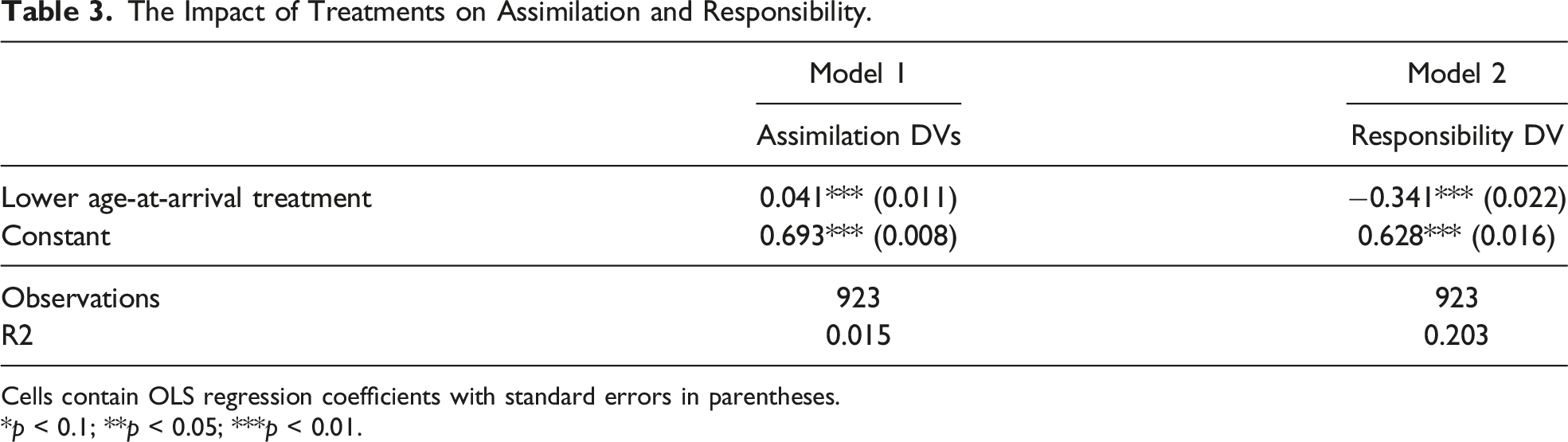
Cells contain OLS regression coefficients with standard errors in parentheses.
*p < 0.1; **p < 0.05; ***p < 0.01.
Tests of H5 and H6 require different measures of assimilation and responsibility, namely, general measures (not linked to Luis directly), asked before rather than after the experimental treatment. These measures were accordingly captured in the first wave of the survey, a week before the experiment. Prior attitudes (i.e., general attitudes) about perceived assimilation are captured using an 8-question battery adapted from Paxton and Mungan (2006). The questions are as follows: Please tell us whether you agree or disagree that immigrants need to do the following things to fit into American society: (1) Immigrants should communicate effectively in English in their daily lives, (2) Immigrants should take any legal job they can when they arrive in the United States, (3) Immigrants should contribute to American life just as much as everyone else, (4) Immigrant children should be better educated than their parents, (5) Immigrants should renounce their citizenship in their country of origin, (6) Immigrants should become American citizens as soon as they possibly can, (7) Immigrants should educate themselves about the culture and customs of the U.S., and (8) Immigrants should not stick to themselves so much. [Response options: Strongly disagree, somewhat disagree, neither agree nor disagree, somewhat agree, strongly agree]. Figure A5 in the Appendix shows the distribution of the prior beliefs about assimilation index, which has an alpha of 0.76, a mean of 0.72, and a standard deviation of 0.15. Zero represents weaker assimilation attitudes and 1 represents stronger assimilation attitudes.
Attribution of responsibility is captured using a scale from Iyengar (1989). This measure asks: On average, how much do you think that immigrants are responsible for illegally immigrating to the United States? [Response options: Definitely responsible, probably responsible, might or might not be responsible, probably not responsible, definitely not responsible]. Figure A6 in the Appendix shows the distribution of prior/general beliefs about attribution of responsibility, which has a mean of 0.75 and a standard deviation of 0.27. Zero represents weaker responsibility attitudes and 1 represents stronger responsibility attitudes.
Impact of Treatments on Support Moderated by Assimilation and Responsibility.
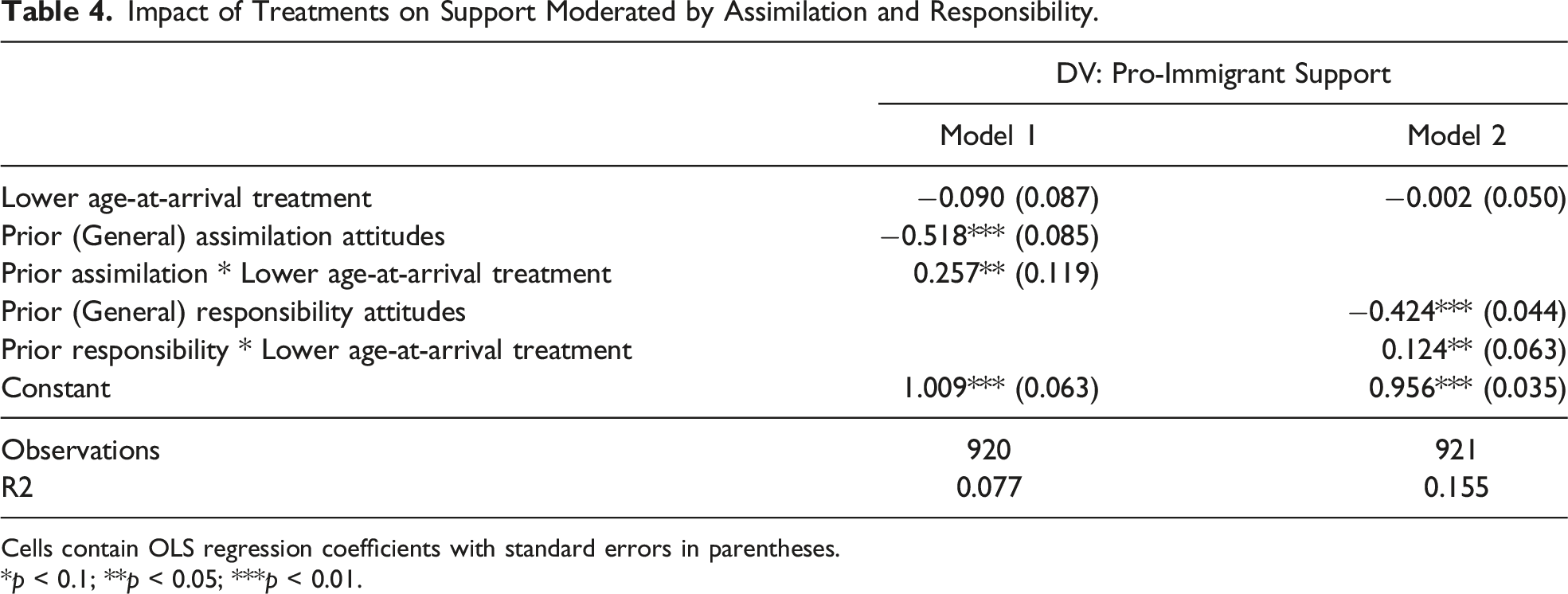
Cells contain OLS regression coefficients with standard errors in parentheses.
*p < 0.1; **p < 0.05; ***p < 0.01.
Note that the r-squared for the responsibility model (Model 2) is roughly twice as large as the r-squared for the assimilation model (Model 1). Prior (general) responsibility attitudes (and the associated interaction) explain more of the variance in Pro-Immigrant Support than prior assimilation attitudes. This is similar to what was found in Table 3 and provides some support for the notion that attributions of responsibility are, in fact, a more significant mechanism than attitudes about assimilation.
Results from Table 4 are illustrated in Figure 3. As in Study 1, the light gray line (and associated 95% confidence intervals) shows estimated values for those in the high age-at-arrival treatment, and the black line shows the same for those in the low age-at-arrival treatment. For both interactions, it is at the highest end of Prior Assimilation Attitudes and Prior Responsibility Attitudes that predicted values differ significantly across the two treatments. And in each case, the slope of the relationship is shallower in the low age-at-arrival conditions.
6
As such, I reject the null hypotheses for H5 and H6. Visualizing heterogeneity in the impact of treatments.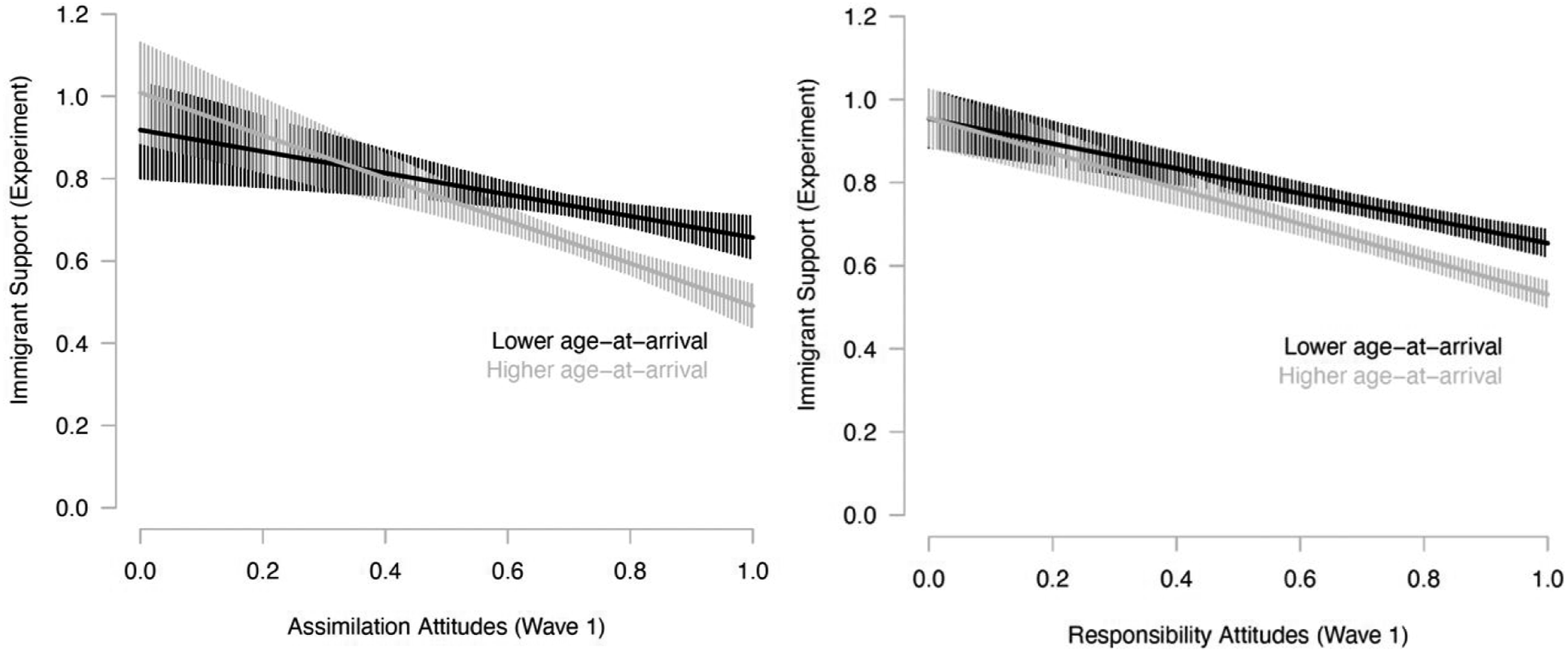
Discussion
This study began with a discussion of Americans’ tendency to have more positive attitudes about Dreamers than about immigrants generally. I have suggested that age-at-arrival is a defining characteristic of Dreamers and use two separate survey experiments to explore this possibility. Results from Study 1 confirm that age of arrival does matter for immigrant support; and that these results hold when controlling for, and interacting with, prior (general) attitudes towards immigration. Study 2 replicates the findings of Study 1 and explores two potential mechanisms behind this impact: attitudes about assimilation and about attribution of responsibility. Results suggest that (1) experimentally manipulating age-at-arrival has a significant effect on immigrant support, attitudes about assimilation, and attributions of responsibility and (2) treatment effects are moderated by attitudes about assimilation and attribution of responsibility.
The American Dreamers exemplify the principles of meritocracy, equality, opportunity, and freedom (Abrego and Negrón-Gonzales 2020). The conflation of Dreamers and the good immigrant narrative is intentional—it is a way for journalists, politicians, and mainstream immigrant rights organizations to increase policy support for these young immigrants (Abrego and Negrón-Gonzales 2020). The narrative argues that Dreamers deserve rights to higher education, to work, to be protected from deportation, and to gain citizenship. However, this narrative implies that not all immigrants deserve these rights—only the exceptional ones. Overall, understanding support for Dreamers helps us, in part, to understand immigration support more generally.
These findings point to the importance of further work on age-at-arrival, and the mechanisms underlying age-at-arrival, on support for immigration. This study nevertheless has several limitations. In terms of experimental design, there is no way to know if respondents perceive the news vignette as an actual news story. Previous studies have used a very similar method (i.e., Iyengar et al. 2013; Madrigal and Soroka 2021), but it still calls into question the external validity of the stimuli. However, news is one of many formats in which Americans consume political information. Even if the respondents do not perceive the vignette as a real news story, this study suggests that being exposed to political information about an immigrant can still potentially affect attitudes and beliefs about the immigrant.
Moreover, the design of this study is focused on a specific immigrant (Luis). This study is premised on the notion that these findings are generalizable to both (a) other individual-immigrants, and (b) immigration support generally. An argument can be made that these findings cannot definitively assess how these attitudes map onto more generalized attitudes about immigration in the United States. However, age-at-arrival is best explored in an individual level story—it would be difficult, even unrealistic, to re-run these studies with multiple immigrants in the news vignettes. In fact, this study is externally valid in this regard, and suggests that the impact of age-at-arrival for individual immigrants does map onto larger immigrant groups, like the Dreamers. The degree to which this is the case requires additional experimentation, however, with other hypothetical immigrants and/or measures of immigrant support.
On the note of generalizability, one might question whether these studies speak to results only applicable to Obama’s presidency and the push for DACA. Obama’s arguments for protecting the Dreamers, as noted in the quote from the State of the Union address, stems from a historic push to pass legislative action that precedes his presidency. The DREAM Act, which was proposed by the senate, was introduced in 2001, about a decade before Obama’s arguments for DACA. Dreamers, and the characteristics of the Dreamer narrative, were already existing in the national political discourse. Moreover, we still see arguments for and against providing young immigrants protection, like the Supreme Court case that ruled in favor of Dreamers in 2020 (well after Obama’s presidency). With these caveats in mind, these findings are still significant for research on news production, citizens’ attitudes about young immigrants, and attitudes toward Dreamers.
In all, these combined studies confirm that age-at-arrival does matter in attitudes towards young immigrants, and that this bias is partially explained by general attitudes about immigration, assimilation, and responsibility. Beliefs about assimilation are essential in the conceptions of cultural threat posed by immigrants in the U.S. Assimilated immigrants are perceived as less threatening than unassimilated immigrants. The same can be said about responsibility—immigrants that are seen as less responsible for immigrating to the U.S. are also most likely perceived as less threatening. This study finds that higher levels of support for young immigrants (and Dreamers), given the results, indicate that age, assimilation, and responsibility have the potential to change attitudes about immigration, and in these ways, disengage threat in attitudes about those immigrants.
Supplemental Material
Supplemental Material - The American Dreamers: The Effects of Media Coverage of Immigrants’ Age-at-Arrival
Supplemental Material for The American Dreamers: The Effects of Media Coverage of Immigrants’ Age-at-Arrival by Guadalupe Madrigal in Political Research Quarterly
Footnotes
Declaration of Conflicting Interests
The author(s) declared no potential conflicts of interest with respect to the research, authorship, and/or publication of this article.
Funding
The author(s) received no financial support for the research, authorship, and/or publication of this article.

Supplemental Material
Supplemental material for this article is available online.
Notes
References
Supplementary Material
Please find the following supplemental material available below.
For Open Access articles published under a Creative Commons License, all supplemental material carries the same license as the article it is associated with.
For non-Open Access articles published, all supplemental material carries a non-exclusive license, and permission requests for re-use of supplemental material or any part of supplemental material shall be sent directly to the copyright owner as specified in the copyright notice associated with the article.
