



Abstract
We examine how responses to individuals displaced by environmental shocks vary based on the ethnicity of the migrants, the locals, and their ethnic groups’ political status. We embed an experiment into a stratified sample of 2,188 white, Black, and Latinx Americans surveyed through Qualtrics Panels. The experiment shows respondents a photo of a flooded road, randomly assigning whether there are white, Black, Latinx, or no persons wading through the water. Results show no outward change in approval for migrants settling in respondents’ neighborhoods based on their ethnicity. However, emotional responses to migrants, perceptions of migrants’ economic backgrounds, and levels of tolerance and ethnocentrism among locals vary based on migrants’ ethnicity. While there may not be outward xenophobia and conflict in the face of internal climate-related migration, the underlying attitudes of members of receiving communities suggest internal migrants from politically excluded groups lack local acceptance and may face more subtle prejudice.
When Hurricane Katrina struck the American Gulf Coast in 2005, hundreds of thousands of people fled to other parts of the United States (Grier 2005). Residents of Houston, which received the plurality of displaced persons, incurred lower wages and higher unemployment (McIntosh 2008). In response, many locals expressed dissatisfaction with migrants, with public opinion fracturing along ethnic lines (Shelton and Coleman 2009). Similarly, historic drought in Syria’s Northeast from 2006 to 2010 forced hundreds of thousands to leave their homes and migrate to other parts of Syria (Ide 2018). The arrival of migrants may have exacerbated already tense interactions between Sunni Arabs and the state and precipitated more protests during the 2011 uprising (Ash and Obradovich 2020; Gleick 2014). In both cases, the displaced mostly came from politically excluded groups: African Americans in the United States (McIntosh 2008) and Sunni Arabs in Syria (Dukhan 2014).
The background of migrants and locals and the potential for conflict raises several questions: how do locals respond to internal migrants fleeing disasters? And, to what extent do responses vary based on the ethnicity and political status of migrants and locals? This article explores how reactions to internal migrants fleeing disasters vary based on both migrants’ and locals’ ethnicity and political status. 1
Our questions connect ethnicity, disaster response, migration, and conflict. Climatic stress has been linked to increased internal migration, especially by rural (Nawrotzki et al. 2017; Thiede, Gray, and Mueller 2016) or excluded populations (Mastrorillo et al. 2016). Migration can serve as a form of adaptation to climatic stress (Black et al. 2011; Simatele and Simatele 2015), but the relationship is not simple. Weather shocks both decrease the capacity to migrate and increase vulnerability for staying, creating ambiguity in how climatic stress affects migration (Kaczan and Orgill-Meyer 2019). Household characteristics, such as land ownership, education or wealth (Gray and Wise 2016; Kelman et al. 2019), along with the nature (Bohra-Mishra et al. 2017; Mastrorillo et al. 2016) and severity of weather shocks (Hunter, Murray, and Riosmena 2013) can all moderate the effects of climatic stress on migration. More frequent and intense environmental shocks and variability in a changing climate may bring about greater sub-national migration (Biermann and Boas 2010; Gray and Mueller 2012) that affects receiving communities.
Environmental migrants can put stress on receiving areas (Reuveny 2007), leading more resource-abundant regions to be susceptible to conflict (De Juan 2015; Koubi et al. 2014). Attitudes about environmental migrants in developing countries and external environmental migrants in developed countries vary.
Environmental migrants and economic migrants are viewed more favorably in developing countries than migrants fleeing persecution (Spilker et al. 2020), albeit sometimes also less favorably than generic migrants (Castellano, Dolšak, and Prakash 2021). External environmental migrants are viewed more favorably than economic migrants and comparably to those fleeing persecution in developed countries (Arias and Blair 2021). Notably, the ethnic backgrounds (see Bansak, Hainmueller, and Hangartner 2016; Hainmueller and Hopkins 2015) and political status (Gaikwad and Nellis 2017) of both migrants and locals in receiving areas may color their attitudes toward one another. A substantial literature already connects heterogeneous vulnerability and effects of natural disasters across ethnicity (Bolin 2007), including links to both out-migration (Barry 1997; Myers, Slack, and Singelmann 2008) and return migration (Asad 2015; Reinhardt 2015). Yet existing studies have not deeply examined the effect of internal environmental migrant characteristics on locals’ reactions, generally looking at approval without delving into whether locals’ responses may signal acceptance. We build on existing research on internal environmental migrants by looking at the role of both migrants’ and locals’ ethnicity and political status in both locals’ approval of internal environmental migrants and emotional responses, perceptions of migrants, and in-group identity.
To examine responses to internal migrants fleeing environmental disasters, we experimentally vary the ethnic background of migrants in a survey of 2,188 Americans administered through Qualtrics Panels. The United States is a particularly relevant case because of both its ethnic diversity and recent experiences with disaster-induced internal migration, ranging from Hurricane Katrina in 2005 to Hurricane Maria in 2017. The sample is stratified by ethnicity. Approximately half of the respondents are white, a quarter are Black, and a quarter are Latinx. During the survey, respondents are told about catastrophic flooding from a storm and shown one of four photos: a flooded road without visible people or the same photo with either a Black, Latinx, or white family wading through the water.
Respondents are then asked about whether they would approve of some of those affected moving into their neighborhood, their emotional response to migration, how they perceive those pictured and their levels of ethnocentrism and tolerance. Emotional responses, perceptions of migrants, and changes in ethnocentrism represent migrant acceptance, where acceptance is the “awareness of both the positive and negative aspects of...others while maintaining an attitude of positive regard” (Williams and Lynn 2010, 6). While respondent approval may initially be positive due to the dire circumstances faced by environmental migrants, a lack of immediate acceptance may represent biases that later manifest through systematic discrimination, support for anti-migration policies, and even violent contention with migrants.
Similar to external migrants fleeing civil conflict (see Alrababa’h et al. 2021), we find that internal disaster migrants do not provoke explicit changes in approval from American locals based on either migrant or respondent ethnicity. Nevertheless, we find white respondents are more likely to react to Latinx in-migration with negative emotions and to view Black migrants as reflective of stereotypes associated with Black Americans. We believe both reactions reflect implicit antipathy by dominant group members toward out-group migrants from status threat. We also find both Black and Latinx respondents perceive the other group as better off, which suggests environmental migration fuels economic competition between the two politically excluded groups. Our results complicate findings on approval toward external environmental migrants by reporting a lack of acceptance of internal migrants through antipathy based on both locals’ and migrants’ political status.
Expected Reactions to Internal Migration
We contend that variation across whether locals and migrants share an ethnic background and come from politically dominant or excluded groups could sway locals’ approval and acceptance of internal environmental migrants. We formulate our predictions for locals’ reactions based on research in political science and psychology. Before laying out these predictions, we justify utilizing ethnicity and group political status to classify reactions. While we did not pre-register these expectations, we described them on a grant application predating our survey, which we summarize in appendix 1.
Both ethnicity and an ethnic group’s political status are relevant to migration and political behavior. Shared group membership creates mutual identification among individuals (Tajfel and Turner 1979), resulting in greater generosity for (Williams 2001), empathy with (Stürmer et al. 2006), and trust of (Tanis and Postmes 2005) in-group members. We thus expect shared identity between environmental migrants and locals to influence locals’ acceptance of migrants. 2 We utilize an ethnic group’s political status as a mediating factor to both in-group and out-group responses to internal migrants. Political status represents the extent to which either locals’ or migrants’ ethnic groups control their country’s political decision-making. Members of ethnic groups that are dominant or hold a monopoly over executive power should behave differently in responding to internal migrants than groups that are systematically excluded from political power or discriminated against (White 2007). 3 Ethnic group political status is distinctly relevant to internal migrants. No matter where external migrants originate from or their ethnic identity, they will usually be seen with a degree of otherness, even from coethnics, and will universally lack any say in a country’s political decision-making. 4 On the other hand, internal migrants have at least some say in the decision-making of a country and are much more capable of forming bonds with either in-groups or out-groups on account of having a shared national identity. The inclusion of ethnic group political status represents a point of departure from research on reactions to external migration that only focus on migrants’ and locals’ ethnicity (i.e., Brader, Valentino, and Suhay 2008).
Reaction to In-Group Migrants
Reactions toward in-group migrants should generally be positive, but especially favorable among politically excluded ethnic groups. One of the most basic factors excluding minority groups from seats of political power may be demographic status. The influx of fellow excluded co-ethnics may then be viewed as a net positive by locals in receiving areas (Gaikwad and Nellis 2017). Added numerical strength may then allow excluded groups to challenge for greater political power (Rüegger 2019; Salehyan and Gleditsch 2006), either locally or nationally. Taking these findings into account, we believe environmental migrants who share the same identity as politically excluded locals should receive greater support.
While it may be tempting to assume that heterogeneity within the dominant group will produce differing responses based on perceived migrant socioeconomic status, we have no reason to expect such considerations to outweigh shared group identity and the advantages afforded to members of a dominant group based on status alone. 5 Absent the perceived benefit from demographic gain experienced by excluded group locals, we do not expect dominant group locals to either react more negatively or more positively to in-group migrants.
Reaction to Out-Group Migrants
Reactions to migrants from out-groups differ based on the political status of both locals and migrants. We expect different reactions by dominant group locals to excluded out-group migrants, excluded group locals to dominant out-group migrants, and excluded group locals to migrants from other excluded out-groups.
For dominant group locals and out-group migrants, the influx of excluded migrants may be perceived as a status threat (i.e., Cohrs and Asbrock 2009). Dominant group members are particularly sensitive to changes in the status quo (Scheepers and Ellemers 2005) and the influx of additional members of an excluded out-group may foment concerns that the dominant group will be outnumbered (Craig and Richeson 2014a, 2014b). Moreover, dominant group members may generally be more likely to feel politically deprived than individuals from excluded groups (Folger 1986), more likely to oppose perceived favoritism for other groups (Kuklinski et al. 1997), and more likely to perceive bias toward them in response to progress from other groups (Wilkins and Kaiser 2014). As society affords certain privileges to those who identify with the politically dominant group, individuals belonging to that group fear losing their status (Horowitz 1985). The influx of migrants from an excluded group may play into the narrative of status threat for dominant group locals. Locals may believe migrants will strain local resources or otherwise take what the locals think they deserve, exacerbating the threat to their status as the dominant group. As such, individuals who identify with a politically dominant group should be more opposed to migrants from excluded out-groups. We posit that reactions by excluded locals will vary based on whether migrants come from a politically dominant or included group. For instance, the influx of migrants from the dominant group should not change excluded locals’ reactions toward migrants.
While dominant group migrants may strain public services, dominant group migrants may get more attention from the state than excluded groups normally receive and be seen as either beneficial or neutral (Dastrup and Ellen 2016). As such, excluded group locals may believe dominant group migrants will bring their community greater attention from the state and not adversely react to dominant group migrants’ presence.
Migrants from other politically excluded out-groups should be met with opposition from excluded locals. While migration may represent an aggregate welfare gain for locals (Maystadt and Verwimp 2014), excluded migrants may be systematically kept from such gains by the state (Fisk 2019). At the same time, migrants from politically excluded out-groups may represent labor competition for locals or otherwise exacerbate scarcity (Gay 2006). As opposed to the arrival of members of the politically dominant group, scarcity in locations populated by politically excluded migrants and locals would not bring about the same state response. Moreover, without shared identity, there may not be sufficient understanding between excluded migrants and locals from different groups to put aside economic grievances (see Gaikwad and Nellis 2017) and unite to challenge the state politically. Thus, without shared identity, locals from politically excluded groups should be more likely to oppose environmental migrants from other politically excluded groups.
Expected Reaction Based on Local and Migrant Ethnicity and Political Status.

Reactions to Internal Disaster Migration in the United States
The United States fits the scope conditions to test our expectations—it is a multi-ethnic society, with a white majority and two large minority groups: African Americans and Hispanic Americans (United States Census Bureau 2010) along with smaller populations of Asian Americans, Native Americans, and other groups. Each of these ethnic identities is constructed with geographic origin as the focal distinguishing point for ethnicity. Those who identify as white are primarily from a European background, no longer considering European country of origin as a relevant distinguishing characteristic (Painter 2010). Similarly, those who identify as “Black” are of African backgrounds, usually descending from individuals brought from Africa as slaves by Europeans (Wright 2003). Latinx and Asian identities similarly emphasize continent of origin, although nationality remains somewhat relevant among these groups (see Claassen 2004; Wong et al. 2011). The salience of certain characteristics has changed before and will change again. Nevertheless, the malleability of ethnic identity over time does not preclude ethnicity from being relevant (Bonilla-Silva 1997), especially for groups that are excluded from political or economic power (Bonilla-Silva 2015).
The United States both historically and contemporaneously excludes non-white groups from political power. The long and contentious history of slavery, segregation, and racial prejudice toward African Americans is too extensive to review here. All other non-white groups have also been excluded from political power for all of American history. Despite proclamations of a “post-racial” America after the election of Barack Obama to the presidency, whites perceived any advocacy on behalf of African Americans by Obama as a threat (Lybarger and Monteith 2011; Skinner and Cheadle 2016). The election of Donald Trump as president in 2016, completed the backlash and returned political power to an overwhelmingly white legislative majority and executive (Mutz 2018). The Ethnic Power Relations data-set (Vogt et al. 2015) defines the political status of white Americans in 2019 as “dominant” and the status of Black and Latinx Americans as “powerless.” With a politically dominant ethnic group, we can infer respondents’ reactions based on both locals’ and migrants’ identities and political status.
With recent internal migration in the United States as a result of Hurricanes Katrina and Maria, the subject of environmental migration is relevant to survey respondents. The survey was carried out in February and March 2019, less than 2 years after hundreds of thousands of Puerto Ricans were displaced by Hurricane Maria (Meléndez and Hinojosa 2017) and 14 years after Hurricane Katrina displaced over one million people from the American Gulf Coast (Grier 2005). Both cases amplify the salience of disaster-induced migration in the American consciousness and suggest that our intervention will activate prior views on the subject.
History also provides a baseline for respondent reactions. The Great Migration of African Americans from rural areas of the South to urban areas around the country was not met with opposition by African Americans already living in urban areas. Instead, Black locals and migrants coordinated and joined to build institutions (McAdam 1985; Morris 1999), reflecting the positive response we expect from excluded co-ethnic locals. Similarly, hostility by white Americans against African American migrants, such as during race riots in the Red Summer of 1919 (McWhirter 2011; Tuttle 1970) and subsequent “white flight” from urban neighborhoods receiving African American migrants (Boustan 2010), also fits the pattern of a dominant group opposing excluded group migration for fear of status change. Easterly (2009) finds that even a single Black resident is enough to trigger the flight of approximately one-sixth of white locals. While there is less historical record of contention between excluded locals and excluded out-group migrants, perceived economic encroachment by Koreans into Black neighborhoods in Los Angeles and subsequent violence during the 1992 Los Angeles riots (Gooding-Williams 2013) may reflect the hypothesized opposition to in-migration from excluded out-groups.
Survey Design
To test our theoretical claims, we surveyed 2,188 Americans in February and March 2019. We recruited respondents through Qualtrics Panels. Qualtrics Panels recruits participants by offering compensation through gift cards, airline miles, or credit card rewards points. Respondents participated in the survey using Qualtrics’ online platform. A total of 2,985 respondents opened the survey. Of those, 2,686 completed the survey. Following survey completion, 498 respondents were excluded from the sample due to failing several pre-treatment attention benchmarks. 6
We employ a blocking design to ensure we have sufficient statistical power to draw inferences from all three of our ethnic groups of interest. Our sample is approximately 50 percent white, 25 percent Black, and 25 percent Latinx.7,8 We block on Black and Latinx ethnicity as these two groups are the largest non-white ethnic groups in the United States and have been most prominently involved in recent climate-induced internal migration. We utilize Qualtrics Panels to boost the representativeness of our sample among Black and Latinx respondents, who are much less likely to utilize platforms such as Amazon’s Mechanical Turk than whites (Levay, Freese, and Druckman 2016). 9 Appendix 3 includes descriptive statistics across ethnicity in several demographic characteristics. Our differences across ethnicity in median age, income, education, marital status, and electoral participation are broadly similar to findings in phone-based and online surveys (pew 2018), suggesting our sample is broadly representative within the three sampled ethnic groups.
Treatments
After asking our respondents demographic and descriptive questions, we present the following narrative: “A storm has hit a metropolitan area in the continental United States. There has been historic flooding. Tens of thousands of homes have been made unlivable due to flood damage.” The narrative reflects events from numerous recent storms, particularly Hurricanes Sandy, Katrina, and Harvey. Below the narrative, respondents are randomly assigned one of the images shown in Figure 1. Respondents have an equal probability of being in either the control group or one of the three treatment groups. The design differs from the conjoint experiments utilized by Spilker et al. (2020), Alrababa’h et al. (2021), and Arias and Blair (2021). By presenting respondents with a single image and asking multiple questions to gauge respondents’ reactions, we trade breadth for depth; examining changes as a result of ethnicity on a host of interrelated outcomes. Moreover, by priming respondents through visual cues, we may overcome social desirability bias in revealing prejudice among some American respondents (Huber and Lapinski 2006; Mendelberg 2001). Conjoint experiments make it clear that ethnicity is a treatment and what the other treatments are.
10
And even list experiments have been documented as problematic in measuring socially desirable outcomes (see Frye et al. 2023). Our design is based on a single visual cue. As a result, respondents should not know ethnicity is the focus of our study and have less incentive to react with responses they perceive as socially desirable. Balance tests are presented in appendix 3. Images randomly assigned to respondents. 
The images presented to respondents are altered using Adobe Photoshop from one master image of seven people wading through a flooded highway taken by the Associated Press after Hurricane Harvey in 2017. 11 All photos are cropped. The control photo is altered to remove all visible people from the road except the furthest individual, who is out of focus. The inclusion of the further out-of-focus individual means the control photo is not a “pure control.” We include this individual to minimize differences between control and treatment images. All treatments, like the control image, remove three people behind the woman in the yellow shirt. The Black treatment is otherwise unaltered. The Latinx and white treatments replace the faces of the child and male in the foreground of the photo and vary the skin tones to be consistent with what Americans would expect from Latinx and white individuals. All photos are presented to respondents at a 640 by 480 resolution. While the images depict a small number of affected individuals, the text and the scope of the flooding in the photo suggest broader effects of the storm than just four depicted disaster victims. As mentioned, Easterly (2009) finds that any amount of migrants elicits responses from at least some locals.
Pre-testing using Amazon’s Mechanical Turk assessed whether respondents perceived the individuals in a treated image as their intended ethnicities and whether respondents could tell whether the treatment images were altered in Adobe Photoshop. Nearly all respondents read the individuals in the white treatment image as white and those in the Black treatment image as Black; a majority read the individuals in the Latinx image as Latinx. 12 Most respondents identified the Black treatment image as the “original” when shown all the images and prompted that all but one were altered in Photoshop. However, when shown a series of unrelated images and only one of the three treatment photos, a majority of respondents could not identify the Photoshopped images as having been altered in Photoshop. Details on the pre-testing are presented in appendix 4.
Results
After several questions about respondents' reaction to the disaster, 13 respondents were prompted that “Some of those affected by the disaster are set to relocate to your neighborhood” and asked whether they agreed along a 5-point Likert scale, operationalizing approval. 14 The prompt is plausible to most, if not all Americans, as refugees from Hurricane Katrina went to nearly every US state, 15 including Wyoming (Associated Press 2005), Colorado (Illescas 2015), and West Virginia (Gutman 2015). Respondents were broadly supportive of relocation. The median response was “Agree,” 42.5 percent of respondents said they strongly agreed and only 7.5 percent disagreed or strongly disagreed.
The differences in means for each treatment group from the control subset by ethnicity are presented in Figure 2. There are no significant differences from the control for any respondent ethnicity. There is also no difference between in-group and out-group responses. The direction and magnitude of the null effects suggest that this is not a power issue as point estimates are fairly close to one another. Results from regression models, presented in full in appendix 6, show no significant treatment effects when adding pre-treatment covariates as controls. We can thus infer that across both respondents’ and migrants’ ethnicity, respondents approve of migrants fleeing disaster into their neighborhoods when asked directly. In appendix 9, we also find no significant differences across migrant ethnicities when asking about respondents’ willingness to volunteer time to help migrants. Some of those affected by the disaster are set to relocate to your neighborhood. Do you strongly disagree, disagree, neither agree or disagree, agree or strongly agree?
Emotions Toward Migrants
In the same screen as the question on approval of arriving migrants, respondents were asked about the emotions they felt after hearing that individuals affected by the storm would be moving to their neighborhood. We expect emotional responses to demonstrate acceptance of migrants, especially when migrants and locals share an identity characteristic (see White et al. 2007). Respondents were told, “Some of those affected by the disaster are set to relocate to your neighborhood. Please choose up to three words that describe your feelings about some of the affected relocating to your neighborhood” and then given a list of 20 emotions from which to choose. 16 The list of emotions was taken from an emotional sentiment scale developed by Scherer (2005). Asking respondents to choose up to three words from a list of words is consistent with other word-list questions (see Smith and Brower 2012). The emotions are meant to represent the full range of sentiments on migration without overwhelming respondents.
Frequency of Emotional Responses to Migrants and Relative Support for Migration.

Note: Differences in means used to assess relative support for migration among those expressing an emotion and all other respondents.
Emotional categories expressed by more than 10 percent of respondents in bold. ∗p < 0.05, ∗∗p < 0.01, ∗∗∗p < 0.001.
Emotions Expressed in Response to Migrants by Treatment Category.

Note: ^ p < 0.1, ∗p < 0.05, ∗∗p < 0.01, ∗∗∗p < 0.001 from ordered probit presented in full in appendix 6.
Fear among white respondents is consistent with a status threat response. Fear is associated with anxiety in the face of sudden threat (Lazarus 1991, 234–236); greater fear suggests white migrants are more anxious and more likely to see both Latinx and Black migrants as a threat. On the other hand, altruistic love is seen as a manifestation of “caring, concern, tenderness...particularly when the others are...suffering or in need” (Sprecher and Fehr 2005). Feeling less love toward Latinx migrants suggests less concern for the suffering of excluded individuals, although less clearly due to status threat.
Results on emotional responses to migrants suggest locals from the dominant group are particularly threatened by both Black and Latinx migrants. As such, approval for migrants does not necessarily suggest that migrants would be accepted.
Perceptions of Migrants
We build on our findings on emotional responses by assessing perceptions of migrants across four dimensions: income, education, employment status, and criminality, 17 to see if respondents disproportionately perceive migrants from out-groups in a way different from their group. Perceptions reflect how individuals see others without supplemental information. Perceptions of migrants, especially in the United States, may strongly align with existing stereotypes (i.e., Hurwitz and Peffley 1997). Significant differences in perceptions could signal negative stereotypes about the out-group or perceptions of economic threat, depending on their respective directions. Perceptions also serve as a metric of migrant acceptance.
For respondents assigned a treatment image, we ask whether respondents believe the adults in the image make at least as much money as the respondent and their immediate family, how likely at least one of the adults is to have a college degree, to be employed or to have been arrested for something more serious than a traffic violation. We then compare respondents’ perceptions of out-groups to their perceptions of their in-group.
Perceptions of Respondents of Individuals in Photographs by Treatment Category.

Note: ^ p < 0.1, ∗p < 0.05, ∗∗p < 0.01, ∗∗∗p < 0.001 from ordered probit presented in full in appendix 6. Responses entered on a 5-point Likert scale from extremely unlikely to extremely likely. Respondents who finished survey in less than 5 minutes excluded. Respondents that received control treatment not asked questions.
Out-group perceptions clarify the rationale for white locals’ reported fear of Black migrants. White respondents perceive Black migrants as making significantly less money than the respondents, being significantly less likely to be educated, and less likely to be employed. All three of these perceptions feed into negative stereotypes of African Americans long held in the white community (Reyna 2008) and are consistent with a status threat response by white locals, itself negatively associated with the perceived status of Black Americans (Giles and Evans 1985). Higher status threat then signals lower acceptance for Black migrants on the part of white locals. On the other hand, Black respondents view white migrants as relatively wealthier and more educated, validating the predicted mechanism for the expected unchanged perceptions of dominant out-group migrants.
Latinx respondents are more likely to think Black migrants are employed and educated. Comparably, Black respondents are significantly more likely to perceive Latinx migrants as making as much money as the respondents and to have a college degree. Jointly, positive economic perceptions of excluded out-group migrants signal perceived economic competition and potentially negative sentiment of the other group (see Gay 2006). Both Black and Latinx respondents may view excluded out-groups as squeezing labor markets without the gain in public services from the arrival of dominant group migrants.
Ethnocentrism and Tolerance
Our final questions asked about how strongly respondents identified with their ethnic group and how they felt about other groups. Respondents were first prompted with the following statement: “Please recall that earlier in the survey, we asked for whether you most identified as White/Caucasian, Black/African American, Hispanic of any race, Asian/Pacific Islander, or the member of another group. For the next part of the survey, there will be a series of statements relating to the group you stated you belonged to most in that question.” Respondents were then asked about the extent to which they agreed with nine statements. The statements were drawn from a broader list of statements to assess nationalism developed by Neuliep and McCroskey (1997). Before evaluating the effect of the treatments on agreement with these statements, we carried out principal components factor analysis isolating the common concepts underpinning the nine statements. Details of the factor analysis and question text are available in appendix 5. The results of the factor analysis suggest the statements measure two concepts: ethnocentrism and tolerance. Notably, ethnocentrism has been found to drive much of American public opinion and political behavior (see Kinder and Kam 2010).
Results for the treatment effects of ethnocentrism are shown in Figure 3. There are neither significant differences across respondent ethnicity for any of the treatment effects nor differences from the control group, except Black respondents receiving the Latinx treatment. Black respondents become significantly more likely to report ethnocentric views when shown migrants are Latinx than in the control group. This finding suggests that the findings on Black perceptions of Latinx migrants reflect concern about economic competition, consistent with the expectations of Gay (2006) and lower acceptance of Latinx migrants. Differences-in-means of factor variable of Ethnocentrism.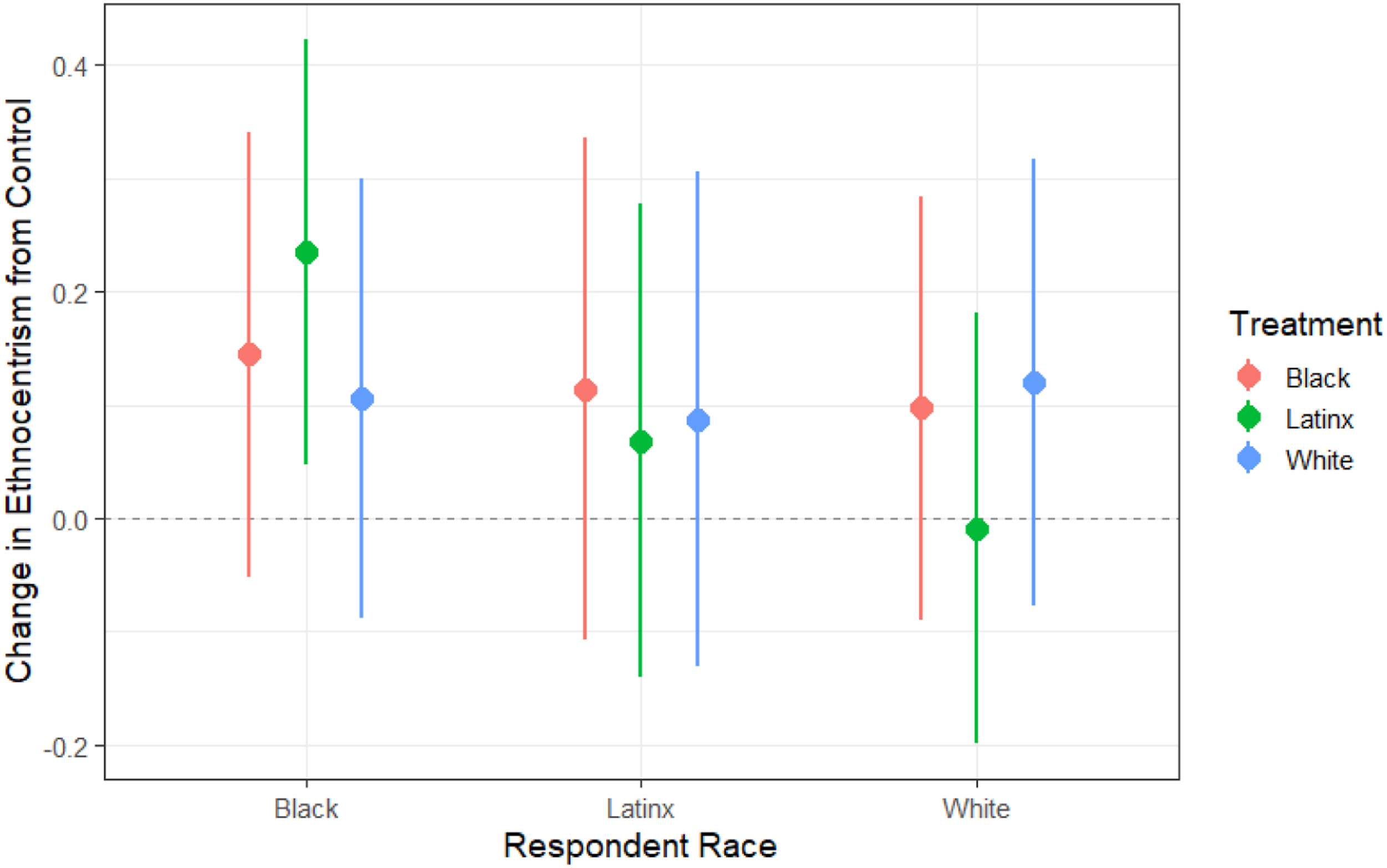
Figure 4 presents results for the treatment effects on tolerance. Most of the treatment-respondent combinations induce a negative, but not significant change in tolerance, with the only significant change on the part of Black respondents in the response to Black migrants. That finding does not relate to any of our expectations. Differences-in-means of factor variable of Tolerance of other groups.
Potential Treatment Moderators
The contact hypothesis is a long-standing theory about intergroup relations (Amir 1969), positing that increased interpersonal contact with an out-group will decrease out-group prejudice (Pettigrew 1998). The theory has been extensively tested and received wide-ranging confirmation (Pettigrew and Tropp 2008). Reactions to arriving migrants are particularly sensitive to prior neighborhood demographics and intergroup contact (Hopkins 2010). In applying intergroup contact, we examine whether locals’ existing contact with members of the group to which migrants belong mediates lower acceptance for migrants from that group.
We detail how we derived our measure of intergroup contact and the results of our analysis of contact as a moderator in appendix 10. From those results, we observe several significant treatment effects conditional on intergroup contact. The most relevant are differences in perceptions of migrants’ income and education based on contact, the marginal effects for which are depicted in Figure 5. White respondents who lack prior contact with Black Americans are more likely to view Black migrants as less educated and making less money than the respondents. Effectively, perceived low income and education, and by extension status threat, are a function of lacking prior contact with Black Americans for white locals, reflecting a mechanism from Craig and Richeson (2014a). On the other hand, prior contact with whites creates contrasting perceptions for Black respondents. Lack of contact leads to perceptions that white migrants are as well off as the respondents financially, while prior contact leads to perceptions white migrants are worse off, the latter suggesting Black respondents are proximate to financially worse-off white Americans. Finally, Black respondents only perceive Latinx migrants as making as much money as they do or as more likely to have a college degree if they lack prior contact with Latinx Americans. As shown in appendix 13, the perceptions that Black migrants are more educated and employed are primarily held by Latinx respondents with Mexican heritage. Marginal effects of changes in perceived income and education conditional on intergroup contact.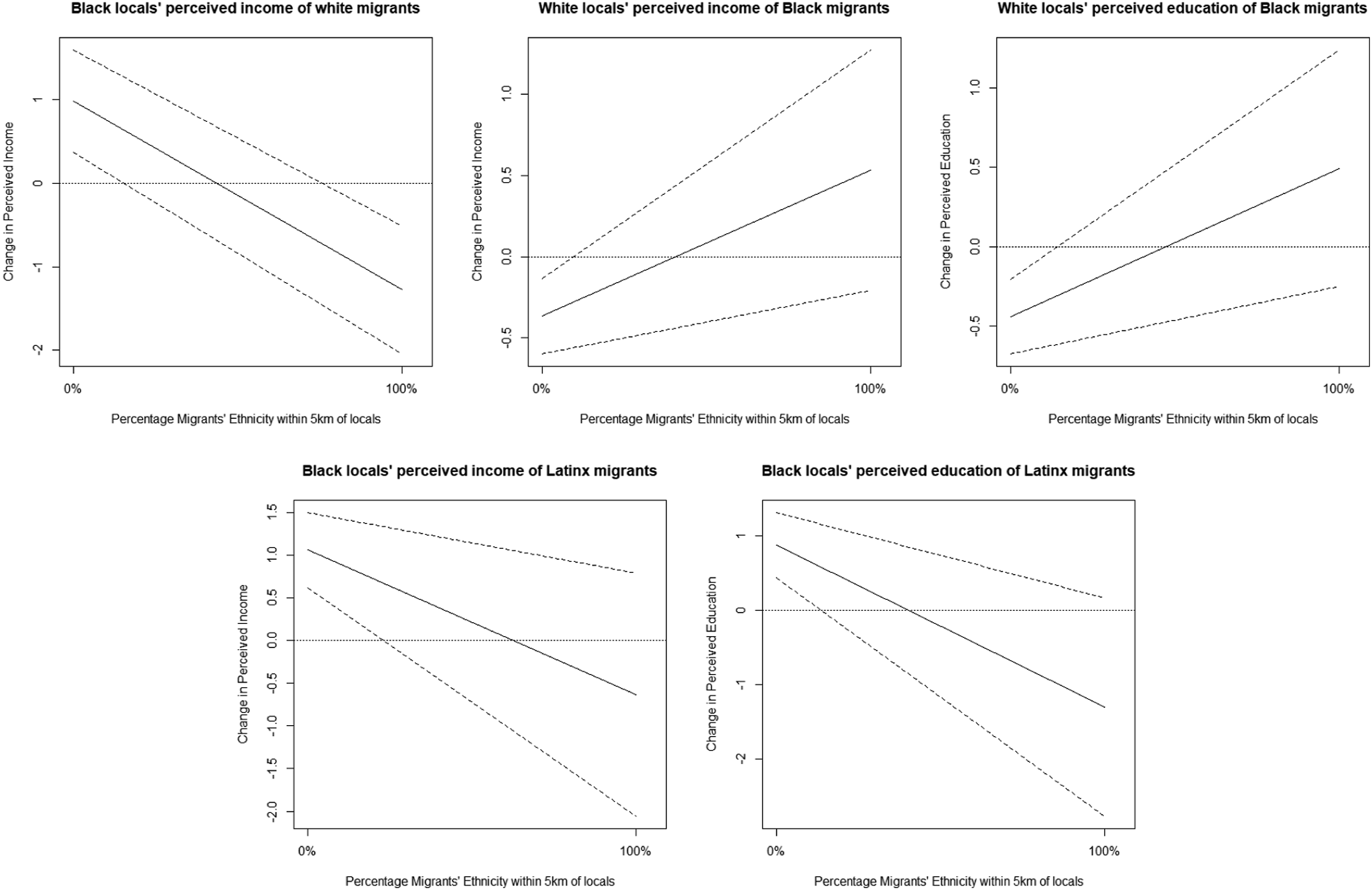
In appendix 11, we explore the moderating role of political preferences among white locals through vote choice in the 2016 presidential election. In appendix 12, we look at the moderating role of being from the US South among white locals. In appendix 14, we look at being from a state bordering Mexico as a moderator. We find little difference among white respondents based either on vote choice or being from the South, apart from heightened ethnocentrism from white Trump voters in response to Latinx migrants, lower ethnocentrism from white Southerners in response to Latinx migrants, and a greater likelihood of perceiving Latinx migrants as having a criminal conviction for white Clinton voters. We also find more labor competition between Black and Latinx respondents in border states as well as greater status threat among white respondents in border states. The results suggest that lower white acceptance of migrants persists across political leanings, but may be stronger in border states. In appendix 15, we find Black respondents who were previously forced to leave their homes due to an emergency may moderate their responses by being more likely to feel love and sadness about Latinx migrants. At the same time, Latinx respondents who had to leave their homes are more likely to view Black migrants as labor competition.
Caveats
Our findings are not without limitations. The lack of explicit opposition to out-group migrants by white locals may be attributed to social desirability bias. Recent cultural shifts in the United States place a social stigma on public expressions of prejudice, suggesting respondents, especially those from a politically dominant group that perceive a status threat, may not be willing to speak frankly. 18 We cannot explicitly rule out such a concern, but there is suggestive evidence that our null findings are not driven by social desirability.
First, point estimates for approval of migration were higher when people of any ethnicity were present in our image of a flooded road and the confidence intervals were consistent across treatments. Were there social desirability bias among some respondents, we would expect to see more positive point estimates or wider confidence intervals from more dispersed responses. Second, we see broadly positive answers from respondents who chose to write something for the donation question, suggesting respondents did not choose more favorable options in close-ended questions. Third, we see little heterogeneous treatment effects in both approval for migration and willingness to volunteer. 19 Were social desirability bias present, we would expect some sub-groups more likely to express prejudiced attitudes instead express starkly positive attitudes. While responses broadly supportive of migration from other countries could be subject to social desirability bias (Knoll 2013), it is also possible that explicit opposition to internal migrants is consistent with explicit racial prejudice, an attitude that most Americans no longer hold (Schuman et al. 1997). Thus, we believe that our respondents did not disguise their responses and there were no masked differences between treatment and control groups. Instead, the implicit opposition we find in heightened fear, reinforcement of stereotypes, and changes in ethnocentrism is more consistent with the nature of intergroup attitudes presently held by Americans (see Bonilla-Silva 2001).
Beyond social desirability bias, other causes for concern include that our findings represent general racial attitudes in the United States or attitudes toward migrants. It would be unreasonable to say our findings would not apply to other forms of internal migration or do not reflect general political attitudes in the United States. However, we also find notable differences. Most prominently, by identifying the migrants in our study as victims of an environmental disaster, we frame migrants in a different light than economic migrants, potentially allaying concerns about economic competition from locals. 20 The fact that Americans can already connect our hypothetical scenario to recent disasters on open-ended questions (see appendices 2 and 8) also bolsters the likelihood that we are connecting to attitudes regarding those displaced individuals. Here, we can rely on Arias and Blair (2021), who suggest migrants fleeing disasters are seen more positively than economic migrants.
Conclusion
While a changing climate may produce more internally displaced persons, results from the United States suggest internal migrants fleeing an environmental shock, regardless of their ethnicity, will ostensibly be welcomed by host communities. However, animosity toward excluded out-group migrants remains prevalent and suggests that approval is underpinned by a subtler lack of acceptance. Specifically, dominant groups remain averse to excluded group migrants, expressing greater fear of out-group migrants and reporting stereotypes about some excluded out-groups, which suggest dominant locals’ concerns about migrants taking locals’ public services. At the same time, politically excluded locals view excluded out-group migrants through the lens of economic competition, with higher ethnocentrism among excluded locals in response to excluded out-group migration.
The implications of the study complicate broader findings on popular attitudes toward internal environmental migrants by Spilker et al. (2020) and Arias and Blair (2021), which broadly compare environmental migrants to other types of migrants. Our findings, much like Alrababa’h et al. (2021), suggest that we should not expect outright instability, backlash, or conflict from internal migration in response to environmental shocks. Nearly all respondents in our survey (87 percent) reacted with compassion when asked about their emotional reaction to the disaster itself. 21 69 percent reacted with compassion to news of the disaster victims’ relocation to their neighborhood. As such, we do not expect internal environmental migrants to face explicit opposition or negativity, especially in developed countries. Nevertheless, we also find that migrant ethnicity induced notable changes in perceptions of migrant characteristics and ethnocentrism from locals. Thus, status threat or economic competition may yet facilitate lower acceptance of migrants from excluded out-groups, regardless of whether locals are from dominant or excluded out-groups. Lower acceptance may then develop into discrimination, anti-migration policies, and violence over time. Consistent with recent work linking climatic factors to political unrest (Buhaug et al. 2014), our findings suggest an indirect mechanism for potential instability, with that mechanism subject to moderators, such as vulnerability (see Adger 2006) or intergroup contact.
Supplemental Material
Supplemental Material - Ethnicity and Response to Internal Environmental Migrants in the United States
Supplemental Material for Ethnicity and Response to Internal Environmental Migrants in the United States by Konstantin and Puck Winchester in Political Research Quarterly
Footnotes
Acknowledgments
The authors would like to thank Henri Barkey, David Bowden, Tom Dolan, Dinissa Duvanova, Chris Faulkner, Arman Grigorian, Sara Guenther, Scott Guenther, Nazita Lajevardi, Mary Anne Madeira, Matthew Nanes, Norrin Ripsman, Zachary Steinert-Threlkeld, Duy Trinh, and Alcott Vernon for their helpful comments. This article was presented in preliminary form at meetings of the ISA 2019 and WPSA 2019. The study was approved by the University of Central Florida Institutional Review Board (IRB) (number SBE-18-14023).
Declaration of Conflicting Interests
The author(s) declared no potential conflicts of interest with respect to the research, authorship, and/or publication of this article.
Funding
The author(s) disclosed receipt of the following financial support for the research, authorship, and/or publication of this article: The authors acknowledge funding from the University of Central Florida’s Department of Political Science and College of Sciences.

Supplemental Material
Notes
References
Supplementary Material
Please find the following supplemental material available below.
For Open Access articles published under a Creative Commons License, all supplemental material carries the same license as the article it is associated with.
For non-Open Access articles published, all supplemental material carries a non-exclusive license, and permission requests for re-use of supplemental material or any part of supplemental material shall be sent directly to the copyright owner as specified in the copyright notice associated with the article.
