



Abstract
In this paper, we explore the roots of perceptions of local corruption in U.S. cities, using survey data collected from 39 cities during 40 different mayoral election campaigns. We examine the impact of the city-level corruption context alongside measures of political information, partisan and racial/ethnic representation in local government, evaluations of personal and policy satisfaction, and other individual-level attitudinal and demographic characteristics. We find that perceptions of local corruption are responsive to the local corruption context—though this relationship is heavily conditioned by political knowledge—satisfaction with local conditions, other attitudinal measures, and, to a lesser extent, co-ethnic representation in local government.
Political corruption has a long, storied, and sometimes disturbing place in American political culture. From the Yazoo land scandal in the early days of the Republic, to the scandal-rich Grant administration, to the evolution of urban political machines in the late 1800s, to struggles with machine remnants in the twentieth century, to scandals such as Watergate, ABSCAM, and the House Banking scandal in the late 1900s, and the escapades of Jack Abramoff and Rod Blagojevich in the 2000s, to the impeachment of President Trump for abuse of power related to his efforts to persuade the president of Ukraine to announce investigations of Joe Biden, there have always been highly visible examples of political scandals, mostly involving corrupt behavior on the part of public officials and their suitors.
By comparative standards, corruption in the United States generally is thought to be relatively low and relatively benign.1 This, perhaps, accounts for why there is so little contemporary research on corruption in American politics, a condition leading one prominent scholar in the area to refer to scholarship on U.S. corruption as a “blind spot” in the study of American politics (Johnston 2006). Still, this does not mean political corruption does not pose certain risks, both of an economic and a civic nature, to the American political system, though perhaps in different ways than elsewhere. As Johnston puts it, “Our corruption problem, arguably, exacts its costs in terms of the openness, competitiveness, and credibility of our political system, rather than in trends of GDP per capita” (Johnston 2006, 812). And some observers think it is possible that “corruption in the United States is much more prevalent, consequential, and resistant to correction than is often assumed” (Etzioni 2014, 141); all the more reason to be concerned about the lack of scholarship in the American setting.
Studies of corruption in the U.S. mostly have focused on public opinion on what constitutes corrupt behavior (Dolan, McKeown, and Carlson 1988; Redlawsk and McCann 2005), explanatory models of cross-state variation in levels of corruption (Boylan and Long 2003; Goel and Nelson 2011; Meier and Holbrook 1992; Schlesinger and Meier 2002; Tyburski, Egan, and Schneider 2020), and studies of the economic and policy effects of corruption in the fifty states (Depken and LaFountain 2006; Johnson, LaFountain, and Yamarik 2011; Mitchell and Campbell 2009; Woods 2008). This paper departs from existing research on corruption in the U.S. in several ways and, in doing so, makes important contributions to the literature. First, our focus is on corruption at the local level, specifically in U.S. cities. Despite the long history of corrupt practices in local governments in the United States (Benson, Maaranen, and Heslop 1978; Johnston 1982), there is very little empirical research on local political corruption. This is especially unfortunate given the rich variation in social, demographic, cultural, and political contexts across U.S. cities. Certainly, in comparison to the fifty states, municipalities in the U.S. offer not only important variation in those things that are likely to influence corruption, but also likely more variation in levels and types of corruption. The advantage of studying corruption at the state-level, however, lies in available data commonly used to measure levels of corruption: federal prosecutions of corrupt practices (Meier and Holbrook 1992; Schlesinger and Meier 2002; Tyburski, Egan, and Schneider 2020) and elite evaluations (Boylan and Long 2003), which either do not exist or are more difficult to translate to the local level. Although corruption is a notoriously difficulty concept to measure, we develop a unique measure of what we call the local “corruption context” based on media coverage of corruption and prosecutions of public officials. To our knowledge, such a blended measure has not been used to operationalize corruption across U.S. cities. Our approach thus provides scholars with a way to measure local corruption in other cities.
We also depart significantly from previous research by focusing on peoples' perceptions of the level of corruption in the cities in which they live. We do this by making use of original survey data collected across dozens of U.S. cities. Our focus on perceptions is not just a significant departure from the study of corruption in the U.S., but from studies of corruption more generally. While there have been studies of the impact of perceptions of corruption on political outcomes (Arnold 2012; Zechmeister and Zizumbo-Colunga 2013), the literature in American politics is relatively bereft of studies of the determinants of corruption perceptions, with most existing studies focusing on demographic and psychological determinants of perceptions of corruption at the national level in countries other than the United States (Agerburg 2022; Bokayev et al., 2023; Canache and Allison 2005; Canache et al., 2019). While some studies of U.S. corruption focus on elite perceptions of corruption (Boylan and Long 2003), or perceptions of what types of behavior constitute corruption (Dolan, McKeown, and Carlson 1988; Redlawsk and McCann 2005), there are no studies that examine individual perceptions of the level of corruption, in particular at the local level. 2 In combination with corruption the measure discussed above, our survey data on perceptions of corruption allow us to examine whether and how perceptions are related to the different contexts that people live in.
Why Study Perceptions of Corruption?
There is much to be gained by understanding perceptions of corruption, not the least of which are important insights into the potential for accountability. A central tenet of democratic governance is the ability of the electorate to hold government officials accountable for their actions, including actions that may be viewed as corrupt in nature. As Canache and Allison put it, “when citizens accurately perceive corruption and adjust their opinions of the leader, they will be better able to hold that leader accountable through democratic processes” (Canache and Allison 2005, 93). As in other forms of “accountable” voting, it is not necessarily required that members of the electorate hold specific information about corrupt practices, and they may do very well with perceptions of corruption in “broad strokes,” somewhat akin to Popkin’s notion of gut-level rationality (Popkin 1994). This view is in keeping with Fackler and Lin’s conception of corruption as the general level of information about corruption in the environment rather than specific acts of corruption (Fackler and Lin 1995). Among other things, we examine the extent to which local residents' perceptions of local corruption are related to the level of information about corruption to which they are exposed.
Perceptions of corruption are also important in that they can influence a broad range of civic attitudes, as well as the potential for cooperation among competing interests at the local level. Numerous studies have demonstrated the impact of corruption or perceptions of corruption on confidence in government and system support (Anderson and Tverdova 2003; Ares and Hernández 2017; Caillier 2010; Hakhverdian and Mayne 2012; Seligson 2002). This connection is not difficult to fathom, given that almost by definition corrupt leaders should not be trusted. But beyond a general sense of trust in government, there are longer-term implications for support for the political system, implications that could lead citizens to withdraw their support and perhaps opt out of participating in political life. Lamentably, none of this research informs us about how corruption or perceptions of corruption affect the connection between the electorate and their local governments, as it focuses on support at the national (Anderson and Tverdova 2003; Ares and Hernández 2017; Hakhverdian and Mayne 2012; Seligson 2002) or state level (Caillier 2010).
Explaining Differences
We model perceptions of corruption as a function of the information environment, individual differences in political expertise, group identity, and satisfaction with personal and local conditions. Our main theoretical interest is in the interaction between the information environment and individual differences in expertise, but the other factors are also important theoretical considerations. The primary data for this project come from the Urban Mayoral Election Study 3 (UMES), a public opinion survey administered prior to 40 separate mayoral elections in 39 cities from 2007 to 2011. 4 We note that although the UMES has been used in previous studies on local politics (Holbrook and Heideman 2022; Holbrook, Heideman, and Weinschenk 2023; Holbrook and Weinschenk 2020a, 2020b; Lay 2015; Lay and Tyburski 2017), it has not been used to study perceptions of corruption. The overall sample size comprises 6,365 respondents, with an average of 159 respondents from each city. 5 Though the survey items covered a broad range of issues, perceptions of local conditions, group-based attitudes, engagement with local politics, and voting behavior constituted a major part of the study. We note that although our dataset dates to 2007 through 2011, we are not aware of other (more current) datasets that measure perceptions of local corruption, along with other questions related to local politics, and that draw samples from across dozens of cities (with relatively large sample sizes per city).
The sample of cities was designed to capture a wide range of experience in urban political life specifically to enhance the generalizability of the findings, and it gives us significant variation on historical patterns of corruption. Using Benson et al.’s classification of cities, we have several cities viewed as historically corrupt (Baltimore, Boston, Cleveland, Detroit, Miami, New York City, Philadelphia, Pittsburgh, and Seattle) and several cities that have made “real progress” against corruption (Atlanta, Cincinnati, Dallas, Houston, and Salt Lake City) (Benson, Maaranen, and Heslop 1978).
The Corruption Context
Foremost among city-level determinants of corruption attitudes is what we refer to as the corruption context of the city. It is problematic at best to assume that we can measure true levels of corruption in these cities. What we can do, though, is measure elements of the local context that are likely to be related to actual levels of corruption, or at least that capture aspects of the information context that are likely to influence perceptions of corruption. This is similar to the approach used by Dincer and Johnson (2017) and Fackler and Lin (1995), whereby the politically consequential aspect of corruption is not a direct measure of corruption, but levels of information about corruption. The basic idea is that when there is more corruption there should also be more information about corruption, and that information should shape perceptions of corruption and the political consequences of those perceptions.
The measure of corrupt context we use is based on two different variables, one that captures media coverage of corruption, and one that captures prosecutions of public officials. For the media-based measure, we used EBSCO and searched Newspaper Source Plus and Newswires for stories related to local government in each locale in the 3 years prior to the mayoral election that coincides with the survey. We then did another search in which we added multiple “corruption” terms to capture a smaller subset of stories that had some content focusing on corruption or related terms. 6 We then took this smaller subset of stories as a proportion of all stories about local government and used this as a proxy for the level of corruption-related media information in the local environment. It is worth noting that information from newspapers is useful for several different reasons. First, newspaper stories provide an information source that we can access and measure across cities and in different years. Although it would be interesting to develop a media-based measure that aggregated coverage of corruption for television, newspaper, and radio outlets in each city in our sample, we are not aware of databases that contain such information at the level of U.S. cities. In addition, we note that the goal of our measure is not to capture every single piece of media coverage about corruption, but instead to get some sense of the extent to which local corruption is present in the information environment in the cities in our sample. Second, although local newspapers have changed considerably (e.g., closure of local newsrooms and decreases in staff) and become more “nationalized” in recent years (e.g., Moskowitz 2021), it is important to recall that our surveys were conducted from 2007 to 2011. Thus, despite such changes to the context of local newspapers, we believe that given the time frame of our sample, they still serve as a reasonable, though admittedly imperfect, proxy for the local information environment.
We also used a measure of corruption based on the number of federal convictions of public officials per 1,000 population in the U.S. Attorney district in which the cities are located. 7 In some cases, the geographic boundaries of the U.S. Attorney offices coincide with state borders but in most cases the states are broken up into multiple U.S. Attorney offices, and cities fall within the boundaries of these districts. A potential downside to these data for the purpose of this paper is that they include convictions for federal, state, and local employees, 8 so they are not a direct measure of the level of corruption among local officials in each city. However, to the extent that some U.S. Attorney districts see significantly higher levels of prosecutions and convictions for corruption, the information context in those districts should contain higher levels of corruption related content.
Rather than relying on one or the other of these two measures of local context or requiring them to “compete” with each other by using them both in the same model, we created a single index based on the average of standardized versions of the media-based and convictions-based variables (high values indicate a context in which corruption cues are likely to be more abundant). The use of an index based on both measures should help reduce some of the “noise” that undoubtedly occurs when trying to measure the corruption context in cities. 9
The Moderating Role of Knowledge
There is abundant evidence from previous research documenting the importance of information acquisition to political decision-making (Crowder-Meyer et al., 2017; Lau and Redlawsk 1997; Zaller 1991), including some showing that perceptions of political outcomes are less biased and track more closely with objective indicators of those outcomes among those with relatively high levels of political expertise than among others (Blais and Bodet 2006; Delli Karpini and Keeter 1996; Dolan and Holbrook 2001; Meffert et al., 2011; Zaller 1991). This general finding extends to perceptions at the city level, where studies have found that perceptions of prevailing local conditions (crime, economy, schools) track better with objective indicators among high-information residents than among others (Holbrook and Weinschenk 2020b).
In line with prior work, we also include a variable measuring political knowledge, intending it to act as an indicator of broader political interest and expertise (Zaller 1991). 10 Importantly, we are not strictly interested in an additive effect from political knowledge but expect it to condition the effect of the contextual measure of corruption. As with almost any stream of political information, we expect a significant “knowledge gap” to exist between the information “haves” and “have nots” (Holbrook 2002; Jerit, Barabas, and Bolsen 2006; Kwak 1999; McCann and Lawson 2006; Moore 1987). In this case, we expect that those with generally high levels of other political information are exposed to and are more strongly affected by the level of information about corruption in the local environment than those with low levels of information. In short, we expect to see a stronger relationship between the corruption context of the city and perceptions of local corruption among high-information respondents than among others.
To ensure the robustness of our key findings, we test the model using three separate indicators of political knowledge, one focused on national politics and two that focus on awareness of local politics. For the national politics variable, we construct a simple three-item scale that is the number of correct responses given to questions about which party controlled the U.S. House of Representatives and the U.S. Senate, and whether they knew what job or political office Nancy Pelosi (before the 2010 election) or John Boehner (after the 2010 election) held. To measure local political awareness, we rely on self-reported familiarity with the two mayoral candidates, 11 and whether respondents could correctly name a member of the city council. 12 Using each item separately allows us to determine whether any interaction effects that exist are comparable across knowledge measures that ask about different levels of government and that assess knowledge in quite different ways (objective vs. self-assessment). Some previous research has indicated that different measures of political knowledge and different types of measures can lead to different inferences (e.g., Shaker 2012), so it is important to examine the robustness of our results across knowledge measures.
In-Group Representation and Identity
Generally, evaluations of officeholders and candidates are heavily biased by group-based connections, whether those connections are based in share political or demographic identity (Achen and Bartels, 2017; Bartels 2002; Campbell et al., 1960; Citrin and Green 1986; Fisher, 2018; Tesler and Sears 2010; White and Laird 2020). Similarly, studies of corruption show that voters are more likely to overlook or downplay corrupt practices that might reflect poorly on their own party and/or their own racial/ethnic group (Agerberg 2020; Anduiza, Gallego, and Muñoz 2013; Solaz, DeVries, and de Geus 2019). Whether due to a need to elevate the group to bolster self-esteem (Tajfel 1970), or to reduce cognitive dissonance via motivated reasoning (Fischle 2000), the incentives to evaluate in-group members differently from others can be quite strong. With this in mind, we consider two key identities shaping political perceptions: partisanship and race/ethnicity. Beginning with party, we expect respondents to have a more benevolent view of corruption if they share party identification with the incumbent mayor. 13 This idea treats party as a group identity and anticipates that in-group members are evaluated more positively than out-group members. We also expect shared party to be a stronger cue in partisan than in non-partisan cities, so we interact the co-partisan variables with the partisan election dummy variable described earlier. Controlling for partisan vs. non-partisan elections is important not just because this structural difference might condition individual behavior, but also because of the historic connection between parties and corruption in U.S. cities (Benson, Maaranen, and Heslop 1978). 14
In addition to shared party, we also consider shared racial/ethnic identity with local elected officials. To capture the possible effects of descriptive representation, we create two measures: one capturing co-racial/ethnic representation by the mayor and one measuring the proportion of co-racial/ethnic representation on the city council. 15 The expectation is that respondents in cities with a co-ethnic mayor should perceive lower levels of corruption, and there should be a negative relationship between co-ethnic share of the city council and the probability of perceiving high levels of political corruption.
Beyond the simple additive effects of co-ethnic representation, we also explore the potential for differences across groups. Extant literature suggests this is plausible path to pursue: For instance, at the local level, White co-racial representation is more strongly associated with trust in local government than Black co-racial representation (Heideman 2020). Further, there is reason to suspect that the effect of a racial outgroup representative has differential effects across groups: increases in minority representation have been linked to lower levels of trust among White electorates (Bobo 1983; Williams 1990). Following this logic, we consider the impact of co-ethnic representation separately for White16 respondents, relative to non-White respondents, with a simple interaction term.
Self-Interest/Policy Satisfaction
While literature exploring perceptions of corruption in the U.S. context is limited, several studies in the comparative literature provide some useful insights regarding the role of self-interest in shaping opinions about corruption; more specifically, that tolerance of corruption is a function of economic gains associated with politicians. For example, some experimental studies find citizens would tolerate corruption if the state of the economy was good (Klašnja and Tucker 2013) and jobs and service delivery were provided (Botero et al. 2015; Konstantinidis and Xezonakis 2013). Likewise, Choi and Woo (2010) found that incumbent regimes are seemingly forgiven for corrupt practices in good economic times but pay a heavy electoral penalty when corruption occurs during times of economic downturn. The key takeaway here is that electorates are willing to ignore, or at least downplay, public corruption if things are going well in other domains.
Given some of the findings from this literature, we include measures of satisfaction with personal and local conditions. For personal finances, the idea is that if individuals have experienced economic improvements in their own lives, which could plausibly be tied to government, they may be willing to give politicians more slack when making assessments about corruption. Similarly, when it comes to local conditions, the logic is that if individuals are generally dissatisfied with some aspects of their community that could be linked to government (e.g., crime), they may vent that frustration via broadly negative evaluations of government and government officials, which could include evaluations of corruption. This is a bit tricky because actual and perceived levels of corruption could easily affect overly broad retrospective questions, such as “Are you satisfied with the way things are going in your city?” To get around this problem, we use more specific indicators. Specifically, we use questions measuring satisfaction with the direction of personal finances, perceptions of the severity of citywide crime, perceptions of the severity neighborhood crime, and evaluations of the direction of the local economy. 17 For each variable, we expect that people who express greater overall dissatisfaction will be more likely to view the city as corrupt. There are a number of possible mechanisms. For example, it could be that perceptions of corruption are tied to the idea that somehow government is not getting things done the way they should be. Another possibility is that people who are generally satisfied with other aspects of their lives or local conditions are more forgiving of evidence of local corruption.
Additional Individual-level Characteristics
Our model also includes a handful of other attitudinal and demographic variables. First, we control for variables that might reflect a general level of distrust in government and government officials, beginning with political ideology and party identification. Here, the focus is not on matching the party or ideology of the mayor, but rather on capturing general anti-government sentiments that covary with directional measures of party and ideology. Our expectation is that conservatives and Republicans should be more likely than liberals and Democrats to view their local (or any other) government as corrupt, due to their general tendency to be suspicious of government officials. We also include a measure of trust in the national government to further account for the possibility that responses to the local corruption question simply reflect a more general level of cynicism regarding government and politics. The beauty of this variable is that it should work as a brute measure of general political cynicism, but its focus is on national rather than local politics, creating some substantive distance between it and the dependent variable. Finally, though limited, preceding work shows the importance of including several demographic control variables (Canache and Allison 2005; Redlawsk and McCann 2005). Toward that end, we control for respondent age, education, income, and sex.
Analysis
The Distribution of Corruption Perceptions in the Full Sample.
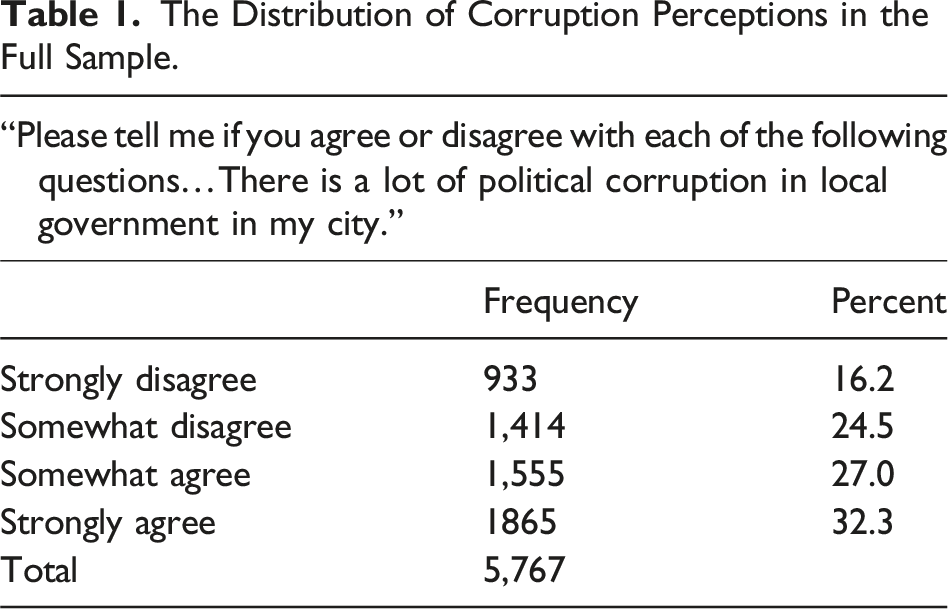
It is difficult to tell if this is particularly high or low without comparison to the same or similar questions asked in other surveys. As it happens, a module from the 2014 Cooperative Congressional Election Survey (CCES) used the same question wording to evaluate perceived levels of corruption in state, local, and national government.
18
Figure 1 shows the percent of respondents in both the UMES (Local) sample used here, and the CCES (Local, State, and National) sample, who agreed (combined “somewhat” and “strongly”) with the statement that “there is a lot of political corruption” across levels of government. Two things stand out. First, the perceptions of local corruption in the UMES (2007–2011) and CCES (2014) surveys were virtually identical. Second, perhaps not surprising, people tend to view their local governments as less corrupt than their state government and the national government. Comparison of perceptions of political corruption across levels of government.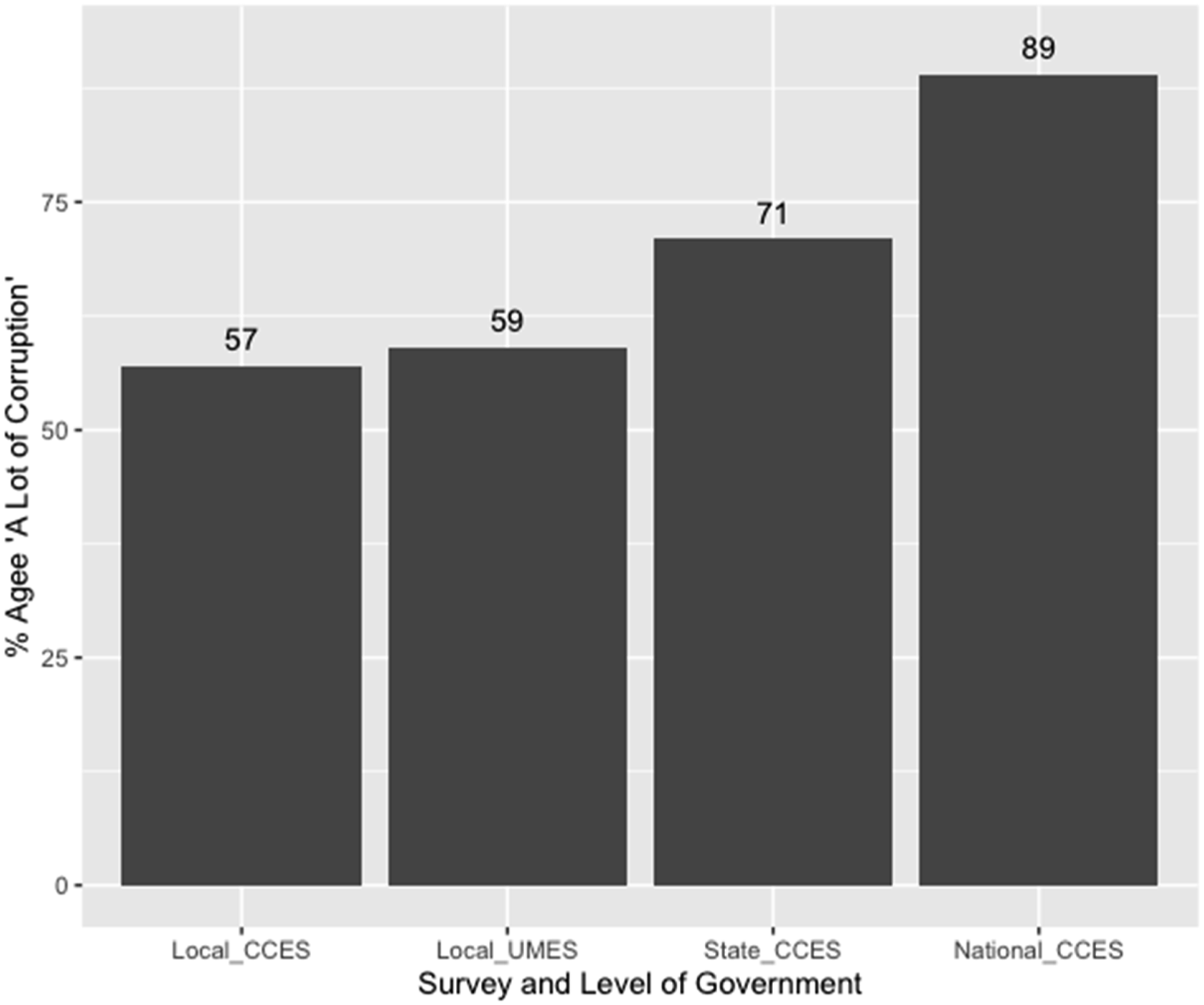
The first bit of analysis examines the extent to which perceptions of corruption vary across locales, as it is improbable that all cities are likely to generate the same response if this item is measuring local perceptions rather than some free-floating, perhaps faddish, or generalized sense of cynicism. Second, we examine the extent to which variation in local perceptions is tied to variations in local contexts that are likely to produce different outcomes in perceptions.
The stacked bar chart in Figure 2 illustrates the variation in perceptions of local corruption both between and within cities. Here we see considerable cross-locale variation in corruption perceptions, with cities like Miami, Cleveland, Detroit, and Philadelphia standing out as places where residents generally see the local government as corrupt, and cities like Boise, Salt Lake City, Seattle, and Fort Wayne anchoring the other end of the graph with relatively low levels of perceived local corruption. A simple ANOVA model (using a dichotomous version, 0 = disagree, 1 = agree) confirms that there is significant cross-city variation in corruption perceptions (F = 17.3, p < .0000), with local context accounting for approximately 10 percent of the variation in attitudes. This being the case, it is also very clear that corruption perceptions exhibit a lot of within-city variation as well, variation that we think can be accounted for by the individual-level characteristics and attitudes identified earlier. Local variation in the proportion perceiving political corruption in local government.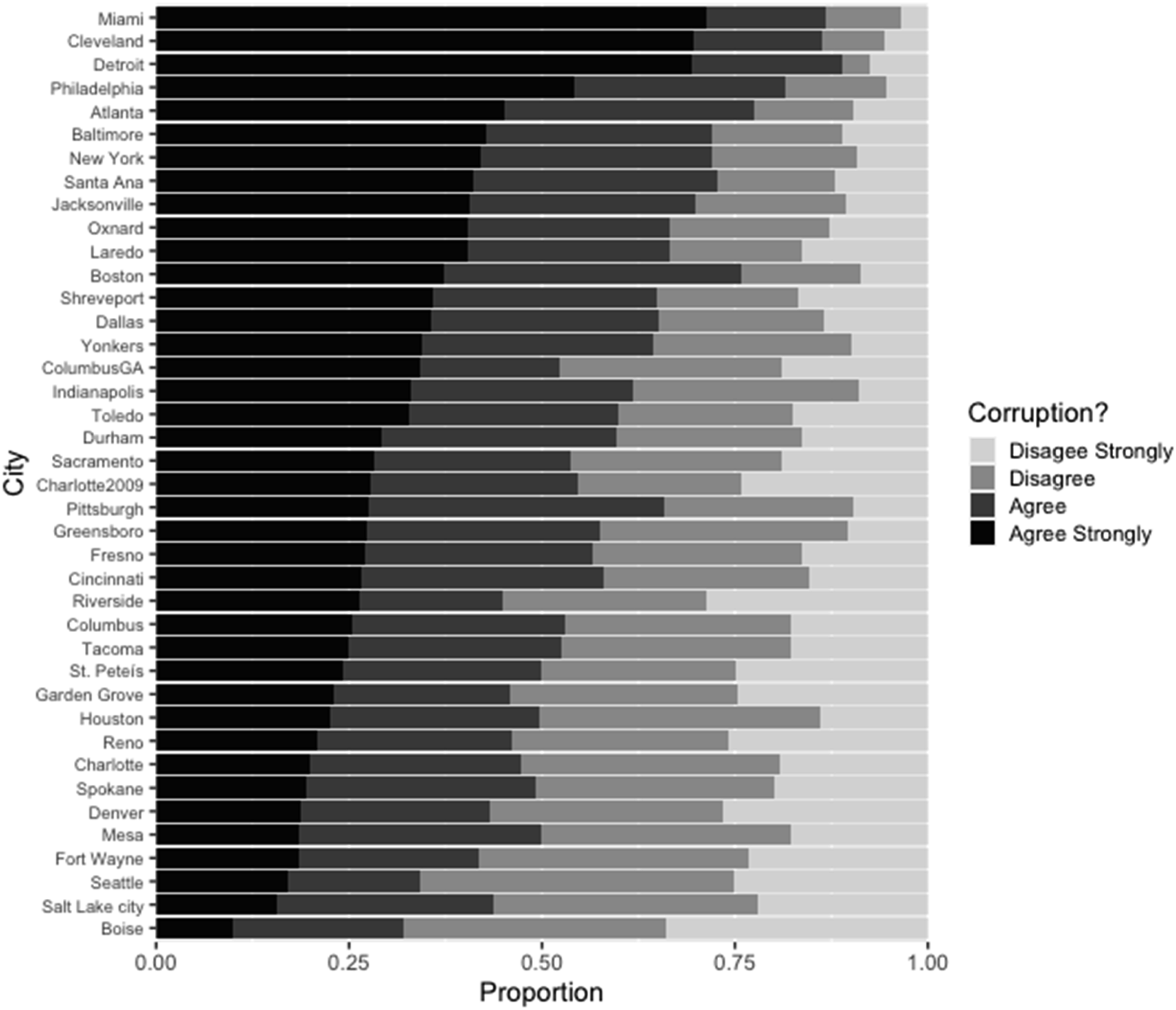
But does the cross-city variation in perceptions of corruption make sense from the perspective of local political context? Specifically, are there higher levels of perceived corruption in cities with higher levels of actual corruption than in cities with lower levels of corruption? This is a difficult one to get a handle on, absent a “true” measure of corruption, but we can look at the bivariate relationship between the measure of the local corruption context and perceptions of local corruption. To the extent that the survey measure of corruption perceptions responds to the political context of the cities, we should see higher levels of perceived corruption in cities that are high on the corruption context index than in cities that are low on the corruption context index. This relationship is shown in Figure 3, where the proportion of the local respondents who agreed (somewhat and strongly combined) is plotted against the corresponding values on the aggregate measure of corruption context, comprised of both the conviction and media data. There is no mistaking a positive pattern to these data: generally, those cities with above average scores on the aggregate corruption indicator also have above average levels of perceived corruption, producing a correlation between the two variables of 0.53. Relationship between aggregate indicator of corruption cues and proportion perceiving corruption in local government.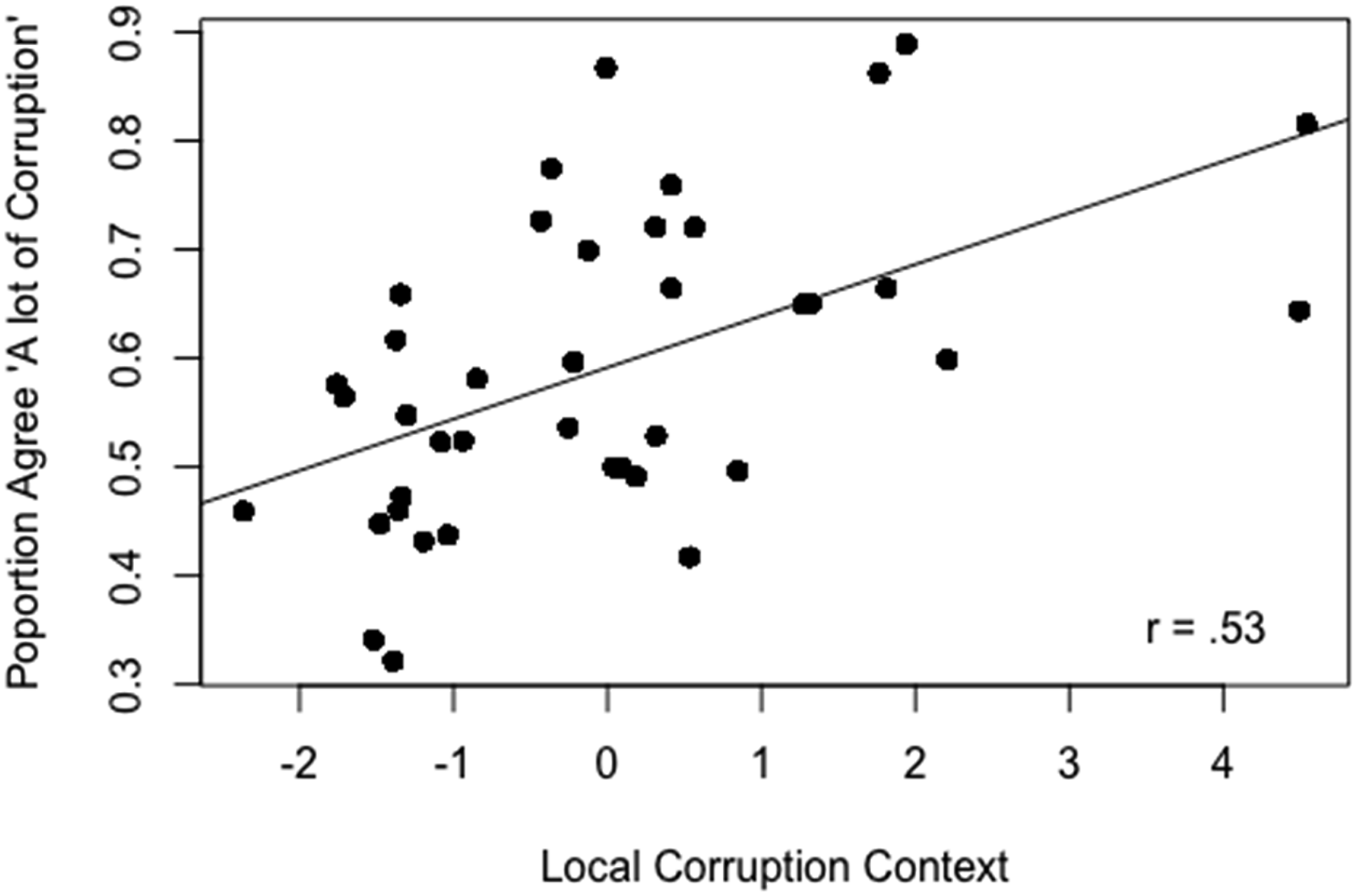
This is an important linkage, for it gets directly at a critical issue. Local populations can comprehend and react to the level of corruption in their environment. Whether they use this information to hold officials accountable is a somewhat separate issue, but these data establish that an important necessary condition is met—broadly speaking local residents can sense the level of corruption information in their environment. These data show that answers to this survey question respond to local conditions in a systematic and predictable fashion, thus suggesting that responses are tapping into unique local conditions.
Model Results
The Additive Effect of the Local Corruption Context on Perceptions of Local Corruption.
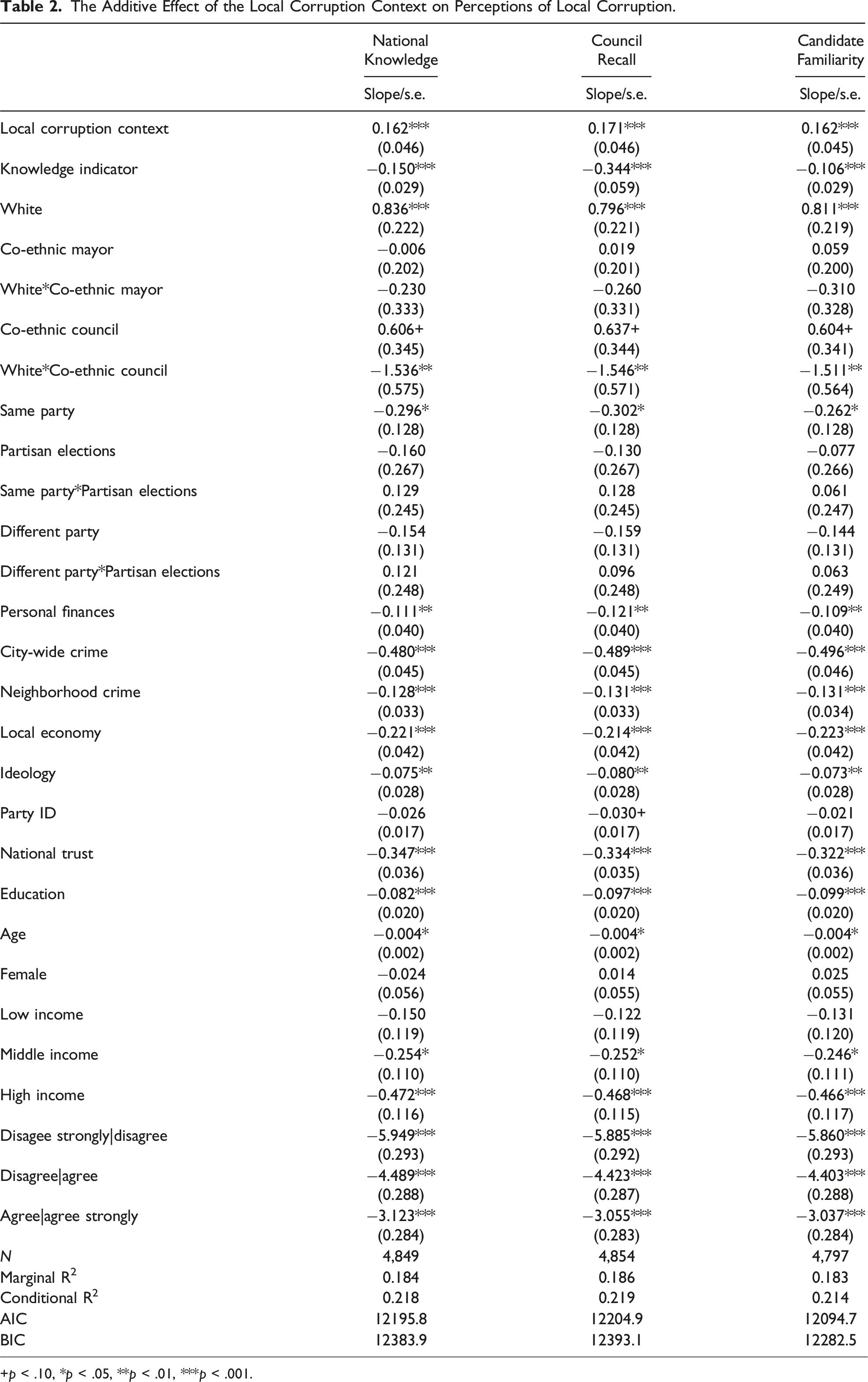
+p < .10, *p < .05, **p < .01, ***p < .001.
The Conditional Impact of Corruption Context on Perceptions of Local Corruption.
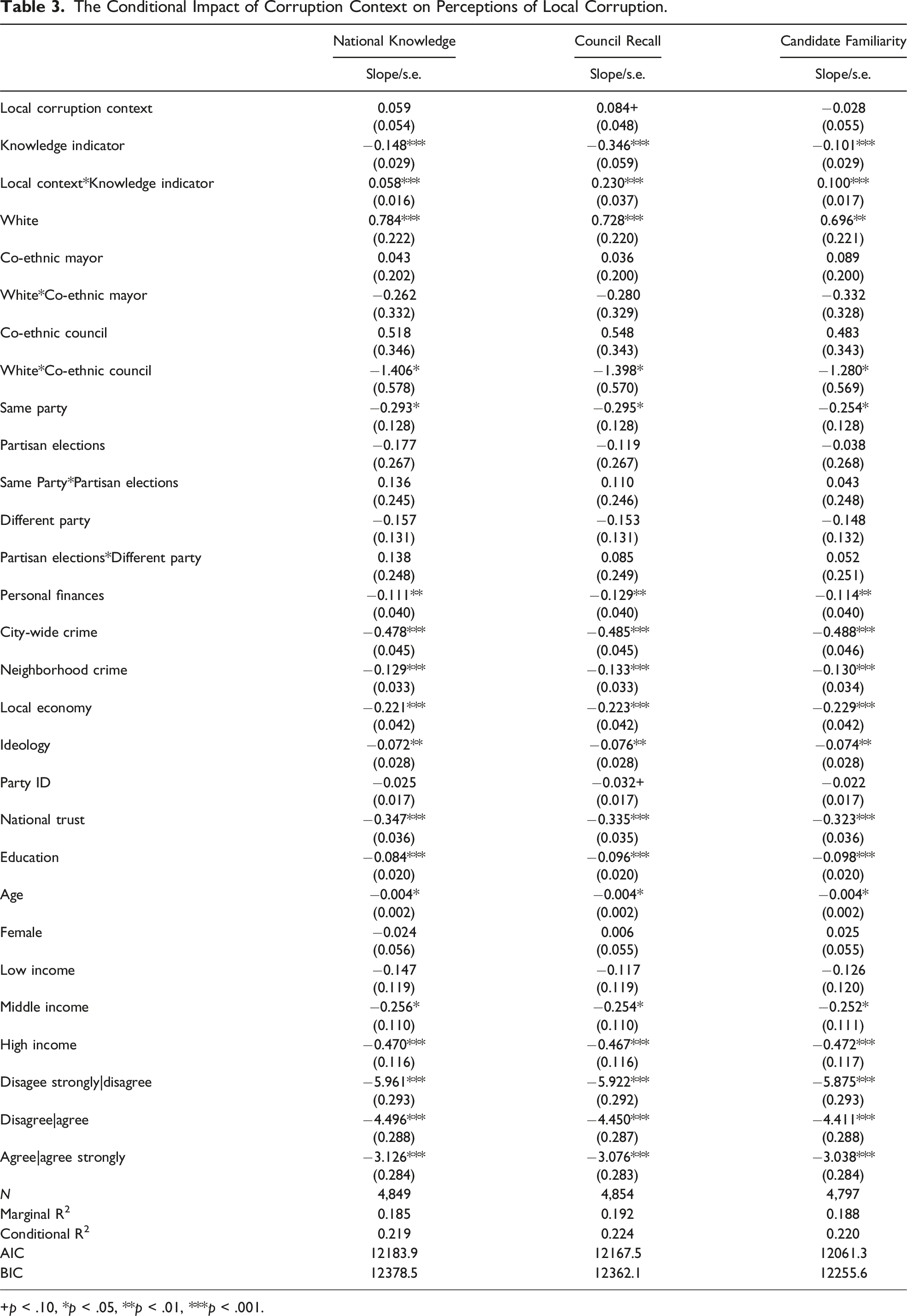
+p < .10, *p < .05, **p < .01, ***p < .001.
Although this is an important finding, it does not paint a complete picture, as it assumes a constant effect from the corruption context across individuals who differ on a number of different traits, most importantly, in terms of information acquisition. We are particularly interested in whether the impact of the corruption context is conditioned by the level of pre-existing political knowledge, which we take as an indicator of likelihood of information acquisition.
The conditional models in Table 3 include an interaction term for corruption context and the political knowledge variables, providing a direct test of whether the impact of the corruption context measure is moderated by knowledge. 20 Overall, the constituent parts of the interaction between the corruption context and political knowledge tell an interesting story—that the impact of corruption context is heavily dependent on respondent political knowledge. In fact, the non-significant slope for corruption context across all three models tells us that those in the lowest political awareness category are not responsive to the level of corruption around them, while the positive interaction terms tell us that the impact of context on respondents' perceptions of local corruption increases as the values of the knowledge variables increase. 21
Figure 4 illustrates this relationship.
22
Here we see dramatic differences in the impact of the corruption context for respondents with different levels of political knowledge. Each pane in Figure 4 compares the impact of corruption context on perceptions of corruption among respondents with the lowest level of information to the impact among those with the highest level of information. The patterns are very similar across measures of knowledge, though the results in Table 3 and Figure 4 show that the interaction effect is somewhat stronger in the models using local measures than in the national political knowledge model. These results are strikingly like those found by Canache and Allison (2005) in their analysis of corruption perceptions in Latin America. This interaction between political knowledge and corruption context has important implications for the prospects for accountability. As is so often the case when analyzing information asymmetries, those with higher levels of information are better situated to take advantage of the political context to shape their decision-making. One conclusion to take from this body of evidence is that accountability is likely a function of how well informed the electorate is. The impact of contextual information on perceptions of corruption, conditioned by political knowledge.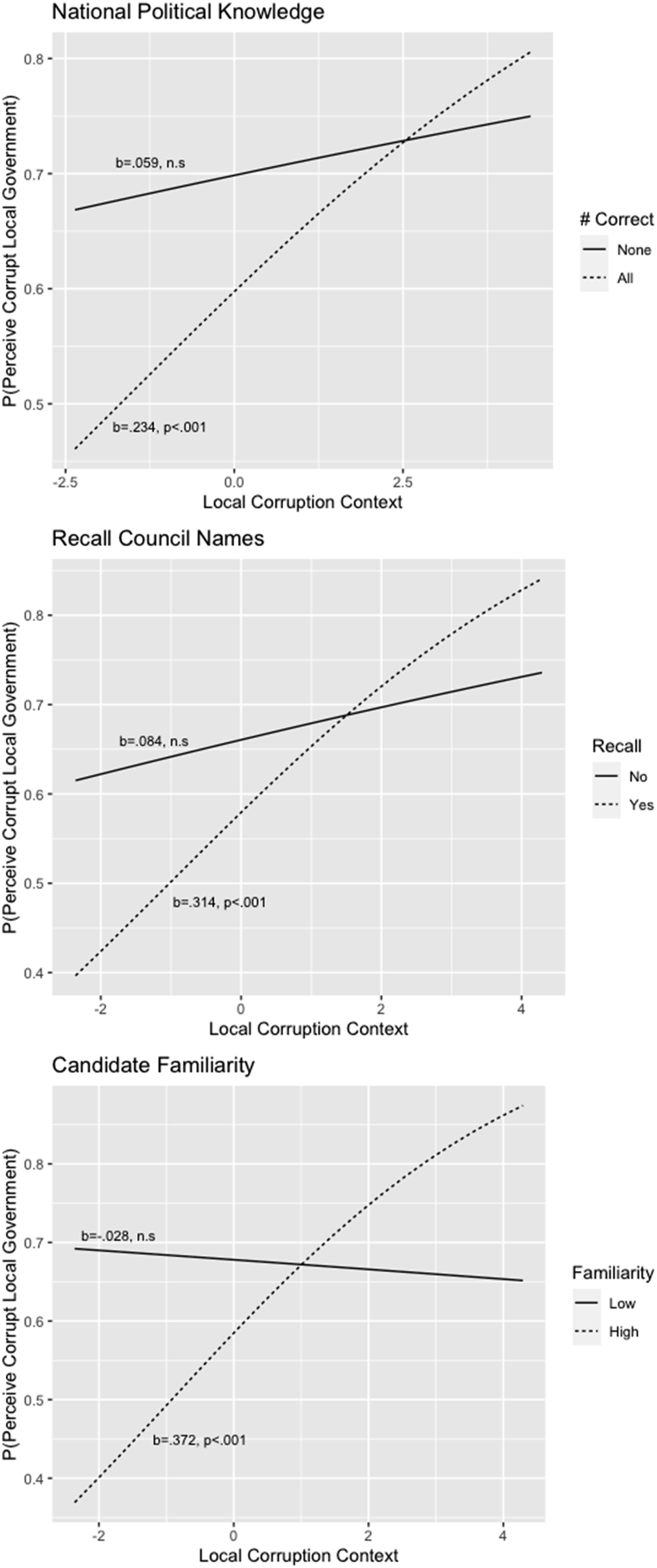
The other results in Table 3 point to a number of interesting patterns. The findings related to shared political and racial/ethnic connections to local government are decidedly mixed. First, sharing the same party affiliation as the mayor slightly decreases the probability of thinking the local government is corrupt, but there is no significant impact from having a different party affiliation than the mayor, and the impact of shared partisanship is not statistically different in partisan compared to non-partisan cities. Also, sharing racial/ethnic identification with the mayor has no impact on corruption evaluations, and the level of co-ethnic representation on the city council has an impact on corruption evaluations for non-Hispanic White respondents but not for others. For White respondents, the probability of agreeing that there is a lot of corruption in local government decreases as the White share of the city council increases. For other respondents, there is a counter-intuitive (positive) but not statistically significant relationship.
The story is quite different when we turn attention toward the measures of personal and policy satisfaction. Here we see that both the personal finance and evaluation of local conditions variables are negatively related to perceptions of corruption. Specifically, respondents who were most satisfied with their personal finances, who did not see local and neighborhood crime as serious, and who evaluated the local economy positively were the least likely to perceive that their local government as corrupt. The evaluation of city-wide conditions (crime and economy) matters more than personal finances or evaluations of neighborhood crime, but all measures of satisfaction have an impact on perceptions of corruption. These findings point to an important link between satisfaction with outcomes and perceptions of corruption, but the precise mechanism is not clear. It could be that those who are less satisfied vent their frustration through negative evaluations of local authorities, or it could be that corrupt governments produce more negative outcomes, and those outcomes are reflected in negative evaluations of local conditions.
Finally, there are mixed findings for the remaining variables. Political ideology is negatively related to corruption evaluations (conservatives are the most likely to view local government as corrupt), but there is no discernible impact from the directional measure of party identification. As might be expected, trusting the national government is also strongly related to perceptions of local corruption, reflecting the impact of generalized political cynicism on attitudes about local government. Among the demographic variables, only education 23 and income are statistically significant, indicating that those with high levels of income and education are less likely than others to agree that there is a lot of corruption in the local government, and in contrast to previous research, there are no significant effects from respondent sex or age.
Conclusions
The empirical study of U.S. political corruption stands out as a vastly “under-tilled” research area. Despite the history of corrupt practices in local governments in the U.S., scholarship on U.S. corruption has been described as a “blind spot” in the study of American politics (Johnston 2006). This is due in part to the nature of the concept itself—corruption is a notoriously difficult concept to measure, particularly at the local level. In this paper, we made important inroads by developing a measure of local corruption context based on media coverage of corruption and convictions related to corruption. This measure, in conjunction with our unique survey data, allowed us to explore whether and how perceptions are related to the different contexts people live in. We found that perceptions of corruption have multiple sources; this implies some good and bad news when it comes to prospects for democratic accountability.
Our results indicate that perceptions of corruption are rooted in reality: perceptions of corruption are influenced by the context in which people live, specifically by the local corruption context. The ability to use information from the political environment to form accurate judgments about political, economic, and social conditions is good news when it comes to the quality of citizen decision-making. If citizens can accurately perceive corruption, they can (theoretically) adjust their opinions accordingly, and elected officials can be held accountable (Canache and Allison 2005). 24 However, even though perceptions of corruption are influenced by the local corruption context, it is important to note that this effect is conditioned considerably by individual differences in political awareness, as measured by political knowledge: individuals with high levels of information have corruption perceptions that correspond to the level of corruption in the local environment, whereas respondents with low levels of information hold perceptions that are relatively unrelated to the local corruption context. We take this as another indication that accountability may be a luxury afforded only to the “information rich.”
We also found a link between satisfaction and perceptions of corruption: those who are relatively satisfied with the direction of their personal finances and local and neighborhood outcomes related to crime and the economy have a low probability of reporting high levels of local corruption. However, the precise mechanism at work here is unclear: are those who are less satisfied venting their frustration through negative evaluations of local officials while those who benefit are willing to look the other way? In strategic terms, this would imply that citizens are predominantly tolerant of corruption insofar as it benefits them (or their neighbors). Another possible explanation for this relationship is that corrupt governments produce negative outcomes, which are then reflected in negative evaluations of local conditions. If the former is true, the implications for political accountability seem quite worrisome, as politicians may be able to avoid the negative consequences of corruption when conditions are favorable. If it is the latter, the implications for accountability seem more positive. Indeed, if political corruption yields negative outcomes which then lead to negative evaluations of local conditions, people could use those evaluations when assessing local candidates or voting in local elections. Either way, further exploration of the mechanisms driving this relationship is crucial for understanding how voters evaluate public integrity and what that means for political accountability.
Despite findings from previous literature suggesting that there are strong incentives to evaluate in-group members differently than others, our results provide little in the way of evidence of group-based perceptions of corruption. Somewhat surprisingly, co-partisan representation in the mayor’s office had only a modest impact on corruption perceptions, even in cities that use the partisan ballot. While we did find some evidence that perceptions of corruption are tied to the extent of co-racial control of local government, this effect is limited to White respondents and is not nearly the magnitude of other influences in the model. How these identities moderate the relationship between context and perceptions is beyond the scope of our analysis but offer an interesting avenue for future research.
The findings from this paper suggest a number of possible research ideas. First, we encourage the collection of additional data on perceptions of corruption. Although our dataset included a large sample of cities and a large sample size, it would be worthwhile to study the relationships examined here in other cities and time periods. It will be important to bring additional evidence to bear on the underpinnings of corruption perceptions. Second, we believe that scholars should devote additional attention to the measurement of corruption at the local level. Our hope is that future researchers can use the measure developed here but will also build on it by considering other possible indicators of local corruption. For example, given the widespread use of social media, it could be interesting to measure the extent to which people in different cities discuss, encounter, or share information about local corruption on different platforms. Finally, we strongly encourage research on the interplay between individual-level factors and measures of corruption. In this paper, our main focus was on the moderating role of political expertise in shaping the link between corruption and perceptions of corruption but there are certainly other relationships that could be explored. In sum, much important research remains to be done on the factors that structure perceptions of corruption.
Supplemental Material
Supplemental Material - Perceptions of Local Political Corruption
Supplemental Material for Perceptions of Local Political Corruption by Thomas M. Holbrook, Amanda Heideman, and Aaron Weinschenk in Political Research Quarterly
Supplemental Material
Supplemental Material - Perceptions of Local Political Corruption
Supplemental Material for Perceptions of Local Political Corruption by Thomas M. Holbrook, Amanda Heideman, and Aaron Weinschenk in Political Research Quarterly
Footnotes
Declaration of Conflicting Interests
The author(s) declared no potential conflicts of interest with respect to the research, authorship, and/or publication of this article.
Funding
The author(s) disclosed receipt of the following financial support for the research, authorship, and/or publication of this article: This work was supported by the National Science Foundation (#0921343) and University of Wisconsin-Milwaukee Research Growth Initiative, Grant (#101X074).

Supplemental Material
Notes
References
Supplementary Material
Please find the following supplemental material available below.
For Open Access articles published under a Creative Commons License, all supplemental material carries the same license as the article it is associated with.
For non-Open Access articles published, all supplemental material carries a non-exclusive license, and permission requests for re-use of supplemental material or any part of supplemental material shall be sent directly to the copyright owner as specified in the copyright notice associated with the article.
