




Abstract
This article examines how asylum decisions in European Union member states are shaped by the tension between administrative assessment and government preferences. Moving beyond the conventional binary distinction between protection and rejection, it focuses on the choice between different protection statuses (refugee, subsidiary, and national statuses) which entail distinct rights and long-term settlement implications. Building on insights from public administration and executive politics, the article develops an explanatory model in which governments seek to steer asylum outcomes in line with their preferences on immigration but are constrained by administrative evaluations of claim merit and public scrutiny. Empirically, the article tests the mechanism on first-instance asylum decisions across EU member states using seemingly unrelated regression models. The findings show that government preferences significantly influence how protection is allocated across statuses, particularly when public scrutiny is low. Under high public salience, restrictive governments are constrained to grant refugee status where claims are well-founded but pursue their preferences by curbing subsidiary protection, while more permissive governments apply protection criteria more stringently. National protection emerges as highly responsive to government preferences. This article advances a more nuanced understanding of asylum governance as a negotiated outcome between legality, political responsiveness, and public accountability.
Introduction
Refugees are not born of persecution; they are made by states. As Sayad (1999) observed, human mobility, and the categories in which it is sorted, reflects state’s thought – la pensée d’État – and whether one is regarded as a refugee or not depends on the outcome of an administrative process. “The right of asylum,” as Joppke (1997: 262) put it, “is the right of states to grant asylum, not the right of individuals to be granted asylum.” Despite extensive research on the determinants of asylum outcomes, surprisingly little attention has been paid to the internal dynamics of the state; specifically, the competing logics that characterise political steering and administrative implementation. 1 Yet, in a context of politicised human mobility, asylum decisions are not only the product of administrative processes or humanitarian imperatives. They are shaped by the tension between bureaucratic procedures and political preferences.
This article investigates asylum decision-making as a domain situated at the intersection of administrative procedures and political preferences. Existing scholarship has examined the determinants of international protection, including economic (Neumayer 2005; Toshkov 2014), political (Schneider, Segadlo, and Leue 2020; Winn 2021), and institutional (Hatton 2023; Van Wolleghem and Sicakkan 2025) factors. While instrumental, much of this work conceptualises recognition as a binary outcome, opposing protection to non-protection. However, the multiplicity of available protection statuses suggests a more nuanced political-administrative environment; one in which decision-makers decide between different forms of protection, thereby fulfilling their obligations under international law while simultaneously shaping long-term migration pattern and integration trajectories.
Although first-instance asylum adjudication in the EU is formally an administrative process carried out by civil servants, it is embedded in a political context in which governments have incentives to steer outcomes towards their political preferences (Gudbrandsen 2010; Winn 2021). Building on insights from public administration and executive politics, this article examines how the tension between government preferences and administrative merit assessment shapes the choice between refugee status, subsidiary protection, and nationally defined forms of protection. Empirically, the explanatory model proposed is tested on asylum policy in the European Union (EU), an ensemble of autonomous states that govern asylum policy with a coherent legal framework in the matter. The existence of different sorts of protection, I posit, offers the opportunity for states to comply formally with their legal obligations while, at the same time, controlling immigration by curbing protected persons’ opportunities to settle.
Not all protection statuses are equal. Refugee status, as defined by the 1951 Geneva Convention, offers the most generous sets of rights: longer residence permit, lenient family reunion conditions, and facilitated access to citizenship (Sicakkan 2008). Subsidiary protection, introduced with the EU’s Qualification Directive, and nationally defined residual statuses are comparatively more flexible in terms of the rights they give access to; not least because they are implemented at national level with significant room for discretion. 2 The existence of different statuses, with different rights associated to them, leads to different possible asylum outcomes. Where governments hold restrictive positions towards immigration, they are likely more inclined to pressure their administration to favour lesser forms of protection to formally fulfil non-refoulement obligations. Conversely, governments more favourable to immigration may encourage broader use of refugee status. Notwithstanding, governments do not operate unconstrained. The likelihood of individual claims being genuine and the level of public scrutiny condition the extent to which political preferences can influence the outcome of claim merit assessment.
To test these propositions, the article uses Eurostat data on first-instance asylum decisions across EU member states from 2008 to 2019 and applies seemingly unrelated regression (SUR) models. Four main findings emerge. First, well-foundedness of asylum claims is a consistent driver of refugee status recognition, irrespective of government preferences. Second, in contexts of low public scrutiny, government preferences become more influential: pro-immigration governments are more likely to grant refugee status, while restrictive governments seek to grant subsidiary protection instead. Third, when asylum claims are strong and public attention is high, even restrictive governments are constrained to grant refugee status where warranted, but they are able to implement their preferences by suppressing subsidiary protection. Fourth, the use of national protection statuses is highly dependent on political preferences, suggesting that governments use this category as a flexible instrument.
The article is structured as follows. The next section reviews extant literature and outlines the expected effect of government preferences on asylum decisions. The third section presents the explanatory model devised and derives hypotheses. The fourth section discusses the empirical strategy and data. Section six presents empirical results. Section seven discusses their implications and proposes alternative interpretations. The last section summarises the findings and concludes.
Asylum Decision-Making: A Tension Between Politics and Administration
The Determinants of Recognition Rates
Over the past two decades, scholarship has consistently documented variation in the granting of international protection across destination countries. Studies converge on the effect of origin-country characteristics on recognition rates. Violence, war, violation of political rights, and curtailed civil liberties are associated with higher recognition rates (Gill and Good 2019; Hatton 2023; Neumayer 2005). However, high residual variation in recognition rates across destination countries has led researchers to posit the importance of factors connected to receiving countries, without, however, reaching consensus on what it is that explains variation in recognition rates.
Some studies find effects for economic features such as unemployment or GDP per capita (Avdan 2014; Neumayer 2005; Schneider, Segadlo, and Leue, 2020; Toshkov 2014) whilst others find no such relationship (Hatton 2023; Holzer and Schneider 2002; Sicakkan 2008). Others insist on the explanatory power of migration-related features, either through the number of asylum applications lodged (Holzer and Schneider 2002; Neumayer 2005) or through the share of foreign residents in the population (Holzer, Schneider, and Widmer, 2000). But such findings are not corroborated in other studies (Avdan 2014; Schneider, Segadlo, and Leue 2020; Toshkov 2014). Some work posits the role of institutional features. Holzer, Schneider, and Widmer (2000) find some effect of decentralised decision-making across the Swiss cantons. Sicakkan (2008) and Van Wolleghem and Sicakkan (2025) present evidence of the effect of the Refugee Status Determination institutional apparatuses. Hatton (2023) finds some effect of the series of EU Directives on migration. Van Wolleghem and Sicakkan (2023) bring evidence on the effect of administrative capacity in asylum matters. Finally, some studies examine the effect of politics, however with mixed results. Most studies find the effect of votes for the far-right to be irrelevant (Holzer and Schneider 2002; Neumayer 2005; Schneider, Segadlo, and Leue 2020). Considering the preferences of governments in office, Holzer and Schneider (2002) and Toshkov (2014) find no effect whilst Schneider, Segadlo, and Leue (2020) and Gundacker, Kosyakova, and Schneider (2025) – whose study regards variation across German lander – and Van Wolleghem and Sicakkan (2023), and Winn (2021) find a significant effect. Importantly, Winn (2021) demonstrates that right-wing governments and governments with far-right parties in the coalition significantly reduce asylum protection rates, thus confirming findings put forth at the national level (Gudbrandsen 2010, for Norway).
This article argues that the inconclusiveness of previous findings (underlined earlier in Toshkov 2014) may be due to the object of their scrutiny. Previous research investigates recognition rates in two ways, by looking at (i) refugee recognition rate for full protection on the basis of the Geneva Convention; (ii) protection rate under any status, that is, refugee and other statuses melted into one category. In so doing, these studies conflate analytically distinct categories and overlook the discretion embedded in the choice among types of protection. Yet, the existence of multiple statuses, each with different rights attached, creates space for the expression of member states’ preferences; a possibility mostly overlooked in scholarship, despite implicit evidence of it. For instance, Neumayer (2005: 44) shows that, if refugee status is “vulnerable to factors outside the merit of the asylum claims,” overall protection recognition rate is insensitive to economic and political conditions in destination countries. This suggests that states may be shifting decisions between statuses rather than between protection and rejection. As Neumayer notes (ibid: 51), observers have pointed to the growing use of lesser statuses in lieu of full refugee protection. More explicitly, Van Wolleghem and Sicakkan (2023) provide a first attempt at disentangling the different mechanisms at play for different statuses by looking at refugee recognition on the one hand and recognition for other statuses on the other hand. 3 They notably show that more favourable positions on migration on the part of government has little effect on refugee recognition rates but is associated with higher recognition rates for other statuses. Whilst they find evidence of different explanations at play, their study is limited to comparing mechanisms across statuses and, therefore, does not account for the possibility to choose between protection statuses. This article addresses that gap.
Administrative Decisions vs. Government Preferences
First-instance asylum adjudication in the EU is an eminently legal-administrative process (Van Wolleghem and Sicakkan 2023; Zaun, Leroch, and Thielemann, 2024). Civil servants assess applicants’ “well-founded fear of being persecuted,” as stated in article 1 of the Geneva Convention, against the criteria established therein. In the Weberian tradition, decisions rendered by the bureaucracy rest on established routines that guarantee procedural certainty and predictability (Pentland and Hærem 2015; Weber 1978). In this perspective, the administration is a rational-legal structure where civil servants operate neutrally, impartially, and whose task is to efficiently execute the rules. In other words, the work of civil servants would be free of political pressures or individual preferences. This apparent neutrality is corroborated in the discourse of asylum caseworkers who refer to legal correctness as a driver of their decisions on individual claims (Affolter, Miaz, and Poertner, 2019; Dahlvik 2018; Liodden 2019).
Notwithstanding, the administration’s tasks may be contrasted by the actions of government – especially so in asylum matters where the administration functions under the direction of the Interior or Justice Ministry (Dahlvik 2018; Fontana 2019; van der Kist, Dijstelbloem, and Goede, 2019). Theoretically, politics and administration operate under different logics of action (Schedler 2003). Whereas civil servants are bound by norms of legality and legitimacy, political actors are driven by the formation of majorities and the winning of positions via elections (Schedler and Eicher 2013). Empirically, however, this distinction does not hold neatly. With the growing importance of the security paradigm in migration policy since the 1990s (Huysmans and Squire 2010), asylum has increasingly shifted from a humanitarian matter to an immigration issue (Morris 2002), thus conflating protection with border control. Rising arrivals (UNHCR 2009, 2021) have contributed to increase the saliency of what is now commonly called “the migration issue,” as well as to heighten nationalist and nativist sentiment in receiving countries. 4 Resultantly, migration has become the object of intensified competition between political parties across the spectrum (Atzpodien 2020; Meguid 2008; Mudde 2013). In this context, political discourse increasingly frames protection through the lens of immigration control (Fassin and Kobelinsky 2012; Souter 2011), which become a driving implementation principle on the part of the administration in charge of assessing asylum claims (Jubany 2011; Madziva and Lowndes 2018; Natter, Czaika, and Haas, 2020; Schneider, Segadlo, and Leue, 2020).
Government preferences can influence asylum adjudication, particularly so at first instance (Gudbrandsen 2010; Winn 2021; Zaun, Leroch, and Thielemann, 2024). This influence operates through two main mechanisms. First, while the Geneva Convention defines refugee status eligibility criteria, it does not provide any procedural requirement as to how states should go about assessing protection needs (Botero and Vedsted-Hansen 2021; Van Wolleghem and Sicakkan, 2025). Despite some level of EU harmonisation, states continue to enjoy a wide degree of discretion in the design and implementation of their asylum policy, which is then applied by civil servants operating under the direction of the Interior or Justice Ministry (Winn 2021). Consequently, asylum claim adjudication was shown to respond to government priorities (Avdan 2014; Gudbrandsen 2010; Micinski 2019). In addition, changes in asylum policy are often procedural rather than legislative, thus directly bearing the imprint of government preferences. A relevant example is that of Italy’s Lega leader, Matteo Salvini, who, while Ministry of the Interior in 2018, issued a number of circulars and decrees to curb recognition of protection statuses without changing the law (Fontana 2019). Similarly, a study conducted in Austria demonstrates how, despite the rule-bound logic of action that characterises caseworkers’ activities, political priorities exert pressures on the administration’s work via management instruments and binding instructions (Dahlvik 2018).
Second, asserting fear of persecution is an arduous task. Intangible, it cannot be directly observed by the administration and deciding on claims requires important cognitive resources. Civil servants thus heavily rely on Country of Origin Information (COI), that is, government-produced reports which inform on the situation in countries of origin, with a view to support civil servants’ decisions (Gibb and Good 2013). These reports are not immune to political bias and preferences, as demonstrated by the 2014 controversy around the Danish COI on Eritrea which was at the basis of the Danish government’s decision to cease examination of claims originating from Eritrea (van der Kist, Dijstelbloem, and Goede 2019).
Influencing Protection Recognition Rates: An Explanatory Model
Granting refugee status, subsidiary protection, or nationally defined (humanitarian) protection statuses has important implications for both asylum seekers and the states that offer protection. Refugee status typically confers longer residence permits and easier family reunification, laying the groundwork for long-term integration. Subsidiary and national protection statuses, by contrast, are conceived as temporary; they may provide shorter residence permit and they do not guarantee family reunification. 5 National statuses, in particular, are defined outside international agreements, leaving significant discretion to states in terms of eligibility and rights.
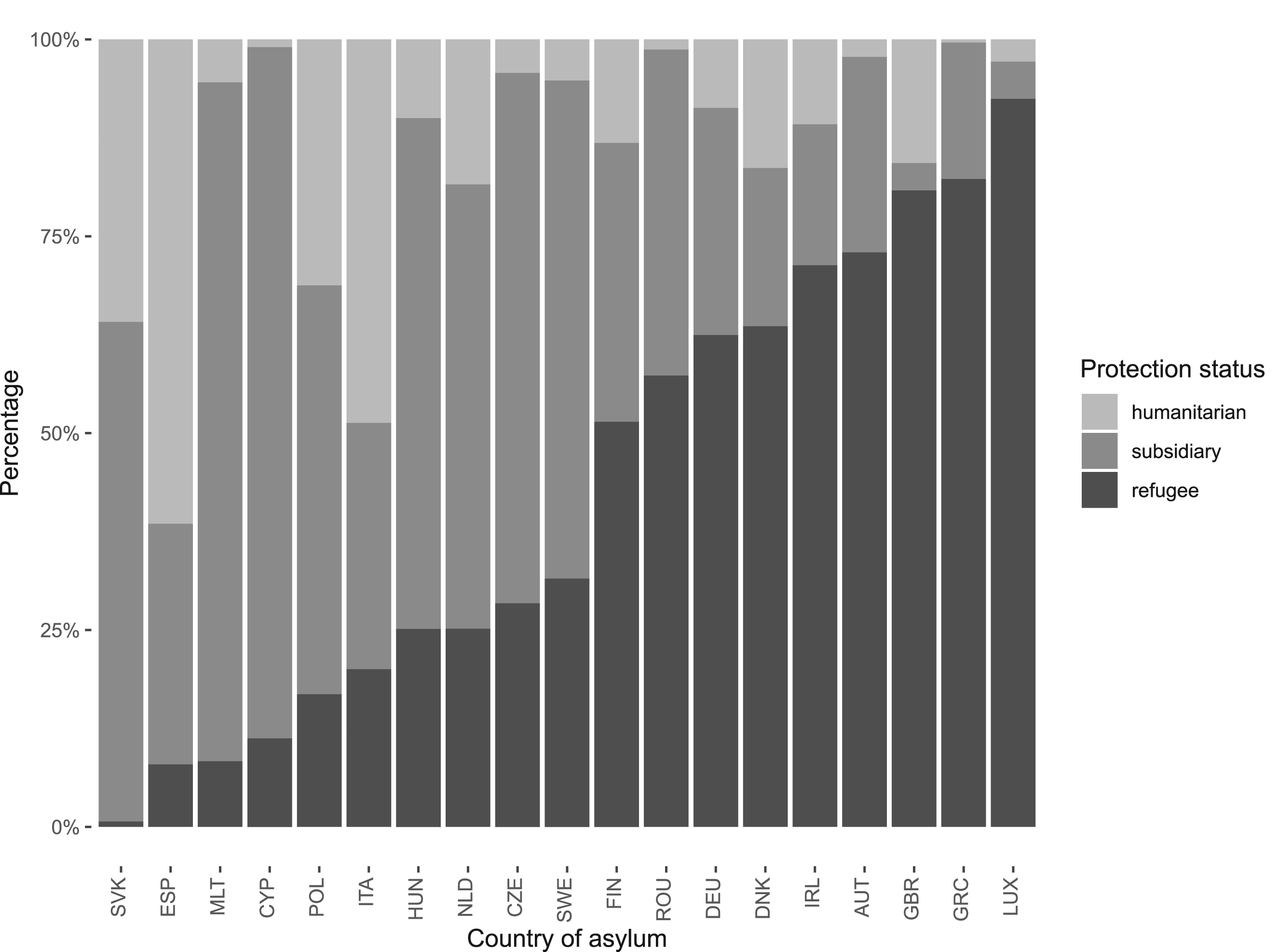
Figure 1 illustrates the share of refugee and subsidiary statuses granted in EU countries out of the total of international protection statuses granted, over the period 2008–2019. Figure 2 considers all protections statuses granted – international (refugee and subsidiary) and national protection statuses – and presents their respective share over the same period. Recognised statuses out of total number of positive first instance decisions for international protection statuses, EU member states, 2008–2019 (%). Source: own elaboration on Eurostat data (MIGR_ASYDCFSTA). Recognised statuses out of total number of positive first instance decisions for national and international protection statuses, EU member states, 2008–2019 (%). Source: own elaboration on Eurostat data (MIGR_ASYDCFSTA). Note: only countries in which there exists a residual national protection status are depicted.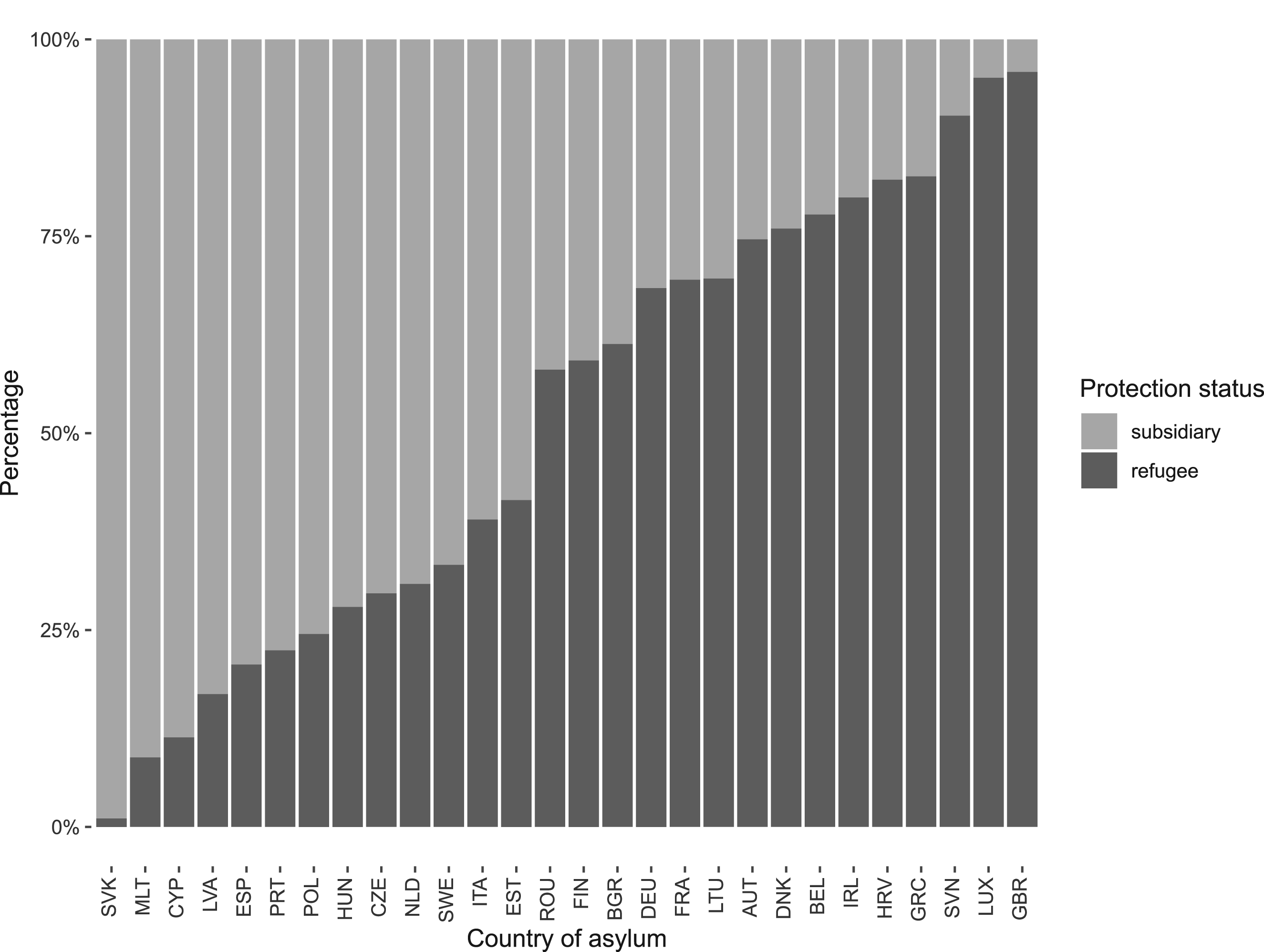
The existence of statuses with different attributes offers states a form of policy compromise. By providing some sort of protection states comply with their non-refoulement duty. But by choosing which form of protection to grant, they retain a measure of control over settlement rights and long-term immigration patterns.
Fundamentally, this dynamic reflects a tension between two types of actors, each governed by a distinct logic of action: the administration and the government. A third type actor must be added given its influence on the action of government: public opinion.
Bureaucracy: Organisational Routines and Their Predictable Outcomes
The administration is a perennial institution tasked with assessing the merit of asylum claims through standardised procedures that are “repetitive, recognisable patterns of interdependent actions, carried out by multiple actors” (Pentland and Hærem 2015: 466). This does not mean that bureaucrats have no room for discretion, or that the administration perfectly and neutrally implements policy (Demir 2009; Lipsky 1980; McCubbins, Noll, and Weingast 1987). Findings at subnational levels demonstrate how decisions rendered by caseworkers reflect regional political preferences (Gundacker, Kosyakova, and Schneider 2025) while ethnographic studies bring forward evidence of significant individual biases in the evaluation of asylum claims (Kobelinsky 2019). It does mean, however, that the administration is, on the whole, structurally insulated from electoral cycles (e.g. for the appointment of staff and public service tenure) and public pressure (Ellermann 2006). While decisions may reflect bureaucrats’ discretion or imperfect policy implementation, the evaluation of asylum claims is expected to be – in the absence of external pressure – time-consistent at the aggregate level. The administration (AD) evaluates the claims of asylum seekers and finds that they either merit or do not merit protection based on the information at their disposal. In this manner, claim evaluation embodies the legal-rational logic of bureaucracies (Pentland and Hærem 2015; Weber 1978). That being said, the administration is an agent of government and may undergo significant pressure from the latter, depending on how institutionally insulated it is (Ellermann 2005, 2021).
Government: The Pursuit of Preferences and Their Influence on the Administration
The government in office (G) is characterised by its policy preferences, and its tenure depends on its ability to secure public support in elections (e.g. competition for office and recurring elections). In a multilevel principal-agent framework (Mair 2009), national governments act as agents of international organisations (e.g. the UN and EU) but are also accountable to their constituencies, which may or may not vote them into office in forthcoming elections. Accordingly, some level of responsiveness to public opinion is expected of government. Where the government in office holds negative (positive) preferences towards immigration, it will attempt to pressure the administration into granting less (more) favourable protection statuses (Schneider, Segadlo, and Leue 2020; Schneider and Zuber 2025). The success of government in influencing administrative decisions will depend on the institutional constraints governing the relationship between government and bureaucracy at the national level (Ellermann 2021). However, government’s pursuit of its preferences is likely constrained by public opinion at large.
Public Opinion: The Expected Effect of Salience
Public opinion (PO) may observe different degrees of attentiveness to migration issues. How attentive public opinion is is influenced by contextual factors in destination countries (such as migratory influxes, changing demographics, media framing, and coverage, to name a few possibilities). Previous studies have shown that attitudes towards migration change little over time as they are anchored in socialisation processes (Kustov, Laaker, and Reller 2021; Taber and Lodge 2006). Conversely, salience of the issue, that is, how important an issue it is for the constituency (compared to other issues), can vary significantly over time, thus affecting voting behaviour (Dennison and Geddes 2019), policymaking (see inter alia Page and Shapiro 1983), and asylum outcomes (Spirig 2021). From a different perspective, governments are generally more responsive to issue salience than to directional preferences per se (Jones 1994; Soroka and Wlezien 2010). When salience of immigration is low, it is easier for governments to ignore public preferences and pursue their own (Claassen and McLaren 2022; Hartland 2023); but when salience is high, government is expected to address the issue (Green-Pedersen and Mortensen 2013), and public pressure is highest where government pursues policies that are at odds with their ideological commitment (Ellermann 2021). Moreover, although public attitudes are generally critical of immigration – or assumed to be (Claassen and McLaren, 2022) – most citizens support protection of exiles who “genuinely” need it (Connor 2018; Salehyan and Rosenblum 2008), while remaining wary of the misuse of asylum as an immigration channel (Jeannet, Heidland, and Ruhs 2021). Consequently, salience – more than the public’s preferences 6 – constrains the extent to which government can enact its preferences (conditional upon asylum seekers’ assessed merit).
In summary, the influence of government on asylum decisions depends on the preferences of two other actors: the administration and public opinion. A fourth category of actors would be international organisations (the UN and the EU) and the set of rules they support. For the sake of clarity, I assume that (i) the international norms are already embedded in national procedures and (ii) that the rules they support are already in place at national level, thus implicitly shaping the administration’s logic of action. 7
Assuming government has adequate knowledge of the state of public opinion and the merit assessment carried out by the administration, 8 I anticipate it will successfully implement its preferences in so far as it may act unconstrained by other actors: government holding negative (positive) preferences towards immigration will be associated with the granting of less (more) favourable statuses. Government may also be hindered by other actors’ move if it is not fully able to implement its preferences. In this scenario, I anticipate a balance between the granting of full refugee status and lesser statuses – a situation that is not preferred by any coloured government, but which is not the least preferred scenario either.
This explanatory model predicts three possible outcomes, from which I derive the following hypotheses: - Recognition rates for refugee status will be higher than lesser status where the government in office holds positive preferences towards immigration. - Recognition rates for refugee status will be lower than lesser status where the government in office holds negative preferences towards immigration. - Recognition rates for refugee status will be higher than lesser status where the government in office holds positive preferences towards immigration. - Recognition rates will be balanced between refugee and lesser statuses where the government in office holds negative preferences towards immigration. - Recognition rates for refugee status will be lower than lesser status where the government in office holds negative preferences towards immigration. - Recognition rates will be balanced between refugee and lesser statuses where the government in office holds positive preferences towards immigration.
Stated differently but equivalently, where asylum claims are founded and public attention is high, government with positive preferences is associated with higher recognition rates for refugee status than for lower statuses, while government with negative preferences is associated with a balance between recognition of refugee status and lesser statuses. Similarly, where asylum claims are not founded and public attention is high, government with negative preferences can increase the prevalence of lesser statuses over refugee statuses, while government with positive preferences is constrained to balance recognition of refugee status and lesser statuses.
Empirical Strategy
Dependent Variables: Administration’s First Instance Decisions
I test the hypotheses on the positive outcomes of refugee status determination processes for first instance decisions. In the European context, first instance decisions are taken by the administration while last instance decisions are the courts’ remit. Accordingly, it is more likely that governments exert pressure on the administration, which is organically connected to its competent ministry, than on the courts (Zaun et al., 2024). To reflect the existence of three possible protection statuses (s), three dependent variables are created. They are the share of (i) refugee status, (ii) subsidiary protection status, and (iii) national protection statuses, granted out of the total number of decisions rendered on applications from country of origin (o) lodged in country of destination (d) each year (t), such that:

Although all EU countries have refugee and subsidiary protection in their legal order, not all countries have residual protection statuses at the national level. This is accounted for in the modelling strategy. Resultantly, y is a percentage and virtually ranges from 0, where a given status is not granted at all, to 100, where all first instance decisions rendered lead to protection.
Figure 3 depicts the mean and standard deviation of the dependent variables for decisions relating to Syrian and Afghan applicants, per year, all EU28 countries considered. Recognition variation for three statuses for Syrian and Afghan applicants in the EU28, 2008–2019.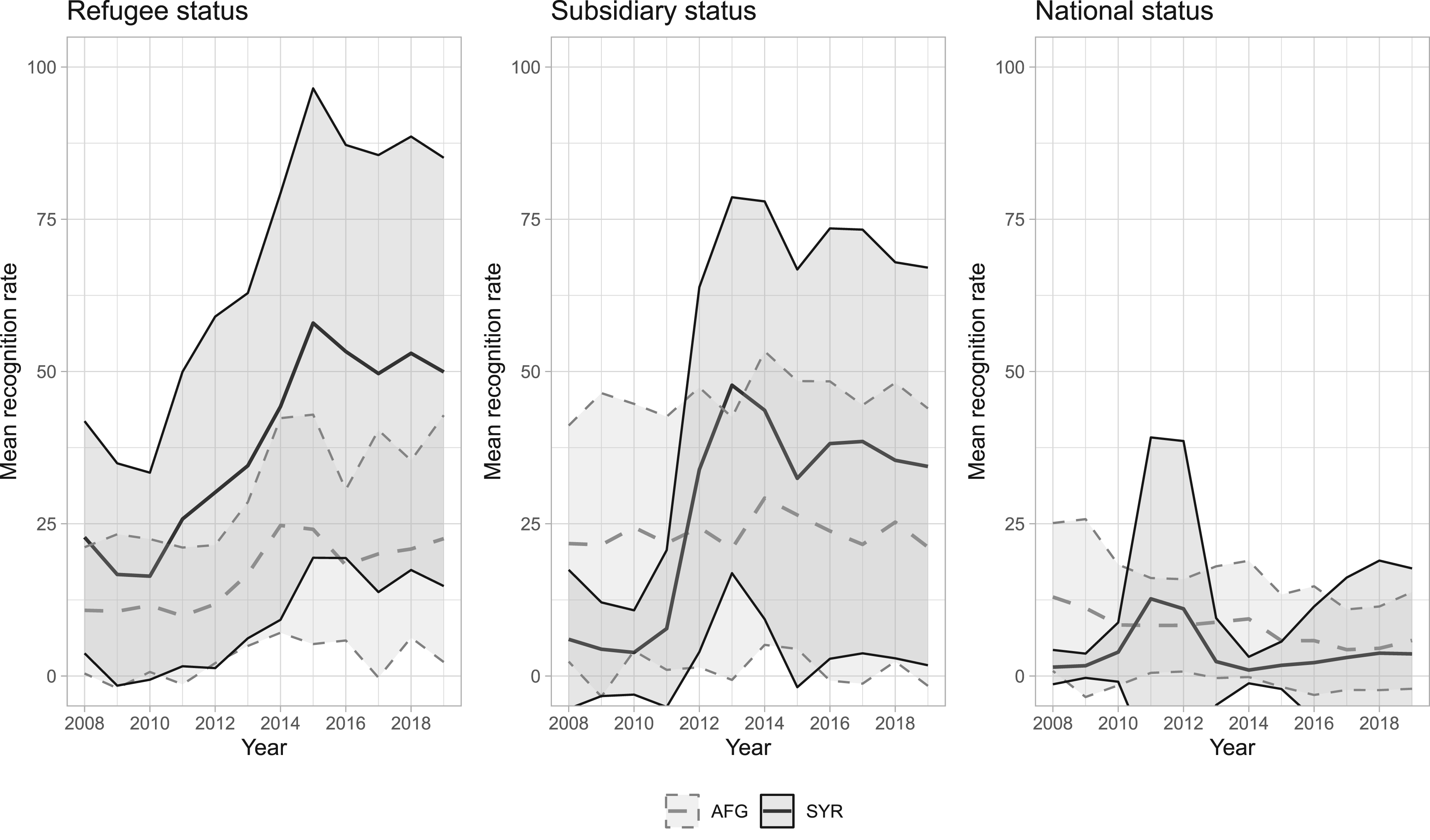
As can be seen from the plotted means, there is considerable variation in the distribution of statuses over time. For instance, Syrians were, on average, more often granted subsidiary protection in 2013 (47.7 percent) than refugee status (34.5 percent) while, 2 years later, it was the other way around (with, respectively, 32.5 percent and 58 percent). Likewise, Syrians were more often granted national protection statuses in 2011 (12.7 percent) than subsidiary protection (7.8 percent) while it is the other way around for the rest of the period. Importantly, recognition rates from one destination country to another, depicted by the shaded area in Figure 3, vary to a significant extent. Considering, for example, the year 2015 when refugee recognition rate for Syrians was the highest (58 percent on average across the EU), nearly 100 percent of decisions in Germany and Greece (97.4 percent and 99.3 percent) granted the refugee status whilst a sheer 9.9 percent of them resulted in refugee protection in Sweden (with 85.6 percent granting subsidiary protection) and 2.1 percent in Spain (with 90.1 percent granting subsidiary protection).
Model
The hypotheses are tested via systems of equations within the seemingly unrelation regressions framework (SUR; Zellner 1962; Wooldridge 2010). The SUR approach employed rests on Ordinary Least Squares (OLS) equations but produces asymptotically more efficient coefficient estimators as the contemporaneous correlation of errors is accounted for in the simultaneous estimation of the parameters.
Accounting for Non-independence of Observations
The unit of analysis is a dyad connecting countries of destination to countries of origin (i.e. asylum claims from o processed in d) every year (t), which makes the observations non-independent. I thus use destination-country fixed effects which, beyond methodological advantages, presents substantive benefits. Chiefly, the relationship between government and administration takes shape within the confines of national institutional designs (Ellermann 2005, 2021). Similarly, the specifics of international protection legal frameworks are also located within the boundaries of the state (Van Wolleghem and Sicakkan, 2025). Taking subsidiary protection as an example, despite it being an EU-induced status, its characteristics stem from member states’ transposition of the EU Qualification Directive, which allows a significant level of discretion in the process. Some member states may decide that subsidiary protection and refugee status be similar (although this changes over time; for instance, Italy, Denmark, Spain, and the UK, to name but a few, granted equivalent length of stay for the two statuses) while some others may cling to the minimum established in EU law (e.g. Germany, Sweden, Cyprus, and Estonia grant 1 year of residence for subsidiary protection and three for refugee status). Opting for destination country fixed effects presents the advantage of controlling for the specificities of each country. By computing country-specific coefficients, unobserved characteristics are kept in check which limits the analysis to what happens within clusters. Differently, cross-country-of-origin heterogeneity is controlled through substantive, asylum-connected variables. This choice is motivated by theoretical considerations. The international protection regime is not designed to consider countries of origin as fixed in time but rather as containers of changing situations over time. The use and, especially, update of Country-of-Origin Information (i.e. summary of current situation in different countries used in refugee status determination processes to shed some more light on individual asylum claims) bears witness to it (Gibb and Good 2013). Therefore, the presence in our models of a wide range of economic, demographic, and political controls accounts for country-of-origin heterogeneity. Finally, the passage of time is modelled via yearly fixed-effects to control for time-limited events (such as the steep increase in asylum applications in the years 2014–2016). Remaining autocorrelation – diagnosed via the Wooldridge test for serial correlation – is controlled for through the computation of robust standard errors clustered at the destination-origin dyad level.
In order to test the hypotheses, the model contains a three-way interaction term to test the conditional effect of government preferences at different levels of likelihood of rights violation in origin countries and of salience of migration in public opinion. The supplemental material provides additional information and robustness tests.
Data
The dependent variables are computed using Eurostat data on first instance decisions on asylum claims. Most studies have used UNHCR data (inter alia Neumayer 2005; Toshkov 2014; Van Wolleghem and Sicakkan, 2023) which provides good estimates of protection decisions for all countries in the world over the years 2000–2024. However, UNHCR does not allow a systematic cross-country distinction between statuses and between stages of decision. Eurostat offers the possibility to disaggregate protection statuses and decision stages. 9 This is important for our purposes as we need to separate first instance from last instance decisions, respectively, rendered by the administration and the courts (Zaun, Leroch, and Thielemann 2024). The downside of using Eurostat data is twofold: (i) asylum data concepts were clarified in Regulation 862/2007/EC, which homogenised categories and data collection methods across countries and their administrations. Prior to 2008, data was collected without established common concepts and should thus be regarded as unreliable for our purposes; (ii) for matters of privacy, Eurostat’s figures are rounded to the nearest 5 figure, which slightly decreases precision. Nonetheless, Eurostat data covers the period 2008–2019 (a period in which the EU’s asylum policy was already in place) and observations with less than 20 decisions for a dyad destination-origin in a given year are discarded in order to reduce both the imprecision induced by Eurostat’s rounding practice and to avoid observing patterns occurring by chance. Additionally, the analyses also control for the number of decisions made in a year for destination-origin dyads.
Government preferences are derived from the collation of Varieties of Party Identity and Organization (V-Party) data on political party positions on immigration (Lindberg et al. 2022) and ParlGov data on governments composition (Döring and Manow 2024). V-Party provides expert-coded party positions on a range of issues, including immigration as referring to individuals entering the country for the long term. It is thus more suited to our purposes than earlier alternatives (Alonso and Da Fonseca 2011; Toshkov 2014; Van Wolleghem and Sicakkan 2023), which indirectly compute party preferences on the matter through their position on, for example, multiculturalism and attitudes to minority groups. As governments are often coalitions of parties, I calculate their preferences by aggregating the preferences of the parties that compose it. Political parties’ preferences are weighted by their relative importance in the coalition, measured in terms of seats they control in the lower chamber (Browne and Franklin 1973).
Public opinion salience is captured by the percentage of the population in a receiving country that considers immigration as an important issue. I use Eurobarometer data which, twice a year, asks a representative sample of EU28 countries what the two most important issues facing their countries are; immigration being one of the possible answers. The two yearly measurements (Spring and Fall) were averaged to obtain a yearly value (Eurobarometer 2022). Note that the direction of public attitudes (i.e. pro- or anti-immigration) is accounted for in robustness tests (see online supplemental material).
Administrative evaluation of asylum claims’ merit is proxied through conditions in origin countries using Freedom House scores on political rights and civil liberties in countries of origin. The two scores are highly correlated and thus aggregated as an indirect measure of the likelihood of claims being well- or ill-founded. This proxy assumes that administrations evaluate asylum claims strictly on the basis of their merit. While civil servants may hold individual preferences, two arguments support this simplifying assumption. First, individual deviation is likely to be averaged out in the aggregation of yearly recognition rates spanning countries of origin. Second, since administrative preferences cannot be directly observed, the analysis tests whether government preferences matter conditional on administrative constraints (merit) and external pressure (public opinion). Finally, the analysis controls for administrative capacity, which was shown to significantly influence recognition rates (Van Wolleghem and Sicakkan 2023).
The analyses count a host of controls, that pertain to both destination and origin countries. These aim to account for cross-country differences in terms of economic development, political context, and demographic trends. For destination countries, the analyses control for vote for far-right parties, as identified in the PopuList dataset (Rooduijn et al., 2019); salience of migration for government in office (also calculated from V-Party data); and for government’s ability to enforce its position with a dummy variable on whether it is backed by a majority in the lower chamber. I include a set of dummy variables to account for the transposition of the EU’s Qualification and Procedure Directives (as well as their recast; see Hatton 2023). Other controls include socio-economic features (old-age dependency ratio, GDP per capita, GDP growth, unemployment, and population density) and migration pressure variables (total number of applications lodged in the previous year and over the past 3 years, and percentage of foreign nationals living in the country). I also control for the total number of decisions rendered per year and for the percentage of positive decisions as the dependent variable may be affected by these two elements.
As for origin country controls, they are life expectancy, population density, unemployment rate, and GDP per capita for the socio-economic features; rights violations (Political Terror Scale data) and intensity of (enduring) conflicts through the number of casualties in a year and over the last 5 years (Uppsala Conflict Data Program data on georeferenced events) for political characteristics; total number of asylum application lodged in the EU in a year from a given country (UNHCR data) and refugee crisis years for asylum pressure.
Most variables are standardised by origin- or destination-country population to make the values more comparable. The supplemental material provides more information on the data, operations on variables, and links to the sources.
Results
Results are reported in figures that plot the predicted probability of observing outcomes at high and low levels of salience of migration in public opinion (PO) and likelihood of the administration to find claims well-founded (AD). 10 Probabilities are computed at different levels of government preference (G) on migration issues. Analyses consider both within-equation first differences (e.g. difference in predicted refugee status between G with positive and negative preferences) and between-equation contrast (e.g. difference between predicted refugee and subsidiary status where G holds positive preferences). 11 Statistical significance refers to the 95 percent level, unless specified otherwise. This section begins with comparing refugee to subsidiary protection recognition rates. It then compares recognition of refugee, subsidiary, and national protection statuses. Full results, coefficients, and predicted values and their confidence intervals are available in the online supplemental material.
Refugee Protection or Subsidiary Status?
Starting with instances in which government is expected to have greater latitude to weigh in on decisions, namely, where PO is inattentive (H1), Figure 4, top row, displays the predicted probabilities of refugee and subsidiary protection recognition with low salience in public opinion and varying levels of well-foundedness of asylum claims. Where asylum claims are unlikely founded (top-left corner), recognition for either status is low (between 2.8 percent and 5 percent) and does not vary much with government position on immigration: the slopes are rather flat (first difference not statistically significant), with significantly overlapping confidence intervals (between-equation contrast not statistically significant). Where asylum claims are likely well-founded (top-right corner), however, the picture shifts. In cases in which there is likely violation of rights in countries of origin, and low attention levels in public opinion, recognition of international protection is heavily affected by government’s position on immigration. Governments favourable to immigration tend to push for higher recognition of refugee status – which is more generous towards the recipient – over subsidiary protection; a difference of 20.7 percentage points between the two statuses for governments with the most positive views (respectively, 27.2 percent and 6.5 percent for refugee and subsidiary protection; between-equation contrast significant at the 99.9 percent level). Conversely, governments with negative views appear to steer implementation of protection towards subsidiary protection almost as often as towards refugee status (with, respectively, 14.9 percent and 16.8 percent recognition; between equation contrast not statistically significant), suggesting a selective use of lesser statuses to fulfil legal obligations while modulating long-term integration implications. Predicted recognition rates for refugee and subsidiary statuses at different levels of PO, AS, and government position.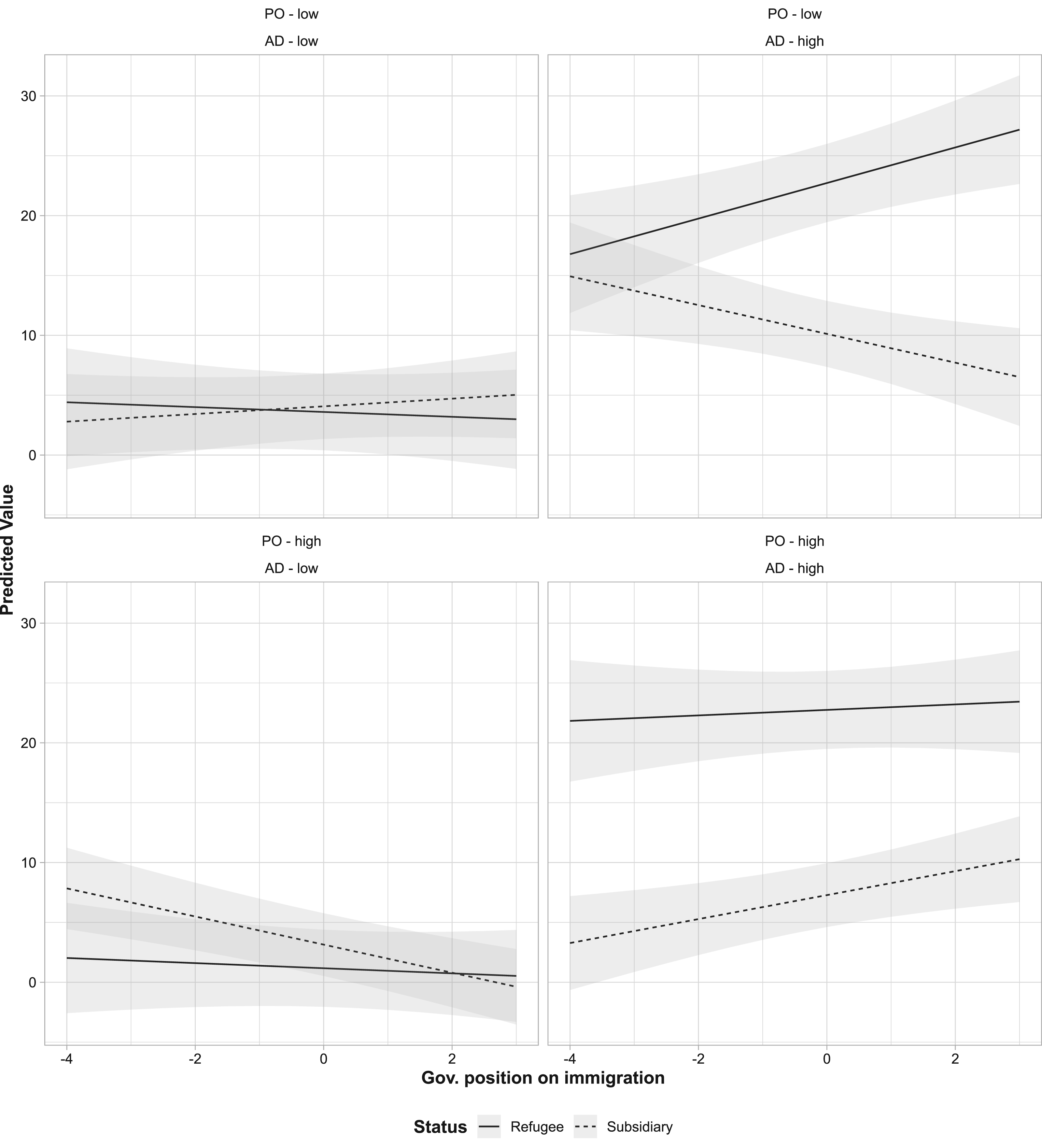
Interestingly, comparing the two graphs in Figure 4, top-row, reveals that likelihood of well-foundedness is an important driver of refugee status recognition for governments with both positive (24.2 percentage-point increase from top-left to top-right corners; within-equation first difference statistically significant) and, although to a lesser extent, negative views (12.4 percentage points increase from top-left to top-right corners; within-equation first difference statistically significant). This suggests that administrative evaluation of merits plays a structuring role that mitigates, to some extent, the preferences of government – a finding in line with Van Wolleghem and Sicakkan (2023). H1 is thus partially validated. Pro-immigration governments are able to increase the granting of more favourable statuses. It is partly rejected, as anti-immigration governments are constrained to a balance between the granting of refugee and lesser statuses.
When public opinion is watching (H2-3), the expression of the preferences of governments with negative views on immigration is constrained. Comparing the graphs in Figure 4, right-hand side, moving from low (top-right corner) to high (bottom-right corner) levels of attention in public opinion, while keeping well-foundedness of asylum claims constant, reveals two patterns.
First, when government holds positive views on immigration, recognition for refugee status and subsidiary protection remain stable (differences of +/−3.7 points not statistically significant). This suggests that governments with positive views on immigration are, by and large, capable of pursuing the granting of more favourable statuses. Second, change for recognition of subsidiary statuses is radical for governments with negative views. Refugee status recognition remains stable (5.1 percentage points increase not statistically significant), thus hinting at constrained preferences, but subsidiary status recognition decreases by about 11.7 percentage points, indicating some margin for manoeuvre in reducing the granting of protection (first difference statistically significant). In this way, H2 is partly confirmed: where asylum claims are founded and public opinion is attentive, governments with positive preferences are able to pursue the granting of more favourable statuses. However, governments with negative preferences observe a dual outcome not hypothesised: they are constrained to grant refugee protection in ways that are similar to governments with positive preferences – that is, a balance between the statuses granted, as hypothesised – but are by and large able to drastically decrease recognition of subsidiary protection (see discussion section).
H3 is also dismissed if one considers Figure 4, left-hand side, which does not show much difference between low (top-left corner) and high (bottom-left corner) attention in public opinion, at comparable levels of low likelihood of ill-founded protection claims (within-equation difference only statistically significant for subsidiary status but substantively non-significant, i.e. about 2 percentage points). Put differently, where asylum claims are unlikely founded and public attention is high (bottom-left corner), there is no robust evidence that governments with negative preferences are able to grant less favourable statuses, or that governments with positive preferences are constrained to a balance between refugee and lesser statuses. Interestingly, however, predicted probabilities for both statuses show descending slopes as a function of government preferences (bottom-left corner; although within-equation change only statistically significant for subsidiary status), meaning that the more positive the position of governments, the lower the recognition for both statuses. We shall return to this point in the next paragraph and in the discussion section.
International Protection Versus National Protection
Refugee and subsidiary protection are international statuses and, while states have some leeway in how they implement them within their legal system, they cannot fundamentally alter the scope of international law on their own volition. It is a different kettle of fish for nationally established statuses. Their existence, their granting, and the rights attached to them are heavily dependent on the government in office. This section examines whether considering national statuses alters the results of the analysis presented above. Figure 5 displays the results of the analysis as predicted probabilities, much like Figure 4. It is worth noting that the results presented above are left unchanged
12
although adding national protection statuses to the equation seems to add another layer of analysis that is somewhat independent from the hypotheses developed above. Predicted recognition rates for refugee, subsidiary, and national statuses at different levels of PO, AS, and government position.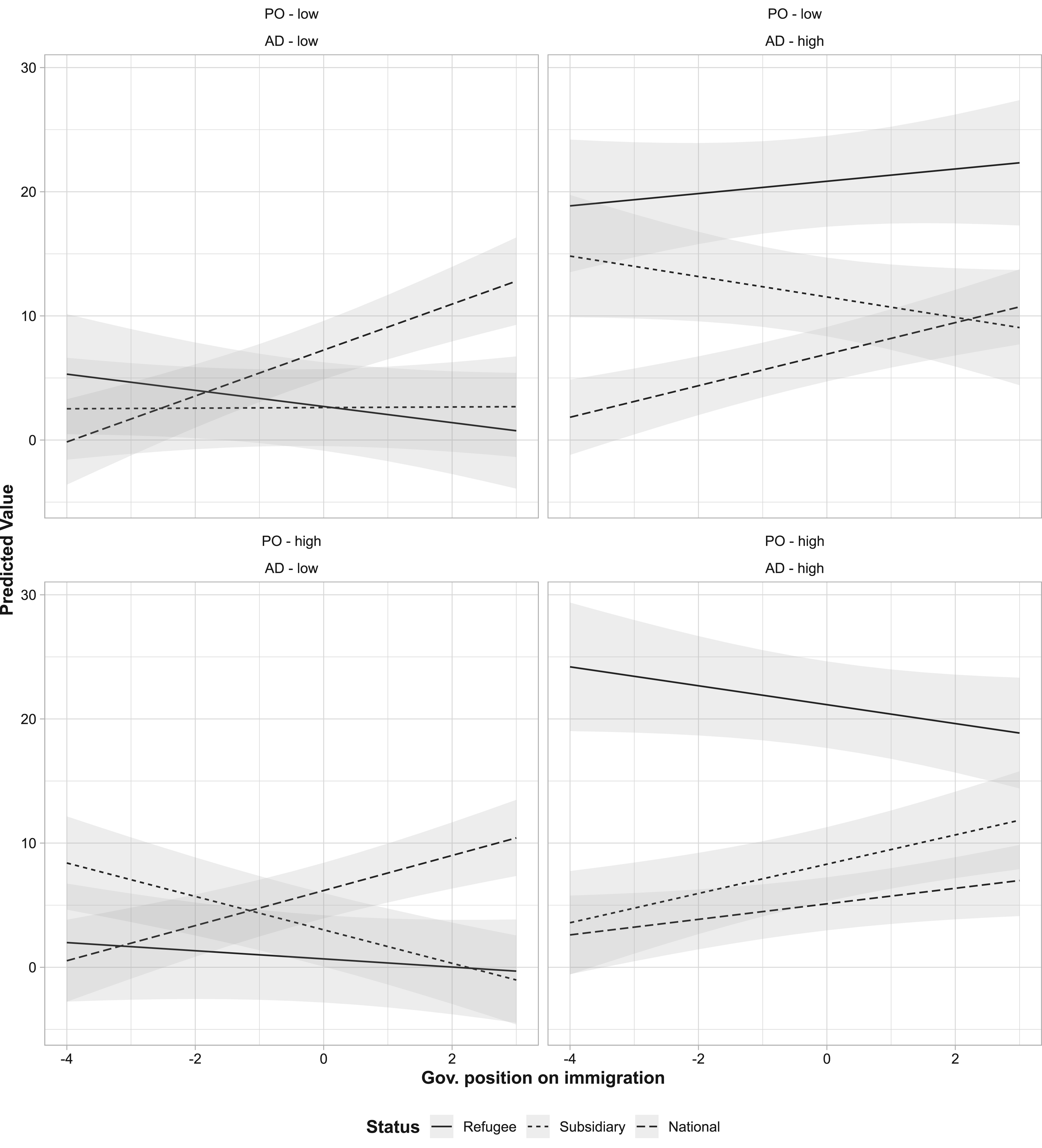
First and foremost, irrespective of salience in public opinion or merit of asylum claims, the granting of national protection statuses significantly depends on the position on immigration of the government in office (Figure 5, all graphs). National protection is more frequently granted when the government in office is favourably disposed to immigration compared to governments opposing immigration; with recognition rates ranging from 0 percent granted in the latter case to 12.8 percent in the former (Figure 5, top-left corner; within-equation first difference statistically significant). This confirms that national protection strongly depends on government preferences and is less mediated by legal-administrative constraints. Accordingly, there is limited evidence of the kind of status trade-off hypothesised in H1-3, or at least not in the form of a substitution between international (i.e. refugee and subsidiary protection) and national protection statuses.
Although there is no difference in trend, there is a clear difference in magnitude, with the largest gap between governments with negative and positive views observed when public opinion and claim foundedness are low (12.8 percentage-point difference; top-left corner; within-equation difference statistically significant). In the opposite situation, that is, high public salience and claim foundedness, the difference between government with negative and positive views is attenuated: a mere 4.4 percentage-point difference with 2.6 percent recognition for the former and 7 percent for the latter (bottom-right corner; statistically significant difference).
From a different perspective, keeping government preferences constant shows that there is little variation in their levels of recognition of national statuses: recognition for anti-immigration governments remains comparable (a 2.6 point difference that is not statistically significant); recognition for pro-immigration governments varies between 7 (bottom-right) and 12.8 percent (top-left; statistically significant). This suggests that there may be a transfer between more favourable and less favourable statuses as a function public opinion and asylum claims, but this transfer is of little magnitude and cannot be robustly established.
Last but not least, we noted earlier that, when public attention is high and claims are unlikely founded, predicted probabilities for refugee and subsidiary statuses show decline as government preferences become more positive (Figure 4, bottom-left corner). Dwelling on Figure 5, bottom-left corner, provides further insights into the matter: adding national protection statuses to the analysis hints at the possibility that the preferences of governments with positive views are constrained by an attentive public opinion. When granting favourable statuses is no longer an option, governments with positive views towards immigration will grant national statuses at a higher rate, thus confirming H3.
Discussion: An Alternative Mechanism?
While the results presented above partially confirm the hypotheses formulated earlier, deviation from said hypotheses delineates the contours of an alternative mechanism at play, one in which the tension between administrative and politics logics of action manifests through a balancing act where governments must preserve their accountability and credibility in a context shaped by administrative merit assessment and public attention. In this alternative explanation, governments with positive views towards migration may support higher protection recognition in principle, but when public scrutiny increases, they may be compelled to demonstrate their credibility in managing asylum influxes by upholding the legal-administrative assessment of asylum claims. This hypothesis is in line with scholarship concerned with immigration policy more generally understood (Alonso and da Fonseca 2011; de Haas and Natter 2015; but see Natter, Czaika, and Haas 2020 for contrasting findings). Conversely, governments with negative views cannot always pressure the administration towards their preferences to reduce protection. They must uphold the rule of law and accept recognition of refugee status where warranted, while simultaneously signalling toughness by seeking to restrict recognition rates for other statuses (Geddes 2009).
These dynamics play out differently depending on the salience of migration in public opinion and the assessment of the merit of asylum claims. Most notably, when attention in public opinion is high, governments with positive views may apply protection criteria more stringently as their actions are more likely to be scrutinised by the public. Similarly, governments with negative views may be emboldened by public scrutiny, motivating them to deliver on restricted immigration by decreasing subsidiary protection while, at the same time, increasing – to a lesser extent – recognition of refugee statuses to communicate a balanced approach to asylum policy.
Evidence of this mechanism can be seen in several places, as referenced in the results section. First and foremost, as Figures 4 and 5, bottom-left corners, indicate, when public opinion is attentive and claims are unlikely founded, recognition for refugee and subsidiary statuses declines as governments become more pro-immigration, while recognition of national protection increases. This suggests that pro-immigration governments are constrained by administrative merit assessment and public scrutiny. The stringent application of recognition procedures serves their maintaining credibility in the eyes of voters less incline to accept further immigration. Similarly, anti-immigration governments are associated with stable refugee recognition and decreased subsidiary recognition when asylum claims are likely founded and public attention is high (Figure 4, right-hand side). This suggests that claim merit prevails where refugee status is warranted, while anti-immigration preferences manifest through lower subsidiary recognition rates. Importantly, however, these governments are still contributing to reducing the granting of international protection if one compares the stable refugee recognition rate to the large decrease in subsidiary recognition (11.7 percentage points).
Conclusion
This article investigates how the tension between politics and administration shapes asylum decisions in EU member states. While existing literature typically opposes protection to non-protection outcomes, the analysis proposed here focuses on the choice between different protection statuses – refugee status, subsidiary protection, and nationally defined statuses – each entailing different rights and long-term implications. This shift in perspective reveals the room for manoeuvre states enjoy in asylum adjudication, even under international legal obligations. By distinguishing between refugee, subsidiary, and national protection statuses, this article moves beyond the conventional dichotomy between granting and rejecting protection. It proposes an explanatory model in which governments prefer outcomes aligned with their stance on immigration but whose capacity to shape those outcomes is conditional upon both evaluation of the merit of asylum claims and the attention immigration receives in public opinion.
The findings demonstrate that the merit of asylum claims remains a fundamental structuring constraint on decision-making, thus supporting earlier scholarship. Higher likelihoods of rights violations in countries of origin are consistently associated with higher recognition of refugee status, confirming the centrality of legal–administrative routines in asylum adjudication. At the same time, the analysis shows that political preferences matter, although not uniformly. Governments’ capacity to shape outcomes depends on the level of public attention to migration and on whether administrative assessments point towards well-founded or ill-founded claims. When public scrutiny is low, governments enjoy greater latitude to pursue their preferences through the allocation of protection statuses: pro-immigration governments tend to favour refugee status, while governments with restrictive positions steer recognition towards subsidiary protection, thereby complying with non-refoulement obligations while limiting long-term settlement prospects. Under conditions of high public salience, however, this discretion is constrained. Restrictive governments are compelled to grant refugee status when claims are well-founded, yet they continue to express their preferences by sharply reducing recognition of subsidiary protection. Conversely, governments more favourably disposed towards immigration appear to apply protection criteria more stringently under heightened scrutiny, suggesting a concern with credibility and accountability rather than simple preference fulfilment. National protection statuses emerge as a distinct category within this landscape. Their use is strongly and consistently linked to government preferences and is only weakly mediated by public opinion or conditions in countries of origin. This suggests that nationally defined statuses function as a flexible policy instrument through which governments can fine-tune asylum outcomes outside the tighter constraints imposed by international protection regimes.
Taken together, these results underscore that asylum decision-making in the EU cannot be understood solely as the product of administrative processes or humanitarian imperatives. They are shaped by the tension between bureaucratic procedures and political preferences and are best conceptualised as a negotiated outcome produced at the intersection of administrative and political logics of action. By disaggregating protection outcomes and modelling the conditional influence of politics, this article contributes to comparative research on asylum policy, public administration, and executive governance. More broadly, it highlights how differentiated legal statuses allow states to reconcile competing imperatives – legal compliance, political responsiveness, and migration control – within the increasingly politicised field of asylum governance.
Supplemental Material
Supplemental Material - The State and the Refugee. Governing Asylum at the Intersection Between Politics and Administration
Supplemental Material for The State and the Refugee. Governing Asylum at the Intersection Between Politics and Administration by Pierre G. Van Wolleghem in Political Research Quarterly.
Footnotes
Acknowledgements
I extend my sincere thanks to Prof. Hakan G. Sicakkan, Department of Comparative Politics, University of Bergen, for inspiring exchanges. I also wish to thank the editor and the anonymous reviewers for their insightful comments.
Funding
The author received no financial support for the research, authorship, and/or publication of this article.
Declaration of Conflicting Interests
The author declared no potential conflicts of interest with respect to the research, authorship, and/or publication of this article.
Data Availability Statement
The data is available at https://doi.org/10.5281/zenodo.20446359 ( ).
).
Supplemental Material
Supplemental material for this article is available online.
Notes
References
Supplementary Material
Please find the following supplemental material available below.
For Open Access articles published under a Creative Commons License, all supplemental material carries the same license as the article it is associated with.
For non-Open Access articles published, all supplemental material carries a non-exclusive license, and permission requests for re-use of supplemental material or any part of supplemental material shall be sent directly to the copyright owner as specified in the copyright notice associated with the article.
