



Abstract
Can messages targeted to underrepresented groups increase their participation in politics? We predict that mobilization messages highlighting a politically relevant group identity will increase participation among racial/ethnic minorities. However, responsiveness to such appeals should vary depending on the strength of one’s identity with that group. We test these predictions by conducting a two-wave panel survey that randomly assigns get-out-the-vote (GOTV) messages that appeal to either racial/ethnic identities or a less politicized identity (state identity). We compare the effects of these messages to a standard GOTV message or one that encourages recycling. We find that racial/ethnic identity appeals increase participation among minorities with weaker group identities, who are initially less inclined to participate. Therefore, such appeals help close the gap in participation between those with weak versus strong identities. These findings indicate that messages highlighting a politically relevant group identity can sometimes be effective at increasing participation among underrepresented groups.
An important concern of both scholars and practitioners over the last several decades has been the underrepresentation of some groups in the U.S. electorate relative to their presence in the population. 1 Such concerns are especially salient in states like California, where non-whites constitute a majority of the population. According to data from the Public Policy Institute of California (PPIC), even though whites only make up 36 percent of the state’s population, they constitute 50 percent of likely voters. In contrast, Asian Americans make up 16 percent of the state’s population but constitute only 12 percent of likely voters. Latinos and Blacks are also underrepresented in California’s electorate (Baldassare et al. 2025). Such “participation gaps” matter: scholars have documented meaningful differences in the policy priorities and political preferences of racial and ethnic minorities relative to whites (e.g., Masuoka and Junn 2013; Schuman et al. 1998).
Are there mobilization strategies that effectively increase the political engagement of racial and ethnic minorities? More specifically, are mobilization messages that activate individuals’ racial/ethnic identities effective at increasing their participation, and more so than standard get-out-the-vote (GOTV) appeals or appeals to a less politically relevant identity? The answers to these questions are of great interest to scholars studying political mobilization, as well as practitioners concerned about unrepresentative electorates. However, previous research offers conflicting evidence about the effects of different types of mobilization messages. A well-known finding in the GOTV literature is that the particular message used in mobilization campaigns does not seem to matter as much as the mode of delivery (e.g., in person, over the phone; one exception is for social pressure messaging; for a review, see Green and Gerber 2024). If this is the case, targeted mobilization messages are unlikely to be an effective remedy for the underrepresentation of racial and ethnic minorities.
In contrast, other studies find that the message does seem to matter for mobilization, at least among certain groups. For example, young people are more responsive to Rock the Vote advertisements than are older individuals (Green and Vavreck 2008). In some GOTV studies, Latinos are more affected by identity-based appeals (Ramirez 2007; Valenzuela and Michelson 2016), a finding also supported in survey and lab experimental work on messaging and engagement (e.g., DeFrancesco Soto and Merolla 2006; Merolla et al. 2013) and in studies of ethnic group endorsements (Boudreau et al. 2019). Thus, these studies suggest that GOTV messages that appeal to the identities of underrepresented groups might be an effective way to increase their political participation.
In this study, we examine whether and when GOTV messages that appeal to individuals’ identities can increase participation among racial and ethnic minorities. To this end, we draw upon theories of persuasion in psychology (Eagly and Chaiken 1993; Petty and Cacioppo 1996) to derive predictions about the conditions under which identity-based mobilization messages will be most effective. We hypothesize that GOTV messages that appeal to an identity that is politicized (i.e., racial/ethnic identity) will be more effective at increasing participation than appeals to a less politicized identity (i.e., state identity) or appeals that do not invoke an identity. We also derive competing predictions about whether mobilization messages that invoke racial/ethnic identity will be more effective among individuals with strong versus weak racial/ethnic identities.
We test these predictions by conducting a two-wave online panel survey with an embedded experiment during the 2018 general election. Our sample consists of Latinos, Blacks, and Asians in California, supplemented with a national sample of Asians and Blacks. In the first wave, we measure respondents’ racial/ethnic identities, as well as the strength of those identities. We also measure the strength of respondents’ identities with a less politicized group (members of the state in which they live). The ability to measure directly the strength of respondents’ identities with multiple groups is a key advantage of our survey experimental approach.
In the second wave (administered approximately 1 week later), we re-contacted these respondents and randomly assigned them to receive different types of GOTV messages. By conducting our experiment 1 week later, we avoid the well-known problems associated with measuring respondents’ identities during an identity-related experiment (i.e., priming effects or post-treatment bias; see Klar et al. 2020). We compare the effects of GOTV messages that appeal to respondents’ identities as racial/ethnic minorities to the effects of a standard GOTV message (that does not activate identities), a message highlighting a less politicized identity (state identity), and a control message that encourages a civic duty other than voting (recycling). We also examine the effects of these messages on different types of respondents (i.e., those with strong versus weak identities).
Our results demonstrate that GOTV messages that appeal to racial/ethnic group identities can in some cases increase political participation among those who are most in need of mobilization: namely, racial and ethnic minorities with weaker group identities. In contrast, minorities with stronger group identities have high levels of political participation to begin with and, thus, are less affected by these messages. In this way, racial/ethnic identity messages effectively close the participation gap between those with strong versus weak identities. Our findings also indicate that appeals to a less politicized state identity have much weaker effects. These findings have important implications for the types of messages that may be effective at increasing political participation among underrepresented groups. In particular, they indicate that organizations seeking to increase participation among Latinos, Blacks, and Asians can do so by crafting messages that appeal to their racial/ethnic identities and targeting these messages to those who more weakly identify with their racial/ethnic group.
For Whom Does the Message Matter?
A key theme in the literature on persuasion is that persuasive appeals, like those used in GOTV campaigns, are unlikely to affect all individuals in the same way. Indeed, people are more likely to process information systematically if they have the ability and motivation to do so (Chen and Chaiken 1999; Eagly and Chaiken 1993; Petty and Cacioppo 1996). While many people have the ability to process messages like those used in GOTV campaigns, their motivation to do so varies depending on the characteristics of the message and how they relate to the individual. If a message is more relevant to a person (e.g., related to something the individual cares about or is linked to her identity), she should be more likely to pay attention to the message, process it systematically, and change her behavior in response (Johnson and Eagly 1989; Petty and Cacioppo 1986; Petty et al. 1981).
In the context of GOTV appeals, Valenzuela and Michelson (2016) argue that to be effective it may also be important that the message invokes an identity that is politicized (i.e., perceived as relevant to politics). Otherwise, individuals may not connect their group’s interests to increased participation in politics (Valenzuela and Michelson 2016). We might therefore expect to find that, on average, a GOTV appeal that invokes a politically relevant group that one identifies with will be more likely to capture one’s attention and be processed than a standard GOTV appeal. As a result, a politically relevant group-based GOTV message should be more likely to increase political participation than an appeal that uses a standard get-out-the-vote script or appeals to some other civic duty (H1). Furthermore, an appeal to a politically relevant group identity should be more effective at increasing political participation than an appeal to an identity group that is less politicized (H2).
In line with Valenzuela and Michelson (2016), we contend that racial and ethnic group identities are politicized given that issues of race and ethnicity have long been salient to American politics. Thus, GOTV appeals that invoke an individual’s racial or ethnic identity or focus on issues of concern to the group may effectively boost participation. We focus on the former type of appeal in this study. Identity-based appeals are ones that focus on group membership and may be largely symbolic. For example, an identity-based appeal might highlight the importance of mobilizing Latinos to turnout in the election or the importance of having Asian or Black voices in the electorate.
A group identity that is less politicized is one’s identity as a member of the state in which she lives. While politicians might sometimes invoke state identity when appealing to voters, it is often in very broad strokes and meant to distinguish the state’s policies and/or culture from those of the federal government. For example, governors often invoke their state’s identity when pushing back against the federal government or highlighting their state’s distinct values (e.g., “Minnesota Nice,” “California for All”). As Hopkins (2018) demonstrates, citizens’ state identities are mostly apolitical; that is, people tend to identify with their state based on factors like its food, music, and natural resources (see Schildkraut 2024 for a discussion). They largely do not think of politics as being relevant to this identity.
Existing research lends some empirical support to the theory that politically relevant group identity messages may effectively mobilize racial and ethnic minorities. For example, in a field experiment by Panagopoulos and Green (2008), voters with Spanish surnames showed higher levels of turnout compared to those without Spanish surnames in an election district in which radio ads were aired on Spanish-language stations. In survey-based work, Abrajano (2010) and DeFrancesco Soto and Merolla (2006) found that advertisements targeted to Latinos increased their likelihood of turning out compared to general advertising appeals. However, others have found more limited effects for such identity-based appeals. For example, a field experiment that mentioned race and racial discrimination in a GOTV message or duty as a community member had a limited impact among Blacks (Green 2004; Scott et al. 2021). Other research on Asians and Latinos finds mixed evidence for whether group-based appeals have stronger effects in increasing turnout than standard GOTV appeals (García Bedolla and Michelson 2009, 2012; Michelson 2003, 2006; Ramirez 2007; Wong 2005).
However, as Valenzuela and Michelson (2016, 617) note, much of this work “implicitly assumed that all group members would be equally responsive to these appeals.” Drawing on the persuasion literature discussed above, motivation to process a message may also vary within groups, especially if individuals place different value on their identities. In short, messages that invoke a politically relevant group identity may be more effective among those who place greater importance and value in that identity, since they will be more likely to pay attention to the message and process it. Scholars have advanced this argument in prior work examining the mobilization of Latinos in the electorate (Abrajano 2010; DeFrancesco Soto and Merolla 2006; Valenzuela and Michelson 2016). Drawing on this work, we may therefore expect to find that GOTV messages that appeal to a politically relevant group identity are most effective at increasing political participation among those who hold a stronger attachment to that identity (H3a).
While some prior research has advanced this argument, empirical support for it is only suggestive, given that the data used in existing studies has not included direct measures of the strength of group identities. For example, some have used Spanish-dominant language use as a proxy for the strength of group identity (Abrajano 2010; DeFrancesco Soto and Merolla 2006). Others proxy for the strength of group identity among Latinos using data on political incorporation and acculturation from publicly available data in the voter file and geographic data (Valenzuela and Michelson 2016). In contrast, an advantage of our survey experimental approach is that we are able to measure the strength of respondents’ identities directly. We are also able to measure identity strength for several different racial and ethnic minorities (not just Latinos), for a less politicized identity (state identity), and examine a variety of forms of political participation (not just voting).
Further, it is possible that individuals who identify strongly with a politically relevant group are already politically engaged, more likely to be exposed to identity-based appeals during elections, and hence, already quite likely to participate in politics. With respect to the racial and ethnic groups we examine, some existing research shows that individuals with stronger group attachments, greater group consciousness, and/or linked fate are more likely to participate in the political system (McClain and Stewart 2003; Miller et al. 1981; Stokes 2003; Smith 2013, 2014; but see Chong and Rogers 2005 for a discussion of some mixed findings in the literature), especially in activities that require greater effort or are more directly related to the group (Barreto 2010; Chong and Rogers 2005; Sanchez 2006; Sanchez and Medeiros 2016). 2
Why might stronger group attachments lead to greater political engagement? According to a number of scholars, strong group attachments are likely to foster a greater sense of collective efficacy, or the ability of the group to enact change, which should in turn spur engagement, especially in activities that require greater effort (Chong and Rogers 2005; Phoenix and Chan 2024; Shingles 1981; Smith 2013, 2014; van Zomeren et al. 2008). In the words of Chong and Rogers (2005, 350): “Consciousness potentially heightens awareness and interest in politics, bolsters group pride and political efficacy, alters interpretations of group problems, and promotes support for collective action.” As a result, there may be a ceiling effect such that exposure to one additional appeal to a politically relevant group identity is not likely to increase participation even further among those who identify strongly with that group.
In contrast, those who identify with a politically relevant group, but who have weaker attachments to it, may be less engaged in politics. However, when such individuals are exposed to an appeal that invokes that identity, it may trigger a sense of group consciousness or identification, which boosts their sense of efficacy and propensity to participate. Indeed, the research discussed above suggests that activating group consciousness may increase racial and ethnic minorities’ political participation, particularly when the issues involved directly affect their group (e.g., Chong and Rogers 2005; Phoenix and Chan 2024; Shingles 1981; Smith 2013, 2014; van Zomeren et al. 2008). As a result, an appeal to a politically relevant group identity may be more effective at increasing participation among those whose identities with that group are initially weak, but become activated in response to the appeal (H3b).
Experimental Design
The 2018 general election provides an opportunity to test our hypotheses about the effects of different types of GOTV messages on racial/ethnic minorities in a real-world context. Specifically, we conducted a two-wave online panel survey with an experiment embedded in the second wave in the weeks leading up to the election. We administered our survey to a large sample of Latino, Black, and Asian respondents in California, which we supplemented with a national sample of Asians and Blacks. 3 We chose to focus on California for a couple of reasons. First, it is a large and diverse state where political candidates and GOTV organizations frequently appeal to racial/ethnic considerations in an attempt to influence voters. California has implemented institutional reforms aimed at increasing the political participation of underrepresented groups (e.g., automatic voter registration via the DMV, vote-by-mail elections). Thus, understanding the effects of appeals to individuals’ identities in this context is an important empirical task. We chose to focus on Latinos, Blacks, and Asians for a few reasons. First, these are salient racial and ethnic minorities in California and elsewhere. Second, we wanted to explore the effects of identity-based appeals for Asians and Latinos since their participation lags substantially behind non-Hispanic whites. At the same time, we wanted to explore whether these types of appeals are also effective among a minority group that participates at a higher rate, and therefore chose to include Blacks. 4
In the first wave of the survey, all respondents were asked basic demographic questions, including one that measures their racial/ethnic identity. They were also asked to express the strength of their racial/ethnic identity on a five-point scale. Respondents were also asked to identify the state in which they live, as well as the strength of their identity as a member of that state. We ask these questions about respondents’ identities in the first wave of the survey (which was administered approximately 1 week before the second wave) to ensure that we do not reveal the purpose of the experiment embedded in the second wave and do not prime identity in that wave. To this end, we also include other questions in the first wave that have nothing to do with respondents’ race/ethnicity or state of residence (e.g., questions that measure respondents’ political knowledge, political interest, and prior participation in politics).
In the second wave, we randomly assign respondents to receive one of four different messages before expressing their likelihood of voting and engaging in other forms of political participation (e.g., contacting one’s senators, attending a local government meeting). 5 In line with several GOTV studies, we include a control (placebo) group to obtain a baseline measure of these outcomes in response to a message that encourages respondents to perform a civic duty other than voting (Nickerson 2005, 2008). Thus, respondents in our control group receive a message from “California Recycles” (or whatever state they live in for the supplemental national sample) that reminds them that Earth Day happens every April and emphasizes that their responsibilities as a citizen include recycling. They are also given information about who to contact if they have questions about recycling. We modeled this placebo condition after those used in a range of GOTV studies (e.g., Broockman and Kalla 2016; Nickerson 2005, 2008; Valenzuela and Michelson 2016). This condition provides an important benchmark against which the effects of different types of GOTV messages can be compared (see pp. 17–20 of the Supporting Information [SI] for the text of the control and treatment messages).
Respondents assigned to the “standard GOTV” treatment group receive a message that is similar to the control message, but it encourages voting instead of recycling. Specifically, respondents receive a message from “The Voter Project” that reminds them of the election in November and emphasizes that their rights as a citizen include voting. They are also given information about who to contact if they have questions about voting. This type of message is commonly used in GOTV research and real-world mobilization efforts, and it allows us to assess the effects that a standard voting message has on intended turnout and other forms of participation, relative to the recycling message.
In the “racial/ethnic identity” treatment group, respondents receive the standard GOTV message, as well as information designed to trigger their racial/ethnic identity inspired by Valenzuela and Michelson’s (2016) design. To this end, the message comes from an organization associated with respondents’ own racial/ethnic group. For example, Latino respondents receive a message from “The Latino Voter Project,” while Black respondents receive a message from “The Black Voter Project.” The message itself conveys that voting is important because it helps ensure that a respondent’s own racial/ethnic group has a voice in government. It states, “The leaders we choose today will influence many issues that affect [Latinos/Blacks/Asian Americans and Pacific Islanders (AAPI)]. Representatives from the [Latino/Black/AAPI] community bring a distinct perspective to the table in Washington. It’s important to vote and make our community heard.” This treatment group enables us to assess whether a message that highlights respondents’ racial/ethnic identities increases their propensity to participate, relative to the standard GOTV or recycling message.
To examine how appeals to racial/ethnic identities compare to those that invoke a less politicized identity, we also include a “state identity” treatment group. In this group, respondents receive the standard GOTV message, as well as information designed to trigger their identity as a member of the state in which they live. Thus, the message in this group is attributed to “The California Voter Project” for California respondents or whatever respondents’ home state is in the national sample. The message also conveys that voting is important because it helps ensure that people from their state have a voice in Washington. For example, for California respondents it states, “The leaders we choose today will influence many issues that affect California. Representatives from California bring a distinct perspective to the table in Washington. It’s important to vote and make our community heard.”
After receiving one of these messages, respondents are asked questions that measure our outcomes of interest: likelihood of voting, likelihood of contacting their senators, and willingness to engage in other forms of political participation. To measure respondents’ propensity to vote, we ask respondents how likely they are to vote in the 2018 general election (response options include “not at all likely,” “somewhat likely,” “likely,” or “very likely”). 6 While we recognize that self-report measures of future participation are often inflated, our interest is in whether respondents’ reports of intention to vote vary across our experimental conditions.
To measure respondents’ willingness to engage in other forms of political participation, we use both behavioral and self-report measures. The behavioral measure asks respondents if they would like to fill out a postcard to express their views to their U.S. senators. If they choose “yes,” then they are asked to convey which policy issues should be at the top of the political agenda and are given an opportunity to write a message to their senators. By including this behavioral measure, we are able to examine whether respondents are actually willing to engage in a particular form of political participation, above and beyond stating an intention to vote. The additional self-report measures ask respondents how likely they are to engage in the following political activities in the next 12 months: (1) contacting a government official to express their policy views, (2) donating money to a campaign, (3) attending a meeting of a town or city government or school board, and (4) joining a protest, march, rally, or demonstration. Response options for each form of participation include “not at all likely,” “somewhat likely,” “likely,” or “very likely.” We combined these responses into a participation index that ranges from 0 to 16 (alpha = 0.85).
Methods
We recruited a sample of 1,774 Latino, Black, and Asian respondents from the Research Now Survey Sampling International (SSI) panel (now Dynata). 7 The firm recruits samples of adults via the Internet. We administered our survey experiment online using Qualtrics software. The first wave of the survey was fielded from October 15 to October 28, 2018. About seven to 10 days after wave 1, respondents were invited to complete the second wave of the survey, which was fielded from October 24 to November 4, 2018, just before Election Day (November 6, 2018). The re-contact rate for the second wave was 60 percent.
Of the 1,774 racial/ethnic minority respondents who participated, 922 are Californians (52 percent). Due to the relatively small percentages of Blacks and Asians in California’s population at the time of our study (6 percent and 16 percent, respectively), the SSI panel did not contain a sufficiently large number of respondents from these racial/ethnic groups in California. Hence, we supplemented our California sample of Latinos, Blacks, and Asians with Black and Asian respondents from other states (an additional 852 respondents; 49.77 percent Black, 50.23 percent Asian). The overall racial/ethnic composition of our sample is 28.75 percent Latino (N = 510), 34.16 percent Black (N = 606), and 37.09 percent Asian (N = 658).8,9
To test our hypotheses, we estimate OLS (for the likelihood of voting and participation index outcomes) and logit (for the probability of contacting one’s senators) regressions. We first regress each of our dependent variables on dummy variables for the treatment conditions using the pooled sample (i.e., Asian, Black, and Latino respondents combined). We also estimate these regressions separately for each racial/ethnic group in the SI. These analyses allow us to test whether the racial/ethnic identity message effectively boosts participation, relative to the standard GOTV or control messages (H1) and/or the state identity message (H2). Second, we re-estimate these regressions with the addition of an indicator for the strength of respondents’ racial/ethnic 10 or state 11 identity measured in wave 1, as well as interactions between the identity strength indicator and each treatment variable. These analyses allow us to test whether the racial/ethnic identity message is more effective among those with stronger racial/ethnic identities (H3a) or among those whose racial/ethnic identities are comparably weak (H3b). They also allow us to observe whether appeals to a less politicized identity are moderated by the strength of respondents’ identity as a member of their state.
Results
Our results indicate that identity-based appeals (either racial/ethnic or state) do not increase political participation among underrepresented groups in the aggregate. However, appeals that invoke racial/ethnic identity effectively boost participation among those whose racial/ethnic identities are weak. These respondents have lower levels of political participation to begin with, but when they receive a message that activates their racial/ethnic identity, they respond by becoming more willing to participate. In contrast, respondents with strong racial/ethnic group identities already participate at high rates, and appeals to these identities do not further increase their participation. In this way, racial/ethnic identity messages close the gap in the participation rates of those with strong versus weak racial/ethnic group identities. Appeals to a less politicized identity (state identity) do not have this effect and are less effective at boosting political participation among those with weak state identities.
The Effects of Identity-Based Messages in the Aggregate
The effects of identity-based messages on participation with the pooled sample
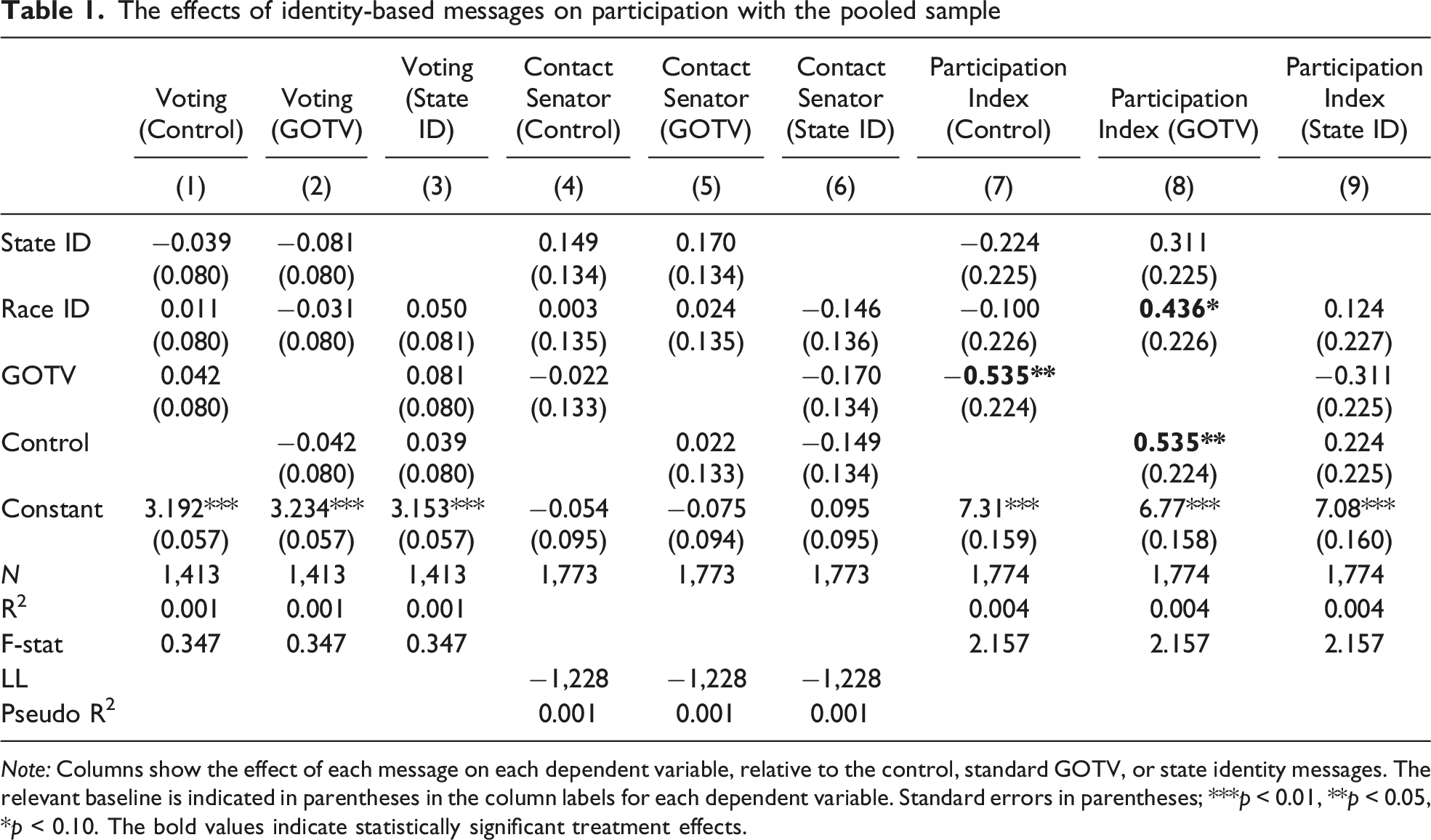
Note: Columns show the effect of each message on each dependent variable, relative to the control, standard GOTV, or state identity messages. The relevant baseline is indicated in parentheses in the column labels for each dependent variable. Standard errors in parentheses; ***p < 0.01, **p < 0.05, *p < 0.10. The bold values indicate statistically significant treatment effects.
To first benchmark the findings against prior research, we compare the effects of the standard GOTV message to the recycling message on respondents’ likelihood of participating in politics. As shown in Table 1, the standard GOTV message did not produce any significant increases in respondents’ likelihood of voting, participating in activities beyond voting, or contacting their senators, relative to the control group. These null results were somewhat surprising; however, our study was in the field just before the election, and this particular election was much higher in salience than typical midterm elections, especially in California. Respondents were therefore likely being inundated with get-out-the-vote appeals, so our one additional GOTV message may not have been very effective.
Further, Californians care about environmental issues and support a range of environmental policies, 12 so the recycling message itself likely had a mobilizing effect. In fact, some of our results suggest that it was actually more mobilizing than the standard GOTV message (for the participation index, see Column 7 of Table 1), so we compare the effects of our treatments against both types of messages in our analyses. Indeed, both the recycling and standard GOTV messages are theoretically relevant baselines, given that they seek to increase participation in ways other than activating identity-based considerations. They are also practically important benchmarks given that identity-based messages are frequently communicated alongside these other types of messages in real-world contexts.
As shown in Table 1, the racial/ethnic identity message does not significantly increase any form of political participation, relative to the control group. When we compare the effects of the racial/ethnic identity message to the standard GOTV message, we again find largely null results, though the racial/ethnic identity message marginally increases the participation index (b = 0.436, p = 0.054). The state identity message also does not significantly increase any form of participation, regardless of the baseline used. We observe similar results for both identity-based messages if we estimate these models separately for Latinos, Blacks, and Asians (see Tables A3-A5 in the SI). 13 Table 1 also shows that there are no significant differences in the effects of the racial/ethnic and state identity messages on any form of political participation. Together, these results are largely contrary to both H1 (that racial/ethnic identity appeals would increase political participation relative to a control or standard GOTV message) and H2 (that the effects of racial/ethnic identity appeals would be stronger than state identity appeals). One possible reason for these limited effects may be that we are not yet considering whether the effectiveness of identity appeals varies by the strength of attachments to that identity.
Do the Effects of Identity-Based Messages Vary by Identity Strength?
To assess whether identity-based messages have different effects on those with strong versus weak identities, we analyze the results of our regressions that include interactions between our treatment variables and the strength of respondents’ racial/ethnic or state identities. The full regression results for each dependent variable and each identity moderator are in the SI (see Tables A7-A9 on pp. 6–8 for the racial/ethnic identity results and Tables A10-A12 on pp. 9–11 for the state identity results). In what follows, we illustrate our findings in figures since models with interaction terms are not directly interpretable.
While there is some variation across outcomes and groups, our results largely provide support for H3b; that is, racial/ethnic identity appeals tend to be more effective among those with weaker racial/ethnic identities. This closes the participation gap between those with strong versus weak racial/ethnic identities. Our results also indicate that appeals to a less politicized identity (state identity) largely do not have this mobilizing effect among those with weak state identities. Therefore, they do not close the gap between those with weak versus strong state identities.
We first present the results that show how the strength of respondents’ racial or ethnic group identity moderates the effect of the racial/ethnic identity treatment on their likelihood of voting. As shown in the top panel of Figure 1, among Asians in the control group, the likelihood of voting is lowest among those with the weakest group identity (i.e., those who state that being Asian is “not at all” important to their identity). These respondents report being only “somewhat likely” to vote (a mean of 2.2 on the likelihood of voting scale). In contrast, Asians with the strongest group identity (i.e., those who state that being Asian is “extremely important” to their identity) are “likely” to “very likely” to vote (a mean of 3.4 on the likelihood of voting scale). Exposure to the standard GOTV message does not significantly change this relationship. However, the racial/ethnic identity treatment increases the likelihood of voting among Asians with the weakest group identities (to 2.8), relative to their counterparts in the control group (2.2), an effect that is just outside of conventional significance levels (p = 0.11). In contrast, this treatment does not increase the likelihood of voting among Asians with the strongest group identities. These respondents have a higher baseline likelihood of voting (a mean of 3.4 in the control and 3.27 in the standard GOTV groups), and the racial/ethnic identity treatment, if anything, slightly reduces their likelihood of voting relative to the control group (a mean of 3.02; p = 0.08). Thus, the racial/ethnic identity message closes the gap in the likelihood of voting among Asians with the strongest versus weakest racial/ethnic identities. Likelihood of voting among Asians, Blacks, and Latinos by racial/ethnic identity strength.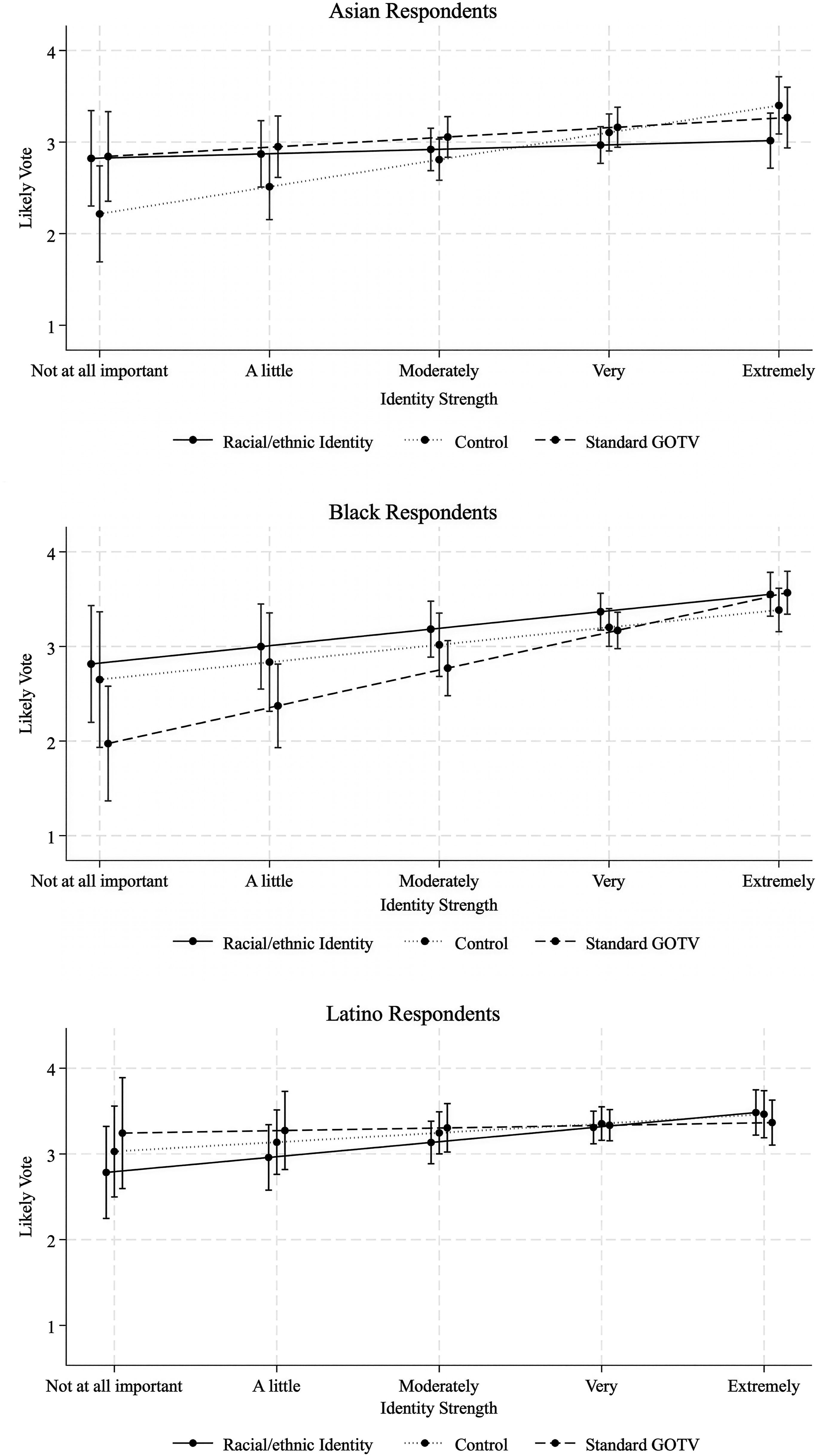
As shown in the middle panel of Figure 1, we observe a similar pattern of results for this outcome variable among Blacks with weak versus strong identities, but relative to the standard GOTV message. Among Blacks in the standard GOTV group, the likelihood of voting is lowest among those with the weakest group identity (a mean of 1.97 on the likelihood of voting scale). In contrast, Blacks with the strongest group identity in the standard GOTV group are more likely to vote (a mean of 3.57 on the likelihood of voting scale). As we observed among Asians, the racial/ethnic identity treatment significantly increases the likelihood of voting among Blacks who state that being Black is “not at all important” to their identity (to 2.81, a shift of 0.84 units), relative to their counterparts in the standard GOTV group (p = 0.057). We also observe significant increases in the likelihood of voting in response to the racial/ethnic identity treatment among Blacks who state that being Black is “a little important” (by 0.63 units, p = 0.051) or “moderately important” to their identity (by 0.41 units, p = 0.052), relative to their counterparts in the standard GOTV group.
In contrast, this treatment does not significantly increase the likelihood of voting among Blacks who state that being Black is “very important” or “extremely important” to their identity. These respondents have a higher baseline likelihood of voting, and the racial/ethnic identity treatment does not significantly increase it. In this way, the racial/ethnic identity message also closes the gap in the likelihood of voting among Blacks with strong versus weak racial/ethnic identities.
However, as shown in the bottom panel of Figure 1, we do not observe the same type of moderating effect of racial/ethnic identity strength among Latinos. It could be that Latinos, regardless of identity strength or exposure to GOTV messages, were more likely to vote in 2018 given the high salience of issues related to immigration with Donald Trump’s tenure in office. 14 Our sample of Latinos also includes relatively few respondents whose racial/ethnic identity is “not at all important” or “a little important” to them, which makes it harder to detect moderating effects for this subgroup.
The strength of respondents’ racial or ethnic group identity similarly moderates the effects of the racial/ethnic identity treatment on their propensity to engage in other forms of political participation. With respect to the probability of filling out a postcard to one’s senators, we find that the racial/ethnic identity treatment again has a stronger effect on Blacks with relatively weak group identities. As shown in the middle panel of Figure 2, Blacks’ probability of contacting their senators increases as the strength of their identity increases among those in the control group (from 0.32 for those who state that being Black is “not at all important” to their identity to 0.55 for those who state that being Black is “extremely important” to their identity). As we observed for the likelihood of voting dependent variable, the racial/ethnic identity treatment increases the probability of contacting one’s senators among Blacks who state that being Black is “not at all important” to their identity by 0.36, relative to their counterparts in the control group (p = 0.06). We also observe significant increases among Blacks who state that being Black is “a little important” or “moderately important” to their identity, relative to their counterparts in the control group (p = 0.058 and p = 0.052, respectively), and a more marginal increase among those who state being Black is “very important” to their identity (p = 0.087). In contrast, this treatment does not significantly increase the probability of contacting one’s senators among Blacks who state that being Black is “extremely important” to their identity. This, again, closes the participation gap among those with weaker versus stronger identities. Probability of contacting senators among Asians, Blacks, and Latinos by racial/ethnic identity strength.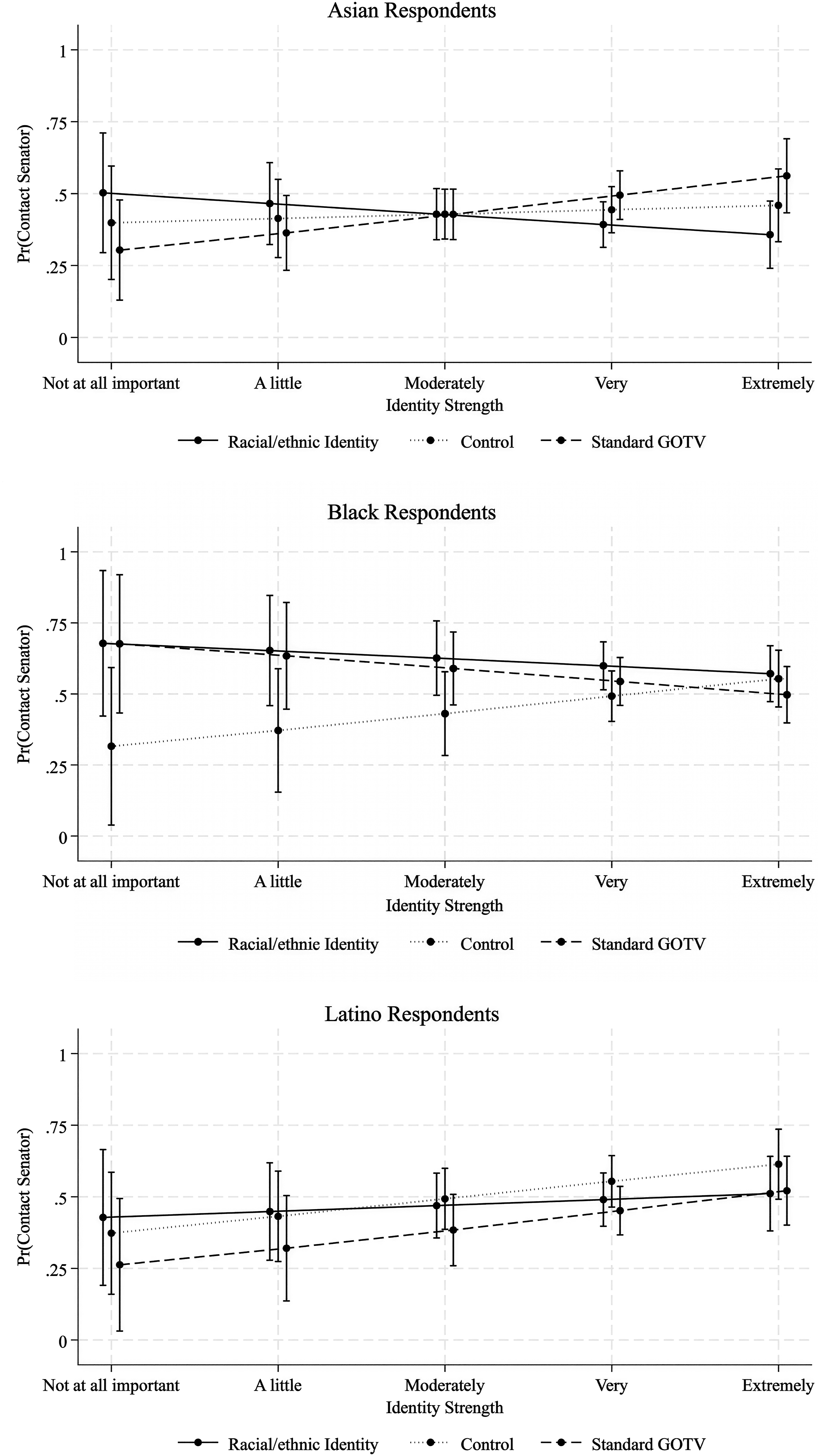
The bottom panel of Figure 2 shows a similar pattern among Latinos weak in identity strength, who appear more likely to contact their senators when exposed to the racial/ethnic identity treatment relative to the standard GOTV treatment. However, the differences between these conditions are not statistically significant. Finally, while the racial/ethnic identity treatment does not increase the likelihood that Asians with weak group identities contact their senators, the top panel of Figure 2 shows that it does decrease the likelihood of contacting one’s senators among Asians who state that being Asian is “very important” or “extremely important” to their identity, relative to their counterparts who received the standard GOTV message (p = 0.08 and p = 0.02, respectively). Thus, we still observe a closing of the participation gap among Asians with strong versus weak identities, but the effect is driven by a reduction in participation among those with stronger group identities.
For our final set of analyses, we examine the participation index and find that the racial/ethnic identity treatment again closes the gap between Blacks with weaker versus stronger identities. As shown in the middle panel of Figure 3, the racial/ethnic identity treatment meaningfully increases Blacks’ willingness to engage in other forms of political participation among those who state that being Black is “not at all important” (by 2.36 units on the participation index; p = 0.09), “a little important” (by 1.81 units; p = 0.08) or “moderately important” (by 1.26 units; p = 0.06) to their identity, relative to their counterparts in the standard GOTV condition. As before, this treatment does not significantly increase the willingness to engage in other forms of political participation among Blacks with stronger group identities (i.e., those for whom being Black is “very important” or “extremely important”), which again equalizes participation between those with weaker versus stronger identities. Predicted values of participation index among Asians, Blacks, and Latinos by racial/ethnic identity strength.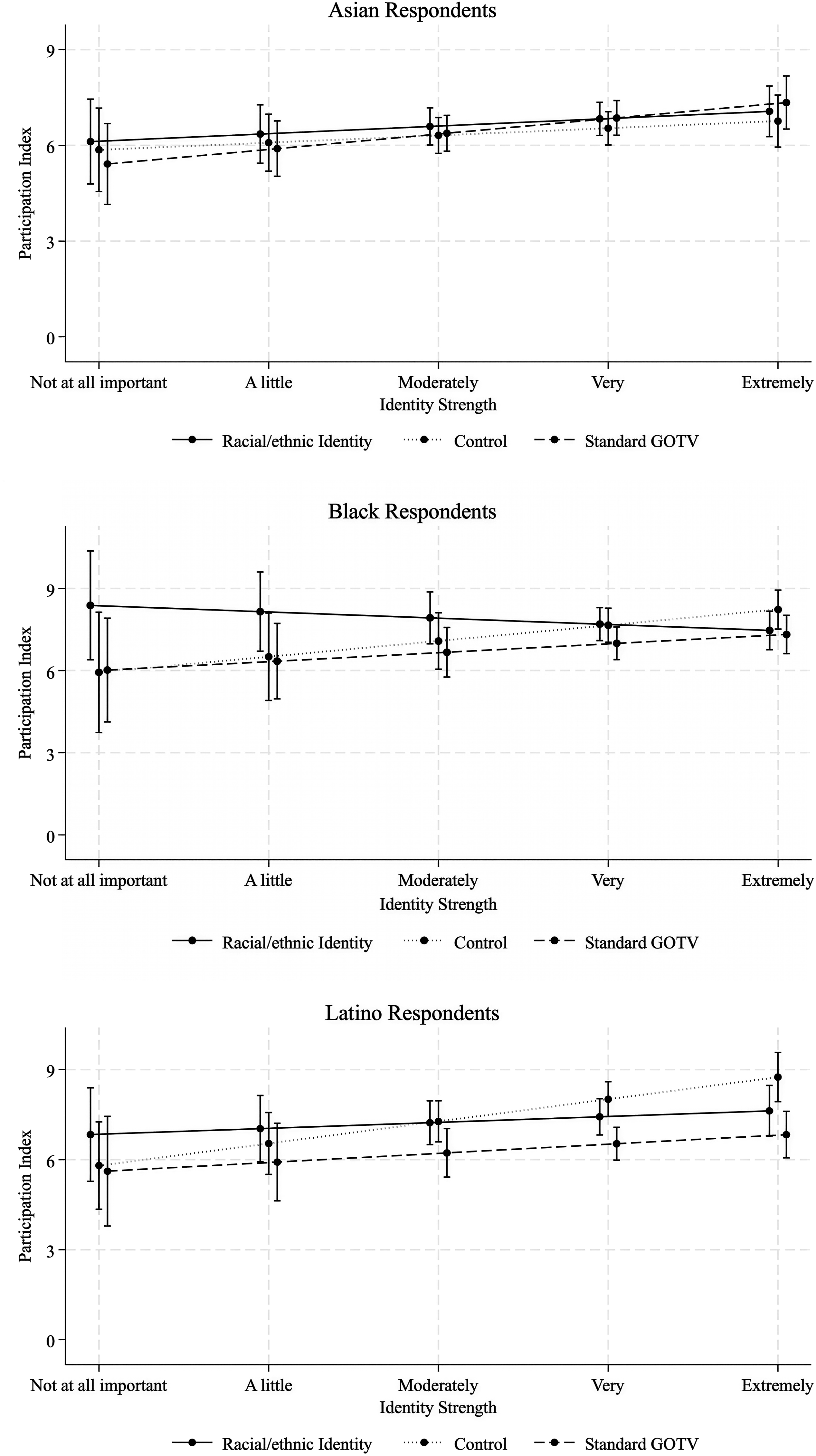
We also observe significant moderating effects of racial/ethnic identity strength for Latinos on the participation index. Specifically, the bottom panel of Figure 3 shows that Latinos who indicate that being Latino is “moderately important” or “very important” to their identity are 1 unit and 0.9 units higher on the participation index in the racial/ethnic identity treatment group, compared to their counterparts in the standard GOTV condition (p = 0.07 and p = 0.03, respectively). The substantive effects among those with the two weakest group identities are higher still (1.22 among Latinos whose identity is “not at all important” and 1.11 among those whose identity is “a little important,” respectively), but not significant, likely due to the smaller number of individuals who fell into these categories. As shown in the top panel of Figure 3, we do not find any significant moderating effects of racial/ethnic identity strength among Asians for this dependent variable.
In contrast to the moderating effects of racial/ethnic identity strength, we do not observe any significant moderating effects of state identity strength on any of our outcome variables except for contacting one’s senators among California respondents (see Table A11 in the SI). Compared to the control message, a state identity appeal marginally increases the likelihood of contacting one’s senators among California respondents whose state identity is “not at all important” (by 0.16) or “a little important” (by 0.13) at the 90 percent confidence level (p = 0.092 and p = 083, respectively). However, the state identity message does not appear to meaningfully decrease the participation gap between weak and strong state identifiers.
Together, these results show that the mobilizing effects of identity-based messages depend on whether the identity that is invoked is politicized, as well as the strength of that identity to respondents. Among Black and Asian respondents, we observe stronger effects of the racial/ethnic identity message among those with weaker group identities (albeit less consistently for Asian respondents). This helps to close the participation gap between those with strong versus weak racial/ethnic identities. The results for Latino respondents are more mixed, likely due to the high salience of the election and importance they already place on their group identity. We also find that the strength of a less politicized identity (i.e., state identity) does not moderate the effects of appeals to state identity as strongly or consistently. That said, for the one moderating effect that we observe, the state identity message pushes those with weaker state identities toward greater participation.
Conclusion
The results of our experiments demonstrate the effects that identity-based messages can have on members of underrepresented groups. In particular, we find that GOTV messages that appeal to racial/ethnic group identities can at times lead to greater political participation among those with weaker racial/ethnic identities. In contrast, those with stronger racial/ethnic identities already have high levels of political participation and are, therefore, less affected by these messages (with the exception of Latino respondents on the participation index). As a result, the racial/ethnic identity messages boost participation among those who are most in need of mobilization, thereby closing the “political participation gap” between those with strong versus weak identities. These effects hold primarily for appeals to a politicized group identity. An appeal to state identity was quite weak in comparison.
These findings have important implications for the scholarly literature on political mobilization and for practical efforts to boost participation among members of underrepresented groups. On the positive side, our results indicate that members of underrepresented groups can be mobilized to participate in politics at greater rates. In contrast to previous research showing that the content of mobilization messages does not seem to matter, we find that appeals to a politically relevant group identity can effectively increase engagement among those who most need mobilizing (i.e., those with weaker group identities). These results indicate that targeted appeals to individuals’ racial/ethnic identities can help close the gap between those with strong versus weak identities. They also provide an explanation for why previous studies have found null (or mixed) effects for different types of messages. That is, our results indicate that understanding whether the message matters requires an examination of for whom the message matters.
Our study raises new questions that future research on this topic should explore. First, why are the effects of racial/ethnic identity appeals most consistent among Blacks with weaker racial identities? Existing research suggests that Black Americans are highly responsive to social expectations of group behavior. For example, even Blacks who hold more conservative ideological perspectives are inclined to vote for the Democratic Party due to social expectations (White and Laird 2020). Our racial/ethnic identity treatment, which included a statement about the importance of making one’s community heard in Washington, may be particularly effective in activating social expectations to be engaged in politics to protect the interests of the group.
Second, why do we observe largely null moderating effects for identity strength among Latinos? Prior research has demonstrated the importance of identity strength for voter turnout among this population (Valenzuela and Michelson 2016). Do our findings stem from the more challenging anti-immigrant climate at the time of our study, which particularly targeted immigration south of the U.S. border? Or, might the muted effects be primarily due to the small sample of Latinos with weak identities in our study? If we had included Latinos from states besides California, would the moderating effects of identity strength have been stronger? These are important questions for future research to explore, especially in light of research indicating that Latinos in different states vary in the nature of their identities, sense of linked fate, policy priorities, and partisan preferences (Pantoja 2025; Trummel 2025; Valenzuela and Michelson 2016).
Third, what accounts for the mixed findings among Asians? The racial/ethnic identity appeal has no effect on their participation in activities other than voting (as measured by the participation index), but for another outcome, namely voting, the racial/ethnic identity appeal helps to diminish the participation gap by increasing engagement among those with weak identities. For still another form of participation, namely filling out a postcard to one’s senators, the participation gap is reduced by the identity appeal decreasing participation among Asians with stronger identities. This latter finding may reflect feelings of social exclusion among Asian Americans (Kim 2000, 2007; Kuo et al. 2017), which may make even those with stronger group identities less likely to reach out to public officials. Given that Asian Americans are often stereotyped as foreigners (Kuo et al. 2017; Masuoka and Junn 2013), they may feel alienated from civic life (Kim 2000, 2007) and reluctant to engage in more costly forms of civic engagement like filling out a postcard to their senators.
Fourth, has state identity become a more meaningful politicized identity since the time our study was conducted? In the current political climate, where Donald Trump has sent national guard troops to many left-leaning states and cities and states have engaged in policymaking on contentious, partisan issues like abortion and immigration, attachments to state identity seem to be on the rise (Pears and Sydnor 2022; Schildkraut 2024). Against such a backdrop, state identity might become more politicized and, therefore, appeals to it may exert a stronger effect on political participation.
Fifth, given our theoretical and empirical goals, we treated racial/ethnic and state identity separately. With state identity potentially becoming more salient and politicized, it will also be important to explore whether the fusion of racial/ethnic and geographic identity is even more effective than each identity alone. Recent work by Michelson et al. (2025) suggests this may be the case. In their GOTV field experiments, they found increases in turnout in Black households that were sent a party box or mailer with merchandise and yard signs that celebrated both racial and local identity.
Another important task for future research is to identify demographic markers for strong versus weak group identities. An advantage of testing our hypotheses with survey experiments is that we are able to include detailed questions that measure these constructs. However, one disadvantage of this approach is that we must largely rely on individuals’ stated intentions about voting and participating, rather than observing their actual behaviors (the postcard dependent variable is one exception). Going forward, academics and practitioners can use data from surveys to identify the markers that proxy for identity strength to help target those who are most likely to be responsive to identity-based appeals. For example, in their field experiment, Valenzuela and Michelson (2016) used nativity and language use as individual markers in voter files and argued that the foreign-born and Spanish speakers should have stronger group attachments, and therefore, be more affected by group-based appeals. Our survey-based approach can help scholars further hone their understanding of the markers of identity strength, while our experimental results can inform scholarly and practical efforts to boost political participation among underrepresented groups via messaging campaigns.
Supplemental Material
Supplemental Material - For Whom Does the Message Matter? The Effect of Identity-Based Get-Out-the-Vote Appeals on the Political Participation of Underrepresented Groups
Supplemental Material for For Whom Does the Message Matter? The Effect of Identity-Based Get-Out-the-Vote Appeals on the Political Participation of Underrepresented Groups by Cheryl Boudreau, Minhye Joo, Jennifer L. Merolla in Political Research Quarterly.
Footnotes
Acknowledgments
We thank Sono Shah for assistance with early stages of the project. We also received helpful feedback from participants in the UC Center Sacramento’s conference on “California’s Voting Rights Expansion: Evidence and Impacts” and on our panels at the Midwest Political Science Association’s and American Political Science Association’s annual conferences.

Ethical Considerations
This study was reviewed by the Institutional Review Boards at the University of California, Riverside (HS-18-137) and University of California, Davis (1299043) and deemed exempt.
Consent to Participate
Consent was acquired online, as a waiver of written consent was granted by the IRBs.
Funding
The authors disclosed receipt of the following financial support for the research, authorship, and/or publication of this article: We are grateful to the University of California Office of the President’s Multicampus Research Program for providing funding for this survey through the MRP-17-454899 grant.
Declaration of Conflicting Interests
The authors declared no potential conflicts of interest with respect to the research, authorship, and/or publication of this article.
Supplemental Material
Supplemental material for this article is available online.
Notes
References
Supplementary Material
Please find the following supplemental material available below.
For Open Access articles published under a Creative Commons License, all supplemental material carries the same license as the article it is associated with.
For non-Open Access articles published, all supplemental material carries a non-exclusive license, and permission requests for re-use of supplemental material or any part of supplemental material shall be sent directly to the copyright owner as specified in the copyright notice associated with the article.
