




Abstract
The internal consistency reliability and structure-related validity of the Lithuanian version of Parenting Styles and Dimensions Questionnaire (PSDQ), a 32-item instrument originally developed to assess the parenting behavior of parents of 4- to 12-year-olds, was the focus of the research study. The translated instrument was completed by 265 parents (mostly mothers) of nonclinical elementary school-aged children from a metro school district in Lithuania. In this pilot study, it was found that the PSDQ Lithuanian version had preliminary sufficient internal consistency reliability and structure-related validity similar to those reported by the authors of the original instrument. However, the PSDQ Lithuanian version still needs further studies with a more balanced gender representation, larger sample, and more diverse number of schools for exploring the psychometric properties more thoroughly. Nevertheless, in that there are few instruments on parenting that have already been translated and used with Lithuanian parents; the authors believe that this pilot study is a very important first step in the process of creating a valid and reliable instrument based on Baumrind’s parenting model.
Parenting is obviously one of the most important factors for a child’s development (e.g., Desjardins, Zelenski, & Coplan, 2008; Latouf, 2008; Onder & Gulay, 2009). The child benefits from growing up in a healthy family as reflected in desirable personality attributes, functional relationships with others, and acquisition of important values and norms of society. Unfortunately, today’s parents are faced with a number of familial and external challenges that make it difficult to fulfill the role of a competent caregiver (Newlon, Borboa, & Arciniega, 1986). Some of the challenges include stressful work situations, financial stressors, lack of support from extended family and social agencies, marital difficulties, and with some families the disruptions caused by emigration of parents to other countries. Many parents are in a constant state of exhaustion and at times question their competence at successfully parenting their children (Chang & Ritter, 2004). In addition, many parents have had little guidance as to the correct way of parenting their children. Some use techniques learned from their own parents, others read parenting magazines, and yet others acquire their information on ways of parenting by watching television. Many parents, however, are still struggling with the best way to get desired results with their present parenting style (Evans, 2005).
This has led to a number of researchers conducting studies related to parenting issues with the intent of attempting to answer the question of what are the most effective techniques, parenting styles and/or discipline strategies to use to increase the probability of the development of psychologically healthy children (e.g., Belsky, 1984; Calzada & Eyberg, 2002; Chang & Ritter, 2004; Cheah, Leung, Tahseen, & Schultz, 2009; Darling & Steinberg, 1993; Desjardins et al., 2008; Dreikurs Ferguson, Hagaman, Grice, & Peng, 2006; George, 2004; Greenspan, 2006; Hubbs-Tait, Kennedy, Page, Topham, & Harrist, 2008; Huver, Otten, de Vries, & Engels, 2010; Latouf, 2008; Mansager & Volk, 2004; Pong, Johnston, & Chen, 2010; Querido, Warner, & Eyberg, 2002; Russell, 1997; Winsler, Madigan, & Aquilino, 2005; Wu et al., 2002).
One line of research that appears promising to address these parenting issues is the body of literature that has evolved in the area of parenting styles based on the theoretical concepts of Baumrind (1971). According to Baumrind, parenting styles can be explained by two independent bipolar factors: warmth (or responsiveness) and control (or demandingness). Warmth/responsiveness dimension refers to the degree of parental nurturance, emotional expression, and positive reinforcement of child’s opinion where as control/ demandingness reflect the parents’ level of demands, control, or expectations (Desjardins et al., 2008). The combinations of these two factors in various degrees according to Baumrind create the behaviors and attitudes that can be conceptualized in three parenting styles: authoritative parenting (high on control and warmth), authoritarian parenting (high on control but low on warmth), and permissive parenting (low on control but high on warmth; Greenspan, 2006). Researchers propose that the authoritative parenting style in western countries appears to be more acceptable and functional based on findings related to higher levels of empathy, prosocial behavior and cooperative attitudes in the family (Cheah et al., 2009; Evans, 2005; Hubbs-Tait et al., 2008; Latouf, 2008; Onder & Gulay, 2009; Pong et al., 2010).
One of the major reasons that the forgoing research findings have supported Baumrind’s model is that a reliable and valid psychometric instrument titled the Parenting Styles and Dimensions Questionnaire (PSDQ) has been developed by a research team in the United States which can be used to assess her Parenting Style model (Robinson et al., 2001). To date, however, there has been little attention given to parenting style research conducted in Lithuania (e.g., Garckija, 2007; Zukauskiene & Malinauskiene, 2008), and no studies could be identified that assessed the psychometric properties of the PSDQ with a Lithuanian sample.
The PSDQ (Robinson et al., 2001), a self-report instrument, has been frequently used in various international studies. Briefly, the PSDQ short form is a 32-item self-report instrument that was designed to measure the attributes of the three parenting styles proposed by Baumrind (Carapito, Pedro, & Ribeiro, 2009). The questionnaire was designed by authors from the United States who claim that it can be used in multicultural settings (Robinson et al., 1996, 2001).
From a historical perspective, the primary version of 62-item PSDQ was translated and prepared for Australian, Russian, and Chinese users (Robinson et al., 1996). With a sample of approximately 190 mothers and 150 fathers from each culture, three parenting styles appeared to be stable constructs regardless of cultural settings. The authoritative parenting pattern yielded the highest internal correlations in Australian, Russian, and Chinese cultures (.84 to .91) followed by the authoritarian parenting practices (.82 to .88). The weakest internal correlation was found for the permissive pattern for all cultures (Cronbach’s α 58–.65; Robinson et al., 1996).
There were some differences of subtle parenting practices related to the parenting styles in each cultural setting. These are as follows. The parenting dimensions’ structure and authoritative parenting styles were present in each sample from various cultures with a similar number of parenting practices with minor variations. Only the United States and Australia had a democratic participation factor. Russia had a unique encouragement factor and China an interesting respect/confidence factor. The authoritarian parenting style was different from one culture to another with Australia having five-specific parenting practice factors (corporal punishment, nonexplanation, directiveness, verbal hostility, short fuse), United States four factors (corporal punishment, nonreasoning/punitive strategies, directiveness, verbal hostility), Russia three factors (verbal hostility and corporal punishment, demandingness, short fuse), and China two (verbal/physical punishment, verbal directiveness). Additional variations were found in the factorial structure in each cultures related to the permissive parenting style. Russia and China had one factor, United States three (following through, self-confidence, ignoring misbehavior), and Australia two factors (spoiling/giving in, following through; Robinson et al., 1996).
Additional international studies have been conducted using a shorter form of the instrument. (e.g., Carapito et al., 2009; Onder & Gulay, 2009; Pedro, Carapito, & Ribeiro, 2008; Winsler et al., 2005; Wu et al., 2002). Calzada and Eyberg (2002) proposed a Spanish version for the parenting instrument but no standardization analysis was reported. A Portuguese version of the instrument was introduced in 2008. Researchers completed a thorough reliability and validity assessment of the instrument with a sample of 453 parents (236 mothers and 217 fathers). Their findings revealed that the three parenting styles suggested by Baumrind were a fit for the Portuguese sample to some degree. The problematic area of the instrument surfaced with weaker than expected findings on the permissive parenting dimension (Carapito et al., 2009; Pedro et al., 2008). Researchers from Turkey presented a study on the PSDQ Turkish version with a sample of 604 parents (320 mothers and 284 fathers). They reported similar finding with the problem area with the permissive style (Onder & Gulay, 2009).
Despite these findings with a variety of parents from different cultures, no studies on the psychometric properties of the PSDQ have been conducted with Lithuanian parent sample. Therefore, the focus of this study was to assess the feasibility of the instrument with a Lithuanian sample. More specifically, the research question is as follows. Can a parenting style questionnaire titled The Parenting Styles and Dimensions questionnaire (PSDQ) created by Robinson and his colleagues (Robinson et al., 2001) be effectively translated, validated, and assessed as a reliable instrument that can be adapted for future use with a Lithuanian parent sample?
We are aware that there may be some question related to the sample size for the study. However, some experts believe that the use of smaller samples should be employed to assess the psychometrics of instruments before using the questionnaires on the larger scale so as to test the preliminary feasibility of the scale for an exact cultural setting and improve the evaluation procedure (Lancaster, Dodd, & Williamson, 2004; Thabane et al., 2010). With the purpose of piloting the reliability, construct validity and back forward translation issues of the PSDQ Lithuanian version which is the major question of this study, a pilot study model was employed.
Method
Participants and Sample
Data for this pilot study were collected by two researchers using a convenience sample. The participants were recruited from six schools in one of the major cities of Lithuania. Each participant was provided with a packet of information including the objectives of the study, description of procedures, consent letters, and the questionnaires to be completed. The participation was voluntary.
The sample consisted of 265 parents (92.5% mothers) with elementary school children (123 boys and 135 girls) ranging from 6 to 12 years of age (average age = 8.64 years, standard deviation = 1.757 with no statistically significant difference between boys and girls). Two hundred thirty-two parents (87.5%) reported on self and spouse. Those who did not complete the spouse form consisted of the remainder of the sample. 49.8% of the sample was well educated and graduated from a university, 21.9% graduated from secondary school, and 21.5% from college, 3.4% completed basic school.
Instruments
The PSDQ (Robinson et al., 2001) with 32 items is a modified version of the original 62-item PSDQ which was developed by authors for use with parents of children from 4 to 12-year-old in various cultures (Robinson et al., 1996). The shortened version of PSDQ was created using the Confirmatory Factor Analysis (CFA)/Structural Equation Modeling. It has two forms for parent’s self-own behavior and reporting on spouse’s behavior with children.
The 32-item PSDQ is designed to measure parenting styles of Baumrind’s well-known typologies of authoritative, authoritarian, and permissive parenting (Robinson et al., 2001).
The Authoritative scale includes 15 items and reflects the three dimensions of warmth and support (e.g., Encourages child to talk about child’s problems), regulation (e.g., Emphasizes the reasons for rules), and autonomy granting (e.g., Allows child to give input into family rules).
The Authoritarian scale consists of 12 items and yields the three dimensions of physical coercion (e.g., Slaps child when the child misbehaves), verbal hostility (e.g., Explodes in anger toward child), and nonreasoning/punitive strategies (e.g., Uses threats as punishment with little or no justification).
The Permissive scale has 5 items and is designed to assess the subfactor of indulgence (e.g., Spoils child).
Users of the inventory are requested to respond to each item based on a 5-point Likert-type scale ranging from never (1) to always (5). The scoring procedures provide a separate score (obtained by counting the mean of specific items) for each parenting style with larger numbers indicating increased use of parenting practices associated with a particular style.
The English version of PSDQ has adequate internal consistency and relatively high reliability. Robinson, Mandleco, Olsen, and Hart (2001) reported Cronbach’s αs for mothers’ and fathers’ reports (averaged together) to be .86, .82, and .64 for Authoritative, Authoritarian, and Permissive Parenting scales, respectively. The sample included 1,377 parents of school-aged children. As of this date, the internal reliability of the instrument is not as high for other cultural groups as reported for the American sample. For example, the coefficients .84, .71, and .38 were found for Turkish version (Onder & Gulay, 2009), .79, .69, and .60 for Spanish version (see Diaz, 2005), and .86, .69, and .55 for Portuguese version (Pedro et al., 2008) for Authoritative, Authoritarian, and Permissive Parenting scales, respectively.
Procedures
Permission for translating the instrument was obtained from the major author of the instrument. The translation was organized following the procedure of back–forward translation according to recommendations prepared by Van de Vijver and Hambleton (1996). One of the authors of this publication translated the instrument, and the translated items were reviewed by the Lithuanian language expert. This was followed by two bilingual (talking Lithuanian and English) psychologists translating the instrument back to the English language. All three translations (the original and back translated by two experts items) were reviewed and analyzed by a psychologist whose native language was English. Difficult items (No. 20, 23, 30) were discussed after the back–forward translation and corrected by translators proficient in both languages.
The completed instrument was then administered to parents of elementary age children in six elementary schools in metropolitan school district in Lithuania. The sample was a convenience sample, in that only schools that would agree to the study were selected. The school master (principal) in each school was briefed and informed of the purpose of the research study. Depending on the school psychologists who were participating in the data collection process, two methods were employed to recruit participants for the study. One consisted of the school psychologist‘s requesting parents to fill out the questionnaire during regular meetings with parents at the school. The second method consisted of children taking packets home for parents to complete and return to the school psychologist within a designated time.
In both methods, the packet of questionnaires included envelope, informed consent form, demographic information questionnaire, PSDQ, and several other questionnaires related to parents’ behavior with children (these are not analyzed in this publication). Parents were also requested to focus on one child in the age range of 4 to 12. All packets were designed to meet the professional requirement of confidentiality and privacy.
Data Analysis
The data were analyzed using the statistical package for the social science 15.0. The statistical methods included Cronbach’s α, Pearson correlation coefficient (Field, 2005 recommendations were followed for interpretations), counting means and standard deviations. The Mahalanobis’ distance procedure was employed to identify outliers. The Exploratory Factor Analysis (EFA) was chosen as the most proper method for exploring the preliminary structure-related validity of the PSDQ Lithuanian version (Costello & Osborne, 2005; Hopwood & Donnellan, 2010).
The missing data in the data set included from 5% to 7% of the sample who did not answer 1 item and 3% for 2 items for self-reports and reports on spouse. The missing data for both report forms were addressed by replacing them with the series means.
In that, the sample size for this study could be questioned related to the analysis, a power analysis procedure using the GPower 3.1 was conducted to assess the feasibility of the use of the EFA (Table 1). The results revealed a minimum sample size of 191 participants for detecting the effect sizes (equal to .2) with the probability of .8 to identify the correlation between the items correctly. Employing the sample of 256 parents with the same effect size gave a possibility to achieve the power of .9.
Power Analysis of the Required Sample Size
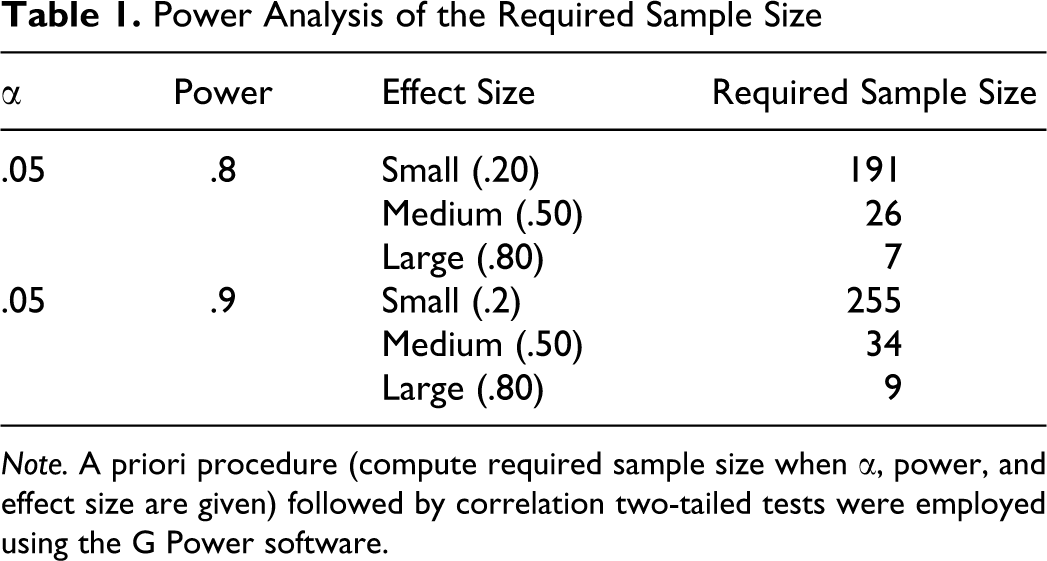
Note. A priori procedure (compute required sample size when α, power, and effect size are given) followed by correlation two-tailed tests were employed using the G Power software.
Results
Internal Consistency Reliability
The preliminary Cronbach’s α coefficients for the translated version of the PSDQ are presented in Tables 2 and 3.
Correlations, Internal Consistency Reliability Coefficients, Means, and Standard Deviations for PSDQ Lithuanian Version (Report on Self)

Note. N = 256. PSDQ = Parenting Styles and Dimensions Questionnaire.
*p < .05. **p < .01.
Correlations, Internal Consistency Reliability Coefficients, Means, and Standard Deviations for PSDQ Lithuanian Version (Report on Spouse)
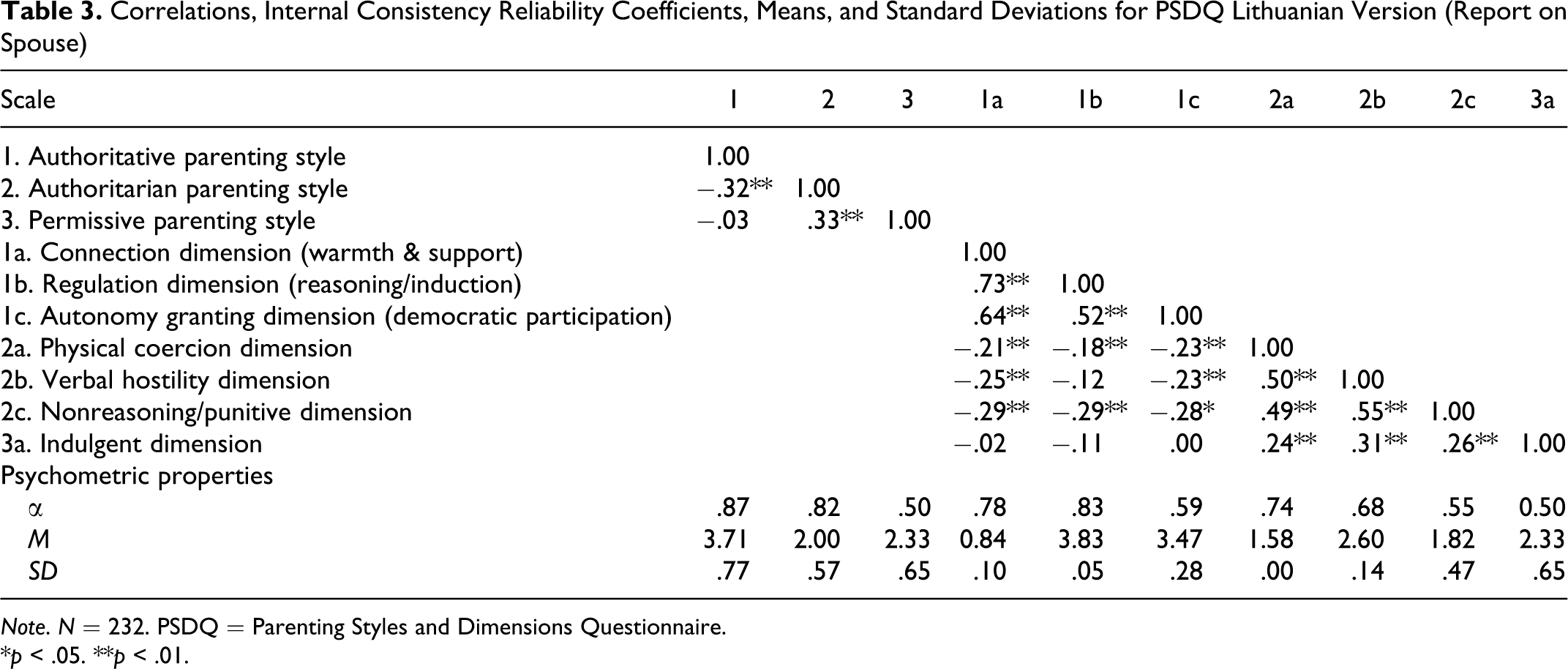
Note. N = 232. PSDQ = Parenting Styles and Dimensions Questionnaire.
*p < .05. **p < .01.
The results presented in Tables 2 and 3 indicated that the Cronbach’s α coefficients for various scales of PSDQ Lithuanian version were slightly different from those reported in the English version. The Cronbach’s α for Authoritative Parenting Style was .85 (for self-report) and .87 (for report on spouse’s behavior with a child). Adequate internal consistency was found for the Authoritarian Parenting scale: .76 (for self-report) and .82 (for report on spouse). However, the internal reliability of PSDQ Permissive Parenting Style was assessed to be unacceptable based on the Cronbach’s α coefficients of .58 (for self-report) and .50 (for report on spouse).
Though authors of the original instrument declared Cronbach’s α for the three major scales, we expanded the analysis by acquiring coefficients of internal consistency reliability on the seven subfactors and the three major scales. Our findings showed that the Regulation Dimension (Authoritative Parenting Style) and Physical Coercion Dimension (Authoritarian Parenting Style) yielded acceptable Cronbach’s α within a range of .74 to .83 for both reporting forms. Verbal hostility dimension and nonreasoning/ punitive dimension (authoritarian parenting style) as well as indulgent dimension (permissive parenting style) did not reach .70 of Cronbach’s α coefficient for self-report or reporting on spouse forms (coefficients were equal to .39–.50). The connection dimension and autonomy granting dimension (authoritative parenting style) had adequate cronbach’s α coefficient for report on spouse and self-report forms, respectively.
The correlational analysis between the PSDQ scales and subscales may also be informative for exploring the PSDQ internal reliability (according to Schmitt, 1996). The Pearson correlation was found to be statistically significant for the self-report form in three major scales: the correlation between authoritative parenting style and authoritarian parenting style as well as the correlation between authoritarian parenting style and permissive parenting style was estimated to be moderate and negative (Pearson correlation coefficients were equal to −.29 and −.22, respectively); the correlation between authoritarian parenting style and permissive parenting style was found to be strong and positive (Pearson correlation coefficient had the value of .49). Considering the spousal form, all correlations were found to be of medium effect and statistically significant. However, the correlation between authoritative parenting style and permissive parenting style was statistically insignificant yielding a Pearson correlation coefficient value of −.03.
The Pearson correlation between different parenting dimensions was found to be statistically significant in most interrelations for both report forms. The strongest positive correlation was identified between parenting dimensions of the same parenting style: Pearson correlation coefficients had the value of .49–.73 (strong correlation) for dimensions of authoritative parenting style and the value of .36–.55 (moderate–strong correlation) for dimensions of authoritarian parenting style. The correlational analysis revealed low–moderate and negative relations between dimensions of authoritative parenting style and authoritarian parenting style: Pearson correlation coefficients for both report forms ranged from −.12 to −.29. Low–moderate but positive correlation was discovered between indulgent dimension (permissive parenting style) and three dimensions of authoritarian parenting style with coefficients values from .24 to .46. However, no statistically significant correlation was determined between indulgent dimension (permissive parenting style) and three parenting dimensions of authoritative parenting style in report on spouse form: Pearson correlation coefficients were lower than .11.
The Structure-related Validity
An EFA was performed to explore the construct-related validity of the PSDQ Lithuanian version. The principal axis factoring method of factor extraction via a promax rotation was selected because it is better suited for identifying factor structure by analyzing only shared variance (Costello & Osborne, 2005). The maximum number of iterations for convergence was set at 25. The question to be addressed was related to the internal structure of the translated questionnaire. More specifically, the focus was to search for the three main factors of authoritative, authoritarian, and permissive parenting styles and seven subfactors (dimensions) in the PSDQ Lithuanian version.
Following the well-known structure of the PSDQ English version, the EFA was performed on the data set. Results of the analysis revealed that the seven factors accounted for 54% of the variance for parental self-reports and 61% for reports on spouse; three factors accounted for 37% and 45% of the variance for self-reports and reports on spouse. An overall Kaiser–Meyer–Olkin (KMO) measure of sampling adequacy of .83 and .88 as well as a Bartlett’s test of sphericity of 2222.70 and 3005.71 (p < .001) for self-reports and reports on spouse suggested that the data could be used for EFA (Cekanavicius & Murauskas, 2002). The examination showed that parental reports on spouse’s behavior with a child were represented by seven as well as three factors better than parental reports on self (with reference to values of initial eigenvalue for cumulative percentage, the KMO and Bartlett’s coefficients).
The seven-factor solution was chosen for a more thorough examination in order to assess if the Lithuanian parenting dimensions could be consistent with the lower structure of PSDQ English version. With this analysis, a decision was made to analyze only items that reached a .4 or above loading (following Field, 2005; Cekanavicius and Murauskas, 2002 recommendations). Items 1, 4, 12, 13, 15, 19, 21, 26, 28 in self-report form and Items 18, 26, 28 in spouse form did not reach the set criteria (see Table 4).
Seven Factors of PSDQ Lithuanian Version
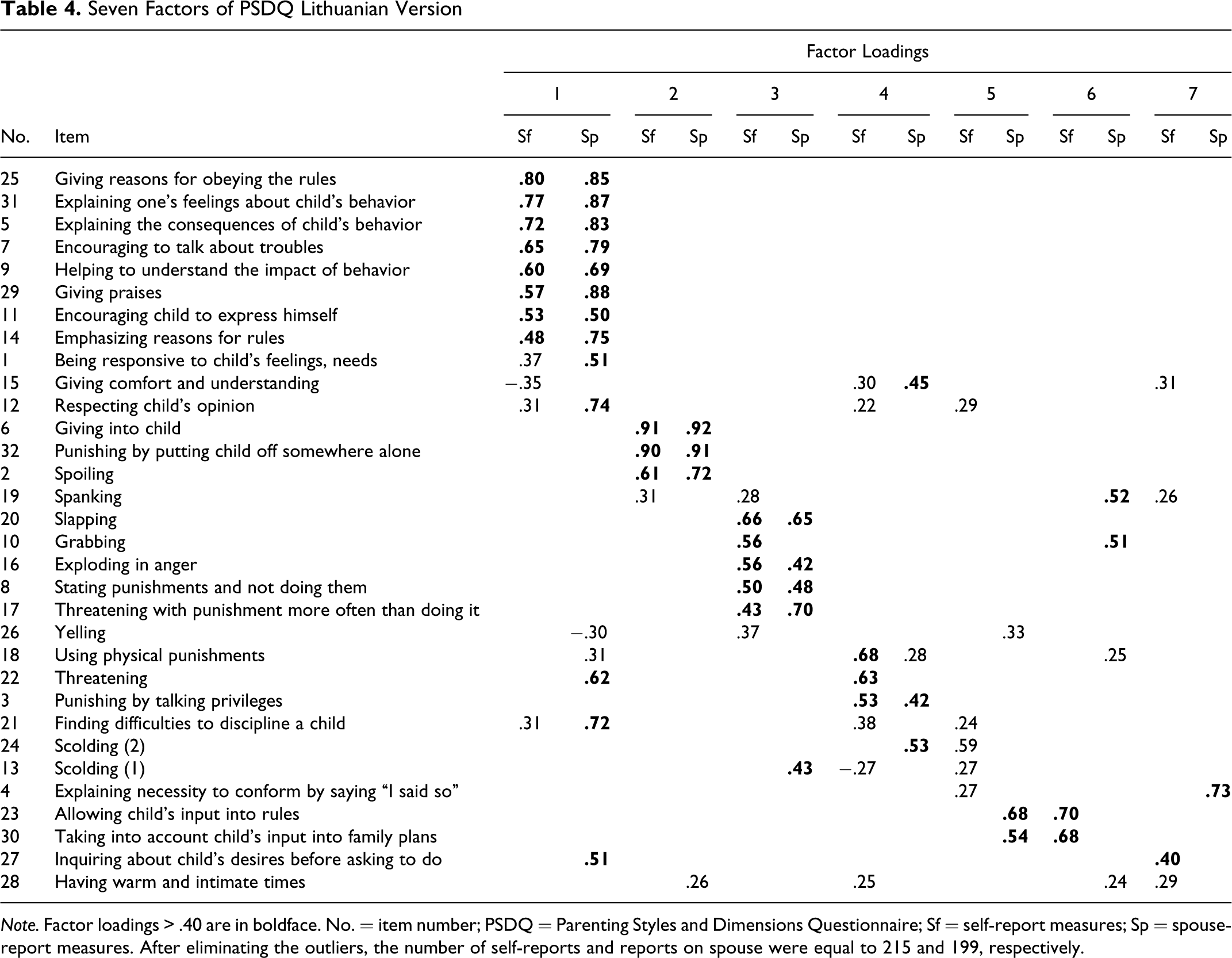
Note. Factor loadings > .40 are in boldface. No. = item number; PSDQ = Parenting Styles and Dimensions Questionnaire; Sf = self-report measures; Sp = spouse-report measures. After eliminating the outliers, the number of self-reports and reports on spouse were equal to 215 and 199, respectively.
The first factor in the seven-factor solution consisted of 8 items (No. 25, 31, 5, 7, 9, 29, 11, 14) for self-report and of 13 items (No. 29, 31, 25, 5, 7, 14, 12, 21, 9, 22, 1, 27, 11) for report on spouse’ behavior with a child with a factor loading ranging from .48 to .88. All items were consistent with the authoritative parenting style in the PSDQ English version for both reporting forms. This factor included at least 1 item and a maximum of 5 items from all three dimensions of Authoritative Parenting scale.
The second factor contained 3 items (No. 6, 32, 2). Factor loadings ranged from .61 to .92 for both report forms, and matched the English version of the physical coercion dimension in authoritarian parenting style.
The third factor consisted of 5 items: Items No. 20, 16, 8, 17 were included into this factor for both parental data set; Items No. 10 and No. 13 were added for self-report and report on spouse, respectively. Three items were consistent with the indulgent dimension (permissive parenting style) and 2 items from dimensions of authoritarian parenting style. The 5 items reflected shouting, stating punishment, threatening, or taking the privileges and were summarized by verbal coercion factor.
The forth factor included 3 items but they were different for self-report and report on spouse forms. The factor in reporting on self-data contained Items No. 18, 22, 3, and were consistent with autonomy granting dimension (authoritative parenting style). Meanwhile, the factor in reporting on spouse data included Items No. 15, 3, 24 that were congruent with indulgent dimension (permissive parenting style). One item from the autonomy granting dimension (authoritative parenting style) was relevant in this analysis. However, factor loadings for these factors were low and ranged from .68 to .53 and .42 to .53 for self-report and report on spouse, respectively. The fifth, sixth, and seventh factors in seven-factor solution were weak and consisted of 1 or 2 items.
After the seven-factor analysis, the decision was made to perform EFA with three-factor solution. The purpose for that was to assess if the PSDQ Lithuanian version was consistent with the three major parenting styles reported by Baumrind (1971). The results are presented in Table 5. The principal axis factoring method of factor extraction and a promax rotation were used again.
Three Factors of PSDQ Lithuanian Version
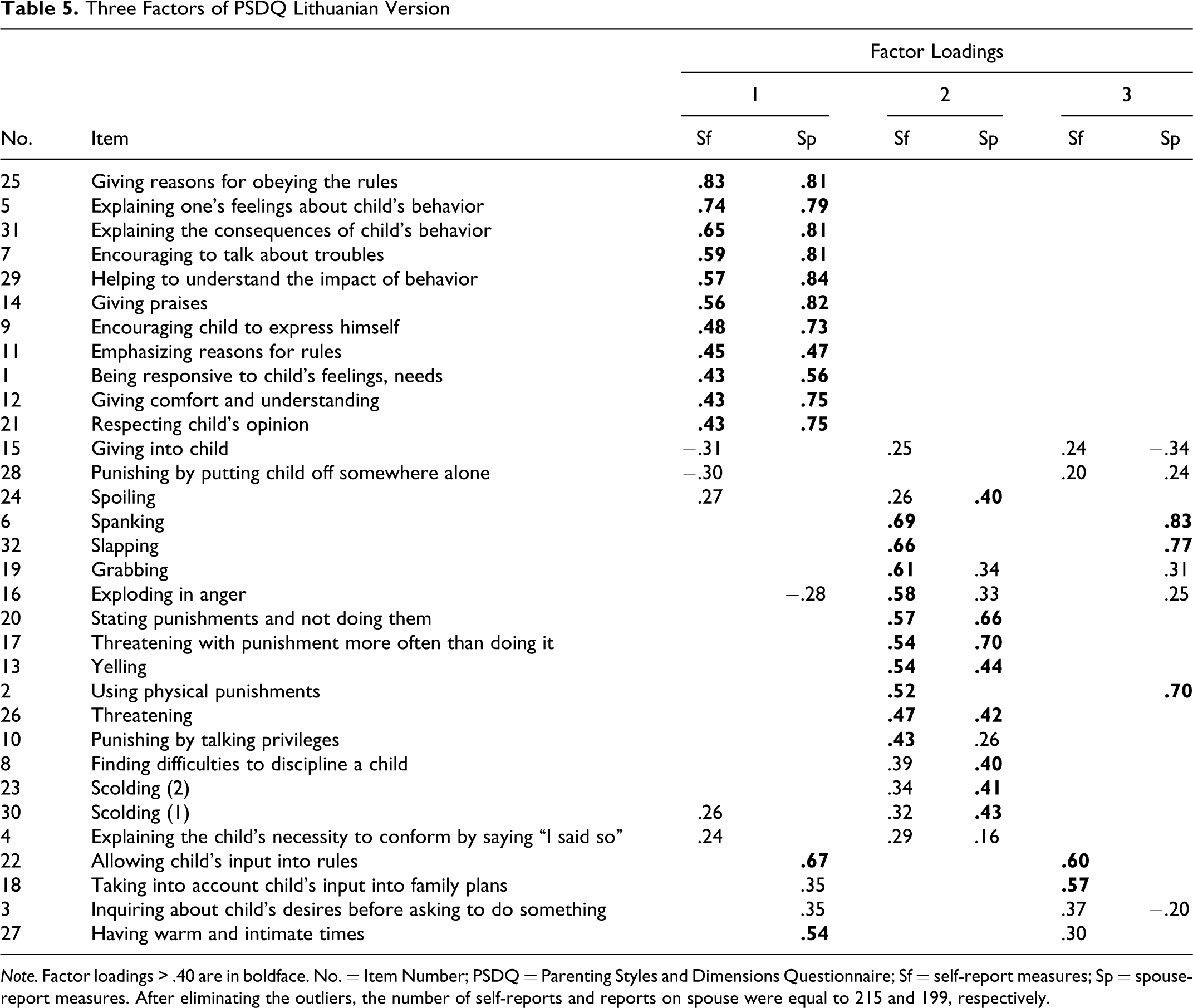
Note. Factor loadings > .40 are in boldface. No. = Item Number; PSDQ = Parenting Styles and Dimensions Questionnaire; Sf = self-report measures; Sp = spouse-report measures. After eliminating the outliers, the number of self-reports and reports on spouse were equal to 215 and 199, respectively.
The first factor in three-factor solution consisted of 11 items for self-report and 13 items for report on spouse. The items were No. 25, 5, 31, 7, 29, 14, 9, 11, 1, 12, 21 for self-report. The EFA identified two additional items for this factor in report on spouse form which were No. 22 and 27. Factor loadings ranged from .84 to.43. All items were consistent with authoritative parenting style and reflected three dimensions—connection, regulation, and autonomy granting.
The second factor contained 10 items (No. 6, 32, 19, 16, 20, 17, 13, 2, 26, 10) in self-report form and 8 items (No. 24, 20, 17, 13, 26, 8, 23, 30) in report on spouse form with factor loadings from .70 to .40 for both data. All items were from authoritarian or permissive parenting style. The factor in self-report data included 2 items (No. 20, 17) of possible five statements in permissive parenting style; the factor in report on spouse—4 items (No. 24, 20, 17, 8). The rest of items were from several dimensions of authoritarian parenting style.
The third factor provided different information. The factor for self-report included 2 items (No. 22, 18) and was consistent with autonomy granting dimension (authoritative parenting style). The factor for report on spouse had 3 items (No. 6, 32, 2) and reported physical coercion dimension (authoritarian parenting style). Therefore, the third factor was found in this research to be not so clear and could be hardly summarized by single title.
In addition to the EFA, we completed a CFA. The research team was aware of the problems of limited sample size but thought that the analysis might provide future researchers with additional information. As expected the CFA was not additive to the exploratory findings, and therefore are not discussed here. However, Table 6 is included related to the CFA.
Confirmatory Factor Analysis Fit Indicators: Pilot Analysis (Without Missing Data)
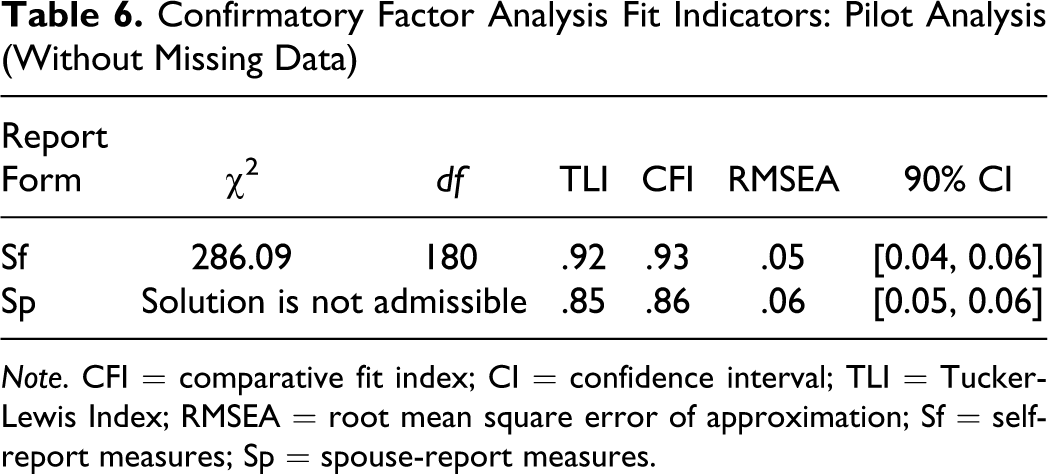
Note. CFI = comparative fit index; CI = confidence interval; TLI = Tucker-Lewis Index; RMSEA = root mean square error of approximation; Sf = self-report measures; Sp = spouse-report measures.
Discussion
The psychometric properties of Lithuanian version of PSDQ among parents with elementary school aged children were explored in this pilot study. Based on this preliminary analysis, we propose the following suggestions and conclusions.
Our findings indicate that the PSDQ Lithuanian version had similar psychometric properties to the PSDQ original version (Robinson et al., 2001) as reflected in results in Tables 2–5. We suggest that increased numbers in the sample by future researchers could more clearly confirm these findings, and thereby support the instrument for research and clinical purpose with parents of young children and preadolescents.
The results of the pilot study revealed the preliminary internal consistency reliability of the three major scales and seven subscales of PSDQ Lithuanian version. Though only some subscales (except verbal hostility dimension, non-reasoning/punitive, indulgent dimension) were found to have acceptable internal consistency reliability, none of them could be compared to the results of other studies as no information was found by authors available on that. For the three parenting styles’ scales, Cronbach’s α ranged from .50 to .87 for both self-reports and reports on spouse’s behavior and was similar to the reliability that was reported by Robinson et al. (2001) for English version (Cronbach’s α .64–.86) and other investigators for translated versions, for example, Spanish—.60 to .79 (see Diaz, 2005), Turkish—.38 to .84 (Onder & Gulay, 2009), or Portuguese—.55 to .86 (Pedro et al., 2008). The main tendencies basically matched the results of other researches (Carapito et al., 2009; Onder & Gulay, 2009; Pedro et al., 2008; Robinson et al., 2001).The reliability of Authoritative Parenting scale had the highest coefficients with a Cronbach’s α range of .85 to .87 for reports on self and reports on spouse, respectively. The Permissive Parenting scale was found to be problematic with Cronbach’s α correlations of .58 to .50 for both forms of the questionnaire. This may have been a result of the limited number of items (5) on the Permissiveness scale (Field, 2005; Schmitt, 1996) as compared to 15 and 12 items on the Authoritative and Authoritarian scales, respectively. This finding seems to support the need for further exploration of the PDSQ Lithuanian version.
According to Baumrind (1971), the three parenting styles were proposed to be the components of the same parenting construct (see Dreikurs Ferguson et al., 2006; Greenspan, 2006). Of interest in this pilot study was that although the three parenting scales strongly or moderately intercorrelate with self-reports, no statistically significant relation was identified between reporting on spouse’s Authoritativeness and Permissiveness scales (and their corresponding subscales as well). Therefore, examining the construct-related validity of the PSDQ Lithuanian version even with the limited sample was expected to give some additional information in this area.
The original factorial structure for the PSDQ Lithuanian version at this stage was identified to be similar but not identical to the PSDQ English version (Robinson et al., 2001). Seven-factor and three-factor EFA solutions revealed that the parenting styles and dimensions model could be possibly confirmed only with some revisions for the Lithuanian sample.
Based on seven factors’ analysis, decision was made that three major factors were authoritative parenting, physical coercion, and verbal coercion (the other four factors were found to be weak and/or had ambiguous meaning for self-report and report on spouse forms). The Authoritativeness scale in the Lithuanian PSDQ was consistent with the original scale of Authoritative Parenting Style in the PSDQ English version (Robinson et al., 2001) and measured parental warmth and support as well as control and regulation of child’s behavior. The Physical Coercion scale in the translated instrument was congruent with the dimension of physical coercion (authoritarian parenting style) in the PSDQ original version and assessed using physical punishments in parenting behavior. The Verbal Coercion scale was constructed of several items from original indulgent dimension (Permissiveness scale) and the Verbal Hostility Dimension scale (Authoritarian Parenting Style). All of the items focused on behaviors such as verbal punishment, yelling, criticizing, and so on. Moreover, the three-factor EFA solution basically confirmed the factorial structure mentioned before and provided two strong factors such as authoritative parenting style and authoritarian-permissive parenting style. These two factors were congruent with authoritative parenting, physical coercion, and verbal coercion in nature.
Although Robinson et al. (1996) reported the parenting styles as stable constructs from a multicultural perspective, our preliminary findings with the limited Lithuanian sample did not support the permissive style of the PSDQ. Our findings indicated that the items of the Permissiveness scale loaded on several other scales. This is consistent with findings of PSDQ Portuguese and Turkish versions where no empirical support for permissiveness was discovered (Onder & Gulay, 2009; Pedro et al., 2008).
Though this was the first study related to this topic there are some limitations. First, the sample included a gender bias with women being overly represented in the sample (92.5% mothers participated in this research). Second, though precautions with the power analysis were conducted to support the sample size for a pilot study we are aware that a larger sample may provide additional findings. Another limitation was that it was a convenience sample with all participants drawn from one metro school district in Lithuania. Finally, all measures were based on parents’ self reports or reports on spouse, and no reciprocal assessment of spouse was developed. The two-way assessment of parenting behaviors could be especially valuable and more congruent with the original idea of PSDQ where mothers and fathers vary concerning some parenting styles or dimensions (Robinson et al., 2001). These limitations may impact the generalizability of the findings of the study.
With these limitations, it is suggested that additional studies need to be conducted to replicate this study with a more balanced gender representation, larger sample, and more diverse number of schools. Future studies might include a comparison of parenting styles across genders and other ethnic groups of parents. Moreover, analyzing other psychometric properties (test–retest reliability, criteria-related validity) of the PSDQ Lithuanian version in future studies may provide additional information.
Even with the forgoing limitations, the importance of this study is that this is the first attempt to translate, adapt, and use the parenting style research instrument that is based on Baumrind’s model (1971). This pilot study gives the basis for future research related to psychometric properties of PSDQ Lithuanian version. The preliminary reliability and structure-related validity analysis could be especially useful for other researchers who might wish to consider additional research with Lithuanian sample.
We propose that the results of this study will provide a base for other researchers to continue exploration of the PSDQ with larger samples of parents in Lithuania. We also believe that in the future Lithuanian family therapist, counselors/ consultants, school psychologists, and researchers could possibly use the PSDQ Lithuanian version to assess families at risk and from the results design more effective intervention strategies related to parenting skills. In addition, we propose that the instrument could be used in parent education groups and other clinical settings as a self-awareness tool prior to organizing and conducting training programs.
Conclusions
In this pilot study, it was found that the PSDQ Lithuanian version has preliminary sufficient internal consistency reliability and structure-related validity. The preliminary conclusion was made that PSDQ Lithuanian version has two major scales—Authoritativeness scale and Authoritarianism–Permissiveness scale. Furthermore, the translated instrument has three dimensions which are as follows: a common authoritativeness dimension and the dimensions of physical coercion and verbal coercion. However, the PSDQ Lithuanian version requires additional studies with a more balanced gender representation, larger sample, and more diverse number of schools for exploring the psychometric properties more thoroughly. However, in its present form it might be helpful for practitioners to use in parent groups, parent consultation, and for instructional purposes.
Footnotes
Acknowledgments
The authors give special thanks to S. Magelinskaite and her supervisor associate professor Dr. B. Grigaite, to school psychologists B. Balseviciene and L. Gudomskiene for their assistance with data collection and R. Vaitkevicius for his contribution to the statistical analysis of the research results.
The author(s) declared no potential conflicts of interest with respect to the research, authorship, and/or publication of this article.
The author(s) received no financial support for the research, authorship, and/or publication of this article.