




Abstract
With structural equation modeling, the National Survey on Drug Use and Health data were used to examine “parental support” and “perception of school” and their relation to Hispanic youth’s substance use (alcohol, cigarettes, and marijuana).
Substance use is one of the major public health concerns for adolescents due to the negative outcomes such as unsafe sexual activity, criminal involvement, and lower academic achievement (Lopez et al., 2009). However, there is a disparity in substance use and its associated problems among ethnic groups (Lopez et al., 2009). Hispanic youth substance use rates continue to be high compared with adolescents from other ethnic groups (Centers for Disease Control and Prevention [CDC], 2005). According to the data from the National Survey of Drug Use and Health (NSDUH), in the year of 2006, 40% of Hispanic/Latino adolescents aged 12–17 reported lifetime use of alcohol, while almost 24% reported lifetime use of cigarettes, and 17% reported lifetime use of marijuana (Substance Abuse and Mental Health Services Administration [SAMHSA], 2006).
Substance use (including alcohol, tobacco, and drug use) represents one of the major contributors to the health disparities between Hispanic adolescents and non-Hispanic White adolescents (Prado, Szapocznik, Maldonado-Molina, Schwartz, & Pantin, 2008). For example, Hispanic adolescents are likely to start using substances earlier than non-Hispanic White adolescents (Johnston, O’Malley, Bachman, & Schulenberg, 2007), which contribute considerably to the observed disparities in HIV prevalence rates, assaults/homicides, intention harm/suicides, and chronic lower respiratory diseases (Arias, Anderson, Kung, Murphy, & Kochanek, 2003). Given the fact that by the year 2000, Hispanic youth aged 12–20 had become the largest ethnic youth population in the United States (U.S. Census Bureau, 2003), it is particularly important to have a better understanding of substance use among Hispanic youth and the risk and protective factors associated with it.
Substance Use Among Hispanic Adolescents
Hispanic youth are more likely to use alcohol, cigarettes, and marijuana than peers of other races and ethnicities (“Hispanic Kids,” 2010). Furthermore, data from Monitoring the Future indicate that there are higher rates of alcohol and marijuana use among Hispanic adolescents than their White and Black counterparts (Johnston, O’Malley, Bachman, & Schulenberg, 2008). Nationwide data sets suggest that Hispanic adolescents report similar rates of using cigarettes as their White counterparts and higher rates than African American adolescents (CDC, 2005). As for alcohol use, Hispanic youth report similar or lower rates than White adolescents (CDC, 2005). However, the fewest protective factors (such as better academic performance, having friends who do not drink, and negative expectancies for drinking) are reported by Hispanic adolescents (Mouttapa, Weiss, & Hermann, 2009). Consequently, long-term negative outcomes have been found for adolescents use alcohol, cigarettes, and marijuana (Zamboanga, Schwartz, Jarvis, & Tyne, 2009). Taking these findings together, Hispanic youth are at higher risk of substance use. Therefore, research should continue to explore variables that may be correlated with substance use among Hispanic adolescents (Zamboanga et al., 2009).
Factors in Hispanic Adolescent Substance Use
There are two major factors widely explored that may be related to Hispanic adolescents’ substance use. These include parental factors (Lopez et al., 2009; Pilgrim, Schulenberg, O’Malley, Bachman, & Johnston, 2006; Prado et al., 2008; Wagner et al., 2010; Wong, 2008) and school factors (Flannery, Vazsonyi, Torquati, & Fridrich, 1994; Lopez et al., 2009; Pilgrim et al., 2006; Vaughan, Kratz, & d’Argent, 2011; Wong, 2008).
Parental factors.
Among Hispanic youth, parents seem to play a critical role in the adolescents’ decision-making process on substance use as evidenced by the results from a special report entitled “Hispanic Teens and Drugs” conducted by the Office of National Drug Control Policy (2007). For example, roughly two thirds of Hispanic youngsters aged 13–17 stated “upsetting their parents” was one of the major reasons they refrained from using marijuana. In Hispanic culture, families serve as primary unit of treatment support for adolescents with drug and behavior problems (Cannon & Levy, 2008). Previous studies have been conducted to examine different aspects of the parental role in relation to Hispanic youth’s substance use, for example, parental support and involvement (Flannery, Vazsonyi, & Rowe, 1996; Prado & Pantin, 2011; Vaughan et al., 2011; Walker, Ainette, Wills, & Mendoza, 2007; Wills & Yaeger, 2003), parental monitoring (Flannery et al., 1996; Lopez et al., 2009; Parsai, Marsiglia, & Kulis, 2010; Shillington et al., 2005; Tobler & Komro, 2010), as well as parent–adolescent communication and connectedness (Prado et al., 2008; Tobler & Komro, 2010).
Parental support and involvement were found to function as protective factors for Hispanic adolescents’ substance use (Flannery et al., 1996; Vaughan et al., 2011). Results from a number of previous studies showed that parental support correlated with the initiation, frequency, and intensity of adolescents’ substance use. A more recent study by Prado and Pantin (2011) showed that a lack of parental involvement in adolescents’ lives could increase adolescents’ problem behaviors including drug use. Furthermore, parental involvement in students’ academic endeavors could decrease the risk of substance use (Lopez et al., 2009). Whereas high level of parental involvement in students’ school life could promote academic achievement and help students form a closer relationship and bonding to schools, which in turn may protect students from using substances (Lopez et al., 2009).
Together with parents’ active involvement in school activities, parental monitoring of adolescents’ activities and whereabouts make up the characteristics of a healthy parent–adolescent relationship. In fact, appropriate parental monitoring has been found to decrease the likelihood of substance use (Barnes, Hoffman, Welte, Farrell, & Dintcheff, 2006). Additionally, parental monitoring consistently asserted positive influence on adolescent’s substance use Tobler & Komro, 2010). Interestingly, parental monitoring was found to have both direct (Griffin, Botvin, Scheier, Diaz, & Miller, 2000; Ramirez et al., 2004) and indirect influences (such as lowering the adolescent’s likelihood to associate with peers who use drugs) on students’ substance use (Sieving, Perry, & Williams, 2000; Simons-Morton & Chen, 2005).
Unlike consistently found results for factors of parental support and involvement as well as parental monitoring, there were mixed results found in studies exploring the relation between parent–adolescent communication and connectedness with adolescent substance use. Some studies found that parent–adolescent communication and parent–adolescent connectedness could prevent Hispanic adolescents from using substance (Prado et al., 2008; Tobler & Komro, 2010). Nevertheless, others showed null effects between these two variables (Griffin et al., 2000; Stanton, Li, & Pack, 2000).
School factors.
In the context of school, several factors were investigated in previous research regarding Hispanic adolescent’s substance use, for example, school adjustment (Flannery et al., 1996), school functioning (Lopez et al., 2008), interests in school (Prado et al., 2008), and school connectedness (Prado et al., 2008; Vaughan et al., 2011). It has been quite consistent in the literature that better school adjustment or functioning, more interests in school and feeling connected to school can serve as protective factors for Hispanic adolescents’ substance use. It was indicated that adolescents who were not interested in school might be at a greater risk of substance use and other problem behaviors (Henry, Swaim, & Slater, 2005). More specifically, Hispanic youth experiencing high rates of high school dropouts (Greene & Forster, 2003) increases the possibility of substance use dramatically (Guagliardo, Huang, Hicks, & D’Angelo, 1998). Compared with all substance users, students who do not use substance reported more interest in school work and stronger feelings of the importance of their school work (Paulson, Coombs, & Richardson, 1990).
Conceptual Model
The model being tested in this article included two major factors that were commonly studied in the previous literature: parental support and perceptions of school. The rationale for including these two factors was that previous research showed that parental support and students’ perceptions of school work both statistically significantly influenced Hispanic students’ substance use (Shillington et al., 2005; Stevenson, McMillan, Mitchell, & Blanco, 1998). In the present study, the interaction effect between these two factors was explored in the model to examine whether there is an interaction effect existing. It was hypothesized that Hispanic youth’s substance use could be explained by parental support, perceptions of school, and interactions effect between these variables (see Figure 1). That is, it was hypothesized that the relation between Parental Support and Substance Use is negative; however, this is moderated by Perception of School. Specifically, as students’ perception of school decreases, the relation between Parental Support and Substance Use becomes more negative.

Conceptual model with standardized structural coefficients and unstandardized structural coefficients (in parentheses) depicting the relation between Hispanic youth substance use and three factors: parental support, perception of school, and interaction effect).
Method
Participants
The participants of this study were from the sample of the National Survey on Drug Use and Health 2009, sponsored by SAMHSA, a U.S. Public Health Agency. The NSDUH data have been widely used by government agencies, universities researchers, private organizations, and the public at large. The NSDUH 2009 used a random sample of households across the country, with one or two residents in the same selected households invited to participate. Once selected, no other residents were allowed to replace the selected person for the purpose of ensuring the representativeness of the sample. In-house interviews were conducted through laptop computers with the assistance of field interviewers. An extensive range of questions were asked in the interviews, such as, use of tobacco, alcohol, illicit drugs, and questions regarding mental health. For school-aged youth (aged 12–17), questions about school experience and parents were included in the interview. Considering the goals of this study were to focus on investigating Hispanic youth substance use, two criteria were adopted in selecting the participants: (a) being Hispanic (using variable “NEWRACE2”) and (b) being aged 12–17 (using variable “AGE”).
Less than 2% of the sample responded as “didn’t know,” “refused to answer,” or “left blank.” When a small amount of data is missing (5% of less), previous research suggested that all of the missing data techniques perform similar (Acuna & Rodriguez, 2004). Thus, listwise deletion was used for this study, which resulted in a total of 2,719 Hispanic youth aged 12–17 that were included in the present study. Among the participants, 51% (n = 1,386) were male and 49% (n = 1,333) were female. The majority of the participants (95%) were enrolled in 6th to 12th grade at school. As for the families’ social economic status, 27% of the participants came from families with incomes less than $20,000 per year, 43% from families with $20,000–$49,999 per year, 15% from families with $50,000–74,999 per year, and 15% from families with $75,000 or more per year.
Measures
The three exogenous latent variables used in this study were “Parental Support,” “Perceptions of School,” and the “Interaction Effect” between them. The endogenous latent variable was “Hispanic Students’ Substance Use.” These variables were considered latent factors in this study because the concepts of parent support, perceptions of school, and substance use could not be measured directly, and were thus measured indirectly through questionnaires.
Parental Support.
Four items were used to measure the Parental Support variable, all of which were measured on a 4-point Likert-type scale (1 = always, 2 = sometimes, 3 = seldom, and 4 = never). These items included (a) parents checked if you were done with your homework, (b) parents helped with your homework, (c) parents let you know that you have done a good job, and (d) parents tell you that they are proud of something you did. Other options listed in the scale (e.g., skip, refused to answer, do not know, and no answer) were treated as “system missing” in the data analysis. All 4 items were recoded, so that lower values indicated lower levels of parental support and higher values indicating higher levels of parental support. The Cronbach’s α for this variable in the present study was α = .779, indicating an acceptable level of internal consistency.
Table 1 illustrates descriptive information including the correlations and means for all the variables. Examination of Table 1 indicates the correlations were of low to moderate degree (r = .126 to .659) and therefore items were not multicollinear.
Means and Correlation of All Variables in the Model.

Note. M = mean; SD = standard deviation.
Perceptions of school.
Four items were used to measure the Perceptions of School variable, and the items were measured on a 4-point Likert-type scale. The items include (a) how you felt overall about going to school, (b) how often you felt school work meaningful, (c) how important you felt are the things learned in the past 12 months, and (d) how interesting you felt are the courses at school. The first item, how you felt overall about going to school, utilized a 4-point Likert-type scale in which 1 = youth liked going to school, 2 = youth kind of liked going to school, 3 = youth did not like going to school, and 4 = youth hate going to school. The remaining 4 items used the following 4-point Likert-type scale (1 = always/very important/very interesting; 2 = sometimes/somewhat important/somewhat interesting; 3 = seldom/somewhat unimportant/somewhat boring; 4 = never/very unimportant/very boring). Cronbach’s coefficient α for the present study of this variable is .748, indicating a high level of internal consistency.
Hispanic adolescents substance use.
Hispanic adolescents substance use was measured through 3 items: (a) “the number of days used alcohol in the past year,” (b) “the number of days used cigarettes in the past month,” and (c) “the number of days used marijuana in the past year.” There were other items asking the participants about their uses of different types of substance, but they were not selected because marijuana, alcohol, and cigarettes were the most common substance being used by adolescents and were used most often in previous research. Also, the time period “in the past year” was consistent in this study. Only the cigarette variable used “in the past month,” which might be explained by the possibility that for adolescents who smoke it would be easier to count the days they smoke in the past 30 days instead of the whole year. The marijuana and alcohol variables utilized a 6-point scale: 1 = 1–11 days, 2 = 12–49 days, 3 = 50–99 days, 4 = 100–299 days, 5 = 300–365 days, and 6 = nonuser or no past year use. The cigarette variable also used a 6-point scale: 1 = 1–2 days, 2 = 3–5 days, 3 = 6–19 days, 4 = 20–29 days, 5 = 30 days, and 6 = nonuser or no past month use. In order to have an easier interpretation of the results, the variables were recoded by transforming code 6 into 0, which indicated did not use/nonusers.
Other measurement information.
Other options listed in the scale (e.g., skip, refused to answer, do not know, and no answer) were treated as system missing in the data analysis. In order to make interpretation more meaningful, the items were recoded to have the lower scores representing lower degree of liking or importance/interests and higher scores representing higher degree of liking or importance/interests. Indicators used for first-order effects were all mean centered prior to running any analyses. The measurement model and the structural model are depicted in Figure 1.
Assumption Testing
The following underlying assumptions for structural equation modeling (SEM) were checked using Statistical Package for the Social Sciences 18.0: multicollinearity, univariate and multivariate outliers, and univariate and multivariate normality. All tolerance and variance inflation factor statistics were within acceptable range as indicated by Kline (2011) standards indicating that multicollinearity was not problematic. Mahalanobis distance did not identify any cases as being multivariate outliers. Skew and kurtosis values were all within acceptable ranges (skew < |3| and kurtosis < |8|) indicating data were univariately normally distributed. Given that there were no univariate or multivariate outliers, and the data were univariately normally distributed, data were assumed to be multivariately distributed.
Results
Analyses were conducted using LISREL Student Version 8.80. Parameters were estimated using maximum likelihood estimation with Satorra–Bentler (SB) corrections for χ2 and standard errors (Satorra & Bentler, 1994). Maximum likelihood estimation is based on the assumption that variables are normally distributed.
Testing for the Latent Variable Interaction
Estimating interaction effects in SEM is a nontrivial task. The constrained approach proposed by Algina and Moulder (2001) for testing for interactions between latent variables was used in the current study. Previous studies have shown that this approach results in unbiased parameter estimates and accurate standard error estimates when data are normally distributed (Weiss, Harring, & Hancock, under review). The indicators for the latent interaction variable were created using the matched-pairs product indicator approach recommended by Marsh, Wen, and Hau (2004). This resulted in four product indicators for the latent interaction variable. The constrained approach imposed four constrains on the latent variable interaction: indicators, mean, errors, and the correlation of the latent interaction with each first-order latent variable. Errors for the interaction indicator were allowed to covary with each of the first-order indicators that were used to create it.
Descriptive Statistics
Based on the descriptive information shown in Table 1, the means of the items that examine students’ perceptions of school were well above the midpoint of the scale, which indicated a relatively negative perception of school among Hispanic youth. The means of the items that measured the degree of parental support were also above the midpoint of the scale, indicating that on average students had a low degree of parental support. The means of the substance use items were between 0 and 1, which indicated a relatively low degree of substance use in this sample.
Measurement and Structural Model
Assessing model fit requires the examination of several fit indices in conjunction. There are three types of fit indices that should be examined: absolute, parsimonious, and incremental (Hu & Bentler, 1998, 1999). Absolute fit indices indicate how well the model-implied covariances match the observed covariances. Parsimonious fit indices are similar in nature to absolute fit indices, but they take model complexity into account. Incremental fit indices compare the fit of the specified model to a baseline model. Based on the recommendations from Hu and Bentler (1998, 1999), the Standardized Root Mean Square (SRMR), the Root Mean Square Error of Approximation (RMSEA), and the Comparative Fit Index (CFI) were used to assess absolute, parsimonious, and incremental model fit, respectively. Traditionally, the χ2 significance test has been a favorable absolute fit index because it allows for significance testing. For this reason, it was also used to evaluate model fit in the current study.
Typically, a two-step procedure is used in which the measurement portion of the model is assessed first and the structural portion of the model is assessed second. Because the model of interest in the current study was fully saturated, the measurement and structural models had identical fit. Thus, only the structural model was fit for the current study. Fit indices suggested that the model fit the data well, SB χ2 = 1,107.433, SRMR = 0.065, RMSEA = 0.061 (95% CI [0.058, 0.064]), CFI = 0.92. Although the χ2 test result was statistically significant, which is indicative of poor data model fit, this was expected due to the large sample size of this study. The values of the SRMR and RMSEA were within the conventionally acceptable levels of model fit (Hu & Bentler, 1998, 1999; Schumacker & Lomax, 2004). Also of note, the CFI was slightly lower than the desired cutoff value of .95 proposed by Hu and Bentler (1998, 1999). Because fit indices all measure different types of comparisons, it is important to consider them in conjunction. Thus, the acceptable fit of the SRMR and RMSEA indicated that the model reproduced the covariances between the observed variables well, while the slightly lower than desired CFI value indicated that the model was not substantially better than a null model. The overall model explained 17.6% of the variance in substance use, which was considered a moderate amount of variance based on only three predictors in the current study.
Figure 1 also depicts the structural model and contains the standardized and unstandardized structural coefficients of the model. All three structural paths were statistically significant. As expected, both parental support and perception of school were negatively associated with Hispanic youth’s substance use. However, there was a statistically significant interaction between parental support and perception of school.
The structural equation for predicting substance use from the three endogenous variables was SubUse = −0.23 × ParSup − 0.27 × PerSch + 0.09 × interaction. Figure 2 shows a graphical depiction of the interaction effect. From the graph, one can see that as parental support increased, substance use decreased. However, this relation was moderated by perception of school in that as parental support increased students with high levels of school perception were less likely to use illicit substances, whereas parental support had little influence on substance use for students with low levels of school perception.

Interaction effect of “perception of school” and “parental support” on “Hispanic youth substance use.”
Validity and Reliability
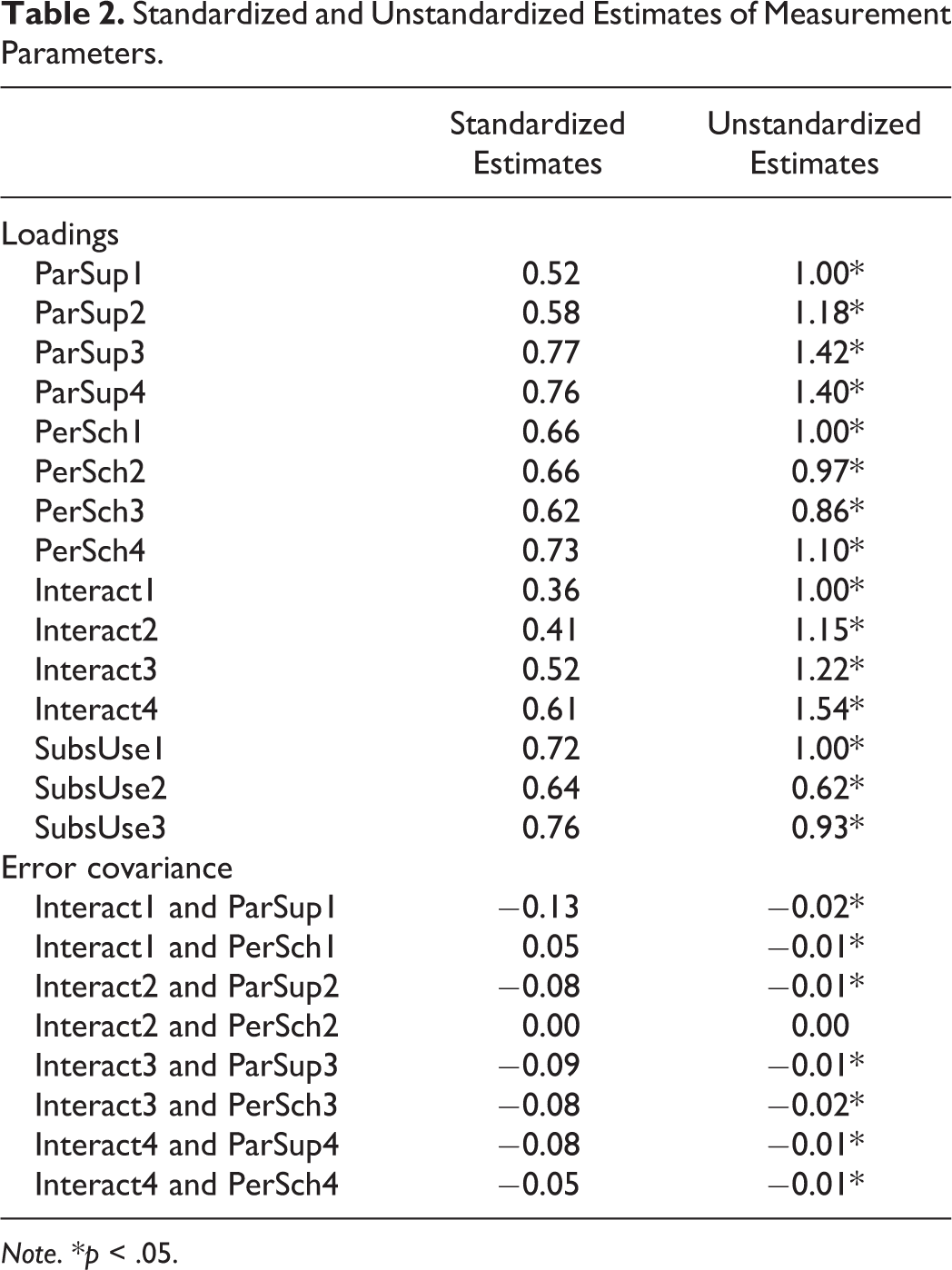
The quality of the latent factors was assessed via two types of measures for validity and one type of measure for reliability. Table 2 contains the standardized and unstandardized loadings for the measurement portion of the model. All loadings were statistically significantly zero for measured variables expected to reflect their respective latent factors. There were no statistically significant cross-loadings for measured variables, indicating that the measured variables were reflective of only the factors they were intended to measure. Validity was examined further by calculating the percentage of variance extracted for each latent variable in the model. The percentages of variance extracted for each latent variable were 44.60%, 44.73%, 23.32%, and 50.13% for Parental Support, Perception of School, the Interaction Effect, and Substance Use, respectively. These were all considered acceptable values indicating adequate validity for the factors with the exception of the interaction effect, which was expected.
Standardized and Unstandardized Estimates of Measurement Parameters.
Note. *p < .05.
Reliability was examined by calculating Coefficient H (Hancock & Mueller, 2001) for all the latent variables. Coefficient H is an estimate of how the factor is expected to correlate with itself overtime (Mueller & Hancock, 2010). Coefficient H values for Parental Support (Coefficient H = 80.82%), Perception of School (Coefficient H = 76.83%), and Substance Use (Coefficient H = 75.8%) were all high, indicating that the factors for the current study are expected to be stable. Reliability for the interaction effect was slightly lower than desired (Coefficient H = 56.5%), but this is expected when estimating interaction effects.
Discussion
The current study examined the relation between parental support, perceptions of school, and substance using SEM. The results from the SEM indicated that the proposed model is one tenable explanation for how these variables relate to one another. Interpreting the individual structural paths, it was found that both Parental Support and Perceptions of School together explained a statistically significant amount of variances in Hispanic youth’s Substance Use as characterized by marijuana use, alcohol use, and cigarette use (R 2 = .176). The results of the analyses also showed a statistically significant interaction effect between the two factors Parental Support and Perceptions of School on Hispanic adolescents’ substance use. More specifically, as parental support increased, substance use decreased. However, this relation was moderated by perception of school in that as parental support increased students with high levels of school perception were less likely to use illicit substances, whereas parental support had little influence on substance use for students with low levels of school perception.
Hispanic students’ substance use could be influenced by the degrees of parental support and moderated by their perceptions of schools. Students whose parents are not that supportive or helpful with their schoolwork are protected from substance use by having a more positive perception of school. In other words, students’ perception of school is found to be a moderating effect from parental support on students’ substance use. These findings are consistent with a previous study (Pilgrim et al., 2006).
Implications
Based on the results found in this study regarding the interaction effect on Hispanic students’ substance use, parents and schools could both start to take more responsibility in preventing Hispanic students’ substance use. Since the perception of school serves as a moderator in the relation between parental support and substance use, Hispanic students would potentially benefit from some programs that could improve their perceptions of schools. For example, school personnel interested in targeting Hispanic students’ substance use could provide opportunities that extend beyond traditional clubs and other activities as a way to engage students in schools. At the very minimum, school personnel could attempt to improve the perceptions of students about their school by establishing a more trusting and engaging school climate that is inclusive of all students despite race, ethnicity, and culture or other cultural factors. Considering the fact that within the sample of this study, there might be a great portion of Hispanic students who are new immigrants to this country, a lack of positive perception of school might be a major factor for this group of students to adopt less favorable ways of coping with their adjustment to a new school environment. Consequently, creating a welcoming environment may nurture students’ positive impression of their school experience.
Besides school environment, a very important factor that cannot be ignored when working with Hispanic youth is their families. Previous research suggested that family attachment has a direct negative relation with minority adolescents’ substance use (Peterson, Buser, & Westburg, 2010). Parental support was found to be a protective factor in this study. Typically, Hispanic parents are encouraged to be more involved and supportive in their children’s lives (Prado & Pantin, 2011; Vaughan et al., 2011). In Hispanic culture, family functions as a primary support of treatment for adolescents with substance use disorders (Cannon & Levy, 2008). It is suggested that families be incorporated into the treatment process when working with Hispanic adolescents with substance use disorders. The following strategies are some of the examples that practitioners may find useful in working with Hispanic adolescents.
First, the strategic structural systems engagement (SSSE) approach was well studied and appeared to be the most effective approach in engaging both families and adolescents (Cannon & Levy, 2008). This approach was designed to address the interactions among family members that would decrease their engagement in the treatment process. The SSSE approach also suggested a strategy for overcoming parental resistance by processing parents’ own perspectives before restructuring them.
Another treatment method is a multidimensional family therapy (MDFT) approach, which includes four major areas of intervention: the intrapersonal and interpersonal functioning of the adolescents, the intrapersonal and interpersonal functioning of the parents, parent–adolescent interaction, and families’ interaction with sources outside of the family (Schmidt, Liddle, & Dakof, 1996). The MDFT approach is considered a comprehensive and empirically supported family-based treatment method for adolescents with drug and behavior problems. This method has been applied in a variety of community settings targeting ethnically and linguistically diverse populations and tested in several randomized efficacy studies (Liddle, 2002).
Another suggestion for practitioners is to borrow from a multiparent family-based prevention group entitled “Familias Unidas” that was developed to decrease the risks and enhance protective factors against substance use among Hispanic adolescents (Prado & Pantin, 2011). This program was tested and from the results it is suggested that parents could learn how to collaborate as a team and increase their investment in their kids’ lives. It is better to use this program as a preventative strategy instead of a remedial strategy and it is specially designed for Hispanic immigrants rather than U.S.-born Hispanics (Cannon & Levy, 2008).
Besides, Santisteban et al. (2003) presented a Brief Strategic Family Therapy model for Hispanic families whose adolescents struggle with both substance use disorders and behavior problems. A major goal for the therapists is to help the family restructure their interaction patterns and it seems to work better with adolescents in the earlier stage of substance use.
It is important to note that cultural considerations need to be made when promoting parental involvement among Hispanic families (Cannon & Levy, 2008; Prado et al., 2008). Considering the important role of families in Hispanic culture, therapists are suggested to engage families into the treatment process in a culturally appropriate way (Cannon & Levy, 2008). Some suggestions include becoming aware of the sociopolitical issues that might prevent immigrant parents from investing in the adolescents’ life. These may include cultural immigration issue, incompatibilities between their original culture and American culture, social isolation, social injustice, and possible discrepancies of the acculturation levels between parents and adolescents (Prado et al., 2008).
Limitations
Although the results in this study show statistical significance, the findings should be taken with caution due to the large sample size, and other possible explanations for why these variables may be related (including variables that were not measured by the NSDUH). Although validity and reliability values were in acceptable ranges, several factors might have limited the validity and reliability of the results found in this study. First, the participants in this study include students from all different Hispanic backgrounds. The within-group heterogeneity in Hispanic culture should be considered when applying the results of this study to decision or policy making in regard to the whole Hispanic student population.
Second, due to the self-report nature of the survey used among the participants, there is a possibility that the participants underreport their substance use in order to avoid parental punishment or simply to present themselves in a socially desirable way. Therefore, the results of the study might not truly represent the real experiences of Hispanic youth substance use.
Finally, previous research has revealed that cultural context (e.g., adaptation stages and social economic status; Martinez, 2006; Szapocznik & Kurtines, 1993; Unger, Ritt-Olson, Wagner, Soto, & Baezconde-Garbanati, 2009) and self-image of the Hispanic youth (Mouttapa et al., 2009) were found to influence the degree of substance use among this population. The current model in this study does not take all these factors into consideration. This might have hindered the power of the model in explaining the variances of the endogenous variable.
Conclusion
In this study, SEM was used to investigate two factors (perception of school and parental support) and the interaction effect between them in predicting Hispanic youth’s substance use. The findings underscore that both the Hispanic students’ perception of school and the amount of support they get from their parents play a critical role in their substance use behavior. Future studies could further this line of research through adding other factors to the model that might better explain substance use behavior among Hispanic youth.
Footnotes
Declaration of Conflicting Interests
The author(s) declared no potential conflicts of interest with respect to the research, authorship, and/or publication of this article.
Funding
The author(s) received no financial support for the research, authorship, and/or publication of this article.