



Abstract
Home-based family counseling (HBFC), also described as “intensive in-home” or “Multi-Systemic” therapy, has been utilized since 1990 and is a growing market trend. However, this modality has only recently become an accepted counseling practice. Currently, there are no professional guidelines for HBFC interventions. Even among accredited counseling programs, it seems that little training is offered specific to HBFC programs and too often in-home interventions are executed by paraprofessionals with little to no formal counseling training. This article will clarify the role of counselors within this growing practice, explore the ethical and multicultural implications of HBFC interventions, and provide an opening for the profession to begin to discuss the professionalization of home-based interventions.
Keywords
Family counseling is a long recognized and well-researched field of counseling that has undergone similar historical and theoretical changes seen in other counseling specializations. One of the more recent trends in family counseling arises out of the social work tradition and serves children and families in crisis. This counseling milieu, described as Home-Based Family Counseling (HBFC) or intensive in-home counseling, is unique in that the counseling is conducted within consumers’ homes and involves significantly more face-to-face time than is typical of traditional outpatient family counseling. Ostensibly, HBFC is a children’s mental health service since the child is the identified client. While the child or children in the home are the identified clients, treatment plans are developed to address issues as they manifest within the family system as well as intervention plans specifically developed for the identified child or children. Further, treatment plans are monitored by state-funding agencies and elements of the treatment plan itself may be state mandated (Hoagwood, 2005).
HBFC is unique in a number of substantive ways (Sheidow & Woodford, 2003), which will be described here, and we would argue that these differences distinguish this form of counseling enough to warrant a formal professionalization of the practice. In the following article, we will offer an argument for professionalization, and we will suggest opening a dialogue concerning what professionalization of home-based interventions would look like by offering initial recommendations and guidelines. It is our goal to consolidate recommendations made by other authors, offer our own ideas, and to open the discussion to ideas and comments from the professional counseling community at large. In this way, this article is not designed to offer a comprehensive look at HBFC or to provide a complete review of the literature, but to provide enough information to invite discussion.
Defining Terms
Professional Counselors
The title counselor has been and continues to be used to refer to professionals, paraprofessionals, and nonprofessional workers. The American Counseling Association’s (ACA, 2010) governing counsel in October 2012 defined counseling as “a professional relationship that empowers diverse individuals, families, and groups to accomplish mental health, wellness, education, and career goals.” However, for the purposes of this article, professional counseling refers to work done by licensed counselors and individuals who have matriculated with a master’s degree in counseling and are in their residencies.
Professional Counselors in Training
This designation refers to students who are in the process of completing a master’s program in counseling. These students (a) have completed all coursework, (b) are currently completing the supervised internship phase of their studies, and (c) benefit from in-house and university supervision. In some cases, students may be in the process of completing coursework if previous training and qualification makes them eligible to provide in-home services; private agencies have some flexibility to hire a small number of individuals in this capacity.
Paraprofessionals
Paraprofessionals, on the other hand, are those who have experience working as helping professionals in a variety of positions, such as case management, mental health support, mentoring, and so on, and hold undergraduate degrees in the humanities (education, psychology, social work, sociology, etc.). Paraprofessionals, for the purposes of this article, include individuals who receive direct supervision from licensed professionals (counselors, social workers, or clinical psychologists) and who have had training relevant to their work, such as workshops, participation in conferences, or informal training from their organizations.
Nonprofessionals
Nonprofessionals include those who carry the title counselor as a part of their job descriptions but do not provide mental health services and are not directly supervised by professional counselors. An example of a nonprofessional counselor might be a person who holds a camp counselor position. However, more germane to this discussion are the nonprofessionals serving in positions in which they provide mental health support but do not benefit from supervision from a licensed counselor or who have no formal or informal training in mental health services. We assert that persons providing mental health services with little or no training should be categorized as nonprofessionals.
Virginia regulations have recently raised the standards for qualification to serve adults, children, and adolescents, a professional status known as Qualified Mental Health Professionals. These requirements have included increased levels of relevant education and direct experience in the mental health field. These new regulations preclude state reimbursement for services provided by those who have not met these standards, something that may help to decrease the number of nonprofessionals serving at-risk families (Department of Behavioral Health & Developmental Services, 2012).
In the current state of the practice of HBFC, individuals from each of the four categories, professionals, professionals in training, paraprofessionals and, to a lesser degree, nonprofessionals, are currently filling the role of counselor within the home-based setting. We argue that the complexity of family counseling, the knowledge and skill required to intervene effectively with multistressed families, and the vulnerability of this population necessitates skilled, professional intervention.
Home-Based Interventions
Home-based counseling is an intervention that takes place in the consumers’ homes and is designed to work with the entire family (in contrast to interventions that work exclusively with either children or parents). Home-based interventions aim to assess and treat families, generally at the request of social service or child welfare agencies (Berg, 1988; Boyd-Franklin & Bry, 2000). In our experience, HBFC entails 4–6 hr of face-to-face therapeutic intervention per week in the consumers’ homes. Other estimates place this number at two to three home visits per week for as much as 4 hr per visit. As a rule, HBFC is time limited, spanning a 3- to 6-month period. During this period, the home-based family counselor is available to the family 24 hr a day, 7 days a week (Lawson, 2005; Lawson, & Foster, 2005; Stinchfield, 2004; Woodford, Bordeau, & Alderfer, 2006).
Frequently, families receiving home-based services struggle with stressors related to poverty, substance abuse, family violence, and physical and mental illness (Boyd-Franklin & Bry, 2000; McCurdy, Gannon, & Doro, 2003) comprising a special population deserving of our attention. Furthermore, HBFC interventions are often an intervention of “last resort” and are implemented in order to address immediate crisis, reduce family violence, address concerns of child abuse and/or neglect, and to preserve families in order to prevent foster-care or other out-of-home placements (Stinchfield, 2004). Consequently, this is a high-stakes form of intervention requiring careful attention from the profession. We approach home-based interventions from our local frame of reference born out of significant personal and professional experience with this form of intervention in Virginia. Our assertions are necessarily based on our experience of HBFC in Virginia and more specifically in our local community. However, recent experience at the ACA conference (Czyszczon, & Hammond, 2011) suggests that many of the issues we raise are present for home-based family counselors across the nation.
Professionalizing the Field
What would it mean to professionalize HBFC? The counseling field has professionalized a number of specialized services, for example, addictions, crisis and trauma, child and adolescent, and marriage and family counseling. We argue that HBFC is distinct from addictions, crisis, child and adolescent, and marriage and family counseling precisely because each of these elements is intricately woven into HBFC to create a unique field of counseling.
For the purposes of this article, professionalization means that standards for ethical practice have been established, including those for training and specialized knowledge and skills, and have been endorsed by recognized professional organizations. Professionalizing HBFC as a subfield of mental health counseling would necessitate an open discussion among members of the profession, the goals of which would include: (a) to define HBFC and recognize it as a distinct counseling specialty, (b) to describe the necessary skills and competencies needed to implement home-based interventions, (c) to offer standards for supervision of home-based counseling, (d) to consider the social justice and ethical considerations posed by HBFC, and (e) to recommend research into the efficacy of HBFC.
This process is necessary in order to distinguish HBFC from other forms of family counseling and to clarify the differences between social work and counseling roles within the home setting. Elucidating the necessary skills and knowledge to be an effective counselor in the home setting is essential. Including home-based competencies within the Council for Accreditation of Counseling & Related Educational programs (CACREP) requirements for training counselors in family counseling is imperative. Further research into the efficacy of HBFC is also essential. Guidelines for the supervision of home-based counseling need to be developed and more fully articulated within the field, and finally, the counseling profession must recognize the vulnerability of clients receiving home-based counseling and include this population in our advocacy efforts.
Distinguishing HBFC From Traditional Family Counseling
Families receiving in-home counseling tend to have greater needs and are at greater risk than families who are seen in more traditional settings (Keresman, Zarski, & Garrison, 1997, in Lawson, 2005). Families who participate in this service are often involved with social services, juvenile justice, and other mental health providers. For example, outpatient counseling may have been attempted but may have been deemed insufficient to meet the child’s and family’s needs.
Socially Just Intervention
HBFC carries with it implications for social justice. Disparities exist in how home-based services are distributed to children in need. Data demonstrate that while White children are more likely to receive in-home services, Black children in similar circumstances are more likely to be placed in foster care (Roberts, 2002). A review of the literature demonstrates that once in foster care, Black and Latino children are less likely to be reunified with their families and are also less likely to exit foster care into adoption (Becker, 2007). For this reason, it seems that children of color with critical needs may be better served while at home than in alternative placements such as foster care or residential facilities. A key component of professionalizing the field of HBFC may include macro-level advocacy competencies (Hendricks, Bradley, & Lewis, 2010; Ratts, Lewis, & Toporek, 2010) for the preservation of families.
Placement trends like those mentioned above also point to the importance of identifying highly effective HBFC interventionists who hold multicultural competencies specific to home-based therapies (Allen-Portsche, 2008). These trends also suggest that the provision of competent services represents a social justice imperative, particularly for families struggling with difficulties related to poverty. These may include a range of skills, knowledge, and awareness from helping clients to make meaning of their circumstances to challenging the counselor’s bias toward upward mobility, when present (Liu & Estrada-Hernandez, 2010).
Possibly one of the most glaring distinguishing features of the home-based interventions lies in the training requirements of the counselors who provide those services. The high standards of training placed on specialists in marriage and family counselors and the lack of training requirements specific to home-based workers offers an implicit distinction within the professional counseling field, within the ACA and CACREP themselves that suggest a lack of careful attention to the critical nature of this work.
Training and Essential Competencies
Researchers have been calling for counselor training programs to include home-based competencies in their curriculum (Cortes, 2004; Woodford et al., 2006). At least one attempt has been made at formalizing training for the home-based setting (Mattek, Jorgenson, & Fox, 2010), indicating an emerging recognition of the need for training standards for in-home counseling modalities. Failing to insist on the same high standards in training home-based versus traditional family counseling may send a message that the counseling profession places less value on the families served in the home than on those who receive services within a traditional outpatient setting and harkens back to less enlightened times. This article is a call to action and a call for social justice and equity for multistressed families.
Establishing Training Standards
For some time, counselor-training programs have neglected to offer the skills necessary for providing HBFC services. Others have expressed concerns that relevant skills have not been offered in a way that can be easily translated to work within the home setting (Stinchfield, 2004). In addition to the basic counseling skills required to provide traditional individual, group and family counseling, home-based counselors must be prepared with additional skills to support their work (Adams & Maynard, 2000).
In her qualitative research, Stinchfield (2004, p. 296) interviewed professionals providing HBFC and found that participants seemed to feel that their own training programs had focused on knowledge and assumed that students would “get [the application] once they leave school.” Other participants expressed concern that their training had been fitted to traditional counseling but had not been relevant to the challenges and unique qualities of the home-based setting. This research highlights the importance of training directly related to HBFC settings and reflects the concerns raised in the field.
Adapting CACREP Requirements to Fit the Home-Based Setting
Stinchfield’s (2004) participants raised concerns that the training they had received had not translated well to the home-based environment. Efforts should be made to examine how skills and knowledge already established by our accrediting body, CACREP, can be modified and expanded to meet the training needs of future in-home counselors. An important example of knowledge and skills that should be elaborated upon to establish relevancy in HBFC are the knowledge, awareness, and skills central to effective multicultural counseling. Standards for training in family intake, treatment plan development, and culturally sound intervention all require special adaptations when working with families in their homes. Among the standards for training that seem critical and particularly relevant to HBFC include, but are not limited to, assessment of crisis and crisis needs, knowledge and skill in assessing trauma and trauma needs, advanced knowledge and skill in cultural competencies such as working with families in poverty, gender issues, and avoiding the culture of poverty perspective when working with clients. An expanded list is included in Table 1.
Table of Proposed Competencies.
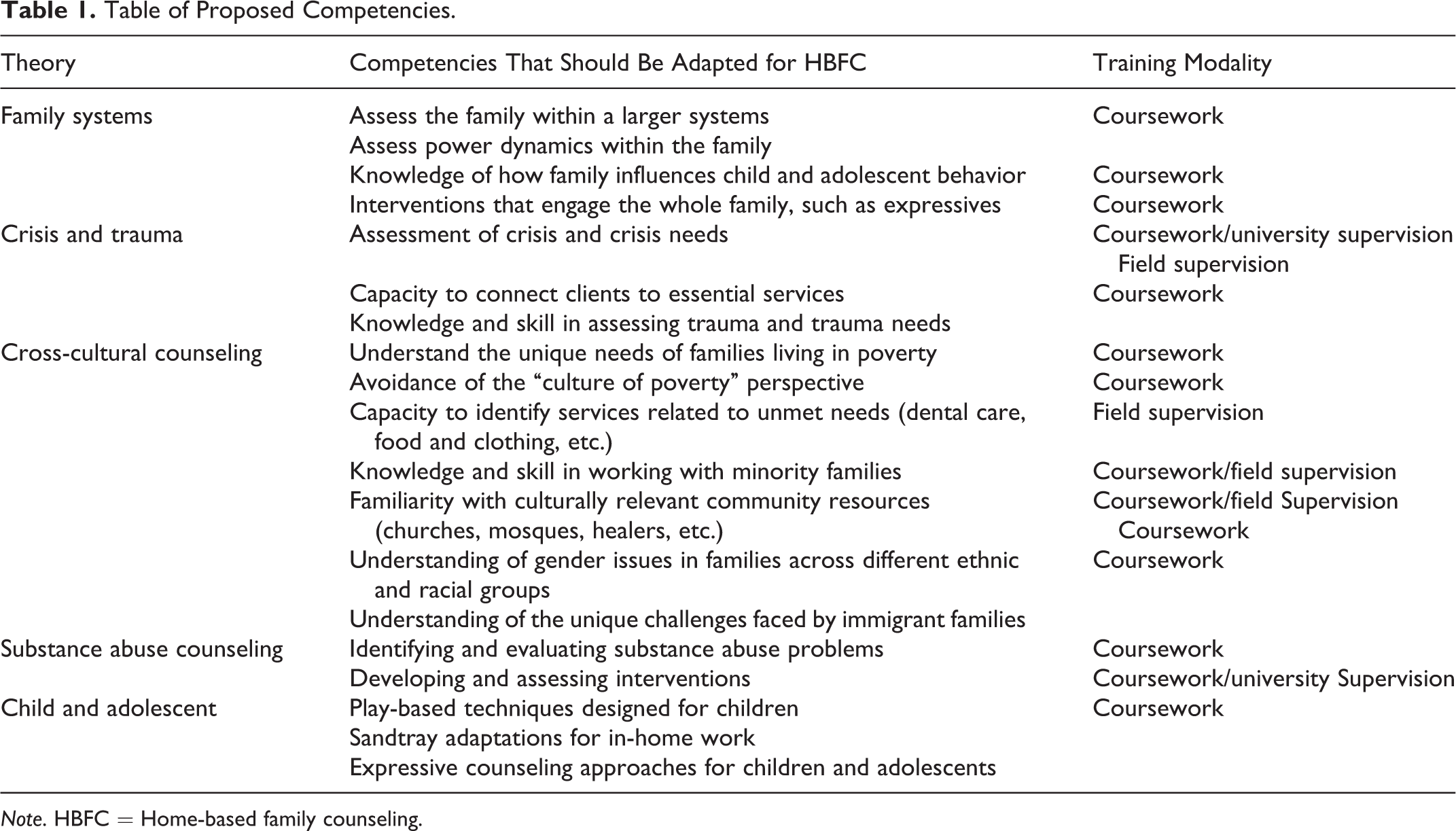
Note. HBFC = Home-based family counseling.
Explorations Outside of CACREP Standards
A number of key differences necessitate the addition of new competencies including such concerns as the use of space, confidentiality, responses to physical or verbal threats to the counselor, and so on. We call upon the ACA membership and those serving or supervising HBFC to expand on needed competencies specific to home-based interventions as well as to competencies that need adapting to fit this specialization.
ACA Ethical standards
The ACA provides the ethical standards for the field and are updated periodically to meet changing needs, particularly where new trends provide additional challenges. It is our assertion that the ACA code of ethics must be updated to give greater relevancy to the in-home setting. An important example of ethical standards that may require consideration pertains to gifts. Some counselors prefer to exchange no gifts at all and consequently are reluctant to accept a drink of water when in their clients’ homes. The difficulty here is that when we enter another’s home but insist that we operate strictly from ethics established for the more traditional settings, we are likely to act with cultural insensitivity or even to invite shame or insult. A healthy therapeutic relationship in the home setting may follow a shared cup of coffee or tea in the consumer’s home. We assert that in-home counselors should be allowed to weigh this option against its potential harms and to make informed decisions about accepting a drink, for example, without risking an ethical violation.
Guidelines for Supervision
We agree with other authors who argue that in order to assure that at-risk families receive quality services counselors in training must be equipped with necessary skills and competencies (Lawson, 2005; Stinchfield, 2004). A key value of counseling profession is quality supervision within the training process (Bernard & Goodyear, 1998) and we assert that this value should extend to trainees providing services within consumers’ homes.
Supervisors overseeing HBFC have unique responsibilities to their supervisees owing to the intensity of the work; at the same time, they experience unique challenges depending largely upon the organizational matrix in which they function. First, as there is no supervision model designed specifically for HBFC, each agency develops its own standards in accordance with state regulations. While such an approach could lead to innovation and better outcomes, in practice, it allows for a level of variability across agencies that may be seen as ambiguous or arbitrary to outside constituencies (social services, school systems, court systems, etc.). Some level of standardization is necessary so that the general public, consumers, and those who refer clients know what to expect from mental health agencies serving children and families under their care. More pressing to our field is that the lack of supervision guidelines leaves counselors at risk and clients subject to substandard care. Additionally, since we have no model and few standards for in-home supervision, those in supervisory roles may or may not have worked as in-home counselors themselves. Where such a scenario exists, it can present exceptional challenges for informed supervision, given the significant differences between HBFC and other forms of child and family counseling.
To ensure that the needs of counselors are being met, supervisors of HBFC have 24/7 responsibilities. Most often, this manifests in crisis phone calls after normal business hours. A significant challenge of HBFC overall is that many critical incidents take place primarily between the hours of 3 and 8 p.m., and supervisors remain unofficially on call during these time (Lawson, 2005). Such a reality places additional stress on supervisors.
Surely, the availability of supervisors to their supervisees is crucial. Therefore, supervisors should have a limited number of supervisees and a limited number of families on their supervisory caseload. For example, the Commonwealth of Virginia allows each supervisor a maximum of 10 supervisees who could collectively carry as many as 50 cases. Whether or not such a caseload for a supervisor is appropriate likely depends on the experience of the supervisor; however, such high numbers make it challenging for supervisors to be available to families if needed.
We would like to open the discussion with the following recommendations for developing relevant supervision standards and competencies for HBFC. First, supervision must be a core value of agencies serving families through HBFC, and significant organizational resources should be devoted to that practice. Second, supervisors of HBFC should have sustainable workloads that provide them adequate flexibility to meet the needs of their supervisees. Third, supervision should be developmental with regard to individuals’ level of training and experience; those new to HBFC necessarily require more supervisory time, and those more experienced may require less. Fourth, supervisors must be available to the families on their caseload when needed, particularly if live supervision is to be possible (Lawson, 2005). Fifth, supervision should be provided by licensed providers only. Sixth, videotaping should be used as a supervisory tool. Seventh, supervisors should meet and assess the family at the opening of services, and, finally, supervisors should themselves have provided HBFC.
Advocacy
Home-based counseling services are provided to families that often have difficulties advocating for their own needs and struggle or are reluctant to identify needed services (Newton & Sprengle, 2000). Advocacy for multistressed families is urgently needed in order preserve the integrity of poor and minority families in crisis and for the communities in which they live. An essential element of effective advocacy would include more aggressive efforts to recruit minority students in counseling training programs, particularly those with fluency in Spanish, French, German, and Russian, the five most common languages spoken in the United States, other than English (U.S. Census Bureau, 2007). Creating incentives for counselors and counselors in training to gain fluency in a second language is also vital. Further, the use of trained and qualified translators is desirable when translation is necessary.
The Need for Research
Currently, there is a lack of research supporting the efficacy of HBFC (Cortes, 2004; Lawson, 2005; Stinchfield, 2004; Woodford et al., 2006). There is a growing body of literature describing the efficacy of specific models of family counseling which use the home as a primary milieu. Many of these models have shown promise including multisystemic therapy, multidimensional family therapy, and functional family therapy. These models have shown particular efficacy in reducing recidivism (Schaeffer & Bourduin, 2005), addressing substance abuse concerns (Gordon, Graves, & Arbuthnot, 1995; Liddle, Dakof, Turner, Henderson, & Greenbaum, 2008), and have been used with success with other presenting problems. It may be important to note that there is some research to suggest that inconsistencies and errors in research design may have overestimated the efficacy of multisystemic therapy (Littell, 2005), however.
Despite this body of research, we believe there is a critical need to discover whether or not organizations that serve families in the home are making use of formal, evidence-based models or are operating on ad hoc approaches, idiosyncratic to each agency rather than theoretically informed practice as we have observed broadly. Further, if indeed organizations are making use of ad hoc practices, the efficacy of these interventions is in need of examination. Research exploring HBFC supervision practices is sorely needed. Finally, a better understanding of the lived experiences of those serving consumers and the experiences of the consumers themselves would benefit the field.
Conclusion
It has been our intention to call for an open discussion within the counseling profession about HBFC and to promote the need for professionalization. The collective knowledge of the members of ACA is needed to assure the ethical implementation of counseling interventions with vulnerable and high-risk populations. We hope this article will open the topic to frank discussion, not only to the topic of professionalization, but to the necessary training standards and companion ethical codes.
Footnotes
Declaration of Conflicting Interests
The author(s) declared no potential conflicts of interest with respect to the research, authorship, and/or publication of this article.
Funding
The author(s) received no financial support for the research, authorship, and/or publication of this article.