




Abstract
Alfred Adler’s wisdom regarding the major life task of love and intimacy is extremely relevant in today’s world of fragile marital relationships. The need to promote a feeling of significance and a sense of belonging is under attack from inadequate preparation, education, knowledge, and interpersonal skill development regarding the important life task of love and intimacy. Alfred Adler stated, “Of all the institutions which have been developed to better the relationship of sexes, co-education is the most important.” Obviously, he was acutely aware of the importance of mutual respect, cooperation, and encouragement that is necessary to meet the needs of one’s spouse to ensure an enriched lifetime relationship. This article discusses the need for optimal process as well as the benefits of developing a premarital program that aims to help prepare and equip couples for the rigors and joy of a lifetime commitment.
Studies from The National Marriage Project (University of Virginia, 2012) indicate that trends in marriage have been changing over the last several decades. For instance, today couples are choosing to marry at an older age or not at all. The number of cohabitating couples is increasing, and more children are being raised in solo-parent households. This trend has been associated with a number of recent social developments. For instance, in 1969 when Ronald Reagan was the governor of California, the state instituted the first no-fault divorce law. The intent of the law was to eliminate strife and deception, but as almost every state adopted a similar law, the divorce rate over the next 20 years almost doubled.
President Reagan later remarked that in retrospect this law was one of the biggest mistakes of his political career. This divorce revolution peaked in the 1970s but left a poisonous legacy in which the perception of the institution of marriage was damaged for many. The damage was also felt by many, especially the children of divorce. In fact, The National Marriage Project (2009) also indicated that the sexual revolution of the 60s and 70s contributed to an increase in the incidence and acceptability of extramarital affairs and most likely still affects the state of marriage to some extent even today. Additionally, an increased recent emphasis on “individualism” and “self-fulfillment” has appeared to increase the attitude of, “what is in it for me?” (Markman, Stanley, & Blumberg, 2010; The National Marriage Project, 2012).
While the divorce rate appears to still linger around the 50% mark, research indicates that it can be significantly decreased by particular factors (Bachand & Caron, 2001; Duba, Hughey, Lara, & Burke, 2012; Henry, Miller, & Giarrusso, 2005). As noted in Table 1, some factors appear to be resources and antidotes for marital success or at least the prevention of separation. For example, if both partners have some education (which can provide them with a means to make a decent living); if they have religious beliefs, come from an intact family, and have not already started a family; and their chances of success are greatly improved (The National Marriage Project, 2012).
Factors That Contribute to Marital Success and Decrease the Risk of Divorce.
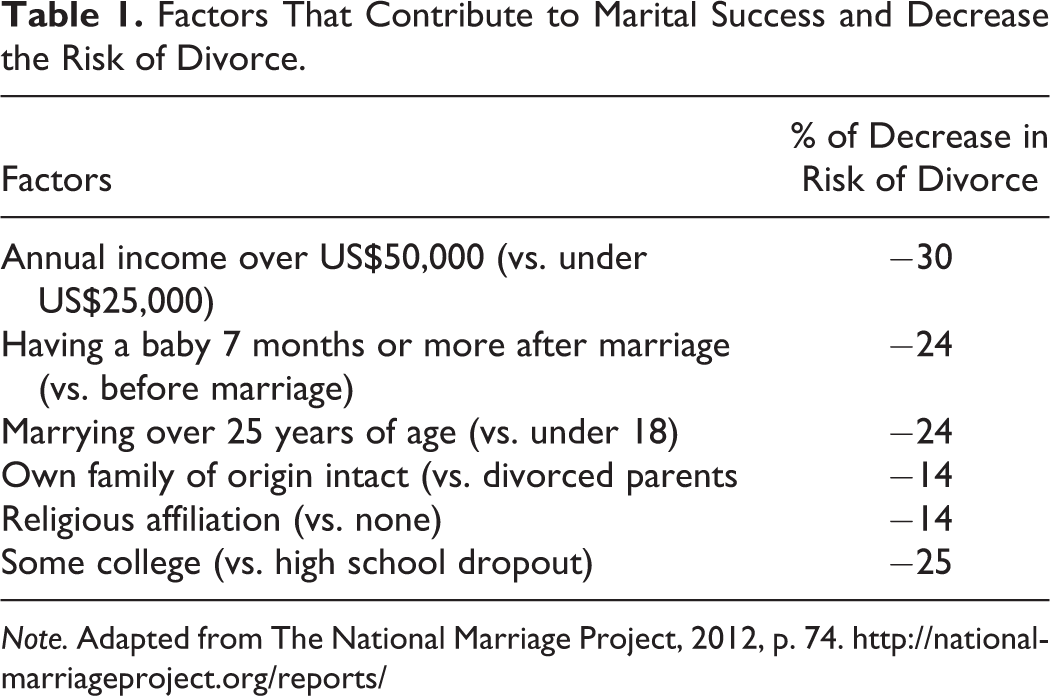
Note. Adapted from The National Marriage Project, 2012, p. 74. http://nationalmarriageproject.org/reports/
What does all of this mean for counselors and family educators? First, those working with couples are behooved to consider what message they are perpetuating. For example, instead of warning dating couples about the 50% divorce rate, couples may be instead encouraged that the chances for divorce are much less than they previously have been led to believe. Perhaps an additional emphasis is placed on how couples can model after “masters of marriage” rather than focusing on “not getting divorced.” Such emphasis and education will likely install hope and motivation, rejuvenate resources, and increase their chances for as well as enjoyment of success. The purpose of this article is to introduce a premarital program aimed at preparing couples with the skills and knowledge required to proactively enter this most sacred and important relationships. The Marital Preparation Program is founded on the authors’ belief that marriage is important and a relevant construct for healthy living, creating, and sustaining a cooperative society, and for religious couples, in particular, for engaging in the sacraments. Prior to describing the program, a brief review of marital satisfaction and Adlerian principles will be discussed.
Ingredients of Marital Satisfaction
Jon Carlson, Adlerian and Distinguished Professor at Governors State University, stated in the forward of Glasser and Glasser’s (2007) Eight Lessons for a Happier Marriage that, “We each become very clear about what our partner needs to do to improve but seem oblivious of the need to change ourselves” (p. xviii). Individuals appear to benefit greatly by asking themselves the following question: “What would it be like to be married to me, and what can I do to bring out the best in my spouse?” It helps to consistently be a “talent scout,” seizing opportunities to share mutual appreciations each day and refraining from negativity. Seizing opportunity insinuates that partners engage in particular behaviors, even when it is difficult to do so (i.e., stress, marital disagreements). Such behaviors might include (a) making positive reframes, (b) responding empathetically, (c) maintaining awareness of spouse’s perspective and feelings (Duba et al., 2012; Fincham, Paleari, & Regalia, 2002), (d) engaging one another positively (rather than violence or withdrawal), and (e) incorporating optimism (Ptacek & Dodge, 1995; Whiting & Crane, 2003). Behaving in the above mentioned ways also implies particular individual dispositions such as respectfulness, patience, loyalty, commitment, ability to cope with stress (i.e., self-soothing), and perhaps even moral values and/or religious affiliation (Bodenmann & Shantinath, 2004; Bryant, Conger, & Meehan, 2001; Duba et al., 2012; Duba & Watts, 2009; Fincham & Beach, 2002).
Mother Teresa once stated, “Loneliness and the feeling of being unwanted is the most terrible poverty.” When partners are engaged in “turning toward” each-other behavior (Gottman, 1999) such as the aforementioned, the sharing and expansion of intimacy becomes possible. This foundation of closeness provides safety in sharing experiences and aspects of emotional, mental, physical, sexual, spiritual, social, and intellectual self (Heller & Wood, 2000). Furthermore, intimacy provides a medium from which to communicate commitment and interest and to further perpetuate a satisfying relationship.
A condensed, yet, concise list of prescriptions for marital satisfaction and intimacy may include the following: Consistently taking an active interest in one’s partner’s life through intimate interactions (Duba, 2010). Treating one’s partner with respect—always “seeking first to understand.” Helping one’s partner feel significant and focusing on his or her positive attributes (Canary & Stafford, 1992; Weigel & Ballard-Reisch, 1999). Learning to deal with conflict in a gentle, positive way that softens anger and promotes compromise and a sense of teamwork (Gottman, 1999; Ptacek & Dodge, 1995; Whiting & Crane, 2003). Developing hopes and dreams that engage both partners in working toward a mutual future and a life that matters (e.g., “What will our legacy be?; Gottman, 1999). Refraining from using criticism that too often leads to defensiveness, contempt, and stonewalling (Gottman, 1999). Regularly performing self-checks that include reflections on how well or often the above behaviors are being implemented, seeking personal growth or self-care opportunities (i.e., counseling, yoga, etc.) when needed.
Marital Cooperation—An Ingredient for Satisfaction and Intimacy
Cooperating couples are using their personal characteristics for the betterment of the relationship. They are interacting in the “pro-relationship” behaviors noted previously. How marital cooperation develops and is maintained depends on various factors. First, similarities or the ability to navigate the differences between each other’s lifestyle or beliefs, attitudes, and convictions is relevant particularly as the couple maintains and nurtures their friendship as well as works toward a future together (McCurdy, 2007; Powers & Griffith, 2011). Cooperating couples will seek to understand how the larger system impacts their own and each other’s lifestyles and will use this insight to the benefit of the relationship. Second, all behavior is purposeful. Adler stated that, “It is impossible to understand another individual if it is impossible at the same time to identify oneself with him” (1927, p. 59). Cooperating couples seek to understand themselves, namely how their behaviors promote or contradict the marriage. Third, Adlerians believe everyone is creative and self-determining. Partners who choose to change behaviors for the good of the relationship will serve to strengthen the cooperation.
The Marital Preparation Program
The Marital Preparation Program was designed by Dr. Mark J. Britzman in 1993 and has evolved significantly with the help of new data regarding facilitating and detracting forces related to marital enrichment. (See www.pursuingthegoodlife.com.) The impetus of the program was to combat the corrosive environment and remedial interventions related to conducting couple counseling. The incorporation of Alfred Adler’s wisdom and preventative and strength-based approach have also made this program much more effective and enjoyable. In fact, 94% of participating couples stated that the program exceeds their expectations (Britzman, 2013a). It is common to see statements on the final evaluation such as, “We really just knew that we needed to attend the Marital Preparation Program but it was refreshing and inspiring to remind us the important ingredients and commitment necessary for an enriched marriage rather than focusing on the wedding planning and just believing our marriage will be fine” (B. Albert, personal communication, July 20, 2013).
Since its inception, the Marital Preparation Program grew at a remarkable rate without much marketing. The lack of preventative educational endeavors to increase the likelihood of marital success concurrently with the bewilderment of faith leaders who were tired of blessing fragile marriages created a strong demand for the program. The Adlerian spirit of respect, belonging, significance, and courage provided a sound and consistent theory from which to continue to strength this program including its spiritual and religious elements. The incorporation of engaging activities as well as compelling information appealed to mostly all participants and encouraged the cooperation and/or social interest in one’s partner as well as in receiving feedback from others. The content of the program was created from numerous useful articles published in a special issue regarding marriage and couples counseling in The Journal of Adlerian Theory, Research, & Practice (Bishop, 1993; Corsini, 1993; Greenstein, Carlson, & Howell, 1993; Hawes & Blanchard, 1983).
The purpose of The Marital Preparation Program is twofold. First, through activities and reflection, couples are provided opportunities to enhance their insight into their beliefs about marital satisfaction, the importance of love and intimacy, and its value to both partners and the system as well as how they may fail or succeed in cooperation. Second, the program provides prescriptions for cooperation and marital satisfaction that include activities and questions for reflection as well as opportunities to practice (e.g., role plays). The program aims at bringing awareness to current beliefs and behaviors while also providing educational tools that the couple can use to establish and reach goals (Carlson & Dinkmeyer, 1987).
The program’s structure is very similar to the Adlerian therapy model in that it resembles the four stages of the Adlerian therapy model, namely (a) forming the relationship, (b) relationship assessment, (c) insight and shared meaning, and (d) reorientation to the marriage (Carlson, Watts, & Maniacci, 2006; Dreikurs, 1967). First, participants are oriented to the purpose and objectives of the program. Second, various activities are used to assess the relationship in current time as well as where it may be headed. The program is educational as well as experiential and emphasizes interpersonal and intrapersonal awareness. Couples are encouraged to consider how they are contributing to a vision for the relationship as individuals and as a couple. The program provides opportunities for the couple to become more insightful about how to better the relationship as well as how to incorporate rituals to self-evaluate the relationship. Finally, couples reorient themselves back to the relationship with grounding in what they have learned about themselves, each other, the relationship as well as what skills and knowledge they have gained from the educational portion of the program.
Evolution of the Marital Preparation Program
As of 2013, this program has had approximately 2,000 couples participate. Most couples are referred by one of the largest Protestant churches in the South Dakota area. Seven other churches refer couples on a consistent basis; however, no couple has denied on basis of their beliefs regarding faith and spirituality. Consequently, couples who have differing faith backgrounds and church memberships have participated, including numerous couples who are not involved in any type of organized religion and are self-referred with the desire to strengthen their relational foundation prior to marriage.
The current Marital Preparation has been facilitated by the first author (Dr. Mark J. Britzman) who is a licensed psychologist and nationally certified counselor. Although the program is psychoeducational and the follow-up couple session is rather informal when compared to couple counseling, significant intrapersonal and interpersonal issues can and do arise frequently. Consequently, it seems important that a licensed mental health provider lead the program. In addition, leaders should have a basic foundation of knowledge regarding consultation, collaborating with other professionals, and making referrals. For example, religious couples may benefit from connecting with their religious and faith leaders and may need the assistance and advocacy of the program leader in making these connections. Second, such faith leaders can provide efficient access to information about relevant Biblical references as well as self-help resources that could be helpful to the program leader (Duba, Minatrea, & Kindsvatter, 2008).
Structure of the Program
The Marital Preparation Program has tried numerous variations in terms of content and scheduling. Providing a schedule for busy couples has often been the most significant challenge. It is also imperative to provide the workshop at least 4 months prior to the couple’s wedding date. Couples who do have significant problem too often go through with wedding when deep into the planning stages (e.g., sent out wedding invitations) and are less likely to delay or postpone if serious issues arise and necessitate a more therapeutic intervention.
The current structure of the Marital Preparation Program, which has been found to be most efficient and effective throughout the last 20 years, is to conduct a monthly meeting with the exception of December because of obvious spiritual holidays and rituals. Individual couple sessions are then provided in a more formal mental health office to ensure confidentiality and maximize counselor comfort.
Each workshop session averages 8–12 couples. There is often a varying degree of anxiety at the outset so it is important to clearly state goals and objectives but also create ground rules consistent with an informed consent process in group counseling (e.g., discussion of fees, confidentiality, discussion of process, right to not participate in an activity, etc.). Each person signs a release of information that allows Dr. Britzman to send a summary of couple’s level of engagement, background information, and strengths and possible group leaders to their faith leaders.
Forming the Relationship: Orientation, Introduction, and First Steps
Participants are required or strongly encouraged by their church to attend The Marital Preparation Program at least 4 months prior to their marriage ceremony. Often they are not certain about what to anticipate in terms of the format of the program as well as what is expected of them. In order to establish an agreement on goals (Sperry, 1986), the beginning of the program includes an introduction of program goals and objectives and expectations of participants. The first stage also serves to motivate the couple to begin reflecting on their own relationship. Partners are encouraged to consider one or two behaviors he or she would like to see from the other partner that would communicate concern and love (Duba Sauerheber & Bitter, in press). In addition, particular educational points are reviewed. Finally, the professional leader of the Marital Preparation Program is also interested in establishing a relationship with each couple as well as a context for safety and trust. Thus, the presenter may reflect and disclose his or her own relationship history, professional experiences, and examples of working with couples as well as personal expectations for the process.
Program goals and objectives
The ultimate goal of this program is for couple to practice and engage in seizing opportunities to bring out the best in one another. This is accomplished via the program’s objectives that are focused on helping couples with the following: to fully understand important components that contributes to marital enrichment; to respect and honor differences influenced by gender, personality, family background, and culture; to improve communication skills with an emphasis on optimal and consistent listening; to consistently use encouragement and other loving gestures; to ensure joint agreement related to budget and charitable giving; and to become aware of relationship strengths and growth areas.
Creating safety through some initial icebreakers and activities
The program is organized in a way that begins with safe exercises and then evolves into deeper communication issues around more challenging questions (e.g., “My biggest insecurity about your being married to me is?” etc.). Thus, prior to launching into education points, the very beginning of the program is meant to encourage the couples to begin thinking about their own relationships. Further, while the program has goals and objectives, it is flexible in nature. As a consequence, often couples bridge their reflections on the icebreaker activities with the whole group. In other cases, couples are more private and only share within their dyad.
Couples are asked to consider the following: How did you first react when you found out that your faith leader mandated you to attend The Marital Preparation Program? How did you meet and what thoughts, beliefs and feelings did you have related to one another? How has your relationship been strengthened or weakened? How have you two overcome adversity? What is your optimal vision of an enriched marriage?
These initial couple icebreakers also help dissipate anxiety when couples begin to trust that they are not required to share uncomfortable information about themselves and their partner in front of the group. In fact, while couples are discussing their answer to the above prompts, contemporary music is playing to ensure privacy with discussion and an informal and upbeat mood.
Educational focus
Adler stated, “Of all the institutions which have been developed to better the relationship of sexes, co-education is the most important” (1927, p. 120). Obviously, he was acutely aware of the importance of mutual respect, cooperation, and encouragement that is necessary to meet the needs of one’s spouse to ensure an enriched lifetime relationship. There are various educational points covered during the beginning of the program that highlight these components. couples are taught optimal skills related to listening, understanding, and conflict resolution stimulated by a myriad of questions (see Appendix A); a discussion is initiated regarding future plans and opportunities to create an optimal monthly budget to improve financial management; assess and disseminate communication and conflict resolution process; and a brief summary of developing a “culture of appreciation” is then disseminated to each couple with an opportunity to link to their current relationship (Gottman, 1999).
In order to prompt a discussion, a True/False Quiz is distributed to the group. This quiz includes research findings regarding factors that contribute to or erode marital enrichment. This list includes the “Four Horsemen of the Apocalypse” (Gottman, 2009). After various educational points have been covered, couples are encouraged to reflect upon the following and to discuss their responses: “What would it be like to be married to you?” (e.g., three positive traits or characteristics and one area in need of growth and development).
Premarital Assessment
In this phase, partners take the initial steps toward becoming familiar with not only their own lifestyles but also their partner’s (Duba Sauerheber & Bitter, in press). Information from a lifestyle assessment, for example, will shed light on how each partner’s childhood messages impact intrapersonal processing as well as the interpersonal dynamics that are enacted within the relationship (Dreikurs, 1946, 1967; McCurdy, 2007). In addition, an exploration of the family-of-origin and early recollections also provides information about how each partner engages in mutual social interest and cooperation (Bishop, 1993; Moschetta & Moschetta, 1993).
The assessment can provide an understanding of how and why partners choose to marry. However, the assessment also provides links to potential problem areas or areas where destructive patterns may arise in years to come (McCurdy, 2007; Moschetta & Moschetta, 1993).
Due to the limited time and staff, a complete lifestyle assessment is not used in The Marital Preparation Program. However, the following questions for reflection are posed. Participants are given time to consider their own personal answers as well as time to share them with their partners. The program’s instructor checks with each couple to discuss what they learned about each other, what they learned that will contribute to the success of the relationship, and what they learned about themselves and each other about what problems could possibly surface in the future.
Family life task
What aspects of your parent’s marriage would you like to incorporate in your marriage?
What would you like to do differently when comparing your parent’s marriage to yourself?
What did you believe you had to do to get noticed and/or make your parents proud?
How many siblings do you have and how did they perceive you?
How do you perceive your family life influenced your beliefs and values?
What is it like for each of you to be around your fiancés family?
What is your optimal vision for future family if it could go according to a plan?
Friendships and support
How would you rate your current satisfaction with social support (i.e., friends, family, etc.)?
Where are your friends at in their life development (i.e., are they settled down or still yearning for freedom)?
Tell me about your current and future living situation (i.e., vast majority of couples are living together)
Occupational tasks
If you could create an optimal job description that matches your interests and talents, what would it look like?
What are you currently doing occupationally?
What is your vision for becoming and sustaining job satisfaction?
What types of volunteer and altruistic activities are you involved in?
How will you find optimal life and work balance in the future?
What is your current strategy regarding money management and budgeting?
Wellness and leisure
What would a great day off look like for you?
What do you look forward to regarding leisure and hobbies?
What do you currently do to reduce distress in life?
What wellness activities do you commit to?
Spirituality, religion, and faith
What were your early experiences like with any faith rituals?
What concerns do you have with organized religions and/or their beliefs?
When do you feel close with your higher power/God?
What would an optimal church setting look like for you?
What faith rituals would you want to commit to going forward in your marriage?
If you created your own vows, what would be the essence related to love, respect, and commitment?
Myers Briggs Type Indicator (MBTI)
Each couple is given the MBTI (Briggs & Myers, 1998) followed by an activity to promote respect and further discussions related to differing temperaments and preferences. This activity appears to be one of the most enjoyable in that it entails having each individual physically stand and develop a continuum regarding their preference scores resulting from MBTI (e.g., high extroverts to high introverts). This is followed by a discussion related to possible strengths and irritants of each personality preference as it relates to daily choices in a marital context.
The MBTI is followed by a discussion about their “money personality” and plan to be disciplined. Each couple is asked to determine expected net income and then develop expenditures from a lengthy list (e.g., stewardship, savings, health insurance, housing, food, technology needs, etc.). Each couple is then asked to develop a disciplined plan with an emphasis on financial discipline and saving for the future concurrently with encouragement to stimulate social interest via charitable giving and/or volunteering.
The premarital assessment phase concludes with asking couples to consider the same question for reflection as from the previous stage, “What would it be like to be married to you?” (e.g., three positive traits or characteristics, and one area in need of growth and development). The hope is that couples have learned something new or have an enhanced perspective on each other and the relationship.
Insight and Shared Meaning
At some point in the program, and after various reflective exercises, the hope is that the couple and each partner has gained a better understanding of oneself as well as of the other person. Such insight makes it possible for the couple to make connections between who they are and current challenges in the courtship as well as potential threats to the marriage (Duba Sauerheber & Bitter, in press). Partners are encouraged to begin to take responsibility for how their attitudes and behaviors impact the relationship in both positive and less than positive ways. In The Marriage Program, couples are asked to consider the following: How their different styles of life will likely be in harmony or be potential source of conflict? In addition, the couples are asked to take time to share with each other, the leader, as well as the group any additional insights related to the workshop manual, activities, and deeper reflection. Finally, the couple is asked to write his or her own vow with an emphasis of an ongoing vision and commitment for bringing out the best in one another.
Reorientation to the Premarital Relationship
Dreikurs (1967) referred to the reorientation to the marriage stage as the most important stage of the process. Throughout this process, the leader has been attempting to attend to the couples’ areas of strength and growth as well as what perceptions the couples have about their areas of growth and strength. One major role of the facilitator is to encourage the couple by noting their hard work, their willingness to be open and vulnerable, and normalizing that it is not easy to try different behaviors or to acknowledge areas of growth particularly as they look toward their wedding day (Dreikurs, 1967; Duba Sauerheber & Bitter, in press).
Each couple is encouraged to review and complete a premarital manual that summarizes the workshop information as well as activities. In addition, each couple is asked to take a premarital assessment developed by the first author (Britzman, 2013b). Results from the assessment are automatically e-mailed to the leader and are used to stimulate further discussion in the individual couple’s meeting. This meeting is scheduled shortly after the workshop and typically lasts 60–90 min. The purpose of the assessment is to generate additional reflection and opportunity for couples to share anything that they may have felt uncomfortable sharing in the workshop setting and/or any new insights about areas of growth and strength since the workshop. When a pending referral is made, information is generated from the individual couple meeting, summarized, and sent to the specific faith leader along with a written consent form from each individual. The faith leader then will meet with the couples according to their standard and policies of the specific church. Each couple is encouraged to seek preventative help if they begin to feel concerned about the current status of their marriage (Bishop, 1993; Bitter, 1993; Corsini, 1993; Greenstein et al., 1993; Hawes & Blanchard, 1983).
During this stage, the leader will also beckon the couple to consider an action plan, namely of what they may do differently and of what they may do more of. Reflective questions such as the following may be posed: Now that you know something about each other, describe how you will build your life together? How will you incorporate elements of what you learned from this program into the process? Now that you understand each other’s wounds and triggers, how will you listen to your partner without defending or blaming (Moschetta & Moschetta, 1993)? How will you need to interact with your partner that he or she is safe to be vulnerable? What is required to become as interested in your partner as you are in yourself? What will get in your way and what will you do about that? (Duba Sauerheber & Bitter, in press) Examine and elaborate upon a past conflict. Describe it step by step. Given that you know about each other, what factors, personal characteristics, interpersonal dynamics played into that argument? Given that you know about each other, develop a list of fun activities that can be engaged in on a daily basis or on a “rainy day.”
As couples engage in this process of reorientation, they are asked to generate a list of resources, particularly when they face times of trouble. For example, the couple might identify other couples that they look up to as well as how they will make contact with them when they are struggling. Couples also receive a resource list that includes community resources for “couple check-ups” and parent education as well as a bibliography of self-help resources (see Appendix B). In addition, religious couples might be encouraged to do any of the following: (a) create a list of scriptural references that can provide support and direction, (b) identify a religious leader or mutual friend who models the religious principles they subscribe to, and (c) generate a list of religious-based activities that can help promote and sustain mutual interest in each other and their relationship (e.g., volunteer work).
Summary and Concluding Discussion
There are many other long-standing and viable premarital programs including the Prevention and Relationship Enhancement Program (PREP), FOCCUS, and PREPARE/ENRICH to mention a few. PREP, for example, is one of the most comprehensive and well-respected premarital initiatives. It is research based and focuses on skill building with an emphasis on conflict resolution (http://www.smartmarriages.com). FOCCUS, Inc. USA is a nonprofit organization dedicated to building, promoting, and enhancing healthy relationships by offering a myriad of resources and training that “Facilitate Open, Caring Communication, Understanding and Study” (FOCCUS, Inc). PREPARE/ENRICH has been one of the most comprehensive and pervasive premarital initiative. The organization has trained over 100,000 facilitators who have helped over 3,000,000 couples grow their relationships and solidify their prospective marriage (https://www.prepare-enrich.com). Any emphasis on premarital programming is to be applauded.
However, our society is experiencing significant systemic changes attributed to a technological revolution. The impact on relationships is not fully understood at this point but seemingly necessitates a premarital initiative that is meaningful, measurable, and sustainable as well as tailored to meet couple needs in an increasingly fast-paced world. Premarital programs that are too expensive and cumbersome; that have not kept up with current research findings; and that can overwhelm couples by becoming too long, expensive, and include information will likely not be effective going forward. The other challenging question facing premarital endeavors is determining the level of competence of the facilitator. Although training lay people can be often very helpful, numerous couples enter marriage with a myriad of challenges that may necessitate a hybrid approach including both a blend of psychoeducation and therapy and a working knowledge of appropriate referral sources when necessitated. Numerous couples enter into marriage with a number of risk factors that may include but not be limited to the lack of social support, significant financial debt, numerous past failed relationships that produced children, and serious mental health disorders.
Dr. Alfred Adler realized that each person is unique and the interplay of differing styles of life necessitates a creative and skilled facilitator. Our proposed workshop and follow-up session allows a professional mental health worker with a background in marriage and family therapy to develop optimal rapport, conduct an assessment related to the interplay of each partner’s private logic, facilitate insight tailored to the couple, and then develop an action plan for reorientation that helps couples to fully understand how to bring out the best in one another.
The Marital Preparation Program is a positive and preventative approach to strengthen couples knowledge, skills, and commitment related to the life task of love and intimacy. Alfred Adler’s wisdom and approach is still extremely useful to strengthen a relationship in a meaningful and practical manner to help facilitate a lifelong, satisfying relational commitment. A 1-day workshop will not magically inoculate a marriage from the myriad of challenges of contemporary life. However, it is an encouraging and hopeful beginning to allow couples to develop the mind-set that their marriage can not only survive but thrive with improved self-awareness and useful striving that includes bringing out the best in one another on a consistent basis.
Alfred Adler’s individual psychology provides a conceptual framework that permeates the entire Marital Preparation Program. Ultimately couples need to be aware and choose attitudes that lead to a positive pattern of encouraging behaviors. This includes, but is not limited to, better understanding one’s partner’s perception of self, others, and the world. It is also important to ensure there is an ongoing, yet dynamic plan to replace faulty private logic that can thwart a relationship and replace with hopeful and encouraging attitudes and behaviors. Consequently, it is possible to significantly increase the likelihood of better understanding how to seize daily opportunities to bring out the best in one’s marital partner, thus successfully fulfilling an essential and meaningful life task—love and intimacy.
Footnotes
Appendix A
Appendix B
Declaration of Conflicting Interests
The author(s) declared no potential conflicts of interest with respect to the research, authorship, and/or publication of this article.
Funding
The author(s) received no financial support for the research, authorship, and/or publication of this article.