



Abstract
Parenting is a challenging activity and many parents report high stress and feelings of incompetence. Both of these factors (a) stress and (b) feelings of incompetence are associated with a variety of negative parenting outcomes. This study evaluated the effectiveness of a community-based, solution-focused, 2-session parent consultation intervention on parent perceptions of stress and competence. A pre-post quasi-experimental design was employed. Forty-five consecutive parents who sought consultation services were administered three preintervention questionnaires. Results included positive outcomes across all three outcome measures as well as high ratings on a satisfaction questionnaire. Although significant reductions in parenting stress and increased parenting self-efficacy were obtained, the study design and small and homogeneous sample limit generalization of these findings. Nevertheless, this study highlights the possibility that a straightforward, positive, brief, and community-based intervention may have the potential to decrease parental stress and increase parenting sense of competence.
Parenting is a challenging and stressful task that often evokes intermittent feelings of incompetence (Kohn, 2005). This is primarily because the parent or caretaker role is complex and associated with multiple demands (Lock, Bradley, Hendricks, & Brown, 2013; Shumaker & Medoff, 2013). These demands include providing for children’s physical and safety needs, expressing love and affection, setting limits and providing discipline, arranging for educational opportunities, as well as many other responsibilities (Baumrind, 1975; Kohn, 2005; Sommers-Flanagan & Sommers-Flanagan, 2011). Parental or caretaker stress can be further exacerbated when parents experience substantial self-doubt and view themselves as having insufficient knowledge and skills (Slagt, Deković, de Haan, van den Akker, & Prinzie, 2012).
Researchers have noted that high parental stress is linked to a wide range of negative child rearing outcomes, including (a) suboptimal language development (Magill-Evans & Harrison, 2001), (b) development of negative parent–adolescent relationships (Slagt et al., 2012), (c) adverse psychosocial adjustment (Deater-Deckard, 1998), and (d) child abuse (Haskett, Ahern, Ward, & Allaire, 2006). Similarly, researchers have reported that when parents perceive themselves as low in parenting competence, they tend to engage in poorer disciplinary practices and have more negative child outcomes (Slagt et al., 2012). These research findings support the need for developing effective community and school-based educational and therapeutic models for helping parents reduce stress and enhance feelings of competency.
Many different models and delivery systems are available for providing educational and therapeutic interventions for parents (Webster-Stratton, 2007). Similar to all counseling and psychotherapy interventions, in recent decades these models and delivery systems have generally become briefer, more focused, and goal oriented. Briefer educational interventions have the advantage of being more accessible, less expensive, and less stigmatizing than longer term therapeutic interventions (Johnson, Harrison, Burnett, & Emerson, 2003; Raviv, Raviv, Propper, & Fink, 2003; Sommers-Flanagan, 2007). Additionally, brief and positive educational interventions can help professionals and parents build an initial connection that eventually grows into a longer term relationship. Consistent with the rationale and need for brief parenting interventions, this article focuses on a parent-centered and solution-focused consultation approach designed to reduce parenting stress and increase parenting sense of competence.
Parenting consultation aimed at addressing parent stress, parent competence, and undesirable child behavior is a brief and nonpathologizing approach that holds promise (Golden & Cook, 2010; Sheridan & Kratochwill, 2008). Although most parent consultation research has occurred within the school psychology discipline, additional reports have focused on parent consultation approaches and child problems based on several different professional disciplines, theoretical perspectives, and community venues (Duckett, Kagan, & Sixsmith, 2010; Holcomb-McCoy & Bryan, 2010). These include consultations (a) as a supplement to individual play therapy (Schottelkorb, 2010; Shaw & Magnuson, 2006) or adolescent therapy (Rustin, 1999), (b) administered in a group format (Selekman, 1991), and (c) as supplementary or stand-alone interventions (Brigman, Mullis, Webb, & White, 2005; Sanders, Murphy-Brennan, & McAuliffe, 2003). Consultations also focus on many different childhood problems and parenting challenges.
In a research review, Guli (2005) reported that although the research was sparse, parent consultation for improving school-related behaviors in school settings was approximately equal in effectiveness as group or individual counseling interventions. Data from more recent studies continue to support parent consultation as a viable professional intervention, primarily within schools (Sheridan et al., 2012). However, to date, the number and scope of effectiveness and efficacy research studies are limited, especially with regard to research on community-based parenting consultations (Sommers-Flanagan & Sommers-Flanagan, 2011). Sheridan’s (1993, p. 129) challenge still holds: There is a critical need to work effectively with parents. Professional interest in serving this client group is increasing, yet empirical support for parent consultation is meager. The development and validation of operational, systematic, and empirically documented models of parent consultation are more important than ever.
The purpose of this study was to evaluate the effectiveness of a two-session community-based parent consultation intervention on parent self-reported stress and competence. A similar study using a single-session design was published previously (Sommers-Flanagan, 2007). Although this previous study supported the utility and effectiveness of a single-session model, a significant number of parents who participated expressed interest in attending additional parenting consultation sessions. Consequently, a two-session model was developed and implemented. It was hypothesized that parents who completed the two-session consultation experience would report decreased stress, an increased sense of competence, improved parenting practices, and satisfaction with their consultation experience.
Method
This is the second of a three-phase research project on the effectiveness of brief parenting consultations with parents who voluntarily sought consultation services through a community-based nonprofit organization. The initial phase included 33 parents attending a single consultation session (Sommers-Flanagan, 2007). The current phase included 45 parents who enrolled for two-session consultations. Phase three is still underway.
Participants
In response to flyers describing an opportunity to participate in a research study on the effectiveness of a two-session consultation experience, 45 parents voluntarily contacted a local parent education nonprofit organization. Approximately 82% (n = 36) of these participants were female, 93% (n = 42) were White, and 71% (n = 32) were married. Parents’ ages ranged from 24 to 49 years, with a mean age of 32.2. Parents reported having 1 (n = 11), 2 (n = 21), 3 (n = 8), or 4 (n = 2) children. Children’s ages ranged from 18 months to 18 years, with a mean of 8.3 years.
The Consultation Model and Consultants
The consultation approach used in this study was based on previously published principles and practices (Sommers-Flanagan, 2007; Sommers-Flanagan & Sommers-Flanagan, 2011). Generally, the model is described as solution focused, with a strong emphasis on person-centered or parent-centered principles. Specifically, the model is consistent with theoretical foundations of solution-focused counseling, including: a consistent focus on parent strengths and solutions instead of problems; belief in the idea that clients often have problems because they have become stuck using ineffective solutions; the foundational belief that because change is constant and inevitable, small changes may be all that is needed to solve the so-called big problems; and Therapy is a collaborative, cooperative, and co-constructive conversation (Murphy, 2008; Sommers-Flanagan & Sommers-Flanagan, 2012).
Consultants were trained to stay positive and validating in their interactions with parents and to spend the first half of the session primarily listening and the second half of the session offering concrete advice or homework assignments, emphasizing mutuality of purpose. In an effort to reduce parent stress and increase parent perceptions of competence, the approach focused on (a) showing empathy for parenting challenges, (b) affirming previous parenting efforts, and (c) guiding parents toward constructive and effective solutions. Consultants were advised to use no more than one or two personal self-disclosures during each session (see Sommers-Flanagan & Sommers-Flanagan, 2011 for additional details on this solution-focused and person-/parent-centered approach).
Initial and second session consultations were conducted either by the first author (male) and a graduate student (n = 19), by graduate students in counselor education working in pairs (n = 18), by the first author alone (n = 1) or by a single licensed female practitioner (n = 7). Four different graduate students were trained to provide consultations (one White male, two White females, and one Japanese female). Of the 45 initial sessions, a male consultant primarily or exclusively led 21 sessions and a female consultant primarily or exclusively led 24 sessions. The first author developed the consultation model and all graduate students had at least 3 hr of training, plus the experience of observing or “sitting in” on at least one session with the first author. The licensed practitioner worked at the agency and had received a single, 3-hr training.
Procedure
All parents who contacted the agency about the research opportunity and expressed interest in an appointment were scheduled for an initial appointment within 2 weeks. Immediately prior to Session 1, parents completed registration and consent forms (as approved by the Institutional Review Board at the University of Montana), the Parenting Stress Index–Short Form (PSI-SF) (Abidin, 1995), the Parenting Sense of Competence (PSOC) scale (Johnston & Mash, 1989), an additional 17-item parenting questionnaire that was included for experimental purposes, and turned these materials in to the consultant. At the end of Session 1, parents were provided a photocopy of the consultant’s recommendations and a second consultation appointment was scheduled from 3 to 15 weeks after the initial session (depending on parent preference and consultant availability).
At the end of the second session, parents were given a stamped envelope with the Parenting Practices Questionnaire (PPQ), PSI, PSOC, and a satisfaction questionnaire and were instructed to take the questionnaires home, complete them, and mail them back to the agency office within a week of their consultation. A US$10 bill was included in the envelope to encourage a higher return rate.
Instrumentation
Pre- and posttest measures used in this study included the PSI-SF, PSOC scale, PPQ, and a satisfaction inventory (SI). These measures were selected because they are relatively brief, unobtrusive, and focus on variables central to the parenting consultation intervention goals.
PSI-SF
The PSI-SF (Abidin, 1995) is a 36-item self-report instrument derived from the full-length PSI. Parents rate items using a 5-point Likert-type scale with responses ranging from strongly agree to strongly disagree. The PSI-SF includes 1 validity scale (Parent Defensiveness) and yields a total stress score compiled from three subscales (Parental Distress, Parent–Child Dysfunctional Interaction, and Difficult Child). The PSI-SF is written at a fifth-grade reading level. The PSI-SF has shown adequate reliability (e.g., internal consistency coefficients from .81 to .85) in a number of studies (Hibel, Mercado, & Trumbell, 2012). It also shows criterion validity as a measure of parental distress and validity for predicting parenting disciplinary and abusive behaviors (Pinderhughes, Dodge, Bates, Pettit, & Zelli, 2000).
PSOC scale
The PSOC (Johnston & Mash, 1989) is a self-report measure focusing on parental self-efficacy. It includes 17 items designed to measure parents’ satisfaction with parenting and their sense of competence within the parenting role. Each item uses a 6-point Likert-type scale ranging from strongly agree to strongly disagree. Scores for Parent Self-Efficacy (subscale), Parent Satisfaction (subscale), and Parent Competence (total score) are calculated from the PSOC. Reliability for the PSOC and subscales has been reported as ranging from .71 to .82. The PSOC has been increasingly used as an outcome measure in parenting intervention research studies (McEachern et al., 2012).
Satisfaction inventory
A postintervention SI was given to parents who completed both consultations. The SI was designed to evaluate participants’ perceptions of and satisfaction with their consultation experience. The questionnaire included four, 5-point Likert-type questions and three open-ended questions to allow for qualitative responding (Sommers-Flanagan, 2007).
Results
All 45 parents completed pretest questionnaires and attended an initial consultation session. Both attrition and inconsistency of parent responding affected data collection and subsequent data analysis. Only 31 (68.9%) parents attended 2 consultation sessions. Of the 14 participants who did not attend their second session, 9 canceled or did not show up, 1 missed due to illness and later canceled her rescheduled appointment, 1 missed due to moving, and 3 were referred for family therapy instead of a second consultation. Of the 31 parents who attended both consultations, 29 completed the posttest questionnaires correctly and 2 either didn’t return the questionnaires or completed them incorrectly. Overall, due to inconsistencies in participant response and attrition, response rates for the questionnaires ranged from 64% (PSI-SF) to 58% (PSOC).
Quantitative Findings
Within-group analyses of pre-post consultations for PSI-SF scores were calculated using paired sample t-tests. There were statistically significant findings for all subscales in the hypothesized directions (see Table 1).
Pre-Consultation Versus Post-Consultation PSI Ratings.
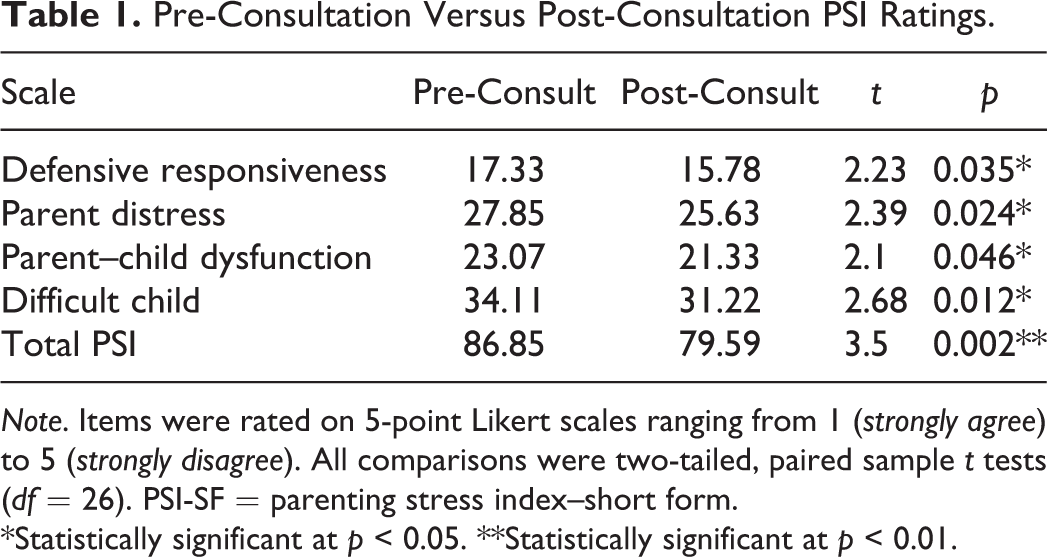
Note. Items were rated on 5-point Likert scales ranging from 1 (strongly agree) to 5 (strongly disagree). All comparisons were two-tailed, paired sample t tests (df = 26). PSI-SF = parenting stress index–short form.
*Statistically significant at p < 0.05. **Statistically significant at p < 0.01.
Paired sample t-tests were also used to evaluate pre- and post-consultation differences on the PSOC. On the Satisfaction subscale of the PSOC there was a trend toward statistical significance t(23) = −2.019, p = 0.055). On the Efficacy subscale there was a statistically significant difference t(23) = −2.963, p = 0.007). Pre-post changes for Total PSOC scores were also statistically significant t(23) = −3.218, p = 0.004).
Twenty-seven parents responded to the Likert-type satisfaction questions about their 2-session parenting consultation experience. Mean scores on these questions indicated parents felt positive about the quality of the consultations, were highly satisfied, viewed the consultations as having a positive effect on their relationship with their children, and would be likely to schedule another appointment in the future. Results are summarized in Table 2.
Consultation Satisfaction Ratings.
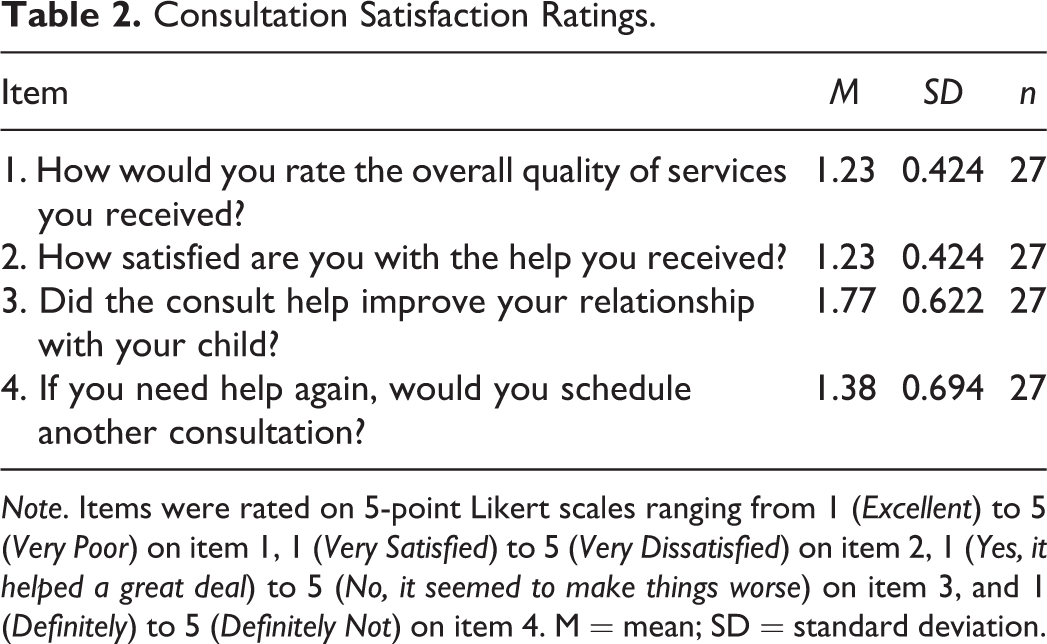
Note. Items were rated on 5-point Likert scales ranging from 1 (Excellent) to 5 (Very Poor) on item 1, 1 (Very Satisfied) to 5 (Very Dissatisfied) on item 2, 1 (Yes, it helped a great deal) to 5 (No, it seemed to make things worse) on item 3, and 1 (Definitely) to 5 (Definitely Not) on item 4. M = mean; SD = standard deviation.
Qualitative Findings
The final 3 items (i.e., 5, 6, and 7) on the parent SI were designed to elicit qualitative responses from parent participants. Item 5 asked parents to list “helpful” consultant behaviors, item 6 asked for examples of “unhelpful” consultant behaviors, and item 7 asked about “any further feedback” pertaining to the consultation.
In response to item 5, 21 out of 29 parents wrote examples of positive consultant behaviors. These responses ranged in length and specificity. Some respondents were very brief, noting the helpfulness of “Concrete suggestions” and “Making a list for me to refer to.” Other respondents were more detailed. For example, one parent wrote: [The] consultant listened well, made accurate assessments and provided specific suggestions—suggestions included help in communicating more effectively to my child that, as a parent, I am in charge, and help handling argumentativeness and defiance and help for me to see effective ways of giving my child more choice and responsibility.
Only 12 parents wrote something in the section on “unhelpful” consultant behaviors. Out of these 12, 10 noted that they did not have any negative feedback by either writing “Nothing” or something positive. Overall, there were two references to negative consultant behaviors. One parent was critical of the consultants’ use of self-disclosure or self-referencing: Some comparisons with the consultant’s own personal experience didn’t pertain well to ours—and we weren’t sure if this tactic was as effective—or perhaps it could be used less.
Another parent noted that “A couple” of the consultant’s suggestions were less helpful. She wrote: A couple of suggestions (to have a race and “I bet you can’t…”) weren’t right for my son because he doesn’t yet engage with competition (unless a toy or attention is involved or other kids). However, these were minor suggestions in a list of useful/helpful options.
On item 7, 12 parents made additional positive comments about their consultation experience. One parent specifically articulated the advantage of private consultations over group classes: I really appreciated having a private consultation. I attend free group programs when offered to the public, but the private consult was 10 times more effective in its specificity. Thanks!
Another parent who was struggling with co-parenting articulated many potential dimensions of a consultation experience. She wrote: [He] suggested contact with counselors, teachers, co-parent, [and was] informative and encouraging, cited resources to refer to in the community. I’d definitely refer anyone, as I found it helpful. I received reinforcement on the positive constructive ways I’m dealing with my children. Consultant was friendly, easy going, approachable, honest, kind, understanding, non-judgmental, professional, and patient.
Overall, the qualitative parent responses included 33 separate positive comments and 2 comments that had a negative or critical tone. Two raters conducted a content analysis of the positive qualitative comments. This analysis revealed: (a) 24 mentions of being provided specific helpful suggestions, (b) 7 comments pertaining to being listened to, respected, and accepted, (c) 5 references to obtaining a sense of reassurance from the consultant(s), (d) 6 comments about gaining a new perspective during the consultation, and (e) 6 comments that were generally positive (e.g., “the consult was very helpful”). Percentage agreement between the two raters was 80.4%.
Discussion
Nearly every outcome variable in the current study showed either statistical significance in the hypothesized direction, or a trend in that direction. Although these findings support the effectiveness of a 2-session parenting consultation intervention in reducing parent stress and increasing parenting self-efficacy, it is prudent to discuss limitations of the study prior to elaborating on the findings. In particular, the study contained a small sample of culturally homogenous participants who were predominantly female, limiting the generalizability of the study to broader populations. Additionally, the lack of a control group makes it impossible to definitively conclude that the intervention directly caused the positive results. Outcomes generally supported the experimental hypotheses. Following the 2-session community-based parenting consultation, parents reported statistically significant reductions in parenting stress, and an improvement in parental self-efficacy. In particular, results from the PSI-SF showed significant decreases in: (a) defensive responsiveness, (b) parent distress, (c) parent–child dysfunction, and (d) perceptions of having a difficult child. Indeed, the total score from the PSI-SF showed substantial statistical significance (p = .002). Additionally, findings based on the PSOC total score revealed that parents reported feeling a statistically significant (p = 0.007) increase in parental self-efficacy. It is noteworthy that the PSOC, in addition to overall or total significance, yielded significance on the efficacy subscale. This subscale measures the degree to which parents feel competent in handling their child’s problems (Rogers & Matthews, 2004). Results from the Satisfaction subscale, the only other subscale on the PSOC, did not show statistical significance but the trend on this subscale from pre-test to post-test was in the hypothesized direction.
Client’s satisfaction ratings were also positive. Although some researchers have challenged the utility of client’s satisfaction ratings (Lambert, Salzer, & Bickman, 1998; Pekarik, & Guidry, 1999; Pekarik, & Wolff, 1996), other research has identified a significant, albeit small, correlation between client’s satisfaction and treatment outcome (Turchik, Karpenko, Ogles, Demireva, & Probst, 2010). Results from the SI used in the current study indicated that parents were highly satisfied with the consultations, believed the consultations had a positive effect on the parent–child relationship, and reported that they would attend a parenting consultation in the future. These positive satisfaction results suggest that parent participants attributed the positive outcomes to the parenting consultation experience. However, this interpretation of the satisfaction ratings is speculative and, as called for by other researchers (Turchik et al., 2010), further study of the correlation between client’s satisfaction and outcome is needed. Nevertheless, in sum, results of this study support findings from the phase 1 study on the efficacy of community-based parenting consultations (Sommers-Flanagan, 2007) and the present study adds more scientific rigor to the results by including two validated measures not present in phase 1.
Given the study’s limitations, there are many possible explanations for the positive results. Three explanations seem most likely. First, it could be that between the pre- and post-assessments many participants experienced something outside the intervention that contributed to their reporting of lowered stress and higher parenting self-efficacy. Although an absence of a control group makes it impossible to completely rule out outside events as contributors to positive outcomes assessments, the positive satisfaction measures and qualitative responses that participants linked to their consultation experience make this explanation less likely.
Second, it may be that many participants were experiencing acute stress and lowered self-confidence linked to their parenting roles and consequently time itself functioned to reduce stress and improve parenting confidence. This is a reasonable explanation and one that cannot be easily discounted. It may be that time would have reduced stress and improved competence independently, but because participants had a consultation experience when their stress was high and confidence was low, they inaccurately attributed their improvements to the consultation, rather than to time passing.
Third, similar to the preceding explanation, it may be that the parenting consultations acted as a placebo to reduce stress and increase parenting self-efficacy. Again, this is a reasonable explanation because parents chose to come to the consultations of their own accord likely because they believed, in advance, that the consultations might be helpful. Consequently, the participants’ positive expectations might account for the positive results (Battino, 2007).
Based on this logical analysis, it seems most likely that the positive results are either: (a) a real effect due to the consultations, (b) a function of time and a causal misattribution, or (c) positive expectations or a placebo effect. To conclusively determine which of these factors best account for the positive outcomes, further research with greater experimental control is needed. Additionally, to generalize these results to diverse populations, a larger and more heterogeneous sample is necessary.
Applications
Despite limitations of this study, we believe the results have significant implications for community-based professionals who work with parents. Specifically, this study is the second in a series suggesting that a relatively straightforward, positive, and brief consultation intervention can have positive effects on parent stress and parenting self-efficacy. This finding is important because although many family therapy practitioners work directly with parents, there are few community-based and empirically supported models directly linked to positive parenting outcomes and high parent satisfaction. The brief solution-focused model used in this study is flexible and can be integrated into family therapy practices ranging from individual play therapy to therapy with adolescents and to stand-alone parent only interventions (Post, Ceballos, & Penn, 2012; Sommers-Flanagan & Sommers-Flanagan, 2011). Findings from this study suggest that parents who receive this positive approach are likely to feel less stress, more competent, and satisfied with their consultation experience.
Results from this study are especially important given the evidence of deleterious effects of parental stress on children’s health. For example, a national study found that 13% of children live in households with at least one parent experiencing high parental stress and that parents with high parental stress had higher rates of seeking emergency medical care for their children than those with lower parental stress (Raphael, Zhang, Liu, & Giardino, 2010). Given direct costs of parental stress on children, families, and society, the possibility that a brief and positive intervention has the potential to significantly reduce stress and increase self-efficacy is a boon to mental health, community, and school-based professionals as well as parents. In many ways, it does not matter that participants may be experiencing a placebo effect or inaccurately attributing their positive outcomes to the consultation rather than the passing of time. This intervention is of minimal expense, burden, and stigma to parents. It is also an approach that can be learned relatively quickly and is well within the practice domain of many different community, mental health, and human services professionals. Consequently, although determining if this intervention is the active ingredient in reducing parental stress and increasing self-efficacy is important and worthy of additional research, providing low cost, parenting consultation services through various community settings is likely to benefit parents and families who choose to participate. Overall, we find the possibility that helping professionals can confidently inform parents that, if they are feeling stressed and ineffective, 2 h of their time and money may significantly reduce their stress and increase their confidence is very exciting news.
Footnotes
Declaration of Conflicting Interests
The author(s) declared no potential conflicts of interest with respect to the research, authorship, and/or publication of this article.
Funding
The author(s) received no financial support for the research, authorship, and/or publication of this article.