



Abstract
A qualitative study exploring how victims of emotional and physical sibling abuse make sense of their abusive experiences particularly in the realm of interpersonal relations also uncovered risk and protective factors. The narratives of 19 self-identified survivors of traumatic childhood and adolescent sibling abuse provide insight into how these at-risk children prospered despite their adverse circumstances. Object relations theory, trauma theory, and resiliency theory provide a lens through which to consider the short-term and long-term emotional resonance and the needs of childhood victims and adult survivors. Creative outlets and supportive relationships during childhood serve as valuable coping mechanisms as does therapy during adulthood. Defenses, such as emotional cutoffs, are discussed as both potential risk and protective factors. Knowledge of protective factors for the sibling abuse individual during both childhood and adulthood indicates the ability to connect families to resources and serve as pathways toward prevention and intervention.
Keywords
Sibling abuse is the most common form of family violence (Button, Parker, & Gealt, 2008; Reid & Donovan, 1990), occurring more frequently than parent–child abuse or spousal abuse (Graham-Bermann, Cutler, Litzenberger, & Schwartz, 1994). Although it has been increasingly addressed in the literature, it remains largely unaddressed, and those aspects that facilitate resilience in the victim have not been explored. Previous research of the risk factors contributing to the existence and perpetuation of sibling abuse (Meyers, 2014; Wiehe, 1997) sets the stage to consider protective factors that may prevent or mitigate the effects of the target’s experience. Highlighted in this article from a retrospective approach are the factors that promote healing for the target of sibling abuse during childhood and adolescence and currently in adulthood. Knowledge of adaptive aspects of trauma can empower child welfare workers, clinicians, mandated reporters, and parents to take protective action. The participants in this study have coped with experiences ranging from physically harmful to life-threatening acts of abuse marked by psychological torment and emotional devastation.
Psychodynamic theory (Freud, 1937) and an object relations perspective (Ainsworth, 1989; Bowlby, 1979; Kernberg, 1984) are the overarching views from which the literature is reviewed, the study conducted, and the findings interpreted. Object relations and trauma theories (Herman, 1997; Van der Kolk, 1987) are presented as a lens through which to view the unconscious assimilation of beliefs and perceptions from the abusive experience, and the challenges thus imposed on interpersonal relationships. Resiliency theory allows consideration of the adaptive processes of survivors of sibling abuse (Gitterman & Germain, 2008) to analyze those elements that provide relief and restore the ego.
Abuse and Object Relations
Towards an understanding of the mitigating aspects of abuse by a sibling, object relations theory serves to contextualize emotional ramifications of the victim experience. This approach contends that current interpersonal relations are perceived as representations of reactivated interpersonal relations from the past (Kernberg, 1984), which emphasizes the lasting impression of early life relationships (St. Clair, 2004). Transference involves the integration of early experiences, an internalization of emotions from those experiences, and a projection of internalized and unconscious manifestations of experience onto another person. Through this unconscious process of projection, figures of attachment in adulthood become substitutes for earlier relationships.
The pleasurable parent–child bond leads children to seek pleasurable relationships with others, however, when parents provide mostly painful experiences, children learn to seek pain as a form of connection rather than avoid pain (Mitchell & Black, 1995). Because of negative interactions with key figures and early caregivers, children of abuse build subsequent relationships that mirror these early interactions. Research (Meyers, 2011) has uncovered and confirmed striking similarities for victims of sibling abuse and victims of parent–child abuse. Children have an intense connection and loyalty to abusive siblings, and children not only repeat negative interactions which mirror the sibling abuse relationship but approach relationships with the assumption that they will be treated in the same manner they were related to by the sibling. In this sense, most relationships are marred with fear and distrust (Meyers, 2014). This resonates through avoidance of conflict, fierce independence, fear of abandonment, and other challenges with intimate relations (Meyers, 2014).
Trauma Theory
Trauma theory also emphasizes the importance of earlier experiences on current relatedness and functioning. In particular, it highlights the aspect of acquiescence and accommodation that results from conditions of terror. In cases of child abuse, the home environment becomes fraught with terror, and as a result, adaptation is required. Adaptation can take the form of hypervigilance to one’s surroundings, and survivors often become intensely attuned to the emotional states of others (Herman, 1997).
The literature on traumatic family abuse focuses on the impact of parent–child abuse; in this context, victims of child abuse experience their most powerful adult as dangerous. Emotional abandonment results when caregivers fail to protect children who then experience a sense of betrayal, abandonment, and the perception that others are indifferent to their well-being. Ultimately, children become vulnerable, distrustful, and feel unworthy (Herman, 1997; Krugman, 1987). Trauma theory and object relations theory coincide regarding the contention that victims of childhood trauma often avoid intimate relationships in an attempt to ward off repeating the familiar but uncomfortable and often intolerable feelings. Trauma theory highlights the impairment of ego functioning that results from traumatic events. This includes a compromised ability to connect, poor interpersonal skills, and difficulty modulating affect (Van der Kolk, 1987).
Similar to studies on parent–child abuse which found that children who are victims of emotional abuse lose confidence in their parent’s emotional and physical availability and responsiveness (Iwaniec, Larkin, & Higgins, 2005), research on sibling abuse uncovered that victims of sibling abuse have parents who are not emotionally responsive (Meyers, 2014). Physically absent parent compound the unavailability of sibling support, and survivors develop the expectation that people, even those closest to them, will not be emotionally available. As a result, they develop insecure attachment styles in relationships marked by anxiety and discomfort. Despite the traumatic experience of sibling abuse, survivors are able to develop resources outside of the home that contribute to resiliency and affect the ability to establish relationships in childhood, and later in life.
Resiliency Theory
Resiliency theory addresses the notion of adaptive behavior by acknowledging the capability of people to cope with adversity or risk particularly in the face of stress or trauma (Gitterman & Germain, 2008). Acknowledging that survivors of sibling abuse do not escape pain, there are protective conditions that help people successfully negotiate trauma, moderate the effects of risk, and enhance adaptation (Fergus & Zimmerman, 2005). Resilience reflects both personal attributes and complex person-in-environment transactions (Gitterman & Germain, 2008). Personal attributes include temperament, intelligence, coping skills, social skills, the ability to regulate emotional experiences, and self-esteem (Gitterman & Germain, 2008), yet these “skills” develop from biological, psychological, and environmental processes.
Study Purpose
This qualitative study explored how victims of sibling abuse make sense of their abusive experiences particularly in the realm of interpersonal relations and the perceived effects of this experience in adulthood. Through the interview process, protective factors emerged which provided insight into how these at-risk children prospered despite their adverse circumstances. This article focuses on aspects of resiliency for victims of sibling abuse.
Method
Conducted in the phenomenological and grounded theory approaches of qualitative research, this study used purposive sampling and in-depth interviews with adults over the age of 21 who were victims of sibling abuse during childhood and through adolescence.
Sample
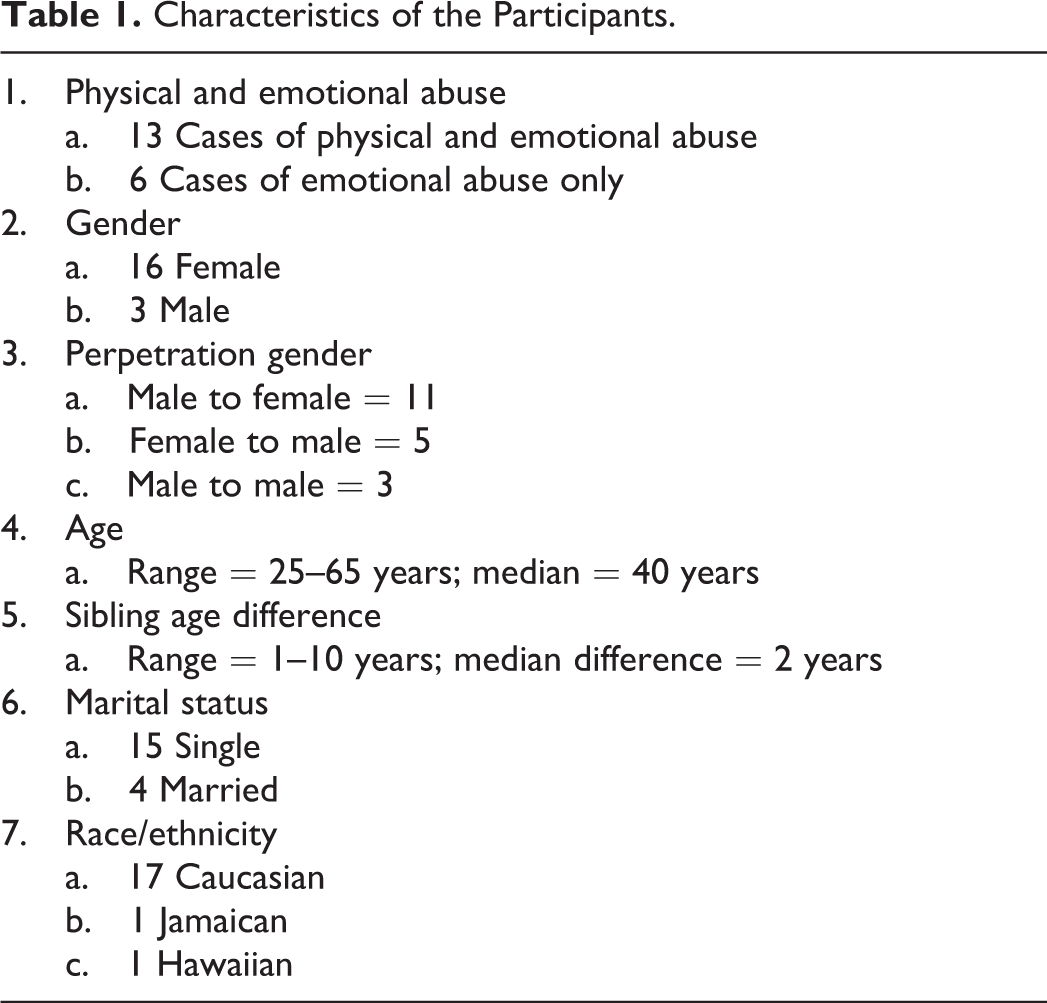
Flyers were disseminated and posted to recruit participants 21 years of age or older who may have self-identified as survivors of sibling abuse. The flyer solicited those interested in participating in a research study about rivalrous and/or abusive sibling relationships during childhood or teen years. Flyers were e-mailed to approximately 500 contacts that were accumulated over the years by the researcher and included personal and professional affiliations. Flyers were also posted at a few local graduate schools of social work and colleges, two of the most populated central metro community centers, and two churches and synagogues. Advertisements were also placed on an online community (www.craigslist.com) and in the National Association of Social Workers’ quarterly bulletin. Characteristics of the participants can be found in Table 1.
Characteristics of the Participants.
Protection of Human Subjects
Although there were no direct benefits for participation in this study, participants recounted that partaking in this research acknowledged their abusive experience and provided a sense of validation. Participants signed a consent form stating they could stop participation at any time and skip any questions they did not want to answer for any reason. The researcher took steps to avoid “secondary victimization” by preparing participants about the nature of the research. Each participant received a resource list including therapy services and hospital emergency rooms should any material arise that incited extreme discomfort. None of the participants chose to interrupt or end the interviews, and no informant had an emotional reaction that was difficult to contain. The researcher had no relationship or contact with participants prior or subsequent to the interviews.
All of the study procedures met with approval from the City University of New York’s Graduate Center Institutional Review Board (IRB). All of the participants signed an IRB-approved informed consent prior to their interview, which indicated their voluntary participation. The face-to-face interviews lasted approximately two hours in a local college’s interview room, audiotaped with informants’ permission, and then transcribed verbatim. After transcription, the tapes were destroyed.
Data Gathering
Both the extant literature and self-reported experiences of the participants operated as a working definition of sibling abuse and served as criteria for inclusion in the study. A phone interview assessed whether they felt denigrated or ridiculed by a sibling, emotionally bullied, physically harmed or threatened, and often fearful and/or anxious around their sibling. However, the subjective interpretation of sibling abuse was necessary to allow room for discovery and allow a definition of the phenomenon to grow out of the incidents subjects reported. An interest in understanding the lived experience of sibling abuse and the lack of instrumentation to assess for sibling abuse led to a study that relied heavily on self-report.
A semistructured interview guide was used as a means of data collection for this study as a method to obtain rich and descriptive insight into the adult survivors’ perceived experiences (Patton, 2002) and unfolding of coping methods. It drew on sensitizing concepts from both psychodynamic theory and empirical research conducted to date on this subject. Through a more open-ended nature of inquiry, participants provided rich and descriptive insight into their experiences. In an effort to uncover the lived experience of sibling abuse and aspects of resiliency, participants were asked “What gives you meaning?”; “How have you found fulfillment in your adult life?”; “During childhood, what or who was helpful in contending with what was happening?” Two of the probing questions were “What is your current relationship with your sibling?” and “What helps you cope with your experience?” Emergent flexibility allowed participants room to introduce material. I ensured coverage of important domains without overly directing the flow of the interview, a strategy that gave informants maximum control over its course.
Data Analysis
As the interview process unfolded, the researcher coded transcripts of the audiotaped interviews and uncovered patterns regarding risk and resilience. Hermeneutic phenomenological analysis (Van Manen, 1990) revealed the essence of the sibling abuse experience and the views of targets, particularly around coping with adversity. It provided the framework to identify patterns of protective factors.
Units of meaning were developed phenomenologically to produce expressed, unique meaning that represented the essence of the discourse through the scrutiny of every word, phrase, and sentence (Hycner, 1999). Examination of the nature of the responses determined a general sense of the meaning-making experience of coping and adaptation. Analysis moved from reliance on the actual words of the participants to uncovering the layers of meaning (Hycner, 1999). While descriptive in nature, hermeneutic phenomenology also allows for the interpretive process (Van Manen, 1990). In this study, interpretation is presented in the analysis (discussion section) and epoche (bracketing) was used to obtain the findings representing the lived experience of the participants (Moustakas, 1994). In this aspect, transcendental phenomenology was drawn on in an effort to embrace a fresh perspective of sibling abuse (Moustakas, 1994). Due to the dearth of literature on sibling abuse, particularly around the nature of resilience, the challenge of bracketing was not overly challenging. However, as a researcher/clinician who has had some personal encounters with patients who have a history of sibling abuse, some obstacles were present. A reflexive journal was used to bring reflexivity into consciousness. This enlightened the researcher to the influence of personal accomplishments of clients and the belief that targets of sibling abuse have both potential to be resilient and many areas of challenges. Statements made by the respondents were transcribed and “clustered” to develop thematic material and memos helped integrate understanding of events and processes (Miles & Huberman, 1994). Successive readings contributed to further understanding and organization of the data as repetitive patterns emerged (Hycner, 1999), such as childhood resiliency factors, adult resiliency, and defense mechanisms. Simultaneously, constant comparison was incorporated into the phenomenological interpretation to organize and understand the concepts that surfaced.
Various means ensured the credibility of this research: the researcher’s commitment to the orientation of the fundamental question, the bracketing of preconceived opinions and conceptions, and constant attention to the design of the study and the significant elements that played a part in the total structure of the text (Van Manen, 1990). The process of intersubjective validity involved testing and verifying understanding of the meaning of the sibling abuse experience through the back-and-forth social interaction of interviewing (Moustakas, 1994). As the interview process progressed, information gathered earlier was presented to subsequent participants to determine if they had similar or different experiences or feelings. In this way, theory triangulation was used as a measure of credibility in its application to both inquiry and data analysis.
The researcher assumed a stance of empathic neutrality (Patton, 2002) in an effort to remain nonjudgmental toward the subjects and neutral to the findings. This stance is a way to avoid engagement in the paradigm debate of objectivity versus subjectivity (Patton, 2002). The researcher balanced the productive use of knowledge with a preconceived psychodynamic lens in order to produce as objective a stance as possible (Osborne, 1994) and in a manner that did not deter comprehensive attunement to the whole phenomenon. On a positive note, the clinical experience and analytic approach of the researcher influenced sensitivity and attention to both individuality and comprehensiveness regarding the path of exploration and interpretation. The desire to uncover various experiences was helpful in remaining attuned to the individual perceptions of participants. The use of colleagues to critique evolving patterns helped ensure credibility and diminish research bias.
Findings
Most of the respondents in this study (whose names have been changed) are graduates of college and graduate school and have established careers; in some respects, they are functioning at high levels. Despite these accomplishments, informants still struggle with low self-esteem and have problems with interpersonal relationships. Nevertheless, their adaptive abilities enable them to achieve in other areas of life. This article highlights the experiences of survivors during childhood and adulthood that allowed them to persevere despite extreme adversity. These include creative outlets, external emotional support, and nurturance. These experiences—personal and interpersonal—allowed the children to develop a sense of accomplishment and gain a sense of purpose.
Childhood Resilience: Supportive Relationships
As children, sibling abuse victims lacked the support of their parents. However, taking refuge in their friends’ homes allowed some participants to experience a sense of stability. Isabelle, a survivor, spent significant time at a friend’s home from the age of 10 through college. She felt “taken in” by this friend’s close-knit family who welcomed her into their lives and communicated with each other with respect. Another survivor attributed her good grades in school to her friend’s mother who helped her with homework. Finding sanctuary with another family with whom they felt accepted promoted a sense of competence.
Some respondents with more than one sibling were able to find comfort and care from the nonabusing sibling, one who often resided outside the home. Marc’s oldest brother Larry was his “lifeline.” Larry confirmed that their home environment was chaotic and served as the “rational voice of the family.” Although Larry was unable to effectively intervene in the abusive relationship between Marc and his older brother, his attempts to defend Marc were meaningful. Marc received the message that he was worthy of being protected, something his parents had failed to transmit. Marc also credited Larry with helping him to understand his abusive brother’s actions by attributing them to his mother’s dysfunction and his father’s lack of emotional relatedness. He helped him depersonalize his brother’s assaults and put them in the perspective of broader family problems. Marc attributed his brother’s affirmation of his victimization and perception of his parent’s shortcomings as both reparative and critical to his well-being.
Thelma’s circumstances were exceptional. As the youngest child of 10, her three oldest sisters lived outside of the home by the time she was 4 years old. Her father died in an accident when she was 6 months old, and her mother raised the family alone. She described her household as chaotic. The five brothers abused their sisters with varying degrees of intensity. Her sister, one and a half years older, offered Thelma a place to live, but her mother prohibited this arrangement. Although Thelma’s move to her sister’s home might have relieved her from abuse, the knowledge that her sister was willing to extend herself in this way enabled her to feel wanted. At the time, Thelma believed that her mother’s refusal to allow her to live with her older sister was an attempt to thwart her happiness. However, looking back, she believes her mother interpreted her sister’s offer as a slight and a threat to her parenting role. As a child, when Thelma endured sibling abuse, she perceived her mother’s lack of support as personal. As an adult, she was able to reflect on her mother’s motivations as a reflection of her limitations. The shift in her perception of her mother helped her to heal. Those survivors, who relieved their parents of responsibility for their actions, or inaction, protected themselves from the perception that they were unloved. Viewing their parents as flawed or limited, is in essence, reparative.
Childhood Resilience: Creative Outlets
Although it is difficult to determine whether or not the survivors in this study involved in these activities ultimately fared better than those who were not, some reported that creative outlets provided them with an emotional release, a sense of meaningfulness to others, and relief from their home environment when they were children. Marc recounted how music served as an escape from his daily life and proved fundamental to his emotional stability. He spoke about the solitude of playing the drums, which offered respite from the onslaught of abuse. He described his music as something that was “in his own control” and “separate from his family.”
For other survivors, creative outlets not only provided emotional release but also helped them establish a sense of community. One participant related her parent’s label of her as the “good child,” because they struggled with her sister’s behavior. However, she did not feel that she reaped any rewards from this status. Her parents paid little attention to her and did not protect her from her sister’s abusive behavior, and because she was the “easy” child, she survived by living “under the radar.” Beginning in junior high school, she sought out theater, which provided her the recognition she needed. Another participant also found that musical theater helped her to express herself and allowed her to have a literal and metaphorical voice that she did not have at home. At home, her brother rebuked her when she expressed herself and invalidated her opinions, whereas at musical theater, she was encouraged to think creatively and actively express herself. This experience developed her ability to take risks. Acting allowed her to try out different personae without personally identifying herself with any particular one. The support, encouragement, and acceptance from her peer group helped her to believe in her capabilities. As a cathartic experience, she identified her involvement in musical theater as “a purposive-directed outpouring of emotion.”
Resiliency in Adulthood
Although psychodynamic therapy rests on the notion of helping individuals work through the pain of their experiences, some survivors identified that their healing came through the supportive role of the therapist. The therapist provided a model of unconditional acceptance, something few of the informants experienced in their childhood.
Therapy
The absence of validating experiences during childhood causes survivors to blame and denigrate themselves. When parents took victims of sibling abuse for therapy during childhood, the victims thought this meant the problem lied within them. Nonetheless, participants described therapy as an invaluable experience; the therapist was the only nonjudgmental and accepting adult who validated the sibling abuse. Sarah explained, “A therapist told me that I was not crazy but that I had an extremely dysfunctional family. It was so helpful to have an outsider validate the psychosis of my brother’s behavior.”
Beth poignantly captured the value of therapy; it enabled her to feel safe with her feelings in the presence of another person. The therapeutic relationship facilitated her ability to trust someone, and subsequently she transferred this confidence into her relationship with her husband, “Before I started going to therapy I was intent on being independent and never relying on another person. Now I’m able to trust my husband.” In Beth’s marriage, she became able to expose her vulnerabilities and have “needy” moments, which her husband met with consistent support. Although she is still working on believing in and accepting his emotional availability, his tolerance of the range and depth of her emotions demonstrates to her that it is possible to experience and survive intense feelings: an experience that is foreign to her from her family of origin.
Another survivor, Isabelle, also described the reparative role of her therapist. “I think in therapy I am getting the secure attachment that I need and have never experienced before.” Talia introduced a different aspect of therapy, one that helps her to negotiate her current relationship with her sister. She stated she was able to understand her sister’s limitations and develop realistic expectations of her. “When I went to therapy, I began to accept that my sister is not normal. I realized I couldn’t have a regular relationship with her. Like the therapist said, ‘you have to think of her as a paraplegic and you cannot expect her to walk.’”
Not all of the informants found therapy helpful in the same vein. Joe does not view it as a vehicle for moving past his feelings about the abuse. Although he knows that therapy will not change his past, he does find it helpful to have someone who listens, empathizes, and supports him: It’s like a balloon. The more air you put into it, it blows up and eventually explodes. So if you go to therapy, it is like you let the air out a little bit. I go once a week and it feels good for a little while. The problems are still there. It is not going to change by talking about it. It doesn’t mean that if you talk about the problems they stay on the shelf and are not in your head anymore.
Defense Mechanisms: Risk or Resilience?
Experiences that provide protection are not always free from risk. There are some coping strategies and defense mechanisms utilized during childhood which, while adaptive, compromise the ego. It may be possible that while they can be considered protective factors in childhood, they may present risk in adulthood. When a child copes with abuse through compliance, the manifestation in adult interpersonal relationships may be passivity. Likewise, attunement to the needs of the aggressor in childhood allows a sense of control and protection from an anticipated threat. However, in adulthood, this hypervigilance may result in a paranoid stance, a general distrust of others, or anxiety.
Similarly, active choices made in adulthood to preserve the ego may be both protective and compromising. While cutting off family members may be based on the realization that they are still injurious, the loss of family creates emotional distress. Decisions made by survivors to maintain contact with family or emotionally cutoff relations demonstrate the enduring nature of this affective relationship. The complexity of emotions regarding family relationships is reflected by the desire to have family ties and the need for self-protection.
Lynn’s description of her response to her brother’s demands highlights aspects of both resilience and risk during childhood continuing into adulthood. Although she did not want to participate in activities with him, he coerced her, and she gave in. Her contact with him exposed her to emotional abuse, but there were similar repercussions if she withdrew from him. He would taunt her relentlessly for not meeting his needs. In an attempt to have an ally, she suppressed her own needs and tended to his. She explained, “I was always scared to make my brother angry, and I would always try to give in to do anything he wanted so that he wouldn’t yell, because his yelling was just the loudest in the world.” Although she found an adaptive strategy during childhood, in adulthood Lynn continues to fear intense emotions from the men she dates. In fact, she does not become involved in a relationship if she cannot “read” the emotional state of the other person.
Although some victims of sibling abuse adopt defense mechanisms that allow them to live through the trauma with some sense of protection, others do not feel the coping strategies they use relieve them from their internal pain. One survivor, Ben, related becoming severely depressed due to his relationship with his brother and turned to drugs as a method of coping. Another respondent, Mia, shared that she steered herself amiss in an effort to gain her parents’ attention: I found a group of people who accepted me. It felt good to be a part of something. We were a gang. We did not do such great things. We hurt people. I think it was a feeling that I had this place and people who I could hang out with and know that they would be there, so to speak. Part of it was acting out, hoping my parents would notice. They did notice when I started self-mutilating. I think I was in 7th grade, and my father saw some cuts on my arm and all that was said was ‘what’s that?’ I said ‘nothing’ and nothing was ever spoken about it again.
The Fight for Family: At What Cost?
Approximately half of the research participants chose to cutoff relations with a sibling or family member. Yet, some remain in contact with their abusive siblings in order to maintain connections with their families of origin. Others remain in complicated relationships with their families who bring them hardship and pain. Some abusive adult siblings continue to exert their power by threatening to cutoff relationships with family members. When Talia’s sister, Alicia, felt injured, she threatened to abandon family members. In this way, Alicia subtly maintains the power in the relationship, in the same way she did when they were children: We recently had a horrible e-mail exchange. I get e-mails that send chills up my spine. She says the most horrible things about me and that I am the worst person in the world and that I make it impossible for her to be in a relationship with me and that I don’t give a shit about her. She’s very extreme. So I stopped responding. Then I feel guilty, and I think maybe I should just e-mail her and say ‘Hi, I was thinking of you’. There is nothing like a sister connection. I do love her. She is my sister but she is crazy.
In a continuation of their childhood drama, Lynn maintained a caregiver role with her emotionally abusive and physically threatening brother: He called and was upset so I checked back in on him later. Well, he started screaming his head off, cursing at me saying all these horrible things. This has happened in the past where I’ll hang up and he’ll call a zillion times over and over for hours. He would call me and tell me that I am ruining his life and who the hell do I think I am, and that he’s going to kill me. He tells me he’s going to throw me through a wall.
Unlike those participants who maintained attachments to their abusers, Sarah attempted to cutoff her emotionally abusive brother. However, when he reached out to her and professed his love, she allowed him to reenter her life only to continue his abusive behavior. The desire and belief in the potential of a loving sibling relationship compelled her to remain connected. And, despite his remorse, he was unable to contain his rage: My brother is still very critical of me. Several years ago, I told him that if he can’t talk to me in a respectful, humane manner I did not want to hear from him. So I didn’t hear from him for two years but then he called and said he loved me. We’ve been building a relationship the last few years but when he’s off his meds, he’s emotionally abusive. He apologized and admitted that it is always his fault, and he doesn’t know why he does it.
Some survivors maintained relationships with the abusive sibling by choice. Others did so out of obligation or fear. Beth, who had moved across the country, remains consumed with anxiety about the potential for more intense contact with her sister. For example, she is afraid she will become ill, and her sister would want to visit. Beth feels trapped in this relationship and lives in anticipation of the next time she will see her. The last time I saw her she was upset with me and she had pushed me into a door and I said to her ‘I am not going to take this abuse’. And she started laughing in my face, really laughing and mocking me. She said ‘poor you, you think you were abused. Everybody you tell will laugh at you’.
Survivors display a continuum of contact with their family members. Some have no contact with family members; a few limit times they spend with family; and others remain connected to emotionally abusive siblings and parents. According to Marc, I really took the work that I was doing with my therapist to heart. I made changes. I decided that I wasn’t going to visit my parents more than once a year. I really restructured my perspective. What is in it for me? If it is hurtful for me, why am I doing it? Who am I doing this for?
Discussion
Most of the literature on resiliency has focused on children. It suggests that temperament, family support, trusting relationships, and peer and community support modify stress and contribute to resiliency (Ferguson & Zimmerman, 2005). Resiliency theory also contends that finding meaning and purpose in one’s experience helps to pave the road toward resilience (Richardson, 2002). Although this study did not initially explore resiliency with the research participants, through the back-and-forth of the interview process, spontaneous accounts of the way survivors persevered in childhood and adulthood revealed meaningful contributions to their adjustment. It became apparent that many adult survivors were functioning well in the world despite their traumatic past. This research uncovered protective factors that helped victims in childhood and survivors in adulthood cope with their experience, and other aspects that put them at risk.
Most of the participants in this research received limited emotional support from their families and developed little social capital outside of the home during childhood; however, others did develop resources that provided them with support and hope. These informants proved resilient in the face of devastating childhood experiences, both during childhood and as adults. These supports appeared to moderate the effects of risk and enhance adaptation. In addition, some participants found creative outlets helpful which build a sense of belonging and competence (Malchiodi, 2008).
The majority of the participants in this study desire to maintain a sense of a connection to their family of origin despite enduring strain with an abusive sibling or a parent. Some survivors choose to remain involved with the abusive sibling, because they want to preserve a sense of family. Others cut ties with their sibling or parents in an effort to achieve self-protection. This decision is complex, because these adults sacrifice their connection to their families in order to avoid the abusive sibling. Bowen (1978) described the concept of emotional cutoff as an individual’s effort to manage unresolved emotional issues with parents, siblings, and other family members by reducing or completely cutting off emotional contact. Strategies include creating geographic distance from one’s family of origin, rarely visiting with family, or staying in physical contact with family but avoiding emotionally close relationships. “Cutting-off” provides a sense of safety. Bowen claimed that despite the use of this defense to manage attachment to family members, it has the potential to cause pain or discomfort. The individual who employs cutting-off of family has a greater sense of vulnerability to intense emotional processes in other relationships (Papero, 1990). Although the choice of cutting-off provides some sense of self-preservation, the sense of loss promotes the trauma of the experience. Clearly, cutting-off does not mend the internalized perspective of relationships that has already been indoctrinated. Unavoidably, the emotional toll on survivors who cutoff family members parallel those who remain in contact with their abusers; those who terminate relationships with the abusive sibling are still devastated by the loss, while those who remain in contact continue to be embattled in turmoil. The emotional cutoff of siblings is an attempt by survivors to protect them from further pain. Most who sever relations with their siblings attempt to gain control of their egos because they remain easily influenced by their siblings’ perception of them. But the depth of the emotional scars remains intrusive. Accepting that they cannot have the idealized or desired sibling relationship enables some survivors to develop their own identity. Tolerating the feelings associated with such loss begins a reparative process and demonstrates resilience. Although the pervasive aspect of the abuse is more distant for survivors who cutoff contact with the perpetrator, reports of projection of the sibling relationship onto intimate relationships are profound. On the other hand, those who maintain connection to their siblings might be trying to get what they need from a sibling who is still unable to provide it. This presents greater risk for projecting these needs into adult intimate relationships. For example, many survivors seek partners who are emotionally unavailable. Their desire to change the other person or gain recognition is met with frustration, disappointment, and self-denigration. This raises the question whether cutoffs can be regarded as a protective feature in adult resilience. Clearly, many of the responses to trauma presented are not necessarily aspects of either risk or resilience. The findings present the complexity of coping and adaptations that may be both protective and present risk.
The vast majority of participants were in therapy at the time of the study. The most common pattern was that they entered therapy on their own volition to address feelings of depression, isolation, intimate relationship hardship, and family relationships. In the process, they felt supported and began to develop a new identity separate and distinct from the one their sibling imposed. As in childhood, adults found that meaningful relationships help them develop new connections that served to replace the emotional nurturance one often relies on from family. Others still struggle to build and maintain connections. Many participants found that reviewing past experiences in therapy helped them process loss and mourning; it facilitated their desire to move forward. However, many times, they coped by suppressing painful feelings and memories. Attempts to remain emotionally stable involved efforts to contain deep emotions.
Doyle (1997) found that the most important single survival factor for abused children is the presence of at least one person who made them feel important and provided unconditional positive regard. Therapists promote resilience by helping survivors develop the capacity to make decisions, engage in other relationships, and detach emotionally from the abusive sibling. Helping survivors make meaning of the abusive experience allows them to depersonalize the sibling’s behavior and recognize the sibling as a person in their own right with their own problems, limitations, and struggles. Helping survivors distance themselves from the true cause of the perpetrator’s aggression allows them to begin to undo internalized messages of blame and gain a sense of control.
The description of Beth’s ability to develop a trusting relationship with her husband was indicative of a “corrective emotional experience” in therapy. Franz Alexander (1946) originated this concept, which comes from the idea that a person internalizes images from others, including the manner in which others perceive the person. These interactions exert a strong influence over one’s perceptions, including perceptions of the self throughout life. Alexander referred to the corrective emotional experience that a therapist provides by constancy and suspension of moral judgment. The therapist offers empathy, insight, understanding, and acceptance. The premise is that the therapist, having communicated a positive regard for the client, provides a reparative experience. The client identifies the therapist as a replacement caregiver and begins to internalize the therapist’s positive regard. The client learns new ways that people can respond to them other than what they expect based on the past: a new experience that does not include rejection. Identification with the therapist has a positive impact on the client’s ego and superego. Through therapy, survivors reported they were able continue and apply these corrective experiences to important figures in their lives.
The defense mechanisms of participants raise question regarding the protective nature of these adaptations or the ways in which they may cause stagnation or compromise positive experiences. For example, while emotional cutoffs of family members may be regarded as a protective feature of adult resilience, it is not without extensive mourning and an enduring trauma of loss. Likewise, although hypervigilant behavior may be adaptive at the time of abuse, it has the potential to compromise trust and the development of deep and “healthy” connections in adulthood. Those factors that may be qualified as protective require further exploration to further assess and analyze any long-term repercussions of seemingly adaptive behavior.
The participants in this study reported that as children they utilized various coping strategies to contend with the abuse, not all of which represented resiliency features. For example, in an attempt to protect themselves, some victims would “stay under the radar.” They would either comply with their sibling’s demands or calculate how to minimize a potential escalation of abuse. Others reported they tuned-in to the needs of their abusers. This is an aspect of the defense mechanism identification with the aggressor (Freud, 1937), which requires the victim of abuse to submit to the aggressor and replace his or her own emotional state with the emotional needs of the other. This compulsive compliant strategy demands excessive vigilance and superficial compliance to the needs of others in an attempt to ward off further trauma (Crittenden & Ainsworth, 1989). This defense mechanism, which allows preservation of the self from further or anticipated harm, may also result in risk for the abused sibling. From a resiliency perspective, the abused child is adapting to the trauma by developing coping strategies to prevent further harm. From a risk perspective, the child who adopts these defenses is sacrificing a part of him or herself in the process. The replacement of one’s own ego with that of another requires a loss of self. This inevitably leads to an internal construct of submission, compliance, and in effect inferiority.
Action-based changes to self-protect demonstrate survivor resiliency. However, as a defining element of resilience, “adaptive capacity” remains difficult to assess. Further research would be required to assess the impact of “intervening variables” on the restorative process for survivors. All of the survivors were functioning, capable adults. Despite being exposed to high risk because of sibling abuse, they were able to attain competence, build community, and achieve success and generativity in adulthood. They are educated, pursuing master’s degrees, find gratification from their professions, and many have solid, supportive friendships. Yet, no one is free of emotional pain. Most participants struggle intensely with emotional issues and adult relationships related to their childhood experience.
Limitations
Some limitations of the present study should be noted. The victims were primarily female. Gender diversity in future studies may uncover varied constructs of family dynamics in cases of sibling abuse for men and women. Gender may also account for variations in coping and protective factors. Similar to past research on sibling abuse (Caffaro, 2014; Wiehe, 1990), Caucasian participants were overrepresented in this study. Future studies should utilize recruitment methods that have the potential to yield greater cultural representation of the sibling-abused population. The primary method of data collection involved interviewing adult survivors and portraying the sibling abuse from their perspective. This method, however, allowed capturing the experience only from self-reported victims of sibling abuse. Obtaining a sample that included perpetrator voices or parental narratives might yield interesting findings and address the subjective aspect of reporting.
Many of the survivors had careers in the helping professions, a possible circumstance of the recruitment method used in this study. A graduate school of social work was one venue of recruitment. Self-reflection is a key component in the field of social work; for these subjects, the ability to confront their histories and explore its manifestations was a testament to their resilience. As well, they were able to sublimate their identification with trauma in a productive manner. As a limitation, being educated about abusive relationships and being influenced by professional views may lead to co-constructed memories and self-analysis.
Conclusion
Since there is no prior research on those elements that contribute to the resiliency of sibling abuse survivors, this study makes significant contribution to the literature. Likewise, survivors’ characterization of the protective aspects of their sibling abuse experience presents implications for prevention and intervention. Supportive relationships, creative outlets and therapy not only provide respites for the sibling-abused child but also increases self-esteem, shapes identity, and validates a sense of self. It is imperative that families are connected to these resources.
Footnotes
Declaration of Conflicting Interests
The author(s) declared no potential conflicts of interest with respect to the research, authorship, and/or publication of this article.
Funding
The author(s) received no financial support for the research, authorship, and/or publication of this article.