



Abstract
Weak management of interpersonal conflicts can lead to dysfunctional relationships with relevant consequences for couple and family well-being. Our purpose was to devise a single dimension scale to assess conflict management in romantic relationships. We focused on five relevant conflict aspects: competition, collaboration, avoidance, accommodating attitude, and compromise. Study 1 (N = 405) confirmed the existence of a single latent dimension, which was defined as the Conflict Management Scale (CMS), and consists of 8 items unbiased by gender. In Study 2 (N = 205), the CMS convergent validity with attachment, empathic self-efficacy, satisfaction, and decision-making in the couple was analyzed. In Study 3 (N = 120), the CMS was administered to 60 heterosexual couples in order to further examine the validity of the newly developed single dimension scale. Results showed that the CMS might be considered a valid and handy tool for planning couple and family therapies.
Management style in couple conflict and early interactions seem to be strictly related (Halford, Sanders, & Behrens, 2000; Levy, Wamboldt, & Fiese, 1997; Wampler, Shi, Nelson, & Kimball, 2003). Family-of-origin negative models can predispose partners to several problems in managing couple conflict; for example, observing parental violence, it appeared to be frequently associated with less adaptive conflict resolution behaviors (Halford et al., 2000). Further, subjective perception of early family-of-origin experiences can be considered a crucial aspect in influencing couple conflict management that could be targeted and modified by couple or family therapies (Wampler et al., 2003).
According to Forsyth’s model (2009), the members of a group or of a couple can find different ways to combine their own satisfaction (assertiveness) and the altruistic care for the other people’s needs (empathy). Five different conflict resolution styles can be defined on the basis of the interaction between assertiveness and empathy (Goldfien & Robbennolt, 2007): Avoiding conflict—Avoider during conflict is passive, he or she tends to withdraw, exhibiting neither involvement nor concern for his or her personal needs as well as for the other’s (Bayazit & Mannix, 2003). Accommodating conflict—This style is typical of a person concerned for the other rather than for one’s self. Empathy is thus maximized while assertiveness is minimized. This kind of person in fact is passive and shows some difficulty in expressing his or her decision about any problem. Competitive conflict—This style is typical of people who are more concerned for their own needs rather than for other people’s requests (high assertiveness). Competitors tend to force others to accept their personal points of view (Morrill, 1995). Cooperative conflict—This style combines assertiveness and empathy at the same time. Cooperators tend to actively collaborate, trying to find a satisfactory solution for both parties (Jarboe & Witteman, 1996). Compromising conflict—Such style is typical of a person who does not make any difference between one’s self and the other when expressing preoccupation or interest (van de Vliert & Euwema, 1994).
Lack of competent management of interpersonal conflicts can lead to dysfunctional couple relationships where decision-making about important relationship problems is challenging (Creasey, 2002). Lack of consciousness in decision-making about significant relationship changes, known as “sliding,” is likely to put relationships at a high risk of poor outcomes (Stanley, Rhoades, & Markman, 2006). On the basis of Stanley, Rhoades, and Markman’s (2006) model, called sliding versus deciding, couples are in fact likely to experience, as a consequence of sliding, a decreased satisfaction in the relationship. Sliding may occur when individuals lack confidence in their own ability to change the course of events. On the contrary, a proper decision-making in the couple appeared to be strongly related to the confidence in the partner’s ability to decide and change the course of events (Vennum & Fincham, 2011).
Within an attachment theory perspective, Mikulincer and Shaver (2007) suggested that securely attached people tend to perceive the competitive aspects of interpersonal conflicts and are confident in their capacity to deal effectively with them in a cooperative manner. On the other hand, insecure attached people are likely to use less successful conflict resolution strategies.
For anxious individuals, conflicts seem to threat the wish to receive approval and security and to cause fear of rejection, thus making them unable to activate affect-regulation strategies. Anxious people tend to experience intense negative emotions, they become obsessive, and hence they are unable to listen to what their partner is telling them. They are likely to become egocentric and their fearful egocentrism might affect the possibility of a fruitful negotiation with the partner. Anxious individuals often try to dominate or sometimes they become submissive to the partner in order to avoid rejection.
Avoidant individuals tend to consider conflict as threatening their need for autonomy and thus they are likely to ignore or to minimize any possible trigger for conflict. If withdrawal became impossible, they frequently manage to control and dominate their partner (Mikulincer & Shaver, 2007).
Both anxious and avoidance-styled people have difficulties in activating healthy decision-making practices in the couple’s relationship. The association between attachment and conflict resolution styles has been widely studied and explored. Anxious and avoidant people showed conflict management problems in romantic relationship (Creasey & Hesson-McInnis, 2001; Pistole & Arricale, 2003) as well as in marital ones (Heene, Buysse, & Van Oost, 2005). Compared with securely attached partners, insecurely attached people self-reported higher levels of aggression and withdrawal but lower levels of affection during discussions (Feeney, 1998; Senchak & Leonard, 1992).
Furthermore, along with decision-making, conflict management, and attachment style, self-efficacy also plays an important role in the couple’s relationship. We refer here not only to specific task-related self-efficacy but to empathetic self-efficacy within the group and the couple relationship, concerning the wide domain of emotional understanding and interpersonal relationships (Bandura, Caprara, Barbaranelli, Gerbino, & Pastorelli, 2003; Di Giunta et al., 2010). A study conducted by Narimani, Agamohammadian, and Ghaffari (2008) aimed to evaluate the relationship among attachment styles, self-efficacy, and conflict resolution styles found that attachment styles along with self-efficacy were predictors of dominant, avoidant, and cooperative conflict resolution styles.
Marital conflict seems to affect not only partners but family and offsprings as well. Concerning the affective quality, there is probably strong continuity between the couple and the triadic relationship involving a child (Kitzmann, 2000). Along with a poor affective regulation, stress and conflict maladaptive management can produce important interferences in family alliances and parenting that sometimes can be expressed mainly by a child symptom (Schor & American Academy of Pediatrics Task Force on the Family, 2003). Thus, evaluating the couple functioning, and in particular the conflict management style, can prove to be very useful for the clinical assessment of the couple, of the family, and of the children and adolescents as well. In fact, in the case of child and adolescent psychopathology, a better understanding of the family environment can help to tailor a targeted and thus acceptable treatment not only for the patient but for the family as a whole (Gatta et al., 2009).
In the past and in most recent years, a number of instruments were constructed to assess individual conflict style and management of conflicts within the family environment: Some measures appear to be mainly related to everyday nonviolent conflictual behaviors and others are particularly devised to assess psychological and physical abuse and violence in the family. Among others, Kilmann and Thomas (1977) devised a Forced-Choice Measure of Conflict-Handling Behavior in order to assess the individual conflict styles such as competitive, avoidant, accommodating, cooperative, and open to compromise. This classification scheme is based upon two separate dimensions of cooperation (attempting to satisfy the other person’s concerns) and assertiveness (attempting to satisfy one’s own concerns): Competing is assertive and uncooperative, collaborating is assertive and cooperative, avoiding is unassertive and uncooperative, accommodating is unassertive and cooperative, and compromising is intermediate in both cooperativeness and assertiveness. Later, Christensen and Sullaway (1984) constructed the 7-item Communication Patterns Questionnaire with the main purpose of measuring the capacity to communicate within the couple. Canary, Cunningham, and Cody (1988) focused their studies on different strategies to manage conflicts also in violent situations, with the purpose of defining the Episode-Specific Conflict Tactics Scale. In 1996, Straus, Hamby, Bone-McCoy, and Sugarman constructed the Revised Conflict Tactics Scale, particularly centered on abuse and violence. The Conflict Management Questionnaire devised by Hojjat (2000) is based on two dimensions: active/passive and positive/negative conflicts management. More recently, Reese-Weber (2008) devised a measure to assess attitudes concerning interpersonal violence in adolescence: the attitudes toward interpersonal violence assessment. Zacchilli, Hendrick, and Hendrick (2009) created a measure called Romantic Partner Conflict Scale (RPCS), based on the theoretical conceptualization that when relating to other individuals, conflict is inevitable. Zacchilli and colleagues designed the RPCS to examine the process of “routine, normative episodes of romantic conflict” (p. 1077), primarily for use with premarital couples. The scale is comprised of 39 items, each rated on a 5-point Likert-type scale. It includes six subscales: Compromise, Avoidance, Interactional Reactivity, Separation, Domination, and Submission. Scores on the scales have been found to be correlated with communication, satisfaction, respect, love, and sexual attitudes.
On the basis of Zacchilli et al.’s (2009) theoretical conceptualization, the present research aims to devise a single dimension scale to assess conflict management in couple relationships. In a latent trait perspective (Rasch, 1960/1980), the new instrument is expected to be characterized by a latent dimension, which should represent the interaction among conflict aspects and related constructs whose relevance has been demonstrated in the literature (e.g., Bayazit & Mannix, 2003; Kilmann & Thomas, 1977; Zacchilli et al., 2009).
Compared with other multidimensional instruments devised to measure conflict, a single dimension questionnaire, designed to capture fundamental aspects of the couple conflict management, is easier to be administered both for research purposes and for clinical practice. In planning the questionnaire, in line with Zacchilli and colleagues’ (2009) approach, we aimed to avoid conflict contents concerning abuse and violence, preferring to describe a self-centered, competitive, and not collaborating conflict attitude; all contents were supposed to be located on a common continuum from “self-concern” (assertiveness) and “concern for the partner” (empathy; Forsyth, 2009).
Three studies were planned to examine the dimensionality (Study 1) and the convergent and predictive validities (Study 2) of the newly planned scale on conflict. In Study 2, in order to examine the validity of the conflict scale, other measures were taken into consideration to assess allied constructs, such as decision-making, attachment, self-efficacy, and relationship satisfaction (RS). In Study 3, in order to further examine the psychometric properties of the conflict scale, the responses to that scale together with decision-making and attachment measures of 60 heterosexual couples (N = 120) were examined.
Study 1
In Study 1, items were developed on the basis of existing researches and theories, mainly on specific constructs proposed by Zacchilli et al. (2009). These authors focused their studies primarily on the definition and evaluation of romantic conflict processes. In the present study, a hypothesis was made on the existence of a single conflict latent dimension overarching different conflict aspects. A Rasch analysis approach was adopted to define such dimension.
Method
Participants
The sample was comprised of 405 psychology graduate students (269 women and 136 men) attending the University of Padova, Italy. During regular lectures in the university course of research methodology in psychology, this study was presented as an example of conducting scientific research in psychology. Participants who refused their participation in the study did not incur any disadvantage in fulfilling the course requirements. Written informed consent was obtained from each student after the procedure had been fully explained. The complete anonymity of the data, used only for the research purposes, was guaranteed. Collected data were aggregated and analyzed at the group level. Participants’ mean age was 24 years (SD = 4.30). All the students were required to be currently in a romantic relationship, the 60% reported being in an exclusive relationship while the 40% reported being in a nonexclusive.
The Scale Construction
In the first phase of a pilot study, a large pool of items on the basis of extensive testing and discussions was generated by psychology graduate students and by experts in clinical psychology; based in large part on Zacchilli et al.’s (2009) perspective, five specific conflict aspects were defined: competition, collaboration, avoidance, accommodating attitude, and compromise. Each aspect was described by a number of items between 10 and 12. In a second phase, based on the results obtained by means of a factor analytical approach, a considerable portion of variance was observed in relation to a dominant main factor that was saturated by 12 items which represented different aspects of conflict management. That factor evidenced in particular aspects such as selfishness and disengagement in the couple relationship. Such factor was analyzed at a latent trait level. The items were expected to be located on a latent dimension between two poles denominated according to Forsyth’s (2009) dual concern theory, “self-concern” (assertiveness) and “concern for the partner” (empathy). Each item was answered on a 4-point scale, ranging from strongly disagree (1) to strongly agree (4). Each conflict aspect was represented by contents such as “I think that in the couple relationship not only my needs are important” (competition), “I try to collaborate with my partner actively to find the solution of a conflict” (collaboration), “I think it is necessary to face the discussion of problems with my partner instead of avoiding it” (avoidance), “I think it is necessary to sacrifice one’s own interests for the good of the relationship” (accommodating attitude), and “I believe that in a conflicting situation both partners should make a step toward the other” (compromise). For the analyses, the items not oriented toward conflict were reversed (R), so that for all items, a high score represented incapacity to manage conflict. A Many-Facet Rasch model (MFRM) analysis was applied to the responses on the matrix participants by items where the variable gender was also introduced. The aim was to (a) define a latent dimension where items, devised to evaluate how people react to conflicting situations within the couple relationship, are located at different levels of conflict intensity from lower to higher and (b) examine the differential functioning of each item as far as gender is concerned in order to detect whether gender represents a bias from the evaluation point of view of items.
Gender was included as a relevant factor in this analysis due to the results that in the literature often underline sex differences in conflict management behaviors. Consistently with the past literature, Hojjat’s (2000) findings indicated that women perceived themselves to be significantly more negative-active in their conflict behaviors than men, whereas men perceived themselves as significantly more positive-passive in their conflict management interactions compared with women. More recently, Umberson and Kroeger (2016) presented findings from a dyadic analysis of diary data collected on marital dynamics and health as related to gender in the couple showing sex significant differences in the couple as far as conflict and both mental and physical health are concerned.
The MFRM
An MFRM analysis (Linacre, 2005) was performed using the FACETS 3.60.0 computer program (Linacre, 2005). The model which belongs to the family of Rasch (1960/1980) models and is a generalization of the simple logistic model has demonstrated to be a powerful modeling framework in defining latent dimensions in health and clinical psychology (e.g., Mannarini, 2009, 2010; Mannarini & Boffo, 2014a; Mannarini, Boffo & Balottin, 2013; Mannarini, Boffo, Bertucci, Andrisani, & Ambrosini, 2013) and was applied here because it allows the simultaneous parameterization of persons (Facet 1) and items (Facet 2) on the dimension, and because it also allows the parameterization of particular attributes of subjects, such as, in this study, gender (Facet 3). The model permits as well the analysis of the interaction of each item with gender in order to find possible item differential functioning due to gender (item bias). Concerning the control fit evaluation of the parameter estimation measures, two fit statistics were calculated, the infit and the outfit statistics; according to Bond and Fox (2007), a range of 0.70–1.30 was considered representative of a satisfactory fit of the empirical data to the model. A χ2 (fixed χ2) statistic was calculated in order to verify whether the items showed a satisfactory discriminating power. Concerning the analysis of the interaction of items with subjects’ attributes, the MFRM allowed to confront the two genders for each items, by means of the t-statistic, and when the t showed significance (p = .05), then that item was dropped in the final version of the scale because it was affected by gender bias.
Results
The Definition of the Conflict Latent Dimension
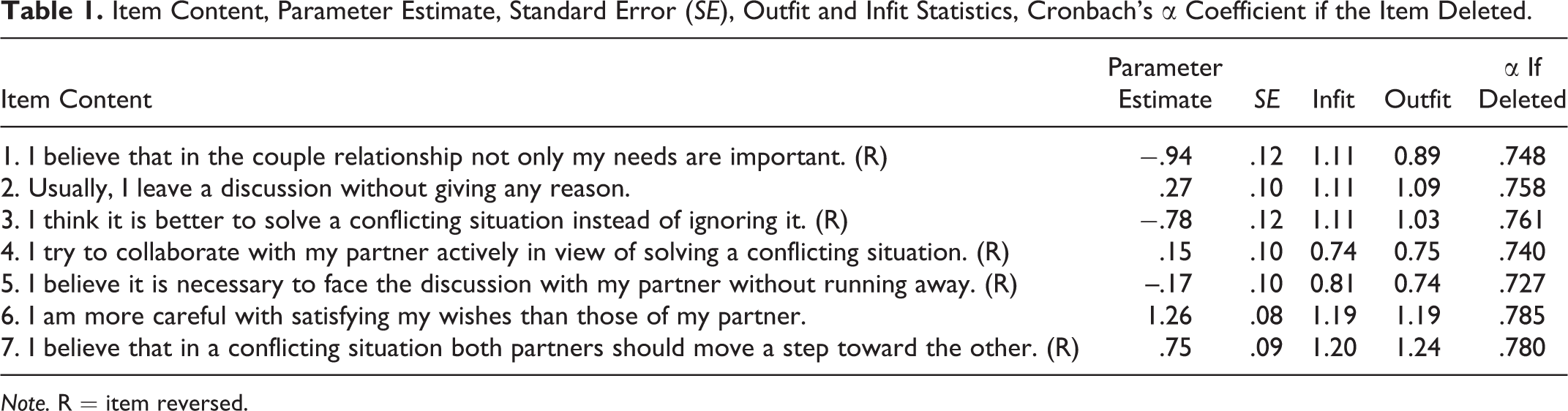
An MFRM analysis was performed on the 12 items. The data showed that all items fitted properly the hypothesized conflict dimension, since for all items the infit and outfit statistics were included in the range 0.70–1.30. The fixed χ2 equaled 1,036.2, with df = 11 and p = .00, showing a satisfactory discriminating power of the items. The analysis of the differential functioning of the items evidenced 4 items that significantly discriminated men’s and women’s responses, namely, gender represented a bias for such items; it was decided then to drop the 4 items in the final version of the scale. In order to further assess the solidity of the 8-item dimension, a second MFRM analysis was performed, where the facets were again, persons, items, and gender. The results confirmed the stability of the 8 items on the dimension since all items had fit statistics in the range 0.70–1.30; their discriminating power was defined by a fixed χ2 = 416.1, df = 7, and p < .005. The item differential functioning analysis did not evidence any significant result, meaning that the 8-item dimension is free from a bias due to gender. In order to assess the reliability of the items, using a classical test theory approach, Cronbach’s α coefficients were obtained for the total score and for each item if deleted. In Table 1, the contents of the 8 items, the parameter estimates, the standard error, the infit and outfit statistics, and the α coefficient for each item are presented. For the data interpretation, it’s worth noting, according to Rasch analysis, that positive parameter estimates indicate participants’ disposition to endorse the lower grades of the rating scale, which means that they are more likely to disagree with higher conflict item contents, whereas negative parameter estimates indicate participants’ disposition to endorse the higher grades of the rating scale, which means that they are more likely to agree with higher conflict item contents.
Item Content, Parameter Estimate, Standard Error (SE), Outfit and Infit Statistics, Cronbach’s α Coefficient if the Item Deleted.
Note. R = item reversed.
Table 1 shows that the item contents were representative of all the main aspects characteristic of the initial pool of items, in particular, the items evaluated by the participants as the most representative of conflicting situations are Item 1 (parameter = −0.94) “I believe that in the couple relationship not only my needs are important” (R), Item 3 (parameter = −0.78) “I think it is better to solve a conflicting situation instead of ignoring it” (R), and Item 8 (parameter = −.54) “I think that renouncing to something for the good of the couple might improve the relationship (R).” Among the items evaluated by the participants as the least representative of conflicting situations are Item 6 (parameter = 1.26) “I am more careful with satisfying my wishes than those of my partner” and Item 7 (parameter = 0.75) “I believe that in a conflicting situation both partners should move a step towards the other” (R). Being the Cronbach’s total score α (.79) satisfactory and the α calculated for each item in the range .727–.785, all items were considered to contribute positively to the internal consistency of the conflict dimension. The dimension was then denominated Conflict Management Scale (CMS).
Conclusion
In Study 1, a latent dimension was defined where items, devised to evaluate how people react to conflicting situations within the couple relationship, are located. An MFRM analysis provided evidence about the psychometric properties of such dimension composed by 8 items, free from gender bias, and related to the five conflict management aspects: competition, collaboration, avoidance, accommodating attitude, and compromise. The Cronbach’s α coefficient analysis confirmed the solidity of the dimension that constitutes the CMS.
Findings give satisfactory support to the CMS dimensional validity within an adaptation perspective for the Italian population. Further research to explore the convergent and predictive validities of such measure was planned in Study 2.
Study 2
In this study, the convergent validity and the predictive validity of the CMS were analyzed. On the basis of previous studies and results (e.g., Creasey, 2002; Narimani, Agamohammadian, & Ghaffari, 2008; Sessler, 2010; Shaver & Mikulincer, 2007; Vennum & Fincham, 2011), the CMS was expected to show significant correlations with decision-making, attachment styles, self-efficacy, and RS (convergent validity). In particular, impaired management of interpersonal conflicts was hypothesized to correlate positively with difficulty in decision-making within the couple (Creasey, 2002). From the attachment styles theory perspective, secure attachment was expected to correlate negatively with interpersonal conflicts, whereas anxiety and avoidance were expected to positively correlate with difficulty in managing conflicts (Mikulincer & Shaver, 2007). A significant correlation was also hypothesized between conflict management and self-efficacy (Narimani et al., 2008). Further, since perception of self-efficacy plays an important role in the couple’s relationship together with decision-making, conflict management, and attachment style, a significant correlation was hypothesized between conflict management and self-efficacy perception (Narimani et al., 2008). In a correlation perspective, variables such as relationship decision-making, attachment styles in the couple, self-efficacy perception, and RS might be also predicted by the capability of managing conflict in the couple relationship (predictive validity; Mikulincer & Shaver, 2007). The predictive validity of the CMS was then tested with the purpose of verifying whether the above-mentioned variables were all predicted with the same strength by the CMS.
Method
Participants and Instruments
The sample consisted of 205 psychology graduate students (153 women and 52 men) attending the University of Padova. The recruitment procedure and the ethic rules adopted with the participants were the same applied in Study 1. Participants’ mean age was 24.64 years (SD = 4.98). All students were required to be currently in a romantic exclusive relationship.
Relationship Deciding Scale (RDS)
The RDS items were generated in line with Stanley et al.’s perspective (2006; Vennum & Fincham, 2011). The scale consists of 12 items and three subscales: Relationship Confidence (4 items), Knowledge of Warning Signs (3 items), and Deciding (5 items; Boffo & Mannarini, 2015).
Attachment Styles Questionnaire (ASQ)
The ASQ consists of 40 items rated on an agreement Likert-type scale from 1 (totally disagree) to 6 (totally agree; Feeney, Noller, & Hanrahan, 1994). On the basis of the studies conducted by Mannarini and Boffo (2014b), the original five subscales converged into three main attachment constructs: Confidence (6 items; feeling secure and self-confident), Avoidance (17 items; discomfort with closeness and relationships as secondary), and Anxiety (14 items; need for approval and preoccupation with relationships). The ASQ applied in this study consists of 37 items (Mannarini & Boffo, 2014b).
Perceived Empathic Self-Efficacy Scale (PESE)
Designed according to Bandura’s perspective (Bandura et al., 2003), PESE seems to be positively related with empathy, sympathy, perspective taking (Ranfone, 2008), and prosociality (Alessandri, Caprara, Steca, & Eisenberg, 2009; Bandura et al., 2003; Caprara, Gerbino, & Delle Fratte, 2001). On the contrary, it appears to be negatively correlated to delinquent conduct (Bandura et al., 2003). The scale consists of 12 items to be rated on a Likert-type rating scale from 1 (not able at all) to 5 (totally able).
RS
Participants were asked how much they were happy and satisfied with their current relationship on a Likert-type rating scale ranging from 0 (not at all) to 4 (extremely).
Results
Convergent Validity
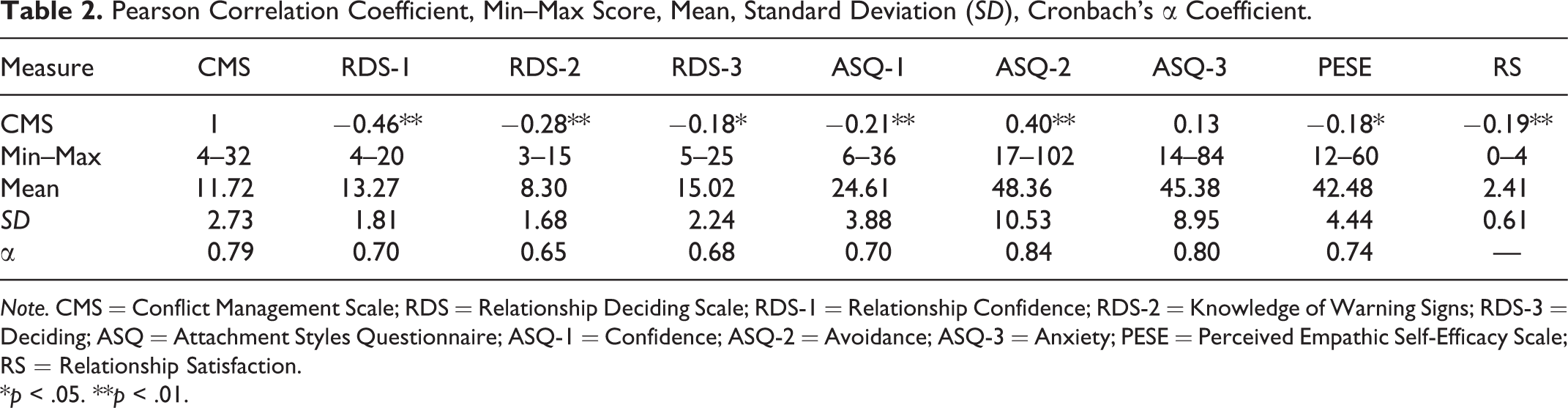
Pearson correlations were computed between the CMS and the other constructs: decision-making (three scales), attachment (three scales), self-confidence, and RS. In Table 2, Pearson correlation coefficients, descriptive statistics, and Cronbach’s α coefficients are presented.
Pearson Correlation Coefficient, Min–Max Score, Mean, Standard Deviation (SD), Cronbach’s α Coefficient.
Note. CMS = Conflict Management Scale; RDS = Relationship Deciding Scale; RDS-1 = Relationship Confidence; RDS-2 = Knowledge of Warning Signs; RDS-3 = Deciding; ASQ = Attachment Styles Questionnaire; ASQ-1 = Confidence; ASQ-2 = Avoidance; ASQ-3 = Anxiety; PESE = Perceived Empathic Self-Efficacy Scale; RS = Relationship Satisfaction.
*p < .05. **p < .01.
As expected, the CMS correlated differently with the other scales. In particular, the CMS was negatively related with all three constructs of the RDS. It was also negatively related to ASQ-Confidence, PESE score, and the RS measure. Moreover, as expected, the CMS was positively correlated with ASQ-Avoidance. Differently from the expectation the positive correlation between conflict management and attachment anxiety was not significant (p = .06). The correlation analysis showed a profile where conflicting situations, characterized mainly by scarce collaboration, egoism, avoidance in the couple relationship, were associated with difficulties in handling decisions in the couple, attachment-avoidance, low levels of attachment self-confidence, and lower perceived self-efficacy and RS. These results in particular highlight that lack of competent management of interpersonal conflicts can lead to dysfunctional couple relationships where decision-making about important relationship problems is very difficult to be handled properly (Creasey, 2002), self-confidence is low, and on the other hand discomfort with closeness within the couple is high (Mikulincer & Shaver, 2007).
Predictive Validity
On the basis of the previous analyses, the capability of prediction of the CMS was examined by a series of regression analyses, where the CMS construct was considered as independent variable. The results showed that conflict management can predict five of the eight variables previously correlated with the CMS, which are confidence in relationship (RDS-1; β = −.461, p < .001), awareness of warning signs (RDS-2; β = −.179, p < .001), secure and confident attachment (ASQ-1; β = −.213, p = .002), avoiding attachment (ASQ-2; β = .402, p < .001), and RS (β = −.194, p = .005). The CMS did not predict the capability of manifesting decisions (RDS-3), feeling anxious (ASQ-3), and the self-efficacy perception (PESE); such constructs in fact also showed lower correlation coefficients with the CMS.
Conclusion
Study 2 provided evidence about the convergent and predictive validities of the CMS. The CMS was hypothesized to be substantially correlated with constructs measured by the RDS, the ASQ, the PESE, and the RS (convergent validity). The correlation results confirmed the expectation with the only exception of attachment anxiety. As far as predictive validity is concerned, the results provided evidence about significant links between the CMS and some specific constructs examined. Of the seven constructs which were correlated with conflict as measured by the CMS, not all added collectively information about the capability of prediction of the CMS, showing that conflict management is not a good predictor of an anxious attachment and of the perceived self-efficacy.
Study 3
Study 3 aims to further analyze the psychometric properties of the CMS on cohabiting couples. The novelty of the study lies in participants: Differently from the previous studies, they were members of a couple who declared to have lived together for a period between 6 months and 3 years. We hypothesized that the CMS would be a valid instrument to assess conflict management not only within individuals experiencing (or having experienced in the past) a romantic relationship but also within couples living together everyday.
Method
Participants
The sample consisted of 60 heterosexual couples, for a total of 120 adult participants. The complete anonymity of the data, used only for the research purposes, was guaranteed. Participants’ mean age was 30.95 years (SD = 5.77). Informed consent was collected according to the guidelines of the Research Ethics Committee. All participants declared that they were currently living together with their partner: In particular, there were 20 married couples, 20 cohabiting nonmarried couples, and 20 couples who were planning to get married.
Instruments
Besides the CMS, the RDS (Vennum & Fincham, 2011—Italian version by Boffo & Mannarini, 2015) and the ASQ (Feeney et al., 1994—Italian version by Mannarini & Boffo, 2014b), described in Study 2, were applied separately to each member of the couple.
Results
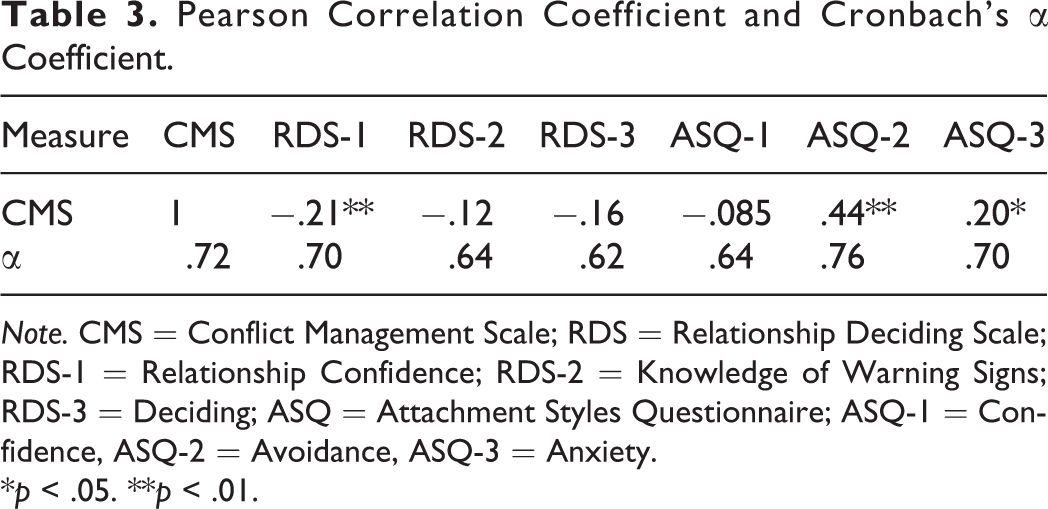
In order to analyze the convergent validity of the CMS, Pearson correlation coefficients were computed between the CMS and the scales measuring decision-making (three scales) and attachment (three scales). The internal consistency of all the scales was also examined by means of the Cronbach’s α coefficient. In Table 3, Pearson correlation coefficients and α coefficients are presented.
Pearson Correlation Coefficient and Cronbach’s α Coefficient.
Note. CMS = Conflict Management Scale; RDS = Relationship Deciding Scale; RDS-1 = Relationship Confidence; RDS-2 = Knowledge of Warning Signs; RDS-3 = Deciding; ASQ = Attachment Styles Questionnaire; ASQ-1 = Confidence, ASQ-2 = Avoidance, ASQ-3 = Anxiety.
*p < .05. **p < .01.
The CMS appeared to be negatively related to Relationship Confidence in decision-making (RDS-1) and positively related to Avoidance (ASQ-2) and Anxiety (ASQ-3) as far as attachment in the relationship is concerned. The correlation analysis showed that conflicting situations in the married and cohabiting couples were mainly associated with less confidence in handling decisions. Difficulties in the conflict management were also associated with high levels of attachment-avoidance and of attachment-anxiety. These results were in line with the findings of Study 2, but fewer correlations emerged, probably due to the kind of participants examined. Results underline in fact specific aspects of the life of a stable couple plenty of future programs. In particular, reciprocal confidence in the ability to handle decision demonstrated to be significant in conflicting situations while the tendency to feel uneasy with closeness was related to a greater extent of difficulties in conflict management. The internal consistency of all the scales was satisfactory.
Discussion
In Study 1, a scale to assess conflict management in couple relationships was devised in line with conflict aspects and constructs which had demonstrated to be relevant in the literature (e.g., Bayazit & Mannix, 2003; Zacchilli et al., 2009). The scale construction procedure was based on the results of a pilot research characterized by successive phases. Initially, items were generated to reflect in large part five specific conflict aspects such as competition, collaboration, avoidance, accommodating attitude, and compromise. Successively through a factorial approach, the items identified as problematic were discarded and 12 items which saturated a dominant main factor were maintained. The 12 items were applied to 405 university students, relying on a latent trait perspective. An MFRM, where besides persons and items also gender was entered, was applied in order to verify the existence of the conflict dimension. The final results provided evidence of a conflict dimension, where 8 of the 12 items, free from gender bias, were solidly located. The internal consistency of the dimension was also demonstrated and the scale was named CMS. In summary from the psychometric point of view, the scale is characterized by one single latent dimension where the items are located in increasing order as regard to the difficulty in managing conflicts in the couple as manifested by the respondents. Further, the scale is consistent and unbiased as far as sex is concerned. From the practical point of view, the scale is short and handy, easy to be applied both for research and for clinical purposes.
In Study 2, the validity of the scale was further analyzed. The results showed that the CMS can concur (convergent validity) with other constructs, such as decision-making, attachment, perceived self-efficacy, and RS, in defining the couple’s relationship functioning. As far as decision-making is concerned, the results seemed to indicate that lack of conscious decision-making about important problems might put relationship at greater risk of negative outcomes such as conflict problems (Stanley et al., 2006). Concerning attachment in the couple, the results seemed to show that a secure and confident approach in the couple relationship may help the couple to communicate openly during conflict in a collaborative manner, instead of avoiding the conflicting situations (Shaver & Mikulincer, 2007). The low correlation between conflict and anxious attachment could not allow to conclude that anxious people have difficulty in activating a healthy conflict management in the couple’s relationship (Shaver & Mikulincer, 2007). The results concerning self-efficacy seemed to support Bandura’s (1977) perspective: Self-efficacy beliefs affect the way people think to manage conflicts and to preserve a good functioning of the couple.
The results dealing with the predictive validity of the CMS added information to the correlation results. Conflicting situations in the couple are not only correlated, but they can also predict other behaviors and attitudes significant for the functioning of the relationship. In particular, CMS responses which endorse contents describing people exhibiting no involvement in conflicts and having low concern for one’s own as well as for the other partner’s outcomes might very easily involve responses which endorse contents describing a bad decision functioning in the couple (Bayazit & Mannix, 2003). Similarly, CMS contents describing partners as competitors who tend to force others and are not willing to collaborate can also predict lack of confidence and avoidant behaviors in the couple’s attachment. According to the literature, a cooperative conflict resolution style seems to promote a better functioning within the couple relationship (Jarboe & Witteman, 1996). Conflicting situations measured by the CMS seemed thus to predict a decreasing satisfaction within the relationship (Shaver & Mikulincer, 2007) together with other potentially unfavorable outcomes. Nevertheless, the convenience sample composed by university students, being in either an exclusive or a nonexclusive relationship, may limit the interpretation of the results connecting the couple management style, measured by the CMS, to other complex constructs, as attachment and self-efficacy. Therefore, Study 3 was planned to explore conflict management in married and cohabiting couples. The results showed that for those couples, conflict was mainly related to low confidence in taking decision within the couple and to high levels of avoidance and of anxiety as far as attachment was concerned.
In future studies, other constructs related to couple and family well-being might be correlated to the new CMS to provide evidence of the instrument’s ability to discriminate conflict attitudes and behaviors relevant to the whole family functioning. For example, besides attachment, self-efficacy decision-making, and satisfaction, it might be interesting to explore the link between conflict management style and emotional functioning, measuring not only individual characteristics, for example, alexithymia in the couple but expressed emotion levels in the whole family too. It is also worth investigating the possible connection between conflict management style of parents and perceived parental rearing styles in offspring. In fact, along with the above-mentioned link between conflict management and attachment styles, several studies (Halford et al., 2000; Levy et al., 1997; Linder & Collins, 2005; Wampler et al., 2003) convey the idea that difficulties in managing couple conflict and family-of-origin negative models are in most cases strictly related. It’s worth noting that current couple relationship can be influenced by the way partners think about family-of-origin experiences (Wampler et al., 2003), and this could be a crucial point to bear in mind when planning couple or family therapies. The very short and easy to administer CMS could thus prove to be a useful diagnostic clinical instrument in this kind of counseling and therapy setting for couples and for families.
Marital conflict in fact seems to have indirect effects not only on couple partners but on children as well (Frosch, Mangelsdorf, & McHale, 2000; Lindahl & Malik, 2011), by means of interferences in family alliances and parenting. The affective quality shows essentially a strong continuity between the two family subsystems, the couple and the triad involving a child (Kitzmann, 2000). The dyad may subsequently include children in the complex dynamics created by parents in order to regulate emotions and manage stress and conflicts within the couple. It is consequently not unlikely that family difficulties happen to find a voice in a child symptom (Schor & American Academy of Pediatrics Task Force on the Family, 2003). Several studies show that a lack of communication or a cutting-off-emotions style in the families, along with a greater extent of coldness, hostility, or high intensity couple conflict tactics can play a negative role in eating (Balottin, Nacinovich, Bomba, & Mannarini, 2014; Duclos et al., 2014; Rommel, Nandrino, Antoine, & Dodin, 2013) as well as in other kinds of childhood-onset disorders (Goldstein et al., 2007; Lumley, Mader, Gramzow, & Papineau, 1996). In this clinical and psychopathological context too, the evaluation of couple’s functioning, starting from the conflict management styles, can prove to be useful and sometimes indispensable to plan a treatment tailored for the child and for the family as a whole and thus likely to be accepted and compliantly followed (Gatta et al., 2009; Gatta et al., 2015).
Conclusions
Being composed by a single dimension, it is a very short and easy-to-administer instrument, handy to capture fundamental aspects of the couple conflict management. In subsequent studies, the scale will be administered to couples with children in order to further support the results obtained in this research.
One of the limitations of the present research lies in the samples: Participants belonging to different ages and cultural levels will be included in subsequent studies. Although it is worth noting that as far as age is concerned, young adults could be a significant sample to assess a variable, such as conflict, which is affected by changes typical of young couple’s relationships.
Moreover, on the basis of both the satisfactory convergent and predictive validity, the results suggested that the CMS may allow to understand how people approach the relationship with their partners, not only in terms of conflict management but also indirectly in terms of decisions-making within the couple, attachment styles, and satisfaction.
The predictive validity of the CMS can thus gain particular weight for the use in clinical settings. The evaluation of conflict can be a preliminary step in order to offer couple therapies, where appropriated, and in order to support the dyad in the parenting tasks, thus fostering children’s and families’ well-being. Being in fact the CMS is very short in its present version, it can be easily applied for research as well as for clinical purposes.
Footnotes
Declaration of Conflicting Interests
The author(s) declared no potential conflicts of interest with respect to the research, authorship, and/or publication of this article.
Funding
The author(s) received no financial support for the research, authorship, and/or publication of this article.