




Abstract
This study investigated the attachment orientations among married couples living in the suburbs of Kuala Lumpur and rural areas of Kota Bahru, Kelantan, Malaysia. The door-to-door approach was used to collect the data. The Experience in Close Relationship–Revised version and the Experiences in Close Relationship–Relationship Structures were used to measure attachment orientations. The results showed that husbands scored higher in anxiety and lower in avoidance than their wives. The participants from Kuala Lumpur reported more anxiety and more avoidance for the partner domain but less avoidance for the best friend domain. The implications of the study as well as the need for understanding attachment orientations for married couples are discussed.
Studies on attachment styles are established worldwide. It has extended beyond the infant–parent emotional bonds to examine close relationships in diverse settings, including schools, urban communities, general population, and psychiatric clinics. Attachment style has been shown to influence a variety of psychosocial factors, for instance, Fuenfhausen and Cashwell (2013) studied the adult attachment styles in relation to stress, dyadic coping, and marital satisfaction among counseling graduate students in the United States. Another example is the study conducted by Jones, Welton, Oliver, and Thoburn (2011) that focused on attachment as a mediator between mindfulness and marital satisfaction among 104 married adults aged 16–66 years via a nationwide online community. While Smith and Ng (2009) examined the associations of adult romantic attachment styles and family-of-origin expressive atmosphere among the general population of North Carolina and Northeast Texas, other social investigators studied the mediating roles of personal and commitment in the relationships between attachment styles and satisfaction in a sample of university students in Hong Kong and the United States (Ho et al., 2012).
Although the majority of adult attachment studies have explored a variety of samples, studies on married couples are scarce. One study reports on the match and mismatch of partner attachment and the interpersonal characteristics among married nonclinical couples (Kilmann, Finch, Parnell, & Downer, 2013). It was revealed that of the 268 spouses studied, 116 reported a secure attachment pattern and 152 reported an insecure attachment pattern. Of the 134 couples, 26 consisted of two secure partners (matched secure). Of the 64 couples consisting of one secure and one insecure partner (mismatched), the most frequent pairing was a secure partner with a dismissive-avoidant partner (n = 32). Of the 44 couples consisting of both partners with an insecure attachment pattern (match insecure), the most frequent pairing was two dismissive-avoidant partners (n = 12). When further analysis was conducted to examine marital satisfaction across couple attachment pairings, the study revealed that match-secure spouses were more significantly associated with marital satisfaction than mismatched insecure spouses. The study suggested that greater marital distress was more likely in marriages consisting of at least one insecure partner. Although that study suggested that wives’ attachment security is the key factor to maintain marital satisfaction in longer marriages, they did not examine the predictors of marital satisfaction for married couples.
In another health-related study, 157 Israeli former prisoners of war and their wives and a comparison group of 72 veterans not held captive and their wives were asked to complete a set of questions in relation to post-traumatic stress disorder and attachment security (Ein-Dor, Doron, Solomon, Mikulincer, & Shaver, 2010). It was revealed that anxiety attachment was associated with the severity of post-traumatic stress disorder and secondary traumatic stress of the veterans and their wives while attachment avoidance was associated with post-traumatic stress disorder and secondary traumatic stress only among couples that included a former prisoner of war. Thus, it was concluded that the development of post-traumatic stress disorder and secondary traumatic stress among the avoidant attachment couples only occurred in the case of extreme trauma. This explains the adverse effects of avoidant attachment on mental health in the presence of prolonged stressful life events, which may diminish strategy coping skills and the support system. Although further results suggested that attachment insecurity was significantly correlated with post-traumatic stress disorder and secondary traumatic stress among the veterans and their wives, the study did not examine whether post-traumatic stress disorder and secondary traumatic stress decrease when there is emotional support from relatives, confidants, neighbors, and peers.
A recent study used a self-report measure to examine the associations among personality factors, attachment styles, and coping strategies in couples with good and poor marital quality (Banerjee & Basu, 2014). Ninety married couples from Kolkata, India, were approached to participate in the study. The findings revealed that husbands with good marital quality scored higher on extroversion, secure attachment styles, and better coping strategies (problem focused, acceptance, low denial) than husbands with poor marital quality. The study also revealed that wives with good marital quality have better religious practices, acceptance, and social support than those with poor marital quality. No significant differences in terms of personality factors and attachment styles were found. Although further results suggested that marital quality was significantly correlated with personality factors, secure attachment style, and coping strategies among husbands, the study did not examine whether the marital quality of the wives increased when there was support from their partners.
One study reported that associations change over time between the attachment dimension and relationship outcome. The researchers searched for relevant studies using the PsycINFO database. Only articles related to relationship quality and attachment were included in the analysis. That study also sent several e-mails to other social researchers who had studied romantic relationships to request unpublished manuscripts and data that measured attachment and relationship satisfaction, commitment, or both (Hadden, Smith, & Webster, 2014). The selection criteria for articles and unpublished manuscripts were only those studies that measured attachment and relationship satisfaction, relationship commitment, or both and any measure of attachment as long as it was measured using a continuous scale. The final overall sample consisted of 57 independent effect sizes from a total of 14,340 people, including 36% men and 48% women. The findings revealed that insecure attachment style was negatively associated with relationship satisfaction. Avoidant attachment reported a stronger relationship than that of anxious attachment. Interestingly, this study also revealed a negative association between insecure attachment and relationship satisfaction in a sample of longer relationship durations. This study provides evidence that these relationship durations might play an important role in developing attachment insecurity.
Another study examined the psychosocial factors that affected the marital satisfaction among 191 married counseling graduate students (Fuenfhausen & Cashwell, 2013). Using a set of questions consisting of perceived stress, experiences in close relationships, dyadic coping skills, the relationship assessment, and demographics, the findings showed that low scores on avoidant and anxiety attachment and high scores in dyadic coping were significant predictors of marital satisfaction. This finding suggested that attachment is an important aspect in achieving marital satisfaction. Although these findings did not offer new knowledge to adult development studies, the findings successfully provided evidence of the strong links between attachment and marital satisfaction.
In relating attachment orientation, and relationship quality and loneliness among married couples, one study reported that insecure attachment was associated with lower relationship quality (Givertz, Woszidlo, Segrin, & Knutson, 2013). One of the most important factors that influences the attachment insecurity was relationship quality. Thus, that study revealed that insecure attachment was associated with lower levels of interpersonal trust and, in turn, lower relationship quality. Similarly, insecure attachment was also associated with lower relationship quality and, in turn, higher levels of loneliness among married couples. The researchers concluded that satisfaction, trust, and dependence are three aspects of close relationship quality.
Attachment Style and Psychotherapy
Previous studies suggested that the most successful methods of intervention for married couples are related to the therapist attachment style (Bucci, Seymour-Hyde, Harris, & Berry, 2015; Taylor, Rietzschel, Danquah, & Berry, 2015; Yusof & Carpenter, 2013). Byng-Hall (1995) proposed that therapists become a temporary attachment figure to clients; therefore, it is important that the therapists be mindful of their secure attachment style themselves. The therapists can be considered as a secure base to help the clients explore ways of improving their secure attachment style in times of crisis. Reports showed that those therapists with secure attachment styles were more successful in helping their clients to improve marital quality and satisfaction than insecure attachment styles (Marmarosh et al., 2014). The most crucial part in the process of psychotherapy is to develop trust and availability in times of crisis in the therapist–client relationships. Mikulincer, Shaver, and Berant (2013) explained that the roles of therapists are to help the client understand his or her life experiences and attachment experiences; identify and revise insecure attachment style by transforming them into secure attachment; and learn about ways to achieve both comfortable intimacy and self-reliance.
Findings from meta-analyses (Bernecker, Levy, & Ellison, 2014; Diener & Monroe, 2011) and a systematic review (Smith, Msetfi, & Golding, 2010) have shown that those individuals with secure attachment style showed stronger working alliance compared to those with insecure attachment style. Client attachment insecurity was also associated with negative therapeutic outcomes (Schauenburg et al., 2010) and client psychopathology (Travis, Bliwise, Binder, & Horne-Moyer, 2001; Van IJzendoorn & Bakermans-Kranenburg, 2010). In line with previous studies, Berry and colleagues (2015) revealed that both therapist attachment style and working alliance were significantly associated with the severity of client psychopathology. Therefore, it is important to consider client–therapist attachment style, working alliance, and client psychopathology to achieve the goals of therapy.
Attachment Studies in Malaysia
Only a few studies on adult attachment in East Asia have been found in the literature, with three studies having been conducted in the Malaysian setting. For instance, Ng, Trusty, and Crawford (2005), using a cross-cultural validation of attachment style questionnaire (ASQ), studied a sample of medical college students, supervisors of an electronics factory, and adults from a Sunday school class. Although this study with a small sample size was not representative of the Malaysian population, it provided an understanding of the suitability of the adult attachment measures to be applied in the local context. The ASQ, which was developed based on a large sample of Australians, was considered to be unsuitable for use in its current form. Thus, the adaptation of the ASQ self-report measure was considered to be the most appropriate. A further study on adult attachment in relation to gender, race, and marital satisfaction was carried out among Malaysians (Ng, Loy, MohdZain, & Cheong, 2013). This study revealed three main findings. First, a few items, including attachment-related avoidance and attachment-related anxiety, were considered suitable to assess adult attachment. Second, race and gender differences play a vital role in affecting adult attachment quality. Finally, both low attachment avoidance and attachment anxiety were significantly correlated with marital satisfaction. Although this study provided some useful information on adult attachment, several limitations were found. First, convenience sampling and oversampling of certain ethnic groups did not permit generalizability. Second, the cross-sectional design in this study did not permit causal relationships to be established. Finally, the deletion of certain items without replacing them with new items might have affected the theoretical constructs in predicting adult attachment styles. Therefore, it is our hope that this research can help fill a gap that has been present for decades in the social and psychological literature concerning adult attachment styles while also helping to advance the understanding of the origins of adult attachment styles in the Malaysian setting. This study aims to help fill this research gap by investigating gender differences in relation to attachment orientations across the partner and friend domains in the Malaysian context. More precisely, this study examines whether wives display more anxiety than the husbands and whether husbands demonstrate more avoidance than the wives. The study also aims to examine whether those individuals living in suburban areas show more anxiety and less avoidance than those who are living in the rural areas. We chose the suburban areas of Kuala Lumpur and the rural areas of Kota Bahru, Kelantan, for two reasons: (1) the cost of living in the suburbs of Kuala Lumpur is higher than that of the rural areas of Kota Bahru, Kelantan, thus many people are living in poverty, and (2) people living in the suburbs of Kuala Lumpur have a limited source of social support compared to those living in the rural areas of Kota Bahru, Kelantan. Based on the attachment literature, socioeconomic status and lack of social support are the key factors for triggering attachment activation behavior.
Method
Participants
The participants for this study were chosen from a suburb of Kuala Lumpur and the rural areas of Kota Bahru, Kelantan. Over a period of 6 months, 200 heterosexual couples (aged 21–80 years) with a minimum relationship length of 2 years, married, still living with each other, and at least one child at home living in an apartment under the Public Housing Program (PPR) in a suburb of Kuala Lumpur were selected to participate in this study. Participants were 199 heterosexual married couples. The mean length of the marital duration of the participants was 16.60 years (SD = 11.06). The mean age of the wives was 39.75 years (SD = 11.81) and, for the husbands, it was 44.41 years (SD = 12.67). Collectively, this sample was 71.9% Malays, 21.6% Indians, 5.0% Chinese, and others 1.5%. Less than half of the wives were employed (41%) with a mean income of RM527.92 (SD = 782.33). In terms of education, 61.5% of the wives had completed their secondary education and 38.5% finished up to primary school. Most of the husbands were employed (87%) with a mean income of RM1,379.64 (SD = 833.44). In terms of education, 78.4% of the husbands had completed their secondary education and 21.6% had finished up to primary school.
Of the remaining participants, 200 heterosexual married couples (aged 22–61 years) with a minimum relationship length of 2 years and at least one child at home were from the rural areas of Kota Bahru, Kelantan. The mean length of the marital relationship of the participants was 15.63 years (SD = 7.38). The mean age of the wives was 39.55 years (SD = 8.20) and, for the husbands, it was 42.35 years (SD = 7.39). This sample was 99.5% Malays and 0.5% Chinese. More than half of the wives were employed (79%) with a mean income of RM2,494.54 (SD = 1,624.50). In terms of education, 62% of the wives had completed their high school and 38% had graduated from universities. Most of the husbands were employed (99%) with a mean income of RM3,333.73 (SD = 1,376.17). In terms of education, 54.5% of the husbands had completed their high school, 45.5% graduated from universities, and 1% had finished up to primary school.
Measures
All the self-report measures used Likert-type response scales. The questionnaires utilized assessed the demographic factors. These standardized questionnaires were translated into the Malay language and translated back to the original version (English) before use to ensure the accuracy of meaning with the first author and research team members. Discrepancies were discussed and the wording changed for ambiguous items and back translated until a satisfactory version was achieved.
The Experience in Close Relationship–Revised version (ECR-R; Fraley, Heffernan, Vicary, & Brumbaugh, 2011) was used to measure adult attachment styles in close relationships with partners/spouses. The ECR-R assessed two indices—avoidance (18 items) and anxiety (18 items). The ECR-R consisted of 36 items rated on a 5-point Likert-type scale to indicate how much the participants agreed with each statement about close relationships. The scores ranged from 1 (strongly disagree) to 5 (strongly agree). The ECR-R avoidance items were “I prefer not to show my partner how I feel deep down,” “I feel comfortable sharing my private thoughts and feelings with my partner,” “I find it difficult to allow myself to depend on a romantic partner,” “I am very comfortable being close to a romantic partner,” and “I don’t feel comfortable opening up to a romantic partner.” Examples of ECR-R anxiety were “I’m afraid that I will lose my partner’s love,” “I often worry that my partner will not want to stay with me,” “I worry that romantic partners won’t care about me as much as I care about them,” and “I often wish that my partner’s feelings for me were as strong as my feelings for him or her.” The reliability analysis was conducted to examine the internal consistency of the items. The Cronbach’s α values of ECR-R for Attachment-Related Avoidance and Attachment-Related Anxiety subscales in our study were .84 and .87, respectively.
The Experiences in Close Relationship–Relationship Structures (ECR-RSs) is a contextual self-report measure of attachment. The ECR-RS was designed to assess attachment orientations across four kinds of intimate relationship, namely, mother, father, partner, and best friend (Fraley et al., 2011). We used the ECR-RS to examine attachment relationships with best friends. The ECR-RS consisted of 9 items to assess anxiety (3 items) and avoidance (6 items) across several distinct relationships including relationships with parents, partners, and friends. Examples of ECR-RS anxiety were “I often worry that this person doesn’t really care for me,” “I’m afraid that this person may abandon me,” and “I worry that this person won’t care about me as much as I care about him.” Examples for ECR-RS avoidance were “It helps to turn to this person in times of need,” “I usually discuss my problems and concerns with this person,” “I talk things over with this person,” “I find it easy to depend on this person,” “I don’t feel comfortable opening up to this person,” and “I prefer not to show this person how I feel deep down.” This ECR-RS reported a good psychometric property. The values of Cronbach’s αs for ECR-RS across four kinds of intimate relationships (father, mother, partner, and friend) ranged from .85 to .92 (Fraley et al., 2011). The value of Cronbach’s α of ECR-RS in our study was .66 for the best friend domain.
Statistical Power and Sample Size
In this present study, the power calculation was undertaken prior to the study to determine the size of sample required based on the expected effect sizes in prior studies using questionnaires. The power calculation was undertaken in relation to expected insecure attachment rates to provide sufficient numbers to detect differences between the two groups. The study aimed for high power while maintaining α at a reasonably low value (e.g., α at .001). The avoidant attachment rate in the United States was 25% and anxiety attachment was 19% (Hazan & Shaver, 1987). With the power (percentage chance of detecting) set at 80% and α = .05, a sample size of 194 was required for each group.
Data Analysis
Principal component exploratory factor analysis with varimax rotation was performed on the ECR-R and ECR-RS. Two factors were extracted for ECR-R, which explained 38.59% of the total variance. The first factor had an eigenvalue of 7.75, which accounted for 21.54% of the variance. The second factor had an eigenvalue of 6.14, which accounted for 17.05% of the variance. Following the recommendation of Hair, Black, Babin, Anderson, and Tatham (2006) that 0.40 is an acceptable factor loading cutoff for the practical significance of standardized factor loadings, this resulted in a consistent pattern of attachment style, in which both anxiety and avoidance loaded on either Factor 1 or Factor 2. There was a consistent pattern of adult attachment style, in which both anxiety and avoidance loaded on either Factor 1 or Factor 2. One item that was designed to assess anxiety tended to have a strong loading on Factor 2; hence, we concluded that this item is a potential measure for avoidance. The 5 items that were designed to assess avoidance tended to have strong loadings on Factor 1; hence, we concluded that these 5 items have the potential for measuring anxiety.
For the ECR-RS measure, two factors were extracted, which explained 60.39% of the total variance. The first factor had an eigenvalue of 2.99, which accounted for 33.26% of the variance. The second factor had an eigenvalue of 2.44, which accounted for 27.13% of the variance. We used 0.40 as the cutoff for the acceptable factor loading for the practical significance of the standardized factor loadings, which resulted in a consistent pattern of the ECR-RS attachment style, for which both anxiety and avoidance loaded on either Factor 1 or Factor 2. There was a consistent pattern of the adult attachment style, for which both anxiety and avoidance loaded on either Factor 1 or Factor 2. The 2 items that were designed to assess avoidance tended to load on Factor 2; hence, we concluded that these items have the potential to measure anxiety.
Procedure
This study was conducted in low-income apartments in a suburb of Kuala Lumpur, the capital city. The PPRs of the Federal Territory of Kuala Lumpur were initiated to accommodate squatters who were affected by the government development projects and for those low-income earners who wish to own their own home. A total of 11 public housing schemes under the City Hall of Kuala Lumpur were then identified as the sample. Official letters were sent to the City Hall of Kuala Lumpur for research approval and collaboration. The leaders at PPRs were approached, and a meeting was organized where he or she agreed to help with the study. The names and addresses of married couples were not provided by the leaders for the purpose of confidentiality; therefore, we decided to apply systematic sampling. However, this technique yielded an unexpectedly low response rate. Therefore, we adopted convenience sampling and door-to-door distribution of questionnaires. A group of Universiti Kebangsaan Malaysia (UKM) social work students was appointed as an enumerator to distribute the questionnaires. This fieldwork was part of their course evaluation toward their course grade. They were responsible for assisting the married couples in completing and returning the completed questionnaires. Meanwhile, in the rural areas of Kota Bahru, Kelantan, two enumerators were also engaged for a 6-month period to help the principal investigator to distribute the questionnaire door-to-door and collect them back. The heads of villages were approached and a meeting organized in which they agreed to help with the study. Convenience sampling was also applied to find the married couple samples at Kota Bahru, Kelantan. The data from both Kuala Lumpur and Kota Bahru were collected from March 2012 to September 2013.
The married couples were asked to complete a set of questions individually, including measures of their own and their spouse’s attachment pattern using the ECR-R and ECR-RS self-report measures. In an informed consent form, participants were told that all the information obtained from the questionnaires would be coded with numbers rather than names. Each couple was provided with a questionnaire pack and told that the purpose of this study was to assess the attachment style and psychological profile and that all the information would be coded and only accessible to the research team. The participants took 20–35 min to complete the questionnaire pack. Complete data were obtained from all the couples included in the study.
Results
Means, Standard Deviations, and Skewness of ECR-R and ECR-RS
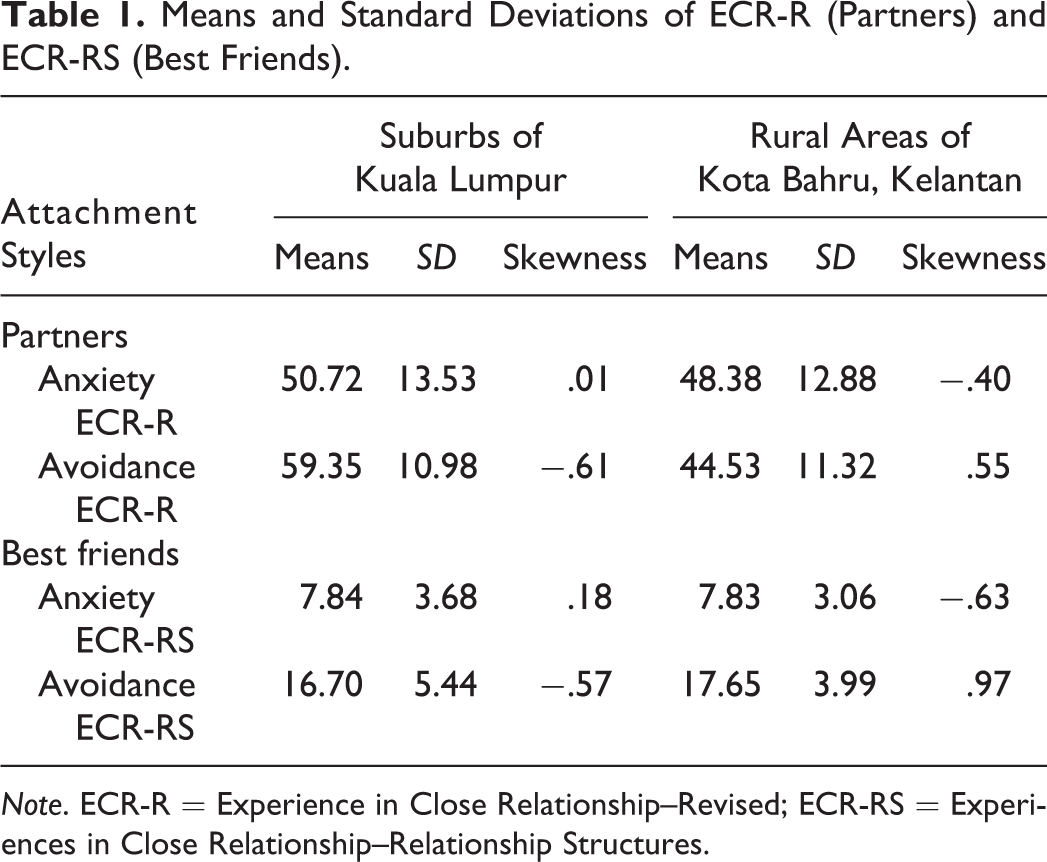
The means, standard deviations, and skewness are reported in Table 1, and the intercorrelations among the scores are reported in Table 2. Based on the descriptive analysis, all variables showed normally distributed data and assuming no collision statistics for skewness. The skewness in this study is approximately symmetric (Field, 2009; Gravetter & Wallnau, 2014; Trochim & Donnelly, 2006).
Means and Standard Deviations of ECR-R (Partners) and ECR-RS (Best Friends).
Note. ECR-R = Experience in Close Relationship–Revised; ECR-RS = Experiences in Close Relationship–Relationship Structures.
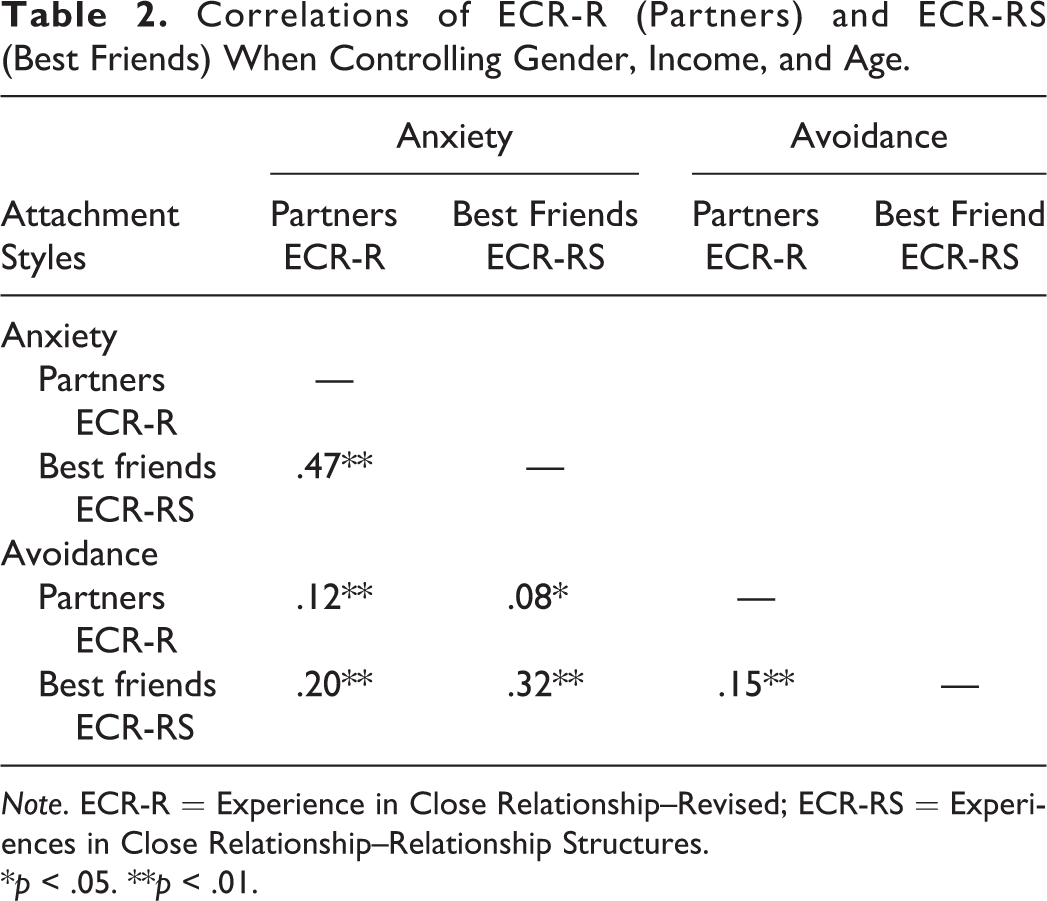
Correlations of ECR-R and ECR-RS
The correlations among the attachment dimensions in different domains were positive but not particularly strong. These results suggested that anxiety ECR-R was significantly correlated with anxiety ECR-RS (r = .47, p < .01), avoidance ECR-R (r = .12, p < .01), and avoidance ECR-RS (r = .20, p < .01). Anxiety ECR-RS was significantly correlated with avoidance ECR-R (r = .08, p < .05) and avoidance ECR-RS (r = .32, p < .01). The avoidance ECR-R was significantly correlated with avoidance ECR-RS (r = .15, p < .01). The results indicated that those who reported anxiety attachment with their partners were more likely to report less avoidant attachment with their best friends. Similarly, those who reported avoidant attachment with their partners were more likely to report less anxiety attachment with their best friends (Table 2).
Correlations of ECR-R (Partners) and ECR-RS (Best Friends) When Controlling Gender, Income, and Age.
Note. ECR-R = Experience in Close Relationship–Revised; ECR-RS = Experiences in Close Relationship–Relationship Structures.
*p < .05. **p < .01.
T-Test for Assessing Differences
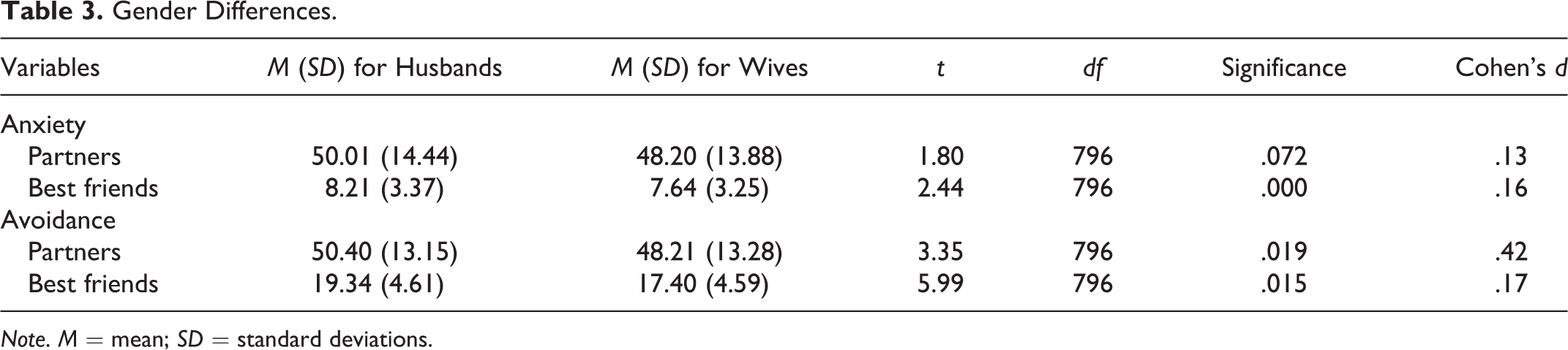
We also examined gender differences in the scales (Table 3). Our findings revealed that husbands and wives differed in their anxiety attachment and avoidant attachment ratings across the various scales, which suggested that wives tended to show more avoidance and less anxiety than husbands for the partner domain. However, no differences were found between husbands and wives for the best friend domain. We computed effect sizes (d) as an expression of the magnitude of the difference between husbands and wives’ levels of avoidant attachment. The results showed that gender differences in avoidant attachment were small to moderate in size (best friend domain d = .42, husband domain d = .16).
Gender Differences.
Note. M = mean; SD = standard deviations.
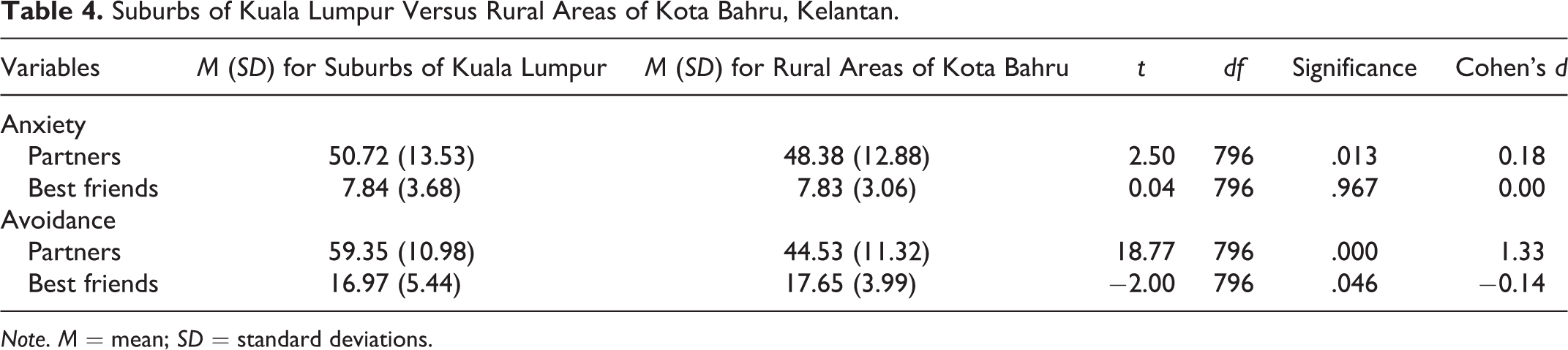
Further analysis was conducted to examine the attachment differences among people in Kuala Lumpur and Kota Bahru, Kelantan (Table 4). Our findings showed that those people who live in Kuala Lumpur report more anxiety attachment and more avoidant attachment for the partner domain. The findings also indicated that those people who lived in Kuala Lumpur showed less avoidant attachment for the best friend domain than those people who lived in Kota Bahru, Kelantan. There were no significant differences in anxiety attachment between those living in Kuala Lumpur and Kota Bahru, Kelantan, for the best friend domain. These findings add new knowledge to the adult attachment research literature.
Suburbs of Kuala Lumpur Versus Rural Areas of Kota Bahru, Kelantan.
Note. M = mean; SD = standard deviations.
Discussion
The primary goal of this study was to present a self-report measure in assessing adult attachment styles in people’s relationships with their partners and best friends. In addition, we examined the extent to which the differences in gender (husbands vs. wives) and environment (suburbs vs. rural) were related to anxiety attachment and avoidant attachment. Our findings revealed that the husbands scored higher in anxiety attachment and lower in avoidant attachment than their wives. The participants from Kuala Lumpur reported more anxiety attachment and more avoidant attachment for the partner domain but less avoidant attachment for the best friend domain. Our findings add new knowledge to the attachment literature in which the differences in gender and sociodemographics play a vital role in patterning attachment orientation toward partners and best friends.
Consistent with the literature (Ng et al., 2013; Schmitt et al., 2003), our findings concerning gender differences supported the theoretically expected differences in gender. In our study, the husbands were more likely to report more avoidant attachment in the partner and best friend domains, as indicated by the moderate scores on adult attachment. Our findings were consistent with the studies conducted by Schmitt et al. (2003), which confirmed that males reported higher scores on avoidance. Our findings of gender differences in avoidant attachment seemed to support the social beliefs that males were less emotional, less nurturing, less willing to connect with others, and display more social restrictiveness (Del Giudice, 2016; Schmitt et al., 2003). Mikulincer and Shaver (2007) further explained that gender socialization plays a vital role in forming avoidant attachment among males that emphasizes on self-reliance and suppress the needs for intimacy and emotional dependence. One possible explanation was avoidant attachment allows the husbands to maintain their sufficient autonomy and independence so that they can regulate their emotions and handle crisis or conflicts (Mikulincer & Shaver, 2003). This is related to the process of coping and adaptation. Another point was avoidant attachment perhaps might be also related to the need for emotional control in relationships in order to maintain social harmony. This emotional control is a part of cultural values for Asians that may appear to resemble the characteristics of avoidant attachment from a Western perspective (Wei, Russell, Mallinckrodt, & Zakalik, 2004).
Surprisingly, our study also revealed that the husbands were more likely to report anxiety attachment in the best friend domain. We suggested that the best friend was also a primary attachment figure in times of stress, in the absence of wife’s ability to provide comfort, love, and compassion. This can be explained in terms of Asian culture where the wives tend to be less expressive with their husbands, for instance, love is not verbally expressed but it can be seen in terms of fulfilling responsibilities and duties. Thus, we concluded that those husbands denoted anxiety attachment possess mental models of friendships as unavailable, unreliable, frustrating, or rejecting attachment figures. However, this anxiety attachment can produce hypervigilant form of coping strategy that allows them in seeking attention of best friends, which reduces a sense of insecurity (Simpson & Overall, 2014).
The findings for the intercorrelations between the partner and best friend domains were consistent with the suggestions that attachment patterns are based on cognitive structures that reflect positive or negative social-developmental experiences with attachment figures. For example, those individuals who reported anxiety attachment with their partners were also more likely to report anxiety attachment with their best friends but only to a low degree. This finding was similar to that reported by Klohnen, Weller, Luo, and Choe (2005), and Fraley, Heffernan, Vicary, and Brumbaugh (2011), that there was a within-person variation and also reflected the working model representations. This can be explained in terms of working models in which the availability of seeking comfort and help depends on the amount of direct personal experience, and the frequency with which they have been used in the past may influence how the individuals orient to their best friends, particularly in times of crisis (Simpson & Rholes, 2012).
Surprisingly, the people living in Kuala Lumpur and Kota Bahru, Kelantan showed similar patterns for anxiety attachment. This is an unexpected finding because the people living in the suburbs of Kuala Lumpur were expected to show more anxiety attachment and less avoidant attachment due to the socioeconomic status. Those people living in the suburbs of Kuala Lumpur and earning an income of less than RM3,000.00 have been identified as the urban poor. This financial hardship can be considered as an adversity. It is clear that financial hardship plays an important role in activating the attachment system. However, it is unclear why financial hardship formed anxiety attachment in the partners’ domain among people living in the rural areas of Kelantan where the cost of living was low, and, therefore, the residents did not face many monetary difficulties. In addition, we did not measure the poor crisis support, poor crisis coping strategies, or any recent life events that might shape attachment styles. However, this finding led us to conclude that, possibly, at this time, both contextual and personal factors contributed more to the differences in anxiety attachment but not in avoidant attachment.
Implications and Limitations of the Study
One implication of this study is that married couples working models with respect to different relational targets (e.g., partner, best friend) appear to help counselors or therapists to understand the different developmental trajectories over the life course. These findings indicate that in order to understand the adult attachment styles, it is necessary to examine married couples’ attachment working models at a specificity global level in terms of individual categorization, such as best friend (Sibley & Overall, 2010), and specific relationships, such as partner (Fraley et al., 2011). Moreover, our findings may suggest that counselors and therapists assess the adult attachment style at both specificity global levels and specific relationship before determining the type of therapy for married couples. This can be done by exploring expectations of the therapists, current interpersonal relationships with partners or best friends, and memories of earlier attachment figures. Through this exploration, the working models of the self and others are recalled, challenged, and modified.
A number of potential limitations of this study and further avenues for research in this area need to be addressed. While the self-report measures employed in this study are well validated and have been used previously in different contexts, the ECR-R and ECR-RS were devised specifically for use among married couples from a Malaysian population. While this did not appear to create any problems in this study, future research should develop versions of these instruments for use among the population of married couples. Finally, this study did not examine the potential interactions between gender and the quality of attachment relationships. Various theoretical positions (Bowlby, 1973; Furman, Stephenson, & Rhoades, 2013; Kirkpatrick & Davis, 1994; Shiota, Campos, Gonzaga, Keltner, & Peng, 2010) suggest possible interactions between the gender differences of partners and gender differences of best friends in relation to the attachment style and psychological health outcomes, which should be explored in future research.
Conclusion
This study has demonstrated that it is useful to consider gender differences when examining the role that attachment styles play in adaptive functioning during adulthood. The findings also highlight the importance of attending to intraindividual differences in close relationships with various attachment figures rather than relying on the global measures of attachment style. The poor intercorrelations between the attachment measures for partner and best friend as well as the complex relationships between these measures indicate that simplistic applications of attachment theory formulations will enhance our understanding of the close relationship of those married couples who are living in the suburbs of Kuala Lumpur and rural areas of Kota Bahru, Kelantan.
Footnotes
Authors’ Note
The authors of this article are all Faculty of Social Science and Humanities.
Acknowledgments
We thank the deputy director of the Housing Management and Community Development Department of Kuala Lumpur City Hall, who collaborated with this study, as well as the research assistants and social work undergraduate students who undertook the fieldwork and collected the data.
Declaration of Conflicting Interests
The author(s) declared no potential conflicts of interest with respect to the research, authorship, and/or publication of this article.
Funding
The author(s) disclosed receipt of the following financial support for the research, authorship, and/or publication of this article: This study was sponsored by the Ministry of Higher Education of Malaysia and Universiti Kebangsaan Malaysia, grant no. UKM-SK-05-FRGS0227-2010.