



Abstract
The study investigated potential variables associated with indiscriminate friendliness (IF) in children adopted from China by U.S. parents. Children in this study were adopted at a mean age of 19 months and have spent an average of 61 months with their adoptive parents. The sample comprised of 92 U.S. parents with children adopted from China. Children’s age at the time of adoption, length of postadoption time, prior institutional care, and postadoption parenting by adoptive parents were investigated in association with IF. Findings showed that prior institutional care was significantly associated children’s IF, whereas an increase in postadoption time shared with adoptive parents was not accompanied by a decrease in children’s IF. The significant regression model explained 9% of variance in children’s IF. Results provided practical implications for family counselors and other mental health professionals working with adoptive families.
According to the U. S. Department of State (2016), more than 76,000 Chinese children were adopted to the United States between 1999 and 2015. Postadoption adjustment of these children has been examined by earlier studies (e.g., Cohen & Farnia, 2011; Pugliese, Cohen, Farnia, & Lojkasek, 2010). Although Chinese adoptees compose a major part of international adopted children in the United States (U.S. Department of State, 2016), their development and well-being have rarely been addressed in counseling literature (Liu & Hazler, 2015). Due to the fact that many international adoptees and adoptive families are considered as needing counseling services (Zeanah et al., 2009), studying Chinese adoptees will offer important information and practical guidance for professional counselors who work directly with Chinese adoptive families.
Among all behavioral adjustment issues reported among international adoptees, indiscriminate friendliness (IF) stood out to be a prevalent one (Chisholm, 1998; O’Connor, Rutter, & The English and Romanian Adoptees Study Team, 2000). An IF refers to children’s affectionate and friendly behaviors toward all adults without appropriate caution and hesitance expected in children at the developmental stage (Tizard, 1977). Chisholm, Carter, Ames, and Morison (1995) found that children adopted from Romanian orphanages presented with significantly more IF behaviors than their noninstitutionalized counterparts.
Previous research focused on whether or not institutionalized adoptees presented with more IF behaviors than fostered adoptees or noninstitutionalized children (Chisholm, 1998; Chisholm, Carter, Ames, & Morison, 1995; Pears, Bruce, Fisher, & Kim, 2011; van den Dries et al., 2012). The link between children’s institutionalization and IF entails further investigation into specific components of institutionalization that may help explain children’s IF. Evidences supported that postinstitutionalized children displayed physical development delays, among which weight delay was highlighted as a common pattern among the children, due to malnutrition and a significant period of institutionalization (van Ijzendoorn, Bakersmans-Kranenburg, & Juffer, 2007; Loman, Wiik, Frenn, Pollak, & Gunnar, 2009). However, there is still an apparent lack of knowledge about IF and important variables associated with it. Studying IF and its associative variables will provide practical insights which professional counselors, especially those who work in the family counseling realm, may incorporate into counseling practice. This study is thus designed to examine potential variables that may be associated with IF in Chinese adoptees in U.S. families. The variables were identified from previous studies on international adoptees’ postadoption adjustment. The research question for this study is: Are levels of IF in Chinese adoptees in the United States associated with their age at the time of adoption, length of postadoption time, prior institutional care, and postadoption parenting received from adoptive parents?
IF
Tizard (1977) defined IF as children’s indiscriminately friendly behavior toward all adults including strangers, lacking appropriate caution, or fear. Children with IF are more likely to approach unfamiliar figures despite having solid relationships with their primary caregivers (O’Connor et al., 2003). Children showing a high level of IF do not demonstrate appropriate screening when interact with strangers. IF was categorized as a disinhibited subtype of Reactive Attachment Disorder (RAD) in the Diagnostic and Statistical Manual of Mental Disorders (DSM) IV (American Psychiatric Association [APA], 1994) and DSM-IV-Text Revision (APA, 2000). It was also named as disinhibited social behavior in previous research targeting for nonclinical settings (e.g., Bruce, Tarullo, & Gunnar, 2009; Pears et al., 2011). In the DSM-5, IF was separated from the traditionally defined RAD as an independent disorder named Disinhibited Social Engagement Disorder (APA, 2013). IF in adopted children was asserted to be related to inadequate and inconsistent care received from previous institutions where the children were adopted from, as most institutions do not seem to have sufficient labor and resource supplies (Smyke, Dumitrescu, & Zeanah, 2002). IF was identified in a number of institutionalized adoptees 11–39 months following adoption (Chisholm, 1998). It was classified as one of the most persistent socially abnormal behaviors in institutionalized children (Zeanah, Smyke, & Dumitrescu, 2002).
IF is proposed as a risk factor for children’s development and has been a concern of adoptive parents and mental health practitioners. Children with IF were found to present with a series of neurodevelopmental problems such as attention deficit hyperactivity disorder and post-traumatic stress disorder in a study of 34 adoptees in comparison with 32 nonadopted children raised by birth parents (Kočovská et al., 2012). In another study by Miellet, Caldara, Raju, Gillberg, and Minnis (2014), children with IF failed to show consensus on trustworthiness and attraction in presenting faces, whereas children without IF were able to reach an agreement demonstrated by previously tested adults. Concerns were thus held on trustworthiness and attractiveness judgments of children with IF. Children with a high level of IF are naturally considered as an at risk (APA, 2000, 2013), yet stay underserved by professional counselors.
IF is often discussed along with attachment in the current literature. It is either considered as a form of disorganized attachment (e.g., O’Connor et al., 2000) or a subtype of RAD (APA, 2000) or compared with attachment in discussing clinical implications (APA, 2013). Some findings, however, do not fully support the relationship between IF and attachment, indicating that IF is not necessarily associated with children’s attachment relationship with parents. Chisholm (1998) noted that securely attached children also presented with IF behaviors, although children with insecure attachment demonstrated a higher level of IF than the securely attached ones. Children adopted from high-quality institutions exhibited more secure attachment behaviors, yet still showed indiscriminate affection to unfamiliar adults (Chisholm, 1998; van den Dries et al., 2012).
Due to the lack of research on Chinese adoptees in the United States, the authors synthesized findings from earlier studies on international adopted children in general and generated four potential independent variables which seem to be associated with children’s IF. Children’s age at the time of adoption, prior institutional care, length of postadoption time shared with adoptive parents, and postadoption parenting received from adoptive parents were discussed, in relation to IF.
Important Variables
Age at the time of adoption
Adoptees’ age at the time of adoption has been rarely treated as a key variable in relation to IF, although it has been examined with relation to international adoptees’ overall adjustment outcomes (van den Dries, Juffer, Van IJzendoorn, & Bakermans-Kranenburg, 2009). Early age adoption has generally been found to be a favorable condition for children’s postadoption attachment development versus children adopted at an older age (van den Dries et al., 2009). However, IF was discussed more in younger children, specifically children who are under 5 or 6 years old, and was noted to dissipate when children get older due to the disinhibited nature of IF (APA, 2013; Hodges & Tizard, 1989). Further examination is needed in regard to whether or not within-group differences exist among children at a significantly younger age (i.e., infants; children who were) and those who were at a relatively older age (i.e., children who are closed to 5 or 6 years old).
Prior institutional care
Prior institutional care has often been linked to the level of IF in international adoptees. Bruce, Tarullo, and Gunnar (2009) examined the relationship between IF and several potential correlates in one hundred and twenty 6- to 7-year-old children equally distributed across three groups: institutional care, nonadopted, and foster care. Children from the institutional care and foster care groups scored significantly higher in the IF measure than those from the nonadopted group (Bruce et al., 2009). Earlier studies used the length of children’s institutionalization and the institutional care quality to reflect the prior institutional care that a child had received prior to the adoption. Love, Minnis, and O’Connor (2015) revealed that the length of institutionalization was found to be a significant variable associated with the level of IF rather the degree of general deprivation. Institutionalization, specifically whether or not a child has been institutionalized, was found to be a significant variable associated with IF (Dobrova-Krol, Bakermans-Kranenburg, van Ijzendoorn, & Juffer, 2010). Dobrova-Krol and colleagues conducted a hierarchical regression analysis to assess the unique role of the type of rearing (i.e., whether a child was reared in a birth family or in an institution), caregiving, and the interaction of both, in predicting IF in a sample of 29 institution-reared and 35 family-reared children. Results of the regression analysis suggested that the type of rearing significantly predicted children’s IF levels, with institutional rearing being associated with a significantly higher level of IF compared with family rearing.
Children’s weight at the time of adoption has been used as another indicator of the overall preadoption institutional care quality. In a meta-analytic study of van Ijzendoorn, Bakermans-Kranenburg, and Juffer (2007), evidences showed significant weight delays in international adoptees compared with the reference groups (i.e., nonadopted or domestically adopted counterparts) across 33 studies. The delays reflected children’s institutionalization history and were closely related to malnutrition in their prior institutions. Institutional care in the current study was measured by a self-constructed questionnaire because no existing instruments were found to measure children’s preadoption institutional care. Participants were invited to report the length of their children’s institutionalization, children’s weight at the time of adoption, and their perception of the overall institutional care quality that their children received prior to adoption.
Length of postadoption time
With institutionalization history being highlighted as a significant predictor of IF, pathogenic care and earlier experienced neglect (mostly associated with children’s institutionalization experience) were proposed to be a primary source of IF (Love, Minnis, & O’Connor, 2015). IF behaviors are expected to decrease with a longer period of time shared with adoptive parents. The significance of the length of time spent with adoptive parents was supported by previous findings that children’s IF behaviors markedly decreased when they reached 16-year-old (Hodges & Tizard, 1989) and IF signs significantly decreased to an indistinguishable level after 30 months of placement in foster care (Smyke, Zeanah, Fox, Nelson, Guthrie, 2010).
Parenting
The relationship between parenting and IF was found to be significant in a study of 13,472 twins tested at 8 years old (Minnis et al., 2007), where a higher level of IF was related to harsh parental discipline and a lower level of IF was related to parental positivity. While Minnis et al. (2007) targeted for IF in all children, van den Dries et al. (2012) specifically examined the relationship between postadoption parenting and IF exhibited in Chinese adoptees. van den Dries et al.’s findings supported that parental sensitivity (i.e., parents’ immediate and consistent responses to children’s needs) was correlated with a lower level of children’s IF. Parents’ emotional availability, an indicator of responsive parenting, at children’s age of 18 month was found to be a significant predictor of children’s IF level measured at 30 month (Garvin, Tarullo, Ryzin, & Gunnar, 2012).
Through this study, the authors focused on studying the relationships between previously discussed variables and IF presented by Chinese adoptees who were considered as an underexplored population in counseling journals (Liu & Hazler, 2015). The authors used the following research question to guide the research design and data analyses: Is lower level of IF in Chinese adoptees associated with younger age at the time of adoption, longer postadoption time spend with adoptive parents, better institutional care received prior to adoption, and more responsive parenting received from adoptive parents since adoption?
Method
Participants
Prior to participants recruitment, an institutional review board approval for this study was obtained from the at the authors’ institution. The authors drafted a Letter to Parents, including relevant information of the study (e.g., significance, purpose, recruitment criteria, risks involved in participation of the study, and confidentiality). Participants were not offered honoraria. Parents were allowed to withdraw from the study at any point of time. Participants were recruited primarily through local chapters of families with children from China and an adoption agency specializing in Chinese adoptions, located in Philadelphia, PA. Participants’ willingness to fill out a self-report online survey via PsychData, including selected measures for variables in this study, served as an agreement to participate in the study.
Participants comprised of 92 U.S. White parents with children adopted from China, who were under 6 years old at the time of the study, based on the rationale that IF has been identified as a more prevalent issue with children at a younger age (mostly under 5 or 6 years old). Participants ranged from 31 to 59 years old (M = 45.6; SD = 6.4). A majority of participants are adoptive mothers (94%; n = 86), and the rest (7%; n = 6) are fathers of the children. Participants represented a wide geographic range, from various states of the United States with children adopted from all over China.
Research Design
Hierarchical multiple regression served as the research design of the study. It aimed at investigating the role of each independent variable (i.e., age at the time of adoption, prior institutional care, the length of postadoption time, and postadoption parenting) in relation to IF. Hierarchical regression helped explain the variance changes in children’s IF by a particular independent variable, while other independent variables are controlled. In examining potential correlates of IF, previous studies revealed small to medium effect sizes. For example, Gleason et al. (2014) reported small effect sizes for chosen variables (e.g., attachment disorganization) in predicting IF, and Bruce et al. (2009) generated a medium effect size (r = .29) for an association between children’s length of institutionalization and their presented IF.
Measures
IF 5-item scale
The most widely used measure for IF behavior is the 5-Item IF Scale (Chisholm et al., 1995). The measure consists of 5 items assessing the following: (1) whether or not a child shows a high level of friendliness toward new adults, (2) whether or not a child is shy in a strange manner, (3) whether or not a child demonstrates excessively friendly behaviors when meets with strangers (e.g., sits on strangers’ laps), (4) whether or not a child tends to go home with newly met adults, and (5) whether or not a child wanders without checking in with caregivers. Participants scored 1 if they answer yes to an item or 0 if they answer no. Participants’ scores range from 0 to 5, which manifests the level of children’s IF, which 0 meaning no IF behaviors/tendencies were identified and 5 meaning a high level of IF. The Cronbach’s α coefficients of the 5-item IF Scale were reported as .83 (Zeanah et al., 2002), .58 to .72 (Chisholm, 1998), .78 to .81 (Pears et al., 2011; with dropping the last item), and .65 using only the first 3 items (van den Dries et al., 2012). Cronbach’s α value was .46 (with all 5 items included), .44 (with the first 4 items included), and .58 (with the first 3 items) for the current study. The last 2 items did not show acceptable item total correlations, and they also gained fewer participants’ endorsement for occurrence in the sample children compared to the first 3 items. The authors thus decided to only use the first 3 items. As a result, participants scored from 0 to 3, with 0 indicating no reported IF and 3 meaning a high level of IF in a child.
Age at the time of adoption and length of postadoption time
A demographic survey was created to collect basic information about the participants and children involved. Children’s age at the time of adoption and their current age were asked in the survey. The length of postadoption time was calculated using their current age minus their age at the time of adoption. Month was used as a measuring unit for age and time in this study.
Prior institutional care
The authors created a brief questionnaire to measure children’ prior institutional care because no existing measure was found. Three questions were designed to measure the institutional care that children received prior to adoption: (1) Was your child in a Chinese orphanage for more than 6 months before arrival? (1 = yes; 2 = no), (2) What was the weight of your child when adopted? (1 = below average, 2 = within normal average, and 3 = above normal average), and (3) What is your perception of the quality of the care that your child received in the orphanage? (1 = was not in an orphanage, 2 = high-quality care, 3 = acceptable quality care, and 4 = poor-quality care). Question 3 was reverse coded. Participants’ scores from the 3 items were summed up and used as the prior institutional care score for data analyses.
Postadoption parenting
Parenting is often measured through the levels of maternal sensitivity or types of parenting styles based on Baumrind’s (1966) primary parenting models: authoritative, authoritarian, and permissive parenting. Maternal sensitivity is often referred as caregiving of newborns and infants, while parenting styles are more often used to refer to parents’ responsiveness and demandingness to children at an older age (Liu & Hazler, 2015) which aligns better with the age of adoptees in this study. The authors chose the Parenting Styles and Dimensions Questionnaire (PSDQ; Robinson, Mandleco, Olsen, & Hart, 1995)–Short Version (Robinson, Mandleco, Olsen, & Hart, 2001) to measure postadoption parenting by adoptive parents. The PSDQ was designed to measure parenting scores for parents with children from toddlers to 12 years old. The short version consists of 32 questions, including 15 items for authoritative parenting, 12 items for authoritarian parenting, and 5 items of permissive parenting. All items were measured on 5-point Likert-type scales by parents based on self-evaluation. The α coefficients in previous research by Tan, Camras, Deng, Zhang, and Lu (2012) were .85 (authoritative), .71 (authoritarian), and .66 (permissive). The α coefficients were .84 (authoritative), .71 (authoritarian), and .68 (permissive) for the current study.
Results
Univariate and bivariate procedures were conducted prior to the hierarchical regression analysis. Univariate analysis yielded descriptive statistics, evidences for mathematical transformation of data, and graphical and residuals demonstration of assumptions testing for proceeding multivariate procures. Bivariate analysis showed significant correlations among variables in the study, which served as a way to test multicollinearity among the chosen variables. Hierarchical multiple regression analysis was conducted to test the significance of the selected variables in predicting children’s IF. The authors analyzed missing data and imputed with their regression values calculated by SPSS Missing Value Analysis using SPSS Statistics 20 (Sterner, 2011).
Descriptive Statistics
The mean and standard deviation values for children’s IF scores were M = 1.3 and SD = 1.1. The average age of children at the time of adoption was 19 months. Children in the study have spent an average of 61 months with their U.S. adoptive parents. Logarithmic transformations were made to all variables except authoritarian parenting due to the skewness of variables. Data transformations ensured that the normality assumption for multiple regression analysis was met. Table 1 shows the descriptive statistics for all variables after logarithmic transformations.
Descriptive Statistics for Variables After Transformation.
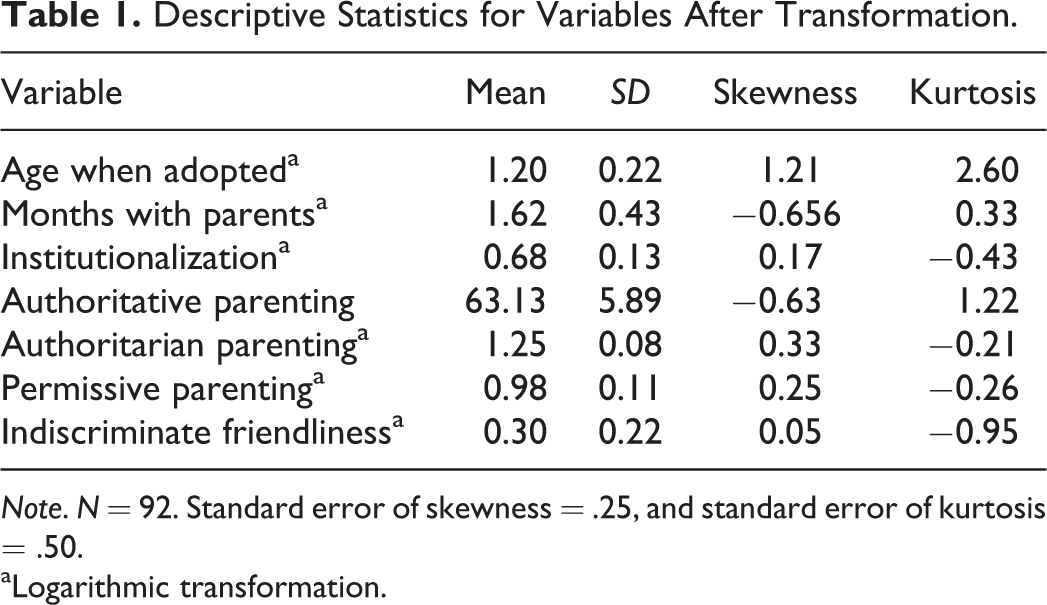
Note. N = 92. Standard error of skewness = .25, and standard error of kurtosis = .50.
aLogarithmic transformation.
The linearity and homoscedasticity assumptions were also tested before conducting hierarchical regression analysis, as violation of the assumptions may lead to Type I or Type II error or result in erroneous estimation of significance and/or effect size (Osborne & Waters, 2002). Bivariate scatterplots and residual plots provided no evidence that the linearity assumption was not met. Bivariate scatterplots also provided no evidence of violation of homoscedasticity.
Correlations
Significant correlations were found between the length of postadoption time and IF (r = .22, p < .05) and prior institutional care and IF (r = −.24, p < .05). Age at the time of adoption was significantly correlated with the length of postadoption time (r = −.56, p < .01), institutional care was significantly correlated with authoritative parenting (r = −.22, p < .05), and the three subscales of parenting styles were significantly correlated with each other. Authoritative parenting had a moderate correlation with authoritarian parenting (r = −.42, p < .01) and permissive parenting (r = −.35, p < .01), and authoritarian parenting had a moderate correlation with permissive parenting (r = .44, p < .01). Table 2 denotes a correlation matrix of the variables.
Correlation Matrix of Variables.

Note. N = 92.
aLogarithmic transformation.
*Correlation is significant at the .05 level. **Correlation is significant at the .01 level.
Hierarchical Regression
Variables were entered into each regression model, following one of the two empirically supported rationales: (1) entering variables strictly following a theory used to guide a study (Petrocelli, 2003) or (2) entering variables according to research relevance (Cohen & Cohen, 1983). Specifically, Cohen and Cohen suggested that demographic variables (e.g., age, gender, and race) always be entered into the initial model, then enter other selected variables based their relevance to the dependent variable, as suggested by the literature. Because this study was not driven by a particular theory, so children’s age at the time of adoption and the length of postadoption time as demographic variables were entered into the first hierarchical regression model, then prior institutional care was entered as the second model while age and postadoption time were controlled, as children’s institutionalization experience has been frequently addressed in relation to children’s IF and overall adjustment. Postadoption parenting, in the form of three parenting styles, was entered into the third model while both demographic variables and institutional care were controlled. The hierarchical regression analysis yielded a significant model, with prior institutional care as a significant variable while demographic variables were controlled. The significant regression model explained 9% of the variance in children’s IF levels. The analysis offered statistically significant findings to the research question of this study. Table 3 shows the hierarchical regression analysis output with the selected variables.
Hierarchical Regression Analysis of Variables Associated With Indiscriminate Friendliness.

Note. N = 92.
*p Value was below .05.
Research Question
Hierarchical regression provided an answer for the research question proposed: Is lower level of IF in Chinese adoptees associated with younger age at the time of adoption, longer postadoption time with adoptive parents, better institutional care received prior to adoption, and postadoption parenting by adoptive parents? Prior institutional care was found to be significantly associated with IF scores in Chinese adoptees in this study (p < .05). A higher prior institutional care score was associated with a lower level of IF in Chinese adoptees in this study.
The second regression model with adding prior institutional care and controlling demographic variables was significant (p < .05), and the first and third models were not (p > .05). The total variance in children’s IF explained by the significant model was 9%, R 2 = .09, F(1, 88) = 4.16, p = .04. The length of postadoption time was positively associated with IF, β = .24, t = 1.92, p < .05, which means that no evidence was found to support that children’s IF decreased with an increase in time spent with their adoptive parents. There was a negative association between prior institutional care and IF, β = −.22, t = −2.04, p < .05; namely, the more positive institutional care that a child had received prior to adoption was associated with a lower level of IF in children. The association between postadoption parenting by adoptive parents and IF was nonsignificant (p > .05).
Discussion
This study found that prior institutional care was significantly associated with children’s IF levels. The more positive institutional care the adoptees received, the lower IF level displayed by the children after adoption. Another interesting finding is that an increase in the amount of time a child spent with adoptive parents was not accompanied by a decrease in IF displayed by the child.
Prior institutional care
The significance of institutional care in association with IF behavior was consistent with previous findings. Children’s preadoption institutional care appeared to be a common significant variable of the IF level in Romanian institutionalized adoptees (e.g., Chisholm, 1998) and international adoptees in the United States (Bruce et al., 2009) and Chinese adoptees in Netherlands (van den Dries et al., 2012). The study solidifies that more positive institutional care is significantly associated with a lower level of IF in the sample of Chinese adoptees in this study. The significance of institutional care strengthens the need of preadoption assessment, prevention, intervention, and clinical and research collaboration with institutions back in adoptees’ home countries. The findings also filled in the literature gap, because the current literature focuses intensively on postadoption research and interventions, without emphasis within counseling journals on potential preadoption clinical programs (Liu & Hazler, 2015).
The length of postadoption time
The length of postadoption time was not accompanied by a decrease in children’s IF as supported by previous research on international adoptees. Instead, a child may still show a higher level of IF with a long time spent with adoptive families since adoption. This result was inconsistent with a previous study (Pugliese et al., 2010), where IF behaviors (as described as disorganized attachment behaviors) were found to decrease with 6 months spent with adoptive parents.
The finding provoked further thoughts on alternative explanations which were not investigated by this study. For example, children’s IF could be due to individual characteristics (children’s personalities; biological or neural factors) and the preadoption conditions that children had experienced. The alternative explanations seem to be consistent with the nonsignificant role of postadoption time shared with adoptive parents in association with children’s IF, as adoptive parents had no control over children’s inherited characteristics and preadoption conditions. Aligning with the alternative explanations, Tan and Marfo (2016) stressed the significant role of Chinese adoptees’ early life adversity prior to adoption, not postadoption factors, in predicting their postadoption behavioral problems and later adjustment, following a 6-year longitudinal study.
Beside these alternative explanations, this inconsistency between the finding and the general assumption that children’s IF behaviors will gradually dissipate with more time spent with their adoptive parents might also indicate postadoption triggers which can potentially arouse children’s IF behaviors. For example, it would make much sense if a child shows a high level of IF to a stranger in the United States (e.g., someone with an Asian appearance) whom the child may feel resonant with or whom reminds the child with someone she or he knew back in China.
Nonsignificant variables
Nonsignificant variables included age at the time of adoption and postadoption parenting by adoptive parents. Parenting styles in this study were assessed by PSDQ with parents’ reported scores for each of the three substyles (i.e., authoritative, authoritarian, and permissive). IF-parenting relationship was specifically investigated based on variance in children’s IF explained by parent’s scores from the three parenting styles. Although the scale is targeted to measure parents’ level of responsiveness to children’s needs and demandingness for children to meet parental expectations (Robinson et al., 2001), variation may still exist between adoptive parents’ overall parenting quality and attributes fall under the three parenting styles. Earlier findings revealed significant relationships between IF and parental sensitivity (van den Dries et al., 2012) and between children’s IF and parenting quality (Minnis et al., 2007). Previous research involved using a summative score to represent parenting quality/sensitivity, whereas it would not make statistical sense to sum scores from the distinct parenting styles using the selected measure.
Limitations
The 5-item IF Scale that has been used frequently in literature yielded low internal consistency reliability with a Cronbach’s α value of .58. Although similar values were reported in previous studies, .58 to .72 in Chisholm (1998) and .65 in Pears, , Bruce, Fisher, and Kim (2011), the low Cronbach’s α value indicated that variability exists among the items within the scale. Namely, the items may not sufficiently measure IF, or they may not capture all pertinent parameters of IF. However, the low Cronbach’s α value could also be interpreted as that the items measure different unique aspects pertinent to IF; and it is not uncommon to encounter low Cronbach’s α values in short scales (Streiner, 2003). With IF emerging as a salient issue in postinstitutionalized or fostered children (Bruce et al., 2009; Pears et al., 2011), this measure limitation indicates a strong need for a well-established measure with a higher level of internal consistency. It is reasonable to develop more items, beyond the current five, to measure a complex construct as IF. Another limitation of the study is associated with using self-reported surveys, as reporters’ bias can be a concern. The IF and early institutional care scores captured only parents’ perceptions of the constructs; however, no children’s input was included for this study.
Practical Implications
The current study brought attention to IF in Chinese children adopted by U.S. families. The findings offered practical implications for family counselors working with adoptive families and scholars interested in Chinese adoption. The role of prior institutional care stressed the importance of preadoption prevention and intervention, in association with children’s IF after adoption. The length of institutionalization, children’s weight at the time of adoption, and parents’ perception of caregiving quality were three criteria to assess children’s prior institutional care in this study. Such institutional care consists of multiple aspects such as food quality/nutrition (Welsh & Viana, 2012), staff’s physical attending skills, and mental and psychological care provided in response to children’s needs. Significance of the prior institutional care implied that necessary preadoption preventions or interventions are necessary. Family counselors may work with families who have been matched with a child in a Chinese institution, or potential adoptive families considering Chinese adoption, to assess children’s IF levels and provide adequate support to children prior to their arrival in the U.S. adoptive parents, family counselors, and other mental health professionals involved in the adoption process may actively initiate collaboration with Chinese institutions. Collaborative efforts can be made to track children’s physical growths, detect children’s IF signs/indicators, and to evaluate and enhance institutional care through improving nutritional and other caregiving improvements.
There are significant opportunities for family counselors to work with parents and adoption agencies to facilitate preadoption prevention and intervention programs (e.g., designing and implementing training programs specializing in institutional care, collaborating with medical professionals and social workers in providing sufficient nutritional diet). The importance of attending to children’s psychological needs may also be reinforced in institutions using special psychoeducational programs. For example, staff members in a Chinese private institutionalization were assigned roles as father, mother, and siblings rather than administrative titles such as “director,” “coordinator,” and “assistant,” which provides children with a quasi-family environment and sense of belonging (Neimetz, 2011).
Family counselors are also encouraged to work with parents to examine potential triggers of IF. Specifically, family counselor may work with parents to assess whether or not children’s IF behaviors have been displayed in a consistent manner and to conduct a more thorough evaluation on where the IF behaviors may come from. In addition, parents may attend to children’s behaviors exhibited right after adoption, as they could offer strong indication of children’s prior institutionalization experience and are noted to be associated with children’s later behavioral adjustment (Tan, Camras, Deng, Zhang, & Lu, 2012). More data related to IF can be gained from tracking the amount of children’s overly friendly behaviors and conducting periodic follow-ups, which assists with a more objective evaluation of IF and designing and implementing future counseling intervention programs for families (Liu & Hazler, 2015).
Future Research Recommendations
This study yielded significant findings on IF in Chinese adoptees with practical implications for professional counselors working with adoptive families with Chinese children or who are considering Chinese adoption. It offered insights for future research directions. The low R 2 value explained by the significant regression model indicated that other important variables need to be investigated in association with Chinese adoptees’ IF.
Considering the instrument limitations, the current 5-Item IF Scale may be used cautiously, and a new measure on IF or an expansion of the current 5-Item Scale needs to be considered. It will better capture IF using items not only generating “yes” or “no” on whether or not children display certain behavior but also assessing the frequency and severity of relevant behaviors. Researchers are also strongly encouraged to look into the alternative explanations of IF when considering new items to measure IF. For example, children’s personal factors could potentially be associated with their friendly manner toward strangers; with extrovert children are more likely to approach strangers and introvert children may choose to stay with their immediate caregivers. Aligning with the line of measure development, based on the fact that children’s institutional care was shown to be a significant variable in the study as well as many previous findings, a valid and reliable instrument may be considered in measuring children’s earlier institutional care.
Qualitative research on IF seems to be desirable, given that current counseling journals do not provide adequate information on the topic, its clinical implications and research needs. An in-depth qualitative study may expand the scope of understanding on what IF entails, what IF productive institutional care is, and parents’, children’s, and counselors’ knowledge on IF. It will be helpful include more diverse perspectives on addressing IF.
Footnotes
Declaration of Conflicting Interests
The author(s) declared no potential conflicts of interest with respect to the research, authorship, and/or publication of this article.
Funding
The author(s) received no financial support for the research, authorship, and/or publication of this article.