



Abstract
The nature of police work includes toxic work environments and uncertain danger which imparts a unique type of occupational stress spillover or the transfer of stress from work life to home life for law enforcement officers. Work stress places officers at risk for negative health and psychosocial outcomes. While it has been shown that occupational stress can compromise the well-being of police officers, little is known about how spillover can effect other areas of life for officers such as marital relationships. This study investigates the association between work demands, emotional stress spillover, and marital functioning in a law enforcement sample. Data from 1,180 married law enforcement respondents to the Police Officer Questionnaire which included 148 items assessing work stress, health, family, and support were examined. Responses were analyzed using regression analyses. Results showed that career demands and emotional spillover were statistically significant predictors of the variance in marital functioning. Social and emotional spillover of work-related stress carries negative consequences for communication and emotion regulation within law enforcement marriages.
Law enforcement work is multidimensional as officers operate in the role of public servants while maintaining readiness to confront dangerous situations and critical incidents at any time (Chopko, 2011; Violanti & Aron, 1993). It has been estimated that over 750,000 sworn officers in the United States make upward of approximately 11 million arrests per year. In 2015 alone, 500,000 of those arrests were violent crime arrests, that is, when an offender uses aggression or force upon a victim (U.S. Department of Justice, Federal Bureau of Investigation, 2016). The uncertainty of the danger that could arise from any given contact with the public is supported by the staggering numbers of assaults on officers and the rise in felonious killing of officers in the line of duty. Between 2005 and 2014, over 563,000 officers were assaulted and 505 officers were murdered (Officer Down Memorial Page, 2016; U.S. Department of Justice, Federal Bureau of Investigation, 2016). As of December 2016, overall line of duty deaths was up 14% from 2015 with a 67% increase in gunfire deaths and 22% increase in auto-related deaths of officers (Officer Down Memorial Page, 2016). The risks of physical harm in policing are rivaled by the risks associated with psychosocial harm which permeate the profession. Police suicide rates exceed the civilian suicide rate at 17 suicides per 100,000 compared to 11 per 100,000 in the general population (The Badge of Life Study, 2015).
Risks associated with policing carry implications for officers’ families that extend beyond individual level risk (Brodie & Eppler, 2012; Fagan, 2015; Kirschman, 2007; Roberts & Levenson, 2001). An extensive body of research has examined law enforcement stress at the individual level, or how work stress places officers at risk for negative health and psychosocial outcomes (Charles et al., 2007; Habersaat, Geiger, Abdellaoui, & Wolf, 2015; Kales, Tsismenakis, Zhang, & Soteriades, 2009; Komarovskaya et al., 2011; Papazoglou, 2013; Toch, 2002). However, the study of risk at multiple levels of influence and across multiple domains for law enforcement officers and their families is lacking. While it has been shown that the stressors from work can compromise the well-being of police officers, little is known about how these stressors, namely, work demands and emotional spillover from work, effect other areas of life for officers such as their romantic relationships, parent–child relationships, social relationships, and beyond. For example, responding to a critical incident involving child welfare may influence the way an officer sets boundaries for their children in an attempt to protect them from harm. Furthermore, officer exposure to crime scenes involving children may shape interactions between an officer and their own children in the days following the on-duty incident. This study seeks to address this gap with the goal of exploring work–family conflict for law enforcement officers from the lens of risk and resilience with emphasis on multiple levels of risk.
The purpose of this article is to examine the relationship between occupational stress and marital functioning in a sample of law enforcement personnel in order to assess the risk of work stress on marital quality. Implications for future directions of research on law enforcement couples and families will be provided based on empirical findings. Recommendations will be made for further examination of law enforcement stress spillover from a family systems perspective of risk and resilience.
Individual Level Risk and Sources of Stressors
Risk can be examined from a cumulative stress standpoint or the pile up of external and internal persistent stressors that threaten adaptation (Patterson, 2002). This conceptualization of risk is grounded in the stress and coping literature (Hawley & DeHaan, 1996; McCubbin & Patterson, 1983) and lends itself to law enforcement stressors which range from acute, critical incident response to ongoing stressors tied to uncertainty of danger, working in toxic environments, and shift work. Generally, risk for police officers originates from four main sources of stressors: organizational, operational, personal, and external stressors. Organizational stressors revolve around the hierarchy of policing and the lack of support within the organization. Shift work, lack of resources, restrictive policies, agency politics, and court system inconsistencies have been cited as organizational stressors (Fagan, 2015; Violanti & Aron, 1993). Operational stressors include the routine work stress of the job such as critical incident response, felony arrests, vehicle pursuits, and the overall dangers of the job (Slate, Johnson, & Colbert, 2007; Violanti & Aron, 1993). External stressors may arise from the political climate, public perception of police work, or negative portrayal of law enforcement by the media (Slate et al., 2007). Personal stress is related to being on call, missing family events, conflict with family, lack of understanding and support from friends and family outside of law enforcement, and anxiety (Fagan, 2015). Work stress, arising from the aforementioned sources, contributes to the multitude of negative outcomes to physical and mental health for law enforcement personnel.
Physical and mental health
Deleterious effects of stress on police officers’ physical and mental health have been well-documented (Lucas, Weider, & Janisse, 2012; Violanti et al., 2009). Law enforcement officers are prone to more at-risk health outcomes such as high blood pressure, headaches, back pain, posttraumatic and perceived stress, unhealthy and/or irregular sleeping patterns, depression, and other mental health issues compared to their civilian counterparts (Avdija, 2014; Charles et al., 2007; Habersaat et al., 2015; Kales et al., 2009; Komarovskaya et al., 2011; Skogstad et al., 2013; Violanti et al., 2009). For example, the presence of cardiovascular disease is 1.7 times higher in retired officers than in other professions (Ramey, Downing, & Franke, 2009). Extant research has shown that law enforcement officers report high levels of anxiety and depression as well as maladaptive coping behaviors (Yoo, 2011). Increased alcohol and tobacco use among officers has been linked to their work stress (Avdija, 2014; Keyes, Hatzenbuehler, & Hasin, 2011). Additionally, mortality rates among police are overwhelming. The average life expectancy of an officer who reaches age 50 is an additional 7.8 years compared to an additional 35 years for the general public (Violanti et al., 2013).
While demands in the line of duty may directly contribute to physical and mental health outcomes by means of witnessing or engaging in violence in order to fulfill duties, other indirect contributions may also have an impact such as 24-hr shifts, night shifts, diet, or proximity to dangerous neighborhoods (Can & Hendy, 2014; Choi, Schnall, & Dobson, 2016).
Family Subsystem Risk
The interplay between work and family stress can pile up to impact family functioning (Walsh, 1996). Notwithstanding individual level risk for negative physical and mental health outcomes for officers, law enforcement stress has ramifications for the family system and subsystems within the family which include marital relationships and dyadic functioning (Brodie & Eppler, 2012; Roberts, Leonard, Butler, Levenson, & Kanter, 2013; Roberts & Levenson, 2001).
Communication, emotional regulation, and day-to-day family activities have been reported as major concerns for marriage and family life of officers (Brodie & Eppler, 2012; Fagan, 2015; Roberts & Levenson, 2001). An outward communication focus for female spouses and an inward focus for male officers have emerged as a pattern of communication for law enforcement couples (Brodie & Eppler, 2012). Likewise, issues surrounding emotional regulation, particularly patterns of high negative affect among officers who report high stress, have been connected to low positive affect for their spouses. Stress can interfere with healthy relationship functioning in large part because coping with high stress can deplete cognitive resources that are necessary to manage emotions (Neff & Karney, 2009). Reactivity to marital interactions and relational experiences are influenced by experiences outside of the relationship. It has been found that partners who experience higher levels of stress from external sources are more reactive to relationship-specific experiences and report less favorable global satisfaction with their relationships than those who experience less stress (Neff & Karney, 2009). Karaffa et al. (2015) revealed that the greatest concerns reported by law enforcement spouses regarding the perceived impact of work on the marriage include officers missing family activities, choosing work over family, and scheduling conflicts.
Spillover Theory and Work–Marriage Interplay
The manner in which occupational stress cascades into domains outside of the work environment has been referred to as “spillover,” and occurs when the thoughts, emotions, and behaviors in the work environment transfer over into the home environment (Bolger, DeLongis, Kessler, & Wethington, 1989; Repetti, 1989; Staines, 1980). A contagion of stress that translates from work to family and from family to work was found by Bolger, DeLongis, Kessler, and Wethington (1989), as well as evidence that there is a compensatory process by which men and women lessen their participation in stressful situations at home after experiencing stress at work. The theory of spillover can be either positive or negative and has been connected to the way home life shapes work life as well (Grzywacz, 2000).
In line with spillover, the idea of emotion transmission serves to explain how emotions are carried over between contexts and between family members (Larson & Almeida, 1999). The study of emotions in police relationships has recognized that the exhausting nature of police work due to organization and operational stressors leaves officers and their romantic partners at risk for negative outcomes. A study from Burke (1993) found that law enforcement spouses absorbed work-related stress and emotional distress that accompanies police work. Furthermore, law enforcement spouses have attributed high levels of family conflict to the influence of work-related stress (Burke, 1993). Harshness toward family members and the use of aggressive control tactics by officers in their home life has been conceptualized by Johnson, Todd, and Subramanian (2005) who offered “authoritarian spillover” to describe the way an officer exercises command and control at home much like he or she does in the workplace. Authoritarian spillover has been used to explain domestic violence in police families (Johnson, Todd, & Subramanian, 2005; Zavala, 2013). Roberts and Levenson (2001) studied the spillover of emotions in law enforcement couples and found that affect patterns for both spouses showed lower levels of positive affect, while husbands showed higher negative affect and wives reciprocated lower levels of positive and negative affect. Furthermore, high levels of work-related stress were linked to increased physiological arousal and low levels of somatic activity for both husbands and wives before and during communication tasks. These findings suggested that there was a “disconnect” pattern among the couple on days of high job stress for the husband. Similarly, dyadic synchrony research has found that affect and hostility were predicted bidirectionally between law enforcement couples (Roberts, Leonard, Butler, Levenson, & Kanter, 2013).
Disengagement by law enforcement spouses was shown to be beneficial for law enforcement couples on days of exhaustion and high stress for officers (Roberts & Levenson, 2001). Specifically, wives were less likely to reciprocate negativity on days when their husbands reported high stress. This relationship acted as a protective factor for the relationship because husbands showed more negativity and less positivity during marital interaction tasks on days of stress and exhaustion (Roberts & Levenson, 2001). However, the wives’ ability to disengage, while protective in the short-term, could be maladaptive in the long-term because emotional withdrawal has also been linked to lower levels of marital satisfaction (Story & Bradbury, 2003). Therefore, protective factors that attenuate the effect of stress on relationship functioning in one domain may induce vulnerability in other domains or over time. Although risk from work-stress spillover can be harmful to relationships, as manifested in communication and emotion regulation patterns in law enforcement samples, protective effects of emotion synchrony are also apparent.
The Present Study
The purpose of this study is to examine the contributions of occupational stress spillover on marriages in a law enforcement sample to determine how social/emotional spillover and work demands are associated with negative relationship functioning. It is expected that high social/emotional spillover will be associated with poorer relationship functioning. Secondly, it is expected that high career demands will be associated with poorer relationship functioning.
Method
Data for this study were derived from the Work and Family Services for Law Enforcement Personnel in the United States study (Delprino, O’Quin, & Kennedy, 1995). Data are comprised of responses to the Police Officer Questionnaire collected in 1995, which included 148 items assessing work stress, health, family, and support. Initially, 4,400 officers were sampled with a response rate of 36.43%, for a sample size of 1,632. The study sampled metropolitan law enforcement personnel from three major regions of the United States including the Northeast, Midwest, and Southwest.
Participants
For the purpose of studying the impact of work stress on law enforcement marriages, purposive sampling was utilized for this study and cases were selected for inclusion based on marital status. Respondents were included in the study if they reported being currently married (those who were single, widowed, or divorced were excluded). The rational for inclusion criteria was to selectively isolate married officers based on outcome of interest pertaining to marital relationships only. Based on inclusion criteria, the original sample of 1,632 was pared down to a final sample of 1,180 married law enforcement personnel. The sample was 91% male, with a mean age of 39 and a mean of 14 years in law enforcement. The sample was predominately White with at least some college education. Sample characteristics by race/ethnicity are 88% White, 4% African American, 5% Hispanic, 1% American Indian, and less than 1% Asian/Pacific Islander. Over half of the participants held the rank of officer.
Measures
Demographic variables
Gender, age, race/ethnicity, and education level were included as control variables for this study. Gender was included as a dichotomous variable, male (1) or female (2). Age was a continuous variable, and responses ranged from 22 to 64. Race/ethnicity was dichotomized as non-White (0) and White (1). Education level was measured as a continuous variable ranging from 1 to 6, such that high school diploma was (1), some college (2), associate’s degree (3), bachelor’s degree (4), some graduate school (5), and graduate degree(6).
Marital functioning
The outcome of interest for this study was marital functioning which was a composite measure of items related to the frequency at which the job influences an officer’s relationship with their spouse. Items included questions about the stress from the job leading to withdrawal from spouse, mood impacting spouse’s mood, and arguments about the job (e.g., “Job stress leads me to withdraw from my spouse/partner,” “The mood I am in as a result of my job influences the mood of my spouse/partner,” “We argue about my job”). A composite measure was created using 4 items with 5-point response options ranging from never to always, with higher scores reflecting higher degrees of negative marital functioning. The items were summed and a total score was generated. The Cronbach’s α for marital functioning items was .817.
Career demands
Career demands was measured through a composite measure of items related to organizational and operational stressors. Example items included questions about the physiological demands, burnout, closed society of policing, missing family events, high moral standards for the family, public criticism of the job, dangers of the job, and the job becoming priority over family. A composite measure was created using 8 items with 5-point response options ranging from not an issue to very much an issue with higher scores reflecting higher demands. The Cronbach’s α for career demands items was .811.
Social and emotional spillover
Social/emotional spillover was measured through a composite measure of items related to cognitive and emotional spillover from the work environment into an officer’s home life. Officers were asked about attitudes being carried over from work to home, feelings at work being carried home, and conflict from work carrying over to home life (e.g., “My experiences and conflicts at work carry over into my home life,” “The feelings I have from incidents at work often come home with me”). A composite measure of 11 items with 5-point response options ranging from strongly disagree to strongly agree with higher scores reflecting higher spillover was created. The Cronbach’s α for social/emotional spillover items was .803.
Analytic Approach
Bivariate correlations were examined and then marital functioning was regressed on predictor variables. Multiple linear regression analysis was employed through use of IBM SPSS 24. For each model, the part and partial correlations were analyzed. Unique variance was calculated for the predictor variables of interest.
Results
Bivariate correlations were tested among the variables and can be found in Table 1. Notably, social/emotional spillover was correlated to each variable in the study with the exception of age. Descriptive statistics were also assessed and can be found in Table 2. Our next methodological approach was a regression analysis. Results can be found in Table 3. The null hypotheses tested were that R 2 was equal to 0 and that the regression coefficients were equal to 0. All tests were done at α = .05 level. The linear combination of predictors accounted for 45% of the variance in marital functioning; R 2 = .456, adjusted R 2 = .453. The model was statistically significant, F(6, 1,053) = 147.145, p < .000. Both career demands and social/emotional spillover were statistically significant predictors of the variance in marital functioning. A 1 unit increase in career demands was associated with a 0.496 unit increase in negative marital functioning holding all other predictors constant (p = .000). Career demands explained 18% of unique variance beyond that accounted for by other predictors in the model. A 1 unit increase in social/emotional spillover was associated with a 0.288 unit increase in negative marital functioning holding all other predictors constant (p = .000). Social/emotional spillover explained 8% of unique variance beyond that accounted for by other predictors in the model. Collectively, 18% of the total variance was shared variance (vs. 27% being unique variance of all predictors), which is also evidenced by the high collinearity of the control variables (i.e., gender and age, gender and race/ethnicity).
Bivariate Correlations.

*p < .05. **p < .01.
Variable Means and Standard Deviations.
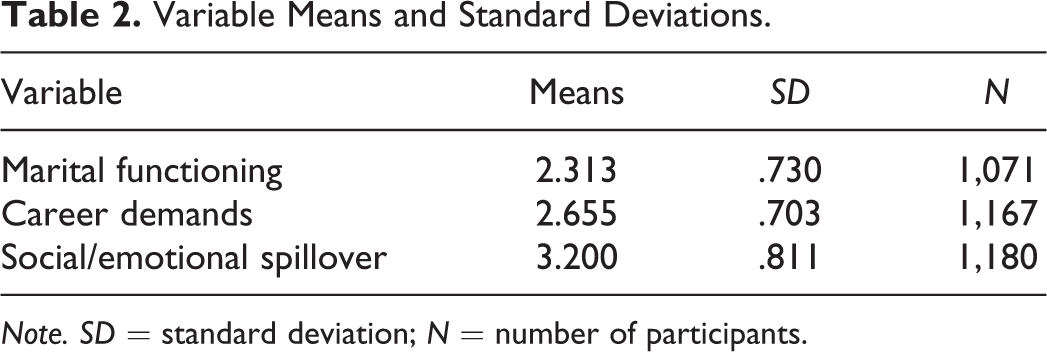
Note. SD = standard deviation; N = number of participants.
Predictors of Marital Functioning.
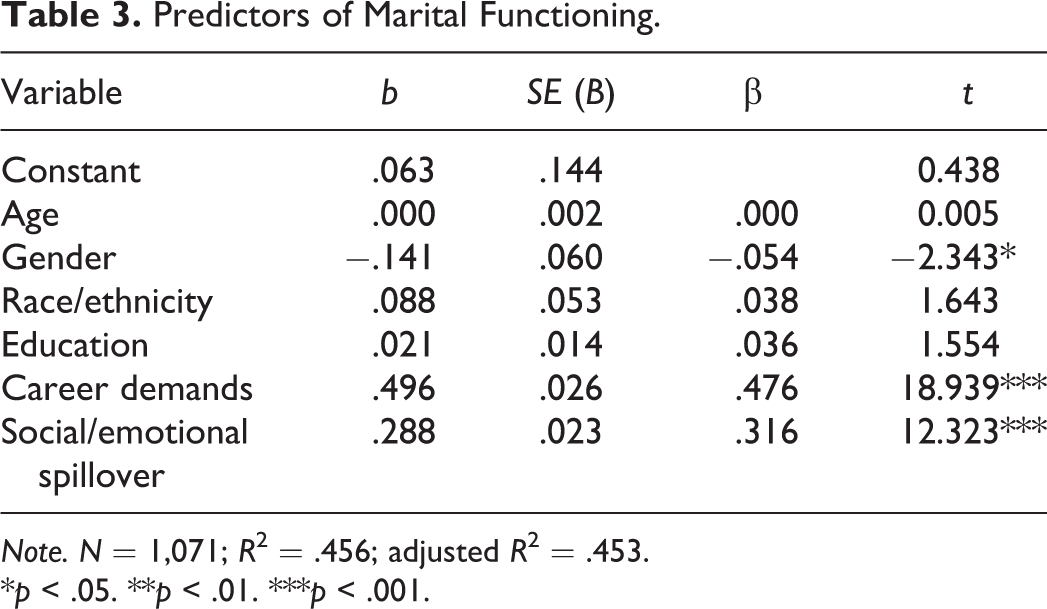
Note. N = 1,071; R 2 = .456; adjusted R 2 = .453.
*p<.05. **p<.01. ***p<.001.
Discussion
This study assessed the association between occupational stress spillover and marital relationship functioning among law enforcement officers. Career demands accompanying the law enforcement profession are associated with poor marital functioning. Likewise, emotional stress spillover is related to negative relationship outcomes. Law enforcement stress and work–family conflict arising from social/emotional spillover have multiple levels of influence.
Findings supported the hypotheses that career demands related to organizational, operational, and external stress of policing were positively associated with negative marital functioning. Similarly, social/emotional spillover related to the mental and emotional stress of policing explained a significant portion of the variance in negative marital functioning. Uniquely, career demands were able to explain 18% of the variance in relationship functioning; however, 8% of the outcome was attributed to social/emotional spillover. These findings suggest that while stress from the day-to-day operations and organizational red tape have consequences for law enforcement marriages, an officer’s inability to leave the badge at work can also be maladaptive for relationship functioning. Findings lend support to prior work on the impact of law enforcement stress on relationships (Fagan, 2015; Roberts et al., 2013; Roberts & Levenson, 2001). This study adds to the existing research in that work stress associated with organization and operational stress was distinguished from the mental and emotional spillover so that unique contributions could be revealed.
Study Limitations
Generalizations of findings are cautioned due to limitations associated with cross-sectional data. Causal inferences cannot be made as data were collected at a single time point. The data included a mere snapshot into the personal and family lives of officers and do not take into account the dynamic nature of a relationship over time. Additionally, this study was limited to self-report data from officers and does not capture spouse reports of law enforcement stress on the family. Further, the sample was obtained from metropolitan police departments only. Police work, culture, and climate in rural areas may hold inherent differences from metropolitan areas and therefore inferences should not be made regarding rural law enforcement families. Lastly, female personnel were underrepresented in the sample, and future research should consider purposively sampling for female officers to investigate gender differences.
Practical and Clinical Implications
Prevention and intervention programming could be focused at the organizational and operational level due to the strong association between career demands and relationship functioning. Nevertheless, department and policy-level change may prove to be cumbersome, and findings from this study also suggest that focusing on officer and family-level coping, communication, and problem-solving would also be worthwhile. For example, an intervention study by McCraty and Atkinson (2012) exposed officers to a resilience training program through a wait-list control design. This program was designed to educate and train officers to cope with physiological and psychological stressors of police work. Results showed that program participation reduced distress, anger, sadness, and fatigue, while improving communication and increasing awareness and self-management of stress reactions (McCraty & Atkinson, 2012). Resilience-focused interventions for police could be a promising avenue for translational science and could be extended to family programs for law enforcement officers. This article lends evidentiary support for programs such as this one.
Officer wellness programming should consider family adaptations that would promote family communication and emotional regulation across the family system. Strengthening family relationships through prevention or intervention programming could buffer families against the stress spillover from law enforcement work into the home. Similarly, clinicians are encouraged to engage families in treatment and treatment planning when possible so that the interplay between individual stress and family system stress can be addressed.
Clinicians and social service providers who work with law enforcement officers or their families are also encouraged to participate in ride-along programs offered by many law enforcement agencies. Ride-along programs allow interested citizens to spend time with an officer while they are on duty to learn more about police work in their communities. Professionals could benefit from gaining insight into the police subculture and police stress through ride-along programs. A more intimate understanding of law enforcement work, gained from riding with an officer, could help professionals build rapport and trust with their clients who are situated within the law enforcement subculture.
Future Research Recommendations
This article reviewed individual-level risk for officers but systematically explored risk for the marital dyad as a family subsystem. Based on family systems theory and family risk and resilience, it can be inferred that risk could extend across other family systems to include parent–child relationships, sibling relationships, and beyond to impact the broader family system in families with law enforcement officers (Henry, Morris, & Harrist, 2015). Future research should focus on the inclusion of law enforcement children as a unit of analysis with recommendations for mixed research methodology to include qualitative interviews or focus groups with children. This could guide the exploration of risk and resilience of law enforcement families beyond the marital dyad, as research has shown that dynamics of family stress are often interconnected and shared among family members (McCubbin & Patterson, 1983). Additional work is necessary to understand the risks throughout the family system; however, a strengths-based approach would be recommended to uncover protective factors born out of law enforcement stress. One example could be explorations in how much police officers disclose privately to their spouses, thus strengthening the coping mechanisms of stress for both individuals collectively.
Law enforcement officers are faced with a multitude of stressors associated with their chosen career field. When stress experienced on-duty is carried home with the officer, romantic relationships are impacted. The social and emotional spillover of work-related stress carries negative consequences for communication and emotion regulation within law enforcement marriages, and the field of police stress spillover should be further expanded upon to understand these complexities.
Footnotes
Declaration of Conflicting Interests
The author(s) declared no potential conflicts of interest with respect to the research, authorship, and/or publication of this article.
Funding
The author(s) received no financial support for the research, authorship, and/or publication of this article.