




Abstract
Face-to-face prevention-focused relationship education programs have generally been efficacious in improving couples’ communication and relationship satisfaction. Computer-based interventions have furthered the dissemination of these interventions, so anyone with access to a computer can participate in the intervention. One of the next steps in this line of research is finding affordable and convenient ways to disseminate this information. One possibility is text messaging. The current study examined the feasibility of utilizing text messages as a dissemination tool for relationship enhancement. In this study, 128 married individuals were randomly assigned to a control condition (n = 64), where relationship-related text messages were not received, or to a treatment condition (n = 64), where relationship-related text messages were received. Individuals assigned to the treatment condition responded positively toward the intervention. Participants’ dropout and retention rates were promising, and 99% of the participants supplied authentic phone numbers. Participants reported the intervention helped them make changes in their relationship, and that the text messages’ content was beneficial to their relationship. Strengths, limitations, and ideas for future research are discussed, as well as the implications for utilizing text messages as a dissemination tool for preventative relationship education.
Prevention-focused relationship education programs have generally been found efficacious in improving couples’ communication and relationship satisfaction (Jakubowski, Milne, Brunner, & Miller, 2004). Traditionally, these interventions have been delivered to couples as face-to-face programs in groups. Simons, Harris, and Willis (1994) found that only a minority of couples attend such programs because they may lack interest, believe the intervention to be intrusive, or lack the desire to talk openly about their relationship problems.
Computers and technology have been shown to be a valuable tool in the dissemination of relationship education programs and to improve relationship functioning (see Braithwaite & Fincham, 2007; Braithwaite & Fincham, 2009; Braithwaite & Fincham, 2011; Braithwaite & Fincham, 2014; Cavanagh & Shapiro, 2004; Doss et al., 2016). In particular, programs such as ePREP, http://OurRelationship.com, and watching movies together as a couple and discussing them have all utilized atypical forms of therapeutic delivery and have produced favorable results. Braithwaite and Fincham’s ePREP (2007, 2009, 2011, 2014) has reduced couples’ levels of anxiety, depression, and intimate partner violence and has improved relationship functioning. Doss et al.’s (2016) http://OurRelationship.com program, an online adaptation of an in-person couple therapy, has been shown to produce improvements in couples’ relationship satisfaction (Cohen’s d = 0.69), relationship confidence (d = 0.47), positive relationship quality (d = 0.15), and in reducing negative relationship quality (d = 0.57). And finally, a large-scale clinical trial found that watching movies and discussing them—an “intervention” that was intended to be a control condition—was as effective as a skill-based relationship education program (Rogge, Cobb, Lawrence, Johnson, & Bradbury, 2013). One potential common factor in all these interventions is increased investment in the relationship, that is, all of these interventions make the relationship more salient and lead to increases in efforts to improve it. Because those who receive these technology-based forms of treatment tend to view them as acceptable forms of treatment (Cavanagh & Shapiro, 2004), this led us to question what other forms of technology could be useful in the dissemination of relationship education?
We believe that one of the next steps in this line of research is finding simple, convenient, and affordable ways to disseminate these interventions to individuals and couples. A potentially useful approach is text messaging (texts) or texting. Texting, or type-written messages or photos sent through mobile phones, allows individuals to be reached at any time or place as long as their phone has a signal (Pettigrew, 2009). Texting also allows individuals to respond when it is most convenient (Pettigrew, 2009). Texts have also been shown to be used by people of various races and socioeconomic backgrounds (Lenhart, 2010).
According to Lenhart (2010), cell phones have become a necessity. An estimated 82% of adults carry mobile phones, with 80% of Whites, 87% of African Americans, and 87% of Latinos reporting owning a mobile phone. African Americans and Latinos, who tend to be of lower socioeconomic status, utilize texting more often than Whites. Additionally, 71% of individuals who make less than US$30,000 a year report owning a cell phone (Lenhart, 2010). Leading us to conclude that texting may have wide-reaching potential even considering individuals of various races or socioeconomic backgrounds.
Texting has already been utilized as an adjunct to traditional forms of therapy (adjunct text therapy (ATT)) with success (see Aguilera & Muñoz, 2011; Chow et al., 2015; Mason, Benotsch, Way, & Snipes, 2014; Obermayer, Riley, Asif, & Jean-Mary, 2004; Weitzel, Bernhardt, Usdan, Mays, & Glanz, 2007). For example, sending individuals’ text messages on randomly selected weekdays has been shown to increase individuals’ amounts of exercise, induce changes in diet, and increase participants’ motivation to change (Chow et al., 2015). Further, text messages have been shown to reduce the negative consequences of alcohol (Weitzel et al., 2007), increase smoking cessation (Obermayer et al., 2004), improve desirable qualities (Aguilera & Muñoz, 2011), facilitate help-seeking behaviors (Joyce & Weibelzahl, 2011), and create an environment of change (Mason et al., 2014).
Most reactions to ATTs have been positive. Participants report these interventions as easy to use, reading a majority of the messages, while generally reporting the texts to be beneficial (Aguilera & Muñoz, 2011; Chow et al., 2015; Obermayer et al., 2004). Criticisms of ATTs have included being sent excessive texts, insufficient texts, or receiving texts at inopportune times (Aguilera & Muñoz, 2011; Chow et al., 2015; Obermayer et al., 2004). Further, some participants have reported the content of various text messages to be demanding or guilt inducing (Keoleian, Stalcup, Polcin, Brown, & Galloway, 2013).
With this in mind, the current study sought to examine the feasibility of utilizing texting as a dissemination tool for relationship enhancement.
Method
Before data were collected, permission was sought and granted from the local institutional review board. Participants were married students who could receive text messages (N = 128) and obtained from a private religious university in the Western United States. All participants were and recruited via the universities’ online research participation system, and aggregated across two semesters. In exchange for participation, participants were granted course credit for a general education requirement. Participation in this study was one of many options from which participants could choose to receive course credit.
From the online research participation system, participants were directed to a recruitment assessment. After completing the assessment, participants were randomly assigned to either the treatment or control condition. Regardless of condition assignment, participants received two text messages: (1) asking them to validate their participation in the study and (2) directing them to take a follow-up survey via a text message embedded URL—sent 28 days after recruitment. All text messages were sent via the online mass text messaging service http://dialmycalls.com at 4:00 pm mountain standard time.
Individuals assigned to the treatment condition (n = 64) received one relationship-related text message daily for 28 days (see Table 1 for a complete list of text messages). These text messages were designed to promote relationship enhancement. Individuals assigned to the control condition (n = 64) only received texts asking them to validate their participation in the study and directing them to take the follow-up survey. Those assigned to the control condition did not receive text messages designed to promote relationship enhancement.
A complete List of Text Messages.

Sample Information
Across the two semesters, 91% of participants reported being White, 2% Asian American, 1% Black, 2% Hawaiian Native, 1% Native American or Alaskan Native, and 3% reported belonging to an ethnicity not listed (Other). The average age of the participants was (M = 22.98, SD = 5.12), the average years married (M = 1.90, SD = 5.12), and the number of female participants (n = 80) was greater than the number of male participants (n = 48).
Primary Outcome Measures
Reactions toward the text messages
To assess reactions based on the relationship-related text messages (prompts), participants assigned to the treatment condition were asked to respond to a qualitative battery of 10 items assessed on a 6-point Likert-type scale. The values were strongly disagree (coded as 1), disagree (2), somewhat disagree (3), somewhat agree (4), agree (5), and strongly agree (6; see Table 2 for a list of the 10 reaction items).
The Reactions of the Treatment Condition to the Text Messages.
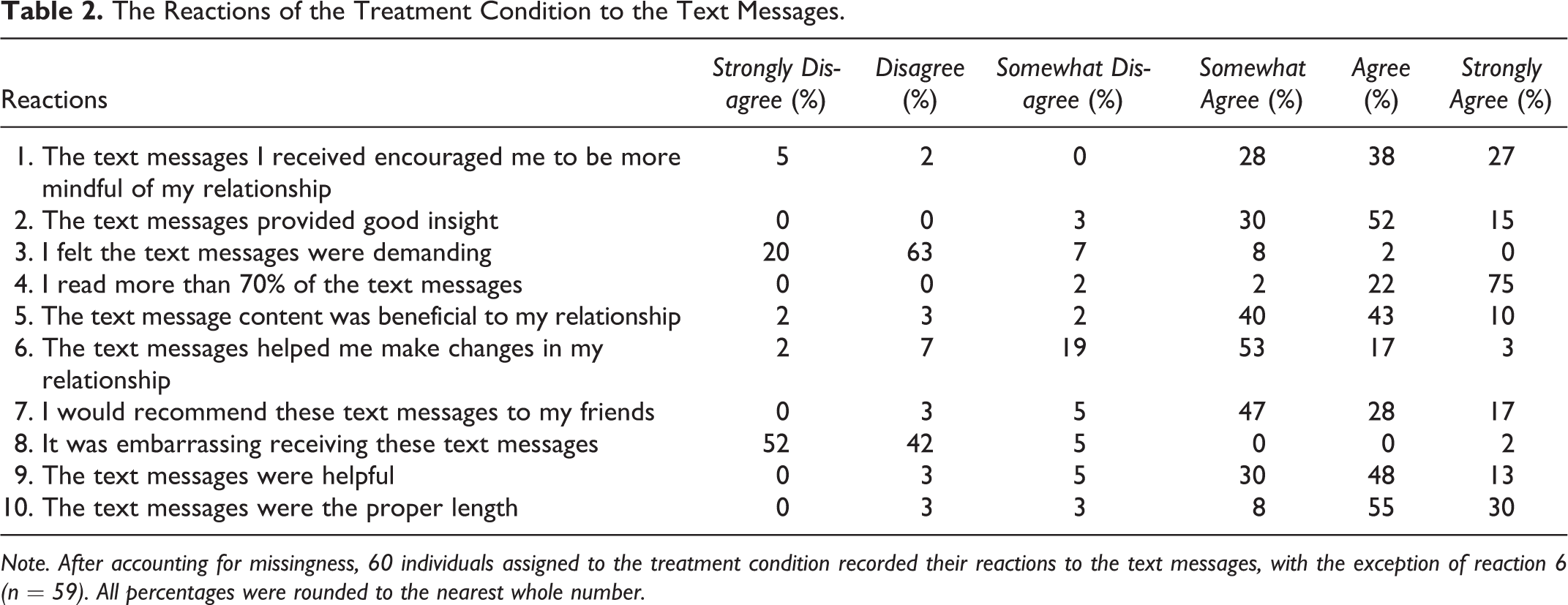
Note. After accounting for missingness, 60 individuals assigned to the treatment condition recorded their reactions to the text messages, with the exception of reaction 6 (n = 59). All percentages were rounded to the nearest whole number.
Dropout rate
During the study, if conditions became too stressful, participants were asked to reply—via text message—“STOP” to http://dialmycalls.com . If a participant texted “STOP,” they were considered a “dropout.” These individuals were removed from the study immediately and increased the dropout rate.
Retention rate
All participants were sent a follow-up assessment 28 days after recruitment. Participants, who responded to the first survey, but did not respond to the second survey, or did not provide their phone number in the second survey, detracted from the retention rate.
Phone number verification
Participants’ phone numbers were considered verified, if they responded “yes” to a verification text message, completed the follow-up assessment, or both. Participants who did not include phone numbers in the recruitment assessment were not included in the experiment or the analysis of phone number verification.
Data Analysis Plan
Because this was a feasibility study, we sought to analyze the difference in the probabilities of participants’ reactions, discrete probability distributions related to participant reactions, participant dropout and retention rates, and the number of participants who verified their phone number. We also wanted to examine whether meaningful differences were present between the proportion of individuals who agreed and disagreed with our self-report measures via a Bayesian analysis.
Examining these probabilities and differences between proportions suits our research question in that they will (1) provide valuable insights into our participants’ reactions to the study’s text messages, (2) notify us of changes we can make to increase participants’ adherence to the intervention, and (3) supply us with feedback about precautions that may need to be taken to ensure participants give us authentic phone numbers.
Results
Analysis of the Text Messages: Probability Distributions and Binary Outcomes
Probability distributions
Discrete probability distributions were constructed for each of the 10 inquiry items and percentages were derived for each response category (see Table 1).
Deriving binary outcomes
Participants were coded to have agreed with an item if they responded somewhat agree, agree, or strongly agree with the statement, that is, the percentages of these responses were summed. A participant was coded to have disagreed with an item if they responded somewhat disagree, disagree, or strongly disagree.
Reporting on binary outcomes
In total, 93% of participants assigned to the treatment condition agreed that the text messages encouraged them to be more mindful of their relationship, 97% agreed that the text messages provided good insight, and 10% of participants thought that the text messages were demanding. Also, 99% of individuals indicated that they read at least 70% of the text messages, 93% indicated that the text message content was beneficial to their relationship, 73% found that the text messages helped them make changes in their relationship, and 93% agreed that they would recommend these text messages to their friends. Only 2% of participants agreed that it was embarrassing to receive the texts, 91% reported that the texts were helpful, and 93% indicated that the text messages were the proper length.
Examining Differences Between Proportions: A Bayesian Approach
Selecting prior distributions for Bayesian analysis
For the subsequent analysis, utilized a Beta(α, β) prior distribution, where α and β are selected by the researcher. Because Bayesian analyses are new to psychological research, we utilized a prior distribution that was uninformative (i.e., our prior knowledge indicated that both outcomes in participants’ reactions were equally likely) and relied on the data for interference. A Beta(1, 1) prior distribution accomplished both of these tasks and was utilized in the subsequent analysis.
Likelihood distributions
The likelihood distributions for the proportion of individuals who agreed and the proportion of individuals who disagreed follow a binomial distribution, Bin(n, θ), where n is the number of individuals who responded to the item and θ is the proportion of individuals who, respectively, agreed or disagreed with the item.
Posterior distributions
Posterior distributions are calculated for both the number of people who agreed and disagreed. Posterior distributions followed a Beta(α’, β’) distribution, where α’ = observed number of successes of n trials + α, and β’ = n − observed number of successes of n trials + β
Estimating posterior distribution of differences
The posterior distribution of differences is unknown in closed form. However, the posterior distribution of differences can be estimated by generating draws via Monte Carlo simulation. After utilizing this technique, draws from the respective posterior distributions, that is, the posterior distribution for the proportion of individuals who agreed, and the posterior distribution for the proportion of individuals who disagreed—are subtracted from one another. Credible intervals (CIs) are then calculated to summarize the posterior distribution of differences.
CI interpretation and deriving significant differences
Instead of reporting 95% confidence intervals, we will report 99.5% CIs, accomplishing two tasks: (1) CIs that do not include 0 suggest that the proportion of individuals who indicated that they agreed/disagreed with the self-report item is statistically greater than the proportion of individuals who disagreed/agreed with our self-report item, and (2) to mitigate the effects of overtesting; decreasing the Type I error rate. The 99.5% CIs should be interpreted as: There is a 99.5% chance that the proportion of individuals who agreed/disagreed with the statement is between XX% and XX% greater than the number of individuals who disagreed/agreed with the statement, given the data and our prior knowledge.
Comparing Proportions
We found that the texts generally encouraged participants to be more mindful of their relationships, that the texts provided good insight, and that the texts were not demanding. A majority of our sample reported reading more than 70% of the text messages, felt that the content was beneficial to their relationship, and that the texts helped them to make changes in their relationship. Further, participants agreed that they would recommend these text messages to their friends, that it was not embarrassing receiving the text messages, that the messages were helpful, and that the messages were the proper length (see Table 3 for the 99.5% CIs).
Table of the 99.5% CIs Comparing the Proportions of the Participants’ Reactions to Receiving the Text Messages and Their Respective Directions.

Note. CI = credible interval.
Analysis Dropout Rate
During the course of the study, one individual—randomly assigned to the treatment condition—terminated their participation by replying “STOP” to the intervention. The dropout rate was less than 1%.
Analysis of Retention Rate
In total, 93% of individuals participated in the follow-up survey. Nine individuals—four assigned to the treatment condition, and five in the control condition—did not complete the follow-up survey. Also, missingness was not related to treatment assignment (r = −0.03, p > 0.05).
Phone Number Verification
With a single exception, all participants verified their phone numbers by texting “yes” to the verification text message or completing the follow-up survey (>99%).
Discussion
We sought to examine the feasibility of utilizing text messages as a dissemination tool for relationship enhancement, and our results seem promising. Several individuals agreed that the intervention helped them make changes in their relationship, that the content was beneficial to their relationship, that they read over 70% of text messages, and that the messages encouraged them to be more mindful of their relationship (see Table 1). Further, the Bayesian analysis that compared the proportion of individuals who agreed/disagreed to the 10 participant reaction items was also promising. Additionally, 99% of participants authenticated their phone number, and the retention rate was 93%, which is greater than the recommended 70% retention rate for randomized controlled trail best-evidence behavioral interventions (Lyles et al., 2007).
These preliminary findings appear to be consistent with those Aguilera and Muñoz’s (2011) who found that text messages may be useful as a behavioral change tool and that text messages can improve desirable qualities, for example, producing changes in a relationship. These findings also fall in line with the broader area of literature that suggests that the content of the text messages was beneficial to the participants and that participants tend read a majority of the text messages that are sent to them (Aguilera & Muñoz, 2011; Chow et al., 2015; Obermayer et al., 2004).
Strengths of the Current Study
A strength of the current study is reflected in the reactions of married individuals in the treatment condition to the intervention. For instance, a greater proportion of participants believed that the texts were the proper length (99.5% CI [67.29%, 94.62%]), assisted them in making changes in their relationship (99.5% CI [20.65%, 65.00%]), and saw the texts as helpful (99.5% CI [63.82%, 92.36%]), among others.
One common complaint with the texts sent during ATTs was that some were demanding or guilt inducing (Keoleian et al., 2013). Contrary to ATTs, our participants’ reactions to the texts indicated that a greater proportion felt that the text messages were not demanding (99.5% CI [58.30%, 90.23%]).
Recommended Changes and Limitations
We recruited a homogenous sample from a large, private, religious university in the Western United States. Because this was a feasibility study, this suited our purposes. However, in future replications of this study, we plan to recruit a larger, more diverse, nationally representative sample that will allow for generalizable statistical inference.
Further, although the reaction to the text message content was positive, we found that http://dialmycalls.com allows its users to send only 142 characters per text message. Any text message exceeding 142 characters must be sent via a string of two text messages. Although this does not have to be changed, it would be convenient for whoever is sending the text messages and would require less time for participants to read.
Future Research
Although this feasibility study was not without limitation, preliminary findings have indicated that sending romantically involved individuals text message prompts produced changes in the relationship (99.5% CI [20.65%, 65.00%]), that the texts were helpful (99.5% CI [63.82%, 92.36%]), and that the content of the messages was beneficial to the individuals that were receiving them (99.5% CI [67.51%, 94.39%]). Due to these preliminary findings, the necessity of cell phones (Lenhart, 2010), the reach of text messages (Pettigrew, 2009), the low cost of delivery, the high retention rate, the low dose, and because texting is used by people of all socioeconomic backgrounds and races (Lenhart, 2010), further investigation into text-message-based prevention or intervention programs may be warranted.
In addition to replicating the current findings, future research could analyze whether the current intervention has an effect on constructs related to relationship health, for example, relationship satisfaction, constructive communication, and depression. This would be useful in determining the overall efficacy of the intervention using psychometrically valid and reliable scales. Additionally, after finishing the intervention, participants could rate text messages on a Likert-type scale to maximize the prompts efficacy. Also, the current study only sent text messages to married individuals. Future research could send both of the married individuals text messages and investigate the dyadic effects that the intervention may have on the relationship.
Future research could also investigate dose and posttreatment effects. Investigating dose and posttreatment effects could be beneficial in determining (1) causality and (2) when, during the intervention, constructs relating to relationship health are most effective, and (3) how long a treatment effect may last.
Conclusion
Relationship education programs, both face-to-face and computer-based, have been efficacious in increasing relationship satisfaction and in improving couples’ communication and relationship functioning (Braithwaite & Fincham, 2014; Jakubowski et al., 2004). Given that computer-based interventions are viewed as adequate forms of treatment (Cavanagh & Shapiro, 2004), results of the current study sought to suggest further investigation into the feasibility of utilizing texts as a dissemination tool for relationship enhancement shows significant promise.
We analyzed reactions to the intervention, dropout and retention rates, and whether participants would authenticate their phone numbers in a sample of married individuals, and the results seem promising. We discuss the next step in this process: investigating the efficacy of this method of delivery in a large, nationally representative sample.
Further, if text messaging proves to be a beneficial tool for dissemination of preventative relationship education, the implication is that other therapeutic interventions could be readily applied using text messages to any diverse context, given the population has the capability to receive text messages and cellular service.
Footnotes
Declaration of Conflicting Interests
The author(s) declared no potential conflicts of interest with respect to the research, authorship, and/or publication of this article.
Funding
The author(s) disclosed receipt of the following financial support for the research, authorship, and/or publication of this article: This study was supported by the Brigham Young University Experiential Learning Grant.
