



Abstract
Research supports an association between depressive symptoms and reduced relationship satisfaction. Yet the etiology of this relationship is unclear. The purpose of this study was to examine individual and partner influence on relationship satisfaction and depressive symptoms. We assessed whether romantic partners (N = 84) reported similar depressive states and whether relationship satisfaction was influenced by partner and/or individual depressive symptoms. Partners had similar levels of depressive symptoms and relationship satisfaction. Actor–partner interdependence models demonstrated no partner effects of depressive symptoms on relationship satisfaction. However, there was an actor effect such that men’s depressive symptoms predicted their own relationship satisfaction; thus, how they perceive the romantic relationship. Couples counseling may be an effective form of treatment for individuals suffering from depressive symptoms to include partner support and to unravel how depressive symptoms may interfere with relationship perceptions.
Despite research suggesting romantic partnering is protective against depressive symptoms (Cooper, Meyer, & Paul, 2008; Meyer & Paul, 2011), the negative outcomes of depressive symptoms seem to affect not only those afflicted with symptoms but also romantic partners (Kouros & Cummings, 2011; Whisman, Uebelacker, & Weinstock, 2004). Yet depressive symptoms are rarely seen as a relationship concern. The association between depressive symptoms and relationship satisfaction may be explained through multiple hypotheses. The first hypothesis examines the recursive process between depressive symptoms and relationship satisfaction, where poor relationship satisfaction increases depressive symptoms or an increase in depressive symptoms predicts poorer relationship satisfaction (Wade & Kendler, 2000; Whisman, 2001; Whisman & Uebelacker, 2009). The second hypothesis examines the systemic influence of depressive symptoms between romantic partners where romantic partner may present with similar moods (Butler, 2011; Butler & Randall, 2013; Schulz et al., 2009). The final hypothesis suggests chronic stress associated with caring for a partner with depressive symptoms may lead to an increase in depressive symptoms in the unafflicted partner due to the increase in emotional strain (Coyne, Thompson, & Palmer, 2002; Nicolas, Desilva, Prater, & Bronkoski, 2009). Yet these hypotheses from the literature often fail to examine how one’s own and one’s partner depressive symptoms are related to relationship satisfaction. Furthermore, because gender differences are present in frequency of depressive symptoms (National Institute of Mental Health, 2016), an investigation is warranted to assess whether the relationship between depressive symptoms and relationship satisfaction is consistent across genders. The purpose of this study is to examine individual and partner influences on depressive symptoms and relationship satisfaction as well as examine gender differences.
Relationship Satisfaction and Depressive Symptoms
Research investigating the relationship between depressive symptoms and relationship satisfaction is circular in nature. These changes could be progressive. Individuals with more depressive symptoms reported an increase in interpersonal distress and rated their marriages as less satisfactory (Whisman & Uebelacker, 2009). As depressive symptoms increase in the afflicted partner, relationship satisfaction decreases over time suggesting changes in couple dynamics preceding reduced relationship satisfaction leads to an increase in depressive symptoms for both partners (Pruchno, Wilson-Genderson, & Cartwright, 2009). Thus, depressive symptoms may be a result of a decrease in relationship satisfaction and partner support (Wade & Kendler, 2000; Whisman, 2001). Partners with more depressive symptoms may be less responsive to their romantic partners and engage in fewer positive and more negative interactions with their romantic partners (Westman & Vinokur, 1998).
The systemic changes in the relationship may lead to depressive symptoms in both partners. A partner’s depressive symptoms may evoke similar responses in the unafflicted partner as a result of shared environment, circumstances, behavioral patterns, and emotion contagion (Schulz et al., 2009). Previous research evaluated the role mood synchrony between partners plays during stressful periods (Butler, 2011; Butler & Randall, 2013; Laurent & Powers, 2007; Meyer, Barkley, Cohn, & Salas, 2018). A contagion of mood seems to exist for negative emotions whereby partners adopt one another’s moods (Saxbe & Repetti, 2010). Unfortunately, couples who synchronize negative moods tend to be less satisfied in their relationship (Ben-Naim, Hirschberger, Ein-Dor, & Mikulincer, 2013). Partner depressive symptoms can lead to reduced relationship satisfaction, low quality of life, and even promote sexual dysfunction across partners (Alves et al., 2015; Kopeykina et al., 2016). The presence of depressive symptoms in one partner can leave the unafflicted partner feeling confused by the relationship and exhausted from worry. At times, one may have difficulty distinguishing the illness from the partner, which may result in an invalidation of feelings and placing blame on the relationship.
Supporting a romantic partner with depressive symptoms creates a stressful environment, placing psychological strain on the relationship (Schulz & Sherwood, 2008). Perhaps because depressive symptoms are associated with an increase in relationship conflict and a decrease in utilizing coping mechanisms during conflict (Coyne et al., 2002; Whiffen, Foot, & Thompson, 2007; Whisman, 2001; Whisman & Uebelacker, 2009). The root of an unafflicted partner going on to develop depressive symptoms could be the unafflicted partner’s concern for the afflicted partner’s that precipitates the depressive symptoms. Research notes that when one family member experiences mood changes, the rest of the family’s stress and worry levels increase, thus increasing the likelihood of other family members to experience mental health distress (Nicolas et al., 2009). Partners of depressed individuals report greater burdens and relationship distress (Coyne et al., 2002). Lack of partner support may increase the risk of depressive symptoms becoming a chronic condition (Wade & Kendler, 2000) or may lead to an increase in substance use and other mood disorders (Whisman, Johnson, Li, & Robustelli, 2014).
Gender Differences
While many studies have evaluated how depressive symptoms affect the couple relationship, more research is warranted to explore the importance of gender (Thomeer, Umberson, & Pudrovska, 2013). Previous research has found evidence of gender differences with negative feelings, which may intensify depressive symptoms. For example, men may engage in behaviors such as distraction or avoidance of negative emotions, while women may engage in behaviors such as confrontation or rumination in response to their negative emotions (Gabriel, Beach, & Bodenmann, 2010). Research indicates a link between wives’ and husbands’ relationship dissatisfaction and depressive symptoms. Wives’ relationship dissatisfaction was associated with increased anger during conflict for both the husband and wife and an increased likelihood that wives’ dissatisfaction will affect conflict resolution (Du Rocher-Schudlich, Papp, & Cummings, 2011). However, husbands’ anger during conflict was associated with greater depressive symptoms indicating the husband’s conflict resolution style may be an emotional barometer for psychological functioning (Du Rocher-Schudlich et al., 2011).
Gender differences in relationship satisfaction by depressive symptoms could be due to gender-linked patterns, such as how women focus on their relationship and may feel responsible for relationship difficulties (Baucom, Notarius, Burnett, & Haefner, 1990; Culp & Beach, 1998), while men may focus on independence (Culp & Beach, 1998; Klinetob & Smith, 1996). Feelings of relationship responsibility may lead women to feel overwhelmed, resulting in an increase in depressive symptoms, while men’s focus on independence may lead to feelings of solitude and a lack of support, resulting in an increase in depressive symptoms. Despite evidence suggesting gender differences are present in relationship functioning related to depressive symptoms, more information is needed to understand whether gender differences are present when assessing differences by one’s own and one’s partner relationship satisfaction and depressive symptoms.
The Current Study
The research demonstrates a link between depressive symptoms and reduced relationship satisfaction. More research is needed to assess depressive symptoms and relationship satisfaction in healthy couples including if both one’s own and one’s partner’s depressive symptoms is associated with both one’s own and one’s partner’s relationship satisfaction. Furthermore, because we know gender differences are present in depression diagnoses, it was important to utilize a healthy sample instead of a clinical sample. Thus, utilizing a clinical sample may have demonstrated gender differences present in the diagnosis rather than a reflection of the relationship between depressive symptoms and relationship satisfaction in couples. By focusing on the gender differences in healthy couples, we were better able to understand how the couple relationship may be affected and increase generalizability.
We sought to answer the following questions: (1) What is the relationship between one’s own depressive symptoms and relationship satisfaction? (2) What is the relationship between one’s partner’s depressive symptoms and their own relationship satisfaction? (3) Are depressive symptoms correlated between romantic partners? (4) Is relationship satisfaction correlated between romantic partners? and (5) Are gender differences present in the influence of depressive symptoms on relationship satisfaction? We predicted that both the individual’s and the partner’s depressive symptoms would be negatively related to an individual’s relationship satisfaction scores. We additionally predicted depressive symptoms and relationship satisfaction would be positively correlated between romantic partners. Finally, we predicted there would be no gender differences in individual and partner effects of depressive symptoms on relationship satisfaction.
Method
Participants
A total of 42 couples (84 subjects) participated in this study—all heterosexual couples. This analysis was part of a larger study examining heart rate changes during a couple interaction. Participants ranged in age from 19 to 67 (M = 24.75, standard deviation [SD] = 8.54). The sample was well educated with 56 participants holding a bachelor’s degree or beyond. The majority of the analytic sample was Caucasian (n = 58), followed by Latino (n = 10), African American (n = 6), Asian American (n = 3), American Indian (n = 2), and five individual identified as multiracial or another race or ethnicity. The couples on average had been with their romantic partner for over 2 years (M = 28.23 months, SD = 31.12). See Table 1 for more sociodemographic details.
Demographics and Partner Correlations Among Variables.
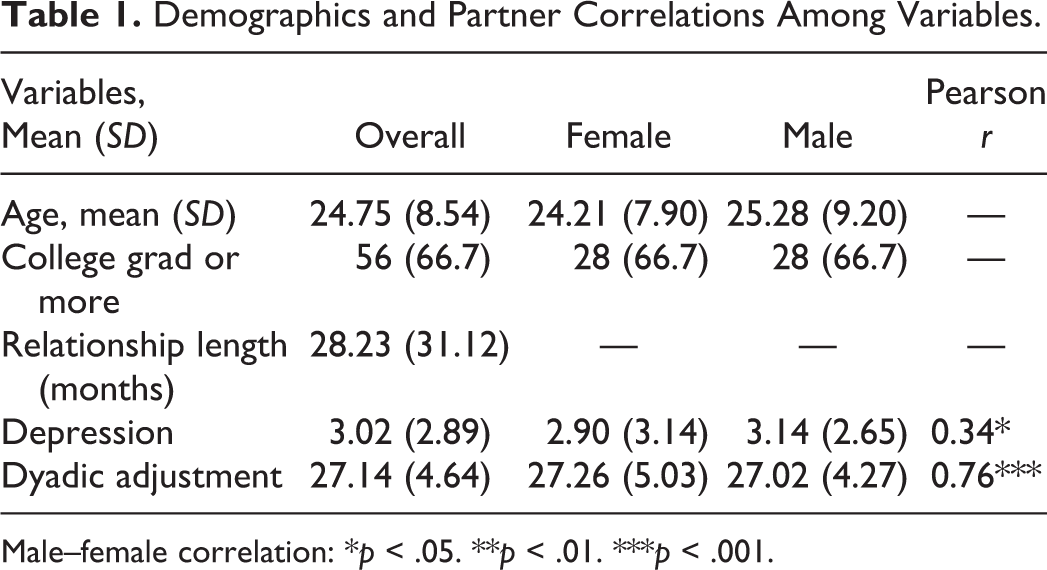
Male–female correlation: *p < .05. **p < .01. ***p < .001.
Procedure
After approval was obtained from the university’s institutional review board, couples learned about the research study through advertisements placed in the university newsletter, flyers placed across campus and the community, word of mouth, and online advertisements. Participants contacted the principal investigator (PI) wherein they were prescreened by either the PI or a research team member to determine eligibility. Inclusion criteria were age of 18 or older, ability to speak and read English at a minimum of a sixth-grade level, being in an exclusive romantic relationship for at least 3 months, and agreement of both members of each couple to participate in the study. After couples agreed to participate, a mutual time was arranged. Upon arrival at the study location, couples were provided with informed-consent forms and an opportunity to discuss the study prior to agreeing to participate. After providing consent, the couple completed the instruments and the demographic information in the same room. Couples were given financial incentives for their participation. As this study was part of a larger study investigating physiological outcomes during couple interactions, only methods relevant to the analytic plan are described.
Measurement
Depressive symptoms
The participants completed the Depression subscale of the Depression Anxiety Stress Scale (DASS 21; Lovibond & Lovibond, 1995b). The DASS 21 uses a 4-point Likert-type scale to rate the emotions participants experienced over the week prior. The researchers examined participant responses to the 7-item Depression subscale. Responses to each question may range from 0, indicating that the statement does not apply to the participant at all, to 3 indicating that the statement does apply to the participant very much or most of the time. A total score is obtained by adding the numeric responses for all seven questions; higher scores indicate more depressive symptoms. Lovibond and Lovibond (1995a) reported high internal consistency (α of .90) and found evidence for convergent and discriminant validity.
Relationship satisfaction
Relationship satisfaction was measured using the 7-item short form of the Dyadic Adjustment Scale (DAS-7; Hunsley, Best, Lefebvre, & Vito, 2001). The DAS-7 is an abbreviated version of the widely used measure (Spanier, 1976) with acceptable reliability established by a meta-analysis covering 30 years of literature (Graham, Liu, & Jeziorski, 2006). Items were selected based on research that suggested the seven items best discriminated between well- and poorly adjusted marriages (Sharpley & Rogers, 1984). The DAS-7 consists of 1-item rating overall marital satisfaction, along with 3 items each from the “Consensus” and “Cohesion” subscales of the original form. Internal consistency for the DAS-7 has been shown to be acceptable in a nonclinical sample (α = .79), indicating that the abbreviated scale does not affect its reliability. Criterion validity was similarly unaffected.
Analytic Plan
All analyses were conducted using SAS v9.4 at a two-tailed α = .05. Paired t tests for continuous variables and McNemar tests for dichotomous variables examined differences between male and female partner demographic, depression, and relationship satisfaction variables. Pearson correlations also examined male–female partner relationships among depression and relationship satisfaction. A crude, bivariate actor partner interdependence model (APIM) was conducted for relationship satisfaction to assess how one’s own and one’s partner’s depressive symptoms affect one’s own relationship satisfaction. Dyads were treated as distinguishable based on gender. A 2-intercept model approach was used to obtain actor–partner effects per level of the distinguishable variable (gender). The model was run within the multilevel framework of SAS PROC MIXED, with a repeated statement and heterogeneous compound symmetry covariance to allow variances to differ across dyad members. The model was run to calculate male and female effects simultaneously. Six effects are given in these models: (1) female intercept, (2) male intercept, (3) female actor effect (effect of female’s depressive symptoms on own satisfaction), (4) female partner effect (effect of male’s depressive symptoms on female’s outcome), (5) male actor effect (effect of male’s depressive symptoms on own satisfaction), and (6) male partner effect (effect of female’s depressive symptoms on male’s outcome). The B coefficients and standard errors were calculated to assess the relationship of actor and partner effects on relationship satisfaction. Male versus female actor and partner B coefficients were compared using a t test in the ESTIMATE statement of PROC MIXED.
Results
Table 1 shows demographic characteristics overall and by gender for 42 heterosexual couples. Males tended to be older (M = 25.28) compared to females (M = 24.21, p = .015). Males and females had similar levels of depressive symptoms and relationship satisfaction. There was a significant positive relationship between male–female relationship satisfaction (r = .76, p < .0001) and male–female depressive symptoms (r = .34, p = .028).
Table 2 shows results of the bivariate APIM examining the relationship between actor and partner depressive symptoms and relationship satisfaction. There were no significant actor or partner effects for females. However, results showed only an actor effect for males, specifically, males’ own depressive symptoms were negatively associated with their own satisfaction scores (B = −0.53, SE = 0.25, p = .045). The t tests comparing actor and partner effects between male and female dyad members showed that actor, t(44) = −0.24, p = .815, and partner, t(44) = −0.12, p = .908, were similar between male and female dyad members.
Depression Actor–Partner Interdependence Model, Two Intercept Approach, for Relationship Satisfaction Among Heterosexual Dyads (n = 42 couples).

Discussion
In support of our hypothesis, findings revealed that men’s and women’s depressive symptoms as well as relationship satisfaction scores were both positively correlated. Going against a separate hypothesis, we found no support of a partner effect of depressive symptoms on relationship satisfaction. Only the actor effect for men was significant, there was no evidence of gender differences in partner effects of depressive symptoms on relationship satisfaction. Thus, in partial support of our hypothesis, for men only, actor depressive symptoms were associated with relationship satisfaction. This suggests that for men, the more depressive symptoms they report, the more likely they are to report lower relationships satisfaction.
Correlated depressive symptoms scores and relationship satisfaction scores between partners are supported in the literature (Cramer, 2004; Li & Johnson, 2016; Meyer et al., 2018), though we cannot confirm the reasoning behind this correlation. The strongly correlated relationship satisfaction scores suggest that both partners have similar perceptions about the quality of the relationship and are nearly equally happy or unhappy in their relationship. Systems theory (von Bertalanffy, 1969) would suggest this is related to a mutual effect whereby the couple maintains homeostasis, thus producing a similar perception of the relationship.
The correlated depressive symptoms scores are not as cleanly ascribed due to a medium effect observed. While it is plausible we could be observing the similarity attraction theory (Berscheid & Walster, 1969; Byrne, 1971), there is enough variability in scores to suggest that additional hypotheses should be considered. As we did not observe partner effects, transmission of depressive symptoms is likely not a theoretical candidate. However, the literature does support that couples functioning does relate to depressive symptoms (Kouros & Cummings, 2011; Whisman et al., 2004). Perhaps depressive symptoms in one partner could lead to depressive symptoms in the other partner due to the added stress of either seeing a loved one in despair (Engert, Ragsdale, & Singer, 2018) or the chronic stress of caring of a loved one suffering from mental health concerns (Coyne et al., 2002). Yet, our findings could be related to the amount of depressive symptoms observed, as this sample was clinically healthy.
Our findings did not support a partner effect of depressive symptoms on relationship satisfaction. This is contrary to research that notes family members may share depressive symptomatology (Coyne et al., 2002; Nicolas et al., 2009). Whereby when one family member develops depression, as time passes more family members may also report an increase in depressive symptoms (Nicolas et al., 2009). As well as the work from Kouros and Cummings (2011) where interdependence effects suggest among couples, men’s depressive symptom predicted womens’ relationship satisfaction. However, in partial support of our findings, Kouros and Cummings did not find the opposite influence such that women’s depressive symptoms predicted men’s relationship satisfaction. Couples influence one another, but there are mitigating factors, which also predict mood. It could be internal not external factors better explain depressive symptomology (Brommelhoff, Conway, Merikangas, & Levy, 2004; Peterson & Seligman, 1984). Individuals who experience more emotional dysregulation report feeling less confident in managing emotions and controlling behaviors (Tani, Pascuzzi, & Raffagnino, 2015). Demonstrating an interpersonal impact despite the internal struggle, individuals may avoid close contact with a partner out of fear of being controlled by their partner (Tani et al., 2015).
In our research study, we found actor effects for men only; men’s depressive symptoms were related to their own relationship satisfaction scores. These findings are consistent with previous research, indicating a connection between depressive symptoms and relationship satisfaction (German, 2008), suggesting men and women report an increase in depressive symptoms while engaged in a low-quality relationship (Whisman, 2007; Whisman, Sheldon, & Goering, 2000). However, our results did not support women’s depressive symptoms scores were related to their relationship satisfaction scores. Perhaps our findings may be revealing gender differences in how women and men allow their mood to affect their perception of the romantic relationship. Beck’s (1976) negative triad suggests those with depression may not be able to control their negative thoughts, clouding their perceptions related to the self, the environment, and the future. It could be extrapolated from this theory that interpersonal evaluation would fall under the environment category. This theory may not be as relevant for women who feel more responsibility for their relationship functioning (Baucom et al., 1990; Culp & Beach, 1998). Thus, women may be more focused on preserving their relationship and their alterations in mood do not negate the relationship focus.
Limitations and Future Research
While our findings add to the current literature by demonstrating a correlation between couples’ depressive symptoms and relationship satisfaction, as well as showing that for men only depressive symptoms are negatively related to relationship satisfaction, there are limitations to our research study. One limitation was our small sample size. This limits ability to generalize our findings to a larger population. When a research study contains a small sample size, it is possible for the results to be considered inconclusive (Hackshaw, 2008). Second, while couples were in stable relationships, our study included a wide variety of relationship statuses (dating, engaged, or married); we cannot conclude the results generalize to any specific relationship status. Whether the couple is dating, engaged, or married may influence their responses to questions. For example, couples who are dating may feel more insecure in their relationship, thus affecting how they respond to the measures. Furthermore, there was variability in the length of the couple relationship. Thus, it could be our findings suggesting a lack of partner effects are better attributed to the couples not being together long enough to share emotional experiences. We also cannot assess bidirectionality of actor–partner effects of depressive symptoms on relationship satisfaction because of the cross-sectional nature of the data. Finally, the sample was predominantly heterosexual. It is recognized that a more diverse sample of sexual minorities could demonstrate a different relationship between depression and relationship satisfaction.
Future research should attempt to replicate our results as we do not know if our findings are revealing more information about the relationship between depressive symptoms and relationship satisfaction or if these findings are specific only to our sample. Despite the mean relationship length being over 2 years, there was variability in relationship length beginning as early in a relationship as only 3 months. Future research should include couples who have been together a minimum of 1 year. This would allow more opportunities for changes in mood to emerge and to assess whether relationship satisfaction changes during those times. Finally, it might be helpful to use a longitudinal study in which one partner has been newly diagnosed with depression to examine changes in couple’s dynamics and depression outcomes across the length of the depressive episode.
Clinical Implications
Given the findings from not only this study, but others before it, depressive symptoms should be treated as a systemic issue. Couples counseling can be vital to the course of treatment. At the onset of counseling, the counselor should view the presenting problem from a systemic perspective, shared among the couple. Thus, the purpose of counseling would be to work collaboratively to develop an appropriate treatment plan.
Our findings reveal that for men, depressive symptoms may cloud the perception of the relationship. Thus, men may internalize their depressive symptoms and allow that to affect how they perceive the world, perhaps, in a more negative light. Reality testing could be necessary to assess whether the perception of the relationship is compatible across both partners. Then if differences are present, those differences could be examined in couples’ counseling.
Because we only know the relationship between depressive symptoms and relationship satisfaction are correlated, we cannot determine whether men are more likely to experience depressive symptoms from being in poor relationships or if poor relationships predict an increase in depressive symptoms. Our findings suggest that partners may not transfer depressive symptoms. Thus, in counseling we could conclude that the unafflicted partner can be a source of support for the partner with depressive symptoms and the couple relationship could be appropriately utilized in counseling as a strength for the depressed partner. Using the unafflicted partner as a source of support, the couple can establish effective means of communication and the ability to understand their emotions, as well as their partner’s emotions. This is an opportunity for the clinician to work with the couple to identify the couple’s emotional responses, provide emotional support, and encourage emotional awareness within the relationship, in an attempt to improve the couple relationship satisfaction.
Footnotes
Acknowledgment
The authors thank Dr. Tony Buchanan for his assistance during this project.
Declaration of Conflicting Interests
The author(s) declared no potential conflicts of interest with respect to the research, authorship, and/or publication of this article.
Funding
The authors received financial support from Saint Louis University to execute this study.
