



Abstract
Older adults and their families may encounter difficulties as they transition from independent living to a dependent living environment. The stress of daily coping and illness can disrupt the family life cycle. The authors have created a theoretically based model: the dependent living success model (DLSM) to assist family counselors when exploring this life transition. Specifically, the authors integrate four theories: successful aging theory, Elder’s life course perspective, Schlossberg’s transition theory, and Nolan’s senses framework to provide a model for how to work with aging adults and their families during the transition to dependent care. There is a dearth of literature to assist family counselors in conceptualizing this part of the life course. The DLSM intends to start the conversation with the older person and their family and provide some strategies and interventions to increase a more successful transition.
Over the course of life, people experience several transitions that impact the socially constructed world of our everyday lives. The way in which individuals respond to these transitions can have positive or negative effects on the direction a person veers toward as they move across the stages of life. Moreover, these same responses can have a profound impact on the individual’s ability to age successfully. When older adults experience a negative life event or illness, the way they have handled previous transitions can give insight into how they will transition in later stages of life. More specifically, as older adults move from living independently to a dependent living situation they may be encountering a difficult and new transition that is difficult to overcome. Additionally, their family may experience a difficult transition with this life cycle event.
The stress of daily coping, chronic illness, and other life crises can disrupt the normal family life cycle (Carter & McGoldrick, 2005). Additionally, Carter and McGoldrick conceptualized that specific developmental skills and tasks were needed to move successfully from one stage of family life to the next. This may explain why some individuals and families adapt well to transitions and why others do not cope well with the transition. The authors will address the literature regarding transitions and the aging process, with specific focus on the transition from independent to dependent living. Additionally, the authors will present a model incorporating social and emotional aging theory, Schlossberg’s transition theory and the senses framework to identify best practices related to family transition from independent to dependent living. The primary purpose of this article is to inform and assist family counselors when working with families during this life cycle stage. The number of residents in assisted living centers is expected to double by 2030; therefore, counselors could benefit with more literature centered on this critical transition in the family life cycle.
Transition From Independent to Dependent Living
Dependent living is also known as assisted living (Bemis, 2017). An older adult who is having difficulty with the daily tasks of living (i.e., preparing meals, personal hygiene, household chores, driving, maintaining finances, and managing medication) may consider transitioning to a maintenance-free lifestyle in an assisted living community. While dependent living or assisted living may be a practical choice in terms of the tasks of daily living, the social and emotional transition to this type of living environment can be difficult for older adults and their families.
A review of literature was undertaken to determine what transition research existed to inform the topic of older adult transitions from independent to dependent living arrangements. Research specific to the transitions of older adults from independent to dependent living could not be identified in the search by the authors. However, a search of literature revealed four primary themes regarding transitions: hospital to home transitions, nursing care to home transitions, nursing care to hospital, and various other research on retirement and volunteer work transitions. These transitions did not include a permanent transition to a dependent care facility. The research identified focused more on temporary stays in assisted living facilities. What follows is a summary of the research as it related to transitions for aging adults.
Much of the research identified on older adult transitions consisted of studies conducted on hospital to home transitions. The Patient Protection and Affordable Care Act (2010) contains a key provision that works toward reducing hospital readmissions. The Center for Medicaid and Medicare Services (CMS, 2016) has funded several studies to test and create programs that would improve the rates of hospital readmissions. The conclusion of many of these studies found that transition from hospital to home is a complex issue. Demographics, socioeconomic status, gender, race, social supports, and many other issues impede successfully overcoming an illness (Ohuabunwa, Jordan, Shah, Fost, & Flacker, 2013). Additionally, the CMS studies also found that key to the transition is exploring and understanding the unique needs of each individual as they transition home, which eludes researchers. Attention to this key detail prohibits researchers from creating programs that attend to the unique differences of each older adult as they transition from hospital to home (Cadogan, Phillips, & Ziminski, 2014). Moreover, what inhibited successful transitions to home is proper caregiving provided by family and physical adjustments by the patient. Many older adults did not follow through with their prescribed home care and prescription requirements that would aid in their recovery. Older adults often struggled to adjust to their current situation cognitively, physically, and emotionally. Additionally, when follow-up services do exist from nurses, social workers, or hospital staff, it is often over the phone and not personal (Fabbre et al., 2010). Fabbre et al. (2010) called specifically in their discussion for models to be developed where home visits and personal relationships be developed to improve the care setting to help avoid hospital readmission.
Much of the research on older adult transitions do not discuss transitions from independent to dependent living; therefore, the authors have created a model to aid family counselors in understanding the factors involved in a successful transition. The DLSM is based on documented social and psychological aging theory to include successful aging (SA) and the life course perspective, as well as Schlossberg’s transition theory. What follows is a description of SA theory, Elder’s life course perspective theory, Schlossberg’s transition theory, and Nolan’s senses framework. The authors used these four theories to create a model to help older adults transition to dependent living situations—DLSM. There is a dearth of literature and research helping family counselors assist families and their aging loved ones as they transition to dependent living arrangements.
Four Aging Theory Perspectives
Four aging theory perspectives will be explored: MacArthur model of SA (Rowe & Cosco, 2016), Elder’s life course perspective (Elder, 1974, 1995), Schlossberg’s transition theory (1981), and the senses framework (Nolan, Davies, & Brown, 2000). The DLSM utilized these four perspectives to form a robust framework to understand transition from independent to dependent living for aging adults and families. These theories are integrated to help family counselors work more holistically with both the aging person and their families.
MacArthur Model of SA
SA was first coined in the MacArthur model of SA (Rowe & Cosco, 2016). This model is a bio-psycho-social approach to aging and has three primary constructs: biological, which constitutes an older adult’s ability to avoid disease and disability; psychological, which reflects an older adult’s ability to have high cognitive and physical function; and social, which reflects older adult’s ability to engage with their social environment and include their relationships and supports (Rowe & Kahn, 1997). Early aging research revolved around a key concept called normal aging. Normal aging was believed to be what most would argue as an expected path toward the end of life. Rowe and Kahn (1997) determined there were two forms of normal aging, usual and SA. Usual aging is defined as factors that could be prevented with lifestyle choices and laden with the risk of disease and illness (Rowe & Cosco, 2016). The second form of aging, SA, is defined as reaching the age we are biologically able to reach based on three components: having a low risk of disease or illness, having a high level of cognitive function, and remaining active by continuing with social relationships and being productive (Rowe & Kahn, 1997). While Rowe and Cosco (2016) claimed that these three components are viable, researchers are calling for an expansion of the MacArthur Model of SA to include more subjective considerations of older adults and environmental factors. Additionally, other critiques of the model include the creation of a more inclusive definition of SA. One such attempt has already been made by Crowther et al. (2002), which added the construct of spirituality to Rowe and Kahn’s (1997) model. In addition to a model for SA, integrating a life course perspective with SA can provide more subjective considerations that critiques of the MacArthur model of SA were calling for.
Elder’s Life Course Perspective
A widely accepted framework for aging is the life course perspective, considering the social and psychological experiences that have framed the life of an individual (Bengsten, 2016). Cain (1964) used a framework of historical and structural factors to explain a person’s development. Elder (1974) expanded on this framework with his work on explaining how children of the great depression framed life through historical events and social structures of living through that time period. Furthermore, Elder (1995) proposed that the life course perspective is based on five key principles: Aging and development are a lifelong process, families have powerful influences through interdependently linked lives, as people age people make choices that affect their development, historical and social structure contexts influence our life development, and the nature and timing of transitions inform our development. The last principle was added later to help understand that transitions at different stages of life create historical and cultural cues that frame how individuals will react to the next transition in life. While the MacArthur model of SA (Rowe & Kahn, 1997) provided a framework for SA, what they did not provide was a framework for how to establish this successfully from a life course perspective. Elder (1974, 1995) provided five key principles that further expand SA through the life course and provides for a more systemic perspective. Taking a macroperspective of aging through the life course assists family counselors in identifying the many variables and constructs of development and aging for not only the person entering dependent living but for the family as well. Aging is not an event that just happens; aging is an event that takes place from the moment of birth. While it is not impossible to develop each principle in detail as it relates to SA, approaching transitions as a key construct of the life course perspective will allow a further detailed description of one aspect of SA.
Schlossberg Transition Theory
The fifth principle of Elder’s (1995) life course perspective focused on transitions as they relate to the nature and timing of a life event. For older adults to age successfully, understanding how people have historically and culturally transitioned during early stages of life can inform the many helping professionals who help them along the way. Schlossberg’s transition theory (1981) is defined as “any event, or non-event that results in changed relationships, routines, assumptions, and roles” (Goodman, Schlossberg, & Anderson, 2006, p. 38). Schlossberg developed this theory primarily while researching transitions of college students from childhood to adulthood. Furthermore, Schlossberg’s transition theory (1981) is primarily known as a development theory and can be useful to understand how adults transition and provide family counselors valuable information to assist adults with coping and adaptation to life. Later in her career, Schlossberg moved her research agenda toward working with transitions for later stages of life to include retirement and working with older adults as they transition through life events.
As individuals move through the stages of the life course, anticipated transitions exist such as moving away from childhood into adulthood, going to college, starting a career, having a family, and retirement. However, many other factors must also be considered when understanding the meaning of a transitions for an individual including the context, type, and potential impact of the transition (Goodman et al., 2006; Schlossberg, 1981). Moreover, unanticipated transitions also occur, such as divorce, death, and unexpected illness or disease. These types of changes usually occur when one does not expect them to happen and the transition is usually not anticipated. Nonevent transitions are usually expected by an individual, but sometimes do not end up occurring because of an adverse outcome. Examples of nonevent transitions are personal, ripple, resultant, or delayed (Goodman et al., 2006). For example, personal nonevent transitions include not being admitted into school or getting turned down for a job promotion. The unintended consequences will cause a change in the individual’s life course that was not anticipated. A ripple nonevent is a change or transition due to someone or something else that did not happen and the individual’s life needs to be changed or adjusted to fit the nonevent. A resultant nonevent is something that is caused by another event that affects the individual. Lastly, the delayed nonevent is when an individual anticipates a transition will occur but it still may occur.
The context of a transition refers to the setting in which it occurs and the relationship the individual has within it. Within the context of a transition is the impact the transition has on one’s life. The impact of a transition is usually felt by an individual daily until it becomes part of their new normal (Goodman et al., 2006). The intent of helping professionals would be to improve the life of the individual with a new normal, resetting homeostatic pattern so they can continue a path toward SA. As older adults transition through life stages, events or nonevents create a change in an adult’s life. These changes are impacted by the type of change, the context of the change, and the impact it has on an individual’s life. How people adapt to those changes will impact older adulthood and SA (Schlossberg, 1981).
Schlossberg identified a four-stage process (the four Ss) used to work with transitions in an adult’s life. Those four Ss are the situation, self, social support, and strategies. The process is used to influence an individual’s ability to cope with a transition: situation, self, support, and strategies (Goodman et al., 2006). The situation of the transition includes several concepts: (a) the trigger, which is the event that precipitated the life event or transition, (b) the timing of the transition in a person’s life, (c) what aspect of the transition is in the person’s control, (d) is there a role change and is it a gain or loss for the person, (e) what is the duration of the transition, is it permanent, temporary, or uncertain, (f) has the individual had prior experience with the same type of transition, how did the person handle it before, (g) is there concurrent stress, and (h) who or what is responsible for the transition and how is it assessed (Goodman et al., 2002). A key element in transition is understanding the situation. Goodman et al. provides several factors for helping professionals to explore.
The second factor identified by Schlossberg is “self,” which refers to two classified categories: personal and demographic characteristics and psychological resources. Personal and demographic characteristics are defined as how an individual may view life and includes age, gender, life stage, health status, ethnicity, and socioeconomic status. Psychological resources refer to an individual’s outlook on life, ego development, and values (Goodman et al., 2002). Understanding the individual is vital for recognizing the historical social structure and environment one comes from that frames their self. For older adults who face an unplanned event, their social construction of self gives many details on how they will cope with this new transition.
The third factor associated with the four Ss is social support. Family units and intimate relationships form the largest social support system when faced with a transition. Equally important is support from a network of friends who will visit and provide additional emotional support from a distance. The last form of social support may include the community, religious or spiritual affiliation, and institutions. Institutions usually are medical in nature as adults move into the later stages of life. All four of the social supports can have deep impacts for an adult who is adapting to a life transition. The final factor from Schlossberg’s model is strategies or coping responses to a transition. Strategies seek to identify how to modify the situation, control the meaning of the situation, and how to aid in stress management of the transition (Goodman et al., 2002). The four S’s of Schlossberg’s transition theory can be an important tool for identifying how adaptable an older adult, as well as the family, may be when transitioning from independent to dependent living. While the McArthur model of SA, the life course perspective, and Schlossberg’s transition theory are helpful in conceptualizing the aging process and the transition to dependent living, the senses framework provides some key areas of intervention for family counselors.
The Senses Framework
The senses framework (Nolan et al., 2000) was developed and tested to encourage staff working with older adults to take a relationship approach to care. Older adults who end up in long-term care struggle with the transition to a dependent living situation (Nolan et al., 2000). The movement toward person-centered care has been ongoing for the past 20 years and provides a good basis for this model. Within the model are two directives, one for older people and one for the caregiver. The “six senses” described by Nolan, Davies, and Brown (2000) include (1) a sense of security, (2) continuity, (3) belonging, (4) purpose, (5) fulfillment, and (6) significance. The first sense of security involves the assurance needed by older adults that their physical and psychological needs will be met. Older adults should be free from harm and made to feel safe; moreover, they should have security from pain and discomfort. As an older adult enters a dependent living situation, they are not aware of what they should expect; therefore, assumptions should not be made regarding their security. Caregivers in these dependent living facilities should also believe their safety is protected and feel supported by management. This allows the caregiver the ability to build the secure environment for the older adult if they in turn know they are secure in their job (Nolan et al., 2000).
The second sense in the model is continuity. Caregivers need to recognize the differences of each older adult’s personal history to aid in framing the current situation and the future (Nolan et al., 2000). The previously described life course perspective is based on historical context and explained the importance of how everyone may have contextualized a transition in early life (Elder, 1995). Understanding these historical contexts can help the older adult transition to the current stage they are in. Caregivers also need to have a positive experience in their early stage of their career. When these individuals have positive experiences, they are more likely to be positive while providing care and assist older adults on a more personal level.
The third sense is belonging in the environment. Older adults will feel they belong when they form relationships that are meaningful and real in their current context or environment. These relationships become a part of their social system that is important in SA. Caregivers should also feel valued for their work because teamwork is essential in creating the environment necessary for both the caregiver and the older adult to succeed in their new living arrangement (Nolan et al., 2000).
The fourth sense of purpose is providing opportunities for older adults to engage in meaningful activity and constructive use of time. Additionally, purpose includes creating goals, improving cognitive and physical function in this space (Nolan et al., 2000). Older adults can pursue their goals and challenge themselves to stay relevant in their community. Caregivers also need a clear direction and participation in setting goals for their work environment. When all individuals, both older adults and caregivers, believe their work had purpose, older adults benefit from this type of positive team environment.
The fifth sense of fulfillment is providing opportunities for older adults to reach for and meet valued goals. When people meet goals, they have a sense of fulfillment and self-satisfaction that give them meaning and purpose. Caregivers too will feel fulfilled and validated that they are providing good care when older adults respond positively to goals that have been established. The final and sixth sense is the feeling of significance. Older adults want to feel recognized and valued and that they matter to the caregiver. Too often older adults are left in the corner and can spiral out into depression and loneliness. Therefore, feeling significant is important for an older adult’s psychological needs. Caregivers need the same feeling of significance because taking care of others takes a lot of emotional, physical, and psychological effort (Nolan et al., 2000). The senses model of care provides a detailed method of working with older adults who transition from an independent to a dependent living situation. Transition theory can work together with the senses model to create a positive SA.
DLSM
For the remainder of the article, the authors will present a theoretical model—the DLSM utilizes concepts and constructs from McArthur model of SA (Rowe & Cosco, 2016), Elder’s life course perspective (Elder, 1974, 1995), Schlossberg’s transition theory (1981), and the senses framework (Nolan et al., 2000) to create an integrated model to understand and work through the process of transition from independent to a dependent living with older adults and their families. The DLSM assists family counselors in understanding and exploring the experience of aging, as well as the experience of the transition from independent to dependent living. The DLSM incorporates a life course perspectives about aging, understanding the narratives the older person and/or family have developed about SA, explaining the transition to assisted living, and exploring factors to increase successful transition. Additionally, the model provides interventions to improve SA outcomes.
The DLSM has six stages: (1) Explore how the older adult and family have prepared for aging experiences, (2) explore the aging narrative, (3) explore the experience of life transitions, (4) Assess older adults’ sense of self, (5) reframe the aging narrative and transitions, and (6) find purpose and meaning in new stage. These stages are informed by the previously mentioned theoretical perspectives. These stages are not meant to be linear, rather provide a place to start with the individual and family. The counselor may need to revisit some stages as needed. An outline of the stages and process for the counselor is provided in Appendix A.
Stage 1: Explore Preparation for Aging Experiences
Family counselors explore how the older adult and family define SA and in some cases, help the older adult and/or family transform their understanding of SA. Elder’s (1974, 1995) five key principles provide a valuable starting point for exploration. Using the diagram of the model (Figure 1), the areas of exploration are listed on the outside of the box and represent a more holistic view of the aging person’s experience. Based in Rowe and Cosco’s (2016) perspectives on SA, as well as Elder’s (1974, 1995) life course perspective, Rowe and Cosco (2016) identified three main constructs of SA: (1) cognitive function, (2) social relationship, and (3) low risk of disease and illness. Elder (1974, 1995) did not identify low-risk disease and illness, rather focused on how people age. Elder’s five key principles were (1) aging and development are a lifelong process, (2) families have powerful influences through interdependently linked lives, (3) as people age people make choices that affect their development, (4) historical and social structure contexts influence our life development, and (5) the nature and timing of transitions inform our development. Together exploring the concepts from each of these two theories can provide a fuller picture for the counselor in terms of historical and social structures that have been in place. Family counselors might consider forming intake questions around these five key principles. For example, here are some suggested questions situated in Elder’s principles: What does aging mean to you? (This should be asked to all family members to ascertain multiple perspectives and note any familial patterns in response to the experience of aging.) How has your family prepared for aging? (This question should be asked broadly to all involved to ascertain how all have prepared for their aging process.) How do your loved ones help you? How does their well-intended “help” hinder you? (It is likely that these questions may need to be asked separately.) How are you currently experiencing your transition to dependent living? What has gone well? What has been difficult?
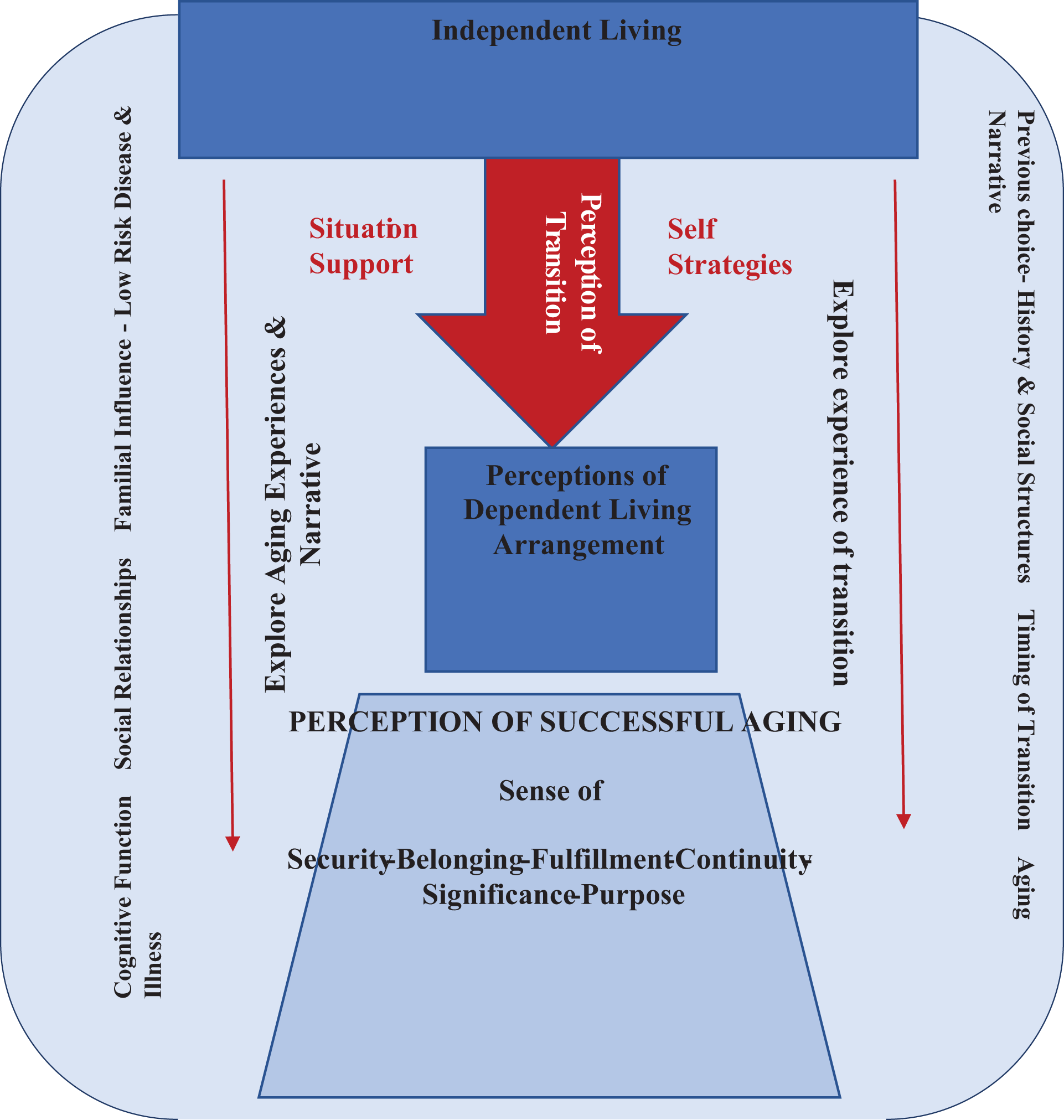
Dependent living success model.
In addition, the counselor should be assessing for cognitive function and do a psycho-social assessment to include a health history.
Stage 2: Explore the Aging Narrative
The intake provides a starting point for family counselors to explore life course development experiences. These experiences are what begin to form the aging narrative for older adults, as well as their families. For many older adults, to age successfully means avoiding disease and disability (Rowe & Kahn, 1997); however, not all older adults are successful in avoiding major illness or disease and may need to live in dependent assisted living environments. The DLSM operates under the premise that SA is more than an absence of disease and disability, rather DLSM assists family counselors by providing a reframe for the aging narrative. While the dependent living arrangement may be permanent, the older adult and their loved ones with the help of a family counselor can reconstruct their experience of SA. Disease, illness, cognitive loss, and changes in social structure do not have to define the aging adult’s experience or narrative.
Family counselors can try to obtain a verbal account of history to provide a sense of how the older adult and their family perceive history. Additionally, it could be a written narrative. The counselor could provide prompts and the older adults and family could respond with their answers. Finally, photovoice emerges as a useful intervention to further explore and understand the narrative that the individual and their family may have about the aging process. Ronzi, Pope, Orton, and Bruce (2016) used photovoice to explore aging people’s perceptions in cities. Photovoice was originally developed by Wang and Burris (1997) as a means to empower people and communities to promote social change. Sackett and Jenkins (2015) suggested that aside from a participatory action research method, photovoice is a useful intervention with clients in counseling to address barriers and promote growth. One aspect that is difficult about working with aging populations can be some of the physical barriers such as hearing loss; therefore, photovoice can be a useful means to understand how they see and understand their world.
Some possible prompts at this stage include: What does aging mean to you? When does it begin? What do you perceive as barriers? What do you perceive as benefits of aging? What do you want people to know about aging? What is the role of family members in the aging process?
By keeping the prompts broad, it allows narratives about aging to emerge that are unique to each perspective. Themes to look for include many of the constructs listed on the side of the DLSM diagram (Figure 1): cognitive function (process and ability in doing this intervention), narrative about disease and illness, social relationships and productivity (Rowe & Kahn, 1997), aging viewed as a lifelong process versus something that just happens, family involvement, the influence of historical and social structure, and the nature and timing of key transitions (Elder, 1995). The narrative that an individual develops about their aging experience informs the experience of transition in life, particularly the transition from independent to a dependent care situation.
Stage 3: Explore Life Transitions
The four stages of Schlossberg’s transition theory are depicted in the model in Figure 1 where the arrow indicates transition. Those stages include the situation, self, social support, and strategies. To address the situational context, many older adult individuals faced with moving into a dependent living environment will need to have an assessment regarding their ability to function. An individual’s situation will determine their mobility, their cognitive function, and social support system to reframe the situation. Family counselors can support the aging adult and their family using the senses framework (previously discussed and in the DLSM diagram), specifically security and continuity. These two constructs are important to develop a safe place and a complete understanding of the individual personal history to build continuity in the new environment. Several questions can be asked of the individual: What are their current challenges and difficulties? How have they transitioned before? What role will the family take with this transition? How has the family transitioned in the past?
This provides needed historical context for the family counselor. How will the individual accept the transition and surrounding environment? Per the life perspective theory, historical context will assist in building the security and continuity necessary for a successful transition. Additionally, this may build the older adults’ sense of confidence as they reflect on their past successes with difficult transitions.
Stage 4: Assess Older Adults’ Ability to Cope With Transition
The fourth stage in the DLSM is to understand the older adult’s ability to cope within the context of the transition to dependent living. Evaluating the individual’s sense of control, level of optimism, their skill and ability level, and degree of resiliency are important factors to identify during this transitional period. Physical and cognitive abilities also play a role in this stage. Additionally, the Senses Framework (Nolan et al., 2000) also provides some useful information regarding coping abilities. The six senses are security, belonging, fulfillment, continuity, significance, and purpose. Family counselors can use open-ended questions within each of these senses to ascertain the older adults’ coping abilities and beliefs. These open-ended questions should be informed by information gathered in previous stages about the individual and their history.
Also, included in coping abilities is the social support that an aging individual perceives. For example, What level of outside support from family and friends exist? How does the older adult accept help from others? What social activity history does the older adult have? For example, what did the older adult do for recreation, physical activity, any spiritual activity, and social activity? Identifying answers to these questions can provide family counselors valuable information regarding the aging persons’ beliefs and perceptions about their social milieu. Knowledge of one’s social past can be reunited with new or similar social interaction created by care staff. A sense of belonging will ensue and create a preferred continuity in the new environment. Purpose can also be created through new social activity that will serve multiple benefits for SA. Lastly, significance is developed through creating value and worth and when family and friends are closely associated with the change that positive SA exists.
Stages 5: Reframe the Aging Narrative and Transitions
A frame of reference is a complex set of beliefs and values. In Stages 1–4, the counselor should be gaining a good understanding of what the aging narrative is for the older adult transition to dependent living and potentially their family. For those who have a more negative frame of reference about aging, it will be necessary to work on reframing what SA means to incorporate more than the absence of disease or disability. Family counselors can work toward helping the family look at aging as a “period of life like any other” (Sweetland, Volmert, & O’Neil, 2017, p. 9). Furthermore, Sweetland, et al. stated that it is important to deconstruct the ideal versus real narrative that reinforces a good or bad version aging increasing fear of decline or dependency, rather they advocate for reframing aging as another period of life like any other. Additionally, if older adults can reframe the aging narrative, they may be able to consider how they can continue to be active participants in life. Family counselors can work with the older adult and their family to disrupt “determinism” and build greater tolerance of the aging process that includes positive and negative elements just like any other point in the life course (Sweetland et al., 2017, p. 9). During Stages 1–4, family counselors need to pay attention to word choice. According to Sweetland, Volmert, and O’Neil (2017), keying into word choice is critical to understanding how the aging individual views the aging process. Aging begins the moment we are born and is not something that happens at a certain stage of life. Counselors can ascertain word choice during the assessment process of Stages 1–4.
In addition to the aging narrative, the older adult and family may need help reframing transition as well. The creation of strategy associated with developing the necessary negotiating skills to manage the transition. Additionally, encouraging a person-centered approach by developing within the older adult assertiveness, goal setting, and the ability to engage in their new environment. This stage would work in combination with the senses framework in creating belonging, purpose, fulfillment, and significance. For a successful transition to a dependent living situation, the individual must exhibit their own willingness to overcome many challenges associated with purpose and significance. Care staff can only prepare and set up opportunities for those in this situation. The individual must accept responsibility for creating their new normal. After acceptance of this new normal, purpose and significance may provide a positive transition toward SA.
Stages 6: Find Purpose and Meaning in New Stage
The Senses Framework (Nolan et al., 2000) is used to increase the likelihood of successful transition, specifically for those individuals who reside in assisted or dependent living situations. To fully utilize this framework, it is important to understand what is needed in these living situations. Transition theory (Schlossberg, 1981) captures a four-stage process that works well when integrated together with the six senses framework. These two theories are considered relatively new; however, both seem to be applicable to an array of transitions during the life course perspective. Furthermore, older adults can benefit when care workers understand these methods when incorporating older adults into a new living situation. Family counselors can utilize Schlossberg’s four-stage process (identified earlier in the article) to reinforce purpose and meaning in the new stage. To review, the four Ss are the situation, self, social support, and strategies. Situation: Understanding the situation is an extremely important aspect of a transition and providing a foundation for helping professionals assist individuals as they experience a transition and find purpose and meaning in the new stage of life, or, for this article, the dependent living situation. Self: Has the older person’s sense of self shifted during the first five stages? For the older adult and the family to find purpose and meaning, the shift in perceptions of aging and SA are critical. Support: How is the older person and the family perceiving support? Support is critical to a successful transition to dependent living. Support does not always have to come in the form of family but can be other resources. Strategies: Strategies seek to identify how to modify the situation, control the meaning of the situation, and how to aid in stress management of the transition. Has the aging individual developed or found some strategies to aid in the transition to dependent living?
Future Research
The creation of this new model presents an opportunity for new research in older adult transitions from independent to dependent living environments. A new definition of SA for older adults in these new living arrangements must be developed. Rowe and Cosco (2016) have shared that researchers in this genre are calling for an expansion of the definition of SA, which includes the perspective of older adults’ lived experience. What do older adults in dependent living situations believe SA would be? Understanding how older adults experience SA may confirm or alter the theoretical underpinnings of both transition theory and the senses framework. Goodman et al. (2006) also put out a call for more application of their model and other theory into practice. Far too often, researchers will develop theory and models and they do not translate into applicable use. Policy is difficult to construct, pass, and implement form a government level; therefore, educating a new generation of caregivers and gerontologists is important in the application of theoretical principles. Education can lead to systemic changes in person-centered care with the use of theoretical principles associated with aging. Expanding gerontological education across the country will only enhance the understanding of SA.
Research can also be developed for understanding the three forms of SA, physical change (biological), cognitive (psychological) changes, and social system changes associated with transitions to dependent living situations. Very little research has been done in this area regarding transitions from independent living to permanent dependent living situations. Measuring the three constructs will provide valuable information when utilizing the theoretical principles of transition theory and the senses framework. Further research could explore the experiences of care workers in these specific areas. Understanding this phenomenon is critical in determining if person-centered practices have an impact on their perspective. Lastly, researching institutional social structures can also continue to provide valuable information on the theoretical principles outlined in this article. Gerontology can benefit from the use of macro- and microlevels of theory to frame topics of aging study.
Footnotes
Appendix A
Dependent Living Success Model. What does aging mean to you? How has your family prepared for aging? How do your loved ones help you? How does their well-intended “help” hinder you? How are you currently experiencing your transition to dependent living? What has gone well? What has been difficult? What does aging mean to you? When does it begin? What do you perceive as barriers? What do you perceive as benefits of aging? What do you want people to know about aging? What is the role of family members in the aging process? What are their current challenges and difficulties? How have they transitioned before? What role will the family take with this transition? How has the family transitioned in the past? Security Belonging Fulfillment Continuity Significance Purpose Deconstruct ideal vs. real narrative that reinforces aging as bad or good. Consider how the aging adult can continue to be an active participant in life. Disrupt determinism and increase tolerance toward aging. Reframe the concept of transition if necessary as well. Situation: Understanding the situation is an extremely important aspect of a transition and providing a foundation for helping professionals assist individuals as they experience a transition. Self: Has the older person’s sense of self shifted during the first five stages? Support: How is the older person and the family perceiving support? Strategies: Strategies seek to identify how to modify the situation, control the meaning of the situation, and how to aid in stress management of the transition.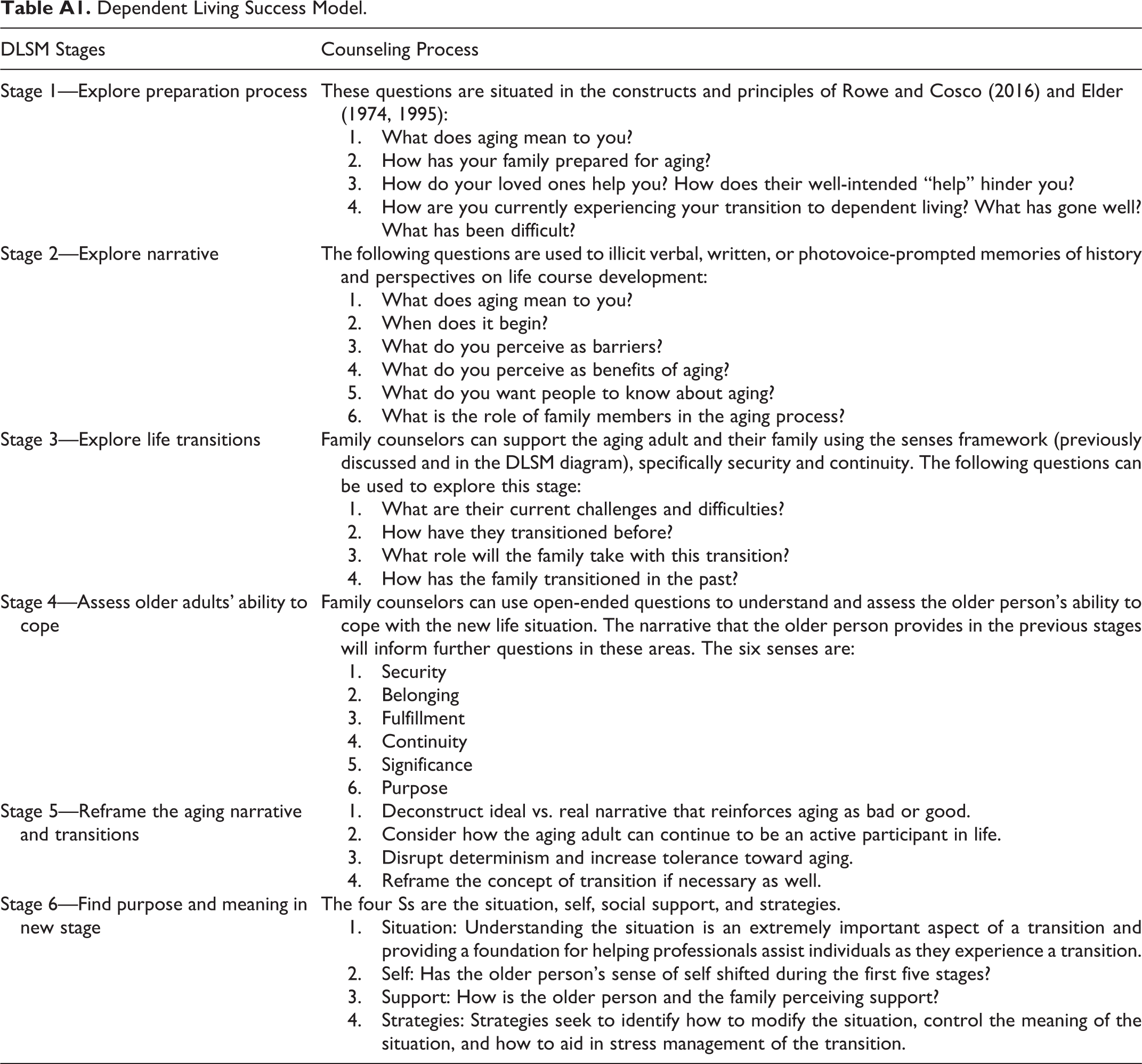
DLSM Stages
Counseling Process
Stage 1—Explore preparation process
These questions are situated in the constructs and principles of Rowe and Cosco (2016) and Elder (1974, 1995):
Stage 2—Explore narrative
The following questions are used to illicit verbal, written, or photovoice-prompted memories of history and perspectives on life course development:
Stage 3—Explore life transitions
Family counselors can support the aging adult and their family using the senses framework (previously discussed and in the DLSM diagram), specifically security and continuity. The following questions can be used to explore this stage:
Stage 4—Assess older adults’ ability to cope
Family counselors can use open-ended questions to understand and assess the older person’s ability to cope with the new life situation. The narrative that the older person provides in the previous stages will inform further questions in these areas. The six senses are:
Stage 5—Reframe the aging narrative and transitions
Stage 6—Find purpose and meaning in new stage
The four Ss are the situation, self, social support, and strategies.
Declaration of Conflicting Interests
The author(s) declared no potential conflicts of interest with respect to the research, authorship, and/or publication of this article.
Funding
The author(s) received no financial support for the research, authorship, and/or publication of this article.